ISTANBUL BILGI UNIVERSITY INSTITUTE OF GRADUATE PROGRAMS
INTERNATIONAL FINANCE MASTER’S DEGREE PROGRAM
BANKRUPTCY ANALYSIS FOR 17 COMPANIES IN TURKISH STOCK MARKET FOR THE YEARS 2018 AND 2019
DUYGU TEZCAN 113664027
PROF.DR. MEHMET FUAT BEYAZIT
İSTANBUL 2019
i Table of Contents
List of Figures ... iii
List of Tables ... iii
Abstract ... v
Özet ... vi
1. INTRODUCTION ... 1
2. RISK MANAGEMENT IN BANKS ... 3
2.1. Types and Classification of Risk in Banking ... 4
2.2. Credit Risk ... 5
2.3. Basel-II ... 8
2.3.1. First Structural Building Block ... 11
2.3.2. Second Structural Building Block ... 11
2.3.3. Third Structural Block ... 12
3. THE CREDIT RISK ESTIMATION ... 14
3.1. Internal Models in Credit Risk Modelling ... 14
3.2. Economic Capital Allocation for Credit Risk ... 16
3.3. Estimating the Credit Loss ... 17
3.3.1. Default Mode Paradigm ... 18
3.3.2. Market Value Based Approach ... 21
3.3.2.1. Discounted Cash Flow Approach ... 22
3.3.2.2. Risk-Neutral Approach ... 22
3.3.2.3. Independent Credit Ratings ... 23
3.4. Types of Credit Ratings ... 24
3.4.1. Maturity ... 24
3.4.2. Types ... 24
3.4.3 Rating Agencies and Their Ratings ... 25
3.4.3.1. Ratings of Standard and Poor’s ... 27
3.5. Credit Risk Mitigation Techniques ... 29
3.5.1. Secured Transactions ... 30
3.5.2. In-balance Netting ... 31
3.5.3. Guarantees ... 31
3.6. Credit Derivatives ... 32
3.6.1. Types of credit derivatives ... 32
ii
4.1. Merton Model ... 34
4.2. Black-Cox Model ... 38
5. REDUCED-FORM CREDIT RISK MODEL ... 40
6. LITERATURE REVIEW... 44
7. DATA AND METHODOLOGY... 49
7.1. CAPM Application ... 49
7.2. Application of Merton Model ... 73
iii List of Figures
Figure 1: Types of Risks ... 4
Figure 2: Expected and Unexpected Loss ... 7
Figure 3: Basel Structural Block ... 11
List of Tables Table 1: The Difference Between Basel I and Basel II Accord ... 12
Tablo 2: Rating Transition Matrix ... 21
Table 3: Comparison of the Agencies’ Ratings ... 26
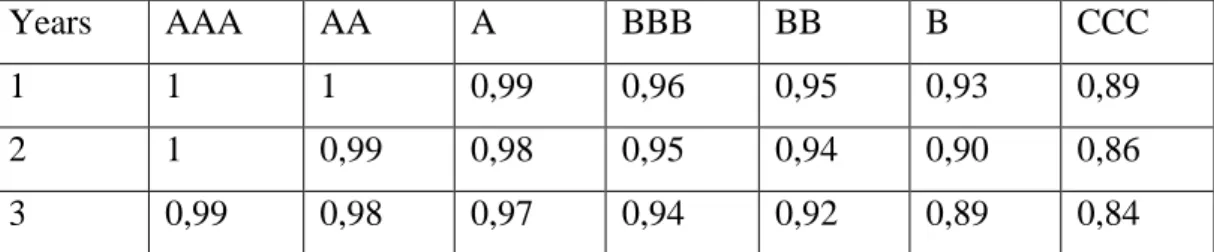
Tablo 4: Credit Risk Migration ... 41
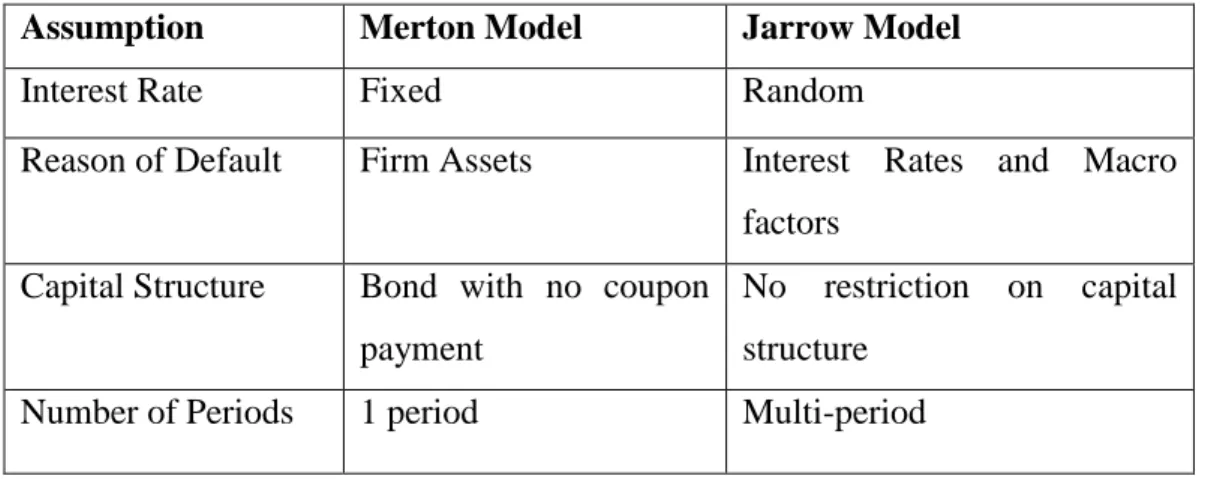
Table 5: Merton vs. Jarrow Model ... 42
Table 6: CAPM Application for Akbank ... 51
Table 7: CAPM Application for Aselsan ... 52
Table 8: CAPM Application for Dogan Holding ... 52
Table 9: CAPM Application for Garanti ... 53
Table 10: CAPM Application for Sabanci ... 53
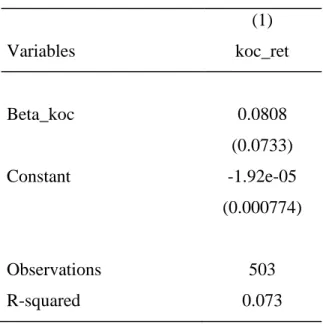
Table 11: CAPM Application for Koc Holding ... 54
Table 12: CAPM Application for Petkim ... 54
Table 13: CAPM Application for Zorlu Holding ... 55
Table 14: CAPM Application for TAV ... 55
Table 15: CAPM Application for Tekfen ... 56
Table 16: CAPM Application for THY ... 56
Table 17: CAPM Application for Tupras... 57
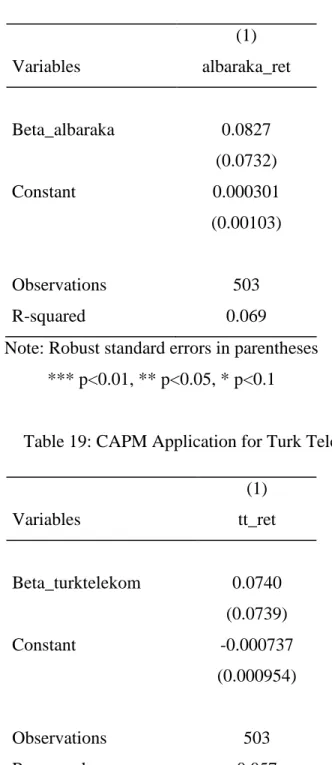
Table 18: CAPM Application for Albaraka ... 58
Table 19: CAPM Application for Turk Telekom ... 58
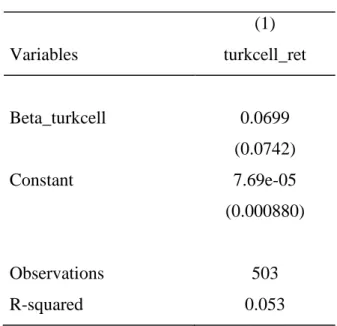
Table 20: CAPM Application for Turkcell ... 59
Table 21: CAPM Application for Halkbank ... 59
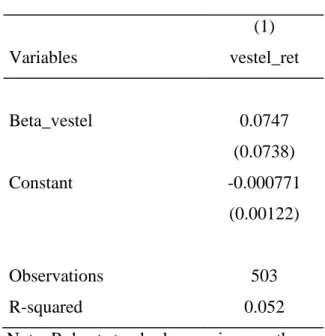
Tablo 22: CAPM Application for Vestel ... 60
Table 23: Variable Sources ... 61
Table 24: Data Used for calibration in 2017 ... 61
Tablo 25: Data Used for calibration in 2018 ... 62
Table 26: Akbank’s Probability of Default and Distance to Default ... 75
Table 27: Turkcell’s Probability of Default and Distance to Default ... 75
Table 28: Aselsan’s Probability of Default and Distance to Default ... 76
Table 29: Koc Holding’s Probability of Default and Distance to Default ... 76
Table 30: Petkim’s Probability of Default and Distance to Default ... 77
Table 31: THY’s Probability of Default and Distance to Default ... 77
Table 32: Vestel’s Probability of Default and Distance to Default ... 78
Table 33: Dogan Holdings’s Probability of Default and Distance to Default ... 78
Table 34: Tupras’s Probability of Default and Distance to Default... 79
iv
Table 36: Garanti’s Probability of Default and Distance to Default ... 80
Table 37: TAV Holding’s Probability of Default and Distance to Default ... 80
Table 38: Albaraka Turk’s Probability of Default and Distance to Default ... 81
Table 39: Tekfen’s Probability of Default and Distance to Default ... 81
Table 40: Turk Telekom’s Probability of Default and Distance to Default ... 82
Table 41: Sabanci’s Probability of Default and Distance to Default ... 82
v Abstract
In this study, it is aimed to explain the concept of credit risk in the framework of Basel II and to investigate credit risk of the banks and the real sector in Turkey. To do that, celebrated Merton model is employed for the period 2017-2018 and 17 companies listed in BIST are considered.
The findings shed lights on the deteoriorated financial outlook of the Turkish companies. In particular, Turkish banks has very high default probability compared to other big companies listed in BIST. It is thought that this finding provides preliminary warning for the emergent precautionary measures needed to be taken by the policy makers.
vi Özet
Bu çalışmada, Basel II çerçevesinde kredi riski kavramını açıklamak ve Türkiye'deki bankaların ve reel sektörün kredi riskini araştırmak amaçlanmaktadır. Bunu yapmak için, ünlü Merton modeli 2017-2018 dönemi için kullanılmıştır ve BIST'te listelenen 17 şirket dikkate alınmıştır.
Elde edilen bulgular, Türk şirketlerinin bozuk fınansal görünümüne ışık tutmaktadır. Özellikle, Türk bankaları BIST'te listelenen diğer büyük şirketlerle karşılaştırıldığında çok yüksek temerrüt olasılığına sahiptir. Bu çalışmanın bulguları, politika yapıcılar tarafından alınması gereken acil tedbirlere ilişkin bir uyarı olara yorumlanabileceği düşünülmektedir.
1 INTRODUCTION
Banks have a key role in the healthy functioning and development of the country's economy. A sound banking promotes a country’s economy and makes it go in the right direction. As the history of economic crises is confirm, most of crises have originated bank-related issue.
Because of the fact that banks are credit institutions, a significant portion of the risks arise from loans. The banks, by taking into account the nature of the financial intermediation, the basic activities of financial intermediation, have the funds used by the banks to demand funds from the financial markets and thus provide the services that reduce the uncertainty by taking over the credit risks that others do not want to undertake. Due to the fact that the lending process constitutes the main activity of the banks, they are always faced with credit risk throughout their operations, and this shows that credit risk is not only a source of existence for banks, but also the reason of extinction if it cannot be determined and managed well. In this respect, banks have faced many serious difficulties for many years due to their credit risk. As credit risk is not managed well enough, problem loans are increasing in banks and this situation causes them to remain in a difficult position by disrupting the asset quality of banks.
Generally, inadequate credit standards, weak credit portfolio risk management or the deterioration in the credit quality of bank customers and other changes in conditions such as good conditions, whether or not measured, such as problems in banks lead to an increase in non-performing loans. For this reason, banks that are of great importance to the national economy in many respects can manage their activities in a healthy manner and to minimize the risks that may arise due to credit risk. It is of great importance to be prepared. The need for this process, which can be expressed as credit risk management, is increasing day by day due to the new generation modern methods developed for this purpose.
2
One of the most important risks of commercial banks is credit risk. It is impossible for banks to undertake banking activities without undertaking the risk of credit and managing credit risk. For the effective management of risks in commercial banking; risks should be defined, risks should be measured, necessary applications should be started and follow-up stages should be carried out.
Different models are used in analyzing and measuring the credit risk. These models can be studied in a very broad framework from relatively qualitative to highly quantitative ones. Many of these models, which do not exclude each other, are used in the pricing of commercial banks' loans or in determining the loan amount.
There have been significant developments over the last two decades in the models of credit risk measurement. Changes in the economic system have made credit risk management important. Commercial banks are able to take into account the risks of the credits they use and monitor all credit portfolios. Although many credit risk measurement models use different methods, all models attempt to calculate the probability of loans that have defaulted or changed quality.
After a brief introduction in the first part, in the second part, risk management in banking sector is discussed. In the third part, credit risk estimation technique is introduced in detail. In the fourth and fifth chapter, structural model as well as reduced model are introduced. Literature review is provided in the sixth chapter. In the seventh chapter, data used in the study are introduced and CAPM and Merton model application is conducted. In the final chapter concludes.
3 2. RISK MANAGEMENT IN BANKS
In terms of financial institutions, generally speaking, risk is the possibility of encountering unwanted situations. Within the framework of finance theory, risk is defined as the difference between the return of the financial transactions and the present value of the cash flows related to these transactions. Risk refers technically to the distribution of probability values for returns on average value. Anything that affects the probability distribution in this sense will affect the investment risk both positively and negatively. Mathematically, the risk is a function of the variance of the distribution of expected returns. In the context of all these definitions, the risk can be explained as the positive or negative difference between the expected value and the realized value in the financial literature (IMKB, 1999).
The concept of risk and uncertainty is used interchangeably.Iit is the interconnection of these two concepts. Uncertainty, ignorance and the surprises of the future, and the risk include danger and vulnerability. In this context, a distinctive definition can be made. The risk is the probability of loss to a known or expected hazard clearance. If the presence and extent of the hazard is not fully known, the risk of uncertainty carries uncertainty if the vulnerability and vulnerability are not fully known.
While financial uncertainty is the distribution of the possible results to be achieved, the risk occurrence is the difference between the most likely outcome (expected) and the actual (actualized) result, and the greater the distribution, the greater the uncertainty. In other words, uncertainty is the inability to predict or detect probability values for the expected results. Therefore, there is no possibility to make a numerical analysis about the possible results. 5 The uncertainty, which is used as a synonym in financial terms in general, has a more general meaning than risk. In fact, financial markets are not feared risk, but uncertainty. This is due
4
to the fact that financial market risks can be measured and managed and it is not possible to say the same for uncertainty (Weston and Brigham, 1975).
2.1. Types and Classification of Risk in Banking
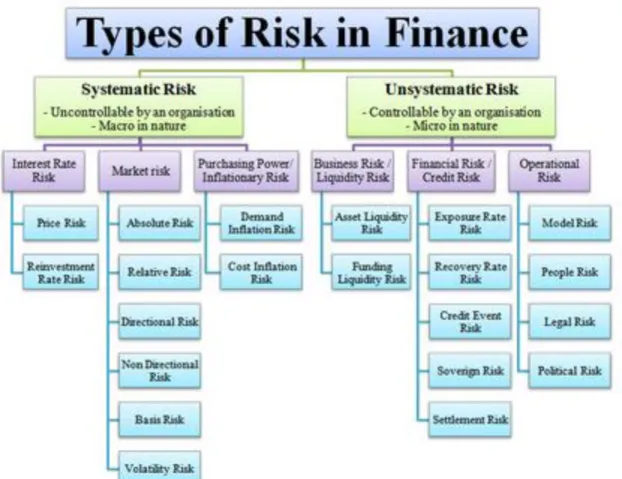
Types of risk in finance can be exhibited as in Figure-1. However, for the sake of generalization, only credit, market, and exchange rate risks are discussed in this study.
Figure 1: Types of Risks
5 2.2. Credit Risk
Credit risk does not comply with the terms of the loan agreement, the possibility of failing to fulfill the obligations, interest and principal payments constitute the credit risk. Almost every credit transaction carries the possibility of non-repayment, delay, default (Akguc, 2007, 8).
Credit risk is the probability that a bank's loan client or a party to it cannot meet its obligations in accordance with the terms of the agreement. Credit risk is not only a risk arising from the credit accounts of banks, but also the loan accounts in which the loan loans are monitored; The Bank's securities portfolio consists of deposits with reverse balance, accounts held by other financial institutions, letters of guarantee and other guarantees, commitments and derivative contracts.
Without the credit risk, it is impossible to engage in banking activities; The only banking transaction that can theoretically be done without credit risk or with a credit risk close to the border is the lending of the collected resources to the national currency, the state treasury or the central bank. The risk that a transaction cannot fulfill the obligation of the counterparty before it is due, is the credit risk arising from the market risk; this risk arises when the loss in market prices moves in the opposite direction to the original contract price. The credit risk arising from the market risk is the risk that one of the parties fails to meet the terms of the contract before the due date and the other party has to perform the same transaction at new market prices in order to meet their financial liabilities. In this case, the loss occurs when the market prices are above the price in the first contract (Laurent and Schmit, 2007).
The purpose of credit risk measurement is to manage the loans with a portfolio approach, to make the pricing in a way to include risks and to create a guarantee against unexpected losses. Basic components of portfolio credit risk models are:
6 Default (expected loss, unexpected loss), Recovery,
Rating-migration,
Risk-adjusted performance measurement and Risk-based capital.
Default: The default refers to the situation in which the bank considers that the debtor's debts to the bank group will not be fully paid without resorting to pledge money, or if the debtor has delayed more than 90 days to fulfill any of his obligations.
Expected Loss: It is an expected loss in a portfolio subject to credit risk (Rich ve Tange, 2003)
EL=PDxLGDxDA (1) where:
PD is probability of default, LGD is loss given default, and DA is the default amount
Unexpected Loss: Unexpected loss is a loss that may occur due to the distribution around the average of uncertainty and the expected loss value that can occur beyond the expected losses (Navarrete, 2007).
7 Figure 2: Expected and Unexpected Loss
Source: Dan (2015)
Recovery: The rate of recovery or recovery is the amount that the bank can collect or recover if the loan is not paid by the debtor (Altman, Resti and Sironi, 2003). Rating migration: Each rating grade shift occurs as a result of independent competitive risks under the conditions of estimating the proportional risks of explanatory variables that may be observed. The probability transition models based on the traffic transition matrices are defined as rating migration models (Kavcioglu, 2011).
Risk-adjusted performance measurement: Traditionally, there are two ratios used in banking performance measurement. The first one is the Net Profit / Total
8
Assets ratio, called the return on assets (ROA), and the second is the Net Profit / Equity ratio. Different versions have been developed over time to make these rates sensitive to risk (Altıntaş, 2018):
Return on risk-adjusted assets: The risk is calculated using the risk factor and adjusted to the adjusted asset. For example, Net Profit / Risk Weighted Assets.
Risk-adjusted return on assets: The return is corrected with a risk factor. For example, (Loan Portfolio Return - Expected Loss) / Credits Portfolio. Return on risk-adjusted capital: It is the ratio of return to capital is
adjusted by risk factor. For instance, Net Income / Economic Capital. Risk-adjusted return on capital: where the fulfillment of shareholders'
equity is a risk factor. For example, (Net Profit-Capital Cost) / Capital. Risk-adjusted return on risk adjusted capital: In this method, both the
return and capital risk factors are corrected. Loan Portfolio Return-Expected Loss / Economic Capital is one example
Risk-based capital: It is related to the fact that banks do not have enough capital to cover their losses as a result of market risks (Bessis, 2010). It is recommended by the Basel Committees that banks hold at least 12.5 times more equity than the total risk they hold (Basel Committee on Banking Supervision, 2006). In this sense, this risk can also be classified as a general risk, except for market risk. 2.3. Basel-II
The new Basel Capital Accord (Basel-II) provides the norm for measuring and assessing the capital adequacy of banks recently introduced in many countries. The Basel Banking Audit Committee, which consists of central banks and bank regulators of developed countries operating in Basel, Switzerland, has not been binding on the whole world, but the the world has been accepted and implemented in the banking sector.
9
The establishment of the Basel Committee rests on the fluctuation of the oil crisis in international markets leading to the excessive increase in oil prices. After this crisis, the quality of auditing and inspection in the banking sector has gained importance and questioned. In 1988, the Basel Committee published the Basel I Capital Adequacy Accord, which aims only to take a standard in capital adequacy calculation methods that take account of credit risk and apply in different countries.
This regulation was inadequate in terms of changing conditions, developing banking sector and increased risk types and new capital standards were needed. Therefore, it was seen that the market risks of the financial structures of banks have a significant effect and in the course of the developments in the sector, Basel I has been in the process of changing and developing since 1996.
The most basic criticism for Basel I is the fact that banks ignored other risks they face as a result of focusing on credit risk. Differing from the differences of banks due to the different features, all types of banks foreseen uniform applications. Another criticism to be managed by Basel I is; As a result of the developments in the markets of securitization and derivative products, the roles and positions undertaken by the banks in these markets and their increased risks could not be adequately evaluated. In general terms, it can be said that the Basel I Accord is not sufficient against the increasing risk and needs in the banking sector. Then, in addition to credit and market risks, operational risks were also included in the scope of the agreement.
The first draft text was published in 1999 and updated with ongoing studies since its publication in June 2004, which was published as ’Basel II New Capital Accord’ and entered into force in 2007.
10 Basel II criteria in general terms (Yüksel, 2011):
Ensuring that banks are exposed to the minimum capital adequacy by providing them with a better analysis and measurement of the risks they may face,
Understand the importance of national supervisors and strengthen their practices,
Ensuring transparency by determining public disclosure requirements, The aim was to ensure market discipline.
Basel II regulation consists of three structural blocks:
The first structural block allows quantitative assessment and sets out minimum capital requirements that are more sensitive to risk.
The second structural block covers the process of examining the supervisory authority with qualitative assessment.
The third structural block relates to the provision of market discipline through public disclosure.
As is shown in Figure-3, Basel has three structural block and in this part of the study, these three structural block are discussed.
11 Figure 3: Basel Structural Block
2.3.1. First Structural Building Block
In BASEL II, as in BASEL I, the minimum capital adequacy ratio is 8%. Although the credit risk is further elaborated in this consensus, the concept of operational risk was added for the first time. There is no change in market risk. In addition, the contribution capital should not exceed 100% of the capital.
Minimum Capital Requirements= Total Capital
Credit Risk+Market Risk+Operational Risk= 8%
2.3.2. Second Structural Building Block
Within the scope of the Basel II Accord, risks such as interest rate risk, business and strategic risks in banking calculations that are not included in the first structural block are included in the second structural block. In addition, external structural factors for banks are included in the second structural block. Issues such as public auditing of all these risks, basic principles such as transparency and accountability, and risk management guidance are within the scope of the second
First Structural Block
The Minimum Capital Requirements
Second Structural Block
Supervisory Review
Third Structural Block
Market Discipline
12
structural block. The Committee has adopted four basic principles in addition to the Basic Principles of Effective Banking Supervision that it has developed as a guide for supervisors (Takan and Boyacıoğlu,2011).
These four principles are:
Capital Adequacy Assessment System Evaluation Process of Audit Authority Sanctions of the Supervisory Authority
Early Intervention Capability of the Supervisor
2.3.3. Third Structural Block
The provision of market discipline, which is the third structural block, is possible if the banks operating in the banking sector explain their knowledge about capital and risk levels in detail. The bank's disclosure of information helps both the bank's counterparties to make healthier decisions with the bank and to ensure that banks are disciplined in order to prevent them from taking excessive levels of risk by the principle of transparency. In the third structural block, the reports should be disclosed to the public in different periods according to the nature of the reports. For instance (Stephanou and Mendoza: 2005):
Banks operating on an international basis, quarterly, on capital and total capital adequacy ratios and components,
Information that is made for informational purposes,
Information about the Bank's risk management and reporting systems is conducted annually.
Table 1: The Difference Between Basel I and Basel II Accord Basel I Accord Basel II Accord Banks Standard Applications to
all Banks
Applying effective techniques for risk
13
management,
Credit and operational risk approaches,
Increased importance of data quality Regulatory Authorities Better information need Different authorities for different financial institutions
Increased strength in motivation and punishment, More and timely access to
information
Rating Agencies Due to limited number of agencies, there is a oligopolistic structure
Growth opportunity created by the rating requests of the participants in the money and capital market,
Many new organizations entering the sector
Capital Markets Tendency towards credit derivatives and securitization
Securitization and the growth of derivatives markets, Growth of debt market
Customers High external source requirement
Need for credit rating to obtain source
The profitability is transparent
14 3. THE CREDIT RISK ESTIMATION
Considering the credit risk management parameters and capital requirements stipulated by Basel II, it is a well-known fact that banks should establish a credit risk management policy within their own structure in accordance with current regulations.
The credit risk measurement of Basel II, which is now considered as a reference in the credit risk management and adopted by the economies of developed countries, is based on the following two basic approaches as mentioned before; • Standard approaches
• Internal rating approaches.
Standard approaches include credit risk weights, treasury and central banks, financial institutions and other corporate credit customers of countries with rating ratings, credit ratings from customers with no ratings, and risk weights for certain assets as similar to Basel I. Internal rating approaches require banks to make their credit risk assessments through rating systems that are going to form their own standards but are detailed in Basel II. The internal rating approach is based on the calculation of expected loss and unexpected loss amounts related to the loan portfolio. The capital requirement is for unexpected losses. Expected losses must be deducted from the capital (Altıntaş, 2006).
3.1. Internal Models in Credit Risk Modelling
Allowing the use of internal models to estimate market risk, BIS does not exhibit the same attitude for internal credit risk models. Below this negative approach, there are some important hesitations about the methodological dimension of internal credit risk measurements (Kafetzaki-Boulamatsis, 2001).
The most important requirement for the adoption of credit risk models as applicable by the regulatory authorities is that a significant improvement in the
15
internal risk management processes has been achieved. However, the fact that models can be used to determine minimum capital requirements can be achieved by solving methodological risks and uncertainties such as lack of data and validity of the model.
The biggest obstacle to identifying the factors and variables that influence the changes in credit quality is the lack of past performance data for the relevant loans. Moreover, the fact that the time horizon is taken as the basis for the measurement of risk makes the problem experienced in this subject more pronounced. For this reason, model parameters can often be analyzed in the light of simplistic assumptions and information from various sources. It is inevitable that the effects of the preferences on this subject is tested with the help of sensitivity analyzes.
In order for regulatory authorities to decide on the availability of models, these internal models are required to adequately reflect the risks they undertake due to the credit portfolios of banks. Accordingly, the expected loss probabilities used in credit risk measurement and economic capital estimates are expected to contain a reasonable level of certainty. However, it is not possible to talk about a common practice similar to the retrospective validity tests used for market risk estimation models. Therefore, it is recommended that supervisory units rely on internal and external validation procedures or on the basis of the standards they will establish based on qualitative and quantitative criteria when developing a conviction about how good the modeling processes are. It is recommended that the model results be tested against other banks and / or similar portfolios. Supervisors may need to bring in some sanctions to prevent abuses, as well as incentives to support the use of internal models (Hirtle, 2001).
Before proceeding to the structural and reduced credit risk model, it is worthwhile discussing the theoretical structure of the credit risk modelling.
16
3.2. Economic Capital Allocation for Credit Risk
The economic capital of the two banks whose credit portfolios are similar might be different for each other. The reason for this is the consideration of the probability density function (PDF) of the targeted PDs and loan losses when calculating the capital amount. In this context, an analytical framework is needed to estimate the amount of capital required for credit risk exposure, which can be related to the bank's targeted PD (Jones and Mingo, 1998).
The expected loss corresponds to the average loss expected by the bank due to the loan portfolio within the prescribed period. Banks explain the risk of any loan portfolio with the concept of unexpected loss, which is defined as the loss amount that occurs above the expected loss. The area of the distribution curve beyond the target default ratio is considered to be the significance or significance level of the analysis. The shape determined or predicted for the curve will determine the strength of the positive relationship between LGD and PD. The strength of this relationship will affect the amount of losses to be associated with the credit portfolio (Chabaane et al., 2007).
The minimum capital requirement of a bank based on credit risk is considered as a function of possible losses due to the credit risk to which it is exposed. Based on the idea that banks are prepared and cautious for the losses that occur in parallel with the expectations, it is stated that the main determinant parameter on the minimum capital amount required is the unexpected losses expressing the deviation from the expected losses (Nickell et al., 2005).
In other words, the amount of economic capital required may be considered as the amount of additional capital needed to achieve the target default rate after the expected losses are met. In particular, a credit risk model should guide all policies, procedures and practices used to determine the default probability function of the current loan portfolio. should not be forgotten.
17
In the process of calculating the economic capital and provisions by using internal credit risk models, and macro-based approaches can be used. In the micro-based approach, while creating a separate risk model for each loan group or type, the credit portfolio is generally considered as a whole in macro-based applications. The most important reason for choosing risk measurements on the basis of portfolio is the opinion that the binary analysis based on bad - good credit classification is in some cases insufficient. Moreover, the revised frequency of economic capital allocation decisions varies on a bank basis (Wilson, 1998). 3.3. Estimating the Credit Loss
Credit loss for a portfolio is defined as the difference between the current value of the portfolio and the value that is reached after a certain period of time. The estimation of the default probability function of the credit portfolio requires the determination of the probability distribution of the current value of the portfolio and the value to be reached at the end of the planned period. It is imperative that a suitable definition of credit loss is made before the current and future value estimates are made. At this point, banks may prefer any of two different conceptual approaches: Default Mode Paradigm and Market Value Based Approach (Mark to Market Paradigm).
There are also two alternative approaches to the decision to be taken when dealing with the credit risk. The first of these approaches is the method known as the liquidation period and where each credit instrument is matched with its specific maturity. There are assumptions that each instrument are held to maturity and there is a limited number of markets in which the instrument can be traded. In the other approach, the same time horizon is applied for all asset classes. For the common time period to be applied, one or more rarely five-year periods may be preferred. It is foreseen that new capital formation is ensured within the period taken, measures to reduce losses, new information is generated, default rate data can be obtained, budgets and reports are prepared and credit renewal transactions are realized.
18
Credit Losses are discussed by two different approaches: Default Mode Paradigm
Market Value Based Approach
3.3.1. Default Mode Paradigm
In this approach, the loss of credit occurs if the user of the loan exhibits non-repayment behavior within the prescribed period. The credit loss to be incurred in the event that the loan user enters into the payment facility is as much as the difference between the total amount of the loan extended until the time of default and the present value of the amounts that can be collected in the future (Altıntaş, 2007).
In the approach, the current and future value concepts, which are expressed in relation to the credit instrument, are explained based on the dual situation in accordance with the definition of default (default or not). While the current value of a credit receivable is defined as the amount that is exposed to credit risk, the uncertain future value of the receivable is closely related to whether the credit debtor falls within the prescribed period. In this context, the future value of a loan is considered to be equal to the gross amount of the loan amount to be included in the bank records in the period to be taken into consideration in case the loan debtor does not enter into payment incurred. On the other hand, in case of insolvency, the future value of the loan will be reached as a result of multiplication of the loan amount (1-LGD). The lower loss rate indicates more collectability. As can be seen, the current value of the credit instrument at the time of estimation of the loss probability function is known, while the future value is uncertain.
In credit risk models based on default, a clear assumption or assumption should be made of the combined probability distribution of each credit item. Distribution estimates should be based on the main risk components (PD, LGD and EAD). In
19
order to make a distribution estimation related to the loss probabilities discussed as a whole, it is necessary to establish EAD, PD and LGD distribution profiles of all credit components constituting the portfolio exposed to credit risk.
In order to make the distribution predictions of the basic risk components, it is necessary to perform the loss analysis based on the mean - standard deviation approach. The standard deviation values are considered as the unexpected loss value of the portfolio. In some of the systems that serve to allocate economic capital to manage credit risk, preliminary assumptions can be made regarding the shape of the distribution of the probability of loss probability. The process is shortened by considering that the distribution is similar to the standard distribution functions such as beta, normal or F distribution. In cases where there is no distribution assumption, the use of nonparametric estimation techniques, such as simulation, becomes necessary.
Practitioners call the research method based on the mean - standard deviation approach as the Unexpected Loss Approach. In this approach, the determination of economic capital is made by multiplying the standard deviation value calculated for the credit losses related to the portfolio with a certain coefficient. In order to calculate the expected and unexpected credit losses, the expected credit loss amount of each credit instrument in the portfolio is determined. All calculations for portfolio values are carried out in a manner similar to that described in Markowitz's Modern Portfolio Theory.
μ = ∑EADi*PDi*LGDi (2)
Standard deviation of the portfolio is
σ= ∑ σiρi (3)
In the above equation; σi shows the loss standard deviation of the portfolio component, and ρi shows the correlation of the credit losses of the portfolio component with the credit losses calculated for the overall portfolio. The
20
correlation coefficient (ρi) reveals the portfolio effect created by the credit component together with other components. The high correlation of the credit component with the portfolio values will also make the expected standard deviation of the portfolio higher. Therefore, it is recommended that banks should not add to the portfolio of credit components, which have negative correlation or low positive correlation, and should not destroy the diversification effect by concentrating on a few credit components (Wilson, 1998).
Estimating standard deviation of the each credit loss is given by:
σi =EADi*(PDi(1- PDi)*LGDi2+ PDiVOLi2)1/2 (4)
VOL represents the LGD’s standard deviation.
As can be seen, the PD value attributed to the customer is a critical input parameter for analysis. In almost all credit risk modeling systems, including the default-based approach, while realistic PD estimates are made for customers, internal credit rating activities carried out by the bank's credit assessment personnel stand out. The probability of default for any customer will be decisive for all credit transactions with that customer.
The process for determining the customer's credibility level and hence the PD is at least one of the following components (Hull, 2012):
a) Traditional and subjective classification scales in which the characteristics of the customer as well as the credit are tried to identified
b) Commercial credit scoring models prepared by a specialist institution c) Internal credit risk estimation models
Banks are more likely to use internal credit risk models. However, it is also observed that the internal credit rating categories determined especially for corporate loans are made compatible with the results published by expert rating companies such as S&P and Moody’s. The likelihood of a customer moving to a
21
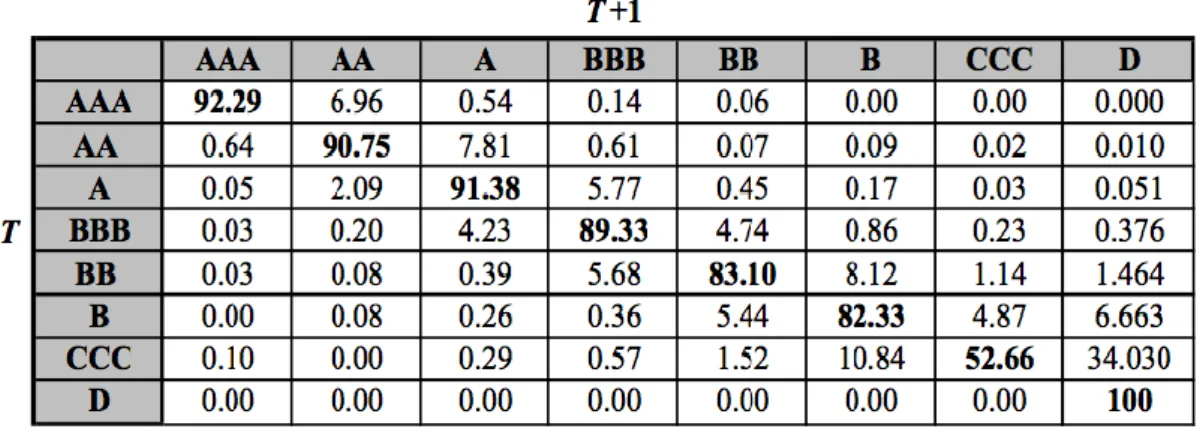
category other than the current credit category can be determined using the Credit Transition Matrix. Tables can also be prepared for summary categories, which are calculated in terms of average default probabilities. To be interpret, moving from credit rating of AAA to AA from T to T+1 is nearly 7%.
Tablo 2: Rating Transition Matrix
Source: Schuermann (2007:2)
3.3.2. Market Value Based Approach
Unlike the default-based approach, in this approach, it is assumed that the loan loss may occur as a result of any decrease in the credit quality of the asset except for the default event. The credit rating on the loan portfolio is based on changes in market value and any difference between the values at the beginning and end of the period is considered as credit loss. It is thought that some events other than default may affect the financial position of the bank by creating a change in the value of the credit asset. Therefore, transitions from higher credit ratings to lower grades are perceived as potential loss causes. Monte Carlo Simulation techniques are used in the calculation of probability values in transition matrices.
22 3.3.2.1. Discounted Cash Flow Approach
In this approach, the present value of a credit receivable which has not yet become a default is considered to be the present value of the cash flows expected to be realized in the future depending on the contract. The timeframe to be used in the reduction of the cash flows of a credit receivable with a certain internal credit rating is similar to that of a bond with the same credit rating in the market. While the current value of the loan is known, the future value will be determined according to the degree of risk that occurs at the end of the period and the distribution of payments over the period. Therefore, the value of a credit receivable may change as a result of changes in the customer credibility and maturity structure over time (Saunders and Allen, 2012).
One of the levels at which the transition between credits may occur is the worst scenario in which the default is experienced. Therefore, it is meaningless to find credit value by reducing contractual cash flows. Therefore, in calculating the future value of the loan, it is more accurate to deduct the amount of loss to be calculated from the total reduced value calculated.
3.3.2.2. Risk-Neutral Approach
In order to overcome the disadvantages of the Discounted Cash Flow Approach, this valuation approach is presented to present a structural model of the firm value and bankruptcy. A default event can be mentioned if the total asset value of the company is below the amount required to pay the total debts. Instead of contractual payments, conditional reductions are preferred. The reason for this is that the contractual payment may be collected by the issuer of the loan in the event that the party receiving the loan fails to pay. In case of the occurrence of the default event, the bank is able to collect only 1 - LGD of the loan amount. LGD amount is refunded. Such a credit relationship is similar to the fact that the lending party has derivative contracts on the customer's right to buy. The sum of
23
the present value of the default derivative contracts is considered as the future value of the loan extended. The discount rate to be used in the reduction of cash flows caused by derivative contracts should be risk free interest rate (Delianedis and Geske, 2003).
The risk-neutral pricing criterion can be seen as a correction for the possibility of defaulting the creditors to bring together systematic and non-systematic (borrower-specific) risk factors. The level of adjustment to be made depends on the expected return and the asset value change of the loan party. At this point, CAPM compatible asset return and risk models are developed. The target price criterion is obtained by adding the average rate of return of the market portfolio to the risk-free rate of return (risk premium) obtained by multiplying the return on assets by a coefficient representing the sensitivity to the market yield.
3.3.2.3. Independent Credit Ratings
While determining the minimum capital requirement of banks that have chosen to apply the method, an evaluation is made on the ratings given by independent external audit companies on the risk weights they will apply to their assets.
In its simplest definition, the rating is a tool that measures the timely and complete fulfillment of the willingness and ability of the debtor to pay the principal and interest obligations. In other words, it is the measurement process for determining the credit history of an economic unit and its repayment capacity (Küçükkocaoğlu, 2018).
The definition of credit rating made by the CMB in our country is as follows. Credit rating is an independent, impartial and fair evaluation and classification of capital markets instruments representing the risk status and payability of enterprises or the indebtedness of their capital, interest and similar liabilities by rating agencies as independent, impartial and fair.
24
The concept of credit grading is an instrument that was introduced in the 19th century in order to provide the official development of the relations between those who demanded debt in the United States and those who funded them. The credit rating enabled the development of the domestic markets and the rapid growth of capital markets in the international arena. It is seen that the rating process is made to securities, commercial companies, financial institutions and banks. Moody Investment Services Company, founded by John Moody, is the first rating company in the world. Moddy was followed in 1916 by Poor bus Publishing Company. In 1922, the Standard Statistics Company was established and then this company was merged with the Poor birleşs Publishing Company and named Standard & Poor şirkets. The third company that started its operations in 1924 in this field is Fitch Publishing Company of New York (Babuscu and Hazar, 2008). 3.4. Types of Credit Ratings
Types of the credit ratings can be classified based on their maturity and types. 3.4.1. Maturity
It is a long-term opinion on the institutional quality of the issuer based on the basic economic and financial characteristics of the sector. While reaching this opinion, the economic conjuncture sensitivity and various risks are taken into consideration such as competition, legal regulations, technological developments, demand changes and management quality.
Liquidity and capital resources on all liabilities up to a year is taken into consideration considering the ability to reach the source.
3.4.2. Types
The rating in international currency rating is evaluated by the ability of the institution to pay foreign currency liabilities by creating foreign currency. All country risks are taken into account.
25
International local currency rating evaluates the ability of the institution to pay local currency liabilities by creating local currency according to international criteria.
National local currency rating assesses the ability of the institution to pay local currency by creating local currency according to national criteria. Country risks are not taken into account.
3.4.3 Rating Agencies and Their Ratings
The three most important and established companies in the rating industry are Moody ands İnvestors Service, Standart and Poor Moods Corporation and FitchIBCA. After giving brief information about these companies, long and short term rating symbols of companies will be given. Since the rating symbols used in the study are the rating symbols of the Standard And Poors And company used by the BIS and the supervisory authorities, the meaning of the rating symbols of this company is examined in detail. The ratings of Standard and Poors and Moodys and Fitch can be seen in Table 2.
26 Table 3: Comparison of the Agencies’ Ratings
Source: Moneyland (2018)
Moody’s Investors Service, founded in 1900, first graded over 1,500 bonds of 250 large American Railway companies in 1909 using ratings symbols from Aaa to C. In 1913, the company expanded its field of activity and also rated indigenous companies and public institutions. Moodytırs was acquired by Dun & Bradstreet in 1962. In the 1970s, the Bank entered the European bond market and in 1972, for the first time in the 1980s, they ranked their asset-based securities, mortgage-backed securities and insurance companies for the first time. In 2000, the company was separated from Dun&Bradstreet and continued to operate in a completely independent manner (Moody’s, 2009).
FitchIBCA is another important rating company. The owner of the company is FIMALAC, a French company. Fitch Publishing Company, originally a publishing company, was acquired in 1989 by the group of independent investors.
27
Fitch merged with a British company, IBCA, in 1997, and later acquired Duff & Phelps in 2000.
Other than these, Canada-based Canadian Bond Rating Service, founded in 1972, founded in 1974, USA-based Thompson Bank Watch, founded in 1975, Japanese Bond Rating Institute of Japanese origin, established in 1977, Canadian Dominion Bond Rating Service and Japanese companies established in 1985 Japanese Credit Rating Agency and Nippon Invertor Service are the major rating companies worldwide.
3.4.3.1. Ratings of Standard and Poor’s
The foundations of the Standard and Poor company were laid in 1860, first to provide financial data for Europeans to respond to their interests in the developing infrastructure sector in the United States. In 1916, the company started to rank the company's debt with public debt. Currently, McGraw-Hill Inc. Company's subsidiary (S&P, 2009).
Definitions of Long-Term Credit Ratings:
AAA Rating: The highest rating given. Represents an extraordinary qualification in the payment of the debt and the principal.
AA Rating: It refers to a great power in repayment of principal and interest. This category differs slightly with a top class (Langhor and Langhor, 2010).
A Rating: Although it is strong in the payment of principal and interest, it is more sensitive to the continuous effects of changes in external conditions and economic situation compared to a higher rating.
BBB Rating: In this category, the repayment of the principal and interest of the debt is sufficient, but this qualification may weaken due to changes in circumstances.
28
The categories after this category are more speculative in the payment of the principal and interest of the debt of BB, B, CCC, CC and C. BB represents the lowest and C represents the highest speculation class.
BB Rating: The risk of non-repayment of debts in this group is lower compared to other speculative-rated securities. However, adverse changes in the business or financial and economic conditions may weaken the power to repay the principal and interest on time.
B Rating: The probability of repayment of the principal and interest of the debt is high. However, as a result of economic and financial developments, the entity may have difficulty repaying debt.
CCC Rating: In this category where the risk of non-payment is very high, there is a possibility of repayment of the principal and interest of the debt due under appropriate conditions. On the other hand, the reimbursement in the unfavorable conditions is greatly challenging (Langhor and Langhor, 2010).
CC Rating: In this category, which is more speculative than a higher group, a negative change in economic conditions can cause serious problems in repayment of debt.
C Rating: In the category of non-repayment of debt, only one category is superior and the borrower in this group has gone bankrupt. However, they still continue to repay the loan. This note represents the highest of speculative degrees.
D Rating: In this group, the principal and interest of the due debt will not be reimbursed or the debt will not be paid even though the due date is not paid.
[+/-] The (+) and (-) signs are used to confirm the relative position of the grades from AA to CCC in the main categories. (+) an upper, (-) refers to a subclass category.
29 N.R. (Not Rated) - Not rated.
P (Probability) - Indicates that the rating is not accurate.
Pi (Public Information) - Rating indicates that the issuer is based solely on public financial data.
Definitions of Short-Term Credit Ratings:
The short-term rating includes loans with a maturity of less than 12 months and focused on the liquidity required to perform financial commitments on time (Boyacioglu, 2002):
A-1: It is the highest category of credit quality. It shows that the capacity to pay financial liabilities on time is very strong. Collateralized debts are also added to the (+) sign127.
A-2: The capacity to pay its obligations on time is sufficient. However, the collateral level of debts is lower than the category A-1.
A-3: While the repayment capacity of the debt is sufficient, it is more likely to be affected by adverse developments in conditions compared to a higher level.
B: It is speculative that the repayment of the debts due. C: It is quite doubtful that the debt can be repaid. D: Debts are not likely to repay.
3.5. Credit Risk Mitigation Techniques
Banks use various techniques to reduce their exposure to credit risks. Credit risk mitigation techniques must meet the minimum standards for legal certainty in order to be used in capital adequacy calculation (BRSA, 2006).
30
Credit reduction techniques generally include the following issues (BSRA, 2009). Secured Transactions
In-balance Netting
Strict Rules in Credit Agreements Warranties and Credit Derivatives.
3.5.1. Secured Transactions
A secured transaction means a transaction that banks are exposed to because of a used or potential loan and that the credit risk or potential credit risk is fully or partially secured by a counterparty, or by a third party's guarantee on behalf of the counterparty.
In Basel II Standard Method, risk reduction techniques are taken into consideration by using one of two different methods. These are Simple and Comprehensive Methods.
In a simple method, the risks are divided into two as collateralized and unsecured parts, while the collateralized parts are multiplied by the risk weights of the collaterals, while the unsecured parts are multiplied by the risk weight the borrower is subject to. In the comprehensive method, the risks and collaterals received against this risk are increased or decreased depending on the changeability of both amounts over time and the difference between the two amounts obtained is multiplied by the counterparty's risk weight. In this framework, the risks related to the counterparty are increased through appropriate deductions, the guarantees received are reduced through appropriate deductions and then the difference between the increased risk and the reduced collateral amount is multiplied by the counterparty's risk weight. In the comprehensive method, an additional deduction will also be applied if the risk and collateral is in separate currencies. The cuts to be applied can be applied at the rates recommended by the Committee, or they can be estimated by banks using
31
historical data or to obtain risk measurement models of the bank. Banks can implement any of these approaches in the banking portfolio and only comprehensive approach in the trading portfolio. Partial guarantees are accepted in both approaches. The mismatches between the credit and the maturity of the collateral are only allowed in the comprehensive approach (Yuksel, 2005).
3.5.2. In-balance Netting
In-balance netting is the clarification of the receivables and payables to be arisen from the work contracts to be realized in the current or future contracts within the rules set forth by the two parties under an agreement.
Netting transactions result in some legal risks while reducing credit risk. Because netting is still not legally regulated in many countries and there are some irregularities that may arise if the netting ends, there may be conflicts due to lack of regulation. For this reason, netting operations are performed on the condition that some elements are found. These elements (Babuccu, 2008):
• The agreement covers each relevant legal situation and the reporting bank has the authority to finalize the clarification,
• The maturity of deposits is at least as high as the relevant credit;
• The reporting bank is monitoring and controlling the related accounts on a net basis.
3.5.3. Guarantees
Warranties must bear the right to a direct claim against the provider of protection, and the scope of protection must explicitly refer to specific credit risks or to a pool of credit risks. The protection should be irrevocable, except when the buyer cannot pay the accrued debt in accordance with the credit protection contract. The contract must not contain any substance that increases the actual cost of protection as a result of credit quality deterioration in the credit risk that allows the
32
protection provider to unilaterally cancel the credit protection or subject to hedging (JCR, 2009).
Acceptable Guarantor, Warranters and Guarantors are as follows.
Treasury and central banks with a lower risk weight than the other party, local public institutions, banks and securities companies
A- or higher rated organizations. This includes the credit protection provided by the parent company, associate and subsidiaries with lower risk weight than the borrower.
3.6. Credit Derivatives
Credit derivatives, the value of the credit risk from the asset or asset portfolio, and this asset or asset portfolio without transfer of the credit risk is transferred to the other party by transferring the contract are the contracts. There are two parties in credit derivatives (Yaslidag, 2007).
• The party selling the risk; sells the risk of the loan to the risk buyer for a premium.
• Risk taker; it buys this risk without instrumentation, that is, without credit. The risk buyer undertakes to bear the economic negative consequences of the transaction.
3.6.1. Types of credit derivatives
• Total Return Swap Contracts: A secondary financial contract where the total return on an asset is exchanged for another cash flow during the contract period. • Credit Margin Derivatives: These are instruments that allow the risks arising from the changes in the credit margin to be separated from the market risk and interest rate risk and enable the investors to provide protection against the risks caused by the mobility in the margins by forming their investment strategies
33
according to the movements in the margins. The credit margin is the rate at which the investor can claim a credit risk of a particular asset, in addition to the risk-free rate of return or the return on another asset.
• Credit Risk Swaps (CDS): The purpose is to transfer credit risk between the parties and manage market risk in this way. Credit risk swap contracts reduce the risk of the investor by transferring the potential risk from one party to another without requiring the transfer of the related bond or other asset related to the debt between the parties. This agreement is similar to an insurance contract.
• Credit Default Swaps: This is the contract for the wage or premium against the seller of protection who wants to protect himself from the fact that the default default swap agreement overwrites the loan by the borrower.
In addition to these, securities linked to credit may make credit risk separate from other risks and subject to sale. Credit-linked securities, which are used to transfer credit risk with or without a derivative of a derivative, transfer the underlying asset or asset portfolio risks with synthetic securitization method. For example, credit-based bonds can be given.
34 4. STRUCTURAL MODELS
Along with the Basel II standards, credit risk (CR, credit risk) modeling has become an important component of risk management systems and continues to be one of the areas where financial institutions are highly emphasized. The purpose of the institutions in modeling the credit risk is to measure, combine and manage risk based on the geographical regions and product groups. The outputs of these models also play an important role in the risk management and performance measurement processes of banks, including performance-based provisioning, customer profitability analysis, and risk-based pricing.
Historically, there is a large number of studies dealing with the decision to default, or endogenous default models. Under structural models, a default event is thought to happen when firms’s assets reach a sufficiently low level in relation with its liabilities. These models require some strong assumptions on the dynamics of the firm’s debt/asset as well as its capital structured. The main pros of structural models are that they give an intuitive understanding.
4.1. Merton Model
Merton model is the initial point of the structural credit risk model. This model tries basically to address the question of how capable does the company to meet its obligation? To properly answer this question, Merton model evaluates credit risk of a company’s debt.
Historically, the first-class applications of credit risk models are the structural approach. This model group includes assumptions about the value of the firm's assets. The liability structure of the firm determines the insolvency status together with the firm's asset value variability. The original Merton model, like the Black & Scholes model, recognizes that interest rates are constant.
Although Merton models are among the statistical models, these models calculate the default based on the asset price and not on the firm ratios. The default process
35
of a firm is determined by the value of the firm's assets and the risk of default. In other words, these models take into account the change in the asset value of firms; the default of the firms is realized when the value of the assets of the firms falls below the value of their debts (Tudela and Young, 2003).
Under this assumption, credit risk is driven by dynamism in asset prices. The model assesses the carrying amounts of the liabilities by adding a number of systemic elements to the possibility of exceeding the market values of the assets. In these models, the market value of firm assets is not considered as observable values; market value can be determined using the book value of liabilities calculated using stock prices, fluctuations in these prices and option characteristics in stocks (Anbar, 2005).
Merton's model of risky borrowing begins with a number of assumptions, which allow the modeler to see the equity as an option on the entity's assets. For the model to be valid, various assumptions, such as in the Black-Scholes option model, should be loaded into the model (Set, 2007:22):
The only random variable in the model is the value of the company's assets.
The Company's assets are completely liquid. Interest rates are fixed.
There is only one period in the life of the company. The volatility of the company's assets is constant.
The Company's assets follows a stochastic process consistent with lognormal distribution.
Merton has made some additional assumptions to make it easier for companies to assess their debts:
The debt has only one payment (in the form of debt, plus interest income or discounted bonds).
36
Management determines the amount of debt and does not change the amount of debt until the company closes at the end of the period.
If the company's assets are less than their debts at the end of a single period, bankruptcy will take place.
The value of the firm's liability plus the equity value of the firm is equal to the market value of the firm's assets.
The value of the firm's debt is simply the difference between the value of the company's assets and the equity value.
In order to model credit risk, the Merton model assumes total value of asset follows geometric Brownian Motion:
dAt =rAtdt +σAtdWt
where r is the expected rate of return, σ is the volatility of asset, and Wt is the Brownian Motion. For the sake of simplicity, Merton model further assumes that market is frictionless in which liquidation value equals to firm value.
In this model, company’s face value of debt, coupon paying bond, is represented by D, the value of the firm is the total value of equity denoted by E, and the maturity of this debt is T. Basic and fundamental accounting identity is:
ET =max(AT −D,0)
If the total value of asset exceeds the total value of debt, total value of debt is paid and what re- mains from the total asset is distributed among shareholders. If value of debt is greater than the total value then it amounts to default. In the default case, bondholders have right to receive liquidation value.
As the Merton model assumes that company’s assets are traded in a complete market, risk free rate, r, can be used in lieu of expected return. This allows us to employ the Black-Scholes by which one can model the value of equity in the form of European Call option.
37 E = Aφ(d1)−De−r(T−t)φ(d2) (5) where d1= ln(AD)+(r+σ2/2)(T−t) σ√T−t (6) d2=d1−σ(T−t) (7)
and θ is the cumulative normal distribution function with mean 0 and standard deviation 1.
Under this setup, credit default at maturity, T, with risk-neutral probability, P, is: P(AT <D)=φ(−d2) (8) To value debt, Dt before maturity, it suffices to subtract European put option from a zero coupon
bond, Dt.
Dt =Ke−r(T−t)−Pt (9)
where Pt is the value of the put option and K is the strike price. As it is dealt with the risky bond as corporate debt, then credit spread, the yield difference between the bond issued by government and the one with lower credit rating, should be taken into account. Thus,
Dt =Ke−(r−s)(T−t) (10) where s is the credit spread. Finally, the closed from solution of the credit spread can be derived as follows:
38
The simplicity of the Merton model rests with applying the Black and Scholes formula of pricing the European options to value firm’s equity and debt. However, this comes at the cost of too simplistic assumptions about the asset value process, interest rate, and the capital structure (Laajimi, 2012).
Due to simplified assumptions of Merton Model, some other models are proposed. Black-Cox Model is one of them and is discussed in this study.
4.2. Black-Cox Model
The Merton model is classified as exogenous default model in that the default barrier in this model is equal to the nominal value of debt meaning that no default before maturity of the debt. This has raised critics on the Merton model. Black and Cox model (1976) addresses this shortcoming by introducing first passage model in which default can happen any time as long as asset value, At , reaches the default barrier from above.
Dynamics of the assets value is the same with the Merton model:
dAt =μAtdt + σAtdWt (12)
This model assumes a time-dependent default threshold. Let K be the default threshold and for
a given K, the optimal default time is given by: τ=inf{t ≥ 0:Vt ≤ K} τ=inf{ t ≥ 0: Wt={ ln 𝐴𝑡 𝐴0−𝑟−σ 2𝑡 σ } (13)
Solving stochastic differential equation gives us the following as default probability:
39 d1= ln( 𝐾 𝑒𝑟(𝑇−𝑡)𝑉𝑡)+(σ 2/2)(𝑇−𝑡) σ√𝑇−𝑡 (14) d2=d1−σ(T−t) (15)
In the literature, Leland (1994), Leland and Toft (1996), Brigo and Tarenghi (2004) along with other provide many extenstion to the Black and Cox model. However these are out of our scope. These two models the backbones of the structural models however they are not safe from critics.
Structural models that provide a useful research method for estimating and modeling credit risk provide a numerical point of view regarding key issues concerning credit risk pricing. A simple and direct criterion is provided for the probability estimates.
The most important feature of the structural models that are found to be negative is that they cause difficulties in the implementation of empirical tests for model validity. In the short term, the predictability level of the default event is low and the asset valuation process requires time. There is also an uncertainty about the correct pricing of corporate bonds. Estimates of price differences were significantly variable. On the other hand, it is considered that credit rating changes cannot be adequately reflected in the model results and the assumptions made regarding the capital structure of the company are considered to be overly simple. These negative characteristics may be the validity of the estimates to be realized through the structural models.