Laser-Patterning Stainless Steel with Nonlinear Laser Lithography for
Enhanced Tribological Properties
I. Gnilitskyi1, I. Pavlov2, F. Rotundo3, L. Orazi1, S. Ilday2, C. Martini3and F. ¨O. Ilday2,4 1Department of Sciences and Methods for Engineering, University of Modena and Reggio Emilia, IT-42020 Reggio Emilia, Italy
2Department of Physics, Bilkent University, TR-06800 Ankara, Turkey 3Industrial Engineering Department, University of Bologna, IT-40126 Bologna, Italy 4Department of Electrical and Electronics Engineering, Bilkent University, TR-06800 Ankara, Turkey
The production of nanostructures on different materials attracts much attention in different fields of manu-facturing as a result of increased availability, affordability and technical capability of laser-based methods [1, 2]. However, some shortcomings such as relatively low speed of processing, problems with material control, and lack of uniformity and/or repeatability over large areas continue to limit their practical adaptation.
Recently, a technique called Nonlinear Laser Lithography (NLL) was introduced, which allows fabrication of extremely uniform nanostructures, with excellent long-range repeatability and high speed and productivity [3]. NLL allows creation of highly regular LIPSS-type nanostructures by exploiting nonlinear feedback mechanisms arising from the interaction of femtosecond laser pulses with the target surface, as well as from the laser-initiated chemical reactions. NLL has been applied to a variety of materials, including non-planar, even flexible surfaces [3]. Key features, such as superior uniformity and ability to process non-flat surfaces are a direct consequence of the self-regulation provided by these feedback mechanisms.
Here, the tribological behavior of laser-textured stain steel (AISI 316L) is controlled by NLL treatment, the results of which are investigated by sliding tests, carried out both in lubricated (ball-on-disk contact geometry) and dry (block-on-ring) conditions. Based on these results, we can characterize the tribological behavior of laser-treated stainless steel surface as a function of the following variables: (i) orientation of the NLL (LIPSS-like) pattern with respect to the sliding direction (parallel/perpendicular lines/perpendicular lines with stripes), (ii) nature of the countermaterial (in dry sliding conditions), and (iii) in the absence or presence of lubrication.
Laser-Patterning Stainless Steel with Nonlinear Laser Lithography for
Enhanced Tribological Properties
I. Gnilitskyi1, I. Pavlov2, F. Rotundo3, L. Orazi1, S. Ilday2, C. Martini3 and F. Ö. Ilday2,4
1 Department of Sciences and Methods for Engineering, University of Modena and Reggio Emilia, Italy 2 Department of Physics, Bilkent University, Ankara, Turkey
3 Industrial Engineering Department, University of Bologna, Italy
4 Department of Electrical and Electronics Engineering, Bilkent University, Ankara, Turkey
In recent years, the production of nanostructures on different materials has attracted much attention in different fields of manufacturing as a result of increased availability, affordability and technical capability of laser-based methods [1, 2]. However, some shortcomings such as relatively low speed of processing, problems with material control, and lack of uniformity and/or repeatability over large areas continue to limit their practical adaptation. Recently, a technique called Nonlinear Laser Lithography (NLL) was introduced, which allows fabrication of extremely uniform nanostructures, with excellent long-range repeatability and high speed and productivity [3]. NLL could be applied to a variety of materials, including non-planar, even flexible surfaces. NLL is a method for creating LIPSS-type nanostructures by exploiting nonlinear feedback mechanisms arising from the interaction of femtosecond laser pulses with the target surface, as well as from the laser-initiated chemical reactions. Key features, such as superior uniformity and ability to process non-flat surfaces are a direct consequence of the self-regulation provided by these feedback mechanisms.
Here, the tribological behavior of laser textured stain steel (AISI 316L) is controlled by NLL treatment, the results of which are investigated by sliding tests, carried out both in lubricated (ball-on-disk contact geometry) and dry (block-on-ring) conditions. Based on these results, we can characterize the tribological behavior of laser-treated stainless steel surface as a function of the following variables: (i) orientation of the NLL (LIPSS-like) pattern with respect to the sliding direction (parallel/perpendicular lines/perpendicular lines with stripes), (ii) nature of the countermaterial (in dry sliding conditions), and (iii) in the absence or presence of lubrication.
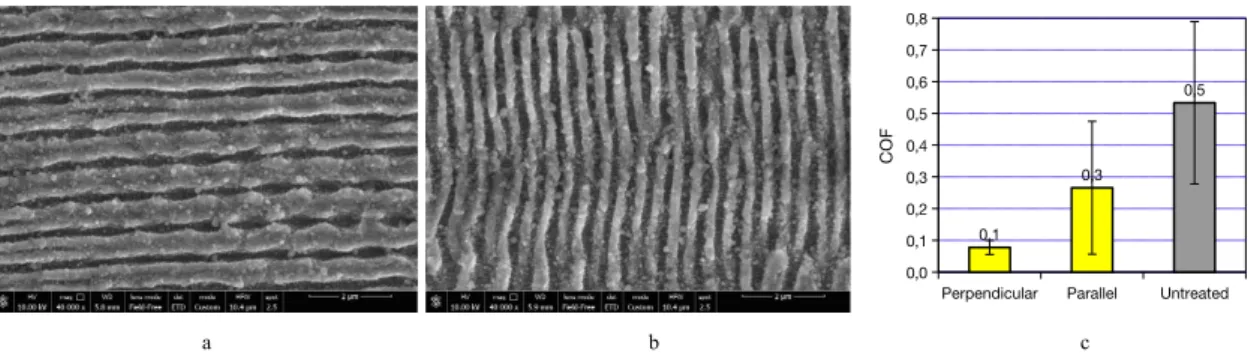
In conclusion, we report application of the NLL technique to control of tribological properties of stainless steel for the first time to our knowledge. Even though the local uniformity of structures is substantially lower than what can be achieved with NLL [3] due to use of unoptimized galvo scanning pattern, repeatability over different regions of the sample or from sample to sample is very good. The results shown that NLL is effective in reducing the maximum coefficient of friction both in lubricated and non-lubricated conditions in the range from 50 to 80%.
a b c
Fig. 1 NLL structures with perpendicular (a) and parallel (b) direction relative to the scanning direction; (c) dependence of coefficient of friction on treated (parallel and perpendicular relative to the scanning direction) and untreated surfaces for dry test condition.
References
[1] J. Bonse, R. Koter, M. Hartelt, D. Spaltmann, S. Pentzien, S. Höhm, A. Rosenfeld, J. Kruger, “Femtosecond laser-induced periodic surface structures on steel and titanium alloy for tribological applications,” Appl. Phys. 117, 103 (2014).
[2] A. Y. Vorobyev, C. Guo, “Femtosecond laser structuring of titanium implants,” Appl. Surf. Sci. 253, 7272 (2007).
[3] B. Oktem, I. Pavlov, S. Ilday, H. Kalaycıoglu, A. Rybak, S. Yavas, M. Erdogan, F. Ö. Ilday, “Nonlinear laser lithography for indefinitely large-area nanostructuring with femtosecond pulses,” Nature Photon. 7, 897 (2013).
Fig. 1 NLL structures with perpendicular (a) and parallel (b) direction relative to the scanning direction; (c) dependence of coefficient of friction on treated (parallel and perpendicular relative to the scanning direction) and untreated surfaces for dry test condition.
In conclusion, we report application of the NLL technique to control of tribological properties of stainless steel for the first time to our knowledge. Even though the local uniformity of structures is substantially lower than what can be achieved with NLL [3] due to use of unoptimized galvo scanning pattern, repeatability over different regions of the sample or from sample to sample is very good. The results shown that NLL is effective in reducing the maximum coefficient of friction both in lubricated and non-lubricated conditions in the range from 50 to 80%. References
[1] J. Bonse, R. Koter, M. Hartelt, D. Spaltmann, S. Pentzien, S. H¨ohm, A. Rosenfeld, J. Kruger, “Femtosecond laser-induced periodic surface structures on steel and titanium alloy for tribological applications,” Appl. Phys. 117, 103 (2014).
[2] A. Y. Vorobyev, C. Guo, “Femtosecond laser structuring of titanium implants,” Appl. Surf. Sci. 253, 7272 (2007).
[3] B. Oktem, I. Pavlov, S. Ilday, H. Kalaycioglu, A. Rybak, S. Yavas, M. Erdogan, and F. ¨O. Ilday, “Nonlinear laser lithography for indefinitely large-area nanostructuring with femtosecond pulses,” Nature Photon. 7, 897 (2013).