“FAUXSSILLES” FOR THE FUTURE:
CYANOTYPE EXPRESSIONS ON PLASTIC WASTE
A Master’s Thesis
by Naz ÖNEN
Department of Communication and Design İhsan Doğramacı Bilkent University
Ankara June 2018
“FAUXSSILLES” FOR THE FUTURE:
CYANOTYPE EXPRESSIONS ON PLASTIC WASTE
The Graduate School of Economics and Social Sciences of
İhsan Doğramacı Bilkent University
by Naz ÖNEN
In Partial Fulfillment of the Requirements for the Degree of MASTER OF FINE ARTS IN MEDIA AND DESIGN
THE DEPARTMENT OF COMMUNICATION AND DESIGN İHSAN DOĞRAMACI BILKENT UNIVERSITY
ANKARA JUNE 2018
I
ABSTRACT
“FAUXSSILLES” FOR THE FUTURE:
CYANOTYPE EXPRESSIONS ON PLASTIC WASTE
Önen, Naz
M.F.A., in Media and Design
Supervisor: Vis. Asst. Prof. Andreas Treske June 2018
This thesis focuses on the increasing plastic waste problem in the marine environment and it tries to create an artistic reflection with the Cyanotype photographic technique in order to create a body of work that highlights the relationship between found Plastic Objects and Cyanotype Photographs. The project conceptualizes the plastics as the fossils of the future since the material is highly durable and much resistant than the organic components in the marine environment. The conceptualization of these “fauxssilles” sounds like fossils, focuses on the plastics and photographic series being “faux”; meaning “fake” and “false”. The Cyanotype as one of the earliest photographic techniques has been used for this series with a reference to the first photographic book by Anna Atkins, and this alternative photographic process has been selected as the Cyan - Prussian blue of Cyanotype technique has a reference to the marine
environment and the chemistry (plasticity) of cyanotype prints are as durable as the content of the images of the plastics. The research focuses on the plastic waste problem and examines key artworks, in addition to the research on the theoretical framework in photography theory, focusing on permanence,
memory and the evidence aspects of photography. The experimentation process uses photograms and the final implementation is a series of 14 photographs. The photographed objects were selected according to the Ocean Conservancy 2017 report, following the top 10 found item on ocean shores.
II
ÖZET
GELECEK İÇİN “FAUXSSİLLER”:
PLASTİK ATIK ÜZERİNE CYANOTYPE DIŞAVURUMLAR
Önen, Naz
Yüksek Lisans, Medya ve Tasarım M.F.A. Tez Danışmanı: Öğr. Gör. Andreas Treske
Haziran 2018
Bu tez, deniz ortamındaki artan plastik atık problemine odaklanmakta ve
buluntu plastik nesneler ve cyanotype fotoğrafları arasındaki ilişkiyi vurgulayan sanatsal bir yansıma yaratmaya çalışmaktadır. Proje, yapısı organik bileşenlere göre daha dayanıklı olan plastiği, geleceğin fosilleri olarak
kavramsallaştırmaktadır ve fosil kelimesi gibi okunan “fauxssilles” adı altında “faux” yani “sahte” ve “yanlış” olmalarını vurgulamaktadır. Anna Atkins tarafından üretilen ilk fotografik kitaba referansla en eski fotoğraf baskı tekniklerinden biri olan cyanotype tekniği kullanılmıştır. cyanotype tekniğinin Prusya mavisi deniz ortamına atıfta bulunduğu ve cyanotype baskıların kimyası (plastisite) görüntülerin içeriğindeki plastik materyaller kadar dayanıklı olduğu için, bu teknik tercih edilmiştir. Araştırma, plastik atık problemine
odaklanmakta ve ilgili projeli incelemekte, fotoğraf teorisindeki kuramsal çerçeve araştırmasının yanı sıra fotoğrafın kalıcılığı, hafızası ve kanıt yönlerine odaklanmaktadır. Deney sürecinde fotogramlar kullanılmaktadır ve
uygulamanın son hali 14 fotoğraflık bir seri olarak sonuçlanmıştır. Fotoğraflanan nesneler Okyanus Koruma 2017 raporuna göre okyanus kıyılarında en çok bulunan ilk 10 maddeyi takiben seçilmiştir.
III
ACKNOWLEDGMENTS
First of all, I would like to express my appreciation to the support of my family and friends for their companionship and patience through my research.
I would like to thank my advisor Andreas Treske for being fully supportive and understanding throughout the process as well as encouraging me for
considering the self-discovery element on this journey, that eventually led me to find my own way of artistic expressions, as he has been a great source of
admiration through my academic career with his motivation as well as his unique ways of constructive criticism. I would like to thank Marek Brzozowski as it was a pleasure working with his assistance since he always reminded me that the thesis is not a firm box of statements, rather a life-long journey full of discoveries and creative paths that I had to face along the way in my research. I also want to express my hearth full of sympathy with my gratitude for her valuable feedback of Pelin Aytemiz and for her guidance both in the academic and the artistic manner as she was encouraging me to find a way out of the critical situations, ending up being creative solutions. I was so lucky to conduct my research with the support of Serdar Bilici as my project wouldn’t become possible without the support and guidance of him who inspired me with his artistic motivation and scientific discipline on the Alternative Photographic Processes. I would like to thank Murat Gürzumar, Aydın Ramazanoğlu, Galip Kürkçü, Naile Kaş, Sena Örücü and Ka Atelier for their support and
companionship on the process. Lastly, I would like to thank Doğu Gündoğdu who was there for me 24 hours a week, with his inspirational support and encouragement.
IV
TABLE OF CONTENTS
ABSTRACT ... I ÖZET ... II ACKNOWLEDGMENTS ... III TABLE OF CONTENTS ... IV LIST OF FIGURES ... VI CHAPTER I: INRODUCTION ... 11.1. Scope of the Study ... 1
1.2. The Conceptual Journey ... 3
1.2. Literature Review ... 8
1.3. Methodology ... 10
1.4. Chapters in Brief ... 13
CHAPTER II: ON PLASTIC WASTE ... 14
ON PLASTIC WASTE ... 14
2.1. Drowning in Plastic ... 14
2.1. Taking Action against the Plastic Waste ... 19
2.2.1. Worldwide ... 20
2.2.2. Turkey ... 29
2.3. Examined Artworks ... 32
CHAPTER III: ON PHOTOGRAPHY ... 44
V
3.1.1. Inventions on Photography:... 45
3.1.2. The Cyanotype Process: ... 49
3.2. Theoretical Framework ... 52
3.3. Photograms, Abstraction and Subjectivity ... 62
3.4. On Permanence and Memory... 69
3.4.1. Memory of Mankind (MOM) ... 73
3.4.2. Antiquarian Avant-Garde ... 78
CHAPTER IV: “FAUXSSILLES” FOR THE FUTURE ... 82
4.1. “Fauxssilles” ... 84
4.2. Experimentation ... 90
4.3. Implementation ... 98
CHAPTER V: CONCLUSION ...105
About the Journey ...105
Future Expectations ...111
VI
LIST OF FIGURES
Figure 1. photograms of of crushed plastic bottles. ... 3
Figure 2. X-ray images of some sea shells. ... 4
Figure 3. Lynnette Miller's Bottles ... 5
Figure 4. Carrie Witherell's Relic series ... 6
Figure 5. Photogram experimentation with plastic objects. ... 7
Figure 6. Ocean Trash Poster from International Coastal Cleanup Project. ... 11
Figure 7. Data from International Coastal Cleanup 2017 Report. ... 12
Figure 8. “Planet or Plastic” webpage of National Geographic Magazine. ... 15
Figure 9 . Plastic 101 Video, showing the scale of plastic waste. ... 16
Figure 10. Photograph from 1955 Time Magazine. (Parker, 2018) ... 18
Figure 11. Fauxssille created with single use plastics used with meals. ... 19
Figure 12. Photograph of Justin Hofman. (Parker, 2018) ... 20
Figure 13. #BreakFreeFromPlastic campaing. ... 21
Figure 14. The Great Pacific Garbage Patch in Numbers. ... 22
Figure 15. The webpage of 4Ocean clenup campaign and bracelet purchase. ... 23
Figure 16. National Geographic Magazine’s 2018/June cover. ... 24
Figure 17. Fauxssille created with transparent grocery bag. ... 26
Figure 18. Fauxssille created with matte grocery bag. ... 26
Figure 19. Jellyfish-Grocery Bag parallelism, the grocery bag as a predator. ... 27
Figure 20. Fauxssille created with grocery bag, looking like a jellyfish ... 28
Figure 21. Fauxssille created with grocery bag, looking like a kind of fish. ... 28
Figure 22. Zero Waste Project, Activity Report... 30
Figure 23. Popsicles of pollution; Hong Yi-chen, Guo Yi-hui, and Zheng Yu-ti ... 33
VII
Figure 25. Midway, Chris Jordan ... 36
Figure 26. Mady Barker’s work ... 37
Figure 27. Plastic Waste in the Seas, National Geographic. ... 38
Figure 28. Mandy Barker’s sketchbooks showcased in her web portfolio... 40
Figure 29. Review mentioning similarities between Barker’s and Atkins’. ... 41
Figure 30. The index page portraying the microscopic images and plastics. ... 42
Figure 31. Example of Henry Fox Talbot’s photogenic drawings. ... 47
Figure 32. Cyanotype as a contact printing process. ... 49
Figure 33. UK Frederick, Slipping through. ... 50
Figure 34. The first photographic book by Anna Atkins. ... 51
Figure 35. Fauxssille created with plastic bottles, looking like bones left behind. ... 60
Figure 36. Fauxssille created with transparent food wrapper. ... 61
Figure 37. Photogram of Moholoy-Nagy ... 66
Figure 38. Luminogram work of Michael Jackson ... 67
Figure 39. Fauxssille created with plastic bottle and glass caps. ... 68
Figure 40. Fauxssille created with toothbrush. ... 70
Figure 41. Fauxssille created with packaging material. ... 71
Figure 42. Fauxssille created with straws. ... 72
Figure 43. MOM projects webpage, telling the production process. ... 74
Figure 44. Tokens of MOM project, indicating the Cave’s location. ... 76
Figure 45. Beringer’s fake fossils. ... 88
Figure 46. Johann Beringer’s Book, reinterpreted in 2017 ... 89
Figure 47. Photogram experiments with plastic objects. ... 93
Figure 48. Photogram experiments with plastic objects. ... 94
VIII
Figure 50. Photography setup; the liquid environment, flashlights. ... 99
Figure 51. Light-Sensitive paper, with the same sized digital negative. ... 101
Figure 52. Table from Serdar Bilici’s thesis, showing the Cyanotype solutions. .... 101
Figure 53. Exposure under the UV unit, washing and drying the papers.Error! Bookmark not defined. Figure 58. Fauxssille created with egg container and plastic bottles.Error! Bookmark not defined. Figure 59. Fauxssille created with plastic ballons. ... 98
Figure 54. Framed photographs in the exhibition Hall. ... 104
Figure 57. Fauxssille created with a big sized plastic bottle. ... 108
1
CHAPTER I:
INTRODUCTION
Do we have the courage to face the realities of our time and allow ourselves to feel deeply enough that it transforms us and our future? Come with me on a journey through the eye of beauty across an ocean of grief and beyond. 1
1.1. Scope of the Study
This research tries to tackle the emerging plastic waste problem in the marine environment, through the photographic series “Fauxssilles for the future” that is created with the Cyanotype technique in order to falsify the human-made fossils endangering the ecological structure worldwide. Within the scope of the
research, I tried to focus on the theoretical and conceptual elements within the history of photography in relation to the emerging plastic waste problem. The research conceptualizes the photographic work as fauxssilles2 to represent fake
and false fossils. The research is shaped with the written material on
1 This is the voiceover taken from the teaser of the Midway Documentary by Chris Jordan. The
Documentary focuses on the life of Albatroses living in the Midway Island in the North Pasific, witnessing the challenges of life. The project is examined in detail on Chapter II.
2 Translated as "False" from French, meaning "Made in imitation; artificial." or "Not genuine; fake or false." in Oxford Dictionary. The conceptual use of this vocabulary is explained in detail on chapter 4.2. “Fauxssilles”
2
photography, focusing on the materiality of photography in addition to the aesthetic and artistic approaches through the history.
This saying of “Fossils for the Future” tries to achieve an artistic criticism since the subject matter of this photographic series hasn’t got any organic elements on their chemistry, rather the term “fauxssilles” is being used to sound like fossils to illustrate the durable and resistant nature of plastic based and single-use products which could remain approximately from 1 year to 450-600 years. The term “fauxssilles” to critically highlight the plastic items as the fossils for the future, even though they do not have biological characteristics, they can be analyzed with the scientific approach that Atkins used on the botanical
elements. I wanted to illustrate my criticism towards the increasing plastic waste problem while approaching plastic items as fake organic subjects that could overtake the coexisting biological specimens due to the resistant chemistry. (Wright, 2017)
This research saying that “There would be more plastic than fish by the year 2050” was supporting my argument on conceptualizing the plastic as the fossils for the future since the marine environment that is home to many species of fish was being filled with plastic, thus replacing and filling the organic traces of marine life with plastic ones. From this perspective I have worked on a series of Cyanotype photographs, with a key focus on plastic waste, in relation to the history of photography and the discussions within the field based on the materiality and permanence of photographs. It is essential to acknowledge the
3
theoretical and aesthetic references that built up this process from scratch towards its final form, which would be highlighted in the next part.
1.2. The Conceptual Journey
Figure 1. photograms of of crushed plastic bottles.
I would like to mention some key concepts, in order to highlight the main elements supporting the Fauxssilles For the Future photographic series.
The creative process started from the very first impressions opened up by the possibilities of cyanotype technique. While the conceptual design was being developed from the allegory of fossils, towards the final photographic series; there has been several inspirations3 from different theoretical approaches,
contemporary projects and artworks creating inspiration on my thought
3 I tried to get as much visual inspiration as possible from the online platforms and printed materials by using keywords such as “fossil”, “photogram” or “cyanotype”. Miller’s and
Witherell’s work was one of the first visual impressions I had in relation to documenting traces and connecting the process to Cyanotype technique.
4
process. I have been working with the cyanotype technique in the last three years. I was focused on the Gestalt’s object & Background principle and how this concept could inspire the photogram experiments in terms of objects’ left traces on a light sensitive surface.
Figure 2. X-ray images of some sea shells.
In the meantime, I have also come across some X-Ray images of sea shells and animals during my research on photogram experiments. Additionally, I have been witnessing many research examples on the plastic waste problem, through some online videos and shared articles. Finally, all of these inspirations came together within a concept to visualize “the plastic on blue” as the traces of the waste on the ecological surface.
5
Figure 3. Lynnette Miller's Bottles4
The first idea that came up to my mind was using some plastic objects’ x-ray images to create cyanotype prints which will have a direct reference to these object’s permanent existence over blue. I came across some visual references to this concept, but I had to correlate this work towards the Cyanotype technique. I was aiming to create a connection between the object and the background, to highlight the fact that the plastic items are ending up in the marine
4 “When we first moved into our home 42 years ago we found a large pile of discarded bottles in
the top corner of the half acre of garden. This place used to be a small farm and was first built at least 200 years ago so some of the bottles, most of which are broken, are very old.” says Miller about this work.
6
environment. In this sense, plastic waste problem of our damaged world would have been illustrated in these x-ray images; just like monitoring someone’s lungs or bones, when they are being harmed or getting sick.
Figure 4. Carrie Witherell's Relic series
Throughout the process, I examined several photographic works, graphic design elements and theoretical approaches in order to support my project design process. Later on the conceptual process, after eliminating the idea of
photographic representation with the x-ray scanning for several reasons, I tried to create a series of photograms. Photograms have a radical standpoint in the history of photography due to the camera-less outcomes of the exposed objects over a light sensitive surface. Creating photograms to document the plastic items seemed very powerful as it refers back to the history of photography and
7
concepts towards the light leaving traces; from Henry Fox Talbot’s photogenic drawings, Anna Atkins’ photograms towards Moholy-Nagy’s photogram
experiments on the “New Vision” of his Bauhaus era, until much contemporary works like Michael Jackson’s Luminograms. The photogram series made out of the plastic elements would be creating ghostly-looking silhouettes that vary in form and texture, portraying different aspects and characteristics of several objects that all share a common chemistry of plasticity. The expected outcome was creating a typology of plastic objects, when they all came together, sharing the similar negative-positive aesthetics with a variety of shapes and intensity. The literature review was also supporting several discussions about the uses of the photograms and the way artists are representing their artistic motivation was very influential and supportive on the conceptualization for my work.
8
What the well-crafted photograms have a powerful representation in the history of photography for me was the fact that they portray the silhouettes of certain elements, being faithful to their materiality but throughout the process of
experimentations resulting in very abstract photograms; and some explorations with the support from some written documents, I have also given up on the photogram practice as it was more related to the abstraction and subjective representations, rather than an objective representation of the visible truth and the measurable reality.5 This is also the reason why I have changed the title of
the thesis from “Cyanotype Impressions”6 to “Cyanotype Expressions” to
highlight my standpoint and artistic motivation more effectively.
1.2. Literature Review
The reading material for my thesis could be divided in two parts; first part (Chapter II) was focused on the scientific research on the plastics and the marine debris7 as I have problematized the plastic waste as the core of my
project, while the second part (Chapter III) was related to the inventions of photography, the theoretical discussions within photography studies, the means of artistic and experimental representation through photograms and some key projects in relation to photography and fine arts with regards to memory transference. Additionally, the scientific approach of paleontology and
5 There were other reasons for not continuing from the photogram works and they are detailed
in chapter 4.2.
6 This part was in the title to “Photographs of British Algae: Cyanotype Impressions” which is the
first photographic book created in 1983 by Anna Atkins’.
7 Also known as marine litter, the common term to describe the human-created waste that has
9
oceanography has been supportive within the creative process in order to understand the nature and meaning of the fossils.
Within the scope of the research, considering the plastic elements and
cyanotype photographs as the fossils for the future, the process encouraged me to create a body of work for the paleontologist of the future. The journey recalls the earliest cyanotype imprints, that gives its name to “Blue Prints” that was a general term for copying the engineering drawings. I have selected the
Cyanotype8 technique not only as a powerful reference with its dark, Prussian
cyan-blue color to the marine environment where the plastic waste ends up; but I also wanted to refer to the history of the Cyanotype Technique. I have been examining literature with a focus on alternative photographic techniques, photographic expressions and the uses of photograms, photographs potential as evidence and it materiality. On the problematic of plastic waste, I examined ongoing projects and the contemporary actions led by United Nation
Environment, National Geographic Magazine, Greenpeace and several NGO’s such as Ocean Conservancy and 4Ocean, in addition to the examination of Governmental action within Turkey. This process was quite critical as I needed the scientific proof in relation to the plastic waste problem and analyzing the ongoing responses worldwide was supportive for me to consider where my project might fit under certain possibilities and future expectations.
8 The photo-chemical process was discovered in 1842 by the English scientist and astronomer
10 1.3. Methodology
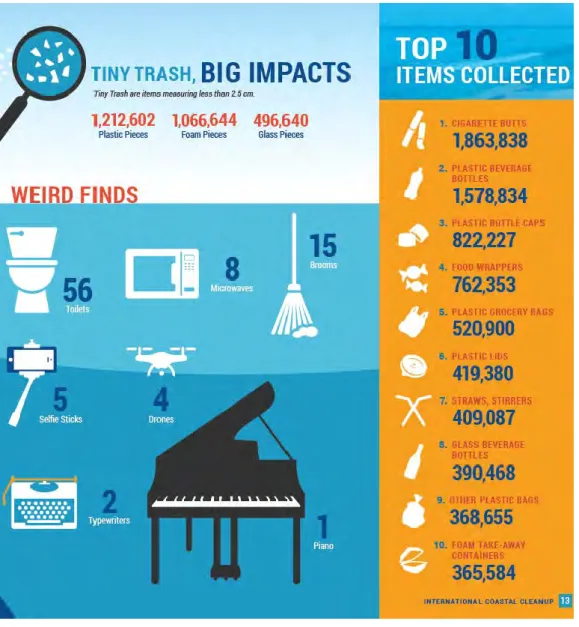
The theoretical framework of the thesis is shaped by the scientific research on the plastic waste problem, in addition to discussion within the photography theory. For the creation of the project, I have photographed a group of plastic material on a liquid environment and created Cyanotype Prints out of a selection of 14 photographs. While creating this body of work, I have used the Ocean Conservancy’s International Coastal Cleanup data from the Ocean Trash Poster that illustrates the most found 10 items on the cleanup process. The Ocean Conservancy has run beach cleanups for 30 years and according to their reserach, 73 percent of the beach litter worldwide came from plastic; such as cigarette butts (the filters), bottles and caps, food wrappers, grocery bags and polystyrene containers. In 2016 the conservancy collected 9,200 tons of trash in 112 (Parker, 2018)
Throughout the process of deciding which plastic material would be used to create the photographic series, the data from the International Coastal Cleanup project led by the Ocean Conservancy Initiative has been supportive. From the list on the Ocean Trash Poster, I have selected the plastic items to be
photographed such as; "Plastic Beverage Bottles", "Forks, Knives and Spoons", "Cups & Plates", "Bottle Caps", "Plastic Grocery Bags", "Takeout-Takeaway Containers", "Straws/Stirrers" and "Food Wrappers". I have excluded the "Fishing Gear" and "Cigarette Butts" from this list.
11
12
Figure 7. Data from International Coastal Cleanup 2017 Report.
Additionally to the list of top 10 items collected, I photographed balloons9 and
tooth brush, in addition to the variety of grocery bags and plastic bottles. The plastic items were easily found on accessible places such as supermarkets or restaurants. I have collected them from these places, rather than adding a performativity element on collecting these items as I wanted to achieve a specific kind of plastic elements and texture.
9 Over 90% of released balloons rise to an altitude of 5 miles then burst into small fragments, the rest remain inflated before descending back down with most eventually ending up in the sea. Attachments such as ribbons and string tied to the balloons are also a problem for marine life as they can lead to the entanglement. (Barker, 2017)
13 1.4. Chapters in Brief
The research can be mainly examined as three separate but connected parts apart from the Introduction and Conclusion chapters. In Chapter II, I have focused on the plastic waste problem through the history and its environmental consequences; in addition to worldwide activities held against the problem with a focus on key artworks that successfully highlight this problem, sharing
common intentions that I have been carrying out throughout my journey. In Chapter III, I tried to highlight ongoing discussions on the photography studies in order to support my standpoint in the photographic series, with the focus on materiality, objective and subjective representations and the photographer’s role in general. Permanence and memory was the key elements that I tried to link the whole chapter into, to support my creative action towards the
“fauxssilles”. Chapter IV reflects how the whole concept merges as one to create the “Fauxssilles For the Future” and Chapter V reflects the implementation phases. The research also required the examination of some artworks that focuses on the same critical problems or succeeds in the same photographic techniques and artistic representations for other subject matters either in a critical way or for other manners. In order to support my artistic motivation and conceptual framework, I tried to focus the artworks of Mandy Barker, Chris Jordan and Von Wong in relation to plastic waste problem on Chapter II. On the photographic and memory transferring aspects of the artistic representations, I examined the Memory of Mankind project, in addition to the focus of
14
CHAPTER II:
ON PLASTIC WASTE
The invention of plastic has brought about a new era in the history of mankind. It is quite possible, that in several hundred years time, people will look back on the 20th century as the ‘plastic period’10 in the same
way that archeologists and anthropologists regard the iron and bronze ages, or the age of steam. Since its introduction, plastic has become an integral part of our lives - quite simply we cannot live without it. (Brighty, 2015)
Througout this chapter, I would be focusing on the Plastic waste as an emerging environmental problem. This part of the thesis tries to highlight
2.1. Drowning in Plastic11
Man is exploiting the past, plundering the fossil record and this can only be done once. There will have to be an end to the
reserves of coal and oil, they cannot grow again in the rocks once they have been removed. (Fortey, 1991, p. 155)
10 This view of today as the plastic era, support the creation of “fauxssilles” as they would be keeping the track of todays data of the plastic filled era. Conceptualization of the plastic materials’ documentation within the cyanotype photographs, this material would be retelling the story of this plastic era for the future.
11 Referring to the June 2018 Edition of National Geographic Magazine’s Planet or Plastic edition cover; “We made plastic, we depend on it. Now we’re drowning in it.”
15
Fortey (1991) mentions that each time we drive a car, we are able to do so because of the photosynthetic activity of plants many millions of years ago. With his words, “It would not be overstating the case to say that western society owes its present affluence to fossil fuels.” (Fortey, 1991) Plastic production is only one example of what humans are creating for the sake of the industry and the economy. Many products owe their existence to energy derived from consuming fossil fuels. Earliest uses of plastic date nearly 3,500 years ago, to the Olmecs of Mexico using the natural plastics from gum trees to create rubber balls. Unlike the 19th and 20th centuries’ synthetic plastics like celluloid (inventor Alexander Parkes) and Bakelite (Leo Bakeland), today’s plastics are mostly made from fossil fuels as the crude oil and natural gas providing cheap alternatives to plastic made from plants. (Gabriel, 2018) The exploitation of coal as a cheap and accessible source of energy became crucial, when the plunder of the fossil fuels started in 1969 when James Watt patented the design of a steam engine and the Industrial world economy became more dependent of the extraction of oil from the rocks. (Fortey, 1991)
16
Because plastic wasn’t invented until the late 19th century, and production really only took off around 1950, we have a mere 9.2 billion tons of the stuff to deal with. Of that, more than 6.9 billion tons have become waste. And of that waste, a staggering 6.3 billion tons never made it to a recycling bin. (Wright, 2017) Figure 9 . Plastic 101 Video, showing the scale of plastic waste.
17
This project entitles the plastic material as fauxssilles since they are inorganic, human-made materials out of real fossil elements. The human influence becomes a critical issue with the increasing uses of plastic, as many types of plastics do not biodegrade threating fish, seabirds and marine mammals. In the earlier years single-use plastics have brought great convenience to people around the world. (Parker, 2018) Unlike organic debris that biodegrades, the plastic debris disintegrates into ever smaller pieces while remaining a polymer. The plastic ultimately becomes small enough to be ingested by aquatic
organisms that reside near the ocean's surface. In this way, plastic may become concentrated in neuston, thereby entering the food chain. (Barnes, Galgani, Thompson, & Barlaz, 1985–98)
The main idea to study plastic waste as fauxssilles first came to my mind from this study from The United Nations Ocean Conference estimating that the oceans might contain more weight in plastics than fish by the year 2050 and an estimated 99 per cent of seabirds will have ingested plastic. (Wright, 2017) This portrays the critical situation that we have to face about the plastic waste
problem. The following chapter focuses on key campaigns held against this problem within the worldwide and Turkey centered scope.
18
Figure 10. Photograph12 from 1955 Time Magazine. (Parker, 2018)
Knowing that the single use plastics allowed easier living standards, the massive production and consumption practices cause the plastic waste problem and the single-use plastics cannot be seen as a solution as they turned out to become a wider problem.
12 “Throwaway Living” became popular but they also play a big part of today’s plastic waste
19
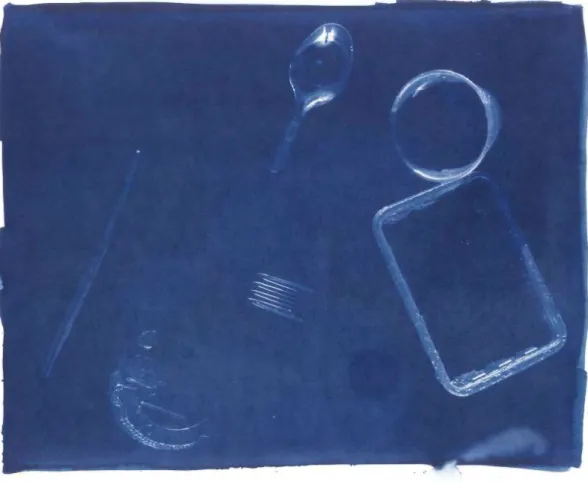
Figure 11. Fauxssille created with single use plastics used with meals.
2.1. Taking Action against the Plastic Waste
"It is past time that we tackle the plastic problem that blights our oceans. Plastic pollution is surfing onto Indonesian beaches, settling onto the ocean floor at the North Pole, and rising through the food chain onto our dinner tables. We’ve stood by too long as the problem has gotten worse. It must stop."13
20 2.2.1. Worldwide
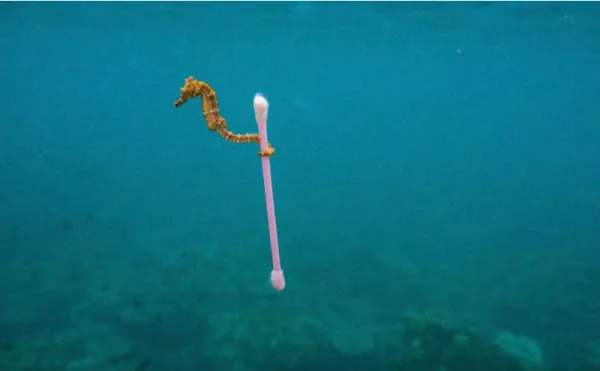
Figure 12. Photograph14 of Justin Hofman. (Parker, 2018)
In the last few years, the plastic waste problem has become even more crucial. Each year, more than 8 million tons of plastic ends up in the oceans, wreaking havoc on marine wildlife, fisheries and tourism, and costing at least $8 billion in damage to marine ecosystems. Up to 80 per cent of all litter in our oceans is made of plastic. (Wright, 2017) Recently, worldwide campaigns are launched against the plastic waste problem. UN Environment launches the global
#CleanSeas campaign to end marine litter by the year 2022, while Greenpeace starts the #BreakFreeFromPlastic movement. National Geographic Magazine published its June 2018 edition with the “Planet or Plastic” title, to share the stories of the growing crisis through the latest science and research, in order to educate audiences around the world about how to eliminate single-use plastics
14 “a photo I wish didn’t exist” says Hofman about this photograph of the seahorse latched onto a
21
for preventing their way into oceans. (Parker, 2018) These campaigns are urging governments and individuals for plastic reduction policies; targeting industry for minimizing plastic packaging and consumers for changing their throwaway habits to prevent an irreversible damage being done to the seas.
Figure 13. #BreakFreeFromPlastic campaing.
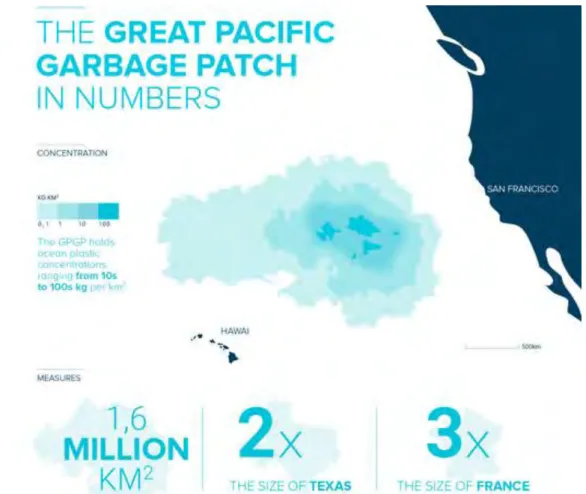
The Ocean Cleanup is a foundation was founded in 2013 develops technologies to extract plastic pollution from the oceans and prevent more plastic debris from entering ocean waters. The project aims to begin the cleanup in 2018, and
22
reach full-scale deployment in the Great Pacific Garbage Patch15 by 2020. (The
Great Pasigic Garbage Patch, 2018) The Ocean Cleanup launched an iOS and Android application in 2015 in a form of a Visual Survey to anyone on a boat on the ocean to contribute data with the purpose of providing scientists with the amount, kind and whereabouts of plastic pollution. The application requires a 30-minute observation session for the observers log the debris they see,
replacing the paper surveys and the data could be shared with other scientists.
Figure 14. The Great Pacific Garbage Patch in Numbers.
15 The Great Pacific Garbage Patch (GPGP) is the largest of the five offshore plastic accumulation zones in the world’s oceans. It is located halfway between Hawaii and California. The term was coined by Charles J. Moore, returning home through the North Pacific Gyre after competing in the Transpac sailing race in 1997. (The Great Pasigic Garbage Patch, 2018)
23
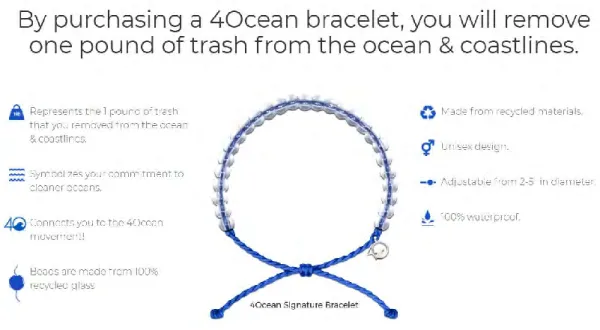
Another Campaign called “4Ocean” started by two Surfers, employs over 150 people worldwide such as captains and cleanup crews full-time from Florida to Bali for cleaning the oceans, in addition to hosting beach cleanups, offshore cleanups and worldwide cleanups to make the greatest impact. 4Ocean has removed 811.034 pounds of trash In less than 2 years from the ocean and coastlines. The project is led by individuals purchasing 4Ocean Bracelets to fund removal of one pound of trash from the ocean and coastlines. The 4Ocean
bracelet represents the commitment to cleaning the ocean and to raise awareness of the 4Ocean movement with the mission of ocean sustainability, recycling awareness , earth preservation and creating global economies.
24
25
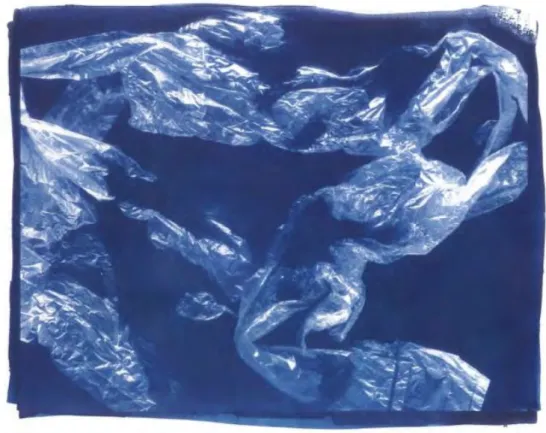
Although there were several photographs and illustrations focusing on the plastic objects that I came across previously, it became more powerful when this photographic design has found its place on a famous magazine cover like National Geographic Magazine that has a chance to reach wider audiences than personal artworks. The Magazine’s June 2018 cover was portraying a gigantic plastic grocery bag, modified like an iceberg with its small top part visible while the larger part was drowning in the ocean. There were more photographs shared online from the magazine edition, portraying animals and wasteland workers being in danger. The final version of my project was exhibited in a group exhibition opened on May 3 2018, in Bilkent University’s Art Room (FADA) within a group of MFA students, shortly after May 18 when the June edition of National Geographic Magazine’s “Planet or Plastic” edition cover was taking its place on some online platforms. This was a nice coincidence to see a worldwide famous environmental magazine launching an activity against plastic waste and highlighting the planet being in danger. Within the scope of the “fauxssilles”, I have also used several grocery bag images as one of the most found items across the ocean shores, with a very short usage time near 15 minutes. (Parker, 2018)
26
Figure 17. Fauxssille created with transparent grocery bag. 16
Figure 18. Fauxssille created with matte grocery bag.
16 Throughout the thesis, the scanned images of fauxssilles are visible, there are 14 photographs
27
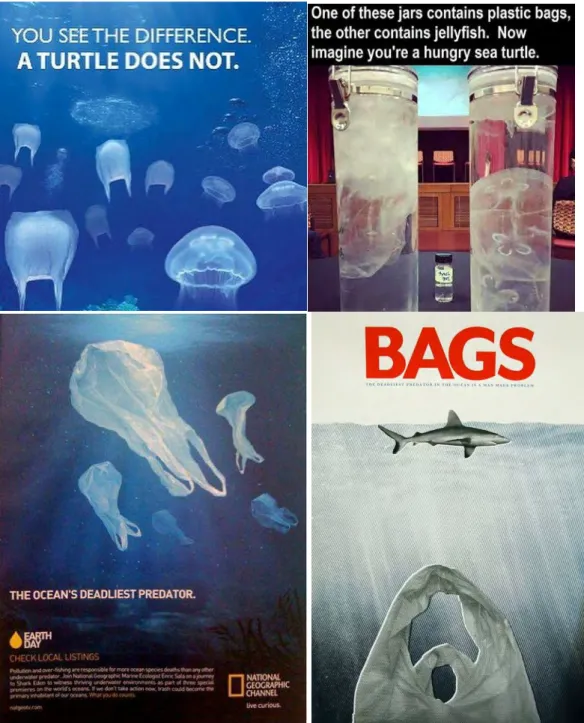
Throughout the research process, I examined the visual works in the online platforms such as pinterest or facebook, and there were common patterns in terms of visual representations of the plastic waste problem, mainly focusing on the transparent structure of plastic materials and their resemblance to organic forms like jellyfish, shark or iceberg.
28
Figure 20. Fauxssille created with grocery bag, looking like a jellyfish
29
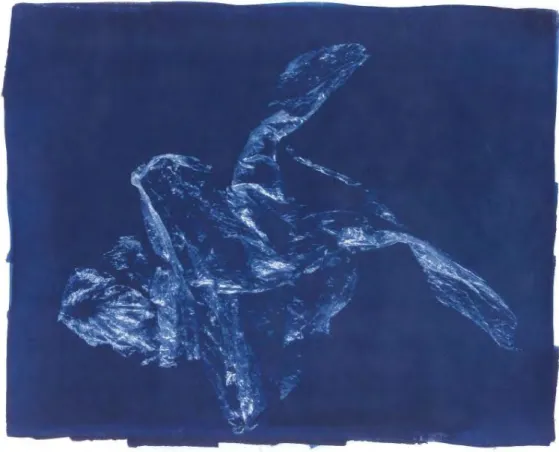
Working with transparent elements on a liquid environment opened up possibilities of several graphic elements to appear. The plastic grocery bags were able to be creating several shapes in the liquid environment while half of the material is placed underneath the water, ending up biologic looking images such as a jellyfish, fish, or the head of a sea turtle, but the final appreciation depends on the viewer to extract meanings out of the visual elements.
2.2.2. Turkey
In the 1970s, after the first discoveries of the oceanic plastics presence, countries with coasts to the Mediterranean joined together under the roof of United Nations Environment Program (UNEP) and signed the Barcelona agreement in 1978 with the aim of preventing and reducing pollution in the Mediterranean. (Güven, 2018) Outstanding research in Turkey was carried out as an academic and was carried out in the first scientific study of the Middle East Technical University by the Institute of Marine Sciences 1982-1983 year, Iskenderun and was screened in order to determine the amount of plastic waste in the coastal areas and the sea floor in Mersin Bay. According to the research, 88 tons of plastic waste was found within one kilometer and the amount of waste was determined to be increasing as the depth increased. (Güven, 2018) As the plastic waste problem arises and the micro plastics became a critical topic worldwide, the activities in Turkey increased.
Middle East Technical University Department of Marine Sciences Institute held another study conducted by the of samples taken from 18 points from Dalaman
30
to Iskenderun coast on Republic of Turkey’s Mediterranean coastline between the years of 2015-2018, , revealing that there are close to 140 micro plastic particles per kilometer on the surface of the sea. (Güven, 2018) Another research focuses on the micro plastic litter composition in the gastrointestinal tract of fish, which is also included in the National Geographic Magazine's Turkey edition entitling the outcomes as "Plastic in the Fist" with an illustration of the surveys findings to highlight the emerging field of study focusing on the plastic entering the food chain. According to the examination of 337 fish from 28 specimens, micro plastics were found in %58 of the fish in the Mediterrean Sea’s Mersin and İskenderun gulf. (Uygun, 2018)
Apart from to the ongoing academic work, Turkey’s Ministry of Environment and Urban Planning also conducted various studies with ecological and economic worries, such as the “Zero Waste Project” started in 2017, aimed to reach 35 percent of the recycling rate from waste by the year 2023. According to the 2017 Activity Report, 97 tons of non-hazardous wastes and 2,5 tons of hazardous wastes are detected throughout the country. (Planning, 2018)
31
Additionally to the academic and governmental work, NGOs are working on the plastic waste issue to raise awareness in the social context. DenizTemiz
(SeaClean) Association (TURMEPA) and Turkish Marine Research Foundation (TÜDAV) are also actively involved such as the environmentally-oriented campaign "Let's keep the Mediterranean clean" (Clean Up The Med) involving all Mediterranean countries, including Turkey, in order to clearing the
Mediterrean coast simultaneously with the support of civil society
organizations. TURMEPA supported approximately 33,000,000 liters of liquid waste and 2,650,000 kilograms of solid waste ending up on the seas.
(TURMEPA, 2017) Şeyda Dağdeviren Hill from TURMEPA was listed as the Coordinator from Turkey, in the Coastal Cleanup 2017 Report. (Jones, 2017) The report mentions volunteers, site captains, state and county coordinators of 112 countries around the world collecting17 over 18 million pounds of trash.
Dr. Olgaç Güven (2018) states that the overall actives are being supportive and the consciousness is rising in Turkey, in his article on the National Geographic Magazine’s 2018 June Turkey edition. He mentions that like the rest of the world, Turkish citizens have to rethink plastic, as we cannot fully exclude it from out lives. It is important to acknowledge the individual responsibilities we have against the plastic waste problem. Six things we can do against plastic waste was mentioned such as; “Give up plastic bags, Skip straws, Pass up plastic bottles, Avoid plastic packaging. Recycle what you can, Don’t litter.” (Wright, 2017) to inform the readers about possible easy solutions. All of the
17 In the project, 1,079 people took part, collecting the total of 31,965 items weighted as 3,292 kilogram within 9.0 kilometers where the most found items were 17,084 cigarette buts and 3,866 plastic beverage bottles. (Jones, 2017)
32
environmental solutions and actives held by the governments and NGO’s depend on us, to create a global awareness against the plastic waste, to reduce our consumption and recycling practices. The fauxssilles for the project not directly offers recycling or cleanup solutions, rather mirrors this critical situation back to the audience, to awaken their environmental concerns.
2.3. Examined Artworks
The conceptualization and implementation of the process was full of
experimentation and discoveries on a personal level but in order to understand the wider context of my project and how it fits under certain art fields; I believe it is important to acknowledge key artworks that touch upon similar problems, either conceptually or implementation wise. Knowing that the plastic waste problem is an emerging aspect within the environmental issues, there is a need to examine some key artworks within the scope of this thesis, as the artistic motivation behind the following projects are encouraged me to finalize my research and have the courage to look for further possibilities for the future of this project. Accordingly, I would be focusing on the following projects in order to see how they have approached the topic of environmental waste that I have problematized through the plastic waste issue. The projects would be examined in relation to the conceptualization of the problem, within the framework of my artistic motivation.
33
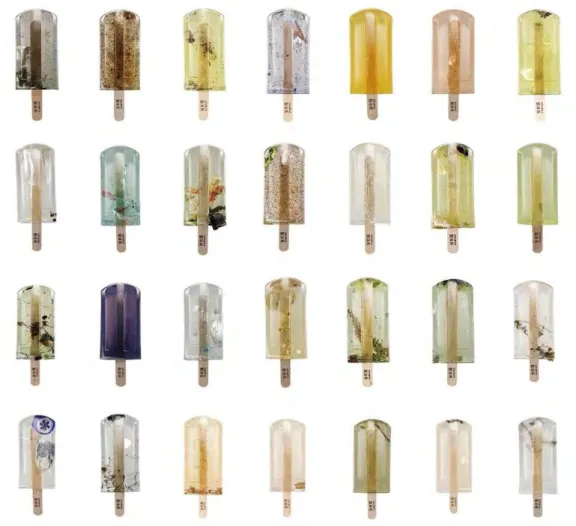
Popsicles of pollution; Hong Yi-chen, Guo Yi-hui, and Zheng Yu-ti
Figure 23. Popsicles of pollution; Hong Yi-chen, Guo Yi-hui, and Zheng Yu-ti
Ice pops usually look delicious, but these are completely inedible. Three art students; Hong Yi-chen, Guo Yi-hui, and Zheng Yu-ti collected polluted water from a hundred sites around Taiwan, then froze it into blocks, hope to draw public attention to water contamination and inspire people to generate less waste. (Parker, 2018) The project has been nominated for the Young Pin Design Award and featured in the New Generation of Design Exhibition at the Taipei World Trade Center. (Sierzputowski, 2017) This body of work was has been very inspirational for me as the project was created under an MFA program in the National Taiwan University of the Arts, which is tackling a similar
34
environmental problem and the implementation to me was very well crafted. Additionally, the project was examined as “Faux Frozen Treats” in an online article (Sierzputowski, 2017) which again encouraged my for falsifying the usual elements within the conceptualization of my project as it might have the capacity to achieve a similar artistic appreciation such as the Popsicles of Pollution project gained. The project not only uses the polluted water samples to create the popsicles, but it has the design of several packaging design in order to illustrate the body of work more of a “faux” frozen treats, fully designed.
#MermaidsHatePlastic, Von Wong
Figure 24. #MermaidsHatePlastic, Von Wong
Von Wong is a globally known photographer, focusing on the environmental waste problems as he creates photographic series focusing on the waste from plastic, electronic and cloth. He mentions how pretty photographs can change the world and just by spreading the word how someone can make a difference.
35
Wong states; “As an artist, I have always wondered what kind of difference I could make. Alone, I was just a photographer – but thanks to the help of amazing individuals we transformed a lifeless pile of used garbage into a message”
(Wong) This is how the #MermaidsHatePlastic18 project is born out of 10,000
bottles borrowed from the waste management centre Tomra. His work had been very influential as this project is published on the website with the
“450years.com” domain, referring to the lifetime of a plastic bottle varying from 450 to 600 years. As my project places the permanence of materials on a dual level, through the photographs and the plastic objects; Wong’s statement was very powerful in terms of his conceptualization over the non-degradable plastics. Within a single week, the project generates over 10,000 pledges from people around the world to reduce their plastic use. (Enos, 2016) Wong tells that, only 1% of them reducing their plastic consumption by 10%, would mean 100,000 less plastic bottles in the sea. It is very powerful to see the potential of such projects, echoing on a worldwide scale in a positive way. He mentions that over 10 million views with the requests for prints came streaming in in just a period of a week, from teachers, entrepreneurs to mothers wanting to have a print up to share the threat of plastic pollution in “a beautiful interesting way”. Accordingly, Wong and his creative team decides to offer prints with a message at cost, so that “You can help spread the word.” (Wong) This is very nice to see his work echoing worldwide that it lead people to support, and the artist
produce printed edition. This way, it is making the plastic waste problem become much more visible, on an international level.
18 The project reflects the idea of creating a series where a mermaid is trapped, or sitting within, a bunch of plastic bottles.
36 Midway, Chris Jordan
Figure 25. Midway, Chris Jordan
The quotation on the beginning of the thesis belongs to Chris Jordan’s teaser of the Midway documentary-photography project. The video opens up with Samuel Taylor Coleridge’s words from the Rime of the Ancient Mariner; “...and till my ghastly tale is told, this heart within me burns”. The teaser portrays Albatrosses of the Midway Island where nearly two million Laysan albatrosses live and twenty tons of plastic debris washes up every year, with five tons of that debris being fed to albatross chicks. Researchers have
concluded that approximately one-third of their chicks die, and many of those deaths are the result of being mistakenly fed plastic by their parents, and every single one contains some quantity of plastic in their digestive system. (Shukman, 2008) Jordan was successful for making me “feel deeply enough” and even such a short video was enough to burn my heart, to face the realities of our time.
37 Figure 26. Mady Barker’s work
I would also focus on Mandy Barker’s project on the following part and I wanted to include her work which was included in the National Geographic magazine, which also focuses on the same problem. Every piece of plastic in her
photographic work was found in the stomach of a single albatross chick. Each piece in the photograph from the bottle caps in the top row to the tiny
fragments along the bottom represent “parts of something we could have once used,” says photographer Mandy Barker and she states “I wanted to create something that would resonate”19. (Daly, 2018) Both Jordan’s observations on
the Island and Barker’s photographic representations are powerfully illustrating the endangered species getting harmed by the marine debris and plastic waste.
38 Works of Mandy Barker
Mandy Barker is an international award-winning photographer whose work involving marine plastic debris has led to a series of photographic projects that illuminate plastic’s ubiquity as well as its reach, receiving global recognition. I came across her works on the Plastic Waste as Art Section in the National Geographic Magazine’s June edition of Plastic or Planet. I wanted to discuss one of her works in a spread of the magazine, where she showcase a collection of Coca Cola bottle caps collected from all around the globe, with the written tag names highlighting which part of the world the object is sent from. As the magazine highlights, “Barker crowd sourced a global collection” to show various projects from discarded bottle caps turning up on beaches—and in birds— around the world. (Daly, 2018)
39
What excites me in Barker’s work is not solely seeing enormous collections of plastic, but the way she describes her work and the artistic motivation shaping her practices. When I was developing this thesis, I was wondering the outcomes of a rather site-specific implementation of the photographic series, highlighting the information of location about where my key plastic objects are found and collected. This would have been adding a locative element and the collection would have an evidence standpoint. Throughout the process, I have excluded the location element as the fauxssilles do not vary in its species dependent on where it’s found or where its ending up. The location element would be adding another statement with its performativity, but for the scope of this project, I decided to limit the project to some standardization.
With similar intentions to Chris Jordan, Barker states that she feels in her gut the reality that no area in the world is free from plastic anymore and she highlights how she wants the rest of us to feel it “from the poles to the Equator, from the sea surface to the ocean floor.” (Daly, 2018) I would be discussing The Photographer’s Role through the theoretical framework in Chapter 3.3, but throughout my thesis process, I felt that Mandy Barker was one of the most successful contemporary photographers that achieved the social role20 of an
artist, as well as succeeding to find her own way of aesthetic representation and visual tone. Her work opened up many possibilities to further develop my work.
20 Her work has been highlighted as “The series aims to engage with the public by stimulating an
emotional response, combining a contradiction between initial aesthetic attraction with an awareness to encourage social responsibility.”
40
Figure 28. Mandy Barker’s sketchbooks21 showcased in her web portfolio.
The discovery of Barker’s work was very aspiring as she plans her projects in collaboration with marine scientists in order for her photos to “give science a visual voice,” conveying plastic’s impact on the natural environment in a way
21
One of the most exciting moments through my thesis development, is coming across Barker’s work, not just for the photographic outcomes being massively illustrative out of the real, found material; but for the state of mind she portrays through the development of her works in general. The sketchbooks are for instance plays the most powerful role portraying her creative journey; showcasing the references and inspirations she intended to reflect, from the formation of the fish shoals and the visualization of the galaxy, towards the impressions from the sea surface and the flowery forms. She has also played with the words such as creating “feel”, “fear” or “real” out of the “sea”.
41
that scientific research papers cannot. (Daly, 2018) The way she approaches the plastic waste problem and the ways in which she creates and captures her collections was as inspiring as Anna Atkin’s photogram works from 1842, for being similar to her scientific approach for the documentation of botanicals, which eventually ends up becoming very powerful, artistic abstractions. Luckily, I came across a book review of Barker’s “Beyond Drifting: Imperfectly Known Animals”22 book review, linking the body of work to Anna Atkin’s book, with a
focus of Barker’s Victorian stylized scientific approach and artistic representations.
The review states that barely two decades later of Atkins' revolutionary move on abandoning the pencil to allow her algae species draw themselves on light-sensitive paper; Barker’s work has produced an important photobook echoing the Victorian-era science as it exposes a contemporary environmental crisis. (André, 2017)
Figure 29. Review mentioning similarities between Barker’s and Atkins’.
42 Beyond Drifting: Imperfectly Known Animals
Barker has chosen a 19th-century form to address a 21st-century problem speaks to both the power and futility of the old notion of photography as proof. Her presentation of this work recalls the era of positivist science, which held that if something could be seen—in a photograph, perhaps—it therefore existed. Ironically, Barker's
constructed images provide a kind of positivist proof that plastic-infused plankton exist. At the same time, despite ample visual evidence and data that warn of this and other contemporary ecological and environmental crises, far too many people—some of whom wield the power to mandate positive change—have chosen to remain in denial of what is, in fact, perfectly known. — (André, 2017)
43
Barker presented the new ‘specimens’ out oft the recovered plastic debris as microscopic samples while each name contains the word 'plastic' hidden within its title. She mimics John Vaughan Thompson’s 23, early scientific discoveries of
plankton, representing both the current situation concerning marine organism's intake of plastic particles, alongside early discoveries when plankton were free from plastic. (André, 2017) The project is presented as an old science book from 1800's like Atkin’s famous work and it “serves as a metaphor to the ubiquity of plastic and the anthroposcene, encapsulating in miniature the much larger problem of an imperfect world." (Barker,2017)
It was quite inspirational to see her work in the National Geographic Magazine. When I examine her work in detail, it became even more exiting since the way the planktons are used as the source of the ecological life on the marine
environment were very enthusiastic as her sketchbook reflects her inspirations from Henry Fox Talbot’s photographs and plankton drawings from the Victorian era. She have made experiments with salt prints to illustrate the body of work, which was once again referring back to photography’s origins. I would be discussing the positivist approach on photography to highlight standpoint, but seing Barker’s approach was very supportive in terms of artistic
representations. Additionally, the way she moves between contemporary and historical time periods and techniques was also supportive for my project, in order to witness successful ways of self-expressions.
23 John Vaughan Thompson (1779-1847) was a British military surgeon, marine biologist,
44
CHAPTER III:
ON PHOTOGRAPHY
In this chapter; I would be focusing on the inventions of photography and the cyanotype technique; theoretical approaches on photography studies,
discussions towards photography’s materiality and the post-photography (Mitchell, 1992) concept; the potential of photograms and abstraction in photography; memory transferring aspects, transparency of photographs and photographers’ role. I would try to emphasize key concepts from the theoretical concepts with the help of key texts written in this manner. In the final part of the chapter, I would be focusing the project Memory of Mankind (MOM) and the Antiquarian Avant-Garde photographic movement to support my argument on creating my photographic series and the conceptual design behind the
implementation.
3.1. Historical Framework
The History of Humanity is known only through the art it leaves behind. Think about it, when was the last time an archaeologist unearthed apolitical speech? (James, 2009, p:510).
45 3.1.1. Inventions on Photography:
The light-marking art (…) is flourishing as a language without compromise (…) one that is not tied to a syntax-dependent feast (as perfect as it is) of 1’s and 0’s that is only a solar flare24 away from erasing history. (James, 2009).
The invention of photography was not one persons’ discovery; rather it was invented as a collaboration of several people who were experimenting with techniques and chemicals. In “The book of alternative photographic processes” Christopher James (2009) mentions amateur artists and chemists were
employing photogram techniques with simultaneous creative and practical scientific intentions such as Sir John Herschel’s Anthotypes created with the juices of flowers and sunlight, Anna Atkin’s cyanotype studies of algae, Mongo Ponton’s work with potassium dichromate for his “shadowagraphs” and William Henry Fox Talbot’s photogenic drawings. The Greek meaning of photography means light drawing and the silhouette might be seen as the essence of
photography. The silhouette was seen different than a painted portrait as it was mechanically produced, more objective in representation of individuals, unlike subjective paintings. (Museum, 2014)
The way that we familiarize ourselves with the world around us just fundamentally changed with photography. (Museum, 2014)
24 James, whose work is highly concerned around alternative photographic processes, mentions
the unexpected risks of geomagnetic solar storms that might be damaging the modern technology, erasing the digital data as the devices are being effected. Solar storm of 1859 was one the most known events in this sense.
46
The invention of the camera was seen as a tool of objective documentation and photographers imitated the aesthetic qualities of the classical paintings for proving themselves to the art world. Images created with camera were taken as “true” resembling human vision. (Neusüss, 1994) After Photo-Secessionists’ success on selling their photographic collections to a fine art museum, it is acknowledged how photography changed and freed painting with the medium’s unique qualities. (Bilici, 2013)
Realizing the creative possibilities, Henry Fox Talbot discovered “the photogenic drawing” such as precise photogram “tracings” of flowers, leaves, feathers and lace o salted and silver nitrate sensitized surfaces while other artists were employing photogram techniques with creative, practical and scientific
intentions by the mid-1800s. (James, 2009). Bilici highlights (2013) that Talbot published his 1844 book The Pencil of Nature with the idea of light and
chemically treated paper automatically producing "drawings" of the natural and unnatural world, which changes the ways of understanding photographic
images as unmitigated proof. The memory carrying capacity of photographs are also important, coming after shadow drawing, painting, and death masks as prior examples of memory devices before the invention of photography. (Aytemiz, 2013)
47
Figure 31. Example of Henry Fox Talbot’s photogenic drawings.
James (2009) focuses on the old “mirrors and windows” conflict ranging from the last century, where the camera represented a perfect tool; where the “mirror” representing the image as an expression of the artist, and the
“window” reflecting the image being defined by the information of within the photograph. The image is “as much about as the information as it is about the system of delivering the content” on the window perspective; but from the “mirrors” perspective, visual literacy emphasizes the “light-marking” , "the “photo-graphis” where the print itself is seen as a sign, a symbol, and a mark, perhaps even a metaphor for the process of making the print. (James, 2009). Within the scope of my project, I would be mainly locating my work as a
48
“transparent” “window” or as an “evidence”. Photography has a special place in material culture, as it is a paradoxical technology. On the one hand, it transforms the material into light and shadow. On the other hand, it gives materiality to the intangible (as in a lost moment, or a lost one). Photographs are not signs of presence but evidence of absence. Or rather the presence of a photograph indicates its subject’s absence. Photographs contain a realization of loss. (Aytemiz, 2013) This is why I found photography a strong medium for the creation of fauxssilles.
Realist theories give priority to the mechanical origins of the photographic image. They argue that the mechanical arrangement of the photographic camera means that ‘physical objects themselves print their image by means of the optical and chemical action of light’ as “stencils off the real”, “traces”, or as “records” (Lister, 1995) The historical use of photographs as ‘evidence’ and a reliable documentation has long been in continual contradiction with other uses of photographs, particularly as art, and in advertising and corporate publicity. Positivism suggested the belief that observable, quantifiable facts, recorded by scientists and experts, would one day offer man such a total knowledge about nature and society, while the “Photographers now supply us with more facts every month than the eighteenth century Encyclopaedists dreamt of in their whole projects.” (Robins, 1995)
49 3.1.2. The Cyanotype Process:
Atkins25 learned about photography from none other than William Henry
Fox Talbot and his wife, Constance, whose experiments with "photogenic drawings" (James, 2009, p:151)
Figure 32. Cyanotype as a contact printing process.
25 Anna Atkins (1799–1871), was the first woman photographer and presumably learned the
cyanotype process from Herschel, who was a family friend. James mentions “a process that she presumably learned from Herschel who lived down the road, and who had invented the process” (James, The Cyanotype Process, 2009)
50
The cyanotype was discovered by Sir John Herschel (1792–1871) in 1842 as the first simple and successfully realized practical non-silver iron process, invented a mere three years after the “official” announcement of the discovery of photography, providing permanent images in blue values. Between 1839 and 1842 Herschel conducted hundreds of separate experiments on the
light-sensitivity of silver salts, metals, and vegetation, including an investigation of potassium Ferro cyanide and ferric ammonium as the two primary chemicals found in the classic cyanotype formula. (James, The Cyanotype Process, 2009)
Figure 33. UK Frederick, Slipping through.26
In October 1843 Atkins began issuing published folios of her photogenic (photogram) drawings where she created cyanotype images of algae, ferns, feathers, and waterweeds. There are thirteen known versions of her work entitled British Algae: Cyanotype Impressions (1843–1853). These books,
51
containing hundreds of handmade images, were the very first published27 works
to utilize a photographic system for scientific investigation and illustration.
Figure 34. The first photographic book by Anna Atkins.
27 “Significantly, created prior to Talbot’s Pencil of Nature (1844–1846), a published work that is generally given credit by historians as the first to have achieved this important milestone.” (James, The Cyanotype Process, 2009)
52 3.2. Theoretical Framework
If photography produces a set of objects, meanings and social
relationships – what we might gloss as ‘histories’ – we need to look for more diverse ways to understand the apprehension of photographs, to break their reduction to the visual alone. (Edwards, 2009)
As I was conceptualizing the body of work, I have made research through the photography studies. From the key discussions ongoing in the field, what interests me about to support my project was highly concerned about
materiality and the permanence, in addition to the focus on memory. For the conceptual process, I was focusing on the photographic series as an evidence of today’s memory, which would be transferred to the following generations. There are several discussions on the meaning of images, the production
techniques and the viewer understands which I would be focusing on according to some theoretical approaches.
For Hans Belting (2001) the "image" is defined not by its mere visibility but by its being invested, by the beholder, with a symbolic meaning and a kind of mental "frame" and an "image" was more than a product of perception and “it is created as the result of personal or collective knowledge and intention.”
(Belting, 2001) He gives the example of the triad image-medium-body, where the medium refers to the technology or artisanship that transmits the image to whatever it is that gives visibility to the image and the body refers to the living body, the spectator. (Belting, 2001) There is a crucial focus on the body as a
53
medium, in order to finalize the transmission of information within my project and it demands a special kind of reading. From this perspective, the images of memory and imagination are generated in one's own body and “the body is the living medium28 through which they are experienced.” (Belting, 2001)
Vilem Flusser, which is another name that discusses photography through philosophy, discusses images as significant surfaces and he says 'Even though the last vestiges of materiality are attached to photographs, their value does not lie in the thing but in the information on their surface.’ He focus on the power of photographs as reductions of the four dimensions of space and time to the two surface dimensions. (Flusser, 2000) His approach was supportive for me as I was trying to conceptualize a series of fossils onto paper, as fauxssilles which tell their story within the exposed area. This specific ability to abstract surfaces out of space and time, to project them back into space and time is what is known as 'imagination' as the precondition for the production and decoding of images from Flusser. (2000) He also mentions that the magical nature of images must be taken into account when decoding them. Thus it is wrong to look for 'frozen events' in images for him, rather they “replace events by states of things and translate them into scenes.” (Flusser, 2000)The connection of magic is once again crucial here and my aim with the photographic series was creating fossils that would speak louder within the environmental context. From his point of view; I wanted my project offer a “window” to a certain series of facts through technical images as Flusser states that; the non-symbolic, objective character of
28 “The medium helps us to see that the image neither equates with living bodies nor with the
lifeless object. The distinction between image and medium is rooted in the self-experience of our body.”