The Role of Adult Attachment in Relationship Patterns and Eating Attitudes
EDA İKİKARDEŞ 113627009
İSTANBUL BİLGİ ÜNİVERSİTESİ SOSYAL BİLİMLER ENSTİTÜSÜ
KLİNİK PSİKOLOJİ YÜKSEK LİSANS PROGRAMI
UZM. PSK. GÜLENBAHT ŞENTÜRK EYLÜL, 2015
Abstract
Present study aims to examine the role of adult attachment on relationship patterns and eating attitudes. There are two main hypotheses. First, whether attachment security has an influence on relationship patterns will be tested. Second, the hypothesis stating that people with insecure attachment are more likely to develop disordered eating attitudes will be evaluated. There are also two exploratory research questions on the role of the body dissatisfaction within these relationships, and the differences across genders within these associations. For testing these hypotheses, Experiences in Close Relationships, Knowledge of Indicators, Relationship Questionnaire, Eating Attitudes Test and Body Image Satisfaction Questionnaire were
administered to young Turkish adults. According to the results attachment quality influences the relationship patterns, and attachment insecurity is a significant predictor for disturbed eating attitudes. While fearful attachment was found to have a significant predictive value for single individuals, attachment anxiety and Body Mass Index predicts disturbed eating attitudes. Results also showed that body satisfaction is not a significant predictor for eating attitudes. Discussion section links the main aspects of the thesis along with the limitations of the current study; suggestions for further research, and therapeutic implications of the results.
Özet
Bu çalışma, yetişkin bağlanma stillerinin ilişki örüntüleri ve yeme tutumları üzerindeki etkisini araştırmayı amaçlamaktadır. Çalışmanın iki temel hipotezi vardır. İlk olarak bağlanmadaki güveninin ilişki örüntüsü üzerindeki etkisi; ikinci olarak güvensiz bağlanmanın bozuk yeme tutumları üzerindeki olası etkisi araştırılmaktadır. Bunlara ek olarak, bu bağlantılarda beden tatmini ve cinsiyet farkının nasıl bir rol oynadığı tespit edilmeye çalışılmıştır. Bu hipotezleri test etmek için, Yakın İlişkilerde Yaşantılar Envanteri, Güven Göstergesi Bilgisi Testi, İlişkiler Anketi, Yeme Tutum Testi ve Beden Bölgeleri ve Özelliklerinden Hoşnut Olma Anketi genç yetişkinlerden oluşan bir Türk örneklemine uygulanmıştır. Sonuçlar, bağlanma stillerinin ilişki örüntülerini etkilediğini ve güvensiz bağlanmanın bozuk yeme tutumları için belirgin bir yordayıcı olduğunu göstermektedir. Şu anda romantik bir ilişkisi olmayan kişilerde korkulu bağlanma yeme tutumlarındaki problemleri yordarken, romantik bir ilişkisi olan kişilerde kaygılı bağlanma ve beden endeksi, bozuk yeme tutumlarının belirgin yordayıcıları olarak bulunmuştur. Tartışma bölümünde çalışmanın temel bulguları ve kısıtlılıkları bağlantılandırılmış, gelecek çalışmalar için öneriler sunulmuş ve sonuçların terapötik çıkarımları üzerinde durulmuştur.
Acknowledgements
The process of writing this master’s thesis was compelling yet a nurturing experience for my academic career and personal growth. Even though the product of this process bears only my name, it involves support of many others without whom it will be very hard to accomplish.
First and foremost, I would like to thank to my thesis advisor, Gülenbaht Şentürk for providing me a ‘secure base’ in which I feel trust and containment that in turn encouraged my exploration and production. With her guiding light and support, this journey became challenging but a joyful pathway to discover. I am also grateful to Dr. Ayten Zara for her valuable
contrıbutions that enriched the product of this journey. Moreover, I would like to offer my special thanks to Assistant Prof. Gülin Güneri for introducing me the field of eating disorders and her endless encouragement and help within this process.
In addition to my thesis committee, I am grateful to this program and valuable people within this program starting with Murat Paker and Zeynep Çatay for providing me their valuable knowledge together with their understanding during this difficult process. I would like to offer special thanks to Assistant Prof. Alev Çavdar Sideris for her help, support and containment that opened a stuck channel for me within this pathway. In addition, I feel indebted to Assistant Prof. Bülent Turan for his help and valuable knowledge that passes over limits of distance and time.
I am also thankful to Türkiye Bilimsel ve Teknolojik Araştırma Kurumu (TÜBİTAK) for sponsoring by graduate education and this thesis. Their support enabled the realization of this challenging product.
I would also like to thank to all of my friends within this graduate program, who
accompanied me during this compelling pathway from the very beginning. I feel deeply grateful especially to Özgün Taktakoğlu, Görkem Çöklü, Merve Özgüle and Kaan Öner for their
priceless love, support and help that kept me standing and continuing.
Despite all of the difficulties in this process, another thing that nurtured me and gave me energy to keep on working was that tango and my tango family, who were there for me anytime I needed. This offered me a safe heaven that includes a warm embrace and a space for creativity and joy. Without the music, dance and holding it will be impossible to accomplish this challenge. Thanks to them, I was able to dance to the end of this journey.
Lastly, I want to offer my special thanks to my dear family for their nurturing love, trust and support. I am truly grateful and lucky to have them for many things. To mention some of them, I am indebted to my mom for being there and holding my hand whenever I needed, to my father for his support and encouragement that widened my life perspective, and to my dearest brother for proving me that distances cannot diminish love, care and understanding we have for each other. Without them it will be impossible for me to accomplish this difficult process. I would also like to thank to my lovely grandmother, my uncle and my aunt-in-law for their love and care that builds both a protection and support around me that kept me continuing. Thanks to all of our nurturing and colorful meals I was able to have the necessary energy to finish this part of the journey of being a clinical psychologist, which is starting just now.
TABLE OF CONTENTS Abstract ... iii Özet ... iv Acknowledgements ... v List of Tables ... x CHAPTER I.INTRODUCTION 1.1. The Primary Relationship: Mother & Infant ... 1
1.1.1. Psychoanalytic Perspective ... 1
1.1.1.1. Sigmund Freud’s Views on the Primary Relationship ... 2
1.1.1.2. Object Relations Theory and The Primary Relationship ... 7
1.1.1.3. Wilfred Bion’s Contributions: Containment ... 13
1.1.1.4. Donald Woods Winnicott: Holding ... 18
1.1.1.5. Self Psychology: Self-Object Needs ... 22
1.1.1.6. Peter Fonagy and Mary Target: Mentalization ... 27
1.1.1.7. Margaret Mahler: Separation and Individuation ... 30
1.1.1.8. Esther Bick: The Role of The Skin ... 36
1.1.2. Attachment Theory ... 40
1.1.2.1. John Bowlby and Mary Ainsworth: Attachment Theory ... 41
1.1.2.2. Affect Regulation ... 48
1.1.2.3. Adult Attachment Interview (AAI) ... 52
1.2. Relationship Patterns in Adulthood ... 57
1.2.1. Elements of Primary Relationship in Adulthood ... 57
1.2.2. The Oedipus Complex in Adult Relationships ... 64
1.2.4. Reflective Function or Mentalization ... 72
1.2.5. Mentalization and Adult Relationship ... 77
1.3. Eating Disorders... 81
1.3.1. Diagnostic Statistical Manual of Mental Disorders: Eating Disorders ... 82
1.3.1.1. Anorexia Nervosa (AN) ... 83
1.3.1.2. Bulimia Nervosa (BN) ... 84
1.3.1.3. Binge Eating Disorder... 86
1.3.1.4. Obesity ... 87
1.3.1.5. Orthorexia Nervosa (ON) ... 87
1.3.1.6. Eating Disorders Not Otherwise Specified (EDNOS) ... 88
1.3.2. Significant Factors in the Development of Eating Disorders ... 92
1.3.2.1. Biological Factors ... 92
1.3.2.2. Sociocultural Factors ... 93
1.3.2.3. Psychological Factors ... 95
1.3.2.4. Psychological Correlates of Eating Disorders ... 96
1.3.3. Intrapsychic Factors Contributing to Eating Disorders ... 97
1.3.3.1. The Representation of the Self ... 97
1.3.3.2. Perfectionism ... 99
1.3.3.3. Gender Differences in Eating Disorders ... 102
1.3.3.4. Affect Regulation and Eating Disorders ... 104
1.3.4. A Cognitive Behavioral Perspective ... 107
1.3.5. Interpsychic Factors Contributing to Eating Disorders ... 108
1.3.5.1. Family Dynamics ... 108
1.3.6. A Systemic-Structural Perspective ... 110
1.3.7. Psychodynamic Perspective on Eating Disorders ... 111
1.3.8. Attachment and Eating Disorders ... 121
1.3.9. Studies on Eating Disorders in Turkey ... 126
1.3.10. Current Study ... 128
II.METHOD ... 130
2.2. Data Collection and Procedure ... 130
2.3. Data Collection Instruments ... 131
2.3.1 Demographic Data Form... 131
2.3.2. Experiences in Close Relationships Questionnaire - Revised (ECR-R) ... 131
2.3.3. Knowledge of Indicators Scale (KNOWI) ... 132
2.3.4. Relationships Questionnaire (RQ) ... 133
2.3.5. Eating Attitudes Test - 40 (EAT-40) ... 134
2.3.6. Body Image Satisfaction Questionnaire (BISQ) ... 135
2.3.7. Body Mass Index (BMI) ... 136
III.RESULTS ... 137
3.1. Descriptives... 137
3.2. Results Concerning Attachment Qualities ... 137
3.3. Results Concerning Eating Attitudes ... 143
3.4. Results Concerning Body Dissatisfaction ... 145
IV.CONCLUSIONS AND DISCUSSION ... 147
4.1. Conclusions ... 147
4.2. Limitations of the Study... 162
4.3. Therapeutic Implications ... 166
REFERENCES ... 170
APPENDICES (In Turkish) ... 192
A.DEMOGRAPHIC DATA FORM ... 192
B. EXPERIENCES IN CLOSE RELATIONSHIPS – REVISED ... 193
C. KNOWLEDGE OF INDICATORS SCALE ... 195
D. RELATIONSHIP QUESTIONNAIRE ... 198
E. EATING ATTITUDES TEST – 40 ... 199
LIST OF TABLES
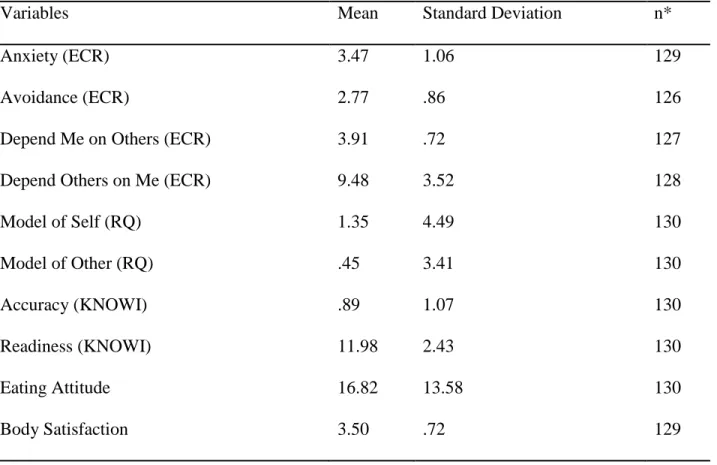
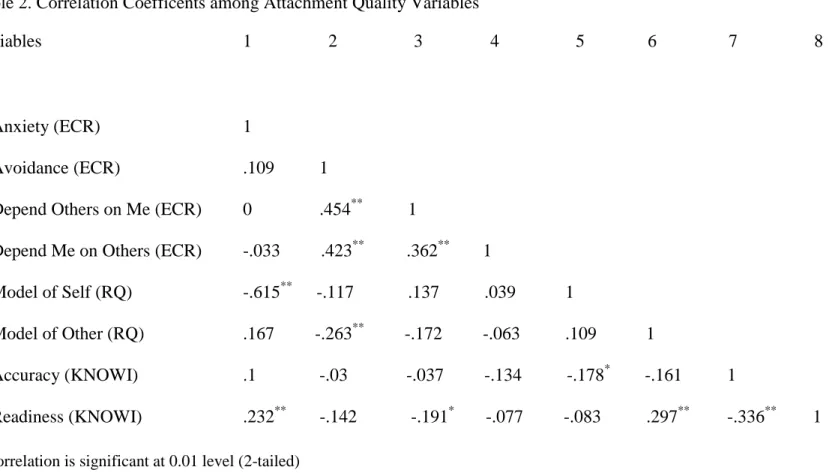
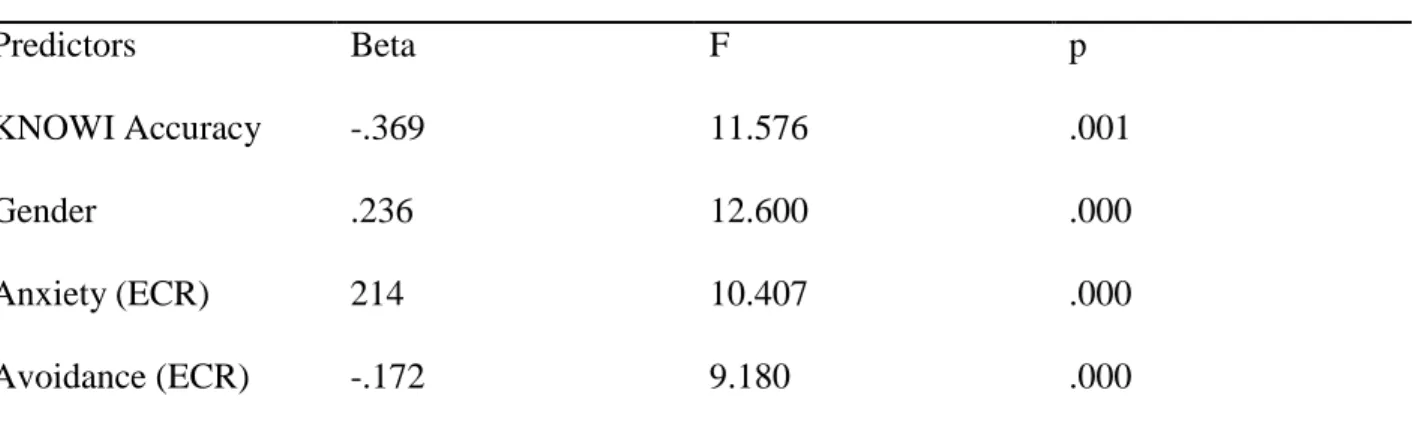
Table 1. Mean scores and Standard Deviations of Variables ... 138 Table 2. Correlation Coefficents among Attachment Quality Variables ... 140 Table 3. Multiple Regression Analysis Results for Predictive Variables KNOWI Readiness and Criterion Variable KNOWI Accuracy ... 142 Table 4. Multiple Regression Analysis Results for Predictive Variables KNOWI Accuracy, Gender, Anxiety and Avoidance, and Criterion Variables KNOWI Readiness ... 142 Table 5. Multiple Regression Results for the Predictive Variable Attachment Interaction and the Criterion Variable Eating Attitudes (for the whole sample) ... 144 Table 6. Multiple Regression Results for the Predictive Variable Attachment Interaction and the Criterion Variable Eating Attitudes (for individuals who are single) ... 144 Table 7. Multiple Regression Results for the Predictive Variable Anxiety and BMI and the
Criterion Variable Eating Attitudes (for individuals who have a current relationship) ... 145 Table 8. Multiple Regression Results for the Predictive Variable Dismissiveness Scores (RQ) and the Criterion Variable Body Satisfaction (BISQ) (for the whole sample) ... 146 Table 9. Multiple Regression Results for the Predictive Variable Dismissiveness Scores (RQ) and the Criterion Variable Body Satisfaction (BISQ) (for individuals who are single) ... 146 Table 10. Multiple Regression Results for the Predictive Variable BMI, and the Criterion
CHAPTER I INTRODUCTION
1.1. The Primary Relationship: Mother & Infant
In the current study the role of early relationships in later relationship patterns and in the development of various disturbances in eating patterns will be examined. To fully understand this association between the primary relationship, adult relationships and the eating disorders, firstly the nature and necessary components of the fundamental relationship between the mother and the infant will be presented. To profoundly examine the essential aspects of the primary relationship the psychoanalytic and psychodynamic perspectives will be reviewed. The elements in this relationship, which are necessary for a healthy psychic development, will be introduced. This is crucial to recognize and identify the counterpart of the healthy growth, which results in unhealthy, problematic or pathological development. In addition to psychoanalytic perspective, the primary relationship is examined through the lens of attachment theory, which conceptualizes this relationship as the prototype for the later relationship patterns. In the second part of this chapter, the incidences of the first relationship that are displayed in the adult relationships and attachment styles will be investigated.
1.1.1. Psychoanalytic Perspective
Psychodynamic theories emphasize the effect of primary relationships on the development of later relationship patterns and satisfaction gained from those
relationships. The first relationship that a baby forms is the relationship to the primary caregiver, which is generally the mother. There are different views and studies on this particular relationship. Some psychologists studied the biological roots of this
relationship; some emphasized the psychological and social dimensions of it. In this section, I will introduce the fundamental theorists and their perspectives regarding the primary relationship between the mother and the baby. These theorists include pioneers of psychoanalytic theory, from Sigmund Freud to Melanie Klein, Wilfred Bion, Donald Winnicott, Heinz Kohut, to more recent ones including Peter Fonagy, Mary Target and Margaret Mahler. Lastly I will summarize the contribution of Esther Bick regarding psychic skin formation, which is crucial in the development of eating problems.
1.1.1.1. Sigmund Freud’s Views on the Primary Relationship
To start with, the father of the psychoanalytic theory, Sigmund Freud has an evolving, changing perspective regarding the first relationship between the mother and the baby. Now, I will briefly introduce Freud’s various
conceptualizations linked to the primary relationship. Firstly he emphasized this complex relationship between the mother and the baby as a part of his drive theory, which states drives as the primary mechanism that builds the psyche and its development (Freud, 1905). He suggests that there are mainly two stimuli, which are either external or internal. According to his theory, the mind is
primarily organized to respond and control internal stimuli. In early 1900s, Freud established this theory, according to which, human beings are considered as mainly driven by two internal stimuli; namely libido and aggression instincts (Freud, 1905).
Libido theory states that the libido is the instinct to live and it is mainly a sexual instinct in nature. Freud (1905) suggests that the sexual instincts are displayed as tensions that derive from various parts of the body and demand
immediate satisfaction. Other than the source –the body part – from which the tension arises, the sexual instinct has two components, which are sexual aim and sexual object. Sexual aim is the instinct’s tendency towards acting. Sexual aim, alike with the sexual source, is mainly genetically rooted and environment has almost no effect on it. On the other hand, the sexual object, through which the sexual instinct is satisfied, is variable in nature and environmentally labile. Here the primary relationship that requires an object enters to the scene.
Depending on his work on sexual development of children, Freud argued that sexual instincts are not aroused only by direct excitation of genital zones (Freud, 1905). He proposes various erotogenic zones, which are the source of sexual instincts, can be sexually aroused anytime. These areas and the sexual arousal in these areas organize the emotional development of the baby. Different erotogenic zones are active in particular psychosexual phases during
development, which are oral, anal, phallic, latency and genital. According to this theory, the conflicts that the child experiences in particular stages have the
possibility to cause fixation on these stages. Freud argues that the development of the personality depends on these fixation points (Freud, 1905).
The oral phase starts from birth and continues during the first year of life. In this stage primary erotogenic zone is the mouth and its sexual object is the mother’s breast and the baby’s own body (seen in thumb-sucking). The mother’s breast constitutes the first external object that the baby relates with. In this stage the main developmental challenge is a passive incorporation, displayed in taking in nourishment. The next stage, the anal stage, captures the second year and
libidinal zone of this phase is accepted as the anus. In this year the toddler experiences the toilette training and his main challenge is constituted of active self-soothing and mastery. The toddler’s own body has the role of the sexual object in this phase of development, within which the excrements is either hold or from which they are depleted. The following stage is the phallic stage, on which Freud’s theory on Oedipal complex evolves. In this stage the erotogenic zone is accepted as the genitals and the sexual object becomes the opposite sex parent. The main challenge within this stage is Oedipus and Electra complexes, to identify with the same sex parent and to tolerate the ambivalence in the love relationships. According to Freud’s conceptualization, after this complicated and intense stage, it is suggested that the child enters into a latency stage between six and eleven years of age, in which almost no sexual activity occurs. Lastly, with puberty, the genital stage begins and endures until the end of life, in which
healthy adult sexuality occurs with the libidinal zone as the genitals and the object of sexual instincts as the sexual partners (Freud, 1905).
According to Freud’s drive theory sexual instincts and ego instincts for self-preservation is separate from each other. However, it is suggested that in early infancy sexual and ego instincts are not distinguished from each other, rather sexual instincts are attached to ego instincts (Freud, 1905, 1914). In the very early phase of development, in the oral stage with Freudian terms, the
primary erotogenic zone is the labial zone from which the nourishment is taken in. As a result, in this period, sexual satisfaction is linked to taking of nourishment. In other words, sexual activity is attached to a vital function necessary for
self-preservation. With Freud’s own words: “The child's lips, in our view, behave like an erotogenic zone, and no doubt stimulation by the warm flow of milk is the cause of the pleasurable sensation. The satisfaction of the erotogenic zone is associated, in the first instance, with the satisfaction of the need for nourishment.” (Freud, 1905, pp.181).
Freud proposes that the sexual instinct requires an object to be satisfied (Freud, 1914). In the early infancy, in which there is a state of total dependence to the mother, the sexual instincts are attached to ego instincts of self-preservation. He writes: “The sexual instincts are at the outset attached to the satisfaction of the ego-instincts; only later do they become independent of these, and even then we have an indication of that original attachment in the fact that the persons who are concerned with a child's feeding, care, and protection become his earliest sexual objects: that is to say, in the first instance his mother or a substitute for her.” (Freud, 1914, pp.87). The baby choses his sexual object depending on these experiences of satisfaction that are maintained through mother. According to Freud’s drive theory, the gratification of the needs is vital for the baby’s psychic development. He argues that, the primary source of anxiety that a baby
experiences, is a danger situation in which the needs are not satisfied. Here, the mother plays a crucial role, because she gratifies the baby’s every need without delay. As a result, the baby feels a great amount of anxiety in times of separation from mother, because they signal a danger to self-preservation (Freud, 1936).
Derived from his drive theory, Freud examines the relationship between the mother and the baby mainly depending upon need gratification. In the
anaclitic explanation of this relationship, it is suggested that the infant’s object choice is based on whether the object satisfy his needs or not. However, later on Freud adds that there is more than need gratification in this particular relationship. Mother strokes, kisses, and rocks the baby in addition to nursing and satisfying his needs. By doing so, mother stands as an unending source of sexual excitation and satisfaction from erotogenic zones. This very first relationship with the mother constitutes a model for later love relationship. In other words, mother is determined as the first love object by the baby and with her reactions she fulfills her task of teaching the baby to love (Freud, 1905). The object of both sexual and self-preservation activities is the same in early infancy and later object-choice is based on this early prototypes of love objects, which are the mother or the father (Freud, 1905, 1914). He claims that “It often happens that a young man falls in love seriously for the first time with a mature woman, or a girl with an elderly man in a position of authority; this is clearly an echo of the phase of development that we have been discussing, since these figures are able to re-animate pictures of their mother or father.” (Freud, 1905, pp.228).
Laplanche and Pontalis (1973), in their work, The Language of
Psychoanalysis, provide definitions of psychoanalytic terms derived from Freud’s theory and that transformed in different ways by the theorists coming after him. In this work they divided the concept of “object” into three different qualities. The first one is the object that is in correlation with instincts, that is the object through which the instinct seeks to attain its aim – satisfaction. As proposed in Freud’s theory firstly the sexual instincts are connected to the self-preservative instincts.
As a result they are satisfied by the same object. Laplanche and Pontalis (1973) suggest that in a way, instincts for the preservation of life show the sexual drives the way to the object. In this period, the object is experienced partially. In other words, in the pre-genital period, the instinctual object is a part-object that mainly satisfies instincts. Later on, when the baby proceeds to the genital phase and the instinctual object transforms into a love-object, which is related to as a whole, with the total ego. Lastly, it is suggested that as the subject gain the capacity to perceive and know, the object becomes something that is perceived. In this phase, the relation becomes an interactive process, in which the object also perceived as a subject.
Freud’s anaclitic type of investigating the relationship between the mother and the infant puts this relationship into secondary value, while the gratification of the needs stands as the primary one in the psychic development. However, Freud’s phylogenetic foundation, in which he argues that this first relationship constitutes a prototype or a model for the later love relationships, puts this relation in the primary place of the development. From this second way of thinking, the theory of object relations is born (Ainsworth, 1979). Now, we will move forward in the direction of object relations theory, whose primary focus is on the
relationship between mother and infant.
1.1.1.2. Object Relations Theory and The Primary Relationship In the current section, I will summarize Melanie Klein’s
conceptualizations regarding the primary relationship between the mother and infant. I will introduce Klein’s essential concepts including paranoid-schizoid and
depressive positions and active mechanisms in this critical period of development involving projection, introjection, splitting and projective identification. All of these terms will be presented within the context of the relationship between the mother and the infant. These processes are crucial to understand the nature and developing quality of the primary relationship. Other contributors and theorists working on the psychic development from a relational perspective (i.e.: the perspectives grounding the psychic development on the basis of the first relationship) will be presented. Later on, how the incidences of these first processes are presented in the adult relationship will be examined.
Melanie Klein, one of the founders of object relations theory, attributes the object relations primary value for the ego development (Klein, 1975). It is
suggested that rather than being as a means for need gratification, the relationship with the primary objects exist from the beginning of life. However, the form and the quality of the relationship transforms as a part of the psychic development. Klein names the main phases in the development as paranoid-schizoid and depressive states (Klein, 1975).
Like Freud, Klein (1975) accepts that the two main instincts – libido and aggression – have a great role in the beginning of the psychic development. Libido stands for the love impulses and strengthens in the times of gratification. On the other hand, destructive impulses are accepted to be most powerful internal source in the first three or four months. Klein argues that death instinct arises from the moment of birth, in which the baby is separated from a fully gratifying environment. In post-natal life, for the first time the baby encounters the
frustrating moments, the times that he is not gratified. This arises the fear of annihilation in the baby, which in turn elicits the persecutory anxiety within the baby. This persecutory anxiety that the baby has plays a crucial role in his dynamics. Moreover, Klein argues that the destructive impulse and the anxiety triggered by it, is highly related with an external object. She claims: “The fear of the destructive impulse seems to attach itself at once to an object—or rather it is experienced as the fear of an uncontrollable overpowering object.” (Klein, 1975, pp.4). In this early phase baby develops different strategies to protect the weak and small libidinal impulses from the strong destructive impulses inside the self and the external object.
Contrary to Freud’s idea that the human beings are born only with impulses, Klein argues that ego is also active in addition to instincts in this early period. However, it is in a disintegrated form and the defenses to protect the self is mostly primitive. Freud (1905, 1914, 1936) suggests that ego develops by introjection of the objects, however Klein (1975) argues that there are other mechanisms other than introjection that indicates the ego is present from the beginning of life and is able to protect and integrate itself as development continues and the object plays an important role during this whole process of development. The first object of the baby is accepted to be mother’s breast. Klein (1975) proposes different processes within this particular relationship, which are namely, splitting, projection, introjection and projective identification.
In the early stages of life, Klein suggests that baby is in the paranoid-schizoid position psychologically (Klein, 1946). Fear of annihilation and
persecutory anxieties are very strong and the ego is in a disintegrated state. The primary mechanism to protect the libidinal impulses, which stand for the forces to live, is to separate them from the destructive forces inside. In Kleinian terms, infant splits the good and the bad parts of the ego in this period. The object has the role to contain these splitted parts. Firstly the infant projects the bad – destructive – parts of the self to the mother but primarily to her breast. The destructive impulses show them selves as oral sadistic tendencies towards the breast. Here, the self and also the object are perceived in parts in this period. The mother’s breast is observed as either good or bad. The feelings towards the object are splitted too as gratifying and frustrating breast. Love impulses are projected to the good breast, whereas the destructive impulses are projected to the bad breast and these objects becomes prototypes for either helpful, gratifying objects or for persecutory objects later in life.
The baby in this period has a tendency to deny all of the bad parts of the self that is attached to the bad breast. Klein (1946) argues that in this early stage of life, the object is not perceived as a separate individual. Therefore, when the mother who contains the bad parts of the self is annihilated, the whole bad self is denied too. This causes a denial of the bad part of the ego and has the possibility to create a rupture in the ego development and integration. However, other mechanisms are activated to prevent this rupture. The baby, projects the good parts, ego ideal, to the good breast, which is loved because of containing the good parts of the self. The process of idealization of the good object and introjection of it becomes a defense against anxiety. According to Klein, introjection of the good
object is essential for ego cohesiveness and development (Klein, 1975). By means of introjection the baby constructs an internal object that he can return in times of danger and anxiety. It is suggested that when the projection of good parts to the mother is excessive, there might be risk for over-dependence to the others and this may give rise to the fear of losing the capacity to love. The baby starts to love the objects only because they are representatives of the good part of the self.
However, if the external frustration is very high and the usage of internal object is very frequent without being assimilated properly to ego, ego is felt to be either very weak or to have almost no life or value of its own (ibid).
The process in which the bad parts projected to the mother cause another crucial process that Klein names as projective identification, which she defines as “Much of the hatred against parts of the self is now directed towards the mother. This leads to a particular form of identification which establishes the prototype of an aggressive object-relation.” (Klein, 1975, pp. 8). Within this process, firstly, the persecutory anxieties are projected orally, which is linked to greed as Klein proposes (Klein, 1946). The baby wants to empty mother’s body from all of the good parts by sucking her breast. Then as the anal tendencies strengthen, the baby projects his aggression in anal terms, i.e.: filling the mother’s body with bad parts of the self that are split off and projected to her. By doing so the baby aims to damage and control the bad object. The crucial element of projective
identification is that in addition to projecting the parts of the self to the object, the object is perceived as the projected substances. In other words, when the infant projects his own destructive impulses to the breast, the breast is conceived as the
persecutor. There are two main reasons for this process to occur. One is that the parts that cannot be integrated to the self are projected to the object and by means of projection they are kept alive within the object. Secondly, when the object is identified with the projected parts, it becomes an extension or a representation of the self. This brings the opportunity to control the object from inside (ibid).
Klein (1946) suggests that the normal ego development proceeds as a result of the balance between projection and introjection. If the development continues without any abnormalities the integration of the ego and assimilation of internal objects will be actualized. However, if disturbances occur in the balance between projection and introjection the development will be arrested. This
disturbance might result from interaction between these processes. The persecutory fears that are projected to the object might be taken back to the self by
re-introjection or re-introjection of a hostile external world might increase the level of projection of hostile inner world. Here, Klein makes an emphasis on the nature of introjection, that it can be perceived as a forceful entry from outside to the self. The baby, then experiences a fear of being controlled by others in a hostile way. As a result of this anxiety, projective identification comes into fore as a sign of the impulse to control an object from within against being controlled by it.
It is proposed that the schizoid object relations have a narcissistic nature both in good and bad object relations (Klein, 1975). The object is either idealized (good object) and loved for being a part of the good self or represents the bad parts of the self (bad object). Here, Klein (1975) suggests that in addition to its narcissistic nature, this type of relations also captures obsessional features. The
excessive need to control others comes from the drive to control parts of the self that are projected to others. These parts can only be controlled by controlling the external objects, and this is obtained through projective identification. By means of this mechanism, the ego has the sense of possession of an external object. However, as Klein emphasizes, excessive splitting and projective identification weakens the ego and diminishes its capacity to assimilate internal objects (Klein, 1975).
1.1.1.3. Wilfred Bion’s Contributions: Containment
Klein’s work has a crucial impact on the rest of the psychoanalytic community. Her novel concepts are examined and elaborated by others. Wilfred Bion, who is one of the loyal followers of Melanie Klein, in addition to accepting her ideas on splitting and projective identification, he expanded them by shading light in different dimensions of these concepts. As mentioned before, Klein (1946) suggested that in the paranoid schizoid position, the baby splits the unacceptable parts of the self and project them onto the object. Then the baby thinks ‘in his phantasy’ that the unaccepted parts of the self belong to the object. In other words, it is proposed that process of the projective identification is experienced in the baby’s mind and phantasy. Bion proposed a new characteristic to projective identification other then being a phantasy in the baby’s mind, which is being a ‘way of communication’ between the baby and the primary caregiver (Bion, 1959).
In 1957, Bion wrote on the differences between the psychotic and non-psychotic patients’ developmental histories. Deriving from Klein’s ideas, he
suggested that in the paranoid-schizoid position the baby is concerned with destructive impulses and these are extremely heavy for the baby to hold in his psyche. The baby deals with these heavy unwanted negative feelings by using destructive splitting and projective identification. Through these mechanisms, the baby disposes ego fragments that are produced by its own destructiveness. Bion (1959) conceptualize these destructive attempts of the baby as attacks on any kind of linking, that is to say attacks on a possible relationship with the object. He writes: “I shall discuss phantasied attacks on the breast as the prototype of all attacks on objects that serve as a link and projective identification as the
mechanism employed by the psyche to dispose of the ego fragments produced by its destructiveness.” (Bion, 1959, pp. 308). He proposed that the destructive impulses and their display through splitting and projective identification express phantasied attacks on anything that is perceived as having the function of
connecting one objecting to another (Bion, 1961). In Klenian terms, the object and the relation to it, is in fragments as well as the ego is in this early state. In line with Klein’s suggestions, Bion accepts that the first attacks on linking show itself on the attacks on a part of the mother’s body: the breast, not the mother as a whole person. Bion argues that in addition to relationship with an anatomical structure, i.e.: breast, there is a relation with its functions which can be named as feeding, poisoning, loving and hating and these are the functions of the object that provides link between the objects. The destructive attacks primarily targets these functions of the object.
In his practice Bion observed patients aggressiveness towards him when he display some attempts to connect with them through interpretations (1959, 1961). His interpretations are either denied or refused. He emphasized the
resemblance of the therapeutic relationship and the primary relationship between the baby and the mother. He suggests that the thought process that develops during the depressive position enables the integration and coherence of the ego. In the paranoid schizoid position these thought processes are attacked which
indirectly damages the relationship with the object. The thought processes and the reflective function will be elaborated in a later section including the resolution of Oedipal conflict and the foundation of mentalization.
If we turn back to Bion, and his suggestion of “attacks on linking”, it is observerd that excessive use of projective identification, which is a way of destroying the possible links, prevents introjection and assimilation of the
impressions (Bion, 1959). As a result the baby denies the personality on which the pre-verbal thought can proceed and be integrated during the depressive position. Bion argues that the pieces of ego that are expelled by the mechanism of
projective identification must be taken back by reversing the process. However, the re-entry or the re-introjection of the projected parts can either be intrusive or helpful depending on the objects attitude towards them (Bion, 1957).
So far, it is mentioned that in the early scene between the mother and the baby, the baby experiences aggression towards the mother as a result of his own destructive impulses and fear of death. The baby projects them to the mother because they are too heavy to be contained within the self, the process known as
the projective identification (Klein, 1946). However, the part of the object, i.e.: the mother, is not well established within this process. Bion (1957) suggests that mother should take these unwanted negative emotions and in the mean time maintain a balanced look. In other words the baby manipulates the mother by his feelings and she should introject them and remain balanced. Responding to the baby’s or the patients’ attempts for projective identification, is stated as being the recipient or ‘the container’ of the thoughts and feelings of the other and ‘having a thought that is not one’s own’. Through projective identification baby feels understood and the attacks decreases. The mechanism becomes a way of communication, i.e.: a tool for interpersonal interaction. When the mother
contains the projected feelings, baby becomes able to investigate those feelings in personality, which is strong enough to keep them. Bion suggests that this is crucial for the development of baby’s curiosity, which is the base the learning depends on.
The quality of the projective identification, which might be utilized as a way for communication necessary for development, is examined profoundly. Bion (1963) conceptualizes the infant’s (the contained) projections as beta elements (β-element) that include toxic materials and negative emotions that are unbearable for the baby to contain. Mother (the container), on the other hand, should take these unbearable materials from the baby, process them and project back to the baby in the metabolized form. Bion (1963) names the whole process of
He describes this process with these words:
“In the situation where the β-element, say the fear that it is dying, is projected by the infant and received by the container in such a way that it is “detoxicated”, that is, modified by the container so that the infant may take it back into its own personality in a tolerable form. The operation is analogous to that performed by function. The infant depends on the Mother to act as its α-function.” (Bion, 1963, pp.27)
Bion (1961) proposes that an arrestment in the development occurs in two folds. Firstly there can be an innate disposition to excessive destructiveness, hatred and envy. Secondly the environment might deny the baby’s use of splitting and projective identification, which is named as ‘the worst environment for development’ by Bion (1961). When the mother cannot deal with the negative emotions that the baby projects to her, either by denial or introjection without processing it, the link obtained through projective identification is destructed. It is argued that a dutiful reaction to the baby’s crying is not enough. When the mother is unreceptive to the unwanted feelings and responds to the baby without
understanding or processing them, the attacks on the link increases. Moreover, as a result of projective identification, these destructive attacks externalized and the objects is perceived as being hostile to curiosity and to projective identification (ibid).
Ogden (1979) summarized the work of Klein, Bion and Winnicott and divides the process of projective identification in three phases. In the first phase
the subject, or the baby, phantasize about the projective identification. He expels some aspects of his ego and self, and put it into the external object. In the second phase, the interpersonal interaction takes plays in which the baby elicits feelings in the recipient, the container, the object that are in line with the projection. Finally in the last phase, the recipient introjects and processes the projection and modifies it and gives this modified version back to the subject, the baby, for re-internalization. Projective identification that involves these phases satisfies various needs of the baby. Firstly it serves as a defense mechanism that enables the baby to keep the unwanted aspects in a distance but still alive in another person. Secondly, it is utilized as a mode of communication through which the baby feels understood because he is able to exert feelings in another that are similar to his own. It also stands as a type of relatedness in which the object is both felt as a separate entity and an undifferentiated part of the self. It is felt as being separate because it is used as a container for some parts of the self but also very similar as a result of feeling the same way with the subject. Lastly, the mechanism can be considered as pathway for psychological change in which the object modifies the unbearable feelings and her way of handling can be
internalized by the subject. The role and the abilities of the object are widely examined by Donald Woods Winnicott, whom suggestions will be summarized in the next section.
1.1.1.4. Donald Woods Winnicott: Holding
In the mean time, one of the leaders of object relation theory in England, Donald Woods Winnicott examined this earliest phase of life in another way. He
examines the containing role of the mother from a different perspective and widens her role and duties crucial for a healthy psychic development. He writes: “…the work of Klein on the splitting defense mechanisms and on projections and introjections and so on, is an attempt to state the effects of failure of
environmental provision in terms of the individual. This work on primitive mechanisms gives the clue to only one part of the story, and a reconstruction of the environment and of its failures provides the other part.” (Winnicott, 1960, pp. 593).
Slightly different than Klein’s conceptualization of infant ego, Winnicott argues that rather than being in fragments (as Klein offers), the infant ego is unintegrated, in which the needs and desires flow separately in the psyche
(Winnicott, 1958). This quality of the ego makes the infant psyche less destructive and dangerous. Winnicott suggests that the development of the ego in a healthy way that depends mostly on the environmental factors, primarily on the
appropriate maternal care. It is proposed that the early ego is not weak as it is thought; in fact it becomes quiet strong with the support of the mother’s ego. As the needs of the baby are met in the right moment with the right amount, it becomes possible to continue being for the baby. According to Winnicott, this going on being is essential for the development of a strong integrated ego and realizing the inherited potential by becoming a separate individual (Winnicott, 1960).
Winnicott (1960) suggests that infantile ego can develop towards a healthy adult ego only if there is a holding environment provided by satisfactory parental
care. He proposes three successive phases of parental care, which are holding, mother and infant relationship (the dyad) and father, mother and infant (the triangle) relationship. The holding phase, which is prior to ‘living with’ phases in which the baby builds object relations, corresponds to the early infancy that starts prenatally and involves the total merging between the mother and the baby.
Winnicott, in addition to accepting the high level of dependence of the child in the early periods of life, divides it into three phases, which are absolute dependence, relative dependence and the last phase that is characterized by the progress towards independence. In the holding phase the baby is maximally dependent to the mother, to the extent that he is not aware of the maternal care and has almost no conscious control over it.
As Winnicott (1960) suggests, holding of the mother starts physically in the womb. Starting from this period mother’s attention orients from her self to the baby and his needs. It is emphasized that even though starting with physiological changes the holding captures crucial psychological characteristics according to which the mother leaves her own subjectivity and identifies with the baby.
Winnicott names this process as primary maternal preoccupation and suggests that it is essential for being a “good-enough mother”. He also conceptualizes it as a kind of projective identification. This identification with the baby results with an increased sensitivity in the mother. Through this identification the mother gain a sense of what the baby needs. This sensitivity in the mother enables her to provide the baby what he exactly needs. In other words, with this type of sensitivity, mother provides the baby an environment that is similar to prenatal state. During
this period, the baby develops a sense of subjective omnipotence, a magical understanding of the needs being satisfied whenever they are wanted. By means of holding provided through maternal care, the baby gains a sense of personal existence and a continuity of being, which results in the realization of the potential of becoming an separate individual (Winnicott, 1960).
It is suggested that in addition to the physical characteristic of holding, there is a psychological dimension, which represents a form of loving. When the baby is not hold the sense of insecurity increases. However, as Winnicott (1960) implies, the holding phase has an end, in which the merging between the baby and the mother ends and the baby becomes separated. If the mother underestimates the subjectivity of the baby and satisfies his needs depending on her prior knowledge, rather than the baby’s signals for help, a failure occurs in the environment. This failure causes baby to react rather than just going on being. Baby’s reactions to the impingements that occur in the environment create an interruption in the continuity of being and this result in fear of annihilation in the baby that causes a weakening in the ego and a development of later pathology.
The importance of sensitivity to the baby’s needs while accepting him or her as a separate individual and the role of the psychological presence of the mother is also stressed by attachment theorists, which will be elaborated in the second part of this chapter. Both theories imply that the failure in sensitivity to the infant’s needs and in acceptance of the infant as a separate entity results in
different types of psychopathology, one of which is eating disorders. The relation between this form of parenting and the development of eating problems is
examined in the eating disorders chapter. However, before explaining the impact of problematic early relationship with the primary caregiver in the development of eating disturbances, it is important to fully understand the nature and components of this early relationship. For this, I will continue with Heinz Kohut, one of the pioneers of Self Psychology and his ideas regarding the primary relationship.
1.1.1.5. Self Psychology: Self-Object Needs
Preceding the object relations theory, in 1970s another path of
psychoanalysis has developed, which is named as Self Psychology. Heinz Kohut was one the founders of this novel stream. After widely accepting the ideas of Freud and object relation theorists on the importance of drives and first
interpersonal relations, Kohut turned his focus on to the concept of self, which he named as ‘the center of the psychological universe’ (Kohut, 1971). As a
consequence of his practical work mostly on narcissistic patients, Kohut noticed that the core of problems lie under the presence of an unhealthy self rather than unresolved conflicts about unacceptable wishes as Freud suggested. In line with the object relations theory, Kohut accepted that the development, also any arrestment in the development, of a coherent, mature self, can be achieved as a result of environmental factors that involve the primary relationships with significant others. Here, rather than referring to the primary caregivers as
‘objects’, as the object relations theorists do, Kohut, established a new concept for them, which is self-objects. His theory on the development of self and pathology was based primarily on this concept.
Kohut (1971) proposes that the self of the infant is very week in the early phases of life and has little capacity to meet internal needs, which he names as self-object needs, such as calming down and comforting on his own. As a
consequence the development of the baby requires an external object to satisfy his needs. However, in this early period of the life, the infant is unable to experience the others around him as separate ‘objects’ that have autonomous selves. Instead, the baby perceives them as self-objects, which are considered as extensions of the self. The baby experiences the self objects such as a part of his own body, and assumes to have control over them as he has control over on his own body. According to Kohut, by means of objects, the internal functions such as self-esteem and emotional stability are obtained. It is also suggested that self-object needs that must be gratified by another person, endure throughout the life but they transform from an archaic level to a mature level. In infancy, these needs are very intense and they are met externally. Towards childhood, the separation from the mother is essential and increasing role of the father meets the self-object needs. In adolescence, peer groups satisfy these needs and lastly in adulthood they are met through spouses, friends and careers (Baker, & Baker, 1987).
It is suggested that the psychological survival of the baby requires the responsiveness of empathic self-objects (Kohut, & Wolf, 1978). The crucial result of the self-object relations is that the baby learns to develop endopsychic
structures that have the capacities and functions of the previously external self-objects have. Kohut (1971) proposes a different phenomenon for this process. He suggests that rather than taking in the total object as in identification, a process
called ‘transmuting internalization’ takes place during the development of the nuclear of self. Through interactions with the self-objects baby takes in certain parts of them and assembles those pieces in his unique way. Kohut and Wolf (1978) suggest three constituents of this interaction. Firstly the human infant has a basic striving for power and success. After sensing them internally, the baby sets basic idealized goals. Then as a result of ambitions and ideals basic talents and skills develop. Before reaching to the transmuting internalization process, the self-object needs must be sufficiently responded to. During this phase it is suggested that ‘good-enough parenting’ captures minor failures in those empathic responses. As a consequence of those optimal frustrations growth takes place and gradually the self-object is replaced by an actual self. The resulting autonomous self occurs not as a replica of the self-objects, but as a different unique entity even after identifications (Kohut, & Wolf, 1978).
Kohut proposes two main self-object needs, which are mirroring and idealization (Kohut, 1971) and later he adds a third one, twinship/alter ego needs (Baker, & Baker, 1987) and the empathic parental responses satisfy these needs. It is emphasized that the crucial element is not what the parents do, rather what they really are. The mature and cohesive parental self that is secure must attune with the baby’s varying needs (Kohut, & Wolf, 1978). The chronic empathic failure in self-object responses, which includes responding according to their own needs, neglecting, rejecting and criticizing, is determined as the core of the
As the previous theories examine, in the beginning of life the infant has a grandiose and exhibitionist self, that feels great and powerful. Mirroring needs require a mirroring self-object that reflects back the child’s greatness and
perfection. Through mirroring, the child acquires a sense of self-worth and value, which in turn builds internal self-respect. As a result of the self-objects mirroring, the child develops self-esteem and some ambitions. It is suggested that the
mirroring responses must be in tune with the child’s age. If the parents repeatedly respond in an indifferent and hostile way to the child’s mirroring needs, the child takes back a low self-worth and a sense of inadequacy from these responses and this inhibits his assertiveness. However, if some optimal frustration occurs after acknowledgment of these needs, the child recognizes his limits and then the growth occurs as a result of developing internal mechanism that regulates self-esteem and tolerates failure.
Kohut suggests that other than mirroring needs, the baby has idealization need, which is a need to merge with or be close to someone that is powerful and secure that will in turn sooth and calm the baby. These external objects provide internal functions, which are calming and comforting in times of stress. For these needs to be satisfied, there must be an idealized parental imago. The optimal merge with this self-object serves as a secure base for the growth and the baby starts to develop internal mechanisms for self-soothing and controlling the aggressive impulses. Having an idealized parental imago also enables the baby to set challenging but realistic goals (Kohut, 1971).
Lastly, a third self-object need is suggested, which is named as
twinship/alter ego need. According to Kohut, the baby has a need to feel alike with others to some degree and a sense of being part of a greater community in order to tolerate differences later on. Self-objects can satisfy these needs by doing activities with their children. If the parents reject or neglect the baby, then the baby becomes aloof and isolated somehow in the following years.
According to Kohut, the self matures and becomes cohesive as these three self-objects needs are satisfied. As the development proceeds, self-object needs transform from archaic levels to more mature ways. However, if there is chronic empathic failure in the way the self-objects respond, an unhealthy self develops, which is dependent on others and relates with others as if they are self-objects. This causes a disintegration anxiety, which Kohut defines as the fear of loss of humanness or some kind of a psychological death. It is proposed that as a consequence of damage in the self-object bonds or narcissistic injuries, the individual develops symptoms to restore vitality to the self (Kohut, 1971).
Until this point, the fundamental processes that are necessary for a healthy psychic development within the primary relationship between the mother and the baby have been summarized. These include, Freud’s ideas on need gratification and the role of the object as being the sexual- and love- object and Klein’s conceptualizations regarding the early phases of an infant’s life involving the processes of projection, introjection, splitting and projective identification in his or her relation to the first object. Then the work of Bion and Winnicott is
and mother’s roles as a container and holding environment are examined. This is followed by Kohut and his focus on the development of a healthy self through satisfaction of basic self-object needs with optimal frustrations provided by the “good-enough-mother”. Now, one last ability that is gained through a containing and supporting primary relationship will be introduced, which is the reflective function, or mentalization, and the role of the caregiver within this development.
1.1.1.6. Peter Fonagy and Mary Target: Mentalization
Peter Fonagy and Mary Target propose a new dimension to the
development of self and to the primary relationships that a baby forms, which is mentalization. As cited in Fonagy and Target (1997), James divides the self into two layers, which are the self that is the subject, the active agent constructing the self, ‘I’, and the self that is the object that experiences this process, ‘Me’. It is suggested that while organizing the construction of the self, the primary function that ‘I’ uses is the reflective function, i.e.: mentalization. This is the function that enables to read others’ minds and organizes the self and the others’ behaviors in terms of mental states. Fonagy and Target (1997) present this function as
underlying mechanism of the building blocks of self-organization, including the capacity of affect regulation, impulse control, monitoring and sense of self-agency. The theory of mind, the ability to understand mental states including beliefs and desires underlying the actions is gained approximately in the age of four. As cited in Fonagy and Target (1997), this phenomenon is examined by various scientists in different ways. They included the emotional aspect of mental
states that determines the reflective capacity, which shows itself in the relationship with parents.
Fonagy an colleagues (1991) suggest that the reflective self of the parents is crucial for the development of reflective function of the baby. In the first years of life, mental representations of oneself and the objects are not fully established. The communication between the baby and the objects are on the action level. The object is perceived as someone who acts, behaves and does as well as the self is. Later on these representations become as psychological entities that think, feel, desire, wish and believe. The reflective self within the caregiver has a
transforming role. When she is able to contain the infant’s unbearable affects, anticipate both the psychological and physiological needs and respond to them appropriately the infant starts to develop reflective function by internalizing the caregiver’s stance. For this to occur, the parent must provide attunement with the baby through recognizing him as a psychological entity with mental experience. The caregiver should reflect on the baby’s mental experience and re-present it to him through her actions, with the appropriate language for the baby to understand. This interaction between the caregiver and the baby creates the necessary basis for the development of a reflective self. The caregiver’s psychic capacity must
involve being aware of the role of mental states on actions and understand the causal relations between thoughts and actions, including defensive behaviors. It is suggested that when the caregiver is able to reflect on the baby’s mental state appropriately and respond to it accordingly then this constitutes a sense of safety for the world of ideas and desires within the baby. Before the infant separates
from the primary caregiver, his mental state is in a sort of fusion with the mother and the mother is internalized by the baby. During this phase, if the mother’s own world of mental states is secure, then the world of intentions and desires is
perceived as a secure environment for the baby to explore.
In 1996, Fonagy and Target examine the development of the reflective function of the baby more profoundly and suggest that there are two modes of psychic reality before reaching the menalization capacity, namely psychic equivalence and pretend modes. In the former one, the baby cannot differentiate between the inner experiences and the external reality. Internal states are
perceived as exact replicas of reality and this creates an anxiety because of the felt power on the outside. Then the pretend mode develops by which the ideas are perceived as mental representations but still they do not have correspondence with reality. During this phase, playing is elevated and the duty of the reflective parent is to ‘play along’ with the infant without pushing him to recognize the reality. In play, the parent provides the child a structured frame in which the wishes can be imagined and metabolized without harmful consequences. In other words, the child gains the opportunity to contact with his thoughts and desires in a safe environment. Fonagy and Target (1996) explain the development of the self as an internalization of the thinking self from the containing object rather than
internalization of the whole containing object. After this period, the two modes of thinking is integrated and the mentalizing mode develops.
The development of reflective function is also examined through
capacity of mentalization is crucial for the ability to form healthy relationships with others, due to its impact on understanding, communication and connection, which are essential for the quality of a relationship. The role of reflective function and its development will be more profoundly elaborated later on. Now, before finishing the presentation of the nature of the early relationship between the mother and the baby, one last aspect of this relationship must be examined. That is the separation-individuation phase of the primary relationship, which is crucial for obtaining an independent self. It is widely investigated by Margaret Mahler, whom work will be summarized in the following section.
1.1.1.7. Margaret Mahler: Separation and Individuation
Margaret Mahler, one of the pioneers of developmental ego psychology examined the first object relations and the formation of an identity from a developmental perspective and shed light to different areas of these processes. She differentiates between actual birth and the psychological birth of the human beings. She suggests that the human beings experience lifelong but slowly diminishing emotional dependence on the mother and the psychological birth mostly occurs after transforming this dependence and becoming more
autonomous (Mahler, 1963). As cited in Mahler and La Perriere (1965), Mahler offers that after birth until two months the infants pass through a normal autistic phase in which there is no differentiation between him and the outer or inanimate world. This stage is followed by a symbiotic phase between the mother and the infant. During the symbiosis phase, even though the infant starts to differentiate between the inner and outer world, the boundaries between the baby and the
mother are fused. In other words, the baby has no image of a separate body/self boundaries different from the mother (Mahler, & Furer, 1963). Mahler (1963) suggests that to understand the symbiotic phenomena it is necessary to keep track of the following stage, which she named as the separation-individuation phase. She offers this stage as being the first critical prerequisite for the formation of a sense of cohesive identity and as the basis for the development of object relations. Moreover, she proposes that the roots of the later pathology come from an
arrestment or disturbance on this stage. Either a strict wall between the mother and the infant or an undifferentiated fusion between them during this stage is suggested as causes of psychopathology (Mahler, 1963).
The separation-individuation phase is examined by Mahler and her co-workers in various studies. She argues that the core of this process is the infant’s demarcation of his body image from mother’s image (Mahler, 1963). She states this differentiation process from mother-infant unity as ‘growing up from oneness with the mother’ (Mahler, 1974). It is stressed that the normal
separation-individuation phase takes place in the presence of the mother, in her own words Mahler states: “It is amazing to observe to how great an extent, and with what resiliency, the child's autonomy unfolds from within his own ego, if only he feels a fair degree of emotional acceptance and a fair degree, of what I, for brevity's sake, would call communicative matching on his mother's part.” (Mahler, 1963, pp. 321).
In her studies, in which many mother-infant dyads are observed, after the peak of symbiosis between the mother and the infant, first signs of individuation
are seen in four and five months of age (Mahler, 1963). In 1965, Mahler proposes sub-phases within the separation-individuation phase which are; differentiation, practicing, rapprochement and on the way to object constancy respectively.
In the first stage of the separation-individuation, the differentiation phase, ‘hatching from the symbiotic membrane’ as she names it, the infant’s attention is directed to outside from inside (Mahler, 1974). If the baby has enough level of confidence for the mother from the symbiotic phase, his interest and curiosity for the strangers increases. On the other hand, if the basic trust to the mother has not developed fully then the infant shows high levels of stranger anxiety, which prevents the pleasure gained from the inspection (Mahler, 1974). Towards the end of this sub-phase, the beginning of the practicing sub-phase starts, during which three main developments occur in a circular way. These developments are the establishment of a special bond between the mother and the infant, infant’s body differentiation from the mother and the growing autonomous ego functions in proximity with the mother. The interest towards the inanimate objects and exploration of the surroundings increase, yet the mother must be held in an optimal psychological distance. The mother must be seen as a stable point to which the baby can turn whenever he wants for the ‘emotional refueling’ as Furer names it (Mahler, 1974). This process of refueling is defined by creating physical proximity with the mother and regaining energy for the continuation of
exploration. The following phase of the practicing is named as proper practicing, in which the baby goes farther away from the mother and seems like he forgets
her presence even though he returns to her periodically. Moreover, the baby becomes more active in the games they play with the mother such as peak-a-boos.
The third phase of the separation-individuation process is stated as the most critical phase for the later development of a sense of autonomous identity (Mahler, 1965). During the ages of sixteen to twenty-five months, the baby gains a novel skill, which is walking. With his heightened loco-motor skills, the baby acquires the sense of ‘making it out there in the independent world’ as the adults do (Mahler, 1974). In addition, his awareness of his physical separateness increases. However, in the mean time the separation anxiety increases due to the experiences of not finding the mother when he hurts himself. As a response to increased anxiety the refueling process in the practicing phase is replaced by an active approach behavior towards the mother (Mahler, 1971). This constitutes the main crisis in the rapprochement stage, which Mahler states as the struggle against fusion and isolation at the same time (Mahler, 1974).
In 1965 Mahler suggests that in the rapprochement phase the toddler experiences both the pleasure of autonomy/mastery and the separation anxiety. She points out the two complementary parts of the separation-individuation process. In the rapprochement sub-phase, individuation is observed to proceed rapidly with the heightened motor skills and the maturation of mental apparatuses, the toddler exercises his mastery to its limits. However, the separateness from the mother cannot be displayed that easily. Most of the time the child shows
resistance to it and tries to experiment with it by moving away and mowing towards the mother (Mahler, & La Perriere, 1965). As Mahler (1971) states, wish
for the reunion with the love object and the fear of re-engulfment go hand in hand in this sub-phase. She explains the situation with these words:
“Two characteristic patterns of behavior—the shadowing of mother and the darting away from her with the expectation of being chased and swept into her arms—indicate the toddler's wish for reunion with the love object, and, side-by-side with this, also a fear of re-engulfment. One can continually observe the warding-off pattern against impingement upon the toddler's recently achieved autonomy. Moreover, the incipient fear of loss of love represents an element of the conflict on the way to internalization.” (Mahler, 1971, pp. 411).
It is suggested that when the toddler moves toward the mother in this specific sub-phase, it is impossible to regain the previous symbiotic situation. Because, he realizes that the parents are separate individuals with their own interests. In other words, the toddler comes to face the delusion of his
omnipotence and grandiosity in controlling the parents. Here, it is crucial that the mother recognizes the toddler’s autonomy, yet she must be emotionally available for him whenever he needs her. This is stated to be important because of the fact that when the child cannot sense the basic trust for the mother, rather than investing his libido to explore the surroundings, he will invest it to look for the mother and reach her for the sense of safety (Mahler, 1972).
Mahler (1972) proposes that in this phase, the toddler experiences three main anxieties. Firstly, the fear of loss and abandonment decreases to some extent however it becomes more complex as a result of internalization of parental