Exploring Children’s Perceptions and Metaphors on
Children’s Rights
Şükran UÇUŞ
1Geliş Tarihi: 19.10.2016 Kabul Ediliş Tarihi: 19.12.2016
ABSTRACT
The purpose of this study was to determine and identify children’s perceptions on children’s rights through metaphors. The participants were asked to complete the sentence "If children’s rights are like….,(fruit, color, game, cartoon/ cartoon character), it would be ... because ..." and to write three words that come to mind first when children’s rights are mentioned. All children participants were between 9-14 ages from elementary and secondary schools which were different socio-economic status in five cities. Data were collected during the fall semester of the 2015-16 school year. Subjects were 874 elementary school students selected on a voluntary basis from all class levels from primary education departments. A phenomenological research design with qualitative research methods and random sampling were used. The systematic metaphor was the specific qualitative analysis technique used. This qualitative study was based on collecting data by metaphors (by survey forms) and semi-structured interviews with 45 students under a triangulation method. The content analysis was used for the metaphors developed by children. These 496 metaphors in 94 different kinds were analyzed in nine different categories and results were interpreted. The results of the study indicated that the metaphorical perceptions of children that generally come to the children’s minds can be characterized as "Freedom for Children", “Children’s Basic Interest”, “Quality of Childhood” themes. Next, the words “Freedom”, “Peace” and “Love” were mentioned most often as words that came to the children’s minds firstly when they thought on the association of words related to children’s rights. It was inferred that the children have awareness but they did not actually experience much "in- depth knowledge” about children’s rights. Their rights consequently seemed to be affected by the attitudes and behaviors of their teachers and parents and by their own prejudice.
Keywords:Children’s rights, metaphors, perception of children, phenomenology.
Çocukların Çocuk Haklarına İlişkin Metaforlarının ve
Algılarının İncelenmesi
ÖZ
Bu araştırmanın amacı metaforlar aracılığıyla çocukların, çocuk haklarına ilişkin algılarını belirlemektir. Katılımcılara sırasıyla "Eğer çocuk hakları ………(meyve, renk, oyun, çizgi film/çizgi film kahramanı) olsaydı,………. olurdu,çünkü ..." gibi farklı metafor oluşturma soruları ve çocuk hakları deyince aklıllarına gelen üç sözcük sorulmuştur. Araştırmaya katılan katılımcılar beş farklı ilin farklı sosyo-ekonomik düzeydeki okullarında öğrenim görmekte olan 9-14 yaş aralığındaki çocuklardır. 2015-2016 eğitim öğretim yılında 874 öğrenciden gönüllülük esasına göre metaforlar toplanmıştır. Nitel araştırma yöntemlerinden fenomolojik yaklaşıma göre araştırma tasarlanmıştır. Veriler üçleme yöntemi altında metaforlar (anket formlarıyla) ve 45 kişi ile yapılan yarı yapılandırılmış görüşme olarak toplanmıştır. İçerik analizi yöntemiyle veriler analiz edilmiştir. 94 çeşit, 496 metafor analiz edilmiş, sonuçlar 9 kategoride sunulmuş ve yorumlanmıştır. Araştırma sonuçlarına göre başlıca metaforik algılar “Özgürlük için Çocuk Hakları“, “Çocuğun Temel İlgisi “, “Çocukluğun Kalitesi “ temaları altında kategorize edilirken, çocuk hakları deyince çocukların
aklına sözcükler “Özgürlük“, “ Barış“, “ Sevgi“ olarak ifade edilmiştir. Çocuklar, çocuk hakları konusunda farkındalığa sahip olduğu ancak derinlemesine bir bilgi birikimine sahip olmadığı çıkarımı yapılırken, çocukların haklar konusunda öğretmen ve ebeveynlerin davranışlarından ve önyargılardan etkilendiği görülmüştür.
Anahtar kelimeler:Çocukların hakları, metaforlar, çocukların algıları, fenomoloji
INTRODUCTION
Successful child raising contributes to guarantees for society’s future. Values such as composing a common quality and common benefit were highlighted by CRC. This convention is one of the most important agreements so far prepared about children’s rights, accepted all around the world and aiming at the greatest benefits and welfare to children. It has been providing children with legal support expected since 1989. It is the most tangible indicator of both children’s significance and the promotion of this significance all around the world (Doğan, 2005; Polat, 2007). The CRC that aims to achieve the "common good" for the children is one of these measures. CRC was adopted by the General Assembly of the United Nations on November 20, 1989, and came into force on September 2,1990 (UNESCO, 2005; Quennerstedt, 2011). The CRC is the first legally binding human rights treaty. All countries with the exception of the US, Somalia, and the newly-formed South Sudan ratified it. All Member States of the Europe Union ratified the Convention and committed itself to its implementation by incorporating child rights in different legal documents and communications (Herczog, 2012, pg.45).
Mainly, every person is regarded as a child until the age of 18 and the rights of these people are taken under protection. in the CRC. Children’s rights are based on the rights to make use of services and particular things, to do something freely and to have a voice in the matters that interest his/her life, to express himself/herself, to protect from violence, abuse and neglect (Cılga,1999; Cılga, 2001). CRC is composed of 54 articles and includes rules that govern children’s rights in four major domains, civic, economic, social, and cultural spheres, similar to the Universal Declaration of Human Rights (İnan, 1995). As can be understood from the articles of the “Concept of Children’s Rights” and includes social, philosophical, moral, and legal dimensions. Seen from philosophical and social perspectives, children’s rights are considered under four main titles welfare rights, protection rights, adult rights, and rights towards parents (Akyüz, 2001; Franklin,1986; Hodgkin and Newell, 2002). Although children’s rights are stated under different titles, it is possible to study them under four primary groups as survival rights, rights to development, rights to protection, and rights to participation (Akyüz, 2000; Karaman & Kepenekçi, 2010; Lansdown, 1994). The right to survive includes the rights that provide the most fundamental needs such as to life itself and the existence of sufficient standards of living, the avoidance of discrimination by social environment (family, school, society, etc.), and the possession of a name, medical care, nutrition, and accommodation. The right to development refers to the rights such as education, play, rest, information, religion, and freedom of conscience and thought. The right to protection includes rights to be protected against any kind of abuse and exploitation. When it comes to protection rights these include protecting children in the judicial system and from use as soldiers, child labor, physical, emotional, and sexual abuse, child neglect drug addiction, and special care for refugee children. The right to participation refers to the rights that provide children freedom of
speech, expressing their feelings and opinions, attending peaceful events and having an active role in the family, school and society (Akyüz, 2000; Merey 2012).
Article 42 in the CRC shows promise for letting children know and have awareness about children’s rights (Hodgkin & Newell, 2002). Countries that have signed CRC have to create opportunities and legislations for all children and people who are responsible to and work with children closely. Implementing child-based approaches, best practices and services require child participation and child opinions. That’s why, applying children’s perceptions and ideas and investigating what children know regarding children’s rights are first steps for implementing CRC. Moreover, children can make suggestions about the topics which are direct of interest to them. Article 42 points out the importance of letting children learn about their rights. Being educated about children’s rights affects the learning child in several ways. Most obvious, such education provides basic knowledge about rights, but simultaneously the underlying principles of basic human rights are learned. If these principles are practiced in the education environment, children will learn respect for the rights of others and social responsibility in general. In this way children’s rights education is fundamentally simultaneously true citizenship education, which empowers and enables children to take action as citizens (Covell et al. 2008; Covell & Howe 1999; Howe & Covell 2005).
When individuals express their opinions and their expressions, it is commonly observed that people usually try to explain intangible concepts by establishing a connection between common, known and intangible concept. Individuals who have taken action with their knowledge and skills have attitudes that create metaphoric constructs to express their feelings via establishing relationships between tangible and intangible things (Saban, 2004). In that sense, using metaphors is a powerful tool to reveal children’s points of view, experiences and opinions regarding the past, present and future. Children’s metaphors could be helpful and noteworthy to understand children’s perceptions and their mental images about children’s rights. Child participation, children’s best and common interests address child-based approaches and implementations. Drawing on constructivist perspectives, this study could be aimed at investigating the tacit knowledge of children regarding child rights by discovering their beliefs and experiences mainly through metaphors analysis.
In the national and international literature, there are many researchers who focus on children’s opinions and perceptions towards children’s rights. In the literature, various aspects of child rights and opinions of children about CRC has been studied (Çetinkaya, 1998; Males-Strivic, 2001; Margolin, 1982; Melton, 1980; Ruck, Abromovitch, Keating, 1998; Salman-Osmanoğlu, 2007; Zög, 2008). The current researcher used the triangulation method in order to conduct an in-depth analysis of the perception of the children’s rights among elementary school students from many different perspectives. Metaphor analyzing is the first study regarding children’s rights in order to explore perceptions of children. The main purpose of this study was to investigate children’s rights perceptions of elementary school students. Within the frame of this main purpose, the researcher attempted to find answers to the following questions in the study: 1. What are the metaphors of children
towards children’s rights? 2. What are the reasons for children’s rights perceptions? 3. What are the experiences of children in the area of children’s rights?
METHODOLOGY
A qualitative research method was used in this research, specifically, a systematic metaphor analysis technique. The current study has been designed as a phenomenological study. Patton (2014) points out that, phenomenology aims at gaining a deeper understanding of the nature or meaning of our everyday experiences. Conducting a study with phenomenological focus is different from using phenomenology to philosophically justify the methods of qualitative inquiry as legitimate in social science research. Participants’ opinions, experiences, perceptions, experiences can be revealed out by the phenomenological approach. A metaphor is the use of one idea or term to present another. It is used to assist with expression and understanding (Lichtman, 2012). As a teaching tool, the most important aspect of a metaphor is able to create an atmosphere which provides for bearing things in mind for a long time (Arslan & Bayrakçı, 2006). Metaphors help us perceive and understand the children’s rights concept from the point of view of other concepts and are tools for revealing the mental links individuals set up about the concept. In this sense, the metaphors, children will create are important for uncovering which experiences about the concept of children’s rights they will associate and determining the experiences about the concept put into practice by them. The metaphors created will help make children’s rights concepts more concrete and will help reveal mental links between the concepts and the concept of children’s rights more clear in the literature.
Participants
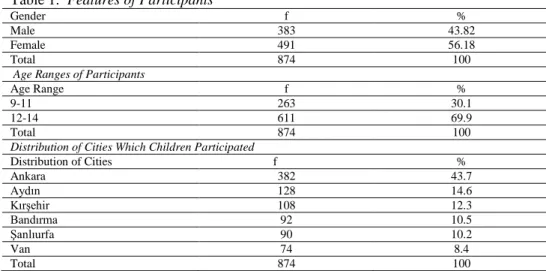
1044 children who participated were from 9 to 14 years old. A total of 874 children from 3rd grade to 8th-grade levels were included in the study on a voluntary basis. Children’s rights readiness was started embedding at 3rd grade including life science, social studies, language and literature curricula etc. ( Merey, 2012; Özdemir-Uluç, 2008; Uçuş, 2009). Besides, late elementary grades and secondary grades were able to mean attribution to stimulate children’s rights in the context of metaphors. A few of children who were eligible couldn’t compose appropriate metaphors and a few left empty blanks. The working group of the research was 874 students from schools which were chosen randomly in five different cities. The sample was selected from Turkey State Planning Organization’s Cities Level of Development. Children were from Ankara (Capital, Developed), Aydın (Developed, Western Part), Kırşehir (Average Developed, Mid-east), Bandırma (Developed, Northwestern), Şanlıurfa (Low Developed, Southeastern Part), Van (Low Developed, Eastern Part) and data were collected during the fall semester of 2015-2016 academic year. Survey forms were applied on November 20th, 2015 “World Children’s Rights Day”. Elementary school teachers and social studies teachers disseminated the survey forms after an activity (first activity) that was related to children’s rights and the meaning and importance of World Children’s Rights Day. The activity was developed as a teaching kit by Uçuş’s (2013) PhD thesis and contained a short movie. After teachers showed children movie and implemented the activity, children filled out survey forms and they composed their metaphors. In the survey form, some examples were given about composing metaphors to guide children.
Table 1. Features of Participants
Gender f %
Male 383 43.82
Female 491 56.18
Total 874 100
Age Ranges of Participants
Age Range f %
9-11 263 30.1
12-14 611 69.9
Total 874 100
Distribution of Cities Which Children Participated
Distribution of Cities f % Ankara 382 43.7 Aydın 128 14.6 Kırşehir 108 12.3 Bandırma 92 10.5 Şanlıurfa 90 10.2 Van 74 8.4 Total 874 100
Survey forms named by numbers to reach participants easily in terms of the city, school, class. Interviews were conducted with 45 children in person (Ankara, Kırşehir, Aydın) and virtual (Bandırma, Şanlıurfa, Van) randomly.Virtual interviews were preferred to access participants easily and in favor of participants’ expressing freely.
Data Collection
Sources of data in phenomenological research studies are those who live the phenomenon the study focuses on and are composed of the individuals or groups who will be able to externalize this phenomenon (Yıldırım & Şimşek, 2006). A semi-structured interview form composed of two sections was used. While demographic features about the participants were queried in the first section, the question “Children’s Rights is like ………; because ………, If children’s rights were a color/fruit/ cartoons/cartoon characters” has been directed to the participants in order to gather the metaphors about lifelong learning. By presenting the question in the data collection tool in a way that allows having more than one answer, the researchers aimed at reaching all metaphors that relate to the concept of children’s rights.
In the analysis of the interview data, emerging themes were investigated based on the research questions posed (Miles & Huberman, 1994). The findings along with exemplary quotes to support the metaphor analysis from the interview was represented in the next section. Semi-structured interviews were conducted regarding metaphors composed by children, opinions and comments on the general distribution of metaphors, frequently metaphors and why they chose theirs. The semi-structured interview, which lasted approximately between ten minutes and half an hour, was transcribed. For the purpose of validity check, the participants were given the opportunity to review the transcription. Children were also asked their opinions about interpretations as to whether they reflected their descriptions of their experiences such as “May you tell more about your metaphor and your sentence? / Do you know/have any experience like that to share with me? / How did you associate your metaphor with your personal idea? What is your reason about this
metaphor? Why do you think that?”. Questions were constructed with supportive and extra questions and added new questions after two interviews had conducted for preliminary phase. To ensure trustworthiness, the metaphors stated by the participants were also analyzed using the categories by a second blind researcher and 100% inter-coder reliability was maintained.
Data Analyses
Metaphor analysis is mainly a qualitative data analysis, including analysis of content analysis. It is also seen as a way of analysis, which enables the formation of the quantitative data for systematic stages such as listing, coding, categorizing, labeling of metaphors and percentage agreement. Data were studied with content analysis. In the content analysis the main aim is to reach the concepts and relations which will be able to explain the data gathered. The basic process carried out in content analysis is to bring the data which are similar to one another together in the framework of certain concepts and themes and to interpret them by organizing them in a way that reader can understand (Merriam, 2009; Yıldırım & Şimşek, 2006). An analytic approach was developed that would ensure validity and reliability. The process of analyzing and interpreting metaphors developed by the participants included: (1) determination of metaphors (2) classification of metaphors (3) development of categories (4) ensuring the validity and reliability.
Ensuring Validity and Reliability
Qualitative validity means that researcher checks for the accuracy of the findings by employing certain procedures while qualitative reliability indicates that the researcher’s approach is consistent across different researchers and different project (Gibbs, 2007, as cited in Creswell, 2014, pg. 201). The approach to data analysis is to triangulate different data sources of information by examining evidence from the sources and using it to build a coherent justification for themes. If themes are established based on converging several sources of data or perspectives from participants, then this process can be considered to add to the validity of the study (Creswell, 2014, pg. 201).
Cross-check codes developed by different researchers independently composed so as to compare results. Miles and Huberman (1994) recommended that consistency of the coding be in agreement at least 80% of the time for good qualitative reliability. The other validation of trustworthiness of the data is “Triangulation” or the use of multiple methods. Creswell (2013) defined triangulation process as “corroborating evidence from different sources to shed light on a theme or perspective” (pg.251). Two types of data collection
were used as tools; interviews and document analysis. Besides triangulation of the
data, member checking was employed, which means that the researcher lets participants review the credibility of finding and interpretations of themes (Creswell, 2013). Another colleague did a blind review of the data in the department to review a few of the transcripts and author’s interpretations of the data to determine consistency.
FINDING
Table 2. Children’s Answers Related to Preliminary Question about CRC
Have you ever heard about CRC? Boy f Girl f Age 9-11 f Age 12-14 f Ankara f Aydın f Bandırma f Van f Ş.Urfa f Kırşe hir f Yes 199 301 218 307 311 120 61 24 30 45 No 184 190 45 304 71 8 31 66 44 63 Total 383 491 263 611 382 128 92 90 74 108 If the answer is YES, tell about how you heard
Boy f Girl f Age 9-11 f Age 12-14 f Ankara f Aydın f Bandırma f Van f Ş.Urfa F Kırşe hir f Textbooks/ Children’s Books 54 53 30 73 34 31 20 4 1 17 Child Friendly City Project 11 81 -- 99 99 -- - -- -- - Elementary School Teachers 35 63 86 12 45 25 14 -- 14 11 Television 55 32 29 58 4 35 16 15 2 15 Newspapers 22 47 34 35 55 13 1 -- -- 1 UNICEF 9 17 2 24 8 9 8 -- -- 1 Social Studies Teachers 11 1 -- 12 7 2 3 -- -- -- Missing 2 6 37 24 59 5 2 5 13 -- Total 199 301 218 307 311 120 61 24 30 45
In the survey form, children were asked whether they had heard about CRC and how they had heard about it before metaphors’ inquiring. Table 4 shows that a reasonable portion of the children (Boys: 199, Girls: 301, Age 9-11: 218, Age 12-14: 307, Ankara: 311, Aydın: 120, Bandırma: 61, Van: 24, Şanlıurfa: 30, Kırşehir: 45 respectively in terms of gender, age, cities) had awareness of the CRC. Even though, a reasonable portion of children left questions unanswered, missing numbers were embedded. They learnt CRC and reached the information from textbooks/ children books (f: 103), Child-Friendly City Project (f: 99), elementary school teachers (98), television (f:87), newspapers (f: 69), UNICEF (f: 26), social studies teachers (f: 12) respectively. Child-Friendly City project was conducted in Ankara as a local project on behalf of Ankara Governship (Tosun et al., 2014).
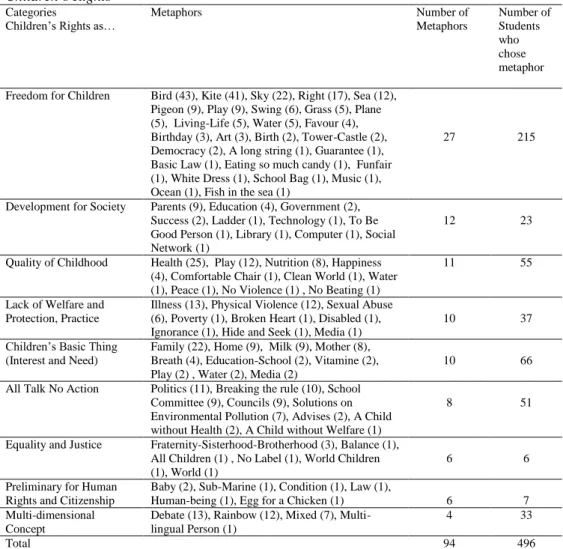
Table 3. The Categories of the Metaphors those Children Compose on the Concept of Children’s Rights
Categories
Children’s Rights as…
Metaphors Number of Metaphors Number of Students who chose metaphor
Freedom for Children Bird (43), Kite (41), Sky (22), Right (17), Sea (12), Pigeon (9), Play (9), Swing (6), Grass (5), Plane (5), Living-Life (5), Water (5), Favour (4), Birthday (3), Art (3), Birth (2), Tower-Castle (2), Democracy (2), A long string (1), Guarantee (1), Basic Law (1), Eating so much candy (1), Funfair (1), White Dress (1), School Bag (1), Music (1), Ocean (1), Fish in the sea (1)
27 215
Development for Society Parents (9), Education (4), Government (2), Success (2), Ladder (1), Technology (1), To Be Good Person (1), Library (1), Computer (1), Social Network (1)
12 23
Quality of Childhood Health (25), Play (12), Nutrition (8), Happiness (4), Comfortable Chair (1), Clean World (1), Water (1), Peace (1), No Violence (1) , No Beating (1)
11 55
Lack of Welfare and Protection, Practice
Illness (13), Physical Violence (12), Sexual Abuse (6), Poverty (1), Broken Heart (1), Disabled (1), Ignorance (1), Hide and Seek (1), Media (1)
10 37
Children’s Basic Thing (Interest and Need)
Family (22), Home (9), Milk (9), Mother (8), Breath (4), Education-School (2), Vitamine (2), Play (2) , Water (2), Media (2)
10 66
All Talk No Action Politics (11), Breaking the rule (10), School Committee (9), Councils (9), Solutions on Environmental Pollution (7), Advises (2), A Child without Health (2), A Child without Welfare (1)
8 51
Equality and Justice Fraternity-Sisterhood-Brotherhood (3), Balance (1), All Children (1) , No Label (1), World Children (1), World (1)
6 6
Preliminary for Human Rights and Citizenship
Baby (2), Sub-Marine (1), Condition (1), Law (1),
Human-being (1), Egg for a Chicken (1) 6 7
Multi-dimensional Concept
Debate (13), Rainbow (12), Mixed (7), Multi-lingual Person (1)
4 33
Total 94 496
Freedom for Children: A majority of children composed metaphors that pertained to “Freedom for Children” and they stated the main construct of children’s rights is respecting freedoms and accepting freedom as a basic need. They also defined it as freedom of thought and speech. The most commonly used metaphors were “ Bird”, “Kite”, “Sky” within this category. Some children’s views about this category are as follows:
“If there is freedom for children in a country, of course, rights are with all children in this country.” (Age 11, Girl, Aydın)
“If someone provides a freedom speech for a child, she/ he can already have her/ his rights.” (Age 13, Boy, Ankara)
Development for Society: A particular part of children agreed on “ Development for Society” category. Most frequent metaphors related to this category were “ Parents”, “Education”, “Government”, “Sucess”. Children reasons’ within this category fell into two subcategories. Firstly, they agreed that informing children about rights provides a country a modern and developed perspective. Secondly, they thought that if countries have children’s rights legislation and child-friendly implementations, rights can be developed. Two examples for this category are as follows:
“Education is a right for a child and is an essential right. Education is related to the development of a country or a region.” (Age 12, Girl, Kırşehir)
“ Happy children, happy life. It is not possible for low-income countries and regions. I am so sorry children in poverty.” (Age 10, Boy, Kırşehir)
The Quality of Childhood: An another particular portion of children composed metaphors regarding on child care and welfare quality. The metaphors most commonly used were “Health”, “Play”, “Nutrition ”. Some children explanations were as follows:
“Children deserve and live a healthy life and peaceful world. Services (food, love, health, respect) are very important for children.” (Age 10, Girl, Van)
“The more attention and respect to children’s opinions make children happier.” (Age 9, Boy, Ankara)
Lack of Welfare, Protection, Practice: Children composed metaphors pertaining to “Lack of Welfare, Protection, Practice” and they pointed out that there are shortages and some important issues affect children which include child' abuse, ignorance of children’s rights and child participation and abuse from media. “Illness”,”Physical”, “Violence”, “Poverty” were most used metaphors for this category. Some children’s opinions about this category are as follows:
“Children don’t know their rights very well. That’s why they can’t defense themselves against bad people or horrible events. We learn from media, there are many bad news and behaviors which children were exposed.” (Age 10, Boy, Şanlıurfa)
“I have just learned World Children’s Rights Day today. I haven’t heard it before. However, we don’t learn our rights in the school. I think, our teachers don’t even know about children’s rights well or they don’t care.” (Age 13,Girl, Aydın) Children’s Basic Thing (Need and Interest): Children emphasized mostly their needs and interests. They mostly visualized “Family”, “Home”, “Milk” in this category. They agreed the right of a child is a basic requirement. They emphasized that children’s rights cover all aspects of welfare for a child. Some of the children’s statements regarding this category are as follows:
“Family is the important and essential thing for a kid. If children live in a happy family. Of course, they will think their rights in a safe.” (Age 11,Boy, Van)
“Children and their parents firstly think about their physical needs. Others parts of children’s rights are still so-called. Thus, if children don’t eat or sleep very well. They will be ignored in especially low-income families, homeless children, Eastern part of Turkey in terms of bad weather conditions etc.” (Age 11,Boy, Van)
All Talk No Action: Children mostly indicated their metaphors such as “Politics”, “Breaking the rule”, “School Committee”. They pointed out that there weren’t enough practices for children. They also stated that people and governments don’t care about children’s rights education and implementations when it comes practice. Some of the children’s statements regarding this category are as follows:
“Everybody knows children’s rights, UNICEF etc… However when it comes to do something for children, they‘re left off.” (Age 13,Boy, Kırşehir)
“I observed some adults and some teachers even some children from my neighborhood. they talk big, they don’t do anything.” (Girl 13, Boy, Kırşehir) Equality and Justice: They stated that rights cover all things for children equally. They composed some metaphors “ Sisterhood-Brotherhood-Fraternity”. Two of children’s statements are as following:
“We are equal. Children black or white, from any nationality… No matter what happens children have to be thought in a same way.” ( Age 10,Girl, Kırşehir) “Child is the core and pure of a human. Children are grown up to have good human-being by their parents and teachers.” ( Age 14,Boy, Ankara)
Preliminary for Human Rights, Citizenship: Children visualized the right that birth provides for human rights and as a basic thing for human rights. In addition, they pointed that the constructs support preparing for active citizenship. They ranged their metaphors in categories such as “Baby”, “Sub-Marine”, “Condition, Law”, “Human-being”.Two of statements are as following:
“Children’s rights contain some steps to be a human.” (Age 10,Girl, Şanlıurfa) “It evolves out of human rights.” (Age 14,Girl, Ankara)
Multi-dimensional Concept: Children in the sample mainly agreed on several points of view, diversity of children’s rights, some controversial topics (rights and responsibilities) in this category. Their metaphors were “Debate”, “Rainbow”, “Mixed”. Some children views about this category as follows:
“Teachers only pay attention to teaching us our responsibilities since early grades. I don’t know what is the differences and limitations.” (Age 14,Girl, Ankara)
“There are many children’s rights. Many children know some basic rights like education, play… Children need to have deep knowledge and conscious.” (Age 11,Boy, Ankara)
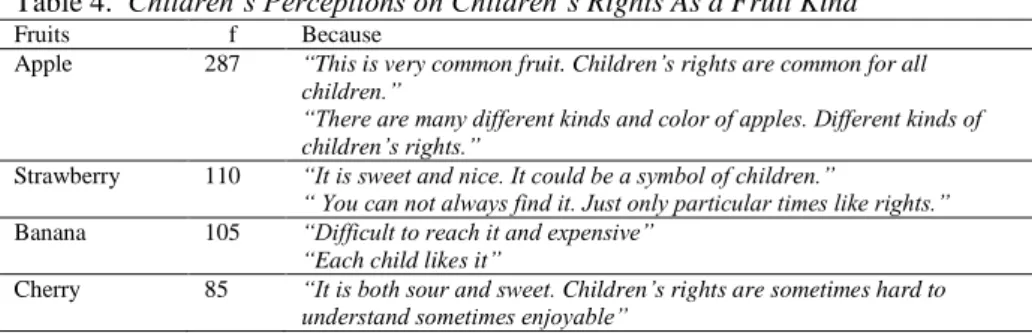
Table 4. Children’s Perceptions on Children’s Rights As a Fruit Kind Fruits f Because
Apple 287 “This is very common fruit. Children’s rights are common for all children.”
“There are many different kinds and color of apples. Different kinds of children’s rights.”
Strawberry 110 “It is sweet and nice. It could be a symbol of children.”
“ You can not always find it. Just only particular times like rights.” Banana 105 “Difficult to reach it and expensive”
“Each child likes it”
Cherry 85 “It is both sour and sweet. Children’s rights are sometimes hard to understand sometimes enjoyable”
“It is difficult to grow up and collect it from the tree.” Grape 93 “It gives a big pleasure while I am eating. I can’t stop myself.”
“ It could be wormy sometimes. So You must be careful while you are eating.”
Pomegranate 82 “ It is difficult to eat. There are some difficulties to practice children’s rights.”
“Mess with clothes. Like misusing of rights.” Mandarin 23 “When you peel it, you can reach the core.”
“ There are many slices. Think about many slices as children. Children’s rights are for all children.”
Peach 13 “You need the struggle to peel it. A right is a struggle to use.” “You need to do something as usual.”
Pineapple 5 “The cover is very stiff. So you should make so much effort to eat the inner of pineapple.”
“You need a material to break the cover. After that, you eat delicious piece. Children’s rights are always full of actions and risks.” All Fruits 3 “We must eat all fruits. All of them are useful. All children in the World
have same language and same idea on it.”
“All fruits are for children to be healthy and powerful like rights.”
Table 4 shows that participant children usually used “Apple”, “Strawberry”, “Banana” metaphors with their reasons. They have some reasons for “Apple” in terms of a common sense for all children, many different kinds of apples representing the diversity of children; for “Strawberry” and “Banana” symboling of children and children’s rights in terms of sweet, difficulties in reaching all rights. Children were asked for their reasons about top rated fruit metaphors that Some of the children’s reasons for these fruits are as below:
“Apple means holistic reason so that all children must be thought together. There are many different kinds of apples. We call the ‘apple’ without discriminating in terms of color. No white child, no black child…” (Age 10, Girl, Ankara)
“Strawberry is sweet so it may represent joy for children. Strawberry was used for different kind of purposes such as birthday cake, smooth, candy. Children’s rights have flexibility and diversity regarding using rights.” (Age 11, Girl, Bandırma). “Banana is very expensive in the store. Parents may not afford to buy it for their children every week. That is the similarity. We may sometimes afford to use our rights. Sometimes it is not possible. This is tricky.” (Age 14, Boy, Ankara)
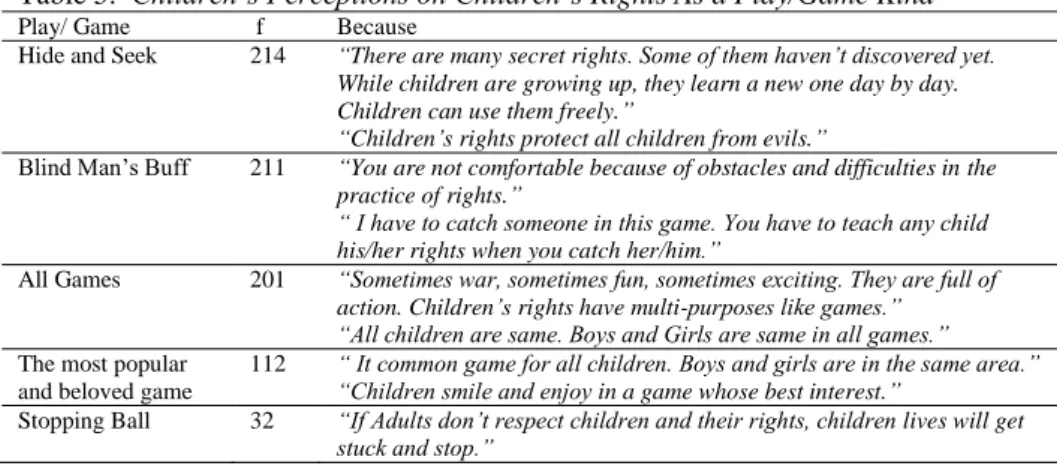
Table 5. Children’s Perceptions on Children’s Rights As a Play/Game Kind
Play/ Game f Because
Hide and Seek 214 “There are many secret rights. Some of them haven’t discovered yet. While children are growing up, they learn a new one day by day. Children can use them freely.”
“Children’s rights protect all children from evils.”
Blind Man’s Buff 211 “You are not comfortable because of obstacles and difficulties in the practice of rights.”
“ I have to catch someone in this game. You have to teach any child his/her rights when you catch her/him.”
All Games 201 “Sometimes war, sometimes fun, sometimes exciting. They are full of action. Children’s rights have multi-purposes like games.” “All children are same. Boys and Girls are same in all games.” The most popular
and beloved game
112 “ It common game for all children. Boys and girls are in the same area.” “Children smile and enjoy in a game whose best interest.”
Stopping Ball 32 “If Adults don’t respect children and their rights, children lives will get stuck and stop.”
“ When children encounter different abuse and neglects, all things stop.” “Listen Listen
Think”
17 “When we hold our hands, we protect our rights with their own hands.” “When we form a circle by holding hands, that is the important note to be cooperative and collaborative for our rights”
Football 14 “It is possible to create a brotherhood, sharing something.” “ Children’s rights have their own rules and regulations like football” Jacks 7 “It is amusing and funny.”
“It cares motivation and patience like the implementation of rights.” Board Games 6 “ They are exciting and competitive”
“ Wee need to make an effort.”
Chess 6 “It is complicated mental activity. Children’s rights need to be established on deep thinking skills.”
“ First you think very well after that you should take an action.” Jigsaw 6 “It is a combination of many pieces. Children’s rights are also a
combination of many rights such as education, the right of play etc.” “ It takes to solve so many times.”
Three Card Monte 4 “Someone could cheat you so you have to be careful.” “ I have to develop myself while I am playing.”
“There are many misuses on children’s rights. Adults don’t care children interests. They only think themselves”
Tug of War 3 “Power and weakness are in the same line.” “There some conflicts on children freedoms.”
Duck duck gooses 3 “It is easy to play If you know it. If you don’t know your rights, you can’t claim any demand”
“ Smooth and peaceful organization.”
Mother-play 1 “ A child needs a peaceful and healthy environment.” Dodgeball 1 “ Pay more attention and active play”
Jumping Rope 1 “You need to be active. The more exercise the more care. Government and adults need to practice on children’s needs.
Running 1 “You are completely free. You can do it”
Table 5 explains that children used “Hide and Seek”, “Blind Man’s Buff” and “All Games” metaphors underbenath children’s rights as a play/game kind. They ranged their reasons from not being familiar with rights, notifying troubles and obstacles on children’s rights, to common facts for all children. Some children’s explanations about these were at follows:
“Children aren’t able to choose only one game. All games represent childhood and all children like to play. Thus I believe that they pointed out all games.” (Age 11, Boy, Kırşehir)
“They may choose Hide and Seek because of features of the game, based on hiding and looking for someone. There are many children’s rights which haven’t been familiar yet by children. We are still discovering them with caring no mind on genders. It is common voice for children.” (Age 13, Boy, Ankara)
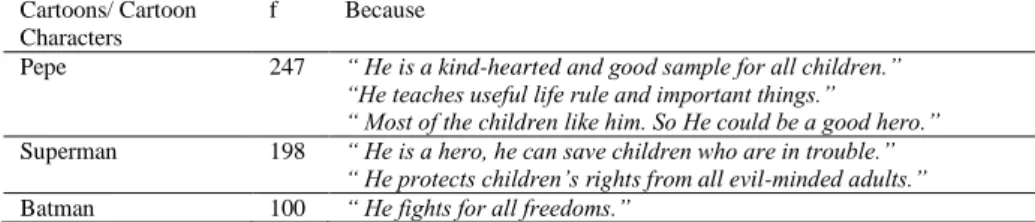
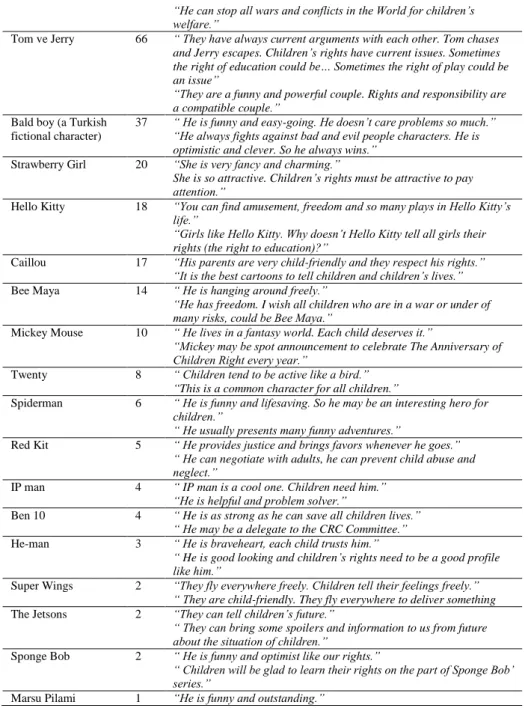
Table 6. Children’s Perceptions on Children’s Rights As Cartoons/ Cartoon Characters
Cartoons/ Cartoon Characters
f Because
Pepe 247 “ He is a kind-hearted and good sample for all children.” “He teaches useful life rule and important things.”
“ Most of the children like him. So He could be a good hero.” Superman 198 “ He is a hero, he can save children who are in trouble.”
“ He protects children’s rights from all evil-minded adults.” Batman 100 “ He fights for all freedoms.”
“He can stop all wars and conflicts in the World for children’s welfare.”
Tom ve Jerry 66 “ They have always current arguments with each other. Tom chases and Jerry escapes. Children’s rights have current issues. Sometimes the right of education could be… Sometimes the right of play could be an issue”
“They are a funny and powerful couple. Rights and responsibility are a compatible couple.”
Bald boy (a Turkish fictional character)
37 “ He is funny and easy-going. He doesn’t care problems so much.” “He always fights against bad and evil people characters. He is optimistic and clever. So he always wins.”
Strawberry Girl 20 “She is very fancy and charming.”
She is so attractive. Children’s rights must be attractive to pay attention.”
Hello Kitty 18 “You can find amusement, freedom and so many plays in Hello Kitty’s life.”
“Girls like Hello Kitty. Why doesn’t Hello Kitty tell all girls their rights (the right to education)?”
Caillou 17 “His parents are very child-friendly and they respect his rights.” “It is the best cartoons to tell children and children’s lives.” Bee Maya 14 “ He is hanging around freely.”
“He has freedom. I wish all children who are in a war or under of many risks, could be Bee Maya.”
Mickey Mouse 10 “ He lives in a fantasy world. Each child deserves it.”
“Mickey may be spot announcement to celebrate The Anniversary of Children Right every year.”
Twenty 8 “ Children tend to be active like a bird.” “This is a common character for all children.”
Spiderman 6 “ He is funny and lifesaving. So he may be an interesting hero for children.”
“ He usually presents many funny adventures.”
Red Kit 5 “ He provides justice and brings favors whenever he goes.” “ He can negotiate with adults, he can prevent child abuse and neglect.”
IP man 4 “ IP man is a cool one. Children need him.” “He is helpful and problem solver.”
Ben 10 4 “ He is as strong as he can save all children lives.” “ He may be a delegate to the CRC Committee.” He-man 3 “ He is braveheart, each child trusts him.”
“ He is good looking and children’s rights need to be a good profile like him.”
Super Wings 2 “They fly everywhere freely. Children tell their feelings freely.” “ They are child-friendly. They fly everywhere to deliver something The Jetsons 2 “They can tell children’s future.”
“ They can bring some spoilers and information to us from future about the situation of children.”
Sponge Bob 2 “ He is funny and optimist like our rights.”
“ Children will be glad to learn their rights on the part of Sponge Bob’ series.”
Marsu Pilami 1 “He is funny and outstanding.”
Table 6 stated that “Pepe”, “Superman”, “Batman” metaphors were mostly used by children. They used these metaphors for some reasons on behalf of helping, saving and supporting children’s rights, being a good and popular hero or character. Some of the the children’s statements from interviews are as follows:
“Children may have chosen ‘Pepe’ as a good sample. His parents are nice, child-friendly. He teaches some useful and helpful information about school and life and uses his rights freely. I believe; lots of children watch Pepe very often. My metaphor was also Pepe. Children’s rights need to have a hero who only works for children. Because of that, children chose them.” (Age 10, Girl, Bandırma)
“When I thought of cartoons or some characters…Mickey, Sponge Bob, Twetty. They really funny. Amusement is the important thing for me. So my metaphor was Sponge Bob. I think, it is important for all children, everywhere in the world. Africa, Somali, Europe, USA…” (Age 13, Girl, Ankara)
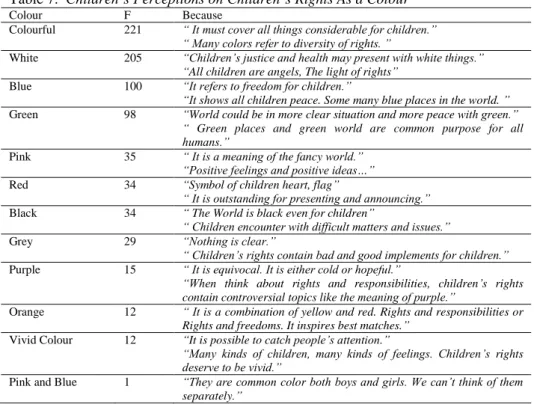
Table 7. Children’s Perceptions on Children’s Rights As a Colour
Colour F Because
Colourful 221 “ It must cover all things considerable for children.” “ Many colors refer to diversity of rights. ”
White 205 “Children’s justice and health may present with white things.” “All children are angels, The light of rights”
Blue 100 “It refers to freedom for children.”
“It shows all children peace. Some many blue places in the world. ” Green 98 “World could be in more clear situation and more peace with green.”
“ Green places and green world are common purpose for all humans.”
Pink 35 “ It is a meaning of the fancy world.” “Positive feelings and positive ideas…” Red 34 “Symbol of children heart, flag”
“ It is outstanding for presenting and announcing.” Black 34 “ The World is black even for children”
“ Children encounter with difficult matters and issues.”
Grey 29 “Nothing is clear.”
“ Children’s rights contain bad and good implements for children.” Purple 15 “ It is equivocal. It is either cold or hopeful.”
“When think about rights and responsibilities, children’s rights contain controversial topics like the meaning of purple.”
Orange 12 “ It is a combination of yellow and red. Rights and responsibilities or Rights and freedoms. It inspires best matches.”
Vivid Colour 12 “It is possible to catch people’s attention.”
“Many kinds of children, many kinds of feelings. Children’s rights deserve to be vivid.”
Pink and Blue 1 “They are common color both boys and girls. We can’t think of them separately.”
“Colourful”, “White” and “Blue” were commonly used metaphors. They used these metaphors on behalf of using rights freely, diversity of rights, child’s innocence. According to some children opinions, children reasons’ can be explained as follows:
“All colors are acceptable for children. Each color present a particular right. Children use their rights freely. Otherwise ‘White’ is a fairy color for children. It inspires happiness, love and protection.” (Age 10, Girl, Aydın)
“ I chose the blue. According to me, blue calls the freedom for children. I like blue. ” (Age 11, Boy, Şanlıurfa)
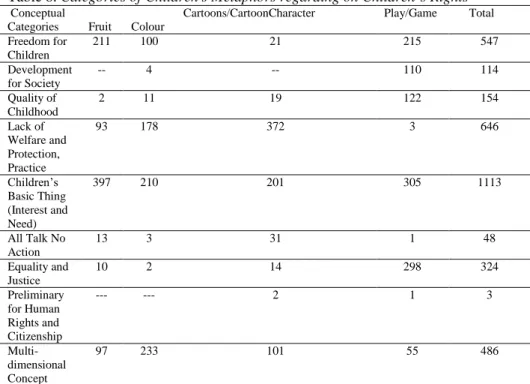
Table 8. Categories of Children's Metaphors regarding on Children’s Rights Conceptual
Categories Fruit Colour
Cartoons/CartoonCharacter Play/Game Total
Freedom for Children 211 100 21 215 547 Development for Society -- 4 -- 110 114 Quality of Childhood 2 11 19 122 154 Lack of Welfare and Protection, Practice 93 178 372 3 646 Children’s Basic Thing (Interest and Need) 397 210 201 305 1113 All Talk No Action 13 3 31 1 48 Equality and Justice 10 2 14 298 324 Preliminary for Human Rights and Citizenship --- --- 2 1 3 Multi-dimensional Concept 97 233 101 55 486
Table 8 explains that “Children’s Basic Thing (Interest and Need)”, “Lack of Welfare and Protection, Practice”, “Freedom for Children”, “Multidimensional Concept” categories came into prominence related to children’s rights. “Children’s Basic Thing (Interest and Need)” category was stated under the name of fruit and play or game, “Lack of Welfare and Protection, Practice” categories were stated under the name of Cartoon and Cartoon Character, “Multidimensional Concept” was stated under the name of Colour. The reasonable part of children composed their metaphors under the name of “Equality and Justice” and “Development for Society” categories.
Table 9. The First Three Things That Comes to Mind on Children’s Rights
Most Frequently Used F Most Frequently Used F
Freedom 293 The meaning of life for a child 1
Peace 91 Housing Right 8
Love 87 The right of identity 3
Respect 70 Nurturing 2
Children’s Demands 59 Teacher 1
Ideas 47 Respect all children 5
Dreams 22 The right of health 5
Future 18 Running 2
Game /Play 17 Life 3
World 10 Equality for all children 7
Warm Family 10 Opportunities for children 11
Universal 11 Special area for children 7
Education 47 War 3
Protection (Abuse and Neglect) 45 Violence 22
Live 11 Basic law/ constitution 1
School 9 The World without adults 1
Art 5 Children’s World 1
Having Fun/ Amusement 5 Basic needs 9
Sports 2 Children’s best interests 5
Learning 2 Children’s all likes 4
Child Friendly 1 Children Welfare/ Human Welfare 1
Children were asked for the first three things comes to mind. Table 9 explains that “Freedom”, “Peace” and “Love” were most commonly stated words. They also stated “Respect”, “Children’s Demands”, “Ideas”, “Dreams”, “Informing”, “Education”, “Protection (Abuse and Neglect)”, “ Violence” reasonably. Some reasons why they wrote these metaphors mostly are as below:
“I have to think all brothers and sisters in the world. If every child has his/her own freedom, children’s rights are being implemented, indeed. I often feel upset about children in war, children who live in different regions without their welfare (poverty and happy being). That’s why children told you freedom and peace.” (Age 13, Girl, Aydın)
“If Adults start to love and pay mind all children, that will be starting point for children’s rights. They need freedom (especially freedom of speech, safety, play outdoor), peace (no war/terrorism), love (no discrimination and segregation). I think they wrote these words because of that.” (Age 12, Boy, Van)
DISCUSSION
As a result of the study, it revealed out that children were aware of children’s rights; they were able to produce 496 valid metaphors about children’s rights. These metaphors were collected under nine different conceptual categories in terms of common features, and they focused on both promoting positive rights and protecting children from negative events. This study, as has been true for others (Saban, 2004; Saban 2008), demonstrates that metaphor can be used as a powerful research tool in understanding and explaining personal perceptions of children, with implications for teaching the concept of child rights and other concepts. Most children have an awareness of The CRC. They indicated textbooks/ children books (f: 103), Child-Friendly City Project (f: 99), elementary school teachers (98), television (f:87), newspapers (f: 69), UNICEF (f: 26), social studies teachers (f: 12) respectively.Textbooks, children’s books and local projects may be effective and noteworthy strategies to reach the children to create awaranesses on their own rights and freedoms as previous researches mostly focused on these aspects and dynamics (Karaman-Kepenekçi, 2010; Karaman-Kepenekci& Aslan, 2011; Nayir& Karaman-(Karaman-Kepenekçi, 2011; Tosun et al., 2014; Turkyilmaz& Kus, 2014). These findings were contrary to with Taylor and his friends (2001) research. They inquired children knowledge about children’s rights and they reached a point that most of the children hadn’t heard about CRC, teachers and TV were a source of information for children (Taylor et al., 2001). They also pointed out that children’s rights education was a must for adults and children in parent or adult education of individuals who work with children closely. When it comes to children’s rights
education for children, curricula (especially social studies curriculum), teachers and media are all avenues. Contrary to this, Akengin’s (2008) comparative research results regarding children's perceptions of the child rights in the Turkish community of Turkey and Northern Cyprus indicated that children are not aware of their rights in general; that while most of the children in Turkey have read the CRC, more; but those students in Turkey trust their families more compared to students in the Northern Cyprus that their families would think better while they were making decisions in matters concerning themselves. Families and teachers have important roles in constructing the concept of children’s rights for children in the current study finding. In that sense, this point has a coincidence with Akengin’s (2008) research. In this study textbooks, teacher’s components for children’s rights education refer to curricula and educating children for their rights. They can easily reach children so as to improve children’s awareness and knowledge (Howe & Covell, 2005; Merey, 2012; Özdemir-Uluç, 2008; Uçuş, 2009).
In the current study, nine different topics emerged including “Freedom for Children, Development for Society, Quality of Childhood, Lack of Welfare and Protection, Practice, Children’s Basic Thing (Interest and Need), All Talk No Action, Equality and Justice, Preliminary for Human Rights and Citizenship, Multidimensional Concept”. However, in fact “All Talk No Action, Equality and Justice, Preliminary for Human Rights and Citizenship, Multidimensional Concept” categories weren’t used commonly by the participants. So, as children have few variety of different and reasonable perceptions of the conception of children’s rights, it is worth bearing in mind that children’s rights have a noteworthy and remain limited dynamics and discipline in terms of content on children’s perceptions. Furthermore, it was seen that children used “freedom, peace, love” concepts often as the three words that first come to their mind. So, based on these words it is understood that children have positive perceptions on children’s rights. However, a minority of children had negative perceptions related to difficulties in implementing, or regard to children’s rights, adults’ and authorities’’ paying no mind. Aydın’s (2007) research which included to 5th grade and 8th-grade students’ perceptions on “right” and “responsibilities” was conducted in a similar manner to the current research. In that study, many of the children explained “the concept of right” as the freedom. They also indicated rights of statues passive (health, education etc.) rather than rights of statues activus (participation). Children perceptions had a similar right of statues in this research (as cited in Özdemir-Uluç, 2008).
The children’s negative views were about implementing, regulations and awareness of children’s rights. Implementing children’s rights education has long been a critical matter for Turkish education system. Teacher training, curricula, education for freedoms in the name of holistic children’s rights education have a great role from early childhood to higher education. Also, a new perspective in teacher regulations, programs and revision are necessary. According to Melton (1980), Males-Stricevic (2001), Howe and Covell (2005) children rights education must be started in elementary grades and they have a common agreement on creating awareness in elementary grades and then continuing with the philosophical construct and getting depth knowledge in the following grades. Zarillo (2004) also pointed out children who are in elementary grades, must learn how and why rules and law establish, why they need obligations in communal living (school, classroom, local communities) in the level of national and universal. Another point that, Merey and Kuş
(2016) also stated that children’s right education had a better start in early childhood education in UNESCO regulations and suggestions. Particular children’s rights education could be implemented between ages 7-10 and ages 8-11. They also suggested self- being with senses, self-awareness for early childhood education, rights in a holistic approach, how to protect rights and ways of protection and defense about rights in order to improve defensing of rights.
Metaphors are conceptual imageries related to a case, fact or a concept. Use of metaphors, constructors demonstrate an individuals’ depth of experience and knowledge. If a participant doesn’t construct a metaphor related to the topic particularly, it suggests that she/he doesn’t make sense of the case in her/his mind (Levine, 2005; Eraslan, 2011). When considered from this point of view, children produced unique, some specific concept-based and limited metaphors. Use of metaphor technique may have been the first time children used metaphors, thus, their metaphors were slight. Nevertheless, the current study suggests regarding children’s rights.
Taking children’s opinion by inquiring mental images may reveal out different points of views on the children’s rights approach in daily life, experiences in different areas and educational practice for raising awareness of the provisions, empowering children rights-based approach and building the capacity of children (as rights-holders).
Metaphors may be used in order to find out, interpret perceptions and explain children’s and people’s who are related to children experiences and beliefs. Besides, metaphor analysis may be helpful to reveal alternative concepts and trends about children’s rights.
Getting a rigorous data about rights of children from children may support accurate expectations for implication for practice and proposing developments for child welfare and children’s rights.
Evaluating the quality of the childhood studies, educational changes, school
environment, child welfare could be affected from rights of children, so investigating views of children about their rights could be noteworthy to foster high-qualified implications for practice for children. The current study, points out that the metaphors of children for their rights have conceptually embedded implications for theory regarding the practice of rights for children.
With having a broader vision of growing up global and active citizens, the concept
children’s rights may enhance constructing 21st-century skills and global citizenship
education and understanding of vitality of real nature and the purpose of the education in today’s world.
LIMITATIONS and FUTURE RESEARCH
This study has some limitations that should be noted. First, although interviews supported and strengthened this study as a basis for in-depth analysis, a more intensive quantitative strand would be a reasonable way to gather rigorous data. Combination qualitative and quantitative data can create a holistic construct based on mixed methods research for future research on this topic. Secondly, children who were interviewed by this researcher, weren’t in a prolonged engagement. Moreover, the current researcher didn’t have a chance to
interview with children in person in some cities (Van, Şanlıurfa). Thus, she did not spend sufficient time in the field to learn or understand the culture, social setting, or phenomenon of interest which were related to participants. Data were gathered at the one-time point so that it was not possible to understand and explore differences over time ina perceptions on children’s rights. Longitudinal research could be a very feasible way to suggest cause-and-effect relationships.
CONCLUSION
Altogether and briefly, this study makes several contributions including demonstrating: (1) that elementary- aged and secondary-aged children are aware of children’s rights and that they have many sources of information; (2) that a number of metaphorical constructions characterize their understanding, both positive and as prevention of negative experiences; and (3) that use of metaphor is an effective way of giving voice to children’s concepts in this area. According to the findings of the study, metaphors can be used as a powerful research tool in understanding and explaining personal perceptions of children related to teaching concepts (Saban, 2004; Saban, 2008).
REFERENCES
Akengin, H. (2008). A Comparative Study on Children's Perceptions of the Child Rights in The Turkish Community of Turkey and Northern Cyprus. Education, 129 (2). 224-234.
Akyüz, E. (2000). Cocuğun haklarının ve guvenliğinin korunması. Ankara: Milli Eğitim Bakanlığı Yayınları, Bilim ve Kültür Eserleri Dizisi, Milli Eğitim Basımevi.
Akyüz, E. (2001). Çocuk Hakları Sözleşmesinin temel ilkeleri ışığında çocuğun eğitim hakkı. Milli Eğitim Dergisi, 151, 3-24.
Arslan, M.; Bayrakçı, M. (2006). Metaforik düşünme ve öğrenme yaklaşımının eğitim-öğretim açısından incelenmesi. Millî Eğitim Dergisi, 171, 100-108.
Cilga, A.(2001). Cocuk Haklari ve Egitim. Milli Egitim Dergisi, S.151, Temmuz-Agustos-Eylul. Retrieved from http://dhgm.meb.gov.tr/yayimlar/Milli_Egitim_Dergisi.html Cilga, I.(1999). Turkiye’de Cocuk Haklari Calismaları. Cumhuriyet ve Cocuk-2. Ulusal
Cocuk Kulturu Kongresi, (Yay. Haz. Bekir Onur), Ankara: Ankara Univ. Cocuk Kulturu Arastirma ve Uygulama Merkezi Araştırmaları. 2, 506-516.
Covell, K. ve Howe, R. B. (1999). The impact of children’s rights education: A Canadian study. International Journal of Children’s Rights, 7, 171-183.
Covell, K; Howe R.B.; McNeil, J.K. (2008). If there’s a dead rat, don’t leave it’. Young children’s understanding of their citizenship rights and responsibilities. Cambridge Journal of Education 38(3): 321–339.
Creswell, J. W. (2014). Research Design (4th Edition). USA: SAGE Publications.
Creswell, J.W. (2013). Qualitative inquiry and research design: choosing among five approaches. Thousand Oaks, CA: Sage Publications, Ltd.
Çetinkaya, N. (1998). Öğretmen ve öğrencilerin çocuk haklarına bakışlarının değerlendirilmesi. (Master’s thesis, Marmara University, Education Instutie, İstanbul). Retrived from https://tez.yok.gov.tr/UlusalTezMerkezi
Doğan, İ. (2005), Modern toplumda vatandaşlık demokrasi ve insan haklarının kulturel temelleri. Ankara: Pegem Yayıncılık.
Eraslan, L. (2011). Sosyolojik Metaforlar. Akademik Bakış Dergisi. Sayı: 27 Kasım – Aralık Uluslararası Hakemli Sosyal Bilimler E-Dergisi.
Franklin, B. (1986). Cocuk hakları (trans. A. Türker). İstanbul: Ayrıntı Yayınları.
Herczog, M.(2012). Rights of the child and early childhood education and care in Europe. European Journal of Education. 47 ( 4). 542-555.
Howe, R.B. ve Covell, K. (2005). Empowering children: children’s rights education as a pathway to citizenship. University of Toronto Press. Toronto Buffalo London. İnan, A. N. (1995). Çocuk Haklarına Dair Sözleşme. Ankara Universitesi Hukuk Fakultesi
Dergisi, 1 (4), 779-796.
Karaman-Kepenekçi, Y. (2010). Children’s social rights in social studies textbooks in Turkish elementary education. Procedia Social and Behavioral Sciences, 2, 576-581.
Karaman-Kepenekci, Y. ve Aslan, C. (2011). Okulöncesi Döneme Seslenen Kitaplarda Çocuk Hakları. Ankara: Ankara Üniversitesi Basımevi.
Lansdown, G. (1994). Children’s rights. İn Children’s Childhoods: Observed and Experienced Mayall B (ed). Falmer Press: London; 33–45.
Levine, P.M. (2005). Metaphors and Images of Classrooms. (ERIC Document Reproduction Service No: EJ724893).
Lichtman, M. V. (2012). Qualitative Research in Education: A User’s Guide (3rd
Edition). USA: SAGE Publications.
Males, D. ve Stricevic, I. (2001). Knowing and living our rights manual for children’s right education in primary school. Zagreb: Skolska Knjiga.
Margolin, C. R. (1982). A survey of children’s views on their rights. Journal of Clinical Child Psychology, 11(2), 96-100.
Melton, G. B. (1980). Children’s concepts of their rights. Journal of Clinical Child Psychology, 9, 186-190.
Merey, Z. (2012). Children Rights in Social Studies Curricula in Elementary Education: A Comparative Study. Educational Sciences: Theory & Practice, Special Issue Autumn. 3273-3284.
Merey, Z. & Kus, Z. (2016). Demokratik vatandaşlık ve çocuk hakları eğitimi. R. Turan& K. Ulusoy (Ed.) Farklı Yönleriyle Değerler Eğitimi Icinde. (s.243-268). Ankara: Pegem Akademi.
Merriam, S. B. (2009). Qualitative research: A guide to design and implementation. San Francisco: John Wiley and Sons.
Miles, M. B.; Huberman, A. M. (1994). Qualitative data analysis (second press). Thousand Oaks, CA: SAGE Publication.
Nayır, F.; Karaman Kepenekci, Y. (2011). Children’s Participation Rights in Elementary Schools’ Turkish Textbooks Elementary Education Online, İlköğretim Online, 10(1), 160-168, [Online]: http://ilkogretim-online.org.tr.
Özdemir-Uluç, F. (2008). İlkoğretim programında çocuk hakları. ( Doctoral dissertation, Ankara University, Education Instutue,Ankara). Retrived from https://tez.yok.gov.tr/UlusalTezMerkezi
Patton, M. O. (2014). Qualitative Research& Evaluation Methods (Fourth Ed.) USA: Sage Publications.
Polat, O. (2007). Tum boyutlarıyla cocuk istismarı 1. Tanımlar. Ankara: Seçkin Publications.
Quennerstedt, A. (2011). The construction of children’s rights in education –a research synthesis. International Journal of Children’s Rights 19 (2011) 661–678. DOI 10.1163/157181811X570708 brill.nl/chil
Saban, A. (2004). Prospective classroom teachers’ metaphorical images of selves and comparing them to those they have their elementary and cooperating teachers. International Journal of Educational Development, 24, 617-635.
Saban, A. (2008). İlköğretim I. kademe öğretmen ve öğrencilerinin bilgi kavramına ilişkin sahip oldukları zihinsel imgeler. İlköğretim Online, 7(2), 421–455. [Online]: http://ilkogretim-online.org.tr/
Salman-Osmanoğu, Y. (2007). Uşak ili lise son sınıf öğrencilerinin çocuk haklarına ilişkin görüşleri. ( Master’s thesis, Ankara University Education Institute). Ankara. Retrieved from https://tez.yok.gov.tr/UlusalTezMerkezi
Taylor, N.; Smith A.; Nairn, K. (2001). Rights important to young people: Secondary student and staff perspectives”, The International Journal of Children’s Rights, (9), 137-156.
Tosun, Z.D.; Uçuş, Ş.; Demir, F.; Kıranbay, P. (2014). Çocuk dostu Ankara rehber kitabı. İz Yayıncılık: Ankara.
Türkyılmaz, M. ve Kuş, Z. (2014). İlköğretim 100 temel eserde çocuk hakları, Uluslararası Avrasya Sosyal Bilimler Dergisi, 5(15), 39-63.
Uçuş, Ş. (2009). Cocuk Hakları Sozleşmesi’nin ilkoğretim programlarındaki yeri ve sozleşme’ye yonelik oğretmenlerin ve okul yoneticilerinin goruşleri. (Master’s thesis, Hacettepe University Social Science Instuitue, Ankara). Retrived from https://tez.yok.gov.tr/UlusalTezMerkezi
Uçuş, Ş. (2013). Çocuk Hakları Eğitimi Programının Hazırlanması, Uygulanması ve Değerlendirilmesi. (Doctoral Dissertation, Hacettepe University, Education Science Instuitu, Ankara). Retrived from https://tez.yok.gov.tr/UlusalTezMerkezi
UNESCO, (2005). Universal Declaration on Bioethics and Human Rights. Retrieved from http://unesdoc .unesco.org/images/0014/001461/146180E.pdf
Yıldırım, A.; Şimşek, H. (2006). Sosyal bilimlerde nitel araştırma yöntemleri. Ankara: Seçkin Yayıncılık.
Zarillo, J. J. (2004). Teaching Elementary Social Studies. Pearson Merrill Prentice Hall: New Jersey.
Zöğ; D. (2008). Öğrencilerin çocuk haklarını algılama düzeyleri ile akademik başarıları arasındaki ilişki. (Master’s thesis, Beykent Üniversitesi Social Science Instuite, Istanbul). Retrived from https://tez.yok.gov.tr/UlusalTezMerkezi