J
OURNAL OF THEF
ACULTY OFF
ORESTRYI
STANBULU
NIVERSITYİSTANBUL ÜNİVERSİTESİ ORMAN FAKÜLTESİ DERGİSİ ISSN: 0535-8418 e-ISSN: 1309-6257
Online available at / Çevrimiçi erişim Research Article / Araştırma Makalesi http://dergipark.ulakbim.gov.tr/jffiu - http://dx.doi.org/10.17099/jffiu.18327
To cite this article (Atıf): Gülci, N., Akay, A.E., Erdaş, O., Acar, H.H., Wing, M.G., 2016. Controlled sliding of logs downhill by chute system integrated with portable winch and synthetic rope. Journal of
the Faculty of Forestry Istanbul University 66(1): 256-263. DOI: 10.17099/jffiu.18327
Controlled sliding of logs downhill by chute system integrated with
portable winch and synthetic rope
Neşe Gülci 1*, Abdullah E. Akay 2 , Orhan Erdaş 1 , H. Hulusi Acar 3 , Michael G. Wing 4
1* Kahramanmaras Sutcu Imam University, Faculty of Forestry, 46100 Kahramanmaras, Turkey 2 Bursa Technical University, Faculty of Forestry, 16200 Bursa, Turkey
3 Karadeniz Technical University, Faculty of Forestry, 61080 Trabzon, Turkey 4 Oregon State University, College of Forestry, Corvallis, 97331 Oregon, USA
* Corresponding author e-mail (İletişim yazarı e-posta): [email protected]
Received (Geliş tarihi): 30.4.2015 - Revised (Düzeltme tarihi): 27.05.2015 - Accepted (Kabul tarihi): 28.05.2015
Abstract: Over 80% of wood extraction operations have been performed by conventional methods in Turkey. Conventional methods include skidding or sliding of logs mainly by man and animal power, which poses problems in terms of technical, economical, environmental, and ergonomic aspects. Skidding wood on plastic chutes has been implemented in limited numbers of logging applications in recent years, and provides important advantages such as reducing environmental damages and minimizing the value and volume loss of transported wood products. In this study, a chute system integrated with a mobile winch was developed for controlled sliding of large diameter logs downhill. In addition, synthetic ropes rather than steel cables were used to pull log products, resulting in a lower weight and more efficient extraction system. The system was tested on a sample wood production operation in Çınarpınar Forest Enterprise Chief of Kahramanmaraş Forest Enterprise Directorate. In the study, productivity analysis of chute system was performed and its ecological impacts were evaluated. During controlled sliding of logs downhill, the highest productivity (10.01 m3/hour) was reached in the fourth chute system characterized as 36 m in length and 70% ground slope. One of the main factors that affected the productivity of chute system was the controlled sliding time of the logs. It was found that residual stand damage was very limited during controlled sliding operations.
Keywords: Wood production, chute system, economic analysis, ecological effect, mobile winch, synthetic rope
Taşınabilir vinç ve sentetik halat ile entegre oluk sistemi içerisinde odun
hammaddesinin yamaç aşağı kontrollü kaydırılması
Özet: Ülkemizde bölmeden çıkarma çalışmaları %80’in üzerinde geleneksel yöntemlerle yürütülmektedir. Bu metotlar sırasında, insan ve hayvan gücü ile sürüterek, atarak ya da kaydırılarak gerçekleştirilen bölmeden çıkarma çalışmaları, teknik, ekonomik, çevresel ve ergonomik açılardan problemlidir. Son yıllarda sınırlı sayıda uygulanan plastik olukla taşıma sistemi, çevre zararlarının azaltılması yanında, taşınan odun hammaddesindeki değer ve hacim kayıplarının minimumda tutulması gibi önemli faydalar sağlamaktadır. Bu çalışmada, dağlık arazide kalın çaplı odun hammaddesinin yamaç aşağı kontrollü kaydırılması amacı ile taşınabilir vinç ile entegre edilmiş bir oluk sistemi geliştirilmiştir. Ayrıca, sistemin daha hafif olması için mevcut uygulamaların aksine çelik halat değil sentetik halat kullanılmıştır. Sistem, Kahramanmaraş Orman İşletme Müdürlüğü, Çınarpınar İşletme Şefliği sınırları içerisinde örnek bir üretim çalışmasında test edilmiştir. Çalışmada oluk sisteminin verimlilik analizleri gerçekleştirilmiş ve ekolojik etkileri incelenmiştir. Yamaç aşağı kontrollü kaydırmada, en yüksek verim (10,01 m3/saat) 36 m ve %70 eğime sahip 4 no'lu oluk sisteminde bulunmuştur. Oluk sisteminin ortalama verimi üzerinde etkili olan ana faktörlerin başında taşınan odun hammaddelerini kontrollü kaydırma zamanı gelmektedir. Kontrollü kaydırma operasyonlarında kalan ağaç zararının çok sınırlı sayıda kaldığı tespit edilmiştir.
Anahtar Kelimeler: Odun hammaddesi üretimi, oluk sistemi, ekonomik analiz, ekolojik etki, taşınabilir vinç, sentetik halat
1.INTRODUCTION
Due to increasing pressures on the natural resources in last decades, forest resources must be managed in a productive, effective, and sustainable way. In order to meet current and future wood product needs, obtaining optimum productivity from forest resources while ensuring minimum environmental damages through using modern techniques and technological tools is essential (Kovácsová and Antalová, 2010). Production of forest products consists of several key activities: felling, delimbing, bucking, logging, loading, hauling, and storing (Eker and Acar, 2006). These activities can be performed through a variety of alternative methods to attain solutions that are economically and operationally efficient. However, in a case where utilization of modern machinery is low, harvesting operations can be costly and a time consuming activity. In addition, man and animal powered conventional harvesting methods can damage forest ecosystems (Akay et al., 2007).
In terms of utilizing harvesting machinery, manual ground-based harvesting methods integrated with chainsaws, skidders, and farm tractors are commonly employed in most of the forest lands in Turkey. About 10% of Turkish forest products are extracted by using rubber-tired skidders. Modified farm tractors are also widely used during skidding, winching, loading and forwarding operations (Öztürk and Akay, 2007). In mountainous regions with steep slope, a limited number of cable logging applications are implemented and can be found primarily in the northeastern part of Turkey (Türk, 2011). In recent decades, downhill sliding of logs using plastic chute systems has been a productive alternative that reduces production cost, minimizes stand damage, and prevents value loss of wood products (Akay et al., 2013).
In previous studies, chute systems have been generally used to transport logs downhill by gravity. The system generally requires a slope of at least 20% while the logs can slide on slope of below 20% if the chute is wet (Dewar, 1994). The chute system can be used safely between slopes of 20-60% (Engelbrecht and Warkotsch, 1994). However, sliding large logs in chute systems may result in some operational problems especially on steep grounds (Gülci, 2014). A primary difficulty is that large logs can easily jump out of the chute system and damage both the system and surrounding forest stands. Large logs can also accelerate in the chute system and reach very high speeds with the potential to cause significant environmental impacts when reaching the end of the chute system. The uncontrolled movement of logs in stands can also pose serious safety risks for loggers. Previous studies indicated that uncontrolled sliding of logs in chute systems may also cause considerable reductions in economic value of the logs (Gülci, 2014).
In this study, a chute system integrated with mobile winch was developed for controlled sliding of large diameter logs downhill. The system included a synthetic rope rather than a steel cable for log yarding so that the weight of the system was minimized. The system was implemented during a logging operation taking place near Kahramanmaraş, Turkey. In the study, the operational productivity of the chute system and resulting ecological impacts were evaluated.
2. MATERIAL AND METHODS 2.1. Study Area
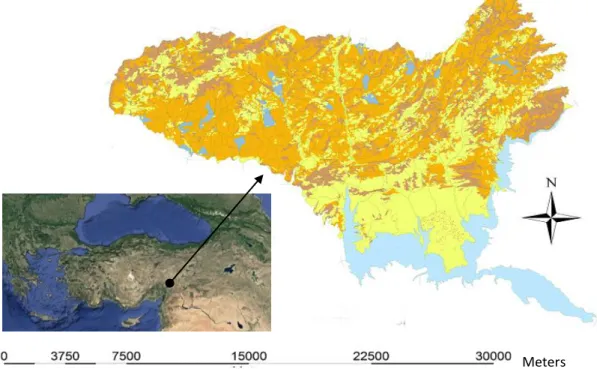
The study area was selected from Çınarpınar Forest Enterprise Chief of Kahramanmaraş Forest Enterprise Directorate at Kahramanmaraş Forest Regional Directorate in Turkey (Figure / Şekil 1). The total area of the Enterprise Chief is 30592 ha with 59% of the area being covered by forest with the dominant tree species being Brutian pine (Pinus brutia Ten.). The average ground slope and elevation was 39% and 672.85 m, respectively. The geographical location of the study area was 37º44’47”-37º32’38”N latitudes and 36º31’50”-36º52’21” longitudes.
2.2. Chute system with portable winch
The chute system consisted of plastic pipes made of polyethylene material which has strong wear and tear resistances (Figure / Şekil 2). Technical configurations of the pipes are listed on Table /Tablo 1. The pipes
(PCW5000) was used for controlled sliding of logs downhill with chute system (Figure / Şekil 3). This winch is able to work effectively up to 100 m skidding distance. Technical specifications of the portable winch are indicated in Table 2.
Figure 1. The study area Şekil 1. Çalışma alanı
Figure 2. Polyethylene pipes used in chute system
Şekil 2. Oluk sisteminde kullanılan polietilen malzemeden üretilmiş boru
Table 1. Technical properties of pipes used in chute system Tablo 1. Oluk sisteminde kullanılan boruların teknik özellikleri Pipe Shape Diameter (mm) Thickness (mm) Length (m) Weight (Kg) Half circle 500 6 6 25 Meters
Figure 3. Fuel powered portable winch Şekil 3. Benzinle çalışan taşınabilir vinç Table 2. Technical specifications of portable winch
Tablo2. Taşınabilir vincin teknik özellikleri Specifications
Engine Honda GXH-50cc
Weight 16 kg
Maximum strength (single line) 1000 kg
(double line) 2000 kg
Minimum rope diameter 10 mm
Maximum rope diameter 20 mm
A portable winch equipped with synthetic rope, chain choker (1.5 m), polyester choker (2 m), metal locks and hooks was used during the logging operation (Figure / Şekil 4). The winch is mounted on a standing tree or a stump by using the polyester choker. The choker setting was done by using a chain choker which is attached by synthetic rope using locks and hooks.
Figure 4. Logging equipment used along with the portable winch Şekil 4. Taşınabilir vinçle birlikte kullanılan malzemeler
2.3. Field Study
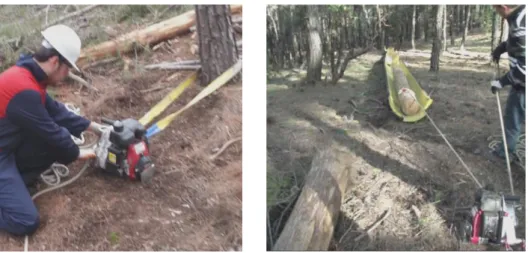
In the field application, controlled downhill sliding of logs within the chute system and portable winch was performed on two slope classes (50% and 70%) and three distance classes (36 m, 48 m, and 60 m). The operational time was observed for a minimum of 30 logs on each chute system. A portable winch was used to establish chute system, which reduced the set-up time during the operation. The main work stages considered in the operational time analysis included carrying a choker to the logs, choker setting, locating log into the chute system, controlled sliding, and releasing the logs from the chokers (Figure / Şekil 5). Setting the chute system up was considered as a secondary work stage, while time spent maintaining the chute system was recorded as an additional work stage. The diameter and length of each transported log
Figure 5. Setting portable winch (left) and controlled sliding of logs (right) in chute system Şekil 5. Taşınabilir vincin kurulumu ve oluk sisteminde tomrukların kontrollü kaydırılması
2.4. Productivity
The productivity of the operation was analyzed based on time study data and log volume. Time study data was collected by a chronometer. The following formulas were used to compute operation productivity with log volume and time cycle data (Gülci, 2014):
𝑝 =𝑉𝑡60 (1)
where,
p = productivity (m3/hr) t = average cycle time (minutes)
60 = coefficient to convert time unit from minutes to hour v = average log volume for each trip (m3)
𝑣 =40000𝜋 𝑑2𝐿 (2) d = mid diameter of log (cm)
L = log length (m)
2.5. Statistical Analysis
Time study data were collected for 30 logs being transported in each of six chute systems with two slope and three distance classes, resulting in a total of 180 measurements for statistical analysis. One-way ANOVA analysis was performed with SPSS® 16.0 statistic software to investigate whether log volumes affect productivity of the operation at a 95% confidence level. The log volumes were regrouped into three classes including low (<0.20 m3), medium (0.20 m3-0.25 m3), and high (>0.25 m3) volume. A Pearson Correlation test was conducted to determine whether statistically significant relationships existed between the dependent and independent variables. Total cycle time (y) was the dependent variable, while log length (x1), diameter (x2), and volume (x3) were independent variables.
3. RESULTS AND DISCUSSIONS 3.1. Field Data and Productivity
Productivity results for each of the six chute systems were recorded and summarized following each of our field tests (Table / Tablo 3). Our primary measure of productivity was expressed as volume by time (m3/hr). The ecological impacts were also assessed following each test. The overall average of log length, diameter,
and volume for the 180 logs was 3.10 m, 31.23 cm, and 0.24 m3, respectively. The average productivity of the chute systems was 7.83 m3/hour.
Results indicated that the highest productivity was provided by the fourth chute system, which had a chute length of 36 m on a 70% ground slope. The productivity of the fourth chute system was m3/hr. The first system was nearly as productive as the fourth at 9.8 m3/hr and featured a chute length of 36 m on a 50% ground slope. Even though the chute length was the same for both chute systems, productivity was likely higher in the fourth system due to higher chute slope, which increased sliding speed of the logs in the system. Similar results were reported by a previous study (Çankal, 2014) where productivity of chute systems increased by steeper chute slope, considering that chute lengths were equal and log volumes were similar.
Table 3. The average values for the parameters of chute systems Tablo 3. Oluk sistemlerine ait parametrelerin ortalama değerleri Chute System Log Length (m) Log Diameter (cm) Log Volume (m3) Chute Length (m) Chute Slope (%) Productivity (m3/hr) 1 3.10 31.47 0.24 36 50 9.88 2 3.08 31.60 0.24 48 50 7.35 3 3.09 31.53 0.24 60 50 6.19 4 3.10 30.93 0.23 36 70 10.01 5 3.10 31.00 0.24 48 70 7.36 6 3.11 30.87 0.23 60 70 6.16
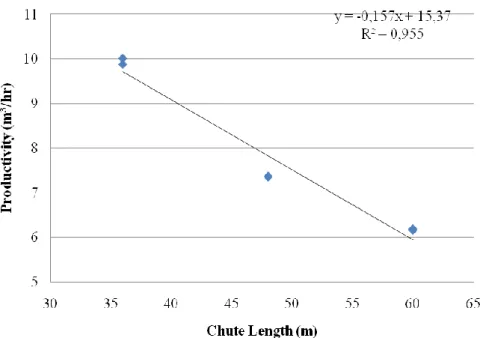
It was witnessed that measured productivity in our study decreased dramatically as chute length decreased. Zarifoğlu (2014) also found that system productivity tends to decrease as chute length increases. Not surprisingly, a strong statistical correlation was found between system productivity and chute length (Figure / Şekil 6).
Figure 6. The relationship between operation productivity (m3/hour) and chute length (m) Şekil 6. Verim ve sistem uzunluğu arasındaki ilişki
It was also found that system productivity was slightly higher in the third chute system in comparison to the sixth chute system. This was likely due to the slightly higher log volume in the third system. A strong correlation between average log volume and system productivity has been reported by previous studies
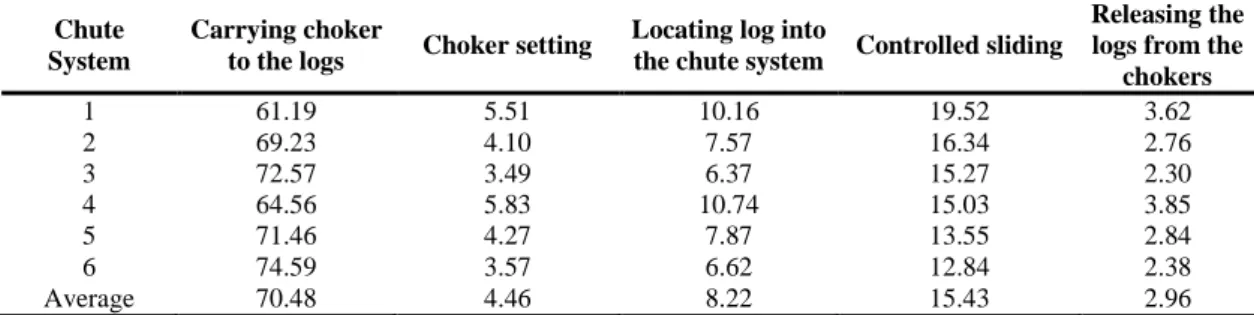
for sliding logs downhill with the chute system (Table / Tablo 4). Results indicated that the most time consuming work stage was carrying the choker to the logs, followed by controlled sliding.
Table 4. The proportion of work stage time requirements as a percentage of total cycle time. Tablo 4. İş aşamalarının toplam zamana göre ortalama yüzde değerleri
Chute System
Carrying choker
to the logs Choker setting
Locating log into
the chute system Controlled sliding
Releasing the logs from the
chokers 1 61.19 5.51 10.16 19.52 3.62 2 69.23 4.10 7.57 16.34 2.76 3 72.57 3.49 6.37 15.27 2.30 4 64.56 5.83 10.74 15.03 3.85 5 71.46 4.27 7.87 13.55 2.84 6 74.59 3.57 6.62 12.84 2.38 Average 70.48 4.46 8.22 15.43 2.96
The effect of log volume classes on productivity was quantified by One-way ANOVA analysis. The results indicated that productivity of the operation was significantly affected by log volume classes (p<0.01). The average productivity increased from low volume class to high volume class.
Statistical analysis results also indicated that there was a significant correlation between total cycle time (y) and log diameter (x1) and log volume (x2) at a 95% confidence level (px1=0.012, px2=0.015, p<0.05). However, it was found that there was no significant relationship (p=0.460, p>0.05) between total cycle time and log length (x3). The results from a previous study reported similar relationships between these parameters (Gülci, 2014).
During field studies, residual stand damage was recorded to evaluate environmental effects of controlled sliding operations. The results showed that there were three bark wounds and only single incidence of sapwood wound on residual stands along the chute alignment. These damages occurred due to loose setting of chain chokers around the logs.
The residual stand damage was considerably low compared to those in a previous downhill chute system study (over 20 bark wounds and 10 sapwood wound) where logs were delivered through the chute system by gravity (Çankal, 2014). Using the synthetic rope and portable winch allowed loggers to control log speed in the chute system and also allowed for letting the logs exit the chute system data controlled speed. Gülci (2014) reported that the most important factor affecting stand damage was the slope of the chute system and log volume.
4. CONCLUSION
A chute system integrated with mobile winch was developed and tested for controlled sliding of large diameter logs into downhill direction. This study was the very first application using a portable winch in controlled sliding of logs downhill to occur in Turkey. The chute system was tested on a sample wood production operation in the Mediterranean city of Kahramanmaraş. During the study, productivity analysis was conducted based on time study information and the ecological impact of the system configurations tested was also investigated. Then, statistical analysis was also performed to determine main factors that affect productivity of the operation.
The productivity analysis resulted in that the chute system with a 36 m length and 70% slope provided the highest wood productivity (10.01 m3/hr). The average productivity of the six system configurations was 7.83 m3/hr. The effects of different log volume classes (low, medium, high) on productivity were investigated and it was found that productivity increased as log volume classes increased. The most important factors that affected productivity were carrying chokers to the logs and controlled sliding time of the logs. The sliding speed of the logs increased based on slope of the chute system, which then led to lower total system cycle time and a higher production rate. It was found that residual stand damage was minimized during controlled sliding operations when compared with previous conventional downhill chute systems.
The findings indicate that a log sliding system empowered by a mobile winch is more economic, practical, efficient, and environmentally friendly than traditional methods used in extracting wood products.
ACKNOWLEDGEMENT
This study is funded by The Scientific and Technological Research Council of Turkey (TUBITAK) with the project number, 113R001.
REFERENCES (KAYNAKLAR)
Akay, A.E., Yuksel, A., Reis, M., Tutus, A., 2007. The impacts of ground-based logging equipment on forest soil.
Polish Journal of Environmental Studies 16(3): 371-376.
Akay, A.E., Acar, H.H., Gülci, S., Özdemir, İ., 2013. Application and Economic Analysis of a Chute System for Wood Extraction in Mountainous Regions. FORMEC 2013: Techniques for Sustainable Management. 30 September 2 October, 2013. Stralsund, Germany.
Çankal, H., 2014. Productivity and Environmental Evaluation of Chute System used in Log Production. Master thesis, Kahramanmaraş Sütçü İmam University, Faculty of Forestry, Kahramanmaraş, Turkey. 39 p.
Dewar, J.A. 1994. Glenfinnan Log Chute, Forestry Research, Technical Development, Technical Note 6/94, 10 p. Eker, M., Acar, H.H. 2006. Operational Planning Method for Timber Harvesting. Süleyman Demirel University Faculty
of Forestry Journal 2: 128-140.
Engelbrecht, G.v.R., Warkotsch, P.W. 1994. Chute Operating Manual. FESA Chute Project Group. 48 p.
Gülci, N. 2014. Researches on precision forestry in forest planning. Phd thesis, Kahramanmaraş Sütçü İmam University, Faculty of Forestry, Kahramanmaraş, Turkey. 264 p.
Kovácsová P., Antalová M. 2010. “Precision Forestry - Definition and Technologies” Journal of Forestry Society of
Croatia 134(11-12): 603-611.
Öztürk, T., Akay, A.E. 2007. Modifying Farm Tractors For Forest Harvesting Operations. International Symposium on Bottlenecks, Solutions, and Priorities in the Context of Functions of Forest Resources. 17-19 October. İstanbul. Türk, Y. 2011. The Optimization of Skid Trails Network for Extracting of Industrial Wood Based Forest Products by Farm Tractors in Forestry.KTU Ph.D. Thesis, Trabzon, Turkey. 159 p.
Zarifoğlu, G. 2014. Economic and Ecological Evaluation of Chute System in Extracting Large Size Logs in Mountainous Regions. Master thesis, Kahramanmaraş Sütçü İmam University, Faculty of Forestry, Kahramanmaraş, Turkey. 106 p.