Chapter 1
DOI: 10.4018/978-1-4666-3006-2.ch001
2008 – 2011 WORLD ECONOMIC
CRISIS
In the context of the 2008 world economic crisis, we observe that the world GDP was $ 60 trillion at that time. However, the amount of financial operations in investment banking and markets were over $ 600 trillion. Concerning this huge amount, we observe that there was no, and today there is no any legal, economic regulatory
frame-work concerning these operations and markets. It can be considered that it is appropriate to call it a “crisis of ethics.” The human society and market structures need definitely a “regulatory frame-work” which endogenize ethics, efficiency, rights and minimizing risks in decision systems which can converge to peace, environmental, nature and human sustainability.
Financial and economic crisis requires urgently the establishment of a more realistic set of basic
Orhan Güvenen
Bilkent University, Turkey & University of Paris – Pantheon, France
2008 – 2011 World Economic
Crisis, New Paradigms, Science
Methodology, Information
Systems, and Decision Systems
ABSTRACT
The human society and market structures need a “regulatory framework,” new paradigms which en-dogenize ethics, efficiency, rights, and minimize risks in decision systems, which can converge in peace and human sustainability. Ethics is a necessary condition for any system at the individual, institutional, corporation, national, and international levels. Globalization with automation transformed global mar-ket parameters. Information distortion in information systems may create high alternative costs such as problems of quantification of socio-economic phenomena and negative impacts on quantitative and qualitative distortions in decision-making structures. In the 21st century, it became a necessary condition
to transform power driven systems to science and culture and endogenize ecology, ethics, which aims “human optimal” welfare decision systems at the world level.
concepts and the promotion of tools for managing complex, dynamic, economic problems (Smith, 2010).
Theorem 1998: System Optimal = α0 + α1 x1 + α2 x2 + α3 x3 + ... + ε (Guvenen, 1998, 2011) “α0” is necessary condition which represents ethics whether at individual, corporate, institu-tional, nation state, transnational corporations, international organizations and international sphere levels.
In the realization of any system optimal all explanatory variables (x1, x2, x3,..., xi) may change through time and space dynamics. The necessary condition is that ethics (α0) must remain constant. If this condition is not satisfied, the system will be under optimal.
Computerization with automation transformed substantially global market parameters (Volle, 2011). As a remarkable tool which contributes a lot to research, decision and daily life at the same time, we observe an abuse of this remark-able tool. This misuse can be considered also as another explanatory variable of the 2008 World Economic Crisis.
The actual European Union economic crisis is structurally different. EU does have very heteroge-neous structures concerning financial, economic, technological, political issues. In practical and mathematical sense, EU optimal becomes purely an ambiguous concept. Given the substantial het-erogeneity between 27 nation states, the practice of decision-making and its realization in terms of financial, economic, technological, political decision systems are highly exogenous to the
economics, politics, and governance represents non-negligible problems.
The below mentioned theorem summarize this observation:
Theorem: Set Optimal ≠ Σ subsets’ optima
EU Optimal ≠
∑
1 27
Individual EU country optimal (Güvenen, 2011a)
These factors can be considered as the main explanatory variables of the actual EU economic and financial crisis.
WORLD DYNAMICS AND
NEW PARADIGMS
The individuals’ basic instinct converges to survival and search for a “power driven system” behavior. In the search of power, humans created institutions and various strategies throughout the history. In terms of decision systems, the following decision making actors can be considered as the most influential ones: international sphere, nation states, international organizations, transnational corporations and enterprises, non-governmental organizations and the individual which represents the core of socio-economic systems. The indi-vidual remains the core and the “initial signal” provider of the system in normative approach. Welfare conditions of the whole world are deter-mined by the mutual complex interactions of the above-mentioned institutions through competi-tion, cooperation and complementarity.
should be the input of decision systems (Figure 1). In the realization of this System 2, which is of normative structure, the humanity will have non-negligible difficulties and constraints to move from System 2 to System 1.
The above mentioned analysis concerning world dynamics in order to move to System 1 requires the realization of new paradigms in sci-ence, economy, decision systems, politics and socio-economic structures (OECD, 2011).
Dreyden (2011) refers to 6 paradigm sections: • Paradigms in science and economics • The economic crisis and a new paradigm • Developing new sources of growth through
innovation
• The OECD Innovation Strategy and the role of science
• The ICT revolution and a possible trajectory
• Shaping a new economic paradigm
Aiming new paradigms and thinking about the interactions of fuzzy systems, information systems, econometrics, statistics, theory, data production, data mining, measurement, applica-tions in the context of decision systems requires the analysis and endogenization of the complexity at the individual, corporation, institution, sector, nation states, and world dynamics level (Güvenen, 2009b).
We need to debate some necessary changes in our practice, diagnosis, and basic paradigms. We
need to find answers and solutions to: what can be the contributions of transdisciplinarity, nanotech-nology, informatics and new economic paradigms to the society, to economics, scientific analysis and their applications in 2010 and the in the coming decades?, What needs to be corrected?, What are the initial signals, the driving structures of the decision systems concerning the society in this context? 20th century gave remarkable scientists, but a limited number of polymaths. What is the difference between a polymath and a scientist? A polymath is a scientist, plus having the capacity through the transdisciplinary methodology to link her or his subject to other disciplines, in science but at the same time to culture, art, ethics, life, decision systems. This approach needs also to be reflected in our education system. In 21st century, it became a necessary condition to transform power driven systems to science, culture and endogenize ecology, ethics, which aims “human optimal”, peace, welfare decision systems at the world level (Güvenen, 2011b).
SCIENCE METHODOLOGY
Science methodologies in the 20th and 21st centuries, especially social science methodolo-gies, dominantly used subset and partial analysis approach.
Along with providing short-term solutions in the analysis of social and economic phenomena, subset approach and partial analysis approach
creates, especially in the medium-long term; mechanistic, short-termist approaches and non-negligible alternative costs.
Subset analysis without consideration of the general system interaction may yield alternative costs.
Especially in the social sciences, such ap-proaches are vulnerable to short-term mechanistic incentives. Partial analysis can be applicable, but understanding general system interaction, set structure is required in order to apply scientific knowledge to decision making.
A monetary model, as an example, which is found to be suitable theoretically may fail because of the effect of social and cultural variables of the society to where it is going to be applied. Another vulnerability is the rapid development of information sciences and technologies without consideration of possible information distortion and measurement.
Transdisciplinarity in science methodology is targeted to complex phenomena; it has iterative approach and covers various sciences and disci-plines (Güvenen, 2010).
It endogenizes the following factors:
• Methodological capacity to create interac-tions with various disciplines in science, art, culture and life in order to under-stand, solve interpret and act on complex problems.
• Understanding and analysis of observable, iterative, probabilistic phenomena.
• Iterative and continuous learning processes between theory and applications.
INFORMATION SYSTEMS
“Information Technologies” creates a base for “Decision Support Systems”. The effectiveness and reliability of the decisions depend on: quantity, accuracy, timing, quality, credibility of the infor-mation that prevails in the system (Volle, 2008). With the help of data mining tools, meaningful representations are drawn from huge data ware-houses but generally the reliability of data is not considered enough. That makes the conclusions distorted. Therefore, a filtering mechanism that eliminates data with a certain minimum error margin is needed.
Data Analysis tools can be very useful in minimizing error margins. The Information and Communication Technologies (ICT) did not only affect the individuals’ lives but also opened new levels of awareness for public, corporate decision makers in terms of governance, and for academi-cians in terms of proposing new areas of research. At the same time, the intensification of infor-mation and communication technologies made it harder to control the quality, authenticity, and reliability of the information that is available. The inconvenient truth is; the information can be distorted, manipulated, distracted, or influenced in order to mislead the user of the information for a specific purpose. There are several examples to these phenomena from all disciplines which created very high social and economic alterna-tive costs.
“Our civilization, our quality of life and our standard of living are built on understanding the world around us. Understanding something means we can predict how it will behave, and perhaps
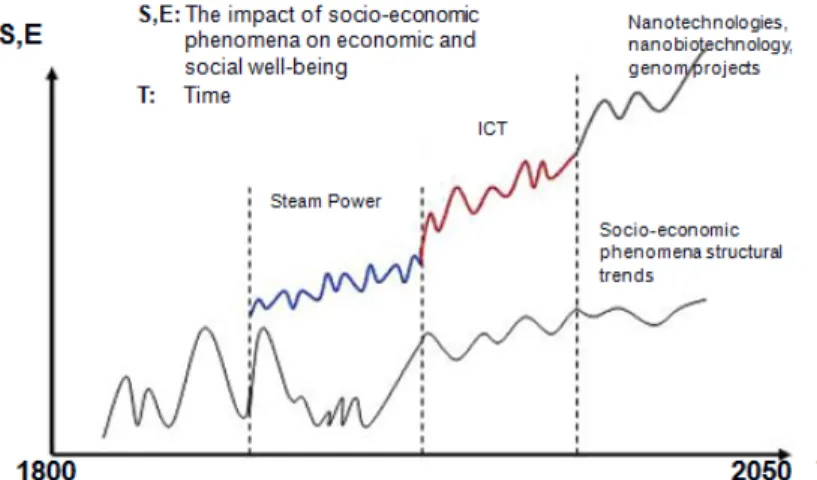
socio-economic structures from 1800 to 2050. We observe that each technology like steam power, ICT, nanotechnology creates a mathematical chaos and moves to upper strata, the socio-economic structure evolution.
In the society, it can be considered as fair ap-proximation that 3% of total information flow can be considered as scientific. It is expected that scientific information also contains error margins.
Some parts of these errors are caused by the unbiased and honest experiments of researchers. Another part of these errors can be categorized as information distortion.
The major proportion of the information that is out of 3% of the total information flow is demand driven, power and power of money driven infor-mation system which endogenize a non negligible ratio of information distortion.
In research and decision systems, in a non-neg-ligible way, data, information level, statistics are used without a systematic evaluation of informa-tion distorinforma-tions and error margins. The alternative costs and misunderstanding that is caused, is an important fact that has to be considered carefully in the national and global scope.
Ethics should be also considered as a necessary condition in Information Systems (IS), research, teaching, and practice (Mingers, 2010).
“Hermeneutics” is a fundamental rule in sci-ence methodology (Gadamer, 1976). The initial source, the initial signals may avoid in the time and space dynamics, high negative impacts and alternative costs that may occur.
Figure 2. The impact of technologies on socio-economic structures in time dynamics (Güvenen, 2009b)
Figure 3. The interaction between decision process and technologies (Guvenen, 2009a)
“Information pollution” is an important topic as environmental pollution, and it has to be con-sidered and resolved sensibly.
Information distortion in information systems may crate alternative costs: quantification prob-lems of socio-economic phenomena and negative impacts of quantitative and qualitative distortions on decision making structures.
DECISION SYSTEMS
Knowledge generates opportunity and power. It requires “ethics,” “responsibility,” and “account-ability” for optimal decision systems. Making “eth-ics and value systems” endogenous to the decision systems is a necessary condition. Discrepancies created by access to knowledge and technology, information distortions create high alternative costs in research and decision-making.
In research and decision systems, in a non-negligible way, data, information level, statistics are used without a systematic evaluation of the information distortions and error margins. The alternative costs and misunderstanding that is caused, is an important fact that has to be con-sidered carefully in the national and global scope. “Hermeneutics” is a fundamental rule in sci-ence methodology. The initial source, the initial signals may avoid in the time and space dynam-ics, high negative impacts and alternative costs that may occur.
“Information pollution” is an important topic as environmental pollution, and it has to be con-sidered and resolved sensibly.
Globalization is one of the most important
fully protected against the effects of information distortion. That is why financial scandals based on information distortion are observed. Neither an effective nor economic legal regulatory system does exist at the global level.
Decision systems must endogenize the conver-gence of factors which determine the S1 (System 1). In other terms, these factors must converge to decision systems.
Figure 3 represents the interaction between decision process and technologies.
Innovation can be considered as a very impor-tant factor in global and social challenges leading to decision making (OECD, 2010). Other factors which are equally important to be considered by the decision systems are: for whom we realize the growth and development and the possible equity in income distribution (Groff, 2011).
CONCLUSION
“Information Technologies” creates a base for “Decision Support Systems”. The effectiveness and reliability of the decisions depend on: quan-tity, accuracy, timing, quality, credibility of the information that prevails in the system.
In research and decision systems, in a non-neg-ligible way, data, information level, statistics are used without a systematic evaluation of informa-tion distorinforma-tions and error margins. The alternative costs and misunderstanding that is caused, is an important fact that has to be considered carefully on the national and global scope.
Endogenization of “ethics and value systems” to decision making is a necessary condition.
REFERENCES
Dreyden, J. (2011). Science, technology,
innova-tion and economic paradigms. Paper presented
at the 100th International Conference of Applied Econometrics. Ankara, Turkey.
Gadamer, H.-G. (1976). Philosophical
hermeneu-tics. Berkeley, CA: University of California Press.
Groff, S. (2011). Croissance et développement:
Pour qui? Paper presented at L’Annuel de l’OCDE
2011. Paris, France.
Guvenen, O. (1998). Theorem. Paper presented at the Club of Rome Annual Conference. Quito, Equador
Güvenen, O. (2008). Economic prosperity, interac-tion with science, knowledge and value systems. In Herzberg, A. M. (Ed.), Statistics, Science and
Public Policy (Vol. 12). Ontario, Canada: Queen’s
University.
Güvenen, O. (2009a). Some comments on science
methodology, fuzzy systems, statistics, economet-rics and information systems. Paper presented at
the 1st International Fuzzy Systems Symposium. Ankara, Turkey.
Güvenen, O. (2009b). Transdisciplinarity. Paper presented at Decision Sciences: A Discourse On Polymath Methodology, Institure for Operations Research and Management Sciences (INFORMS). San Diego, CA.
Güvenen, O. (2010). Information Distortion and
its Impact on Decision Systems. Paper presented
at Institute for Operations Research and Manage-ment Sciences (INFORMS), Annual Meeting. Austin, TX.
Guvenen, O. (2011a). World dynamics, ethics, and society. In Herzberg, A. M. (Ed.), Statistics,
Science, Public Policy (Vol. 15). Ontario, Canada:
Queen’s University.
Güvenen, O. (2011b). World dynamics and
sci-ence methodology, technologies, innovation, production structures, information systems, ethics and strategic decision making. Ontario, Canada:
Queen’s University.
Güvenen, O. (2011c). Opening. Paper presented at the 100th International Conference of Applied Econometrics Association. Ankara, Turkey. Hand, D. J. (2007). Information generation, how
data rule our world. Oxford, UK: Oneworld
Publications.
Mingers, J. (2010). Toward ethical information systems: The contribution of discourse ethics.
Management Information Systems Quarterly, 34(5), 849.
OECD. (2010). The OECD innovation strategy. Paris: OECD.
OECD. (2011). OECD economic outlook. Paris: OECD.
Smith, P. (2010). The methodology of economic: An agenda for reform. Journal of Academic
Re-search in Economics, 2(1), 80.
Volle, M. (2008). Prédation et prédateurs. Paris: Economica.
Volle, M. (2011). A crisis can hide another. Paper presented at the 100th International Conference of Applied Econometrics Association. Ankara, Turkey.