EFFECTIVE PRECONDITIONERS FOR LARGE
INTEGRAL-EQUATION PROBLEMS
12 "1,2 1,2 T.
Malas'
,0. Ergill' L. GiUrel''Departmentof Electrical and Electronics Engineering
2Computational Electromagnetics Research Center (BiLCEM) Bilkent University, TR-06800, Bilkent, Ankara, Turkey E-mail: [email protected],
lgurelgbilkent.edu.tr
fax: +90-312-2905755
Keywords: Preconditioning, electromagnetic scattering, integral equation methods, multilevel fast multipole
algorithm, large-scale problems.
Abstract
We consider effective preconditioning schemes for the iterative solution of integral-equation methods. Forparallel implementations, the sparse approximate inverse or the iterative solution of the near-field system enables fast
convergence up tocertainproblem sizes. However, forvery
large problems, the near-field matrix itself becomestoocrude approximationtothe densesystemmatrix andpreconditioners generated from the near-field interactions cannotbe effective. Therefore, we propose an approximation strategy to the multilevel fastmultipole algorithm (MLFMA)tobe usedas a
preconditioner. Our numerical experiments reveal that this scheme significantly outperforms other preconditioners. With the combined effort of effective preconditioners and an
efficiently parallelized MLFMA,we are ableto solve targets
withtensof millions of unknownsinafew hours.
1
Introduction
In this paper we consider fast iterative solutions of the integral equation methods, which yield dense linear systems inthe form of
Z x = b. (1)
The multilevel fastmultipole algorithm (MLFMA) [5] defines
asplitting of the Zmatrixinthe form of
z =zNF +zFF
(2)
where ZNFand ZFF corresponds to the near-field and far-fieldelements, respectively.
In real-life problems, the number of iterations required for
convergencerapidly increases asthe size of theproblem gets
larger. Hence, it becomes critical to develop and apply efficientpreconditioning techniques for the solution of large-scaleproblems [6].
The sparse approximate inverse (SAI) preconditioner using
the near-field matrix pattern is a suitable candidate if the construction of the preconditioner is to be parallelized efficiently [2]. We compare the performance of SAI with
respect to the exact solution of the near-field matrix. We
show that SAI produces successful results for real-life problems formulated by the combined-field integral equation (CFIE). On the other hand, for the electric-field integral equation (EFIE), which is the only choice for open
geometries, SAIdoesnotprovideagood approximationtothe
exact inverse [3]. Since the exact solution of the near-field matrixininfeasible, weiteratively solve thenear-field system
using SAI as a preconditioner, and this iterative solution is used as the preconditioner of the original matrix equation.
Weshow that0.1 errortolerance, whichcanbe achievedin a
few iterations, suffices for an effective preconditioner. We
call thispreconditioning schemeNF/SAI.
Whenaniterative solver is usedas apreconditioner as inthe
case ofNF/SAI, the original system must be solved by a
flexible solver, such as FGMRES. The difference of
FGMRES from GMRES is that FGMRES holds the variable preconditioned Krylov vectors, as well as the unpreconditioned Krylovvectors. Consequently, thememory
requirement is doubled. This can be alleviatedby solving a systemthat is closerto theoriginal matrix equation. In fact,
MLFMA can also be used for the inner system so that by fixing the inner solver's toleranceto 0.1, convergence to 10-6
error can be attained by only six outer iterations. Even
though this method provides us a very powerful preconditioner, the totalCPUtimeturnsout tobehigher with
respect to NF/SAI. Sincewe solve the inner systemcrudely, suchaswith 0.1 tolerance, aless accuratebut fasterMLFMA
canhelptoreduce theCPUtime. Therecanbemany waysto
decrease the accuracy of MLFMA. Nonetheless, a rigid error-control mechanism, such as decreasing the number of
accurate digits, is not optimal. In this paper, we propose a
less-error-controlled but very cheap approximation to
MLFMA. We carefully reduce the truncation numbers using
a tuning parameter, whichwe call the approximation factor.
We propose a strategy to determine the innertolerance, the maximum allowable inner iterations, and an approximation
factor sothatwe optimize the overall solution cost. We call the resulting preconditioner approximate MLFMA (AMLFMA) preconditioner. We show that AMLFMA preconditioner outperforms SAI for both EFIE and CFIE for large-scale problems.
2
Near-field Preconditioners
It is customary to construct preconditioners from ZNF assuming it to be a good approximation toZ. We group
these preconditioners as the block-diagonal preconditioner, incomplete factorization methods, SAI, and iterative
near-field schemes.
2.1 Block-Diagonal Preconditioner
This is the most widely used preconditioner for CFIE. The block-diagonal preconditioner is usually constructed from the self-interactions of the last-level clusters. Eventhough it has
very low setup time, for complex closed targets, stronger
preconditioners has a good potential to improve the
convergence rate [ 1]. ForEFIE systems, thispreconditioner deteriorates the convergence rate compared to using no
preconditioning, hence it shouldnotbe used.
2.2Sparse Approximate Inverse
There are various types of SAI preconditioners. Among
them, the onethat is based on Frobenius norm minimization is successfully used in CEM problems for EFIE [4] and for hybrid-equations [9]. We notethat, SAIhas a good potential
tobehelpful for real-life problems formulated byCFIE. Forthe SAI preconditioner that depends on Frobenius norm
minimization, the sparsitypattern of the approximate inverse should beprescribed. When, the samepattern of ZNF isused for the approximate inverse, significant reduction can be achieved in setup time, because of the block-structure of the near-field matrix [4]. However, filtering maybe adequate to
gain frommemorysometimes[9].
2.3 Iterative Near-Field Preconditioner
For ill-conditionedproblems suchasthoseproduced byEFIE,
it is known that SAIisnot as successfulasILUwhenwe use
the same amount ofmemory [3]. On the other hand, since
SAI is a good approximation to the inverse of the near-field matrix, a fast iterative solution of the system involving
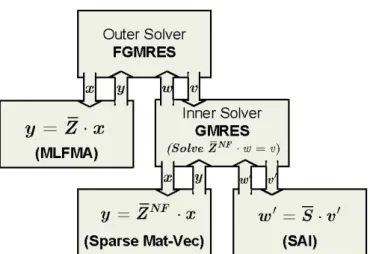
near-field matrix canbe obtained and usedas apreconditioner. This approach produces a nested implementation of iterative solvers. Intheoutersolver that solves the originalsystem,we use FGMRES, a flexible version ofGMRES, which allows thepreconditionertochange from iterationto iteration. Then, the preconditioner of this solver can be another preconditioned Krylov subspace solver which is called the inner solver. We solve the near-field system in the inner solver, using SAI as the fixed preconditioner. We illustrate thispreconditioning schemeinFigure 1.
Figure 1: Graphical representation of the iterative near-field preconditioner.
Since the inner solver is used forpreconditioningpurposes, a
rough solutioncanbeadequate. Hence, GMRESisasuitable choice for the inner solver since itprovides afastdrop of the residualnormintheearly iterations.
3 Preconditioners Based
onMLFMA
When wehave the opportunity to use an iterative procedure forpreconditioning as in the iterative near-field scheme, we
can also make use of MLFMA to have stronger
preconditioners withrespect tothose obtained from the
near-field matrix. In order to reduce the solution time, cheap versions ofMLFMA canbe introduced and used for the inner solver. These versions can be obtained by relaxing the
accuracyofMLFMA. We achieveanapproximate version of
MLFMA (AMLFMA) by redefining the truncation number for each levelIas
LI'
= L1+af
(LI-
L1),(3)
where L1 is the truncation number defined for the first level,
LI
is the original truncation number for the level Icalculated byusing the formula [8]L 1.73ka+
2.16(do
)2
3(ka)V
3(4)
The approximation factor af is definedintherange from0.0
to 1.0. As af increases from 0.0 to 1.0, the AMLFMA
becomesmore accuratebut lessefficient, while it corresponds
tothe fullMLFMAwhen
af
=1.0 [10].We fixthestopping criteria of the inner solverat0.1 anduse
AMLFMAwith
af
= 0.2, whichseems a good choice [10].Ingeneral,we setthe maximum number of iterationsto 10,to
prevent performing unnecessary work when the inner solver
stagnates.
4 Results
In this section, we demonstrate the performance of the aforementioned preconditioners for EFIE and CFIE
patch (P) and the reflector antenna(RA) have open surfaces. Therefore, they are inevitably modeled by EFIE. The closed targets Flamme, which is a stealth geometry [7], and the
helicopter (H) are modeled by CFIE. We illustrate these problems in Figure 2 and Figure 3, respectively. More information about the problems is provided in Table 1 and
Table2.
PATCH REFLECTOR ANTENNA Figure2: Opengeometries.
perform the parallel tests on a cluster connected via Infiniband network. The nodes have dual XEON 5355 processors and 16 GB of RAM.
First, we compare SAI and iterative near-field (NF/SAI)
preconditioners. We also give the number of iterationsforthe exact solution of the near-field system (NF-LU) for
benchmarking. ForSAI, we usethe same sparsity pattern of
the near-fieldmatrix. ForNF/SAI,thestopping criteria of the inner solver is set to one order residual drop or amaximum of 5iterations. The results presented in Table 3 revealsthat such
acrude solutionof thenear-fieldsystemoutperformsSAIand produce iteration counts that are very close to those of NF-LU. The solution times are also significantly reduced comparedto SAI.
Table 3: Comparison of preconditioners.
HELICOPTER FLAMME Figure 3:Closedgeometries.
RA2
Table 1: Information about theopengeometries.
Fl 1 5 30 197,892_
F2 60 120 3X5817628
H2 0.6 5 185,532_
H2 2.76
1161
2X957,61-Table 2: Information about the closedgeometries.
In our experiments we use the GMRES solver for its
robustness. We tryto reduce thenorm of the initial residual
by 10-6 in 1,000 iterations, unless stated otherwise. We
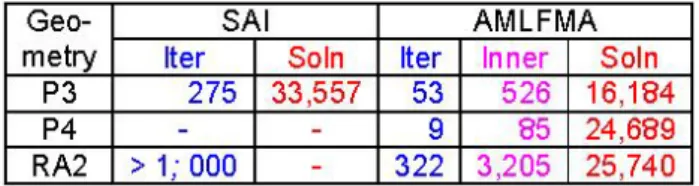
SAI and the iterative near-field Then, we compare SAI and AMLFMA preconditioners in
Table4. We note that, HS4 andRA2 cannotbe solved with
SAI orNF/SAI preconditioners. For SP5, the problem is so
large that, for SAIpreconditioner the available RAM cannot
afford the accumulation of the residual vectors ofno-restart GMRES.Allof theseproblemscanbe solvedinmodest times thanks to the AMLFMA preconditioner. We also note that, for the problems that are solvable by SAI or NF/SAI, the
AMLFMA preconditioner reduces the solution time drastically, asintheSP4case.
Geo- SAI AMLFMA metry Iter Soln |ter Inner Soln
P3 275 33,557 53 526 16,184
P4 - - 9 85 24,689
RA2I > 1 000 - 322T
3,205
|25,Table4: Comparison ofSAI andAMLFMA preconditioners. The solution ofP4 is obtained using 10-3 iterative residual
error.
Forthe closedgeometriestobe modeledbyCFIE,the block-diagonal preconditioner is commonly used, because of its
ease ofparallelization and the low setup time. Onthe other hand, particularly for complex targets such as Flamme and helicopter, we observe that the solution times can be significantly improved by using better preconditioners suchas
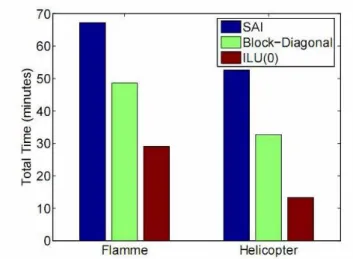
ILU(0), SAI or the AMLFMA preconditioner. We support
this claim by comparing the solution of the closed problems
inFigure 4 andFigure 5. For smallerproblems that can be solvedsequentially, ILU(O)isagood candidate because of its low setup time [11]. We see that total solution time with
ILU(0) is decreasedbymore than
5000
for both Ft andHI. Geo- NF-LU SAI NF/SAI metry IterSetup
Iter Soln Iter SolnP1 26 4 44 12 29 9 P2 53 52 91 336 59 253 P3 275 253 7,6217 165 5,387
RAI
952 125 878 71 646 Problem P1 P2 P3 P4 RA1 +1-1 - --l- --___.I__._._
I-Problem,,.~~~~~~~~~~~~~~~~~~~~~~~~~~~~
I I T II~~~~~~~~~~~~~~~~~~~~~~~~~~
Considering larger problemsthat can be solved in parallel, we seethat for Flamme, eventhough the iterationcounts ofSAI are much smaller than those of the block-diagonal
preconditioner, because of the larger setup time of SAI there is not a significant difference between the total solution times
of these preconditioner. However, for helicopter the gain is around 4000 with SAI. Furthermore, for bistatic RCS
calculations, the gains can be much higher. On the other
hand, the AMLFMA preconditioner performs outstandingly
better withrespect totheblock-diagonal preconditioner. The solution times is reducedby3500 for Flamme and 7500 for the
helicopter. Hence, for large-scale problems it is wise to construct preconditioners that make use more than the near-field in an efficient manner.
70,
60[
250 E40 30a.20
F lo[
Figure4: Total solution times (setup+iterations) forFt and
HI.
well-conditioned systems, the solution of the large real-life
problems in short times necessitates preconditioning. On the
other hand, severely ill-conditioned EFIE systems may not convergewithout effective preconditioning.
Up to certain sizes, SAI enables fast convergence for both CFIE andEFIE. For EFIE, SAI can be made even stronger
by embedding it in an inner-outer solution scheme. On the
other hand, forvery large problems, the near-field systemdo
not provide a good approximation to dense system matrix. Therefore, preconditioners that are built from the near-field interactions cannot be effective. Considering this fact, we
develop the AMLFMA preconditioner. Taking into account
the far-field interactions as well as near-field interactions,
AMLFMA preconditioner succeeds to solve ultra large EFIE
and CFIE systems in reasonable solution times. Our
experimental studies reveal the following outcomes for the solutions of large-scale problems using the AMLFMA preconditioner:
* Very largeEFIE systems,whichare insolvable with other preconditioners, are rendered solvable in
moderate solution times.
* Solution times of bothEFIE andCFIE problemsare
decreasedbyasmuchasfourfoldcomparedto SAI.
Acknowledgements
This work was supported by the Scientific and Technical Research Council of Turkey (TUBITAK) under Research
Grant 105E172, by the Turkish Academy of Sciences in the framework of the Young Scientist Award Program
(LG/TUBA-GEBIP/2002-1-12), and by contracts from
ASELSANandSSM.
References
7200 4 150, 3 .E a) 100,m C: EWSAI_DIUc^-LfldyUf 1dI
I1AMLFMA
Flamrme
Helicopter
Figure 5: Total solution times (setup+iterations) forF2and
H2.
5 Conclusion
In this work we show that the effectiveness of the integral
equation methods can be significantly improved by
preconditioning. Even though CFIE is known to produce
[1] S. Balay, W. D. Gropp, L. C. McInnes, and B. F. Smith,
"PETSc users manual," Argonne National Laboratory, Tech.
Rep.ANL-95/11-Revision2.1.5, 2004.
[2] M. Benzi, "Preconditioning techniques for large linear
systems: a survey," J. Comput. Phys., vol. 182, no. 2, pp.
418-477, 2002.
[3] M. Benzi andM. Tuma, "A comparative study ofsparse
approximate inverse preconditioners," Applied Numerical Mathematics. Transactions ofIMACS, vol. 30, no. 2-3, pp.
305-340, 1999.
[4] B. Carpentieri, I. S. Duff, L. Giraud, and G. Sylvand, "Combining fast multipole techniques and an approximate inverse preconditioner for large electromagnetism calculations," SIAMJ. Sci. Comput., vol. 27,no. 3,pp.
774-792,2005.
[5] W. C. Chew, J.-M. Jin, E. Michielssen, andJ. Song, Eds.,
Fast and
Efficient
Algorithms in Computational Electromagnetics. Norwood, MA, USA: ArtechHouse, Inc., 2001.bL-[6] 0 . Erguil and L. Guirel, "Efficient parallelization of multilevel fast multipole algorithm," in Proc. European
Conference on Antennas and Propagation (EuCAP), no.
350094, 2006.
[7] L. Guirel, H.
Bagci,
J.-C. Castelli, A. Cheraly, and F.Tardivel, "Validation through comparison: Measurement and calculation of the bistatic radar cross section of a stealth
target,"RadioScience,vol.38, no. 3, pp. 1046-1058, 2003.
[8] M. L. Hastriter, S. Ohnuki, and W. C. Chew, "Error
control of the translation operator in 3D MLFMA," Microwave Opt. Technol. Lett., vol. 37, no. 3, pp. 184-188, 2003.
[9] J. Lee, J. Zhang, and C.-C. Lu, "Sparse inverse preconditioning of multilevel fast multipole algorithm for hybrid integral equations in electromagnetics," IEEE Trans. Antennasand Propagation, vol. 52, no. 9, pp. 158-175, 2004. [10] T. Malas and L. Guirel "The solution of large EFIE problems via preconditioned multilevel fast multipole
algorithm", in Proc. European Conference on Antennas and
Propagation (EuCAP),2007.
[11] T. Malas and L. Guirel, "Incomplete LUpreconditioning
with the multilevel fast multipole algorithm for
electromagnetic scattering," SIAMJ. Sci. Comput., vol. 29, no. 4, pp. 1476-1494, 2007.