See discussions, stats, and author profiles for this publication at: https://www.researchgate.net/publication/328542882
Cr: Colquiriite Lasers: Current Status and Challenges for Further Progress
Preprint · October 2018 CITATIONS 0 READS 269 1 author:Some of the authors of this publication are also working on these related projects:
Birefringent filter design for laser applicationsView project
Development of diode-pumped, high-power Cr:LiCAF laser systems via usage of lower doped crystalsView project Umit Demirbas
Antalya Bilim University 111PUBLICATIONS 915CITATIONS
SEE PROFILE
All content following this page was uploaded by Umit Demirbas on 03 August 2019.
Cr:
Colquiriite Lasers: Current Status and
Challenges for Further Progress
U
MIT
D
EMIRBAS
Laser Technology Laboratory, Department of Electrical and Electronics Engineering, Antalya Bilim University, 07190 Antalya, Turkey
*Email: [email protected]
Cr: Colquiriite laser materials (Cr:LiCAF, Cr:LiSAF, Cr:LiSGaF) own broad absorption bands in the visible region that allow direct-diode pumping by well-developed low-cost red diodes. Moreover, they possess broad emission bands in the near infrared that enable widely tunable laser operation (720-1110 nm), and generation of sub-10-fs light pulses via mode-locking. Furthermore, Cr: Colquiriite crystals can be grown with a very low loss level of 0.2%/cm, which enables the construction of high-Q-cavities, resulting in lasing thresholds below 1 mW, and slope efficiencies above 50%. High-Q-cavities constructed with Cr: Colquiriites could store large amount of intracavity laser powers which is off great interest: (i) for increasing the efficiency of intracavity nonlinear processes such as intracavity frequency-doubling, and (ii) for minimizing laser noise such as timing jitter noise in femtosecond operation. However, thermally and mechanically Cr: Colquiriites have glass like properties. Hence, average power scaling has been challenging in the cw and femtosecond Cr: Colquiriite lasers, as well as in their amplifiers. In this paper, we will review research efforts over the last decades, in developing robust, low-cost, highly-efficient, and tunable cw and femtosecond laser sources based on diode-pumped Cr:Colquiriite gain media. Challenges for future progress have also been discussed.
1) Introduction
1.1) Historic Review and General Categorization of Lasers
The underlying idea of Light Amplification by Stimulated Emission of Radiation (LASER) is stimulated emission, which was proposed by Albert Einstein in 1917, in his famous paper on “Quantum theory of radiation” [1, 2]. It took quite a while for physicists to use the idea of stimulated emission and realize it experimentally. In 1947 Willis Lamb and Robert Retherford from Colombia University used stimulated emission to amplify the microwave frequency radiation emitted by hydrogen molecules at a wavelength of 2.74 cm [3]. In 1954, Charles H. Townes, J. P. Gordon, and H. J. Zeiger build the first maser (microwave amplification by stimulated emission of radiation) using the vibrational energy levels of ammonia molecules in a resonant cavity, obtaining only nW level powers at a wavelength of around 1.25 cm [2, 4, 5]. C. H. Townes and A. L. Schawlow suggested the extension of maser technology to higher (optical) frequencies, and they proposed the idea of Fabry-Perot resonators for feedback [6]. It took a while to find an appropriate gain media and a suitable way for excitation that could generate enough population inversion [7]. Finally, in 1960, T. Maiman build the first laser operating at 694.3 nm using the 2E, 4A
2 transition of ruby (Cr+3 in corundum, crystalline form of Al2O3) as the gain medium
where flahslamps were used as the excitation mechanism [8].
Since then, lasing has been demonstrated in thousands of different laser gain media, and the Handbook of Laser Wavelengths by M. J. Weber lists more than 15,000 laser lines (most gain media have more than one lasing line) [9, 10]. Among all these available lasers, only a few hundreds of them are used most frequently, and maybe around ten dominates most of the laser field (like Ti:Sapphire and Yb:YAG being the main workhorse of today's ultrafast laser technology ) [10]. One can categorize these lasers in several ways, using their operational wavelength (UV, visible, IR, etc..), operational mode (continuous-wave, q-switched, gain-switched, mode-locked, etc..), excitation mechanism (electrically pumped, flashlamp pumped, diode-pumped, etc..), their historic role (first generation, second generation, third generation[11]), and their application area. Maybe one of the most convenient ways of categorization lasers is made by differentiating them according to the type of gain media used. In this respect lasers can be categorized as (a) gas lasers, (b) liquid lasers, and (c) solid-state lasers [18]. Most of the known laser transitions belong to gas lasers [9, 10]. The lasing lines of gas lasers are quite narrow in general (Doppler, collisional and rotational line broadening effects are present but they are not very strong), and without a tuning element, an individual laser can lase at several different distinct wavelengths simultaneously [9,
12, 13]. The transition involved in the stimulated emission process might be between electronic, vibrational or transitional energy levels, enabling gas lasers to cover a quite wide spectral range [9, 14, 15]. The wavelengths available from gas lasers start from 3.9 nm and covers all the vacuum ultraviolet, ultraviolet, visible, infrared, far infrared, and millimeter microwave regions [9].
Liquid lasers are mostly based on organic dye lasers, which are basically dye molecules (e.g. rhodamine, fluorescein) in an organic solvent such as ethanol, p-dioxane or dimethylsulfoxide [9, 16]. Dye lasers were discovered quite early in 1966, by P. P. Sorokin and F. P. Schäfer around the same time [17, 18]. They have relatively broad absorption and emission bands due to the coupling of electrons with molecular vibrations [16]. Hence they could provide tunable laser operation over 10’s of nanometers, and also facilitate sub-100-fs pulse generation in mode-locked regime (27 fs pulses directly from the oscillator [19] and down to 6 fs pulses with external pulse compression [20]). Using different dye molecules, the laser wavelength range from 330 nm to 1800 nm could be covered [9]. Dye gain media have relatively high gain and their upper-state lifetimes are in the ns range; hence, they don’t have the tendency for q-switching instabilities during mode-locked operation [21, 22]. In 1970’s and 1980’s most of the ultrafast laser technology was based on dye lasers [21, 22]. Unfortunately, the dye lasers have several disadvantages including low output powers, low pulse energies in Q-switched mode (due to short lifetimes), requirement for expensive pump sources in the green or blue region of the spectrum and rapid degradation during laser operation [21]. Moreover, dye gain media and/or the solvents are sometimes highly toxic and carcinogenic [21]. Hence, today dye lasers are mostly replaced by solid state laser technology, and mostly with Ti:Sapphire [13, 23]. Besides the organic dye lasers, liquid lasers also include rare-earth chelate lasers and inorganic aprotic solvents, which also had very little practical usage, due to their corrosive and toxic nature [9].
Solid state lasers are based on solid-state crystalline or amorphous hosts and have laser transitions originating from the doping of paramagnetic ions (with incompletely filled electron shells), organic dye molecules and color centers [9]. The typical doping concentrations of active ions are less than 1 % in general, but can reach to 100 % (stoichiometric lasers) for some specific cases like LiChrom (LiSrCrF6, 100% Cr doped LiSrAlF6) [9, 24].
Semiconductor lasers are also listed under solid-state lasers, since they are also solid-state devices, but actually they use completely different physics in the generation of laser active centers [9]. Today solid-sate lasers has an important part in laser market, due to their several favorable properties including robustness, reliability, safety, user-friendliness, compactness, and low-cost per performance [25]. They can cover the spectral region from 170 nm to 360 m, enabling the generation of laser radiation at the optimum wavelength for many different applications [9].
Solid-state lasers based on paramagnetic ions can be categorized in two sub segments: rare earth element and transition metal-doped solid-state lasers. Rare earth elements/metals are a collection of 17 chemical elements which includes lanthanoids (lanthanides), scandium and yttrium. The lasing lines of rare-earth doped gain media originate mostly from the transitions between the partially filled 4f shells. These states are split by Coulomb interaction, spin-orbit coupling and crystal-field interaction [26]. Coulomb interaction has the strongest effect on the lines which separates the lines typically by 10,000 cm-1 (1.24 eV, 1000 nm photon), followed by the
spin orbit coupling which creates an additional splitting of around 3,000 cm-1 (0.37 eV, 3350 nm photon)
[26].Since the 4f shell is shielded by the outer 5s and 5p electrons, the effect of crystal field is relatively weak, which further splits each manifold by only 200 cm-1 (25 meV, 50 m photon) [26, 27]. The shielding of
crystal field results in relatively narrow but strong emission lines in rare-earth doped gain media (em is high),
and also the position and width of the emission lines does not differ a lot from host to host [7, 9, 26]. Hence, most of the rare-earth doped gain media provide very little tunability and the obtainable pulsewidths in mode-locked regime are relatively long. Moreover, dipole transitions between the 4f shells are parity forbidden, and a mixture of wave functions with opposite parity is required for a transition [26]. These opposite parity wave functions are generated by the weak crystalline field, hence these transition probabilities are quite weak also [26]. This results in relatively long upper state lifetimes () in rare-earth doped gain media [26]. Hence in general, rare-earth doped gain media has a very high em value, resulting in low laser thresholds at low
concentration values (at high concentrations increased nonradiative decay rates might lower the lifetime) [26]. We note hear that, in some cases, rare-earth doped gain media can also have lasing transitions between 4f and 5d shells, and in this case laser lines are quite broad and one can possibly obtain broad tunability and ultrashort pulses (examples are Ce+3:LiCaAlF
6 and Sm+2:SrF2) [9]. This is because unlike the 4f shell, the 5d shell has no
shielding and hence it is exposed to the crystalline environment, which broadens the emission lines [12].
As a side note, one should differentiate rare-earth doped glasses from rare earth doped crystals [28]. Rare-earth doped glasses can take the form of bulk materials, fibers or planar waveguides [9]. In glassy structure the crystalline field surrounding the active ions are not as well defined as crystalline hosts; hence, laser emission lines can be slightly broader [7], enabling relatively broadband tuning and shorter pulses in mode-locked
operation. Other advantages of glass hosts include ability to produce large samples for high energy applications, and ease of fabrication, whereas the drawbacks include lower thermal conductivity, lower emission cross section, and thermally induced birefringence problems [7].
Transition metal elements are elements whose atom has an incomplete d sub-shell, or elements which can give rise to cations with an incomplete d sub-shell [29, 30]. The name “transition” comes from the place they appear on periodic table: they represent transition between group 2 and group 13 elements [29]. So far, lasing have been reported in the transition metal elements of titanium (Ti), vanadium (V), chromium (Cr), manganese (Mn), iron (Fe), cobalt (Co) and nickel (Ni), and gain has been reported in transition metal elements of copper (Cu), silver (Ag) and rhodium (Rh) [9]. Example gain media include Ti+3:Al
2O3(sapphire), Co+2:MgF2, Cr+2:ZnSe, Cr+2:ZnS,
Cr+3:Al
2O3 (ruby), Cr+4:Mg2SiO4 (forsterite), Cr+4:YAG and Fe+2:ZnSe.
Cr3+:Colquiriites of the general formula Li MeII MeIIIF
6 (MeII = Ca, Sr, Cd; MeIII = Al, Ga, Ti, V, Cr, Fe) (e.g.
Cr:LiSAF [31, 32], Cr:LiCAF [33-35], Cr:LiSGaF [36], Cr:LiSCAF [37] and LiSrCrF6 (LiChrom) [24]), the
topic of this review article also belong to the family of transition metal doped solid state lasers. The most important point here is that the d orbitals determine optical properties of ions, and since the d orbitals are not shielded (as in the case of rare-earth ions), the optical properties are greatly influenced by the host [13]. Moreover, absence of shielding in transition-metal doped gain media enables strong phonon broadening in the absorption and emission lines, which enables ultrabroad tuning ranges and ultrashort pulse generation in mode-locked operation. Dipole transitions between the 3d shells are also parity forbidden, however due to the strong crystal field, opposite parity wave functions are generated more easily, resulting in higher transition rates and shorter lifetimes [26]. Compared the RE-doped gain media em value is an order of magnitude smaller [26]. 1.2) Where does Cr:Colquiriite stand among other tunable solid state laser gain media?
In tunable solid-state lasers, by definition the output wavelength can be tuned over a substantial fraction of the central emission wavelength (at least several percent of the laser central wavelength) [13, 38]. This enables the generation of coherent optical radiation at the desired wavelengths as well as generation and amplification of ultra short pulses. Usually, the fractional tuning range, defined as /0 (=full width of the tuning range and
0=the central emission wavelength) is used to compare different gain media. A good reason for this is the pulse
width that could be obtained from a gain medium scales inversely with /0 [39]:
0 0
(1)Basically, the pulse duration is linearly proportional to the wavelength and inversely proportional to the number of optical cycles of the electric field of the pulse (the number of optical cycles scales with 0/) [27].
Table 1 shows selected examples of tunable solid-state gain media and their reported fractional tuning range at room temperature. Demonstrated shortest pulsewidths in mode-locked regime are also reported along with the estimated minimum pulsewidths that are supported by the gain bandwidth of the materials. Figure 1 graphically provides similar information. Note that the spectral region in the 350-700 nm range is empty: we don't have any known broadly tunable solid-state laser gain media that emits in this region. Ce:LiCAF, Ce:LiSAF, Ce:LLF cover the near ultraviolet region (280-330 nm), and Ti:Sapphire, Alexandrite, Cr:Colquiriites cover the long end of visible and near-infrared spectral regions. Then laser materials such as Cr:Forserite, Cr:YAG, Co:MgF2,
Cr:ZnSe and Fe:ZnSe cover the whole near-to-mid infrared region till 5000 nm. Each wavelength region is important, since different applications and different tasks could provide optimized performance with specific laser wavelengths.
Note from Eq. 1 that, the required fractional bandwidth to support an ultrashort pulse is smaller at shorter wavelengths, providing advantage to laser gain media with a tuning range in the near ultraviolet and visible. One of the best studied tunable near-ultraviolet solid state gain medium is Ce+3:LiCAF. As mentioned above
Ce+3:LiCaAlF
6 is an exceptional rare earth doped gain media, where the lasing transitions between 4f and 5d
shells can be used to generate broadly tunable laser operation (280-316 nm) [40-42]. Ce:LiCAF has a fluorescence lifetime () of only 25 ns, and has an emission cross section (em) of 9.6x10⁻¹⁹ cm2; hence, the
product em is only 2.4 x10⁻²⁰ s x cm2 [41], which is about 50 times smaller compared to Ti:Sapphire
(131x10-20 s x cm2). This prevents continuous wave lasing operation in this gain media (due to high lasing
thresholds), and so far only gain switched operation have been reported with ps to ns pulse durations, upon pumping with the 4th harmonic of pulsed Nd-lasers [41]. The demonstrated tuning range in gain switched
operation extends from 280 nm to 316 nm, with W level average output powers from ns pulses at kHz repetition rates [40]. Mode-locked operation with Ce:LiCAF has also been reported, where 6 ps pulse durations were demonstrated upon synchronously pumping [43]. Ce:LiCAF gain media has also been used in chirped pulse
amplification of ultraviolet femtosecond pulses around 290 nm [44], which is attractive due to its high saturation fluence (115 mJ/cm2) [42]. We note here that the bandwidth of Ce+3:LiCAF is broad enough to support 5-fs
pulses [43]. Other important Ce+3 doped solid state gain media include Ce:LiLuF
4 (LiLuF) with a tunability from
305 nm to 333 nm [45], and Ce:LiSAF with a tunability from 288 nm to 313 nm [46]. Unfortunately, ultrafast pulse generation with these gain media is hindered by their small gain cross section.
Gain Medium Tuning Range (nm) /0 (%) Minimum theoretical pulse duration (fs) Shortest demonstrated pulsewidth (fs) Ce+3:LiCaAlF 6 280-316 [40] 12 5 6000 [43] Ce+3:LiSrAlF 6 288-313 [46] 8 7.5 - Ce+3:LiLuF 4 305-333 [45] 9 7.5 - Ti3+:Al 2O3 660-1180 [23] 57 3.5 5 [47] Cr3+:BeAl 2O4 714-818 [48] 14 12 70 [49] Cr+3:LiCaAlF 6 720-887 [33, 50, 51] 21 8 9 [52] Cr+3: LiSrGaF 6 777-977 [50, 53] 23 8 14 [54] Cr+3:LiSrAlF 6 775-1110 [50, 55, 56] 36 5.5 10 [57] Nd:GSAG:YSGG - - - 260 [58] Nd+3:glass - - 53[59] 60 [60] Cr4+:Mg 2SiO4 1130-1367 [61] 19 13.5 14 [62] Cr4+:Y 3Al5O12 1309-1596 [63] 20 15.5 20 [64] Yb+3:Y 3Al5O12 1016-1108 9 26 35 [65] Tm,Ho:BaY2F8 2005-2094 [66] 4 100 120000 [66] Tm:YAG 1870-2160 [67] 15 30 3000 [68] Tm:YLF 1910-2070 [69] 2200-2460 [70] 8 11 52 44 515 [71] Co2+:MgF 2 1750-2500 [72] 35 13 - Cr2+:ZnS 1962-3195 [73, 74] 48 12 [59] 29 [75] Cr2+:CdSe 2180-3610 [76-78] 49 12 - Cr2+:ZnSe 1880-3349 [74, 79] 56 11 [59] 47 [80] Fe2+:ZnSe 3770-5050 [81] 21 30 -
Table 1: Room-temperature tuning ranges and calculated fractional tuning percentage of several broadly tunable
transition metal and rare-earth ion-doped solid state gain media. Minimum theoretical pulse durations supported by the gain bandwidth of the material and demonstrated shortest pulse widths are also included.
Figure 1: Summary of tuning ranges for selected broadly tunable solid-state laser gain media. Demonstrated
tuning ranges and theoretically estimated minimum pulse durations are indicated. Inspired from [38].
Probably the most important known member of broadly tunable solid-state lasers is Ti+3: Sapphire (660-1180
nm). Ti+3:Al
2O3 gain media have been discovered by Dr. Peter Moulton in 1982, and with time it has quickly
become the working horse of ultrafast laser technology, by replacing the dye lasers [11, 23, 82]. Among solid-state lasers, Ti:Sapphire has the broadest fractional tuning range (660-1180 nm), and can directly generate the shortest possible pulses from a laser oscillator (sub-5-fs) [23, 47, 83]. Ti:Sapphire lasers are commercial standards today, and systems can provide (i) more than 3 W of output power with continuous-wave (cw) tuning from 675 to 1100 nm, and (ii) peak powers of hundreds of kW in mode-locked operation with either 100 fs tunable pulses (680 to 1080 nm) or 10 fs pulses around 800 nm. Ti:Sapphire gain media has a quite broad absorption band centered around 490 nm, with a FWHM of 120 nm (460 to 580 nm) [84]. Until recently, due
250 750 1250 1750 2250 2750 3250 3750 4250 4750 5250 Wavelength (nm) Cr: LiCAF (720-887 nm, 8 fs) Ti: Sapphire (660-1180 nm, 3.5 fs) Cr: LiSAF (780-1110 nm, 5.5 fs) Cr: Forsterite (1130-1367 nm, 13.5 fs) Cr:YAG (1309-1596 nm, 15.5 fs) Tm: Fiber (1800-2180 nm, 22 fs) Fe: ZnSe (3770-5050 nm, 30 fs) Co:MgF2(1750-2500 nm, 13 fs) Cr: ZnSe (1880-3349 nm), 11 fs Cr: LiSGaF (777-977 nm, 8 fs) Fe: ZnS (3490-4650 nm, 30 fs) Cr: CdSe (2260-3610 nm), 12 fs Ce:LiCAF (280-316 nm, 5 fs) Ce:LiLuF (305-333 nm, 7.5 fs) Alexandrite (714-818 nm, 12 fs)
to the absence of high power laser diodes in this wavelength range, efficient direct diode pumping of Ti:Sapphire gain media was not possible, which has been the main disadvantage of Ti:Sapphire technology. Direct diode pumping of Ti:Sapphire with single-emitter diodes in the blue and green spectral region has been shown in the last decade, both in cw and cw mode-locked operation [84-97]. Currently, the Ti:Sapphire laser systems on the market are still not based on diode pumping, and mostly rely on 2nd harmonics of Nd-based lasers. On the other
hand, further progress in brightness and robustness is expected for the relatively new green/blue pump diodes used in pumping Ti:Sapphire. We believe as the diode technology at these wavelengths get more mature, this will enable further improvements in performance of diode pumped Ti:Sapphire lasers over the coming decades, enabling cost and complexity reduction in Ti:Sapphire laser and amplifier systems.
Cr3+-doped Colquiriite crystals (Cr:LiCAF, Cr:LiSAF and Cr:LiSGaF) and Alexandrite possess emission bands
that cover a spectral region similar to Ti:Sapphire. Cr:Colquiriite have broad absorption bands around ~650 nm (compared to 490 nm band of Ti:Sapphire), and hence enables direct diode pumping with the mature red diode technology. Thermo-mechanical and optical properties of Cr:Colquiriites, Alexandrite and Ti:Sapphire will be discussed in great detail in the next sections in a comparative manner.
It is important to note that, Nd and Yb-based systems are also attractive gain media for the development of diode-pumped low-cost cw and fs laser and amplifier systems due to the existence of low-cost InGaAs diodes around 975 nm [98-102]. For example, state-of-the-art Yb-doped systems could provide down to 35 fs pulses [103], with optical-to-optical conversion efficiencies above 50% [104], and average powers above 1 kW [11, 105, 106]. Their long upper state lifetimes also enable efficient energy storage that makes them suitable especially as an amplifier media [101, 107-110]. However, due to their relatively narrow gain bandwidths, the obtainable pulsewidths from Yb-based systems are limited to at best about 50 fs level in oscillators and to about 1 ps in amplifiers [11, 110]. Hence, these systems work in a set of parameters that do not substitute Ti:Sapphire and Cr:Colquiriite systems for many applications. On the other hand, optical parametric amplification driven by high peak and average power Yb-systems could combine short pulsewidths with high peak/average power, but are quite complex and expensive systems [11, 111].
At this point, for a review of other broadband solid-state gain media, we refer the reader to several excellent review articles such as [13, 112-117].
1.3) Thermo-mechanical Parameters of Cr:Colquiriites
The laser host must have good optical, mechanical and thermal properties to withstand the expected operating conditions of practical lasers and amplifiers [13, 118]. Desirable thermo-opto-mechanical properties include hardness, chemical inertness, absence of internal strain and refractive index variations, resistance to radiation induced color center, ease to fabrication, large damage threshold, high thermal conductivity values, etc.. [7, 118]. In this section, we will compare laser related thermo-mechanical parameters of Cr:Colquiriites with the other competitive crystals, namely: Ti:Sapphire, Alexandrite and Yb:YAG. Spectroscopic and optical properties will be discussed in the next section. For this purpose, important thermo-opto-mechanical properties of these gain media are listed in Table 2.
As mentioned earlier, currently Ti:Sapphire is the dominant player and the working horse of ultrafast lasers, whereas Yb:YAG and Yb-based materials in general dominate the field in terms of high average powers at the expense of slightly longer pulsewidth. Alexandrite has also been included in the discussion, since its operation range partly matches (and partly extends) Cr:Colquiriites, and it possess interesting spectroscopic properties (such as improved laser performance at elevated temperatures), and we believe that it has the potential to be one of the critical players in the field of diode pumped ultrafast systems in the coming decades.
In Cr:Colquiriites the dopant Cr+3 ion substitutes Al in Cr:LiSAF (LiSrAl
1-xCrxF6) and Cr:LiCAF (LiCaAl 1-xCrxF6), and substitutes Ga in Cr:LiSGaF (LiSrGa1-xCrxF6). The dopant density at 1% doping corresponds to
0.875 x10²⁰ ions/cm3 in Cr:LiSAF. The typical doping concentration of Cr+3 ions in Cr:Colquiriites are in the 0.5
to 10 % range; however, up to 100% doping is possible: (e.g. LiChrom: LiSrCrF6, 100% Cr doped LiSrAlF6) [9,
24]. Mass density () of Colquiriites are similar to Sapphire and Alexandrite, which are slightly lower compared to YAG.
Gain Medium Ti 3+:Al 2O3 (Ti:Sapphire) Cr+3:LiSrAlF 6 (Cr:LiSAF) Cr+3: LiSrGaF 6 (Cr:LiSGaF) Cr+3:LiCaAlF 6 (Cr:LiCAF) Cr+3:BeAl 2O4 (Alexandrite) Yb+3:Y 3Al5O12 (Yb:YAG) Dopant site (TixAl1-x)2O3 LiSrAl1-xCrxF6 LiSrGa1-xCrxF6 LiCaAl1-xCrxF6 Be(Al1-xCrx)2O4 (YbxY1-x)3Al5O12
Dopant density at 1% doping [x1020 ions/cm3] 4.7 [119] 0.875 0.835 0.775 3.51 [7] 1.38 [119]
Mass density [g/cm3], 3.98 3.45 [32] 3.89 [120] 2.99 [121] 3.69 [122] 4.56 [7]
Melting point [C] 2040 766 [36] 716 [36] 810 [36] 1870 1970
Specific heat capacity [J/gC], Cp 0.761 0.842 [32] 0.76 [123] 0.935 [121] 1.05 [121] 0.59 [7]
Moh hardness 9 3-4 [124] 4 4 8.5 8.5
Knoop hardness [kg/mm2] 1800(//c), 2200(//a) 197 [7] - - 1600-2300 [125] 1320 [7]
Thermal conductivity [W/K.m], 30.3 (//a) 32.5 (//c) [126] 1, 1.8 (//a) 1.68, 3 (//c) [32, 120, 127] 1.3 (//a), 2.6 (//c) [120], 3.6 [12] 4.58 (//a) 5.14 (//c) [128] 23 (//a-b-c) [125, 129] 10 [128]
Thermal expansion coefficient [x10-6/K], 4.8 & 5.3 [128]
22.2, 25, 26 (//a) -9.8, -10, -8.1 (//c) [127, 130, 131] 12, 23 (//a) 0, -5.4 (//c) [127, 130, 131] 22, 21 (//a) 3.6, 3.1 (//c) [36, 121, 131] 6 (//a) 6 (//b) 7(//c) [122] 6.7 [128, 132]
Thermal diffusivity [x10-3 cm2/s], D 92.5 6(//a)
10 (//c) [120]
4.4 (//a) 8.8 (//c)
16.4 (//a)
18.4 (//c) 60 37
Young modulus [x109 Pa], E 335
109 (avg) [32, 127] 85 (//c) [127] 120 (//a) [127] - 96 [121] 469 [122] 280 [121], 310 [7] Poisson's Ratio, 0.29 0.3 [32] - 0.25[121] - 0.3 [7]
Tensile (fracture) strength [x106 Pa],
f 400 38.5 8 [7, 127] - - 457-948 (//a), 520 (//b) [133] 200 [7]
Fracture toughness [x106 Pa m1/2], K
1c 2.2 [128] 0.33, 0.4 [32, 127, 134] - 0.18-0.37 [134] 0.31[128] 2.6 [121] 1.4 [128]
Thermal figure of merit [W/m1/2], R
T' 22 [128] 0.42(//a), 0.80 (//c) [128] 0.55 0.53 [121, 128] 14 [121] 5.1 [128]
Thermal shock resistance parameter [W/cm], RT
(for 2a=50 m flaw) 44
0.84(//a)
1.60 (//c) [128] 1.1 [135] 1.06 28 10.4 [135]
Maximum acceptable thermal power density [kW/cm3], P
ter, max
(for t=2 mm slab size)
3.12 0.25 0.33 0.32 8.4 3.12
Maximum temperature difference before cracking,
rod geometry [C], Tmax,rod 473 27 31 39 275 190
Maximum temperature difference before cracking,
thin disk geometry [C],Tmax,disk 675 39 44 52 395 270
Damage threshold [J/cm2] 7.8 @ 0.5 ps 80 @ 50 ps [136] 210 @ 8 ns [137] 1.5 @ 20 ps [138] 8-24 @ 50 ps [127] 20-26 @ 50 ps [127] 20-25 @ 50 ps [127] 270 @ 12 ns [129] 110 @ 4.5 ns [139]
Moh hardness values determines the scratch hardness of minerals, a scale which goes from 1 (for talc) to 10 (for diamond), where each mineral will scratch the one on the scale below it but will not scratch the one above it [124]. The Moh hardness values could be scaled to more empirical hardness tests such as Knob hardness [124]. Note that Cr:Colquiriites has a Moh hardness value of around 3-4, showing their susceptibility to get scratches, whereas sapphire, alexandrite and YAG has values of 8-9 showing their superiority in this respect. For comparison, the Moh hardness of glass is around 5. Hence, in handling Cr:Colquiriites soft tools such as usage of plastic tweezers are recommended.
(b)
(a)
Figure 2: (a): Unit cell of LiCAF: lithium (red), aluminum (blue), fluorine (green), calcium (purple) [140]. Cr
ions replace some of the aluminum atoms. (b): Cr:LiSAF crystals grown by the Czochralski method [118].
One of the most important parameter for power scaling of laser and amplifier materials is thermal conductivity () of the host material. Thermal conductivity of the uniaxial Cr:LiSAF is only 1.8 W/Km in a axis, and 3 W/Km in the c axis [32, 120]. Unfortunately, these values are an order of magnitude lower than Sapphire (31 W/Km) [126], and about 1/4th of the value for YAG (10 W/Km) [128]. Cr:LiCAF has more isotropic and higher thermal conductivity values (4.58 in a and 5.14 in c axis [128]), making it the best candidate amongst Cr:Colquiriites for power demanding applications. Unfortunately, variation of thermal conductivity (and other thermo-mechanical parameters) in Cr:Colquiriites with temperature and doping is not reported in the literature. For example, in Yb:YAG thermal conductivity improves from around 10 W/Km at room temperature to around 50 W/Km at 80 K for a 2% Yb-doped sample [132]. Such improvements in thermal parameters at low temperatures enabled power scaling of Yb:YAG amplifiers at cryogenic temperatures [141, 142], which is still an open research question for Cr:Colquiriites. It is educational to compare these values with thermal conductivity of glass (0.6 W/Km [7]), cupper (400 W/Km ) and diamond (2200 W/Km [143]).
Thermal expansion coefficient () is a material property that is indicative of the extent to which a material expands upon heating. As we will discuss in more detail later, smaller values of thermal expansion coefficient is generally desired to minimize bulging/deformation contribution to thermally induced lensing [130]. An interesting property of Cr:LiSAF is its relatively large thermal expansion coefficients with opposite signs for a and c axis (expanding in a axis: 25 x10-6/K, contracting in c axis: -10 x10-6/K [130, 131]). There is some
variance in the reported values of thermal expansion in literature, but reported values for Cr:LiCAF is more homogenous and all positive in different axis [36, 121, 131]. Thermal expansion values for sapphire, Alexandrite and YAG are in the 5-7 x10⁻⁶/K range [122, 128]. For comparison, thermal expansion coefficient for glass is
around 10 x10-6/K [7], and it is around 1 x10⁻⁶/K for diamond [144].
Thermal diffusivity (D) is the ratio of thermal conductivity () to the product of specific heat capacity (Cp) and
density of the material () and it is a measure of the rate of heat transfer for a material and determines how quickly a material reacts to a change in temperature (could also be named as thermal inertia). Specific heat capacity and mass density values of Cr:Colquiriites are similar to sapphire and alexandrite. On the other hand, due to their low thermal conductivity values, Cr:Colquiriites also possess an order of magnitude lower thermal diffusivity values compared to Sapphire, Alexandrite and YAG, and again the LiCAF host provides the highest value among Cr:Colquiriites.
Young modulus (E) is a measure of the stiffness of a material, and represents the ability of a material to withstand changes in length when under lengthwise tension or compression. Young modulus of Cr:Colquiriites are around 100 GPa [7, 32, 121], about 1/3 the value of YAG (300 GPa) and sapphire (335 GPa) [121]. Among the laser materials considered in Table 2, Alexandrite has the highest value of Young modulus: 469 GPa [122]. For comparison young modulus for glass and diamond are >50 GPa and >1000 GPa, respectively [7].
Tensile (fracture) strength (f) is the measure of maximum stress that a material can withstand while being
stretched or pulled before breaking. The theoretically estimated tensile strength of materials is in the order of one tenth of the Young modulus (E/10) [145]. However, materials are more brittle in general due to their sensitivity to small flaws, and the real-life tensile strengths are orders of magnitude lower [145]. Unfortunately, the tensile strength of Cr:Colquiriite is measured to be only around 40 MPa, even smaller than typical glass (50 MPa) [7]. Note that, Ti:Sapphire (400 MPa), YAG (200 MPa) and Alexandrite (500-900 MPa) [133] all has much higher tensile strengths.
Fracture toughness (K1c), is the ability of a material to resist fracture, and this parameter is related with the
tensile strength (f) of the material, but the relation depends on the fracture mechanism, and displays a wide
variation across materials [145, 146]. To relate this quantities, Marion introduces the following formula [145]:
1c f
K
a (2)where a is the one half the length of the pre-existing flaw that causes fracture. Note that the fracture toughness of
the material (K1c) is an intrinsic property of the material. On the other hand, tensile/fracture strength (f) depends
on extrinsic quality of the material, and earlier work has shown that it can be improved an order of magnitude by minimization of flaws via deep chemical polishing [145, 147]. Note that, fracture toughness values for Cr:Colquiriites are about 1/5th of the value in sapphire and alexandrite, indicating they would require 2-3 times
smaller surface flaw size to reach similar f values. However, looking at the measured values of f in Table 2,
we estimate a flaw size of 30 m for Ti:Sapphire and 100 m for Cr:LiSAF, resulting in a f value for Cr:LiSAF
that is 10 times lower than Ti:Sapphire. This shows that, due to their glassy structure, it is also harder to obtain nice polishing finish with Cr:LiSAF samples, and they might require additional care to reach higher tensile fracture values.
Thermal shock parameter (RT) is defined as:
1c 1 T K R E a (3) where all the parameters are same as what is described above [32]. For materials selection process, a measure of the intrinsic strength is desired (similar to tensile and fracture toughness that is discussed) [145]. Removing the extrinsic parameter a, which depends on the quality of surface polish, an overall intrinsic thermo-mechanical figure of merit (also named as thermal-stress-resistance figure of merit) RT' is usually defined as [32, 145]:
1 ' c 1 T T K R R a E . (4) Relevant values of thermal shock parameter and thermo-mechanical figure of merit for Cr:Colquiriite and others have been listed in Table 2. As it is also pointed out by Koeachner, comparing the intrinsic thermal-stress-resistance figure of merit (RT') parameters, it is clear that Cr:Colquiriites which has values around 0.5 W/m1/2 arerather soft and mechanically weak materials with properties more related to glass [7, 121, 128]. Thermal-stress-resistance figure of merit for Ti:Sapphire is more than an order of magnitude better (22 W/m1/2 [128]), enabling
superior power scaling potential and reduced crystal damage due to thermally induced stress. YAG has a value of around 5 W/m1/2 [128], but due to the lower quantum defect, thermal loading in Yb:YAG based
lasers/amplifiers are usually much lower, enabling power scaling to kW average power levels [148]. Alexandrite also has quite large intrinsic thermo-mechanical figure of merit (14 W/m1/2 [121]), providing the strength
required in handling sometimes harsh requirements from the laser host. This parameter clearly shows the main intrinsic challenge in power scaling of Cr:Colquiriite systems.
There are other ways to look at this issue. For example, it can be shown that, for a disk/slab amplifier cooled through two faces, the maximum thermal power density (Pter,max) that may be applied without laser material
fracture is given by:
,max 2 12 T ter R P t (5) where RT is the thermal shock parameter, t is the thickness of the slab [32]. For a 2 mm thick slab, the calculated
values for the maximum heat load is presented in Table 2.). For Cr:LiSAF, Pter,max is estimated to be 0.25
kW/cm3, and assuming a fractional heat load of 50% (a safe number), and keeping the thermal load to 1/3th of
the maximum accaptable value, we end up with a safe pumping power density of around 150 W/cm3. This
analysis also clearly indicates advantages of Sapphire, YAG and Alexandrite over Cr:Colquiriites in handling higher (at least an order of magnitude) incident pump powers.
As another approach, the thermal stress and strain in rod and disc geometry of laser gain media could be calculated assuming plane-stress and plane-strain approximations, and then one can estimate the maximum
temperature differences that the laser gain media can handle without fracture in rod and thin-disk geometry using [149]:
max, 4 1 2 f rod T E (6) max, 4 2 f disk T E . (7) Calculated parameters of Tmax,rod and Tmax,disk for Cr:Colquiriites, Yb:YAG, Ti:Sapphire and Alexandrite arepresented in Table 2. The calculations show that in rod geometry, fracture could be observed in Cr:LiSAF at temperature difference values even below 30 C, whereas Ti:Sapphire, Alexandrite and Yb:YAG could handle temperature differences above 100 C. This simple estimate also clearly shows tendency of Cr:Colquiriite for thermally induced fracture, requiring great deal of attention in power scaling studies compared to Ti:Sapphire, Alexandrite and Yb:YAG. We also note here the potential advantage of thin-disk like laser structures in handling high power compared to regular slab geometry, which probably should be one of the paths for further power scaling of Cr:Colquiriite laser and amplifier systems.
Laser induced damage (Fth) of Cr:Colquiriites have been reported by Richardson et al. using 50 ps long pulses at 1064 nm [127]. Their results indicate a damage threshold of around 20 J/cm2. Damage threshold of materials
usually reported for 10 ns pulsewidths, and using the well-known heat diffusion dominated scaling of damage threshold with pulsewidth (Fth )[150], the scaled value for 10 ns pulses is around 280 J/cm2, which is
similar to the vales measured for YAG, sapphire and Alexandrite [129, 137, 139]. Hence, on this respect Cr:Colquiriites seems to have similar peak power handling capability.
1.4) Spectroscopic Parameters of Cr:Colquiriites
In the previous section we have presented a summary of thermo-mechanical properties of Cr:Colquiriite lasers, and discussed the challenges in terms of mechanical handling and power scaling. In this section, we will look at laser related optical and spectroscopic parameters of Cr:Colquiriites in comparison with Ti:Sapphire, Alexandrite and Yb:YAG laser gain media. Table 3 provides a detailed summary of relevant parameters.
Cr:Colquiriites are positive uniaxial materials with a refractive index of around 1.4. The nonlinear refractive index of Cr:Colquiriites are also relatively low. For example, Cr:LiCAF has an n2 of 0.4 x10⁻¹⁶ cm2/W[12, 127],
which is 1/8th the value for Ti:Sapphire (3.2 x10⁻¹⁶ cm2/W). In mode-locking using the Kerr-effect the low n 2
value might be a disadvantage. On the other hand, for amplifiers, a low n2 value could help to lower the overall
B-integral of the system, minimize undesired degradation of beam quality and could serve positively to the design of high peak power amplifiers. Among Cr:Colquiriites, Cr:LiSAF has the highest n2 value, providing
easiness in Kerr-lens mode-locking studies.
One of the important parameters effecting the overall thermal lensing observed in laser crystals is the temperature dependence of refractive index (dn/dT parameter). One interesting property of Cr:Colquiriites is that they have negative thermal refractive coefficients for both axis, which is actually typical for the fluoride crystals [130]. We note here that, the thermal lensing due to the negative thermal refractive coefficients of Cr:Colquiriites tend to balance other contributions of thermal lens (bulging and stress induced), resulting in a relatively small and positive thermal lensing [130]. Unlike Cr:Colquiriites thermal refractive coefficients are positive and slightly larger in magnitude for YAG, sapphire and Alexandrite materials, and their overall thermal lens ends up being relatively larger [130]. As a result, in a first order discussion, we can say that Cr:Colquiriites are superior to YAG, sapphire and Alexandrite in terms of thermal lensing.
For the generation of ultrashort pulses, careful optimization of total cavity second and third order dispersion is required. Initially, there was some discrepancy between measured and calculated dispersion values for Cr:Colquiriites from reported Sellmeier equations; however, the issue has been resolved by careful measurement of dispersion parameters by several groups, and typical values is listed in Table 3 [52, 151-155]. The group velocity dispersion (GVD, which is also named as second order dispersion) is in the order of 20-25 fs2/mm for
Cr:Colquiriites in the 800 nm region (around half to 1/3th of what Sapphire, YAG and Alexandrite has), enabling easier dispersion control of the laser cavities when soliton pulse shaping is desired.
Gain Medium Ti 3+:Al 2O3 (Ti:Sapphire) Cr+3:LiSrAlF 6 (Cr:LiSAF) Cr+3: LiSrGaF 6 (Cr:LiSGaF) Cr+3:LiCaAlF 6 (Cr:LiCAF) Cr+3:BeAl 2O4 (Alexandrite) Yb+3:Y 3Al5O12 (Yb:YAG) Birefringence Negative uniaxial Positive uniaxial Positive uniaxial Positive uniaxial Biaxial Isotropic Refractive index, n 1.7573 (//c) [156] 1.7655 (//a) 1.3940 (//c) [155] 1.3873 (//a) 1.391 (//c) [155] 1.3893 (//a) 1.3808 (//c) [155] 1.380 (//a) 1.7367 (//a), 1.7421 (//b) 1.7346 (//c) [7] 1.82 [101]
Nonlinear refractive index [x10-16 cm2/W], n
2 3.2 [12] 0.8 [12]
0.52-2.15 [127] 1.2 [12]
0.4 [12]
0.36-0.66 [127] 2 [122], 3.54 [157] 6.9 [101] Temperature dependence of refractive index [x10-6 K],
dn/dT 13 [119] -2.5, -4.5 (//a) -4, -9.1 (//c) [120, 130, 131] -7, -2.7 (//a) -1.8 (//c) [120, 131] -4.2, -7.3 (//a) -4.6, -4.9 (//c) [128, 131] 5.5, 9.4 (//a) 7, 8.3 (//b) 14.9 (//c) [121, 158] 9.9 [119]
Group velocity dispersion (fs2/mm), GVD 56.6 [159] 22.7 [151, 153] 25 [154] 24 [52] 60.7 [160] 66.6 [161]
Third order dispersion (fs3/mm), TOD 41.4 [159] 22.5 [151, 153] 154 [155] 22 [52] 39.5 [160] 66.7 [161]
Pump wavelength (nm) 480 [23] 650 630 630 550 (//a), 595 (//b), 570(//c)
[162] 940 [119] Absorption bandwidth (nm) 125 100 85 90 90 (//a), 80 (//b), 70 (//c) [162] 12.5 [119] Peak absorption cross section [x10-20 cm2],
ab 6.4 (//c) 2.6 (//a) [23] 4.5 (//c) 2.5 (//a) [135] 3 (//c) 1.5 (//a) [135] 1.3 (//c) 0.9 (//a) [135] 3.9 (//a) 19(//b) , 9 (//c) [163] 0.83 [119]
Maximum gain wavelength [nm] 790 [12] 855 840 780 750 1030
Quantum Defect (%), qd 40 24 25 19 20 9 Gain bandwidth, FWHM (nm) 260 170 100 85 55 15 Tuning range [nm] 660-1180[83] 770-1110 [55, 56] 777-977[50, 53] 720-887 [33, 51] 714-818 (300 K) up to 858 nm (800 K) [164-167] 1016-1108
Minimum theoretical pulse duration [fs] 3.5 5.5 8 8.2 11.9 26
Demonstrated shortest pulse duration[fs] 5 [47] 10 [57] 14 [54] 9 [52] 70 [49] 35 [65]
Peak emission cross section [x10-20 cm2], em 41 (//c) 15 (//a) [23] 4.8 (//c) 1.6 (//a) [59] 3.3 (//c) 1.4 (//a) [36] 1.3 (//c) 0.9 (//a) [59] 0.5 (//c) [168], 0.7 @ 22 C 3 @ 290 C [129] 2.1 [7] Room-temperature fluorescence lifetime [s], f 3.2 [59] 67 [59] 88 [36] 175 [59] 262 [129] 940 [119]
T1/2, F(T1/2)=0.5R[C] 100 [23] 69 [169] 88 [130] 190-255 [130, 169] 225 [164] -
Radiative lifetime [s], R 3.9 [23] 67 [31] 88 200 [33] 1540 [129] -
High temperature limit of the
nonradiative lifetime [fs], τNR 0 4x10
5 [23] 24 [169] 6.9 [170] 1.3 [169] 6.6-9.55 x10⁹ [129, 167] -
Nonradiative decay activation energy [cm-1], E 2350 [23] 5125 [169] 5155 [170] 8532 [169] 720-800 [129, 167] -
em [x10-26 cm2s] 131 [59] 322 [59] 290 [59] 228 [59]
183 @ 22 C, 210 @ 290 C
[129] 1975
Auger upconversion rate [10-16 cm3/s], - 4 + 0.85*doping [32]
2.7+0.28*doping [171]
6.5 [135] 0.2+0.2*doping [154]
1.65 [135]
2.8 [172] - -
Intrinsic slope efficiency [%], 64 [173] 53 [31], 54[50] 52% [36], 60[50] 67 [33], 69[50] 65 [174] >85% [175] Relative strength of excited-state absorption 0 [23] 0.33 [135], 0.30 [176] 0.33 [36] 0.18 [135], 0.23[176] 0.1 [168] 0 [177]
Passive losses [%/cm] 2 [84] 0.15 [51] 0.15 0.15[51] 0.06 [174] -
Crystal figure of merit (FOM) 150 [84] 3300 [178] 2000 2150 [51] 3000 [179] -
Gain saturation fluence [J/cm2], J
sat 0.6 (//c) 4.8 (//c) 7.5 (//c) 19.1 (//c) 38 @ 22 C, 9 @ 290 C (//c) 8.8 [101], 9.2
Gain saturation intensity [kW/cm2] 189 (//c) 73 (//c) 86 (//c) 109 (//c) 145 @ 22 C, 125@290 C (//c) 9.7
Pump saturation intensity [kW/cm2] 1210 (//c) 77.5 (//c) 94 (//c) 57 (//c) 5.3 (//b), 11.2 (//c) 24.5 Table 3: Comparison of the spectroscopic and laser parameters of the Ti:Sapphire, Cr:LiSAF, Cr:LiSGaF, Cr:LiCAF, Alexandrite and Yb:YAG gain media.
In order to discuss the relevant absorption and emission profiles, as an example, Tanabe-Sugano diagram and configurational coordinate diagram of energy levels for Cr+3 ions in the octahedral field [12, 180, 181], as well as
a simplified energy level diagram for Cr:LiSAF without the configuration coordinate shift is shown in Fig. 3. In these systems, independent of the crystal field strength, the ground state is always the 4A
2 level [180]. In the
Tanabe-Sugano diagram, "Dq/B" parameter in the horizontal axis represents the normalized crystal field strength, and in the vertical axis the normalized energy difference between the lowest lying 4A
2 level and the
excited states (E/B) are plotted [180]. Note from Fig. 3 (a) that, the energy difference between the 4A
2 level and 2E level is relatively insensitive to the crystal field strength, since this interaction is due to spin-orbit coupling
which is intrinsic to Cr+3 activators [13]. The transitions between the ground level and 2E level is parity and spin
forbidden, resulting in a metastable state with relatively long lifetime, and narrowband transition [12, 13]. On the other hand, the energy difference between the laser active 4T
2 level and 4A2 ground level is created by the
crystal field (zero in free space for a free Cr+3 ion), and their separation follows an almost linear increase with
the crystal field [13]. The phonon broadened transition between the 4T
2 level and the ground state is spin
allowed, resulting in shorter lifetimes. Note that at around Dq/B=2.3, 4T
2 and 2E level crosses each other and
become degenerate, creating a border crystal field strength value.
(b)
(a) (c)
Cr:LiSAF
Figure 3: (a) Simplified Tanabe-Sugano diagram and (b) configurational coordinate diagram of energy levels for
Cr+3 ions in the octahedral field [12]. (c): A simplified energy level diagram for Cr:LiSAF.
The solid vertical line in the Tanabe-Sugano diagram (Fig. 3 (a)) represents the low crystal field gain media (where Dq/B < 2.3), such as Cr:Colquiriites (e.g. Dq/B=2.15 for Cr:LiCAF [176]), where the energy difference between the 4T
2 level and ground state is smaller than the energy of the 2E level (E<0)[180]. As a result, the 2E
level lies within the phonon broadened 4T
2 level. The transition between 2E and 4T2 states is very fast (in
picosecond time scale). The lowest energy level of 4T
2 state (4T2a) lies below the 2E state; hence, at equilibrium
the 4T
2 state is heavily populated, and the 2E state does not play a role in lasing dynamics except acting like a
reservoir (due to parity and spin forbidden nature of transitions from this level). In other Cr+3-doped gain media,
in a high strength crystal field (Dq/B > 2.3), like ruby (Dq/B=2.8 ) and alexandrite, the 2E energy state can be
below the 4T
2 state (see the dashed line in the Tanabe-Sugano diagram in Fig. 3 (a)), which then considerably
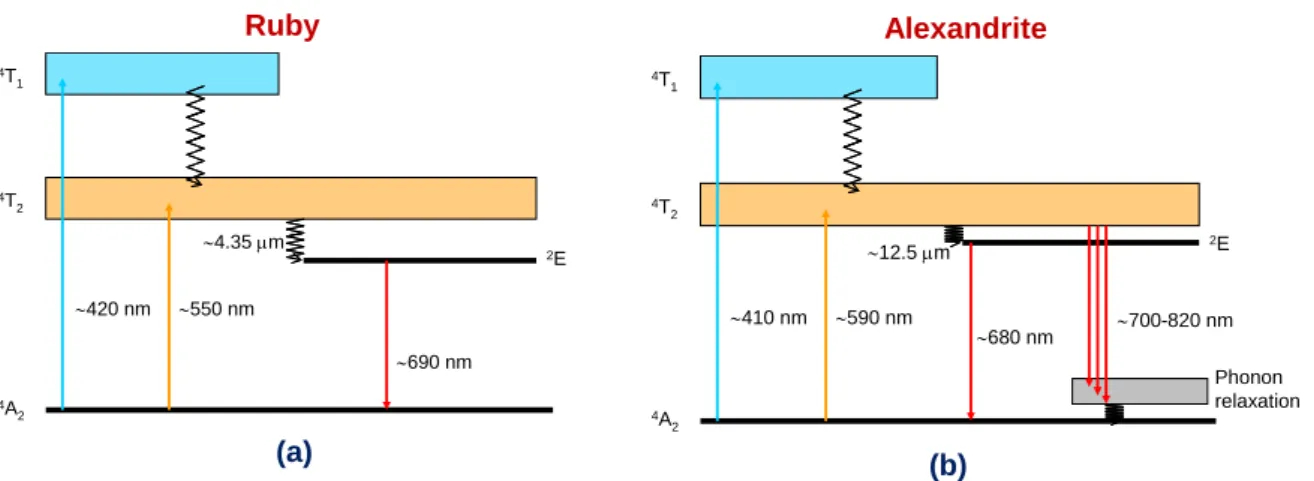
changes the lasers properties [7, 26, 180]. Figure 4 shows simplified energy level diagrams for ruby (a) and Alexandrite (b), where the main difference between Cr:LiSAF is the position of the 2E energy level with respect
to the 4T
2 level. Moreover, due to the large Dq/B value, energy differences between levels are larger, resulting in
blue shifted absorption and emission profiles.
For example, as also mentioned in the introduction section, ruby (Cr+3: Al
2O3) is the first gain medium where
lasing is demonstrated [8]. However unlike Cr:Colquiriites, ruby is not a phonon broadened laser system (Fig. 4 (a)). This is because, in ruby the 2E energy level lies well below the 4T
2 level (4.35 m or 2220 cm-1). The
excited state of the Cr+3 ion is a superposition of the 4T
2 and 2E state, but at room temperature in thermal
equilibrium, using Boltzman distribution one can easily show that the population of the 4T
2 level is ignorable
[26]. The 4T
1 and 4T2 states has very short lifetimes (1 ps), and decay back to the metastable 2E level, which has a
lifetime of about 3 ms [7, 26]. Hence, at room temperature, one can assume that only the 2E state is occupied in
ruby upon optical excitation. Lasing transition occurs between the 2E and 4A
2 states and transitions between
these states are not phonon broadened. So ruby lasing line around 690 nm is quite sharp, enabling only ps pulse generation in mode-locked regime [182].
550 nm 420 nm 690 nm 4.35 m 4T 1 4T 2 4A 2 2E 590 nm 410 nm 680 nm 12.5 m 4T 1 4T 2 4A 2 2E 700-820 nm Phonon relaxation Ruby Alexandrite (b) (a)
Figure 4: Simplified energy level diagram for ruby (a) and for Alexandrite for E//c polarization (b).
Before we proceed with Cr:Colquiriites, for the sake of completeness, we would like to review the situation in Alexandrite as well. As also discussed earlier, Alexandrite (Cr+3: BeAl
2O4) was the first broadly tunable ion solid
state laser that can be operated at room temperature, which was discovered while trying to find an alternative to ruby. Historically alexandrite took quite a lot of attention (it has an intrinsic slope efficiency of 65% at room temperature) [7, 26, 129, 162, 164, 183, 184]. Figure 4 (b) shows a simplified energy level structure for alexandrite gain medium, which actually looks quite similar to ruby, where the 2E state lies below the
vibronically broadened 4T
2 level. However, the energy difference between the 2E and 4T2 levels is lower in
alexandrite (12.5 m or 800 cm-1), which is only a few kT at room temperature (48 m). Hence, in thermal
equilibrium, upon excitation, a reasonable level of the states in the 4T
2 level is populated. Duo to Franck-Condon
principle, transitions from the 4T
2 level to 4A2 is preferable over transition from the 2E level to 4A2 level; hence,
alexandrite can produce broadly tunable laser radiation in the 700-820 nm wavelength range [7, 26]. To increase the performance of alexandrite lasers, the crystal is usually held at elevated temperatures (50-70 C), which increases the effective emission cross section values for the 4T
2 level to 4A2 transition [7, 26, 185]. In the last few
years, Alexandrite gain media has seen a returned interest, and diode pumping as well as femtosecond operation have been investigated by several groups [49, 166, 167, 179, 186-191]. We believe that, with its superior mechanical properties, and interesting laser related spectroscopic properties, Alexandrite might become a strong competitor to Ti:Sapphire and Cr:Colquiriite laser and amplifier systems in the coming years.
(b) (a)
Figure 5: Measured room-temperature absorption and emission spectrum of Cr:LiSAF and Cr:LiCAF gain
media for E//a and E//c axis [31, 35].
As mentioned above, strong electron-phonon coupling in Cr+3:Colquiriite gain media creates three strong and
broad absorption bands (Fig. 5) that are centered around 275 nm, 445 nm (4A
2 level to 4T1 transition) and 640
nm (4A
2 level to 4T2 transition) [31, 35]. Existence of these broad absorption bands and a relatively long upper
state lifetime, which allows reasonable energy storage, enable flashlamp pumping of Cr:Colquiriites. Even though flashlamp pumping is still used for pumping Cr:Colquiriites for some applications, direct diode pumping of Cr:Colquiriite by low cost AlGaAs and/or AlGaInP diodes around 650 nm enables a more advantageous approach. Note that, the absorption profile of Cr:Colquiriites are relatively broad, which enables wavelength flexibility in selection of the diode sources. Moreover, unlike for systems like Yb:YAG, the laser diodes do not require precise control of laser wavelength (and hence laser diode temperature). Also wavelength coupling of diodes at several different wavelengths could be applied to increase the diode brightness. Furthermore, the absorption cross section of Cr:Colquiriites are relatively high for both polarizations, enabling polarization
coupling of diodes as well. Due to all these advantages, direct diode pumping of Cr:Colquiriite allows the construction of compact, efficient and low-cost laser systems. As another example, for Alexandrite, the absorption peak lies at 595 nm for E//b polarization, at 570 nm for E//c polarization, and at 550 nm for E//b polarization, respectively. Hence, with the currently available red diode technology, that could provide efficient emission in the 640-680 nm region, only the E//b polarization could be used effectively for diode pumping, and hence polarization coupling of pump diodes is not possible. Even for E//b polarization, the shortest wavelengths available from the state-of-the-art high power red diodes (640 nm) is relatively far away from the absorption peak (595 nm). This is probably one of the reasons for slower progress in diode pumped Alexandrite systems compared to Cr:Colquiriites. Also, for Ti:Sapphire the absorption band is centered around 480 nm and as mentioned earlier, diodes in this spectral region (blue and green) just became available in the last decade, resulting in even slower progress. What is clear is future progress in diode technology will play a significant role in what we could achieve with diode pumping of these systems.
Broad emission bands of Cr:Colquiriite centered around 800-850 nm region (Fig. 5), enables broadband tuning of laser wavelength as well as generation/amplification of ultrashort pulses. Birefringent nature of Cr:Colquiriites create an uneven strength of emission for the E//a and E//c polarizations, and this can be used as an advantage by exploiting the polarization with higher cross section in lasers/amplifiers (which is E//c in Colquiriites). Note that the cross section values in Cr:LiSAF and Cr:LiSGaF is around 2 times higher than Cr:LiCAF (Table 3). On the other hand, compared to Ti:Sapphire, emission cross section of Cr:Colquiriites are 8-32 times lower. As will be discussed in detail later, a lower emission cross section increases the tendency of the laser towards q-switched mode-locking instabilities. Especially for Cr:LiCAF, which has the lowest emission cross section value among Cr:Colquiriites, the stable working range of cw mode-locked lasing is quite narrow for sub-50-fs pulses, and this issue will be discussed in more detail later (Fig. 32).
On the other hand, room temperature upper state fluorescence lifetimes of Cr:Colquiriites (f) are 20-55 times
longer than Ti:Sapphire (67 s in Cr:LiSAF compared to 3.2 s in Ti:Sapphire). Hence, actually for Cr:Colquiriites the product of room temperature upper state lifetime and emission cross section (emf) is 2-2.5
times higher. Another major advantage of Cr:Colquiriites is the ability to grow high quality crystals with minimal passive losses below 0.15% per cm [51, 134, 178]. If we compare the figure of merit (FOM) of the crystals, which is defined as the ratio of absorption coefficient at the lasing wavelength to that at the pump wavelength, Cr:Colquiriite crystals has about one order of magnitude higher FOM than those for Ti:Sapphire (Table 2). Moreover, similar crystal quality could be obtained even from highly doped crystals. Lastly, Cr:Colquiriites do not suffer from concentration quenching of fluorescence lifetime, and the room-temperature fluorescence lifetime values reported in Table 3 for Cr:Colquiriites is doping independent. This enables efficient laser operation even in 100%-doped Cr:LiSAF (LiChrom: LiSrCrF6) at least at low pumping intensities (we will
discuss later that Auger upconversion process limits the usability of highly-doped crystals for strongly pumped systems) [24].
The laser threshold pump power (Pth) for cw operation could be estimated using:
2 2 ( ) (2 ) 4( ) τ p c p th g em ESA f p w w h P A T L (8)
where h is Planck’s constant, p is the pump photon frequency, P is pumping efficiency, wp (wc) is the pump
(cavity) beam waists, em (ESA) is the emission (excited state absorption) cross section, f is the fluorescence
lifetime of the upper laser level, Ag is the ground state absorption of the Cr3+ ions, L is the total round trip loss
and T is the transmission of the output coupler. A larger em product, along with low crystal passive losses
results in record low lasing thresholds (sub mW) in Cr:Colquiriites, as it will be presented in the next sections.
In general a higher emf product also means a higher small signal gain, but in Cr:Colquiriites this is only true at
low pumping densities. This is because small signal gain is proportional to the product of emission cross section and population inversion, and even though Cr:Colquiriites has a quite long upper state lifetime, it is not trivial to achieve high population inversion levels, since the fluorescence lifetime in Cr:Colquiriites is quite sensitive to temperature and inversion.
To elaborate this issue in detail, we need to look at the important mechanisms that play a role in population dynamics of Cr:Colquiriite lasers/amplifiers. In Cr:Colquiriites, there are four main mechanisms that contribute to thermal loading: (a) quantum defect, (b) thermal quenching of the upper laser level, (c) excited-state absorption, and (d) upconversion (Fig. 6). The first of these effects is the quantum defect, which is due to the energy difference between the pump (p) and laser (l) photons. As discussed above this phonon based effect
also enables the desired absorption/emission broadening process, and facilitates the 4-level laser structure. However, as a side back, difference in energy is transferred to the crystal via nonradiative transitions (phonon
emission) causing an inevitable heat source, and in that respect a pump wavelength as close to the laser wavelength as possible is desired. If we define the quantum defect qd as (1-p/l), the quantum defect in
Yb:YAG is around 9% (Table 3), and in Ti:Sapphire it is around 40%, which is the main advantage of Yb:YAG systems for power scaling. Cr:Colquiriites has quantum defect values in the 20-25% range, and among them Cr:LiCAF have the lowest value (19%).
Quantum defect Thermal quenching Excited state absorption g l g l e g l e l λ l λ p λ λl g l Auger Upconversion g l e l λ (a) (b) (c) (d)
Figure 6: (a) Quantum defect, (b) thermal quenching, (c) excited-state absorption at the laser wavelength and (d)
Auger upconversion effects that cause thermal loading in Cr:Colquiriites.
The second mechanism, thermal quenching is a phenomenon where excited ions at the upper laser level, which ideally contributes to amplification/lasing process via stimulated emission, decays back to the ground state via nonradiative processes. As a result, the mechanism reduces achievable gain, reduces upper state lifetime via this nonradiative channel, and creates an undesired heat load. As noted by Stalder et al., in Cr:Colquiriites, this nonradiative processes is due to the tunneling of excited ions from excited vibrational states of the 4T
2 level to
highly excited vibrational levels of the electronic 4A
2 ground state [169, 192, 193]. Mott equation is generally
used to describe the strength of temperature-dependent nonradiative relaxation processes [194, 195], where the temperature dependence of the fluorescence lifetime f (T) is described using
R NR
R NR 0 1 1 1 1 1 ΔE Exp τ Tf τ τ T τ τ kT . (9)Here, R-1 is the radiative decay rate, f (T)-1 is the temperature-dependent nonradiative decay rate, NR0-1 is the
high temperature limit of the nonradiative decay rate, E is the activation energy, k is the Boltzmann’s constant and T is the absolute temperature in degrees Kelvin.
0.01 0.1 1 10 100 1000 0 50 100 150 200 250 300 Temperature (o C) L if e ti m e ( u s ) Cr:LiCAF Cr:LiSGaF CrLiSAF Ti:Sapphire Alexandrite
Figure 7: Calculated effect of temperature on fluorescence lifetimes of Cr:LiCAF, Cr:LiSAF, Cr:LiSGaF,
Ti:Sapphire and Alexandrite gain media.
Figure 7 shows the calculated variation of fluoresce lifetime with temperature in Cr:Colquiriites, Ti:Sapphire and Alexandrite (parameters that are used in the calculation is listed in Table 3) [130, 169]. The table also lists the critical temperature, T1/2 [169], which is the temperature at which the fluorescence lifetime drops to half of the
radiative lifetime value (above this temperature thermal quenching starts to cause significant nonradiative decay of the excited-state ions from the upper laser level l to the ground state g). Note that, among all the laser materials considered here, Cr:LiSAF has the lowest critical temperature 69 C for thermal quenching [169], indicating the difficulty of power scaling with this material. Actually, this property (sharp variation of lifetime with temperature) makes Cr:LiSAF a good temperature sensor also (Fig. 8 [196]). Within Cr:Colquiriites,
Cr:LiCAF has the highest critical temperature for thermal quenching (190-255 C [130, 169]), again making it the material of choice when power scaling is desired. Before we pass to the third effect, we would like to underline the nonlinear nature of the lifetime thermal quenching process. Due to the cascading nature of this mechanism; the rate of heat generation via thermal quenching is itself temperature-dependent. Once thermal quenching becomes significant, and temperatures close to T1/2 is reached,additional heating increases its rate
even further in an exponential manner. This finally leads to a rapid decay of all the excited ions to the ground state, and sometimes even leading to permanent damage to the crystal due to the low fracture toughness of Cr:Colquiriite gain media (as also observed several times by this author).
Figure 8: A temperature sensor proposal based on temperature dependence of lifetime in Cr:LiSAF [196].
The third mechanism that creates thermal loading in Cr:Colquiriites is excited state absorption (ESA), where an ion in the upper laser level l absorbs a laser or a pump photon and gets promoted to a higher lying excited level e [31, 33, 36, 176, 197-200]. The ion then relaxes back to the upper laser level l via nonradiative decay, and hence heats up the crystal (Fig. 6 (c)). Hence, similar to thermal quenching, the process uses up an ion at the lasing level, which should ideally contribute to the lasing process and creates undesired heat load. For Cr3+:Colquiriites, ESA at pump wavelengths is due to the transition between 4T
2 and4T1b (Fig. 3), covers the
region from around 475 nm to 555 nm in Cr:LiCAF, and do not really pose a problem, especially while pumping with diodes around 650 nm [176]. Beaud et al. studied ESA at the lasing wavelength in Cr:LiCAF and Cr:LiSAF in detail as a function of wavelength (which is due to the transition between 4T
2 and4T1a levels) [176]. For
Cr:LiSAF, ESA cross section is estimated to increase from about 1 x 10-20 cm2 at 780 nm to around 2 x 10-20 cm2
at 920 nm, and the peak is estimated to be at longer wavelengths [176]. Note that this corresponds to a relative ESA cross section (ESA/em) of around 30% at 850 nm. For Cr:LiCAF an ESA cross section of around 3 x 10-21
cm2 is estimated around 800 nm, corresponding to a relative ESA cross section of 23% [176].
According to Caird analysis, the slope efficiency of the laser can be expressed as: L T T L T T hv hv e ESA e p p l
0
, (10) wherev
l is the laser photon frequency, 0 is the maximum (intrinsic) slope efficiency that can be obtained athigh output coupling and the other terms are same as Eq. 8. If we look at Eq. 8, we see that ESA increases the laser threshold, and from Eq. 10, we see that it also reduces the laser slope efficiency. Moreover, we can look at the effect of ESA on the small signal gain (g0) of an amplifier, which can be calculated using [201, 202]:
1 J sto ESA g o J em sat em (11)where Jsat is the saturation fluence of the gain medium (JSath / em), JSto is the stored energy density (JSto
Eabs/Aeff
P/ L
), Eabs is the stored pump energy, Aeffis the effective pump beam area. As it is also clear from Eq. 11, excited state absorption also decreases small signal gain in amplifiers. Note that unlike Cr:Colquiriites, Ti:Sapphire and Yb:YAG does not suffer from ESA, and relative strength of ESA is only around 10% in Alexandrite [168] (even approaches 0 around 775 nm [166]). Hence, ESA (especially at the lasing wavelength) is another significant mechanism that reduces the performance of Cr:Colquiriite lasers/amplifiers.Another very important mechanism that creates thermal loading in Cr3+:Colquiriites and limits the obtainable
gain at high power levels is the Auger energy transfer upconversion (ETU) process[135, 172, 203, 204]. In ETU, excited neighbor ions at the upper laser level l interact with each other and exchange energy, where the energy generated from decay of one of the ions is used to excite another neighboring ion to the upper lying excited level e (Fig. 6 (d) ). Once excited to level e, the ion non-radiatively decays back to the laser level l and heats up
![Figure 15: Continuous-wave power efficiency curves for one single-mode-diode pumped (a) Cr:LiSAF [178],](https://thumb-eu.123doks.com/thumbv2/9libnet/3795006.31142/22.892.187.698.409.591/figure-continuous-power-efficiency-curves-single-pumped-lisaf.webp)