MODEL-DRIVEN ARCHITECTURE BASED
TESTING USING SOFTWARE ARCHITECTURE
VIEWPOINTS
A THESIS SUBMITTED TO
THE GRADUATE SCHOOL OF ENGINEERING AND SCIENCE
OF BILKENT UNIVERSITY
IN PARTIAL FULFILLMENT OF THE REQUIREMENTS FOR
THE DEGREE OF MASTER OF SCIENCE IN COMPUTER ENGINEERING By Burak Uzun June, 2015
ii
MODEL-DRIVEN ARCHITECTURE BASED TESTING USING SOFTWARE ARCHITECTURE VIEWPOINTS
By Burak Uzun June, 2015
We certify that we have read this thesis and that in our opinion it is fully adequate, in scope and in quality, as a thesis for the degree of Master of Science.
_____________________________________ Assist. Prof. Dr. Bedir Tekinerdoğan (Advisor)
_____________________________________ Prof. Dr. Ali Hikmet Doğru
_____________________________________ Assoc. Prof. Dr. Buğra Gedik
Approved for the Graduate School of Engineering and Science:
_____________________________________ Prof. Dr. Levent Onural
iii
ABSTRACT
MODEL-DRIVEN ARCHITECTURE BASED TESTING
USING SOFTWARE ARCHITECTURE VIEWPOINTS
Burak Uzun
M.S. in Computer Engineering
Advisor: Assist. Prof. Dr. Bedir Tekinerdoğan June, 2015
Software testing is the process of checking whether a system meets the specifications and fulfills its intended purpose. Testing a system requires executing the test cases that can detect the potential defects in the program. In general, exhaustive testing is not possible or practical for most real programs due to the large number of possible inputs and sequences of operations. Because of the large set of possible tests only a selected set of tests can be executed within feasible time limits. As such, the key challenge of testing is how to select the tests that are most likely to expose failures in the system. Model-based testing (MBT) relies on models of system requirements and behavior to automate the generation of the test cases and their execution. Model based testing can use different representations of the system to generate testing procedures for different aspects of the software systems. Example models include finite state machines (FSMs), Petri Nets, I/O automata, and Markov Chains.
A recent particular trend in MBT is to adopt architecture models to identify the defects related to systemic properties. These systemic properties are typically defined in architecture views which represent the gross level structure of the system from particular concern perspective. Assessing software system correctness with respect to architectural specifications is called architecture based testing (ABT). Many studies have focused on architecture based testing in which different models have been applied. However none of these have so far explicitly focused on adopting architecture views for deriving the test cases.
In this thesis, we first provide a systematic review on existing model-driven architecture based testing. We define all the existing processes in the literature and discuss the current limitations. Based on the result of the systematic review and our own analysis we provide a novel model-driven architecture based testing approach using architecture views. With the approach we focus on detecting the deviations in the code from the architectural views. For this we use models of architecture views together with executable transformation model to generate the test cases which are then executed on the real code. Our approach has been evaluated within a real industrial context of The Scientific and Technological Research Council of Turkey Software Technologies
iv
Institute (STRCT-STI). The results of the industrial case study showed that model-driven architecture based testing can be effective for reducing the time to generate and execute the test cases, and enhancing the reliability of the system.
Keywords: Systematic Literature Review, Software Architecture Viewpoints, Architecture Based Testing, Model Based Testing.
v
ÖZET
YAZILIM MİMARİSİ BAKIŞ AÇILARI KULLANILARAK
MODEL GÜDÜMLÜ MİMARİ TABANLI TEST ETME
Burak Uzun
Bilgisayar Mühendisliği, Yüksek Lisans Tez Danışmanı: Yrd. Doç. Dr. Bedir Tekinerdoğan
Haziran, 2015
Yazılım test etme bir sistemin amacını yerine getirip getirmediğini ve istenilen özellikleri karşılayıp karşılamadığını denetleme sürecidir. Bir sistemi test etmek için olası program hatalarını keşfedebilen test durumlarını çalıştırmak gerekir. Genelde birçok gerçek program için olası girdi ve operasyon dizilerinin çok sayıda olması sebebiyle ayrıntılı test etmek mümkün ve pratik değildir. Büyük test setlerinden sadece seçilen olası test durumları kısıtlı bir zamanda koşturulabilir. Görüldüğü gibi, yazılım test etmede ki esas sorun sistemdeki hataları ortaya çıkarabilen test durumlarını seçebilmektir. Modele dayalı test etme (MDT) sistemin gereksinimlerinin ve davranımlarının modellerine dayanarak test durumlarının oluşturulmasını ve koşturulmasını otomatikleştirir. Modele dayalı test etme sistemin farklı temsillerini kullanarak yazılım sistemin farklı yönleri için test prosedürleri oluşturur. Örnek modeller içerisinde sonlu makineler, Petri Netler, otomatalar ve Markov zincirleri bulunur.
Modele dayalı test etmede yazılım mimarisi kullanılarak sistemik özelliklerde bulunan hataları ortaya çıkarmak yeni bir eğilim olarak görülmektedir. Bu sistemik özellikler tipik olarak mimari bakışlarında tanımlanmıştır. Bir yazılım sisteminin belirtilen mimari özelliklere göre doğruluğunu ölçmek mimari tabanlı yazılım testi (MBYT) olarak adlandırılır. Birçok çalışma farklı modeller kullanarak mimari tabanlı test yöntemleri üzerinde yoğunlaştı. Ancak bu çalışmaların hiç birisinde yazılım mimarisi bakış açıları test durumlarını üretirken kullanılması benimsenmedi.
Bu tezde biz, öncellikle var olan model güdümlü mimari tabanlı test etme yöntemlerinin sistematik incelemesini sunuyoruz. Literatürde var olan yöntemleri tanımlıyor ve yöntemlerin sınırlarını tartışıyoruz. Sistematik incelememiz ve analizlerimiz sonucunda yeni bir mimari bakış açılarını kullanan model güdümlü mimari tabanlı test yöntemi geliştiriyoruz. Yöntemimizde mimari bakış açılarında belirtilen tanımlardan sapan kodlar üzerinde yoğunlaşıyoruz. Bunun için mimari bakış açısı modellerini kullanan dönüşüm modellerini koşturarak sistem üzerinde koşturulacak test durumlarını üretiyoruz. Yöntemimiz Türkiye Bilimsel ve Teknolojik Araştırma Kurumu - Yazılım
vi
Teknolojileri Enstitüsü’ndeki (TÜBİTAK-YTE) bir proje üzerinde değerlendirildi. Bu değerlendirmenin sonucu olarak model güdümlü mimari tabanlı test yöntemimiz test durumları oluşturmak ve koşturmak ve sistemin güvenilirliğini arttırmak için etkili bir yöntem olduğunu gördük.
Anahtar Kelimeler: Sistematik Literatür İnceleme, Yazılım Mimari Bakış Açıları, Mimari Tabanlı Test, Model Tabanlı Test
vii
Acknowledgements
I would like to express my sincerest gratitude to my advisor Dr. Bedir Tekinerdoğan for giving me the chance to research on my topic. He drove me forward with his supervision, support, time and advises throughout my research.
I am thankful to Prof. Dr. Ali Hikmet Doğru and Assoc. Prof. Dr. Buğra Gedik for kindly accepting to be in the committee and also for giving their precious time to review and read this thesis.
I am grateful to The Scientific and Technological Research Council of Turkey Software Technologies Institute (STRCT-STI) for the support and permission of evaluating my approach on institute’s project. I would also like to thank my colleagues for their support especially Mehmet, Ahmet and Ali.
I would like to thank to my soon to be wife Başak for her invaluable support and the joy she brings in my life with her endless love.
Last but not least, I would like to thank my mother Fatma, my father Müjdat and my brother Tekin Alp for being there for me when I need help and support me in every step of my life with their love.
viii
Contents
Introduction ... 1 1.1. Background ... 1 1.2. Problem Statement ... 2 1.3. Contribution ... 31.4. Outline of the Thesis ... 4
Preliminaries ... 5
2.1. Software Architecture Modeling ... 5
2.2. Software Testing ... 8
2.2.1. Model Based Testing ... 9
2.2.2. Architecture Based Testing ... 10
Model-Driven Architecture Based Testing: A Systematic Literature Review ... 11
3.1. Background ... 12
3.1.1. Architecture Based Testing ... 12
3.1.2. Systematic Literature Review ... 14
3.2. Research Method ... 15
3.2.1. Review Protocol ... 15
3.2.2. Research Questions ... 16
3.2.3. Search Strategy ... 17
3.2.4. Study Selection Criteria ... 18
3.2.5. Study Quality Assessment ... 19
3.2.6. Data Extraction ... 19
3.2.7. Data Synthesis ... 20
3.3. Results ... 20
3.3.1. Overview of Reviewed Studies ... 20
3.3.2. Research Methods ... 21
3.3.3. Methodological Quality ... 22
3.3.4. Systems Investigated ... 24
3.4. Discussions ... 42
3.5. Conclusion ... 43
Model Driven Architecture Based Testing Using Architecture Viewpoints ... 44
4.1. Process ... 44
ix
4.3. Architecture Viewpoints & Architecture View Criteria ... 48
4.3.1. Decomposition Viewpoint ... 49
4.3.2. Uses Viewpoint ... 49
4.3.3. Generalization Viewpoint ... 50
4.3.4. Layered Viewpoint ... 51
4.3.5. Shared Data Viewpoint ... 52
4.4. Transformation Model Construction and Concrete Test Case Generator ... 53
4.4.1. Decomposition Viewpoint ... 54
4.4.2. Uses Viewpoint ... 55
4.4.3. Generalization Viewpoint ... 58
4.4.4. Layered Viewpoint ... 60
4.4.5. Shared Data Viewpoint ... 61
4.5. Execution & Report ... 62
Case Study ... 64
5.1. Architecture Design of Case Study ... 65
5.1.1. Shared Data Viewpoint ... 65
5.1.2. Decomposition Viewpoint ... 65
5.1.3. Uses Viewpoint ... 66
5.1.4. Layered Viewpoint ... 67
5.1.5. Generalization Viewpoint ... 67
5.2. Validating the Test Execution Environment ... 69
5.2.1. Shared Data Viewpoint ... 70
5.2.2. Decomposition Viewpoint ... 71
5.2.3. Uses Viewpoint ... 72
5.2.4. Layered Viewpoint ... 73
5.2.5. Generalization Viewpoint ... 73
5.2.6. Summary ... 74
5.3. Test Execution Results ... 75
5.3.1. Shared Data Viewpoint ... 75
5.3.2. Decomposition Viewpoint ... 76 5.3.3. Uses Viewpoint ... 76 5.3.4. Layered Viewpoint ... 76 5.3.5. Generalization Viewpoint ... 76 5.4. Discussion ... 76 Related Work ... 78 Conclusion ... 80 Bibliography ... 82
x
Appendix A - Search Strings... 85
Appendix B – List of Primary Studies ... 89
Appendix C - Study Quality Assessment ... 90
Appendix D - Data Extraction Form ... 91
xi
List of Figures
Figure 2.1. Context of software architecture ... 6
Figure 2.2. Core of software architecture description ... 7
Figure 2.3. Architecture framework ... 8
Figure 2.4. Process of model based testing ... 10
Figure 3.1. Process model of MDABT ... 13
Figure 3.2. Review protocol ... 16
Figure 3.3. Year wise distribution of the primary studies ... 20
Figure 3.4. Reporting quality distribution of the primary studies ... 22
Figure 3.5. Rigor quality distribution of the primary studies ... 23
Figure 3.6. Relevance quality distribution of the primary studies ... 23
Figure 3.7. Credibility quality distribution of the primary studies ... 24
Figure 3.8. Total quality distribution of the primary studies ... 24
Figure 3.9. Addressed concern distribution of the primary studies ... 25
Figure 3.10. Process model applied in study A ... 27
Figure 3.11. Process model applied in study B ... 28
Figure 3.12. Process model applied in study C ... 29
Figure 3.13. Process model applied in study D ... 30
Figure 3.14. Process model applied in study E ... 31
Figure 3.15. Process model applied in study F ... 32
Figure 3.16. Process model applied in study G ... 33
Figure 3.17. Process model applied in study I ... 34
Figure 3.18. Process model applied in study J ... 35
Figure 3.19. Process model applied in study K ... 36
Figure 3.20. Process model applied in study L ... 37
Figure 3.21. SA model type distribution over primary studies ... 38
Figure 3.22. Test model distribution over primary studies ... 38
Figure 3.23. Test criteria distribution over primary studies ... 39
Figure 3.24. Test case generation type distribution over primary studies ... 39
Figure 3.25. Test analysis type distribution over primary studies ... 40
Figure 4.1. Process model of MDABT using architecture viewpoint ... 45
Figure 4.2. Process model of our approach ... 47
Figure 4.3. Decomposition viewpoint metamodel ... 49
Figure 4.4. Uses viewpoint metamodel ... 50
Figure 4.5. Generalization viewpoint metamodel ... 51
Figure 4.6. Layered viewpoint metamodel ... 52
Figure 4.7. Shared data viewpoint metamodel ... 53
Figure 4.8. Decomposition viewpoint transformation model ... 54
Figure 4.9. Method for retrieving packages under given package name ... 54
Figure 4.10. Method for searching given package name in package list ... 55
xii
Figure 4.12. Uses viewpoint transformation model ... 56
Figure 4.13. Helper method for retrieving direct classes under given package ... 56
Figure 4.14. Helper method for retrieving direct classes under given package ... 56
Figure 4.15. Helper method for deciding uses relation ... 57
Figure 4.16. Template test case method for uses viewpoint ... 58
Figure 4.17. Generalization viewpoint transformation model ... 58
Figure 4.18. Helper method for retrieving every parent of given class ... 59
Figure 4.19. Template test method for generalization viewpoint ... 59
Figure 4.20. Layered viewpoint transformation model ... 60
Figure 4.21. Template test method for layered viewpoint ... 60
Figure 4.22. Shared data viewpoint transformation model ... 61
Figure 4.23. Helper method for method existence checking ... 61
Figure 4.24. Template test method for shared data viewpoint ... 62
Figure 4.25. Core classes of xUnit test framework architecture ... 62
Figure 5.1. Shared data view of Project X infrastructure ... 65
Figure 5.2. Decomposition view of Project X infrastructure ... 66
Figure 5.3. Uses view of Project X infrastructure ... 66
Figure 5.4. Layered view of Project X infrastructure ... 67
Figure 5.5. Generalization view of Project X infrastructure within package B ... 68
Figure 5.6. Generalization view of Project X infrastructure within package C ... 68
Figure 5.7. Generalization view of Project X infrastructure within package D ... 69
Figure 5.8. Generalization view of Project X infrastructure between package D and F ... 69
Figure 5.9. Generalization view of Project X infrastructure within package F ... 69
Figure 5.10. Shared data view representation of mutant implementation ... 71
Figure 5.11. Decomposition view representation of mutant implementation ... 71
Figure 5.12. Uses view representation of mutant implementation ... 72
Figure 5.13. Layered view representation of mutant implementation ... 73
xiii
List of Tables
Table 1. Overview of search results and study selection ... 18
Table 2. Quality checklist ... 19
Table 3. Distribution of studies over publication source ... 21
Table 4. Distribution of studies over research methods ... 22
Table 5. Addressed concern and study map ... 25
Table 6. Fault-based testing results for each viewpoint ... 75
1
Chapter 1
Introduction
1.1. Background
Software testing is a process of investigating a software product to identify possible mismatches between expected and present requirements of the system [24]. Identified mismatches are categorized as bugs, errors and defects. Software bug is a static fault in the software system and activates a software error. Software error is a faulty state of the software system which is activated by the execution of software bug. Furthermore, software defect is a propagation of a software error which causes external, observable and incorrect behavior of the system. One of the main motivations of software testing is to ensure the correctness of a software system. Software is correct if and only if each valid input to the system produces an output according to system specifications. Therefore, software must be verified and validated according to specifications provided. Moreover, software testing requires executions of test cases which can detect possible bugs, errors and defects. In most cases, exhaustive testing is not possible due large number of possible operation sequences and inputs. As a result, selecting set of test cases which can detect possible flaws of the system is the key challenge in software testing. Model based testing addresses this challenge by automating the generation and execution of test cases using models based on system requirements and behavior. Recently, studies in model based testing adopt software architecture models to identify the defects related to systemic properties. Software architecture is a blueprint of the system which enables communication between stakeholders of the system and clear representation of abstract system model. Software representation of complex and large domains grounds software architecture modeling and proper documentation of software architecture to gain more importance [1].
2
International standards for software architecture are defined and adapted as the software architecture concept attracts more attention ([2], [23]). In a software system, software architecture provides high level specifications of the low level implementations in which the mapping between levels can be performed. Accordingly, one can use architecture specifications for verifying and validating a software system to ensure correctness of the system. This idea emerged architecture based testing concept for testing the architecture specifications in a software system. In this thesis we will present current techniques adopted in architecture based testing using systematic literature review protocol and novel approach evaluated on real industrial case study.
1.2. Problem Statement
Architecture based testing is a developing and promising research area in software testing. In architecture based testing software correctness is assessed with respect to given architectural specifications which are actually models representing software architecture of the system. Therefore, architecture based testing is inherently model driven approach. Accordingly, we will infer architecture based testing as model driven architecture based testing (MDABT) in this thesis. Furthermore, systematic literature review we applied on this domain enabled us to identify issues in current studies for MDABT. None of the studies we examined explicitly used architecture viewpoints in the definition software architecture models. Moreover, none of the studies presented in architecture based testing presents a systematic literature review for MDABT domain. At last, almost all studies evaluated suggested approaches on small scale examples such as client server applications.
Architecture viewpoint notion takes an important part in software architecture modeling. Software architecture defined by combination of different architecture views governed by viewpoints each mapping to different stakeholder concern. Therefore, in architecture based testing architecture view must be taken into account when the test cases are generated. This way each separate concern of the stakeholders can be tested as a specific architecture view.
As far as we know there is no study in which systematic literature review of the domain is performed. It is important to have a study to analyze and identify the studies in this domain so that new researchers can identify challenges and suggest new research areas.
3
Current literature in architecture based testing present approaches for the research area. In most of the studies the approach is evaluated on small scale examples. Moreover, most of the examples are created along with the approach to be performed on which implies to biased examples. It is critical to use unbiased case study to evaluate newly presented technique.
1.3. Contribution
The contribution of this thesis can be listed as follows:
A systematic review on current state of the art in model driven architecture based testing approaches
We have carried out a systematic review on existing approaches for model driven architecture based testing. We have found 158 studies and selected 12 of these as primary studies which we analyzed in detail. The systematic review is novel and has not been defined before. The systematic review provides systematic overview of current state of the art and has resulted in important lessons learned about MDABT. This can be used both by researchers to identify the important challenges in MDABT and practitioners who can use the guidelines of the identified approaches in setting up an MDABT approach.
A novel systematic approach for MDABT
After performing systematic literature review on architecture based testing domain, we have seen that although the definition of the architecture evolved none of the studies concentrated on architecture view. Software architecture is not single perspective entity rather a set of perspectives mapping to different stakeholder concerns. Each concern must be handled individually in testing so that complete testing on system using architecture can be achieved.
Tool support for MDABT
Eclipse Epsilon IDE and its integrated tools have been used in the development of our approach implementation. Eclipse Epsilon offers a wide variety of tools, languages and support of all model driven development issues and centralizes these technologies in one framework. In our study we created an Eclipse Epsilon environment to generate test cases for our approach.
4
Systematic literature review we performed pointed out that most of the studies did not evaluate their suggested approaches on real industrial case contexts. In fact small scale examples are created to evaluate suggested approaches which are prone to be biased to suggested approach. Our approach has been successfully tested on a software systems infrastructure that is being actively used by 4500 users throughout the day since 2010.
1.4. Outline of the Thesis
The rest of thesis is organized as follows: Chapter 2 gives a preliminary about software architecture, MDABT and model based testing concepts. Note that in Chapter 3 more detailed information of MDABT will be delivered in which systematic literature review is presented. The generic process model for MDABT is obtained from the selected studies using Kitchenham’s guideline for systematic literature review. Chapter 4 presents our approach on MDABT using architecture viewpoints. The process model we created for our approach and details of the implementation will be explained. Furthermore, Chapter 5 presents our case study from STRCT-STI in which we evaluated our approach. Evaluation results and result discussions of our approach are presented alongside with our case study. Chapter 6 presents the related work and at last Chapter 7 presents the conclusions and discussions.
5
Chapter 2
Preliminaries
In this chapter software architecture and architecture views will be presented alongside with model based testing (MBT) and architecture based testing (ABT). Software architecture is presented using IEEE 1471 standard [23]. This standard discusses that software architecture descriptions are inherently multi view entities and single view description of architecture cannot completely express stakeholders concerns. Additionally, architecture view definitions will be presented using Clements et al. work in [1]. Furthermore, software testing concept will be presented together with model based testing and architecture based testing concepts.
2.1. Software Architecture Modeling
Software architecture became a fundamental subpart of software engineering [1]. According to IEEE 1471 standard software architecture is defined as main part of a software intensive system expressed by set of components, components inter and intra relations [23]. It can be inferred that architecture of a system is not a monolithic concept rather it is complicated set of components and relations which are evolving with the system itself. Therefore, each component and component relation is very important from the different aspects of the system stakeholders from which the concept of architecture view emerged. In this section first we will give background information for software architecture and then architecture view types of Views and Beyond framework will be presented.
Software architecture is an entity exhibited by a system and expressed by architecture description. Figure 2.1 (adopted from [23]) shows the context of software architecture concept with respect to system perspective. System is situated in its environment and can be enterprise, system of systems, service or
6
software. System environment is explained as every interface that is interacting and affecting system. For instance environment can be the domain which system represents or it can be the server system resides. Moreover, stakeholders have interests in the system which can be called as system concerns. Stakeholders are any organization or people that have concerns and interests in system such as user, consumer, supplier... System must be present for an architecture concept to be provided. Systems have architecture or architectures which are expressed by architecture descriptions. Architecture description explains the architecture of the system utilizing different notation techniques and it is a "blueprint" between architects and stakeholders.
expresses situated in System Environment Architecture Architecture Description Stakeholder 1.. * 1.. * has interests in 0.. * 1.. * 0.. * 0.. * exhibits 0.. * 1.. *
Figure 2.1. Context of software architecture
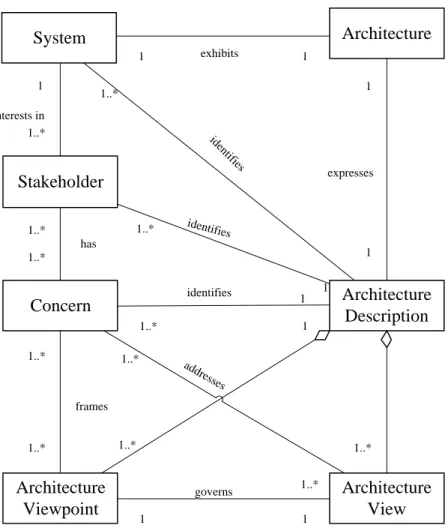
In Figure 2.2 (adopted from [23]) core architecture descriptions concept and its relations with other architecture concepts is shown. Architecture description expresses an architecture belonging to some system of interest. Moreover, it identifies system including system stakeholders and stakeholder concerns. Architecture description consists of architecture views and viewpoints where viewpoints are guidelines of mapped views. Architecture view is a perspective of a system addressing a specific concern of a system stakeholder.
7 1..* 1..* has Architecture Stakeholder System Architecture Description Concern Architecture Viewpoint Architecture View 1..* 1 1 governs 1 1 expresses 1 1..* has interests in 1 exhibits 1 1..* 1..* 1 identifies 1..* 1..* add resses frames 1..* 1..* 1..* 1 identifies 1..* 1 iden tifies
Figure 2.2. Core of software architecture description
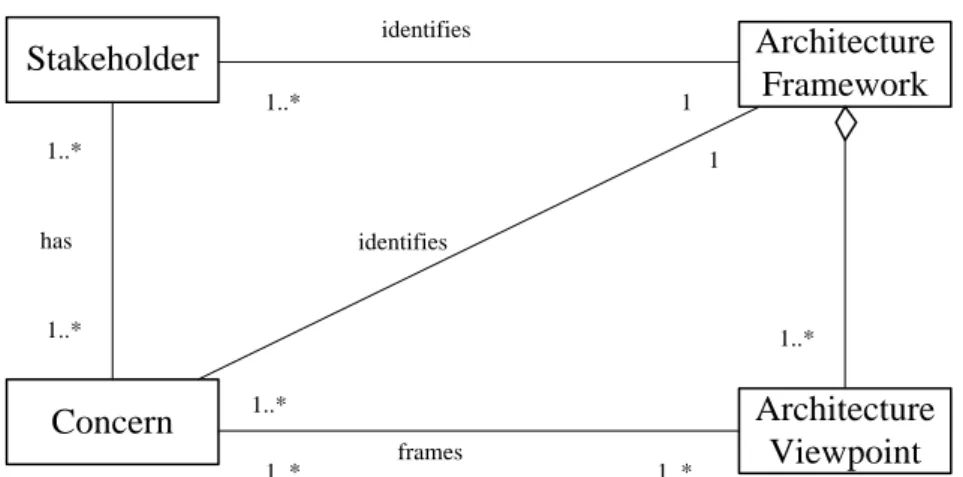
In Figure 2.3 (adopted from [23]) architecture frameworks and its relations with other components are presented. Architecture framework provides a typical convention for presenting, analyzing and using architecture descriptions. There are several frameworks already practiced today which are not limited to MODAF, TOGAF, RM-ODP and Kruchten's 4+1 View Model. Architecture frameworks have a set of architecture viewpoints defined in the framework and identify stakeholder and their concerns.
8 Stakeholder Architecture Framework Architecture Viewpoint Concern 1..* 1..* 1..* 1..* 1..* 1..* 1 1..* 1 frames has identifies identifies
Figure 2.3. Architecture framework
Architecture is a complicated and large concept that cannot be explained from a single perspective [1].Therefore notion of architecture view is introduced for representing set of system components and inter and intra relations. An architecture view is related to a particular concern of a stakeholder. Different stakeholder yields different concern which yields set of views representing architecture of the system. Architectures described by multiple views is easy to understand, model, communicate with and analysis. Architecture modeling with architecture views supports separation of concerns where the concerns are identified by different stakeholders. Therefore, the notion of architecture view becomes more important to clearly express the architecture using different perspectives according to concern of the stakeholders. Architecture viewpoints dictate architecture view in which architecture viewpoint specifies details of architecture view and its structure. Moreover, viewpoint specifies what kind of information to be held in the architecture view model. Several architectural frameworks have been proposed in the current literature using architecture viewpoints. In this study we are interested in architecture views and viewpoints defined in Views and Beyond framework [1]. Views and Beyond framework utilizes three types of views module views, component and connector views and allocation views. In this thesis we will use the implementation of this framework implemented in Demirli et al. work [3].
2.2. Software Testing
Software testing is a process of investigating a software product to identify possible mismatches between expected and present requirements of the system [24]. Software testing can be done dynamically by executing the test cases or statistically by inspecting the system under test. Moreover, software testing
9
methods can be divided into two methods which are white box testing and black box testing. White box testing refers to testing the internal content of the system in which the tester must know the detail of the implementation. Black box testing on the other hand refers to testing the functionality of the system without knowing the internal structure. Software testing can be applied at different levels such as unit testing, integration testing, component interface testing and system testing. In unit testing the unit under test is isolated and the unit’s functionality is tested. Integration tests verify the interaction between the units with respect to functional and non-functional requirements of the system. Moreover, component interface testing is applied for verifying the data transmission between the architectural design elements which can be component, units or subsystems. At last system testing is a typical acceptance testing of system in which the system components are integrated and possible scenarios are executed on the system under test.
2.2.1. Model Based Testing
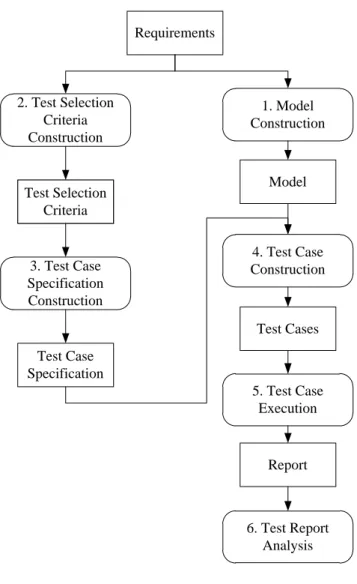
According to Utting et al.[4] MBT is a type of testing that utilizes the information in model which is the intended behavior of the system and its environment. There are several motivations for to perform model based testing such as easy test maintenance, automated test design and enhancing test quality. In Figure 2.4 (adapted from [4]) process of model based testing is presented. Model of the system under test is constructed from the requirements of the system. Likewise, test selection criteria are formed by requirements, which is used for selecting test cases that detects faults, errors and possibly failures. Test case specifications are constructed from test selection criteria which are then used with system model to generate actual test cases. Test cases are executed at system under test and test results are analyzed by test verdict.
10 Requirements 1. Model Construction Model 4. Test Case Construction 2. Test Selection Criteria Construction Test Selection Criteria 3. Test Case Specification Construction Test Case Specification Test Cases 5. Test Case Execution Report 6. Test Report Analysis
Figure 2.4. Process of model based testing
2.2.2. Architecture Based Testing
In architecture based testing system is test using the information presented in architecture model of the system. Current literature performs architecture based testing at two levels for different test concerns which are architecture and code level testing. Architecture-level testing and code-level testing performed using architectural relations and components specified in the architecture description. Architecture level testing carried out by testing architectural properties of the system. In this thesis we focus on architecture based testing at code level for architecture to code conformance concern for different views of the system. Different approaches for architecture based testing have been offered and these approaches are analyzed by us using systematic literature review technique.
11
Chapter 3
Model-Driven Architecture Based
Testing: A Systematic Literature
Review
In general, exhaustive testing is not possible or practical for most real programs due to the large number of possible inputs and sequences of operations. Because of the large set of possible tests only a selected set of tests can be executed within feasible time limits. As such, the key challenge of testing is how to select the tests that are most likely to expose failures in the system. Moreover, after the execution of each test, it must be decided whether the observed behavior of the system was a failure or not (the oracle problem). In the traditional test process the design of test cases and the oracles as well as the execution of the tests are performed manually. This manual process is time consuming and less tractable for the human tester. Model-based testing (MBT) relies on models of system requirements and behavior to automate the generation of the test cases and their execution. A model is usually an abstract, partial presentation of the desired behavior of a system under test (SUT). A model act as an oracle for the SUT since it defined the intended behavior. In addition the structure of the model can be exploited for the generation of test cases. Test cases derived from such a model are collectively known as an abstract test suite. Based on the abstract test suite a concrete test suite needs to be derived that is suitable for execution. Hereby, the elements in the abstract test suite are mapped to specific statements or method calls in the software to create the concrete test suite. The generated executable test cases often include an oracle component which assigns a pass/fail decision to each test. Because test suites are derived from models and not from
12
source code, model-based testing is usually seen as one form of black-box testing.
Model based testing can use different representations of the system to generate testing procedures for different aspects of the software systems. Example models include finite state machines (FSMs), Petri Nets, I/O automata, and Markov Chains. A recent particular trend in MBT is to adopt architecture models to provide automated support for the test process.
So far, many approaches have been introduced but no explicit effort has been undertaken to provide a systematic overview on the existing literature. In this study we adopt a systematic literature review (SLR) approach based on Kitchenham’s guidelines.
The remainder of the chapter is organized as follows: Section 1 of the chapter describes the overall background on architecture-based testing, architecture modeling and systematic literature reviews. Section 2 discusses the overall protocol of the adopted in SLR. Section 3 presents the results of the adopted SLR protocols. Section 4 presents discussion over the SLR. At last section 5 presents the conclusion of this chapter.
3.1. Background
3.1.1. Architecture Based Testing
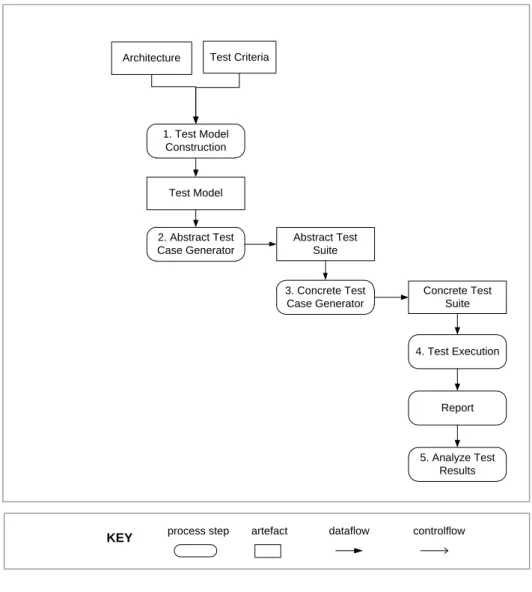
Software testing is process of verifying and validating software against its expected requirements. Testing is continuous process in software development life cycle and can be performed at different levels in the cycle. Software design phase is one of the levels where testing can be applied due to various benefits. Architecture based testing is a testing type exploiting the knowledge in the design phase to test the software system within different abstraction levels. One of the benefits using architecture based testing is to detect defects earlier at software development life cycle. This prevents the propagation of defect to other levels of software development life cycle such as implementation and integration of the system. In architecture based testing the software architecture implementation (SA) is validated and verified against the SA specifications provided. Below process model of model driven architecture based testing (MDABT) is given. This process model or "pattern" is extracted from the thoroughly analyzed studies that are involved in this literature review.
13
KEY process step artefact dataflow controlflow
Architecture 1. Test Model Construction Test Criteria Test Model 2. Abstract Test Case Generator Abstract Test Suite 3. Concrete Test Case Generator Concrete Test Suite 4. Test Execution Report 5. Analyze Test Results
Figure 3.1. Process model of MDABT
Based on Figure 3.1 we can identify the following issues that are present for realizing MDABT:
Description of the Architecture
In order to use the architecture for the purposes of MBT it should be properly described using a well-defined representation mechanism or language. The provided representation can be refined to other representations for purposes of analysis.
Description of Test Criteria
Testing is carried out based on predefined testing goals and testing criteria. For example, the criteria might be based on coverage of graph paths. It is important to specify these criteria.
14
Generating Test Model based on Architecture
Based on the architecture and the provided test criteria the required test model needs to be generated. The generation process can be carried out in different ways and may depend on the provided representations.
Test Case Generation based on Test Model
Based on the provided test model test cases need to be generated. Different approaches might apply different generation approaches and adopt different representations for the test cases. Furthermore, test case can be defined in multiple steps and usually a distinction is made between abstract test cases and concrete test cases.
Test Execution
Once the test cases have been derived these are executed on the real code or on the architecture of the system. The execution can be carried out in different ways.
Analysis of test results
The final step of the process is the analysis of the test results which might be again represented in various ways. The analysis can be manual or automated.
Each approach will realize the MDABT process differently. Further some approaches might not apply all the steps that are described above, but focus on particular steps instead.
3.1.2. Systematic Literature Review
A systematic literature review is method of synthesis for identifying, evaluating and clarifying all filtered research with respect to specific research questions or research area [5]. Systematic literature review (SLR) is a secondary study taking primary studies as input for a synthesis. There are many motivations for taking on SLR approach such as summarizing the existent methods for research, finding out gaps in current techniques and discovering new research areas [5]. Summarizing the existent methods or techniques for specified research area will provide an overview and background of the domain. Overview and background information extracted can reveal limitations, benefits and pre-required conditions needed for methods in the research area. Moreover, SLR helps to find out the gaps or holes in the current research studies indicating areas for further examination. Furthermore, SLR studies can discover new research areas or
15
directions within the specified research areas. There are both advantages and disadvantages of applying SLR method. The disadvantage is that it consumes too much time. On the other hand, results of the SLR are more likely to be unbiased. SLR provides knowledge across different configurations and methods. Moreover, data in quantitative studies can be united by meta analytic techniques. The SLR method first applied successfully in the field of medicine for the need of evidence based research. Then it is adopted by other fields such as organic chemistry, education and psychology. Similarly, evidence-based software engineering emerged along with the guidelines for performing systematic literature reviews [6]. The main motivation of the evidence-based software engineering is to enhance the solutions for quality concerns as well as give primary knowledge to different stakeholder groups. In this chapter we aimed at identifying and evaluating the evidences and studies regarding the MDABT. As a result, a systematic literature review was an applicable and satisfactory research method for our research.
3.2. Research Method
As mentioned SLR is a method of synthesis identifying, clarifying and evaluating whole set of research studies answering specific set of research questions or related to a specific research area [5]. In this study we conducted the SLR for identifying and evaluating the existing evidences and studies in the MDABT area. Kitchenham and Charters [5] guideline of systematic literature review in software engineering is accompanied in this study. The further subsections of this section explain review protocol and steps directed in the guideline [5].
3.2.1. Review Protocol
Firstly, we have created a review protocol before accompanying a systematic literature review which can be seen in Figure 3.2. Review protocol identifies the approaches which will be utilized to accompany systematic literature review. Pre-defining review protocol will greatly reduce researcher bias.
To begin with research questions of the systematic literature review is identified. Then scope and strategy of our research study searching is defined. Search scope is a means of identifying platforms that studies are published and publication dates to be considered while picking out a set of possible studies. Search strategy on the other hand, is a means of identifying keywords for search queries which is a fundamental part of process for applying full scan on the research area. After
16
the definition of search strategy, definition inclusion and exclusion criteria are performed. In this study we have defined exclusion criteria to pick out studies which are not actually in our research area. Next step in our protocol is the definition of quality assessment where the criteria identification performed, in the previous step is detailed by assessing studies over set of attributes and picking the ones that are not satisfying the quality requirements. This step is then followed by the design of data extraction form for extracting information from studies answering the research questions. In order to design the data extraction form, we apply data extraction on sample studies for singling out the properties or attributes that will be extracted in data extraction form. At last, definition of data synthesis method is introduced for managing the extraction of attributes or properties from the studies.
Figure 3.2. Review protocol
3.2.2. Research Questions
The fundamental step of the SLR is identification of specific and valid research questions. The selected studies after applying review protocol must answer all research questions defined. Research question must be valid in order to be answered by each study in the domain. We have identified the following research question which should be answered by the selected set of studies. In this study we are interested in conducting the following research questions which are...:
17
RQ.1: What are the addressed concerns for applying model-driven software architecture based testing?
RQ.2: What are the proposed solutions in architecture-based testing?
RQ.3: What are the existing research directions within architecture-based testing?
3.2.3. Search Strategy
One of the main motivations of SLR is to identify primary studies answering the specified research questions utilizing well-defined search strategy. In the subsections we will provide search scope and method details which are two subparts of our search strategy definition.
Scope
Our search scope includes two attributes which are publication date range and publication platforms. We have selected the range of dates between period of 2000 and April 2014 for our publication date range attribute. We have selected start date as 2000 because first paper having strong foundations on the topic with a proper case study explaining overall method is published at this date. We included reputable publication platforms which are listed below for identifying journal papers, conference papers and workshop papers.
IEEE Xplore
ACM Digital Library
Wiley Interscience
ScienceDirect
Springer
ISI Web of Knowledge Search Method
To search a database we used two search methods, automatic search and manual search. Automatic search is performed by executing search strings on search engines of electronic data sources. Manual search is conducted by manually browsing journals, conference proceedings or other important sources. Since the selected databases include thousands of published papers, manual search becomes very time consuming. For this reason, we conducted automated search by using search string.
18 Search String
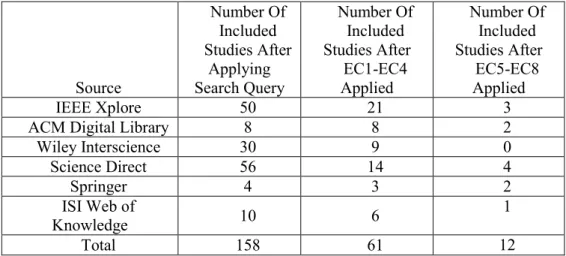
We have identified a search string for each publication platforms listed in our search scope for retrieving as much possibly related studies we can. Each platform has different features, attributes to query for primary studies we are interested in. We have defined queries for each platform using each platform search language. Search strings for each platform is located in Appendix A of the study. In Table 1 result of overall search process after querying for each platform can be seen.
Table 1. Overview of search results and study selection
Source Number Of Included Studies After Applying Search Query Number Of Included Studies After EC1-EC4 Applied Number Of Included Studies After EC5-EC8 Applied IEEE Xplore 50 21 3
ACM Digital Library 8 8 2
Wiley Interscience 30 9 0 Science Direct 56 14 4 Springer 4 3 2 ISI Web of Knowledge 10 6 1 Total 158 61 12
In the first column each platform listed in the search scope is shown. As can be seen in the second column 158 studies are retrieved after executing the search strings in the platforms. Third and fourth column of the table shows the filtered studies after applying study selection criteria explained in the following section. At the last step of the process 12 studies have been identified as the primary study for SLR.
3.2.4. Study Selection Criteria
Search query strings provide large range of primary studies over the domain so that we will not miss any related studies. Study selection criteria are defined so that studies that are not directly related to our domain are excluded. Defined criteria are manually applied on the set of selected studies. In the following part we provide exclusion criteria:
EC 1: Papers in which the full text is unavailable.
EC 2: Papers gathered as duplicate or similar at different platforms.
EC 3: Papers are not written in English.
19
EC 5: Papers do not explicitly discuss architecture based testing.
EC 6: Papers which are experience and survey papers.
EC 7: Papers don't validate the proposed study.
EC 8: Papers that provide only a generals summary without a clear contribution.
3.2.5. Study Quality Assessment
We have defined a method for study quality assessment method for giving further detailed exclusion or inclusion criteria. The importance or validness of the study is examined by quality assessment method we provide. Our defined method is based on quality attributes which are checklist of properties that each study assessed by [5]. The checklist created by taking in account the properties that could bias study results. Defined quality assessment method maintains the summary quality checklist for quantitative studies and qualitative studies which is proposed on [5]. Table 2 provides our quality checklist for quality assessment method. Our main motivation in adopting quality checklist is to assess a study by an overall quality score. Therefore we utilized set of scores from three point scale which are yes (1), somewhat (0.5) and no (0). Results for each primary study filtered by study selection criteria are presented in Appendix B.
Table 2. Quality checklist
No Question
Q1 Are the aims of the study is clearly stated?
Q2 Are the scope and context of the study clearly defined? Q3 Is the proposed solution clearly explained and validated by an
empirical study?
Q4 Are the variables used in the study likely to be valid and reliable?
Q5 Is the research process documented adequately? Q6 Are all the study questions answered?
Q7 Are the negative findings presented?
Q8 Are the main findings stated clearly in terms of creditability, validity and reliability?
Q9 Do the conclusions relate to the aim of the purpose of study? Q10 Does the report have implications in practice and results in
research area for model-driven software architecture testing?
3.2.6. Data Extraction
Data extraction is performed by reading all 12 selected primary studies for answering each research question. Furthermore, data extraction form is designed for retrieving all the information to answer research questions and all the attributes for study quality assessment criteria. Data extraction form contains set
20
of attributes such as identification number of the study, date of data extraction year, publication year, authors of the study, platform of the publication, and type of the publication. Extraction of data purpose columns are inserted in to the form as well by study description and evaluation parts which can be seen in Appendix D.
3.2.7. Data Synthesis
Data synthesis is the most important part of the SLR process in which the extracted data from the primary studies is summarized and research questions are answered [5]. In this study we implemented both qualitative and quantitative synthesis on the extracted data that enables us to result the foundation of both perspectives. We examined if the qualitative results enable us to clarify any quantitative results as well. The results of the synthesis are provided in the next section for both perspectives of the selected studies.
3.3. Results
3.3.1. Overview of Reviewed Studies
This section of the study presents the publication year distribution and the publication platforms of the 12 selected primary studies. Figure 3.3 shows the publication year distribution of the selected primary studies.
Figure 3.3. Year wise distribution of the primary studies
In Table 3 publication sources and channels of the selected studies are presented. This table also presents the publication type and distribution of studies over the attributes. We can infer that selected primary studies are published at very reputable publication sources such as IEEE, ScienceDirect, ACM and Springer.
0 1 2 3 2000 2001 2004 2005 2006 2009 2010 2013 Num ber o f Studies Year
21
Moreover, "Electronic Notes in Theoretical Computer Science" is one of the reputable publication channels having remarkable studies published related to theoretical computer science. Another reputable publication channel listed below is "Information and Software Technology" which is highly reputable for publication in the area of software engineering.
Table 3. Distribution of studies over publication source
Publication Channel Publication Source Type Number of Studies
Information and Software Technology ScienceDirect Article 1
Formal Methods for Software
Architectures Springer Chapter 1
Fundamental Approaches to Software
Engineering Springer Chapter 1
Applying Formal Methods: Testing,
Performance, and M/E-Commerce Springer Article 1
Software Engineering, 2000.
Proceedings of the 2000 International
Conference ACM Article 1
Software Reliability Engineering, 2001. ISSRE 2001. Proceedings. 12th
International Symposium IEEE Conference 1
Software Engineering, IEEE
Transactions on (Volume:30 , Issue: 3 ) IEEE Article 1
Proceeding ROSATEA '06 Proceedings of the ISSTA 2006 workshop on Role of software architecture for testing and
analysis ACM Article 1
Electronic Notes in Theoretical
Computer Science ScienceDirect Article 1
Information Technology: New
Generations (ITNG), 2010 Seventh
International Conference IEEE Conference 1
Information and Software Technology ScienceDirect Chapter 1
Journal of Systems and Software
Volume 91 ScienceDirect Article 1
3.3.2. Research Methods
Empirical studies having well-defined research methodologies are fundamental part for relying and validating the findings of the studies. Selected primary studies must state and utilize the research methodology. In Table 4 types of the research method applied in the selected primary studies are presented. Three types of research methods are identified during the review processes which are case study, experiment and short example. It can be identified from table that case study research method is widely used in the selected studies. Moreover, experiment and short examples are used in the selected studies as well.
22
Table 4. Distribution of studies over research methods
Research Method Studies Number Percent
Case Study A, C, D, E, F, H, K 7 58
Experiment B, L 2 16
Short Example G, J 2 16
None I 1 10
3.3.3. Methodological Quality
This section provides quality results of the selected studies which are relevance, quality of reporting, rigor and credibility. Quality results are calculated from the quality checklist which was given in the previous sections and three point score range. First three question of the quality checklist forms the attributes of reporting quality. Moreover, last two questions are used for relevance quality. Fourth, fifth and sixth questions are used in the calculation of rigor quality. Seventh and eight questions are the assessment questions for credibility quality. In Appendix C, the result of the quality checklist is presented.
Figure 3.4 shows the reporting quality of the studies according to the first three questions of the quality checklist. It can be seen that 91% of the primary studies are perfect and 9% percent of the primary studies is very good. In this case perfect means that studies reporting quality calculated as three which is the full point. Good on the other hand means that study lost points in one of the questions and gathered two and half point.
Figure 3.4. Reporting quality distribution of the primary studies
Rigor quality of the study refers to the trustiness of findings of the study. Figure 3.5 shows that 75% of the studies are perfect in terms of rigor quality. Moreover, 16 % of the studies assessed as very good. However, 9% of the studies ranked as good rigor quality.
0 2 4 6 8 10 12 2.5 3 Num ber o f Studies Reporting Quality
23
Figure 3.5. Rigor quality distribution of the primary studies
Another quality measure is the relevance quality of the primary studies. Figure 3.6 shows relevance quality scores calculated from ninth and tenth question of the quality checklist. It can be seen that 33% percent of the studies is directly relevant to MDABT. The rest of the studies are relevant to MDABT.
Figure 3.6. Relevance quality distribution of the primary studies
At last credibility quality of the studies are calculated by using the seventh and eight questions. Figure 3.7 presents the credibility quality score and distribution of the studies. It can be seen that 83 percent of the studies calculated as 1 point. Remaining 17% of the studies calculated as 0.5 point. According to our evaluation there is no primary study that has full credibility in terms of evidence. All studies are missing the statement of counter example for their suggested approaches. 0 2 4 6 8 10 2 2.5 3 Num ber o f Stduies Rigor Quality 0 1 2 3 4 5 6 1 1.5 2 Num ber o f Studies Relevance Quality
24
Figure 3.7. Credibility quality distribution of the primary studies
To sum up, summary of overall methodological quality scores of selected primary studies are given in Figure 3.8. Total quality is calculated by adding up reporting, relevance, rigor and credibility qualities. We consider 8.5-9 as high quality, 7.5-8 very good quality and 7 as good quality. It can be seen that 41% studies have high overall quality. Moreover, 41% of the studies have very good overall quality and 18% of the studies have good overall quality.
Figure 3.8. Total quality distribution of the primary studies
3.3.4. Systems Investigated
This section provides the results that are extracted from selected primary studies for answering the research question specified in the previous sections.
RQ1: What are the addressed concerns for applying model-driven software architecture based testing?
Target domain analysis of the 12 selected primary studies is performed and the results are shown in Figure 3.9. Figure presents addressed concerns over the distribution of the primary studies. There are 2 main concerns that are addressed which are functional concerns and code to architecture conformance. The functional concerns are functional requirements that are tested on architecture or code level. For instance architecture level functional requirement can be graph
0 2 4 6 8 10 12 0.5 1 Num ber o f Studies Credibility Quality 0.0 1.0 2.0 3.0 4.0 5.0 7 7.5 8 8.5 9 Num ber o f Studies Total Quality
25
representation of architecture cannot have tangling node whereas at the code level this can be the validation of the functional requirement.
Figure 3.9. Addressed concern distribution of the primary studies
Furthermore, Table 5 shows the addressed concern of each study. As table present studies B, F and J addresses function concerns and other studies addresses code to architecture conformity concern.
Table 5. Addressed concern and study map
Addressed Concerns Studies
Code to architecture conformity
A, C, D, E, G, H, I, K, L
Functional concern B, F, J
In study A, authors are explaining how to derive test plans from software architecture (SA) specifications. Architecture based testing is performed for conforming implemented system with the specified SA. The main motivation of this paper is to use SA specifications for integration testing of the implemented system.
Study C is the continuation of the study A in which concerns and motivations are same A's. In this study authors explain how they fill the gap between the abstraction of SA and implementation using architectural and code level sequence diagrams.
In study B, authors define test criterion to use in SA based testing. The testing is done at architectural level to test functional properties of SA. The main motivation of this paper is to define formal testing criteria based on architectural relations.
In study D, authors explain how they provide systematic way to perform the refinement step. In this study specific architectural style is used which has mapping between SA and code based test cases to delivery completely systematic SA based approach. The testing is performed for code to architecture
0 2 4 6 8 10 Code to Architecture Conformity Functional Concern Num ber o f Studies Adressed Concern
26
conformance. The main motivation of this study is to exploit architectural style information to create mapping between component in SA and units in implementation.
In study E, authors uses both model checking and SA based testing approaches. The addressed concern of this study is code to architecture conformance and the main motivation is to select architecture level test cases using the output generated from model checking stage.
In study F, authors perform SA based testing at architectural level for testing specifications against functional properties of SA. The main motivation of this paper is to validate architectural units using object oriented models.
In study G, the addressed concern is code to architecture conformity. The main motivation of the paper is to perform validation at different abstraction levels of system under test using system goals.
In study H, authors used their previous works on architecture based testing for regression testing of software system. The addressed concern of code to architecture code conformity is regressively tested in this approach. The main motivation of this paper is to use architecture based testing for regression testing of systems.
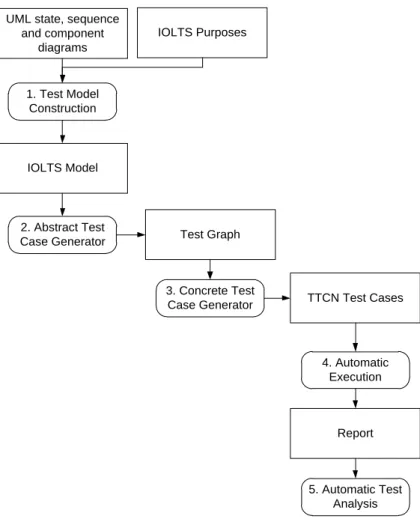
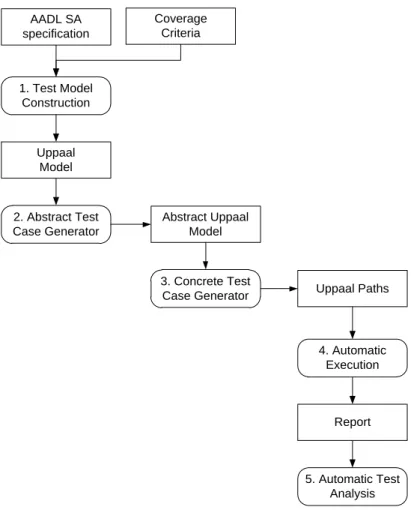
In study I, both model checking of SA and architecture based testing approaches are experimented. The addressed concern of the study is code to architecture conformity. Moreover, the main motivation of this paper is to use Architecture Analysis and Design Language (AADL) specifications in verification of software system.
In study J, author addresses the concern of functional properties of SA. The testing is performed at architectural level. The main motivation of this paper is to use SA in model based testing to detect defects earlier in software lifecycle.
In study K, service oriented applications (SOA) are tested which is said to be more challenging than monolithic applications. The main motivation of this paper is to use SA based testing to solve observability and controllability problems that are created by message exchanges between the services that are hidden behind the front service of the system. The addressed concern of this study is code to architecture conformity.
In study L, authors use SA based testing approaches to variant-rich software systems. The main motivation of the study is to address the challenge of ensuring correctness of component implementations and interactions with any system variant. The addressed concern of this study is code to architecture
27
conformity. Transformation definition is executed by a transformation engine. It reads source model and outputs the target model. The transformation can be unidirectional or bidirectional based on the transformation definition.
RQ2: What are the existing solutions?
Study A
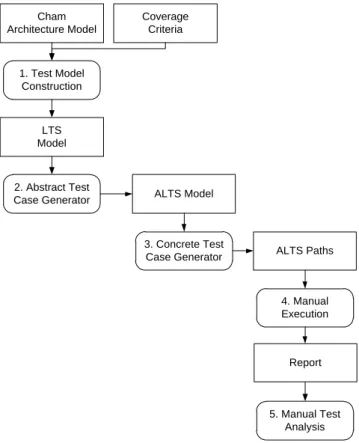
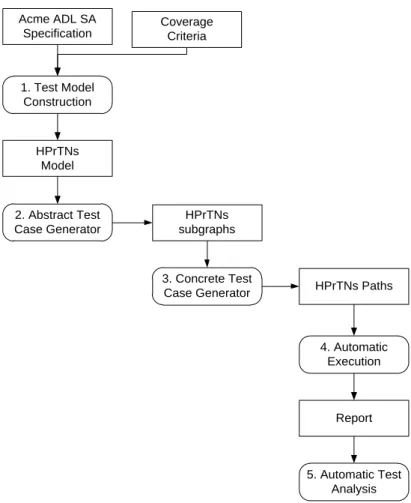
This study presents the adoption of chemical abstract machine (CHAM) specifications to represent software architecture and derive test cases from these specifications using coverage criteria. Test model is generated using CHAM specifications and coverage criteria which is label transition system (LTS). From this graph abstract labeled transition systems (ALTS) are obtained simply by applying obs function. Obs functions are functions that exclude unnecessary details for the selected view of the software architecture. Test cases are generated using the paths from ALTS graph. Each path can correspond to different concrete test cases. Test cases are generated manually by software architect. Test execution and test analysis are handled manually by software architect. In Figure 3.10 process model of this study can be seen.
Cham Architecture Model 1. Test Model Construction Coverage Criteria LTS Model 2. Abstract Test
Case Generator ALTS Model
3. Concrete Test
Case Generator ALTS Paths
4. Manual Execution
5. Manual Test Analysis
Report
28 Study B
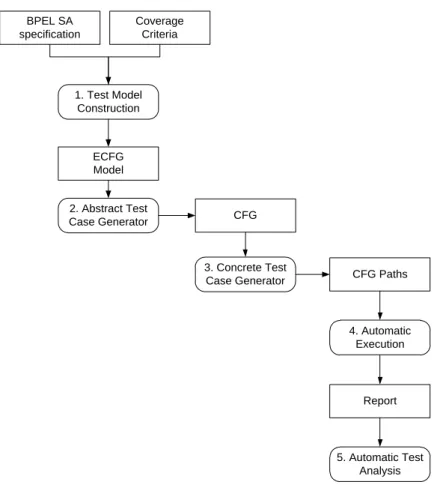
This study presents testing at architecture level for conformance of SA properties which are pointed as test criterion they define. In this case SA is specified using Wright ADL and six test criteria are defined based on data flow reachability, control flow reachability, connectivity and concurrency. These criteria are used as functional properties of SA to be tested and verified. In this study test model is based on behavior graph (BG) and obtained by transforming Wright ADL specifications into BG using coverage criteria as the test criteria. From the BG test model test paths are generated using the tool they created called ABaTT. Each test path is manually transformed into test cases. The test cases and test case results are automatically handled. In Figure 3.11 process model of this study can be seen.
Wright ADL Specifications 1. Test Model Construction Coverage Criteria Behavior Graph Model 2. Abstract Test
Case Generator BG Model
3. Concrete Test
Case Generator BG Paths
4. Automatic Execution
5. Automatic Test Analysis
Report
29 Study C
This study presents the continuation work of previous authors in A by replacing their SA specification of CHAM model to FSP (Finite State Process) model. The reason to use FSP instead of CHAM model is stated as FSP algebra is easier to map to LTS graph. In this study authors explains the work of the software architect to generate test cases and execute them manually. This study presents the use UML Stereotyped Sequence Diagrams for filling the abstraction gap between the SA and implementation. For each architecture level sequence diagram, software architect defines code level sequence diagrams. Global sequence diagram is obtained by combining the code level sequence diagrams where it represents code scenarios that is implementing SA path that is extracted from ALTS graph. Software architect then runs the code to see if the created sequence diagram is implemented by the system.
FSP Architecture Model 1. Test Model Construction Coverage Criteria LTS Model 2. Abstract Test
Case Generator ALTS Model
3. Concrete Test
Case Generator ALTS Paths
4. Manual Execution
5. Manual Test Analysis
Report