THE FUTURE SETTING OF THE DESIGN STUDIO
i : n
Abstract
This study explores the impact af virtual classrooms as an emerging classroom typology in comparison to the phys-ical classrooms in the design process. Two case studies were held in order to infer design students' classroom prefer-ences in the project lifecycle. The findings put forth figures that campare two forms af design communication in the two classroom types in terms of their contribution to design development. Although the students acknowledged many advantages of web-based communication in the virtual classroom, they indicated that they are unwitting to let ga aff face-to-face encounters with the instructors and fellow students in the physical classroom. It is asserted that the future design studio will be an integrated learning environment where both physical and virtual encounters will be presented ta the student. Utilizing the positive aspects of both communication techniques, a hybrid setting for the design studio is introduced, comprising the physical classroom as well as the virtual one. The proposed use for the hybrid setting is grouped under 3 phases according to the stage of the design process; as the initial, development and final phases. Within this framework, it is inferred that the design studia of the future will be an integrated form of space, where the physical meets the virtual.
Keywords: Classroom, Design Studio, Hybrid Course, Learning Environment.
INTRODUCTION
Design education is generally carried out in design studios, where design students communicate on their projects with their instructors and fellow stu-dents. In the design studio students express them-selves, introduce and discuss ideas, generate and evaluate alternatives, and make decisions based on given projects. In the traditional design studio set-ting, student-instructor communication is held face-to-face, through physical encounters. The possibili-ty of face-to-face interaction is a key advantage of the place-based offering. It is through this interac-tion that the students improve skills as presentainterac-tion and debate (Parker and Rossner-Merrill, 1998). Hundhausen et.al. indicate that the key features of the studio-based education are construction and presentation of representations (Narayanan and Crosby, 2008).
With recent developments in technology however, Internet-based platforms emerged as an alternative to the face-to-face design communica-tion and to the physical encounters in the class-room. Web-based communication seems to elimi-nate the prerequisites related to the physical class-room setting, such as having to be in the classclass-room
at a specific time, by enabling the virtual classroom alternative (Norman, 2 0 0 1 ; Reffat, 2002; Kalay, 2004; Clark & Maher, 2005). The virtual class-room also allows for having feedback in written form for further and repeated reference. Students no longer have to come to the design studio with drawings and scaled models, and wait for the spe-cific time interval to meet with the design instructor to get face-to-face oral critiques. They can now load their drawings or 3d files on a website or ottach them to e-mails, and get written critiques on their designs within a pre-determined time interval. As the virtual opportunities emerged, soon it became inevitable to discuss the future of design education and the implications of the virtual oppor-tunities on the design pedagogy (Clayton, 2000; Andia, 2002; Oxman, 2007; Akkoyunlu & Soylu, 2008). Based on the advantages of the virtual classrooms and given the strong background of this generation of students in using and being familiar with computers, with a rushed presumption one might assert that majority of the design students would prefer to use web-based design communi-cation. Extending the presumption, it may be expected that as the students use Internet-based communication, they will attend to the design
stu-dio less, deserting the physical classroom.
Within this framework, two consecutive stud-ies with two different student groups were held involving both physical and virtual classroonn set-tings. The aim was to infer design students' class-room preferences in the project lifecycle. In order to determine their preferences a special focus was cast upon the communication techniques used in both classroom settings. In the physical design studio communication is held face-to-face, wheras in the virtual one the communication is held through web-based techniques.
Current generation of design students com-prises members of an age group who were intro-duced with computers at an early age. Even though they may not have started using computers at early ages, they regard and accept computers as part of daily life. It is worth investigating whether this situa-tion leads them to favor computers for design com-munication. Moreover, it is intriguing whether stu-dents become more self-focused using computers for design communication rather than getting socialized in the design studio.
HYBRID LEARNING ENVIRONMENTS
In higher education, in fields other than design, with the incorporation of new educational techniques, hybrid courses have been developed (Latchman, 1998; Dennis etal., 2002; Koohang & Durante, 2003; El-Gayar & Dennis, 2005; Sigle etal., 2005; Nguyen &Bodi, 2007).
Hybrid courses are courses in which a signif-icant portion of the learning activities takes place online. Hybrid courses reduce, but do not totally eliminate, the time spent in the classroom. According to Garnham and Kaleta (2002), the goal of hybrid courses is to join the best features of in-class teaching with the best features of online learning to promote active independent learning and reduce class seat time. Accessibility to the course content, effectiveness of large lecture instruction, and level of connectivity between stu-dents and instructor are advantages of hybrid courses over the traditional face-to-face physical classroom encounters (Poltrock & Engelbeck, 1999; Cheng & Kvan, 2000; Johnson, 2002). In the fields where hybrid courses are practiced, stud-ies demonstrate that few students have difficulty using the technology; and the instructor spends more time on individual communication compared to a regular class (Hensley, 2005).
In an earlier study, Benbunan-Fich and Hiltz (2003) found that there were no significant differences in the perceived learning by students between three modes of courses; traditional, mixed and totally online. They suggested that such studies need to be carried out in other fields than theirs. This study introduces a mixed (face-to-face and online) setting for the design studio to find out the students' asses-ments of the setting. The structure of the online activities is different in design considering that in many other fields the content travels one-way from the instructor to the student, whereas in the design studio, the content travels back and forth in revised versions (Levine & Wake, 2000). Therefore, the findings of the use of online activities in the design studio may differ from those in other fields. In this study the impacts of face-to-face communication through physical encounters and web-based com-munication through virtual encounters are exam-ined. Al-Qawasmi (2006) discussed the transfor-mations in design education after the emergence of the virtual and paperless design studios under sev-eral titles including 'peer learning', inferring that the basic assumptions are changed in the traditional deisgn studio. This study is an attempt to explore the direction which these changes are pointing to.
CASE STUDIES
The case studies focus on the preferences of the design students about physical and virtual encoun-ters. We worked with the 3rd and 4th year students of the interior architecture curriculum at Bilkent University Faculty of Art, Design and Architecture, to see their tendencies in preferring the physical and the virtual classroom.
The students enrolled in an elective design course in two different semesters have participated in the studies. The students were asked to develop design projects through physical and virtual encounters. Physical encounters comprised the face-to-face meetings and discussions in a desig-nated design studio. Virtual encounters involved web-based communications using specific commu-nication platforms. At the end of each semester the students were asked to fill in questionnaire forms assesing their satisfaction and inquiring about the strong and weak aspects of both encounters. First Study
13 students participated in the first study, who were
Students' background in terms of years In using computer ond Internet
enrolled in an elective course. Students formed groups of 3-4 to work on a given project. Total duration of the project was 6 weeks. A 3-hour course was held each week. There was one pre-jury (comprising 3 design instructors) during the project period. Students had the chance to have physical class hours each week (except for the jury week) and for the rest of the week they had the opportu-nity to communicate virtually through a server space specially allocated for the course (Senyapili & Karakaya, 2005).
Second Study
In the second study, 1 ó design students were enrolled in the same elective design course. Design students constituted 4 groups, each group com-posing of 4 students. This time, the design project duration was 8 weeks, with one 3-hour course each week, except for one week dedicated to the pre-jury. During the semester the students were required to have physical encounters as well as virtual ones, which were held through a special platform Virtual Campus' developed by Bilkent University (Senyapili & Karakaya, 200Ó).
KEY FINDINGS
The findings are grouped in three main categories composing of:
• students' background in using computers, • students' assesment of face-to-face and web-based communications separately,
• students' evaluation of the both communica-tions comparatively.
Students' Background in Using Computers
In a previous study, Koohang and Durante (2003) found that experience with the Internet was a signif-icant factor in learners' perception toward
web-Favored communication technique prefer-ences using o 1 -5 scale
based learning. In this study, initially students' expe-rience in computer use was determined. All students had previous computer experience. Second group of students were more experienced with computers. In the first study, the student with the least comput-er expcomput-erience had 3 years of expcomput-erince (mean — 7,46), whereas in the second study the least was 6 years (mean^ 9,18). Students indicated that they use computer for mostly writing, drawing, and con-necting to the Internet. Especially regarding the Internet use, the mean of years of using the Internet for first group of students was 5,41, and 6,18 for the second group of students (Figure 1). Both stu-dent groups were familiar with computers, used to navigating in the Internet as well. Therefore, stu-dents were not expected to have difficulties in terms of handling virtual tools.
Assesment of Face-to-Face and Web-bosed Communication Separately
In the questionnaires, students were asked which type of communication they found useful the most. Major part of the students said that both techniques were useful, while a few favored face-to-face com-municotion alone. Students were asked to evaluate both types of communications on a 1 to 5 scale, 5 being 'very helpful', and 1 corresponding to 'not helpful at air. In both studies, face-to-face commu-nication were favored more than web-based com-munication (for the first study the mean for face-to-face was 4,69 and and for web-based 3,53) (for the second study the mean for face-to-face 4,62 and for web-based was 3,87) (Figure 2).
Both communication techniques were tested in terms of a given set of criteria, each item being evaluated on a 5-point scale, the criteria being:
• Understanding the critiques • Preparation load for presentation • Quality of presentation
100 90 80 70 60 50 40 30 20 10 D lacö-lo-face • web-based
r,; N Assesment of face-tO'face and web-based communication in both studies
• Collaboration with the instructor • Collaboration with the friends
For face-to-face communication the highest mean (Miirîisiud,^ 4 , 7 6 , MsBcond study =^ 4 , 3 7 ) w a s r e c e i v e d in terms of understanding the critiques in both studies. This result indicates that understanding the critiques via face-to-face communication was evaluated as being easy by the students. For face-to-face com-munication, the least mean was equally received for both preparation load for presentaion and quality of presentation (Mii^titudy^ 3,76). In the sec-ond study, the least mean was received for quality of presentation (M= 3,28) and similar to the first study, preparation load for presentation received the second lowest mean (M= 3,76). These results showed that for face-to-face critiques students thought that the preparation load for presentations was dense and they were not satisfied with the qual-ity of the presentations.
For web-based communication, in the first study the highest mean was received for under-standing the critiques (M= 4,30), in the second
study for collaboration with friends ( M ^ 4,03). The least means for web-based communication was received for changes on the design after the ciri-tique in the first study (M= 3,30), and for presenta-tion quality in the second study (M= 3,40) (Figure 3)(Table 1),
The most preferrable aspect of face-to-face communication in both studies turned out to be understanding the critiques. This shows that although the face-to-face critiques are not written and do not offer the chance of repeated reference, students still value the advantages of face-to-face communication, such as;
• facial expressions, • instant response,
• complimentary figures of speech, • gestures.
Interestingly, in the second study, web-based com-munication received the highest mean for under-standing the critiques, with a slight difference in the mean. This provides grounds to argue that students acknowledge the positive assets of the web-based communication as well, which helped them in com-prehending the critiques on their designs, such as;
• clear and concise critique text, • chance of repeated references,
• chance of discussing with others over the cri-tique text.
It seems to be no coincidence that both face-to-face and web-based communication have received least means for quality of presentation since stu-dents tended to blame presentation's inadequen-cies for the shortcomings of their design.
Comparative Assesment of Face-to-Face and
Web-based Communication
A set of 5 point scole was used to obtain an
over-f-t-f 1 f-t-f 2 w b 1 w b 2 understanding 4,76 4,37 4,30 3,52 preparation 3.76 3,76 3.55 3.09 quality 3,76 3,28 4,00 3,40 change 4,26 4,37 3.30 3,91 coll w/inst. 4,56 4,37 3.70 3.61 col! w/friends 4,71 4,08 3,45 4.03 GO J I o o o
100 90 ao 70 60 50 40 30 20 10 D face-to-face • web-based
Fiqun' Comparative assessment of face-to-face and web-based communication in the design studio all evaluation of both types oí communication, in terms of easiness, interaction, quickness, stimula-tion capacity, and clearness.
In the first study, face-to-face communication received highest mean for easiness ( M ^ 4,46) and least (M= 3,84) for being stimulative. Web-based critiques, similarly, received highest mean for easi-ness ( M ^ 4,53) and least ( M - 3,69) for being stimulative. This result is very interesting as it shov>/s that there is a comparatively students indicate no difference betv/een the two techniques.
In the second study, the highest mean for face-to-face communication v/as received for clear-ness ( M ^ 4,27) and the least for quickclear-ness (M= 3,57), whereas web-based communication received the highest mean for quickness (M= 4,50) and the least ( M ^ 3,ó2) for interaction. Again, the findings rightfully acknowledge the time consuming nature of face-to-face communication, while giving credit to web-based communication in that ospect, but the differences are not major (Figure 4) (Table 2).
DISCUSSIONS: A HYBRID SETTING
FOR THE DESIGN STUDIO
The findings provide grounds to assert two major arguments:
1 The students have a strong background in computer use and they are familiar with way finding in virtual environments. With a quick presumption, one would expect them to favor web-based communication in a design envi-ronment. However, they hold on to the positive assets of traditional face-to-face communica-tion and do not welcome web-based commu-nication without reservations.
2 Although students seem to favor face-to-face communication while separately evaluating the communication techniques, when it comes to comparative evaluation, they do not seem to distinguish majorly between the two. In other words, they do not favor one communicotion alone. Figure 4 shows how close their evalua-tions for both communication techniques are. Therefore it may be asserted that in the design studio students will appreciate on integrated communication framework instead of utilizing one communication technique alone.
One interesting observation is that although stu-dents may get their critiques through virtual plat-forms whenever they want, without having to come to the design studio, they did not mention this as a positive factor. On the contrary, they indicated that they wanted to know how the others were doing and thus, some groups asked the others how their web-based critiques were. Fiedler (2001) stotes that invisibility of the instructors and a lack of contoct with other students in e-mail communication often makes social interaction difficult, takes away the
f-t-f 1 f-t-f 2 w b 1 w b 2 easiness 4,46 3,93 4.53 4,25 interaction 4.15 3.81 4,00 3,62 quickness 4,35 3.57 4,20 4.50 being stimulative 3,84 3,73 3,69 4,00 clearness 3,92 4,27 4,38 4,12
Comparative assesment of communication types (face-to-face f-t-f and web-based Wfa) in the first and second studies
f a c « - t o - f a c e
web-based
ft 5 Phases of design process and design communication
personol connection to the class and the instructor, and this results in lack of knowledge about course participants and their projects. It is evident that keeping track of how the others are doing are important for the students and they fee! that this is best achieved in the physical classroom. On the other hand, as the design project develops, in the virtual classroom setting, there are opportunities for the students to generate a collective understanding and communication rather than the instructor(s) alone (Hou & Kang, 2006). Therefore, the hybrid setting for the design studio, in terms of involving physical and virtual encounters, may change as the project evolves.
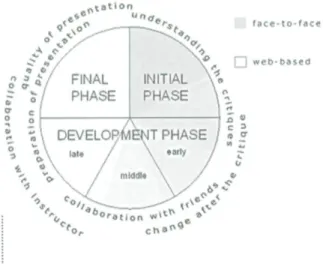
The project cycle may be divided into three phases: initial, development and final. The initial phase involves generation of ideas, the develop-ment phase involves collaboration with friends and the instructor(s), and the final phase focuses on the presentation (Figure 5). Based on the findings, it
may be asserted that at the initial phase, the encounters should take place in the physical class-room. As the phases evolve, both physical and the virtual classrooms may be utilized. At the final phase virtual classroom may be used solely.
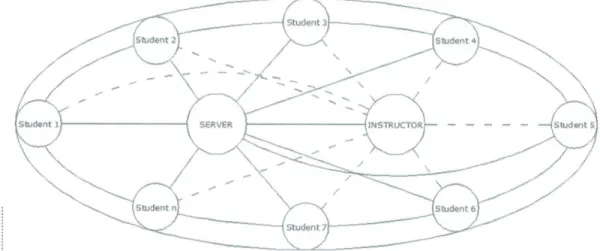
As the design process requires different means and densities of communication at different stages, the framework may be adapted according to the design phase. For the initial design phase the density of communication should involve face-to-face encounters (Figure 6), as the findings suggest understanding the critiques, changes in design and collaboration with the instructor(s) and collabora-tion with friends are better in physical encounters.
The continuous lines indicate primary com-munication; while the dashed lines represent sec-ondary communication. The development phase involves both face-to-face and web-based commu-nication (Figure 7). The presence of the student shifts from the physical classroom to the virtual one as the development phase emerges. Slmoff and Maher indicate the need for a 'warm-up' period in
the schedule of the virtual design studio for those
students who have "difficulties in adapting to the reduction of personal physical interaction" (1997: 7). The mixed structuring in the development phase is expected to aid students organize their own pace in shifting to the virtual classroom.
In the final design phase (Figure 8), virtual classroom may be frequented more than the phys-ical one, since the findings suggest that web-based encounters are found to be more satisfactory in quickness, clearness, required preparation load for presentation, and quality of presentation, assets that are more related to the presentation of the fin-ished project.
S E R V E R I — - - - — ( I N S T R U C T O R
Figure 6. The hybrid framework af communication for the initial design phase
1 0 9 JZ o o o CN X u o o
z
5
o c o o o JI c a. oFigura . The hybrid framework of communication for the development phase
Figure ¿ The hybrid framework of communication for the final design phase
CONCLUSION
This study is an effort towards determining the future setting of the design studio in the emerging power of the virtual classrooms. In order to determine the impact of face-to-face encounters in the physical classroom and web-based encounters in the virtual classroom, a study is held in a hybrid design studio setting. The group of students, who participated in the study, belongs to the current generation that is familiar with using computers. The findings showed that although the students acknowledge many advantages of using computers in design (such as economizing from time and decrease in physical stress in completing various tasks, high capacity and meticulous look of the outputs), they are cau-tious in their evaluation of the medium. Especially when design communication is involved, students still seem to value the factors inherit in physical encounters, such as facial expression, ability to
respond immediately, and possibility of stating themselves verbally. Generating ideas may be faster and more productive while using computers, but students preferred the possibility of talking about the new alternatives quickly during face-to-face encounters and with the presence of classmates.
Considering the discussions that the future design studio will shift from the physical classroom to fully virtual ones, it may be asserted that there will be a transition period where hybrid courses -in hybrid environments- shall take place. Hybrid envi-ronments allow for integrated design communica-tion, where face-to-face and virtual encounters are available to the students. Hybrid courses are employed in other fields, but their introduction to the field of design is new. In this study it is proposed that the hybrid setting for the design studio should involve the physical encounters more at the initial phase of design, evolving into a mixed setting of physical and virtual encounters in the design
devel-opment phase, and having more virtual encounters than the physical ones in the final phase. Such set-ting needs to be experienced and assessed in fur-ther studies in order to establish a beneficial frame-work for the setting of the design studios in the future.
REFERENCES
AKKOYUNLU, B. AND SOYLU, M.Y 2008, A Study of Student's Perceptions in a Blended Learning Environment Based on Different Learning Styles,
Educafior^ol Technology & Society, yO\. (11), No.
(1), PR 183-193.
AL-QAWASMI, J. 2006, Tronsformotions in Design Education: The Paperless Siudio and The Virtual Design Studio, Special Issue on Design Studio Teaching Proctices, (ed.} A. M. Salama, Open House
International, VO\. (31), No. (3), PP 9 5 - 1 0 1 .
ANDIA, A. 2002, Internet Studios: Teaching Archüectural Design On-Line between the United States and Latin America, Leonardo, Vol. (35), No. (3), PR 297-302.
BENBUNAN-FICH, R. and HILTZ, S. R. 2003, Mediators of Effectiveness of Online Courses, in IEEE
Transactions on Professional Communication. Vol.
(46), No. (4), PP 298-312.
CHENG, N. and KVAN, T. 2000, Design Collaboration Strategies, in SiGraDi 2000:
4^"^ Iberoamerican Congress of Digital Graphics, Rio de Janeiro.
CLARK, S. and MAHER, M l . 2 0 0 5 , Learning and Designing ¡n a Virtual Place, J. Duarte, G. Ducla-Soares and A. Z. Sampaio (eds) eCAADe23 Digital Design: The Quest for New Paradigms, eCAADe and Insituto Superior Técnico Lisbon, PP 303-309.
CLAYTON, M.J. 2000, Design Desk Critiques: Digital or Face-to-Face?, 4 ' " Sigradi Conference
Proceedings: Constructing the Digital Space, Sigradi, PP 41-44.
DENNIS, T., EL-GAYAR, O.F. and ZHOU, Z. 2 0 0 2 , A Conceptual Framework for Hybrid Distance Delivery for Information System Programs, Issues in
Information Systems, VoL (3), PP 137-143.
EL-GAYAR, O.F and DENNIS, T. 2 0 0 5 , Effectiveness of Hybrid Learning Environments, Issues in
Informations Systems, Vol. (6), No. (1), PP 176-182.
FIEDLER, S. 2 0 0 1 , The Studio Experience: A Case Study On Self-Direction In Learning Within A Formal Instructional Setting, Diplomorbeit in der Psychologie,
Friedrich-Alexander-Universität Erlangen-Nürnberg. GARNHAM, C. and KALETA, R. 2002, Introduction to Hybrid Courses, Teaching V^iih Technology Today, Avoilable at: http://www.uwsa.edu/ttt/articles/gar-nham.ht.
HENSLEY, G. 2005, Creating a Hybrid College Course: Instructional Design Notes and
Recommendations for Beginners, Journal of Online
Learning and Teaching , Available at:
http://iolt.mer-lot.org/voll no2 hensley.htm.
H O U , J. and KANG, M.J. 2006, Differences and Dialogic Learning in a Collaborative Virtual Design Studio, Special Issue on Design Studio Teaching Practices, (ed.) A. M. Salama Open House
International, Vol. (31), No. (3), PP 85-94.
HUNDHAUSEN, C D . , NARAYANAN, N.H. ond CROSBY, M.E. 2008, Exploring Studio-Based Instructional Models for Computing Education, ACM
SIGCSE Bulletin, Wo\. 40, No. (1), PP 392-396.
JOHNSON, J. J. 2 0 0 2 , Reflections on Teaching a Large Enrollment Course Using a Hybrid Format, Teaching V*/ith Technology Today, Available at: http://www.uwsa.edu/ttt/articles/iiohnson.htm KALAY, Y E. 2004, Virtual Leorning Environments,
Itcon Special Issue ICT Supported Learning in Architecture and Civil Engineering, Vol. ( 9), PR
195-207.
KOOHANG, A. and DURANTE, A. 2003, Learners Perceptions toward the Web-based Distance Learning Activities/ Assignments Portion of an Undergraduate Hybrid Inrstructional Model, Journal of Information
Technology Educafion,\/o\. (2), PR 105-113.
LATCHMAN, H. A., SALZMANN, C , THOHAPILLY, S., and BOUZEKRI, H. 1998, Hybrid Asynchronous and Synchronous Learning Networks in Distance Education, Intemational Conference on
Engineering Education, Rio de Janeiro, Brazil LEVINE, S.L. and WAKE, W.K. 2000, Hybrid Teaching: Design Studios in Viriuol Space, presented to the National Conference on Liberal Arts and the Education of Artists SVA, New York, Available at: http://research.the-bac.edu/sva/index.htm. NGUYEN, T I and BODI, J. M. 2007, Online Teaching: The Development of a Hybrid Course in Higher Education, in K. Kumpulainen (ed.)
Eductional Technology Opportunities and Challenges, Oulu University Press, Finland, PR
24-29.
NORMAN, F. 2 0 0 1 , Towards a Paperless Studio, Reinventing the Discourse - How Digital Tools Help Bridge and Transform Research, Education and Practice in Architecture [Proceedings of the 2 1 ^ '
E JZ < CQ Û o o CM O
z
3 O C <u a. oAnnual Conference of the Association for Computer-Aided Design in Architecture], Buffalo, PR 336-343. OXMAN, R. 2007, Digital Architecture as a
Challenge for Design Pedagogy: Theory, Knov^ledge, Models ond Medium, Design Studies, VOL (29), No. (2), PR 99-120.
PARKER, D., and ROSSNER-MERRILL, V 1998, Socializalion of Distonce Education: The Web as Enabler, H. Maurerand R. G. Olson (ed.s) WebNet 98: World Conference of the V\WW, Internet, and Intranet Proceedings, Association for the
Advancement of Computing in Education, Charlottesville, VA.
POLTROCK, S. and ENGELBECK, G. 1999, Requirements for a Virtual Collocation Environment, information and
Software Technology. VoL (41), PR 331-339.
REEEAT, R. M. 2002, Designing with Computers in o Paperless Design Computing Studio, A. Eshaq, C. Khong, M. Neo and S. Ahmad (eds) Proceedings of the 7'^ International Conference on Computer Aided Architectural Design Research in Asia (CAADRIA],
Rrentice Hall, New York, PP 347-354.
SIGLE, J., KEY J., CRITCHER, A. and PRINCE, J, 2005, Tools for Hybrid Instruction- Classroom and Distance Instruction in Synchronous and
Asynchronous Modes, Information Systems Education
Journat, Vol. (3), No. (14), PR 3-7.
SIMOFF, S. J. and MAHER, M.L. 1 997, Design Education via Web-based Environments, in
Proceedings of 4th ASCE Congress of Computing in
Ovit Engineering. ASCÍ. Nev^ York, NY, PR418-425.
SENYAPILI, B. and KARAKAYA, A.F. 2 0 0 5 , Design Studio Communication: Young Generation Holding on to Old Techniques, in Innovation in Architecture, Engineering and Construction, S. Sariyildiz, et.al. (ed.). Optima Grafische Communicatie, Rotterdam, PP 375-385.
SENYAPILI, B. and KARAKAYA, A.E 2006, A Hybrid Framework Eor Collaboration In Design Curricula, Joint International Conference on Construction Culture, Innovotion, and Management Conference Proceedings: Sustainable Development through Culture and Inn
Authors' Addresses:
Burcu Senyapili & Ahmet Fatih Karakaya Foculty of Art, Design and Architecture Bilkent University
Ankara, Turkey burcu @bilkent.edu.tr of ati h @bi I kent. ed u. tr