PROCESS ORIENTED VALUE JUDGMENTS OF ACTOR GROUPS IN MASS HOUSING:
THE CASE OF ERYAMAN FOURTH STAGE, ANKARA
A THESIS SUBMITTED TO THE DEPARTMENT OF INTERIOR ARCHITECTURE AND ENVIRONMENTAL DESIGN
AND THE INSTITUTE OF FINE ARTS OF BİLKENT UNIVERSITY
IN PARTIAL FULFILLMENT OF THE REQUIREMENTS FOR THE DEGREE OF DOCTOR OF PHILOSOPHY IN
ART, DESIGN, AND ARCHITECTURE
By Can Altay September, 2004
I certify that I have read this thesis and that in my opinion it is fully adequate, in scope and in quality, as a thesis for the degree of Ph.D. in Art, Design, and Architecture.
___________________________________ Prof. Dr. Mustafa Pultar (Principal Advisor)
I certify that I have read this thesis and that in my opinion it is fully adequate, in scope and in quality, as a thesis for the degree of Ph.D. in Art, Design, and Architecture.
___________________________________ Assoc. Prof. Dr. Feyzan Erkip
I certify that I have read this thesis and that in my opinion it is fully adequate, in scope and in quality, as a thesis for the degree of Ph.D. in Art, Design, and Architecture.
___________________________________ Prof. Dr. Vacit İmamoğlu
I certify that I have read this thesis and that in my opinion it is fully adequate, in scope and in quality, as a thesis for the degree of Ph.D. in Art, Design, and Architecture.
___________________________________ Assoc. Prof. Dr. Tahire Erman
I certify that I have read this thesis and that in my opinion it is fully adequate, in scope and in quality, as a thesis for the degree of Ph.D. in Art, Design, and Architecture.
___________________________________ Prof. Dr. Murat Balamir
Approved by the Institute of Fine Arts
ABSTRACT
PROCESS ORIENTED VALUE JUDGMENTS OF ACTOR GROUPS IN MASS HOUSING:
THE CASE OF ERYAMAN FOURTH STAGE, ANKARA
Can Altay
Ph.D. In Art, Design, and Architecture Supervisor: Prof. Dr. Mustafa Pultar
September, 2004
This study is an attempt to develop an understanding of the mass housing process, through establishing a wider perspective to acknowledge the contributions of various groups. The theoretical structure of the study is composed of understanding the life-cycle of building, and the appropriation of the social constructionist paradigm; as well as establishing value judgments as the tools of analysis. “Actor groups”, refer to the various social and professional groups who act within the process, whose values are formative of mass housing. Value judgments are proposed as the assertion and expression of values. Mass housing in Turkey, and the role of Housing Development Administration (HDA) is noted, followed by explaining the case of Eryaman as a demonstrational project by HDA. The fourth stage of Eryaman is focused on as it includes wider variety of actor groups with distinct roles. An exploratory part, an inquiry into the value judgments of executive policy makers, has been conducted. This is followed by a survey study where representatives of various actor groups are exposed to the derived value judgments. The results present situations that provide knowledge on various conflicts and values of groups. Conceptual contributions as well as insights on the case are provided, as schemes of process oriented value judgments, classified according to a hierarchical structure are proposed. The second conceptual contribution is the introduction of six conceptualizations for further studies of values in the building context, which are consensus, opposition, inter-group valuations, fields of authority, notions related to conjuncture, and internal polarizations within groups.
Keywords: Life-cycle of Building, Social Construction of Housing, Value Studies, Value Judgments, Actor Groups, Housing Studies, Mass Housing, Eryaman, Consensus, Conflict, Fields of Authority.
ÖZET
TOPLU KONUTTA KATILIMCI GRUPLARIN SÜRECE YÖNELİK DEĞER YARGILARI: ERYAMAN DÖRDÜNCÜ ETAP ÖRNEĞİ, ANKARA
Can Altay
İç Mimarlık ve Çevre Tasarımı Bölümü, Doktora Tez Yöneticisi: Prof. Dr. Mustafa Pultar
Eylül 2004
Bu çalışma, toplu konut sürecini anlamaya yönelik, çeşitli grupların katkılarını tanıyacak geniş bir perspektif oluşturma çabası içermektedir. Çalışmanın kuramsal çerçevesi, “yapının yaşam döngüsü” ve “sosyal yapısalcı” yaklaşımın yanısıra değer yargılarını temel analiz alanı olarak oturtmuştur. Sürece katılımda bulunan ve süreci şekillendiren sosyal ve mesleki gruplar “aktör gruplar” olarak adlandırılmış ve bu grupların sürece ve birbirlerine dair
görüşlerine odaklanılmıştır. Değer yargıları, değerlerin ifade ve teyit ediliş biçimleri olarak önerilmiştir. Çalışma, Türkiye’de toplu konut alanı ve Toplu Konut İdaresi’nin (TOKİ) rolünü vurgulayarak, TOKİ’nin gerçekleştirdiği örnek konut projelerinden Eryaman’ın tanıtımıyla devam etmektedir. Katılımcı grupların çeşitliliği ve belirginliği dolayısıyla Eryaman 4. Etap örneği üzerinde durulmuştur. Keşifçi bir yaklaşımla kurgulanan ön çalışma yetkili idarecilerin değer yargılarına yönelmiştir. Takip eden anket çalışmasında farklı grup temsilcilerine ön çalışmanın bulguları doğrultusunda değer yargıları üzerinde görüşleri sorulmuştur. Çalışmanın sonuçları, grupların sürece dair değer ve karşılıklı ihtilaflar üzerinde bilgiler sunmaktadır. Eryaman örneğinin yanısıra, çalışmanın kuramsal katkıları da vurgulanmıştır. Sürece yönelik değer yargıları üzerinde geliştirilen isimlendirme ve hiyerarşik sınıflandırma ile sonuçlar üzerinden önerilen altı kavramlaştırma tezin katkıları olarak önerilmektedir. Çalışmanın ve bulguların üzerinden geliştirilen ve ileriki çalışmalarda yol gösterici olduğuna inanılan bu altı gözlem: fikir birliği, karşıtlıklar, gruplar-arası değerlendirmeler, otorite alanları, konjonktüre dayalı durumlar, ve grup içi kutuplaşmalar olarak sıralanmıştır.
Anahtar Sözcükler: Yapının Yaşam Döngüsü, Konutta Sosyal Yapısalcı Yaklaşım, Değer Çalışmaları, Değer Yargıları, Aktör Gruplar, Konut Çalışmaları, Toplu Konut, Eryaman, Fikir Birliği, Karşıtlıklar, Otorite Alanları.
ACKNOWLEDGEMENTS
I would like to thank my supervisor Prof. Dr. Mustafa Pultar, for his endless support and guidance. His genuine supervision and patience enabled me to finalize the work. It has been a great pleasure and honor to work with him, and this thesis would not be possible without him.
I owe special thanks to Prof. Dr. Vacit İmamoğlu and Assoc. Prof. Dr. Feyzan Erkip, for their valuable contributions throughout the process. Their views constitute a respectable input to the thesis. I would also like to thank Assoc. Prof. Dr. Tahire Erman and Prof. Dr. Murat Balamir for their interest and definitive contribution to the final version of the thesis. I would like to thank Assoc. Prof. Dr. Murat Güvenç especially, for sharing his experience and his interest, and his support in introducing me to the Correspondence Analysis method, which made the thesis shift gear and opened up wider possibilities for interpreting the results.
I need to address my deepest gratitude to all the respondents who have spared their valuable time and opening their views to contribute to the research. Particular mention should go to Yıldız Tokman, to Ziya Tanalı for his generosity in valuable discussions that exceed this project, to Ayhan Razgat for his hospitality and fruitful conversations, to Hamza Kahraman in Eryaman, and to Pervin Bilgen in HDA for helping at the initial phase of my inquiry. Extra special thanks will go to Yalçın Demirtaş at HDA for his friendship and unlimited support to the thesis, as well his valuable contacts that made the case study possible.
To Erdem Başer for introducing my numerically illiterate mind to the basics of statistics. Big thank you to my irreplaceable friends, Ümit Alacalı for endless hours of help and company, Egemen Özkan for being there in times of need, Oğuzhan Genç for constantly reminding the must to finish what one starts, to Mehmet Çopur for long distance laughter and reality checks, to Emek Ataman for SPSS and what not, to Engin Öncüoğlu for his care and direct support to the process, to Umut Barutçu and all friends who have contributed one way or another. To Orcan Yiğit and Özge Baran for giving the final boost to find the strength to finish the work.
To Malmö and all involved. Charles Esche, the Swedish Institute and the consul Annika Svahnström, to Lesley and Karlotta for being a family, and to Hyunjin Kim.
Thank you Ariane Müller for invaluable company and endless hours of discussions on and off the topic, in locations all around the globe.
Finally to the Family. Bülent Altay for sharing over 30 years of experience as a building professional and his support in all means, Serpil Altay for constant stimuli, provoking and reinforcements, Yunus and Burçak for long distance attention, and particularly Deniz Altay for her full-time support and for being there from start to finish.
TABLE OF CONTENTS
ABSTRACT ... iii
ÖZET ………..iv
ACKNOWLEDGEMENTS ………... v
TABLE OF CONTENTS ... vi
LIST OF TABLES ...…... xii
LIST OF FIGURES ... xiv
1. INTRODUCTION ... 1
2. UNDERSTANDING THE BUILDING / MASS HOUSING PROCESS ...…... 8
2.1. Understanding the Life-Cycle of Building, and Situating Particularities for Housing ...….... 8
2.2. Social Constructionist Perspectives in Understanding the Building / Housing Process ...………... 10
3. VALUES, VALUE JUDGMENTS, AND VALUE SYSTEMS AS TOOLS OF ANALYSIS ... 20
3.1. Values, Value Judgments, and Value Systems ...…... 20
3.1.1. Values: Brief Description ...….. 21
3.1.2. Value Judgments: How are Values Defined and Expressed ... 26
3.1.3. Value Systems ...…... 32
3.2.1. Social Values; Values at the Level of Social Groups ... 34
3.2.2. Temporal and Conjunctural Differentiations ... 38
3.3. The Role of Values in the Building Process and in Mass Housing ...… 41
3.3.1. Values and Ethics of Building ...….. 42
3.3.2. Value Systems of Groups Involved in Building/Housing Process ....45
4. THE STUDY ON AN EXAMPLE OF MASS HOUSING IN TURKEY ... 48
4.1. The Eryaman Mass Housing ...…... 49
4.2. A Gradual Analysis on Values that Shape the Process ...…... 57
5. EXPLORATION ON VALUE JUDGMENTS... 59
5.1. The Initial Study Group: Policy Makers ... 59
5.2. The Interviews ...62
5.2.1. Open-Ended Questions for the Initial Study………..62
5.2.2. List of Questions and Intentions ... 64
5.2.3. Remarks on the Conduct of Interviews ... 68
5.3. Extracting Values And Value Judgements ...……... 69
5.3.1. Operational and Relational Values ... 73
5.3.1.1. Propriety ... 75
5.3.1.2. Competency ...…... 80
5.3.1.3. Accessibility for Users ...….. 82
5.3.2. Values Related to Socio-Cultural and Technical Aspects in Mass-Housing ...…... 85 5.3.2.1. Continuity ...….. 87 5.3.2.2. Contextuality ...…... 89 5.3.2.3. Professionalism ...….... 90 5.3.2.4. Dishabituality ...….... 92 5.3.2.5. Economic Efficiency ...……..93 5.3.2.6. Compatibility ...…...94
6. STUDY ON VALUE JUDGMENTS OF ACTOR GROUPS……….……95
6.1. Transferring The Value Schemes into Value Judgements And Hypotheses………..…..95
6.2. Preparing The Survey On Social And Operational Value Judgments ...96
6.3. Conducting the Survey ...…... 100
6.3.1. Sample Selection ...….. 100
6.3.2. Face – to – Face and Distance Surveys ... 102
6.3.3. Processing the Data ... 103
6.3.3.1. Transferring Raw Data ... …103
6.3.3.2. Classification of Responses ... 104
6.3.3.3. Conditioning the Data for Statistical Tests ... 105
6.4. Results and Analyses ...…... 107
6.4.1. Sample Characteristics and Categorization ...….. 107
6.4.1.1. Age ... 107
6.4.1.2. Sex ... 108
6.4.1.3. Profession ... ....109
6.4.1.4. Actor Group ... 110
6.4.2. Statistical Tests and Discussions ... 112
6.4.2.1. Chi-Square Tests ...……...113
6.4.2.2. Correspondence Analysis ...…... 113
6.4.3. Value Based Analyses of Responses ...…. 116
6.4.3.1. Propriety ...… 116
6.4.3.1.1. Justness (Just Treatment Of Parties) ...….118
6.4.3.1.2. Congruity (Conformity To Deeds) ...122
6.4.3.1.3. Autonomy ...127
6.4.3.1.4. Corruption ... 134
6.4.3.2.1. Cross-Disciplinary Consonance ... 138
6.4.3.2.2. Competitiveness ...….145
6.4.3.2.3. Control ...… 149
6.4.3.3. Accessibility for Users ...…..151
6.4.3.3.1. Financial Availability ...….151 6.4.3.3.2. Egalitarianism ... .…153 6.4.3.3.3. Participation ...…..158 6.4.3.4. Continuity ...…165 6.4.3.4.1. Epitomicality ...…...166 6.4.3.4.2. Seminality ...…...168 6.4.3.4.3. Future Promise ...…...170 6.4.3.5. Contextuality ...…..173 6.4.3.6. Professionalism ...…....177
6.4.3.6.1. Progressive Conduct Of Practice ...…..177
6.4.3.6.2. Designers’ Quality ...178
6.4.3.7. Dishabituality ...…..182
6.4.3.7.1. Novelty ...182
6.4.3.7.2. Creativity ...183
6.4.3.8. Economic Efficiency / Self-Sufficiency ...185
6.4.3.9. Compatibility / Buildability ...186
7. EVALUATIONS OF THE RESULTS AND DISCUSSION ... 190
7.1. Consensus ...…199
7.2. Oppositions ...….203
7.3. Inter-Group Valuations ...…..211
7.4. Fields of Authority ...……215
7.4.1. Claims for Authority ... …………216
7.5. Conjunctural Notions ... ….224
7.6. Intro-Group Polars...…. 225
8. CONCLUSION ... 228
REFERENCES ... 233
APPENDICES ... 241
Appendix 5. The Value Charts……….242
Appendix 6.1. The List of Value Judgments / Hypotheses ...244
Appendix 6.2. Sample Sentences Applied to the Values – Value Judgments Charts...247
Appendix 6.3. The Survey: Turkish Original... 257
Appendix 6.4. The Survey: Sample Sentences in English... 271
Appendix 6.5. The Survey Conducted on Users Group: Sample Sentences in English ...281
Appendix 6.6. The Survey Conducted on Users Group: Turkish Original ... 287
Appendix 6.7. Sample Characteristics...296
Appendix 6.8. Sentence 63...298 Appendix 6.9. Sentence 64 ...300 Appendix 6.10. Sentence 52 ...302 Appendix 6.11. Sentence 9 ...304 Appendix 6.12. Sentence 82 ...308 Appendix 6.13. Sentence 2 ...310 Appendix 6.14. Sentence 6 ...312 Appendix 6.15. Sentence 59 ...314 Appendix 6.16. Sentence 78 ... 316 Appendix 6.17. Sentence 91 ...318 Appendix 6.18. Sentence 94 ... 320
Appendix 6.19. Sentence 96 ... 322 Appendix 6.20. Sentence 100 ... 324 Appendix 6.21. Sentence 104 ... 326 Appendix 6.22. Sentence 97 ... 328 Appendix 6.23. Sentence 22 ... 330 Appendix 6.24. Sentence106 ... 332 Appendix 6.25. Sentence 43 ... 334 Appendix 6.26. Sentence 44 ... 336 Appendix 6.27. Sentence 31 ...338 Appendix 6.28. Sentence 34 ...342 Appendix 6.29. Sentence 35 ...344 Appendix 6.30. Sentence 29 ...346 Appendix 6.31. Sentence 28 ...348 Appendix 6.32. Sentence 37 ...350
LIST OF TABLES
Table 5.1. Operational and Relational Values ... 92
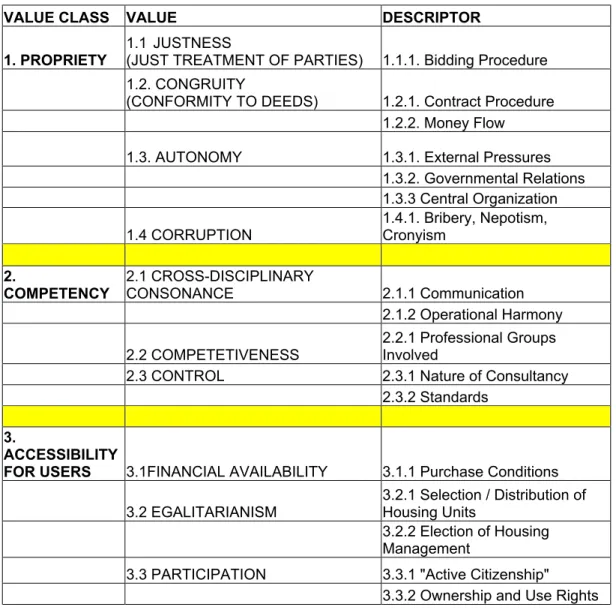
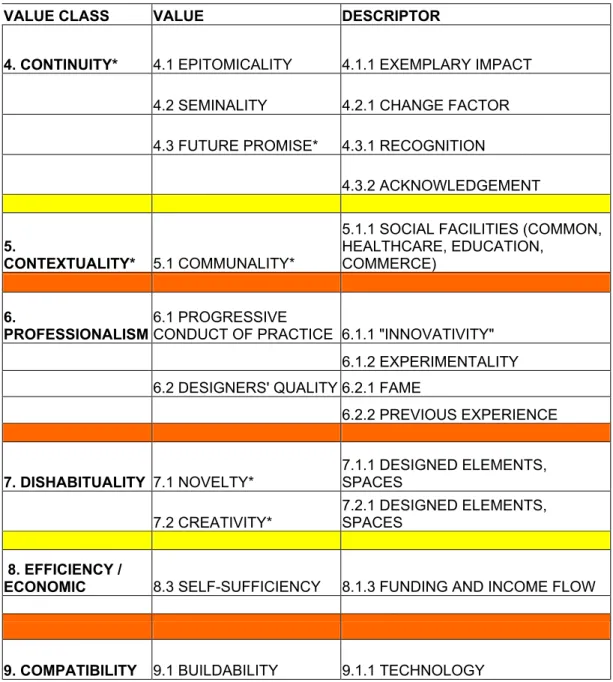
Table 5. 2. Value Classes, Values and Descriptors ... 104
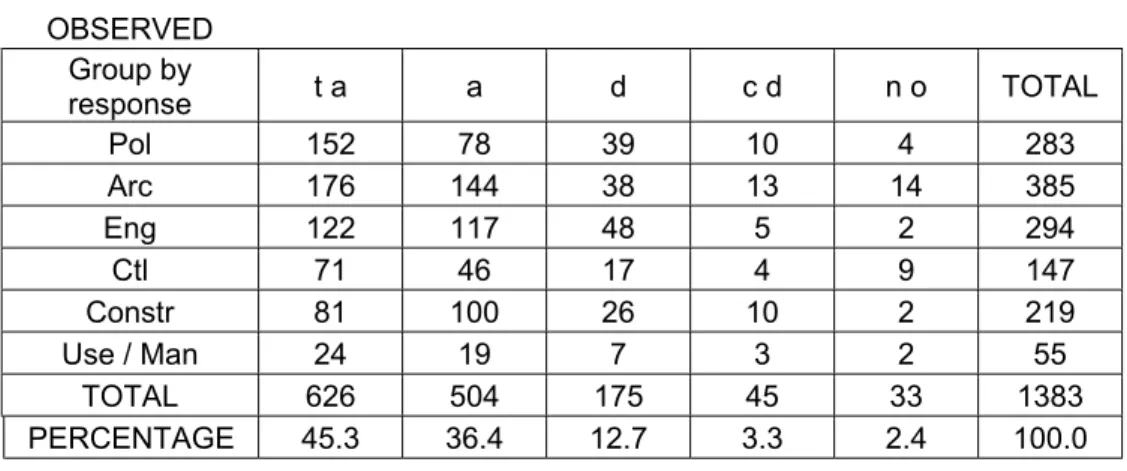
Table 6.1. Cross-tab Propriety ...………... 117
Table 6.2. Cross-Tab Justness ...………. 118
Table 6.3. Frequencies Sentence 60 ...………... . 120
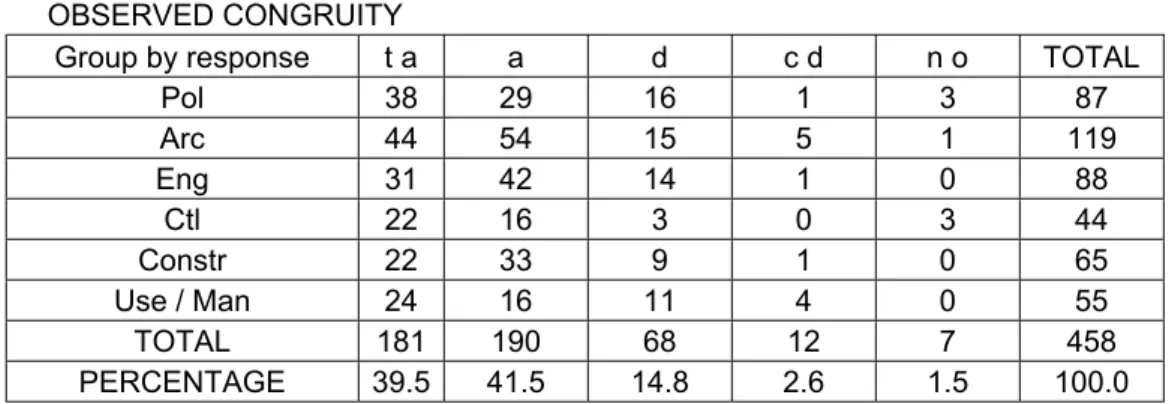
Table 6.4. Cross-Tab Congruity ...………. 122
Table 6.5. Cross-Tab Sentence 63 ...………... ..123
Table 6.6. Cross-Tab Autonomy ...………...…..127
Table 6.7. Cross-Tab Sentence 52 ...………...128
Table 6.8. Frequencies Sentence 9 ...……….... ..131
Table 6.9. Cross-Tab Sentence 9 ...……….... ..131
Table 6.10. Cross-Tab Corruption ...………... 134
Table 6.11. Frequencies Sentence 13 ...………... 135
Table 6.12. Cross-Tab Competency ...………... 138
Table 6.13. Cross-Tab Cross-Disciplinary Consonance ...………... 139
Table 6.14. Frequencies Sentence 5 ...………... 141
Table 6.15. Cross-Tab Competitiveness ...………... 146
Table 6.16. Cross-Tab Control ...……….... 149
Table 6.17. Cross-Tab Accessibility for Users ...………... 151
Table 6.18. Cross-Tab Financial Availability ...………... 152
Table 6.19. Cross-Tab Egalitarianism ...………... 153
Table 6.21. Cross-Tab Sentence 100 ………..…….159
Table 6.22. Cross-Tab Continuity ……….……….165
Table 6.23. Sentence 18 Cross-tabs………..167
Table 6.24. Cross-Tab Future Promise………..170
Table 6.25. Sentence 30, Frequencies ……….184
Table 6.26. Sentence 30, Cross-tabs ………184
LIST OF FIGURES
Figure 6.1 Sentence 63, Correspondence Analysis ……….. 124
Figure 6.2 Sentence 64, Correspondence Analysis ………126
Figure 6.3. Sentence 52, Correspondence Analysis ………..129
Figure 6.4. Sentence 9, Correspondence Analysis ……….…….. 132
Figure 6.5. Sentence 82, Correspondence Analysis ………. 137
Figure 6.6. Sentence 2, Correspondence Analysis ………..……. 140
Figure 6.7. Sentence 6, Correspondence Analysis ……… 143
Figure 6.8. Sentence 59, Correspondence Analysis ………..147
Figure 6.9. Sentence 78, Correspondence Analysis ………. 148
Figure 6.10. Sentence 91, Correspondence Analysis ………..……. 154
Figure 6.11. Sentence 94, Correspondence Analysis ………...… 156
Figure 6.12 Sentence 96, Correspondence Analysis ………...…157
Figure 6.13. Sentence 100, Correspondence Analysis ………..160
Figure 6.14. Sentence 104, Correspondence Analysis ………..…163
Figure 6.15. Sentence 97, Correspondence Analysis ………164
Figure 6.16. Sentence 22, Correspondence Analysis ………169
Figure 6.17 Sentence 106, Correspondence Analysis ………...…171
Figure 6.18 Sentence 43, Correspondence Analysis ………...…..176
Figure 6.19. Sentence 31, Correspondence Analysis ………...….179
Figure 6.20. Sentence 34, Correspondence Analysis ………181
Figure 6.21. Sentence 28, Correspondence Analysis ………187
1. INTRODUCTION
Mass housing, like any building process, involves a variety of social groups, who are engaged in, and who contribute to its formation. It is particular for the urban context, as it has been developed as a solution to the essential need of housing, for growing urban populations, to house the masses. This thesis is an attempt to develop an understanding of the building process and that of mass housing, through
establishing a wider perspective, acknowledging the contributions of various groups, various groups who are informed by a general conjuncture as well as their
formations as individuals or within social groups, such as professions.
Acknowledging the existence of a wider social frame where building and mass housing is shaped by contributions and interactions of a variety of groups, with their own views and beliefs on the process, is the essential aim, as well as the structure of the study.
The basis of this study lied in an interest to construct a theoretical framework for a value-based study of building. Pultar’s study on the conceptual basis of building ethics has been a starting point, and the initial research question of the study was on how to approach the problem of value judgments in the building context, and mass housing in particular.
The theoretical structure of the study is composed of two approaches that support and serve each other in establishing an understanding of the building process. These two main approaches are gathered from knowledge and methods developed in a variety of social scientific fields, and appropriated into the study of mass
housing. These two bodies of knowledge refer, first to understanding the life-cycle of building, and the appropriation of the social constructionist paradigm into research on built environment; and secondly, to situating values, value judgments, and value systems in a key position in this aspect, forming the backbone of the thesis study, establishing value judgments particularly as the tools of analysis.
The life cycle of building is an approach that constitutes building as an ongoing process of a cyclic nature, composed of a set of phases where building gets to become, with the sequential contributions of various social groups who contribute to the process. These groups have a particular role in the life cycle, and unavoidably establish relations with other groups. Be it a simple transfer of knowledge, or a more intertwined position, each group involved interacts with other groups and holds certain views, notions, and beliefs concerning building. The life-cycle view is
supported by the social constructionist paradigm, to give emphasis to these various groups, and on their interaction with the process just as between themselves. An approach rooted in the social studies of science and technology, the social constructionist view on technological processes is put forward as tools in
understanding how building, and mass housing operate. The social construction of technology and related approaches such as the actor-network theory are presented and explained, stressing the emphasis they give to varying social groups involved in the process, the values they hold and their interactions in terms of conflict,
The notions of values, value judgments, and value systems are described, informed by scholarly work in various fields including social psychology, sociology,
ethnography, literature, environmental ethics, and technology studies. Values are stressed in Chapter 3, regarding their importance in the way they affect the acts and approaches of various actor groups involved in the process. Values are proposed as mental constructs, which refer to conceptions on how things ought to be
(Goldthwait). Furthermore they are viewed as constructs, which are not only individually shaped, but also, and very much so, defined socially. Value judgments are proposed as the ultimate and only assertion of values. It is only through value judgments, that values get to be defined, formulated, and circulated in the form of verbal expressions. Social structures such as professional groups, and disciplinary formations such as education, and discourses, which encompass claims and
expressions by authorities and those that dissemination organs such as publications include, as well as in-group discussions, are influential and formative of values and value judgments (Kaplan). Social mechanisms are very much at work in the
formation of values. Value systems, are defined as collections of value judgments by an individual or a group that define their position and views concerning any
phenomena (Pultar).
Social, temporal, and conjuncture-related nature of values is an important input in understanding how various groups value the process, and in establishing the study on value judgments of actor groups involved. The second section of Chapter 3 focuses on these notions, defining social values, as values at the level of social groups; and situating them as bi-products of particular conjunctures, acknowledging the role of time, of temporal change. Values are not strict constructs that stay the same once adhered to. They are rather fluid, affected by various changes, yet they are not at all incomprehensible. On the contrary, the social and temporal
differentiations help the researcher in investigations on values, in terms of various references, that enable comparisons. The final section of Chapter 3 locates the building context and mass housing in relation to this theoretical foundation. Ethical considerations, ethics and their intimate connection to values are noted, stating how a study on values in the building context is directly also a question on ethics.
Professional ethics, and particular studies on actor groups involved in the housing process are reviewed.
Chapter 4 starts by briefly contextualizing housing, urbanization, and the
introduction of mass housing in Turkey. The institutionalization and the state’s role in mass housing by the formation of “Housing Development Administration”
(henceforth referred to as HDA) is explained. The HDA is particular in maintaining the credit and loan systems as well as constructing mass housing projects, with the aim of providing “examples”, for the sector, on how mass housing ought to be done. The Eryaman Mass Housing District in Ankara, one of the major demonstrational projects by HDA, is focused on, looking at the various stages constructed in
consecutive time periods. The structures of each stage, the formation, and the actor groups involved in each stage are briefly mentioned. The most appropriate case, for the attempts this thesis study is set to make, is the 4th Stage. The 4th stage
includes clearly distinct positions of those groups stated to partake in the process according to the life-cycle model. It is the only stage with a wide group of
architectural commissions, and a stage where the “design” phase is distinct.
This explanation in the context of mass housing in Turkey, and validity of the selected case is discussed, to follow up with the proposal on how the study is to be accomplished. A two-part study is proposed in the final part of the fourth chapter, as an analysis that builds itself gradually on the data obtained. An exploratory first part,
with an open inquiry into the value judgments of executive policy makers, followed by a survey study where representatives of a variety of actor groups are exposed to and asked to respond on the derived value judgments.
The aim of the thesis study is to constitute a body of knowledge, that relates not only to the 4th stage of Eryaman case as such, but also reveals how groups operate, how
they relate to the mass housing process and to other groups, by an investigation on their value judgments. There exists a general aim of working for a wider scope theory that would locate the mass housing, or building process within a larger frame in accordance with the social, political, economic operations, rather than isolating it as an act that can happen by itself. Knowledge on each actor group involved in the housing process, is thus of value, for it will demonstrate the position of the group in relation to the housing process, and to the other actor groups involved, as well as the wider conjuncture, the conditions, and the situations that contextualize the process as such.
The first part of the study is established through interviews involving open-ended questions held with the highest executives in HDA who were involved in the
conception, the structure, and the implementation of the 4th stage in Eryaman. This
initial part is given a particular importance in the formation of the whole study. The possibly hypothetical presuppositions of a researcher to form a survey, is replaced by the concrete outcome derived from these interviews. The interview texts and researcher notes are examined to point to value judgments expressed by the executives. From this analysis certain process oriented values and value classes are derived, forming the scheme of values, judgments, and descriptors on the mass housing process, referred to by the executive policy makers.
Chapter 5 is devoted to this initial part of the study, first explaining the situation, and the subject group as executive policy makers, followed by remarks on the methods, both explaining the interviews and the qualitative analysis applied. The latter part of the chapter focuses on the findings of the interview study.
The second part of the study on the 4th stage of Eryaman, builds upon the findings
of the exploration. The schemes and classifications provided as a result of the exploration part are re-evaluated to construct a body of value judgments that will set the basis of inquiry in this second part. The construction of the survey, its
implementation, the sample characteristics, as well as the results and outcomes of the survey are discussed in Chapter 6.
The analyses provided in Chapter 6 focus on the results, value by value according to the schemes provided in Chapter 5. Each value judgment is reviewed in the analysis section, according to the consensus, conflict, or variations in valuations of the subjects, representing the actor groups involved in the process. These analyses provide an analysis on the derived judgments from the first part, testing their
recognition on other actor groups, as well as providing insights on the relations between actor groups, and their value judgments concerning the mass housing process.
Chapter 7 provides a re-evaluation of the results, for the sake of stating implications of the study, for fields involved in the study of housing and the built environment as well as the policy-making bodies. Remarks related to the further studies on the subjects are also pointed out in this chapter. Six main conceptualizations from the study are stated in this conclusive chapter as: consensus, opposition, inter-group
valuations, fields of authority, notions related to conjuncture, and internal polarizations within groups.
The first three of the conceptualizations build on the analyses and the outcomes of the study, compiling them to present the possible implication of the study by stating the issues of consensus among actor groups, evident and significant oppositions among various groups involved, and the way these opposing groups tend to value one another. These are believed to be putting together a body of knowledge relative in understanding the mass housing process through an example in the Turkish context, and are proposed to possibly have implications in the scientific fields devoted to social studies of built environment, as well as professional or
governmental managerial sectors, in understanding the dynamics between groups in the mass housing process.
The latter three, on the other hand, build more on speculative remarks on the results and observations throughout the study. These are stressed to be of importance in establishing a further theoretical basis on the distinction of social or professional groups; and furthering the knowledge on the formative aspects of conjuncture on value judgments. The last part focuses more on issues such as value differentiations within groups, which were not the intended content of the study. Compiling the observations from survey results, this section proposes the study of further variables as a valuable field of study. The whole chapter has a conclusive quality in that it wraps up and re-evaluates the study for implications of results as well as providing grounds for further study in every section.
2. UNDERSTANDING THE BUILDING / MASS HOUSING PROCESS
2.1 Understanding the Life-Cycle of Building, and Situating
Particularities for Housing
Buildings are made up of natural or human-produced physical ingredients, be it soil, water, air, or timber, metal, glass, plastics, but also by human knowledge, skills, culture, social norms, resources, labor. In designing and constructing also passed into the building are the genotypes, inherited knowledge, patterns of space and behavior (Teymur, 57).
The life cycle of building (in the formalized-professional sense) generally consists of four stages, as planning and programming, design, construction, and use. There exist a number of initiatives in the planning and programming stage, according to the situation, which may include the users of building, occupants, etc. The main idea is to maintain certain goals for the problem, a fit to the misfit. The product of design reflects the designer’s interpretation of the problem, as well as his or her own convictions about the desirable conditions (Pultar, 155). When we take the life of a building, architects or designers are just one of the participants in the whole process (Teymur, 58). The construction stage involves a major transformation of materials, energy, finance, and labor into the building product. “What are now considered to be good and desirable are likely to be quite different to those of both the owner and
designer, use is that stage of the building life cycle, where the building’s impact extends not only to the users but also to the social and built environment at large, and for long periods of time” (Pultar, 158). “The lives of buildings thus continue after they are assumed to be finished” (Teymur, 58).
These titles can be re-appropriated according to this study’s concern, context, and objectives; however the stages named by Pultar reveals information about what takes place in each stage. What, or who are the actors involved in building and the housing process in particular then? In the context of mass housing, that is the concern of this study, we can name the “actors” or agents in relation to the four stages as follows:
1. Policy makers, or programmers: This group, - according to the type and qualities of the housing project - may involve the state, local governments, entrepreneurs, housing cooperatives, and other institutional or private enterprise.
2. Designers: This group of actors includes those who decide on the physical and related aspects of the project, such as urban planners, architects, designers, landscape designers, various engineers and such other professionals. 3. Producers: The physical construction stage involves those as contractors, builders, constructors, and managers.
4. Users: as the name implies, end users, occupants, the community, individuals.
Of course this main classification into four stages or four actor groups, does not mean that each is homogeneous in itself. Overall value systems may and actually do vary within each group. However, each actor group’s distinction comes from the value systems in general and how the value systems of each group differ from and at times conflict with one another. It must also be noted that the fourth “users” group
contains more variety and different qualities within it, when compared to the other three titles. But as this framework is set to contexts, and approached not only in general, “users” also have tangible qualities to be observed.
2.2 Social Constructionist Perspectives in Understanding the Building
/ Housing Process
An approach that has originated in the history of technology and sociology of scientific knowledge studies (a general area referred to as science, technology and society studies) can be helpful in understanding how the building process comes to be constituted by a number of varying actor groups, and how an analysis of this constitution can be established. This approach, named the social-construction of technology, has been written on and applied in many fields, primarily on
technologies and technological artifacts. Argued along three main approaches, being the systems approach, actor-network approach, and the social constructivist approach, it was set to locate how technologies did not have a life of their own, or develop autonomously but were related to the varying actors or social groups involved in the process (Bijker, 117 and Lambright, 47). Technology was seen as constructed by various social groups whose values it comes to embody (Pinch and Bijker).
What these approaches attempt in general is the acknowledgement of the social construction through varying actors or social groups. The key concepts of “relevant social groups” and “interpretative flexibility” were introduced by Bijker, as units of analysis, for “the need to analyze technical change as a social process” (117). The relevant social groups, which are basically the people involved in the process of
production and use of an artifact (in technological terms) in one way or another, were used as the starting point of description, thus making possible to demonstrate “the interpretative flexibility”. “Demonstrating the interpretative flexibility of an artifact amounts to showing that one seemingly unambiguous ‘thing’ is better understood as several different artifacts” (Bijker, 118). This is to say that each group involved in the process has a particular conception of the process and the “thing”, the result,
building, or mass housing in our case, both as the process of building and as the artifact building. Each of these different artifacts (varying conceptions) can be traced, Bijker claims, through identification of the meanings (and thus values) attributed by the relevant social groups. Against technical determinism where technical analysis is claimed to be autonomous and driven by purely internal dynamics, “interpretative flexibility” becomes the justification for the existence of social studies of technology (Bijker). Relevant social groups form the starting point of the “social construction of technology” model, as Bijker explains:
“Artifacts are, so to speak, described through the eyes of the members of the relevant social groups. The interactions within and among relevant social groups constitute the different artifacts, some of which may be hidden in the same “thing”. In that case, the interpretative flexibility of that “thing” is revealed by tracing the meanings attributed to it by the various relevant social groups.” (119)
In a descriptive model such as Bijker proposes, it is not possible for an artifact to “suddenly leap into existence” as a result of a momentary act of invention, by an heroic inventor; rather, it takes place in a gradual construction among the social interactions of relevant social groups.
Following the “interpretative flexibility” emphasis in social construction of technology studies has led to “controversies” claiming that differences among relevant social
groups in terms of the meanings given, often give rise to conflicts about the desired direction of technical change; and to “closure mechanisms” arguing that the
resolution of these conflicts lead to the concentration of technical work on a single artifact or system, and thus elimination of alternatives (Pinch and Bijker, 27; Hard, 414). Pinch and Bijker claim that technological closure is established “when the relevant social groups see the problem as being solved”, this they call “stabilization” (Pinch and Bijker, 27). How can this stabilization take place? Is it ever possible for such single alternative to result in a consensus of all social groups –or actor groups- in the building context? Hard criticizes this “closure mechanism” resolution of Pinch and Bijker as “dropping their conflict perspective” and questions the conclusions they derive in terms of disappearance of conflict, emergence of the solution and leaving everybody “happy and content”, and the scheme as lacking a discussion of power, stratification and hierarchy (415). He continues:
“…considering that social groups being affected by and involved in the development of technological artifacts and systems are, usually both large in number and quite dissimilar, it does not seem likely that technological closure should always be of the consensus kind.” (415)
Misa also stresses this ambiguous character of “closure” in order to include a “power relations” perspective into social constructivism. He stresses how closure may involve “the creating or restructuring of power relationships”, claiming how hard it is to simultaneously talk about power relations and consensus. This approach to conflict opens a further visage for studies in building; questions of how and what power relations exist in terms of professions’ or other social formations’ come to mind. These issues will be investigated later in this thesis. “If closure is the outcome of one group imposing its solution in the face of others”, as Misa and Hard both stress, “it cannot be identical with consensus” (Hard, 416). Another point related to
conflict that Hard puts forward is how groups act partly as purposeful agents when they are in conflict, when they interact, and at the same time how these conflicts and interactions form the acts of the very groups and people in conflict and interaction (416).
Following these issues Hard goes on to establish an understanding of technologies through the analysis of conflicts. “Technology is formed by social groups in conflict and technological change is never a socially neutral process” he writes, and sees technology as a tool for establishing and influencing social relations.
Although Hard does not explicitly claim his work’s relation to values, except a few notifications, the levels his argument rests on, what he refers to as interests, ideas, and conflict are value-based and value related concepts and issues. He claims that the “interests and ideas” of an agent “do not emerge in a social vacuum but are formed in opposition to, or in accordance with those of other agents”, as well as it can be derived from the group’s social position (a profession or a class), but does not suggest that such a correspondence approach is generally applicable (417). The existence of conflict implies, for Hard, “first, that there is some degree of cooperation and understanding within each group and, second, that conflicting groups share values, norms, and presuppositions” (417).
The definition of conflict, that Hard borrows from Weber, is as follows: “A social relationship will be referred to as ‘conflict’ insofar as action within it is oriented intentionally to carrying out the actor’s own will against the other party, or parties” (418).
However not all would agree in considering conflict as a motive to understand formations of technologies. Lambright is in search of coalitions and consensus in order to achieve success in large scale projects, meanwhile stressing the roles of politicians, and agency managers, as those who are to maintain consensus.
“In a perfect world technical process would be governed by consensus, the heart of which would be the advocacy coalition of agency managers, scientists, and
engineers performing research, and elected leaders…the record of failure in large-scale technology programs suggest that such consensus is rare.” (Lambright, 50)
Lambright believes that management is the locus where successes for technologies are established. He claims this to be possible not only by “building an external coalition but also by maintaining a common direction among the disparate units working inside” (51). The values held by all actor groups, if we may say so, should refer to a common good, which is the success of the project, according to Lambright. A coalition is needed, not only within the boundaries of the system and actors but also to outer environment. However still, Lambright keeps the position of referring to technologies and systems not as relatively stable systems of actors interacting among one another, but subject to sudden changes related to one certain actor’s manipulation, or other interactions. Law and Callon’s “actor-network theory”
becomes at stake here. Although it seems suitable neither for Lambright’s coalition of actor groups approach, nor the more value related position this study is set to take, in the way it includes inanimate objects into consideration as well as actors, the theory presents powerful insights and possibilities in understanding issues and conducting research.
Actor-Network theory, through a collective look at the works of Callon, Latour, and Law, is concerned with rendering visible the existence of relationships among
people, places, ideas, and things that have long been thought of as distinct and separate (Callon, Latour, Law, Frickel). Networks describe simultaneously the strong and fragile relationships among people, things, and places involved in production or creation of technologies (Latour, 1987). “Networks are constructed by actors
engaging in various strategies that they hope will strengthen the object of their interest –be it a scientific fact or an engineering project- in the eyes of others” (Frickel, 30). The actor-network approach is more of an “all-or-nothing” endeavor; one either accepts “the analytical and political implications of the ‘politics of explanation’ or not” (Latour, 1989).
How technology is constructed cannot be reduced to a social, technical, or scientific construction singularly. It is an irreducible configuration of different “bits and pieces” of all three (Frickel, 34-35). Actor network theory begins with a focus on associations among elements and asks whether or not they exist. What Frickel puts forward is the need to pay more attention to the political character of these associations among actors (48).
Importantly for conducting studies, Bijker stresses the position of the analyst, comparing it to that of the actors: As it is now impossible to make distinctions between the technical, the social, and the scientific, and rather whatever can be seen are made by the actors or by the analyst, in it the analyst should study the distinctions actors make and hold, rather than assuming their own a priori
distinctions (121-133). This is to say that what the analyst should do is to focus and conduct analysis on what the actors’ distinctions, priorities, interests; and values in general, are.
Values play a crucial role in the conceptions or the interpretations that members of relevant social groups have or make, the meanings they attribute to the certain artifact, and more importantly during their involvement in the process of production of it (not only physically coming to being, but also obtaining varying meanings). Values are also a key issue in establishing ethical studies of such constructions.
It is possible to argue for political and ethical positions with respect to technological choices, and in the context of building these positions are interwoven to the
technical or political or the related concerns of relevant social groups (or actor groups as they will be named). “Values, in this view of technology-society-ethics, are not pre-given as universal ethical laws but socially constructed together with
technology” (Bijker, 130).
What the social construction approach is set to do in general is, to establish an understanding of how technologies are socially constructed, in terms of the interrelations of varying social groups (actor groups) who take place in a process, regarding their value based decisions, distinctions, presuppositions, and activities. The positions these actor groups take in accordance with the process, the product, and the other actor groups involved are what constitute the process, the social construction of a technology. Values are a prevalent and predominant issue, even if authors of the field explicitly claim and notify their role (as in Pinch and Bijker; Bijker), or propose value related concepts without mentioning values (as in
Lambright; Frickel). It must be noted here that such an approach never neglects or rejects any physical ‘coming to being’, i.e. the ontological aspects of the subject issue; buildings are physically built, mass housing projects are planned, built, and lived in; they are existing physically. But the way in which they come to being is
directly related to, and, is an outcome of the social groups, and their conceptions, interests, decisions, the meanings they give, to sum up the values they hold.
In varying examples certain groups and their values can have more effect on the process of interest, where conflict between actor groups is the dominant trait. Although quite rare, harmonious examples (where “closure” tends to happen) can also be found. These examples are all again related to conflicts, contradictions in value systems, power relations among actor groups, and to political and ethical dimensions.
Further research on the social constructionist paradigm revealed that relative and relevant studies were also carried out in the context of the built environment, some of which acknowledged an affiliation with the social construction of technology approach (quite recent studies such as Jacobs and Manzi, 2000 on housing), and some were more involved in similar topics, studying with different terminologies or contexts (such as Ellis and Cuff, 1989; Larson, 1993; and Knox, 1987 who work more on architects, architectural literature and discourse, and the role of
professions).
Jacobs and Manzi claim that for most of the academics involved in housing research, the task is that of “discovering objective facts, presenting them in a descriptive format in the expectation that policy makers will take notice and act accordingly”, meanwhile neglecting how issues come to be constituted in a broader sense, and lacking theoretical concerns, which results in research that is
“methodologically conservative”; which makes it “difficult to pursue new lines of investigation, or, for that matter, to develop different conceptualizations of the policy process” (Jacobs and Manzi, 35). Recognizing these problems, as Jacobs and
Manzi claim, more contributions have begun to use the “methodological insights” of the social construction approach as an attempt to “broaden the scope of housing studies” (36). It has been noticed that from the late nineties on studies that relate to the social constructionist approach are beginning to be seen in the field of housing research (Hastings; Sahlin; Allen; Clapham; Clapham and Franklin; Gurney; Haworth and Manzi; Jacobs; and Jacobs and Manzi). More recent studies by academics such as Marston, have also attempted to introduce critical discourse analysis into policy oriented housing research.
“A major claim advanced by those adopting a social constructionist epistemology is that actors do not merely provide descriptions of events, but are themselves
constitutive of wider policy discourses and conflicts” (Jacobs and Manzi, 36).
However, it is striking how current studies that adopt social construction into housing do not use terminology related to values, when their claims mostly revolve around the conception of values as will be presented in this study. The application of social constructionist epistemology as Jacobs and Manzi put forward, “offers [a] ... different conception of reality... as well as a basis from which to understand the contexts and processes of housing” (36). As they reveal what they mean by this “different
conception of reality” it is what Bijker calls meanings and values attributed by relevant social groups; or values as constructs, as will be explained in this study. Another important point is that housing studies concerns so far are around policy making and management; where studies fall short in noticing the life-cycle of building, and all possible actor groups, whose value systems are constitutive in the process.
Social constructionist approach evaluates situations more in the realm of language, and discourse. This is pretty much related to more philosophical underpinnings of
the approach, for example the work of Foucault. “Foucault’s interest in language is important primarily for its focus on social relations, identity, and acquisition of
knowledge” where discourses and rhetoric become effective tools of power relations (Jacobs and Manzi, 36). “Discourse and language are therefore centrally important in understanding how we perceive and make sense of the social world” (Jacobs and Manzi, 37). Since “whatever does exist we can only know by way of our constituting through discourse” (Grint, 8). That is claimed to be the main reason why scholars involved in social constructionist methods of research are involved in discursive analysis. What this thesis study is attempting to do is developing a methodology, which is set to establish an accurate analysis of value judgments of actor groups on the process of mass housing. In fact what the social constructionist attempts are set to do is, improve understanding of the “complexities of policy as informed by
empirical research”, never undermining positivist research methods, “which have proved invaluable to practitioners and policy makers” in the housing context (Jacobs and Manzi, 40).
With the attempt to identify and acknowledge the varying actors in a process and how their relations, interactions, co-operations, or conflicts shape this process and its product, we tend to move toward more value related issues, in terms of the values that varying actor groups hold and express. So far terms such as values, value judgments, value systems, have been mentioned, yet unless these are clearly defined all that has been said will remain in ambiguity. It is important to establish a conception of values, in order to be able to define and examine the scopes of the study that will follow in the coming chapters. The following chapter is an attempt to establish an appropriate identification and clarification of value related concepts, acknowledging their crucial role in political and ethical considerations.
3. VALUES, VALUE JUDGMENTS, AND VALUE SYSTEMS AS TOOLS
OF ANALYSIS
3.1 Values, Value Judgments, and Value Systems
During the explanation of the particular conception of building process, through “life-cycle” and “social construction of technology” approaches, the key element which distinguishes various actor groups was revealed to be the values held by these groups: their value systems. Value systems thus form (and, in return, are formed by) the conflicts, the consensus, and all varying approaches and thoughts regarding the building process. To establish an understanding on value systems, the essential element is the value judgments, as the field where values are defined and
expressed. One may quickly notice and argue the role of professions, when almost all actor groups are composed of particular professional groups. Professions, disciplines, and such formations, by their nature constitute particular discourses regarding their acts, their members, their identity, and thus through discourse constitute particular value systems, in order to maintain, supplement, and reinforce their existence as such professions.
To understand the building process as constituted by various social groups, and reveal the various dynamics in this constitution, values held by these groups, and
value judgments that express them should be considered as the field of inquiry and the tools of analysis as well. To initiate such a search in obtaining such knowledge about the building process, values need to be thoroughly examined, understood in the light of previous theories, and a methodology is needed. To develop such a study, what is understood by “values”, and through which theoretical frameworks “value systems” are approached need to be clearly stated and put forward.
3.1.1
Values: Brief Description
A value is basically a conception of how something ought to be (Goldthwait, 42). Kluckhohn defines value as “a conception, explicit or implicit, distinctive of an
individual or characteristic of a group, of the desirable which influences the selection from available modes, means, or ends of action”(395). To quote Rokeach’s often cited definition; “a value is an enduring belief that a specific mode of conduct or end state is personally or socially preferable relative to an opposite or converse mode of conduct or end state”(Rokeach, 1973: 5).
The term “value” is being and has been used in all social sciences, “with different but not unrelated meanings”(Hofstede, 20). There is certain consensus in what the term refers to, but no two definitions are exactly the same, variations and
inconsistencies exist, still the term has an interdisciplinary existence, understanding it needs references from a variety of fields and disciplines.
Many authors working in varying fields encompassing psychology, social
psychology, sociology, ethnography, literature, environmental ethics, technology studies, and the like, who deal with values and strive to establish ways of
“constructs”, as “mental structures”, which are not only individually but more often socially defined (Smith, B; Smith, M; Epstein; Staub; Hofstede; Wojciszke; O’Brien and Guerrier; Levitin; Levine and Moreland).
Levitin defines a construct as “not directly accessible to observation but inferable from verbal statements and other behaviors and useful in predicting still other observable and measurable verbal and non-verbal behavior”(1973:492). Thus, as Hofstede stresses constructs “do not exist in an absolute sense: we define them into existence”(1998:17). These aspects, of constructs, and moreover values as
constructs; being inferable more than observable, and defined through verbal statements, will be utilized further in understanding and analyzing values.
Hofstede, inspired by Kluckhohn (1951:395) and Rokeach (1972:159) defines a value as “a broad tendency to prefer certain states of affairs over others”(1998:17).
“Whatever is of significance to an individual, will be valued by the individual, either positively or negatively.” (Epstein, 15).
As O’Brien and Guerrier propose, “all individual and collective action is informed by values” be it by more individually based personal values each actor holds, or by socially responsive values which are “embedded in a social context (family,
community, school, work, etc)” which need not be in accord with personal values but come to constrain or enable individual action. Meanwhile “all such values are
practically and concretely realized in social action and organization” (xiii).
Values have strong influence on everyday practices as well as more formal and professional practices. In fact values that people hold in a broad sense are what
orientations and value relations saturate our experiences and life practices from the smallest established micro structures of feeling, thought, and behavior to the largest established macrostructures of organizations and institutions”(1988:x).
O’Brien and Guerrier stress that when more than one way of acting in and on the world is possible, which is the general condition of living, a choice is to be made; a choice on what ought be, which makes the effects of values become tangible, interpretable, or contestable.
“[The] problematic relation between action and values persists in the complex intersection of motives, constraints, contexts, and choices that underpins both the ordinary conduct of everyday life and the systems of production, organization, and control that sustain wider societies”(O’Brien and Guerrier, xiii). The argument in this statement is two-folds, the statement firstly draws our attention to the relation between values and action, which has been an important issue in value studies, an issue too important to be undermined, and an issue, which ought be taken into consideration through the establishment of any study on value. For a study on values is bound to face the values-actions duality, it should be acknowledged, not neglected. If we return to the second point of the above statement by O’Brien and Guerrier, we see that values do not exist by themselves or could ever come to be initiated solely by themselves; “values do not arise in a vacuum” (O’Brien, 167) they are dependent of certain aspects of a basically social life, certain aspects which come to constitute the values that individuals or groups hold. Moreover, the affects of values are not only visible in the more individual or small social group realms of everyday life, but also are significant in systems that sustain wider societies.
Carlton also claims that social life is underpinned by value assumptions, which are often explicit and intelligible as in the forms of beliefs, ideologies, and moralities, but are also possibly implicit and left unrecognized “even though they interiorise the everyday world in unperceived ways”(1995:135).
“Values are learned responses to the environment in which people grow up… Apart from individual personality and life experiences, factors like education, occupation, gender, and age will also affect values” (Hofstede, 20)
“Values circulate and mutate, are fore grounded and back grounded, adopted or excluded on the basis of a very wide range of social, cultural, economic, and political priorities and commitments” (O’Brien and Guerrier, xiii).
Values according to B. Smith, are inter-subjective human creations, and are subject to changing human needs. He continues his approach on values proposing that social relations have a crucial role in the production of values, beliefs, behavior, and all lived experience. Not only does the social and natural world have by themselves values given to them, different histories, traditions, and social practices, power relations affect the conceptual models we produce and utilize.
“...[T]he values apparently held by any individual are themselves unstable and shifting rather than fixed and reliable: they embody contradictions, inconsistencies, and wide variations in different circumstances.” (O’Brien, 167).
Staub’s study on values is one of the studies, which prefer to put “value” beside another degree of value (that is in the definition his study proposes) such as goals, motives, etc. Staub’s study differentiates values and goals, as values being “desired outcomes that relate to welfare of human beings” thus being always moral or morally relevant, always having “dear moral implications”, whereas goals being desired outcomes that do not necessarily refer to a moral “goodness” (46). This
differentiation, as the author acknowledges, is established in order to create
differences among values, goals, and to take “other conceptual frameworks” motives in general. This differentiation is disabled as in the conception proposed with this study, when values refer to preferences for desired outcomes, and what ought be for particular subjects, groups, and in particular situations. Staub continues his
differentiation claiming that certain values may conflict with certain goals that actors hold. This very claim reflects that the differentiation between values and goals is established not to claim that values held by an individual or group may conflict, and thus presupposes that a totally homogeneous “moral good” can and does exist for all, and values held can not be conflicting among themselves. However this undermines the dynamics of value systems which will be explained below, and neglects the fact that values held by certain subjects (be them an individual or a social group), may and often do conflict among themselves. Actually, Staub’s work, although initiating such a differentiation, tends to treat values and goals together as the total of “desired outcomes” definition goes, when establishing the notions of how values are formed by and tend to form in return, certain aspects of human life, and their relation with the “assumed self” that works for both individuals and social groups.
“Specific values and goals may be regarded as independent, relatively separate components of a person’s personality. In contrast they may arise from the self concept and world views that individuals or groups hold, which together comprise much of a person’s assumptive world” (Staub, 48).
Wojciszke also deals with this notion of self-assumption. His work is established on the trajectory of individual personal values, and it’s relations with the “ideal self”.
desired by a subject, and they refer to the person of their beholder (himself, herself)...personal values defined in such a manner are closely related to another psychological concept of long tradition – the ideal self” (Wojciszke, 229).
Wojciszke’s notion of personal values “serves as a very general guide for behavior” although he stresses the specific actions may sometimes be “hard to predict based on the values just because of their abstract nature”(230). This again refers to the problem of values and action, which will be addressed below.
3.1.2
Value Judgments: How are Values Defined and Expressed
"A value judgment is an expression used to assert a value" (Goldthwait, 30). Thus it is the value judgment about the value, that we can recognize and identify, but not the value itself. As Goldthwait stresses, "value judgments are what guide us and tell us what to do" (53). B. Smith claims that “value judgments appear to be among the fundamental forms of social communication” and also among benefits of social interactions (4).
According to Goldthwait, value judgments are embedded in value-claiming propositions, which express how states of affairs ought to be. Value-claiming propositions are direct outcomes of values people hold, and are what guides them. Goldthwait creates a binary opposition where fact-claiming propositions, which express states of affairs or events, how things are or how things happen, constitute the opposite end (23-32). There also exists opposite views which propose value judgments being possibly evident in any proposition; B. Smith stresses that such dualisms have obscured “the crucially relevant continuities between evaluative and other types of discourse, and most significantly, the social dynamics through which all utterances, evaluative and otherwise, acquire value”(4). What B. Smith intends to
establish is the idea that since all values are formed through social mechanisms -which in the verbal and literary milieu related to certain social groups include
discourses-, also reciprocally come to form the very social mechanisms themselves. This reciprocal fashion is seen evident in the findings from the 1990-1993 World Values Survey where these findings concerning value and belief systems “...are not [just] mere consequences of economic or social changes, but shape socio-economic conditions as well as being shaped by them, in reciprocal fashion” (Inglehart,
Basanez, and Moreno, 23).
A discourse, which may be defined as “a kind of system, shared by a socially
constituted group of speakers, or as referring to a particular social practice” (Kaplan, 347) includes the whole body of knowledge, propositions, values, and ideas related to that group or social practice. A discourse by its nature includes or is constituted by sets of propositions, be them value claiming or fact claiming, and these sets of propositions affect the values held by individuals and groups involved in that “social practice” who also happen to be the “socially constituted group of speakers” who share and produce this system, which includes all sorts of propositions. Thus when the “social dynamics through which all utterances acquire value” are mentioned, what is stressed is that all propositions produced within those social dynamics face the possibility of being influenced by sets and systems of values embedded. Thus a hard cut separation between fact-claiming and value-claiming propositions are problematic. It must be noted here that having no distinction, and difference
between any proposition, is also quite problematic and does not lead to any further clues in our search for understanding how values are formed, shaped and how they operate. However, it would be an easy, dismissive and misjudging way to approach ideas and exercises which are also established for the quest of understanding values, to take them at face value, for example to consider B. Smith’s claim as an
“everything is everything” approach, which dismisses the possibility of studying or separating values from anything, thus demolishing the significance and
instrumentality of values people hold. On the contrary, her study (as well as others’) in establishing an understanding of value, may lead to possibilities of further
investigation on the ways in which values come to be formed, constituted in a social milieu, how they reciprocally shape the social milieu they come to be formed within, and how changes in values among social groups vary through social, contextual, and temporal dimensions.
B. Smith further notifies her intentions on the impossibility of both value-ridden propositions and value judgments that come to being, solely by themselves. She writes “...no judgment, ...is totally unaffected by the particular social, institutional and other conditions of its production and totally immune to – or we could say, because it cuts both ways and that is the point, altogether unresponsive to – the assumed interests and desires of its assumed audience” (B. Smith, 9 ). In fact, while claiming that there exists two main types of propositions, Goldwaith also reminds and warns the reader that there are propositions which seem to be fact claiming but happen to be claiming certain values or value affected propositions. However he does not relate this to the idea that every possible judgment being affected by and affects in return the particular conditions that surround this judgment, or the proposition put forward.
An important point that M. Smith utilizes is the consideration of not only the medium but the mediation of values, meaning that values need to be expressed, and the concern should be not only on where the values are initiated but also how, and to whom these values are mediated.
There is another important issue concerning values and value judgments, that is the value – action problem which needs to be addressed, and investigated further at this point of the study. Although there exists a variety of attitudes towards this problem, the consensus is that values and action, more correctly value judgments (which are the claimed, expressed forms of values held) and behavioral outcomes, do not always overlap (Epstein, Hofstede, Tatum, Wojciszke).
Tatum stresses that values are embedded in action. A separation of values and action is empty by definition, he claims, “insofar as values are expressed and even defined through actions” (72). However this happens not to be the generally
encountered case, as data obtained in studies of values especially in the field of social psychology show (Epstein, Hofstede, Wojciszke).
Wojciszke defines personal values and ideal self as “specific instances of mental representations” and thus approaches to the problem of the relation between value and behavior “as a specific case of the relation between a cognitive structure and behavior implied by the structure” (231). Hofstede believes that there needs to be an important distinction between values as “the desired” and values as “the desirable”; that is a distinction between what people actually desire against what they think ought to be desired (21). These in Hofstede are not possibly independent, however should not be equated as well. Hofstede relates to with what Levitin named the “positivistic fallacy” in which “reality” is confused with “social desirability” (497). Unfortunately this distinction is hardly clear, where what “reality” refers to be very much related to what one makes believe, as in the case of values. Hofstede brings forward the attention needed to be paid that in a study concerning values of different natures are encountered, and both should be studied, in order to be able relate values to behavior (Hofstede, 21). The scholar or researcher involved in the study of