INFORMS is located in Maryland, USA
Management Science
Publication details, including instructions for authors and subscription information: http://pubsonline.informs.org
Performance Information, Production Uncertainty, and
Subjective Entitlements in Bargaining
Emin Karagözoğlu, Arno Riedl
To cite this article:
Emin Karagözoğlu, Arno Riedl (2015) Performance Information, Production Uncertainty, and Subjective Entitlements in Bargaining. Management Science 61(11):2611-2626. https://doi.org/10.1287/mnsc.2014.2012
Full terms and conditions of use: http://pubsonline.informs.org/page/terms-and-conditions
This article may be used only for the purposes of research, teaching, and/or private study. Commercial use or systematic downloading (by robots or other automatic processes) is prohibited without explicit Publisher approval, unless otherwise noted. For more information, contact [email protected].
The Publisher does not warrant or guarantee the article’s accuracy, completeness, merchantability, fitness for a particular purpose, or non-infringement. Descriptions of, or references to, products or publications, or inclusion of an advertisement in this article, neither constitutes nor implies a guarantee, endorsement, or support of claims made of that product, publication, or service.
Copyright © 2015, INFORMS
Please scroll down for article—it is on subsequent pages
INFORMS is the largest professional society in the world for professionals in the fields of operations research, management science, and analytics.
Vol. 61, No. 11, November 2015, pp. 2611–2626
ISSN 0025-1909 (print) ISSN 1526-5501 (online) http://dx.doi.org/10.1287/mnsc.2014.2012 © 2015 INFORMS
Performance Information, Production Uncertainty,
and Subjective Entitlements in Bargaining
Emin Karagözo ˘glu
Department of Economics, Bilkent University, 06800 Ankara, Turkey, [email protected]
Arno Riedl
Department of Economics (AE1), Maastricht University, 6200 MD Maastricht, The Netherlands; CESifo, 81679 Munich, Germany; IZA, 53113 Bonn, Germany; and, Netspar, 5037 AB Tilburg, The Netherlands,
W
e experimentally explore the effect of performance information and production uncertainties on (i) subjective entitlements derived from the production process and (ii) bargaining over the jointly produced surplus. We hypothesize that performance information and details of the production process affect entitlements, which in turn influence bargaining behavior. We find that, without performance information, subjective entitlements are mostly mutually consistent, and bargaining mainly ends with an equal split. In stark contrast, negotiators derive strong, mutually inconsistent, subjective entitlements when there is performance information. These subjective entitlements affect opening proposals, concessions, and bargaining duration and lead to asymmetric agreements. Moreover, given performance information, endogenous variations in entitlements influence bargaining, suggesting an independent role of subjective entitlements. Production uncertainties influence bargaining, especially when performance information is present, but do not substantially mitigate the effect of entitlements. Theoretical bargaining models allowing for reference points or fairness principles can partly account for the empirical results. Yet, important aspects are left unexplained and our results suggest ways for extending these models.Data, as supplemental material, are available at http://dx.doi.org/10.1287/mnsc.2014.2012.
Keywords: bargaining; performance information; noisy production process; subjective entitlements; reference points; experiments
History: Received August 12, 2013; accepted May 27, 2014, by Uri Gneezy, behavioral economics. Published online in Articles in Advance December 10, 2014.
1.
Introduction
Economic surplus is often created through a joint pro-duction process, which raises the question of how to share the joint proceeds. Since ex ante contrac-tual solutions are not always feasible or prone to renegotiation (Ledyard 2008), parties often have to negotiate the distribution of the proceeds ex post. In such bargaining a fair distribution may be difficult to determine because the exact relative contributions of different parties may not be fully disclosed. Exogenous shocks to the production process may additionally increase uncertainties regarding relative contributions. Examples of negotiation conflicts that have (at least partly) been induced by such uncertainties range from the U.S. National Basketball League (NBA),1 to the
1In the season of 1998–1999, NBA players were on strike for 191 days.
In the conflict the main point at issue was the relative contributions of players and owners to the enormous growth of the NBA league at that time (Schiesel 2008).
computer gaming industry,2 to more general labor
disputes.3
Another important aspect of such conflicts is that negotiators often bring subjective entitlements to the bargaining table, which may be derived from their real or perceived contributions to the joint surplus. In most cases such entitlements are mutually inconsistent and self-servingly biased, which may hamper finding an agreement that all involved parties find acceptable. (For effects of mutual inconsistency, see, e.g., Hoffman and Spitzer 1985, Burrows and Loomes 1994, Hoffman et al. 1994, Gächter and Riedl 2005); and for self-serving
2In 2008 the conflict between a voice actor and the owning company
of Grand Theft Auto IV—then the fastest-selling computer game in history—caught media attention. The voice actor and the company haggled about the relative contributions of the “human performance” and the “conception of the art director” to the success of the game (Ortutay 2008, Totilo 2008).
3See, e.g., Corfman and Schmeltzer (2002) and Lyons (2009) for
public accounts of discussions and disputes about how to share the burden between white collar and blue collar workers or between management and workers during business and economic crises. 2611
bias, e.g., Messick and Sentis 1979, Thompson and Loewenstein 1992, Babcock et al. 1995b, 1996, Charness and Haruvy 2000, Buchan et al. 2004, Gächter and Riedl 2005, and Luhan et al. 2013.)
Although performance information, production uncertainties, and subjective entitlements are consid-ered as important variables affecting negotiations, there is yet no systematic investigation of how differences in performance information and the production process affect subjective entitlements, which in turn may influ-ence bargaining over a jointly produced surplus. In this paper we use laboratory experiments to provide comprehensive evidence on this question.4
In the experiment, pairs of subjects produce a joint surplus by individually performing a real-effort task. The size of the surplus depends on the total perfor-mance of both parties involved. Thereafter negotiations over how to share the surplus take place in a com-pletely symmetric free-form bargaining environment. In the case that bargainers agree on a split of the surplus, they earn their respective shares. In the case of disagreement, they earn nothing.
Subjective entitlements are defined as “subjectively perceived rights that go along with a motivational disposition to defend them” (Schlicht 1998, p. 24). In our experiment subjects may derive such subjective rights to a fair share of the surplus from their performance in the real-effort task. To elicit these subjective entitlements, we privately and anonymously ask bargainers what they think a fair distribution of the jointly produced surplus should be from the vantage point of a neutral arbitrator. We ask this question after the size of the surplus is known but before bargaining begins.
Previous research has shown that entitlements can be important in bargaining (see references above). In this paper we proceed beyond these studies and investigate how performance information and production uncer-tainties affect entitlements and how they in turn impact negotiations. To this end, we manipulate performance information and production in the following way. First,
4Our study is also related to the literature exploring distribution
behavior in environments with joint production. Gantner et al. (2001) show that fairness judgments influence the distribution of the surplus in simple ultimatum and demand games. Cherry et al. (2002), Frohlich et al. (2004), and Cappelen et al. (2007) investigate how a dictator’s distribution decisions depend on contributions to the production of the surplus. Camerer and Loewenstein (1993), Babcock et al. (1995a), and Loewenstein and Moore (2004) study the effect of information in bargaining and show that information disclosure does not necessarily facilitate bargaining. Wittig et al. (1981) report that people allocate more to themselves when they are told that their own contribution to the joint surplus is not due to luck but due to their performance. See Karagözo ˘glu (2012) for a comprehensive survey. Our study also relates to work comparing different bargaining rules and procedures (e.g., Gächter and Riedl 2006, Gantner et al. 2013) and investigating the role of asymmetries in coordination games (Crawford et al. 2008).
negotiators either learn whether they have been the better or worse performer in their pair or they do not receive this information. In the former case we deliberately do not give precise performance infor-mation because such inforinfor-mation is also usually not known in the field. Second, in one condition negotiators know that the joint surplus is solely due to their joint performance, whereas in another condition the actual size of the pie is also affected by an exogenous random event.
Crossing these conditions gives a 2 × 2 experimental design with which we can study important issues in bargaining. First, we can investigate which entitlements bargainers derive from their performance in the joint production task and whether these entitlements are self-servingly biased. Research on accountability (e.g., Konow 1996, Cappelen et al. 2007) states that a person’s entitlement should only be related to variables an agent controls. From that perspective one may expect that entitlements emerge only when there is performance information, i.e., that they are performance specific, and weaker when there are production uncertainties. Second, when subjective entitlements are mutually inconsistent, an agreement can be reached only when at least one bargaining party concedes. Therefore, entitlements likely affect bargaining but the strength of the effect may depend on performance information and production uncertainties, because entitlements themselves are likely influenced by them. With our experimental design we can track the influence of entitlements and their interaction with performance information and production uncertainties through the whole negotiation process, beginning with opening offers, via concessions and bargaining duration, to agreements.
It should be noted that performance information in our experiment is relatively coarse, which may make it difficult for negotiators to derive subjective entitlements at all. Moreover, in contrast to previous research (Gächter and Riedl 2005), our performance information also does not provide claims that could be used as an anchor for subjective entitlements. Therefore, we consider our set-up as a rather conservative test bed for the existence of subjective entitlements as well as their potential impact on bargaining.
Our main results are the following. First, bargain-ers undoubtedly derive subjective entitlements from the performance task, but only when there is relative performance information. Second, entitlements are per-formance specific because better performers derive stronger entitlements than worse performers. In addi-tion, within bargaining pairs, entitlements are mostly mutually inconsistent. Third, perhaps surprisingly, uncertainties in the production process only weakly affect subjective entitlements. Fourth, the existence and strength of subjective entitlements are reflected in the
whole bargaining process. They impact opening offers and agreements because those are skewed away from the equal split and correlated with subjective entitle-ments. Further bargaining takes longer and concessions are smaller, and both are correlated with the tension in entitlements in a bargaining pair. Hence, we find that the (in)existence and strength of subjective entitlements strongly depends on the information negotiators have and that derived subjective entitlements systematically influence the whole bargaining process. Fifth, produc-tion uncertainties about the translaproduc-tion of performance into surplus do affect bargaining (opening proposals, concessions, bargaining duration, and frequency of equal splits) but do not systematically mitigate the effect of entitlements on bargaining. Moreover, although all bargaining pairs received the same coarse relative performance information, individual and pair-level differences in entitlements correlate with all aspects of bargaining. This strongly suggests that entitlements per se are important factors shaping the bargaining process. The rest of this paper is organized as follows. Sec-tion 2 presents the experimental design and procedures. Section 3 develops our research hypotheses, partly based on theoretical bargaining models. Section 4 con-tains the results. Section 5 summarizes our findings and puts them into perspective, especially in relation to theoretical bargaining models assuming reference dependence.
2.
Experimental Design
and Procedures
In our experiment, randomly and anonymously paired subjects take on the role of department heads of a company. Subjects are informed that their firm has a standard “salary budget” of 2,050 points available for them and that this budget can change depending on their performances and (in some treatments) external factors. They are further told that the top management of the firm does not want to impose a salary distribution and that they will have to bargain over the distribution of the salary budget.
Our experiment was not framed neutrally for the following reasons. First, our experimental set-up is relatively complex: it involves a real-effort task, elicita-tion of entitlements, unstructured bargaining, and— depending on the treatment—different forms of perfor-mance information and uncertainties in the production process. Providing an explicit natural context might have helped subjects to understand the rules and incentives in the experiment. Second, laboratory experi-ments are sometimes criticized for their lack of external validity. This may hold especially for neutrally framed experiments. Providing an explicit natural frame in a laboratory experiment may increase external validity without compromising internal validity. Therefore,
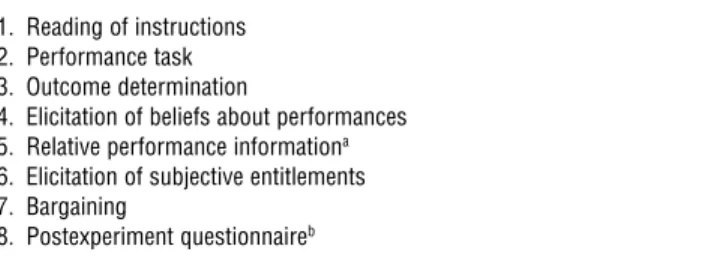
Table 1 Sequence of Events 1. Reading of instructions 2. Performance task 3. Outcome determination
4. Elicitation of beliefs about performances 5. Relative performance informationa
6. Elicitation of subjective entitlements 7. Bargaining
8. Postexperiment questionnaireb
aThis information is provided only in the Info treatments.
bBefore stage 8 there was another bargaining experiment that was not
preannounced; the results of this stage are reported elsewhere.
the chosen frame reveals insights about the role of entitlements in negotiations that may be more relevant for actual negotiations in companies and other orga-nizations than results found under a neutral frame. Third, we use the same frame as Gächter and Riedl (2005), allowing us to make direct comparisons with their results on the effect of entitlements.
In the experiment we vary (i) the information that subjects receive about their own and the other depart-ment head’s performance in a real-effort task and (ii) the way these performances are translated into the salary budget, as explained below. Table 1 summarizes the main elements of the experiment in the sequence in which they were presented to the subjects. In the fol-lowing we describe these elements and our treatments in detail.
Performance and Outcome Determination. After read-ing the instructions aloud, the performance of each department head is determined with a real-effort task for which we use a version of a general-knowledge quiz that has successfully been applied in other studies (Hoffman et al. 1994, Clark 1998, Gächter and Riedl 2005). The quiz consists of 16 multiple-choice questions with four incorrect and one correct answer to each question. The questions concern a variety of fields of knowledge, such as politics, music, religion, astronomy, and geography. Each participant receives the same set of questions in the same order. Subjects have at most 30 seconds to answer each question and unanswered questions count as wrong answers. All this information is public knowledge.
Before the subjects take the quiz, in the two treatments with deterministic production (called Info-Det and Noinfo-Det), it is explained to them that the salary budget in a pair will be 1,390 points in case of both department heads having in sum 0 to 10 correct answers, 2,050 points in case of 11 to 20 correct answers, and 2,710 points in case of 21 to 32 correct answers. In the two treatments with uncertainty in production (called Info-Unc and Noinfo-Unc), subjects are informed that with a chance of 25% their salary budget is determined by their joint performances (as described above) and that with a chance of 75% each salary budget size is randomly
chosen with equal probability.5In all treatments, subjects
get to know the actually produced salary budget before bargaining.
Elicitation of Beliefs on Performances. Knowing the salary budget, each subject is asked to guess the number of her (or his) own as well as the other department head’s number of correct answers. This belief elicitation is incentivized: for each precise estimation, a subject earns 60 points; for each estimation with 1 (2) error(s), a subject earns 30 (15) points; and for estimates with larger errors, a subject does not earn any payoff.
Relative Performance Information. In one pair of treat-ments, subjects do not receive any information about their performances in the quiz (Noinfo-Unc and Noinfo-Det), whereas in another pair of treatments subjects get to know whether they are the better or worse performer in their pair (Info-Unc and Info-Det). In each pair, a head of department is called the bet-ter (worse) performer for getting more (less) correct answers.6In case of a tie, subjects are also informed
about that.
Elicitation of Subjective Entitlements. We elicit subjec-tive entitlements by adopting the elicitation question used by Gächter and Riedl (2005) (see also Babcock et al. 1995b). Specifically, all subjects answer the following question:
According to your opinion, what would be a “fair” distribution of the salary budget from the vantage point of a noninvolved neutral arbitrator? (Please use exact amounts; no intervals! The amounts have to sum up to the salary budget!)
Subjects are not informed about this question before-hand. In the Noinfo treatments, they see and answer it after they have stated their beliefs about performances,
5In the Unc treatments, subjects do not get to know whether it
was actually luck or their joint performance that determined the salary budget. We have made this design choice for the following reasons. First, in many actual bargaining situations over a jointly produced surplus, negotiators often do not know to what extent the realized outcome is due to their own performance and to what extent it is due to other (random) factors (see the examples discussed in §1). Second, if we had informed subjects about whether or not their joint performance mattered, we would have effectively introduced two treatments. One treatment, where subjects would have known for sure that it was their performance that determined the surplus, would have been equivalent to our treatments with deterministic production, and we would expect similar results. The other treatment, where they would have known for sure that it was not their performance that determined the surplus, would have been equivalent to a production process completely determined by chance. In this case we would expect little effect of entitlements and mostly 50/50 agreements, as in the implemented Unc treatments (see also our hypotheses below).
6We present this information after eliciting beliefs on performances
because (i) we do not want beliefs to be affected by performance information, and (ii) in this way we keep symmetry in belief elicitation between the Info and Noinfo treatments.
and in the Info treatments they see and answer it after they have received the relative performance informa-tion. Hence, subjects’ fairness judgments likely depend on their (believed) relative performance, and elicited entitlements are therefore considered subjective.
Bargaining. Each pair of department heads bargains over the distribution of their salary budget. If an agree-ment is reached within 10 minutes, both earn the agreed shares. If no agreement is reached they are informed that they are to be “fired” by the management of the firm and do not earn anything. We implement free-form bargaining (like, e.g., Roth and Murnighan 1982, Gächter and Riedl 2005), because it is a natural bargaining pro-tocol, avoids exogenous first-mover effects, and gives subjects much freedom in bargaining (e.g., in the timing, sequence, and number of proposals). Subjects are seated in computer cubicles and bargain anonymously with their opponents over a computer network by sending proposals that consist of an amount for themselves and an amount for the other department head.7
Postexperiment Questionnaire and Payout. After all parts of the experiment are finished, subjects answer a questionnaire where we ask them about their opinion on the general knowledge quiz, among other questions. They are also presented with the Machiavelli personal-ity test (Christie 1970), a risk-attitude questionnaire (Dohmen et al. 2011), and questions about their per-sonal background. Thereafter, subjects are paid their earnings in cash individually and confidentially.
The experiment was computerized and programmed with the software z-Tree (Fischbacher 2007) and con-ducted in the BEElab (Behavioral and Experimental Economics Laboratory) of Maastricht University in April 2009 and February 2010. In total 348 subjects par-ticipated in 16 randomized experimental sessions. Most subjects were undergraduates in economics, business, and international business. A typical session lasted approximately 90 minutes. The points earned in the experiment were converted into cash with an exchange rate of 100 points equalling 65 euro cents. The average earnings (including a lump-sum show-up fee ofE3, –) were approximatelyE16, –.
3.
Research Hypotheses
We are interested in the existence and strength of sub-jective entitlements over a jointly produced surplus and how such entitlements are affected by performance information and production uncertainties. Further, in case entitlements do emerge, we want to investigate how they influence the bargaining process under the described information and production conditions. In this section we develop some hypotheses regarding these issues.
7Detailed bargaining instructions and example computer screens can
be found in §S2 of the online appendix (available as supplemental material at http://dx.doi.org/10.1287/mnsc.2014.2012).
3.1. Subjective Entitlements
In our experiment, subjective entitlements are expressed as subjectively perceived fair shares of the jointly produced surplus. Therefore, we will say that a subjec-tive entitlement exists when the perceived fair share is larger than the equal split and will call an entitlement stronger the more it deviates from the equal split.
We investigate two exogenous factors that could affect subjective entitlements, relative performance information and noise in the process producing the joint surplus. The literature on accountability (e.g., Konow 1996) argues that subjective entitlements can emerge only when an agent has control over the variables affecting outcomes. In our experiment it is perfor-mance in the quiz over which subjects have control, and this performance also affects the salary budget. Therefore, accountability theory suggests that subjec-tive entitlements will emerge when the production process is deterministic (Det treatments). When the production process is influenced by exogenous factors (Unc treatments), production cannot unambiguously be attributed to performance and the role of desert is more controversial (Bazerman and Neale 1992). Experimental evidence (e.g., Hoffman and Spitzer 1985) has also shown that people often care more about effort than about luck. Together with accountability theory, this implies that subjective entitlements should be weaker or even absent when there is noise in production.
Information about relative performance may also influence subjective entitlements. Research on attribu-tion and motivaattribu-tional biases in performance evaluaattribu-tion has shown that people consistently attribute successes to internal factors (i.e., to one’s own performance), whereas failures are attributed to both internal and external factors (Zuckerman 1979, Babcock et al. 1995b, Duval and Silvia 2002). In the context of our experi-ment, this implies that high performers should have a tendency to attribute stronger entitlements to them-selves than low performers do and vice versa. Such performance-specific entitlements are only possible if one has at least relative performance information. There-fore, entitlements should emerge in treatments with performance information (Info). These entitlements may be moderated by uncertainties in the translation of performance into outcomes because then the pro-duced surplus can less easily be attributed to one’s own performance. We summarize our considerations in the following hypothesis.
Hypothesis 1 (Subjective Entitlements, Perfor-mance Information, and Production Uncertain-ties). (i) Subjects exhibit subjective entitlements when production is deterministic (Det). These entitlements are weaker or absent when there is noise in the production process (Unc).
(ii) Subjects exhibit performance-specific subjective enti-tlements when performance information is available (Info).
Better performers attribute stronger entitlements to them-selves than worse performers attribute to better performers. (iii) Performance-specific subjective entitlements are stronger when the production process is deterministic (Info-Det) than when there is production uncertainty (Info-Unc). 3.2. Subjective Entitlements and Bargaining In our free-form bargaining, subjects’ strategy sets are extremely rich, and to our knowledge there is no theo-retical model that could predict behavior in the whole bargaining process (i.e., first proposals, concessions, and bargaining duration) and agreements as well as the influence of subjective entitlements. However, there is some theoretical literature that analyzes bargaining situations that may be viewed as similar to ours and, hence, can be informative about what to expect in our bargaining experiment.
When predicting agreements in unstructured bar-gaining, classical cooperative bargaining solutions are often employed (see, e.g., Nash 1950 and Kalai and Smorodinsky 1975 for theoretical solutions; see, e.g., Roth 1995 for early experimental evidence). Importantly, these solutions are completely determined by the utility set and disagreement point and ignore any form of entitlements. In our experiment the bargaining parties are symmetric from a strategic point of view. Therefore, all such solutions predict an equal split of the produced surplus, irrespective of entitlements and treatment.
The bankruptcy and bargaining with claims literature has introduced objective entitlements in the form of claims into bargaining theory (see Thomson 2003 for an overview and Gächter and Riedl 2006 for an exper-iment). More closely related to our bargaining with subjective entitlements are models using reference and ideal points (Gupta and Livne 1988, Balakrishnan et al. 2011). In these models the ideal point is exogenously defined via the disagreement point. In our bargaining environment we can define the ideal point endoge-nously via subjective entitlements. All these models predict a correlation between entitlements (subjective or objective) and bargaining agreements. Specifically, the stronger the entitlement of a negotiator, the larger the share of the surplus this negotiator can secure, given the entitlement of the other negotiator.
Recently, Birkeland and Tungodden (2014) developed a bargaining model that explicitly takes entitlements (“fairness principles” in their terminology) into account. They incorporate entitlements as variables in the asym-metric Nash bargaining solution and show that the negotiator with stronger entitlements (and with a higher willingness to defend them) generally receives a larger share of the pie. Hence, this model also predicts a positive correlation between strength of entitlement and received share in bargaining.8Moreover, and in
8In a related model, Bolton and Karagözo ˘glu (2012) modify the
concession game of Zeuthen (1930) by adding symmetric and
contrast to cooperative bargaining models, Birkeland and Tungodden (2014) show that incompatible sub-jective entitlements can lead to disagreement when bargainers attach sufficient weight to their entitlements. Their result implies that the likelihood of disagreement increases with the tension in subjective entitlements between bargainers.
In case there are no entitlements, the discussed models predict the equal split. The equal split is also predicted when subjective entitlements of bargaining partners are symmetric around it. This prediction is consistent with the long strand of literature on the prevalence of the equal split in (almost) symmetric bargaining environments (e.g., Schelling 1960; Siegel and Fouraker 1960; Nydegger and Owen 1975; Roth and Malouf 1979; Anbarci and Feltovich 2013, 2014).
Together with our hypothesis on the emergence and strength of subjective entitlements, the discussed theoretical models provide us with a useful framework for qualitative and comparative statics predictions. We can distinguish two effects of subjective entitlements on bargaining agreements that may differ across treat-ments. First, there could be a level effect, in the sense that the existence of entitlements leads to bargaining agreements different from the equal split. Specifically, since we hypothesize that subjective entitlements will differ in strength across treatments (Hypothesis 1(i)), we expect that agreements will also similarly differ across treatments. Moreover, if entitlements are indeed perfor-mance specific (Hypothesis 1(ii)) and influenced by the production process (Hypothesis 1(iii)), this should also be reflected in bargaining agreements. Second, there may also be a marginal effect of entitlements, implying that bargaining agreements within each treatment are correlated with the entitlements subjects in a bargaining pair hold. In principle, such a marginal effect could be similar in different treatments. However, as argued above, in the Unc treatments, entitlements are likely weaker than in the Det treatments. In this case, or if there are no entitlements at all (as we expect to be the case in the Noinfo treatments), the marginal effect of entitlements may be weakened or nonexistent. Third, in line with the theoretical results reported in Birkeland and Tungodden (2014), in those treatments where strong entitlements occur, they may even lead to disagreements. The following hypothesis, which is con-ditional on the observation of entitlements as described in Hypothesis 1, captures these considerations.
Hypothesis 2 (Subjective Entitlements and Bar-gaining (Dis)Agreements). (i) When there is no per-formance information (Noinfo), agreements do not differ from the equal split. With performance information (Info), asymmetric focal points. They show that agreements should lie between these focal points.
agreements do differ from the equal split in favor of the better performer and deviate more when production is deterministic (Info-Det) than when it is noisy (Info-Unc).
(ii) Moreover, with performance information (Info), agreements are positively correlated with each bargain-ing partner’s subjective entitlement, and the correlation is stronger without production uncertainty (Info-Det) than with it (Info-Unc). Without performance information, no such correlation exists (Noinfo).
(iii) Disagreements are more frequent in the Info-Det treatment than in the Info-Unc treatment and do not occur when there is no performance information (Noinfo).
Recent theoretical bargaining models (Compte and Jehiel 2003, Li 2007, Hyndman 2011) can account for the fact that bargaining agreement is almost never immediate but rather follows a gradual process of offers, counteroffers, and concessions. However, these models are not rich enough to be used for predictions of how entitlements will affect important elements of the bargaining process, such as opening proposals, concession behavior, and bargaining duration. We, therefore, refrain from formulating specific hypotheses regarding these elements of the bargaining process. Intuitively, however, it seems reasonable that entitle-ments have similar effects on the bargaining process as on agreements.
Opening proposals set the stage for the rest of the bargaining process and are likely influenced by strategic considerations. Nevertheless, if performance-specific entitlements are strongly present, they may also be reflected in these first proposals. Specifically, when negotiators anticipate that they have to make some compromises during bargaining and when their target outcome is related to derived and ascribed entitlements, these may influence their opening proposals in a simi-lar way as agreements. Entitlements may also affect concessions and bargaining duration. If entitlements are weak and bargaining partners view the equal split as the natural focal point to agree upon, there is lit-tle reason for much haggling and long negotiations. However, if entitlements are strong, incompatible nego-tiators should be ready to defend them and not give in easily when the other side has a different view on matters. In that case, concessions may build in later and only in small steps, and bargaining will take longer. Hence, we expect that across treatments concessions and bargaining duration will be influenced by subjec-tive entitlements in a similar way as agreements are. This influence will be the more pronounced the farther apart individual entitlements within a pair are, i.e., the larger the tension in entitlements is.
4.
Results
In the following we refer to the subject with the better performance (i.e., more correct answers in the perfor-mance quiz) in a pair as the “winner” and to the other
subject as the “loser.” Further, we express entitlements, proposals, and agreements in shares to the winner (“winner share”).
On average subjects answered 7 of the 16 questions correctly, indicating that the questions were neither too easy nor too difficult. In addition, subjects’ answers to postexperiment questions show that they perceived the performance quiz as a legitimate measure of general knowledge.9 Subjects’ estimates of their own and their
partner’s number of correct answers were, with 7026 and 7054, respectively, pretty accurate.10 This is in
concordance with other studies also reporting no or little overconfidence at success levels around 50% (Moore and Healy 2008, Blavatskyy 2009).
In total we have data of 174 bargaining pairs. The salary budget of 1,390, 2,050, and 2,710 points occurred in 55, 81, and 38 pairs, respectively. Across salary budgets we do not find statistically significant differ-ences in the variables of interest.11 Therefore, in the
subsequent statistical analysis we pool the data of the different salary budget sizes.
4.1. Subjective Entitlements
Figure 1 depicts the distribution of subjective entitle-ments as stated by winners and losers, pooled across treatments. Entitlements are shown as shares to the winner (winner shares), and losers’ entitlements should be read as the entitlement that losers ascribe to winners. It shows that, for winners as well as losers, subjective entitlements are skewed in the hypothesized way. In the pooled data the average subjective entitlement stated by winners and losers is 00572 and 00544, respectively. For both roles, Wilcoxon signed-ranks (WSR) tests indicate that entitlements are significantly larger than the equal split (p < 000001, two-sided).12The difference in stated
entitlements between winners and losers is significant (p < 000001, WSR test), indicating performance-specific entitlements.13
9On a 7-point Likert-scale (1 = “do not agree at all,” 7 = “agree very
much”), the average (median) answer to the statement “In my view the knowledge questions have been difficult” was 5010 (5), and to “The one with the better general knowledge is able to answer more
questions correctly” was 5042 (6).
10The difference is statistically significant (p = 000151, Wilcoxon
signed-ranks test, two-sided) but small in quantitative terms.
11Two-sided Kruskal–Wallis rank-sum tests do not reject the
hypothe-ses of equality across salary budget sizes for subjective entitlements of both winners and losers, separately and pooled, (p > 004755), bargaining durations (p = 005961), and agreements (p = 005374).
12For convenience we report two-sided tests throughout. Because
some of our hypotheses are one-sided, our statistical analysis can be seen as rather conservative in these cases.
13By definition, there are no losers and winners in pairs where
subjects performed equally well in the performance task (22 pairs). Not surprisingly, there is no difference in entitlements within such pairs (absolute difference is smaller than 00001). Therefore, here and in the following analyses, we do not take into account the data of these pairs.
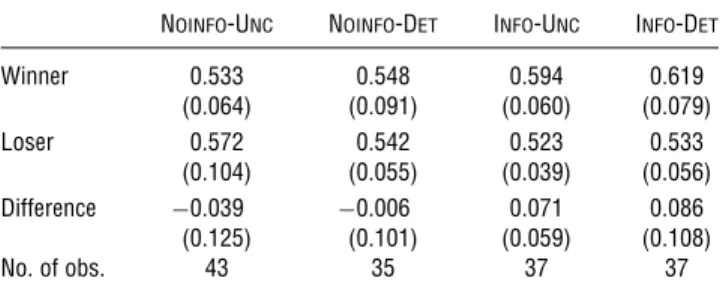
Table 2 Subjective Entitlements Stated by Winners and Losers in Each Treatment
Noinfo-Unc Noinfo-Det Info-Unc Info-Det
Winner 00533 00548 00594 00619 4000645 4000915 4000605 4000795 Loser 00572 00542 00523 00533 4001045 4000555 4000395 4000565 Difference −00039 −00006 00071 00086 4001255 4001015 4000595 4001085 No. of obs. 43 35 37 37
Notes. The table reports averages and average differences, respectively. Standard deviations are given in parentheses.
To test our Hypotheses 1, we analyze winners’ and losers’ entitlements separately for the four treatments. The descriptive statistics reported in Table 2 show that subjective entitlements of winners and losers vary across treatments. Winners’ subjective entitlements are stronger with performance information than without it. A Kruskal–Wallis (KW) test indicates significant differences across treatments (p = 000001). Subsequent pairwise comparisons with Mann–Whitney (MW) tests show that the differences between the Noinfo-Unc and Noinfo-Det treatments, as well as between the Info-Unc and Info-Det treatments, are not significant (p = 009671 and 002398, respectively). At the same time, comparisons of the Noinfo with the Info treatments show significant differences (p < 000001) in all pairwise comparisons. For losers a KW test detects differences across treatments at the marginal significance level (p = 000521). Pairwise comparisons using MW tests show that differences in the production process do not affect entitlements in either information condition (Noinfo-Unc versus Noinfo-Det: p = 002644; Info-Unc versus Info-Det: p = 001805). In contrast, perfor-mance information does influence losers’ entitlements when the production process is noisy (Noinfo-Unc versus Info-Unc: p = 000104) but not when it is deter-ministic (Noinfo-Det versus Info-Det: p = 005711). Hence, for winners and losers, performance-specific entitlements are strengthened by performance infor-mation but unaffected by the production process. The effects on losers’ entitlements are less pronounced, however.
Analyses of the differences between winner and loser entitlements across and within treatments fur-ther supports the idea that it is mainly performance information that strengthens performance-specific enti-tlements (see lower part of Table 2). Comparisons across treatments show that there are no significant dif-ferences between both Noinfo treatments or between both Info treatments (p ≥ 004873), whereas all other pairwise differences are significant (p ≤ 000002). Within treatments, WSR tests indicate that differences between winners’ and losers’ entitlements are highly significant
Figure 1 Distribution of Subjective Entitlements for Losers and Winners (Pooled Across Treatments) 0 0.1 0.2 0.3 0.4 0.5 0.6 0.7 0 0.1 0.2 0.3 0.4 0.5 0.6 0.7 0 0.1 0.2 0.3 0.4 0.5 0.6 0.7 0.8 0.9 1.0 0 0.1 0.2 0.3 0.4 0.5 0.6 0.7 0.8 0.9 1.0 Loser Winner Relative frequency
Subjective entitlement (winner share)
Note. Bin width is 0.05.
when performance information is available (Info-Unc: p < 000001; Info-Det: p < 000001) but fail to detect sig-nificant differences in treatments without performance information (p ≥ 001754). In the Noinfo treatments, the belief of being a better or worse performer may induce entitlements. To explore this possibility, we compare subjective entitlements of “belief-winners” and “belief-losers” (i.e., bargainers who believe to have more and fewer answers correct than the paired subject). In the Noinfo-Det treatment, the average subjective entitlements of belief-winners (005921 n = 18) and belief-losers (005321 n = 30) indeed significantly differ (p = 000445), whereas in the Noinfo-Unc treat-ment, they are virtually the same (005471 n = 34 and 005501 n = 46, respectively; p = 007534). Hence, only when production is deterministic is there evidence in favor of belief-based performance-specific entitlements.
In summary, the data support the hypothesis that performance-specific entitlements are established when there is performance information. Entitlements also exist without performance information, especially for those who believe themselves to be better performers, but only when production is deterministic. Notably, given performance information, noise in the production process has little to no effect on performance-specific subjective entitlements.
4.2. Bargaining and Subjective Entitlements In the previous subsection we showed that performance-specific subjective entitlements exist and that they emerge especially when there is performance infor-mation. Yet, as such, entitlements are cheap talk and will be economically relevant in bargaining only when negotiators are ready to defend them. In the following subsections we look into this issue and explore the effect of entitlements on the whole bargaining process:
opening proposals, concessions, bargaining duration, and agreements.
4.2.1. Opening Proposals. Depending on who makes the first move, in each pair the very first pro-posal comes either from a winner or a loser. Table 3 shows summary statistics of these opening proposals. The figures in the table show that in each treatment winners demand significantly higher shares for them-selves than losers are offering them (in all treatments p ≤ 000001).
As expected, across treatments, opening proposals are influenced by performance information and the nature of the production process. The lower part of Table 3 shows the average distances of opening proposals from the equal split. In the Noinfo-Unc treatment, these dis-tances are close to symmetrical for winners and losers, and a MW test does not reject the hypothesis of equal absolute distance from the equal split (p = 006332). In the other treatments, winner and loser opening propos-als are skewed toward the winner (p < 000028). Further, a KW test indicates that opening proposals of winners Table 3 Opening Proposals Made by Winners and Losers in Each
Treatment (Winner Shares)
Noinfo-Unc Noinfo-Det Info-Unc Info-Det
Winner 00588 00598 00642 00692 4001115 4001045 4000675 4001265 No. of obs. 20 18 18 23 Loser 00408 00482 00450 00479 4000895 4000355 4001245 4000815 No. of obs. 23 17 19 14
Distances from equal split:
Winner 00088 00098 00142 00192
Loser −00092 −00018 −00050 −00021
Notes. The table reports averages. Standard deviations are given in parentheses.
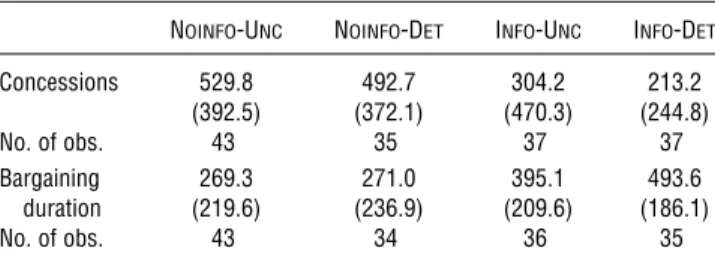
Table 4 Concessions and Bargaining Duration in Each Treatment Noinfo-Unc Noinfo-Det Info-Unc Info-Det Concessions 52908 49207 30402 21302 4392055 4372015 4470035 4244085 No. of obs. 43 35 37 37 Bargaining 26903 27100 39501 49306 duration 4219065 4236095 4209065 4186015 No. of obs. 43 34 36 35
Notes. The table reports averages. Concessions (duration) statistics include (exclude) pairs that disagree. Standard deviations are given in parentheses.
significantly differ across treatments (p = 000009). Pair-wise comparisons between treatments fail to detect significant differences between both Noinfo treatments and both Info treatments (p = 006907 and p = 002308, respectively) but indicate significant differences when varying performance information while keeping the production process constant (p ≤ 000084). For losers a KW test indicates significant differences in opening proposals across treatments (p = 000005). MW tests reveal a significant difference between the Det and Unc treatments when there is no performance informa-tion (p = 000008) but not when there is performance information (p = 001144). Varying performance infor-mation affects opening offers significantly only when there is noise in the production process (Noinfo-Unc versus Unc: p = 000038; Noinfo-Det versus Info-Det: p = 001503). When comparing opening proposals between the Noinfo treatments, we find that belief-winners as well as belief-losers ask significantly more when production is deterministic than when it is noisy (winners: 00621 and 00483, p = 000030; losers: 00565 and 00464, p = 000040). This is consistent with the stronger performance-specific entitlements of belief-winners and belief-losers for deterministic production.
Overall, these results confirm a level effect of entitle-ments on opening proposals that differs across treat-ments. Winners ask for more when there is performance information than when this information is not available. Without performance information, subjects ask for more when production is deterministic than when it is uncertain, irrespective of whether they believe to be better or worse performers. Further, given performance information, opening offers appear to be more strongly skewed toward winners when the production process is deterministic than when it is noisy.
To investigate whether there is also a marginal effect of entitlements on opening proposals, we run Tobit regressions for each treatment.14As expected, in both
treatments with performance information, opening proposals are significantly and positively affected by subjective entitlements. Those who state a stronger
14To save space, we discuss these results rather informally here; for
the detailed regression results, see Table A.1 in the appendix.
entitlement also demand a higher proportion of the salary budget. Unexpectedly, the effect of entitlements does not significantly differ between the Info-Unc and Info-Det treatments. Without performance information, entitlements do not play a significant role for opening offers. In sum, entitlements exhibit a strong marginal effect on opening proposals only when performance information is available. This holds irrespective of whether or not there is noise in the production process.
4.2.2. Concessions and Bargaining Duration. To analyze concessions in bargaining, we employ con-cession measures introduced by Gächter and Riedl (2005), which incorporate both the size of a conces-sion relative to the remaining surplus, taking into account the concessions already made, and the time at which a concession is made. These measures are (i) the sum of average relative concessions, (ii) the sum of average concession times, and (iii) the sum of average time-weighted relative concessions, where the sum is taken over the individual statistics of the two bargainers in a pair.15 These concession measures
summarize concession behavior on the pair level by combining individual-level data in each pair. For the sake of clarity, we report here only results for the most encompassing concession statistic, the sum of average time-weighted relative concessions (concessions, for short), and relegate results regarding the other two concession measures to §S1.2 in the online appendix.
15The exact definitions are as follows (slightly adapted from Gächter
and Riedl 2005, p. 256, to fit our bargaining environment): A relative concession of a winner is defined as the difference between a winner’s standing offer (in winner share) and his new offer (in winner share) divided by the current bargaining area. The current bargaining area is given by the difference between the standing offer of the winner (as winner share) and the standing offer of the loser (as winner share). A relative concession of a loser is defined analogously. For example, if the standing offers of a winner and a loser are 007 and 005, respectively (i.e., the current bargaining area is 002), and the winner now demands only 006 for himself, then the absolute concession is 001 and the relative concession is 005 (= 001/002). The magnitude of 005 can be interpreted as going halfway toward an agreement. The initial bargaining area is assumed to be equal to the salary budget (i.e., 1). A concession leading to a new offer that precisely matches the opponent’s standing offer gives a relative concession of 1. Therefore, an acceptance is calculated as a relative concession of 1. The summary statistics average relative concession of a bargainer is just the average of all of the relative concessions made by that bargainer during bargaining.
The average concession time of a bargainer is defined as the sum of the points in time at which concessions are made divided by the number of concessions.
A time-weighted relative concession is a relative concession (as defined above) multiplied by (601-time of concession) if the concession is positive, and multiplied by time of concession if the concession is negative, respectively. This measure has the property that a given positive (negative) relative concession gets less (more) weight the later the concession is made. The statistic we use is the average of all time-weighted relative concessions of a bargainer.
The upper part of Table 4 reports descriptive statistics of concessions for all four treatments, where smaller val-ues indicate weaker concessions (i.e., concessions that are made later and/or are smaller). As expected, con-cessions in bargaining differ across treatments (KW test, p = 000001). Specifically, concessions are weaker with than without performance information and are weakest when performance information is combined with a deterministic production process. Pairwise comparisons with MW tests show that the difference between the Noinfo treatments is insignificant (p = 009519), whereas there are significant differences when comparing the Noinfo and Info treatments for given production process (p ≤ 000236). Concessions are also significantly weaker in the Info-Det than in Info-Unc treatment (p ≤ 000088).
The lower part of Table 4 reports descriptive statistics for bargaining duration (i.e., the time spent until an agreement is reached). It differs across treatments in a similar way as concessions do (KW test, p = 000001). Bargaining duration is shortest and almost equal in both treatments without performance information and it takes longest until an agreement is reached when performance information is combined with determinis-tic production. Pairwise comparisons with MW tests show that equality of bargaining duration cannot be rejected for the Noinfo treatments (p = 006961) but is rejected for all other comparisons (p ≤ 000277).16Hence,
overall, the data clearly support the expected level effect of entitlements on concessions and bargaining duration.
For testing a potential marginal effect of entitlements on concessions and bargaining duration, we define the tension in entitlements between losers and winners as the difference in subjective entitlements between winners and losers in each bargaining pair.
Next to tensions in entitlements, concessions and bargaining duration may also be influenced by the dif-ference in first proposals of winners and losers, because a larger initial difference needs larger concessions for an agreement to be struck and may also elongate the bargaining process. Our concession measure incorpo-rates this potential influence of opening proposals by defining concessions relative to bargaining areas, which are given by standing proposals. Therefore, we do not need to control for opening offers in the concessions regressions discussed below. When analyzing bargain-ing duration we explicitly control for the influence of initial proposals.17
16We find a similar effect of entitlements on the likelihood of so-called
last-minute agreements. Details can be found in §S1.3 of the online appendix.
17To save space, we discuss the main results rather informally here;
for the detailed regression results, see Tables A.2 and A.3 in the appendix.
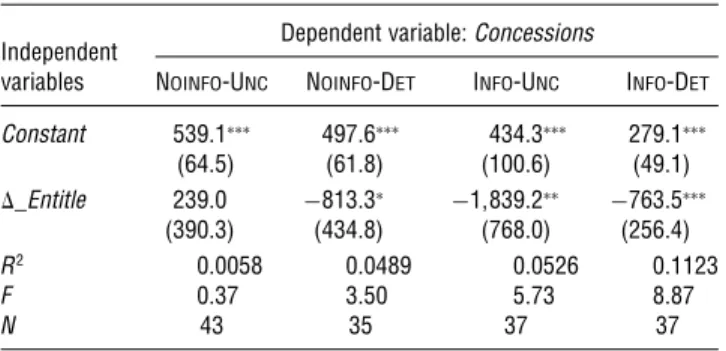
As expected, without performance information (Noinfo), concessions are largely unaffected by entitle-ments but they do have an effect when performance information is available (Info). In the latter treatments, a larger tension in entitlements significantly weakens concessions made in a bargaining pair. The effects do not differ statistically significantly when there is noise in the production process (Info-Unc) or when production is deterministic (Info-Det).
The effects of entitlements on concessions are largely mirrored by their effects on bargaining duration. With-out performance information, tensions in entitlements do not significantly affect bargaining duration, irre-spective of the production process. With performance information and noisy production (Info-Unc), ten-sions in entitlements significantly increase the time until an agreement is reached, whereas this is only insignificantly the case for deterministic production (Info-Det). However, in the latter treatment there is a significantly positive effect of the difference in first proposals on bargaining duration. Together with the already established result of a significant effect of enti-tlements on opening proposals, this points toward an indirect effect of entitlements on bargaining duration in this treatment.
In summary, without performance information, stronger tensions in entitlements affect neither conces-sions nor bargaining duration, but they weaken con-cessions and increase bargaining duration (directly or indirectly) when performance information is available.18
4.2.3. Agreements. Figure 2 shows the distribution of agreements and Table 5 reports summary statistics for all four treatments. Both indicate clear differences across treatments that are confirmed by a KW test (p = 000001). Further, applying pairwise MW tests, we find that there are no significant differences in agreements between both Noinfo treatments and both Info treatments (p = 007042 and p = 004071, respectively), whereas all other pairwise differences are highly significant (p = 000001). Figure 2 shows specifically that, without performance information, almost all bargaining pairs agree on split-ting the salary budget equally. In Noinfo-Unc and Noinfo-Det treatments, respectively, 7404% and 6707% of all agreements are exactly on the equal split, and all other agreements are very close to it, save one outlier in the Noinfo-Det treatment.
WSR tests confirm that in these treatments agree-ments are not significantly different from the equal split (p = 006636 and p = 009918, respectively). In the treat-ments with performance information, the frequency
18Consistent with results in other comparable free-form bargaining
experiments, we observe only few disagreements, making statisti-cal results regarding the effect of entitlements unreliable. For the interested reader, we report some results in §S1.4 of the online appendix.
Figure 2 Distribution of Agreements in Each Treatment 0 0.1 0.2 0.3 0.4 0.5 0.6 0.7 0.8 0.9 1.0 0 0.1 0.2 0.3 0.4 0.5 0.6 0.7 0.8 0.9 1.0 0 0.1 0.2 0.3 0.4 0.5 0.6 0.7 0.8 0.9 1.0 0 0.1 0.2 0.3 0.4 0.5 0.6 0.7 0.8 0.9 1.0 0 0.1 0.2 0.3 0.4 0.5 0.6 0.7 0.8 0.9 1.0 0 0.1 0.2 0.3 0.4 0.5 0.6 0.7 0.8 0.9 1.0 0 0.1 0.2 0.3 0.4 0.5 0.6 0.7 0.8 0.9 1.0 0 0.1 0.2 0.3 0.4 0.5 0.6 0.7 0.8 0.9 1.0 Relative frequency
Agreements (winner share)
NOINFO-UNC NOINFO-DET
INFO-UNC INFO-DET
Note. Bin width is 0.05.
of equal splits is strongly reduced and amounts to only 1309% in the Info-Unc and 806% in Info-Det treatments. Consequently, WSR tests indicate that bar-gaining pairs split their salary budget in favor of the better performer rather than equally (p < 000001 in both Info treatments).
In summary, in line with our results on subjective entitlements and in accordance with Hypothesis 2, agreements are on the equal split when there is no performance information, but with performance infor-mation winners receive a significantly higher share than losers. Interestingly, agreements do not differ between noisy and deterministic production processes. The latter result contrasts partly with Hypothesis 2 but is in concordance with our earlier finding that entitlements respond to performance information but are, given the respective performance information condition, largely unaffected by the nature of the production process.
Next we analyze whether subjective entitlements exhibit a marginal effect on agreements as also hypoth-esized in Hypothesis 2. We look at two outcome Table 5 Agreements in Each Treatment
Noinfo-Unc Noinfo-Det Info-Unc Info-Det Agreements 00502 00511 00548 00550
4000095 4000545 4000505 4000555
No. of obs. 43 34 36 35
Notes. The table reports averages in winner shares. Standard deviations are given in parentheses.
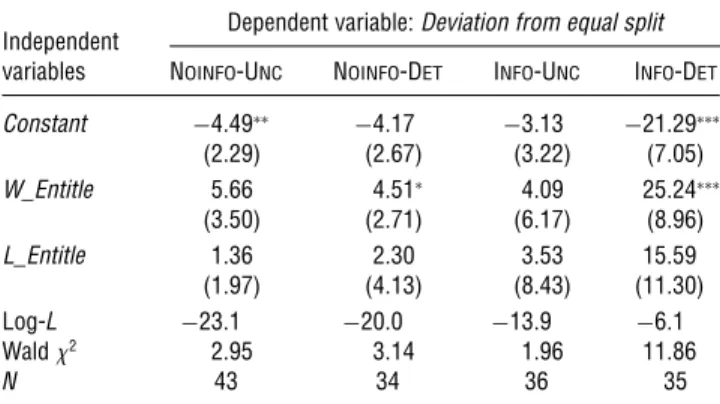
measures and relate winner and loser entitlements (W_Entitle and L_Entitle) in each pair, first, to the actu-ally agreed share and, second, to the likelihood that the agreement deviated from the equal split.
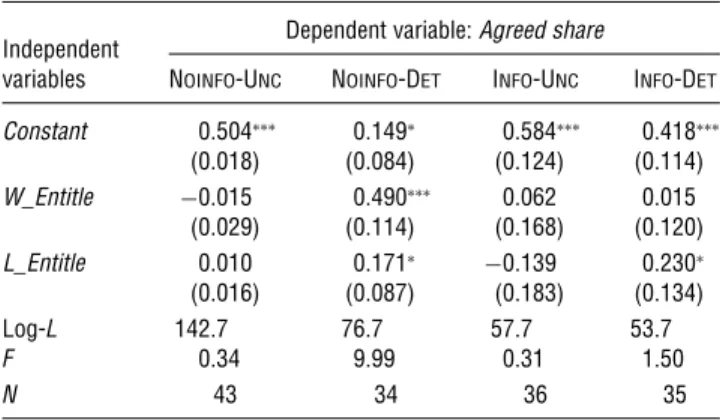
Table 6 reports the Tobit regression results for agreed shares. Overall we find a relatively weak marginal effect of entitlements on agreed shares. Only in the Info-Det treatment do entitlements of losers affect agreements significantly (at the 10% level) as expected. Unexpectedly, winner and loser entitlements appear (marginally) significant in the NoInfo-Det treatment, suggesting an entitlement effect even without perfor-mance information. However, closer inspection reveals Table 6 Agreements as a Function of Subjective Entitlements in Each
Treatment (Tobit Regressions)
Dependent variable: Agreed share Independent
variables Noinfo-Unc Noinfo-Det Info-Unc Info-Det Constant 00504∗∗∗ 00149∗ 00584∗∗∗ 00418∗∗∗ 4000185 4000845 4001245 4001145 W_Entitle −00015 00490∗∗∗ 00062 00015 4000295 4001145 4001685 4001205 L_Entitle 00010 00171∗ −00139 00230∗ 4000165 4000875 4001835 4001345 Log-L 14207 7607 5707 5307 F 0034 9099 0031 1050 N 43 34 36 35
Note. Robust standard errors are given in parentheses.
∗and∗∗∗indicate statistical significance at the 10% and 1% levels, respectively.
Table 7 Likelihood of Deviation from the Equal Split as a Function of Subjective Entitlements in Each Treatment (Probit Regressions)
Dependent variable: Deviation from equal split Independent
variables Noinfo-Unc Noinfo-Det Info-Unc Info-Det Constant −4049∗∗ −4017 −3013 −21029∗∗∗ 420295 420675 430225 470055 W_Entitle 5066 4051∗ 4009 25024∗∗∗ 430505 420715 460175 480965 L_Entitle 1036 2030 3053 15059 410975 440135 480435 4110305 Log-L −2301 −2000 −1309 −601 Wald2 2095 3014 1096 11086 N 43 34 36 35
Note. Robust standard errors are given in parentheses.
∗,∗∗, and∗∗∗indicate statistical significance at the 10%, 5%, and 1% levels,
respectively.
that this result is solely driven by a single outlying observation.19 We, therefore, refrain from drawing
conclusions from this result.
Across treatments, entitlements have a strong differ-ential effect on the likelihood that agreements deviate from the equal split. Probit regressions in Table 7 show this. In the Info-Det treatment, subjective entitlements of winners have a strong influence on the occurrence of deviations from the equal split, whereas there is no significant effect in the Info-Unc treatment. Comparing both Info treatments shows a significant difference in the effect of winner entitlements (p = 00050) but not of loser entitlements (p = 00389). In the Noinfo-Det treatment, winner entitlements are significant at 10%, but this is driven by the same outlying observation as for agreed shares. Moreover, comparisons of the winner entitlement effect between both Noinfo treatments do not show a significant difference (p = 00793), whereas the effect in the Info-Det treatment is significantly stronger than in the Noinfo-Det treatment (p = 00040). Overall the reported evidence shows that, with performance information, entitlements have a strong level effect irrespective of the production process. For a marginal effect of entitlements to emerge, both performance information and deterministic production are necessary preconditions.
5.
Concluding Remarks
In this paper we explore, first, the effect of differences in performance information and the process in producing a joint surplus on subjective entitlements derived from
19In this pair the “winner” stated an extreme entitlement of
W_Entitle = 00996 (the “loser’s” entitlement was reasonable with L_Entitle = 00631) and was obviously ready to defend it. This led to a concession of only 8709 (treatment average: 49207), a duration of 598 seconds (treatment average: 271 seconds), and an agreement in favor of the winner of 00812 (treatment average: 00511).
the production process and, second, the effect of these entitlements on bargaining over the produced surplus. There is no doubt that in our experiment participants derive subjective entitlements from the performance task. These entitlements are significantly affected by the (in)existence of performance information, whereas the (in)existence of production uncertainties has a much less pronounced effect. The derived entitlements impact all stages of bargaining and observed differ-ences in entitlements are reflected by differdiffer-ences in the bargaining process.
Without performance information, entitlements mostly center around the equal split and are mostly mutually consistent. Interestingly, entitlements are found when considering beliefs about performance only when production is deterministic. However, such beliefs seem not to influence bargaining (except for opening proposals) because in the absence of performance infor-mation all agreements are on or close to the equal split. Further, negotiators make relatively large and early concessions and reach agreements relatively quickly. Overall, given the little variation in entitlements it is unsurprising that there is no strong correlation between entitlements and bargaining behavior.
In stark contrast, with performance information, subjective entitlements are clearly skewed toward the better performer and mostly mutually inconsistent. These entitlements are economically relevant because they significantly influence opening proposals, con-cessions, bargaining duration, and final agreements. We find this effect of performance information to be strong although negotiators learn only whether they are better or worse performing. In comparison to when entitlements are made specific and quantifiable (as, e.g., in Gächter and Riedl 2005), such coarse performance information should make it harder for bargainers to derive entitlements and use them as an anchor for bargaining behavior. Moreover, our subjects correctly predicted that even the better performers would not do very well in absolute terms, which also should work against the emergence of subjective entitlements. We nevertheless observe them, and their impact on bar-gaining behavior shows that subjective entitlements can be important even under circumstances unfavorable to their emergence.
The economic importance of subjective entitlements in bargaining is also corroborated by the fact that entitlements affect bargaining even when there are relatively large uncertainties regarding the translation of performance into surplus. Specifically, we see that production uncertainties affect the bargaining process, but we do not find that they strongly mitigate the effect of entitlements. Overall, our findings show that negotiators derive subjective entitlements from perfor-mance information, which affects bargaining because the negotiators are ready to defend their entitlements.
This observation is also consistent with the casual evidence of our motivating examples, presented in §1.
In the investigated bargaining environment, the existence of entitlements is closely related to perfor-mance information. Yet, the significant marginal effect of entitlements for given performance information strongly suggests that entitlements as such are the force behind bargaining behavior. If this indeed holds, then entitlements may be manipulated to influence the bargaining process and outcome, independent of the actual performance of the involved negotiators. Such strategic use and manipulation of entitlements via private or public information channels, for example, could be important in many bargaining-like situations, from client–customer relations to union–firm wage bargaining to even political negotiations, and may be an interesting area of future research.
Our experimental results also speak to and inform theoretical bargaining models that assume reference points or reference-dependent preferences (Kahneman and Tversky 1979). As discussed in §3, some coopera-tive bargaining models with reference points (Gupta and Livne 1988) and recent models incorporating fair-ness principles in the bargaining process (Birkeland and Tungodden 2014) predict agreements that deviate from the equal split. This prediction is consistent with the skewed distribution of agreements observed in our experiment. These models are mostly silent about origins of the reference points and fairness principles, respectively. We show that they can be attributed to subjective entitlements that bargaining parties derive from their relative performance in a joint production process. Hence, reference points and fairness princi-ples and their effect on the bargaining process and agreements should be viewed as endogenous to the economic environment. In addition, salient factors of that environment (e.g., performance information and production uncertainties) can modulate bargaining outcomes and should be taken into account when modeling negotiations.
Compte and Jehiel (2003) and Li (2007) model bar-gaining as a process where negotiators use reference points derived from past proposals when evaluat-ing offers (see also Hyndman 2011). Their models can capture the facts that bargaining agreements are seldom immediate and that bargaining is gradual, and they formalize the idea that it may be risky to start bargaining with too generous offers. We indeed observe gradual bargaining and strategically low open-ing offers. However, we also see that openopen-ing proposals, concessions, and bargaining duration are related to subjective entitlements. On top of that, gradual conces-sions, delays in agreement, and last-minute agreements are not equally distributed in all of our treatments. Specifically, with no performance information, most negotiators quickly agree on the equal split because
asymmetric entitlements are hard to defend in that case. This suggests that bargaining behavior should not only be modeled as reference dependent in the sense that preferences are influenced by bargaining history but also be modeled as dependent on subjective entitlements and factors influencing them, which may be independent of bargaining history.
Theoretical bargaining models and bargaining exper-iments have greatly improved our understanding of how negotiations work. However, many aspects of bargaining are still not well understood. Our study pro-vides insight about the role of performance information, production uncertainty, and subjective entitlements in bargaining. Perhaps more importantly, though, the sketched theoretical approaches to bargaining that use reference dependence, together with our experimental evidence on the emergence and influence of subjective entitlements, may provide a fertile ground for more theoretical and experimental research furthering our knowledge of bargaining behavior.
Supplemental Material
Supplemental material to this paper is available at http://dx .doi.org/10.1287/mnsc.2014.2012.
Acknowledgments
The authors thank two anonymous referees, the associate editor, and Uri Gneezy for valuable comments and sug-gestions. The authors also thank participants of seminars and conferences at University of Antwerp, Bilgi University, University of Copenhagen, DIW Berlin, University of East Anglia, Harvard Business School, Koç University, Maastricht University, University of Munich, University of Nice, Univer-sity of Nottingham, Penn State Smeal College of Business, and University of Rotterdam for many useful comments and remarks. Financial support of the Oesterreichische National-bank [Project 11780] is gratefully acknowledged. All errors remain the authors’ responsibility.
Appendix. Detailed Analysis of Marginal Effects of Entitlements
In this appendix we present the regression analyses investi-gating the marginal effect of entitlements on opening offers, concessions, and bargaining duration that are more informally presented in the main text.
A.1. Opening Offers
Table A.1 reports the results of Tobit regressions for each treatment, where the independent variable Entitle stands for the entitlement claimed by and ascribed to the winner, by the winner and the loser, respectively.20In both treatments with
performance information, opening proposals are significantly
20To save space, we report the pooled data for winners and losers here.
Results from regressions run separately for winners and losers show similar patterns and are reported in §S1.1 of the online appendix. In addition, in §S1.5 of the online appendix we report results of regressions run with added individual characteristics as control variables. In these regressions, we add variables that can reasonably be assumed to