Journal of Global Strategic Management (JGSM), as a refereed journal, strives to be amongst the highly qualified journals in the field by providing leadership in developing theory and introducing new concept to its readership. All submissions are subject to a two person blind peer review process. The primary goal of the journal will be to provide opportunities for business related academicians and professionals from various business fields in a global realm to publish their paper in one source. The journal will provide opportunities for publishing scientific papers as well as providing opportunities to view others’ works. Doctoral and MBA students are highly encouraged to submit papers to JGSM for competitive review. Manuscripts must be prepared according to the requirements indicated at the end of the last two pages.
The views expressed by the articles in the journal are those of the individual authors and do not necessarily reflect official positions of Journal Of Global Strategic Management (JGSM). Articles published are authenticated and cannot be reproduced or utilized in any form without reference to the journal. All inquiries must be directed to the submission address.
JGSM is an independent business journal published twice a year by the International Strategic Management and Managers Association.
Journal of Global Strategic Management is indexed and abstracted in: *Cabell's Directory
*Asosindex
Manuscripts may be sent via e-mail to be folloving e-mail addresses: [email protected]; [email protected] Webpage: http://www.isma.info
Correspondence Address: Sogutlucesme Cad., Rasime Uzlar İş Hani, No: 86, Daire: 3, Altiyol, Kadiköy, Istanbul, TURKEY Produced by: Marka Ve Ötesi, Uskudar, Istanbul, TURKEY
Printed by: Kaan Matbaa, Litros Yolu, 2.Matbaacılar Sitesi, 2NC3, Topkapı, İstanbul Tel. 0212 576 52 78
Journal of Global Strategic Management (JGSM)
EDITORIAL INFORMATION
EDITORIAL BOARD
DECEMBER 2011, VOLUME. 5, NUMBER: 1, ISSN 1307-6205
Editor in Chief: Erol EREN
Dean of Facullty of Business Administration, Beykent University, Istanbul-Turkey Email:[email protected]
Managing Editor: Cemal ZEHİR
Facullty of Business Administration, Gebze Institute of Technology, Kocaeli-Turkey Email:[email protected]
Ali Akdemir (Co-Chair, Onsekiz Mart University, Canakkale-Turkey) Asim Sen (St. John Fisher College, USA)
Dababrata N. Chowdhury (University of Plymouth, UK)
Esin Sadikoglu (Gebze Institute of Technology, Kocaeli-Turkey) Ekaterina Shekova (St.Petersburg State University)
Jamaladdin H. Husain (Purdue University, USA) Johan Hough (Stellenbosch University, South Africa) Keith Cundale (OPAL Consulting Pte Ltd, Singapore)
Lutfihak Alpkan (Gebze Institute of Technology, Kocaeli-Turkey) Mariana Dodourova (University Of Hertfordshire, UK)
Meral Elci (Gebze Institute of Technology, Kocaeli-Turkey) Mehtap Ozsahin (Gebze Institute of Technology,Kocaeli-Turkey) Oya Erdil (Co-Chair, Gebze Institute of Technology, Kocaeli-Turkey) Shaukat Ali (University of Wolverhampton, UK)
A.Asuman Akdoğan (Erciyes University, Kayseri, Turkey)
A.Zafer ACAR (Okan University, İstanbul, Turkey)
Alexander Egorshin (The Nizhny Novgorod Institute of Management and Business, Russia)
Ali Akdemir (Canakkale Onsekiz Mart University, Çanakkale, Turkey)
Ali Ekber Akgün (Gebze Institute of Technology, Kocaeli, Turkey)
Alistair M Brown (Curtin University of Technology, Western, Australia)
Amar KJN Nayak (Xavier Institute of Management, Orrissa, India)
Asım Şen (St. John Fisher College, USA)
Atilla Dicle (Yeditepe University, Istanbul, Turkey)
Aurea Helena Puga Ribeiro (Fundacao Dom Cabral, Brazil)
Canan Çetin (Marmara University, Istanbul, Turkey
Celso ClaudioHildebrand Grisi (University of Sao Paulo, Brazil)
Cemal Zehir (Gebze Institute of Technology, Kocaeli-Turkey)
Cengiz Yılmaz (Bogazici University, Istanbul-Turkey)
Cevat Gerni (Gebze Institute of Technology, Kocaeli-Turkey)
Ceyhan Aldemir (Dokuz Eylül University, Izmir-Turkey)
Chien-Chung Nieh (Tamkang University, Taipei Country- Taiwan)
Con Korkofingas (Macquarie University, Sydney- Australia) Sarajevo, Bosnia)
Dursun Bingöl (Atatürk University, Erzurum-Turkey)
Ekaterina Shekova (St.Petersburg State University)
Enver Özkalp (Anadolu University, Eskişehir-Turkey)
Erol Eren (Beykent University, Istanbul-Turkey)
Esin Can Mutlu (Yıldız Technical University, Istanbul-Turkey)
Esin Sadıkoğlu (Gebze Institute of Technology, Kocaeli-Turkey)
Eyüp Aktepe (Gazi University, Ankara-Turkey)
Fahri Karakaya (University of Massachusetts, Dartmouth-USA)
Fuat Oktay (Beykent University, Istanbul-Turkey)
Garry L. Adams (Auburn University, USA)
Gönül Budak (Dokuz Eylul University, İzmir-Turkey)
Gulruh Gurbuz (Marmara University, Istanbul, Turkey)
Güneş Zeytinoğlu (Anadolu University, Eskişehir, Turkey)
Güven Alpay (Bogazici University, Istanbul-Turkey)
Halil Zaim (Fatih University, Turkey)
Halit Keskin (Gebze Institute of Technology, Kocaeli, Turkey)
Hasan İbicioğlu (Süleyman Demirel University, Isparta-Turkey)
HA-Nguyen (Vietnam National University, Hanoi School of Business, Vietnam)
Hayat Kabasakal (Bogazici University, Istanbul-Turkey)
Hisao Fujimoto (Osaka University of Economics, Japon)
Howard Clayton (Auburn University, USA)
Hüseyin İnce (Gebze Institute of Technology, Kocaeli, Turkey)
İnan Özalp (Anadolu University, Eskişehir, Turkey)
Jamaladdin H. Husain (Purdue University, USA)
Lutfihak Alpkan (Gebze Institute of Technology, Kocaeli-Turkey)
Mariana Dodourova (University Of Hertfordshire, UK)
Mehmet Barca (Sakarya University, Sakarya, Turkey)
Musa Pınar (Pittsburg State University, Pittsburg-USA)
Neil Bechervause (Swinburne University of Technology, Melbourne- Australia)
Nigar Çakar (Izzet Baysal University, Bolu-Turkey)
Ömür Özmen (Dokuz Eylül University, İzmir-Turkey)
Oya Erdil (Gebze Institute of Technology, Kocaeli, Turkey)
Özlem Özkanlı (Ankara University, Ankara-Turkey)
Pauline Magee-Egan (St. Johns University, USA)
Refik Culpan (Pennsylvania State University, Harrisburg, USA)
Refika Bakoğlu (Marmara University, Istanbul, Turkey)
Salih Zeki İmamoğlu (Gebze Institute of Technology, Kocaeli, Turkey)
Selim Ilter (St. John Fisher College, USA)
Sergei Mordovin (International Management Institute St. Petersburg, Russia
Shamsul Nahar Abdullah (Northen University of Malaysia, Aman, Malasia)
Sharan L. Oswald (Auburn University, USA)
Shaukat Ali (University of Wolverhampton, Shropsire, Great Britain)
Sonja Petrovich Lazarevic (Monash University, Victoria-Australia)
Stanislav Poloucek (Silesian University, Opava, Czech Republic)
Subodh Bhat (San Francisco State University, San Francisco, USA)
Tanses Gülsoy (Beykent University, İstanbul, Turkey)
Uğur Yozgat (Marmara University, İstanbul, Turkey)
Zoltan Veres (Budapest Business School, Budapest, Hungary)
ADVISORY BOARD&REVIEW COMMITTEE
Dear Colleagues and Readers,
I am honored to present to you the ninth edition of the Journal of Global Strategic
Management. With this new issue, the journal starts its fifth year. Every year the
journal meets increasing interest from researchers, academicians and scientists
around the world.
Starting with the last edition, the Journal of Global Strategic Management is indexed
and abstracted in some of the major international databases , among them
Asosin-dex, Cabell’s Directory of the US, and Emerald Group Publishing of the UK. The
world renowned Emerald gives a link to the Journal and publishes on line the
ceedings of the International Strategic Management Conference (CPCI) in the
pro-cedia which is indexed by Thomson Reuters, Conference Proceedings Citation Index.
This edition of the Journal contains 14 articles, which were selected from among 60
following a screening by a group distinguished reviewers wereselected among the 60
them, receved for this edition, after being screened by rewievers.
We continue to receive articles from researchers, academicians and practitioners to
be considered for publication. Dear Colleagues and Readers we would like to advise
you that these academic articles should be prepared in accordance with our
manu-script guidelines which can be accessed from the Web site of the Journal at http://
www.isma.info/
In 2011 we will hold the seventh International Strategic Management Conference in
Paris France, between the dates of June 30- July 2, 2011 at Millennium Hotel Paris
Charles de Gaulle. This year 161 papers will be presented from 35 different
coun-tries. I would like to invite our colleagues and readers to participate in this
interna-tional event.
As an academician knows, issuing a journal demands a lot of laborious work. For
that reason, I would like to thank all of the members of the Editorial Board, Advisory
Board and Peer Review Committee and Regional Coordinators who have
volun-teered their efforts for publishing this edition. I would like to reiterate that we
con-sider ourselves lucky, if through these efforts we are able to make a small
contribu-tion to the management field.
As a final word, on behalf of the International Strategic Management and Managers
Association, I again extend my sincere gratitude to every one involved and to our
colleagues and readers.
Erol Eren, Ph.D.
Editor-in Chief
PURSUIT FOR STRATEGIC FOREIGN
TRADE MARKET
Volkan ONGEL
Alkan CELIK
Ilyas SOZEN
Beykent University, Turkey
ABSTRACT
With the end of the Cold war and dissolution of the Soviet Union caused the termination of the trade structure between Turkey and Soviet Union. After the Soviet Union era, the newly independent states - that are out of planned economy- in Eurasia region and the trade relations that are kept with central-ized management for many years started to be carried out with different states. This change affected trade relations that Turkey had with this region.
Several unions were tried to be formed over the region for the past 20-year-period. However, because of several reasons, these unions failed. Nevertheless, EURASEC that was decided to be established in 2000, has become a constitution of customs union among 3 members. In 2012 a common market will be formed among these 3 countries that increase the economy by 2 trillion U.S. Dollars and trading volume by 1 billion U.S. Dollars.
Therefore, this paper argues that EURASEC including especially Russia, Kazakhstan and Belarus common economic space would be a strategic foreign trade market for Turkey. Hence, this paper tries to analyze the goods specified trade opportunities of this market for Turkey’s export potential. This paper is based on the historical analyze method and also the statistical goods specified foreign trade data of relevant countries.
Key words: Economic Integration, Trade Forecasting, EURASEC
INTRODUCTION
During the Cold war period, countries forming the Soviet Union, maintained their social, administra-tional, economical, safety and energy processes within a central planning structure bound to one au-thority. By disintegration of the Union at the end of 1991, many independent governments have oc-curred in the Eurasia region. The countries that evolved their trade relations and business processes suddenly were faced with open economic conditions under central planned economy. This change directly affected trade relations between the governments of the region and Turkey. The end of the Cold war and demise of the Soviet Union changed trade relations that Turkey had with. After the So-viet Union era, the newly independent states- that are out of planned economy- in Eurasia region and the trade relations that are kept with centralized management for many years started to be carried out with different states.
In Eurasia, it is claimed that economic and political unions after the dissolution of the Soviet Union could not survive for various reasons and committed negotiation and agreements remained on paper only. Despite that, it can also be said that the development of Eurasian Economic Community was a success. That is to say; a customs union that came into force on 1 January 2010 was built among the three member nations Russia, Belarus and Kazakhstan. The aim for 2012 is the composition of com-mon market which shall be defined as a step further in economic integration.
In this context, our study aims at analyzing possible strategically markets for Turkey’s foreign trade due to changes in the region. In this respect the data on the foreign trade between Eurasec Region and Turkey area examined by historical analysis method. Empirical literature is mentioned about customs unions and economic integration theory in our study. Eurasian economic community and goods speci-fied analysis of trade of Turkey is analyzed afterwards. Our study is completed by things needed to be performed to render governments of the region a strategically foreign trade market for Turkey.
CUSTOMS UNIONS AND ECONOMIC INTEGRATION THEORY
It is claimed that economic integration is carried out by following certain processes. In foreign trade zone is based on an agreement which provides the free circulation of goods among members there is no obstacle change of goods and quota. This is accepted as the first phase of economic integration.The members of foreign trade zone are able to move for their own benefit in their relations with third countries. They do not have any obligation to implement the common customs tariff towards the non-union member states (Ertürk, 2010: 142-143). The second phase of economic integration is the cus-toms union which includes the free change of goods among the member nations and additionally it brings a common restraint system for the trade among the non-member states (Karluk, 1996: 214). Viner’s (1950) famous book “The Customs Union Issue” is the initiator of subsequent customs union literature. Jacob Viner’s Customs Union (CU) theory is directly derived from the Ricardian approach to international trade, according to which countries trade with one another because they are different. He developed what later became known as the trade creation-trade diversion approach to regional trade agreements to help in understanding this ambiguity. The Vinerian theory describes only the static, one-off benefits to be gained from forming a customs union. (Garcia, Clayton, Hobley, 2004, 142-143) The static effects of a customs union can be trade diversion or trade creation. Following Viner’s work, for many years trade creating regional agreements were seen as good, and trade divert-ing agreements were seen as bad. (Abrego and others, 2005:120) In his analysis, Viner studied the changes in allocation of resources and production effectively and he ignored demands. Meade (1955) superimposed consumption to Viner’s analysis in his work entited “The Theory of Customs Union”. The dynamic approach, supported by economists like Krugman, takes into account economic elements which were previously overlooked in the Vinerian approach, arguing that there are also dynamic gains to be achieved in a CU. Dynamic effects of a CU are the effects on GDP’s growth rate in long-term. These are; i) increased competition ii) economies of scale iii) investment subsidy effect iv) effect of external economies, v) effect of technological improvement, vi) polarization effect. (Yıldırım and Dura, 2007:146)
In literature, it is seen that the description of economic integration has a general definition which in-cludes various kinds of structures, while J. Tinbergen (1965), who did many works on that issue, states that with the international economic union, international economic cooperation should be opti-mized C. Kindleberger (1958) takes the definition as the equality of the cost of production elements. (Karluk, 1996:212) Nowadays generally is known that economy of separate countries should be uni-fied in the manner that it can form an economic region (Ongel, 2010:87).
In addition to customs union, the common market which consists of free movement of the factors of production (goods, services, labour and capital) can be evaluated as the third phase. According to eco-nomic integration theory, the last phase is a kind of ecoeco-nomic union which combines the economies of member nations in a central bank, single money and fiscal system in addition to all features. In conse-quence of economic union, in addition to free movement of goods and products, it is seen that it is achieved in common social and economic policies. With the rise of trade volume which is the primary aim of economic integration by means of creating an extended market, recovery, rise of living stan-dards, remove of regional imbalances, strengthening the status of group in political and financial events around the world, finding common solutions to the problems are also important goals (Kılıç, 2002).
In order to have a successful economic integration; (Kilic, 2002) i. member nations should have similar economic structures ii. they should have regional proximity
iii. they should have neighbour earth proximity iv. they should have a wide earth land
v. they should take place in union.
Because geographical proximity has a reducing effect on transportation costs, and it is argued that economical integration has more profits for the member countries. Wonnacott and Lutz (1989), Krug-man (1991), Panagariya (1997), Bhagwati and Panagariya (1996), Frankel etc. (1996), Schiff (1997, 1999) Krishana (2003) studied over this issue.
vi. Group members should be their best customers and providers vii. consisted union should be a market which has a big population
viii.union members should share in production and trade in the World is claimed as the fea-tures which rise the prospects and benefits of success of economic integration.
Since the 1980s in the world economy there have been increasing tendencies of regionalization. Euro-pean Union (EU), found on the Rome Treaty (1957) purposed the creation of a common market by the 1993, and it created not only the common market, but also achieved the economic union with a com-mon currency EURO, and is actively moving towards the political union (Moldosanov, 2005:23).
EURASIAN ECONOMIC COMMUNITY AND
GOODS-SPECIFIED ANALYSIS OF TRADE OF TURKEY
The Eurasian Economic Community (EURASEC) is an international economic organization which also created a common external border around the member countries. The Eurasec’s history goes back to January 6, 1995 when Russia and Belarus signed bilateral Customs Union Agreement. On January 20, 1995, these two countries and Kazakhstan signed the trilateral Customs Union Agreement. Kyr-gyzstan and Tajikistan acceded to both agreements in 1996 and 1999, respectively. With the purpose of institutionalizing the formation of customs union and the single economic space, these five coun-tries signed the Treaty on the Establishment of Eurasian Economic Community on 10 October 2000. The Treaty entered into force on 30 May 2001. (Shadikhodjaev, 2009:559) Uzbekistan joined the Community in 2006, but left the membership in 2008. Ukraine, Moldova and Armenia have been in watchdog position since 2003 (Eurasianhome). It can also be argued that the development of Eurasian Economic Community was successful. That is to say; there is a customs union between the three member nations Russia, Belarus and Kazakhstan, which came into force on 1 January 2010. Objective for 2012 is the composition of common market which shall be defined as a further step in economic integration. This customs union formed an area was a population of seventy million and gross domes-tic product is a two trillion dollar. The total trade of union is about 900 billion dollar. It seems possible that by 2012 a new market will be established. When the total Eurasec region is considered, this num-ber could increase. For the economic integration theory and empirical results, it is predicable that the union has a high chance of success (Öngel, 2010:86-88).
In 2006, a Eurasian development bank was founded with the financial support of Russia and Kazakh-stan under the name of Eurasian Development Bank. In this bank, the member states including Arme-nia, Tajikistan and Belarus gave support other members’ states during economic crises. Besides, it also contributes to the matter of removing differences between economies and making up deficiencies in infrastructures (Eurasian Development Bank). According to the current geopolitical position and the possessed energy resources, it is claimed that, there is a need of creating a single energy region in order to achieve the energy safety and association within the aims of the union and this would be an important factor in increasing the prospects of economic integration. Furthermore, it is thought that such kind of a union is necessary for Central Asia countries and that it would be an important alterna-tive for the countries, Russia in particular, which is an unsuccessful to be a member of World Trade Organization until now (Norling and Swanstrim, 2007).
The Eurasec region covers an area of more than 20 million km2. However, it has 174 million
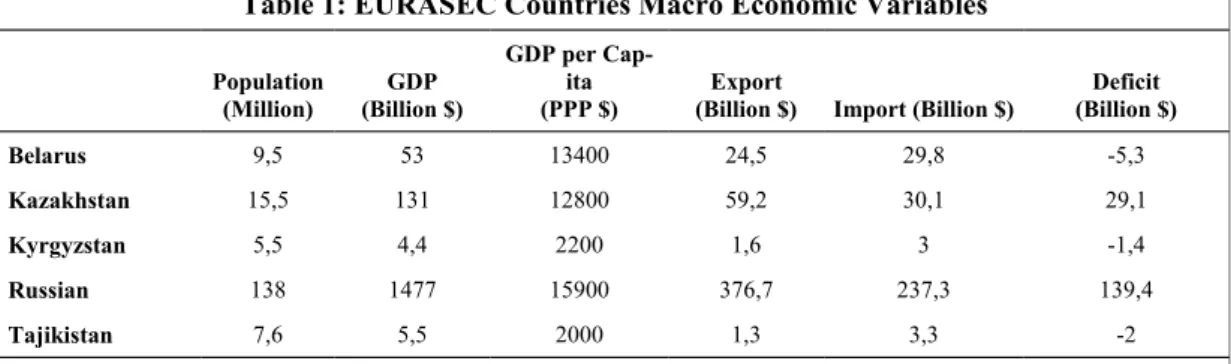
popula-tions in total. The countries which are situated within this region will join the customs union in 2012. The Eurasec countries such as Belarus, Kazakhstan and Russia's hold per capita income of 13-16 thousand dollars. These countries have bilateral trade potential through high per capita income. The half of the Russian’s 376 billion $ generated export and sixty percent of Kazakhstan’s exports which reached 60 billions $, include raw materials, such as oil and natural gas (CEID Data, Russia and Ka-zakhstan). Increase in the prices of natural resources has led to a rise in the rates of net exports both in
Table 1: EURASEC Countries Macro Economic Variables Population
(Million) (Billion $) GDP
GDP per Cap-ita
(PPP $) (Billion $) Export Import (Billion $) (Billion $) Deficit Belarus 9,5 53 13400 24,5 29,8 -5,3
Kazakhstan 15,5 131 12800 59,2 30,1 29,1
Kyrgyzstan 5,5 4,4 2200 1,6 3 -1,4
Russian 138 1477 15900 376,7 237,3 139,4
Tajikistan 7,6 5,5 2000 1,3 3,3 -2
Source: Prepared from 2010 IMF IFS data.
Kazakhstan and Russia. The Kyrgyzstan and Tajikistan have fewer incomes and less economic goods than other Eurasec countries. Russia and Kazakhstan have imported cotton from Kyrgyzstan and alu-minum from Tajikistan. (CIA, Factbook). On the other hand, Kyrgyzstan and Tajikistan are countries which supply raw materials to Eurasec region.
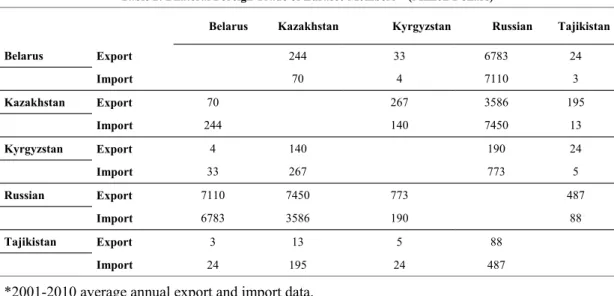
The basic reason of the customs unions established among Belarus, Russia and Kazakhstan from 2012, can be remarked in the bilateral trade figures at table 2. Because, these three countries trade figures flows at a very low level in Tajikistan and Kyrgyzstan. As indicated in the table 2, Russia is the main hub country. Russia’s bilateral trade is higher in comparison with Kazakhstan and Belarus. However, Kazakhstan and Belarus bilateral trade has started to rise in the last four years (CEIC Data, Belarus and Kazakhstan Foreign Trade Data). To establish the customs union among Belarus, Ka-zakhstan and Russia at 2012, this union is economically significant.
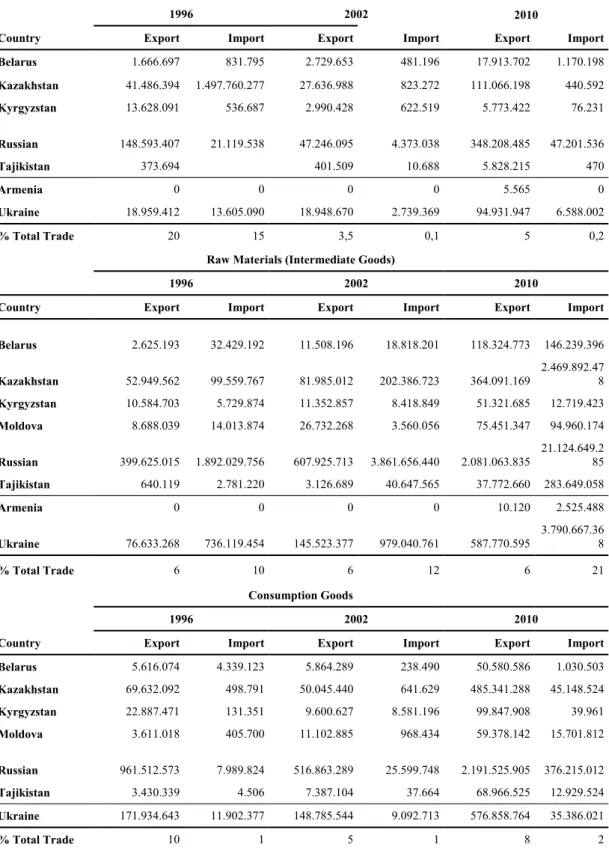
Turkey and Eurasec countries bilateral (trade) imports and exports in 1996, 2002 and 2010 are pre-sented in table 3 as capital goods, raw materials (intermediate goods) and consumption goods. 1996 is the year which Turkey joined EU customs union, 2002 is the foundation of Eurasec Union, and 2010 displays the year after the global economic crisis. As it is known, the reason of Turkey’s foreign trade deficit is in consequence import of raw materials and intermediate goods. Turkey imports replacement from EU, raw materials as oil and natural gas from Eurasec countries (TUIK, Foreign Trade Data). Turkey’s foreign trade deficit with Russia and Kazakhstan is due to the rise of oil prices and “Blue Stream” obligation. Turkey’s bilateral trade with Eurasec region keeps a continuous increase. Only, Turkey’s capital goods export to Kyrgyzstan has decreased in fifteen years period.
Table 2: Bilateral Foreign Trade of Eurasec Members * (Million Dollars)
Belarus Kazakhstan Kyrgyzstan Russian Tajikistan
Belarus Export 244 33 6783 24 Import 70 4 7110 3 Kazakhstan Export 70 267 3586 195 Import 244 140 7450 13 Kyrgyzstan Export 4 140 190 24 Import 33 267 773 5 Russian Export 7110 7450 773 487 Import 6783 3586 190 88 Tajikistan Export 3 13 5 88 Import 24 195 24 487
*2001-2010 average annual export and import data. Source: Prepared from CEIC Foreign Trade data
Source: TUIK Data Base
Notably, Turkey’s foreign trade deficit with Russia is equal to 23 percent of Turkey’s current account deficit; trade deficit in the raw materials from Russia is 26 percent of Turkey’s current account deficit. As the table 3 shows, Russia has 11 percent share in Turkey’s total import but only holds a 4 percent share in Turkey’s total export (TUIK, Foreign Trade Data). Turkey needs to reduce dependence on imports of raw material from Russia or must start a trade attack. Because of the increase in the prices of oil, Russia’s share would increase in the foreign trade deficit of Turkey. Kazakhstan is another
Table 3: Turkey - Eurasec Foreign Trade (US Dollars) Capital Goods
1996 2002 2010
Country Export Import Export Import Export Import Belarus 1.666.697 831.795 2.729.653 481.196 17.913.702 1.170.198 Kazakhstan 41.486.394 1.497.760.277 27.636.988 823.272 111.066.198 440.592 Kyrgyzstan 13.628.091 536.687 2.990.428 622.519 5.773.422 76.231 Russian 148.593.407 21.119.538 47.246.095 4.373.038 348.208.485 47.201.536 Tajikistan 373.694 401.509 10.688 5.828.215 470 Armenia 0 0 0 0 5.565 0 Ukraine 18.959.412 13.605.090 18.948.670 2.739.369 94.931.947 6.588.002 % Total Trade 20 15 3,5 0,1 5 0,2
Raw Materials (Intermediate Goods)
1996 2002 2010
Country Export Import Export Import Export Import Belarus 2.625.193 32.429.192 11.508.196 18.818.201 118.324.773 146.239.396 Kazakhstan 52.949.562 99.559.767 81.985.012 202.386.723 364.091.169 2.469.892.47 8 Kyrgyzstan 10.584.703 5.729.874 11.352.857 8.418.849 51.321.685 12.719.423 Moldova 8.688.039 14.013.874 26.732.268 3.560.056 75.451.347 94.960.174 Russian 399.625.015 1.892.029.756 607.925.713 3.861.656.440 2.081.063.835 21.124.649.2 85 Tajikistan 640.119 2.781.220 3.126.689 40.647.565 37.772.660 283.649.058 Armenia 0 0 0 0 10.120 2.525.488 Ukraine 76.633.268 736.119.454 145.523.377 979.040.761 587.770.595 3.790.667.36 8 % Total Trade 6 10 6 12 6 21 Consumption Goods 1996 2002 2010
Country Export Import Export Import Export Import Belarus 5.616.074 4.339.123 5.864.289 238.490 50.580.586 1.030.503 Kazakhstan 69.632.092 498.791 50.045.440 641.629 485.341.288 45.148.524 Kyrgyzstan 22.887.471 131.351 9.600.627 8.581.196 99.847.908 39.961 Moldova 3.611.018 405.700 11.102.885 968.434 59.378.142 15.701.812 Russian 961.512.573 7.989.824 516.863.289 25.599.748 2.191.525.905 376.215.012 Tajikistan 3.430.339 4.506 7.387.104 37.664 68.966.525 12.929.524 Ukraine 171.934.643 11.902.377 148.785.544 9.092.713 576.858.764 35.386.021 % Total Trade 10 1 5 1 8 2
member of Eurasec which also exports oil and natural gas to Turkey. Belarus, Kyrgyzstan and Tajiki-stan bilateral trades with Turkey are not excess.
Turkey carries out exports consumption goods to Eurasec region and import raw materials (oil, natural gas) from Eurasec region. The gap between exports and imports among Turkey and Eurasec region are in increase both numerically and proportionally. To settlethe trade deficit between Turkey and Region holds a great importance.
CONCLUSION
When the economic structures of Eurasec members are examined, it seems that these countries are exporters of raw materials, intermediate goods and energy. Economic development and progress of these countries are based on these exports. Despite this, especially importation of products and con-sumer products are the common features of these mentioned countries. In this respect, the general eco-nomic structure of region and the foreign trade structure are completely the opposite of improved economies.
When the current economic structures are considered, we can see that Turkey maintains a strong posi-tion in Eurasec region at basic importaposi-tion products like food, textile, chemistry, machine and ready-made. It is known that sovereignty of retailing sector in region is about 1 billion dollar and %80 of this consumption is taken with importation. Thus, there is a high chance that Turkey could sell retail food, textile and confection products to these regions by considering the consumption tendency, needs and region’s population. Another area that is seen as opportunity for Turkey is the substructure defi-ciencies which union countries have. In that point, especially in the construction sector, Turkey is very compelling and there exists good opportunities. On the other hand, more than % 95 of importation of Turkey from this region is formed of especially gasoline, natural gas, raw materials and intermediate goods. Therefore it could be claimed that this bilateral trade could improve in favour of Turkey. Geographical proximity between Eurasec countries and Turkey can be a major advantage for counter trade. However, one of the biggest problems of trade that is done with Eurasec countries in current situation is the transportation cost and toll. In this respect, Kars-Tbilisi rail line and Istanbul-Almaty container lines should be processed but to actualize this necessary rehabilitations should be built in order to work productively. Considering the EU customs responsibility of Turkey and the current situation of Eurasec customs union, it is presumed that providing mutual customs tariffs and quota exemption are in favour of Turkey.
In conclusion, after considering the economic improvement level with resolution advisories, Eurasec countries could open strategic foreign market for Turkey.
REFERENCES
Abrego, Lisandro. Raymond Rieazman and John Whalley (2005), “Computation and the Theory of Customs Unions”, CESifo Economic Studies, Vol.51, 1/2005, 117-132.
Bhagwati, Jagdish and Arvind Panagariya (1996), “The Theory of Preferential Trade Agreements: Historical Evaluation and Current Trend”, The American Economic Review, 86(2), 82-87. CEIC Data, Foreign Trade Data, Belarus, Kazakhstan, Kyrgyzstan, Russian, Tajikistan. CIA, Factbook, Belarus, Kazakhstan, Kyrgyzstan, Russian, Tajikistan Country Profile. EDP, Eurasian Development Bank, http://www.eabr.org/eng
Ertürk, Emin (2010), Uluslararası İktisat, [International Economics], Alfa Press, Istanbul. Eurasianhome, Eurasian Economic Community (EAEC).
http://www.eurasianhome.org/xml/t/databases.xml?lang=en&nic=databases&intorg=3&pid=25 http://www.worldtradelaw.net/fta/agreements/eaecfta.pdf
Foreign Economic Relations Board (February 2007), Foreign Relations Committee, Kazakhstan Country Journal, Istanbul.
Foreign Economic Relations Board (June 2009), Foreign Relations Committee, Tajikistan Country Journal, Istanbul.
Foreign Economic Relations Board (May 2009), Foreign Relations Committee, Kyrgyzstan Country Journal, Istanbul.
Frankel, Jeffrey A. and etc. (1996), “Regional Trading Arrangements: Natural or Supernatural?” The American Economic Review, 86(2), 52-56.
Garcia, Juan Fernandez Garcia, Jess Clayton and Christopher Hobley (Ed.) (2004), The Student’s Guide To European Integration, Polity Press, UK.
ICI, Istanbul Chamber of Industry (April 2010), Russia Country Report, http://www.aia-istanbul.org/ files/bilgibankasi/pazarlar/ulkeler/russia_ulkeraporu.pdf
Karluk, Ridvan (1996), Uluslararası Ekonomi, [International Economy], Beta Press, Istanbul. Kiliç, Ramazan (2002), Türkiye- AB İlişkileri ve Gümrük Birliği, [Turkey-EU Relations and Customs Union], Siyasal Kitabevi, Siyasal Press, Ankara.
Kindleberger, Charles P. (1958), International Economics, Uluslararası İktisat, (Trans. N. Serin), Sevinç Matbaası, Ankara, 1970.
Krishna, Pravin (2003), “Are Regional Trading Partners Natural?”, Journal of Political Economy, 111 (1), 202-231.
Krugman, Paul (1991), “Increasing Returns and Economic Geography”, The Journal of Political Economy, vol.99, Issue.3 (Jun.1991), 483-499.
Meade, James E. (1955), The Theory of Customs Unions, North-Holland, Amsterdam. Moldosanov, Janybek (2005), Prospects for Regional Integration in Central Asia: The Case of EURASEC, Unpublished Master Thesis, Marmara Universitesi Avrupa Topluluğu Enstitüsü.
Norling, Nicklas and Niklas Swanstrim (2007), “The Virtues and Potential Gains of Continental Trade in Eurasia”, Asian Survey,.47: 3, 351-373.
Öngel, Volkan (2010), “An Alternative Foreign Trade Market for Turkey: The Eurasian Economic Community”, International Conference On Eurasian Economies 2010, Istanbul.
Panagariya, Arvind (1997), “Preferential Trading and the Myth of Natural Trading Partners”, Japan and the World Economy, 9, 471-489.
Schiff, Maurice (1997), “Small is Beautiful Preferential Trade Agreement and the Impact of Country Size, Market Share, Efficiency and Trade Policy”, Journal of Economic Integration, 12(3), 359-387. Schiff, Maurice (1999), “Will the Real Natural Trading Partner Please Stand Up?”, World Bank Pol-icy Research Working Paper, No.2161.
Shadikhodjaev, Sherzod (2009), “Trade Integration in the CIS Region: A Thorny Path towards a Cus-toms Union”, Journal of International Economic Law, 12(3), 555-578.
Tinbergen, Jan (1965), International Economic Integration, Elsevier Publishing Co., Amsterdam. TUIK, Turkey Statistics Corporation (2010), Foreign Trade Statistics, http://www.tuik.gov.tr/ VeriBilgi.do?tb_id=12&ust_id=4
Under secretariat of the Prime Ministry for Foreign Trade, Export Promotion Center of Turkey (ÝGEME), (2008), Belarus Country Report, Ankara.
Viner, Jacob (1950), The Customs Union Issue, Carnegie Endowment for International Peace, New York.
Wonnacott, Paul and Mark Lutz (1989), “Is There a Case for Free Trade Areas”, in Schott, J. (Ed.), Free Trade Areas and US Trade Policy, Institute for International Economics, Washington, D.C. Yıldırım Ertugrul and Cihan Dura (2007), “Gümrük Birliği’nin Türkiye Ekonomisi Üzerindeki Etkil-eri Konusunda Literatüre Bir Bakış”, Erciyes University IIBF Journal, 28: January-June 2007.