ANALYSIS OF SELECTION CRITERIA FOR MANUFACTURING EMPLOYEES USING FUZZY- AHP
Aşkın Özdağoğlu*
Abstract
An analytical way to reach the best decision is more preferable in many business platforms. When variables are quantitative and number of criteria is not high, then one can use several analysis tools and make his/her decision and solve the problem. However, many times beside the measurable variables, there exist qualitative variables for decision making problems, or people are supposed to prefer the best among the many choices. Even if only linguistic evaluations may be available for such problems, an analytical way to find the solution systematically to make a successful decision is needed. Fuzzy Analytical Hierarchy Process (Fuzzy AHP) is one of the best ways for deciding among the complex criteria structure in different levels. Fuzzy AHP is a synthetic extension of classical AHP method when the fuzziness of the decision makers is considered. In this paper, the criteria set and their importance for the selection of manufacturing employee in a firm producing shoe machines are analyzed. Finally a systematic solution and decision support are provided for management.
Keywords: Fuzzy Analytic Hierarchy Process, Selection Criteria, Fuzzy Sets.
İMALAT İŞÇİLERİNİN SEÇİM KRİTERLERİNİN BULANIK AHS YÖNTEMİ İLE ANALİZİ
Özet
Birçok iş ortamında analitik yöntemler, en iyi kararı vermek adına daha çok tercih görmektedir. Sayısal olarak ölçülebilen değişkenlerin ve kriterlerin varlığında kullanılabilecek birçok analiz ve problem çözme tekniği bulunabilirken, kalitatif değişkenlerle seçim ya da karar verme zorunluluğu olduğunda farklı yaklaşımlara gerek duyulmaktadır. Böyle bir durumda, öznel ve sözel değerlendirmeler yapma zorunluğu doğmakla birlikte, sistematik ve analitik bir yol izlemek başarılı karar vermek açısından kaçınılmazdır. Bu koşularda özellikle karar verme ortamı bulanık veriler içeriyorsa, en çok tercih edilen tekniklerden biri de Bulanık Analitik Hiyerarşi Süreci (Bulanık AHS)dir. Karmaşık kriter set ve çoklu düzey yapısında seçenekler içerisinde en iyi seçimi yapma konusunda başarılı kararlar alınmasında sık kullanıma sahiptir. Bulanık AHS karar vericilerin yaptıkları yorum ve değerlendirmelerde belli bir bulanıklık olduğu düşünüldüğünde ortaya çıkan ve AHS’nin bir uzantısı olarak geliştirilen sentetik bir yaklaşımdır. Bu çalışmada, ayakkabı makinalar üreten bir firma için imalatta çalışacak işçilerin seçiminde hangi kriterlerin gözetildiği ve bu kriterlerin hangi ağırlıklarla kararda etkili olduğu bulanık AHS yöntemi ile analiz edilmiş, firma yetkilerine sistematik bir çözüm ve karar desteği sağlanmıştır.
Anahtar Sözcükler: Bulanık Analitik Hiyerarşi Süreci, Seçim Kriterleri, Bulanık Kümeler
INTRODUCTION
In daily lives, people often have to make decisions. “When decision is made” is important as “what decided”. Everyday life and history are full of lessons that can help people recognize that critical moment.. Deciding too quickly can be hazardous; delaying too long can mean missed opportunities. In the end, it is crucial that people make up their mind. What people need is a systematic and comprehensive approach to decision making (Saaty, 2001).
In evaluating n competing alternatives A1, ... , An under a
given criterion, it is natural to use the framework of pairwise comparisons
represented by a n x n square matrix from which a set of preference
values for the alternatives is derived. Many methods for estimating the preference values from the pairwise comparison matrix were proposed and their effectiveness comparatively evaluated. Some of the proposed estimating methods presume interval-scaled preference values. But most of the estimating methods proposed and studied are within the paradigm of the analytic hierarchy process that presumes ratio-scaled preference values. Analytical Hierarchy Process (AHP) is one of the best ways for deciding among the complex criteria structure in different levels. Fuzzy AHP is a synthetic extension of classical AHP method when the fuzziness of the decision maker is considered.
This paper aims at determining the criteria and the importance levels of these criteria through the use of fuzzy AHP. To determine the importance levels, a case study is handled from shoe industry in which the management should decide about the selection criteria for its employees working in the manufacturing area. In the flow of the paper, first the classical AHP and Fuzzy AHP methods are introduced including the past studied from literature, then the summary of calculations are presented as the next section. Finally, the paper ends with results, findings, and comments about these methods.
AHP AND FUZZY - AHP
Classical AHP
AHP is a method for ranking decision alternatives and selecting the best one when the decision maker has multiple criteria (Taylor, 2004: 374). It answers the question, “Which one?” With AHP, the decision maker selects the alternative that best meets his or her decision criteria
developing a numerical score to rank each decision alternative based on how well each alternative meets them.
In AHP, preferences between alternatives are determined by making pairwise comparisons. In a pairwise comparison, the decision maker examines two alternatives by considering one criterion and indicates a preference. These comparisons are made using a preference scale, which assigns numerical values to different levels of preference (Taha, 2003: 522). The standard preference scale used for AHP is 1-9 scale which lies between “equal importances” to “extreme importance” where sometimes different evaluation scales can be used such as 1 to 5. In the pairwise comparison matrix, the value 9 indicates that one factor is extremely more important than the other, and the value 1/9 indicates that one factor is extremely less important than the other, and the value 1 indicates equal importance (Sarkis and Talluri, 2004: 322). Therefore, if the importance of one factor with respect to a second is given, then the importance of the second factor with respect to the first is the reciprocal. Ratio scale and the use of verbal comparisons are used for weighting of quantifiable and non-quantifiable elements (Pohekar and Ramachandran, 2004: 369).
Since 1977, Saaty proposed AHP as a decision aid to help solve unstructured problems in economics, social and management sciences. AHP has been applied in a variety of contexts: from the simple everyday problem of selecting a school to the complex problems of designing alternative future outcomes of a developing country, evaluating political candidacy, allocating energy resources, and so on. The AHP enables the decision-makers to structure a complex problem in the form of a simple hierarchy and to evaluate a large number of quantitative and qualitative factors in a systematic manner under multiple criteria environment in confliction (Cheng, 1996).
The application of the AHP to the complex problem usually involves four major steps (Cheng, 1996):
• Break down the complex problem into a number of small
constituent elements and then structure the elements in a hierarchical form.
• Make a series of pair wise comparisons among the elements
according to a ratio scale.
• Use the eigenvalue method to estimate the relative weights
of the elements.
Aggregate these relative weights and synthesize them for the final measurement of given decision alternatives.
The AHP is a powerful and flexible multi-criteria decision-making tool for dealing with complex problems where both qualitative and quantitative aspects need to be considered. The AHP helps analysts to organize the critical aspects of a problem into a hierarchy rather like a family tree (Bevilacqua, D’Amore & Polonara, 2004: 255).
The essence of the process is decomposition of a complex problem into a hierarchy with goal (criterion) at the top of the hierarchy, criteria and sub-criteria at levels and sub-levels of the hierarchy, and decision alternatives at the bottom of the hierarchy. Elements at given hierarchy levels are compared in pairs to assess their relative preference with respect to each of the elements at the next higher level. The method computes and aggregates their eigenvectors until the composite final vector of weight coefficients for alternatives is obtained. The entries of final weight coefficients vector reflect the relative importance (value) of each alternative with respect to the goal stated at the top of the hierarchy (Pohekar & Ramachandran, 2004: 369). A decision maker may use this vector according to his particular needs and interests. To elicit pairwise comparisons performed at a given level, a matrix A is created in
turn by putting the result of pairwise comparison of element i with
element j into the position aji as below.
= 1 . . 1 . . . . . . . 1 . 1 . 1 . 1 . 1 . 1 . . 21 21 4 3 2 1 6 65 64 63 62 61 5 56 54 53 52 51 4 46 45 43 42 41 3 36 35 34 32 31 2 26 25 24 23 21 1 16 15 14 13 12 6 5 4 3 2 1 6 5 4 3 2 1 a a a a a a a a a a a a a a a a a a a a a a a a a a a a a a a a a a a a a a a a a a C C C C C C C A C C C C C C C n n n n n n n n n n n n Where
n = criterion number to be evaluated Ci = ith
criterion,
aij = importance of ith criterion according to jth criterion
After obtaining the weight vector, it is then multiplied with the weight coefficient of the element at a higher level (that was used as criterion for pairwise comparisons). The procedure is repeated upward for each level, until the top of the hierarchy is reached (Saaty, 1994). The overall weight coefficient, with respect to the goal for each decision alternative is then obtained. The alternative with the highest weight coefficient value should be taken as the best alternative. Saaty’s AHP, is a well-known decision-making analytical tool used for modeling unstructured problems in various areas, e.g., social, economic, and
management sciences (Bard and Sousk, 1990; Triantaphyllou and Mann, 1995; Wabalickis, 1988).
Fuzzy AHP
There is an extensive literature that addresses the situation where the comparison ratios are imprecise judgments (Leung & Chao, 2000: 102). In most of the real-world problems, some of the decision data can be precisely assessed while others cannot. Humans are unsuccessful in making quantitative predictions, whereas they are comparatively efficient in qualitative forecasting (Kulak and Kahraman, 2005: 192). Essentially, the uncertainty in the preference judgments give rise to uncertainty in the ranking of alternatives as well as difficulty in determining consistency of preferences (Leung and Chao, 2000: 102). These applications are performed with many different perspectives and proposed methods for fuzzy AHP. In this study, Chang’s (1992) extent analysis on fuzzy AHP is formulated for a selection problem.
The fuzzy AHP technique can be viewed as an advanced analytical method developed from the traditional AHP. Despite the convenience of AHP in handling both quantitative and qualitative criteria of multi-criteria decision making problems based on decision makers judgments, fuzziness and vagueness existing in many decision-making problems may contribute to the imprecise judgments of decision makers in conventional AHP approaches (Bouyssou, Marchant, Pirlot, Perny, Tsoukias and Vincke, 2000). So, many researchers (Boender, De Graan, and Lootsma, 1989; Buckley, 1985a; Buckley, 1985b; Chang, 1996; Laarhoven and Pedrycz, 1983; Lootsma, 1997; Ribeiro, 1996) who studied the fuzzy AHP which is the extension of Saaty’s theory, provided evidence that fuzzy AHP shows relatively more sufficient description of these kind of decision making processes compared to the traditional AHP methods. (Huang, Chu and Chiang, 2008) used fuzzy AHP for the selection of government sponsored technology development projects can be viewed as a multiple-attribute decision that is normally made by a review committee with experts from academia, industry, and the government. (Yu, 2002) employed the property of goal programming to solve group decision making fuzzy AHP problem. (Sheu, 2008) integrated fuzzy AHP and the technique for order preference by similarity to an ideal solution (TOPSIS) at the information technology (IT) industries of Taiwan. (Sheu, 2004) presented fuzzy-based approach to identify global logistics strategies. (Çakır, 2008) used fuzzy preference programming. (Kulak and Kahraman,
2005) used fuzzy AHP for multi-criteria selection among transportation companies. (Büyüközkan, Feyzioğlu & Nebol, 2008) evaluated e-logistics-based strategic alliance partners and then conducted the fuzzy Technique for Order Preference by Similarity to Ideal Solution (TOPSIS) to achieve the final partner-ranking results. (Kuo, Chi, and Kao, 2002) integrated fuzzy AHP and artificial neural network for selecting convenience store location. (Zaerpour, Rabbani, Gharehgozli & Tavakkoli-Moghaddam, 2008) determined whether a particular product should be produced under make-to-order or make-to-stock strategy consisting of strengths, weaknesses, opportunities and threats (SWOT) analysis and fuzzy analytic hierarchy process. (Cheng, 1996) proposed a new algorithm for evaluating naval tactical missile systems by the fuzzy AHP based on grade value of membership function. (Duran and Aguilo, 2008) used fuzzy AHP for the evaluation and justification of an advanced manufacturing system. (Zhu, Jing, and Chang, 1999) made a discussion on the extent analysis method and applications of fuzzy AHP.
In complex systems, the experiences and judgments of humans are represented by linguistic and vague patterns. Therefore, a much better representation of this linguistics can be developed as quantitative data; this type of data set is then refined by the evaluation methods of fuzzy set theory. On the other hand, the AHP method is mainly used in nearly crisp (non-fuzzy) decision applications and creates and deals with a very unbalanced scale of judgment. Therefore, the AHP method does not take into account the uncertainty associated with the mapping (Cheng, Yang, and Hwang, 1999). The AHP’s subjective judgment, selection and preference of decision-makers have great influence on the success of the method. The conventional AHP still cannot reflect the human thinking style. Avoiding these risks on performance, the fuzzy AHP, a fuzzy extension of AHP, was developed to solve the hierarchical fuzzy problems.
Chang’s extent analysis on fuzzy AHP depends on the degree of possibilities of each criterion (Chang, 1992). According to the responses on the question form, the corresponding triangular fuzzy values for the linguistic variables are placed and for a particular level on the hierarchy the pairwise comparison matrix is constructed. Sub totals are calculated for each row of the matrix and new (l, m, u) set is obtained, then in
order to find the overall triangular fuzzy values for each criterion, li/Σli,
mi/Σmi, ui/Σui, (i=1,2,..., n) values are found and used as the latest Mi (li,
mi, ui) set for criterion Mi in the rest of the process. In the next step,
intersections are determined by comparing each couple. In fuzzy logic approach, for each comparison the intersection point is found, and then the membership values of the point correspond to the weight of that point. This membership value can also be defined as the degree of possibility of the value. For a particular criterion, the minimum degree of possibility of the situations, where the value is greater than the others, is also the weight of this criterion before normalization. After obtaining the weights for each criterion, they are normalized and called the final importance degrees or weights for the hierarchy level.
To apply the process depending on this hierarchy, according to the method of Chang’s (1992) extent analysis, each criterion is taken and
extent analysis for each criterion, gi; is performed on, respectively.
Therefore, m extent analysis values for each criterion can be obtained by using following notation (Kahraman, Cebeci, and Da Ruan, 2004: 176):
m g g g g g gi
M
iM
iM
iM
iM
iM
1,
2,
3,
4,
5,...
...,
where gi is the goal set (i = 1, 2, 3, 4, 5, ...n) and all the j gi
M
(j = 1, 2, 3, 4, 5, ..., m) are Triangular Fuzzy Numbers (TFNs). The steps of Chang’s analysis can be given as in the following:
Step 1: The fuzzy synthetic extent value (Si) with respect to the ith
criterion is defined as equation 1 . 1 1 1 1 ] [ − = = =
∑
∑
∑
⊗ = m j j n i m j j iM
gM
g S i i (1) To obtain equation 2;∑
= m i j jM
gi (2)perform the “fuzzy addition operation” of m extent analysis values for a particular matrix given in equation 3 below, at the end step of calculation, new (l, m, u) set is obtained and used for the next:
) , , ( 1 1 1 1
∑
∑
∑
∑
= = = = = m j j m j j m j j m j ju
m
l
M
gi (3) Where l is the lower limit value, m is the most promising value and u is the upper limit value.and to obtain equation 4; 1 1 1 ] [ − = =
∑
∑
m j j n iM
gi (4) perform the “fuzzy addition operation” ofj gi M
(j = 1, 2, 3, 4, 5, ..., m) values give as equation 5:
) , , ( 1 1 1 1 1
∑
∑
∑
∑
∑
= = = = = = n i i n i i n i i m j j n iM
gil
m
u
(5)and then compute the inverse of the vector in the equation (5) equation 6 is then obtained such that
=
∑
∑
∑
∑
∑
= = = − = = n i i n i i n i i m j j n il
m
u
M
gi 1 1 1 1 1 1 1 , 1 , 1 ] [ (6) Step 2: The degree of possibility ofM2 = (l2, m2, u2)
≥
M1 = (l1, m1, u1) is defined as equation 7:))] ( ), ( [min( sup ) ( 2 1 1 2 M M x M y M V x y µ µ ≥ = ≥ (7)
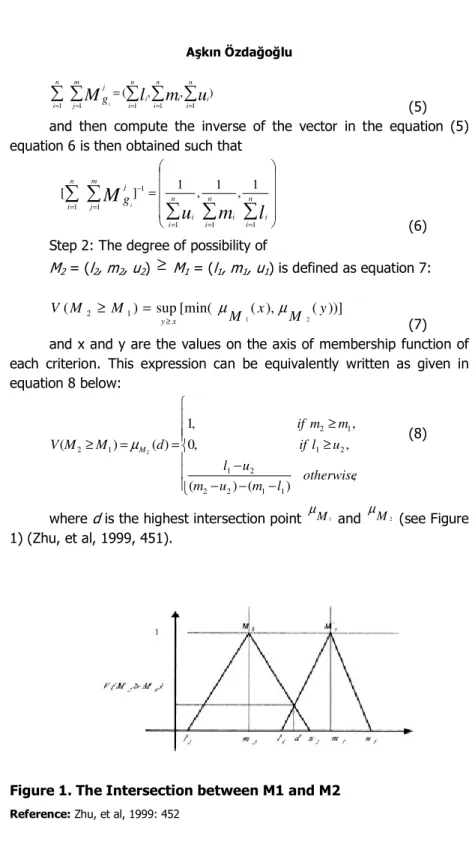
and x and y are the values on the axis of membership function of each criterion. This expression can be equivalently written as given in equation 8 below: − − − − ≥ ≥ = = ≥ , ) ( ) ( , , 0 , , 1 ) ( ) ( 1 1 2 2 2 1 2 1 1 2 1 2 2 otherwise l m u m u l u l if m m if d M M V µM (8)
where d is the highest intersection point M1
µ
and M2
µ
(see Figure 1) (Zhu, et al, 1999, 451).
Figure 1. The Intersection between M1 and M2
To compare M1 and M2; we need both the values of V(M2
≥
M1) andV(M1
≥
M2):Step 3. The degree possibility for a convex fuzzy number to be greater than k convex fuzzy numbers
Mi (i = 1, 2, 3, 4, 5, ..., k) can be defined by
V(M
≥
M1, M2, M3, M4, M5, M6, ..., Mk) =V[(M
≥
M1) and (M≥
M2) and (M≥
M3) and (M≥
M4) and ... and(M
≥
Mk)] =min V(M
≥
Mi), i = 1, 2, 3, 4, 5, ..., k.Assume that equation 9 is
dı(Ai) = min V(Si
≥
Sk) (9)For k = 1, 2, 3, 4, 5, ..., n; k
≠
i. Then the weight vector is givenby equation 10:
Wı = (dı(A1),dı(A2),dı(A3),dı(A4),dı(A5), ..., dı(An))T (10)
Where Ai (i = 1, 2, 3, 4, 5, 6, …., n) are n elements.
Step 4. Via normalization, the normalized weight vectors are given in equation 11:
W = (d(A1),d(A2),d(A3),d(A4),d(A5),d(A6),..., d(An))T (11)
Where W is non-fuzzy numbers.
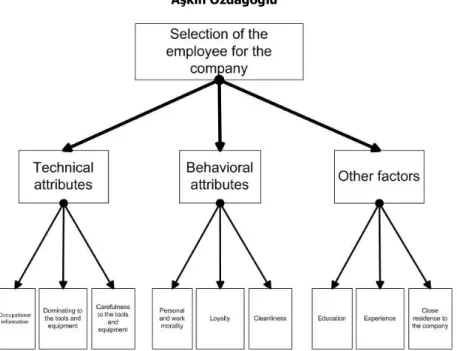
After the criteria are determined as given in Figure 2, a question form has been prepared to determine the importance levels of these criteria. To evaluate the questions, people only select the related linguistic variable, then for calculations they are converted into the following scale including triangular fuzzy numbers developed by (Chang, 1996) and generalized for such analysis as given in Table 1 below:
Figure 2. Hierarchy of the Criteria Set
Table 1. TFN Values
Statement TFN
Absolute (row to column) (7/2, 4, 9/2)
Very strong (row to column) (5/2, 3, 7/2) Fairly strong (row to column) (3/2, 2, 5/2)
Weak (row to column) (2/3, 1, 3/2)
Equal (1, 1, 1)
Weak (column to row) (2/3, 1, 3/2)
Fairly strong (column to row) (2/5, 1/2, 2,/3) Very strong (column to row) (2/7, 1/3, 2/5) Absolute (column to row) (2/9, 1/4, 2/7) Reference: Developed from Tolga et al, 2005: 22
APPLICATION OF FUZZY AHP ON THE SELECTION PROBLEM
In this paper, a decision making process is handled in Göksu Machine Shoe Co., providing the machine products with respect to the shoe industry in Manisa, about analyzing the selection criteria for manufacturing employees. In this part, firstly the outlines of employee selection and the extent analysis with fuzzy AHP are given and then the method is applied to determine the importance level of the employee selection criteria handled as a decision making process in a company. In appropriate with the fuzzy AHP method, employee selection criteria are
determined and compared the sub criteria according to these criteria and then importance level for each criterion is found with the calculation of the process according to the given hierarchy structure. A decision making process arises to select the employees. According to the management board of the company the following criteria set is constructed as given in Figure 2. As an evaluation scale, 1 to 5 ratio scale is applied for fuzzy AHP.
The question form developed for this study includes all questions for each level of hierarchy, i.e., the questions with respect to the overall goal “selecting the most appropriate employee for the company” are given as follows:
Question 1: How important is “technical attributes” when it is compared with “behavioral attributes”?
Question 2: How important is “technical attributes” when it is compared with “other factors”?
Question 3: How important is “behavioral attributes” when it is compared with “other factors”?
The remaining questions are arranged in a form and represented in Appendix A. By starting with the first hierarchy level comparisons are performed to determine the local and global importance levels. These questions are asked for both fuzzy AHP methods, but the calculation of the importance weights are handled according to the methodology given for each process.
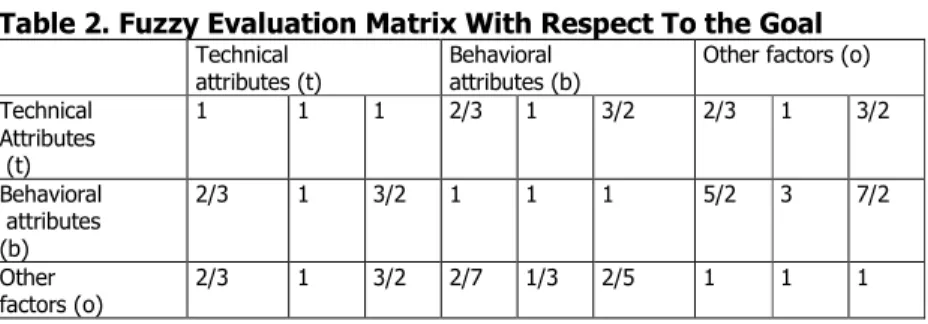
From the fuzzy numbers in Table 1, following calculations are performed to reach the importance values of the first level as a sample fuzzy evaluation matrix is obtained in the Table 2 below:
Table 2. Fuzzy Evaluation Matrix With Respect To the Goal
Technical attributes (t)
Behavioral attributes (b)
Other factors (o) Technical Attributes (t) 1 1 1 2/3 1 3/2 2/3 1 3/2 Behavioral attributes (b) 2/3 1 3/2 1 1 1 5/2 3 7/2 Other factors (o) 2/3 1 3/2 2/7 1/3 2/5 1 1 1 St = (2,33; 3; 4)
⊗
(1/8,452; 1/10,333; 1/12,9) Sb = (4,167; 5; 6 )⊗
(1/8,452; 1/10,333; 1/12,9) So = (1,952; 2,333; 2,9)⊗
(1/8,452; 1/10,333; 1/12,9)Are obtained. Using these vectors, V(St
≥
Sb) = 0,437 V(St≥
So) = 1 V(Sb≥
St) = 1 V(Sb≥
So) = 1 V(So≥
St) = 0,715 V(So≥
Sb) = 0,072Thus, the weight vector from Table 9 is found as
WGoal = ( 0,289; 0,663; 0,048 )T.
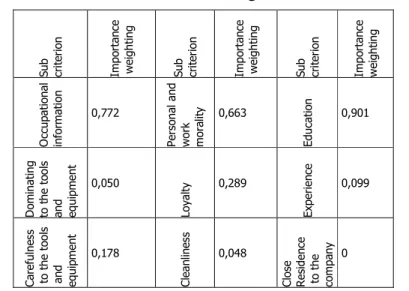
According to the decision maker group, “technical attributes” has got the highest importance level value with 0,663. The next step consists of operations to calculate the local importance values or weight vector of the second level in hierarchy. For each branch, each criteria group in the second level is subject to a pairwise comparison in itself. The criteria sets are calculated with the same approach and procedure is ended when global and local importance levels are obtained. Table 3 shows local importance levels for this decision making problem.
Table 3. Local Importance Weightings of All Sub Criteria for Decision Makers in the Management Level
S u b cr it e ri o n Im p o rt a n ce w e ig h ti n g S u b cr it e ri o n Im p o rt a n ce w e ig h ti n g S u b cr it e ri o n Im p o rt a n ce w e ig h ti n g O cc u p a ti o n a l in fo rm a ti o n 0,772 P e rs o n a l a n d w o rk m o ra lit y 0,663 E d u ca ti o n 0,901 D o m in a ti n g to t h e t o o ls a n d e q u ip m e n t 0,050 L o y a lt y 0,289 E x p e ri e n ce 0,099 C a re fu ln e ss t o t h e t o o ls a n d e q u ip m e n t 0,178 C le a n lin e ss 0,048 C lo se R e si d e n ce t o t h e co m p a n y 0
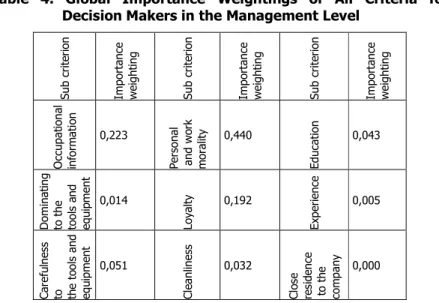
In order to calculate the global importance weightings for all sub criteria importance level of the main criteria set is multiplied by the importance levels corresponding sub criteria set. Table 4 shows the global importance levels for each criterion.
Table 4. Global Importance Weightings of All Criteria for Decision Makers in the Management Level
S u b c ri te ri o n Im p o rt a n ce w e ig h ti n g S u b c ri te ri o n Im p o rt a n ce w e ig h ti n g S u b c ri te ri o n Im p o rt a n ce w e ig h ti n g O cc u p a ti o n a l in fo rm a ti o n 0,223 P e rs o n a l a n d w o rk m o ra lit y 0,440 E d u ca ti o n 0,043 D o m in a ti n g to t h e to o ls a n d e q u ip m e n t 0,014 L o y a lt y 0,192 E x p e ri e n ce 0,005 C a re fu ln e ss to th e t o o ls a n d e q u ip m e n t 0,051 C le a n lin e ss 0,032 C lo se re si d e n ce t o t h e co m p a n y 0,000
The quantitative values explain that there are three criteria “personal and work morality” have got the highest priority according to the employee selection with 0,440. The second and the third important factors for employee selection are “occupational information” and “loyalty” with 0,223, 0,192 respectively. Thus, the employee who has a personal and work morality, occupational information and loyalty would have a higher chance of being selected. Another distinction point between the methods is about the zero weights of fuzzy AHP. However, classical AHP does not allow such a situation, fuzzy AHP executives find it very natural when a criterion is absolutely not important than all the criteria in its level.
FINDINGS AND CONCLUSION
AHP is an effective problem solving methodology. Decision problem may contain social, economic, technical and politic factors that need to be evaluated by linguistic variables. Then AHP is one of the most commonly used techniques for such situations.
In this study, the criteria and the importance levels of these criteria for selecting an employee through the use of fuzzy AHP. To determine the importance levels, a case study is handled from shoe industry in which the management should decide about the selection criteria for its
employees working in the company. When fuzzy AHP is applied to the given case of selection, then “personal and work morality”, “occupational information” and “loyalty” are the most three important criteria. “Close residence to the company” is calculated as zero which is an interesting result, because, at the beginning of the study the given criteria set is assumed to be evaluated. This is not an extraordinary situation and a gap for the Fuzzy-AHP approach, and the situation in the case that the decision makers may not consider one or more of the criteria for the evaluation of the employees even if this criterion is placed in the hierarchy. Therefore, the Fuzzy-AHP approach provides to eliminate the unnecessary criterion or criteria if all of the decision makers assign “absolutely not important” value when compared with the other criteria and expresses the more important criteria. Some expertise does not accept this result whereas some think it is natural. Due to the fact that European culture is affected by the Aristo logic based on existence – nonexistence, which is called 0-1 logic, some European researchers deny the fuzzy set theory. But, Japan scientists adapt to the fuzzy set theory and they use fuzzy logic in many different areas such as the production of the washing machines, microwave oven, refrigerator, scanner, and photograph machine. Consequently, fuzzy set and related methods are still conflictions in the literature so fuzzy AHP applications have some risk about it, but the conventional AHP still cannot reflect the human thinking style. Avoiding these risks on performance, the fuzzy AHP, a fuzzy extension of AHP, was developed to solve the hierarchical fuzzy problems.
In the methodology, one can not find a consistency process for fuzzy inputs and crisp weights and the consistency index method is not appropriate because of the fuzziness. In fact, Chang’s fuzzy AHP comprises such a mechanism during the pairwise calculations when the membership values or possibilities are compared and the intersections are obtained. Furthermore the fuzziness concept has some bias including decision maker’s inconsistency. Because of that the publications applying Chang’s fuzzy AHP did not require any consistency mechanism as seen in many applications in the literature.
REFERENCES
Bard, J.F. & Sousk, S.F. (1990). A Trade Analysis for Rough Terrain Cargo Handlers Using the AHP: An Example of Group Decision Making. IEEE Transactions on Engineering Management 37 (3): 222–228.
Bevilacqua, M. D’Amore, A. & Polonara, F. (2004). A Multi-Criteria Decision Approach to Choosing the Optimal Blanching–Freezing System. Journal of Food Engineering, 63: 253-263.
Boender, C.G.E., De Graan, J.G. & Lootsma, F.A. (1989). Multicriteria Decision Analysis with Fuzzy Pairwise Comparisons. Fuzzy Sets and Systems, 29: 133–143.
Bouyssou, D., Marchant, T., Pirlot, M., Perny, P., Tsoukias, A. & Vincke, P. (2000). Evaluation Models: A Critical Perspective. Kluwer, Boston.
Buckley, J.J. (1985/a). Ranking Alternatives Using Fuzzy Members. Fuzzy Sets and Systems, 15: 21–31.
Buckley, J.J. (1985/b). Fuzzy Hierarchical Analysis. Fuzzy Sets and Systems, 17: 233–247.
Büyüközkan, G. Feyzioğlu, O. & Nebol, E. (2008). Selection of the Strategic Alliance Partner in Logistics Value Chain International Journal of Production Economics, 113 (1): 148-158.
Chang, D.Y. (1996). Applications of the Extent Analysis Method on Fuzzy-AHP. European Journal of Operational Research, 95: 649-655. Chang, D.Y. (1992). Extent Analysis and Synthetic Decision, Optimization
Techniques and Applications, World Scientific, Singapore, 1: 352. Cheng, C.H. (1996). Evaluating Naval Tactical Missile Systems by Fuzzy
AHP Based on the Grade Value of Membership Function. European Journal of Operational Research, 96: 343-350.
Cheng, C.H. Yang, K.L. & Hwang, C.L. (1999). Evaluating Attack Helicopters by AHP Based on Linguistic Variable Weight. European Journal of Operational Research, 116: 423-435.
Çakır, O. (2008). On the Order of the Preference Intensities in Fuzzy AHP. Computers & Industrial Engineering, 4: 993-1005
Durán, O. & Aguilo, J. (2008). Computer-Aided Machine-Tool Selection Based on A Fuzzy-AHP Approach Expert Systems with Applications, 34 (3): 1787-1794.
Huang, C.C. Chu, P.Y. & Chiang, Y.H. (2008). A Fuzzy AHP Application in Government-Sponsored R&D Project Selection. Omega, 36 (6): 1038-1052.
Kahraman, C., Cebeci, U. & Ruan, D. (2004). Multi-Criterion Comparison of Catering Service Companies Using Fuzzy AHP: The Case of Turkey. International Journal of Production Economics, 87: 171-184.
Kuo, R.J., Chi, S.C. & Kao, S.S. (2002). A Decision Support System for Selecting Convenience Store Location Through Integration of Fuzzy AHP and Artificial Neural Network, Computers in Industry, 47 (2): 199-214.
Kulak, O. & Kahraman, C. (2005). Fuzzy Multi-Criterion Selection Among Transportation Companies Using Axiomatic Design and Analytic Hierarchy Process. Information Sciences, 170: 191-210.
Laarhoven, P.J.M. & Pedrycz, W. (1983). A Fuzzy Extension of Saaty’s Priority Theory. Fuzzy Sets and Systems, 11: 229–241.
Leung, L.C. & Chao, D. (2000). On Consistency and Ranking of Alternatives in Fuzzy AHP. European Journal of Operational Research, 124: 102-113.
Lootsma, F. (1997). Fuzzy Logic for Planning and Decision-Making. Kluwer, Dordrecht.
Pohekar, S.D. & Ramachandran, M. (2004). Application of Multi-Criteria Decision Making to Sustainable Energy Planning. A Review Renewable and Sustainable Energy Reviews, 8: 365-381.
Ribeiro, R.A. (1996). Fuzzy Multiple Criterion Decision Making: A Review and New Preference Elicitation Techniques. Fuzzy Sets and Systems, 78: 155–181.
Saaty, T.L. (1994). Fundamentals of Decision Making and Priority Theory with the Analytical Hierarchy Process. RWS Publications. Pittsburgh.
Saaty, T.L. (2001). Decision Making with Dependence and Feedback: Analytic Network Process. RWS Publications. Pittsburgh.
Sarkis, J. & Talluri, S. (2004). Evaluating and Selecting E-Commerce Software and Communication Systems for A Supply Chain. European Journal of Operational Research, 159: 318-329.
Sheu, J.B. (2008). A Hybrid Neuro-Fuzzy Analytical Approach to Mode Choice of Global Logistics Management. European Journal of Operational Research,189(3): 971-986.
Sheu, J.B. (2004). A Hybrid Fuzzy-Based Approach for Identifying Global Logistics Strategies. Transportation Research, 40: 39-61.
Taha, H.A. (2003). Operations Research. Pearson Education Inc. Fayetteville.
Taylor, B.W. (2004). Introduction to Management Science. Pearson Education Inc. New Jersey.
Tolga, E., Demircan, M. L. & Kahraman, C. (2005) Operating System Selection Using Fuzzy Replacement Analysis and Analytic Hierarchy Process. International Journal of Production Economics,97: 89-117.
Triantaphyllou, E. & Mann, S.H. (1995). Using The Analytic Hierarchy Process for Decision Making in Engineering Applications: Some Challenges. International Journal of Industrial Engineering: Applications and Practice, 2 (1): 35–44.
Wabalickis, R.N. (1988). Justification Of FMS with the Analytic Hierarchy Process. Journal of Manufacturing Systems. 17:175–182.
Yu, C.S. (2002). A GP-AHP Method For Solving Group Decision-Making Fuzzy AHP Problems. Computers and Operations Research, 29: 1969–2001.
Zaerpour, N., Rabbani, M., Gharehgozli, A.H. & Tavakkoli-Moghaddam, R. (2008). Make-to-Order or Make-To-Stock Decision by a Novel Hybrid Approach Advanced Engineering Informatics, 22 (2): 186-201.
Zhu, K.J., Jing, Y. & Chang, D.Y. (1999). A Discussion On Extent Analysis Method and Applications Of Fuzzy-AHP. European Journal of Operational Research, 116: 450-456.
APPENDIX: Question Form for Evaluation
Read the following questions and put check marks on the pair wise comparison matrices. If a criterion on the left is more important than the matching one on the right, put your check mark to the left of the importance ‘‘Equal’’ under the importance level you prefer. If a criterion on the left is less important than the matching one on the right, put your check mark to the right of the importance ‘Equal’ under the importance level you.
With respect to the main criterion “technical attributes”
Question 1: How important is “Occupational information” when it is compared with “Dominating to the tools and equipment”?
Question 2: How important is “Occupational information” when it is compared with “Carefulness to the tools and equipment”?
Question 3: How important is “Dominating to the tools and equipment” when it is compared with “Carefulness to the tools and equipment”?
W it h re sp e ct t o : “t e ch n ic a l a tt ri b u te s”
Importance (or preference) of one sub-criterion over another
Q u e st io n s C ri te ri a A b so lu te V e ry s tr o n g F a ir ly s tr o n g W e a k E q u a l W e a k F a ir ly s tr o n g V e ry s tr o n g A b so lu te C ri te ri a 1 O cc u p a ti o n a l in fo rm a ti o n D o m in a ti n g t o t h e t o o ls a n d e q u ip m e n t 2 O cc u p a ti o n a l in fo rm a ti o n C a re fu ln e ss t o t h e t o o ls a n d e q u ip m e n t 3 D o m in a ti n g t o t h e to o ls a n d e q u ip m e n t C a re fu ln e ss t o t h e t o o ls a n d e q u ip m e n t
With respect to the main criterion “behavioral attributes”
Question 1: How important is “Personal and work morality” when it is compared with “Loyalty”?
Question 2: How important is “Personal and work morality” when it is compared with “Cleanliness”?
Question 3: How important is “Loyalty” when it is compared with “Cleanliness”?
W it h re sp e ct to : “b e h a v io ra l a tt ri b u te s”
Importance (or preference) of one sub-criterion over another
Q u e st io n s C ri te ri a A b so lu te V e ry s tr o n g F a ir ly s tr o n g W e a k E q u a l W e a k F a ir ly s tr o n g V e ry s tr o n g A b so lu te C ri te ri a 1 P e rs o n a l a n d w o rk m o ra lit y L o y a lt y 2 P e rs o n a l a n d w o rk m o ra lit y C le a n lin e ss 3 L o y a lt y C le a n lin e ss
With respect to the main criterion “other factors”
Question 1: How important is “Education” when it is compared with “Experience”?
Question 2: How important is “Education” when it is compared with “Close residence to the company”?
Question 3: How important is “Experience” when it is compared with “Close residence to the company”?
A ş k ın Ö z d a ğ o ğ lu 1 6 0
With respect to: “other factors”
Im p o rt a n ce ( o r p re fe re n ce ) o f o n e s u b -c rit e rio n o v e r a n o th e r Questions Criteria Absolute Very strong Fairly strong Weak Equal Weak Fairly strong Very strong Absolute Criteria 1 Education Experience 2 Education
Close residence to the
3
Experience