The Experimental Investigation of The Viscosity of The Al
2O
3Nanofluid
Eda Feyza AKYÜREK1, Kadir GELİŞ2* and Bayram ŞAHİN31Dept. of Mech. Eng, Faculty of Eng&Arc., Technical Univ. of Erzurum, Erzurum, Turkey, [email protected]
2Bolu Abant Izzet Baysal University, Faculty of Engineering, Department of Mech. Engineering, Bolu, Turkey, [email protected]
3Dept. of Mech. Eng, Faculty of Eng&Arc., Technical Univ. of Erzurum, Erzurum, Turkey, [email protected]
Abstract
Nanofluids have recently been the subject of interest from researchers in parallel with the developments in nanotechnology. In most of the calculations related to nanofluids, it is necessary to determine their thermophysical properties accurately. The accurate determination of viscosity, which is one of the thermophysical properties of nanofluids, is very important, especially for heat transfer practices. In the study, the viscosity values of the nanofluids in different temperatures, which were prepared by adding Al2O3 nanoparticles in gamma phase with volumetric ratios of 0.4%, 0.8%, 1.2% and 1.6% into distilled water, were determined experimentally and the results were presented comparatively with literature.
Keywords: Nanofluids, Thermophysical Properties, Viscosity, Preparation Of Nanofluids
1. Introduction
Heat transfer improvement methods can be classified as active, passive and mixed methods. Active methods are methods that require the use of an external power supply, and that provide improvement in heat transfer by giving additional energy to the liquid or the environment to which heat is transferred.
Received: 01.05.2019 Revised: 19.11.2019 Accepted: 12.12.2019
*Corresponding author: Kadir GELİŞ, PhD
Bolu Abant Izzet Baysal University, Faculty of Engineering, Department of Mechanical Engineering, Bolu, Turkey E-mail: [email protected]
Cite this article as: E.F. Akyürek, K. Geliş and B. Şahin,
The Experimental Investigation of the viscosity of the Al2O3
Nanofluid, Eastern Anatolian Journal of Science, Vol. 5, Issue 2,
26-35,2019.
Passive methods are methods that provide improvement in heat transfer without additional energy being given. Machined surfaces, uneven surfaces, extended surfaces, rotatory flow elements, and improvement elements placed inside the pipe are examples of passive methods. In mixed methods, two or more active or passive methods are used together. Although different improvement methods are used for heat transfer improvement, the fact that heat transfer performances of conventional fluids are low causes low improvement efficiency and limits the heat exchanger to a small size and a space-saving geometry. Using additives to improve the heat transfer performance of the fundamental fluid is one of the passive methods used towards improving heat transfer. For this reason, it was attempted to improve heat transfer by adding metal or non-metal particles into these liquids. However, the millimeter or micrometer-sized particles caused various problems in heat transfer devices. The biggest problems of the suspensions that contain particles in these sizes are both the rapid precipitation of these particles and these particles being too big for microsystems. All of the aforementioned negative situations became insignificant as modern technology made the production of nano-sized metal or non-metal particles possible. The fluids in which nanometer-sized solid particles are suspended are called "nanofluids". Nanofluids are the suspension of ultrathin particles
that merge into conventional fluids, which significantly improves the heat transfer characteristic of the fundamental fluid. As they cause a slight increase in the pressure drop, they are thought to be suitable for practical applications. When ultrafine-grain-sized particles (16-60nm) are mixed very well in the fluid, the resulting fluid behaves more like a single-phase fluid than a solid-liquid mixture.(Daungthongsuk and Wongwies 2007).
During the examination of nanofluids; the concept of nanofluids, the preparation of nanofluids, the thermophysical properties of nanofluids and the heat transfer measurement techniques need to be known. The preparation of nanofluids is the first and most important step applied to change the heat transfer performance of the fluid. There are 2 methods for the preparation of nanofluids. The first is the single-step method, and the second is the two-step method. In the two-step method, nanoparticles are initially produced in the form of dry dust. In the second step, nanoparticles are added into the fundamental fluid. This method is quite common. That is because when physical, chemical and laser-based methods are multifarious, nanoparticles can be easily provided today. This situation enables the production of nanoparticles to be used in nanofluids (Goharshadi et al. 2011). There are various disadvantages in preparing nanofluids using the two-step method. Nanoparticles can be agglomerated during drying, storage and transportation phases. This situation prevents the nanofluid from being stable. Also, production costs are too high. The single-step method was developed to prevent the nanofluids from being agglomerated. It was determined that the nanofluid prepared by Eastman et al. (2001) using the single-step method with a volumetric ratio of 0.3% Cu showed an increase of up to 40% in thermal conductance compared to the oxide nanofluids
prepared with the two-step method. The particle concentrations must be above approximately 10% in order for conventional particle-fluid suspensions to reach such an increment value.
In the studies conducted, it was determined that nanofluids were much better in problems such as precipitation, flow inhibition and pressure drop compared to conventionally used mixtures. The biggest problem in nanofluid suspensions is agglomeration. Agglomeration causes precipitation, blockage in microchannels and a decrease in thermal conductivity. For this reason, preparing a stable nanofluid is an important step in the application field of nanofluids. In order to prevent agglomeration, a suitable surface activator or dispersant is added to the suspension in very small quantities depending on the properties of particles and solutions. Generally, the surface-active agents and dispersants used are thiols, oleic acid and laurate salts (Xuan and Li 2000). The addition of surface-active agents affect the heat transfer performances of nanofluids, especially at high temperatures. The corrosion and pressure drop problems in the pipe are largely reduced using low particle volume rates (usually in volumetric ratios less than 5%).
There are many methods to improve the stability of nanofluids. The simplest and most reliable method is precipitation (sedimentation). In this method, the change in concentration with the precipitation time or the particle size on the surface is obtained with special devices. Photographing the precipitation of the nanofluid with the camera placed on the test pipe is another method used to determine the stability of nanofluids. The zeta potential method is also used to determine the stability of nanofluids. However, this method is limited by the viscosity and concentration of nanofluids (Li et al. 2009).
Li et al. (2007) examined the distribution behaviors of the nanofluid that they created by adding Cu nanoparticles into the water with different pH values and different types of surface-active agents using the zeta potential method and precipitation photographs. Peng and Yu (2007) examined the factors that affect the stability of nanofluids. According to the results they obtained, they determined that the most important factors that affect the stability of the suspension were the concentration of nanoparticles, surface-active agents, the viscosity of the fundamental fluid and pH value. In addition, it was determined that stabilities of nanofluids were also affected by the diameter and density of nanoparticles and ultrasonic agitation. In their study, Wang et al. (2003a) and Wang et al. (2003b) stated that the most important factors that affect the stability of the suspension that was composed of nanoparticles were the equivalent diameters of nanoparticles and the dynamic viscosity of nanofluids. In their study on the CuO-Water suspension, Li et al. (2007) stated that pH value, types of surface-active agents and concentration were the factors that affected the stability of nanofluids. It was determined that the optimum adjustment of surface-active agents with 9.5 pH was the best stability status for the CuO-Water nanofluid. Changing the pH value with diluting agents such as Oleic acid and Cetrimonium Bromide, adding diluting agents, improving the surface properties of nanoparticles and ultrasonic agitation are some of the methods used to increase the stability of nanofluids. However, these methods were used to make them remain stable for a few days or a month. Methods to make them remain stable for a longer time are not yet available (Li et al. 2009).
Viscosity is defined as the internal resistance fluids show to flow. The viscosity of the fluid is related to pumping power. In laminar flows, viscosity
is directly related to pressure drop. Convective heat transfer coefficient is affected by viscosity. It is for this reason that viscosity is as important as thermal conductivity for engineering systems (Mahbubul et al. 2012). The addition of particles into fluids increases the viscosity of fluids along with thermal conductivity. It is seen that some of the theoretically developed models are suitable for estimating viscosity while some others are not. This situation is related to the nanofluid preparation method with the geometric and chemical properties of the particles studied. It is also known that temperature has a great effect on thermophysical properties.
In the experiments they conducted with the nanofluids they created by adding the nanoparticles CuO, Al2O3 and SiO2 into the mixture of Ethylene Glycol and water at temperatures within the range of 35°C and 50°C, Kulkarni et al. (2009) determined that viscosity decreases as temperature increases. However, in contrast with the other studies, Prasher et al. (2006), Chen et al. (2007a) and Chen et al. (2007b) stated that viscosity was independent of temperature. There are a limited number of studies that examine the effect of the size and shape of particles on the viscosity of nanofluids. Nguyen et al. (2008) determined that the viscosity of the nanofluid consisting of 36nm nanoparticles was 5% lower compared to the nanofluid with 47nm nanoparticles. They stated that particle size was even more important for the nanofluids with particle rates of 7% and 9%.
He et al. (2007) stated that viscosity increased with particle rate. They measured the viscosities of the TiO2-Distilled Water nanofluids for 3 different nanoparticle sizes (95nm, 145nm, 220nm) in a different concentration. They concluded that the viscosity of nanofluids increased with the increase in particle diameter. In contrast with the aforementioned
studies, Lu and Fan (2008) examined the viscosities of the nanofluids Al2O3-Water and Al2O3-Ethylene Glycol in different particle sizes both numerically and experimentally. They stated that the viscosity of nanofluids decreased with the increase in particle diameter. They also stated that there was less change in diameters bigger than 30nm. In their study, Anoop et al. (2009) found a similar result. It was determined that the viscosity of the Al2O3-Water nanofluid, which contains nanoparticles of different sizes (45nm and 150nm) and has a particle concentration of 1%, 2%, 4% and 6%, decreased with the increase in particle size. Prasher et al. (2006) examined the nanofluid Al2O3-Propylene Glycol with particle sizes of 27nm, 40nm and 50nm. They concluded that nanoparticle diameter had no effect on the viscosity of nanofluids.
There are also studies that examine the effect of particle shape on the viscosity of nanofluids. In their study, Timofeeva et al. (2009) and Timofeeva et al. (2011) stated that nanoparticle shape had a very strong effect on viscosity.
Although there are opposing views regarding the effects of temperature, particle size and particle shape on the viscosity of nanofluids, all studies have a common view regarding the effect of volumetric ratio. In the studies, the view that viscosity increases in parallel with the volumetric ratio of particles is agreed on. Chevalier et al. (2007) measured the viscosities of the nanofluid SiO2-Ethanol with particle diameters of 35nm, 94nm and 190nm and volumetric ratios of 1.4% and 7%. They determined that viscosity increased in parallel with increasing volumetric ratio. Duangthongsuk and Wongwises (2010) compared the thermophysical properties of the TiO2-Water nanofluid they measured with models. The average diameter of the TiO2 nanoparticles is 21nm and its volumetric ratio within the nanofluid is
between 0.2% and 1%. They measured thermal conductivity with hot-wire and viscosity with Bohlin's rheometer. They calculated the thermal conductivity and viscosity necessary to define the Nusselt number of the nanofluid with well-known correlations and compared these calculations with the results they measured. They reported that the thermophysical properties calculated gave the same result as the measurement data. They stated that the best model for thermal conductivity was Yu and Choi (2003) and the best model for viscosity was Wang et al. (1999).
The aim of this study is to prepare nanofluids in different volumetric ratios that can remain steady and stable for long time periods, to determine the viscosity of the nanofluids, one of their thermophysical properties, experimentally and compare them with the models in the literature.
2. Materials and Methods 2.1. Preparation of Nanofluids
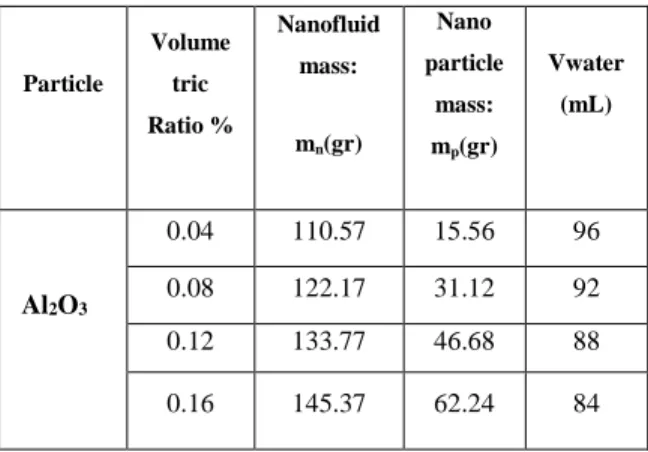
Al2O3 nanoparticles with 4 different volumetric ratios of 0.4%, 0.8%, 1.2% and 1.6% were added into distilled water as the fundamental fluid. A 100 mL sample was prepared for the viscosity to be measured. As a result of the calculations, the ratios and amounts of the nanoparticle to be added into distilled water are given in Chart 1.
Table 1. Calculation results for preparing 100 mL nanofluids
Particle Volume tric Ratio % Nanofluid mass: mn(gr) Nano particle mass: mp(gr) Vwater (mL) Al2O3 0.04 110.57 15.56 96 0.08 122.17 31.12 92 0.12 133.77 46.68 88 0.16 145.37 62.24 84
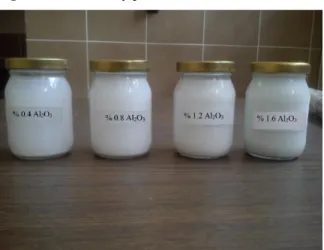
1st and 90th-day pictures of the prepared nanofluids were taken in order to determine their stability in time. When Figure 1 and Figure 2 are examined, it can be said that the nanofluids did not precipitate in 90 days and remained stable.
Figure 1. The 1st-day pictures of the nanofluids
Figure 2. The 90th-day pictures of the nanofluids
2.2. Experimental Set-Up
In the study, it was initially calculated how many nanoparticles would be used for varying volumetric ratios. The calculated nanoparticles were weighed on a precision scale and mechanically mixed with water. An ultrasonic homogenizer was used to make the mixture homogeneous. The nanofluid suspension, which was left in the ultrasonic homogenizer for 4 hours, was put in the ultrasonic bath and left to wait.
The properties of the Al2O3 nanoparticle are given in Chart 2.
Table 2. The properties of the nanoparticle used in the study.
Molecular Weight Phase Particle Size Surface Area Thermal Conductivit y (21°C) 101.96 g/mol Gamma 40– 47nm 35–43 m2/g 37.14 W/mK
When preparing the nanofluid, the number of nanoparticles that were specified in terms of volumetric ratio were converted into mass and added into distilled water. The AND GR 200 precision scale used in the nanoparticle measurement with a sensitivity of 0.0001 g and a maximum measuring capacity of 210g is given in Figure 3.
Figure 3.Precision scale
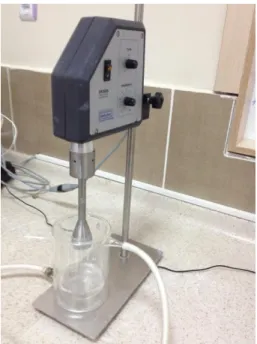
In the preparation of nanofluids, the biggest problem is agglomeration. The Hielscher brand UP200S model Ultrasonic Homogenizator used to prevent agglomeration and increase the stability of the nanofluid is given in Figure 4. When preparing the nanofluid, a frigorific glass reactor is used to prevent it from heating up. When the nanofluid was being prepared, a glass reactor was used and infrigidation
was performed with a water-bath to prevent the suspension from heating up.
Figure 4. Ultrasonic Homogenizator
Another method used to prevent agglomeration and increase stability in nanofluids is using ultrasonic baths. During the experiment, the nanofluids prepared in the ultrasonic homogenizator were kept in the ultrasonic bath for a while in order to preserve their stability. The ultrasonic bath used during the experiments is given in Figure 5. The voltage of the ultrasonic bath is 230 V-50 Hz, its Ultrasonic Power is 600 peak/300 Watts, its Heating Power is 500 Watts and its ultrasonic frequency is 28 kHz.
Figure 5.Ultrasonic bath
The viscosities of the prepared nanofluids were measured at between 5°C and 75°C with 5°C intervals using the Brookfield brand DV-I Prime model viscometer .(Figure 6)
Figure 6.Viscometer
2.3. Data Reduction
Nanoparticles with 4 different volumetric ratios of 0.4%, 0.8%, 1.2% and 1.6 were added into the fundamental fluid, and the nanofluid was prepared using the two-step method. The mass of the nanoparticle to be added to the nanofluid was calculated by following the steps given below. In Equation 1, ϕ is the volumetric ratio. The ρn density of the nanofluid is calculated by placing the ρn and ρl
density values of the particle and fluid in the equation respectively.
𝜙 =𝜌𝑛−𝜌𝑙
𝜌𝑝−𝜌𝑙 (1)
The mn mass of the nanofluid is calculated by placing the ρn value in Equation 2, and the mass ratio of the nanoparticle is calculated by writing the x value in Equation 3. 𝜌𝑛= 𝑚𝑛 𝑉𝑛 (2) 𝑐𝑚= 𝜙 ∗ 𝜌𝑝 𝜌𝑛 (3)
The nanoparticle mass in the suspension was calculated by placing 𝐶𝑚 in Equation 4. The mass of the fundamental fluid to be used while preparing the nanofluid was calculated by placing mp in Equation 5 and the volume of the fundamental fluid was calculated by placing the calculated mwater value in Equation 6
𝑚𝑝 = 𝑐𝑚∗ 𝑚𝑛 (4)
𝑚𝑠𝑢= 𝑚𝑛− 𝑚𝑝 (5)
𝜌𝑠𝑢 =𝑚𝑠𝑢
𝑉𝑠𝑢 (6)
The data obtained as a result of experimental measurements were compared with current correlations. The correlation used by Batchelor (1977) to estimate the viscosity of the nanofluids composed of circular-shaped nanoparticles Equation (7);
w
nf
(
1
0
.
5
6
.
2
2)
(7)
To calculate viscosity, Drew and Passman (1999) proposed the Einstein equation shown in Equation
(8), which is suitable for the circular particles with volumetric ratios of less than 5%.
w
nf
(
1
2
.
5
)
(8)
Brinkmann (1952) modified the Einstein equation in order to make it more generalized and presented it in the form given in Equation (9);
w nf
2.5)
1
(
1
(9)The correlation proposed by Wang et al. (1999) to calculate viscosity shown in Equation (10);
w
nf
(
1
7
.
5
123
2)
(10)
In the correlations, μnf is the viscosity of the nanofluid, μw is the viscosity of the fundamental fluid and ϕ is the volumetric ratio.
3. RESULTS AND DISCUSSION
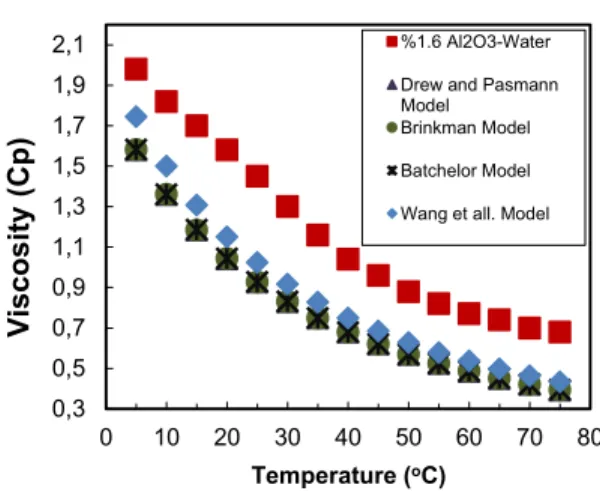
The viscosities of the nanofluids with volumetric ratios of 0.4%, 0.8%, 1.2% and 1.6% were measured at temperatures ranging between 5ºC and 75ºC. The graphic containing the viscosity results of water and nanofluids with volumetric ratios of 0.8%, 1.2% and 1.6% is given in Figure 7, the viscosity graphic obtained for the Al2O3-Water nanofluid prepared in a volumetric ratio of 0.4% is given in Figure 8, the viscosity graphic obtained for the Al2O3-Water nanofluid prepared in a volumetric ratio of 0.8% is given in Figure 9, the viscosity graphic obtained for the Al2O3-Water nanofluid prepared in a volumetric ratio of 1.2% is given in Figure 10, and the viscosity graphic obtained for the Al2O3-Water nanofluid prepared in a volumetric ratio of 1.6% is presented in
Figure 11. It was observed that each graph presented was in parallel with the models in the literature, that the increase in volumetric ratio increased viscosity and that viscosity decreased with the increase in temperature.
Figure 7. The viscosities of Water, 0.4%, 0.8%, 1.2% and 1.6% Al2O3-Water nanofluids
Figure 8. Comparison of the viscosity of the 0.4% Al2O3-Water nanofluid with the models
Figure 9. Comparison of the viscosity of the 0.8% Al2O3-Water nanofluid with the models
Figure 10. Comparison of the viscosity of the 1.2% Al2O3-Water nanofluid with the models
Figure 11. Comparison of the viscosity of the 1.6% Al2O3-Water nanofluid with the models
0 0,2 0,4 0,6 0,8 1 1,2 1,4 1,6 1,8 2 2,2 0 10 20 30 40 50 60 70 80 V is cosity ( C p) Temperature (oC) Water %0.4 Al2O3-Water %0.8 Al2O3-Water %1.2 Al2O3-Water %1.6 Al2O3-Water 0,3 0,5 0,7 0,9 1,1 1,3 1,5 1,7 0 10 20 30 40 50 60 70 80 V is cosity ( C p) Temperature (oC) %0.4 Al2O3-Water Drew and Pasmann Model
Brinkman Model Batchelor Model Wang et all. Model
0,3 0,5 0,7 0,9 1,1 1,3 1,5 1,7 1,9 0 10 20 30 40 50 60 70 80 V is cosity (C p) Temperature (oC) %0.8 Al2O3-Water Drew and Pasmann Model
Brinkman Model Batchelor Model Wang et all. Model
0,3 0,5 0,7 0,9 1,1 1,3 1,5 1,7 1,9 0 10 20 30 40 50 60 70 80 V is cosity ( C p) Temperature (oC) %1.2 Al2O3-Water Drew and Pasmann Model
Brinkman Model Batchelor Model Wang et all. Model
0,3 0,5 0,7 0,9 1,1 1,3 1,5 1,7 1,9 2,1 0 10 20 30 40 50 60 70 80 V isc o sity ( Cp ) Temperature (oC) %1.6 Al2O3-Water Drew and Pasmann Model
Brinkman Model Batchelor Model Wang et all. Model
4. CONCLUSIONS
When the experimental results were examined it was observed that, as expected, the viscosity of the Al2O3-Distilled Water nanofluid decreased with the increase in temperature and increased in parallel with particle concentration. When compared with the viscosity models presented in the literature, it was found that the experimental results were generally in harmony.
Experimental viscosity measurement values were found to be higher than the models. The viscosity values for the nanofluids with volumetric ratios of 0.4%, 0.8%, 1.2% and 1.6% are higher than the Wang et al. (1999) equation with between 5.98% and 20.56%, 8.66% and 30.26%, 10.78% and 43.61% and 13.52% and 56.66% respectively. It is seen that deviations from the models are higher as volumetric concentration increases.
According to the correlations, effective viscosity depends on the viscosity of the fundamental fluid and particle concentration. However, experimental results showed that temperature and particle type also have an effect on effective viscosity. Also, when other studies conducted on this topic are examined, it can be said that the effect of particle diameter should also be evaluated. The reasons behind the difference between the models and the experimental results could be that particle size, particle geometry and the effect of temperature was not considered in the models. Also, the properties of the fundamental fluid and nanofluid preparation methods could be possible reasons to explain this difference.
When the viscosity values for nanofluids with volumetric ratios of 0.4%, 0.8%, 1.2% and 1.6% at temperatures of between 5ºC and 75ºC were compared with distilled water, it was found that they were higher by between 11.78% and 33.3%, 18.52% and 47.13%, 25.25% and 66.67%, and 33.3% and 88.89%. The number of particles in the fluid increases with the increase in the volumetric ratio. A large number of small particles cause more particle interaction. Viscosity increases as a result of this. Also, it is seen from the graphics that viscosity decreases as temperature increases. This decrease in viscosity can be explained by the interaction between the nanoparticles and the fluid being weakened.
References
ANOOP K.B., SUNDARARAJAN T., DAS S.K., 2009. Effect of particle size on the convective heat transfer in nanofluid in the developing region, Int. J. Heat Mass Transfer, 52 (9–10), 2189–2195.
BATCHELOR G.K., 1977. The effect of Brownian motion on the bulk stress in a suspension of spherical particles, Journal of Fluid Mechanics 83 (1), 97–117.
BRINKMAN H.C., 1952.The viscosity of concentrated suspensions and solution, Journal of Chemical Physics 20, 571–581.
CHEN H., DING Y., HE Y., TAN C., 2007a. Rheological behaviour of ethylene glycol based titania nanofluids, Chem. Phys. Lett., 444 (4–6), 333–337.
Chen H., Ding Y., Tan C., 2007b. Rheological behaviour of nanofluidS, New J. Phys., 9 (10), 267.
CHEVALIER J., TILLEMENT O., AYELA F., 2007. Rheological properties of nanofluids flowing through microchannels, Appl. Phys. Lett., 91 (23), 233103.
DUANGTHONGSUK W., WONGWISES S., 2010. An experimental study on the heat transfer performance and pressure drop of TiO2–water nanofluids flowing under a turbulent flow regime, Int. J. Heat Mass Transfer, 53 (1–3), 334–344.
DREW D.A., PASSMAN S.L., 1999. Theory of Multi Component Fluids, Springer, Berlin.
DAUNGTHONGSUK W., WONGWISES S., 2007. A critical review of convective heat transfer of nanofluids, Renewable and Sustainable Energy Reviews. 11/ 5, 797–817
EASTMAN, J. A., CHOI, S. U. S., YU, W., AND THOMPSON, L. J., 2001. Anomalously increased effective thermal conductivity of ethylene glycol-based nanofluids containing copper nanoparticles, Applied Physics Letters, 78/6, 718–720.
GOHARSHADI S., SAMIEE P., NANCARROW J., 2011. Fabrication of cerium oxide nanoparticles: Characterization and optical properties, Colloid Interf. Sci. 356, 473-480. HE Y., JIN Y., CHEN H., DING Y., CANG D., LU
H., 2007.Heat transfer and flow behavior of aqueous suspensions of TiO2 nanoparticles (nanofluids) flowing upward through a vertical pipe, International Journal of Heat and Mass Transfer 50, 2272–2281.
KULKARNI D.P., DAS D.K., VAJJHA R.S., 2009. Application of nanofluids in heating buildings and reducing pollution, Appl. Energy, 86 (12), 2566–2573.
LI X., ZHU D., WANG X., 2007. Evaluation on dispersion behavior of the aqueous copper nano-suspensions, J. Colloid Interface Sci., 3 (10), 456–463.
LI Y., ZHOUA J., TUNG S., SCHNEIDER E., XI S., 2009. A review on development of nanofluid preparation and characterization, 196, 89–101. LU W., FAN Q., 2008. Study for the particle’s scale
effect on some thermophysical properties of nanofluids by a simplified molecular dynamics method, Eng. Anal. Boundary Elem., 32 (4), 282–289.
MAHBUBUL I.M. , SAIDUR R., AMALINA M.A., 2012. Latest developments on the viscosity of nanofluids, International Journal of Heat and Mass Transfer, 55, 874–885.
NGUYEN C., DESGRANGES, GALANIS F. N., ROY G., MARE T., BOUCHER S., ANGUEMINTSAH.,2008. Viscosity data for Al2O3–water nanofluid—hysteresis: is heat transfer enhancement using nanofluids reliable Int. J. Therm. Sci., 47 (2) , 103–111.
PENG X., YU X., 2007. Influence factors on suspension stability of nanofluids, J. Zhejiang Univ.: Eng. Sci., 41, 577–580. B. S.
PRASHER R., SONG D., WANG J., PHELAN P., 2006. Measurements of nanofluid viscosity and its implications for thermal applications, Appl. Phys. Lett., 89 (13), 133108.
TIMOFEEVA E.V., ROUTBORT J.L., SINGH D., 2009. Particle shape effects on thermophysical properties of alumina nanofluids, J. Appl. Phys., 106 (1), 014304.
TIMOFEEVA E.V., YU W., FRANCE D.M., SINGH D., ROUTBORT J.L., 2011. Nanofluids for heat transfer: an engineering approach, Nanoscale Res. Lett., 6 (1), 182.
WANG X., XU X., AND CHOI S. U. S., 1999. Thermal Conductivity of Nanoparticle-Fluid Mixture, Journal of Thermophysics and Heat Transfer, 13/4,474–480.
WANG B., LI C., PENG X., 2003A. Research on stability of nano-particle suspension, J. Univ. Shanghai Sci. Technol., 25, 209–212.
WANG B., LI C., PENG X., 2003B. Stability of nano-particle suspensions, J. Basic Sci. Eng., 11, 169–173.
XUAN Y., LI Q., 2000. Heat transfer enhancement of nanofluids, International Journal of Heat and Fluid Flow, 21/1, 58–64.
YU W, CHOI SUS.2003.The role of interfacial layers in the enhanced thermal conductivity of nanofluids: a renovated Maxwell model. J Nanoparticle Res , 5, 167–171.