DELEGITIMATION OF A CULTURAL PRODUCT: THE CASE OF TURKISH TELEVISION DRAMA BEHZAT Ç.
A Master’s Thesis
by
ANIL SUPHİ İŞİSAĞ
Department of Management İhsan Doğramacı Bilkent University
Ankara June 2015
DELEGITIMATION OF A CULTURAL PRODUCT: THE CASE OF TURKISH TELEVISION DRAMA BEHZAT Ç.
Graduate School of Economics and Social Sciences of
İhsan Doğramacı Bilkent University
by
ANIL SUPHİ İŞİSAĞ
In Partial Fulfilment of the Requirements for the Degree of MASTER OF SCIENCE
in
DEPARTMENT OF MANAGEMENT İHSAN DOĞRAMACI BİLKENT UNIVERSITY
ANKARA
I certify that I have read this thesis and have found that it is fully adequate, in scope and in quality, as a thesis for the degree of Master of Science in Management. ---
Prof. Dr. Güliz Ger Supervisor
I certify that I have read this thesis and have found that it is fully adequate, in scope and in quality, as a thesis for the degree of Master of Science in Management. ---
Asst. Prof. Dr. Olga Kravets Examining Committee Member
I certify that I have read this thesis and have found that it is fully adequate, in scope and in quality, as a thesis for the degree of Master of Science in Management. ---
Assoc. Prof. Dr. Eminegül Karababa Examining Committee Member
Approval of the Graduate School of Economics and Social Sciences ---
Prof. Dr. Erdal Erel Director
iii
ABSTRACT
DELEGITIMATION OF A CULTURAL PRODUCT: THE CASE OF TURKISH TELEVISION DRAMA BEHZAT Ç.
İşisağ, Anıl Suphi
Master’s, Department of Management Supervisor: Prof. Dr. Güliz Ger
June 2015
This thesis examines the de-legitimation of a cultural product. Although legitima-tion of consumplegitima-tion practices and products and its role in formalegitima-tion of markets has been studied in consumer research, scant attention have been paid to cases in which practices and products are de-legitimated. Using an array of qualitative methods, I fo-cus on the case of Turkish television drama Behzat Ç., which was criticized and scru-tinized by a group of actors including parliament members and regulatory institutions. Drawing on the concept of legitimacy in institutional theory and Bourdieu’s conceptu-alization of homologies between fields, I investigate de-legitimation, its consequences for the producers and viewers of the drama, and reverberations for the Turkish TV dramas market (organizational field level) and Turkish society in general (societal lev-el). I map out the relations between different actors in legitimation-de-legitimation dy-namic, mechanisms utilized in legitimating Behzat Ç., and the ways in which de-legitimation damages the marketplace presence of the drama. I demonstrate the role of changes in prevailing norms and values at the organizational field and societal levels in de-legitimation. I discuss the implications of my findings for the legitimation-de-legitimation dynamic, consumer resistance, and relations between definitions of legit-imacy at different levels.
Keywords: Legitimacy, De-legitimation, Isomorphism, Homologies Between Fields, Organizational Field Level, Societal Level, Television Drama, Behzat Ç., Resistance.
iv
ÖZET
BİR KÜLTÜREL ÜRÜNÜN GAYRİMEŞRULAŞTIRILMASI: TÜRK TELEVİZYON DİZİSİ BEHZAT Ç. VAKASI
İşisağ, Anıl Suphi Yüksek Lisans, İşletme Bölümü Tez Yöneticisi: Prof. Dr. Güliz Ger
Haziran 2015
Bu tez bir kültürel ürünün gayrimeşrulaştırılmasını incelemektedir. Tüketici araş-tırmalarında tüketim pratiklerinin ve ürünlerin meşrulaştırılması ve bunun piyasalar kurulmasındaki rolü çalışılmış olmasına rağmen, pratiklerin ve ürünlerin gayrimeşru-laştırıldığı vakalara yeterince ilgi gösterilmemiştir. Bu tezde bir dizi nitel metod kulla-narak, içerisinde milletvekilleri ve düzenleyici kuruluşların bulunduğu bir grup aktör tarafından eleştirilen ve mercek altına alınan Türk televizyon dizisi Behzat Ç.’ye odak-lanıyorum. Kurumsal teoride geçen meşruiyet kavramı ve Bourdieu’nun alanlar ara-sında özdeşlik kavramsallaştırmasını kullanarak gayrimeşrulaştırmayı, bunun dizinin yapımcıları ve izleyicileri için sonuçlarını ve Türk televizyon dizileri piyasası (örgütsel alan düzeyi) ve genel olarak Türk toplumundaki (toplumsal düzey) yansımalarını ince-liyorum. Meşrulaştırma-gayrimeşrulaştırma dinamiğinde farklı aktörlerin ilişkilerini, Behzat Ç.’nin gayrimeşrulaştırılmasında kullanılan mekanizmaları ve gayrimeşrulaş-tırmanın hangi yollarla dizinin piyasadaki varlığına zarar verdiğini ortaya koyuyorum. Örgütsel alan ve toplumsal düzeylerde hüküm sürmekte olan normların ve değerlerin değişiminin gayrimeşrulaştırmadaki rolünü gösteriyorum. Bulgularımın meşrulaştır-ma-gayrimeşrulaştırma dinamiği, tüketici direnişi, ve farklı düzeylerde meşruiyet ta-nımları arasındaki ilişkilerle alakalı çıkarımlarını tartışıyorum.
Anahtar kelimeler: Meşruiyet, Gayrimeşrulaştırma, Eşyapılılık, Alanlar Arası Özdeş-lik, Örgütsel Alan Düzeyi, Toplumsal Düzey, Televizyon Dizisi, Behzat Ç., Direniş.
v
ACKNOWLEDGEMENTS
I would like to express my gratitude to my supervisor, Güliz Ger, who has not only guided me throughout my thesis and studies, but also been a role model in any sense of the word. I learned a lot from her in terms of thinking out of the box, being a hardworking and at the same time imaginative scholar, and opening my horizon in ac-ademia as well as in life - I am indebted. I would like to thank Olga Kravets who has been a great mentor and friend throughout my journey at Bilkent. She was the one who brought the critical scholar inside me to the forefront and opened my eyes to the exist-ence of different possibilities in a restricted field. I was very fortunate to have Eminegül Karababa as my external examining committee member and I appreciate her valuable comments and critiques on my thesis as well as her sincerity and positivity which gave me hope about future when I really needed it. I would also like to extend my thanks to Özlem Sandıkcı and Nedim Karakayalı, from whom I took intriguing courses and who supported me in my endeavor to get into the right doctoral program.
vi
I have always been so lucky to have my beloved family by my side. I appreciate the love and support of my mother, father, and brother, and other members of my family. Especially during the thesis-writing process, I might have, at times, consumed the life energy and joy of my mother and brother. This thesis has been possible thanks to your eternal patience and words would fall short to convey my appreciation. Anoth-er pAnoth-erson to whom I am indebted for hAnoth-er patience and support throughout the process is Özge Hatipoğlu – thank you for being a valuable part of my life at a very critical point in time. My dear friends Ahmet Arık, Burak Ünal, Büşra Ferligül, Hilal Terzi, Selim Orhan, and Şükrü Öz have been with me through thick and thin. Over the years, I spent several hours with them, either face to face or over the phone, contemplating about stuff, complaining about stuff, and laughing at stuff – thank you for being you and being with me.
A big thank you goes to my friends from the MS and PhD programs – Alev Ku-ruoğlu, Forrest Watson, Gülay Taltekin, Aslı Zarakol, Fatoş Özkan Erciyas, Eren Eser, Shahid Mahmud, and Burçak Baş among others. It was a great pleasure to get to know you and to be side by side in all kinds of endeavors academic and whatnot. Finally, I would like to express my sincere appreciation to my informants and to other members of the Behzat Ç. family for making this thesis possible in the first place.
vii
TABLE OF CONTENTS
ABSTRACT…..………...……..iii ÖZET………..………...….iv ACKNOWLEDGEMENTS……...………..…v TABLE OF CONTENTS………..………....vii CHAPTER I: INTRODUCTION………...…….1CHAPTER II: THEORETICAL BACKGROUND……...………..……...8
2.1. The Notion of Legitimacy………..………..9
2.1.1. Legitimacy and Related Concepts in Institutional Theory………9
2.1.2. Legitimacy at Different Levels………13
2.1.3. Managing Legitimacy, Legitimation, and De-legitimation……..…...16
2.2. Legitimacy and Legitimation in Consumer Research and CCT………..……..20
2.2.1. Legitimation and De-legitimation of Products…………..……….…….21
2.2.2. The Relations between Legitimacy at Different Levels…………...…25
2.3. Television Programming………27
CHAPTER III: CONTEXT AND METHODOLOGY………..…………...…32
3.1. Context………..………..……...32
3.1.1. The Turkish TV Dramas Market……….……....33
viii
3.1.3. Behzat Ç. An Ankara-based Detective Drama...………...43
3.2. Methodology………...…...50
3.2.1. Data Collection………....…....50
3.2.1.1. RTUK, Parliament Members and Public Figures………….….…54
3.2.1.2. Fans, Viewers and Non-Viewers……….………..55
3.2.1.3. Producers – The Production Company………..63
3.2.1.4. Online News Media and TV Critics………..…………....64
3.2.2. Data Analysis………...66
3.3. Limitations……….…68
CHAPTER IV: FINDINGS………..…..………...71
4.1. The De-legitimation of Behzat Ç. ………..…..….71
4.1.1. Setting the Stage: Initial Normative Attempts………...…..74
4.1.2. The Undermining of Regulative Legitimacy………..……….80
4.1.3. The Undermining of Normative Legitimacy………...90
4.1.3.1. Attempts by Public Figures………...……....90
4.1.3.2. Excessive and Exaggerated Media Coverage………93
4.1.3.3. Concerned Non-Viewers: Incongruence with Moral Ideals…..…97
4.1.3.4. Concerned Viewers and Fans: Normalizing Police Brutality…..100
4.2. Consequences of De-legitimation for the Producers and the Viewers ……...103
4.2.1. Consequences for the Production Company and the Broadcasting TV Channel………....103
4.2.2. Consequences for the Viewers…………..……….106
4.2.2.1. Changes in Viewing Practices……….…...107
4.2.2.2. The Shaping of Viewer Interpretations………....110
4.2.2.3. The Further Legitimation of Behzat Ç. in the Eyes of Its Viewers and Resistance………..……….…………...117
ix
4.2.3. Summary of the Section………..……...124
4.3. Reverberations of De-legitimation at the Organizational Field Level……….125
4.3.1. Mechanism 1: Elimination……….128
4.3.2. Mechanism 2: Self-Censorship………...…...133
4.3.3. Homogenization of the Turkish TV Dramas……….…140
4.3.4. Summary of the Section……….141
4.4. Reverberations of De-legitimation at the Societal Level………...……..142
4.4.1. Debate 1: Alcohol Consumption in Behzat Ç. ……….…145
4.4.2. Debate 2: “Traditional Turkish Family”………...149
4.4.3. Intended Consequence 1: Homogenization of the Society……..……..152
4.4.4. Intended Consequence 2: Appealing to and Consolidating the Voter Base………..…156
4.4.5. Intended Consequence 3: Eliminating the De-legitimating Points of View………...160
4.4.6. Generalized Resistance………...…….164
4.4.7. Summary of the Section………...……...…168
CHAPTER V: DISCUSSON………...………..…….…….169
5.1. De-legitimation………...……….171
5.2. Legitimation-De-Legitimation Dynamic and Consumer Resistance………...174
5.3. Legitimacy at Different Levels………..………..178
SELECT BIBLIOGRAPHY………..………...182
APPENDICES A. Scenes From the Drama and Pictures From the Outdoor-Watching Event…...191
1
CHAPTER I
INTRODUCTION
The trajectories of consumption practices depend on their perceived congruence with the common norms, values, and rules that prevail within the field they are situated as well as the society at large. This congruence comes to mean that these practices are appropriate according to the predominant definitions of legitimacy, and since legitima-cy is necessary for their perpetuation, marketers and other institutional actors utilize certain tactics to gain, extend, and maintain legitimacy (Ashforth and Gibbs, 1990; Dowling and Pfeffer, 1975; Giesler, 2008; Giesler, 2012; Humphreys, 2010a; Hum-phreys, 2010b; Karababa and Ger, 2011; Press and Arnould, 2011; Sandıkcı and Ger, 2010; Suchman, 1995). These tactics may come in the forms of compliance with,
2
association with, or alteration of the definitions of legitimacy, and as a result consump-tion practices strengthen their foundaconsump-tions within the field and the society.
Legitimacy of consumption practices have been studied in consumer research and especially in consumer culture theory (CCT) (Arnould and Thompson, 2005; Joy and Li, 2012). The particular focus in this stream of research was on formation of new markets as a process of legitimation. Accordingly, consumption practices become le-gitimate through the operation of normative, regulatory and cultural-cognitive mecha-nisms as well as alterations in public discourse (Humphreys, 2010b). In the process, groups of actors with divergent interests, and conflicts and negotiations between them are implicated (Giesler 2008; Giesler, 2012; Karababa and Ger, 2011; Thompson, Rindfleisch and Arsel, 2006). The process may be facilitated if networks of (political and economic) actors that are powerful enough to challenge the prevailing (taste) structures act as legitimating actors (Sandıkcı and Ger, 2010). Multiplicity of discours-es to derive legitimating tactics/strategidiscours-es from (Karababa and Ger, 2011) and connota-tions with commonly-held cultural imaginaries (Press and Arnould, 2011) may also help legitimation. The noted studies rigorously explicate how a consumption practice gets legitimated and new markets are formed concomitantly.
On the other hand, there are other consumption practices which do not comply with, cannot get associated to, or cannot alter the definitions of legitimacy, and these are usually eliminated. Consider the gradual disappearance of rave which lacked
3
legitimacy in the neoconservative political climate of Thatcherite Britain (Goulding, Shankar, Elliot and Canniford, 2009: 762):
From the late 1980s through the early 1990s, thousands of raves were held across Britain, evoking moral panic in the media (Thornton 1995). The emergence of rave was viewed largely as an antisocial practice and therefore a threat to public order. In particular, rave became a target for the right-wing press, such as the Sun and the Daily Mail. Rave existed in opposition to and represented the antithesis of middle-class conserva-tive values… Raves and ravers did not fit in with a Thatcherite view of Britain, and the moral panic whipped up by the right-wing press was an attempt to "control . . . these 'threatening' aspects of popular culture" or the "enemy within" (Hill 2002, 90). As media hype concerning raves mounted, in 1989 the police forces in and around London set up a spe-cial unit to monitor and control raves. In 1990, Margaret Thatcher's Conservative government responded with legislative amendments to the Entertainment (Increased Penalties) Act (Hill 2002). By early 1994, part five of the Criminal Justice and Public Order Act was drafted to specifi-cally target raves, and on November 3, 1994, the act was passed into law and raves were made illegal (Collin 1997; Hill 2002; Reynolds 1998).
While the consumption practice of rave lacked a certain level of legitimacy in the first place, its legitimacy was gradually decreased with negative media coverage, police monitoring, and legislative amendments. Similar stories of how the legitimacy of con-sumption practices are challenged and decreased over time are prevalent in the mar-ketplace whose dynamics are shaped by not only consumers and marketers, but also a diffuse network of institutional actors including the state, political institutions, regula-tory bodies, media, activist groups, and society at large (Giesler, 2008; Giesler 2012; Humphreys, 2010a; Humphreys, 2010b; Karababa and Ger, 2011; Press and Arnould, 2011; Sandıkcı and Ger, 2010; Thompson et al., 2006; Penaloza and Venkatesh, 2006).
4
Scant attention has been paid to such cases in which consumption practices are challenged and eliminated from the marketplace as a consequence of their inability to comply with, become associated with, and alter the definitions of legitimacy. This the-sis aims to examine this reverse process called de-legitimation (Johnson, Dowd and Ridgeway, 2006). De-legitimation stands for the process through which a consumption practice is detached from the prevailing norms, values, and rules within a field and the society at large. Whereas legitimation is important for the perpetuation of consumption practices in the marketplace, I argue that de-legitimation damages the marketplace presence and may lead to the elimination of these practices.
De-legitimating acts of opposing groups have been touched upon in the studies examining legitimacy (Giesler 2008; Giesler, 2012; Goulding et al., 2009; Karababa and Ger, 2011; Sandıkcı and Ger, 2010; Thompson et al., 2006). Doppelganger brand images, defined as “famil[ies] of disparaging images and stories about a brand that are circulated in popular culture by a loosely organized network of consumers, antibrand activists, bloggers, and opinion leaders in the news and entertainment media” (Thomp-son et al., 2006: 50; also see Giesler, 2012), are exemplars of de-legitimating imageries which become threats for the brands in question. However, these threats are not in any way profound as they are deemed manageable and can be turned to the brand’s ad-vantage with necessary manoeuvers made by managers. In addition, there is another group of studies which mention governments’ direct engagement in de-legitimation of consumption practices (Goulding et al., 2009; Karababa and Ger, 2011; Sandıkcı and
5
Ger, 2010). However, instead of focusing on how consumption practices in question become illegitimate, these investigate the subsequent process during which changes in the government policies with respect to that consumption practice takes place. For ex-ample, Goulding et al. (2009) focused on the emergence of clubbing as the safeguard-ed form of rave which was facilitatsafeguard-ed by the government instead of paying attention to how rave was de-legitimated in the first place as summarized in the quote above. Simi-larly, Sandıkcı and Ger (2010) and Karababa and Ger (2011) focused on how govern-ments play parts in legitimation of consumption practices due to the latter’s congru-ence with their political projects or other benefits such as tax yields. All in all, a full-fledged study of how a consumption practice gets de-legitimated is lacking in the liter-ature.
Using an institutional theory perspective, this thesis examines the de-legitimation of a cultural product, namely the Turkish TV drama Behzat Ç. An Ankara-based De-tective Drama (Behzat Ç. here onwards). The drama which is known for its leftist, pro-test and anti-status quo tone was scrutinized by the regulatory body, parliament mem-bers, and public figures due to its incongruence with the conservative and religious politico-moral ideals of the current Turkish government. Throughout its 3-year broad-cast time on Turkish televisions, it was subjected to administrative sanctions including warnings and a monetary fine, became a matter of parliamentary debate and written parliamentary questions, and reprimanded in public speeches, traditional and social media channels, and daily conversations. By the time it was discontinued by its TV
6
channel and production company, it was acknowledged that producing and/or broad-casting Behzat Ç. was illegitimate, i.e. incongruent with the common norms, values, and rules within the organizational field of Turkish TV dramas market and the society at large.
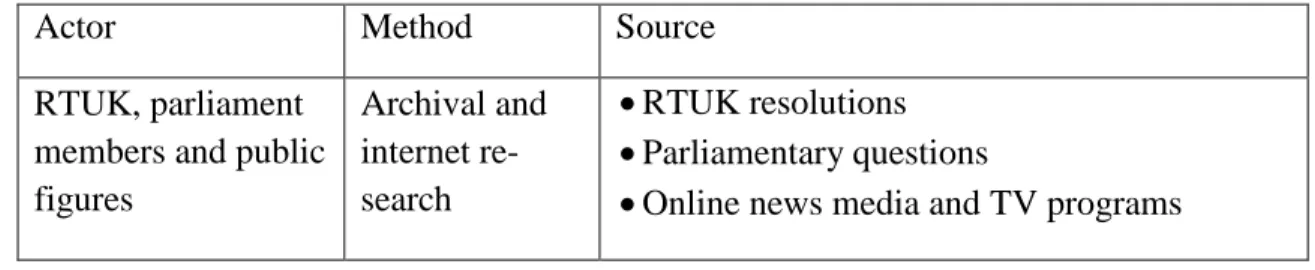
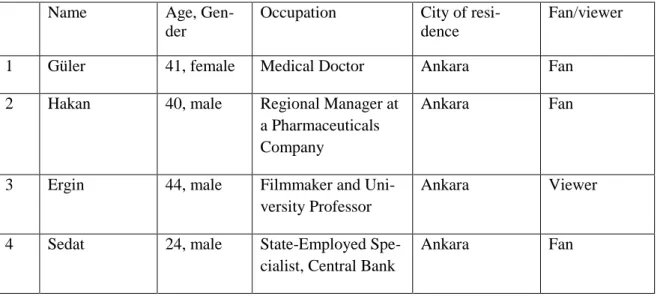
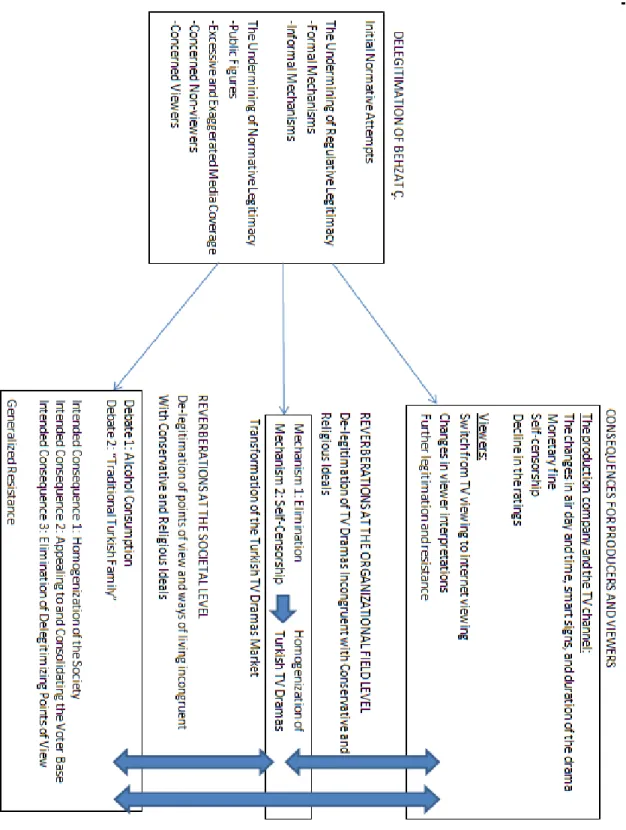
To illuminate the de-legitimation of Behzat Ç., I collected data via interviews, observations, archival and internet research from and about viewers, producers, TV critics and journalists, parliament members, the regulatory body, and public figures. In explaining the findings, I lean on the concepts of regulative legitimacy, normative le-gitimacy, and cultural-cognitive legitimacy borrowed from institutional theory (Hum-phreys 2010a; Hum(Hum-phreys, 2010b; Scott, 1995; Suchman, 1995). I examine the conse-quences of de-legitimation for the marketers, i.e. TV channel and production company, and consumers, i.e. viewers, of the drama as well as its reverberations for Turkish TV dramas market and societal dynamics drawing from Bourdieu’s (1993) discussion of homologies between different fields.
The thesis is structured as follows: In the next chapter, I review the institutional theory literature on legitimacy, legitimation, and other related concepts and highlight the linkage between definitions of legitimacy at different levels. Then, I go over the studies relating to legitimacy and legitimation in consumer research and CCT litera-tures and relations between definitions of legitimacy in different levels in these studies. In the third chapter, I give details about the empirical context and the methodology. I first explicate the context of the Turkish TV dramas market and Behzat Ç., and then go
7
into detail about the data collection from and about different actors, and data analysis. The fourth chapter is devoted to the findings of the study. I present the mechanisms utilized in the de-legitimation of Behzat Ç. and the consequences of de-legitimation for the TV channel, production company, and viewers along with the reverberations for the Turkish TV series market and the society at large. I finish with the discussion of the findings by comparing and contrasting them with prior studies.
8
CHAPTER II
THEORETICAL BACKGROUND
In this chapter, I will provide an overview of the theoretical toolbox I use in making sense of the de-legitimation of the production and broadcast of Behzat Ç. My overview will focus on the notion of legitimacy. I will first explain legitimacy and the related concepts of institutionalization and isomorphism drawing from institutional theory. Then I will highlight the linkages between definitions of legitimacy at different levels focusing on the organizational field level and the societal level. In so doing, I will lean on Bourdieu’s (1993) discussion of homologies between different fields. In order to make sense of de-legitimation at the societal level, I will briefly mention We-ber’s (1978) notion of legitimate authority and Gramsci’s (1971; 2006) theory of cul-tural hegemony. I will also examine the literature on managing legitimacy and legiti-mation as a process. After that, I will go over the studies relating to legitimacy and
9
legitimation in consumer research and CCT literatures. I will review the prior studies that investigate the relations between definitions of legitimacy at different levels. Be-fore moving on to the context and methodology, I will touch upon the literature on tel-evision programming in media and cultural studies and consumer research.
2.1. The Notion of Legitimacy
In this section, I will focus on the notion of legitimacy and some other related concepts in institutional theory. Then, I will dwell on the extant literature on the rela-tions between definirela-tions of legitimacy at different levels. Lastly, I will mention the strategic take on legitimacy which treats it as an asset of the organization and also mention the process of legitimation.
2.1.1. Legitimacy and Related Concepts in Institutional Theory
Institutional theory, also known as new institutionalism in organizational sociol-ogy, is a body of research which extensively inquires “the ways in which action is structured and order [is] made possible by shared systems of rules” (DiMaggio and Powell, 1991: 11). Accordingly, these shared systems of rules are “highly rationalized myths” (Meyer and Rowan, 1977) which are first constructed and then shared and
10
objectified by different types of actors (Berger and Luckmann, 1966). They become taken-for-granted over time. According to Jepperson (1991: 145), an institution comes to stand for “a social order or pattern that has attained a certain state or property” and we consider an order institutionalized if divergences from that order are “counteracted in a regulated fashion, by repetitively activated, socially constructed controls”. With their cognitive, normative, and regulative pillars, institutions appear to individuals as impersonal and objective, although these individuals themselves are the ones who con-structed and maintained these institutions in the first place (Scott, 1995).
Within institutional theory, legitimacy is extensively studied as it is closely relat-ed to institutionalization. The way legitimacy is conceptualizrelat-ed in institutional theory stems from Max Weber’s usage of this notion. According to Weber, in order for a so-cial relationship to be called an order, i.e. institution, it has to be “oriented toward de-terminable maxims” (Weber, 1978: 31). Furthermore, in order for that social order to be deemed legitimate, the orientation towards these maxims should result from indi-viduals’ consideration that this orientation is “in some way obligatory or exemplary” for them, not merely from custom or self-interest. Similarly, in institutional theory, le-gitimacy is defined as “a generalized perception or assumption that the actions of an entity are desirable, proper, or appropriate within some socially constructed system of norms, values, beliefs, and definitions” (Suchman, 1995: 574). Based on this defini-tion, the way to assess the legitimacy of an entity is not solely to check its legality, but to examine the prevalent values and norms in a society and see whether it is fit with
11
them as well (Dowling and Pfeffer, 1975). In this regard, one important aspect of legit-imacy to be stressed here is that it is a generalized perception and thereby it is of a col-lective nature (Ashforth and Gibbs, 1990; Johnson et al., 2006; Scott, 1995). However, it is also important to note that although it is a generalized perception, legitimacy, as is institutional reproduction, is closely linked with the demands of certain powerful ac-tors who have the ability to mold public opinion (DiMaggio and Powell, 1991). After all, social power is the determinant of whose values it is that defines legitimacy (Stinchcombe, 1965 in Scott, 1995).
According to institutional theory, there are three pillars of legitimacy which cor-respond to the three pillars of an institution, which are regulative, normative, and cul-tural-cognitive (Scott, 1995; cf. Suchman, 1995). Regulative legitimacy refers to the extent to which an entity (a practice or an organization) conforms to the set of rules established by a higher-order organization, such as the state. Normative legitimacy re-fers to the extent to which the activities the entity engages in are consistent with the widespread norms and values. Since it denotes to a deeper level beyond legality and assesses the moral acceptability of the entity, the corresponding set of rules is more likely to be internalized by individual actors, and the incentives for conformity consist of intrinsic in addition to extrinsic awards. Cultural-cognitive legitimacy refers to the extent to which the entity is taken-for-granted. It is, in other words, the extent to which the entity can be grasped and made sense of according to the commonly-used cultural and cognitive frames of reference, i.e. "widely held beliefs and taken-for-granted
12
assumptions that provide a framework for everyday routines, as well as the more spe-cialized, explicit and codified knowledge and belief systems promulgated by various professional and scientific bodies" (Scott, 1995: 81). As the definitions suggest, a shift in cultural-cognitive legitimacy is harder to attain and more time-demanding compared to a shift in regulative or normative legitimacy.
Another important concept from institutional theory which is closely linked with legitimacy is isomorphism. Starting with the question why organizations are becoming more and more homogenous, DiMaggio and Powell (1983) conceptualize isomorphism as a process which enforces entities to resemble others that face similar environmental conditions. Following this definition, legitimacy and isomorphism can be said to be going hand in hand. If legitimacy is the extent to which the actions of an entity are ap-propriate according to the established norms and values, it can be inferred that entities get more and more homogenized as they attain legitimacy. In a similar vein, three mechanisms of institutional isomorphic change, proposed by DiMaggio and Powell, show resemblances to aforementioned pillars of legitimacy. The first mechanism called coercive isomorphism “results from both formal and informal pressures exerted on organizations by other organizations upon which they are dependent and by cultural expectations in the society within which organizations function” (DiMaggio and Pow-ell, 1983: 150). While the first part of this definition clearly reminds of regulative le-gitimacy, the second part is more of a cultural-cognitive nature. The second mecha-nism called mimetic isomorphism functions when the environment creates ambiguity
13
and organizations model themselves after other organizations which they regard as le-gitimate or successful. The third mechanism works via normative pressures which specify the way things ought to be in the environment. These two mechanisms are both interrelated with normative legitimacy. While the latter is linked to how factors external to the entity pressurize its normative legitimacy, the former is linked to the entity’s internalization of predominant norms and values in order to attain normative legitimacy.
2.1.2. Legitimacy at Different Levels
Legitimacy, along with institutionalization and isomorphism, can be analyzed in varying levels. In order to account for these different levels it is necessary to introduce the Bourdieuian concept of field, which institutional theorists draw upon in conceptu-alizing organizational field. In Bourdieu’s account, fields are networks of relations be-tween different positions which are objectively defined in accordance with their cur-rent and potential status (Bourdieu, 1993; Swartz, 1996). Within fields, production, exchange and accumulation of valued resources, i.e. specific types of capital, take place between actors occupying these different positions. There is a specific type of capital that prevails in each field. For example, while intellectual capital is the valuable type of capital within the field of artistic production, economic capital is the coin of
14
the realm in the business world. Actors gain access to certain profits that emanate within fields thanks to the specific types of capital they invest in and accumulate.
Drawing upon the Bourdieuian concept of field, DiMaggio and Powell (1983: 148) define organizational field as “those organizations that, in the aggregate, consti-tute a recognized area of institutional life: key suppliers, resource and product consumers, regulatory agencies, and other organizations that produce similar services or products”. The uniqueness of this level of analysis is that it focuses on the totality of relevant actors within the field. While organizational field is the key level of analysis in institutional theory, Scott (1995) mentions four other levels. These are world system level, societal level, organizational population level, and organizational level. Of spe-cial interest to the current study are the organizational (or entity) level (the drama it-self), the organizational field level (the Turkish TV dramas market), and the societal level (the societal dynamics) and the relations between these different levels with re-spect to legitimacy.
According to Bourdieu (1993), actors gain access to specific profits according to their level of capital within fields and thus fields may be thought of as arenas of strug-gle between actors in different hierarchical positions. These actors aim not only to ac-cumulate capital, but also to define what the most valuable form of capital within the field is. As this struggle suggests, fields can also be described as arenas of struggle for legitimacy. In his writings on the field of cultural production, Bourdieu (1993) further asserts that struggle of legitimacy within a field, particularly the field of cultural
15
production, is linked to struggles of legitimacy within the field of class relations and the field of power, i.e. the dynamics within the society and politics. He puts forward that (44):
[t]he field of cultural production produces its most important effects through the play of homologies between the fundamental opposition which gives the field its structure and the oppositions structuring the field of power and the field of class relations… [T]he logic of the homologies between the two spaces means that the struggles going on within the inner field are always overdetermined and always tend to aim at two birds with one stone.
Accordingly, homologies between the fields signify that definitions of legitimacy with-in the field of cultural production are always shaped by those withwith-in the higher order fields. Therefore, the legitimacy of a cultural product is assessed based on its congru-ence with the commonly-held norms and values not only in the field of cultural pro-duction, but also in the field of class relations and the field of power. In the case of Behzat Ç., this comes to mean that the legitimacy of Behzat Ç. is based not only on the definitions of legitimacy within the Turkish TV dramas market, but also on those cir-culating within Turkish society and politics.
The shaping of definitions of legitimacy within the field of cultural production by these higher-order fields is closely related to Gramsci’s thesis on cultural hegemo-ny. According to Gramsci (1971; 2006), supremacy of the dominant class within a so-ciety is ensured not only via economic domination, but also by means of intellectual and moral leadership. The latter comes to mean that the dominant class manipulates the culture of the society so that its worldview is accepted by other groups as common
16
sense and its norms and values are regarded as true, normal and moral. In so doing, it furthers the belief in its legitimacy and justifies its domination (Weber, 1978). Accord-ing to Weber, any form of domination needs to justify itself and therefore attempts to establish and then improve the belief in the legitimacy of its authority. Since justifica-tion is the building block of dominajustifica-tion itself, the dominant continuously engages in actions of self-justification by bringing the principles of its legitimation to the forefront. Therefore, while Behzat Ç. and the organizational field of Turkish TV dra-mas market is shaped by the struggles within the Turkish society and politics, legiti-macy within the former field is an important tool for the political authority to justify its domination within the latter field.
2.1.3. Managing Legitimacy, Legitimation, and De-legitimation
The account of legitimacy presented above mainly aimed to introduce the con-cept, the way it is dealt with in institutional theory, and its pillars, and relations be-tween the ways in which legitimacy is defined and assessed at different levels/fields. This section will add to the understanding of legitimacy by discussing the ways and processes of attaining, extending, maintaining and defending legitimacy and some challenges to it. While in the former sections legitimacy was reviewed with an institu-tional lens, this section takes more of a strategic perspective treating legitimacy as an asset of the entity (organization or company) and also looks at the dynamic process of
17
legitimation. In the next three subsections, I will discuss legitimation by paying atten-tion to how legitimacy is gained/attained and extended, what possible challenges to it are, and how it is maintained and defended against these challenges.
Gaining/attaining and extending legitimacy. In order to attain legitimacy, entities employ certain tactics such as conforming to the environment, selecting which envi-ronments to enter, becoming connoted with what is legitimate, and manipulating the environment as to what counts legitimate (Dowling and Pfeffer, 1975; Suchman, 1995). First of all, when there are strongly established norms and values that shape the definitions of legitimacy within the environment, the entity can choose to conform to the environment (Dowling and Pfeffer, 1975). Secondly, rather than simply conform-ing to the definitions of legitimacy within an environment, the entity can choose to se-lect and subsist in environments in which its activities are deemed appropriate in the first place (Suchman, 1995). Thirdly, the entity can choose to employ communication strategies which will help it to be identified with legitimate norms, values and institu-tions, without altering its actual activities too much (Dowling and Pfeffer, 1975). Last but not the least, another tactic to be employed is to alter what is defined as legitimate in the environment.
Once legitimacy is attained, it can be extended by strengthening the establish-ment of the entity in its particular environestablish-ment or by entering and gaining legitimacy in new environments (Ashforth and Gibbs, 1990). However, entities should be careful in their attempts to extend legitimacy as they “run the risk of “protesting too much”, of
18
being perceived by constituents as precisely the opposite; manipulative and illegiti-mate, and thereby decreasing legitimacy” (Ashforth and Gibbs, 1990: 186). Once the desired level of legitimacy is reached, it is important for the entity to maintain and de-fend it. However, the entity should first be aware of possible challenges to its legitima-cy. The following subsection will first account for these challenges and then discuss the ways to maintain and defend legitimacy.
Challenges and Maintaining/Defending Legitimacy. Legitimacy of an entity con-sists of three pillars which are regulative, normative and cultural-cognitive. While cul-tural-cognitive legitimacy is a much more subtle phenomenon which can be attained or challenged after a long period of changes in regulative and normative legitimacy, more immediate changes are possible in the latter two. Dowling and Pfeffer (1975) put for-ward that challenges to legitimacy are linked to the dynamic between the entity and the environment. Firstly, the alterations in predominant values and norms within the envi-ronment constitute a motivation for change and source of pressure for legitimacy. It is also important to note that alteration in values and norms in higher-order fields can al-so be regarded as a al-source of pressure for legitimacy, as I have elaborated above. Sec-ondly, competition is also a challenge to legitimacy. The rivalry between different enti-ties is a source of pressure for legitimacy as each entity constitutes a threat to others’ legitimacy while trying to extend and maintain its own. Thirdly, the entity’s output, i.e. the type of activities it engages in, also constitutes a source of pressure for legitimacy,
19
since the assessments of legitimacy are based on comparisons between the entity’s ac-tivities, those of others and the conventional norms and values within the environment. While there are constant challenges, it is important for entities to maintain and defend their legitimacy. The efforts to maintain legitimacy start just after the entity reaches a level of legitimacy that is sufficient for ongoing activities, while the efforts to defend legitimacy come to the forefront in situations where the entity’s legitimacy is challenged (Ashforth and Gibbs, 1990; Suchman, 1995). Maintaining legitimacy re-quires the entity to perceive the change in the environment and audiences and to protect what it has accomplished in terms of legitimacy so far. Defending legitimacy, on the other hand, requires a process of repairing by going back to basics of gaining legitimacy.
Legitimation and De-legitimation. The aforementioned ways in which entities can manage legitimacy and possible challenges they may come across with constitutes a strategic perspective on the concept of legitimacy and an introduction to the dynamic nature of this phenomenon. To further comprehend this dynamic nature, it is important to account for the process of legitimation. Legitimation is characterized by “the inter-active and often iterative process of social construction, negotiation and labeling” (Ashforth and Gibbs, 1990: 186) between different groups of actors. According to Johnson and colleagues (2006), this process comprises of four stages, which are denot-ed as innovation, local validation, diffusion, and general validation, respectively. The first stage starts with the introduction of a social innovation, while the second stage is
20
the period during which the innovation is accepted at its immediate local level. The third stage remarks the diffusion of the locally accepted innovation into other contexts. The last stage of the legitimation process witnesses the general validation of the social innovation, i.e. its establishment as an element of the society’s shared culture. The ways to manage legitimacy and challenges entities come across with can be observed throughout the legitimation process.
While this strategic take on legitimacy and the stages summarized here explicate the process of legitimation in a compelling way, the focus on legitimation obfuscates the equally crucial process of de-legitimation to a great extent. Johnson and colleagues (2006) remark that their analysis of the legitimation process has some implications for de-legitimation as well. They put forward that “de-legitimation of an [entity] might begin with a change in the structural conditions that currently undergird [it]” (p. 73). Problematizing the focus on legitimation, the current thesis examines how a (cultural) product (the TV drama Behzat Ç.) gets de-legitimated. Taking inspiration from John-son and colleagues, I pay attention to the structural conditions within the Turkish TV dramas market in which the common norms and values are undergoing a change.
2.2. Legitimacy and Legitimation in Consumer Research and CCT
In this section, I will review consumer research and specifically CCT literature on legitimacy to point out the ways in which this notion is utilized and the ways in
21
which legitimacy is further conceptualized in relation to consumption and markets. I will also focus on how the relations between different fields are taken into account in prior research.
2.2.1. Legitimation and De-legitimation of Products1
Legitimacy with respect to consumption and markets has been studied in con-sumer research and especially in CCT literature. Legitimacy of brands and products such as Botox Cosmetic (Giesler, 2012), Absolut, Coors and Levi’s (Kates, 2004) and Starbucks (Thompson et al., 2006); and consumer practices such as music download-ing (Giesler, 2008), ravdownload-ing/clubbdownload-ing (Goulddownload-ing et al., 2009), Islamic veildownload-ing (tesettür) (Sandıkcı and Ger, 2010), gambling (Humphreys, 2010a; Humphreys 2010b; Hum-phreys and Latour, 2013) and Ottoman coffeehouse consumption (Karababa and Ger, 2011) has been studied. Legitimacy of corresponding industries of clubbing (Goulding et al., 2009); casino gambling (Humphreys, 2010a; Humphreys, 2010b; Humphreys and Latour, 2013), Ottoman coffeehouse (Karababa and Ger, 2011) as well as commu-nity supported agriculture (CSA) (Press and Arnould, 2011) has been examined. In ad-dition, legitimacy of consumers such as Star Trek fans (Kozinets, 2001); Fatshionistas, i.e. plus-sized fashion consumers (Scaraboto and Fischer, 2013), music downloaders
1 From this point onwards, when talking about legitimacy with respect to consumption and markets, I
will briefly use the word “product”. Legitimacy, legitimation or de-legitimation of products will stand for legitimacy, legitimation or de-legitimation of products and brands, consumption practices, and in-dustries in a broad sense. The other terms will be used whenever necessary.
22
(Giesler, 2008), women with tesettür (Sandıkcı and Ger, 2010) and gay consumers (Kates, 2004) has also been discussed.
Among the studies on legitimacy, of special interest to this thesis are the ones that investigate market formation as a process of legitimation. Accordingly, legitima-tion process of a product unfolds as changes in semantic associalegitima-tions go hand in hand with changes in regulative, normative and cultural-cognitive structures (Humphreys, 2010a; Humphreys, 2010b). The process may be facilitated if networks of (political and economic) actors that are powerful enough to challenge the prevailing (taste) structures act as legitimating actors (Sandıkcı and Ger, 2011). Multiplicity of discours-es to derive legitimating tactics/strategidiscours-es from (Karababa and Ger, 2011) and connota-tions with commonly-held cultural imaginaries (Press and Arnould, 2011) may also help legitimation. One common point in these studies is that legitimation is never a smooth process. In the process, groups of actors with divergent interests, and conflicts and negotiations between them are implicated (Giesler 2008; Giesler, 2012; Karababa and Ger, 2011; Thompson et al., 2006). As there are groups of actors with divergent interests, there is a legitimation-de-legitimation dynamic such that while certain actors make an effort to legitimate a particular product, there are others who try to undermine its legitimacy.
Among the studies that touch upon this dialectical relationship between legitima-tion and de-legitimalegitima-tion, Thompson and colleagues’ (2006) and Giesler’s (2012) stud-ies on doppelganger brand image particularly focus on de-legitimating actors.
23
Doppelganger brand image refers to “a family of disparaging images and stories about a brand that are circulated in popular culture by a loosely organized network of con-sumers, antibrand activists, bloggers, and opinion leaders in the news and entertain-ment media” (Thompson et al., 2006: 50). Doppelganger brand images are exemplars of de-legitimating imageries which become threats for the brands in question. In both of these studies, these threats are regarded as manageable, and strategies to cope with them and use them for the brand’s advantage are presented. Therefore, their de-legitimating influences are not deemed intensive. This is stemming from the fact that in both cases the brands (Starbucks and Botox) and the companies owning them were more powerful than the de-legitimating actors, so that they could turn the doppelgang-er brand images to their advantage by adjusting their brand strategies accordingly. Therefore, these imageries do not result in full-fledged processes of de-legitimation because of the relative impotency of the actors enacting them.
Another group of studies that touch upon legitimation-de-legitimation dynamic briefly mention governments’ engagement in de-legitimation of consumption practices (Goulding et al., 2009; Karababa and Ger, 2011; Sandıkcı and Ger, 2010). Goulding et al. mention the role of conservative media and Thatcher government in de-legitimating rave. Karababa and Ger touch upon the Ottoman state and the religious institution’s scrutiny of coffeehouse consumption as the practice was regarded immoral for an ideal Ottoman Muslim. Sandıkcı and Ger mention the role of republican ideology of Turkish Republic and its promotion of modern Turkish identity in stigmatization of Islamic
24
veiling in the first place. However, instead of analyzing the de-legitimation process, these studies primarily focus on the subsequent processes during which governments make concessions and facilitate legitimation and market formation. Goulding et al. find that clubbing emerged as a site of contained illegality in which illegitimate prac-tices of rave were transformed into more predictable and manageable forms with the initiation of marketers and the government. Karababa and Ger find that multiparty re-sistance by consumers and marketers (along with benefits such as tax yields) made the sultan and the religious institution make concessions from their earlier position and become more favorable towards coffeehouse consumption. Sandıkcı and Ger find that the rise of political Islam and the ascent of Islamist Justice and Development Party (Adalet ve Kalkınma Partisi in Turkish; the AKP hereafter) in Turkish political arena played a part in the legitimation of Islamic veiling. All in all, a full-fledged study of how a product or consumption practice gets de-legitimated is lacking in the literature.
In this study, I define de-legitimation as the process through which a product is detached from the predominant rules, norms, values and frames of reference by using regulative, normative and cultural-cognitive mechanisms. Whereas legitimation facilitates the formation of new markets and is significant for the perpetuation of prod-ucts in the marketplace, I argue that de-legitimation damages the marketplace presence and may lead to the elimination of these products. Focusing on a cultural product (the Turkish TV drama Behzat Ç.) which was scrutinized by parliament members, the
25
regulatory body, and public figures because of its allegedly explicit content, I investi-gate de-legitimation via normative and regulative mechanisms.
De-legitimation of a (cultural) product brings the homologies between different levels and the linkages between the definitions of legitimacy at different levels to the forefront. In the next section, I will discuss the studies that touch upon the defini-tions/perceptions of legitimacy within different fields and their interactions.
2.2.2. The Relations between Legitimacy at Different Levels
Reciprocity of legitimacy, as it is accounted for in consumer research, comes to mean that while a consumer or a group of consumers attribute(s) legitimacy to a prod-uct, this particular product also legitimates this consumer or group of consumers in turn (Kates, 2004). Similarly, allying with institutional entrepreneurs may facilitate illegitimate consumers’ quest to become legitimate, and at the same time increase the legitimacy of these entrepreneurs (Scaraboto and Fischer, 2013). While legitimacy of products and brands, consumption practices, consumers, and marketers may be recip-rocal within a field, what is regarded legitimate may also be shaped by perceptions of legitimacy within different fields.
Bourdieu (1993) notes that fields can be regarded as arenas of struggle for legit-imacy. In his account, the oppositions within the field of power and the field of class
26
relations are never independent of each other and they are also influential in shaping the struggles within other (lower-level) fields. A similar relation is also prevalent be-tween the organizational field level and societal level, as described in institutional the-ory (DiMaggio and Powell, 1983; Scott, 1995). The homologies between these the fields at these two levels suggest that a change in the struggles for legitimacy at the societal level would be effective in shaping the struggles at the organizational field level. In this thesis, while focusing on the de-legitimation of Behzat Ç., I also touch upon how the replacement of secular and modern norms and values with religious and conservative ones at the societal level has shaped the organizational field level, namely the Turkish TV dramas market.
Prior research has briefly mentioned the relations between different fields with respect to legitimacy. Scaraboto and Fischer (2013) find that oversized consumers find support in adjacent fields such as the one constituted by the Fat Acceptance Movement in their quest for participation in mainstream fashion markets. Sandıkcı and Ger (2010) acknowledged the role of the AKP’s ascent in the field of power in the legitimation of Islamic veiling for urban middle-class consumers. The current study contributes to this line of research by explicating the linkages between definitions of legitimacy within fields at different levels, namely the organizational field level and the societal level. It seeks out the relations between the legitimacy of Behzat Ç., legitimacy within the Turkish TV dramas market and legitimacy at the societal level, by focusing on the de-legitimation of Behzat Ç.
27
Before continuing with the context and methodology, I will go over the literature on television programming in media and cultural studies and consumer research.
2. 3. Television Programming
Television programming has primarily been the subject matter of media and cul-tural studies, and particularly of television studies. Two streams of research prevalent in this field have been textual analyses of television programs and similar media texts and empirical research on how audiences receive these texts (Ang, 1991; Fiske, 1987; Morley, 1992). While the first stream draws from a text-based semiotics tradition, the second one regards audiences as active social actors that make meanings through en-gaging with media texts. Drawing from Hall’s thesis ([1980] 2006) that while encod-ing (by producers) provides the general framework that can be utilized in makencod-ing sense of media texts, viewer interpretations built through decoding diverge from the ones intended by producers; it opts for empirical (ethnographic) research of audience recep-tion. Henry Jenkins (1992) takes the idea of active audiences a step forward and dis-cusses the ways through which television fans not only actively make meaning out of media texts, but also construct a culture of their own by borrowing from these texts to create parallel fictional stories, songs, poems, etc.
Although sporadic, there have also been investigations of television program-ming and audiences in marketing and consumer research literature. In line with the two
28
streams in television studies, research has focused on textual analyses of consumption meanings in television texts and also ethnographic investigations of viewers (blurring or neglecting the line between consumption and viewership)2. An early example of the textual analyses was Hirschman’s (1988) study of TV dramas Dallas and Dynasty as carriers of consumption ideology in which she investigates the messages about secular and sacred consumer behaviors within these texts. Other studies from this stream focus on consumption’s role in resolving and resulting in tensions related to countervailing discourses of gender as represented in TV dramas (Zayer, Sredl, Parmentier and Cole-man, 2012) and mobilization of audiences’ emotional engagement with reality shows by TV producers for profit-making (Bonsu, Darmody and Parmentier, 2010). One path taken by consumer researchers that employ ethnographically-informed studies of audi-ence reception has been examining the interpretive strategies of consumers in their en-gagement with television and other media texts (Hirschman and Thompson, 1997; Russell, Schau and Crockett, 2013; Schau and Russell, 2004). Hirschman and Thomp-son identify three strategies, which are inspiring and aspiring, deconstructing and re-jecting, and identifying and individualizing. Similar to the third strategy offered by them, Russell et al. introduce the term homophilization, which comes to stand for con-sumers’ relating to TV texts by associating certain elements of them with their
2 According to Graeber (2011), TV viewing should not be regarded as a form of consumption. While
consumption is, in the very basic sense, a metaphor of eating (Wilk, 2004), there is no reason to extend the metaphor this far to include viewership. While Wilk points out that we should consider how far we really want to extend the metaphor, in consumer research as well as in media studies many scholars use the term “TV consumption”. Throughout this thesis, I refrain from this usage and regard the Behzat Ç. followers as viewers (and fans). As I will explicate below, I do not dwell primarily on the viewing prac-tices, but focus on the interactions between different actors in the Turkish TV dramas market and specif-ically those surrounding Behzat Ç.
29
everyday (consumption) experiences. The second path taken in ethnographically-informed studies has been studying the tensions and paradoxes consumers encounter with or resolve in their TV viewership (Kjeldgaard and Storgaard Nielsen, 2010; Rose and Wood, 2005). These studies have focused on consumers’ tensions and negotiations related to countervailing discourses of gender within the dramas they watch (Kjeld-gaard and Stor(Kjeld-gaard Nielsen, 2010) and paradoxes they encounter with in their quest for authenticity in viewing reality TV. On the other hand, Kozinets’s (2001) study of Star Trek consumers is possibly the greatest example of viewer ethnographies in con-sumer research. This study takes into account not only interpretive strategies and ten-sions and paradoxes of consumers, but also how these are shaped by producers, sub-cultures and wider cultural meanings that circulate in the Star Trek culture of con-sumption. In addition to textual analyses and ethnographic investigations of audience reception, there are also quantitative studies that employ survey methodology focusing on the context of TV programming in consumer research. The relationship between TV viewing and consumer perceptions of social reality (Shrum, Wyer and O’Guinn, 1998) and the relationship between TV viewing and consumer beliefs about the perva-siveness of products and consumer practices that connote an affluent consumer style are examined (O’Guinn and Shrum 1997). A connectedness scale which measures consumers’ level of engagement with a TV program and its characters is developed (Russell, Norman and Heckler, 2004).
30
As Jansson (2002) proposes, it is possible to conceive of the contemporary socie-ty as an image culture, a term which draws upon the interlinkages between what we call consumer culture and media culture. Therefore, it is not unusual to see consumer researchers examining media contexts, particularly those of TV programming. Alt-hough the aforementioned studies investigated different aspects of TV texts and audi-ences’ reception of these texts, there hasn’t been to date a study which focuses on TV markets, rather than TV texts and viewership. Although Kozinets (2001) does a good job in examining the interactions between consumers, subcultures, producers and widespread cultural meanings; he emphasizes on how all these practices shape con-sumer interpretations of Star Trek texts and objects instead of focusing on market-level implications. As Bagozzi (1975) points out, TV markets are systems of complex exchange in which relationships between various actors are played out. Therefore, fo-cusing on one such market, it is possible to answer Penaloza and Venkatesh’s (2006) call for studying markets as social constructions in which consumers, marketers, and other actors can be investigated as constituting parts of social groups. In an attempt to address this issue, I utilize a relational approach to examine Behzat Ç. viewers, pro-ducers, broadcasting TV channel, the regulatory body, and other actors within and be-yond the Turkish TV dramas market throughout the de-legitimation process (Penaloza, 2001).
The research questions that direct this study are as follows: (1) How does a (cul-tural) product, namely the TV drama Behzat Ç., get de-legitimated? (2) What is the
31
role played by different actors, such as consumers, marketers, media, and the govern-ment, in de-legitimation? How do these actors shape legitimation-de-legitimation dy-namics? (3) How does de-legitimation shape the practices and interpretations of these different actors? What are the reverberations of de-legitimation at the organizational field (the Turkish TV dramas market) and the societal levels? How do definitions of legitimacy within these different levels relate to each other? In the next chapter, I will detail the empirical context and the methodological tools utilized to address these re-search questions.
32
CHAPTER III
CONTEXT AND METHODOLOGY
In this chapter, I will first talk about the context of the study: Turkish TV dramas market and especially the Behzat Ç. case. Then I will explicate the data collection and analysis methods utilized. I will finish with methodological and contextual limitations.
3. 1. Context
The broad empirical context of the study is the organizational field of the Turk-ish TV dramas market3. In order to make sense of the de-legitimation of Behzat Ç., it
3
Throughout this thesis, I use “drama” as an umbrella term. I refrain from using the term “series”, be-cause Turkish dramas contain elements from both “series” and “serial” genres. While series comes to mean a single story broken into different episodes, serial refers to a show with the same characters but a
33
is important to understand the dynamics of this field, how it is shaped by the political authority and the position Behzat Ç. occupies in it. Therefore, I will first make a brief introduction to the emergence and the current state of Turkish TV dramas. Then, I will briefly mention the current government and its attempts to shape media environments including the Turkish TV dramas market with recourse to its politico-moral ideals. Lastly, I will describe Behzat Ç. and the ongoing debate about it.
3. 1. 1. The Turkish TV Dramas Market
The first examples of domestically-produced TV dramas met Turkish audience in the state-run TV channel TRT (abbreviation of Turkish Radio and Television Cor-poration) in mid-1970s (Çelenk, 2010; Yağcı, 2011). While many dramas in both serial and series formats were produced and broadcasted by TRT in late 70s and 80s, the ac-tual proliferation of Turkish TV dramas became possible when private TV channels started broadcasting in early 1990s. The wave of liberalization initiated by the center-right nationalist Motherland Party (Anavatan Partisi) which was in power from 1983 to 1991 had important impact on media. With the initiation of Turgut Özal, the found-ing leader of the party (PM from 1983 to 1989 and President from 1989 to 1993), 12 private TV channels were founded from 1990 to 1993 (Serim, 2007). The audience
different story each episode. Although they are rare when compared to dramas, there are also comedies (especially sitcoms) broadcasted in Turkish televisions. When I use the term Turkish TV dramas market, I also refer to them.
34
interest in TV dramas, which was even prevalent in fan letters sent to TRT in 1970s, came to the forefront in 1990s with the establishment of private TV channels and paved the way for the proliferation of domestically-produced TV dramas (Çelenk, 2010). Late 1990s and early 2000s witnessed the rise of a TV dramas industry in Is-tanbul which has developed to an unprecedented magnitude in a short span of time. For the viewers, watching Turkish TV dramas has become the most common practice of evening entertainment and way of spending time with family. By the second half of 2000s, in order to attract audience attention, get high ratings and thereby guarantee a bigger slice of the advertisement cake which amounts to approximately 4.5 billion Turkish Liras, national TV channels filled the prime-time with TV dramas, an episode of which lasts for 85 to 120 minutes. During the 2013-2014 television season, approx-imately 60%-65% of primetime schedules was occupied with Turkish TV dramas and 50%-55% of top 5 programs in rating lists was comprised of the dramas (Deloitte, 2014). Especially the period between 2005 and 2008 witnessed the boom of Turkish TV dramas (ISMMMO, 2008). In 2008, 63 domestically-produced dramas were broadcasted in 11 national channels, while the size of the industry amounted to 1 bil-lion Turkish Liras. At the same time, the boom in the industry paved the way for Turk-ish TV dramas to become export commodities to Middle East, Balkans, Middle Asia, and then Northern Europe.
Since Turkish TV dramas are produced and broadcasted with the aim of scoring high ratings to charge high prices for advertisement slots, they are intended to reach
35
the widest possible public. As such, external demand from audiences and investment profitability are important concerns that direct the cultural production of Turkish TV dramas, which limits the autonomy of the producers. The two key stakeholders within the organizational field of the Turkish TV dramas market are the national TV channels and independent production companies (Deloitte, 2014; ISMMMO, 2008; ISMMMO, 2010). While some TV channels undertake the production of the dramas they broad-cast, 90 percent of Turkish TV dramas are produced by independent production com-panies and marketed to the channels. Producers generally make agreements with the TV channels on the basis of rating forecasts; the competition is so fierce that if the tar-geted level of ratings is not achieved, a drama gets cancelled after only a few episodes. In the production of each drama, 60 to 100 cast and crew members, including (execu-tive) producers, directors, actors and actresses, and musicians, work collaboratively.
Although the Turkish TV dramas industry has reached a non-ignorable size via the transactions between the aforementioned stakeholders and there are lucrative do-mestic and foreign markets for its products, dramas broadcasted in major TV channels have been thematically bound with certain discourses and thereby similar storylines are repeated over and over again. For one thing, a conservative discourse which sacral-izes “the traditional Turkish family” has been an important pillar of Turkish TV dra-mas starting from the early 1990s (Yağcı, 2011). Similar conservative sentiments can be observed in mafia dramas (Deliyürek [Crazy Heart], 1998; Kurtlar Vadisi [Valley of the Wolves], 2003), dramas that portray the still-continuing feudal system in
36
Southeast Turkey (for example Asmalı Konak [The Mansion with Wines], 2002; Sıla, 2006] and crime-dramas that are adorned with messages which foster a positive image of police department in the society (for example Yılan Hikayesi [The Story of the Snake], 1999; Arka Sokaklar [Back Streets], 2006). Altough conservative and also re-ligious sentiments are widespread in these dramas, it is important to note that TV dra-mas in Turkey are still founded on a liberal and secular basis as per the language of television programs (such as dramas, reality shows, quiz shows, etc.) in general (Tay-fun Atay, ‘Televizyon Seküler Sever’, Radikal; October 30, 20124).
On the other hand, 2000s are regarded as a period during which Turkish TV dramas have become “politicized” (Emre Çetin, 2014). Politicization took place through the emergence of dramas that deal with contemporary political issues (Kurtlar Vadisi Pusu [Valley of the Wolves: Ambush], 2007; Sakarya Fırat [2009]), dramas that settle accounts with the past (Çemberimde Gül Oya [Rose Embroidery on My Hoop], 2004; Öyle Bir Geçer Zaman Ki [As Time Goes By], 2010;), neo-Ottoman cos-tume dramas (Muhteşem Yüzyıl [The Magnificent Century], 2011; Ertuğrul: Diriliş [Resurrection], 2014) and the introduction of piety and Islamic worldview in storylines (Kurtlar Vadisi Pusu, 2007; Huzur Sokağı [Peace Street], 2012). However, the politici-zation of TV dramas has been far from democratizing Turkish television; on the con-trary, it paved the way for interventions from the government which directly target the content of the dramas. In the next section, I will illustrate how the political authority
4