Mindful eating questionnaired: eating control, emotional
eating and conscious nutrition trio
Gizem Kose
1, Ertugrul Ciplak2
1Department of Nutrition and Dietetics, Istanbul Kent University, Istanbul, Turkey - E-mail: [email protected]; 2 Depart-ment of Physical Education and Sport, Zonguldak Bulent Ecevit University, Zonguldak, Turkey
Summary. Objective: Present study, it was aimed to determine the relationship between university students’ mindful eating according to their age, body mass index and gender, and also to find mindful eating and sub-scales correlations and relationships, especially between emotional eating. Methods: This cross-sectional study was conducted 400 randomly selected undergraduate students in a university in Turkey. Participants completed Mindful Eating (MEQ) questionnaire that included questions related to their eating discipline, mindfulness, eating control, disinhibition, etc. Results: In our study, participants were aged between 18-26 and 35.0% were female and 65.0% were male, the mean BMI (kg/m²) was 22.93±2.93. There were no significant difference be-tween participants applied with national examination and taken the talent selection in any statistical assessment (p>0.05). Mean MEQ score was 3.14±0.44 and there was no statistically significant difference between males (3.14±0.45) and females (3.14±0.43) (p> 0.05). Obese group was found to be having less MEQ scores than any other BMI classes and participants in normal weight group had the highest MEQ score (p<0.05). Obese participant found to have less disinhibitio n, eating discipline, emotional eating, and conscious nutrition scores (p<0.05). In correlations, when age increased, BMI (r=0.122, p=0.015), mean MEQ score (r=0.156, p=0.002), emotional eating (r=0.250, p=0.000), eating discipline (p=0.124, p=0.013), and interference (r=0.128, p=0.010) increased statistically significantly. There was strong correlation between total MEQ and subscales (p<0.01). Eating control, emotional eating, mindfulness, conscious nutrition and interference had a strong correlation (p<0.01). Conclusion: Young adulthood is an important stage of life to create lifelong eating and nutritional hab-its. With age, body mass index increases as expected, but this can lead to impair life quality. It is vital to detect mindful eating status and make an intervention about nutrition and eating.
Keywords: Mindful eating, mindfulness, nutrition, emotional eating, body mass index.
Introduction
Mindful eating is an approach adapted from mindfulness to eating food with focusing internal awareness and experience (1,2). Mindful eating is use-ful for making healthier food choices (3), overcoming binge eating (4,5), stopping overeating (6,7), dealing emotional eating (8-10), and not only weight man-agement but also maintenance (11). It is a known fact that weight loss with strict or calorie restricted diets is not permanent and as a result weight regain can be
inevitable. Researchers suggest mindful eating added weight management treatment programs especially for overweight and obese individuals (6,8,12).
Obesity is generally caused by overeating. Over-eating has been increasing rapidly between young adults (8,11). It can be occurred by emotional or exter-nal factors. When emotioexter-nal factors are formed by the influence of emotions and thoughts, external factors consist of factors such as the smell or appearance of food (13-15). Overeaters can have a meal even if they are full because of strong external factors. Meal
por-tion can be controlled by mindful and intuitive eating trainings (16). Body mass index increase has an effect on mindful eating such as decline. Because of this bi-directional effect, being overweight or obese can cause emotional and external eating (17,18). Because indi-viduals with high BMI cannot give their attention to food and internal signals (19).
Emotional eating was found to be strongly related to overeating and becoming overweight (7). If emo-tional eating cannot be controlled, it can lead to weight gain in the life stream in the future. It can be seen as a negative factor in the performance of athletes (20,21) as it will negatively affect sedentary individuals’ body weight management (11,12). Emotions stops dishin-bition system to work properly in our brain. In some researches it was found that they have strong negative effects to each other (22, 23).
Having right knowledge about healthy nutrition and mindful eating help individuals to avoid obesity and risk factors of it in the future (24,25). To be able to consciously manage both eating attitudes and body weight, eating mindfully is an essence. Mindful eating has an anti-overeating effect on especially impulsive or automatic eating habits. Especially seeing food had the strongest effect on individuals as making them want to eat much more than other senses (15,25). If there is no self-control, automatic eating will happen. Be-ing aware of hunger type (emotional or physical) is es-sential as listening internal signals, when to start and when to stop eating can stop disordered eating (16,22). Physical activity helps to keep body mass index under control. however, in some cases it may also have an adverse effect (26). Besides, people think that doing physical activity has a ticket to unlimited food intake. When individuals make intense exercises, it can cause eating more because of some internal signal changes like leptin, ghrelin or any other agents (27). Excessive physical activity is as harmful as unlimited or over-eat-ing, forwhy eating regularly and staying in the limits is important. Being a ‘natural mindful eater’ is a key to have normal eating patterns (3,22). Eating consciously may have great benefits in preventing emotional eating (28). Many researchers and studies found relationships and differences between gender, body mass index and Mindful Eating Questionnaire (1-4, 10, 16, 19, 22, 24, 26,28-33).
The main purpose of present study is to determine relationships between university students’ age, gender, BMI with overall scores of Mindful Eating Question-naire (MEQ) and the subscale scores. We hope to shed light for future studies about mindful eating for sup-porting young adults to be more advantageous having a healthy life than other individuals.
Materials and Methods
In the present study, a questionnaire form con-sisting of 3 questions including age, gender, applica-tion informaapplica-tion was used and body mass index that was calculated as body weight (kg) / height² (m) after measurement of body weight and height. The World Health Organization classification was used for BMI classification (34). The data of the students who ap-plied with the national examination and taken the tal-ent selection were evaluated.
Mindful Eating Questionnaire (MEQ)
Mindful Eating Questionnaire (MEQ) was de-veloped in 2009 (1). Kose et al. (2016) adapted to Turkish as MEQ-30 The subscales were divided into seven as disinhibition (mindless eating), emotional eating, eating control, mindfulness, eating discipline, conscious nutrition and interference (3). Examples of items are “I eat healthy,” and “I eat chocolate to make myself happy”. The scoring of the scale is as follows: Items 1, 7, 9, 11, 13, 15, 18, 24, 25 and 27 are scored straight, and the remaining questions are scored reverse (Reverse Scoring: 1=5, 2=4, 3=3, 4=2, 5=1). In original form of MEQ cronbach’s alfa,was 0.640, Turkish form was 0.733, in this study it was found 0.761.
Statistical analysis
In the study, reliability tests of scale (cronbach’s alfa), Student t-test, one-way ANOVA, chi-square analysis, Kolmogorov-Smirnov normality test, Mann Whitney U and Kruskal-Wallis test, Pearson and Spearman correlation analysis were used to evaluate age, BMI, the MEQ and PSQI total and score groups. Data were analyzed by using the IBM SPSS Statistics version 21 software for Windows. Significance level was taken as p<0.05.
Results
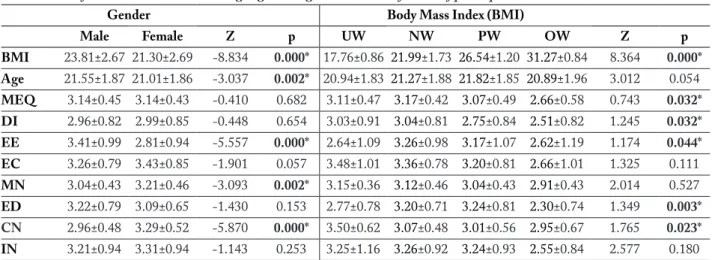
In this present study, 65.0% of the participants were male, %35.0 were female and the mean age was 21.36±1.88 years. There was no significant difference between participants applied with national examina-tion and taken the talent selecexamina-tion (p>0.05). Mean body mass index (BMI, kg/m²) of total participants was 22.93±2.93; according to gender, 23.81±2.67 in males and 21.30±2.69 in females (p<0.001). BMI clas-sification distribution was divided into four groups in males as 0.8% underweight (UW), 69.6% normal weight (NW), 27.3% pre-obese (PW), 2.3% obese (OW) and in females as 11.4% UW, 38.0% NW, 12.3% PW, 2.3% OW (p<0.000).
Mean scores of MEQ was 3.14±0.44, highest and lowest score of the subscales were interference (3.24±0.94) and disinhibition (2.97±0.83). Mean MEQ scores of males (3.14±0.45) and females (3.14±0.43) were so close but there was no significant difference (p>0.05). When BMI classification evaluated, it is found that normal weight (NW) had the highest and obese group (OW) had the lowest mean MEQ score (3.17±0.42 and 2.66±0.58, p<0.05).
It is found that males had more emotional eating than females and females had more mindfulness and conscious nutrition than males (p<0.05). Neverthe-less, the relationship with BMI is OW group had less
mean scores of all MEQ subscales than other classes (p<0.05) and interestingly UW group got close mean emotional eating score (p<0.05). Obese participants were found to have less disinhibition, eating discipline and emotional eating, and conscious nutrition scores compared to other BMI groups (p<0.05).
In the present study, correlations between partici-pants showed us while age increased, BMI (r=0.122, p=0.015), mean MEQ score (r=0.156, p=0.002), emotional eating (r=0.250, p=0.000), eating disci-pline (p=0.124, p=0.013), and interference (r=0.128, p=0.010) increased statistically significant but the re-lationship with other subscales were not significant (p> 0.05). There was strong correlation between total MEQ and subscales (p<0.01).
A significant relationship was found between BMI and both eating control (r=-0.129, p<0.05) and conscious nutrition (r=-0.140, p<0.01). While con-scious nutrition increases, dealing with emotional eat-ing increased too (r=0.137, p<0.01). Eateat-ing control, emotional eating, mindfulness, conscious nutrition and interference had a strong correlation (p<0.01).
Discussion
In this present study we focused on the rela-tionship between participants’ mindful eating scores
Table 1. Score of scales and subscales according to gender, age and BMI classification of participants
Gender Body Mass Index (BMI)
Male Female Z p UW NW PW OW Z p BMI 23.81±2.67 21.30±2.69 -8.834 0.000* 17.76±0.86 21.99±1.73 26.54±1.20 31.27±0.84 8.364 0.000* Age 21.55±1.87 21.01±1.86 -3.037 0.002* 20.94±1.83 21.27±1.88 21.82±1.85 20.89±1.96 3.012 0.054 MEQ 3.14±0.45 3.14±0.43 -0.410 0.682 3.11±0.47 3.17±0.42 3.07±0.49 2.66±0.58 0.743 0.032* DI 2.96±0.82 2.99±0.85 -0.448 0.654 3.03±0.91 3.04±0.81 2.75±0.84 2.51±0.82 1.245 0.032* EE 3.41±0.99 2.81±0.94 -5.557 0.000* 2.64±1.09 3.26±0.98 3.17±1.07 2.62±1.19 1.174 0.044* EC 3.26±0.79 3.43±0.85 -1.901 0.057 3.48±1.01 3.36±0.78 3.20±0.81 2.66±1.01 1.325 0.111 MN 3.04±0.43 3.21±0.46 -3.093 0.002* 3.15±0.36 3.12±0.46 3.04±0.43 2.91±0.43 2.014 0.527 ED 3.22±0.79 3.09±0.65 -1.430 0.153 2.77±0.78 3.20±0.71 3.24±0.81 2.30±0.74 1.349 0.003* CN 2.96±0.48 3.29±0.52 -5.870 0.000* 3.50±0.62 3.07±0.48 3.01±0.56 2.95±0.67 1.765 0.023* IN 3.21±0.94 3.31±0.94 -1.143 0.253 3.25±1.16 3.26±0.92 3.24±0.93 2.55±0.84 2.577 0.180 *p<0.05
UW: Underweight, NW: Normal Weight, PW: Pre-obese, OW: Obese, MEQ: Mindful Eating Questionnaire, BMI: Body Mass Index, DI: Disinhibition, EE: Emotional Eating, EC: Eating Control, MN: Mindfulness, ED: Eating Discipline, CN: Conscious Nutrition, IN: Interference.
according to their age, gender and body mass index. Withal, our results stated some statistically significant correlations between mindful eating and all subscales.
In this study, 35.0% of the participants were fe-male, and the mean age was 21.36±1.88 years (data not shown in tables). Mean scores of MEQ was 3.14±0.44, highest and lowest score of the subscales were interfer-ence (3.24±0.94) and disinhibition (2.97±0.83).
Framson et al. (2009) studied with the original form of MEQ, found body mass index (BMI, kg/ m²) ranged from 17.7 to 62.0 and mean of BMI was 24.2±5.1. Similarly, Moor et al. (2013), Anderson et al. (2016), Clementi et al. (2017), Choi and Lee (2019) studied with mostly normal weight group. In a research, it was found that 50.7% of the participants were women, mean BMI was 24.57±6.05 kg/m² (31) and in another study classified BMI to four groups as in our study (33). In the present study, mean BMI of participants was 22.93± 2.93; according to gender and classification, 23.81±2.67 and 0.8% underweight (UW), 69.6% normal weight (NW), 27.3% pre-obese (PW), 2.3% obese (OW) in males and, 21.30±2.69 and 11.4% UW, 38.0% NW, 12.3% PW, 2.3% OW in females (p<0.001) with a good consistency with other studies, conducted on mostly participants with normal weight.
Mindful eating questionnaire, subscales, gender and BMI relations
In general, it is thought that females eat more emo-tionally than men. Clementi et al. (2017) and Choi and Lee (2019) couldn’t find any mean MEQ score difference between gender. In the present study, mean MEQ scores of males (3.14±0.45) and females (3.14±0.43) were so close but there was no significant difference (p>0.05). It is found that males had more emotional eating dealing than females and females had more mindfulness and conscious nutrition than males (p<0.05).
Body weight and BMI is strongly related to de-creased mindful eating (8). Framson et al. (2009) stated that lower MEQ score was significantly related to obese women. Moor et al (2013) and Anderson et al (2016) could not find a significant relationship between BMI classification and MEQ. Mason et al. (2016) conducted a study on obese women and
re-T able 2. Corr elatio ns bet ween age
, BMI and MEQ,
MEQ subsc ales (n=400) Var iables Age BMI MEQ DI EE EC MN ED CN IN r p r p r p r p r p r p r p r p r p r p Age BMI 0.122 0.015* MEQ 0.156 0.002** -0.064 0.201 DI 0.071 0.154 -0.067 0.180 0.800 0.000** EE 0.250 0.000** 0.097 0.052 0.736 0.000** 0.565 0.000** EC -0.015 0.771 -0.129 0.010* 0.665 0.000** 0.445 0.000** 0.369 0.000** MN 0.000 0.995 -0.065 0.198 0.173 0.001** -0.029 0.566 -0.053 0.288 0.140 0.005** ED 0.124 0.013* 0.022 0.667 0.296 0.000** 0.091 0.068 0.052 0.303 0.060 0.228 0.085 0.091 CN -0.042 0.406 -0.140 0.005** 0.486 0.000** 0.371 0.000** 0.137 0.006** 0.264 0.000** 0.047 0.352 0.067 0.182 IN 0.128 0.010* -0.056 0.260 0.614 0.000** 0.505 0.000** 0.413 0.000** 0.353 0.000** -0.062 0.213 0.120 0.016* 0.269 0.000** *p<0.05, **p<0.01 MEQ: Mindful Eating Q uestio nnair e, BMI:
Body Mass Index,
DI: Disinhibitio n, E E: Emotio nal Eating , EC: Eating Co ntr ol, MN: Mindfulness, E D: Eating Discipline , CN: Co nscious N utr itio n, IN: Inter fer ence.
ported mean MEQ score as 2.6±0.3. In their study, Fung et al (2016) noticed that mindful eating sta-tus can be predictive for body weight management. Similarly, in this study, it is found that normal weight (NW) had the highest (3.17±0.42) and obese group (OW) had the lowest mean MEQ score (2.66±0.58, p<0.05). In so many studies it was found that mind-ful eating scores were significantly lower among obese participants (p<0.001) (28,32,33). Choi et al. (2019) concluded that obese individuals had more emotional eating. In another study BMI and awareness factor had a strong relationship (p<0.05) (33). Mason et al (2016) found that participants with high BMI had decreased emotional eating scores. Nevertheless, in this study, OW group had less mean scores of all MEQ subscales than other classes (p<0.05) and interestingly UW group got close mean emotional eating score (p<0.05). Obese participants were found to eat without thinking (disinhibition), have difficulties with meal time-order (eating discipline) and manage emotions when there is a food presence (emotional eating), and the most importantly eating consciously or nutrition knowledge (conscious nutrition) compared to other BMI groups (p<0.05).
Correlations between MEQ, subscales, age and BMI Emotional eating subscale increased with age (1,23,26,28). In their study, Framson et al. (2009) stat-ed that as the age increasstat-ed, four subscales (mindful-ness, disinhibition, emotional eating and external cues) increased, but MEQ and distraction subscale did not change. Choi and Lee (2019) found a relationship be-tween age and emotional eating (p<0.05). In the pre-sent study, correlations between participants showed us age had a significant positive correlation with BMI, mean MEQ score, emotional eating, eating discipline, and interference (p>0.05) but the relationship with other subscales were not significant (p> 0.05).
Framson et al (2009) stated that BMI and both MEQ and all subscales were negatively correlated (p<0.001). Additionally, Moor et al. (2013) reported a negative correlation between BMI, disinhibition and emotional eating subscales. In other studies, Grin-nell et al. (2011), Moor et al. (2013), Beshara et al. (2013), Webb et al. (2018), and Choi and Lee (2019) found a negative correlation with MEQ scores and
body weight (p <0.05). On the other hand, some stud-ies didn’t report any significant relationship between BMI and MEQ scores (p>0.05) (29,31). In this study, a significant negative correlation was reported between BMI and both eating control (r=-0.129, p<0.05) and conscious nutrition (r=-0.140, p<0.01). It seems to be obese individuals do not have eating control when they are eating, and maybe that is why gaining weight. And because the lack of nutritional knowledge, BMI and conscious nutrition were inversely associated. These results showed us that as BMI increases, eating atti-tudes may impair and, it can be hard to focus on eating because of internal and external distractions. In inter-ventional studies, Dalen et al. (2010), Daubenmier et al. (2011), Timmerman and Brown (2012), Hendrick-son and Rasmussen (2013), Werthmann et al. (2016), Dunn et al. (2018), Dibb-Smith et al. (2019), and Giannopoulou et al. (2020) all stated that with nutri-tion educanutri-tion or mindful eating intervennutri-tion partici-pants lost weight, their health outcomes showed posi-tive developments and mindful eating status increased (p<0.05). We can say that these participants need nu-trition educations.
MEQ and subscales
Both Grinnell et al. (2011) and Beshara et al. (2013) stated a negative correlation with emotional eating and disinhibition subscales (p<0.05). Ab-baspor et al. (2018) stated that MEQ is negatively correlated with disinhibition and emotional response (p<0.05). Choi and Lee (2019) found strong correla-tion between MEQ and all subscales except external cues, and disinhibition and emotional response were positively correlated (p<0.001). It was concluded that mindful eating was inversely correlated with negative emotions and emotional eating (p=0.0001) (9). Gian-nopoulou et al. (2020) concluded that MEQ and all subscales are negatively correlated with binge eating (p<0.05) except awareness. In this study, conscious nu-trition and dealing with emotional eating were posi-tively correlated (p<0.01). Eating control, emotional eating, mindfulness, conscious nutrition and interfer-ence had a strong correlation, too (p<0.01). Besides, there was strong correlation between total MEQ and subscales (p<0.01). In harmony with other researches, MEQ and subscales shows good consistency. Now we
know from the studies that emotional eating can be prevented by mindful eating interventions.
Conclusion
Young adulthood is a crucial period of life because life-long habits are started to route in exact that time. It is important to detect status of mindful eating and make an intervention for individuals. Mindful eating inter-ventions within the framework of nutritional educa-tions have been useful for treatments and prevention of obesity or eating related diseases.
Acknowledgements
Special thanks to Assoc. Professor Erkut Tutkun for his intense support.
References
1. Framson C, Kristal AR, Schenk JM, Littman AJ, Zeliadt S, Benitez D. Development and validation of the mindful eating questionnaire. Journal of the American Dietetic As-sociation 2009; 109(8): 1439-44.
2. Moor KR, Scott AJ, McIntosh WD. Mindful eating and its relationship to body mass index and physical activity among university students. Mindfulness 2013; 4: 264-74.
3. Kose G, Tayfur M, Birincioğlu I, Donmez A. Adaptation Study of the Mindful Eating Questionnare (MEQ) into Turkish, Journal of Cognitive-Behavioral Psychotherapy and Research 2016; 5(3): 125-34.
4. Giannopoulou I, Kotopoulea-Nikolaidi M, Daskou S, Mar-tyn K, Patel A. Mindfulness in Eating Is Inversely Related to Binge Eating and Mood Disturbances in University Stu-dents in Health-Related Disciplines. Nutrients 2020; 12(2): 396.
5. Kristeller JL, Wolever RQ. Mindfulness-based eating awareness training for treating binge eating disorder: The conceptual foundation. Eating Disorders 2011; 19: 49–61. 6. Ozkan N, Bilici S. New Approaches in Eating Behavior:
In-tuitive Eating and Mindful Eating. Gazi Journal of Health Sciences 2018; 3(2): 16-24.
7. Daubenmier J, Kristeller J, Hecht FM, Maninger N, Kuwata M, Jhaveri K, et al. Mindfulness Intervention for Stress Eat-ing to Reduce Cortisol and Abdominal Fat among Over-weight and Obese Women: An Exploratory Randomized Controlled Study. Journal of obesity 2011; 651936.
8. Fung TT, Long MW, Hung P, Cheung LW. An expanded model for mindful eating for health promotion and sustain-ability: issues and challenges for dietetics practice. Journal
of the Academy of Nutrition and Dietetics 2016; 116(7): 1081-6.
9. Czepczor-Bernat K, Brytek-Matera A, Gramaglia C, Zeppegno P. The moderating effects of mindful eating on the relationship between emotional functioning and eating styles in overweight and obese women. Eating and Weight Disorders-Studies on Anorexia, Bulimia and Obesity 2019; 1-9.
10. Sarto HM, Barcelo-Soler A, Herrera-Mercadal P, Pantilie B, Navarro-Gil M, Garcia-Campayo J, Montero-Marin J. Efficacy of a mindful-eating programme to reduce emotion-al eating in patients suffering from overweight or obesity in primary care settings: a cluster-randomised trial protocol. BMJ open 2019; 9(11).
11. Dunn C, Haubenreiser M, Johnson M, Nordby K, Ag-garwal S, Myer S, Thomas C. Mindfulness approaches and weight loss, weight maintenance, and weight regain. Cur-rent obesity reports 2018; 7(1): 37-49.
12. Fuentes Artiles R, Staub K, Aldakak L, Eppenberger P, Rühli F, Bender N. (2019). Mindful eating and common diet programs lower body weight similarly: Systematic re-view and meta-analysis. Obesity Rere-views, 20(11), 1619-1627.
13. Timmerman GM, Brown A. The effect of a mindful restau-rant eating intervention on weight management in women. Journal of nutrition education and behavior 2012; 44(1):22-8. 14. Dalen J, Smith BW, Shelley BM, Sloan AL, Leahigh L,
Begay D. Pilot study: Mindful Eating and Living (MEAL): weight, eating behavior, and psychological outcomes as-sociated with a mindfulness-based intervention for people with obesity. Complementary therapies in medicine 2010; 18(6):260-4.
15. Werthmann J, Jansen A, Roef, A. Make up your mind about food: A healthy mindset attenuates attention for high-calo-rie food in restrained eaters. Appetite 2016; 105: 53-9. 16. Anderson LM, Reilly EE., Schaumberg K, Dmochowski
S, Anderson DA. Contributions of mindful eating, intui-tive eating, and restraint to BMI, disordered eating, and meal consumption in college students. Eating and Weight Disorders-Studies on Anorexia, Bulimia and Obesity 2016; 21(1): 83-90.
17. Da Rosa Finger I, De Freitas BI, Da Silva Oliveira M. Psy-chological inflexibility in overweight and obese people from the perspective of acceptance and commitment therapy (ACT). Eating and Weight Disorders-Studies on Anorexia, Bulimia and Obesity 2020; 25(1): 169-75.
18. Hendrickson KL, Rasmussen EB. Effects of mindful eating training on delay and probability discounting for food and money in obese and healthy-weight individuals. Behaviour research and therapy 2013; 51(7): 399-409.
19. Mason AE, Epel ES, Kristeller J, Moran PJ, Dallman M, Lustig RH. Effects of a mindfulness-based intervention on mindful eating, sweets consumption, and fasting glucose levels in obese adults: data from the SHINE randomized controlled trial. Journal of Behavioral Medicine 2016; 39(2): 201-13.
20. Albay DM , Tutkun E , Ağaoğlu Y, Canikli A, Albay F. Hentbol, voleybol ve futbol üniversite takimlarinin bazi motorik ve antropometrik özelliklerinin incelenmesi. Spor-metre Beden Eğitimi ve Spor Bilimleri Dergisi 2008; 6(1): 20-13.
21. Acar H, Eler N. The Relationship between body composi-tion and jumping performance of volleyball players. Journal of Education and Training Studies 2019; 7(3), 192-196. 22. Beshara M, Hutchinson AD, Wilson C. Does mindfulness
matter? Everyday mindfulness, mindful eating and self-re-ported serving size of energy dense foods among a sample of South Australian adults. Appetite 2013; 67: 25-9.
23. Grinnell S, Greene G, Melanson K, Blissmer B, Lofgren IE. Anthropometric and behavioral measures related to mind-fulness in college students. Journal of American College Health 2011; 59(6): 539-45.
24. Dibb-Smith A, Chapman J, Brindal E. Breaking habits with mindful snacking? An email-based intervention targeting unwanted snacking habits in an Australian sample. Eating behaviors 2019; 32: 37-43.
25. Fisher N, Lattimore P, Malinowski P. Attention with a mindful attitude attenuates subjective appetitive reactions and food intake following food-cue exposure. Appetite 2016; 99: 10-6.
26. Moor KR, Scott AJ, McIntosh WD. Mindful eating and its relationship to body mass index and physical activity among university students. Mindfulness 2013; 4: 264-74.
27. Acar H, Tutkun E. The effect of different term swimming exercise in rats on serum leptin levels: Effect of different term exercise on leptin. Progr Nutr [Internet] 2019; 22(1). 28. Choi SH, Lee H. Associations of mindful eating with
di-etary intake pattern, occupational stress, and mental well-being among clinical nurses. Perspectives in Psychiatric Care 2019; 1-8.
29. Taylor MB, Daiss S, Krietsch K. Associations among self-compassion, mindful eating, eating disorder symptomatol-ogy, and body mass index in college students. Translational Issues in Psychological Science 2015; 1(3): 229.
30. Webb JB, Rogers CB, Etzel L, Padro MP. “Mom, quit fat talking—I’m trying to eat (mindfully) here!”: Evaluating a sociocultural model of family fat talk, positive body image, and mindful eating in college women. Appetite 2018; 126: 169-75.
31. Abbaspoor Z, Javadifar N, Miryan M, Abedi P. Psychomet-ric properties of the Iranian version of mindful eating ques-tionnaire in women who seeking weight reduction. Journal of Eating Disorders 2018; 6(1): 1-8.
32. Chung S, Zhu S, Friedmann E, Kelleher C, Kozlovsky A, Macfarlane KW, Tkaczuk KHR, Ryan AS, Griffith KA. Weight loss with mindful eating in African American women following treatment for breast cancer: a longitudinal study. Supp Care in Cancer 2016; 24(4): 1875-81.
33. Clementi C, Casu G, Gremigni P. An abbreviated version of the Mindful Eating Questionnaire. Journal of nutrition education and behavior 2017; 49(4): 352-6.
34. World Heath Organization (WHO). BMI classification. Access: (http://appswhoint/ bmi/ indexjsp?introPage=intro _3html). Access date: 23/08/2019.
Correspondence: Gizem Köse
Department of Nutrition and Dietetics, Istanbul Kent Univer-sity, Istanbul, Turkey
E-mail: [email protected]
View publication stats View publication stats