THE USAGE OF DEIXIS IN THE SPEECHES OF TURKISH SPEAKERS OF ENGLISH
İngilizce Öğrenen Türklerin Konuşmalarındaki Gösterici Sözcük Kullanımları
Bilal GENÇ
Yrd. Doç. Dr. İnönü Üniversitesi Eğitim Fakültesi billgencgmail.com
Kağan BÜYÜKKARCI
Araş. Gör. Dr. Çukurova Üniversitesi Eğitim Fakültesi İngiliz Dili Eğitimi Anabilimdalı
Abstract
Narrative discourse of EFL learners has long been the concern of many studies in the field of applied linguistics. Based on videotaped data of seventeen university students’ spontaneous speeches about an event in their life, this study examines, quantitatively, the use of deictic expression particularly the use of personal deixis. The participant students are from Cukurova University English Language Teaching Department. They are all graduates of both state and private high schools of Turkey, which enables them to share same cultural characteristics of Turkey. Deictic expressions are the kinds of words which cannot be clarified without knowing the physical context, written or spoken. It has been found that the participants mostly use personal deixis, and they rarely use other types of deictic expressions.
Keywords: Deixis, Reference, Anaphora, Cataphora. Özet
Yabancı dil olarak İngilizce öğrenen öğrencilerin sözlü anlatıları uygulamalı dilbilim alanındaki birçok çalışmanın konusu olmuştur. Bu çalışmada 17 üniversite öğrencisinden hayatlarındaki bir olayı anlatmaları istenmiş ve bu anlatılar video kamera cihazı ile kaydedilmiştir. Çalışmaya katılan öğrenciler Çukurova Üniversitesi İngiliz Dili Eğitimi ABD’de öğrenimlerine devam etmektedirler. Öğrenciler arasında Türkiye’deki hem özel okul hem de devlet okulu mezunları bulunmaktadır. Bu yönüyle de tüm katılımcıların aynı kültürel özellikleri paylaştığı düşünülmektedir. Bu video kaydını esas alarak yapılan bu çalışmada öğrencilerin kullandıkları gösterici sözcükler ve özellikle de kendileri ve diğer insanlarla ilgi kullandıkları gösterici sözcükler nicel olarak analiz edilmiştir. Çalışma sonucunda şahıslarla ilgili gösterici sözcükleri diğer gösterici sözcük türlerinden daha sık kullandıkları görülmüştür.
INTRODUCTION
In a language, there are some kinds of words which cannot be clarified without knowing the physical written or spoken context. These words are like here, there, now, then, this, that as well as commonly used pronouns such as I, you, her, we, etc. In English some sentences are nearly impossible to understand if we do not know who is speaking, where, and when. For example: You will have to explain everything to him, because these are all your fault (Yule, 1996b: 130).
These kinds of sentences are really unclear when out of context. When you include such expressions (you, these, him) in your utterance, the sentence needs urgent physical context for the interpretation those expressions. Such expressions are certainly parts of language which we can understand in terms of speaker’s intended meaning, and they are called deictic expressions, which are derived from the word deixis meaning by means of language. As Hanks (2005) argues deictic reference occurs all the time when agents communicate with language.
Types of Deixis
a) Personal deixis: These are the expressions used to refer a person like I, you, he, them. Person deixis is based on three parts, (I) first addressor, (you) second addressee, and (he, she, it) the third person-others. Januskevici and Selmistraitis (2005) state that person deixis is interested in the encoding of the participants’ role in the communicative event in which the utterance is delivered. The category of first person is the grammaticalization of the speaker’s reference to herself or himself, the second person is the encoding of the speaker’s reference to one or more addressees, and the third person is the encoding of to person or entities which are neither speakers or nor addressees of the utterance.
e.g. I would like you to invite him to the party.
b) Time deixis: This is the reference which is made to particular times relative to some other time, most currently the time of utterance. If we do not know the utterance time of a note (such as in: back in fifteen minutes), we may not know if we have a long or a short wait ahead. Some of these deictic expressions are soon, now, yesterday, etc.
e.g. He will call you tomorrow.
c) Place (Spatial) Deixis: It is a spatial setting relative to the spatial location of the speaker. It can be proximal or distal, or sometimes medial. It can also be either bounded (indicating a spatial region with a clearly defined
boundary, e.g. in the box) or unbounded (indicating a spatial region without a clearly defined boundary, e.g. over there). However, it should always remember that location from the speaker’s perspective can be fixed mentally or physically. Speaker temporarily away from home location will often continue to use here to mean the home location, as if they were in that location. Here is an example for place deixis:
e.g. Could you please bring me those towels right there?
d) Discourse deixis: These are where different forms of the deictic are used to indicate the speaker's emotional closeness or distance from the referent. Empathetic deixis is the metaphorical use of deictic forms to point out emotional or other psychological distance or closeness between a speaker and a referent.
e.g. The use of this to indicate the speaker’s empathy.
e.g. The use of that to indicate the speaker’s emotional distance. However, the distance in such cases can also include physical distance of arguments within a discourse. This/these usually refers to the ideas just mentioned or quite close in the discourse. That/those refers back to distant places in the discourse. Moreover, if we feel really close to an idea, we are more likely to refer it as this. With lack of alignment, we are likely to refer it as that.
Reference
A reference is something that refers to or designates something else, or acts as a connection or a link between two things. The objects it links may be concrete, such as books or locations, or abstract, such as data, thoughts, or memories. The object which is named by a reference, or to which the reference points, is the referent. Yule (1996a) explains reference as an act that a speaker or a writer uses language to make it possible for a listener or reader to recognize something.
We often suppose that the words that we use to identify something are in a kind of relationship to those things. However, there may be more difficult cases. Even if we do not know someone’s name, it does not stop us referring to that person. For example, somebody passing by you very fast with a car can be referred as Mr. Porsche. A brand name for a car can surely be used for a person.
Anaphora
information already given in an earlier clause or sentence (Hall, 1997). Anaphora refers to preceding utterances such as in: ‘John decided to go home yesterday. He was angry, I think.’ In this sentence ‘he’ only refers to ‘John.’
Anaphora has one more type which is called ‘Zero anaphora.’ It is the use of a gap, in phrase or clause, having an anaphoric function which is similar to a pro-form, which is a word, replacing other words, phrases, clauses, or sentences, whose meaning is recoverable from the linguistic or extra linguistic context. For example: ‘Jerry cooks faster than she does.’ Zero anaphora is often described as referring back to an expression that supplies the information necessary for interpreting the gap. For example: ‘There are two roads to eternity, a straight and narrow, and a broad and crooked’ (Hartmann and Stock, 1972: 258).
Cataphora
Cataphora can be said to be the opposite of anaphora in that it occurs when an expression co-refers with a later expression in the discourse. For example: He is very smart. Alex is number one in his class. Cataphora has different usages such as:
- It is used for rhetorical effect: He is so snob. He does not like anyone. John is our manager in our company.
- It is used in subordinate clauses within a sentence: In case you want, there is some orange juice in the refrigerator.
Methodology
The data for this study were qualitatively collected from seventeen students (fourteen females and three males), as participants. These students are from Cukurova University English Language Teaching Department. They were all graduates of both state and private high schools of Turkey, which enable them to share the same cultural characteristics of Turkey. Their age range changes between eighteen and twenty-one and they are all non-native speakers of English.
Data Collection
The data examined in this study stem from individual narratives of 17 Turkish speakers of English. The students were assigned to speak about a memorable event in their life. Narratives from the students were both video-recorded and transcribed into standard orthography for analysis. It took each student about 3-9 minutes to complete the assignment.
Research Questions
Among the various research questions posed within the broader project, the following research questions, addressed in the current paper, were aimed to investigate the usages of deictic expressions in students’ speeches:
1- What is the most frequently used deixis type in students’ speeches? 2- How does deixis usage affect the audience?
3- Does the context of speech (via discourse tasks under study) determine deixis use rates?
Results and Discussion
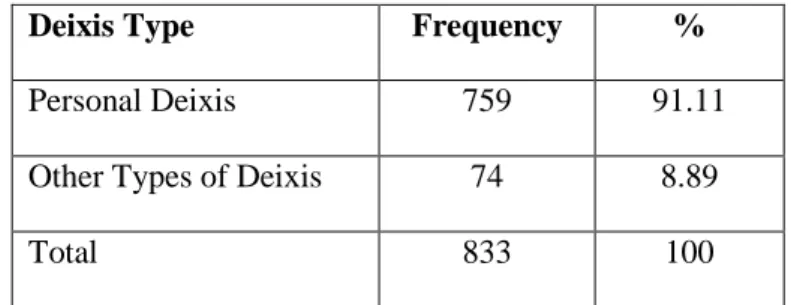
The distribution of frequencies of functions of deictic expressions as personal deixis and other deixis types and their percentages in the oral narratives of the participants appear in Table 1 below. As noted, the total number of deixises in narratives of the students is 833. When considering the total number of words used in the narratives was about 5500, it is clear that the role of deictic expressions in the narratives cannot be ignored. Although more frequent usages of time deixis, such as yesterday, soon, now, can be seen in native speeches, only few usages of this kind deixis have been found in our participants’ narratives. For example:
Yesterday I was talking about which topic I should talk about for this presentation.
Yesterday I wanted to give a nice present to my mother.
In the narratives of the students, when compared with personal deixis, the number of usages of other deixis types, such as place and discourse deixis, is not many. As place deixis, the students usually use here and there. As in:
The other thing, a lot of people lived in the world, and we are here for little time...
He wants to be very rich, and he misses his hometown, and wants to go there...
and as discourse deixis:
He thinks lastly to steal a machine about the brain form the hospital which he is working for. One night, he also finds friends for help that event.
Table 1: Distribution of functions of personal deixis and other types of deixis
If we look at Table 1, we can easily see that 91.11 % of total deixis usage is personal deixis, and 8.89 % is the other types, such as time, place and discourse. There may be some reasons why the participants use so many personal deixis. Firstly, the students were asked to narrate an event in their lives, which caused them use pronouns as personal deixis. Another reason is that Turkish speakers of English prefer mostly personal deixis instead of repeating the names of people. If they used a name of a person, or a person with a job such as “the doctor”, the next time and whenever they needed to call that person in their narrative, they preferred calling that person by using a personal deixis, which increases the number of this type of deictic expression usage. We can see, for example, this preference in one of the participants’ telling an event about a doctor:
There is a doctor working in a hospital. He wants to be very rich, and he misses his hometown, and wants to go there. He writes a letter to his manager, and managed to promote him to his hometown, and his manager accepts this. Also, he wants to be rich, and for that he needs things. He plays…
The student starts with telling about a doctor, and then she never uses the word doctor again. She prefers using personal deixis instead of repeating that name. However, the frequent number of usage of personal deixis may make the listener confused if the narrative gets longer because when the number of the people in the context increase the addressee could have trouble in identifying the referents.
Deixis Type Frequency %
Personal Deixis 759 91.11
Other Types of Deixis 74 8.89
Another point to be discussed here is the rare usages of time, and discourse deixis types. The students’ rare using of these types may be because of the events they were narrating. Those events mostly happened in the same day, and the time did not change so often, that is, the students’ using only one time deixis was enough for them, and they did not feel necessary to repeat the time again.
Discourse deixis, such as using this and that, also is not so clear-cut in students’ narratives. It is not so clear if they are using this and that due to feeling close to them or not. What is mostly used in these narratives is anaphoric usage of deixis. Nearly all personal deixis here is anaphoric. The task the participants have to carry out for anaphoric usage is to connect a present utterance to a formerly stated linguistic entity in such a way as to make it possible for the audience to activate the same past person as the speaker has mentioned. For example:
I want to tell something about my grandmother who died almost six months ago. She was very funny woman.
Because they thought that Aylin wouldn’t live any more. They send her home.
While the speaker constructs anaphora by linking a present utterance to an already existing element in the past, the speaker who attempts to use cataphora has to keep the referent to which s/he intends to attach the deixis in mind until the physical utterance of that referent (Özcan, 2005). Cataphoric usage of deixis in narrative texts is also so rare. There are only a couple of such usages as in:
And we want to jump at sea. First Ozge and Pınar wanted this but decided that this is so crazy because we wore jeans and t-shirts.
I met a woman last year while I was coming from Eskişehir to Adana, Ms. Sevim Hanım, Ms. Sevim. Conclusion
The results of this study show that deixis usages of Turkish speakers of English are really common when considered 833 deixis out of 5500 total words, which means that one out of six words used in the narratives is deixis.
The participants preferred mostly personal deixis instead of using people’s names or title words as Mr. or Mrs. Other deixis type usages are
another point to be discussed here. Turkish speakers do not often necessarily use time, place and discourse deixis. This rare usage may be due to the assignment that they were given. The events they were narrating was mostly a limited time such as in a day, which might have led them not to use time deixis a lot.
It may be argued that so many deixis usage depends on the narratives’ context. Meanwhile, due to telling an event from their lives, the number of deixis usage increases, which sometimes results in getting lost in the context due to increasing number of people in the event. Although the participants’ use of personal deixis prevails over other type of deixis, which we believe in large part caused by the task they were given, the usage of deictic forms in the context of utterances by the speakers may change depending on the receivers’ world knowledge, cultural background, life style, the society in which they live, the language level, etc.
REFERENCES
JANUSKEVICI, I. & SELMISTRAITIS, L. (2005). Deictic Markers in Monologue and Dialogue. Kalbotyra 55 (3), 22-30.
HALL, B.T. (1997). Key Concepts in ELT: Anaphora. ELT Journal 51 (4), 406-407. HANKS, W. F. (2005). Explorations in the Deictic Field. Current Anthropology 46 (2), 191-220.
HARTMANN, R.R.K., and F.C. STORK. (1972). Dictionary of language and
linguistics. London: Applied Science.
Özcan, M. (2005). Developmental differences in the use of deixis by children from 3 to 9 plus 13-year-olds. From:
http://www.ling-hil.ox.ac.uk/events/lingo/proceedings/ozcan.doc. 17/01/2007. YULE, G. (1996a). Pragmatics. Oxford: Oxford University Press.
YULE, G. (1996b). The Study of Language. Cambridge: Cambridge University Press.