Combined filtering and key-frame reduction of
motion capture data with application to 3DTV *
Onur Önder
Bilkent University Computer Engineering
Department Bilkent, Ankara, Turkey
[email protected]
Çiğdem Erdem,
Tanju Erdem
Momentum DMT TUBITAK-MAM TEKSEB
Gebze, Kocaeli, Turkey
[email protected]
[email protected]
Uğur Güdükbay,
Bülent Özgüç
Bilkent University Computer Engineering Department Bilkent, Ankara, Turkey[email protected]
[email protected]
ABSTRACT
A new method for combined filtering and key-frame reduction of motion capture data is proposed. Filtering of motion capture data is necessary to eliminate any jitter introduced by a motion capture system. Key-frame reduction, on the other hand, allows animators to easily edit motion data by representing animation curves with a significantly smaller number of key frames. The proposed technique achieves key frame reduction and jitter removal simultaneously by fitting a Hermite curve to motion capture data using dynamic programming.
Keywords
motion capture, key-frame reduction, curve fitting.
1. INTRODUCTION
Human motion capture is an important area of research with applications in diverse fields such as art, entertainment and education [Nguyen05]. It is also regarded as one of the enabling technologies for the ongoing 3DTV development [3DTVNoE]. Although human motion capture systems vary in nature, such as optical, magnetic, mechanic or hybrid systems, the captured motion data in general need to be filtered and edited before they can be used on a human model [Jun00a]. Filtering is necessary in order to eliminate any jitter that may be introduced by the motion capture acquisition system. It is also desired to represent the filtered motion data with a smaller number of samples (key frames) than those
that are acquired. Animators can then modify the animation curves more effectively by editing the attributes of a much smaller number of key frames. Key frame reduction requires fitting a spline curve to motion data.
In this paper, we propose an algorithm for fitting a Hermite curve [Foley95] to motion capture data by means of dynamic programming [Amini90]. Hermite curves are easily controlled via the position and tangent vectors at key frames and are generally used by animators for motion editing. The proposed dynamic programming based curve fitting technique achieves combined filtering and key-frame reduction of motion capture data.
2. CURVE REPRESENTATION
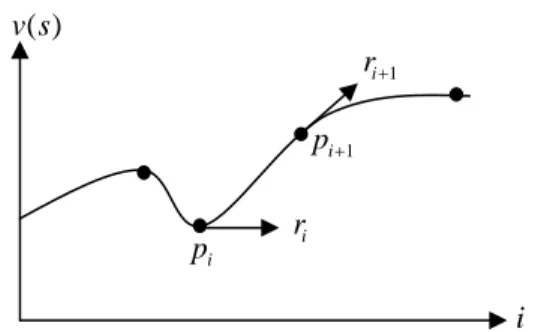
A segment of a Hermite curve
v
(s
)
between the control pointsi
andi
+
1
is given by (see Figure 1)[
]
⎥
⎥
⎥
⎥
⎦
⎤
⎢
⎢
⎢
⎢
⎣
⎡
⋅
⎥
⎥
⎥
⎥
⎦
⎤
⎢
⎢
⎢
⎢
⎣
⎡
−
−
−
−
⋅
−
−
−
=
+ + 1 1 2 30
0
0
1
0
1
0
0
1
2
3
3
1
1
2
2
1
)
(
)
(
)
(
)
(
i i i ir
r
p
p
i
s
i
s
i
s
s
v
where
p
k represent the positions andr
k representPermission to make digital or hard copies of all or part of this work for personal or classroom use is granted without fee provided that copies are not made or distributed for profit or commercial advantage and that copies bear this notice and the full citation on the first page. To copy otherwise, or republish, to post on servers or to redistribute to lists, requires prior specific permission and/or a fee.
Posters proceedings ISBN 80-86943-04-6 WSCG’2006, January 30-February 3, 2006 Plzen, Czech Republic.
Copyright UNION Agency – Science Press
*This work was supported by EC FP6 Grant 511568 with the acronym 3DTV, and by TUBITAK TIDEB under Grant 3050135.
the tangents at key frame
k
; they will be called the control vectors of a Hermite curve.It will be necessary to calculate the value of a Hermite curve between consecutive control points during the curve fitting algorithm presented in Section 3. To this end, a Hermite curve segment is first converted to a Bezier curve [Foley95]. Once a curve segment is converted to a Bezier curve, it becomes straightforward to sample the curve segment at any accuracy. This is because a Bezier curve can be recursively divided in half where each half is also a Bezier curve. The equations for obtaining the Bezier control points from Hermite control points and tangents and the process of recursively dividing a Bezier curve can be found in [Foley95].
3. CURVE FITTING ALGORITHM
The goal of the proposed curve fitting algorithm is to minimize the mean squared error (MSE) between the motion capture data and its curve representation. That is, we would like to find the position and tangent vectors of a Hermite curve so that the overall curve fits the motion data in the minimum MSE sense. Dynamic programming is employed so that all possible combinations of control vectors are taken into consideration by only computing MSE values for individual segments. The proposed algorithm is given as follows:1. Find initial estimates of
p
i,p
i+1,r
i, andr
i+1, for alli
by placing key frames at those locations where the first and second derivatives are zero on the motion capture data. Hence the number and estimated locations of key frames are determined at this step.2. Determine search spaces around the initial estimates for all vectors
p
i,p
i+1,r
i, andr
i+1. Note that each vector has x- and y- components. In addition to the original component value, use values that are obtained by adding and subtracting a predetermined step to/from the original value. Hence, each search space willhave 3 values, and there will be 6561 combinations for each curve segment.
3. Compute the MSE for each combination of
p
i, 1+ i
p
,r
i, andr
i+1 in the search space. In order to calculate the value of the Hermite curve at the same frame locations as the captured data, we subdivide every Hermite curve segment based on a corresponding Bezier representation (see Section 2). Save the best values ofp
i andr
ifor each combination ofp
i+1 andr
i+1.4. When the last segment of the curve is reached, find the total MSE for each combination of
p
i+1and
r
i+1. To calculate the total MSE, traverse the curve backwards and use the best (minimum) previous values obtained in Step 3.5. Pick the overall path of control vectors that results in the minimum MSE in Step 4.
6. Assume that the values
p
i,p
i+1,r
i,r
i+1, for alli
, obtained in Step 5 are the updated initial values and repeat Steps 2-6 until a predetermined accuracy in x- and y- components is reached.4. CONCLUSION
A new algorithm is presented that employs dynamic programming to fit a Hermite curve to motion capture data in the MSE sense. The performance of the proposed technique will be demonstrated on actual motion capture data. Both subjective and objective evaluations of the results will be presented.
5. REFERENCES
[Amini90] Amini, A.A., Weymouth, T.E., Jain, R. C., Using dynamic programming for solving
variational problems in vision, IEEE Trans. Pattern
Anal. Mach. Intel., vol. 12, pp. 855-866, Sept 1990 [Foley95] Foley, J.D., van Dam, A., Feiner, S.K., Hughes, J.F., Computer Graphics: Principles and
Practice in C, 2nd ed., Addison-Wesley, 1995
[Jun00a] Jung, M., Fischer, R., Gleicher, M.,
Thingvold, J., Motion Capture and Editing: Bridging
Principles and Practices, 2000.
[Nguyen05] Ta Huynh Duy Nguyen, Tran Cong Thien Qui, Ke Xu, Cheok, A.D., Sze Lee Teo, ZhiYing Zhou, Mallawaarachchi, A., Shang Ping Lee, Wei Liu, Hui Siang Teo, Le Nam Thang, Yu Li, Kato, H., Real-Time 3D Human Capture System for
Mixed-Reality Art and Entertainment, IEEE Trans.
Visualization and Computer Graphics, Dec. 2005 [3DTVNoE] www.3dtv-research.org i r 1 + i r i p 1 + i p i ) (s v
Figure 1. Control points and tangent vectors define the shape of a Hermite curve.