İSTANBUL BİLGİ ÜNİVERSİTESİ
SOSYAL BİLİMLER ENSTİTÜSÜ
MEDYA ve İLETİŞİM SİSTEMLERİ YÜKSEK LİSANS PROGAMI
THE REPRSENTATION OF THE AKP IDEOLOGY WITHIN THE TURKISH
CHILDREN CARTOON SERIES “PEPEE”
NAZLI KAZANOĞLU
113680008
Table of Contents:
Acknowledgements:... 5 Abstract:... 7 Özet:……… 9 List of Tables:……… 11 Introduction:... 12 1. Theoretical Background:………. 151.1. The concept of Mass Media Texts:……….. 16
1.2. Politics of the Mass Media:……….. 18
1.3. Politics of Television Broadcasting:………. 24
2. Brief Background of Mass Media in Turkey:……… 29
2.1. The Background of Television Broadcasting in Turkey:…………. 29
2.2. The Period of TRT Monopolization:………. 31
2.3. Privatization Period of Turkish Television Broadcasting:…………. 33
2.4. The Period of the AKP Governance:………. 38
3.1. Children and Television:………. 43
3.2. Children Cartoons:……… 45
4. Case Study: Reflection of the AKP ideology in Turkish Cartoon Series “Pepee” 4.1. The Scope of Analysis and Research Method:………. 47
4.2. Brief Information About Pepee:……… 48
4.3. Research Findings:……… 50
4.3.1. Religious and Islamic Features:……… 51
4.3.2. Patriarchal Features:……….. 58 4.3.3. Family Relations:……… 72 4.3.4. Anti-Western Values:……… 77 4.3.5. Gender Inequalities:……… 83 Conclusion:……… 88 Bibliography:……… 91
Acknowledgements:
I wish to express my deepest gratitude to my supervisor Prof. Dr. Aslı TUNÇ for her valuable insight, guidance, constructive criticism and encouragement throughout the research.
I would also like to thank Assoc. Prof. Dr. Itır Erhart for her suggestions and comments and affectionate support and Assoc. Prof. Dr Gokce Dervisoglu Okandan for her contribution to the dissertation committee.
I am grateful to Assoc. Prof. Dr. İdil Aybars, who was my inspiration in choosing to do my masters degree in department of mass media and communication systems and Ayça Ergun, who have never hesitated to share her own experiences with me.
I would also like to express my deep respect to the Ecevit Family for their guidance throughout my whole academic journey.
There are so many friends who have given their hearts and shed light on my path throughout this journey, who deserve more than a “thank you”. But very special thanks to Cansu Güvenel, Duncan Silver, Emre Erbirer, Fatih Kaya, Merve Tiryaki, Meryem Sultuybek, Sevgin Gül and Zeynep Pamukçu who were always there for me.
I want to shout out my sincere gratitude to my parents Nesli Kazanoğlu, Taner Kazanoğlu and my brother Murat Kazanoğlu for their limitless support, patience, encouragement and bearing with me all through this period.
To thank my aunt Nesrin Doğu, words are not enough. I know her heart beats with me and for my happiness and success. I could do nothing without her technical and motivational support.
Finally, to two amazing people who I view as a role model throughout my life and who have raised me and made me who I am today: my grandmother Sevim Doğu and my grandfather Turgut Doğu. I can never thank you enough.
Abstract:
Mass media play a significant role in the reproduction and dissemination of the government ideology due to its ability to reach thousands, millions and even billions of people. The aim of this thesis is to analyze and evaluate the first Turkish cartoon series “Pepee” in relation to the Turkish ruling party AKP’s ideology. Representation of the governing ideology through children cartoons plays an important role in the construction and formation of children’s political identity.
This is a descriptive study utilizing a qualitative research design. The sample of the study consists of eight seasons of the Pepee cartoon series that comprised of 211 episodes. Research data was analyzed both using the methods of content analysis and discourse analysis.
Based on the analysis, it was observed that the Pepee cartoon series did contain several messages in line with the AKP ideology. It was revealed that the AKP’s ideas about patriarchy, family values, Westernization, Islam and gender dimensions were strongly reflected within the cartoon series through the language used in the episodes, food and beverages, colors and style of clothing, the socio-cultural and socio-economic status of the characters, emotional situations and the games played by the characters throughout the episodes.
Keywords: autocracy, censorship, children cartoons, content analysis, cultivation, democracy, discourse analysis, European Union, freedom of expression, gender equality, gender roles, government, hegemony, ideology, the JDP, mass media, media and state relations, media literacy, media politics, narrative, Pepee, politics, political
parallelism, representation, regulation, socialization, television, television transparency, Turkish broadcasting, westernization.
Özet:
Kitle iletişim araçları, egemen ideolojinin yayılmasında ve yeniden üretilmesinde önemli bir rol oynamaktadır. Özellikle birden fazla duyuya hitabedebilirliği ve her sosyo-ekonomik duzeydeki aileye ulaşabilirliği sayesinde televizyon bu hususta oldukça etkilidir. İzleyici kitlesi çocuk olduğunda ise, durum daha da hassasiyet kazanmaktadır çünkü çocuklar televizyondan aldıkları mesajları sorgulamaksızın bilgi dağarcıklarına eklemektedirler (Bandura, 1986).
Bu çalışmanın temel amacı son dönemlerde bir çok çocuğun severek izlediği Pepee çizgi filminin söylem analizini ve içerik analizini yapmaktır. Tez kapsamında, 2008 yılının Eylül ayından 2015 yılının Ocak ayına kadar geçen sürede yayınlanan 211 bölüm Pepee incelenmiştir. Ortalama 11 dakika süren bölümlere internet aracılığı ile ulaşılmış, bölümler indirilmiş, arşivlenmiş ve analiz edilmiştir.
Yapılan araştırmaların ve incelemelerin sonucuna gore ilk Türk yapımı çizgi filmi olan Pepee’nin bir çok yönden egemen ideolojiyle paralellik gösterdiğini söylemek mümkündür. Bu benzerlikler ataerkil motifler, dini öğeler, aile ilişkileri, kadın-erkek eşitsizliği ve batı karşıtlığı olarak beş ana başlık altında toplanmıştır. Söz konusu hususlar genellikle bölümlerde kullanılan dile, müziğe, karakterlerin kıyafet ve aksesuarlarına, bölümlerde yenilen yemeklere, içilen içeceklere, karakterlerin oynadıkları oyunlara, birbirleriyle olan ilişkilerine, sosyo-ekonomik ve sosyo-kültürel durumlarına yansımıştır.
Anahtar Kelimeler: AKP, animasyon, Avrupa Birliği, basın özgürlüğü, çizgi film, demokrasi, egemen ideoloji, hegemonya, içerik analizi, ifade özgürlüğü, kitle iletişim araçları, medya, medya ve siyaset ilişkisi, sansür, televizyon, Türk televizyonculuğu.
List of Tables and Charts:
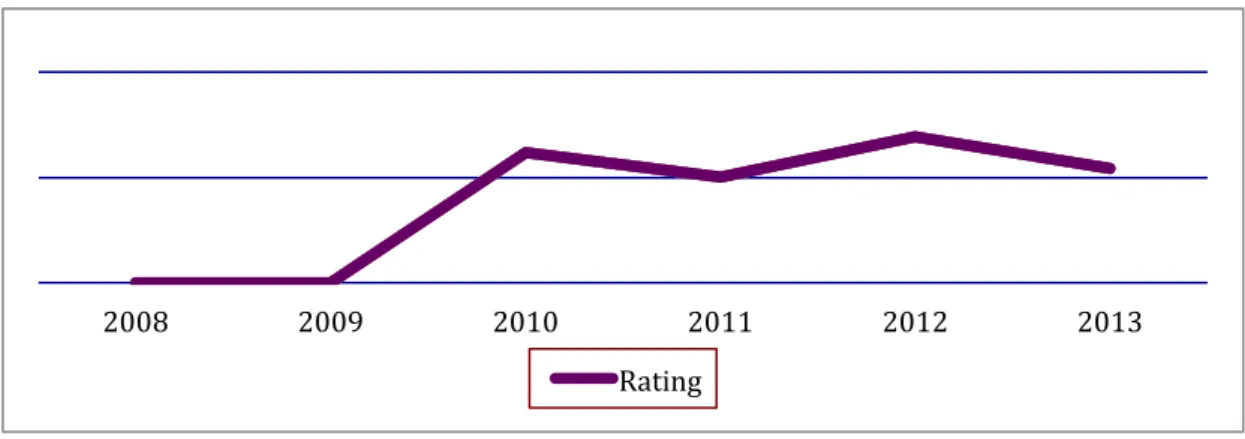
Table 1: Distribution of Pepee’s ratings according to years.
Table 2: Distribution of Islamic Symbols and Conservative Motives in Pepee. Table 3: Distribution of Islamic expressions in Pepee.
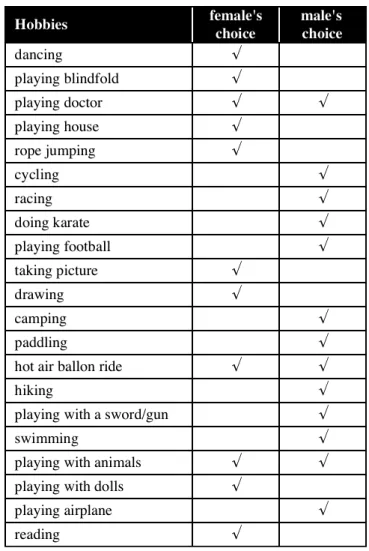
Table 4: Distribution of works done inside and outside the house in Pepee. Table 5: Distribution of Games and Hobbies Preferences in Pepee.
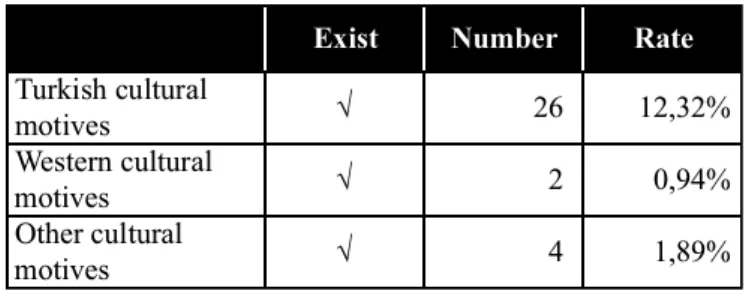
Table 6: Distribution of works done by family members in Pepee. Table 7: Distribution of various cultural motives in Pepee.
Table 8: Frequency of characters’ appearances in Pepee.
Table 9: Frequency rate of male and female characters in Pepee. Chart 1: Frequency rate of male and female characters in Pepee.
Introduction:
Democracy has always been considered an ideal form of governance and its most important guiding principle is “freedom”. The European Convention on Human Rights provides the right to freedom of expression and information subject to certain restrictions that are “in accordance with law” and which are “necessary in a democratic society” (EC, article 10). This right includes the freedom to hold opinions and to receive and impart information and ideas. Moreover, in the Foreign Affairs Council meeting in Brussels on the 12th
of May 2014 it was stated that:
“Free, diverse and independent media are essential in any society to provide and protect freedom of opinion and expression. By facilitating the free flow of information and ideas on matters of general interest and by ensuring transparency and accountability, independent media constitute one of the cornerstones of a democratic society. Without freedom of expression and freedom of the media, an informed, active and engaged citizenry is impossible” (EC, 2014).
Although Turkey claims to be a democratic society in a modernization period and is being propelled into an open-ended path of European style normalization to converge with the European Union (EU) standards in almost all walks of life (Belge, 2004), the freedom of the mass media is very low in Turkey. According to Tanış (2014), Turkey is the only European country, which has not a full freedom of expression (Tanış, 2014). Moreover, according to the US-originated think tank “Freedom House”, who is investigating the freedom of press in 195 countries and 15 territories (Freedom House,
2015), the press status of Turkey is “not free” with 65 point out of 100 (FHR, 2015). Moreover Turkey took the 149th
place out of 180 in Reporters Without Borders Organization World Press Freedom Index Report 2015 (RSF, 2015). Although Turkey applied EU-inspired reforms such as expanding freedom of expression, allowing education and broadcasting in Kurdish or abolishing cruel punishments for verbal propaganda (Governments reform package, 2002), it could not prevent nor reduce the state’s involvement and regulation of media institutions. Contrarily, the Freedom House and Reporters Without Borders Organization World Press reports indicate that it has been decreasing every year (FHR, 2015 and RSF, 2015). While the press freedom grade of Turkey was 62 in 2014 out of 100, it declined to 65 in 2015, where zero is considered as the best and hundred considered as the worst (FHR, 2015).
Following AKP’s coming to power after the 2002 general elections, the political discourse and practices in many spheres including the media, education, economy and so on have faced a major transformation. During the period of its governance, slowly but surely the AKP has built close relations with the owners of various mass media institutions, who were businessman instead of media professionals (Gül, 2012). Moreover, when AKP raised share of its votes from 34.26 per cent to 46.58 per cent (Turkstat, 2007) and guaranteed its place within the public by re-winning the elections on the 22nd
of July 2007, its religious-oriented background has become more and more visible than before and this has reflected heavily within the media content. Even, the current president and former Prime Minister Recep
Tayyip Erdoğan did not hesitate to express that their goal is to raise “religious youth”. In one of his speeches during the AKP’s second tenure he said that:
“…Did not come pious contemporary generation? Cannot one be both religious and contemporary? Gentlemen bend your head forward and consider… One can be both religious and contemporary and we the AKP will show you how to do this…”1
(Erdoğan, retrieved from:! http://www.hurriyet.com.tr/gundem/19825231.asp).
Hence children have become the new target for Turkish media. The timing of the broadcasting of the first Turkish prime time television cartoon series “Pepee” corresponds with the second tenure of the AKP governance, which should not be considered as a simple coincidence.
Since, “childhood” is recognized to be a stage in life open to learning, realizing and discovering the world and framing an identity (Casey, et al., 2008), they cannot learn everything on their own. They also need external sources to guide them, and prime time television cartoons provide a unique opportunity for this (Bandura, 1986). A growing body of literature demonstrates that children learn the facts, values and norms about the world from cartoons and then retain what they have watched and add this to their stock of prior knowledge (Lemish, 2015). However, assuming children’s cartoons to be one of the biggest sources of education does not mean that every single message conveyed by them has a positive content. They may be equally good or bad for children. I therefore strongly believe that analyzing the content of the
one and only Turkish prime time television cartoon series’ content is very significant for the future vision of children and for the country.
Accordingly, this thesis is aimed at revealing the AKP’s ideology from the first Turkish prime time television cartoon series Pepee and analyzing how government reach children through the mass media. However, the contextual analysis of the cartoon series would be more meaningful with an understanding of media politics; thus the first chapter of the study provides a detailed illustration of the relationship between media and the State. Chapter two focuses mainly on television, which is one of the most important mass media tools and examines its linkage with the government. Chapter three covers on the state of the television broadcasting in Turkey and its historical transformation. Since the Turkish ruling party’s vision is to create a religious youth, chapter four examines the media’s role on children’s lives and last but not least chapter five provides a discourse analysis of the one and only Turkish cartoon series Pepee and illustrates the reflection of the AKP ideology within the cartoon series.
1. Theoretical Background:
The freedom of mass media is one of the most significant issues in the contemporary mass media studies. Very basically it can be defined various channels of communication that involve transmitting information in some way, shape or form to large numbers of people (Gordon, 1998). In other words the term mass media can be considered as the organized means of open communication at a distance and to many in a short space of time (McQuail, 2010). What makes mass media an important
feature in society is its capacity to reach the entire population rapidly and with much of the same information, the universal fascination it holds, the presumed relationship to forces of power and last but not least the assumption of great impact and influence. Throughout time some ongoing changes have happened in the spectrum of mass media and in many aspects of their form and content. However, their continuing significance in contemporary societies in the spheres of politics, culture, economics and everyday social life has never changed. According to Dennis McQuail, in respect of politics the mass media provides an arena of debate for politicians, interest groups and government agents to disseminate their ideas to the public. In the realm of culture, the mass media is for most people the main channel of cultural representation and expression and the primary source of images of social reality and materials for forming and maintaining social identity. Moreover, everyday social life is strongly influenced by the routines of media use and infused by its contents through the way leisure time is spent and lifestyles are influenced. Lastly, mass media corporations are dominating the media market (McQuail, 2010). As he clearly states and we can clearly see, what makes the mass media significant in a society is neither its form nor its technology; it is the message that in carries by its content.
1.1. Mass Media Texts:
In this sense, we can confidently argue that the media is not objects like newspapers, television sets or telegraphs or so on but the messages and the content that these objects convey. Therefore “mass media” of itself clearly has no straightforward definition; it gains a meaning through the message or text that it
carries. Because what we call text is the process of making meaning (Barthes, 1994). Media texts refer to the given meaning and exist in the mind of the media - when they are seen, read or heard. Briggs and Cobley suggest that texts are important for the role they play in producing our “common sense” understandings of the world. As such media texts are thought to affect the way we understand others and ourselves and the way we lead our lives (Briggs and Cobley, 2002). In a broad sense, media texts are objects produced with the explicit intention of engaging an audience and they comprise a torrent of materials and produce a flood of meanings (Lotman, 2011). The connection between text and meaning is also about the relationship between the media and society. The classical Marxist approach assumes that text messages, which are conveyed into the consciousness of the audience, have shape and structure (Burton, 2009). They are nothing but representations in both the material and ideological sense (Hallam, 2000). In the material sense the media text is a made thing, a product of technology (Burton, 2009), an image on a screen or a set of marks on a page. However, in an ideological sense, media texts represent the ideas of a special group of people (Burton, 2009). Hence, media texts are an illusion of power rather than the mirror of a reality. They are something socially constructed; the representations of the social reality but from a biased perspective.
Very basically the term representation is considered as the way in which the media portrays particular groups, communities, experiences, ideas, or topics from a particular ideological or value perspective (Burgan, 2004 as cited in Levin, 2013). It is the construction of ideas about a subject through some means of communication
(Burton, 2009). Stuart Hall argued in “The Work of Representation” that representation connects meaning to culture (Hall, 1997:2). So representations are the fundamental elements of the world, which have saturated us. People seek to give meaning to the world by constructing a set of correspondences between things, people, objects, events, ideas or abstracts and so on, the so-called “reality” inside their heads, and then they desire to express, share or exchange those interpretations they have formed in their heads. The concept we call representation is the process of using language to say something meaningful about the world or to represent the world meaningfully to other people (Hall, 1980). Moreover, David Chandler (2005) defines mass media representations as:
“…representation refers to the construction in any medium
especially the mass media of aspects of reality such as people, places, objects, events and cultural identities…” (Chandler, 2005 as cited in Signes 2007).
1.2. The Politics of the Mass Media:
All mass media representations tend to reflect an ideological position. As Levi-Strauss (1958) notes all representations have ideologies behind them. While certain paradigms are encoded into media texts others are left out (Levi-Strauss, 1958). What paradigms those are and to whom they belong are the main issues requiring analysis within media studies. Hence Gigi, Durham and Kellner’s (2012) statement that mass media representations are not pure entertainment or informative
tools but instead they are saturated with social meanings and transcode major political discourses (Gigi et al., 2012). The social and political impacts generated are to reinforce the existing domination and subordination. Thus it is always necessary to ask and illustrate in whose reality we are seeing, reading or hearing through the mass media. This question highlights the effects of politics on the media and turns the freedom of mass media into one of the most significant issues in contemporary mass media studies. This goes back to Karl Marx and Friedrich Engels and has been theorized by a number of notable scholars. According to Marx ideology is the system of ideas and representations, which dominate the mind of a man or a social group (Althusser, 1971). Marx and Engels strongly disagree with the neutrality and objectivity of ideology and developed a theory in order to criticize the already noted illustration of ideology. They claimed that:
“…The class which has the means of material production at its disposal has control at the same time over the means of mental production, so that thereby, generally speaking, the ideas of those who lack the means of mental production are subject to
it…” (Marx & Engels: The German Ideology, as cited in Curran et al. 1982: 22).
Marx and Engels opined a harsh critique of ideology attempting to show how cultural texts protect the interests of dominant groups by naturalizing, idealizing and legitimizing their views. They state that the ruling classes employ intellectuals and cultural producers to glorify their own ideas in literature, the press or film and
television because the media is an integral part of the capitalist system (Burton, 2009). According to the classical Marxist position the mass media disseminate the ideas and world-views of the elites and impugn contrary ones. Ergo, since the mass media became a part of capitalism and its interests the media texts turned into manufactured goods. Hence one can justifiably claim that control over the means of production and distribution of goods leads to control over the ideas within those goods. Since the ruling elite are the owners of the means of production, including the media organizations, it is an incontrovertible fact that media texts advance the dominant ideology and serves to maintain the power of these ruling elites.
The raison d’etre, the basic reason of this biased mass media can be shown as the desire of the ruling class to ensure and sustain their dominance over society. In order to satisfy this desire, the ruling class has taken control of mass media organizations and uses them according to its own interests. These groups manipulate the perception about current issues with their own thoughts and judgments about certain issues. With the power they have they can be effective in promoting certain factions of the society to certain fields of action (Arsan, 2013). The governments also try to control the minds of readers or viewers through the media and produce a consensus among the audience in society leaving the mass media to pose as neutral and impartial but they are not. Various scholars have theorized the issue of the relationship between politics and the mass media. Although they all focused on different aspects of the issue, they all agree that the centrality of the media to social life is taken for granted today. Ruling classes spread their ideology over the general
masses through the mass media. And people start to accept these ideas as “normal”. Antonio Gramsci is another second-generation European Marxist scholar who has theorized this common-sense building process. According to Gramsci, the dominant class constantly tries to win people’s consent and he uses the term “hegemony” for this endless winning and re-winning of the consent of the majority (Gramsci, 1971). He believes that the ruling class has to produce a consensus within society (Yaylagül, 2006) and this can be built through social institutions such as schools, religion or the media. These institutions teach people the world views of the ruling class’ which come to be accepted as commonsensical by people, who in turn start to evaluate the real facts according to those imposed views and ideas (Yaylagül, 2006). Therefore the media is a medium, which transfers the ruling class’ values to its readers, viewers and listeners. It is always hostile to any kind of message, which opposes the views of the ruling structure, dominant values and any kind of event that threatens them. Gramsci supports the idea that we acquire a naturalized and dominant view of how things should be but indirectly, through formal learning and through media consumption (Burton, 2009). The media filters our perception of reality, which in turn accords with the ruling class’ perception. The way we think about social reality is bound up with the ideas of the ruling elites. For example, in todays’ patriarchal and heterosexual societies homosexuals are shown as deficient people who need punishment and correction and people accept this idea as something normal and as a result homosexual people are turned into minority people. Indeed, there is not any rule or
statement telling homosexual people that they are deficient; this is just the ideology of the ruling elite, which has been conveyed into public’s mind.
Furthermore, an American linguist and philosopher Noam Chomsky and professor Edward Herman outlined a model called “Propaganda Model” in their book “Manufacturing Consent: The Political Economy of the Mass Media” in 1988. Very basically the propaganda model seeks to explain the behavior of news media operating in a capitalist economy. The model suggests that media outlets will consistently produce news content that aligns with the interests of the political and economic elites (Enoch, 1996). Although both Chomsky and Herman are not identified as Marxist scholars, they have similar thoughts to the classical Marxist approach. They believed that within capitalist societies the media and culture had turned into an industry and were organized according to codes of capitalism. Both the media and culture are owned and controlled by capitalists who are wealthier and politically more powerful than the rest. Chomsky and Herman claim that todays the mass media and culture are being used to spread these powerful groups’ ideologies to the public. It is almost impossible for an ordinary citizen to represent his or her own ideas to the public by using the mass media or a cultural tool. Therefore, the freedom of the media in todays’ world cannot even be mentioned (Yaylagül, 2006).
All in all, the governments control the minds of readers or viewers through the media and produce a consensus among the audience within society thus the mass media poses as neutral and impartial, however they are not. As Richard Hoggard argues:
“…The whole ideological atmosphere of our society, which tells us that some things can be said and that others had best not be said. It is that whole and almost unconscious pressure towards implicitly
affirming the status quo towards confirming the “ordinary man” in his existing attitudes, towards discouraging refusals to conform, that atmosphere which comes from the morning radio news and chat programs as much as from the whole pattern of reader-visual
background and words in which is the context of television news…” (Hoggart, as cited in Bennet, 1982: 303).
Because people have limited time and cognitive resources to seek and process information themselves they have good reasons to rely on the information offered to them by the media (Somer, 2010). However, the problematic nature of mass media with its interest and profit-based relationship with the government means it has lost its beneficial feature and has turned into a medium of economic and political manipulation by the authorities. Governments are constantly releasing their own ideology to the public through various mass media tools including the press, radio and television broadcasting, books and so on.
The broadcast and cable television, radio, movie and music studios, newspapers, magazines, books and most print publications which are all considered “old media” are more likely to fit into these definitions than the new media tool which is the “internet”. This is because the old media is silent and the audience cannot engage actively with the media texts. Since all the old media tools are as problematic
as each other the aim of this thesis will mainly focus on television. The rationale behind choosing television as the subject matter of this thesis is the inter-related aspects of television, which continually figure in any debate about it and make it different from a debate about the press, radio or cinema. A distinctive feature of television has been its high degree of regulation and control by governmental authorities- initially out of technical necessity and later out of a mixture of state self-interest and sheer institutional custom (McQuail, 2010). Moreover television can reach a potentially scopic range and penetration of everyday living (Corner, 1999). A popular television show can reach 15-20 million households (Croteau and Hoynes, 2003) and must be considered as one of the most powerful media tools. Despite the fact that television has been largely denied an autonomous political role and is primarily considered as a medium of entertainment, it plays a vital role in modern politics. It is the main source of news and information for most people and the main channel of communication between politicians and citizens (McQuail, 2010). Although, it is severally considered as a channel of communication between politicians and citizens, it has remained credible and trusted. Hence, in order to illustrate the relationship between politics and mass media one needs to analyze the sphere of television broadcasting and how broadcasting firms serve the dominant groups within society.
1.3. Politics of Television Broadcasting:
By the mid 2000s, pronouncements of the death of television were very common. This was because people were tweeting, watching video online or updating
their Facebook status and so on. Nevertheless, television has not gone anywhere and continues to play a crucial part in the media landscape in most societies. It can still regularly command a nightly viewing audience of over 100 million in the United States and 20 million in the United Kingdom in 2010 (Gray and Lotz, 2012). Television in the late 1940s and early 1950s like any new invention entered societies that had already established norms of social relations. Ten years after its entrance to people’s homes as a new popular form of media, television studies emerged as an identifiable entity due to their close relationship with politics, economics and culture. The theoretical and methodological roots of television studies lie in the field of “cultural studies” which derives from particular inflections of Marxism, semiotics and post-structuralism (Fiske, 1987). The role of television on people’s attitudes and behaviors can be summarized as educating children, setting the agenda on public discourse, supplying resources for political participation and shaping the cultural identity of its viewers (Gripsrud, 2010), is very important. But what makes the study of television so important is its power to determine people’s view of the world because as Gripsrud (2010) states it is still a mirror and an actor in the social, political and cultural spheres. Thus it is very important to analyze the messages conveyed by television because close dialogical and reflective relations with the rest of the society are manifested in its contents day by day following historical and socio-political developments (Gripsrud, 2010). Roughly, television is considered as the source of the most broadly shared images and messages in history (Gerbner, 1985-1989, p.1). It is a medium, which has become so closely integrated to our daily and domestic lives
because of its ability to command the attention of our eyes, ears, fears and dreams like few other sources can. Despite the proliferation of competition from a variety of new media forms, it is still one of the most important sources of communication, the key storyteller whose impact is increasingly felt around the contemporary industrialized world. Television constantly punctuates, articulates and manipulates the world around us. It is the primary source of things that we know because it is the continual repetition of stories, myths, facts, lessons and so on that define the world (Gerbner, 1985-1989). It provides a daily ritual and legitimizes a particular social order. However, nothing that happens on television “actually” happens, everything is a representation of reality. The role that television plays in society is constructing core beliefs, telling stories and offering information (Gray and Lotz, 2012). It is giving us a representation of reality. As such, everything on television is an image of and a play on a message with some meanings. John Fiske and O’Sullivan define television as a mass communication medium, a cultural agent, a provoker consisting of transmitted programs, that carry some meanings (Fiske, 1983 and O’Sullivan et al., 1983). They argue that these meanings are embedded in television codes (Fiske, 1983 and O’Sullivan et al., 1983). John Fiske defines a code that:
“…a rule-governed system of signs. They are the links between
producers and audiences, agents of meaning network that constitutes our cultural world and reflects the reality…” (Fiske, 1987:3)
Therefore the main concern of television studies is how these meanings are produced. People perceive and make sense of reality by these codes. In short, this socially
constructed, transmitted reality is structured into television codes with the aim of serving the dominant ideology. Thus television is not a medium offering a public service by informing, entertaining or educating its audience, on the contrary it is maintaining the ideological power by reflecting the views and concerns of the ruling class (Creeber, 2006). Because television broadcasting is a costly activity, the ones who hold the purse strings play a significant role in the broadcasting process (Crisel, 2006). Although television broadcasting appears as a natural and transparent window on the world, it is actually highly constructed to align with the interests of powerful groups (Spigel et al., 2004). The government decides what the broadcasting firms can do or cannot do. Television texts produce and perpetuate a distorted perception of the world; it prescribes and constructs reality in such a way as to maintain the politically dominant ideology (Gitlin, 1978). Because of its potential influence on society, what television should broadcast and who should broadcast it has always been one of the greatest concerns of government. Thus in almost every country the state imposes rules and policies over television broadcasting firms under its control (Miller, 2010). This does not take place only in politically biased television programs such as news or current affairs; it clearly takes place in less politically motivated genres such as soap operas, television action series, police shows, children cartoons or even sitcoms. Therefore, one should analyze all television genre’s contents because television can be considered to be one of the most powerful tools for disseminating the dominant ideology because it is 24 hours broadcasting and not only so-called politics, but it is
also entertaining people but as James Curran states while entertaining it is still reproducing the dominant ideology.
“…entertainment is intimately linked with politics through the values it articulates and the passions it generates…” (Curran, 2000:139). Government institutions in all branches and at all levels invest sizeable resources to manipulate the television texts and messages so that they favor their causes and generate supportive public opinions. Although these government regulators act as allies of and protectors of the weak and vulnerable in society, protecting children, the disabled, rural dwellers, the poor and further the political promise of free expression, in fact they ensure the production and reproduction of the dominant ideology. As Patricia Aufderheide states, each of these social welfare-oriented approaches has a slightly different take on the notion of the public and its relationship to government (Aufderheide, 1999). And both the manner and the extent of the government’s regulation are primarily the expression of its own ideological position. It consistently naturalizes the world around us and turns ideological bias into a natural representation (Creeben, 2006). Thus Fiske calls television an essentially realistic medium because of its ability to carry a socially convincing sense of reality, which is indeed just the dominant sense of reality (Fiske, 1987:21). Having looked at an expansive literature on the relationship between media and politics I can say that due to the social, economic and technological changes that have occurred in Western countries and also in societies adopting western-originated values, freedom of expression has lost its meaning. Television broadcasting has lost its role of defending and protecting
individuals from the abuses of the state and facilitating their rights and liberty, on the contrary it has become a weapon of the ruling elite to spread and disseminate their own values and to protect their own interests. Although freedom of speech is a fundamental human right and protected in international human rights instruments including the Universal Declaration of Human Rights (Article 19), the International Convent on Civil and Political Rights (Article 19 and 20) and the European Convention for the protection of Human Rights and Fundamental Freedoms (Article 10) it cannot be fully realized all over the world (Arat, 2007). Furthermore, the European Court of Human Rights has ruled that any infringement on freedom of expression “must be prescribed by law”, must be needed in a democratic country and must be reasonably proportionate to the aim of responding to that need (Robertson and Nicol, 1984). Although Turkey identifies itself as a democratic country, freedom of expression cannot even be mentioned in Turkey. There have been frequent government restraints and restrictions on freedom of expression especially on freedom of the press and freedom of television broadcasting in Turkey (Arat, 2007).
2. Brief Information about Mass Media in Turkey:
2.1. The Background of Television Broadcasting in Turkey:
In 1914 the Turkish journalist Ahmed Emin Yalaman defended his dissertation at Colombia University by stating that:
“…the press should be taken as a measure of development because it has always been the leading factor in the modern Turkish
A century later numerous key scholars including Ali Çarkoğlu, Gözde Yavuz and Raşit Kaya have accepted this argument and applied it to television broadcasting. Çarkoğlu and Yavuz (2010) argue forcefully that the critical role that freedom of television broadcasting plays in a society is constantly monitored as a measure of the quality of democracy (Çarkoğlu and Yavuz, 2010). Although Turkey identifies itself as a democratic country the freedom of broadcasting is very limited in Turkey. It has always been marked by a high degree of political parallelism (Kaya and Çakmur, 2011). Political parallelism is a concept built upon from Seymour Ure’s term “press-party parallelism” by Daniel Hallin and Paolo Mancini. Colin Seymour Ure coined the term “press-party parallelism” in 1974 in his book “The Political Impact of Mass Media”. He used the notion to describe the degree to which the newspaper systems mirror the party system (Ure, 1974). After a while Hallin and Mancini took the term and developed it. They prefer to call it “political parallelism” instead of “press party parallelism” to widen the analysis of the relationship between politics and mass media to all media tools and not limiting it to the press only because politicians are now using all mass media tools to disseminate their messages to the public (Gripsrud and Weibull, 2010). They identified a three-fold typology of media systems according to the degree of state involvement and regulation on media institutions, the historical developments and the extent of media professionalism (Curan, 1986). These typologies are: Liberal Model, Democratic Corporate Model and Polarized Pluralist Model. Raşit Kaya places Turkish broadcasting in the “Polarized Pluralist Model”
which mainly typifies the countries in Mediterranean Europe and calls for deep concern over the more restricted freedom of expression (Kaya and Çakmur, 2010).
As a regulator and funder the state has always exerted strong control over the television broadcasting in Turkey. In order to analyze the current state of television broadcasting in Turkey and the reasons for this political parallelism and its consequences, we should look at historical developments and the transmissions that the Turkish mass communication system has experienced.
2.2. The Period of TRT Monopolization (1960-1980):
Turkey has a short but complex broadcasting history, and it is worth a profound analysis. In general from the first television broadcasting until today it has been under a high level of state regulation. The Turkish television broadcasting roots back to the 1960s. The Turkish Radio and Television Corporation (TRT) was established as an autonomous institution in 1960 but because of the technical incompetence and lack of television broadcasting equipment in Turkey only began at the end of the 1960s. It was a publicly owned autonomous institution with a legal status (Çaplı, 1998). On the 31st
of January 1968 test transmissions started on the channel TRT 1 in Ankara by the announcer Nuran Devres. The first television program was her opening speech. From 1968 to 1971 there was not a regular television broadcasting in Turkey, it was more like a trial than a full functioning service. A full nationwide service of regular daily broadcasts only began in December 1972 in more developed big cities such as Ankara, Istanbul, and Izmir. Day
after day it became more wide spread and today there is at least one or more television sets in every household.
From the establishment of TRT until March 1990, when the first private sector station was launched and co-owned by the son of the president at the time Turgut Özal, TRT was the only television channel in Turkey. Thus it was under a high level of state regulation. This state control of TRT broadcasts has always been an issue with the government applying a variety of control mechanisms (Aziz, 1993). This monopolization of TRT, which was owned by the government, led the state to broadcast everything in accordance with its own ideology and not to broadcast any contrary ideas. It has been operated entirely according to an authoritarian state-broadcasting model rather than as a “public service”. It was a publicly owned, autonomous institution. As Ayşen Akkor Gül states in her article “Monopolization of Media Ownership as a Challenge to the Turkish Television Broadcasting System and the European Union” TRT had full autonomy for programing, administration and for its finance. Its functions were defined as being those of a fully public service (Gül, 2011). Although TRT was constantly reflecting the dominant ideology (Aksoy and Robins, 1997), one should not deny that on the one hand TRT tried to inform the public and educate people with hundreds of programs such as Anadolu’ya2
, Gezelim görelim3
, Yediden adam olacak çocuk4
and so on. But on the other hand, TRT has always been in agreement with the ruling government. It has always been criticized !!!!!!!!!!!!!!!!!!!!!!!!!!!!!!!!!!!!!!!!!!!!!!!!!!!!!!!!
2!A Turkish television show, which broadcast about various places in the Anatolian
region of Turkey!
because for reflecting the ruling government and prioritizing it (Gül, 2011). TRT has always been the voice of government and has been reluctant to debate any controversial issues on the public agenda. The Gezi demonstrations that happened in summer 2012 in Turkey can be given as the biggest and the most recent example.
2.3. The Privatization Period of Turkish Television Broadcasting (1980-2000):
When we come to the 1980s and beyond we can see how Western countries were affected by neo-liberal policies, which lead to “privatization” and “deregulation” (Mchesney and Herman, 1997). An under-developed country like Turkey adopted these policies at its national level. Moreover, at this time Turkey experienced its third military coup, the 1980 intervention, which brought the need for a smooth transfer to a “liberalist” system (Kılıç, 1998 as cited in Tunç, 2002). These neo-liberalization policies and the privatization of public broadcasting times came up to Turgut Özal’s prime ministry in Turkey (1984-1989). So he was the one who opened up Turkey’s economy to global market forces. His project was to integrate the Turkish economy into the global economic system (Şahin and Aksoy, 1993). The integration of Turkish broadcasting into the global media market started with TRT Avrasya and various commercial channels beaming their signals to Turkish diaspora viewers in Europe and later to viewers in America, Australia and Africa (Karanfil, 2009). Within this conjecture in the early 1990s the private channels entered the market and challenged TRT’s monopoly position. This was the start of commercial broadcasting in Turkey. Starting with Star1, which quickly mushroomed, new, private
television broadcasting channels started to be established (Kaya and Çakmur, 2011). Three years after the first broadcast of the private channel Star1 in July 1993, Article 133, which permitted private radio and television stations to operate was incorporates into the Turkish constitution. The official constitution is:
“Radio and television stations shall be established and administered freely in conformity with rules to be regulated by law.
The unique radio and television administration established by the state as a public corporate body and the news agencies which receive aid from public corporate bodies shall be autonomous and their
broadcasts shall be impartial…” (Constitution of Turkey; 1982, Article 133)
Especially in the second half of the 1990s a considerable number of television channels have started in Turkey and Turkish audiences were free to zap among them. These new channels offered a wide range of content. They were sometimes showing American dramas, sometimes daily-reality shows, sometimes entertainment and informative programs for children and sometimes they featured serious debate programs on various themes. Faced with this situation Karanfil and Kaptan of the state Turkish broadcasting arena started to experience an unprecedented feeling of disorder and chaos in the media scene as stations had not been authorized to operate on specific frequencies or were competing for the same airwaves. Moreover the popularity of religious channels was concerning the government (Kaptan and Karanfil, 2013). This was the period when the state broadcasters’ monopoly was
broken and private commercial broadcasters entered the national Turkish broadcasting sphere (Aksoy and Robins, 1997). On the one hand this was something productive but on the other hand it caused some problems within the industry. The main problem was the lack of legislation regulating these new channels and a regulatory body to assign frequencies to them. According to Kaya and Çakmur, this situation frightened the government and all the political parties because private channels were using powerful transmitters, which caused interference to and jammed other frequencies and this was decreasing the ability of the state to convey their ideologies as it had been. The Prime Minister at the time, Süleyman Demirel, decreed that closure was necessary to create a climate of order (Aksoy and Robins, 1997). Thus the government proceeded to make an amendment to the constitution in July 1993 and finally in 1994 the law on the Establishment of Radio and Television Enterprisers and Their Broadcast was adopted as a licensing and supervision authority (Kaya, 1994). This is how the biggest fear of broadcasting institutions and the biggest regulation of the state over television emerged. On the 16th
of May 1994 as a direct result of the new legislation the Turkish Radio and Television Supreme Council (RTÜK) was established (as cited in http://www.rtuk.gov.tr/#) as a regulatory body, and as a major actor in the field of broadcasting primarily responsible for the “orderliness” of the sector (Kaptan and Karanfil, 2013). Since the abandonment of the state monopoly could not put an end to the use of television solely for political purposes by the government the RTÜK solved this problem and started to exert strong control over the content of television texts. Gökçen Karanfil argues that from the day of its establishment the acronym became
one of the most common words used in the Turkish broadcasting sphere (Karanfil, 2013) because of its great responsibilities and authorities. This new Council was made up of nine members appointed by Parliament. The main responsibilities of the RTÜK included the setting up of rules and regulations for running radio stations and television systems, allocating frequencies, granting channels and transmission licenses to all broadcasting organizations, supervising broadcasting companies, granting permission for the establishment of private radio and television systems, monitoring broadcasters and regulating broadcasting activities (Kejanlıoğlu et al., 2004, Kaptan and Karanfil, 2013, Çaplı, 1998). The authorities and sanctions given to the RTÜK by the Government and parliament covered a wide range. The lightest of these was a warning. If a station continued to ignore the Council's decisions, then tougher sanctions would be implemented, ranging from closing the station down for one day, or withdrawing the station's broadcasting license altogether (Çaplı, 1998). In other words the RTÜK was able to control the content and the channels, which are against the state and to punish them according to these controls. It became a body responsible for considering the dialectic between broadcasting policies, broadcasting companies and broadcasted content. It functioned to regulate the content and context of broadcasting with the dominant party’s ideology.
By the end of the 1990s and early 2000s the Turkish broadcasting market with 18 million television- owning households became one of the biggest in Europe (Ratem, 2009 as cited in Gül, 2011). The number of television channels has risen to 23 national, 16 regional and more than 212 local channels (Ratem, 2009) and Turkish
audiences were free to zap between them. This situation created expectation within the sphere of media studies, which is the hope of a decrease of state regulation. However, unlike many other European countries neither neo-liberation, privatization nor the development of commercialization could decrease the high degree of political involvement in television broadcasting institutions because the media market was dominated by major and smaller cross-media groups who are also businessmen rather than media professionals. They are involved in other businesses or holdings involving the media sector thus they need to have very close relations with the politicians and they all targeted either to gain some political power or to turn their investments into profitable enterprises and accumulate more and more money (Gül, 2011). In other words in order to survive within the harsh market conditions, the broadcasters tried to increase the usage level of their media properties by reflecting the dominant ideology with the aim of making more money. Broadcasting owners kept on serving the dominant ideology in order to protect their own interests and make more and more money. In response the politicians responded for this and used this great variety of channels to convey their ideology as much as they could. Thus totally contrary to expectations this situation became a win – win situation. The private media in Turkey developed a close relationship with the state. Media always worked for and allied themselves with the national interest. They incorporate elements from official ideology (Mutlu, 1999). Still every single genre is carrying the dominant ideology values. According to Ergur, increasing levels of control by the conglomerates of media institutions together with the crude commercialism promoted by the private
television channels had an inevitable impact on the economic and socio-political functions of the media systems in Turkey (Ergur, 1997). So contrary to expectation, the shift towards the neo-liberal policies, by being so far away from abolishing the state regulation on broadcasting, it could not decrease its level but instead it fortified the media industry and thus paved the way to the instrumentalization of the media outlets by the corporate interest (Adaklı, 2006). The media systems in Turkey show a parallelism with political systems and develop according to dynamics of country’s specific political background.
2.4. The Period of Justice and Development Party Governance (2000s and onwards):
Another distinctive change that the Turkish television broadcasting experienced was the rapid proliferation of conservative/Islamist contents, which came up in the early 2000s with the rise of “Adalet ve Kalkınma Partisi” (AKP) (Justice and Development Party). The former Professor at the Middle East Technical University and the current minister of the Republican People’s Party (CHP), Sencer Ayata, argues that today the conservative/Islamist print and broadcasting media can easily rival the mainstream media in Turkey (Ayata, 1993). The formation of the AKP has its roots in the Islamic political movement created by the former prime minister (1996-1997) Necmettin Erbakan in the late 1960s (Gülalp, 1999). His three political parties the National Salvation Party (Milli Selamet Partisi), the Welfare party (Refah Partisi) and the Islamist Virtue Party (Fazilet Partisi) were closed down one by one. However, there was a younger generation of Islamists within Erbakan’s party who
were seen as moderate, pro-western and in support of globalization (Cizre and Çınar, 2003). This group will later form the original codes of the AKP and will cause important changes in various spheres of the Turkish political context.
In the year 2002 the AKP won the general elections in Turkey. After the AKP came to power the political discourse and practice in Turkey on many issues including economy, education, media, social policy etc. have faced a great transformation as a result of the policies of AKP. The party’s image was accompanied by a promise of “change” that signaled a rupture from their political Islamist legacy and manifested itself in the party’s pro-EU stance. However since 2007, patriarchal and moral values often framed by religion have started to become dominant in the party’s regulation of social and cultural domains (Öniş, 2009 and 2012). So it is better to consider AKP’s ruling period as two different phases because the period from 2002 to 2007 and 2007 to 2015 show big differences in the party’s image itself. Even though, the Turkish media has been under siege by the ruling government AKP and the level of political pressure and legal restraints on Turkish television broadcasting were still visible in an unprecedented scale between 2002-2007, the AKP were promoting western values within cultural, social and political spheres. The AKP portrayed itself as a conservative party that advocated a liberal market economy and membership of the European Union. In this first phase of its government the AKP focused on nurturing a recovery from the recession, pushed the liberalizing reforms required to enable Turkey to begin official accession negotiations for membership of the EU and to adopt the EU’s policies including freedom of expression. Furthermore during these
years the AKP prioritized Turkey’s relationship with the European Union and the democratization process and Turkish foreign policy remained anchored to Europe with the goal of integration to the EU. This pro-EU stance offered a glimmer of hope to the media sphere because it is always claimed that the EU will have a positive effect on media policies in Turkey. The EU with its culture and tradition of law in accordance with the European Human Rights Convention has a democratizing effect on political culture and communication. These values were very important and were obviously reflected and seen within the broadcasting texts and RTÜK’S membership. At this time RTÜK became one of the 53 members of EPRA, European Platform for Regulatory Authorities (Karanfil, 2013). This membership shows that Turkey accepts the regulation policies of Europe. So Turkey’s face was still looking towards the West. During the first phase of AKP’S governance Turkey leaped forward in democratizing its legislative framework for the media and the Prime Minister of the period, Recep Tayyip Erdoğan, promised that all broadcasters will be treated equal thus the media need not fear (Güvenç, 2007). So arguably, the AKP’s governing policies were in compliance with the media.
However, after 2007 a greater change happened in Turkey. On the 22nd
of July 2007, when AKP increased its share of the national votes from 34.26 per cent to 46.58% (Turkstat, 2007) and guaranteed its place with the public by re-winning the elections, the Turkish socio-cultural and socio-political discourse started to change rapidly. In this new phase of AKP governance, its Islamic background has become more and more visible and the party has started to push its Islamic values on the
public more than it had before. In this second phase of its government, Turkish foreign policy took a dramatic turn and Turkey turned its face towards the East instead of the West. The new vision of the AKP government was to become a global player in world politics on the back of the heritage of their Ottoman legacy (Gianotta, 2012). Former minister of foreign affairs and current Prime Minister, Ahmet Davutoğlu, aimed to give Turkey a major role in the unanimity of Islamic countries and to hold a prominent position in the Muslim world (Akser and Baybars, 2012). These activist policies of the AKP, which are aiming to harmonize Turkey’s European and Islamic identities and to improve its relations with Middle Eastern and Islamic countries was clearly transferred to the new television broadcasting sphere (Kaptan and Karanfil, 2013). For example the number of religious television programs has increased, women with religious hijab can be seen on the screens both in reality shows and in television series, the wives of politicians with religious hijabs have become visible on the screen, and the number of domestic women’s programs has increased. Moreover, the RTUK took the initiative of creating two organizations, BRAF an acronym for Black Sea Countries Broadcasting Regulatory Authorities, and IBRAF an acronym for Islamic Countries Broadcasting Regulatory Authorities Forum (İlter et al., 2010).
Whilst, theories of representative democracy suggest three major roles for television broadcasting: it should be a civic forum encouraging pluralistic debate about public affairs, it should be a mobilizing agent encouraging public learning and entertainment and lastly it ought to stay at the same distance to all political ideologies
(Norris, 2000). Moreover according to Çarkoğlu and Yavuz the debate on media independence is twofold: first it has to be free from political pressure in order to function well and second it has to be distanced from partisan loyalties as much as possible in order to maintain the objectivity (Yavuz and Çarkoğlu, 2010). However, Turkey has always had poor results in fulfilling the roles identified by Pippa Norris and has always been devoid of these features as clarified by Yavuz and Çarkoğlu. The media discussions and value changes of the contents were always linked with subsequent political developments (Yavuz and Çarkoğlu, 2010). Turkish television broadcasting always shapes the public values and preferences by reflecting the thinking of the elite. So from the establishment of TRT until today, the Turkish broadcasting has always been ideologically biased and has served the dominant ideology. The content of the flow and narrative is continuously changing in accordance with the governing groups. As Murat Akser and Banu Baybars state, the mandate of media bosses, political pressures have very often worked against the independence of television broadcasters (Akser and Baybars, 2012). Aslı Tunç summarizes the situation in her article “Mediated Justice: Turkish Newspapers’ Coverage of Controversial Criminal Cases” after 2007. Especially during the AKP’s second tenure the structure of media changed radically with the increase of media outlets openly supporting government policies and with the AKP’s move toward a more authoritarian control of the media (Tunç, 2010). Although a restricted freedom of press began after the third military coup on 12 September 1980 this has become worse and even dangerous since the AKP’s coming to power in the 2002 general
elections. There was a decline in media independence and the emergence of an advocate partisan media. In addition to strong control over broadcasting firms, the AKP was aiming to bring back all those Islamic motives inherited from Ottoman Empire. Television series telling the stories of the revolutionist communist youth were replaced with the series telling the time of the Ottoman Empire. Moreover, former Prime Minister Recep Tayyip Erdoğan has never abstained from stating that he is aiming to encourage a religious youth. He repeated his goal several times in his speeches and in one of them said that:
“…Did not come pious contemporary generation? Cannot one be both religious and contemporary? Gentlemen bend your head forward and consider… One can be both religious and contemporary and we the AKP will show you how to do this…”5
(Erdoğan, as cited in https://www.youtube.com/watch?v=8GGeXLgcMBA).
And immediately children have become the new target for Turkish media.
3. Children and Television:
3.1. Children and Television:
The concept of “childhood” is understood as being a stage in life characterized by dependency and immaturity and being open to learning and shaping (Casey, et al., 2008). Generally it is seen as an important part of the realizing and discovering of the world mainly through education and play where children are raised to be well functioning adults. Although Freud suggests that a sense of personal identity is learnt
by observation of and interactions with others (Freud, 1933) we cannot deny the significant role of television on that learning. This process is called “socialization”. It is the total set of experiences in which children learn about the norms and values of the culture they were born in. It is the process of learning how to function as respected and accepted members of a society. Children are socialized at both conscious and unconscious levels to internalize the dominant values and norms of their culture and in doing so develop a sense of self (Croteau and Hoynes, 1997). There are numerous theories of how socialization works and how children learn to adapt themselves to their culture and all these theories agree that there are some particular agents of socialization that strongly influence children’s cultural adaptation including the mass media, family, school and the peer group (Holtzman, 2000). As Buckingham states cultural texts addressed to children are social constructions, prepared for them at the micro level by their parents and at the macro level by the dominant ideology (Buckingham, 2001). Thus children’s programs are not produced by children but for children with the aim of educating them. So one can claim that television is one of the most powerful sources, to reinforce and shape the attitudes and experiences of children.
Another widely referenced model of the relationship between television and children is Albert Bandura’s “social learning” or “observational learning” theory (Bandura, 1986). He argues that children cannot learn all or even much of what they know to guide their own behavior from direct personal observation and experience alone but rather from indirect sources where they learn more than they learn from
direct sources. Television is one of the most important of those indirect sources. His theory suggests that children’s attention is directed towards media content of potential relevance to their lives and personal needs and interests. They then retain what they have watched and add it to their stock of prior knowledge (Bandura, 1986). Thus the media are continually offering children pictures of life and models of behavior and in doing so media portrayals are constructing, shaping and re-shaping children’s normative standards. Early studies of children’s use of media revealed a tendency for children to find lessons about life and connect these with their own experience. Television presentation of images of social reality strongly shape children’s expectations and aspirations (McQuail, 2010). So people are born into a symbolic environment, which has television as its mainstream. Children begin watching TV several years before they begin reading and well before they can even talk, so television teaches various “facts” about the world (Gerbner, pp.14-21) via various television genres.
3.2. Children Cartoons:
A growing body of literature demonstrates that prime time television cartoons provide a unique opportunity for children to learn information and even to modify their attitudes and behaviors accordingly (Brodie, et al., 2001). Children start watching television at a very early age, 18 months to 2 years old (Hapkiewicz, 1979), and cartoons are the preferred television format for them (Lyle & Hoffman, 1971a,b as cited in Thompson & Zerbinos, 1997). Children cartoons are television programs designed for children between 3 to 9 years of age because the age 3 is accepted as the
earliest age when children can start realizing and generalizing the world around them and age 9 is considered as the upper limit of children who are watching cartoons. Older children tend to prefer programs other than cartoons (Lyleer & Hofmann, 1971a,b). Cartoons are normally scheduled for broadcast during the morning and afternoon when children are awake. They can sometimes run in the early evening, allowing children to watch them after Kindergarten or school. In Turkey various cartoons are generally broadcasted on the local and national channels during the morning on weekdays and on weekends. In addition there are some other channels such as the Cartoon Network, TRT Kids and Yumurcak TV, which broadcast cartoons at almost any time of the day or reserve a large time slot of their programming for cartoons (Kalaycı, 2015). The purpose of the shows is mainly to entertain and to educate (Bernstein, 2002). Although many studies state that cartoons teach children the facts, behaviors, values, norms and how the world works and it contributes to the formation of their worldviews (Lemish, 2015) as Former Federal Communication Commissioner of United States of America Nicholas Johnson said:
“…All television is educational: the only question is what it is teaching..?” ("Opinion," July 20, 1999, p. 13A).
So assuming television to be one of the biggest sources of teaching does not mean that every single thing that it conveys to people has a positive content. The messages that television is passing on may be either good or bad for children. I therefore strongly believe that analyzing the content of the cartoons’ texts and seeing how much children notice the given messages from those texts is very significant for the future vision of