EFFECT OF FORM OF SELENIUM USED IN BROILER BREEDERS’ DIET ON EGG
PRODUCTION, EGG QUALITY, HATCHABILITY AND CHICKS GROWTH
PERFORMANCE
H. R. Kutlu1*, S. N. Saber1,H. Kutay1, L. Çelik1, F. Yenilmez2, N. Toy1, M. Kutlu1and O. Yücelt1 1Department of Animal Science, Faculty of Agriculture, University of Çukurova, Adana, Turkiye,
2University of Çukurova, Vacational School of Tufanbeyli, Adana, Turkiye *Corresponding Author’s email: [email protected]
ABSTRACT
The present study was conducted to evaluate two different sources (Se- hydroxy-4-methylselenobutanoic acid, HMSeBA vs. selenium yeast) of organic selenium in female broiler breeder’s diets on egg production, fertility, egg quality, hatchability and chicks’ growth performance. Two hundred and twenty, 54 weeks old Ross-308 male (20) and female (200) breeders were used in the experiment for 9 weeks. Standard breeder (female) diet based on corn and soya were used. Birds were placed in a completely randomized design with 2 dietary treatments (HMSeBA and Selenium yeast) groups with 10 replicates each including 10 females and 1 male per pen. Feed intake, feed conversion ratio, egg production, egg yield, hen-day egg production were recorded. Hatching and progeny performances were run twice. Form of selenium did not have any significant effects on body weight changes, egg production, egg weight, egg mass, feed efficiency and hatching performance (P>0.05). Chicks of the first hatching from the maternal receiving HMSeBA had higher body weight gain at 7 and 14 days of age (P≤0.05). At 35 days of age, the chicks obtained from the breeder receiving HMSeBA had numerically higher (P>0.05) body weight, feed intake and better feed efficiency (P>0.05) than those of maternal receiving selenium yeast. Chicks of the second hatching from the maternal receiving HMSeBA had attained numerically (P>0.05) better growth performance than the group fed Se-Yeast. Additionally, the performance values of the chicks obtained from the both hatching were found to be greatly higher than breeder’s expectation in the both trials.
Keywords: Organic Selenium, Breeder, Egg, Fertility, Hatching, Broiler, Performance.
INTRODUCTION
It is well documented that selenium with the conjunction of vitamin E is the vital nutrient source to maintain health, growth and product quality in mammals and birds (Cheeke, 2005). Vitamin E is a fat-soluble nutrient found in body fat depots, plasma lipoproteins, and cell membrane phospholipids, where it serves as an important antioxidant (Surai, 2002). Selenium (Se) fulfils an antioxidant role as a component of glutathione peroxidase (GSHPx). Selenium is widely distributed in the body, but the most labile reservoir is in the liver (Surai, 2002). It is found in body tissue principally as selenomethionine (SeMet) or as selenocysteine (SeCys), the latter found in selenium, glutathione peroxidase (GSHPx). Both nutrients should be examined together because of their related functions and similar deficiency signs. However, selenium and vitamin E each have unique metabolic roles, and the factors that alter the oxidative state of an animal may differentially affect their dietary needs. It is now well known that selenium plays an important role in maintaining semen quality (Ebeid, 2009). An optimal selenium status in male birds is considered to be an important factor in ensuring the fertility of breeding stocks, while an optimal selenium
status of the eggs of females needs for antioxidant system to maintain embryo development and also hatchability (Pappas et al., 2006). In poultry nutrition, selenium requirements meet through trace mineral premixes in conventional feeding systems. Recent literatures showed that selenium inclusion in trace mineral premixes is not only made using mineral forms, mainly sodium selenite in animal diets, organic selenium sources have also been used through selenized yeast with selenium in the form of selenomethionine or -hydroxy-4-methylselenobutanoic acid; HMSeBA (Briens et al., 2013). Comparative studies examined inorganic and organic sources showed that organic Se source provides some advantages with higher bioavailability and lower inclusion rate in the diet (Briens et al., 2013). More recently, Khan et al. (2017) reported that dietary supplementation of organic Se (Se-enriched yeast) could be used to improve hatching traits as well as reduce embryonic mortality in native Aseel chicken. However, no comparative studies have been conducted to evaluate different organic sources of selenium used in broiler breeder hens’ diet in terms of egg quality, laying, hatching and progeny performances. The present study was aimed to evaluate effect(s) of organic sources of Se-hydroxy-4-methylselenobutanoic acid (HMSeBA) in contrast to the other organic source as selenium yeast on
egg quality, laying, hatching, and progeny performances of broiler breeders.
MATERIALS AND METHODS
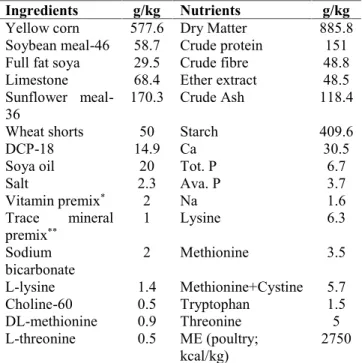
The present study was carried out in the Broiler Breeder Unit of the Experimental Farm of the Department of Animal Science, Faculty of Agriculture, University of Çukurova, Adana-Turkey in the autumn of 2016.Throughout the experimental study, the standard breeder (female) diet based on corn and soya was used. Ingredients and nutritional composition of the diet are given in Table 1.
Table 1. Ingredient and nutritional composition of the female breeder diets.
Ingredients g/kg Nutrients g/kg
Yellow corn 577.6 Dry Matter 885.8
Soybean meal-46 58.7 Crude protein 151
Full fat soya 29.5 Crude fibre 48.8
Limestone 68.4 Ether extract 48.5
Sunflower
meal-36 170.3 Crude Ash 118.4
Wheat shorts 50 Starch 409.6
DCP-18 14.9 Ca 30.5
Soya oil 20 Tot. P 6.7
Salt 2.3 Ava. P 3.7 Vitamin premix* 2 Na 1.6 Trace mineral premix** 1 Lysine 6.3 Sodium bicarbonate 2 Methionine 3.5 L-lysine 1.4 Methionine+Cystine 5.7 Choline-60 0.5 Tryptophan 1.5 DL-methionine 0.9 Threonine 5 L-threonine 0.5 ME (poultry; kcal/kg) 2750
*:Each 2 kg of vitamin premix contains 5.000.000 IU Vitamin
A, 5.000.000 IU Vitamin D3, 100.000 mg vitamin E, 3.000 mg
Vitamin K3, 3.000 mg Vitamin B1, 8.000 mg Vitamin B2,
60.000 mg Niacin, 15.000 mg Ca-D-Pantothenate, 5.000 mg Vitamin B6, 20 mg Vitamin B12, 2.000 mg Folic Acid, 200 mg
D-Biotin ve 100.000 mg Vitamin C.
**:Each kg of trace mineral premix contains 80000 mg
Manganese, 60000 mg Iron, 60000 mg Zinc, 5000 mg Copper, 200 mg Cobalt, 1000 mg Iodine,no Selenium.
Two hundred female and 20 male Ross 308 broiler breeders were placed in the unit at 52 weeks of age. After 2 weeks pre-feeding period (52-53 weeks of age, during which egg production was recorded) birds at the beginning of 54th weeks of age were grouped
according to body weight and also egg production in a completely randomized design with 2 treatments (0.2
ppm HMSeBA or 0.2 ppm Se-Yeast) with 10 replicates, each having similar body weight and egg production levels. Each replicate had 10 females and 1 male per pen sizing 2.0 x 1.5 m in the breeder unit where 20 pens were available for the trial. Each pen of the breeder unit had five nests having wood shavings, sizing 25×43×35 cm each, and containing a female tubular feeder and one chain male feeder, and an automated water-bowl for providing fresh and clean drinking water ad libitum. Animals were placed on wood shavings litter 7-8 cm height. The experiment lasted while the broiler breeders were from 54 to 62 weeks of age and the lighting and feeds (female: 156 gram/day, male: 130 gram of the standard male-breeder diet/day) were supplied according to the recommendation of Ross Breeding Company (Ross, 2011) with drinking water ad libitum. The environmental temperature (18-22°C) and humidity (55-60% RH) were maintained within the animal comfort zone using foggers and tunnel ventilation. Male performance was watched out and the male with low mating performance was replaced with the spare one, as 5 spares were raised separately to replace sexually inactive or dead males. Eggs were collected every day and measured for exterior quality (size, weight, and crack incidents) measurements. Weekly egg production, hatching eggs, and eggs with defects were obtained through daily collections and were expressed in percentage. Defective eggs were considered those with physical deformities and those bearing cracks. Double yolk and floor eggs will be added up to total production but were not incubated.
In order to observe body weight changes of breeders throughout the experiment, at the beginning of the experiment when the birds 54th week of age, and at
the end of the experiment when the birds 62nd week of
age, all birds were weighed individually.
In the experiment feed intake, feed conversion ratio, egg production (in number and mass), egg yield and hen-day egg production were recorded weekly. At 54 weeks of age and thereafter laying performance parameters were analysed weekly.
At the third week (56thweeks of age) of the trial
and thereafter (57-62th weeks of age) eggs obtained on
the third day of the weeks analysed for interior [albumen and yolk measurements] and, also, exterior quality measurements such as egg shape index, shell thickness (by micrometres), shell weight, shell strength (forced by texture analyser, kg/cm2). It is well known that albumen
height was correlated to egg weight, according to the following formula introduced by Brant et al. (1951); Haugh Units=100 log (H + 5.57 - 1.7 W0.37)
Where: H = albumen height (mm); W = egg weight (g) On the fourth week (57th weeks of age) and
seventh week (60thweek of age) of the experiment, eggs
were checked and collected for fertility test before onset of the first and the second incubation, respectively.
During the experiment, hatching performance of the eggs obtained from the birds receiving HMSeBA or Se-Yeast was performed by 21 day-incubation twice. For hatchings process, eggs were selected and stored in a cool room until owing 700 eggs, 350 from each group between 58-59 weeks of age for the first hatched and 61-62 weeks of age for the second hatched, respectively. Eggs were incubated in a single stage incubator using 35 eggs per replication. Temperature was controlled according to McQuoid (2000). Hatching was completed on the 21st
day. The chicks were carefully removed from the pouches and their weights were determined by using an electronic scale with a sensitivity of 0.01 g. The strain of Ross breeder used in the study is known to be feather sexing. Chicks were sexed by wing feathers according to Ross Instruction (Ross, 2011). During hatching, embryo mortality was also recorded. At the end of incubation, eggs that did not hatch were broken to perform embryo diagnosis with classification of eggs as infertile or dead embryos. A visual estimation of the age at death was carefully performed and embryo mortality was separated as early, mid or late/dead in shell (1 to 7 days; 8 to 14 days; 15 to 21 days). The percentage of hatching chicks considered improper for placement as well as pips was calculated. The difference between total eggs set and infertile eggs was allowed the calculation of the present
hatchability of fertile eggs. So, fertility rate (%), hatching yield (%), and hatchability (%) were calculated (Sahin et al., 2009) as given below;
Fertility Rate (%) = (No of fertile eggs / No of eggs placed in hatchery) ×100
Hatching Yield (%) = (No of chicks hatched / No of eggs placed in hatchery) × 100
Hatchability (%) = (No of chicks hatched / No of fertile eggs placed in hatchery) × 100
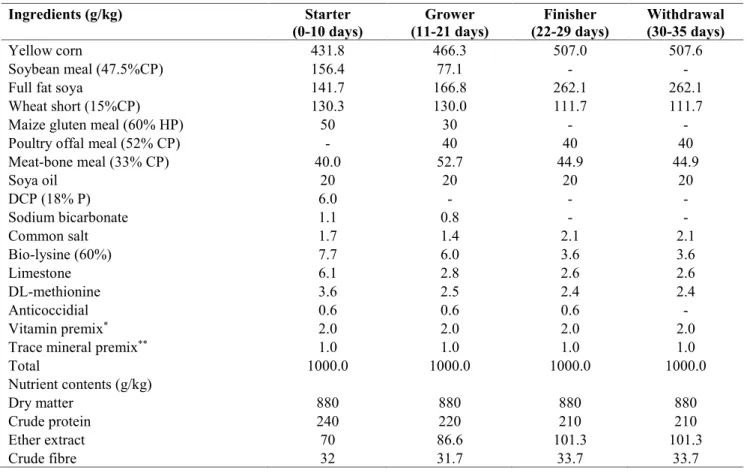
During the experiment, hatching performance of the eggs obtained from the birds receiving HMSeBA or Se-Yeast was performed by incubation twice. Chicks obtained at the end of the first and the second incubation were carefully removed from the pouches, weighed, sexed and accommodated in 20 pens, each treatment groups has 10 pens sized 2×3m and equipped with a tube feeder and an automatic water-bowl on litter; wood shavings litter 7-8 cm height. Chicks were given feed and water for 35 days ad libitum under a 23:1 light: dark photoperiod. The chicks obtained from the eggs of a group/subgroup were housed by name of the maternal group/subgroup number to fellow on the same axis to maternal to its chicks. Chicks were received four stages (starter, grower, finisher and withdrawal feeds) feeding program with the diets containing conventional vitamins and trace mineral premixes (Table 2).
Table 2. Ingredient and nutritional compositions of broiler diets used in the study.
Ingredients (g/kg) Starter
(0-10 days) (11-21 days)Grower (22-29 days)Finisher Withdrawal(30-35 days)
Yellow corn 431.8 466.3 507.0 507.6
Soybean meal (47.5%CP) 156.4 77.1 -
-Full fat soya 141.7 166.8 262.1 262.1
Wheat short (15%CP) 130.3 130.0 111.7 111.7
Maize gluten meal (60% HP) 50 30 -
-Poultry offal meal (52% CP) - 40 40 40
Meat-bone meal (33% CP) 40.0 52.7 44.9 44.9 Soya oil 20 20 20 20 DCP (18% P) 6.0 - - -Sodium bicarbonate 1.1 0.8 - -Common salt 1.7 1.4 2.1 2.1 Bio-lysine (60%) 7.7 6.0 3.6 3.6 Limestone 6.1 2.8 2.6 2.6 DL-methionine 3.6 2.5 2.4 2.4 Anticoccidial 0.6 0.6 0.6 -Vitamin premix* 2.0 2.0 2.0 2.0
Trace mineral premix** 1.0 1.0 1.0 1.0
Total 1000.0 1000.0 1000.0 1000.0 Nutrient contents (g/kg) Dry matter 880 880 880 880 Crude protein 240 220 210 210 Ether extract 70 86.6 101.3 101.3 Crude fibre 32 31.7 33.7 33.7
Crude ash 60.3 58.0 54.8 54.8 Lysine 14.3 12.6 10.9 10.9 Methionine 7.0 5.6 5.0 5.0 Methionine + cystine 10.7 8.4 8.6 8.6 Calcium 10 10 9.0 9.0 Available phosphorous 4.5 4.5 4.0 4.0 Sodium 1.6 1.6 1.6 1.6
Metabolizable energy (kcal/kg) 3050 3150 3250 3250
*:Each 2 kg of vitamin premix contains 13.500.000 IU Vitamin A, 4.000.000 IU Vitamin D3, 100.000 mg vitamin E, 5.000 mg
Vitamin K3, 3.000 mg Vitamin B1, 8.000 mg Vitamin B2, 60.000 mg Niacin, 18.000 mg Ca-D-Pantotenate, 5.000 mg Vitamin B6, 30
mg Vitamin B12, 2.000 mg Folic Acid, 200 mg D-Biotin ve 100.000 mg Vitamin C,
**:Each kg of trace mineral premix contains 100.000 mg Manganese, 80.000 mg Iron, 80.000 mg Zinc, 8.000 mg Copper, 200 mg
Cobalt, 1000 mg Iodine,150 mg selenium (sodium selenite), 500.000 choline chloride.
During the experiment, live weight, feed intake and feed conversion ratio were recorded weekly in subgroup. At 35 days of age, birds were attained the weight given for 42 days of age by Breeder Handbook (Ross, 2011), therefore feeding was ceased and birds were taken slaughterhouse one week earlier.
The data obtained in the study were analyzed by using t-test procedure of SAS; the Statistical Analysis System (SAS, 2000). Results obtained in this study are presented as means per bird with standard errors (se) of the mean and/or CV (coefficient of variation) with P values, except for feed intake as feeds were given to the birds in equal amount according to the recommendations of the Breeding Company and all the feed offered daily were totally consumed by the birds in half an hour.
RESULTS AND DISCUSSION
The results with respect to body weight changes hens showed almost 240 g difference between groups without significant difference (Table 1). Throughout the experiment, the birds were allowed to consume feed according to the recommendation of the Breeding Company. Foods were given to female birds 156 g/day, male birds 130 g/day. Feeding management was based on recommendation of Breeder Company, aiming breeders’ target in body weight, fertility, hatchability and hatching yield. The results with respect to live weight changes and feed intake results are given in Table 3. Table 3. Live weight changes and feed intake of birds throughout the experiment.
Parameters HMSeBA (n=10) Se-Yeast (n=10) P=
Mean se Mean se
Live weight at the first day of the trial (g/hen) 4697 27.25 4738 29.83 0.321
Live weight at the last day of the trial (g/hen) 4940 35.75 4976 36.02 0.486
Weight changes (g/hen) 243.3 39.84 238.3 22.28 0.917
Feed intake (g/hen/day) 156 156 NA*
Feed intake (g/cock/day) 130 130
*: Not Available
The results with respect to laying performance at 56 and 62 (two weeks after and eight weeks after the initiation of the experiment) weeks of age are given in Table 4.
Table 4. Egg production of the breeders at the second week and last week of the trial.
Parameters 56thweeks of age 62ndweeks of age
HMSeBA (n=10) Se-Yeast (n=10) P= HMSeBA (n=10) Se-Yeast (n=10) P=
Mean se Mean se Mean se Mean se
Egg production (number/week/hen) 4.78 0.34 4.65 0.25 0.293 4.13 0.22 3.86 0.20 0.368
Egg weight (g/day) 46.79 3.03 45.59 2.22 0.215 41.79 2.23 38.85 2.02 0.342
Egg weight (g/egg) 68.67 0.25 68.76 0.38 0.850 70.76 0.22 70.52 0.50 0.657
Egg mass (g/week/hen) 327.6 23.47 319.37 17.22 0.215 292.54 15.38 271.95 14.17 0.342
Feed conversion ratio (g feed/g egg) 3.19 0.23 3.52 0.24 0.332 3.74 0.22 4.01 0.23 0.402
The results showed that providing selenium in the form
groups (Table 4). Additionally, the performance values obtained at 56-62 weeks of age in the present trial were higher than the values set by the Breeding Company (Ross, 2011).
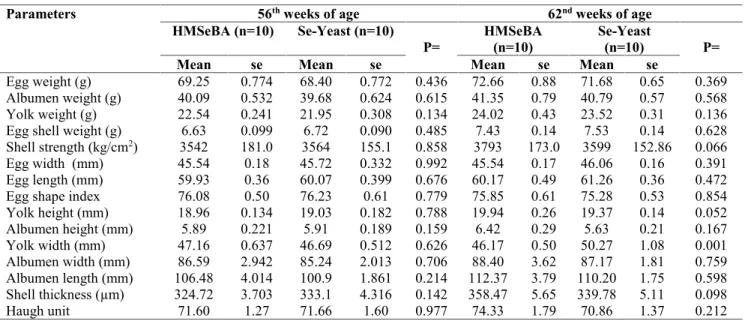
The results with respect to quality of eggs obtained two weeks after the beginning (56th week of
age) and at the last weeks (62nd week of age) of the
experiment are given in Tables 5. Table 5. Quality measurements of eggs obtained at the beginning and end of the trial.
Parameters 56thweeks of age 62ndweeks of age
HMSeBA (n=10) Se-Yeast (n=10)
P= HMSeBA(n=10) Se-Yeast(n=10) P=
Mean se Mean se Mean se Mean se
Egg weight (g) 69.25 0.774 68.40 0.772 0.436 72.66 0.88 71.68 0.65 0.369
Albumen weight (g) 40.09 0.532 39.68 0.624 0.615 41.35 0.79 40.79 0.57 0.568
Yolk weight (g) 22.54 0.241 21.95 0.308 0.134 24.02 0.43 23.52 0.31 0.136
Egg shell weight (g) 6.63 0.099 6.72 0.090 0.485 7.43 0.14 7.53 0.14 0.628
Shell strength (kg/cm2) 3542 181.0 3564 155.1 0.858 3793 173.0 3599 152.86 0.066
Egg width (mm) 45.54 0.18 45.72 0.332 0.992 45.54 0.17 46.06 0.16 0.391
Egg length (mm) 59.93 0.36 60.07 0.399 0.676 60.17 0.49 61.26 0.36 0.472
Egg shape index 76.08 0.50 76.23 0.61 0.779 75.85 0.61 75.28 0.53 0.854
Yolk height (mm) 18.96 0.134 19.03 0.182 0.788 19.94 0.26 19.37 0.14 0.052 Albumen height (mm) 5.89 0.221 5.91 0.189 0.159 6.42 0.29 5.63 0.21 0.167 Yolk width (mm) 47.16 0.637 46.69 0.512 0.626 46.17 0.50 50.27 1.08 0.001 Albumen width (mm) 86.59 2.942 85.24 2.013 0.706 88.40 3.62 87.17 1.81 0.759 Albumen length (mm) 106.48 4.014 100.9 1.861 0.214 112.37 3.79 110.20 1.75 0.598 Shell thickness (µm) 324.72 3.703 333.1 4.316 0.142 358.47 5.65 339.78 5.11 0.098 Haugh unit 71.60 1.27 71.66 1.60 0.977 74.33 1.79 70.86 1.37 0.212
The results showed that at the initial period of the experiment all the quality measurements of the treatment groups were similar to each other. However, at the last weeks of the trial eggs obtained from the group receiving HMSeBA exhibited better values in terms of egg shell strength (P≤0.07), shell thickness (P≤0.1), yolk height (P≤0.06) and yolk width (P≤0.01).
Fourth week of the experiment when the animals were 57 weeks of age, all eggs were collected and
subjected to fertility test. Fertility rate was found around 93 and 96% in Se-Yeast and HMSeBA groups, respectively. During 58th and 59th weeks of age,
collections of eggs for the first hatching were compiled within 9 days. 700 eggs were placed in the incubator for 21 days. The results obtained at the end of the incubation for the first hatching are given in Table 6.
Table 6. Hatching performance of breeders at the first incubation
Parameters HMSeBA Se-Yeast P=
Mean se CV Mean se CV
Number of eggs placed hatchery 35 0.00 0.00 35 0.00 0.00 0.000
Number of fertile eggs 33.80 0.25 2.33 32.56 0.67 6.16 0.087
Number of unfertile eggs 1.50 0.19 35.63 2.44 0.67 82.10 0.217
Fertility rate (%) 96.57 0.71 2.33 93.02 1.91 6.16 0.086
Embryonic mortality in early stage 6.30 1.72 86.31 6.44 0.93 43.28 0.943
Embryonic mortality in mid stage 1.22 0.15 36.08 1.86 0.34 48.45 0.083
Embryonic mortality in late stage/in shell 4.22 0.60 42.33 3.00 0.58 57.74 0.160
No of chicks hatched alive 22.40 1.56 22.09 21.22 1.31 18.52 0.576
Male 11.70 1.05 28.50 10.44 1.09 31.43 0.420
Female 10.70 0.70 20.69 10.78 1.18 32.73 0.954
No of chicks hatched after death 2.00 0.00 0.00 2.00 1.00 70.71 1.000
Chicks’ weight at hatching (g/chick) 49.25 1.28 0.28 50.78 0.78 3.43 0.102
Hatchability (%) 66.20 4.51 21.54 65.30 3.96 18.18 0.576
Hatching yield (%) 64.00 4.47 22.09 60.64 3.74 18.52 0.571
The group receiving HMSeBA had numerically higher
rate were similar but hatching yield in HMSeBA group found to be almost 4% higher than those of Se-Yeast group. A week after the egg collection for the first hatching, eggs collected at 60 weeks of age were subjected to fertility test again. Fertility rate was found around 89 and 91% in Se-Yeast and HMSeBA groups,
respectively. During 61st and 62nd weeks of age,
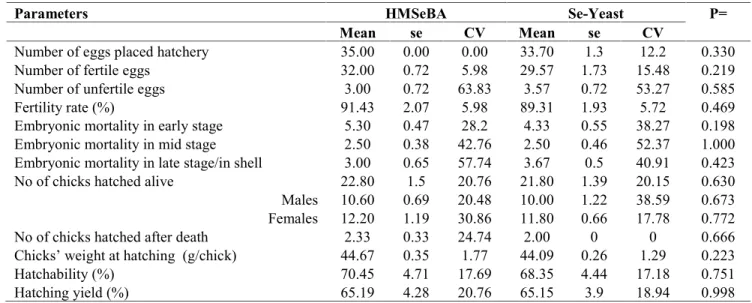
collection of eggs for the second hatching was compiled within 13 days. Almost 680 eggs were placed in the incubator for 21 days. The results obtained at the end of the incubation for the second hatching are given in Table 7.
Table 7. Hatching performance of breeders at the second incubation
Parameters HMSeBA Se-Yeast P=
Mean se CV Mean se CV
Number of eggs placed hatchery 35.00 0.00 0.00 33.70 1.3 12.2 0.330
Number of fertile eggs 32.00 0.72 5.98 29.57 1.73 15.48 0.219
Number of unfertile eggs 3.00 0.72 63.83 3.57 0.72 53.27 0.585
Fertility rate (%) 91.43 2.07 5.98 89.31 1.93 5.72 0.469
Embryonic mortality in early stage 5.30 0.47 28.2 4.33 0.55 38.27 0.198
Embryonic mortality in mid stage 2.50 0.38 42.76 2.50 0.46 52.37 1.000
Embryonic mortality in late stage/in shell 3.00 0.65 57.74 3.67 0.5 40.91 0.423
No of chicks hatched alive 22.80 1.5 20.76 21.80 1.39 20.15 0.630
Males 10.60 0.69 20.48 10.00 1.22 38.59 0.673
Females 12.20 1.19 30.86 11.80 0.66 17.78 0.772
No of chicks hatched after death 2.33 0.33 24.74 2.00 0 0 0.666
Chicks’ weight at hatching (g/chick) 44.67 0.35 1.77 44.09 0.26 1.29 0.223
Hatchability (%) 70.45 4.71 17.69 68.35 4.44 17.18 0.751
Hatching yield (%) 65.19 4.28 20.76 65.15 3.9 18.94 0.998
The group receiving HMSeBA had numerically higher fertility rate. The both groups had similar rate of embryonic mortality and similar number of chicks hatched alive. In both groups, the chicks’ weight at hatching and hatching yield were similar but hatchability in HMSeBA group found to be almost 2% higher than those of Se-Yeast group.
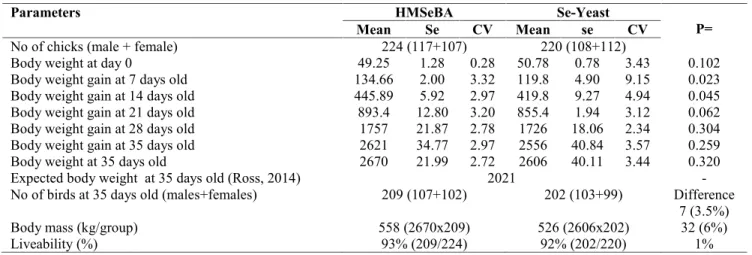
At the end of the first and the second incubations, all the chicks obtained at hatching were subjected to growth performance test by feeding starter, grower, finisher and withdrawal feeds containing no organic selenium source but inorganic selenium (sodium selenite) for a period of 35 days during which all the animals were allocated in a group named by its maternal group. When the trial was proposed, broiler performance test at the end of both incubations were planned to carry out 42 days, however, in order to control leg problems due to enormously fast-growing chicks during the testing period did not let trials to be run 42 days. At 35 days of age in the first and the second trials, broilers had to be slaughtered. The results obtained during the first performance test are given in Tables 8, 9 and 10.
The chicks of both groups grew very fast. Especially, the chicks from maternal receiving HMSeBA had average slaughter weight as 2670 g at 35 days of age, being a 7-days earlier and 0.09 better feed efficiency (FCR, 1.52) than breeder’s expectation (FCR, 1.61) at 35 days of age. Chicks from maternal receiving Se-Yeast
had mean slaughter weight of 2606 grams at 35 days of age, being a 5-days earlier and 0.10 better feed efficiency (FCR, 1.51) than breeder’s expectation (FCR, 1.61) at 35 days of age. The results also showed that at the end of the feeding period, the chicks, whose maternal received HMSeBA attained body mass almost 6% higher than those of the birds of Se-Yeast group. Both groups had similar liveability, feed intake (Table 9) and also feed conversion rate (Table 10) throughout the feeding period. The results obtained during the second performance test were given in Table 11. The chicks of the both groups grew very fast similar to the first performance test. Especially chicks from maternal receiving HMSeBA had mean slaughter weight of 2531 grams at 35 days of age, being a 6-days earlier and 0.11 better feed conversion ratio (FCR, 1.49) than breeder’s expectation (1.61) at 35 days of age. Chicks from maternal receiving Se-Yeast had mean slaughter weight of 2481 grams at 35 days of age, being a 4-days earlier and 0.06 better feed efficiency (FCR, 1.55) than breeder’s expectation (FCR, 1.61) at 35 days of age. The results also showed that at the end of the feeding period, the chicks, whose maternal received HMSeBA attained body mass almost 6% higher than the birds of Se-Yeast group. Both groups had similar liveability and feed intake (Table 12) but HMSeBA group attained 0.06 better feed efficiency (Table 13) than Se-Yeast group.
Table 8. Growth performance (g/chicks) of chicks obtained from the first hatching.
Parameters HMSeBA Se-Yeast
P=
Mean Se CV Mean se CV
No of chicks (male + female) 224 (117+107) 220 (108+112)
Body weight at day 0 49.25 1.28 0.28 50.78 0.78 3.43 0.102
Body weight gain at 7 days old 134.66 2.00 3.32 119.8 4.90 9.15 0.023
Body weight gain at 14 days old 445.89 5.92 2.97 419.8 9.27 4.94 0.045
Body weight gain at 21 days old 893.4 12.80 3.20 855.4 1.94 3.12 0.062
Body weight gain at 28 days old 1757 21.87 2.78 1726 18.06 2.34 0.304
Body weight gain at 35 days old 2621 34.77 2.97 2556 40.84 3.57 0.259
Body weight at 35 days old 2670 21.99 2.72 2606 40.11 3.44 0.320
Expected body weight at 35 days old (Ross, 2014) 2021
-No of birds at 35 days old (males+females) 209 (107+102) 202 (103+99) Difference 7 (3.5%)
Body mass (kg/group) 558 (2670x209) 526 (2606x202) 32 (6%)
Liveability (%) 93% (209/224) 92% (202/220) 1%
Table 9. Cumulative feed intake (g/chicks) of chicks obtained from the first hatching.
Parameters HMSeBA Se-Yeast P=
Mean se CV Mean Sderr CV
Feed intake at 7 d 159.7 7.34 10.3 161.3 8.01 11.1 0.886
Feed intake at 14 d 605.8 19.95 7.36 618.9 31.97 11.6 0.738
Feed intake at 21 d 1484 42.05 6.34 1504 71.12 10.6 0.818
Feed intake at 28 d 2553 68.30 5.98 2531 97.68 8.99 0.334
Feed intake at 35 d 3973 89.20 5.02 3860 108.3 6.44 0.166
Expected feed intake at 35 (Ross, 2014) 3248
-Table 10. Feed conversion ratio (feed/gain) of chicks obtained from the first hatching.
Parameters HMSeBA Se-Yeast P=
Mean se CV Mean se CV
Feed conversion rate at 7 d 1.19 0.05 9.49 1.36 0.10 16.41 0.162
Feed conversion rate at 14 d 1.36 0.03 5.06 1.48 0.09 12.88 0.223
Feed conversion rate at 21 d 1.46 0.04 5.80 1.46 0.09 11.89 0.365
Feed conversion rate at 28 d 1.45 0.04 6.41 1.47 0.05 8.00 0.500
Feed conversion rate at 35 d 1.52 0.04 5.65 1.51 0.04 5.50 0.411
Expected FCR at 35 d (Ross, 2014) 1.61
-Table 11. Growth performance (g/chicks) of chicks obtained from the second hatching.
Parameters HMSeBA Se-Yeast P=
Mean Se CV Mean se CV
No of chicks (male + female) 228 (106+122) 218 (101+117)
Body weight at day 0 44.67 0.35 1.77 44.09 0.26 1.29 0.223
Body weight gain at 7 days old 90.70 2.83 6.98 89.42 2.51 6.27 0.742
Body weight gain at 14 days old 349.5 8.06 5.16 341.9 8.56 5.60 0.533
Body weight gain at 21 days old 956 17.24 4.03 925 13.30 3.21 0.192
Body weight gain at 28 days old 1708 37.84 4.95 1658 24.09 3.25 0.290
Body weight gain at 35 days old 2486 42.62 3.83 2437 50.26 4.61 0.472
Body weight at 35 days old 2531 42.46 3.75 2481 50.31 4.53 0.467
Expected body weight at 35 days old (Ross, 2014) 2021
-No of birds at 35 days old (males+females) 210 (99+111) 202 (94+108) Difference
8 (3.5%)
Body mass (kg/group) 531 (2531x210) 501 (2480x202) 30 (6%)
-Table 12. Cumulative feed intake (g/chicks) of chicks obtained from the second hatching.
Feed intake HMSeBA Se-Yeast
P= Mean Se CV Mean se CV at 7 d 114.65 5.78 9.01 111.1 7.79 12.62 0.527 at 14 d 482.5 21.94 8.91 489.9 15.22 6.13 0.874 at 21 d 1295 40.34 7.53 1278 27.25 5.15 0.755 at 28 d 2337 42.47 4.06 2323 31.90 3.07 0.804 at 35 d 3702 59.95 3.62 3765 46.41 2.76 0.431
Expected Feed Intake at 35 (Ross, 2014) 3248
-Table 13. Feed conversion ratio (FCR; g feed/g gain) of chicks obtained from the second hatching.
Feed conversion ratio HMSeBA Se-Yeast
P= Mean se CV Mean se CV at 7 d 1.25 0.04 5.94 1.24 0.08 11.34 0.314 at 14 d 1.38 0.06 7.81 1.43 0.06 7.73 0.534 at 21 d 1.35 0.04 6.27 1.38 0.03 5.86 0.605 at 28 d 1.37 0.03 5.26 1.40 0.02 3.70 0.435 at 35 d 1.49 0.01 2.14 1.55 0.04 6.28 0.232 Expected FCR at 35 d (Ross, 2014) 1.61
-The results obtained in the present study showed that broiler breeder receiving organic form of selenium in HMSeBA had attained numerically better performance than the group receiving Se-Yeast with respect to egg production, egg weight, egg mass, feed conversion ratio, hatching and also growth of progeny.
Although the differences were insignificant (P>0.05), providing organic selenium in the form of HMSeBA could have a potential to increase laying performance, interior and exterior egg quality, fertility, hatching performance and also progeny performance in terms of meat production with a higher efficacy.
Better results obtained with the organic form of HMSeBA could be attributed to its biologically better activity as more recent studies showed that a new organic selenium source based on the 2-hydroxy-4-methylselenobutanoic acid (HMSeBA), which can be assimilated to hydroxy-analog of selenomethionine, has been reported to be high dietary efficacy, biologic activity and stability in poultry (Briens et al., 2013; Jlali et al., 2013) and pigs (Jlali et al., 2014).
As it can be seen in Table 3 there was not significant effect(P≤0.05) on body weight change and feed intake parameters between experiment groups throughout the experiment, the birds were given equal amount of feed according to the recommendation of the Breeding Company (female birds 156 g/d, male birds 130 g/d). Also in this study, it was showed that (Table 4) supplementation of broiler breeder’s diet with different source of organic selenium did not have significant effects (P>0.05) on egg production, egg weight, egg mass, and feed conversion ratio. These data support the findings of previous research on selenium (Cantor et al., 2000; Paton et al., 2000; Jiakui and Xiaolong, 2004;
Payne et al., 2005). However, Invernizzi et al (2013) showed that inclusion of organic selenium (selenium-enriched yeast) in the laying hen’s diet did not have any effect on egg weight, egg mass, and egg production. Fernandes et al (2008) also reported no significant differences in egg production feed intake, feed conversion ratio in laying hens receiving 0.250 or 0.500 ppm dietary selenium in organic or mineral forms. However, they reported that selenium supplementation improved yolk yield and its total solid contents, and the deposition of selenium increased with the age of white layers.
It is well documented that selenium is an essential nutrient. Its role in metabolism is mainly related to the synthesis of Se-amino acid and Se-protein complexes that act as potent antioxidants. In addition to its antioxidant function, selenium could have a potential to affect egg quality. Wakebe (1999) and Pappas et al. (2005) showed that Se addition to layer diets can mitigate the reduction of Haugh units in stored eggs. Our results on increased shell strength are confirmed by previous studies (Paton et al., 2000; Siske et al., 2000; Golubkina and Papazyan, 2006; Invernizzi et al., 2013), they reported that shell strength could be related to higher Se concentration in the shell and shell membrane. These two last factors are particularly increased when diet contains organic Se sources, suggesting that the high Se concentration could be the main factor for increased shell strength through its role in formation of the organic matrix. It is well-known that eggshell membrane is mainly consists of fibrous protein or collagen-like proteins (Tullet, 1987), which derives organic matrix. It has been shown that fortifying poultry feeds with selenium, especially organic source, have a great
potential to increase egg selenium contents (Jlali et al., 2013). Our results suggest that selenium in the egg have a powerful agent with its antioxidant properties and also being a significant factor in synthesis of organic matrix of egg shell. It is also reported that the natural selenium-containing antioxidant enzymes like glutathione peroxidase and thioredoxing reductase have the potential to reduce the effect of free radicals on the ageing process (Best, 2014). Disulfide bonds (bonds between sulphur atoms) can cross-link proteins, decreasing enzyme function and increasing the sinew associated with ageing collagen. Protein oxidation is known to be related to selenium deficiency (Moskovitz and Stadtman, 2003). The present literatures with respect to selenium and its protective effect on structural protein suggest that selenium is a key factor for the formation of organic matrix derived by shell membrane by maintaining the integrity of fibrous protein or collagen-like proteins, leading to increase in shell strength.The improvement in egg quality could be attributed to selenium and selenomethionine role in the synthesis of egg shell matrix, mineralization and also its contribution to antioxidant capacity and membrane integrity.
In this experiment fertility rate and hatching performance of broiler breeders were showed in Table 6 and Table 7. It was observed that supplementation of broiler breeder’s diet with different source of organic selenium did not make any significant difference in fertility and also hatching performance. These findings are in contrast with the results reported by Osman et al (2010). They found that supplementation of breeder hen’s diet with 0.1 and 0.2 mg/kg organic selenium had significant effects on fertility, hatchability, and embryonic mortality. It was also previously reported that selenium supplementation increased the hatchability and hatching yield (Hanafy et al., 2009; Petrosyan et al., 2006).
Growth performance, cumulative feed intake, feed efficiency of broiler chicks obtained from the first and the second hatching were shown in Tables 8 to 13. These results suggested that supplementation of broiler breeder diet with different source of organic selenium does not make a significant difference on their chicks’ growth performance; weight gain, feed intake and feed efficiency at 35 day of age. Our results support Oliveira et al. (2014) who reported that breeders receiving 0.15, 0.30, 0.45, 0.60 ppm selenium exhibited no significant differences in term of performance parameters. Similarly, Perić et al. (2009) observed no effects on the performance of the broiler when received different source and levels of selenium. Moreover not in feed but Joshua et al. (2016) reported that in ovo supplementation of nano forms of zinc, copper and selenium gave best feed efficiency at certain inclusion levels. The research clearly showed that nano minerals are not harmful to the embryo
and can be used to improve the post-hatch performance of broiler chicks.
Conclusions: From the results reported here it may be concluded that although the differences were insignificant (P>0.05), providing organic selenium in the form of HMSeBA instead of Se-Yeast could be a potential to increase laying performance, interior and exterior egg quality, fertility, hatching performance and also progeny performance in terms of meat production with a higher efficacy.
Acknowledgements: The authors are grateful to Ekol Gıda A.Ş. for obtaining HMSeBA, Se-Yeast and vitamin and trace mineral premixes used in the study.
REFERENCES
Best, B. (2014). Selenium: Anti Oxidant, Anti-Carcinogen
and Immune System Booster.
http://www.benbest.com/nutrceut/Selenium.html. Online source, accessed on 27.10.2017.
Brant, A.W., A.W.Otte, and K.H. Norris (1951). Recommended standards for scoring and measuring opened egg quality. Food Technology 5: 356-361.
Briens, M., Y.Mercier, F.Roffineau, V.Vacchina, and P.A. Gereart(2013). Comparative efficiency of a new organic selenium source vs. seleno-yeast and mineral selenium sources on muscle selenium enrichment and selenium digestibility in broiler chickens. British J. Nutrition 110: 617-624. Cantor, A. H., M. L. Straw, M. J. Ford, A. J. Pescatore, and
M. K. Dunlap (2000). Effect of feeding organic selenium in diets of laying hens on egg selenium content. Page 473 in J. S. Sim, S. Nakai, and W. Guenter, eds. Egg nutrition and biotechnology. CABI Publishing, New York, NY.
Cheeke, P. R (2005). Applied Animal Nutrition, Feds and Feeding, 3. Edit. Pearson, Prentice Hall, Upper Saddle River, New Jersey 07458.
Ebeid, T. A (2009). Organic selenium enchances the antioxidative status and quality of cockerel semen under high ambient temperature. British Poul. Sci., 50: 641-647.
Fernandes, J. I. M., A. E. Murakami, M. I. Sakamoto, L. M. G. Souza, A. Malaguido, and E. N. Martins (2008). Effect of organic mineral dietary supplementation on production performance and egg quality of white layers. Brazilian J. Poul. Sci., 10: 59-65.
Golubkina, N.A., and T.T. Papazyan (2006). Selenium distribution in eggs of avian species. Comparative Biochemistry and Physiology. Part B 145: 384-388.
Hanafy, M. M., A. M. H. El-Sheikh, and E. A. Abdalla. (2009). The effect of organic selenium
supplementation on productive and physiological performance in a local strain of chicken.1-The effect of organic selenium (sel-plex™) on productive, reproductive and physiological traits of bandarah local strain. Egyptian Poul. Sci., 29: 1061-1084.
Invernizzi,G., A. Agazzi, M. Ferroni, R. Rebucci, A. Fanelli, A. Baldi, V. Dell’Orto, and G. Savoini (2013). Effects of inclusion of selenium-enriched yeast in the diet of laying hens on performance, eggshell quality, and selenium tissue deposition. Italian J. Anim. Sci., 12:1, e1, DOI: 10.4081/ijas.2013.e1
Joshua, P., C. Valli, and V. Balakrishnan (2016). Effect of in ovo supplementation of nano forms of zinc, copper, and selenium on post-hatch performance of broiler chicken. Vety. World. 9(11): 287-294. Jiakui, L., and W. Xiaolong (2004). Effect of dietary
organic versus inorganic selenium in laying hens on the productivity, selenium distribution in egg and selenium content in blood, liver and kidney. J. Trace Elements in Med. Bio. 18: 65-68. Jlali, M., M. Biens, F. Rouffineau, P. A. Geraert, and Y.
Mercier (2013). Effect of 2-hydroxy-4-methylselenobutonoic acid as a dietary selenium supplement to improve the selenium concentration of table eggs. J. Anim. Sci., 91:1745-1752.
Jlali, M., M. Briens, F. Rouffineau, P. A. Geraert, and Y. Mercier (2014). Evaluation of the efficacy of 2-hydroxy-4-methylselenobutanoic acid on growth performance and tissue selenium retention in growing pigs. J. Anim. Sci., 92:182-188.
Khan, M. T., A. Mahmud, I. Zahoor and K. Javed (2017). Organic and inorganic selenium in Aseel chicken diets: Effect on hatching traits. Poul. Sci., 96:1466–1472.
Moskovitz, J., and E. R. Stadtman (2003). Selenium-deficient diet enhances protein oxidation and affects methionine sulfoxidereductase (MsrB) protein level in certain mouse tissues. Proceedings of the National Academy of Sciences of the United States of America 100: 7486-7490. Oliveira, T.F.B., D.F.R. Rivera, F.R. Mesquita, H. Braga,
E.M. Ramos, and A.G. Bertechini (2014). Effect of different sources and levels of selenium on performance, meat quality, and tissue characteristics of broilers. The J. Applied Poul. Res., 23:15–22.
Osman, A.M.R., H.M.Abdel Wahed, and M.S. Ragab (2010). Effect of supplementing laying hens diets with organic selenium on egg production, egg quality, fertility, and hatchability. Egyptian Poul. Sci., 30: 893-915.
Pappas, A. C., T.Acamovic, N. H.Sparks, P.F.Surai, and R.M. McDevitt (2006). Effects of supplementing
broiler breeder diets with organoselenium compounds and polyundaturated fatty acids on hatchability. Poul. Sci., 85: 1584-1593.
Pappas, A. C., T. Acamovic, N. H. Sparks, P. F. Surai, and R. M. Mc Devitt (2005). Effects of supplementing broiler breeder diets with organic selenium and polyunsaturated fatty acids on egg quality during storage. Poul. Sci., 84: 865-874. Paton, N.D., A. H. Cantor, A.J. Pescatore, and M.J. Ford
(2000). Effect of dietary selenium source and storage on internal quality and shell strength of eggs. Poul. Sci., 79(Suppl.1):116 (abstr.).
Payne, R.L., T. K. Lavergne, and L. L. Southern (2005). Effect of inorganic versus organic selenium on hen production and egg selenium concentration. Poul. Sci., 84: 232-237.
Perić, L., N.Milošević, D.Žikić, Z.Kanački, N.Džinić, L.Nollet, and P.Spring (2009). Effect of selenium sources on performance and meat characteristics of broiler chickens. J. Applied Poul. Res., 18:403–409.
Petrosyan, A., T.Papazyan, and L,Nollet (2006). “Administration of Selenium as Sel-Plex on top of Sodiumselenite still improves fertility of hatchability Of a broiler breeder flock.” XII European Poultry Conference, Verona, Italy, 10-14 September.
Ross. (2011). Parent Stock Performance Objectives, June. www.aviagen.com
Ross (2014). Ross 308 Broiler Performance Objectives. www.aviagen.com
Sahin, E.H., E.Sengor, M.Yardimci, and S. Cetingul (2009). Relationship Between Pre-Incubation Egg Parameters from Old Breeder Hens, Egg Hatchability and Chick Weight. J. Anim. Vet. Adv. 8: 115-119.
SAS Institue; SAS User’s Guide. Statistics.Version 5th Edition. 2000, SAS Institue Inc., Cary, NC Siske, V., L. Zeman, and D. Klecker (2000). The egg shell:
a case study in improving quality by altering mineral metabolism-naturally. Page 327 in Proceedings of 16th Alltech’s Annual Symposium, Nottingham, UK.
Surai, P.F. (2002). Antioxidant Systems in the Animal Body.In Natural Antioxidants in Avian Nutrition and Reproduction. Nottingham Press: Nottingham, England, pp:1-25.
Tullett, S.G (1987). Egg shell formation and quality. In: Wells, R.G., Belyavin, C.G. (Eds.), Egg Quality—Current Problems and Recent Advances. Butterworths, London. 123–146. Wakebe M. (1999). Organic selenium and egg freshness.
Japanese Patent Office, Application Heisei 8-179629. Poster Presentation, 15th Annual Symposium. On Biotechnology in the Feed Industry, Lexington, KI, USA.