Solution of Extremely Large Integral-Equation
Problems
¨
O. Erg¨
ul
∗T. Malas
∗L. G¨
urel
∗†Abstract — We report the solution of extremely
large integral-equation problems involving electro-magnetic scattering from conducting bodies. By orchestrating diverse activities, such as the multi-level fast multipole algorithm, iterative methods, preconditioning techniques, and parallelization, we are able to solve scattering problems that are dis-cretized with tens of millions of unknowns. Specif-ically, we report the solution of a closed geometry containing 42 million unknowns and an open geom-etry containing 20 million unknowns, which are the largest problems of their classes, to the best of our knowledge.
1 INTRODUCTION
For the numerical solution of scattering problems in electromagnetics, integral-equation formulations provide accurate results when they are discretized appropriately by using small elements with respect to wavelength. On the other hand, accurate solu-tions of many real-life problems require discretiza-tions with millions of elements, which result in dense matrix equations with millions of unknowns. For the solution of these large-scale problems in-volving complicated structures, we employ a paral-lel implementation of the multilevel fast multipole algorithm (MLFMA) [1].
With the efficient parallelization of MLFMA, problems with tens of millions of unknowns are eas-ily solved on relatively inexpensive computing plat-forms [2]–[4]. For scattering problems with open surfaces, however, parallel MLFMA is not sufficient to obtain efficient solutions. These problems are inevitably formulated with the electric-field inte-gral equation (EFIE), which usually produces ill-conditioned matrix equations that are difficult to solve iteratively, especially when the problem size is large [5]. Therefore, we employ advanced pre-conditioning schemes, such as nested precondition-ers based on an approximate MLFMA (AMLFMA) to obtain accelerated convergence even for ill-conditioned matrix equations obtained from EFIE. ∗Department of Electrical and Electronics Engineering,
Bilkent University, TR-06800, Bilkent, Ankara, Turkey.
†Computational Electromagnetics Research Center
(BiL-CEM), Bilkent University, TR-06800, Bilkent, Ankara, Turkey.
e-mail:{ergul,tmalas,lgurel}@ee.bilkent.edu.tr tel.: +90 312 2905750, fax: +90 312 2664192.
2 PARALLELIZATION OF MLFMA
MLFMA reduces the complexity of the matrix-vector multiplications (MVMs) related to an N ×N dense matrix equation from O(N2) to O(N log N ). Therefore, it provides the backbone of iterative so-lution of large scattering problems in electromag-netics. However, it is also desirable to parallelize MLFMA for the solution of many real-life problems that are not easily handled by sequential imple-mentations. On the other hand, parallelization of MLFMA is not trivial due to the complicated struc-ture of the algorithm [6]. Communications between the processors and duplications of the computations reduce the efficiency of the parallelization. In this manner, our implementations involve various paral-lelization strategies, load-balancing algorithms, op-timizations, and many other techniques to improve efficiency without sacrificing accuracy.
2.1 Near-Field Interactions
In MLFMA, there are O(N ) near-field interactions that are calculated directly and stored in mem-ory. These interactions are distributed among the processors using a load-balancing algorithm. The partitioning of the matrix equation for the near-field interactions is different from the partitioning for the far-field interactions and the iterative algo-rithm. Therefore, we perform all-to-one (gather) and one-to-all (scatter) communications in each MVM to match the different partitioning schemes. 2.2 Far-Field Interactions
In MLFMA, far-field interactions are calculated in a group-by-group manner involving three main stages, i.e., aggregation, translation, and disaggre-gation, which are performed on a multilevel tree structure constructed by recursively dividing the computational domain into subdomains (clusters). The tree structure is distributed among the proces-sors using a hybrid approach involving different strategies for the lower and higher levels [6]. In the lower (distributed) levels, each cluster is assigned to a single processor. In the higher (shared) lev-els, however, processor assignments are made on the basis of the fields of the clusters, not on the basis of the clusters themselves. Then, each
ter is shared by all processors and each processor is assigned to the same portion of the fields of all clusters.
2.2.1 Aggregation Stage
During the aggregation stage, radiated fields are calculated at the centers of the clusters from the bottom to the top of the tree structure. Sampling rates for the radiated fields depend on the sizes of the clusters, due to the oscillatory nature of the Helmholtz solutions. Therefore, local interpolation methods are employed to match the different sam-pling rates of the consecutive levels. In the distrib-uted levels, aggregation stage can be performed at each processor without any communication. Then, an all-to-all communication is required to switch the partitioning strategy from the distributed lev-els to the shared levlev-els. In the shared levlev-els, ag-gregation from a level to the next level requires one-to-one communications between the processors, which should be organized carefully. We apply load-balancing algorithms to efficiently distribute the clusters and fields among the processors in the distributed and shared levels, respectively. Finally, the radiation patterns of the basis functions are cal-culated and stored in memory so that they can be used multiple times during the iterative solution. 2.2.2 Translation Stage
In MLFMA, translations are required to compute the interactions between the clusters. For a basis cluster at any level, there are O(1) testing clus-ters to translate the radiated field into incoming fields. In the distributed levels, some of the trans-lations require one-to-one communications between processors, which are organized carefully by pairing the processors using a communication map. In the shared levels, where each processor is assigned to the same portion of the fields of all clusters, trans-lations are completed without any communication. Using cubic clusters, there are a maximum 316 dif-ferent translations in each level. The required op-erators for the translations (or their portions for shared levels) are calculated and stored in memory before the iterative solution. In order to achieve the O(N ) complexity for the setup, interpolation algorithms are used during the calculation of the translation operators [7].
2.2.3 Disaggregation Stage
During the disaggregation stage, incoming fields at the centers of the clusters are calculated from the
0 4 8 12 16 75 80 85 90 95 100 Number of Processes Efficiency (%)
Sphere (Radius=24λ), 2,111,952 Unknowns
Total Solution Setup
Figure 1: Parallelization efficiency for the solution of a scattering problem involving a sphere of radius 24λ discretized with 2,111,952 unknowns.
top of the tree structure to the lowest level. Trans-pose interpolations (anterpolations) are employed to match the different sampling rates of the consec-utive levels. In the lowest level, incoming fields are multiplied with the receiving patterns of the testing functions and angular integrations are performed to complete the MVM. Similar to the radiation pat-terns, receiving patterns of the testing functions are also calculated and stored in memory before the it-erative solution.
2.3 Efficiency
To demonstrate the efficiency of the paralleliza-tion of MLFMA, we consider a scattering problem involving a sphere of radius 24λ discretized with 2,111,952 unknowns. The problem is solved on a cluster of quad-core Intel Xeon 5355 processors con-nected via an Infiniband network. Figure 1 presents the parallelization efficiency, when the solution is parallelized into 2, 4, 8, 12, and 16 processes. Near-field and far-Near-field interactions are calculated with 2 digits of accuracy. It can be observed that the par-allelization of the setup part can be achieved with 97% efficiency for 16 processes. The solution part, which involves 27 BiCGStab iterations to obtain 10−6 residual error, is also parallelized efficiently. Due to the communications required during the MVMs, it is difficult to obtain high efficiency for the solution part. However, we are able keep the efficiency above 80%, thanks to effective paralleliza-tion strategies and load-balancing algorithms.
3 SOLUTION OF PROBLEMS
INVOLV-ING CLOSED SURFACES
For the solution of scattering problems involving closed surfaces, we use the combined-field inte-gral equation (CFIE), which is free of the internal-resonance problem and produces well-conditioned matrix equations that can be solved efficiently [5].
170 172.5 175 177.5 180 −20 −10 0 10 20 30 40 50 60 Bistatic Angle Analytical Computational 220λ
Sphere (Radius=110λ), 41,883,648 Unknowns
Total RCS (dB)
Figure 2: Bistatic RCS (in dB) of a sphere of radius 110λ discretized with 41,883,648 unknowns from 170◦ to 180◦, where 180◦corresponds the forward-scattering direction. 0 45 90 135 180 225 270 315 360 −60 −40 −20 0 20 40 60 RCS (dBms) Bistatic Angle
θθ
y
x
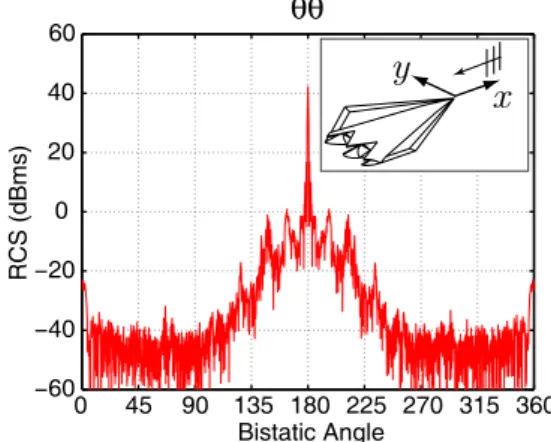
Figure 3: Bistatic RCS (in dBm2) of a stealth air-borne target Flamme at 16 GHz discretized with 24,782,400 unknowns.
As an example, we present the solution of a scat-tering problem involving a sphere of diameter 220λ discretized with 41,883,648 unknowns. The solu-tion is parallelized into 16 processes. The MLFMA tree has 3 shared and 6 distributed levels, while the smallest cluster size (in the lowest level) is about 0.21λ. Both the near-field and far-field interactions are calculated with 2 digits of accuracy. The solu-tion requires only 19 BICGStab iterasolu-tions to reduce the residual error below 10−3, when the iterations are accelerated by employing an inexpensive block-diagonal preconditioner. The setup and solution parts require 274 and 290 minutes, respectively, and the peak memory requirement is 229 GB us-ing the sus-ingle-precision representation to store the data. Figure 2 depicts the normalized bistatic radar cross section (RCS/λ2) values in decibels (dB). An-alytical values obtained by a Mie-series solution is
plotted as a reference from 170◦ to 180◦, where 180◦ corresponds the forward-scattering direction. Fig. 2 shows that the computational values sam-pled at 0.1◦ are in agreement with the analytical solution.
Next, we present the solution of a real-life prob-lem involving the Flamme geometry, which is a stealth airborne target, as detailed in [8]. The maximum dimension of the geometry is 6 meters, which corresponds to 320λ at 16 GHz. The scat-tering problem is discretized with 24,782,400 un-knowns using λ/10 triangulation. Figure 3 presents the bistatic RCS values in dBm2, when the target is illuminated by a plane wave propagating in the −x direction. The target is on the x-y plane and its nose is directed towards the x axis. Only the θ polarization is considered and co-polar RCS is plotted as a function of the bistatic angle φ, where φ = 180◦ corresponds to the forward-scattering di-rection. Solution of the problem is performed by us-ing 10-level MLFMA parallelized into 16 processes. All electromagnetic interactions are calculated with 2 digits of accuracy. The setup and solution parts take 104 and 246 minutes, respectively, while the peak memory requirement is only 139 GB.
4 SOLUTION OF PROBLEMS
INVOLV-ING OPEN SURFACES
For the solution of large problems involving open surfaces that are formulated by EFIE, strong pre-conditioners are required to obtain rapid conver-gence. In MLFMA, near-field interactions that are calculated directly can be used to construct ro-bust preconditioners, such as the sparse approxi-mate inverse (SAI) preconditioner. On the other hand, these preconditioners are not always suffi-cient for the solution of the dense matrix equations obtained from EFIE, especially when the prob-lem size is large. Therefore, we need stronger preconditioners that provide better approximations to the impedance matrix. For this purpose, we propose AMLFMA, which performs much faster MVMs compared to full MLFMA at the cost of re-duced (but controllable) accuracy. We achieve this by carefully decreasing the truncation numbers of the translation operators and the sampling rates of the radiated and incoming fields. AMLFMA is employed in an inner-outer solution scheme [9] and the outer solutions are performed by a flexi-ble solver that allows modifications for the precon-ditioner. For the inner solutions, MVMs are per-formed by AMLFMA and the iterative convergence is also accelerated by employing a SAI precondi-tioner. It is usually sufficient to perform the inner solutions with 10% residual error. Constructing the
0 45 90 135 180 −20 −10 0 10 20 Bistatic Angle Patch (256λ x 256λ), 20,321,134 Unknowns RCS (dBms) MLFMA PO
z
y
x
45
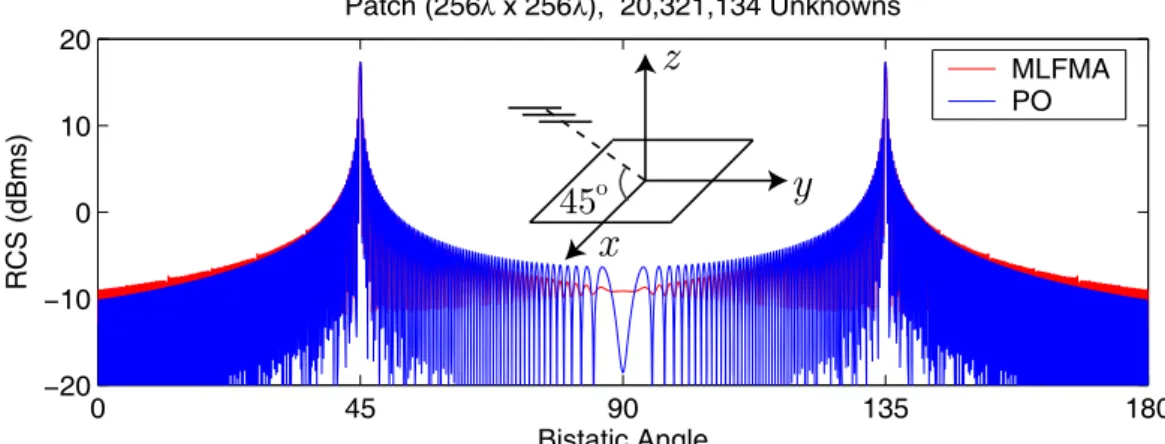
oFigure 4: Bistatic RCS (in dB) of a 256λ × 256λ patch in the x-z plane from θ = 0◦ to θ = 180◦. The angles θ = 45◦ and θ = 135◦ correspond to specular-reflection and forward-scattering directions, respectively.
AMLFMA carefully by considering the trade-off be-tween the accuracy and efficiency, we are able to solve very large problems involving open surfaces. As an example, Figure 4 presents the co-polar RCS of a 256λ×256λ square patch illuminated by a plane wave propagating at 45◦ from the z axis. Electric field is polarized in the y direction. The scattering problem is discretized with 20,321,134 unknowns and the MLFMA solution is parallelized into 16 processes. The iterative solution, which requires only 9 accurate and 85 approximate MVMs, is com-pleted in 416 minutes. The processing time for the construction of the SAI preconditioner is about 113 minutes. The RCS values are also calculated by em-ploying the physical optics (PO) technique, which is expected to be accurate for the solution of large surfaces. In Figure 4, we observe that PO and MLFMA results agree with each other especially in the specular-reflection and forward-scattering di-rections, where the PO results are more reliable.
5 CONCLUSION
In this paper, we present the solution of extremely large integral-equation problems involving tens of millions of unknowns. With an efficient paralleliza-tion of MLFMA and using robust precondiparalleliza-tioning techniques, we are able to solve closed geometries containing 42 million unknowns and open geome-tries containing 20 million unknowns on relatively inexpensive computing platforms.
Acknowledgments
This work was supported by the Scientific and Technical Research Council of Turkey (TUBITAK) under Research Grant 105E172, by the Turk-ish Academy of Sciences in the framework of
the Young Scientist Award Program (LG/TUBA-GEBIP/2002-1-12), and by contracts from ASEL-SAN and SSM. Computer time was provided in part by a generous allocation from Intel Corporation. References
[1] J. Song, C.-C. Lu and W. C. Chew, “Multilevel fast multipole algorithm for electromagnetic scattering by large complex objects,” IEEE Trans. Antennas
Prop-agat., vol. 45, no. 10, pp. 1488–1493, Oct. 1997.
[2] M. L. Hastriter, “A study of MLFMA for large-scale scattering problems,” Ph.D. thesis, University of Illi-nois at Urbana-Champaign, 2003.
[3] G. Sylvand, “Performance of a parallel implementation of the FMM for electromagnetics applications,” Int. J.
Numer. Meth. Fluids, vol. 43, pp. 865–879, 2003.
[4] L. G¨urel and ¨O. Erg¨ul, “Fast and accurate solutions of integral-equation formulations discretised with tens of millions of unknowns,” Electronics Lett., vol. 43, no. 9, pp. 499–500, Apr. 2007.
[5] L. G¨urel and ¨O. Erg¨ul, “Extending the applicability of the combined-field integral equation to geometries containing open surfaces,” IEEE Antennas Wireless
Propagat. Lett., vol. 5, pp. 515–516, 2006.
[6] S. Velamparambil and W. C. Chew, “Analysis and performance of a distributed memory multilevel fast multipole algorithm,” IEEE Trans. Antennas Propag., vol. 53, no. 8, pp. 2719–2727, Aug. 2005.
[7] ¨O. Erg¨ul and L. G¨urel, “Optimal interpolation of trans-lation operator in multilevel fast multipole algorithm,”
IEEE Trans. Antennas Propagat., vol. 54, no. 12,
pp. 3822–3826, Dec. 2006.
[8] L. G¨urel, H. Ba˘gcı, J. C. Castelli, A. Cheraly, and F. Tardivel, “Validation through comparison: mea-surement and calculation of the bistatic radar cross section (BRCS) of a stealth target,” Radio Sci., vol. 38, no. 3, Jun. 2003.
[9] B. Carpentieri, I. S. Duff, L. Giraud, and G. Sylvand, “Combining fast multipole techniques and an approxi-mate inverse preconditioner for large electromagnetism calculations,” SIAM J. Sci. Comput., vol. 27, no. 3, pp. 774–792, 2005.