T.C. SELÇUK ÜNİVERSİTESİ EĞİTİM BİLİMLERİ ENSTİTÜSÜ YABANCI DİLLER EĞİTİMİ ANA BİLİM DALI İNGİLİZ DİLİ EĞİTİMİ BİLİM DALI THE ROLE OF MANAVGAT FOLK TALES FOR TEACHI NG ENGLI SH HACI VEY I SZADE AHMET HASHAS ELEMENTARY
SCHOOL YÜKSEK LİSANS TEZİ DANIŞMAN YRD. DOÇ. DR. AHMET ALİ ASLAN HAZIRLAYAN MÜZEYYEN AYKUT KONYA 2011
T.C.
SELÇUK ÜNİVERSİTESİ Eğitim Bilimleri Enstitüsü Müdürlüğü
BİLİMSEL ETİK SAYFASI
Bu tezin proje safhasından sonuçlanmasına kadarki bütün süreçlerde bilimsel etiğe ve akademik kurallara özenle riayet edildiğini, tez içindeki bütün bilgilerin etik davranış ve akademik kurallar çerçevesinde elde edilerek sunulduğunu, ayrıca tez yazım kurallarına uygun olarak hazırlanan bu çalışmada başkalarının eserlerinden yararlanılması durumunda bilimsel kurallara uygun olarak atıf yapıldığını bildiririm.
Öğrencinin Adı Soyadı Müzeyyen AYKUT
T.C.
SELÇUK ÜNİVERSİTESİ Eğitim Bilimleri Enstitüsü Müdürlüğü
YÜKSEK LİSANS TEZİ KABUL FORMU
Müzeyyen Aykut tarafından hazırlanan “The Role Of Manavgat Folk Tales For Teaching English Hacıveyiszade Ahmet Haşhaş Elementary School” başlıklı bu çalışma 31/01/2011 tarihinde yapılan savunma sonucunda oybirliği ile başarılı bulunarak, jürimiz tarafından yüksek lisans tezi olarak kabul edilmiştir. Ünvanı, Adı Soyadı: Danışman İmza Yrd. Doç. Dr. Ahmet Ali Aslan Ünvanı, Adı Soyadı: Üye İmza Doç. Dr. Hasan Çakır Ünvanı, Adı Soyadı: Üye İmza Dr. Fahrettin Şanal
ACKNOWLEDGEMENT
Firstly, I would like to offer my thanks to my supervisor Assist. Prof. Dr. Ahmet Ali Aslan for his guidence and suggestions throughout the process.
I am deeply grateful to my friends, Fatma Gencer and Fatma Yaman because of their contributions with the writing process of my study.
I am also thankful to my lovely students who have provided me with valuable data and with their sincere contribution to my study by answering my questions honestly.
I would also like to thank to my dear sister Mürüvvet Yılmaz, my dear brother Talat Aykut and my closest friend Rukiye Güngör who offered me their supports morally.
Finally , I would like to offer my deepest gratitude to my dear mother Zeynep Aykut and my dear father Üzeyir Aykut who answered all my questions about our culture patiently and supported me morally during the process of my thesis.
ABSTRACT THE ROLE OF MANAVGAT FOLK TALES FOR TEACHING ENGLISH HACIVEYISZADE AHMET HASHAS ELEMENTARY SCHOOL AYKUT, Müzeyyen M.A., Department Of English Language Teaching Supervisor: Assist. Prof. Dr. Ahmet Ali ASLAN January 2011, 132 Pages
This study was performed in two 8th grade classes including 23 and 20 students at Hacıveyiszade Ahmet Hashas Elementary School. We tried to determine whether using Manavgat folk tales was motivating and beneficial for learning English. The experimental group including 23 students was taught four Manavgat folk tales and related activities were done. The control group including 20 students had no specific study related to Manavgat folk tales. Control group was taught English by means of course book during four weeks. Both groups were given a questionnaire as a pretest and a posttest. It consisted of three openended questions related to the attitudes of students towards learning English through Manavgat folk tales. The results showed that Manavgat folk tales have a positive effect on students while they are learning English.
ÖZET MANAVGAT MASALLARININ HACIVEYİSZADE AHMET HAŞHAŞ İLKÖĞRETİM OKULUNDA İNGİLİZCE ÖĞRETİMİNDEKİ ROLÜ AYKUT, Müzeyyen M.A., Department Of English Language Teaching Supervisor: Asist. Prof. Dr. Ahmet Ali Aslan January 2011, 132 Pages
Bu çalışma, Hacıveyiszade Ahmet Haşhaş İlköğretim Okulu’nda 23 ve 20 öğrenciden oluşan sekizinci sınıf seviyesindeki iki sınıfta yapıldı. Manavgat masallarının İngilizce öğrenmek için motive edici ve yararlı olup olmadığını belirlemeye çalıştık. 23 öğrenciden oluşan deney grubuna dört tane Manavgat masalı öğretildi ve ilgili etkinlikler yapıldı. 20 öğrenciden oluşan kontrol grubunun Manavgat masallarıyla ilgili özel bir çalışması yoktu. Dört hafta boyunca kontrol grubuna ders kitabı aracılığıyla İngilizce öğretildi. Her iki gruba da ön test ve son test olmak üzere bir anket uygulandı. Bu, öğrencilerin Manavgat masallarıyla İngilizce öğrenmeye karşı tutumlarıyla ilgili üç açık uçlu sorudan oluşan bir anketti. Sonuçlar, İngilizce öğrenirken Manavgat masallarının öğrenciler üzerinde olumlu bir etkisinin olduğunu göstermiştir.
LIST OF TABLES
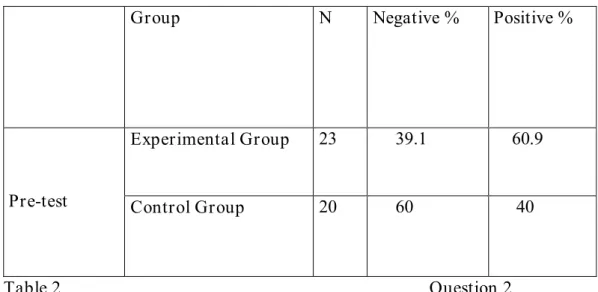
TABLE 1. Comparison Of The Experimental and The Control Group For The First Question in PreTest………..90 TABLE 2. Comparison Of The Experimental and The Control Group For The Second Question in PreTest……….92 TABLE 3. Comparison Of The Experimental and The Control Group For The Third Question in PreTest………93 TABLE 4. Comparison Of The PreTest with PostTest Results Of The First Question Within The Control Group……….99 TABLE 5. Comparison Of The PreTest with PostTest Results Of The Second Question Within The Control Group………100 TABLE 6. Comparison Of The PreTest with PostTest Results Of The Third Question Within The Control Group………101 TABLE 7. Comparison Of The PreTest with PostTest Results Of The First Question Within The Experimental Group………..102 TABLE 8. Comparison Of The PreTest with PostTest Results Of The Second Question Within The Experimental Group………..104 TABLE 9. Comparison Of The PreTest with PostTest Results Of The Third Question Within The Experimental Group………..105 TABLE 10. Comparison Of The Experimental and The Control Group For The First Question in PostTest………..106 TABLE 11. Comparison Of The Experimental and The Control Group For The Second Question in Post Test……….107 TABLE 12. Comparison Of The Experimental and The Control Group For The Third Question in PostTest……….107
TABLE OF CONTENTS BİLİMSEL ETİK SAYFASI……….i TEZ KABUL FORMU………..ii ACKNOWLEDGEMENT………iii ABSTRACT………...iv ÖZET………...v LIST OF TABLES……...……….vi TABLE OF CONTENTS………vii CHAPTER I INTRODUCTION 1.1. Background Of The Study………1 1.2. The Problem………..2 1.3. Purpose………..3 1.4. Hypotheses………3 1.5. Significance………...3 1.6. The Limitations Of The Study………..3 CHAPTER II LITERATURE REVIEW 2.1. The History Of Folk Tales………5 2.1.1. Folk Tale And The Arising Of Folk Tale………6 2.1.2. The Development And Enrichment Of Folk Tales………...16 2.1.3. The Current Position Of Folk Tales………..23 2.2. The Folk Tales Of Manavgat………..27 2.2.1. Short History Of Manavgat………..28 2.2.2. Native Culture Of Manavgat………30 2.2.3. Some Examples Of Manavgat Folk Tales……….32 2.3. Analysis Of Manavgat Folk Tales………...42 2.3.1. Supernatural Events In The Said Folk Tales……….42 2.3.2. The Relationship Of The Said Folk Tales With Real Life………44 2.3.3. The Gains Of The Said Folk Tales………46 2.4.Why We Use Manavgat Folk Tales In Education………50 2.5. How We Use Manavgat Folk Tales In Education and Classroom…………..62
CHAPTER III METHOD 3.1. Before The Study………68 3.2. During The Study………68 3.2.1. First Week Activity………...69 3.2.2. Second Week Activity………...75 3.2.3. Third Week Activity……….77 3.2.4. Fourth Week Activity………...83 3.3. After The Study………..87 CHAPTER IV RESULTS 4.1. Analysis Of PreTest Scores Of Experimental Group and The Control Group……….89 4.2. The Analysis Of Classroom Observation………93 4.2.1. Analysis Of The First Week Activity………94 4.2.2. Analysis Of The Second Week Activity………95 4.2.3. Analysis Of The Third Week Activity………...96 4.2.4. Analysis Of The Fourth Week Activity……….97 4.3. Analysis Of PreTest and PostTest Scores Of The Control Group…………98 4.4. Analysis Of PreTest and PostTest Scores Of The Experimental Group…102 4.5. Analysis Of PostTest Scores Of The Experimental Group and The Control Group………106 4.6. Lesson Diary After The Study………..108 CHAPTER V CONCLUSION AND FURTHER IMPLICATIONS 5.1. Summary Of The Study………110 5.2. Conclusion………110 5.3. Implications For Further Research………...111 REFERENCE………113 APPENDICES………...118 ÖZGEÇMİŞ………...132
1. INTRODUCTION
In this part, the background of the study, the problem, purpose, hypotheses, significance and the limitations of the study will be mentioned.
1.1. BACKGROUND OF THE STUDY
While teaching a foreign language, it is essential to create an enjoyable, free and easy atmosphere. Students have become bored because of intense grammar for many years. Not only do they become bored but also they can not speak a word. With the help of enjoyable atmosphere, they may become more motivated to learn even if they can not speak quickly.
Isolated grammar patterns makes the situation more difficult for the learners. They should be given in a context. They should be part of the conversation or the communication. In other words they should be comprehensible or meaningful, so the learners can get the language easily. At this point Krashen’s comprehensible input hypothesis explains us the situation clearly.
The comprehensible input hypothesis reflects his view that L2 learning, like L1 learning, occurs as a result of exposure to meaningful and varied linguistic input. Linguistic input will be effective in changing the learner’s developing competence if it is comprehensible (with the help of contextual information) and also offers exposure to language which is slightly more complex than that which the learner has already acquired. 1
Today many language teachers have paid attention to this point, in that so many of them have been trying to provide with a comprehensible input and natural atmosphere for their pupils.
This research explores language teaching with the help of folk tales. As language teachers we need to create an enjoyable atmosphere and comprehensible input for our students. Folk tales, especially specific and local ones, may help us
1
to provide the said atmosphere above. We know that local folk tales are the significant products of culture. Such cultural products may help students get the language more easily and they can provide with comprehensible input for the students.
Folk tales are one of the most important members of the literature family. It is considered that literature has a significant impact on language teaching. Folk tales, novels, epics, plays all of which belong to literature, provide meaningful and enjoyable contexts for students. They contribute to students’ development in terms of so many areas. Ghosn explains this point as the following:
Literature can function as a change agent: a good literature deals with some aspects of human condition, and can thus contribute the emotional development of learners and foster positive interpersonal and intercultural attitudes. 2
Manavgat folk tales are also the local members of literature. They are natural products of culture. In this study, we translated four local folk tales into English. We tried to expose students to cultural products. Students are interested in teaching materials which include something related to them. So, they can provide wanted enjoyable atmosphere and motivate students while they are learning English.
1.2. THE PROBLEM
The problem which necessitated this study is that while learning the target language, students become unwilling, bored and lowmotivated. This study aimed to research whether using Manavgat folk tales provide with enjoyable and free atmosphere for those lowmotivated, unwilling and bored students. Hence, this study is trying to find answer to the following research question:
Are Manavgat folk tales effective to create an enjoyable and free atmosphere while students are learning English?
2
1.3. PURPOSE
The purpose of this study is to find out whether students’ low motivation can be raised by means of different activities which consist of Manavgat folk tales. In other words, this study tries to find out the difference between two distinct teaching styles: teaching English through Manavgat folk tales and teaching English through usual grammar based style.
1.4. HYPOTHESES
Regarding to the research question of the study, the following hypothese have been tested:
Teaching English through Manavgat folk tales has an impact on development of students low motivation while learning English. Furthermore, teaching English through Manavgat folk tales to 8th grade students at Hacıveyiszade Mah. Ahmet Hashas Elementary School will be more effective than teaching English through usual grammar based mathods.
1.5. SIGNIFICANCE
The aim of the study above appears to prove the thesis, the study may contribute to creating enjoyable and free atmosphere while teaching English at an elementary school. The instructional goals may be achieved easily by different activities which include Manavgat folk tales.
1.6. THE LIMITATIONS OF THE STUDY
The first limitation of the study is the period of the study. The curriculum of the books was so intense and we as researcher had to complete the weekly plan.
The second limitation of the study is the inconsistency of student participation in the activities. All of the students in the group couldn’t participate
in all activities. If their proper participation could have been assured, the data obtained would have more reliable results.
The third limitation of the study is the different levels of students. Although they were at the same grade8th grade there was a huge inequality among some students.
2. LITERATURE REVIEW
Folk tales are one of the most important elements of our verbal literature. Folk tales which have a remarkable place in our literature play an important role in education. Folk tales which are told in so many places of Turkey today, include the oldest times of Turkish culture. We haven’t got so many published products including Turkish folk tales but so many folk tales are told among the public. At the same time, lots of our folk tales are forgotten.
The situation is not different for Manavgat which is one of the most popular place of Turkey. Up to now, the collection of Manavgat folk tales haven’t been studied. There are so many folk tales told among the public but a few of these folk tales have been transferred in written products. Hüseyin Çimrin mentions these folk tales in some of his books. At the same time Hasan Kırtı who has important studies on Manavgat, its villages and culture, mentions some of these folk tales too. On the other hand, there is no study about the usage of these folk tales in English language teaching.
We can benefit from our folk tales especially told in a certain area effectively. At this point we will study on the usage of Manavgat folk tales in English language teaching . First of all we will start with a short history of folk tales.
2.1. THE HISTORY OF FOLK TALES
Justice, beauty, jealousy, richness, poverty, dreams, magic, mysterious powers always occupy the mind of human being.Mystery, extraordinariness, unknown worlds are the worlds are the parts of folk tale. These are important reasons of people’s wonder for folk tales.
All of us know folk tales which were one of the most entertaining activity of cold winter nights. In Turkish culture, especially in Anatolia, folk tales have very special position. Folk tales have very important position not only in Anatolia, but
also in all over the world. Folk tale is one of the most charming type of verbal literature. It is the tale of heroes who live in an unreal world. There is no sore, no pain, no injustice in the world of folk tale. There is hapiness.
Culture and folk tale are interacted with each other. Culture feeds folk tale and at the same time folk tale feeds the culture of a country. Then what is the source of this important product? Let’s start with the large description of folk tale and then continue with the source or arising of folk tale.
2.1.1. FOLK TALE AND THE ARISING OF FOLK TALE
Folk tale is a kind of verbal literature which include extraordinary events, extraordinary heroes, unknown places and unknown times. It is transferred from generation to generation verbally. It hides so many imaginative creations into itself. It is a product of imagination. It is very different from other types of literature.
There are some features of folk tales which dicriminate it from other writing types. First of all, folk tale is a tale of extraordinary events and it is not almost known when and where these events were lived. Another words , there is no notion of time and place in folk tale. 3
There are so many descriptions for the folk tale. Different writers have produced different descriptions. One of the most interesting description of folk tale is made by Sekip Tunc. We may get information about his description in Ferhan Oguzkan’s book ‘Cocuk Edebiyatı’.
In his response for a questionnaire, M. Sekip Tunc states that folk tale is a kind of literature product which has the traces of ages which people spend in a discipline of imagination and emotion with myth and he describes it as the present of human being’s childhood term. 4 3 Oguzkan, Ferhan, Çocuk Edebiyatı, Ankara, 2001, p: 17 4 Ibid, p: 18
In fact, Sekip Tunc’s desription is very brief and understandable. Folk tale is the oldest product of verbal literature. When and where it was created is unknown but we know that it was created before other literature products. As we said before, it was transferred from ages to ages verbally. The creation of folk tale is as old as the creation of human being. So, it is human being’s childhood poduct. We will mention the creation or arising of the folk tale in a detailed way later. There is another description of folk tale in Ferhan Oguzkan’s book Ignacz Kunos who is a popular Hungarian Turcologist.
Popular Hungarian Turcologist Ignacz Kunos describes folk tale as the products which reflects both the religion of old ages , their features and the literature and the philosophy of people who lived in ancient times. 5
This description is very including.By means of the folk tale, we can get information about religion, philosophy and literature of people living in ancient times. According to Kunos, folk tale depends on real life and thought. On the other hand, Pertev Naili Boratov, who collected so many folk tales, thinks that folk tale is free of real life, thought and beliefs. According to him, folk tale has no aim to make people to believe something. Thus, we may get so many different assumptions about the description of folk tale.
Folk tale is a very interesting and charming product for both children and adults because of the extraordinary events , heroes, settings and so on…There are so many incredible events in a folk tale. Happiness is a very important function for a folk tale. By means of this eternal happiness human beings like folk tale. In everyday life, people live stressfully and problematically. It is impossible to escape from unhappiness. On the other hand, it is not same for the folk tale. Of course, there is unhappiness in a folk tale too, but at the end of the tale happiness and goodness are usually winner. This notion comfort the reader of the folk tale. We can find every type of characters in a folk tale. Good characters and bad characters, generous characters and stingy characters…Opposite sides are given in 5 Ibid, p:18
a folk tale, but usually as I said before, goodness is the winner because folk tales are optimistic. It does not mention punishment, terrible events a lot. Folk tale presents terrible events in a funny way. Optimism and tolerance have very important role in a folk tale. In a folk tale, we can get the thought of two types of life. The life we are obliged to live and the life we want tol ive. Both of them are mentioned in folk tale. People find themselves, their happiness, their sorrow in a folk tale.Although a folk tale has extraordinary events, extraordinary heroes, such as different animals and different creature, it make people to believe. Extraordinary animals in a folk tale are only a tool to create succesful heroes. When wanted coclusion is got, those extraordinary animals are lost , then the heroes of folk tale return to the real world. In this real world, readers find or imagine themselves.So folk tale is very important for both adults and children.
The heroes of the folk tale are not normal individuals. They do not belong to a certain society, they do not live in a certain city or town. Generally they are unknown and homeless individuals. Of course they have names but these names only facilitate the expression.
In some folk tales, animals such as lions, fox and rooster take the place of individuals or creatures out of nature such as giants, fairies and dragons which never lived and won’t live in our world, are included in their adventure. Where and when do these creatures, individuals and animals live? Folk tale answers these questions like ‘once upon a time…in a country’. 6
Folk tales have a special manner or style. In a folk tale, animals may speak, individuals may behave like an animal, individuals may behave in an extraordinary way which we aren’t used to. At this point, we can not mention the subject of a folk tale but we can express it as the general subject of folk tales, because generally every folk tale whichever nationality it belongs to has a similar style. Goodness and badness, modesty, jealousy, dreams of human being success are common subjects mentioned in folk tales. All of these subjects are related to 6 Sirin, Mustafa Ruhi, Cocuk Edebiyatı Yıllıgı 1987, “Pertev Naili Boratov, Masal”, İstanbul, 1987, p: 111
all human beings in the world. They are not belong to a special time or a special place. So there is universality in folk tale notion.
Happiness is a very important component of folk tale. This happiness is reached after the characters deal with a difficulty successfully. All types of characters, rich, poor, beautiful, ugly, all of them may encounter with a diffucult position. To get the happiness, all of them have to overcome that difficulty. This idea is dominant in all the folk tales. At this point, perhaps we can mention a Turkish proverb ‘No pain, no gain.’The logic in this proverb can be found in folk tales.
Tongue twisters are the other important element of folk tale atmosphere. Readers encounter with tongue twisters in introduction, developing part and conclusion of folk tale. Dr Umay Gunay mentions tongue twister of folk tales in such way.
In tongue twisters, time, place, birth, death and similar notions, the quality and quantity of creatures are mentioned in different and unusual way. There is no limit of existence and nonexistence. Existence is told by means of nonexistence, nonexistence is told by existence. Out of the usual rules of life style, problems are made fun in an extraordinary world, it is tried to reach a life happiness by means of relief, liveliness and comedy seeing all the impossibilities in possible position. 7
Folk tales have a large fancy world. This world affects the reader because fancy or daydream has a very important role in human’s life. Each person has daydreams so the reader may find his daydream come true in a folk tale. At the same time folk tale includes real like heroes and setting. These real like heroes and settings are of course very effective in terms of the readers.
Even if folk tales are based on a huge dream power, it is sometimes encountered with real events and individuals.
7
Sirin, Mustafa Ruhi, Cocuk Edebiyatı Yıllıgı 1987, “Umay Gunay, Turk Masallarının Hususiyetleri”, İstanbul, 1987, p: 129
Heroes are the individuals with whom can be encountered such as king, sultan, vizier, poor girl or poor boy. 8
Folk tales have unknown places and times. There are extraordinary events in unknown places and unknown times. Places mentioned in a folk tale may have names, but those names may not be real. Even if the names of the places such as Bagdat, İstanbul, India, China are real, the event in those places are not real. Time is also similar. So many folk tales start with ‘once upon a time’. Events may come true in such a long time that heroes may live up to long ages. Sukru Elcin mention time in a folk tale as such. This is a time which takes human being into the garden of life which is colourful and has no responsibility. It is a time which Heraklit resembled a flowing river, which is far from pessimistic appearance of the creature with whose water we can not have bath, in which it is possible tol ive everytime. 9
Then how was such a colourful, incredible and effective world born? What is the source of such a colourful world? While trying to answer these questions we can find different assumptions about this subject.
We know that folk tale is the type of verbal literature. This feature of folk tale may lead us to the thought that folk tales’ arising is as old as the creation of human being. First of all, human beings speak with eachother to communicate, there is no writing, it becomes later. Before writing we can encounter with the type of folk tale. It starts with the thought of human being. In a civilization, folk creates their culture and in their culture they create the type of folk tale. In fact both of them are within eachother. Human beings producefolk tale and while producing this product they usify their culture. In addition to culture w emay encounter with the lifestyle and belief style of the society. All of them feed folk tales. So folk tale has a national position at this point. Every nation has something related to their society in their folk tales. We may conclude that folk tale is created in a society and it is transferred verbally by including so many features of the society. 8 Gurel, Zeki, Fahri, Temizyurek, Namık Kemal, Sahbaz, Cocuk Edebiyatı, Ankara, 2007, p: 45 9 Elcin, Sukru, Halk Edebiyatına Giris, Ankara, 1998, p: 368
Folk tales are anonymous. We may find folk tale in both primitive societies and developed societies. It has a geographical prevelance. So there becomes studies on the source of folk tale and there becomes so many assumptions on this subject. At this point Grimm 10 has very important position.
So many assumptions on the sorce of folk tale whose leader was Grimm were produced, but those assumptions which developed with so many discussions were not agree on a source. So the assumptions related to sources, become around three school:Mythology School, Indian School, Antropology School. 11
Let’s mention mythology school a bit. For the first time, Muller examined mythology. According to Muller, mythology goes back the thought of Indian. Muller compares mythologies of different countries. G. V. Cox improves Muller’s method for the folk tales of different countries. Cox finds some similarities between the heroes of these mythologies. Because of these similarities he thinks that Greek mythology and other types of mythologies have the same source. Muller, Cox and Ruben look for the sorce of folk tale in mythology. They think that so many extraordinary events and heroes in a folk tale depend on mythology. According to them mythology is the sorce of the imaginative and unreal world in a folk tale.
Researchers such as Grimm Brothers, Max Muller and G. V. Cox defend this vision. In this school, it is believed that folk tales come from mythology. According to Wilhelm Grimm who is the one of Grimm Brothers, the source of folk tales is IndiaEurope. According to this view, the mythologies of nations which are in the circle of IndiaEurope change and create folk tale. 12
The other idea supported about the source of folk tale is Indian school. The first supporter of this view is Deslengehaus. According to his idea, Asian and European folk tales are based on Indian folk tales, because there are some similarities between the features of Indian and European, Asian folk tales. Then
10 Grimm: He is an important German writer of folk tale. 11 Ozturk, Ali, Turk Anonim Edebiyatı, Istanbul, 1986, p: 114 12 Gurel, Temizyurek, Sahbaz, opt. cit., p: 48
Theodor Benfey enlarges Deslengehaus’s view. Benfey believes that Indian culture and thought are the source of folk tale. All the folk tales are based on Indian thought except Ezop folk tales.
According to Benfey, folk tales which are shaped for the first time in India are transferred to other countries by three ways. First of all some folk tales are transferred to Europe by means of some movements before tenth century. The second way, after the tenth century folk tales are spread in Italy and Byzantium by means of Islam. Then they spread in Europe by means of Spain. The last and third way is the viewpoint of Budism in Asia and different verbal products developed by this viewpoint are spread in Europe and other countries by means of Mongols.
It is accepted that folk tales have widened from India to all over the world since the tenth century. Ignacz Kunos, Theodor Benfey and Emanuel Cosquin are the people who accept this view. 13
The other view about the source of folk tale is anthropology school. Edward Taylor is the most popular supporter of this view. According to him, folk tales are based on the life of society. This view is created opposite to mythology and Indian school. A. Lang is another supporter of this idea. He believes that some motifs of Egypt folk tales can be found in the history of Herodot and Homer epics. At this point, motifs in Mediterranean Region are not based on India. There are some researchers who believes that the source of folk tale is primitive life style.
We have different assumptions about the source of folk tales. It seems that there are so many differences between these schools, but in fact they have some basic similarities. For example, myths of mythology echole are related to the life of society. In terms of Indian school, folk tales depend on the life of society. Similarly, in anthropology school folk tales are directly related to the life of society. We can see that society, its life style, beliefs, culture have remarkable role. A society gains its features in a process of time. In this process human
13
beings have happiness, sadness, fights and so on…All of these create the elements of folk tale and they are so helpful to find the source of folk tale.
In spite of all these assumptions about the source of folk tale, it is still unknown when and where folk tale arises. All of these assumptions may be true, they are related to eachother to some extent, but they are not certain. Before writing, only speaking was enough for a folk tale to be told.
The same folk tale can be told in different countries in different types. This difference depends on the cultures of societies. For example Turkish folk tales differ from Indian folk tales, Arabic folk tales and so on. An event is told in different ways in different cultures. Cultural difference leads to create different folk tales on an event. This point is stated in Ali Ozturk’s book ‘Turk Anonim Edebiyatı’ as such.
First of all although Dr Dilek Daltas supports the universal structure in folk tales, civilization has unique development limits like Ziya Gokalp states. Folk tales in these limitations, are the products of civilizations which has unique accumulation in terms of source, so before the universality of folk tale, the national elements of folk tale cause a folk tale to gain its shape and features. 14
By means of folk tales we can examine special and secret aspects of a society. Society and folk tale interact with eachother. Real world and the world in a folk tale are different from eachother. On the other hand, the world of folk tale is close to the real world, it reflects the real world and the needs of human beings to some extent. There is something related to real world in a folk tale. Details of real life in a folk tale cause a folk tale to belong to a society. For example, in Turkish folk tales it is possible to find our tradition, belief and intellect. We can not seperate a folk tale from the society and time in which it is created and kept alive. Even the most extraordinary event or hero reflects something about the society and its philosophy of life.
14
According to some folklorists, folk tales are the remnants of primitive life. The lifestyles and beliefs of primitive human beings come in the form of folk tale by being transferred from nation to nation and from age to age. French anthropologist Paul Saintyves supporting this idea states that folk tales come on the scene by means of primitive ceremony. These ceremonies are celebration ceremonies, entrance ceremonies (entrance to malehood and girlhood) and the ceremonies held in Middle ages. 15
Let’s mention features of Turkish folk tales a bit. In Turkish folk tales passive and lazy characters are seldom. Characters always cope with their problems on their own. For example Keloglan is very intelligent and capable character. It is common that the characters of Turkish folk tales are sound Muslims. When a human being encounters with a problem he prays and trusts God. By this way their wishes are accepted directly or some helpers such as Pir, Dervis, an old mano r woman help the characters. Characters do not accept desperation, instead of this, they try to make beautiful their fortune. They struggle for beauty and goodness, so God help them everytime. Bravity and heroism are important elements of Turkish folk tales. Turkish clans has relations with Chinese and Indian culture. In Turkish folk tales we can see the effects of these cultures. There are spirits, giants and fairies in Turkish folk tales. These are related to the belief of Turkish people Islamic era.
The structure of folk tales is another point we should pay attention to. We will tell about the structural features of folk tales in this section. Turkish folk tales and Eastern folk tales have so many differences in terms of structural features. In Eastern folk tales differences between elements of opposition’s are very clear and certain. According to Propp, who has an evaluation on the common fiction features of folk tales, actions in an Eastern folk tale are very close to eachother, but heroes and their materials change. He says that there is a structural unity. In Alemdar Yalcın’s and Gıyasettin Aytas’s book ‘Cocuk Edebiyatı’ this subject is stated as the following.
15
Sirin, Mustafa Ruhi, Cocuk Edebiyatı Yıllığı 1987, “Bilge Seyidoglu, Masalların Kaynakları”, İstanbul, 1987, p: 124
According to Propp, after the event and the conclusion of this event are determined, the chain of event development appers. To reach or not to reach this aim forms the base of folk tale fiction. Generally heroes reach this aim. Propp decided thirty one basic functions in a folk tale. These functions have different sequence of events. 16
There are three basic features in folk tales. These are continual change, mystery and repetitions. In a folk tale there are exciting events which follow eachother. The rapid change and development of the events make easy to read and understand. There is mystery in Eastern folk tales. Magic, extraordinary events, monsters and the effort to rescue from monsters, create a mystery in a folk tale. As human being has a natural curiosity for the mystery, folk tales become charming and exciting for him. Repetition is the other important point for Eastern folk tales. Similar events can be repeated in a folk tale. These repetitions increase the power of foktale and they make the folk tale more understandable.
Folk tales always play very important roles in the processes of language learning because folk tales usually contain repetitive language patterns, phrases, or questions, refrains, strong rhythm and rhyme, sequences of numbers or days of the week. 17
Turkish folk tales have a bit different structure. A Turkish foktale has three sections. These are, tongue twister part, the part in which events are told and conclusion part. Tongue twister part prepares the reader for the folk tale. It is a kind of introduction. Tongue twisters used in a folk tale have a huge richness and humour. They emphasize that events are not in the real world, they are in the folk tale world. In a tongue twister, possible and impossible events create a unity. The part in which events are told is the second section of Turkish folk tales. This part is the base of a folk tale and there is a sequence of events. The third section is the conclusion part. The end of folk tales are similar to eachother. Bad characters are punished and good characters are always happy. 16 Yalcın, Alemdar, Gıyasettin, Aytas, Cocuk Edebiyatı, Ankara, 2002, p: 58 17 http://iteslj.org/Techniques/WuTeachingFolk tales.html, 08.03.2010, 15.00 pm.
In this part of our work, we mentioned a large description of folk tale, the source of folk tales and the structures of folk tales. We have tried to explain all of these in a detailed way. After the description and the source of folk tales, let’s get some information about the development and enrichment process of folk tales. 2.1. 2. THE DEVELOPMENT AND ENRICHMENT OF FOLK TALES We can encounter with folk tale and its rich belongings in verbal literature. Verbal literature has a very large and rich circle. First of all, we know that folk tales are told verbally. Being told in a verbal way, enriches the folk tales to some extent. A folk tale is created in a society and it is spread to other societies and regions by means of this verbality. Of corse a folk tale is not told in the same version in every region and society. For example, some societies add some extra parts, on the other hand, some societies extract some parts. So the same folk tale is told in differnt ways and in different versions. It has different names in every society. At this point, folk tales enrich to some extent, not wholly. Verbality has some negative effects on folk tales. Some parts of folk tales are forgotten. We have mentioned the source of folk tale in the first part. We have stated that the source of folk tales is stilll uncertain. Being told in a verbal way plays an important role in this uncertainity.
The real enrichment of folk tales can be accepted with the help of writing. Folk tales have had their places in written literature since every nation started to use writing. Writing has hidered the forgetting some parts of folk tales. After the use of writing some writers start to record folk tales and their names. Pertev Naili Boratov states this point as such.
The writers most of whom were nameless and the writers whose names reached us seldomly, recorded the folk tales they heard from public or perhaps they make public to listen in a book form by changing. So they created a type in written literature. Then these books became sources for other writers.
So folk tale has developed both in written literature and in its own verbal tradition throughout the centuries. 18
Books of folk tale have been among the most important products of world literature since old times. Folk tale texts of old Egypt, Pacatantras of Indians, animal folk tales which belong to Esope in old Greek, Binbir Gece Masalları which were brought in Arabic world from Indian and enriched in Arabic world after Islamic era and Turkish folk tales in Uighur language are some examples of these products.
After the usage of writing there becomes so many studies on folk tales especially on the collection of folk tales. Folk tales become a type of literature after they are written. First written examples of folk tales are Pacatantra, Tutiname, Decameron by Boccacio, Binbir Gece Masalları, Pentamerone by Basile. Pacatantra includes didactic animal folk tales. It is translated into Turkish as Kelile ve Dinme. The oldest folk tale of Eastern Region is Binbir Gece Masalları and it is accepted that they have Arabic roots. Aisopos gives birth the first examples of folk tale in old Greek. Those folk tales are developed in the next centuries. By means of these products La Fontaine writes his work.
In Europe, first serious collection of folk tales was made in nineteenth century. Grimm Brothers had their collection in Germany in 1812 and Andersen had the collection of folk tales in Denmark in 1835. In Turkey, foreign scholars were the first people dealing with collecting folk tales. There are a few printed books including Turkish folk tales, on the other hand we have so many alive folk tales among people. Some of the folk tales have been transferred verbally so they are still alive, but some of them were forgotten. Verbal tradition and texts collected by native and foreign scholars play an important role in getting the available folk tales. For the last two centuries, Turkish folk tales have been collected. At this point, foreign scholars’ efforts can not be deniable. In his book ‘Gumushane ve Bayburt Masalları’, Saim Sakaoglu says about this subject the following.
18
The oldest colletion which include Turkish folk tales is the work of M. Digeon who is the translator and secretary of French King Lui XVI. The second volume of this book was published in 1781. It has three folk tales and three of them are Turkish folk tales. Some texts in this work named ‘Nouveaux Turc et Arabes’, are too long for a folk tale. First, third and fifth ones of folk tales in this book, are introduced as Turkish folk tales. 19
There are so many foreign and native scholars and their works on Turkish folk tales. The popular traveler Wilhelm Radloff is the first foreign scholar who collected Turkish folk tales from Anatolia and other Turkish homelands. This collections were published between 1866 and1899. Hungarian Ignacz Kunos is one of these foreign scholars too. He collected so many folk tales from different regions and he compiled them in different volumes. The first volume including these compiled folk tales, Oszman Torok Nepkoltesi, was published in 1887. English writer R. N. Bain is another scholar intersted in Turkish folk tales. Bain’s book ‘Turkish Fairy Tales’ was published in 1896. As foreign writers Cyrus Adler’s and Alan Ramsey’s collection about Turkish folk tales was published in 1989. Of course Turkish writers and scholars have works on Turkish folk tales too. For example Ziya Gokalp published folk tales he heard from his parents in ‘Kucuk Mecmua’ 20 . Hamit Zubeyr, Bahtevar Hanim, Yusuf Ziya Demircioglu, Suat Salih Arsal are the other writers intersted in compiling Turkish folk tales. Naki Tezel published his famous book ‘Keloglan Masalları’ in 1936. About this subject Ahmet Ali Arslan states the following in his book ‘Kuzeydogu Anadolu Turk ve Kuzey Britanya Halk EdebiyatlarındaMasallar’.
Studying on Turkish folk tales systematically and introducing them to international area began with Pertev Naili Boratov. Beginning in 1955, he published four folk tale books in the languages French, German and Turkish. His first book was Contes Turcs Boratov, which was published in 1955. There are
19
Sakaoglu, Saim, Gumushane ve Bayburt Masalları, Ankara, 2002, p: 38
20
twenty one folk tales which were choosen from the books in this field in this book. 21
About Turkish folk tales Ahmet Edip Uysal Ph. D and American W.S. Walker Ph. D created a valuable work. Their book ‘Tales Alive In Turkey’ was published in 1966 and by means of this book our folk tales were taken into account in international area. After these studies on Turkish folk tale, regional studies start. Saim Sakaoglu’s book ‘Gumushane Masalları’ is the first study about regional folk tales. We can say that, the collection of Turkish folk tales coincided with nineteenth century. Billur Kosk is the oldest book which was collected verbally. It has fourteen folk tales. Theodor Menzel published this book by translating it into German. Of course these collections and studies contribute to the enrichment and development of folk tales.
Folk tales usually have changes as verbal tradition because the collection of folk tales has continued since nineteenth century mostly. Of course some popular folk tales such as Binbir Gece Masalları, Indian Animal Folk tales, Esope Folk tales and Kelile ve Dinme were written in earlier times. These folk tales include something which addresses to adult readers. This is the most important reason that these folk tales get a lot concern. The changes of folk tales continue until the writing is used.
After folk tales have their places in written literature, some classifications can be made more easily.J. G. Von Hahn is the first person who has effort to classify folk tales. Then Aarne and Thompson have some studies on classification of folk tales. There are different classifications of folk tales in different times. The most common of these classifications belongs to Thompson. According to his classification folk tales are divided in five parts. These are; animal folk tales, basic folk tales, funny tales, successive folk tales and folk tales which are not in the classification. In this classification, animal folk tales are the most popular ones perhaps. It is known that the source of animal folk tales is based on India. On the other hand, there are animal folk tales which countries produced according to
21
Aslan, Ahmet Ali, Kuzeydogu Anadolu Turk ve Kuzey Britanya Halk Edebiyalarında Masallar, I. Cilt, Ankara, 1998, p: 34
their own culture. These folk tales tell the need and will of society by using remarkable examples. Different folk tales of different cultures include som ant talking animals. Geographical situation, social, cultural and economical level affects this position. Alemdar Yalcın and Gıyasettin Aytas explain this point as the following.
Motifs of talking fish are noticed in the folk tales of England, Scandinavian countries, Germany and south sea countries.In Russian folklore, bear, wolf and firefly folk tales are noticed. Spiders, rabbits, turles, crocodiles, monkeys, lions and tigers are the heroes of folk tales in a huge part of Africa. In Japenese folk tales, rabits, badgers, monkeys and bears are noticed intensely. 22
Basic folk tales are divided in two parts too. These are extraordinary folk tales and realist folk tales. Extraordinary folk tales include extraordinary creatures such as giants, fairies and so on. Realist folk tales include sultans, princes, hodjas and so on. Funny tales are the other type and they include comic tales and witty remarks. Successive folk tales also include human beings and animals as characters. Keloglan folk tales are good examples of this type. Except this classification, there is another categorization of folk tales. According to this categorization there are two types of folk tales. They are folk tales which has folkloric features and artificial features. Folkloric folk tales are told among the public initially. These folk tales are developed and some scholars carry them in written literature.
Folkloric folk tales reflect the historical features of the society and by means of these qualities they provides materials for sociology and anthropology. These type of products express a certain cultural situation in the liveliest way and they help some traditions continue up to now. 23
The topics of folkloric folk tales are simple. These folk tales are told in different places and times by different people. They have a considerable effect on children. Artificial folk tale is the other type of this categorization. It is written by 22 Yalcın, Alemdar, Gıyasettin, Aytas, opt. cit., p: 51 23 Oguzkan, opt. cit., p: 19
a writer according to his fantastic world. It is similar to folkloric folk tale. In these folk tales society is mentioned in a funny way. Expression and esthetic are improved. The descriptions of different people and places are available in this type of folk tale.
Artificial folk tales are the folk tales which come into being as the result of a new adaption of folkloric folk tales and at the same time they are formed only by the dream power of writer. The topics of this type of folk tales are generally unrealistic and events come into being in imaginary places and countries. Heroes are the beings which often encounter with extraordinary events and have extraordinary qualities. 24
Turkish folk tales are classified in two parts. These are; folk tales living in verbal tradition and texts which native and foreign writers tranferred in written literature. Turkish people have had cultural relarions with other countries such as China, India and Iran. Because of these relations there become interactions between their cultures. We know that folk tales are the elements of cultures so folk tales are affected by these relations. Texts of old times are only in verbal literature so we can not get much information about them. Turkish folk tales have changes while they are being transferred from Middle Asia to Anatolia and Europe. Anonymous products of literature are produced in Seljuk Era and Otoman Empire Era. In Anatolia, anonymous culture of society lives in verbal literature.
Turkish folk tales have lived in a historical period and they have reached up to now by changing and developing. Turkish products of tenth century can be accepted as the written folk tales. The studies on Turkish folk tales are started by foriegn scholars in nineteenth century. We have mentioned these studies in a detailed way before. Dede Korkut folk tales are among the popular Turkish folk tales. These folk tales belong to the Turkish culture before Islamic era. Mesnevi by Mevlana is the other important product of Turkish culture. Mesnevi is rich in animal folk tales written to advise. Ali Ozturk mentions Mevlana and his products Mesnevi as the following.
24
Mevlana Celaleddin comes from Belh to Konya in his young age and he settles in Konya. While he is living in West Turkistan, he is nourished with the anonymous culture of West Turkistan region. In addition to this, after coming in Anatolia, of course he absorbes the culture of this region. It is very usual that he takes so many folk tales, tales and funny tales, which he uses as materials while writing Mesnevi, from the culture in which he lived and grew up. So, so many anonymous Turkish literature products living in Konya and Belh region are collected in Mesnevi. 25
Another classification of Turkish folk tales is possible too. According to this classification Turkish folk tales are divided into parts again. They are imaginary folk tales and realistic folk tales. Folk tales which have fantastic events and heroes are included in imaginary folk tales. On the other hand, folk tales which are logical and similar to the real life are included in realistic folk tales. This is the other categorization for Turkish folk tales.
We have mentioned the categorization of folk tales. This type of categorization becomes easy and clear after folk tale is included in written literature. At this point the other categorization is made for the characters of folk tales. This categorization consists of seven parts. They are aggressive characters, forgiver characters, helper characters, the person is looked for, sender person, real character, false character Some of the characters are classified according to their personal features. The person who is looked for, helps to overcome complex situations in a folk tale. Sender person assigns the character to overcome a complex situation. Real character carries all of the emotional elements. False character may be regarded as the hero by mistake. Aggressive characters create the negative part of conflict. On the other hand forgiver characters and hepler characters create positive parts of the conflict.
There becomes different classification of heroes. Let’s mention the other classification which includes three parts. The first one is the heroes who carry the wishes and values of society, the second one is extraordinary powered creatures
25
who convey us to the conclusion and the last one is opposite characters who have more power than these types of heroes. These opposite characters represent our passions which we keep under pressure.
All of these categorizations contribute to the enrichment and development of folk tales. Certainly folk tale materials have been enriched throughout the centuries. At the same time subjects of folk tales have improved with the help of literature evolution. For example Voltaire adapts folk tale to philosophy.
We know that folk tales are related to societies’ social, cultural, and economical structure. The cultural, social and economical structure of a society change throughout centuries and this change affects the folk tales of that society of course. The development of cultural and social situation contribute the subject development of folk tales. Economical development is very important point in terms of folk tale development. By means of their economic power, countries can publish so many books and materials related to their folk tales. So their own folk tales become common in all over the world. So many scholars of developed countries researched the source of folk tales and categorization of folk tales. They studied on collection of folk tales. Even Turkish folk tales were studied by foreign scholars for the first time. So there is a correct balance between the development level of a country and the development and enrichment of folk tales.
2.1.3. THE CURRENT POSITION OF FOLK TALES
Folk tale seems to belong to past times but in every ages and also current days we need folk tales. Current position of folk tale is very different from its position in old times. At this point we can mention folk tale tellers. They are important part of folk tale tradition. Nowadays can we mention folk tale tellers in folk tale tradition? Of course not. In the old days, they had important position. Folk tale tellers were generally woman and they were called as folk tale mothers. So many people were coming for those folk tale mothers. Enver Naci Goksen mentions folk tale tellers as the following.
Every village has a folk tale mother like every house has a folk tale teller. In village, everyone waits for her words, but she is so reluctunt, she doesn’t start to tell folk tale easily. People who are gathered around the folk tale teller near the stove, apply to different way to make folk tale teller to tell. Some of them promise to plough her field, some of them promise to milk her cow and make ayran. 26
Manner of telling is another important point for the foktale culture. There is a good expression “How you say something is much more important than what you say.” Once upon a time folk tale mothers were gathering so many people around them ,because they were telling folk tale in an effective way. They were telling them like they were living the events in that time. Nowadays, this is very different of course. We can find only a few folk tale mothers. Nobody collects around a folk tale mother and listen to her folk tales these days. People are gathered to watch TV, films and different programmes. Folk tales are common in written literature. There are so many published book especially for the children. They don’t listen to anybody to dream something in their mind. Generally they read and they dream. Folk tales are stories passed on from one person to another by word of mouth. These tales were not written down, but existed only in the memory of mankind. It is only now, as the tradition of storytelling is giving way to books and television that such tales are being collected and written down. 27 Television and fantastic film world make use of folk tales these days. There is a magic lamp of Alaaddin in our folk tale culture. The irradiation in films today is not different from the lamp of Aladdin. Today there are space ships instead of flying rugs. So many cartoon characters and fantastic films are created with the help of folk tales. They are so common that children have the pictures of characters on their bags, clothes and so on. Cartoon films and fantastic film include a huge imagination as folk tales. By means of this imagination world, they take viewer far from the real world. These films sometimes represent didactic
26
Goksen, Enver Naci, Cocuklar Icin Edebiyat, İstanbul, 1960, p:58
27
events in an effective ways. In every ages there become so many problems in human beings’ lifes. These problems and deficiency are tried to expressed and solved by means of folk tales in old times. On the other hand, the way to express and solve these problems to lead people to new and beautifl ideas is different from old times. In every ages, human beings find different ways to search for justice, beauty and honesty. Sevinc Cokum expresses her idea about this subject as the following.
Folk tale is a school of language. It is true that today in which image techniques are dominant, the need for listening and speaking is decreasing and people are losing the opportunity to chat. Neighbours can not be gathered and they can not share their problems. Of course, folk tales are not told for the children. 28
Nowadays folk tales tradition has been being lost slowly. Folk tales are collected in books and they are read just like a story. They are not old by a folk tale mother. The culture of newspaper, television, radio and cinema has become much more important for the people. People have no time to spend for folk tales which they created once upon a time. We have mentioned before, there are so many studies on the on the collection of folk tales today. On the other hand so many folk tales have been lost up to now. Scholars are trying to collect folk tales by means of old people and they record the collected materials to get cocrete results for the education of children. Children literature has improved recently and so many writers of education have created different materials fort his area. Folk tales they created with the help of their imagination are among these materials. They may create these folk tales with the help of their imagination and at the same time they may benefit from old created folk tales. So they get materials for the children literature.
28
Sirin, Mustafa Ruhi, Cocuk Edebiyatı Yıllıgı 1988, “Sevinc Cokum, 1987’de Cocuk Edebiyatında Masal, Hikaye, Roman”, İstanbul, 1988, p: 40