PAPER • OPEN ACCESS
Determination of naturally occurring radionuclides
in soil samples of Ayranci, Turkey
To cite this article: Osman Agar et al 2015 J. Phys.: Conf. Ser. 590 012042
View the article online for updates and enhancements.
Related content
Technically enhanced naturally occurring radionuclides (TENORM) in
phosphogypsum: Comparison CCRI(II)-S5 A Shakhashiro, U Sansone, H Wershofen et al.
-Determination of natural radioactivity in rock salt and radiation doses due to itsingestion
S N A Tahir and A S Alaamer
-Summaries of articles in this issue
-Recent citations
Measurement of natural radioactivity in several sandy-loamy soil samples from Sijua, Dhanbad, India
M. Zubair and Shafiqullah
Determination of naturally occurring radionuclides in soil
samples of Ayrancı, Turkey
Osman Agar1,2,*, Canel Eke1,3, Ismail Boztosun1,4, M. Emin Korkmaz2
1Akdeniz University Nuclear Research and Application Center, Antalya, Turkey 2Karamanoglu Mehmetbey University, Physics Department, Karaman, Turkey 3Akdeniz University, Faculty of Education, Department of Secondary Science and
Mathematics Education, Division of Physics Education, Antalya, Turkey
4Akdeniz University, Faculty of Science, Physics Department, Antalya, Turkey
*E-mail: [email protected]
Abstract. The specific activity, radiation hazard index and the annual effective dose of the
naturally occurring radioactive elements (238U, 232Th and 40K) were determined in soil samples
collected from 12 different locations in Ayrancı region by using a NaI(Tl) gamma-ray spectrometer. The measured activity concentrations of the natural radionuclides in studied soil samples were compared with the corresponding results of different countries and the internationally reported values. From the analysis, it is found that these materials may be safely used as construction materials and do not pose significant radiation hazards.
1. Introduction
Terrestrial gamma rays and cosmic rays are the two prominent natural sources of external radiation. The first source mainly originates from the primordial radioactive nuclides, originated in the early stages of the formation of the solar system [1]. Natural terrestrial radioactivity arises from the primordial radionuclides, such as, 40K, and the radionuclides from the 238U and 232Th and their
progenies [2,3]. Terrestrial background radiation represents the main external source of irradiation of the human body. Human beings are also exposed naturally from sources outside their bodies at any time.
The main objective of this study is to determine the activity concentration of natural radionuclides in the soil samples collected from Ayrancı, Turkey and to evaluate the radiological hazard of the natural radioactivity in samples. In the next section, we present the materials and method of the present study. In Section III, we show the result obtained by a NaI(Tl) scintillation detector and Section IV is devoted to our summary and discussion.
2. Material and Method
2.1 Study Area
Ayrancı is a district located in south of central Anatolian of Turkey. This study area is between latitudes 37°20' N and 37°22' N and longitudes 33°40' E and 33°42' E. The total urban area of Ayrancı is 2577 km2 and the urban population is approximately 10 600.
2.2 Sample collection and preparation
Soil samples were collected from 12 different points in Ayrancı, Turkey. About half a kilogram of each sample was taken at a depth of 15 – 20 cm and filled into plastic bags and tagged. Each soil sample was air-dried (about 10 d) naturally in the laboratory. Thereafter, these samples were sieved
2.3 Experimental techniques
For measurements of the gamma activity concentrations of naturally occurring radionuclides namely
238U, 232Th and 40K in soil samples, a 3" x 3" NaI(Tl) gamma-ray spectrometric system was employed.
The detector was surrounded by a special cylindrical lead shield of about 10 cm and a height of 38 cm thickness to reduce the gamma-ray background. The system was calibrated for the gamma energy range 186 keV to 3000 keV. The IAEA gamma-ray spectrometry standard reference sources of known radionuclides with 238U (RGU-1), 232Th (RGTh-1) and 40K (RGK-1) were used to determine the
efficiency of the detector for various energies in the prescribed geometry [4]. The soil samples were placed on top of the detector and each sample was counted for 10 000 s. The net area count was calculated by using ScintiVision program.
3. Results
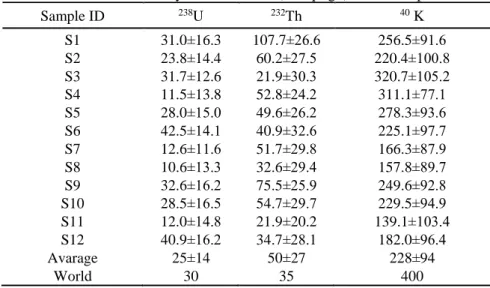
Table 1 shows activity concentration of naturally occurring radionuclides in soil samples collected from 12 different points in Ayrancı, Turkey. In soil samples, the average concentrations of 238U, 232Th
and 40K were found to be 25±14, 50±27 and 228±94 Bq/kg, respectively. The data obtained for the
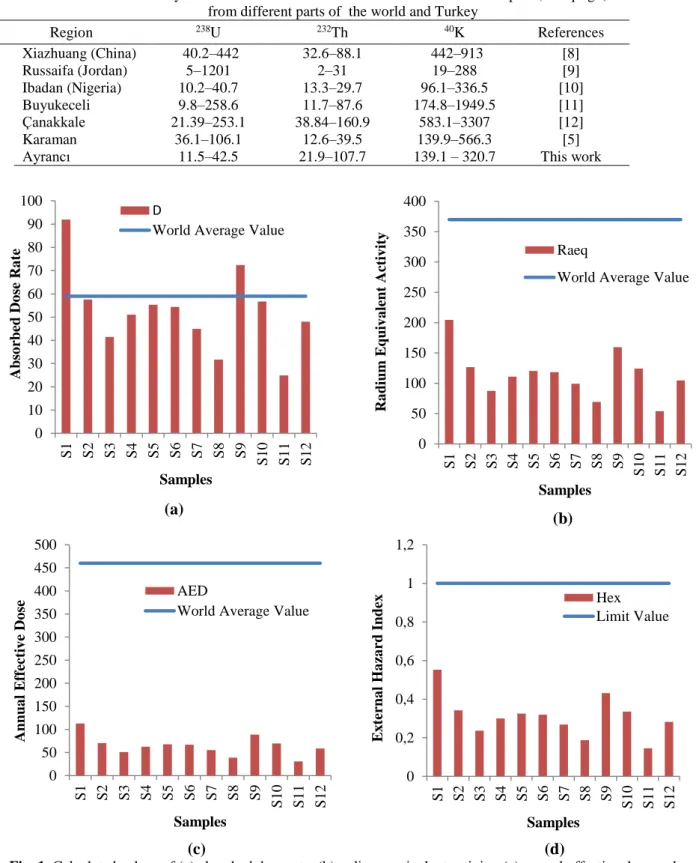
above–cited radionuclides in this study are compared with concentrations from different regions of the world and Turkey in table 2.
Radiation hazard index analysis such absorbed dose rate, radium equivalent activity, annual effective dose and external hazard index is performed to arrive at a better and safer conclusion and calculated according to the equations given in our previous study [5,6].
As can be seen in Fig. 1, the total absorbed dose in the studied area changed from 24.92 to 91.99 nGy h-1 with an average value of 52.56 nGy.h-1. Whereas, the calculated values for annual effective dose
varied from 35.56 to 112.81 𝜇Sv.y-1 with an average value of 51.82 𝜇Sv.y-1. These values are within
the permissible dose equivalent limit (460 𝜇Sv.y-1) [2].
Radium equivalent activity in soil samples varied from 53.94 to 204.54 Bq kg-1 with mean value of
114.95 Bq kg-1 (Fig. 1). All soil samples have Raeq which is commonly used to measure radiation
hazards of the cited radionuclides in single quantity lower than the (370 Bq kg-1) limit proposed by
OECD [7].
Table 1. Radioactivity concentrations (in Bq·kg-1) in soil samples.
Sample ID 238U 232Th 40 K S1 31.0±16.3 107.7±26.6 256.5±91.6 S2 23.8±14.4 60.2±27.5 220.4±100.8 S3 31.7±12.6 21.9±30.3 320.7±105.2 S4 11.5±13.8 52.8±24.2 311.1±77.1 S5 28.0±15.0 49.6±26.2 278.3±93.6 S6 42.5±14.1 40.9±32.6 225.1±97.7 S7 12.6±11.6 51.7±29.8 166.3±87.9 S8 10.6±13.3 32.6±29.4 157.8±89.7 S9 32.6±16.2 75.5±25.9 249.6±92.8 S10 28.5±16.5 54.7±29.7 229.5±94.9 S11 12.0±14.8 21.9±20.2 139.1±103.4 S12 40.9±16.2 34.7±28.1 182.0±96.4 Avarage 25±14 50±27 228±94 World 30 35 400 2
Table 2. Activity concentrations of the natural radionuclides in soil samples (in Bq·kg-1)
from different parts of the world and Turkey
Region 238U 232Th 40K References Xiazhuang (China) 40.2–442 32.6–88.1 442–913 [8] Russaifa (Jordan) 5–1201 2–31 19–288 [9] Ibadan (Nigeria) 10.2–40.7 13.3–29.7 96.1–336.5 [10] Buyukeceli 9.8–258.6 11.7–87.6 174.8–1949.5 [11] Çanakkale 21.39–253.1 38.84–160.9 583.1–3307 [12] Karaman 36.1–106.1 12.6–39.5 139.9–566.3 [5]
Ayrancı 11.5–42.5 21.9–107.7 139.1 – 320.7 This work
(a)
(b)
(c) (d)
Fig. 1. Calculated values of (a) absorbed dose rate, (b) radium equivalent activity, (c) annual effective dose and
(d) external hazard index.
The obtained values of external hazard index (Hex) range from 0.39 to 0.64. For the materials to be used in construction, this index should be less than unity. The external radiation hazard in this studied
0 10 20 30 40 50 60 70 80 90 100 S1 S2 S3 S4 S5 S6 S7 S8 S9 S10 S11 S12 Abs o rbed Do se Ra te Samples D
World Average Value
0 50 100 150 200 250 300 350 400 S1 S2 S3 S4 S5 S6 S7 S8 S9 S1 0 S1 1 S 1 2 Ra diu m E qu iv a lent Act iv it y Samples Raeq
World Average Value
0 50 100 150 200 250 300 350 400 450 500 S1 S2 S3 S4 S5 S6 S7 S8 S9 S1 0 S1 1 S1 2 Annu a l E ff ec tiv e Do se Samples AED
World Average Value
0 0,2 0,4 0,6 0,8 1 1,2 S1 S2 S3 S4 S5 S6 S7 S8 S9 S10 S11 S12 E x ter na l H a za rd Ind ex Samples Hex Limit Value
4. Conclusions
In present study, levels of natural radioactivity in soil samples collected from Ayrancı, Turkey is determined using a NaI(Tl) scintillation detector. The activity concentrations of 238U and 40K are
lower than the world wide average, but the activity of 232Th is higher than the world wide average. The
obtained values of known radiation hazard indices in study area also are calculated and lower than recommended values. The results reveal that the average dose rates do not exceed the average world recommended values and do not pose a significant health hazard. The data presented can be used for comparison in future investigations and may be useful for preparing a radiological map of the area. The results may also be used as a reference data for monitoring possible radioactivity pollutions in future.
Acknowledgment
This study is supported by Akdeniz University (Project Number:2014.03.0121.006) and Karamanoğlu Mehmetbey University Scientific Research Project (14–M–14).
References
[1] Rahman S U, Matiullah, Malik F, Rafique M, Anwar J, Ziafat M, Jabbar A 2011 J. Radioanal. Nucl. Chem. 287 647–655
[2] United Nations Scientific Committee on the Effect of Atomic Radiation 2000, United Nations. [3] Bolca M, Saç M M, Çokuysal B, Karal T, Ekdal E 2007 Rad. Meas. 42 263–270
[4] Ravisankar R, Chandrasekaran A, Vijayagopal P, Venkatraman B, Senthilkumar G, Eswaran P, Rajalakshmi A, 2012 Radiat. Phy. Chem. 81 1789–1795
[5] Agar O, Boztosun I, Korkmaz M E, Özmen S F 2014 Radiat. Prot. Dosim. doi:10.1093/rpd/ncu027 [6] Eke C, Boztosun I 2014 J. Radioanal. Nucl. Chem. 301 103–108
[7] OECD 1979 Exposure to radiation from the natural radioactivity in building materials. Report by a Group of Experts of the OECD Nuclear Energy Agency.
[8] Yang Y, Wu X, Jiang Z, Wang W, Lu J, Lin J, Wang L W, Hsia Y 2005 Appl. Radiat. Isot. 63 255–259
[9] Hamideen M S, Sharaf J 2012 Radiat. Phy. Chem. 81 1559–1562 [10] Jibiri N N, Bankole OS 2006 Radiat. Prot. Dosim. 118(4) 453–458
[11] Özmen S F, Boztosun I, Yavuz M, Tunc M R 2014 Radiat. Prot. Dosim. 158 (4) 461–465
[12] Kam E, Bozkurt A, Ilgar R 2010 Environ. Monit. Assess. 168 685–690
[13] Al-Sulaiti H, Alkhomashi N, Al-Dahan N, Al-Dosari M, Bradley D A, Bukhari S, Matthews M, Regan P H, Santawamaitre T, 2011 Nucl. Instr. Meth. Phys. Res. A 652 915–919