Aydemir Okay - Ayla Okay** ABSTRACT
Communication and job satisfaction have been one of the popular topics in business research. Communication activities directed at employees are currently considered as necessary, which are also seen as an investment that will eventually yield its return. In literature there are some evidences that favourable employees communication have effects on the increase of job satisfaction and employee performance. The appearing job satisfaction, in return, creates an increase in productivity, which contributes to the success of the organization, too. It should be considered that employee communication differs among public institutions and private organization in Turkey. It can be seen that public institutions are rather weak in their internal communication activities whereas private organizations give more importance to communicate with employees. The reason is mainly the fact that in the bureaucratic structure of Turkish public institutions. The most widely used business communication satisfaction questionnaire, the Communication Satisfaction Questionnaire (CSQ) has not been used in the postal service in Turkey. This field study of 520 postman investigated the relationship amongst perceived satisfaction with organizational communication, job satisfaction and, job performance in Turkey. This article presents a factor analytic study of CSQ in a postal service. Our research has revealed that top management does not use effective communication methods towards employees, likewise the employees are not satisfied with those communication activities.
Keywords: Communication satisfaction, Communication Satisfaction Questionnaire, postal service, Turkey, Turkish Post and Telegraph Organization.
PTT’DEKİ İLETİŞİM MEMNUNİYETİNİN ANALİTİK BİR ÇALIŞMASI
ÖZET
İletişim ve iş tatmini, işletme araştırmasında popüler konulardan birisi olmuştur. Çalışanlara yönelik olarak yapılan iletişim faaliyetleri bir gereklilik olarak değerlendirilmekte ve kuruluşun yaptığı bu faaliyetler ileride kazanç sağlayacak bir yatırım olarak görülmektedir. Literatürde çalışanlarla olumlu iletişimin çalışanların performansını ve iş memnuniyetlerini artırdıklarına dair bazı bulgular vardır. İş tatmini de sırasıyla verimliliği artırmakta ve kuruluşun başarısına katkıda bulunmaktadır. Türkiye’de çalışanlarla iletişimin kamu ve özel kesimlerde farklılık gösterdiği göz önünde tutulmalıdır. Kamu kuruluşlarının dahili iletişim faaliyetleri bir hayli zayıfken özel kuruluşların çalışanlarıyla iletişime daha fazla önem verdikleri görülebilir. Bunun başlıca nedeni Türk kamu kuruluşlarının bürokratik yapısıdır. Büyük ölçüde kullanılan işletme iletişimi memnuniyeti anketi olan İletişim Memnuniyeti Anketi, Türkiye’de posta hizmetinde kullanılmamıştır. 520 postacının katıldığı bu alan araştırması, Türkiye’deki örgütsel iletişim, iş memnuniyeti ve iş performansıyla algılanan memnuniyet arasındaki ilişkiyi incelemiştir. Bu makale posta hizmetinde İletişim Memnuniyeti Anketi’nin faktör analizini ortaya koymaktadır. Araştırmamız üst yönetimin çalışanlara yönelik olarak etkin iletişim yöntemlerini kullanmadıklarını ve çalışanların da yapılan bu iletişim faaliyetlerinden memnun olmadıklarını ortaya çıkarmıştır.
Anahtar sözcükler: İletişim memnuniyeti, İletişim Memnuniyeti Anketi, posta, Türkiye, PTT.
*
This research study was supported by Istanbul University Scientific Research Projects. Project no: 1785.
**
INTRODUCTION
Communication activities directed at employees are currently considered as necessary both for workers and employers, which are also seen as an investment that will eventually yield its return. It has become a routine for employees to come across internal communication activities in their jobs. With widespread media facilities and access, most workplaces have been transformed to multicultural environments, which led to a significant increase in the expectations of workers. From the employer’s viewpoint, it is important that the information is being transferred to the employees in order to meet their needs, as well as their happiness with this information flow.
Favourable employee communication has an effect on the increase of job satisfaction and employee performance (Jo & Shim 2005: 277). The appearing job satisfaction, in return, creates an increase in productivity, which contributes to the success of the organization. The way employees are involved in communication and decision making processes differs from culture to culture (Silverthone 2005: 42). When Turkey is taken into consideration, it can be seen that public institutions are rather weak in their internal communication activities whereas private organizations give more importance to communicate with employees. The reason is mainly the fact that in the bureaucratic structure of Turkish public institutions, no qualified people to be in charge of this kind of internal communication are found whereas the qualified people in private sector do not want to work for the government, where communication and job satisfaction are not enough. This study analyses the role of the communication activities of Turkish Post and Telegraph Organization (PTT), a Turkish public institution, on employee satisfaction. COMMUNICATION STYLES IN ORGANIZATIONS
Major changes in business may directly affect the organizations and/or their employees. It doesn’t seem possible for organizations to remain stable in an environment of
competition. Therefore, it is necessary to clarify the changes and innovations to be held in the organization. Communication activities towards employees within public institutions and private enterprises are carried out in different ways regarding the structure of that institution. In some institutions bureaucratic communication style is overspread while some others tend to implement democratic communication style. In most of the public institutions such as Post and Telegraph Organization (PTT), bureaucratic communication style is realized.
Miller states that communication in bureaucracies takes on specific characteristics. The content of communication is task-related and discourages social communication besides innovation. Typically, the direction of communication will be routed up and down in the organisational chart, and horizontal communication will only be encouraged among employees of the same level. The content will be in the form of orders, rules and directives which will result in little feedback. Style of communication will probably be formal and even when the managers are asked for employee input; it is likely that these managers will not act on employee opinions. Bureaucratic structure seldom leads to job satisfaction (Holtzhausen 2002).
Probably, communication is the most central process in organizations. The importance of effective communication has been recognized through numerous studies in various fields of industry (Downs & Hazen 1977, Pincus 1986, Sparks 1994). Most researchers believe intuitively that a positively perceived communication environment substantially contributes to organizational effectiveness (Pincus 1986).
ORGANIZATIONAL COMMUNICATION Organizational communication as a discipline grew tremendously over the latter part of 20th century. Generally speaking, the modern study of organizational communication dates from the 1930s and early 1940s. In the number of areas (e.g., communication networks, superior-subordinate communication, organizational group communication, feedback and task performance) different types of organizational
communication have been done (Tompkins & Wanca-Thibault 2001).
Goldhaber identified two major research perspectives for organizational communication; process and perception. Information flow is the main concern for the process perspective, although attitude or perception is the main concern for the perception perspective (Pincus 1986, Gray & Laidlaw 2002).
According to process perspective, the information could flow downward, upward or horizontal directions within organizational communication systems (Mount & Back 1999). The direction of communication flow depends on the structure of the organization (Pincus 1986).
THE CONCEPT COMMUNICATION SATISFACTION
Downs defined the concept of communication satisfaction as one emerging construct emphasizing the perception perspective. Communication satisfaction is defined as satisfaction with communication that is linked with the employee’s position in the organization (Mount & Back 1999). Communication satisfaction was described as a socio-emotional outcome resulting from communication interactions by Michael L. Hecht (Gray & Laidlaw 2004: 426). Downs and Hazen (1977) express that “communication satisfaction is multidimensional rather than unidimensional” and set out to determine how the individual dimensions are related to global job satisfaction. Hence, this multidimensional construct has been defined as “a summary of an individual’s satisfaction with information flow and relationship variables” (Downs & Hazen 1977, Pincus 1986). These aspects of communication underpin the ‘exchange of information and transmission of meaning throughout the organization’ and therefore, measuring communication satisfaction should be a useful gauge of the climate and “health” of the organization (Gray & Laidlaw 2004: 428). The Effects of Communication Satisfaction in Organizations: An Overview
Researchers generally assume that effective and satisfactory communication may contribute to an organization’s productivity, performance
and external customer orientation. At the same time, researchers seem to agree that communication satisfaction consists of multiple constructs such as the amount of information employees receive, the organization’s communication climate, the receptivity of upward communication, and employees’ frequency of interaction (Hargie et al. 2002). Research on the perception of communication is based on the premise that an individual’s cognitive and affective perceptions of the organization will influence that individual’s behavior in the organization (Goldhaber et al.1978, Hunt et al. 2000). Another research has shown that the perceived quality of information communicated within the organizations is significantly linked to organizational performance and employee or organizational outcomes. Quality of information refers to whether the communication is relevant, accurate, reliable or timely as well (Byrne & LeMay 2006). Communication satisfaction has received considerable attention in the research literature in the past 25 years, where studies have linked communication satisfaction with job satisfaction, productivity, job performance and organizational commitment. For example, a study by Clampitt and Downs (1993) on the relationship between communication satisfaction and productivity using the CSQ found that communication satisfaction factors differentially affected productivity that varied both in kind and magnitude. It appeared that the factors of Supervisory Communication and Subordinate Communication were the areas of the greatest employee satisfaction, whereas Personal Feedback provides the least satisfaction. The results provide evidence for the multidimensional nature of the CSQ construct.
Job Satisfaction and Employee Communication Satisfaction as a Whole
Job satisfaction has been defined in varying ways, but it is generally considered to be an individual’s perceptual/emotional reaction to important facets of work (Pincus 1986, Mount & Back 1999). Grunig presented Locke’s definition of job satisfaction as “a pleasurable
or positive emotional state resulting from the appraisal of one’s job experiences” (Serini et al. 1997: 100). An organization’s ability to get transformed is dependent on the job satisfaction of its employees (Holtzhausen, 2002a).
J. Grunig points to studies that have begun to separate two levels of satisfaction: Satisfaction with work and satisfaction with the organization as a whole. His findings point to complexity of the job as the best predictor of individual satisfaction and to organic organizational structure and the symmetrical communication system as the best predictors of the individual’s satisfaction with organization (Grunig et al. 2002, Serini et al. 1997). Johlke and Duhan (2000) found that employee satisfaction can be enhanced by simply increasing the frequency of supervisor-employee communication.
Employee communication satisfaction is important because it highlights a key issue for employees who play central role in determining organizational effectiveness and who reflect the corporate image. Clampitt and Downs (1993) conclude that the benefits obtained from internal communication of good quality include improved productivity, reduced absenteeism, higher quality of services and products, increased levels of innovation, fewer strikes and reduced costs. Furthermore, satisfaction in organizational communication is positively related to actual job performance and productivity, organizational commitment and job satisfaction (Byrne & LeMay 2006). In other study, Hargie et al., (2002) express that the outcomes of poor organizational communication include reduced employee commitment, greater absenteeism, increased industrial unrest, higher employee turnover and reduced productivity. E.B. Ray stresses that at an individual level, poor communication may result in increased uncertainty about situations, the self, others, relationships, increased occupational stress and burnout (Gray & Laidlaw 2004: 427). Therefore the evaluation of employee communication satisfaction has been an important component of organizational communication audits assessing effectiveness of communication. In particular, assessments of communication are designed to gather data
on strengths and weaknesses of organizational communication and provide a foundation for communication strategies in order to develop positive working relationships while improving the transmission of information and organizational effectiveness.
Historically, the practice of employee communication has evolved in the West. Seminal thinking on bureaucratization, stated in the arguments by European sociologist Max Weber (Chen 2008). Corporate employee communication has been predominantly in one-way direction – that is, from management to employees and other internal constituencies- while being asymmetrical in the West (Chen 2008).
According to Dover, US corporations have gone through three eras of employee communication: 1) entertaining employees in the 1940s; 2) informing employees in the 1950s; and 3) persuading employees in the 1960s (Chen 2008). Employee communication is aimed to generate in the workforce behaviors which meet the company’s expectations. It also goes further by making people feel involved and valued. This helps to foster commitment to the company and improves job performance (Nicoll 1993). It is necessary to understand the corporate value statements and to show employees how they work in practice. Sometimes, the corporate value statements are understood but simply ignored. Employee communication requires more of an understanding of what companies are trying to achieve as well as the environment in which they are trying to achieve it.
Managers sometimes forget that employees are the most important constituent of all. Argenti (1998) stated that “once an organization has lost the faith and goodwill of its employees, it faces an uphill battle as it tries to correct its errors and rebuild credibility with those who hold the future of most corporations in their grasp”.
In larger organizations, the biggest problem companies have appears to be faceless organizations with no soul. This impression is exacerbated by lack of input from employees upwards to management. Top managers often isolate themselves physically and
psychologically from other employees at the peril of effective communication. (Argenti 1998). However, employees are one of the most influential elements providing the success or failure of that enterprise. For that reason, besides the efforts to set out good relations with the environment, it is required for an institution to establish good relations with its employees and to inform them about the issues concerning activities and the institution itself while reinforcing the horizontal and/or vertical communication within that organization. Regarding the communication satisfaction of employees, Downs and Hazen’s (1977) study comes forth in the literature.
COMMUNICATION SATISFACTION QUESTIONNAIRE
It has been developed to assess The Communication Satisfaction Questionnaire (CSQ) by Downs and Hazen (1977) in an attempt to discover the relationship between communication and job satisfaction. The Communication Satisfaction Questionnaire is one of the most widely used instruments in the organizational context, because it assesses the direction of information flow, the formal and informal channels of communication flow, relationships with various members of organizations and the forms of communication. The CSQ focuses on the overall judgment employees have of the communication in their organization; this judgment is the result of a series of recurring communicative behaviors. The CSQ, a 40-item instrument with a reported reliability of .94 for eight dimensions was used to rate satisfaction with aspects of communication in the workplace on a 10-point Likert-type scale ranging from 1=very dissatisfied to 10= very satisfied. The 5 items were averaged for a factor score. These factors are as follows:
1. Communication Climate: the extent to which communication motivates and stimulates workers to meet organizational goals, 2. Supervisory Communication: the upward and
downward aspects of communicating with superiors,
3. Organizational Integration: the degree to which individuals receive information about their immediate work environment,
4. Media Quality: the extent to which meetings are well organized and written directives are short and clear,
5. Horizontal Communication (Co-worker Comm.): the extent to which informal communication is accurate and free flowing and which includes perceptions of the grapevine,
6. Organizational Perspective (Corporate Information): information about the organization as a whole,
7. Personal Feedback: information concerning how worker performance is being appraised, 8. Subordinate Communication: upward and
downward communication with subordinates. Subordinate communication items were administered only by supervisors. Gray and Laidlaw (2004) proposed a two-factor solution, in which they only distinguished a relational and an informational dimension. The CSQ is a quantitative method that maps the overall attitudes of employees (Zwijze-Koning & Jong 2007).
COMMUNICATION SATISFACTION DIMENSIONS
There has been a considerable discussion concerning the factor structure of the CSQ. Downs and Hazen (1977) who were developers of the instrument identified eight factors that have been confirmed by several studies. Some researchers have reduced those factors, whereas some researchers have added additional factors or dimensions to them. Several researchers have identified two dimensions contributing to organizational communication. These are informational dimension and relational dimension. Informational dimension focuses on satisfaction with the content and flow of information. Relational dimension however, focuses on satisfaction with communication relationships towards other organizational members (Pincus 1986).
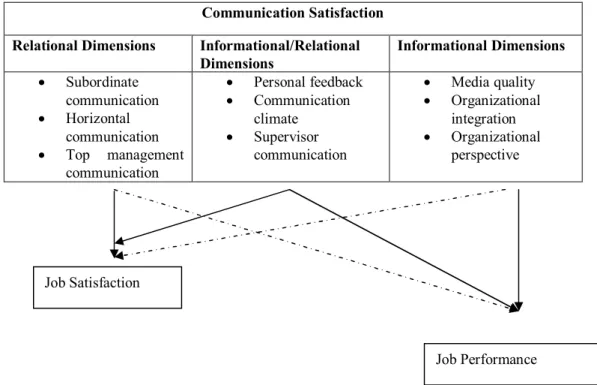
Pincus (1986: 402) grouped the communication satisfaction dimensions into three categories as informational, relational, and informational/ relational factors.
Communication Satisfaction Relational Dimensions Informational/Relational
Dimensions Informational Dimensions Subordinate communication Horizontal communication Top management communication Personal feedback Communication climate Supervisor communication Media quality Organizational integration Organizational perspective
Figure 1: Pincus, (1986). “Comm Sat Outcomes” Research Model, p.403. METHOD
Purpose of this study is to analyze the communication satisfaction perceptions of the PTT employees about the institution they are employed. Within this context, the questions below have been tried to be answered:
- Do the PTT executives use effective communication methods towards the employees?
- Do the employees feel satisfied with the communication activities?
The primary objective of this article is to validate the CSQ as proposed by Downs and Hazen to determine whether the CSQ can be used in research concerning postal services. A review of the relationship of communication and job satisfaction and, communication and job performance will be provided first and then, a factor and correlation analysis will be completed with a discussion of the results. Once the CSQ is validated or modified as necessary, the results of this study can be compared to results of studies in other fields. This research may provide a guide for further examination of the relationship amongst communication satisfaction, job satisfaction and job performance in postal services.
General limitation of this research is for instance, its having been realized at merely one institution. It is a field study, thus a search-kind (descriptive) study. Universe of the study is composed of 1200 PTT employees (supervisors, directors, vice-directors, clerks and deliverymen) in Istanbul. This number was determined by the statistics obtained from the Principal Directorate of PTT in Istanbul European Side. 520 PTT employees were included in the research through the relevance sampling technique. Reliability value of the scale is also high (Cronbach =0.81).
In order to form the sampling, judgmental sampling technique was utilized so that 520 PTT employees took the questionnaire. Questionnaires were distributed in June – July 2008 and 396 of them were returned back as making the response rate 76.3 %.
Questionnaire survey was used as a data collection instrument in this research. The Communication Satisfaction Questionnaire, whose reliability and validity had been proved in various studies by Downs and Hazen (1977), has been composed of 40 statements overall including the dimensions of communication structure, communicating with supervisors, Job Satisfaction
organizational integrity, quality of communication, getting along with colleagues, shared information, personal feedback and relationships with the subordinates. Other statements taking place in the questionnaire were all selected after the literature review on national and international publications. The data processing and assessment tool for the research was SPSS 16.0. Being relevant for the objectives of this research, frequency and correlation analyses were used to evaluate the findings.
FINDINGS
Demographic Features of the Participants Analyzing the findings upon demographic features of the participants, it is seen that 328 of them are male (82.8 %) and 65 of them are female (16.4 %). 59.7 % of the participants are over the age of 36 and 60 % of them work for delivery services. 45.4 % of the participants are high school graduates whereas 56.6 % have been working at that institution for more than 16 years. The long duration of them to be at work in the same institution is a significant finding.
Participants’ Satisfaction at Work and How They Are Informed
During the study, frequency, mean and standard deviation values were found out for every statement in the questionnaire which would determine positive and non-positive perceptions of PTT employees about the organization. According to frequency analysis results, participants’ satisfaction at work is medium (36.5 %). This finding is parallel to the results of informal interviews. During the interviews, participants indicated that their satisfaction at work was low. However, having an average score lets the findings possibly mean that participants might worry about the results to be controlled by their supervisors. This can be expressed as an expected result for public institutions. Participants’ satisfaction at work had also remained unchanged for the last six months (56.1 %). Thus, both results seemed complementary for each other.
Positive Perceptions of Employees
The statements “I obtain information about what my job requires” (55.2 %) and “I obtain information so as to promote and advance in my job” (57.2 %) reflect strong positive perceptions. Participants’ firmly agreeing on these statements does not reveal that communication within the organization is strong. Since the information for employees is given in the form of job directives by the top management and supervisors, it is an expected situation that the communication route is downwards and one-way. This communication route is compatible with the process perspective of process and perception perspectives defined by Goldhaber within the organizational communication.
In addition, a person’s self-improvement through the information acquired is possible only if he/she undertakes his/her job in accordance with the directives. Although the communication executed explains obligatory elements, it does not meet the personal communication satisfaction. C. Anderson and Martin also pointed out that the information obtained by employees through communication was not sufficient alone. C. Anderson and Martin (1995) found that employees seek communication interactions with co-workers and superiors so as to satisfy interpersonal needs of pleasure and inclusion.
The statements “I receive information about the changes undergone by PTT” (40.8 %), “I receive information about accomplishments and/or failures of the institution” (33.2 %), “I receive information about the policies and goals of the institution” (34 %), “I receive information about departmental policies and goals” (29.1%) reflect positive perceptions at the indicated rates. Participants in general express that they take information about their institution. As they work at a public institution, changes in the structure and the policies of the institution or in its volume of transactions (successes and failures) are announced by the top management and supervisors in written directives. However, it is also possible to access them on the organizational website. This finding is partially in accordance with Goldhaber et.al’s findings. Goldhaber et.al.
(1978) concluded that communication received from important relationship partners (supervisors, top management) in addition to the amount of information received within the communication were the best predictors of job satisfaction.
At the same time, the literature of communication points out two beneficial effects of an involved and informed employee public. Involved and informed employees both have the skills and the attitudes to deliver better services. Schlesinger and Heskett make the point “Customer satisfaction is rooted in employee satisfaction and retention, more than anything else”. Employees are seen as knowledgeable about what is “really going on” in an organization, they can positively and sometimes negatively affect public opinion (Therkelsen & Fiebich 2003).
The statement “I receive information about government actions affecting my institution” (34.6 %) displays another positive perception. The governmental actions taken about PTT are transmitted to the employees by formal communication channels. It should be considered as a quite natural result that government orders about PTT are announced and transmitted to the employees through a chain since PTT has a centralized and a hierarchical nature.
The statement “I receive information on how problems in my job are being handled” (43.4 %) also reflects a positive perception. In public institutions having a centralized structure and a hierarchical communication order, who is responsible for whom is a definite situation. Thus, it is a an expected result for such kind institutions in which the principle is that subordinates apply to the superiors and inform them about the problem while they are being obliged to act through the proposed instructions.
“I receive information about how I am being judged” (33 %) displays a positive perception. Participants express that they have been sufficiently informed about the issue and they feel satisfied with that information. Communication satisfaction means the employee is taking sufficient information related to his/her position. This requires his/her
being informed not only about his/her job, but also about the institution, his/her social rights, how his/her performance assessment is being done and so on. That’s why “communication satisfaction is multidimensional rather than unidimensional” as Downs and Hazen state. Our research findings, in general, reveal that the statements positively perceived by the participants are more than the statements negatively perceived by them. Thus, it supports the multidimensional nature of communication satisfaction.
The statement “The ‘grapevine’ is active in PTT” (39.7 %) has been perceived positively by the participants. In general, the evidence suggests that informal communication is more appreciated and carries greater credibility than formal communication (Johnson et al., 1994). However, internal communication including informal communication within the institution should live up to employees’ expectations. It is quite natural for this gap to be filled by gossips and rumors when the information flow is insufficient. But open internal communication is vital in keeping morale high and employees happy, which helps to ensure an effective work environment (Therkelsen & Fiebich 2003). It is generally accepted that face-to-face or two-way symmetrical communication is the best model for internal communication and for building morale and job satisfaction in organizations (Farmer et al. 1998, Holtzhausen 2002). Even though large institutions are willing to establish two-way communication, it is not possible for them to do so; as they keep on operating in diverse geographical regions with a large number of employees. In that case, some information gaps are filled by rumors.
DeGreene cites many difficulties within organizations. These are transmission problems such as one-sided (especially downward) communication processes, suppression of information, mistakes in the facts being communicated, the grapevine and rumor mill, and purposeful distortion (Kitchen & Daly 2002). Employees facing anxiety or high uncertainty regarding issues of great relevance may conjure scenarios that are often worse than the reality, even to the extent of attributing malevolent intentions to management. Employers can reduce that uncertainty by communication (DiFonzo & Bordia 1998)
since the remedy for rumors and a pervasive sense of uncertainty is the provision of accurate and timely information.
Several studies ranking employees’ preferred sources of information about the organization say that employees firstly prefer their immediate supervisors. Second source is small group meetings keeping the opportunity of two-way communication (Therkelsen & Fiebich 2003).
The statement “informal communication is active and true” (24.7 %) has not a clear perception of the participants. That is because at PTT, there is usually vertical communication carried out downwards, whereas horizontal communication is seen only in rumors. Therefore informal communication is active although it is hard to say the information getting around is always true.
Participants’ perception of the “assessment of work efficiency” (31.9 %) has been positive. Daily jobs to be done by deliverymen and clerks who form the majority of the participants are certain. Like the pay desk operations, the posts are also needed to be delivered within working hours. It is not possible to postpone the work till next day. Therefore, the work undertaken daily is always completed so that it makes employees feel themselves as efficient. Having a good institution-wide internal communication also influences the efficiency.
Improved internal communication brings large scales of organizational benefits. For example, Hanson found that the presence of good interpersonal relationships between managers and staff were three times more powerful in predicting profitability at 40 major companies over a five-year-period (Tourish 1997). Perception of the “assessment of recent 6-month-efficiency” (49.6 %) has been positive. It seems participants’ perceptions of work satisfaction have parallel results to those of the latest semi-annual work satisfaction. The person’s work satisfaction is his/her emotional reaction towards the job. It is also possible to find a direct relation between work satisfaction and the efficiency acquired. Evidence suggests that job satisfaction and performance are
correlated. Various studies have tried to assess how job satisfaction is influenced. Below are some factors seen as important (Hackman et al. 1975):
Improving work conditions,
Incentives –bonus payments, good pensions, etc.
Other perks –health insurance, company car Empowerment –inclusion in decision making and effective delegation
Reward systems –acknowledging and recognizing hard work and innovation
While the first three factors can be categorized as material benefits for employees, the others remain as more motivational benefits (Croft 2003). In order to increase workforce efficiency; besides effective communication, sometimes benefiting the motivating and rewarding conducts may result in beneficial outcomes in favor of the institutions.
Negative Perceptions of Employees
The statements “upper management knows about and understands the problems faced by employees” (35 %), “upper management listens and pays attention to me” (34.1 %) as well as “my supervisor is open to ideas” (24.6 %) reflect negative perceptions with reference to each other. During the interviews, participants have mostly complained about not being able to reach their supervisors through internal communication as well as not being able to transmit their views, ideas and problems. It is natural to have these results in institutions where hierarchical communication is overspread and in case the communication is one-way and downwards.
“My institution’s publications are interesting and helpful” (29.1 %) has been negatively perceived by the participants. This is due to the publishing policy which causes the institution-wide publications to be seen as ¨the manager’s trump¨ without declaring information or news for the employees.
“Our meetings are well-organized” (28.6 %) is a negatively perceived statement by the
participants. This is also parallel to the condition of hierarchical communication in which work and duty descriptions are given to subordinates in written. However, every order or directive may not be always so clear and easy to understand. Similarly, participants have exhibited an obscure perception of “written directives and reports are short and clear” (21.3 %). Oral communication deficiency, written transmission of orders and directives to the subordinates and not arranging meetings for two-way communication cause the written directives not to be comprehended.
“Attitudes toward communication in the PTT are basically healthy” (21.7 %) also reveals an unclear perception. This makes the result to be considered like that participants view those
directives taken from their superiors as a communication activity.
FACTOR ANALYSIS OF THE
DIMENSIONS OF COMMUNICATION SATISFACTION
Factor analysis with varimax rotation has been implemented to the 40 statements in the survey and a meaningful factor structure representing 7 dimensions has been found out. Those three factors have a 61.3 % of explanatory rate for total variance. Their KMO value is 0.824 and Bartlett's Test of Sphericity value is 521.532. The reliability value of this scale, whose validity has been verified by factor analysis is also high (Cronbach =0.81). The factor analysis regarding those dimensions is seen in Table 1.
Factors Factor Values Cronbach Alpha
Communication Climate and Organizational Integration 8279 PTT communication motivates and stimulates an enthusiasm
for meeting company goals. .768
People in my organization have great ability as communicators. .728 Communication activities of PTT
makes me identify with it or feel a vital part of it. .669 Attitudes toward communication in the PTT are basically healthy. .650 The amount of communication in the PTT is about right. .643 I receive information about personnel. .524 I receive information about the requirements of my job. .514 I receive information about departmental policies and goals. .423
Supervisory Communication .8056
Upper management knows about the problems faced by employees. .717
Upper management listens and pays attention to me. .689
My supervisor offers guidance for solving job-related problems. .678 My supervisor trusts me. .611
My supervisor is open to ideas. .653
I receive on-time information needed to do my job. .590 I receive information about employee benefits and pay. .411
Media Quality .7719
PTT’s publications are interesting and helpful .727
Our meetings are well-organized. .712 Written directives and reports are clear and concise. .568 Communication practices are adaptable to emergencies. .547 Communication with employees in other department is accurate
Horizontal (Coworker) Communication .7972
I receive information on problems in my job are being handled. .732
Conflicts are handled appropriately through proper communication channels. .665
My work group is compatible. .660 The ‘grapevine’ is active in my organization. .544
Informal communication is active and accurate. .405
Organizational Perspective (Corporate Information) .8052
I receive information about government actions affecting my institution. .789
I receive information institutional policies and goals. .678
I receive information about the changes in the organization. .655
I receive information about profits and financial standing of PTT. .544
I receive information about accomplishments and/or failures of the institution. .412
Personal Feedback .8136
I receive information about my progress in my job. .799
I receive information about how I am being judged. .723
I receive information about how my job compares with others. .610 I receive recognition of my efforts .567
The amount of supervision given me is about right. .523
Subordinate Communication .8166
My employees are responsive to downward directive communication .798 My employees anticipate my needs for communication. .742
I do not have a communication overload. .616 My employees are receptive to evaluation, suggestions, and criticism. .600 My employees feel responsible for initiating accurate upward communication .598
Table 1: Factor Analysis for Dimensions of Communication Satisfaction Communication satisfaction regarding PTT
employees’ perceptions is arranged under seven factors. According to the results of factor analysis realized for communication perceptions at PTT, there is a difference between those dimensions perceived to explain communication.
Especially since dimensions of communication climate and organizational integrity have been perceived homogeneously by the employees, the statements representing those dimensions have been gathered under one factor. This factor is called ¨communication climate and
organizational integrity¨ and it builds up the first factor.
RELATIONSHIP BETWEEN
COMMUNICATION SATISFACTION AND ITS DIMENSIONS
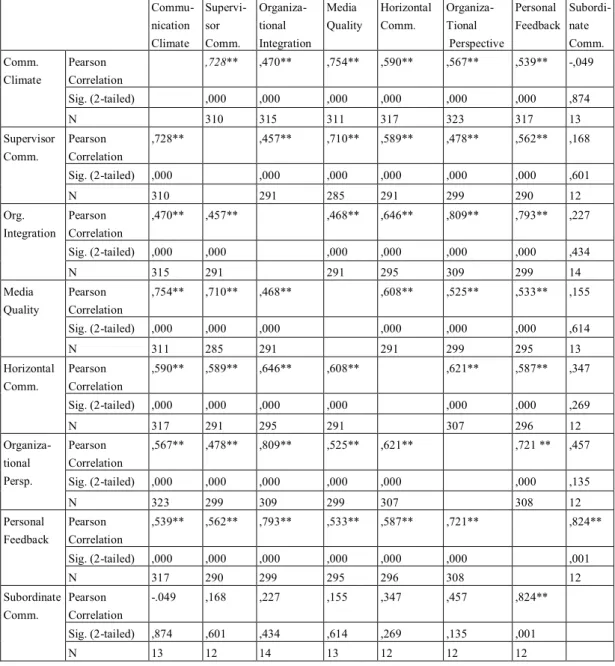
According to results of Pearson Correlation analysis, there are meaningful relationships among dimensions of communication satisfaction at P‹0.01 level. This relationship is shown in Table 2.
Commu-nication Climate Supervi-sor Comm. Organiza-tional Integration Media Quality Horizontal Comm. Organiza- Tional Perspective Personal Feedback Subordi-nate Comm. Comm. Climate Pearson Correlation ,728** ,470** ,754** ,590** ,567** ,539** -,049 Sig. (2-tailed) ,000 ,000 ,000 ,000 ,000 ,000 ,874 N 310 315 311 317 323 317 13 Supervisor Comm. Pearson Correlation ,728** ,457** ,710** ,589** ,478** ,562** ,168 Sig. (2-tailed) ,000 ,000 ,000 ,000 ,000 ,000 ,601 N 310 291 285 291 299 290 12 Org. Integration Pearson Correlation ,470** ,457** ,468** ,646** ,809** ,793** ,227 Sig. (2-tailed) ,000 ,000 ,000 ,000 ,000 ,000 ,434 N 315 291 291 295 309 299 14 Media Quality Pearson Correlation ,754** ,710** ,468** ,608** ,525** ,533** ,155 Sig. (2-tailed) ,000 ,000 ,000 ,000 ,000 ,000 ,614 N 311 285 291 291 299 295 13 Horizontal Comm. Pearson Correlation ,590** ,589** ,646** ,608** ,621** ,587** ,347 Sig. (2-tailed) ,000 ,000 ,000 ,000 ,000 ,000 ,269 N 317 291 295 291 307 296 12 Organiza-tional Persp. Pearson Correlation ,567** ,478** ,809** ,525** ,621** ,721 ** ,457 Sig. (2-tailed) ,000 ,000 ,000 ,000 ,000 ,000 ,135 N 323 299 309 299 307 308 12 Personal Feedback Pearson Correlation ,539** ,562** ,793** ,533** ,587** ,721** ,824** Sig. (2-tailed) ,000 ,000 ,000 ,000 ,000 ,000 ,001 N 317 290 299 295 296 308 12 Subordinate Comm. Pearson Correlation -.049 ,168 ,227 ,155 ,347 ,457 ,824** Sig. (2-tailed) ,874 ,601 ,434 ,614 ,269 ,135 ,001 N 13 12 14 13 12 12 12 Correlation is meaningful 0.01.
Table 2: Relationship between communication satisfaction and its dimensions. Correlation between organizational integrity
and corporate information
The correlation analysis of the elements among the dimensions of study displays a meaningful relationship between each dimension. There is a correlation of (,809) between organizational integrity and corporate information (organizational perspective). This implies that the more information employees have about their jobs, objectives and policies of their
department, the more their knowledge about the overall institution increases.
Correlation between organizational integrity and personal feedback
There is also a correlation of (,793) between organizational integrity and personal feedback. The increase in employees’ knowledge about their jobs causes them to judge on how they are rated as well as what will proceed their inspections and results.
It is seen that there is a correlation of (,754) between media quality and communication. The use of positive and good communication channels towards employees motivates them while raising their sense of belonging to the institution.
Correlation between supervisor
communication and communication climate There is also a correlation of (,728) between supervisor communication and communication climate. What also raises employees’ motivation and their sense is the increase in knowledge of top management about workforce as well as their listening to employees’ problems and offering solutions while having an open communication between executives and subordinates. Employees’ perceptions of top management’s openness of communication and willingness to include employees in the decision making have been positively correlated with employees’ overall job satisfaction (Byrne & LeMay 2006). Putti et.al (1990) found differences between communication from top management and the supervisor, in that the strongest correlate of organizational commitment was satisfaction in communication from top management versus communication from the supervisor.
Correlation between personal feedback and subordinate communication
There is a high correlation of (,824) between personal feedback and subordinate communication. This implies that s/he learns about how s/he is being judged and acquires the knowledge required for improvement and advance through the communication s/he has with his/her superiors and subordinates. It is possible that employees, as being informed, undertake some more effective roles either among colleagues or with business contacts. According to Rubin (1993), when employee needs are met through satisfying communication, employees are more likely to build effective work relationships. There is a high positive correlation between communication satisfaction and overall job satisfaction.
Some studies of communication-performance relationship have yielded mixed results. For example, internal managerial communication and supervisor communication have been
found to be key contributors to organizational effectiveness. In contrast, some studies exploring the link between job performance and organizational climate and perceived downward communication observed no significant relationships, either (Pincus 1986). Correlation between personal feedback and corporate information
Furthermore, there is a correlation of (,721) between personal feedback and corporate information. This mentions that there will be an increase in corporate information s/he has when s/he learns about how s/he is being judged and when s/he receives information about her/his progress in her/his job.
SUGGESTIONS
It has to be accepted that employee is the most valuable asset of the organization and the only sustainable source of competitive advantage. Communication is critical for an organization’s success and effectiveness. Management needs to recognize employee communication and communication satisfaction as strategic and should learn to lever its capabilities.
Employee communication must play a strategic role in an organization in order to work effectively. That strategic role means communication must be integrated into the organization’s strategy and recognized for its implications and effects (Kalla 2005, Barrett 2002). Undoubtedly, employee communica-tions takes time and effort. Communication dynamics in organizations are necessarily multifaceted and intricate (Buckley et al. 1998), reflecting the complex norms, values, climate and goals of the organization. That is because communication is a multidimensional construct (Smidts et al. 2001).
The best approach for communication with employees is to begin with informal discussions between the employee and the supervisor. Employees must feel secure enough in their positions to ask questions and offer advice without fear of reprisals from top management. It has to be remembered that enlightened managers know that the more information they provide for employees, the more likely these employees are to be highly motivated to do a better job, to advance in their positions, and to further the goals of the
organization itself. The best way to create this is effective communication. Organizations should consider that the employees are “ambassadors of the organization” (Cutlip et al. 1985, Argenti 1998).
When employees are asked to give their opinion on top management communication activities (for example, “Top management communicates openly and honestly”; “Top management cares about its employees”), they will presumably base their responses partly on their feelings and opinions regarding the way decisions are made in the organization. In this case, CSQ results may lead to misinterpretations: Actually management team may not be communicating in an open and honest way, whereas employees may be dissatisfied with the way decisions are made (Koning & Jong 2007: 280).
Communication relationship with superiors may play critical role in determining employee job satisfaction. In previous studies of the relationship between communication and job satisfaction, three factors -personal feedback, communication climate and supervisory communication have been most strongly correlated with job satisfaction measures (Pincus 1986). Personal feedback is important for motivating workers. Mayfield et al. demonstrated that a leader’s use of motivating language had significantly improved worker performance and job satisfaction. Thus, dissatisfaction with feedback may depress employee performance and job satisfaction (Gray &Laidlaw 2002: 222).
CONCLUSION
Our research has revealed that top management does not use effective communication methods towards employees, likewise the employees are not satisfied with those communication activities. It has displayed that the communication between top managers and subordinates is mostly one-way and through business directives. It has also exhibited that the corporate information obtained by employees is usually in the form of general information provided on the internet and that information does not necessarily satisfy them. Thus, effective and mutual communication is not made possible. It should be noted in communication activities between top
management and subordinates that communi-cation satisfaction has a multidimensional nature. Communication is rarely recognized as a required principal competency. Therefore, a paradox exists where increasing awareness concerning the importance of communication in organizations though exists, that knowledge appears to have been rarely transformed into practice (Kalla 2005).
During the interviews, the employees in general have appeared to be pleased with their jobs although they also have expressed their dissatisfaction with strong statements. Poor communication was seen as a key drive of negative feelings and among the employees of organization. For this reason, the effective use of each flow should be analyzed within the organization, and the organization must be communicative with all of its employees at every level disregarding that the flow is either downwards or upwards.
Our study has shown that the efficiency reached by the institution is not related to communication satisfaction but comes out of the obligation of completing the daily workload.
Although the Communication Satisfaction Questionnaire is considered the best measure of communication satisfaction, the instrument is not without limitations, and the results indicate that further refinement of the factors would be useful. A reliable and valid measure of communication satisfaction should further the understanding of role of communication and its relationship to key dependent variables such as job satisfaction, productivity, organizational commitment, trust, and overall organizational performance (Gray & Laidlaw 2004: 444). REFERENCES
Anderson C & Martin M M (1995) Why employees speak to coworkers and bosses: Motives, gender, and organizational satisfaction, Journal of Business Communication, 32(3), 249-266.
Argenti P A (1998) Strategic Employee Communications, Human Resource Management, 37(3-4), 199-206.
Barrett D J (2002) Change Communication: Using Strategic Employee Communication to Facilitate Major Change, Corporate
Communications: An International Journal, 7(4), 219-231.
Bartoo H & Sias P M (2004) When Enough is too Much: Communication Apprehension and Employee Information Experiences, Communication Quarterly, 52(1), 15-26. Buckley F, Monks K & Sinnott A (1998) Communication Enhancement: A Process Dividend for the Organization and the HRM Department, Human Resource Management, 37(3/4), 221-234.
Byrne Z S & Lemay E (2006) Different Media for Organizational Communication: Perceptions of Quality and Satisfaction, Journal of Business and Psychology, 21(2), 149-173. Chen N (2008) Internal/Employee Communi-cation and Organizational Effectiveness: A Study of Chinese Corporations in Transition, Journal of Contemporary China, 17(54), 167-189.
Clampitt P G & Downs C W (1993) Employee Perceptions Of The Relationship Between Communication and Productivity: A Field Study, Journal of Business Communication, 30(1), 5-28.
Croft S (2003) Managing Corporate Reputation: The New Currency, Thorogood, London.
Cutlip S M, Center A H &Broom G M (1985) Effective Public Relations, 6th Edition, Prentice Hall, New Jersey.
Daft R L & Weick K E (1984) Towards A Model Of Organizations As Interpretive Systems, The Academy of Management Review, 9(2), 284-295.
Difonzo N & Bordia P (1998) A Tale Of Two Corporations: Managing Uncertainty During Organizational Change, Human Resource Management, 37(3/4), 295-303.
Dolphin R R (2005) Internal Communications: Today’s Strategic Imperative, Journal of Marketing Communications, 11(3), 171-190. Downs C W, & Hazen M D (1977) A Factor Analytic Study of Communication Satisfaction, Journal of Business Communication, 14(3), 63-73.
Farmer B A, Slater J W &Wright K S (1998) The Role Of Communication in Achieving
Shared Vision Under New Organizational Leadership, Journal of Public Relations Research, 10(4), 219-235.
Goldhaber G M, Porter D T, Yates M P & Lesniak R (1978) “Organizational Communica-tion: 1978”, Human Communication Research, 5(1), 76-96.
Gray J & Laidlaw H (2002) Part-time Employment and Communication Satisfaction in an Australian Retail Organization, Employee Relations, 24(1-2), 211-228.
Gray J & Laidlaw H (2004) Improving The Measurement Of Communication Satisfaction, Management Communication Quarterly, 17(3), 425-448.
Grunig L A, Grunig J & Dozier D M (2002) Excellent Public Relations and Effective Organizations, Lawrence Erlbaum Associates, Inc., New Jersey.
Hackman J R, Oldham G R (1975) Develop-ment Of The Job Diagnostic Survey, Journal of Applied Psychology, 60(2), 159-170.
Hargie O, Tourish D & Wilson N (2002) Communication Audits and the Effects of Increased Information: A Follow-up Study, Journal of Business Communication, 39(4), 414-436.
Holtzhausen D (2002) The Effects of a Divisionalised and Decentralised Organizati-onal Structure on a Formal Internal Communication Function in a South African Organization, Journal of Communication Management, 6(4), 323-339.
Holtzhausen D (2002a) The Effects of Workplace Democracy on Employee Communication Behavior: Implications for Competitive Advantage, Competitiveness Review, 12(2), 30-48.
Hunt O, Tourish D & Hargie O D W (2000) The communication experiences of education managers: Identifying strengths, weaknesses and critical incidents, The International Journal of Educational Management, 14(3), 120-129. Jo S & Shim S W (2005) Paradigm shift of employee communication: The effect of management communication on trusting relationships, Public Relations Review 31(2), 277-280.
Johlke M C & Duhan D F (2000) Supervisor Communication Practices And Service Employee Job Outcomes, Journal of Service Research, 3(2), 154-165.
Johnson J D, Donohue W A, Atkin C K & Johnson S (1994) Differences between Formal and Informal Communication Channels, Journal of Business Communication, 31(2), 111-122.
Kalla H K (2005) Integrated Internal Communications: A Multidisciplinary Perspec-tive, Corporate Communications. An International Journal, 10(4), 302-314.
Kitchen P J & Daly F (2002) Internal Communication during Change Management, Corporate Communications: An International Journal, 7(1), 46-53.
Mount D J & Back K-J (1999) A Factor-Analytic Study of Communication Satisfaction in the Lodging Industry, Journal of Hospitality and Tourism Research, 23(4), 401-418.
Nicoll D C (1993) Corporate Value Statements and Employee Communications, Management Decision, 31(8), 34-40.
Pettit J D, Goris J R & Vaught B C (1997) An Examination of Organizational Communication as a Moderator of the Relationship Between Job Performance and Job Satisfaction, Journal of Business Communication, 34(1), 81-98. Pincus J D (1986) Communication Satisfaction, Job Satisfaction, and Job Performance, Human Communication Research, 12(3), 395-419. Proctor T & Doukakis I (2003) Change Management: The Role of Internal Communication and Employee Development, Corporate Communications: An International Journal, 8(4), 268-277.
Putti J M, Aryee S & Phua J (1990) Communication Relationship Satisfaction and Organizational Commitment, Group & Organization Studies, 15(1), 44-52.
Rubin A M (1993) The effects of locus of control on communication motives, anxiety, and satisfaction, Communication Quarterly, 41, 162-171.
Rudnick M (1996) Employee Communications: How Technology Impacts on Practice, Managing Service Quality, 6(2), 45-48.
Seitel F P (1992) The Practice of Public Relations, 5th
Edition, Macmillan ,New York. Serini S A, Toth E, Wright D K & Emig A G (1997) Watch for Falling Glass… Women, Men, and Job Satisfaction in Public Relations: A Preliminary Analysis, Journal of Public Relations Research, 9(2), 99-118.
Silverthone C P (2005) Organizational Psychology in Cross-Cultural Perspective, University Press, New York.
Smidts A, Pruyn A T H & VanRiel C B M (2001) The Impact of Employee Communication and Perceived External Prestige on Organizational Identification, Academy of Management Journal, 44(5), 1051-1062.
Sparks B (1994) Communicative Aspects of the Service Encounter, Journal of Hospitality & Tourism Research, 17(2), 39-50.
Spitzer R & Swidler M (2003) Using a Marketing Approach to Improve Internal Communications, Employment Relations Today, 30(1), 69-82.
Therkelsen D J & Fiebich C L (2003) The Supervisor: The Linchpin of Employee Relations, Journal of Communication Management, 8(2), 120-129.
Tompkins P K & Wanca-Thibault M (2001) Organizational Communication: Prelude and Prospects, In F. M. Jablin & L. L. Putman (Eds.), The New Handbook of Organizational Communication: Advances in Theory, Research and Methods, (pp. xvii-3), Sage Publications, Inc., London.
Tourish D (1997) Transforming Internal Corporate Communications: The Power of Symbolic Gestures and Barriers to Change, Corporate Communications: An International Journal, 2(3), 109-116.
Young M & Post J E (1993) Managing to Communicate, Communicating to Manage: How Leading Companies Communicate with Employees, Organizational Dynamics, 22(1), 31-43.
Zwijze-Koning K & Jong M (2007) Evaluating the Communication Satisfaction Questionnaire as a Communication Audit Tool, Management Communication Quarterly, 20(3), 261-282.