ARAŞTIRMA
THE VALIDITY AND RELIABILITY OF ITS
TURKISH ADAPTATION
GERİATRİK İSTİSMAR ÖLÇEĞİ:
TÜRKÇE’YE UYARLAMA, GEÇERLİLİK VE
GÜVENİLİRLİK ÇALIŞMASI
Introduction: This study aims to assess the validity and reliability of the Turkish version of the ‘Geriatric Mistreatment Scale’, which was developed to identify elder abuse.
Materials and Method: Random sampling methods were used to survey 776 elders over the age of 60 residing in various cities in Turkey in their own homes or with other family members (their children or relatives). The Geriatric Mistreatment Scale is a 22-item assessment designed to assess five categories of elder abuse; namely, physical abuse, psychological or emotional abuse, neglect, financial or material abuse and sexual abuse. To adapt the scale into Turkish, language validity and confirmatory factor analysis were performed to assess its validity and internal consistency, and item analyses to assess its reliability.
Results: Among the 776 participants, 460 (59.3%) were female and 316 (40.7%) were male. The mean age of the participants was 71.68 years. For 22 items of the scale, a Cronbach’s alpha coefficient of 0.80 was obtained, and item-total score correlations ranged from 0.27 to 0.58.
Conclusion: The Turkish adaptation of the Geriatric Mistreatment Scale is a valid and reliable measurement tool that can be used in Turkish populations to determine rates of the five categories of elder abuse.
Keywords: Elder abuse; Aged; Reproducibility of results; Turkey
Giriş: Bu çalışmada yaşlı istismarını belirlemek üzere geliştirilen “Geriatrik İstismar Ölçeği”nin Türkçe formunun geçerlilik ve güvenirlik çalışmasının yapılması amaçlanmaktadır.
Gereç ve Yöntem: Araştırmanın çalışma grubunu kolay ve tesadüfi örnekleme metotları kullanılarak ulaşılan, Türkiye’nin farklı illerinde ikamet eden, kendi evinde ya da yakınlarının (çocukları veya akrabalarının) evinde yaşayan 60 yaş üstü 776 yaşlı oluşturmaktadır. Geriatrik İstismar Ölçeği; fiziksel istismar, duygusal istismar, ihmal, ekonomik istismar ve cinsel istismar olmak üzere yaşlıya yönelik kötü muamelenin beş farklı türünü ölçmek üzere tasarlanmış ve 22 maddeden oluşan bir ölçektir. Ölçeğin Türkçe’ye uyarlanmasında, geçerlik için dil geçerliliği ve doğrulayıcı faktör analizi yapılırken; güvenirlik içinse iç tutarlılık ve madde analizlerinden yararlanılmıştır.
Bulgular: Araştırmaya katılan 776 yaşlının 460’ı kadın (%59.3), 316’sı erkek (%40.7); yaş ortalaması 71.68’dir. Ölçeğin 22 maddesi üzerinde yapılan test sonucunda Cronbach Alpha değerinin 0.80, madde-toplam puan korelasyonlarının 0.27 ile 0.58 arasında değiştiği bulunmuştur.
Sonuç: Geriatrik İstismar Ölçeği beş farklı türde yaşlı istismarının belirlenmesi amacıyla Türk örnekleminde kullanılabilecek geçerli ve güvenilir bir ölçme aracıdır.
Anahtar sözcükler: Yaşlı istismarı;Yaşlı; Uyarlama; Türkiye
A
BSTRACTÖ
Z Turkish Journal of GeriatricsDOI: 10.31086/tjgeri.2019150578 2019;22 (1):91-100
Serap DAŞBAŞ1
Deniz KOÇOĞLU TANYER2 Nur Feyzal KESEN1
CORRESPONDANCE Serap DAŞBAŞ
Selcuk University, Faculty of Health Sciences, Department of Social Work, Konya, Turkey Phone: 03322233531
e-mail: [email protected] Received: 05/07/2018 Accepted: 11/12/2018
1 Selcuk University, Faculty of Health Sciences,
Department of Social Work, Konya, Turkey
2 Selcuk University, Faculty of Health Sciences,
INTRODUCTION
Elder abuse can be defined as a single or repeated act or lack of appropriate action occurring within any relationship where there is an expectation of trust, which causes harm or distress to an older person. It can take various forms such as physical, psychological, sexual and financial, and it can also be the result of intentional or unintentional neglect (1). Elder mistreatment is a phenomenon that has increased proportionally with the increase in the number of older adults in various populations around the world and is particularly more significant in developed countries. Elder abuse has been a major issue since the 1950s in the USA and the 1970s in Britain, but the legal and social aspects of this issue were not addressed until the 1980s and 1990s (2), when the US enacted the ‘Older Americans Act’ (OAA) to prevent elder abuse, established the ‘Adult Protection Services’ (APS) agency and created the ‘Elder Abuse Forensic Center’ that adopted a multidisciplinary approach to identifying elder abuse (3).
Elder abuse in Turkey has recently received increasing attention as a common problem due to the country’s increasing elderly population. There have been several studies endeavouring to identify elder abuse, but these have been very limited (4,5). Most victims do not report elder abuse, as they feel guilty, ashamed or fearful; instead, they tend to pursue an isolated life. Therefore, it is very hard to identify elder abuse (6). Additionally, most social service professionals lack sufficient information and cannot differentiate the symptoms of elder abuse from other physical or mental disorders, making it difficult to recognise elder abuse (7). Therefore, it is important to increase awareness on elder abuse all over the world.
There have been many studies on the identification and evaluation of elder abuse. Various assessment tools have also been developed to identify elder abuse. Some of these assessment tools identify elder abuse in general (8); some of
them identify particular sub-categories of elder abuse (9); and some determine risk factors for elder abuse (10). In Turkish literature, there is only one Turkish assessment tool to identify elder abuse. Özmete adapted the Hwalek–Sengstock Elder Abuse Screening Test into Turkish, which is a three-factor measurement tool defining elder abuse as overt violation of personal rights or direct abuse (11).
The literature suggests that further scientific research is required to assess elder abuse (12). In addition, it is clear that research on all categories of elder abuse is important to provide a safer life for the ageing population, as research findings can ensure that social service professionals will have the information that they need to help the elderly (13).
Turkey is an ageing country. This has brought protective services and measures for the elderly into government and social agendas. The present situation of elder abuse and how abuse typically occurs should initially be defined. Currently, however, there is no Turkish assessment tool to identify the specific types of elder abuse and perpetrators. Therefore, this study aims to adapt the ‘Geriatric Mistreatment Scale’ into Turkish. It is considered that this assessment tool will increase elder abuse awareness, which will lead to an increase in precautions and social services provided to elderly people to improve their quality of life.
MATERIALS AND METHOD
Study design: This study was conducted using a
methodological research design for the adaptation of the Geriatric Mistreatment Scale to Turkish.
Geriatric Mistreatment Scale
The Geriatric Mistreatment Scale was developed in 2013 by Giraldo-Rodriguez and Rosas-Carrasco (Development and psychometric properties of the Geriatric Mistreatment Scale) to assess elder mistreatment (9). The Geriatric Mistreatment Scale is a 22-item assessment designed to assess five
different categories of elder abuse: (a) physical abuse, (b) psychological or emotional abuse, (c) neglect, (d) financial or material abuse and (e) sexual abuse. The answer to each item is either ‘yes’ or ‘no’, and ‘yes’ for a question equals one point (0=No=No abuse, 1=Yes=Abuse). Each question aims to identify whether there was any mistreatment in the last 12 months, and a ‘yes’ answer to at least one question means that the individual was abused. The scale can be scored either by summing the scores for all 22 items (determining the presence or absence of elder abuse in general) or by calculating the scores independently for each sub-category of mistreatment.
The Geriatric Mistreatment Scale is unique as it assesses different categories and frequencies of elder abuse and asks who is responsible for the abuse (the spouse, son, daughter, daughter-in-law, etc. of the elderly victim), when the abuse started and the sex of the perpetrator.
Study group: The study group consisted of 776
elders over the age of 60 who resided in various cities in Turkey in their own homes or with family members (their children or other relatives). Almost 35 measures were done for each item in this 22-item scale. Among the 776 participants, 460 (59.3%) were female and 316 (40.7) were male; the mean age of participants was 71.68 years.
Data collection: Only elderly individuals
who were capable of providing their own health information were interviewed and included in this study. For instance, patients diagnosed with advanced dementia or Alzheimer’s were excluded from the research. The data collection interviews were conducted in the houses of the elderly in a comfortable atmosphere at a convenient time. Data was collected through face-to-face interviews.
Analyses: We used AMOS program for
confirmatory factor analysis and SPSS program for other statistics. Kendal W analysis has been used for language validity; internal consistency analysis has been used for reliability; test-retest reliability has
been evaluated by split half reliability; confirmatory factor analysis has been used for validity and descriptive statistics (mean and standard deviation) of the scale has been given. For analyzing the relationship between sociodemographic variables and elder abuse independent sample t-test and F test were used.
RESULTS
Validation of the Turkish Version of the Scale Permission: The scale, originally written in Spanish,
was also published in English (‘Development and psychometric properties of the Geriatric Mistreatment Scale’, Geriatrics Gerontology International, 2013). The authors’ permission was asked and received via email to adapt the Geriatric Mistreatment Scale into Turkish. To conduct the study, permission was granted from the Non-Initiative Clinical Research Ethical Committee of the Graduate School of Health Sciences of Selcuk University.
Language validity: The scale was translated from
English to Turkish and then revised by six experts who are fluent in both languages. Experts were asked to evaluate each item in terms of four possible responses: not applicable, partially applicable, applicable, or completely applicable. Consistency among the experts’ responses was evaluated using the Kendal W analysis (KW:17.236, p:0.384), and it was determined that the experts were consistent with each other. These experts’ suggestions were taken into account to identify necessary corrections. Some additions and extractions were done to complete these corrections. The final version of the Turkish scale was sent to language experts to re-translate it into English, and the matching was performed. Thus the scale was thoroughly and accurately translated into Turkish, resulting in a scale that can be easily applied.
Reliability Study
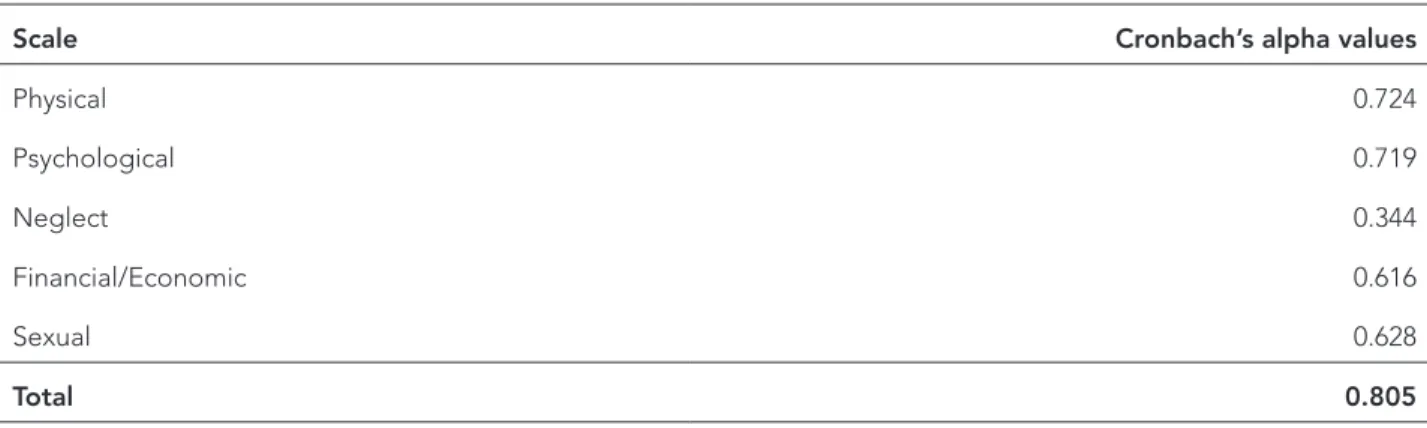
was evaluated using internal consistency analysis. Cronbach’s alpha coefficient was determined. The Cronbach alpha was 0.80 as a result of the test being conducted on 22 items of the scale. As for the five sub-dimensions of the scale, the alpha value was 0.724 for physical abuse, 0.719 for psychological abuse, 0.344 for neglect, 0.616 for financial abuse and 0.628 for sexual abuse (Table 1).
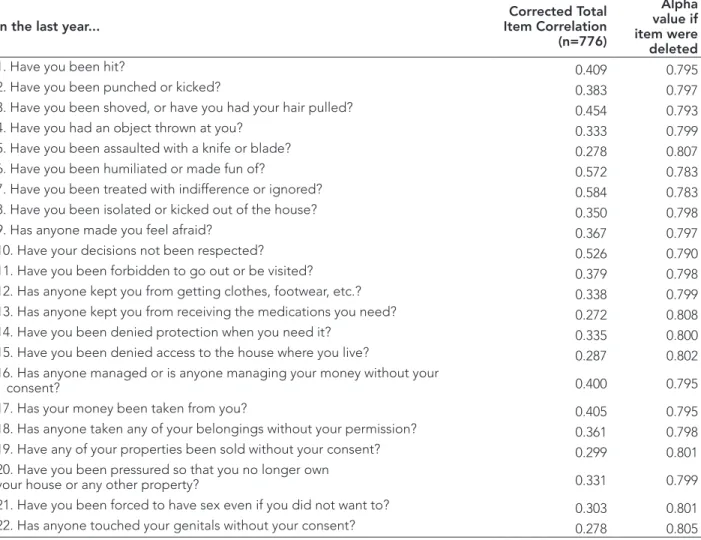
Item analysis of the scale indicated that item-total score correlations range between 0.27 and 0.58, and it was determined that the removal of any item did not increase Cronbach’s alpha value in a significant way (Table 2).
Test-retest reliability was evaluated by split half reliability. Cronbach alpha was found 0.75, Spearman-Brown was found 0,86 and Guttman Split-Half Coefficient was found 0,86.
Validity Study
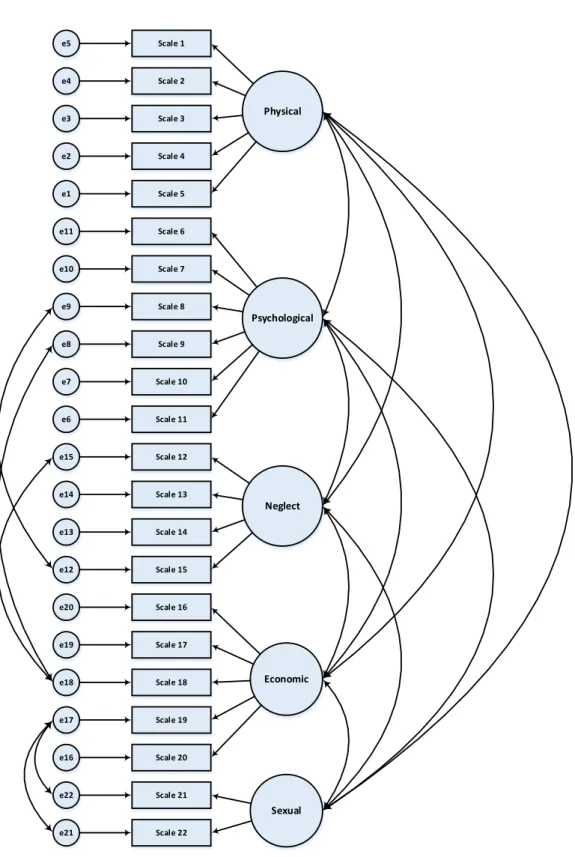
A confirmatory factor analysis was conducted to evaluate the validity of the factor structure of the scale (14). It was determined that the first model did not have acceptable fit indices; therefore, regression weights were analysed to re-structure a new model whose values, excluding the CFI value, were defined to show acceptable fit indices (Table 3).
To check whether a model is acceptable, first the chi-square index is divided by the degrees of freedom; the criterion for acceptance is a result less than or equal to 2. The model is acceptable if its value is less than or equal to 5.
The RMSEA value showed significance at less than 0.080, indicating that the model fits well. The SRMR value was less than 0.10, the CFI value was 0.85, and the AGFI value was 0.89, which indicates that the model’s goodness-of-fit indexes are satisfactory and that the model fits the data. The GFI value, which was greater than or equal to 0.91, also indicated that the model fits the data. (Figure 1)
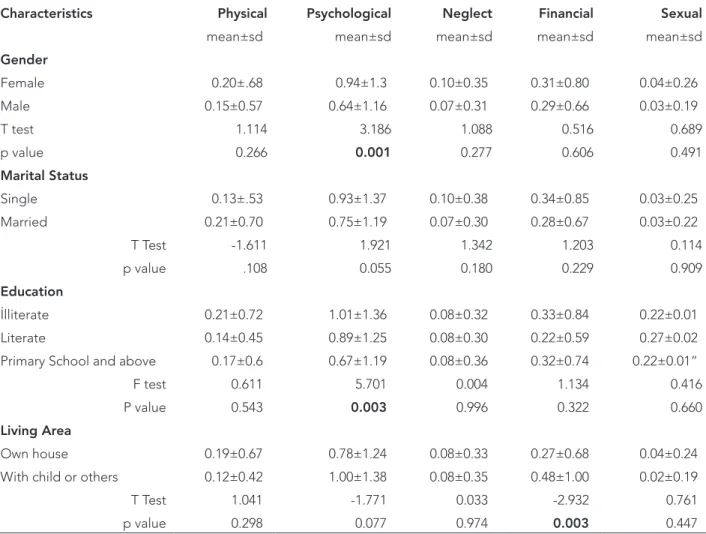
When the dispersion of the subscales Geriatric Mistreatment Scale according to various socio-demographic characteristics is explored, the psychological abuse score of women and illiterate have higher than men and other groups of educational level. Financial/Economic abuse score of elderly people living with child or others has higher than elderly people living own house (p<0.05). It has been observed that the score of abuse does not change according to other factors (p>0.05) (Table 4) and descriptive statistics (mean and standard deviation) of the scale has been given (Table 5).
Table 1. Cronbach’s alpha values for Geriatric Mistreatment Scale.
Scale Cronbach’s alpha values
Physical 0.724 Psychological 0.719 Neglect 0.344 Financial/Economic 0.616 Sexual 0.628 Total 0.805
e5 e4 e3 e2 e1 e11 e10 e8 e9 e7 e6 e15 e14 e13 e12 e20 e19 e18 e17 e16 e22 e21 Scale 1 Scale 2 Scale 3 Scale 4 Scale 5 Scale 6 Scale 7 Scale 8 Scale 9 Scale 10 Scale 11 Scale 12 Scale 13 Scale 14 Scale 15 Scale 16 Scale 17 Scale 18 Scale 19 Scale 20 Scale 21 Scale 22 Physical Psychological Neglect Economic Sexual
Table 2. Geriatric Mistreatment Scale and Item-Correlation Analysis.
In the last year... Item CorrelationCorrected Total
(n=776)
Alpha value if item were deleted
1. Have you been hit? 0.409 0.795
2. Have you been punched or kicked? 0.383 0.797
3. Have you been shoved, or have you had your hair pulled? 0.454 0.793
4. Have you had an object thrown at you? 0.333 0.799
5. Have you been assaulted with a knife or blade? 0.278 0.807
6. Have you been humiliated or made fun of? 0.572 0.783
7. Have you been treated with indifference or ignored? 0.584 0.783
8. Have you been isolated or kicked out of the house? 0.350 0.798
9. Has anyone made you feel afraid? 0.367 0.797
10. Have your decisions not been respected? 0.526 0.790
11. Have you been forbidden to go out or be visited? 0.379 0.798
12. Has anyone kept you from getting clothes, footwear, etc.? 0.338 0.799
13. Has anyone kept you from receiving the medications you need? 0.272 0.808
14. Have you been denied protection when you need it? 0.335 0.800
15. Have you been denied access to the house where you live? 0.287 0.802
16. Has anyone managed or is anyone managing your money without your
consent? 0.400 0.795
17. Has your money been taken from you? 0.405 0.795
18. Has anyone taken any of your belongings without your permission? 0.361 0.798
19. Have any of your properties been sold without your consent? 0.299 0.801
20. Have you been pressured so that you no longer own
your house or any other property? 0.331 0.799
21. Have you been forced to have sex even if you did not want to? 0.303 0.801
22. Has anyone touched your genitals without your consent? 0.278 0.805
Table 3. Consistency index results for Geriatric Mistreatment Scale.
Consistency Index First Model Second Model Ranges for Consistency
χ²/sd 5.856 3.778 2<χ²/sd≤5 GFI 0.880 0.920 0.90≤GFI AGFI 0.847 0.895 0.85≤AGFI≤0.90 CFI 0.752 0.863 0.95≤CFI<0.97 SRMR 0.080 0.060 0.05≤SRMR≤0.10 RMSEA 0.079 0.061 0.05<RMSEA≤0.08
Table 4. Dispersion of the Geriatric Mistreatment Scale according to various socio-demographic characteristics.
Characteristics Physical Psychological Neglect Financial Sexual
mean±sd mean±sd mean±sd mean±sd mean±sd
Gender Female 0.20±.68 0.94±1.3 0.10±0.35 0.31±0.80 0.04±0.26 Male 0.15±0.57 0.64±1.16 0.07±0.31 0.29±0.66 0.03±0.19 T test 1.114 3.186 1.088 0.516 0.689 p value 0.266 0.001 0.277 0.606 0.491 Marital Status Single 0.13±.53 0.93±1.37 0.10±0.38 0.34±0.85 0.03±0.25 Married 0.21±0.70 0.75±1.19 0.07±0.30 0.28±0.67 0.03±0.22 T Test -1.611 1.921 1.342 1.203 0.114 p value .108 0.055 0.180 0.229 0.909 Education İlliterate 0.21±0.72 1.01±1.36 0.08±0.32 0.33±0.84 0.22±0.01 Literate 0.14±0.45 0.89±1.25 0.08±0.30 0.22±0.59 0.27±0.02
Primary School and above 0.17±0.6 0.67±1.19 0.08±0.36 0.32±0.74 0.22±0.01”
F test 0.611 5.701 0.004 1.134 0.416
P value 0.543 0.003 0.996 0.322 0.660
Living Area
Own house 0.19±0.67 0.78±1.24 0.08±0.33 0.27±0.68 0.04±0.24
With child or others 0.12±0.42 1.00±1.38 0.08±0.35 0.48±1.00 0.02±0.19
T Test 1.041 -1.771 0.033 -2.932 0.761
p value 0.298 0.077 0.974 0.003 0.447
Table 5. Descriptive statistics of the scale and subscales.
N Minimum Maximum Mean sd
Physical 776 .00 4.0 0.18 0.64 Psychological 776 .00 6.0 0.82 1.27 Neglect 776 .00 3.0 0.09 0.34 Financial 776 .00 5.0 0.31 0.75 Sexual 776 .00 2.0 0.04 0.23 Total 776 .00 13.0 1.4 2.31
DISCUSSION
This study aims to adapt the Geriatric Mistreatment Scale developed by Giraldo-Rodriguez and Rosas-Carrasco into Turkish and to conduct validity and reliability studies of the Turkish version (9). In the validity study of the scale, language validity and structure validity methods were used. Validity refers to how well a test measures what it is purported to measure. The validity of a scale can be examined under the headings of content, logical, referential and structural validity (15). The methods to be used are determined according to the objective and features of the scale. For instance, an explanatory factor analysis with content and structural validity is an option preferred for the recently designed scales. Scales that have been adapted to another language, however, must be analysed for their psycholinguistic characteristics (language validity), and confirmatory factor analysis is accordingly preferred. The language of the present scale was shown to have a comprehensible structure through the language validity assessment in this study. Following that, the Turkish form was re-translated into English to ensure that the two English versions had the same meaning. All concepts were transferred to the Turkish form to be measured in a similar way. Confirmatory factor analysis (CFA) is a commonly used method to investigate construct validity (16). The ratio of chi-square to its degrees of freedom (Cmin/sd), Goodness of Fit Index-GFI, Adjusted Goodness of Fit Index-AGFI, Comparative Fit Index-CFI, Standardized Root Mean Square Residual (SRMR) and Root Mean Square Error of Approximation-RMSEA were analysed for the CFA of this study. In addition to these indices, other assessments can be done for a CFA. In the literature, many different indices are used to conduct CFA (17,18). A meta-analysis study has pointed out the importance of the use of the SRMR and RMSEA indices (19). Schreiber et.al. defined the break points and acceptable values for fit indices (17). Similarly,
Bayram identified goodness-of-fit and acceptable values (16) (See Table 2). According to these, all values excluding the CFI value fit well in this study. CFI compares the fit of a target model to the fit of a null or independent model, that is, a model in which the variables are assumed to be uncorrelated. Values that approach 1 indicate an acceptable fit. In this study, the CFI value was not far from the expected value but was not exactly the expected value. Ayyıldız and Cengiz have pointed out that even a value of 0.85 would be sufficient for a CFI value in a new developing area (20). Our finding may be due to the lack of literature on measurements for abuse and neglect. Our language validity and CFA results suggest that the Turkish version of the Geriatric Mistreatment Scale is a valid assessment tool to identify elder abuse and each of its sub-categories in Turkish culture. However, its validity should be confirmed in a multi-centre study. As additional scales are developed in the future, the validity of each scale should be repeated with reference to this study.
Reliability is an indicator of the persistence of the results obtained from different measurements under the same conditions (21). Cronbach’s alpha value for the total scale is 0.80, while the values for the five sub-dimensions are 0.724 for physical abuse, 0.719 for psychological abuse, 0.344 for neglect, 0.616 for financial abuse and 0.628 for sexual abuse. Cronbach’s alpha coefficient of the original form of the scale was determined to be 0.82, and alpha values for the sub-dimensions ranged between 0.55 and 0.87. A high value for Cronbach’s alpha indicates good internal consistency of the items in the scale. George and Mallery proposed that a Cronbach’s alpha coefficient of 0.80 is good, 0.70 is acceptable and 0.60 is questionable (22). Özdamar alternatively proposed that Cronbach’s alpha values ranging between 0.00 and 0.40 show that the data are not reliable, values between 0.41 and 0.60 represent low reliability, values between 0.61 and 0.80 represent significant reliability and
values ranging between 0.81 and 1.0 represent high reliability (23). Based on these definitions, it can be concluded that our scale has a significant reliability coefficient. Reliability is lower for each of the sub-dimensions of the scale, a finding that may be due to the low number of abuse and neglect cases in our sample.
The positive and high item-total score correlation for our scale indicates that each item is effective and adequate to measure the intended behaviour. The acceptable coefficient for item selection should be higher than 0.20 and 0.25 (24). In this study, it was found that the item-total score correlations ranged between 0.27 and 0.58, and it was noted that Cronbach’s alpha did not increase significantly with the removal of any one item.
After the adaptation of the Geriatric Mistreatment Scale to Turkish, the relationship between the elderly and the sociodemographic characteristics of the elderly was evaluated. Similar to our research in the literature, it is stated that female elders are more emotionally abused than males (25).
To conclude, the Geriatric Mistreatment Scale is uniquely useful as it assesses five different categories of elder abuse: physical abuse, psychological or emotional abuse, neglect, financial or material abuse and sexual abuse. It is an assessment tool that can be used by healthcare, social science and forensics professionals and academicians to identify the categories of elder abuse and perpetrators.
REFERENCES
1. WHO. A global response to elder abuse and neglect: building primary health care capacity to deal with the problem worldwide: main report. WHO Library Cataloguing in Publication Data, France 2008 [Internet] Available from: http://www. who.int/ageing/publications/ELDER_DocAugust08.pdf. Accessed:12.1.2017.
2. Anetzberger G. Elder Abuse, In: Bette R. Bonder, Vanino D. Bello-Haas (Eds). Functional Performance in Older Adults. 3rd Edition, F.A. Davis Company, Philadelphia, Pennsylvania 2009, pp 609-32.
3. Bergeron LR. Self-determination and elder abuse: do we know enough? J Gerontol Soc Work 2006;46(3– 4):81-102. (PMID:16803778).
4. Keskinoğlu P, Pıçakçıefe M, Bilgiç N, Giray H, Karakuş N, Uçku R. Elder abuse and neglect in two different socioeconomic districts in Izmir, Turkey. Int Psychogeriatr 2007;19(4):719-31. (PMID:17433122). (in Turkish).
5. Özden D, Kelleci M, Güler N. An investigation on mental status of the elderly in terms of exposure to violence and some other properties and of individuals. Turkish Journal of Research & Development in Nursing 2010;12(3):5-13. (in Turkish). 6. Lachs MS and Pillemer K. Abuse and neglect of elderly persons. N Engl J Med 1995;332(7):437-43. (PMID:7632211).
7. Meeks-Sjostrom D. A comparison of three measures of elder abuse. J Nurs Scholarsh 2004;36(3):247-50. (PMID:15495494).
8. National Research Council (US) Panel to Review Risk and Prevalence of Elder Abuse and Neglect. RJ Bonnie, RB Wallace (Eds). Elder Mistreatment: Abuse, Neglect, and Exploitation In An Aging America. National Academies Press, Washington 2003, pp 104-21. (PMID:22812026).
9. Giraldo-Rodríguez L, Rosas-Carrasco O. Development and psychometric properties of the Geriatric Mistreatment Scale. Geriatr Gerontol Int 2013;13(2):466-74. (PMID:22694594).
10. Cohen M, Levin SH, Gagin R, Friedman G. Elder abuse: disparities between older people’s disclosure of abuse, evident signs of abuse, and high risk of abuse. J Am Geriatr Soc 2007;55(8):1224-30. (PMID:17661961).
11. Özmete E. The Hwalek-Sengstock elder abuse screening test: the adaptation study into Turkish. Anatolian Journal of Psychiatry 2016;17(Suppl.1):45-52. (in Turkish).
12. Fulmer T, Guadagno L, Bitondo Dyer C, Connolly MT. Progress in elder abuse screening and assessment instruments. J Am Geriatr Soc 2004;52(2):297-304. (PMID:14728644).
13. Schofield RB. Office of justice programs focuses on studying and preventing elder abuse. J Forensic Nurs 2006;2(3):150-3. (PMID:17073064).
14. Büyüköztürk Ş. Data Analysis Handbook for Social Sciences. Pegem Academic Publishing, Ankara 2017, pp 179-94. (in Turkish).
15. Erdoğan S, Nahcivan N, Esin MN. Research in Nursing: Process, Practice and Critical. Nobel Medical Publising, İstanbul 2014, pp 217-21. (in Turkish).
16. Bayram N. Introduction to Structural Equation Modeling: Amos Applications. Ezgi Publising, Bursa 2010, pp 78. (in Turkish).
17. Schreiber JB, Nora A, Stage FK, Barlow EA, King J. Reporting structural equation modeling and confirmatory factor analysis results: a review. J Educ Res 2006;99(6):323-38.
18. Thompson B. Exploratory and confirmatory factor analysis: understanding concepts and applications. American Psychological Association, Washington DC, 2004, pp 109-32.
19. MacCallum RC, Austin JT. Applications of structural equation modeling in psychological research. Annu Rev Psychol 2000;51(1):201–26. (PMID:10751970). 20. Ayyıldız H, Cengiz E. A conceptual investigation
of structural equation models (SEM) on testing marketing models. Süleyman Demirel University Journal of Faculty of Economics and Administrative Sciences 2006;11(2):63-84. [Internet] Available from: http://dergipark.gov.tr/sduiibfd/issue/20838/223311). Accessed: 12.1.2017. (in Turkish).
21. Ercan İ, Kan İ. The reliability and validity in scales. Uludağ University Journal of the Faculty of Medicine 2004;30(3):211-6. [Internet] Available from: http:// dergipark.gov.tr/uutfd/issue/35255/391149). Accessed: 12.1.2017. (in Turkish).
22. George D, P Mallery. SPSS for Windows Step by Step: A Simple Guide and Reference. 4th Edition, Allyn & Bacon, Needham Heights, MA 2003, pp 54-5. [Internet] Available from: https://wps.ablongman. com/wps/media/objects/385/394732/george4answers. pdf. Accessed: 4.6.2018.
23. Özdamar K. Statistical Analysis by Package Programs. Kaan Publishing, Eskişehir 1999, pp 279. (in Turkish). 24. Şencan H. The Reliability and Validity of Social
and Behavioral Measurements. Seçkin Publishing, Ankara 2005, pp 105-81. (in Turkish).
25. Daşbaş S, Işıkhan V. Elder abuse in Turkey and associated risk factors. J Soc Serv Res 2018. DOI: 10.1080/01488376.2018.1511883. [Internet] Available from: https://www.tandfonline.com/doi/pdf/10.1080 /01488376.2018.1511883?needAccess=true. Accessed: 19.09.2018.