©BEYKENT UNIVERSITY
DETERMINATION OF THE SHEAR AND
CLEAVAGE STRENGTHS OF EUROPEAN
HOPHORNBEAM (OSTRYA CARPINIFOLIA
SCOP.) WOOD
Derya SEVİM KORKUT Süleyman KORKUT
Duzce University, Faculty of Forestry, 81620 Duzce/TURKEY se vimderya @ hotmail. com suleymankorkut @ hotmail. com
Received: 20 Nov. 2007, Revised: 10 December 2007, Accepted: 25 December 2007
ABSTRACT
This study was conducted to evaluate the shear and cleavage strengths of European Hophornbeam-wood. The sample trees were selected from a beech-oak-hornbeam mixed stand in the Zonguldak Forest Regional Directorate of the western Black Sea region of Turkey. Following standard methods shear strength and cleavage strength test were performed on sub-samples taken from the field. Data revealed that European Hophornbeam wood has an average 24.505 and 1.132 N/mm2 shear strength and cleavage strength, respectively.
The results of the study suggested that European Hophornbeam wood can be used as furniture, flooring material, axles, levers, mallets, splitting wedges, canes, wooden wares, and novelties. Thus Turkish forest service should promote European Hophornbeam in their silvicultural practices.
Keywords: Ostrya carpinifolia, European Hophornbeam, shear strength,
GÜRGEN YAPRAKLI KAYACIK (OSTRYA
CARPINIFOLIA SCOP.) ODUNUNUN
MAKASLAMA VE YARILMA DİRENCİNİN
BELİRLENMESİ
ÖZET
Bu çalışmada kayacık odununun makaslama ve yarılma direnci değeri belirlenmiştir. Ağaçlar Batı Karadeniz Bölgesi, Zonguldak Orman Bölge Müdürlüğü, Alaplı Orman İşletme Müdürlüğü'nden kayın-meşe ve gürgen'den oluşan karışık meşcereden temin edilmiştir. Çalışma sonucunda; makaslama direnci 24.505 N/mm2 ve yarılma direnci 1.132 N/mm2 olarak saptanmıştır.
Çalışma sonucuna gore kayacık odunu mobilya, döşeme malzemesi, tekerlek, kaldıraç, tokmak, yarma kamaları, baston ve süs eşyası yapımında kullanılabilir. Geniş kullanım alanlarına sahip olması sebebiyle kayacık yetiştiriciliğinin Ağaçlandırma Genel Müdürlüğü'nün silvikültür uygulamalarında kullanması tavsiye edilmektedir.
Anahtar Kelimeler; Kayacık, makaslama direnci, yarılma direnci
1. INTRODUCTION
Ostrya is a genus in the family Betulaceae and is composed of eight species
native to Mexico, Eurasia, eastern Asia/Japan, USA and Canada [1, 2, 3, 4]. The most important ostrya species are known as; Ostrya carpinifolia (European hophornbeam), Ostrya virginiana (Eastern hophornbeam), Ostrya
chiosensis (Chisos hophornbeam), and Ostrya knowltonii (Knowlton
hophornbeam) [5].
European Hophornbeam (EH) shows an expansive distribution from Southern France to Bulgaria, West Syria, Anatolia and Transcaucasia. In Turkey, E H is primarily found in northern Anatolia as small groups in mixed forests of angiosperms [3, 6, 7, 8].
EH is a small deciduous tree with a scaly rough bark. The bark of young stems is dark grey and smooth, bark of the mature tree is rough, fissured longitudinally and dark-brown in color. EH can reach to 20 m heights and to 30 cm diameter in humid and hot environments. EH is a semi-shade species and it grows well in upland regions [1, 3, 9, 10].
EH-woods has been used for different purposes such as furniture, axles, levers, mallets, splitting wedges, canes, wooden wares, novelties, fuel wood, charcoal, etc [4, 11, 12].
Although EH has been a subject of some studies in Turkey, most of them are anatomical and botanical reports [1, 2, 7]. Dogu et al. [2] studied oven and air dry densities (787 and 833 kg m- 3 respectively) besides microscopic and
macroscopic features of this species. However, these mechanical wood properties have not been studied.
A strong relationship is well known with wood properties and the quality of wood [13, 14]. Thus, these properties especially strength properties are classically used to select wood for the forest product industry, in particular structural applications [14]. Therefore, the aim of the study was to fulfill the gap in the literature and to facilitate optimal utilization fields of this species.
2. MATERIAL AND METHOD
The sample trees were selected from a beech-oak-hornbeam mixed stand in the Zonguldak Forest Regional Directorate of the western Black Sea region of Turkey. The sample area is located at 650 m elevation. The climatic data obtained from Alapli meteorology station located adjacent to sample area indicate that yearly mean annual precipitation of sample site is >1000 mm, The area has an average 14 C° temperature with prevailing northern wind direction. The soil type of the region ranges from clay to sandy clay.
From a randomly selected sampling area (20*20 m= 400 m2) diameter at breast
height (dbh) of EH were measured to calculate arithmetic mean. Then, five trees with average dbh and, without knot, reaction-wood, slope-grain etc., were designated. The designated trees were fallen down with a chainsaw after marking the north directions of the trees, and 1.5 m log segmented from 2-4 m of the base of these trees [15]. The sample trees were about 80 years old and they have 25 m mean height and 40 cm diameter at dbh.
Boards with 8 cm width were cut from logs according to TS 2470 [16] (same ISO 3129) and TS 53 [17]. After removing the sawdust from their surfaces, the boards were stored for air drying.
To determine shear- (xaB) and cleavage strength (os) small and clear specimens
were taken from air-dried boards according to TS 3459 same ISO 3347 [18] and TS 7613 same ASTM D 143, respectively [19].
Then the specimens were conditioned at 20 ± 2oC with 65 % relative humidity
according to TS 642 [20] (same ISO 554). After acclimatization, mechanical properties of the EH wood were determined. Then, moisture contents (M) of specimens were measured according to TS 2471 [21] (same ISO 3130). The data were analyzed if they deviate from 12 % moisture content. The strength values were adjusted for 12 % moisture content with the following equation:
§ 12 = § m * [ 1 + a (M2 - 12) ]
Where § 12 = strength at 12 percent moisture content (N/mm2), § m = strength at
moisture content deviated from 12 percent (N/mm2), a = constant value
showing relationship between strength and moisture content (a=0.03 and 0.03 for xaB, os, respectively) M2= moisture content during test (%).
3. RESULTS AND DISCUSSION
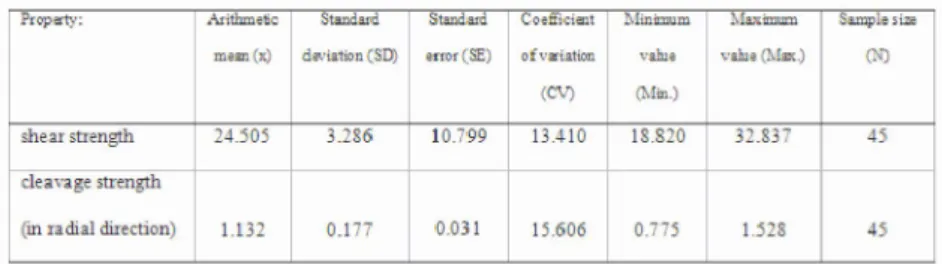
The shear strength and cleavage strength (in radial direction) of EH-wood were found 24.505 and 1.132 N/mm2, respectively (Table 1). Compared to Ostrya
ssp. wood, shear strength and cleavage strength values of the current study were higher. In comparison with Acer trautvetteri wood, shear strength was higher but cleavage strength was similar. The differences in such properties can be partly explained by the different anatomical characteristics of EH wood compared to those of the other species. In that EH-wood is generally composed of libriform fibers as a fiber tissue however walnut wood contains mostly libriform fibers and fiber tracheids.
Table 1. Strength values of European Hophornbeam (N/mm2) Prop arty: Arithmetic
mían (x) Standard detiitiDiiCSEtl Standard ärror(SE) Co?Œkiait D f variation <CV) -IjLİülJLü (Min.) Maximum v a i n e (Iilffii) Sample sis
TO
shear strength 24.505 32286 10.799 13.410 18.820 32.837 4 5 cleavage strength(in radial direction) 1.132 0.177 0.031 15.60« 0.775 1.528 4 5
Hardwoods are used in various structural applications and other places where stress-graded lumber is more appropriate. EH-wood, can also be used for furniture, axles, handles, levers, mallets, splitting wedges, canes, wooden wares, novelties, and fuel wood. Doğu et al. [2] stated that the wood of EH can be used as parquet. The result of the current study revealed that EH-wood could be used in flooring materials where high mechanical strength is need.
Since the wood of EH is hard, very tough and heavy it is difficult to work with it compared to that of Eastern Hophornbeam (Ostrya virginiana).
The disparate size of different wood cells in the hardwoods results in heterogeneous compressive deformation. During compression, large vessels cause smaller surrounding cells to be deformed more than in regions without vessels, increasing the energy absorbed.
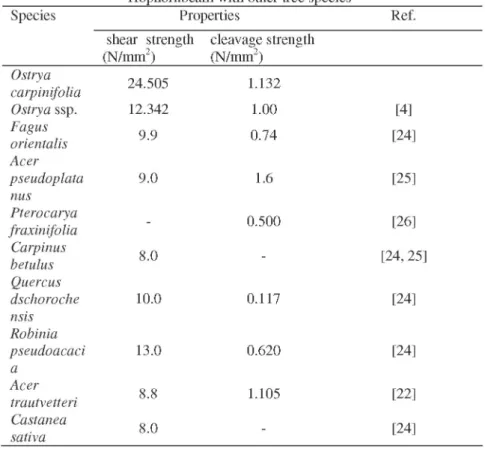
The different morphologies of hardwoods are probably responsible for the variation in resistance between species [22]. The shear strength of EH is higher than that of Ostrya ssp., Fagus orientalis, Robinia pseudoacacia, Acer
pseudoplatanus, Acer trautvetteri and Carpinus betulus. This strength type is
important in jointing points of wood products (Table 2).
Table 2. Comparison of physical and mechanical properties of European Hophornbeam with other tree species
Species Properties Ref. shear strength cleavage strength
(N/mm2) (N/mm2) Ostrya carpinifolia 24.505 1.132 Ostrya ssp. 12.342 1.00 [4] Fagus orientalis 9.9 0.74 [24] Acer pseudoplata 9.0 1.6 [25] nus Pterocarya fraxinifolia - 0.500 [26] Carpinus betulus 8.0 - [24, 25] Quercus dschoroche 10.0 0.117 [24] nsis Robinia pseudoacaci a Acer trautvetteri 13.0 0.620 [24] pseudoacaci a Acer trautvetteri 8.8 1.105 [22] Castanea sativa 8.0 - [24]
Ostrya carpinifolia Scop. had higher cleavage strength compared to other Ostrya species. This can be a result of anatomical structure and high density of
the wood. However, cleavage strength of EH found to be equal to red-bud maple (Acer trautvetteri Medw.) [23]. It is known that rays significantly affect the cleavage strength of wood. Increasing the amount of rays in wood decreases the cleavage strength. In addition, wood density affects this strength.
4. CONCLUSION
The results of the study can provide information about more efficient utilization of this species. Consequently EH wood can be used as furniture, flooring material, axles, levers, mallets, splitting wedges, canes, wooden wares, and novelties. But, it is well known that growing stock of a species is very important and restrictive factor for forest product industry. Because of low growing stock of this species in Turkey, it is not possible to be used largely by forest product industry for the present. But, forest enterprise should give more attention to EH-wood, which is more valuable wood source for forest industry.
REFERENCES
1. Z. Gerçek, N. Merev, R. Ansin, Z.C. Ozkan, S. Terzioglu, B. Serdar and T. Birturk, Ecological wood anatomical characters of European Hophornbeam (Ostrya
carpinifolia Scop.) grown in Turkey, Kasnak Oak and Turkey Flora Symposium,
21-23 September, (1998) 302-316, Istanbul, Turkey.
2. A.D. Dogu, S.N. Kartal, C. Kose and N. Erdin, Some Anatomical Properties and Wood Density of Ostrya carpinifiloa Scop., Review of the Faculty of Forestry, University of Istanbul, A, 50(2) (2000) 167-176.
3. F. Yaltirik and A. Efe, Dendrology Handbook, Gymnospermae-Angiospermea. University of Istanbul Publication No.4265, Faculty of Forestry Publication No. 465, ISBN 975-404-594-1, (2000).
4. H. A. Alden, Hardwoods of North America, General Technical Report FPL-GTR 83, Forest Prod. Lab. USDA Forest Service, Madison, U.S.A., (1995).
5. J.H. Flynn, A Guide to Useful Woods of the World. King Philip Publishing Co. Portland, Maine, USA. ISBN 0-9614811-7-X, (1994) 382p.
6. PH. Davis, Flora of Turkey and the East Aegean Island, Volume 7, Edinburgh, (1982).
7. R. Ansin, Z. Gercek, N. Merev, Z.C. Ozkan, S. Terzioglu, B. Serdar and T. Birturk, The Distribution, Floristic and Phytosociological factors of Ostrya carpinifolia Scop. in Turkey, Kasnak Oak (Quercus vulcanica) and Turkey Flora Symposium, 21-23 September, (1998) 130-146, Istanbul-Turkey.
8. M. Konukcu, Statistical Profile of Turkish Forestry, Republic of Turkey, Prime Ministry State Planning Organization, (1998) 44p.
9. Anonymous, VIII. Five Years Development Plan, Forestry Private Specialty Commission Report, DPT Publication No: 2531, OIK Publication No: 547, ISBN: 975-19-2555-X, Ankara, Turkey, (2001).
10. H. Kayacık, Special systematic of forest and park trees, Istanbul University, Faculty of Forestry Publication No: 2766/287, (1981) 224 p., Istanbul-Turkey. 11. A.Y. Bozkurt and N. Erdin, Wood Material Technology Handbook, Istanbul
University Publication No: 3998, Faculty of Forestry Publication No: 445, ISBN 975-404-449-X, (1997).
12. A.Y. Bozkurt and N. Erdin, Important trees in trade, Istanbul University Publication No: 4024, Faculty of Forestry Publication No: 445, ISBN 975-404-467-8, (1998). 13. A.J. Panshin and C. De Zeeuw, Textbook of Wood Technology, McGraw-Hill
Series in Forest Resources, USA, ISBN: 0-07-048441-4, (1980).
14. J.G. Haygreen, and J.L. Bowyer, Forest Products and Wood Science, Third Edition, IOWA State University Press, (1996).
15. TS 4176 ISO 4471, Wood -- Sampling sample trees and logs for determination of physical and mechanical properties of wood in homogeneous stands, Turkey, (1982).
16. TS 2470 ISO 3129, Wood-Sampling methods and general requirements for physical and mechanical tests, Turkey, (1976).
17. TS 53 ISO 3129, Wood -- Sampling methods and general requirements for physical and mechanical tests, Turkey, (1975).
18. TS 3459 ISO 3347, Wood-Determination of ultimate shearing stress parallel to grain, Turkey, (1980).
19. TS 7613 ASTM D 143, Wood - Determination of cleavage strength, Turkey, (1989).
20. TS 642 ISO 554, Standard atmospheres for conditioning and/or testing; specifications, Turkey, (1997).
21. TS 2471 ISO 3130, Wood-determination of moisture content for physical and mechanical tests, Turkey, (1976).
22. D.G. Hepworth, J.F. Vincent, G. Stringer and G. Jeronimidis, Variations in the morphology of wood structure can explain why hardwood species of similar density have very different resistances to impact and compressive loading, Philos. Transact A Math Phys Eng Sci. Vol. 360 (2002) 255-72.
23. S. Korkut and U. Buyuksari, Some mechanical properties of red-bud maple (Acer
trautvetteri Medw.) wood grown in different districts. Duzce University, Journal
of Forestry, 2(2):24-31, ISSN 1306-2182, Duzce-Turkey, (2006).
24. N. As, K.H. Koç, A.D. Dogu, C. Atik, B. Aksu and S. Erdinler, Anatomical, physical, mechanical and chemical properties of industrial trees grown in Turkey, Review of the Faculty of Forestry, University of Istanbul, Series B, 51(1) (2001) 71-88, Istanbul-Turkey.
25. Y. Bozkurt and Y. Göker. Physical and mechanical wood technology, Istanbul University Publication No: 3445, Faculty of Forestry Publication No: 388, Istanbul, (1987).
26. N.M. Gungor, S.N. Kartal and R. Kantay, Technological properties of wingnut
(Pterocarya fraxinifolia (LAM.) Spach.) wood and characteristics of plywood