O U T L O O K
Stakeholders in Equity-Based Crowdfunding:
Respective Risks Over the Equity Crowdfunding
Lifecycle
SEMENSONTURANa,†aMEF Üniversity
ABSTRACT
Objective. The purpose of this paper is to present a thorough research on the risk categories and specific risk factors that each immediate stakeholder faces over the equity crowdfunding lifecycle.
Methodology. This study employs an exploratory approach, supported by current data to understand the global equity crowdfunding setting and the stakes for major players. Findings. Findings show that, although equity crowdfunding, can be a unique opportunity especially for underdeveloped countries and SMEs who have difficulty obtaining funding elsewhere, is also a potential peril for those who ignore or underestimate the overall and stand-alone risks that come along with each stage of the process. The findings have implications for all ventures seeking alternative financing venues, investors and equity crowdsourcing platforms. Furthermore, they pinpoint potential areas of further investigation for researchers and policy makers.
Originality/Value. This study differentiates itself from the limited number of papers on equity crowdfunding, as a newly developing field of academic research, in that it underscores financial, regulatory, operational, reputational and strategic risks from several perspectives and offers recommendations on how these risks can be addressed.
KEYWORDS: Innovative Investment Models, Equity Crowdfunding, Technology Push Demand Pull, Financial Innovation, Open Innovation, Financial Risks, E-Commerce, Alternative Financing.
1 INTRODUCTION
Crowdfunding (CF), also called crowdinvesting, represents a fairly new source of early stage venture funding, where a large number of people are virally mobilized through an online donation-or investment-based model, to contribute during a given time period, relatively small portions of funds with the aim of supporting a cause, project or business venture. Donation-based models are either set up to facilitate philanthropic giving or to provide non-material rewards to the
†Email: [email protected]
pp. 141–151
Journal of Financial Innovation, São Paulo, Vol. 1, No.2, August 2015, pp. 141–151 Received 2015-06-03 © 2015 Instituto Brasileiro de Inovação Financeira under a Creative Commons Revised 2015-06-09 Attribution 4.0 International License Accepted 2015-06-10 Editor responsável: Wesley Mendes-Da-Silva e Cristiane Chaves Gattaz http://ibrif.org/ojs
donors, whereas investment-based models offer a claim to a debt or a share of equity (or a portion of profit or revenue) in exchange for the contribution of the investor (also referred to as the backer).
Though the history of collective fundraising goes back as far as the 18th century subscription or “praenumeration” model used to finance the printing of books (Corsten, 1991), the morphed practice of raising capital through online communities formed by “sheer strangers”, who may or may not be sophisticated investors depending on the legal restrictions of their home country, are rooted in the donation-based model spearheaded by a rock band’s fan funded reunion tour in 1997 (Feinberg, 2013). With its tremendous growth worldwide, CF increased from 21% to 143% from 2007 to 2011, and the equity crowdfunding (EC) share of the CF pie increased threefold, reaching 15% during the same period (Statista, 2014). The rapid evolutionary pace of today’s social network engines that facilitate instant access to huge easily and the growing funding gap, especially burdening the SMEs, and with its potential of democratizing finance to empower the third world, seem to have contributed significantly to the increasing interest in CF.
Due to the lack of a centralized and independent data collection agency, it is difficult to gauge the total size of the CF market based on EC platforms’ potentially biased disclosures. Predictions of a Bank-commissioned study (infoDev, 2013) are that the global CF market could reach between USD 90 million and USD 96 million over the next 25 years, which is almost 1.8 times the size of the global venture capital industry today. Furthermore, a Statista survey determined that, in the UK CF market, which comprises 74% of the total European CF market, the market value of EC projects as of the first quarter of 2014, amounted to 14 million GBP. It is most likely due to less stringent regulations and tax breaks granted to startups, that the UK EC market, with a growth average of 410% from 2012 to 2014, is emerging as a world leader.
While funding new ventures is risky in and of itself with very low survival in the early years, this risk, as is commonly known, is even more for equity holders rather than bond holders. Naturally, EC is surely riskier than traditional financing alternatives such as angel investments and venture capital and also innovative finance models like debt-based CF.
Hornuf & Schwienbacher (2014) study the differences between angel in-vestors and crowdfunders and maintain that there is a “fuzzy boundary” crowd-funding and angel investing. According to the authors crowdinvesting portals allow for small investment tickets to attract a large crowd and in return provide boilerplate contracts, while business angels buy large investment tickets and benefit from customized contracts as the gains from financial contracting outweigh their negotiation and drafting costs.
Although the EC still accounts for the smallest portion of the global CF market, the ratification of Title III of the JOBS (Jumpstart Our Business Startups) Act is a potential game changer. The act will lift the restrictive clauses of the Securities Act of 1933 that made it almost impossible for the EC model to prolif-erate in the US. As a natural outcome, EC is likely to expand both in scale and in
scope through the inclusion of small or “unsophisticated” investors, which can be thought of as relatively amateur compared to their rather professional coun-terparties. Therewith, EC will most likely pose a threat to traditional investment products offered through mature financial services industry intermediaries.
According to finance theory, the higher the risks attached to a certain cash flow, the higher should the compensation be in the form of higher returns. EC, with its very short track record and huge shares of non-finalized or unsuccess-ful projects, inherently, contains huge incalculable risks. It is this Knightian uncertainty component associated with long-run implications of financial inno-vations and the risk exposure faced by immediate EC stakeholders that is being explored in this paper. So then is EC a means towards the “democratization” of finance or the sword of Damocles hanging over the head of all those involved? To the best my knowledge, little is known about the riskiness associated with CF and no study, as of yet, has addressed the risks from a stakeholders’ perspective during each stage of the lifecycle of a typical EC process.
2 THEORETICAL FRAMEWORK AND THEECMARKET
Research on CF is beginning to emerge, though it mostly focuses on donation-based funding (Mollick, 2014). Thetechnology push–demand pull framework
offers a viable explanation for the surge in EC platforms: The subprime mort-gage crisis, which was triggered by imprudent lending practices of greedy investors and loose regulatory control, in its aftermath, created a more chal-lenging lending environment, or a “funding gap”, especially for SMEs and new ventures in need for these funds (the “demand pull” factor). Business angels, and, at latter stages, venture capitalists partially served as remedy, however, only to the lucky few of entrepreneurs who had the awareness of their existence, the communication skills to access them and make their “pitch” to these organized groups of investors. On the contrary, online investment platforms (the “tech-nology push” factor) relieve both investors and entrepreneurs from the burdens of the traditional early stage investment process by providing quick, easy and low cost access to a variety of projects, in a transparent setting facilitated by a third party.
The importance of angel investors has increased in recent years given the difficulties young innovative firms face in securing finance from other channels (OECD, 2011). Meanwhile, venture capital firms are paying more attention to later-stage investments, and, coupled with the post-2008 crisis growing de-mand for cheap and accessible funds, have left a significant funding gap at the seed and early stage. Angel investors, operate in this investment segment and thus help to fill this increasing gap. EC departs from the models of traditional angel investors and venture capital firms since transactions are intermedi-ated by an online platform. Some platforms are more active in screening and evaluating companies than others. Also, their role during the investment and post-investment stages can vary significantly. EC platforms, in general, follow
the phases described in this paper.
There are three direct stakeholders to the EC model: (i) the entrepreneur, (ii) the investor, and, (iii) the EC platform. These players may not be fully aware of the immediate and long-term risks they have to bear prior to, during, and in the aftermath of the EC process.
3 STAKEHOLDER RISKS
Some entrepreneurs do not fully comprehend the unique challenges that going down the EC route can bring. Investors, especially unsophisticated ones, may underestimate the risks associated with high-risk investments or misread sig-nals. EC platforms, on the other hand, carry the burden of acting, both, as an investment bank and an auditor.
From a legal standpoint, the investor buys a stake in the company, where the value of the venture must be estimated in advance, a task extremely difficult for a company with no track record. Many more complexities pose problems that are distinct and more fundamental than those of other CF models. And while, there is an increasing amount of papers discussing the benefits of EC, little is known about the risks, most probably attributable to data scarcity and short historical records of EC projects. However, the market is expanding quickly and is likely to become larger with JOBS Act becoming effective in the US.
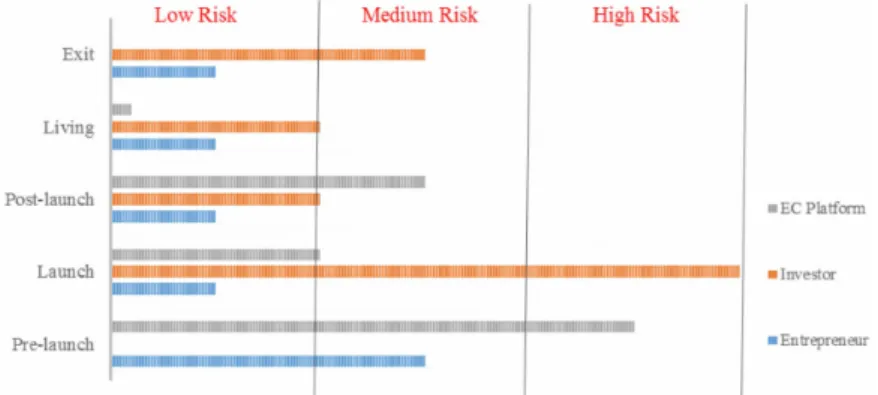
Figure 1 shows how much risk each immediate stakeholder is exposed to during the lifecycle of the EC process. The metrics used for this evaluation are the time, costs and expenses as well as the extent of resources employed, such as those outlined in Table 1. While the investor and the EC platform carry relatively higher risk during the pre-launch period, this risk changes in intensity and type as the EC process evolves.
The CF cycle starts with the pre-launch period, which involves the EC platform and the entrepreneur. At this time the entrepreneur chooses the EC platform and consequently the EC model, decides on the funding amount
Table 1: Types of stakeholder risks at different stages of the EC cycle
Pre-launch Launch Post-launch Living Exit
EN F (1) Platform comparability (2) Costs of ignorance (6) Partial failure of pitch (13) Further funding RG (11) Fulfilment of obligations O (12) Managerial problems RP (7) High visibility S (3) Opportunity costs (4) Model selection / Investor value (5) Unfit product/ service for EC (8) Privacy concern (9) Market positioning/ Investor mix (10) Information asymmetries IN F (1) Low risk awareness/ Payoff uncertainty/ Valuation and ROI
/ Comparability
(4) Performance
tracking (7) Liquidity RG
O (3) Delivery risk (5) Managerial
problems RP S (2) Diversification / Information asymmetry/ Opportunity cost (6) Dilution of shares ECP F (1) Cost of appraisal and due
diligence (5) Intermediary
duties RG (2) Fraud detection
O (3) Costs & Expenses
RP (6) EC success/ failure
Notas: EN, IN and ECP stand for entrepreneur, investor and EC platform, respectively. F, RG, O, RP and S represent financial, regulatory, operational, reputational and strategic risk categories, respectively.
and equity share to be offered, gathers all required legal documentation and prepares for the EC campaign. The EC platform, by regulation, is responsible to ensure that the entrepreneur is fit to be listed on their platform, the offer price is right and all documentation requirements are fulfilled. The launch period is when the entrepreneur’s pitch is alive and listed on the EC platform. At that point it is the duty of EC platform to provide smooth online visibility and access to all registered investors with correct information about the equity pitch, such as the percentage and amount of funded equity, the target amount, the number of investors and what percentage of ownership they represent, and the days left till the expiry of the pitch, along with further details about financials, the market and sectors and home location. The post-launch period is relatively shorter and is the time when the EC platforms coordinate funds and equity
share flows between investors and the entrepreneur.
During the living stage, the fully crowdfunded company has started oper-ations with its new shareholder profile. At the exit stage, the company may decide that it needs to grow and may mobilize efforts to gain access to first round funding through professional investors in the form of venture capital. The exit stage for the investor, in contrast, may come at a different time when the investor wants to leave the company due to various reasons. Table 1 shows the risks faced by the immediate stakeholders according to risk types: Financial, regulatory, operational, reputational and strategic.
3.1 Potential risks to entrepreneurs
1. Due to the lack of a single supervisory authority, selection of the “right” platform that fit the entrepreneurs’ needs is a somewhat ambiguous task. A thorough market research on the platform success rates, the fine print of the platform contract, the length of the campaign, and the profiles of similar competitors deems necessary. Thus, some of the questions the entrepreneur should ask herself are: What are the pros and cons of the EC platform, what are my expectations and time frame for fundraising, are there similar pitches already listed that may cannibalize my potential market share, does the EC platform have the right mix of sophisticated/unsophisticated investors that may be my potential shareholders?
2. The cost of incomplete information regarding the EC process and related costs and expenses may lead entrepreneurs to form unrealistic expecta-tions and underestimate risks. The regulatory due diligence requirements, CPA audits and filing of legal documentation may result in going over budget and campaign failure even before the pitch goes live. Further-more, the target amount to be raised, the share price and timing, viable operating and productions budgets are important decisions that may cause financial distress later on.
3. Opportunity costs are mostly those of not going down the traditional angel investment route and benefiting from such investors expertise and resources.
4. Entrepreneurs need to be aware of the particular features the ECP offers. For instance some platforms only allow for fully funded projects, whereas others release the funds of partially successful projects as well. Some platforms act a special purpose vehicle and create a pool of money; others only facilitate operations. And then there is also the question of what type of investors prefer investing with the specific platform. The logic of restricting EC to sophisticated investors originally was that these are supposed to exercise professional judgement and understand the risks of new ventures. Most of these high-net-worth individuals have a wealth of management experience and other resources from which the entrepreneur could benefit. With the accreditation of unsophisticated
investors investing “dumb money”, and the emergence of too many small investors scaring away potential institutional investors who would potentially be willing to provide extra funds along the way, entrepreneurs may lose out on potential investor value.
5. Some products or services may be more adequate for other more tradi-tional types of angel funding due to their complexity and originality. 6. If the entrepreneur has opted for an “all-or-nothing” EC model where
he leaves empty-handed if the full target amount cannot be raised, all the hassle has been in vain. As a precaution, EC platforms enabling partial-funding can be chosen.
7. High visibility may cause the venture look too desperate or unprofessional and hinder future potential through organized investor networks. 8. The privacy concern may create what Cooter & Schaefer (2012) call the
double trust dilemma of innovation, where the investor is faced with entrusting his money to the entrepreneur who, in return, discloses his idea to the investor. This relationship gets complicated when using an online platform where the entrepreneur has to put his best foot forward and publically disclose his innovative idea to the digital world without the security of having a non-disclosure agreement, and the investor, based on a limited information-set, has to decide on the best venture to invest. Consequently, if the idea can be replicated easily, the entrepreneur’s prod-uct faces digital commoditization, especially following with the American Invents Act, which grants the first person to file a patent application the ownership of the invention.
9. The entrepreneur may be placed in a favorable or unfavorable position in terms of visibility, furthermore this positioning and the wording and technical features used in the description of the pitch may put the venture in a disadvantaged position in terms of attracting the right investor mix. The crowd is known to be quite sensitive according to Mollick (2014) who in his research shows that a single spelling error decreases the chance of funding success by 13 percent.
10. As with stock markets, the transparency inherent in EC platforms can exacerbate information asymmetry among investors and push unsophis-ticated investors to go with the crowd. In response rational investors may take advantage by counteracting on this herding behavior.
11. If the entrepreneur does not, or the EC platform fails to, transfer the shares to the investor, legal repercussions are eminent.
12. Entrepreneurs may underestimate the costs of fulfillment; go over budget or experience delays. Furthermore company management and equity management require two distinct skillsets. EC entrepreneurs need to have a solid understanding not only of the product or service they are offering but also of the how to anticipate market demand and capacity, how to interact with shareholders and resolve potential managerial conflicts.
13. A CF platform can help a company get publicity, but it also shines a harsh spotlight on the venture at a time when it is still formative and volatile. Entrepreneurial firms that are financed via crowdinvesting are often too small for an IPO on the stock market. Exit opportunities are thus restricted in crowdinvesting (Hornuf & Schwienbacher, 2014). 3.2 Potential risks to investors
1. Since the payoff is highly uncertain, EC investors have less incentive to perform costly and time-consuming due diligence. While the valuation of startups which predominantly have high intellectual capital as opposed to fixed assets, is already a difficult task, EC investors with unsophisticated ones leading the way, will most probably lack the expertise and skills to perform adequate due diligence checks. And become too optimistic about expected returns. Dividends and capital gains are the two possible types of returns an investor can expect from an equity investment. However, with startups without a track record, investors are left in the dark about dividend payout policies. Similar to the entrepreneur, the investor too faces the lack of platform comparability problem.
2. Among the strategic risks unsophisticated investors, in particular may face, is that they may not be aware of investment basics and diversification strategies. As observed in stock markets, unsophisticated investors, may either imitate the trading behavior of visible institutional investors, invest with syndicates or or imitate the crowd. Investors may prefer ECPs over traditional angel networks for reasons such as ease of access and comfort of transparency and forego the benefits of interacting with more organized network of angel investors.
3. If not audited properly, entrepreneurs who fail to deliver pledged results may defraud investors or ECPs may fail or default entirely.
4. Mollick (2014) suggest that investors face information flow risk, since there’s no statutory requirement for unlisted companies to disclose any change in the way the business is run, including any change to operational activities. Thus, performance tracking becomes difficult for the share-holder, who has to rely on self-reported information by the entrepreneur. 5. Managerial problems and operational hold-ups are more likely to emerge in crowdfunded startups due to their shareholders structure and inexpe-rienced entrepreneurs. Those who invest through CF may be left in the dark about their company’s operations and progress.
6. Dilution or crowding out occurs when a company issues more shares. If existing shareholders do not buy any of the new shares, their propor-tionate shareholding of the company is reduced, or diluted. Apart from affecting the shareholder’s value, this can also affect voting and dividends. Venture capitalists and business angels can include anti-dilution provi-sions in their covenants that protect against unfavorable exit conditions.
Moreover, business angels sometimes stage their provision of capital, notably as a way to reduce their risk exposure. Therefore the investor should be aware of the share types offered by businesses as part of an equity investment and the implications for the dividend payments, voting rights, creditor preference and attractiveness to potential buyers. 7. There is no secondary market for EC shares meaning that the only
re-alizable gain is from dividends or from the actual sale of the company (thus no capital gains from selling shares is possible) as opposed to a VC investment, which secures cash backs through IPOs or partial sell-offs. 3.3 Potential risks to EC platforms
1. In a regulatory ambiguous environment the ECP carries the burden of correctly appraising the venture, performing due diligence, identity checks and verifications mitigating the risk of fraud and scams. In that sense, the ECP is working as a checks and balances mechanism in EC market.
2. The ECP has to perform the audit and educate investors on risks of EC. 3. According to the growing number of investors and entrepreneurs
interact-ing through the platform, there may be increases in maintenance costs, e.g. security systems against hackers, or even idiosyncratic aspects of the means of payment.
4. With increasing CF platforms, setting the right price ticket price is crucial for the ECP’s market positioning and survival. CF platforms are said to have increased by 91% in 2012 in North America.
5. The EC platforms carries the burden of facilitating the physical flow of funds and shares, ensuring that the selected entrepreneur is fit to get listed on their site according to regulations, the coordination of paperwork, the monitoring of funds.
6. The failure of the pitch may signal incompetency on part of the EC plat-form and those who invest through CF may be left uninplat-formed about their company’s operations and progress.
4 CONCLUSION
CF, particularly for its potential to provide equity funding to startups, is increas-ingly attracting attention. Providing funding to young and innovative firms is particularly relevant given their importance for job creation and economic growth (OECD, 2013). Growing funding difficulties necessitate alternative forms of financial intermediation. In light of the risks outlined in this paper, if regulated and standardized practices are applied, EC may be a game changer not only for startups but for impoverished nations as well. If the growth in EC continues at its present pace, it will soon change the financial intermediation landscape.
In this realm, in order for EC to flourish healthily, the task rests with the regulators to implement risk-reducing measures such as those addressed in the minutes of the 2ndEuropean Crowdfunding Stakeholder Forum (European
Crowdfunders Forum, 2014):
• how to account for cross-border transactions
• the possibility of establishing EC shares to be listed in secondary markets • creating put and call options for better exit possibilities for investors • increasing transparency concerning shareholder rights
• having a certain percentage of professional investors undersign the fi-nancial instrument
• disclosing information about credentials and nature of who is performing the pricing of the company, the pricing methodology and having common pricing guidelines
• establishing a third party auditor to provide objective judgment about financial and quality of the company
• drafting an “investor rights charter” which would be more visible and perhaps more effective for investors
• imposing self-regulation and facilitating transparency
• educating investors and informing them about selective criteria for the projects and valuation as facilitated by EC platforms
• adopting of a code of conduct to stimulate professionalism in the industry • establishing a standardized information sheet that provides for
trans-parency and comparability of platforms
Until these measures are implemented, investors who are the stakeholders facing the highest risks, should exercise utmost prudence, continue to diversify their investments and avoid channeling all their money planned for investment to EC projects.
REFERENCES
Cooter, R. D., & Schaefer, H. B. (2012). Solomon’s knot: How law can end the poverty of nations. Princeton University Press.
Corsten, S. (1991). Praenumeration: Lexikon des gesamten Buchwesens VI.
Stuttgart : Verlag Anton Hiersemann.
European Crowdfunders Forum. (2014, November 3). Minutes of the 2nd European Crowdfunding Stakeholder Forum meeting. Re-trieved from http://ec.europa.eu/finance/general-policy/docs/ crowdfunding/141103-minutes_en.pdf
Feinberg, M. (2013). Why donationan-based crowdfunding is here to stay (and growing). Retrieved from http://www.csrwire.com/blog/posts/
1050-why-donation-based-crowdfunding-is-here-to-stay-and -growing
Hornuf, L., & Schwienbacher, A. (2014). Crowdinvesting – Angel investing for the masses? Business Angels (Vol. 3)[forthcoming].
infoDev (Information for Development Program/The World Bank). (2013). Crowdfunding’s potential for the developing world. Finance and Private
Sector Development Department. Washington, DC : World Bank.
Mollick, E. (2014). The dynamics of crowdfunding: An exploratory study. Jour-nal of Business Venturing, 29(1), 1–16. doi: 10.1016/j.jbusvent.2013.06.005
OECD. (2011). Financing high-growth firms: The role of angel investors. OECD
Publishing. doi: 10.1787/9789264118782-en
OECD. (2013).OECD science, technology and industry scoreboard 2013. OECD
Publishing. doi: 10.1787/sti_scoreboard-2013-en
Statista. (2014).Equity crowdfunding market value in the United Kingdom (UK) from 1st quarter to 4th quarter of 2014 (in million GBP). Retrieved from
http://www.statista.com/statistics/372838/uk-alternative -finance-equity-crowdfunding-market-value-growth