Abstract
In this research, it was aimed to determine the effect of eugenol with concentrations of 0.5% and 1.0% on L. monocytogenes with amount of 103 cfu/g, 104 cfu/g, 105 cfu/g and on total aerobic mesophilic microorganisms. In the experimental samples, presence of L. monocytogenes, the total aerobic mesophilic microorganisms and pH values were determined in the beginning (day 0), 5th and 10th days of cold storage at 4°C and 30th and 60th days of frozen storage at -18°C. There were significant differences in the number of total aerobic mesophilic microorganisms at the beginning day (day 0) and 30th day of the experimental İnegöl meatballs between groups, statistically (P<0.01). Considering the storage period, it was observed that the number of initial total aerobic mesophilic microorganisms was reduced in experimental samples during whole storage time (P<0.01). As an overall evaluation it was determined that the initial number of L. monocytogenes untreated with eugenol was higher than the samples treated with eugenol 0.5% and 1% after 60 days of frozen storage. This difference probably indicates that eugenol has an inhibitory effect on L. monocytogenes.
Keywords: Eugenol, İnegöl meatballs, L. monocytogenes
Eugenolün İnegöl Köfteye İnokule Edilen Listeria monocytogenes’in
Varlığını Sürdürmesi Üzerine Etkisi
Özet
Araştırma, %0.5 ve %1.0 eugenol uygulamalarının 103 kob/g, 104 kob/g, 105 kob/g L. monocytogenes 4b ile inokulasyon sonrası etkisi ve aynı oranlardaki eugenol uygulamalarının toplam genel canlı mikroorganizmalar üzerine etkisini belirlemek amacıyla yapıldı. Deneysel numunelerde başlangıç (0. gün), 4°C’de muhafazanın 5. ve 10. günlerinde, -18°C’de donmuş muhafazanın 30. ve 60 günlerinde L.monocytogenes, toplam canlı mikroorganizması sayısı ve pH değerleri belirlendi. Deneysel İnegöl köftelerin başlangıçta (0.gün) ve donmuş muhafazanın 30. gününde toplam mezofilik aerob mikroorganizma sayısında istatistiki bakımdan gruplar arası önemli farklılıklar gözlemlenmiştir (P<0.01). Muhafaza periyodu dikkate alındığında ise deneysel uygulamalar yapılan numunelerin başlangıçta belirlenen toplam canlı mikroorganizma sayısının muhafaza periyodu süresince azaldığı gözlemlenmiştir (P <0.01). Genel olarak değerlendirildiğinde eugenol uygulanmayan numunelerin başlangıçta tespit edilen L. monocytogenes sayısının 60. gün donmuş muhafaza sonrasında %0.5 ve %1 eugenol uygulanan numunelerde belirlenen L. monocytogenes sayısından daha yüksek olduğu belirlenmiştir. Bu farklılık muhtemelen eugenolün L. monocytogenes üzerine inhibe edici etkisinin olabileceğini göstermektedir. Anahtar sözcükler: Eugenol, İnegöl köfte, L. monocytogenes
The Effect of Eugenol on Survival of Listeria monocytogenes
Inoculated İnegöl Meatball
[1] [2]Ümit GÜRBÜZ
1
H. Ahu KAHRAMAN
1A. Ezgi TELLİ
1Duygu BALPETEK KÜLCÜ
2[1]
[2] 1
2
This project was supported by the Scientific Research Projects Coordination Unit of Selcuk University with the project number 09202057
This study was presented in 2nd International VETIstanbul Group Congress 2015 in St. Petersburg - Russia
Selcuk University, Faculty of Veterinary Medicine, Department of Food Hygiene and Technology, TR-42003 Selcuklu, Konya - TURKEY
Giresun University, Faculty of Engineering, Department of Food Engineering, TR-28200 Giresun - TURKEY
INTRODUCTION
Listeria monocytogenes, which is an important food- borne pathogen, cause widespread epidemics, pneumonia, septicemia, meningitis, central nervous system infections
and approximately 30% result with deaths. Human listeriosis formed by three serotypes (4b, 1/2a, 1/2b) [1,2].
Meat and meat products are contaminated with L. monocytogenes in various stages of production. It was reported by various investigators that, minced meat widely
İletişim (Correspondence)
+90 332 2232704, Mobile: +90 533 4698994
[email protected]contaminated with L. monocytogenes. It’s stated that, up to 100 colonies of L. monocytogenes can be tolerated in a gram or milliliter of foods and may be inactivated with heat before consumption. However it is stated that foods with high numbers of L. monocytogenes needs to be removed from consumption [3].
Many methods are used against the risks created by pathogen microorganisms in foods. Heating, freezing, antimicrobial compounds and synthetic preservatives are the most common applications among these methods. However, these methods cause changes in organoleptic properties of food and loss of nutrients. Therefore, there has been increasing interest in the obtaining of the natural antimicrobial compounds which are effective, nontoxic, constant flavour and nondecremental of nutrient value of foods instead of synthetic preservatives which has negative effects on public health [4,5]. Although spices
obtained from plants is usually used as flavoring agents, it is shown by numerious researches that essential oils (EO) of various spices has antimicrobial activity and can be used as natural preservative [6,7].
Essential Oils (EO) are known to have different bio-logical effects since the MiddleAges[8]. In addition to
anti-bacterial [9-12] effect of EO or EO compounds, antiviral [13,14],
antimycotic [15-18], antioxidant [19-22], antitoxigenic [23-25],
antiparasitic [26,27] effects have been reported by several
researches.
This study was then conducted to investigate the effects of eugenol on total aerobic mesophilic bacteria (TAMB) and L. monocytogenes in İnegöl meatballs, which has widespread ready to consumption in Turkey and has low microbiological quality.
MATERIAL and METHODS
Experimental Materials
Meat and spices, used in this study were obtained from markets in Konya. The rib cap (lower portion, LP) of lamb and brisket region of veal meats were used.
Experimental Production of İnegöl Meatballs
In this study, İnegöl meatball samples were prepared according to conventional methods. Veal (70%), lamb (12%) and tallow (18%) were passed together through a meat grinder. Then 1.5% NaCl, 10% breadcrumbs, 0.05% ascorbic acid, 1.0% caseinate, 0.15% garlic, onion 5%, 1.2% spices (pepper powder, paprika, cumin, allspice) added to this main mixture and mixed thoroughly by adding 0.7% water and passed through a grinder again. 25 g meatballs were formed of rod from meatball dough. 12 İnegöl meatball production groups were carried out for experimental studies. Procedures applied to the production groups are shown in Table 1.
After production and applications, all experimental İnegöl meatball groups were porsioned and placed in foam plates and covered with stretch film. Packages were stored under cold and freezing conditions at +4°C and –18°C. Analysis were carried out at 0th, 5th and 10th days for
+4°C storage and 0th, 30th and 60th days for –18°C storage.
Production were carried out in 3 replications. Experimental Methods
Detection of Total Mesophilic Aerobic Bacteria: Detection of Total mesophilic aerobic bacteria count were performed according to the method suggested by Maturin and Peeler [28] in FDA Bacteriological Analytical Manual.
Detecting and Enumeration of L. monocytogenes: Detecting and enumeration of L. monocytogenes was performed according to the methot suggested by Hitchins ve Jinneman [29] in FDA Bacteriological Analytical Manual.
Statistical Analysis
The data obtained from the survey were analyzed using SPSS software package 21.00. Variance analysis (One-way ANOVA) of the obtained data, was subjected in accordance with the experimental design, and Duncan test was applied to detect differences between groups (P<0.05).
RESULTS
In this study; it was investigated that the use of eugenol essential oil and its’ antibacterial effect on the total aerobic bacteria and Listeria monocytogenes in İnegöl meatballs which is sold and consumed commonly in Turkey and reported to have a low microbiological quality. The first group of experimental production of İnegöl Meatballs
Table1. Experimental samples and control groups used in the study Tablo 1. Araştırmada kullanılan deneysel numuneler ve kontrol grupları
Group Procedures
I.
- Meatball + inoculation of 103 CFU/g L. monocytogenes 4b
- Meatball + inoculation of 104 CFU/g L. monocytogenes 4b
- Meatball + inoculation of 105 CFU/g L. monocytogenes 4b
II.
- Meatball + 0.5% Eugenol +
inoculation of 103 CFU/g L. monocytogenes 4b
- Meatball + 0.5% Eugenol +
inoculation of 104 CFU/g L. monocytogenes 4b
- Meatball + 0.5% Eugenol + inoculation of 105 CFU/g L.
monocytogenes 4b
III.
- Meatball + 1.0% Eugenol + inoculation of 103 CFU/g L.
monocytogenes 4b Meatball +
1.0% Eugenol + inoculation of 104 CFU/g L. monocytogenes 4b
- Meatball + 1.0% Eugenol + inoculation of 105 CFU/g L.
monocytogenes 4b
P1 Production of traditional Inegöl Meatballs P2 Meatball + 0.5% Eugenol
held for 10 days at the temperatures between 0-4°C and the samples of the other groups were stored at -18°C for 60 days. After the production of experimental samples (day 0), changes in the total mesophilic aerobic and L. monocytogenes count was determined on 5th and 10th
days of cold storage at 4°C and 30th and 60th days of frozen
storage at -18°C. It was confirmed that the experimental samples do not carry any L. monocytogenes with analyzing of control samples before the inoculation process.
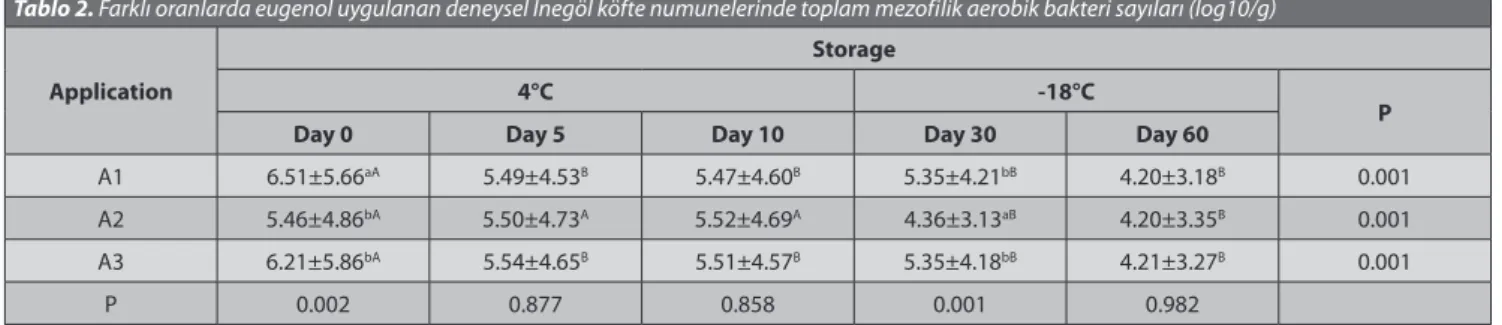
The count of total aerobic mesophilic bacteria in experimentally manufactured meatball samples obtained with inoculation of 103 cfu/g L. monocytogenes 4b and
different rates of eugenol is shown in Table 2.
There were major statistical differences in the number of the total mesophilic aerobic microorganisms between the groups at the beginning stage (day 0) and frozen storage at 30th day of the experimental İnegöl meatballs
(Table 2; P<0.05). When considering the storage period,
it was determined that the total number of aerobic mesophilic microorganisms decreased during the storage period. The minimum number of total aerobic mesophilic microorganisms count was observed in the experimental samples stored at -18°C. These differences were found to be statistically important (Table 2; P<0.01).
At the beginning stage, the total mesophilic aerobic number of viable microorganisms were found between 5:46 and 6:51 in the experimental samples. Considering the eugenol application the differences was determined only 30th day of frozen storage between groups. At this period,
the lowest number of microorganisms was determined in the group that 0.5% eugenol application was performed. In general consideration, it can be stated that this effect is due to the low number of microorganisms of these groups of samples at the beginning stage rather than the effective application of eugenol. Furthermore, in view of storage period, the frozen storage of the samples were considered to be more effective on the growth of total viable microorganisms (Table 2).
In general, a reduction is achieved in the microflora at varying rates by freezing of food. A quite large variation
of the reduction in microflora may be caused by the contamination in production process and growth of microorganisms during the thawing stage.
This can be explained by the view of Yıldırım [30]. The
researcher stated that the microflora in a certain period (lag phase) of cold stored food has been unchanged qualitatively and quantitatively. He stated that bacteria in food start to multiply at the end of the lag phase depending on storage conditions (cold or frozen), replication of microflora can be inhibited in the products which chilled in accordance with technological rules and has a high quality. He also indicated that, both mesophilic bacteria and psychrotrophic bacteria reduce during the cold storage for 3-5 days in meat and meat products. The microbiological results of this study support the views and ideas mentioned above.
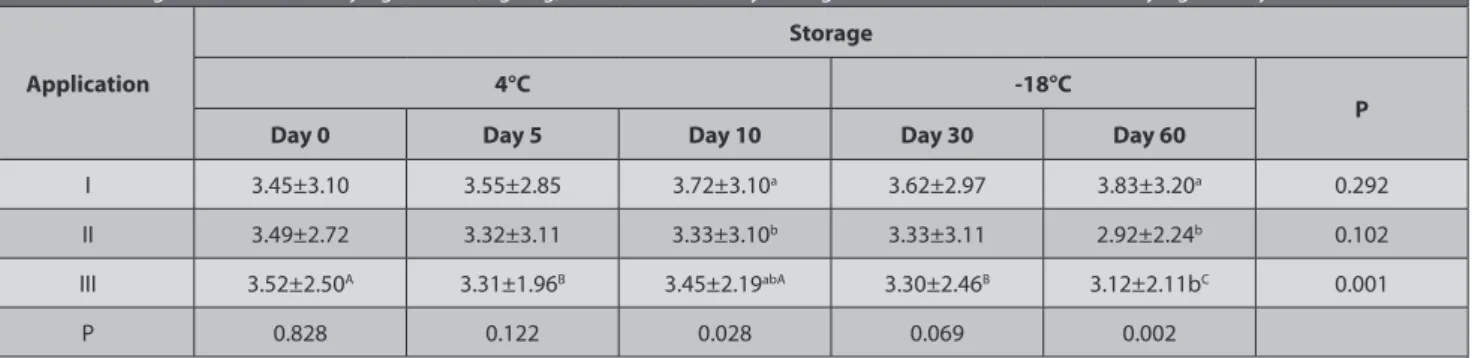
The experimental meatball samples with different rates of eugenol which inoculated with 103cfu/g L. monocytogenes
4b displayed intergroup differences on 10th day of cold
storage and 60th day of frozen storage with regard to the
number of bacteria (Table 3; P<0.05). The highest value of bacteria on 10th day of cold storage and 60th day of frozen
storage was determined in the Group I which the samples are untreated with eugenol. When considering the storage period, samples of Group III were only observed to be statistically different (Table 3, P<0.01).
The number of L. monocytogenes in the first experimental group (Group I) which is untreated with eugenol, was almost stable and maintain the level of initial stage (3.45 cfu/g). The number of the bacteria in the second experimental group (Group II) which is treated with 0.5% eugenol decreased 3.49 cfu/g to 2.92 cfu/g from the initial level to the 60th day of frozen storage, respectively.
In the sample which is treated with 1.0% eugenol, it was determined that the initial count of L. monocytogenes detected as 3.52 cfu/g and decreased to 3.12 cfu/g on 60th
day of frozen storage. Based on these results, it was thought that the application of the eugenol may have an inhibitory effect on L. monocytogenes. In addition, reduction in the number of L. monocytogenes in 1.0% eugenol treated
Table 2. Total aerobic mesophilic bacteria count of experimental Inegol meatball obtained by the application of different rates of eugenol (log10/g) Tablo 2. Farklı oranlarda eugenol uygulanan deneysel İnegöl köfte numunelerinde toplam mezofilik aerobik bakteri sayıları (log10/g)
Application
Storage
4°C -18°C
P
Day 0 Day 5 Day 10 Day 30 Day 60
A1 6.51±5.66aA 5.49±4.53B 5.47±4.60B 5.35±4.21bB 4.20±3.18B 0.001
A2 5.46±4.86bA 5.50±4.73A 5.52±4.69A 4.36±3.13aB 4.20±3.35B 0.001
A3 6.21±5.86bA 5.54±4.65B 5.51±4.57B 5.35±4.18bB 4.21±3.27B 0.001
P 0.002 0.877 0.858 0.001 0.982
a,b,c: The differences between the mean values in the same column with different letters are important (P<0.05). A,B,C: The differences between the mean
values with different letters on the same line are important (P<0.05). A1. Traditional Inegöl Meatball production, A2. Meatball + 0.5% Eugenol addition,
samples were determined to have statistically significant
(Table 3; P<0.01).
The experimental meatball samples with different rates of eugenol which are inoculated with 104 cfu/g
L. monocytogenes 4b displayed intergroup differences only on 5th day of storage with regard to the number of
bacteria. The number of L. monocytogenes of the groups II and III were found lower rather than the group I which was untreated with eugenol (Table 4, P<0.05) Considering the storage period, the groups II were found to contain lower numbers of L. monocytogenes only in 60th days of -18°C
storage (Table 4, P<0.05).
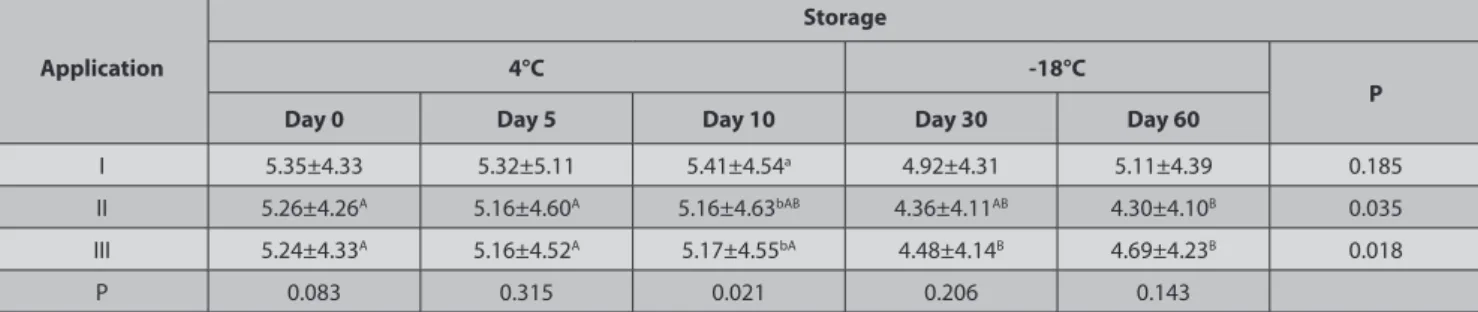
The experimental meatball samples with different rates of eugenol which are inoculated with 105 cfu/g
L. monocytogenes 4b displayed intergroup differences only on 10th day of storage with regard to the number
of bacteria (Table 5, P<0.05). When the groups were compared the groups II and III which were treated with eugenol displayed a lower number of L. monocytogenes rather than the group I which was untreated with eugenol. Considering the storage period, the samples including group II and III were found to contain lower numbers of L. monocytogenes on 30th and 60th days.
On the 60th day of the experiment, the initial number
of L. monocytogenes in the experimental samples which were untreated with eugenol, treated with 0.5% eugenol and treated with 1.0% eugenol was determined to decrease from 5.35 cfu/g to 5.11 cfu/g, 5.26 cfu/g to 4.30 cfu/g and 5.24 cfu/g to 4.69 cfu/g, respectively.
DISCUSSION
An overall evaluation of the results displayed that the number of L. monocytogenes in the experimental samples of group II and III which are treated with eugenol was determined to reduce at the duration of the storage period. This finding of the study was suggested that the eugenol may possess a growth inhibitory effect on L. monocytogenes as well as in other studies. While a large number of studies [31-47] have reported that eugenol has
an inhibitory effect against L. monocytogenes, in contrast several researchers [48] claimed that the eugenol has no
effect against L. monocytogenes.
It was observed that the eugenol was more effective on L. monocytogenes strains in comparison with other essential oils (cinnamaldeyhd, thymol, citral, citronellol, limonenes) by Balch and Deans [31]. Filgueiras and Vanetti [35]
Table 3. Number of L. monocytogenes in experimental samples of Inegol meatballs which inoculated different rates of eugenol and 103 cfu/g L.
monocytogenes 4b (log10/g)
Tablo 3. 103 kob/g oranında L. monocytogenes 4b (log10/g) inokule edilen deneysel İnegöl köfte numunelerinde L. monocytogenes sayısı
Application
Storage
4°C -18°C
P
Day 0 Day 5 Day 10 Day 30 Day 60
I 3.45±3.10 3.55±2.85 3.72±3.10a 3.62±2.97 3.83±3.20a 0.292
II 3.49±2.72 3.32±3.11 3.33±3.10b 3.33±3.11 2.92±2.24b 0.102
III 3.52±2.50A 3.31±1.96B 3.45±2.19abA 3.30±2.46B 3.12±2.11bC 0.001
P 0.828 0.122 0.028 0.069 0.002
a,b,c: The differences between the mean values in the same column with different letters are important (P<0.05). I. Meatball + Inoculation of 103 cfu/g L.
monocytogenes 4b. II. Meatball + 0.5% Eugenol + Inoculation of 103 cfu/g L. monocytogenes 4b. III. Meatball + 1.0% Eugenol + Inoculation of 103 cfu/g L.
monocytogenes 4b
Table 4. Number of L. monocytogenes in experimental samples of Inegol meatballs which inoculated different rates of eugenol and 104 cfu/g L.
monocytogenes 4b (log10/g)
Tablo 4. 104 kob/g oranında L. monocytogenes 4b (log10/g) inokule edilen deneysel İnegöl köfte numunelerinde L. monocytogenes sayısı
Application
Storage
4°C -18°C
P
Day 0 Day 5 Day 10 Day 30 Day 60
I 4.27±3.30a 4.30±3.73a 4.40±3.43 4.14±3.39 4.52±4.20 0.110
II 4.39±3.27A 4.11±3.40bA 4.23±3.82A 4.24±3.86A 4.17±3.95B 0.009
III 4.35±3.48 4.13±3.18b 4.19±3.38 4.10±3.22 3.71±3.22 0.236
P 0.116 0.046 0.067 0.251 0.087
a,b,c: The differences between the mean values in the same column with different letters are important (P<0.05). I. Meatball + Inoculation of 104 cfu/g L.
monocytogenes 4b. II. Meatball + 0.5% Eugenol + Inoculation of 104 cfu/g L. monocytogenes 4b. III. Meatball + 1.0% Eugenol + Inoculation of 104 cfu/g L.
investigated the growth of L. monocytogenes and listeriolysin O (LLO) production. They stated that eugenol promoted a delay on the growth of L. monocytogenes at concentrations of 100, 300 and 500 mg mL-1 and above
800 mg mL-1 the effect was bactericidal. In addition, they
argued that production of LLO by L. monocytogenes was reduced 80-100% in the presence of eugenol.
It was suggested that Gram (-) bacteria are more resistant to volatile oils [45]. Indeed Bežić et al.[32] stated that
lipopolysaccharide (LPS), a structure of Gram (-) bacteria cell wall, inhibited the interaction of the volatile oil cell to bacteria membrane. However, Kim et al.[42] argued
that L. monocytogenes is more resistant to the volatile oil although it’s Gram (+).
Blaszyk and Holley [33] stated that 500 ppm eugenol
has an inhibitory effect on L. monocytogenes. Chen et al.[34] argued that the forms of eugenol and thymol are
more effective on L. monocytogenes than other forms. The bactericidal activity of clove on food-borne pathogens such as L. monocytogenes had been also reported by Ting and Deibel [46].
Garcia-Garcia et al.[36] reported that 350 mg/kg−1 of
eugenol did not inactivate L. innocua. However, a 450 mg /kg−1 concentration of this antimicrobial agent inactivated
the microorganism in the first few hours, and this condition prevailed after 72 h. So they argued that 450 mg/ kg−1 eugenol concentration was the minimal bactericidal
concentration for L. innocua.
Gaysınsky et al.[37] stated that Eugenol encapsulated
in Surfynol 485W micelles was most efficient in inhibiting of the growth of the pathogens. They argued that 1.0% Surfynol 485W and 0.15% eugenol was sufficient to inhibit the growth of all strains of E. coli O157:H7 and three of four strains of L. monocytogenes (Scott A, 310 and 108).
Gill et al.[38] stated that, eugenol and carvacrol lead
to degradation in E. coli and L. monocytogenes’ in cell membrane, also they caused to increase extracellular ATP concentrations and reduce to intracellular ATP
concentration. In addition, Gill et al.[39] stated that eugenol
and carvacrol inhibited the membrane ATPase activity of E. coli and L. monocytogenes.
Gill and Holley [40] suggested that eugenol was a more
effective bactericidal agent than Cinnamaldehyde in same concentration. They stated that eugenol has a dose-dependent bactericidal effect on log-phase cells of L. monocytogenes within 15 min.
Hao et al.[41] stated that eugenol was slow down the
growth of L. monocytogenes in cooked beef while it was maintained at 5°C and 15°C. Smith-Palmer et al.[45] argued
that the clove essential oil could be implemented to control of L. monocytogenes and it has low bacteriostatic and bactericidal effects at 4°C.
Perez-Conesa et al.[43] reported that L. monocytogenes
strain Scott A was more sensitive to eugenol than to Carvacrol after 2 min of exposure, as eugenol led to a 3.3 log cfu/cm2 reduction compared with the 1.9
log cfu/cm2 reduction achieved by carvacrol and they
observed that viable cells were below detectable levels for L. monocytogenes strain ScottA was exposed to 0.7% eugenol-loaded micelles for 10 and 20 min.
Santiesteban-L’opez et al.[44] evaluated the effects of
antimicrobial agents on S. aureus, L.innocua, E. coli and S. typhimurium and they determined that the most effective antimicrobial agent was carvacrol followed by thymol and eugenol.
Upadhyay et al.[47] investigated that the effects of
generally recognized as safe (GRAS), plant-derived anti-microbials (PDAs); trans-cinnamaldehyde (TC 0.50, 0.75 mM), carvacrol (CR 0.50, 0.65 mM), thymol (TY 0.33, 0.50 mM) and eugenol (EG 1.8, 2.5 mM) on L. monocytogenes (LM) biofilm formation. When applied at subinhibitory concentrations, they were considerably effective in killing mature LM biofilms and has an inhibitory effect on biofilm synthesis.
Despite advances in food technology, food poisoning continues to maintain an increasing importance in terms
Table 5. Number of L. monocytogenes in experimental samples of Inegol meatballs which inoculated different rates of eugenol and 105 cfu/g L.
monocytogenes 4b (log10/g)
Tablo 5. 105 kob/g oranında L. monocytogenes 4b (log10/g) inokule edilen deneysel İnegöl köfte numunelerinde L. monocytogenes sayısı
Application
Storage
4°C -18°C
P
Day 0 Day 5 Day 10 Day 30 Day 60
I 5.35±4.33 5.32±5.11 5.41±4.54a 4.92±4.31 5.11±4.39 0.185
II 5.26±4.26A 5.16±4.60A 5.16±4.63bAB 4.36±4.11AB 4.30±4.10B 0.035
III 5.24±4.33A 5.16±4.52A 5.17±4.55bA 4.48±4.14B 4.69±4.23B 0.018
P 0.083 0.315 0.021 0.206 0.143
a,b,c: The differences between the mean values in the same column with different letters are important (P<0.05). I. Meatball + Inoculation of 105 cfu/g L.
monocytogenes 4b. II. Meatball+ 0.5 %Eugenol + Inoculation of 105 cfu/g L. monocytogenes 4b. III. Meatball + 1.0% Eugenol + Inoculation of 105 cfu/g L.
of public health. Pathogenic microorganisms such as E. coli O157:H7, Salmonella spp. and L. monocytogenes found in meat products threaten public health even today.
L. monocytogenes is considered as an important pathogen that causes food-borne epidemia, pneumonia, septicemia, meningitis, central nervous system infections and death about 30% of cases. Meat and meat products are contaminated with L. monocytogenes at different stages of the production. Many methods are used in food against the risks generated to pathogenic microorganisms. Heating, freezing, preservatives and synthetic antimicrobial compounds are the most frequently used methods among these. However, these methods cause changes in the organoleptic properties of food and loss of nutrients. Synthetic preservatives are known to affect negatively to public health; because of this reason the natural anti-microbial compounds which are effective, non-toxic, constant flavour and nondecremental of nutrient value of the product are use in food production. It has been shown in the studies, spices obtained from plants are use as flavorer in food products, many spices has essential oils (EO) which can be used as a natural preservative for their antimicrobial activity.
Thus, using essential oils of plant origin as an alternative to chemical compounds in the manufacturing of the meat products, particularly İnegöl meatball would be beneficial for protecting the public health. It was concluded that eugenol can show inhibitory activity especially against L. monocytogenes and other pathogenic microorganisms, but for a certain opinion, new experimental models and new researches need to be done.
C
onfliCtofi
nterestAll the authors declare that there is no conflict of interests regarding the publication of this research article.
REFERENCES
1. Farber JM, Peterkin PI: Listeria monocytogenes, a food-borne
pathogen. Microbiol Rev, 55, 476-511, 1991.
2. Juhe A, Ingolf UG, Azlin M: Effects of plant extracts on microbial
growth, color change, and lipid oxidation in cooked beef. Food Microbiol, 24, 7-14, 2007. DOI: 10.1016/j.fm.2006.04.006
3. Soyutemiz E: Changes in bacterial flora and Listeria monocytogenes
counts in vacuum packed İnegöl meatballs refrigerated at differenet degrees. Gıda, 25 (2): 79-86, 2000.
4. Rasooli I: Food preservation - A biopreservative approach. Food, 1 (2):
111-136, 2007.
5. Shan B, Cai YZ, Brooks JD, Corke H: The in vitro antibacterial activity
of dietary spice and medicinal herb extracts. Int J Food Microbiol, 117, 112-119, 2007. DOI: 10.1016/j.ijfoodmicro.2007.03.003
6. Zhang H, Kong B, Xiong YL, Sun X: Antimicrobial activities of spice
extracts against pathogenic and spoilage bacteria in modified atmosphere packaged fresh pork and vacuum packaged ham slices stored at 4°C.
Meat Science, 81, 686-692, 2009. DOI: 10.1016/j.meatsci.2008.11.011
7. Duman Aydın B: Investigation of antibacterial effects of some
medicinal plants and spices on food pathogens. Kafkas Univ Vet Fak Derg,
14, 83-87, 2008. DOI: 10.9775/kvfd.2008.11-A
8. Bakkali F, Averbeck S, Averbeck D, Idaomar M: Biological effects
of essential oils - A review. Food Chem Toxicol, 46, 446-475, 2008. DOI: 10.1016/j.fct.2007.09.106
9. Nazer AI, Kobilinsky A, Tholozan JL, Brissonnet FD: Combinations
of food antimicrobials at low levels to inhibit the growthof Salmonella sv.
typhimurium: A synergistic effect. Food Microbiol, 22, 391-398, 2005. DOI:
10.1016/j.fm.2004.10.003
10. Busatta C, Vidal RS, Popiolski AS, Mossi AJ, Dariva C, Rodrigues MRA, Corazza FC, Corazza ML, Oliveira JV, Cansian RL: Application of
Origanum Majorana L. essential oil as an antimicrobial agent in sausage.
Food Microbiol, 25, 207-211, 2008. DOI: 10.1016/j.fm.2007.07.003
11. Çelikel N, Kavas G: Antimicrobial properties of some essential oils
against some pathogenic microorganisms. Czech J Food Sci, 26, 174- 181, 2008.
12. Tohidpour A, Sattari M, Omidbaigi R, Yadegar A, Nazemi J:
Antibacterial effect of essential oils from two medicinal plants against methicillin-resistant Staphylococcus aureus (MRSA). Phytomedicine, 17, 142-145, 2010. DOI: 10.1016/j.phymed.2009.05.007
13. Sinico C, Logu AD, Lai F, Valenti D, Manconi M, Loy G, Bonsignore L, Fadda AM: Liposomal incorporation of artemisia arborescens l.
essential oil and in vitro antiviral activity. Eur J Pharm Biopharm, 59, 161-168, 2005. DOI: 10.1016/j.ejpb.2004.06.005
14. Koch C, Reichling J, Schneelebk, Schnitzler P: Inhibitory effect
of essential oils against herpes simplex virus type 2. Phytomedicine, 15, 71-78, 2008. DOI: 10.1016/j.phymed.2007.09.003
15. Aurelio LM, Alzamora SM, Enrique P: Aspergillus flavus dose–
response curves to selected natural and synthetic antimicrobials. Int J
Food Microbiol, 73, 213-218, 2002. DOI: 10.1016/S0168-1605(01)00639-0
16. Braga Pc, Dal Sasso M, Culici M, Alfieri M: Eugenol and thymol,
alone or in combination, inducem morphological alterations in the envelope of Candida albicans. Fitoterapia, 78, 396-400, 2007. DOI: 10.1016/j.fitote.2007.02.022
17. Omidbeygi M, Barzegar M, Hamidi Z, Naghdibadi H: Antifungal
activity of thyme, summer savory and clove essential oils against
Aspergillus xavus in liquid medium and tomato paste. Food Control, 18,
1518-1523, 2007. DOI: 10.1016/j.foodcont.2006.12.003
18. Tzortzakis NG, Economakis CD: Antifungal activity of lemongrass
(Cympopogon citratus L.) essential oil against key postharvest pathogens.
INNFOO 8, 253-258, 2007. DOI: 10.1016/j.ifset.2007.01.002
19. Sallam KI, Ishioroshi M, Samejima K: Antioxidant and antimicrobial
effects of garlic in chicken sausage. Lebenson Wiss Technol, 37, 849-855, 2004. DOI: 10.13140/RG.2.1.1501.5843
20. Sacchetti G, Maietti S, Muzzoli M, Scaglianti M, Manfredini S, Radice M, Bruni R: Comparative evaluation of 11 essential oils of different
origin as functional antioxidants, antiradicals and antimicrobials in foods.
Food Chemistry, 91, 621-632, 2005. DOI: 10.1016/j.foodchem.2004.06.031
21. Suhaj M: Spice antioxidants isolation and their antiradical
activity: A review. J Food Comp Anal, 19, 531-537, 2006. DOI: 10.1016/j. jfca.2004.11.005
22. Terpinc P, Bezjak W, Abramovic H: A kinetic model for evaluation
of the antioxidant activity of several rosemary extracts. Food Chemistry, 115, 740-744, 2009. DOI: 10.1016/j.foodchem.2008.12.033
23. Marin S, Velluti A, Ramos AJ, Sanchis V: Effect of essential oils on
zearalenone and deoxynivalenol production by fusarium graminearum in non-sterilized maize grain. Food Microbiol, 21, 313-331, 2004. DOI: 10.1016/j.fm.2003.08.002
24. Aldred D, Fuller CV, Magan N: Environmental factors affect efficacy
of some essential oils and resveratrol to control growth and ochratoxin a production by Penicillium verrucosum and Aspergillus westerdijkiae on wheat grain. J Stored Prod Res, 44, 341-346, 2008. DOI: 10.1016/j. jspr.2008.03.004
25. Kordali S, Cakir A, Ozer H, Cakmakci R, Kesdek M, Mete E:
Antifungal, phytotoxic and insecticidal properties of essential oil isolated from turkish origanum acutidens and its three components, carvacrol, thymol and p-cymene. Bioresour Technol, 99, 8788-8795, 2008. DOI:
10.1016/j.biortech.2008.04.048
26. Anthony JP, Fyfe L, Smith H: Plant active components - A resource
for antiparasitic agents? Trends Parasitol, 21, 463-468, 2005. DOI: 10.1016/j. pt.2005.08.004
27. Atjanasuppat K, Wongkham W, Meepowpan P, Kittakoop P, Sobhon P, Bartlett A, Whitfield PJ: In vitro screening for anthelmintic
and antitumour activity of ethnomedicinal plants from Thailand. J
Ethnopharmacol, 123, 475-482, 2009. DOI: 10.1016/j.jep.2009.03.010
28. Maturin L, Peeler JT: Conventional Plate Count Method. Chapter 3.
Bacteriological Analytical Manual, U.S. Food and Drug Administration, 2001. http://www.fda.gov/Food/FoodScienceResearch/LaboratoryMethods/ ucm063346.htm, Accessed: 03.02.2015.
29. Hitchins AD, Jinneman K: Detection and Enumeration of Listeria
monocytogenes in Foods. Chapter 10. Bacteriological Analytical Manual,
U.S. Food and Drug Administration, 2013. http://www.fda.gov/Food/ FoodScienceResearch/LaboratoryMethods/ucm071400.htm, Acessed: 03.02.2015.
30. Yıldırım Y: Et Endüstrisi. Uludağ University Press, Bursa, 1996.
31. Balchin M, Deans SG: Bioactivity of selected plant essential oils
against Listeria monocytogenes. J Appl Microbiol, 82, 759-762, 1997. DOI: 10.1046/j.1365-2672.1997.00153.x
32. Bezić N, Skočibušić M, Dunkić V, Radonić A: Composition and
antimicrobial activity of Achillea clavennae L. essentialoil. Phytother Res, 17, 1037-1040, 2003. DOI: 10.1002/ptr.1290
33. Blaszyk M, Holley RA: Interaction of monolaurin, eugenol and
sodium citrate on growth of common meat spoilage and pathogenic organisms. Int J Food Microbiol, 39, 175-183, 1998. DOI: 10.1016/S0168-1605(97)00134-7
34. Chen H, Zhang Y, Zhong Q: Physical and antimicrobial properties of
spray-dried zein-casein nanocapsules with co-encapsulated eugenol and thymol. J Food Eng, 144, 93-102, 2015. DOI: 10.1016/j.jfoodeng.2014.07.021
35. Filgueiras CT, Vanetti MCD: Effect of eugenol on growth and
Listeriolysin O production by Listeria monocytogenes. Braz Arch Biol
Technol, 49, 405-409, 2006. DOI: 10.1590/S1516-89132006000400008
36. Garcia-Garcia R, L´opez-Malo A, Palou E: Bactericidal action of
binary and ternary mixtures of carvacrol, thymol, and eugenol against
Listeria innocua. J Food Sci, 76(2), 95-100, 2011. DOI:
10.1111/j.1750-3841.2010.02005.x
37. Gaysinsky S, Davidson PM, Bruce BD, Weiss J: Growth inhibition
of Escherichia coli O157:H7 and Listeria monocytogenes by carvacrol and
eugenol encapsulated in surfactant micelles. J Food Protect, 68 (12): 2559-2566, 2005.
38. Gill, AO, Holley RA: Disruption of Escherichia coli, Listeria monocytogenes
and Lactobacillus sakei cellular membranes by plant oil aromatics. Int J
Food Microbiol, 108, 1-9, 2006. DOI: 10.1016/j.ijfoodmicro.2005.10.009
39. Gill AO, Holley RA: Inhibition of membrane bound ATPases of
Escherichia coli and Listeria monocytogenes by plant oil aromatics. Int J Food Microbiol, 111, 170-174, 2006. DOI: 10.1016/j.ijfoodmicro.2006.04.046
40. Gill AO Holley RA: Mechanisms of bactericidal action of
cinnamaldehyde against Listeria monocytogenes and of eugenol against
L. monocytogenes and Lactobacillus sakei. Appl Environ Microbiol, 70,
5750-5755, 2004. DOI: 10.1128/AEM.70.10.5750-5755.2004
41. Hao YY, Brackett RE, Doyle MP: Inhibition of Listeria monocytogenes
and Aeromonas hydrophilabyplat extracts in refrigerated cooked beef. J
Food Protect, 61, 307-312, 1998.
42. Kim J, Marshall MR, Vei C: Antimicrobial activity of some essential
oil components against five food borne pathogens. J Ag Food Chem, 43, 2839-2845, 1995. DOI: 10.1021/jf00059a013
43. Perez-Conesa D, Cao J, Chen L, Mclandsborough L, Weiss J:
Inactivation of Listeria monocytogenes and Escherichia coli O157:H7Biofilms by micelle-encapsulated eugenol and carvacrol. J Food Protec, 74, 55-62, 2011. DOI: 10.4315/0362-028X.JFP-08-403
44. Santiesteban-L´opez A, Palou E, L´opez-Malo: Susceptibility of
food borne bacteria to binary combinations of antimicrobials at selecteda and pH. J Appl Microbiol, 102, 486-497, 2007. DOI: 10.1111/j.1365-2672.2006.03092.x
45. Smith-Palmer A, Stewart J, Fyfe L: Antimicrobial properties of
plantessential oils and essences against five important food-borne pathogens. Lett Appl Microbiol, 26, 118-122, 1998. DOI: 10.1046/j.1472-765X.1998.00303.x
46. Ting WTE, Deibel KE: Sensitivity of Listeria monocytogenes to spices
at two temperatures. J Food Safety, 12, 129-137, 1992. DOI: 10.1111/ j.1745-4565.1991.tb00071.x
47. Upadhyay A, Upadhyaya I, Kollanoor-Johny A, Venkitanarayanan K:
Antibiofilm effect of plant derived antimicrobials on Listeria monocytogenes.
Food Microbiol, 36, 79-89, 2013. DOI: 10.1016/j.fm.2013.04.010
48. Apolonio J, Faleiro ML, Miguel MG, Neto L: No induction of
antimicrobial resistance in Staphylococcus aureus and Listeria monocytogenes during continuous exposure to eugenol and citral. FEMS Microbiol Lett, 354, 92-101, 2014. DOI: 10.1111/1574-6968.12440