Synthesis of novel 3, 5, 6-trisubstituted
triazine derivatives and their biological
activity evaluation as potential antitumor
and anti-inflammatory agents
Acta Pharm. Sci. Vol 54 No: 1. 2016
Leyla Yurttaş1, Zafer Şahin2, Gülşen Akalın Çiftçi3, Halide Edip Temel3, Şeref Demirayak2
*Corresponding author: Leyla YURTTAŞ E-mail address: [email protected]
1Anadolu University, Faculty of Pharmacy, Department of Pharmaceutical Chemistry, Eskişehir, Turkey 2Medipol University, School of Pharmacy, Department of Pharmaceutical Chemistry, İstanbul, Turkey 3Anadolu University, Faculty of Pharmacy, Department of Biochemistry, Eskişehir, Turkey
INTRODUCTION
Together cardiovascular diseases, cancer is one of the common causes of death. By the discovery of mechanisms of cancer, efforts focused on different targets to treat disease. Besides the new techniques like hyperthermia, photodynamic therapy and stem cell transplation; old techniques radiotherapy, hormonal and non-hormonal chemotherapy, immunotherapy and surgery methods is still
be-ABSTRACT
In this study, new 3, 5, 6-trisubstituted 1, 2, 4-triazine derivatives (1-9) were synthesized and their structures were determined by using NMR, IR and Mass spectroscopic methods. In vitro antitumor activities against MCF-7 breast adenocarcinoma and C6 rat glioma cell lines were evaluated via MTT colorimetric assay. Among the compounds, compound 4 (IC50=21.0 µg/mL) was found as the most active one against C6 cell line, whereas compound 5 (IC50=9.5 µg/mL) was found the most potent compound against MCF-7 cell line and both of compounds had higher activity than cisplatin in their line. Furthermore, IC50 value of compound 6 was found as 26.0 µg/mL against C6 which was very close to cisplatin potency (IC50=23.5 µg/mL). Besides, all compounds were tested to determine their lipoxygenase (LOX) inhibitory activity. Compounds 1 and 6 showed LOX inhibition with percentages of 43.35% and 38.79% at 100 µg/mL concentration, respectively. The obtained results on cell lines inspire to synthesise new and more potent molecules compounds as anticancer agents.
ing used1. In chemotherapy, alkylation agents, mitotic inhibitors and
antimeta-bolites are used either alone or in combination with each other. In simple terms, a selective drug must be active on cancer cells but inactive in normal cells. But the differences between normal and cancer cells is quite little and not qualitative so that its hard to find an exploitable mechanism2.
Purine and pyrimidine analog drugs such as 5-fluorouracil and 6-mercapto-purine have been widely used in succesful treatment of cancer disease3. Many
nitrogen containing heterocylic compounds such as 1,2,4-triazines have been constitutes medicinal chemists’ interest area in cancer theraphy4,5. The potential
anticancer-cytostatic effects of 1,2,4-triazine derivatives were widely studied and reported to have promising activity6-12.
5-Lipoxygenase (5-LOX) is a crucial enzyme which catalyses biosynthesis of leu-kotrienes in the arachidonic acid (AA) cascade. Variable leukotriene levels were reported in different diseases like cardiovascular diseases and certain types of cancer as well as asthma, allergic rhinitis13. In particular, 5-LOX have been
fo-und to be up-regulated in many cancer cell lines, which results in promoting the development of carcinogenesis. Inhibition of LOX enzyme could be a subsidiary mechanism for down-regulation of tumors accordingly this approach enables a rational concept for the design of more effective antitumor agents14.
Accordingly, we aimed to synthesize 1-[4-(5,6-bis-(4-substituted phenyl)-1,2,4-triazin-3-yl)piperazin-1-yl]-2-[(1H-(benz)imidazol/thiazole/oxazole-2-yl)thio] ethan-1-one derivatives (1-9) for evaluating anticancer activity by following a study reported before a number of derivatives with similar structures15. The
structure elucidation was carried out by spectroscopic techniques and in vitro anticancer activities of compounds were evaluated using MTT technique on MCF-7 and C6 tumor cell lines. The lipooxygenase (LOX) enzyme inhibitory ac-tiviy of the compounds were also studied.
METHODOLOGY Chemistry
Synthesis and characterization
All needed chemicals were purchased from Sigma-Aldrich (Sigma-Aldrich Corp., St. Louis, MO, USA). All melting points (m.p.) were determined by MP90 digi-tal melting point apparatus (Mettler Toledo, OH) and were uncorrected. All the reactions were monitored by thin-layer chromatography (TLC) using Silica Gel 60 F254 TLC plates (Merck KGaA, Darmstadt, Germany). Spectroscopic data were recorded with the following instruments: a Bruker Tensor 27 IR spectrop-hotometer; 1H NMR (nuclear magnetic resonance) Bruker DPX- 300 FT-NMR
spectrometer, 13C NMR, Bruker DPX 75 MHz spectrometer (Bruker Bioscience,
Billerica, MA, USA); M+1 peaks were determined by Shimadzu LC/MS ITTOF system (Shimadzu, Tokyo, Japan). The synthesis of three intermediate products, 2-chloro-1-[4-(5,6-bis-(4-substituted phenyl)-1,2,4-triazin-3-yl)piperazin-1-yl] ethanones (IIIa-c) was carried out by the following study of Demirayak and co-workers15.
General procedure for the synthesis of the final compounds (1-9)
Equal moles of halogenated compounds (IIIa-c), 2-mercapto(benz)imidazole/ thiazole/oxazole and potassium carbonate were stirred in acetone for 5 h. At the end of the reaction, the solvent was evaporated and the residue was treated with water. The obtained precipitation was filtered and it recrystallized from ethanol after dryness.
To realize the characterization and identification of compounds, Infrared-
1H-NMR, 13C-NMR and mass spectroscopy methods were used. Melting points
were determined by using stuart melting apparatus. Yields and elemental analy-sis also calculated for each compound.
1-[4-(5,6-Bis-(4-methylphenyl)-1,2,4-triazin-3-yl)piperazin-1-yl]-2-[(1H-benzimidazol-2-yl)thio]ethan-1-one (1):
75 % yield; mp 248 oC. IR ν
max (cm-1): 1639 (C=O), 1684 (amide C=O), 1525-1379
(C=C, C=N), 1269-1051 (C-N). 1H-NMR (300 MHz, DMSO-d
6, ppm) δ 2.31 (s,
6H, CH3), 3.67 (brs, 2H, piperazine CH2), 3.78 (brs, 2H, piperazine CH2), 3.92 (brs, 2H, piperazine CH2), 4.04 (brs, 2H, piperazine CH2), 4.50 (s, 2H, CH2CO), 7.09-7.13 (m, 2H, Ar-H), 7.17 (d, J= 8.07 Hz, 2H, Ar-H), 7.27 (d, J= 8.13 Hz, 2H, Ar-H), 7.37 (d, J=8.13 Hz, 2H, Ar-H), 7.44 (brs, 2H, Ar-H), 12.58 (s, 1H, NH). 13C-NMR (75 MHz, DMSO-d
6, ppm) δ 21.28 (CH3), 21.38 (CH3), 35.59
(COCH2), 41.78 (CH2), 43.38 (CH2), 43.68 (CH2), 45.53 (CH2), 121.83, 129.21, 129.35, 129.41, 129.87, 133.76, 133.96, 138.11, 140.68, 148.95, 150.22, 155.64, 159.60, 166.46 (C=O). For C30H29N7OS HRMS (m/z): [M+H]+ calcd: 534.67;
fo-und 536.22. 1-[4-(5,6-Bis-(4-methylphenyl)-1,2,4-triazin-3-yl)piperazin-1-yl]-2-[(1H-benzoxazol-2-yl)thio]ethan-1-one (2): 72 % yield; mp 135 oC. IR ν max (cm-1): 1651 (C=O), 1533-1381 (C=C, C=N), 1219-1068 (C-N, C-O). 1H-NMR (300 MHz, DMSO-d 6, ppm) δ 2.32 (s, 6H, CH3), 3.69
(brs, 2H, piperazine CH2), 3.77 (brs, 2H, piperazine CH2), 3.94 (brs, 2H, pipera-zine CH2), 4.06 (brs, 2H, piperazine CH2), 4.66 (s, 2H, CH2CO), 7.17 (d, J= 7.71 Hz, 4H, Ar-H), 7.26-7.35 (m, 6H, Ar-H), 7.63-7.7.68 (m, 2H, Ar-H). 13C-NMR (75
43.34 (CH2), 43.63 (CH2), 45.46 (CH2), 110.68, 118.68, 124.75, 125.11, 129.22, 129.36, 129.42, 129.87, 133.76, 133.95, 138.13, 140.69, 141.76, 148.98, 151.67, 155.66, 159.60, 164.56, 165.54 (C=O). For C30H28N6O2S HRMS (m/z): [M+H]+ calcd: 537.65; found 537.20. 1-[4-(5,6-Bis-(4-methylphenyl)-1,2,4-triazin-3-yl)piperazin-1-yl]-2-[(1H-benzothiazol-2-yl)thio]ethan-1-one (3): 74 % yield; mp 130 oC. IR ν max (cm-1): 1647 (C=O), 1525-1379 (C=C, C=N), 1238-1001 (C-N). 1H-NMR (300 MHz, DMSO-d 6, ppm) δ 2.32 (s, 6H, CH3), 3.69 (brs,
2H, piperazine CH2), 3.80 (brs, 2H, piperazine CH2), 3.94 (brs, 2H, piperazine CH2), 4.06 (brs, 2H, piperazine CH2), 4.64 (s, 2H, CH2CO), 7.17 (d, J= 8.22 Hz, 4H, Ar-H), 7.27 (d, J= 8.13 Hz, 2H, Ar-H), 7.34-7.7.40 (m, 3H, Ar-H), 7.46 (t, J=7.10 Hz, Ar-H), 7.85 (d, J=7.83 Hz, 1H, Ar-H), 8.02 (d, J=7.86 Hz, 1H, Ar-H).
13C-NMR (75 MHz, DMSO-d 6, ppm) δ 21.29 (CH3), 21.38 (CH3), 37.14 (COCH2), 41.89 (CH2), 43.41 (CH2), 43.71 (CH2), 45.55 (CH2), 121.52, 122.29, 124.93, 126.84, 129.21, 129.36, 129.42, 129.88, 133.75, 133.96, 135.20, 138.13, 140.70, 148.97, 153.09, 155.64, 159.60, 165.75, 166.69 (C=O). For C30H28N6OS2 HRMS (m/z): [M+H]+ calcd: 553.72; found 553.18. 1-[4-(5,6-Bis-(4-methoxyphenyl)-1,2,4-triazin-3-yl)piperazin-1-yl]-2-[(1H-benzimidazol-2-yl)thio]ethan-1-one (4): 78 % yield; mp 243 oC. IR ν max (cm-1): 1647 (C=O), 1608-1325 (C=C, C=N), 1244-1024 (C-N). 1H-NMR (300 MHz, DMSO-d 6, ppm) δ 3.67 (brs, 2H, piperazine
CH2), 3.77 (brs, 8H, OCH3 and piperazine CH2), 3.91 (brs, 2H, piperazine CH2), 4.03 (brs, 2H, piperazine CH2), 4.50 (s, 2H, CH2CO), 6.91-6.96 (m, 4H, Ar-H), 7.10-7.13 (m, 2H, H), 7.32 (d, J= 8.79 Hz, 2H, H), 7.44-7.48 (m, 4H, Ar-H), 12.57 (s, 1H, NH). 13C-NMR (75 MHz, DMSO-d 6, ppm) δ 35.58 (COCH2), 41.79 (CH2), 43.39 (CH2), 43.70 (CH2), 45.55 (CH2), 55.61 (OCH3), 55.79 (OCH3), 114.25, 114.34, 121.85, 128.63, 129.26, 130.57, 131.64, 148.65, 150.22, 154.98, 159.52, 159.73, 161.45, 166.46. For C30H29N7O3S HRMS (m/z): [M+H]+ calcd: 568.67; found 568.21. 1-[4-(5,6-Bis-(4-methoxyphenyl)-1,2,4-triazin-3-yl)piperazin-1-yl]-2-[(1H-benzoxazol-2-yl)thio]ethan-1-one (5): 78 % yield; mp 215 oC. IR ν max (cm-1): 1649 (C=O), 1529-1377 (C=C, C=N), 1244-1026 (C-N, C-O). 1H-NMR (300 MHz, DMSO-d 6, ppm) δ 3.69 (brs, 2H,
pipera-zine CH2), 3.78 (brs, 8H, OCH3 and piperazine CH2), 3.92 (brs, 2H, piperazine CH2), 4.04 (brs, 2H, piperazine CH2), 4.66 (s, 2H, CH2CO), 6.92-6.96 (m, 4H, Ar-H), 7.30-7.35 (m, 4H, Ar-H), 7.47 (d, J= 8.85 Hz, 2H, Ar-H), 7.63-7.68 (m, 2H, Ar-H). 13C-NMR (75 MHz, DMSO-d
43.69 (CH2), 45.44 (CH2), 55.80 (OCH3), 110.68, 114.26, 114.34, 118.67, 124.75, 125.11, 128.63, 129.25, 130.57, 131.64, 148.67, 155.0, 159.51, 159.74, 161.46, 165.54 (C=O). For C30H28N6O4S HRMS (m/z): [M+H]+ calcd: 569.65; found
569.20. 1-[4-(5,6-Bis-(4-methoxyphenyl)-1,2,4-triazin-3-yl)piperazin-1-yl]-2-[(1H-benzothiazol-2-yl)thio]ethan-1-one (6): 71 % yield; mp 189 oC. IR ν max (cm-1): 1647 (C=O), 1527-1377 (C=C, C=N), 1244-1008 (C-N). 1H-NMR (300 MHz, DMSO-d 6, ppm) δ 3.68 (brs, 2H, piperazine
CH2), 3.77 (brs, 8H, OCH3 and piperazine CH2), 3.93 (brs, 2H, piperazine CH2), 4.04 (brs, 2H, piperazine CH2), 4.63 (s, 2H, CH2CO), 6.91-6.96 (m, 4H, Ar-H), 7.31-7.49 (m, 6H, Ar-H), 7.84 (d, J= 7.80 Hz, 2H, Ar-H), 8.02 (d, J=7.32 Hz, 1H, Ar-H). 13C-NMR (75 MHz, DMSO-d 6, ppm) δ 37.14 (COCH2), 41.88 (CH2), 43.41 (CH2), 43.71 (CH2), 45.59 (CH2), 55.61 (OCH3), 55.80 (OCH3), 114.25, 114.34, 121.52, 122.29, 124.93, 126.84, 128.63, 129.25, 130.57, 131.64, 148.67, 153.09, 154.98, 159.52, 159.74, 161.46, 165.74, 166.69 (C=O). For C30H28N6O3S2 HRMS (m/z): [M+H]+ calcd: 585.21; found 585.17. 1-[4-(5,6-Bis-(4-chlorophenyl)-1,2,4-triazin-3-yl)piperazin-1-yl]-2-[(1H-benzimidazol-2-yl)thio]ethan-1-one (7): 78 % yield; mp 175 oC. IR ν max (cm-1): 1647 (C=O), 1525-1379 (C=C, C=N), 1240-1014 (C-N). 1H-NMR (300 MHz, DMSO-d 6, ppm) δ 3.67 (brs, 2H, piperazine CH2), 3.79 (brs, 2H, piperazine CH2), 3.94 (brs, 2H, piperazine CH2), 4.06 (brs, 2H, piperazine CH2), 4.50 (s, 2H, CH2CO), 7.10-7.13 (m, 2H, Ar-H), 7.39-7.50 (m, 10H, Ar-H), 12.61 (s, 1H, NH). 13C-NMR (75 MHz, DMSO-d 6, ppm) δ 35.56 (COCH2), 43.41 (CH2), 43.72 (CH2), 45.51 (CH2), 122.03, 129.02, 131.19, 131.83, 133.74, 135.23, 135.32, 135.80, 147.80, 150.19, 154.93, 159.63, 166.49 (C=O). For C28H23Cl2N7OS HRMS (m/z): [M+H]+ calcd: 577.50; found 577.11. 1-[4-(5,6-Bis-(4-chlorophenyl)-1,2,4-triazin-3-yl)piperazin-1-yl]-2-[(1H-benzoxazol-2-yl)thio]ethan-1-one (8): 78 % yield; mp 242 oC. IR ν max (cm-1): 1651 (C=O), 1527-1379 (C=C, C=N), 1240-1014 (C-N). 1H-NMR (300 MHz, DMSO-d 6, ppm) δ 3.69 (brs, 2H,
pipe-razine CH2), 3.78 (brs, 2H, piperazine19 CH2), 3.95 (brs, 2H, piperazine CH2), 4.07 (brs, 2H, piperazine CH2), 4.66 (s, 2H, CH2CO), 7.31-7.35 (m, 2H, Ar-H), 7.39-7.42 (m, 4H, Ar-H), 7.46-7.49 (m, 4H, Ar-H), 7.64-7.66 (m, 2H, Ar-H).
13C-NMR (75 MHz, DMSO-d
6, ppm) δ 36.95 (COCH2), 41.84 (CH2), 43.39 (CH2),
45.30 (CH2), 110.68, 118.67, 124.75, 125.12, 129.0, 131.19, 131.82, 133.75, 135.22, 135.31, 135.81, 141.76, 147.83, 159.62, 165.58 (C=O). For C28H22Cl2N6O2S HRMS (m/z): [M+H]+ calcd: 578.48; found 578.10.
1-[4-(5,6-Bis-(4-chlorophenyl)-1,2,4-triazin-3-yl)piperazin-1-yl]-2-[(1H-benzothiazol-2-yl)thio]ethan-1-one (9): 78 % yield; mp 124 oC. IR ν max (cm-1): 1647 (C=O), 1525-1379 (C=C, C=N), 1240-1014 (C-N). 1H-NMR (300 MHz, DMSO-d 6, ppm) δ 3.69 (brs, 2H, piperazi-ne CH2), 3.80 (brs, 2H, piperazine CH2), 3.95 (brs, 2H, piperazine CH2), 4.07 (brs, 2H, piperazine CH2), 4.64 (s, 2H, CH2CO), 7.36-7.39 (m, 2H, Ar-H), 7.42-7.49 (m, 10H, Ar-H), 7.85 (d, J=7.56 Hz, 1H, Ar-H), 8.02 (d, J=8.25 Hz, 1H, Ar-H). 13C-NMR (75 MHz, DMSO-d 6, ppm) δ 37.12 (COCH2), 41.84 (CH2), 43.42 (CH2), 43.76 (CH2), 45.49 (CH2), 121.53, 121.69, 122.30, 124.94, 126.85, 129.0, 131.19, 131.83, 133.75, 135.32, 135.82, 147.82, 154.92, 159.63, 165.78 (C=O). For C28H22Cl2N6OS2 HRMS (m/z): [M+H]+ calcd: 594.55; found 594.07. Biochemistry Cytotoxicity
For measuring the cytotoxic activity of compounds, MTT method (tetrazolium salt (3-(4,5-dimethylthiazol-2-yl)-2,5-diphenyltetrazolium bromide) was appli-ed on MCF-7 breast adenocarcinoma and C6 rat glioma cell lines. The instructi-on in literature was followed to carry out experiments. To produce the cells, cell lines incubated in 96 well-plates for 24 h at 37 0C. Then, 20 µL of MTT solution
(5 mg/mL MTT in PBS) was added for each well and incubation was continued for more 2 hours at 37 0C 16,17. Before measuring the absorbance by ELISA reader
(OD 570 nm), dissolving of crystals using DMSO (200 µL) was needed. Absor-bance values were read and percentage of survival cells was calculated compared medium. All measurements were measured triplicate18.
In vitro lipoxygenase (LOX) inhibition assay
LOX inhibition activity was measured by a modified the spectrophotometric method developed by Baylac and Racine19. LOX (1.13.11.12, type I-B, Soybean),
linoleic acid and all required chemicals were purchased from Sigma-Aldrich. Po-tassium phosphate buffer (1,94 mL; 100mM; pH 9.0), 40 µL of test compound solution and 20 µL of lipoxygenase solution were mixed and incubated for 10 min at 25 °C. The reaction was then initiated by the addition of 10 µL linole-ic acid solution, the change of absorbance at 234 nm was followed for 10 min. Test compounds and positive control Nordihydroguaiaretic acid (NDGA) were dissolved in methanol. All spectrum measurements were carried out in quartz cuvette avoiding material absorbance interference.
The concentration of test compounds which provided 50% inhibition (IC50) of LOX enzyme was calculated and the experiments were performed triplicate for each concentration. For eliminating faults and non-enzymatic hydrolysis, blanks
were compared without test compounds. Alteration in absorbance was recorded comparingly between with and without test compounds for determining enzyme inhibition activity and the results were given in percentages and standard devia-tions (SD+)were performed using Microsoft Office Excel 2013 program.20
RESULTS AND DISCUSSION Chemistry
The synthesis of title compounds were carried out by a multi-step synthetic procedure according to previously reported study of us10. New
1-[4-(5,6-bis-(4-substituted phenyl)-1,2,4-triazin-3-yl)piperazin-1-yl]-2-[(1H-(benz)imidazol/ thiazole/oxazole-2-yl)thio]ethan-1-one derivatives (1-9) were acquired with the reaction of 2-mercapto(benz)imidazole/thiazole/oxazoles and the intermedia-tes (IIIa-c) which were already synthesized in early step. Nine final compounds were yielded in a range of 72%-78% range and melting points were found betwe-en 124 0C and 248 0C.
In IR spectra of the compounds characteristic streching bands were observed at 1647-1680 cm-1, 1325-1608 cm-1 and 1001-1269 cm-1 belong to C=O double
bond, C=C and C=N double bonds and C-N and C-O single bonds. According to
1H-NMR results, four methylene groups of piperazine rings resonated as broad
singlets at about 3.67-4.07 ppm. The other methylene protons vicinal to carbonyl group were observed with a chemical shift at 4.50-4.68 ppm range. The aroma-tic protons of heterocyclic ring and phenyl rings were seen in between 7.0-8.80 ppm. In the 13C-NMR spectra of the compounds, signals belonging to aliphatic
carbon atoms were assigned at about 21.28-55.80 ppm; and signals for aromatic carbon atoms were observed at 101.68-165.75 ppm. The carbonyl carbon of ami-de group was seen at about 166 ppm. In mass spectroscopy, [M+H]+ peaks were
established in accordance with the molecular weights of the compounds.
Biology
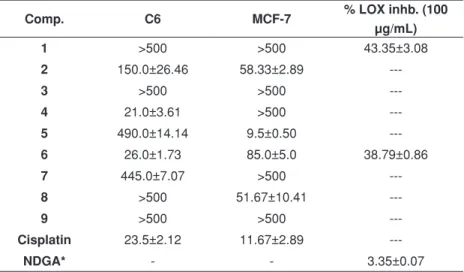
The cytotoxic activity of nine triazine compounds (1-9) were determined aga-inst C6 rat glioma and MCF-7 breast adenocarcinoma cell lines and results were summarized in Table 1. IC50 values were calculated in between 9.5-500 µg/mL. Compound 4 (IC50=21.0 µg/mL) was found as the most active compound even more than cisplatin against C6 cell line. Compound 6 was also exhibited good antiproliferative activity with a IC50 value of 26.0 µg/mL which is very close to cisplatin (IC50=23.5 µg/mL). The IC50 values could not be calculated for compo-unds 1, 3, 8 and 9 even if at the highest tested concentration which is 500 µg/ mL against C6 tumor cells. Against MCF-7 cell line, compound 5 showed the strongest cytotoxicity (IC50=9.5 µg/mL) which was higher than cisplatin.
Com-pound 2 and 8 also showed good activity with IC50 values of 58.33 and 51.67 µg/ mL, respectively. Two active compounds against C6 cells, compound 4 and 6 did not exhibite enough cytotoxic activity against MCF-7 cell line. Moreover, the lipooxygenase (LOX) inhibitory activity of the compounds were studied. None of the compounds showed LOX inhibition as much as standard drug nordihydro-guaiaretic acid, even if IC50, the half maximal inhibitory concentration could not be calculated. At 100 µg/mL concentration, LOX inhibition percentages were identified for compounds 1 and 6 as 43.35% and 38.79%, respectively. The re-sults revelaed that 1,2,4-triazine derivatives have considerable cytotoxic activity. As a follow up study from past to present studies, antiproliferative activity of the compounds are rational and it worths to design new compounds based on this substructure.
Scheme 1: The synthesis of the compounds. Reactants and reagents ; i: NaHCO3, CH3OH, reflux 3 h; ii: pyridine, reflux 6 h; iii: Et3N, DMF, r.t., 45 min; iv: K2CO3, Acetone, r.t., 5 h.
Table 1: IC50 values (µg/mL) against C6 and MCF-7 tumor cell lines and % LOX enzyme inhibition of the compounds
Comp. C6 MCF-7 % LOX inhb. (100
µg/mL) 1 >500 >500 43.35±3.08 2 150.0±26.46 58.33±2.89 ---3 >500 >500 ---4 21.0±3.61 >500 ---5 490.0±14.14 9.5±0.50 ---6 26.0±1.73 85.0±5.0 38.79±0.86 7 445.0±7.07 >500 ---8 >500 51.67±10.41 ---9 >500 >500 ---Cisplatin 23.5±2.12 11.67±2.89 ---NDGA* - - 3.35±0.07 Not determined :
---*NDGA : Nordihydroguaiaretic acid, IC50 valueis represented in the corresponding line. REFERENCES
1. Cancer Facts/Figures 2016, American Cancer Society. http://www.cancer.org/research/can-cerfactsstatistics/cancerfactsfigures2016/index/ (Accessed August 22, 2016).
2. Wilson, C. O.; Gisvold, O.; and Doerge, R. F., Wilson and Gisvold’s Textbook of Organic Me-dicinal and Pharmaceutical Chemistry. Philadelphia: Lippincott, 1982.
3. Montgomery, J.A. Studies on the Biologic Activity of Purine and Pyrimidine Analogs, Med. Res. Rev. 1982, 2, 271-308.
4. Liu, Y.; Laufer, R.; Patel, N.K.; Ng, G.; Sampson, P.B.; Li, S.W.; Lang, Y.; Feher, M.; Brokx, R.; Beletskaya, I.; Hodgson, R.; Plotnikova, O.; Awrey, D.E.; Qiu, W.; Chirgadze, N.Y.; Mason, J.M.; Wei, X.; Lin, D.C.; Che, Y.; Kiarash, R.; Fletcher, G.C.; Mak, T.W.; Bray, M.R.; Pauls, H.W. Discovery of Pyrazolo[1,5-a]pyrimidine TTK Inhibitors: CFI-402257 is a Potent, Selective, Bio-available Anticancer Agent. ACS Med. Chem. Lett. 2016, 6, 671-675.
5. Singla, P.; Luxami, V.; Paul, K. Synthesis and In Vitro Evaluation of Novel Triazine Analogues As Anticancer Agents and Their Interaction Studies with Bovine Serum Albumin. Eur J Med Chem. 2016, 19, 59-69.
6. Krauth, F.; Dahse, H.M.; Rüttinger, H.H.; Frohberg, P. Synthesis and Characterization of Novel 1,2,4-Triazine Derivatives with Antiproliferative Activity. Bioorg Med Chem. 2010, 18, 1816-1821.
7. Al-Issa, S.A. Synthesis and Anticancer Activity of Some Fused Pyrimidines and Related Hete-rocycles. Saudi Pharm. J. 2013, 21, 305-316.
8. Sztanke, K.; Pasternak, K.; Rzymowska, J.; Sztanke, M.; Kandefer-Szerszeń, M. Synthesis, Structure Elucidation and Identification of Antitumoural Properties of Novel Fused 1,2,4-Tria-zine Aryl Derivatives. Eur. J. Med. Chem. 2008, 43, 1085-1094.
9. Hunt, J.T.; Mitt, T.; Borzilleri, R.; Gullo-Brown, J.; Fargnoli , J.; Fink, B.; Han, W.C.; Mor-tillo, S.; Vite, G.; Wautlet, B.; Wong, T.; Yu, C.; Zheng, X.; Bhide, R. Discovery of the Pyrrolo [2, 1-f][1, 2, 4] triazine Nucleus As a New Kinase Inhibitor Template. J. Med. Chem. 2004, 47, 4054–4059.
10. Walters, T.; Aur R.J., Hernandez K. 6-Azauridine in Combination Chemotherapy of Child-hood Acute Myelocytic Leukemia. Cancer 1972, 29, 1057-1060.
11. Abd All, A.S.; Osman, S.A.; Roaiah, H.M.F.; Abdalla, M.M.; Abd El Aty, A.A.; Abd El-Hady, W.H. Potent Anticancer and Antimicrobial Activities of Pyrazole, Oxazole and Pyridine Derivatives Containing 1,2,4-Triazine Moiety. Med. Chem. Res. 2015, 24, 4093-4104. 12. El-Gendy, Z.; Morsy, J.M.; Allimony, H.A.; Abdel-Monem, W.R.; Abdel-Rahman, R.M. Synthesis of Heterobicyclic Nitrogen Systems Bearing A 1,2,4-Triazine Moiety as Anticancer Drugs: Part IV. Phosphorus, Sulfur 2003, 178, 2055-2071.
13. De Lucia, D.; Lucio, O.M.; Musio, B.; Bender, A.; Listing, M.; Dennhardt, S.; Koeberle, A.; Garscha, U.; Rizzo, R.; Manfredini, S.; Werz, O.; Ley, S.V. Design, Synthesis and Evaluation of Semi-synthetic Triazole-containing Caffeic Acid Analogues As 5-Lipoxygenase Inhibitors. Eur. J. Med. Chem. 2015, 101, 573-583.
14. Cai, H.; Huang, X., Xu, S.; Shen, H.; Zhang, P.; Huang, Y.; Jiang, J.; Sun, Y., Jiang, B.; Wu, X.; Yao, H.; Xu, J. Discovery of Novel Hybrids of Diaryl-1,2,4-Triazoles and Caffeic Acid As Dual Inhibitors of Cyclooxygenase-2 and 5-Lipoxygenase For Cancer Therapy. Eur. J. Med. Chem. 2016, 108, 89-103.
15. Yurttas, L.; Demirayak, S.; Ilgın, S.; Atlı, Ö. In Vitro Antitumor Activity Evaluation of Some 1,2,4-Triazine Derivatives Bearing Piperazine Amide Moiety Against Breast Cancer Cells, Bio-org. Med. Chem. 2014, 22, 6313-6323.
16. Mossmann, T. Rapid Colorimetric Assay for Cellular Growth and Survival: Application to Proliferation and Cytotoxicity Assays. J. Immunol. Methods. 1983, 16, 55-63.
17. Keiser, K.; Johnson, C.C.; Tipton, D.A. Cytotoxicity of Mineral Trioxide Aggregate Using Human Periodontal Ligament Fibroblasts. J. Endod. 2000, 26, 288-291.
18. Yurttaş, L.; Demirayak, Ş.; Akalın Çiftçi, G. Cytotoxic, Antiproliferative and Apoptotic Ef-fects of New Benzimidazole Derivatives on A549 Lung Carcinoma and C6 Glioma Cell Lines. Anticancer Agents Med. Chem. 2015, 15, 1174-1184.
19. Baylac, S.; Racine, P. Inhibition of 5-Lipoxygenase by Essential Oils and Other Natural Frag-rant Extracts. Int. J. Aromather. 2003, 13, 138-142.
20. Demirci, B.; Temel, H.E.; Portakal, T.; Kırmızıbekmez, H.; Demirci, F.; Baser, K.H.C. In-hibitory Effect of Calamintha nepeta subsp. Glandulosa Essential Oil on Lipoxygenase. Turk J. Biochem. 2011, 36, 290-295.