LINEAR/NONLINEAR ADAPTIVE POLYPHASE SUBBAND
DECOMPOSITION STRUCTURES FOR IMAGE COMPRESSION
Omer N . Gerelc, A . Enis
Getin
Bilkent University,
Dept.
of
Electrical Engineering,
Bilkent, Ankara TR-06533, Turkey
E-mail: gerek@ee
.
bil kent .edu
.
t r
ABSTRACT
Subband decomposition techniques have been ex- tensively used for data coding and analysis. In most filter banks, the goal is t o obtain subsampled signals corresponding to different spectral bands of the original data. However, this approach leads t o various artifacts in images containing text, subtitles, or sharp edges. In this paper, adaptive filter banks with perfect recon- struction property are presented for such images. The filters of the decomposition structure vary according to the nature of the signal. This leads to higher compres- sion ratios for images containing subtitles compared to fixed filter banks. Simulation examples are presented.
1. INTRODUCTION
Subband decomposition is widely used in signal pro- cessing applications including speech, image and video compression. In most practical cases, the goal is to ob- tain subband signals corresponding to different spectral bands of the original signal. The frequency content of most audio and visual data are suitable for this kind of frequency selective coding. However, this approach leads to ringing artifacts in image and video signals containing text, subtitles or sharp edges. In this pa- per, we present Perfect Reconstruction (PR) polyphase filter bank structures in which the filters adapt to the changing input conditions. This leads to higher com- pression results for images containing sharp edges, text, and subtitles.
The ringing artifacts on the boundaries of subtitles, texts and sharp edges can be removed by using adap- tive filters. In this paper, we introduce polyphase filter bank structures with PR property which allow the use of LMS-type linear or nonlinear order statistics based adaptive filters.
This work is supported by NSF Grant No. INT-9406954.
In Section 2, we review the PR polyphase structure concept [l] and present a procedure to make it adap- tive. We describe two adaptive polyphase structures one of which contains a fixed anti-aliasing filter for the upper biranch and an adaptive prediction filter for the lower branch. In Section 3, multichannel extensions of adaptive filter banks are presented. In Section 4, we present simulation examples and image compression re- sults.
2. ADAPTIVE PREDICTION FILTERS IN
POLYPHASE FORM
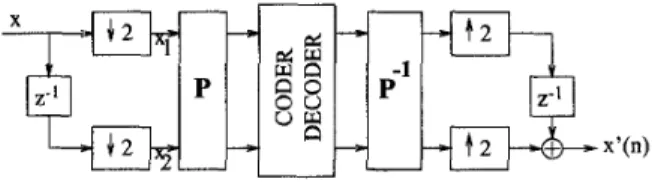
The block diagram of the basic 2-band polyphase sub- band structure is shown in Fig. 1. In this structure, the
Figure 1: Polyphase decomposition
input polyphase components x1 and 2 2 are multiplied by a 2 x 2 matrix, P I . For perfect reconstruction, the only constraint on this matrix is invertability. One can try to optimize the P matrix according to the applica- tion as long as P-1 exists.
2.1. Tlhe Basic Adaptive Filter Bank Structure In this subsection, we describe a specific structure for the P matrix which allows the use of both linear and non-linear adaptive filters while preserving the PR prop- erty.
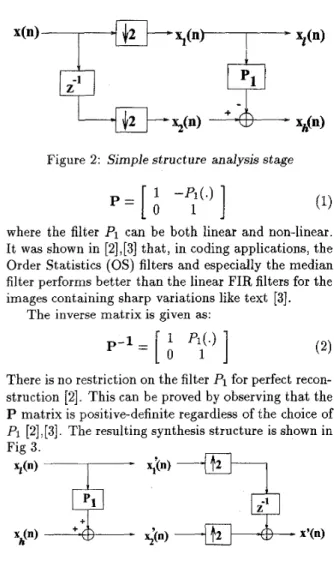
Consider the polyphase filter bank structure shown in Fig 2. This structure has a simple transform matrix:
Figure 2: Simple structure analysis stage 1
-P1(.)
p = [ o 1
]
where the filter PI can be both linear and non-linear. It was shown in [2],[3] that, in coding applications, the Order Statistics (OS) filters and especially the median filter performs better than the linear FIR filters for the images containing sharp variations like text [3].
The inverse matrix is given as: 1 Pl(.)
.-'=[
0 1]
There is no restriction on the filter PI for perfect recon- struction
[a].
This can be proved by observing that the P matrix is positive-definite regardless of the choice of PI [2],[3]. The resulting synthesis structure is shown in Fig 3.x" Figure 3: Simple structure synthesis stage In coding applications, the goal is to remove the cor- related portion of the original signal as much as possi- ble. In this way, unnecessary information is eliminated. In this structure, the subsignal $ 1 is simply the down- sampled version of the original signal, z. Since there is no control over the subsignal x t ( n ) , a good way of obtaining the subsignal, xh(n), is to predict the sam- ples of zz(n) from z1(n) or from x[(n). An adaptive predictor is ideal for image and video signals as they are unstationary in nature. This reasoning leads to the polyphase structure shown in Fig. 4 in which the prediction filter adapts itself to minimize xh(n). This is especially useful when there are sharp transition re- gions in an image such as subtitles, text and graphics. In Figure 4, xh(n) is obtained by predicting z z ( n )
from z1(n) as follows:
N M
& ( n ) = u k 2 1 ( n - k ) = ukx(2n
-
2k) (3)k=-N k=-N
1346
Figure 4: Adaptive structure analysis stage
Figure 5: Adaptive structure synthesis stage
where the filter coefficients u k ' s are updated using an LMS-type algorithm [4], and the subsignal x h is given by
z&) = .2(n) - & ( n ) . (4) The PR property is preserved in this structure as long as the same adaptation algorithm is used at the encoding and the decoding stage. Since the error signal
zh(n) is available both at the encoder and at the de- coder, the synthesis stage can adapt the filter PI with the same error signal which provides perfect reconstruc- tion.
The adaptive OS filters can also be used in Figures 4 and 5. In this case, the input elements are first sorted and the LMS type adaptation is applied to the middle elements of the ordered list.
2.2. Cascaded Adaptive PR blocks
The structure described in Subsection 2.1 can be gen- eralized by cascading matrices similar to the matrix in Eq.(l). The analysis and synthesis stages of the cas- caded two band decomposition structure can be gener- ated using Equations (1) and (2). The overall cascaded transformation matrix is obtained by multiplying tri- angular matrices which correspond to basic building blocks as follows:
where the filters P I , G I , P2,
.
can be linear, nonlinear or adaptive. In this way, the upper and lower branch subsignals can be filtered a number of times. The in-verse matrix is given as
(6) The synthesis filter bank can be easily reconstructed from P-'
.
2.3. Adaptive P R Structure with an Anti-Aliasing Filter
In many applications, multiresolution display of an im- age is a desirable property. Since x(n) is simply down- sampled in the upper branch of Fig 4, the quality of z i ( n ) is poor due t o aliasing.
In order to remove the aliasing, a two stage cas- caded P matrix can be used. The matrix P should be designed in such a way that the first stage should re- duce the aliasing and the second stage should produce a good "high-band" signal.
In a typical QMF structures, the input signal is low- pass filtered before down-sampling to eliminate alias- ing. If the low-pass filter is a half-band filter [6], i.e,
H ( z )
=
$[l+z-1A(z2)], then the so called "noble iden- tity" [l] can be used and the filtering operations can be carried out after down-sampling as shown in Fig. 6.Figure 6: Equivalent structures.
A good choice for the half-band low-pass filter is the Lagrange family [6]. Consider the first two Lagrange filters:
h3(n)
=
* . e 0 1/4 1/2 1/4 0 . a .h ~ ( n ) = . . .O -1/32 0 9/32 1/2 9/32 0 -1/32 O . . .
In the first case,
1 1
2 2
A(%) =
-
+
-2'and in the second case,
(7)
(8)
1 9 9 1
16 16 16 16
A(z) = - - - z - ~
+
-
+
-2' - -z4.The second stage of the analysis structure consists of adaptive prediction of subsignal x h ( n ) . In this case, the samples of the low-pass filtered subsignal x t ( n ) are
used to predict zh(n). The overall analysis structure is shown in Fig 7. Perfect reconstruction can be achieved using the synthesis block shown in Fig. 8.
Figure 7: Adaptive Analysis Structure with an Anti- Aliasing Filter
Figure 8: Synthesis stage
Using the PR property of the cascaded structures] the prediction filter PI can be appended t o the anti- aliasing filter and a residual subsignal signal (y2) can
be obtained. The anti-aliased adaptive scheme is illus- trated in Fig. 7.
3. MULTICHANNEL EXTENSION OF THE
P R STRUCTURE
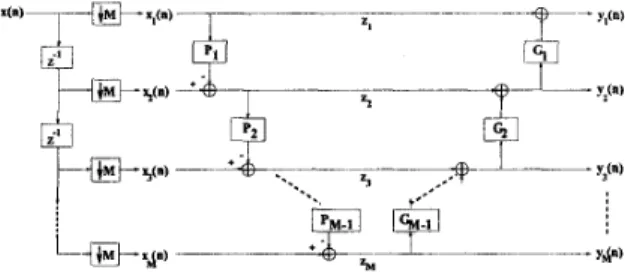
The filter bank structures described in Section 2 can also be extended to handle decompositions to bands other than the powers of two [2]. Consider the multi- band decomposition structure shown in Fig 9. In this
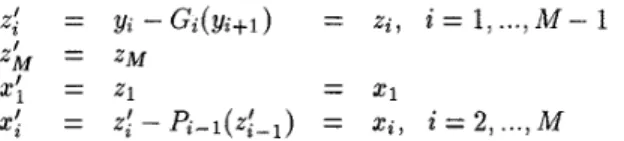
Figure 9: Multi-band analysis structure figure, an M band decomposition with two cascaded P R building blocks is illustrated. The PR property of this structure can be proved easily. In the analysis stage,
and in the synthesis stage, we have zi, i = 1,
.,.,
M - 1-
zj = yi -Gi(Yi+i)-
2; = 2.1 = 21 2: = &‘;-Pi-l(z;-l) = ti, i = 2,...,
M&‘h
= ZM (10) The outputs, xi, of the synthesis filters are the same as the polyphase components, zi, of the analysis filter bank. Notice that there are no restrictions on the filtersPi and
Gi
for perfect reconstruction.PI filter Median Adaptive FIR
Adaptive OS
4. SIMULATIONS STUDIES AND
CONCLUSIONS
Plain Downs. Antialiased Downs.
36.19 36.00
36.80 36.76
36.96 36.90
The proposed structures are used in image compres- sion. The extension t o two-dimensions is carried out in a separable manner.
For images that contain text, subtitles or sharp edges, the adaptive filter banks produce better cod- ing results than the conventional Embedded Zerotree Wavelet (EZW) coder [7]. The coding results for the image shown in Fig 10 at C R = lbits/pixel is presented in Table 1. In all the examples, we used the Embedded
Figure 10: Test image
type prediction filter. This PSNR is also comparable t o the conventional EZW compression scheme which produces 35.90dB PSNR.
It should be noted that the adaptive synthesis filters do not diverge due to the quantization noise at high PSNRs.
5. REFERENCES
[1] Gilbert Strang, Wavelets and filter banks, Welles- ley - Cambridge Press, Wellesley, MA, 1996. [2] F. J. Hampson and J. C. Pesquet, “A nonlinear
subband decomposition with perfect reconstruc- tion,” IEEE Int. Conf. on Image Proc. 1996. [3] 0. Egger, W. Li, and M. Kunt, “High Compression
Image Coding Using an Adaptive Morphological Subband Decomposition,” Proc IEEE, vol. 83, no. 2, pp.272-287, February 1995.
ZeroTree (EZT) coder to encode the transform coeffi- cients [7]. Due to the characteristics of this coder, the best coding results were obtained by tree-structured two-band decompositions. The first column of the table
[41 0. Arlkan, A- E- Getin, Engin Erzin, ‘Adaptive Filtering for non-Gaussian stable processes,’ IEEE Signal Processing Letters, vol. 1, No. 11, pp. 163- 165, November 1994.
[5] P. Salembier, “Adaptive rank order based filters,”
EURASIF Signal Processing, 27( 1):l-25, 1992. shows the results without using the anti-aliasing filter
stage, and the second column shows the results with the anti-aliasing filter stage. The EZW coder with a fixed filter bank produces a PSNR of 36.10dB for this image which is about 1dB less than the adaptive filter banks. Furthermore, the adaptive filter banks eliminate the ringing effects which are apparent in the EZW coder as shown in Fig 11. Fig. l l ( a ) shows the enlarged de- tail of our encoder output, and Fig. l l ( b ) shows the EZW output of the same place. Similar coding results are obtained in other images as well.
The 6 7 2 ~ 560 “barbara” image was compressed to 1 bits/pixel at a PSNR of 35.80dB with the adaptive OS
161 S-M. Phoong, C. W. Kim, P.P Vaidyanathan, R. Ansari, “A new class of two channel biorthogonal filter banks and wavelet bases,” IEEE Trans. Sag-
nal Proc., Vo1.43, No.3, pp. 649-665, March 1995. [7] J. M. Shapiro, “Embedded Image Coding Using Zerotrees of Wavelet Coefficients,” IEEE Trans. Signal Proc., vol. 41, no. 12, pp. 3445 - 3462, Dec. 1993.