An attempt to clarify the link between cognitive style and political
ideology: A non-western replication and extension
Onurcan Yilmaz
∗S. Adil Saribay
†Abstract
Previous studies relating low-effort or intuitive thinking to political conservatism are limited to Western cultures. Using Turkish and predominantly Muslim samples, Study 1 found that analytic cognitive style (ACS) is negatively correlated with political conservatism. Study 2 found that ACS correlates negatively with political orientation and with social and personal conservatism, but not with economic conservatism. It also examined other variables that might help to explain this correlation. Study 3 tried to manipulate ACS via two different standard priming procedures in two different samples, but our manipula-tion checks failed. Study 4 manipulated intuitive thinking style via cognitive load manipulamanipula-tion to see whether it enhances conservatism for contextualized political attitudes but we did not find a significant effect. Overall, the results indicate that social liberals tend to think more analytically than conservatives and people’s long term political attitudes may be resistant to experimental manipulations.
Keywords: political ideology, analytic cognitive style, dual process model, conservatism, liberalism, Turkey
1
Introduction
Have you ever thought about the processes activated in your mind when you are moving toward the source of a sud-den incoming sound? Or when focusing on a specific per-son’s voice in a crowded and noisy room? When these pro-cesses are at work, two separate mental systems are acti-vated according to the dual process model of mind (Evans, 2003; Kahneman, 2011). Respectively, Type 1 processes are mostly evolutionarily older and characteristically pro-duce automatic and intuitive responses whereas Type 2 cor-responds to analytic and controlled processes which de-veloped later in our evolutionary history and typically re-quire considerable working memory resources (Evans & Stanovich, 2013). Differential reliance on these two sys-tems and concomitant cognitive styles may shape our social and political responses.
Researchers have recently argued that religious belief de-pends more on Type 1 thinking (Gervais & Norenzayan, 2012; Norenzayan, 2013; Pennycook, Cheyne, Seli, Koehler & Fugelsang, 2012; Shenhav, Rand & Greene, 2012; Yil-maz, Karadöller & Sofuoglu, 2016; but see Piazza & Sousa, 2014). Social conservatism, which is positively correlated with religiosity, can also vary depending on the cognitive or
Parts of this work comprised the first author’s M.A. thesis conducted under the second author’s supervision at Bo˘gaziçi University. We thank Begüm Co¸sgun, Aslıhan ˙Ikizo˘glu, and Emine Temel for help with data collection, and Jonathan Baron for effort on the manuscript.
Copyright: © 2016. The authors license this article under the terms of the Creative Commons Attribution 3.0 License.
∗Department of Psychology, Do˘gu¸s University, 34722, Acıbadem,
Is-tanbul, e-mail: [email protected].
†Bo˘gaziçi University
thinking styles. For example, the need for cognitive closure is higher in conservative people than in liberals (Kruglanski, 2004). In addition, conservative people exhibit more nega-tivity bias than liberals (Hibbing, Smith & Alford, 2014). Liberals also show higher levels of integrative complexity — the tendency to consider and link multiple perspectives — than conservatives (Tetlock, 1983). Moreover, one of the core elements underlying conservative ideology — accep-tance of hierarchy — is also related to cognitive style. For example, Zitek and Tiedens (2012) showed that social hier-archies are remembered and processed more easily and liked better than less hierarchical stimuli, thereby showing the in-tuitive, low-effort nature of the processing and acceptance of hierarchy. These findings from diverse research streams imply that social conservatism is associated with Type 1 or intuitive thinking, much as religious belief is (see also Pacini & Epstein, 1999; Shook & Fazio, 2009; Sidanius, 1985; Van Berkel, Crandall, Eidelman & Blanchar, 2015). Although all of these characteristics differentiating liberals and conserva-tives are not directly connected to cognitive style in the same way, we suggest that most, if not all, of them are parsimo-niously explained by the distinction between intuitive and analytic thinking styles.
In recent years, there has been an increase in the number of studies investigating cognitive style differences between liberals and conservatives (Eidelman, Crandall, Goodman & Blanchar, 2012; Brandt, Evans & Crawford, 2015; Tal-helm et al., 2015). For example, TalTal-helm et al. (2015) demonstrated that thinking analytically led both American and Chinese participants to favor more liberal social atti-tudes whereas thinking holistically led them to favor more
conservative social attitudes. Some studies have found that liberals show higher scores on the Cognitive Reflection Test (CRT; Deppe et al., 2015; Pennycook et al., 2012; Iyer, Kol-eva, Graham, Ditto & Haidt, 2012), a test used to measure the dispositional tendency to think analytically (Frederick, 2005). However, Kahan (2013), using a different sampling procedure that attempted to sample the American popula-tion in a more representative way, found that conservatives are in fact slightly (but not significantly) more likely to cor-rect their intuitive responses than liberals on the CRT. There is also hardly any evidence on this issue outside of Western cultures.
We report data collected in Turkey, a non-western and predominantly Muslim country whose political system has more than two major political parties. Turkey presents interesting challenges to political psychologists. For in-stance, it is difficult to apply the traditional left-right or liberal-conservative distinctions, since European style so-cial democracy is not prevalent (see Onis, 2007, 2009, for a detailed discussion). Although few researchers have stud-ied the nature of the left-right distinction in Turkey, a recent set of studies found that participants’ self-placement on the left-right continuum predicts their moral foundations (Yil-maz, Harma, Bahçekapili & Cesur, 2016; Yil(Yil-maz, Saribay, Bahçekapili & Harma, invited revision) in parallel with the U.S. findings (Graham et al., 2011).
Here we investigate the relationship between analytic cognitive style (ACS) and political ideology in Turkey, while measuring several other variables. Study 1 examined the relationship between ACS and political orientation in a Turkish sample, as an extension of this topic of investigation to non-Western cultures (see Henrich, Heine & Norenza-yan, 2010). In Study 2, we investigated the relationship be-tween ACS and different aspects of political ideology while measuring other potential causal factors such as personality traits, need for cognitive closure, and religiosity. In Study 3, we tried to manipulate ACS in two different samples in order to investigate its causal role on political ideology. In Study 4, we attempted a conceptual replication of Eidelman et al.’s (2012) results to investigate the causal influence of intuitive thinking style on political ideology.
2
Study 1
2.1
Method
Participants. With an estimated correlation coefficient of .15, an 85% power for detecting an effect required a sample of at least 314 participants. We therefore collected data from 356 participants (mean age = 25.83, SD = 9.37, 203 females, 142 males, 11 unreported). Two hundred and thirty-two of them were enrolled in an introductory psychology course at Do˘gu¸s University (Istanbul) in return for extra course credit. The remaining sample was non-student, with ages ranging
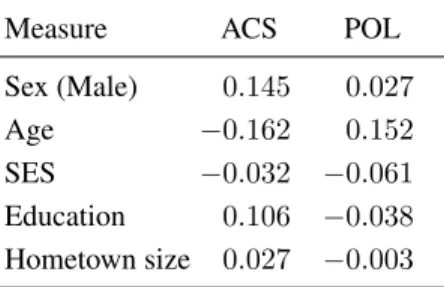
Table 1: Correlations of each variable with ACS and politi-cal orientation (POL, high scores are right wing).
Measure ACS POL Sex (Male) 0.145 0.027 Age −0.162 0.152 SES −0.032 −0.061 Education 0.106 −0.038 Hometown size 0.027 −0.003 Note: a correlation of 0.095 is sig-nificant at p < .05, 0.134 at p < .01, two tailed.
from 25 to 76, collected via snowball sampling. All partici-pants were native Turkish speakers.
Materials and Procedure. All materials in the current set of studies were administered in Turkish. The CRT con-sists of three different questions designed to measure a dis-positional tendency to think analytically (Frederick, 2005) and is a widely used measure of cognitive style (Toplak, West & Stanovich, 2011). Each question has one correct, reflective (Type 2) and an incorrect, intuitive/spontaneous answer (Type 1). ACS score was operationalized as the total number of correct answers given to the three CRT questions. Political orientation was measured by the traditional one item self-placement question from 0 (“left”) to 10 (“right”). Participants were first asked to respond to the CRT, then a demographic form (age, sex, SES, hometown size, ethnicity, religious and political affiliations, preference for political party, and identification with political party were obtained), and finally the political orientation question.
2.2
Results and discussion
As predicted, ACS (here just the 0–3 score on the CRT test) was negatively correlated with political orientation [r (348) = –.163, p = .002], replicating past research (Deppe et al., 2015; Pennycook et al., 2012; Iyer et al., 2012). Table 1 shows the correlations of each of the other variables with ACS and political orientation. It is apparent that, of these, only Age can help to explain the observed negative corre-lation, because older subjects get lower scores on ACS and they are more conservative; but it does not fully explain the ACS-politics correlation; the relationship is still significant (standardized β = −0.138, p = .013) when ACS is re-gressed on Age and political orientation.
In the next study, we used an additional measure of ACS (see Baron, 2015; Baron, Scott, Fincher & Metz, 2015, for a justification of using measures in addition to CRT), and
differentiated between separate components of political ide-ology.
3
Study 2
3.1
Method
Participants. With an estimated correlation coefficient of .15, a 95% power for detecting an effect required a sample of at least 476 participants. We collected data from as many participants as possible and exceeded the minimum sample requirement, since participants were readily available. As a result, we collected data from 750 participants (mean age = 20.63, SD = 2.13, 452 females, 256 males, 22 no answer), who were enrolled in an introductory psychology course at Bo˘gaziçi University (Istanbul) and participated in return for extra course credit.1All students were native Turkish
speak-ers.
3.1.1 Measures
Analytic Cognitive Style. In addition to the CRT (see Study 1), we employed three different base-rate conflict (BRC) problems as used by Penncycook et al. (2012). BRC problems consist of a salient stereotype with probabilistic information such as the following:
In a study 1000 people were tested. Among the participants there were 4 kindergarten teachers and 996 executive managers. Lilly is a randomly chosen participant of this study. Lilly is 37 years old. She is married and has 3 kids. Her husband is a veterinarian. She is committed to her family and always watches the daily cartoon shows with her kids.
What is most likely?
a) Lilly is an executive manager (correct answer) b) Lilly is a kindergarten teacher
In this kind of question, people generally ignore the base-rate probability (99.6 % chance that Lilly is an executive manager) and select the intuitive, wrong answer (De Neys & Glumicic, 2008). This mistake can be prevented by thinking analytically.2 For the six questions, coefficient α (for the
number of correct answers) was .66.
1Five participants were eliminated because they answered only half of
the ACS items, or fewer. Other participants failed to answer some ques-tions, so that the sample size of various correlations is usually closer to 700.
2We included four additional problems. One of them was omitted by
42% of the participants. The other three correlated poorly with each other (α = 0.13) and reduced the overall reliability of the ACS measure when they were combined with the other items. Thus, we do not report the results of these additional items.
Big Five Personality. Since personality has been found to be related to political orientation (Carney, Jost, Gosling, & Potter, 2008), we measured it using the Big Five Personal-ity Inventory (BFI; Benet-Martinez & John, 1998). BFI was translated and adapted to Turkish by Sümer, Lajunen, and Özkan (2005). The inventory has five subscales: Neuroti-cism (α = .80), Extraversion (α = .88), Openness (α = .79), Agreeableness (α = .69), and Conscientiousness (α = .78). Forty-four personality descriptors are presented and the par-ticipant is asked to indicate the extent to which each of these is self-descriptive (e.g., “I see myself as a talkative person”), ranging from 1 (strongly disagree) to 5 (strongly agree).
Social/Political Conservatism. We used two different scales to measure social conservatism. The first — So-cial/Political Conservatism scale — was developed by Olcaysoy and Saribay (2014) by compiling items from the Social Dominance Orientation scale (Pratto, Sidanius, Stallworth & Malle, 1994), Right-Wing Authoritarianism scale (Altemeyer & Hunsberger, 1992), F-scale (Adorno, Frenkel-Brunswik, Levinson & Sanford, 1950), Social and Cultural Attitudes scale (Küçüker, 2007), Egalitarianism-Inegalitarianism scale (Kluegel & Smith, 1983), and items measuring resistance to change used by Jost et al. (2007). The scale (Appendix B, Table A1) measures the two dimen-sions of conservatism as theorized by Jost, Glaser, Kruglan-ski & Sulloway (2003): resistance to change (two differ-ent samples’ Cronbach’s α = 0.80, 0.83) and opposition to equality (α = 0.90, 0.88). The response scale ranged from 1 (totally disagree) to 7 (totally agree). Scores on resistance to change (α = .88 for this study) and opposition to equality (α = .75 for this study) are summed and averaged for each participant in order to form a composite conservatism score in which higher scores indicate more conservative attitudes (one factor solution α = .88 for this study).
The second measure we used — Revised Version of Scale of Social Conservatism — was developed by Henningham (1996) over almost two decades in the Australian culture and adapted to the current American political system by Piazza and Landy (2013). In the original scale participants respond dichotomously on each social issue by choosing “opposed to it” or “not opposed to it”. We revised the scale in ac-cordance with Turkish politics removing some items (e.g., “Outlawing the buying and selling of firearms”) and adding new ones, resulting in 15 items (Appendix B, Table A2). In addition, we changed the response format to an 11-point scale ranging from –5 (strongly disagree) to +5 (strongly agree). The items had good reliability (α = .89). Two items with low (below .20) item-total correlations were excluded. Higher scores indicated greater social conservatism.
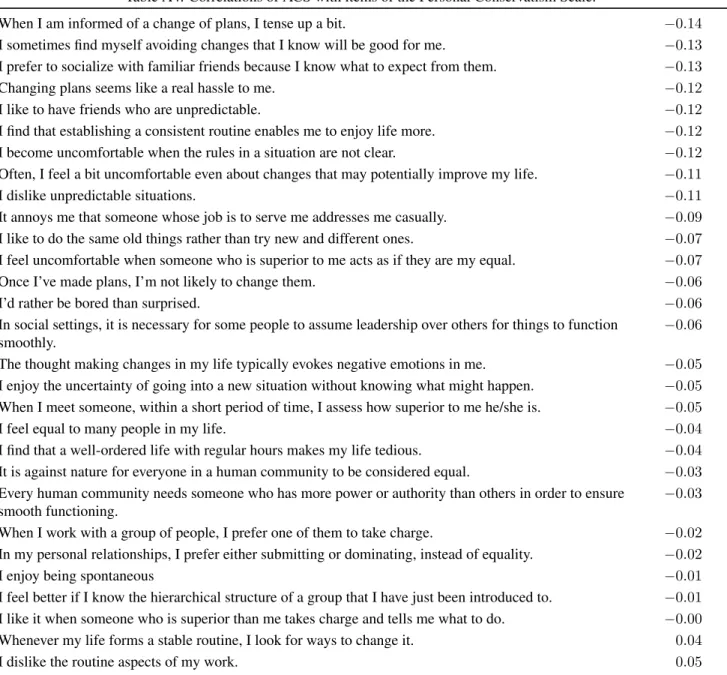
Personal Conservatism Scale. This scale was also de-veloped by Olcaysoy and Saribay (2014) in order to mea-sure personal (as opposed to political) conservatism on the
same two dimensions: resistance to change and opposition to equality. The items (Appendix B, Table A4) were devoid of political content and focused instead on the individual’s personal preferences and lifestyle. It was developed by com-piling items from Resistance to Change scale (Oreg, 2003), Need for Cognitive Closure scale (Kruglanski, Webster & Klem, 1993) and 14 new items. The response scale ranged from 1 (totally disagree) to 7 (totally agree) and scores on resistance to change (α = .86 for this study) and opposi-tion to equality (α = .80 for this study) were summed and averaged for each participant in order to form a composite personal conservatism score in which higher scores indicate more personal conservatism (one factor solution α = .86 for this study).
Economic Conservatism Scale. In Turkish, to the best of our knowledge, there is no scale measuring economic polit-ical attitudes. We composed 16 items suitable for Turkish participants (Appendix B, Table A3). Since these 16 items had good reliability (α = .73), we averaged them into a sin-gle score of economic conservatism.
Religiosity. We used the Turkish adaptation of the intu-itive religious belief scale (IRS; see Yilmaz & Bahçekapili, 2015) developed by Gervais and Norenzayan (2012). It has 5 items with responses given on a scale ranging from 1 (strongly disagree) to 5 (strongly agree) (e.g., “When I am troubled, I feel the need to seek help from God”).
Need for Cognitive Closure. Need for Cognitive Closure scale (NFCC) was developed by Webster and Kruglanski (1994) and revised by Roets and Van Hiel (2007). Subse-quently, Roets and Van Hiel (2011) validated an abridged version of the scale. This scale consists of 15-items and the response scale ranged from 1 (strongly disagree) to 7 (strongly agree). NFCC has five subscales: order, pre-dictability, decisiveness, ambiguity, and closed-mindedness. Every subscale is represented by 3 items (e.g., “I find that a well ordered life with regular hours suits my temperament”). We combined all the subscales into a single need for cogni-tive closure score (α = .84).
Demographic Questions. Information about participants’ demographic background including age, sex, SES, home-town size, ethnicity, religious and political affiliations, pref-erence for and identification with political party was ob-tained.
3.1.2 Procedure
At the beginning of the Spring 2015 semester, students tak-ing Introduction to Psychology course at Bo˘gaziçi Univer-sity received an e-mail invitation to complete an online bat-tery of measures for extra-course credit. Students were
given two weeks to complete the battery and they were free to complete it at their own pace but were asked to complete it in only one session. The battery contained all the measures listed above and its completion took approximately 45 min-utes. We counterbalanced the order of the analytic thinking and political conservatism measures.
3.2
Results and discussion
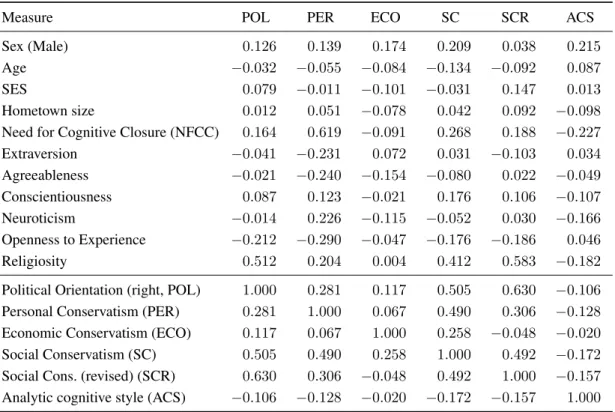
Table 2 shows the main correlations of interest. As pre-dicted and consistent with Study 1, ACS is negatively corre-lated with Political Orientation, Social Conservatism (both forms), Personal Conservatism, and NFCC, but did not sig-nificantly correlate with Economic Conservatism. In addi-tion, ACS is negatively correlated with Religiosity, replicat-ing previous research (Gervais & Norenzayan, 2012; Penny-cook et al., 2012; Shenhav et al., 2012; Yilmaz et al., 2016). Appendix B shows the main correlations by item, along with the text of the items.
Among the other measures, possible variables that could help to explain the correlation between ACS and social con-servatism are those that correlated positively with ACS and negatively with a measure of social conservatism, or the op-posite. These include Age, NFCC, Conscientiousness, and especially Religiosity. Note that, unlike Study 1, Age cor-relates slightly positively with ACS, surely a result of the different sampling procedure. For Political Orientation, the variables that could play a similar role are NFCC, Consci-entiousness, Openness to Experience, and Religiosity.
Overall, these results demonstrated that ACS is correlated with social conservatism, personal conservatism, and polit-ical orientation, but not economic conservatism. In Study 3 and 4, we aimed to go beyond these promising correlational findings and investigate the causal relation between cogni-tive style and political ideology.
4
Study 3
In this study, we aimed to investigate the causal role of ACS on political ideology. Before conducting the main study, we conducted two studies to replicate, in a Turkish sample, the effectiveness of analytic primes previously used in some published research (Gervais & Norenzayan, 2012; Shenhav et al., 2012) in order to find a way of manipulating ACS.
4.1
Study 3A
We first tried to replicate the thought prime technique, orig-inally used by Shenhav et al. (2012), with a total of 145 (105 females, 39 males, 1 unreported; mean age = 21.45, SD= 1.77) undergraduates in Do˘gu¸s University. They par-ticipated in this study for extra course credit. They were randomly assigned to the Intuitive-positive condition (n =
Table 2: Correlations of measures with Political Orientation (POL), Personal Conservatism (PER), Economic Conservatism (ECO), Social Conservatism (SC, and SCR, revised), and Analytic Cognitive Style (ACS).
Measure POL PER ECO SC SCR ACS
Sex (Male) 0.126 0.139 0.174 0.209 0.038 0.215 Age −0.032 −0.055 −0.084 −0.134 −0.092 0.087 SES 0.079 −0.011 −0.101 −0.031 0.147 0.013 Hometown size 0.012 0.051 −0.078 0.042 0.092 −0.098 Need for Cognitive Closure (NFCC) 0.164 0.619 −0.091 0.268 0.188 −0.227 Extraversion −0.041 −0.231 0.072 0.031 −0.103 0.034 Agreeableness −0.021 −0.240 −0.154 −0.080 0.022 −0.049 Conscientiousness 0.087 0.123 −0.021 0.176 0.106 −0.107 Neuroticism −0.014 0.226 −0.115 −0.052 0.030 −0.166 Openness to Experience −0.212 −0.290 −0.047 −0.176 −0.186 0.046 Religiosity 0.512 0.204 0.004 0.412 0.583 −0.182 Political Orientation (right, POL) 1.000 0.281 0.117 0.505 0.630 −0.106 Personal Conservatism (PER) 0.281 1.000 0.067 0.490 0.306 −0.128 Economic Conservatism (ECO) 0.117 0.067 1.000 0.258
−0.048 −0.020 Social Conservatism (SC) 0.505 0.490 0.258 1.000 0.492 −0.172 Social Cons. (revised) (SCR) 0.630 0.306
−0.048 0.492 1.000 −0.157 Analytic cognitive style (ACS) −0.106 −0.128 −0.020 −0.172 −0.157 1.000 Note: Correlations greater than .140 are significant at p < .0001, .117 at p < .001, .088 at p < .01, and .062 at p < .05, two tailed and uncorrected for multiple tests.
39), the Intuitive-negative condition (n = 35), the Analytic-positive condition (n = 37), or the Analytic-negative condi-tion (n = 34) and then they were asked to respond to the stan-dard three-item CRT and BRC (base rate) problems used in Study 2. We computed CRT and BRC scores and combined them into a single ACS score.
In the Intuitive-negative condition, participants were asked to “write a paragraph (approximately 8–10 sentences) describing a time your intuition/first instinct led you in the wrongdirection and resulted in a bad outcome” (The ital-ics represent the parts that differed between the four con-ditions). In the Intuitive-positive condition, participants were asked to “write a paragraph (approximately 8–10 sen-tences) describing a time your intuition/first instinct led you in the right direction and resulted in a good outcome”. In the Analytic-positive condition, participants were asked to “write a paragraph (approximately 8–10 sentences) describ-ing a time carefully reasondescrib-ing through a situation led you in the right direction and resulted in a good outcome. Lastly, in the Analytic-negative condition, they were asked to “write a paragraph (approximately 8–10 sentences) describing a time carefully reasoningthrough a situation led you in the wrong direction and resulted in a bad outcome”.
In contrast to Shenhav et al.’s (2012) results, a one-way
ANOVA revealed no significant main effect of thought-priming on ACS, F(3, 123) = 0.18, p = .912, ηp² = .004.
4.2
Study 3B
As part of our attempt to discover a suitable procedure that primes analytic thinking, we also tried to replicate the cog-nitive disfluency paradigm (Gervais & Norenzayan, 2012) on a Turkish sample. We estimated a medium effect (f ) of .3, which required a total sample of 90 with 80% power of detecting any effect. Three participants (one in the Ana-lytic, two in the Neutral condition) were excluded from the analyses because they did not respond to any manipulation check questions. Eighty seven (73 females, 13 males, 1 un-reported; mean age = 22.22, SD = 3.67) undergraduates in Do˘gu¸s University participated in this study for extra course credit and they were randomly assigned to either the Ana-lytic (n = 44) or the Neutral (n = 43) conditions and then they were asked to respond to the standard three-item CRT used in Study 1. In the Analytic group, participants were given the materials in a difficult to read font to prod ana-lytic thinking whereas in the Neutral condition, the materi-als were given in a standard font. However, as in Study 3A, the results revealed no significant effect of our manipulation
on analytic thinking tendency, F(1, 85) = 1.18, p = .281, ηp² = .014.
After these failures of replication (see Deppe et al., 2015 for similar replication failures), we decided to manipulate intuitive, instead of analytic, thinking style in the next study.
5
Study 4
Eidelman et al. (2012) found that people under cognitive load reported more conservative opinions in long-term at-titudes. However, Talhelm et al. (2015) primed analytic ver-sus holistic thinking and found that the latter increased con-servatism in contextualized, less stable opinions, but unlike Eidelman et al., they did not find an effect of priming on long-term stable opinions. Thus, we decided to do a con-ceptual replication of Eidelman et al.’s basic results in order to test whether the activation of intuitive thinking will lead people to adopt more conservative political attitudes on con-textualized opinions.
5.1
Method
Participants. We estimated a medium effect (f ) of .3, which required a total sample of at least 90 with 80% power of detecting any effect. We considered potential attritions and collected data from 104 participants. Participants were selected from those who participated in the online survey (see Study 2). They participated in this study for extra course credit. All students were native Turkish speakers. They were randomly assigned to either the Cognitive load (n = 56) or the No-load (n = 48) condition. However, in the cognitive load condition, we excluded participants if they responded incorrectly in more than half of the 12 differ-ent load trials. This resulted in seven participants being ex-cluded from the analyses.
5.1.1 Materials and measures
Manipulation. We used a cognitive load method which includes memorization of random sequences of numbers and letters presented in a random order (e.g., “ig4j6sf”)3.
In the cognitive load condition, in each of 12 trials, partic-ipants saw a sequence of numbers and letters, always con-sisting of a total of 6 or 7 characters, before engaging in the primary task (e.g., responding to an item of the conser-vatism scale). They were asked to keep this alphanumeric sequence in memory for an uncertain period of time while continuing to engage in the primary task and to report the se-quence back when asked. The first sese-quence appeared at the beginning of the first questionnaire. The remaining 11 se-quences were interspersed among items of the various ques-tionnaires used in this study. For each sequence, memory
3The full list was: 2hs6ö53, y8kzp4e, d2wct7ö, g7ü2çq, xa8ö01f,
m2z87i3, rw79jf4, d¸s32sy6, t1ö7d˘g, y5g1wv, r6x¸s4a8, 5k8b2e4.
recall was requested after a few items of the questionnaire that the participant was working on, followed by provision of the next load sequence. In each trial, if an alphanumeric sequence reported by the participant had more than half of the same characters (at least 4 correct characters out of 7) of the original sequence, it was considered a correct recall. In the no load condition, participants did not see any load items nor were they given any of these instructions.
Conservatism Measures. The Scale of Social Conser-vatism (α for this experiment = .90) and Economic Con-servatism Scale (α for this experiment= .74) were used in this study.
Contextualized Political Opinions. In Talhelm et al.’s (2015) study, training people to think analytically or holis-tically led to a change in a contextualized political opinion (responses to a news article) but did not lead to a change in stable political attitudes such as having the opinion that “flag burning should be illegal.” Thus, we exposed partici-pants to two semi-fabricated news articles that included con-textualized political opinions and were also each related to a particular policy (Appendix A). We predicted that the cogni-tive style manipulation would not influence stable political opinions but would influence political opinions which are actively being processed by the participants.
Collectively, the articles presented two different disputes between rightist and leftist positions in the Turkish political system: One of the disputes was related to a conservative policy and included a conservative anchor (a new internet law which enables government to totally ban internet sites in only 4 hours after a complaint). The other dispute was related to a liberal policy and included a liberal anchor (an argument that the primary function of the prison system is rehabilitation of the prisoners).
Participants were asked to carefully read the article. Once finished, they answered a single question measuring their at-titude on the presented issue. The 7-point response scale had conservative (e.g., “I am strongly supportive of the internet law.”) and liberal (e.g., “I am strongly against the internet law.”) anchors at the extremes and a neutral (“I do not have an opinion”) option in the middle. Higher scores in the first article represent higher conservative values whereas higher scores in the latter article represent higher liberal values. We used responses to these two news articles as two subscales: liberalism (score of rehabilitation article) and conservatism (score of internet law article) scores. Additionally, we also treated liberalism score as a reverse-coded item, and com-bined it with the conservatism score to get a total conser-vatism score.
Positive and Negative Affect Scale. This scale was devel-oped by Watson, Clark and Tellegen (1988) and was adapted
into Turkish by Gençöz (2000). It measures participants’ current moods on two dimensions separately: positive and negative affect.
Design and Procedure. The study was conducted in two sessions. The first session was identical to Study 2. In the second session, at least five weeks later, participants were individually invited to the social psychology lab at Bo˘gaziçi University and were randomly assigned to either the Cognitive-load or the No-load condition. After the ma-nipulation phase, participants were asked to read the two semi-fabricated news articles and indicate their opinions re-garding the disputes presented in them (as in Talhelm et al., 2015). Finally, they completed the Social Conservatism and Economic Conservatism scales. We counterbalanced the or-der of these two scales and we individually randomized the order of items within each scale. We implemented the ex-periment using Medialab (Jarvis, 2012).
5.2
Results and discussion
Contextualized political opinions. Contrary to our pre-diction, a one-way ANOVA did not reveal a significant ef-fect of the manipulation on either the liberal-anchored arti-cle, or the conservative-anchored one (both Fs < 1).
In the liberal-anchored article (rehabilitation), partici-pants in the load condition (M = 5.63, SD = 0.96; 95% CI [5.35, 5.90]) reported more liberal attitudes than no-load condition (M = 5.44, SD = 1.07; 95% CI [5.13, 5.75]), a non-significant difference, F(1, 94) = 0.82, p = .368, ηp² = .009.
In the conservative-anchored article (Internet law), par-ticipants in the load condition (M = 2.51, SD = 1.45; 95% CI [2.10, 2.93]) reported less conservative attitudes than no-load condition (M = 2.69, SD = 1.43; 95% CI [2.27, 3.10]), but this difference was also not statistically significant, F(1, 95) = 0.37, p = .545, ηp² = .004.
When we controlled for baseline political orientation, gender, SES, age, and the current mood of the participants, the results remained constant (all ps > .05).
When we treated the liberalism score as a reverse-coded conservatism item, and combined them as a total conser-vatism score, a one-way ANOVA revealed no significant differences among groups, F(1, 94) = 0.86, p = .355, ηp² = .009.
Stable political attitudes. As expected, we did not find a significant effect of our manipulation on the social and eco-nomic conservatism scales (both ps > 21). The results re-mained constant when controlling for baseline political ori-entation, gender, SES, age, and the current mood of the par-ticipants (all ps > .05). We also used the pre-experimental Social and Economic Conservatism scores of the partici-pants collected in the online survey and compared them with
their post-experimental scores to test whether our manipula-tion had an effect. To assess differences between pretest and posttest, we subtracted the pretest value from the posttest and computed a single difference score. A one-way ANOVA failed to yield any significant terms (all ps > .17).
Overall, in this study, we predicted that a cognitive load manipulation would activate intuitive thinking, which in turn would lead people to adopt more conservative attitudes on the issues they are actively processing (i.e., the news ar-ticles), but would not lead to a change in people’s stable attitudes. In contrast to the previous finding that low-effort thinking enhances political conservatism (Eidelman et al., 2012), our manipulation did not influence people’s long-term stable political attitudes, nor political opinions that they were actively processing.
One potential limitation of this study concerns the manip-ulation technique used. We did not do a real manipmanip-ulation check, therefore we cannot know with certainty whether our cognitive load manipulation really influenced people’s cog-nitive styles. Moreover, the load conditions may have been too difficult for the participants, because of the length and complexity of the alphanumeric strings, thus we may have encountered a floor effect in this manipulation. The find-ing that almost no one was able to memorize the load items exactly supports this argument. On the other hand, one alter-native interpretation of the current results is that the original findings (i.e., those of Eidelman et al., 2012) are spurious because our sample size is higher than 2.5 times (n = 104) the number that Eidelman et al. (2012) used (n = 38, see Si-monsohn, Nelson & Simmons, 2014). In other words, our results may imply that since political attitudes are formed over a long number of years in a person’s life, they might be less prone to experimental manipulations.
6
General discussion
The present study aimed at clarifying the relation between cognitive style and political ideology, which our data re-vealed to be more complex than one might initially assume. Study 1 demonstrated a correlation between cognitive style and conservative political ideology, and Study 2 replicated and extended this result to other measures of political ideol-ogy, but not economic conservatism. In Study 3, we tried to manipulate ACS to examine its causal role on political ide-ology, but we could not succeed (our manipulation checks failed). In Study 4, we attempted to direct participants’ cog-nitive style toward intuitive thinking by a cogcog-nitive load ma-nipulation to see whether they would become more conser-vative as a result, but we found no significant effect.
The original contribution of the current set of studies rests primarily on the following conclusions from our findings: (1) When merely measured, there is some evidence that ACS is associated with political ideology in Turkey. (2) Standard
procedures commonly used in the literature to prime ana-lytic thinking may not work as expected (see also Deppe et al., 2015). (3) Manipulations of intuitive thinking do not seem to affect conservative attitudes. These results are in line with some previous research findings showing the relationship between cognitive style and political ideology (Brandt et al., 2015; partially Eidelman et al., 2012; Deppe et al., 2015; Iyer et al., 2012; Jost et al., 2003; Pennycook et al., 2012; Talhelm et al., 2015; Van Berkel et al., 2015; but see Kahan, 2013).
The current research was also motivated by Henrich et al.’s (2010) account of WEIRDness according to which only 15% of people live in Western, educated, industrialized, rich, and democratic societies and the remaining 85% are generally out of the scope of psychological research. Thus, it is important to differentiate the characteristics of the mi-nority (15% of the world population mostly represented by Western people) and the majority (85% of the world pop-ulation mostly represented by Eastern and Southern peo-ple). Talhelm et al. (2015) suggested a sixth characteristic of Westerners: their liberal tendency. On this basis, they offer a new concept: WILDER (Western, industrialized, liberal, democratic, educated, and rich). Perhaps, a seventh letter — “A” for “analytic” — is necessary to add to this list. Like the WEIRD samples that most psychological research employs, our sample was also highly educated (most of them were university students). However, unlike the literature we refer to, our samples were all Turkish and predominantly Mus-lim. Furthermore, Turkey (compared to the U.S.) is unique in terms of the complexity of its political structure and its multi-party political system (see Onis, 2007, 2009). These facts increase the value of our replications (cf. Henrich et al., 2010).
6.1
Conclusion
The current results are in line with the general view of con-servatism as motivated social cognition (Jost et al., 2003). Some core characteristics of conservatism such as prefer-ence for hierarchy and uncertainty avoidance are seen to be a product of intuitive thinking, whereas being more toler-ant and egalitarian may require more effortful thinking (Van Berkel et al., 2015). Thus, the main difference between con-servative and liberal people may stem from the general cog-nitive thinking style as characterized in the present research in terms of intuitive and analytic thinking styles.
Our findings also suggest the presence of boundary con-ditions surrounding the effect of cognitive styles on political orientation. For instance, changing stable political opinions with contextual primes may not be that easy, as shown in the current research and some previous non-significant re-sults investigating the effect of cognitive style on political attitudes (e.g., Deppe et al., 2015, see also Yilmaz, 2015). All in all, the findings are compatible with the view that
lib-erals are dispositionally more analytic and conservatives are more intuitive, but it is experimentally difficult to manipu-late these long-term political attitudes. Therefore, in today’s culture wars between leftist (liberal) and rightist (conser-vative) ideological views, being more tolerant, rather than attempting to persuade the opposite parties using analytic arguments, might be a more effective tool for agreement be-cause convincing people of certain ideologies or manipulat-ing their long-term political attitudes may be more difficult than initially assumed.
7
References
Adorno, T. W., Frenkel-Brunswik, E., Levinson, D. J., & Sanford, R. N. (1950). The authoritarian personality. New York: Harper & Row.
Altemeyer, B., & Hunsberger, B. (1992). Authoritarianism, religious fundamentalism, quest, and prejudice. The In-ternational Journal for the Psychology of Religion, 2(2), 113–133.
Baron, J. (2015). Supplement to Deppe et al. (2015). Judg-ment and Decision Making, 10(4), 1–2.
Baron, J., Scott, S., Fincher, K., & Metz, S. E. (2015). Why does the Cognitive Reflection Test (sometimes) predict utilitarian moral judgment (and other things)? Journal of Applied Research in Memory and Cognition, 4(3), 265– 284.
Benet-Martinez, V., & John, O. P. (1998). Los Cinco Grandes across cultures and ethnic groups: Multitrait-multimethod analyses of the Big Five in Spanish and English. Journal of Personality and Social Psychology, 75(3), 729–750.
Brandt, M. J., Evans, A. M., & Crawford, J. T. (2015). The unthinking or confident extremist? Political extremists are more likely than moderates to reject experimenter-generated anchors. Psychological Science, 26(2), 189– 202.
Carney, D. R., Jost, J. T., Gosling, S. D., & Potter, J. (2008). The secret lives of liberals and conservatives: Personal-ity profiles, interaction styles, and the things they leave behind. Political Psychology, 29(6), 807–840.
De Neys, W., & Glumicic, T. (2008). Conflict monitoring in dual process theories of thinking. Cognition, 106(3), 1248–1299.
Deppe, K.D., Gonzalez, F. J., Neiman, J. L., Jacobs, C., Pahlke, J., Smith, K. B., & Hibbing, J. R. (2015). Re-flective liberals and intuitive conservatives: A look at the Cognitive Reflection Test and ideology. Judgment and Decision Making, 10(4), 314–331.
Eidelman, S., Crandall, C. S., Goodman, J. A., & Blanchar, J. C. (2012). Low-effort thought promotes political con-servatism. Personality and Social Psychology Bulletin, 38(6), 808–820.
Evans, J. St. B. T. (2003). In two minds: dual-process ac-counts of reasoning. Trends in Cognitive Sciences, 7(10), 454–459.
Evans, J. St. B. T., & Stanovich, K. E. (2013). Dual-process theories of higher cognition: Advancing the debate. Per-spectives on Psychological Science, 8(3), 223–241. Frederick, S. (2005). Cognitive reflection and decision
mak-ing. The Journal of Economic Perspectives, 19(4), 25–42. Gençöz, T. (2000). Pozitif ve negatif duygu ölçe˘gi: Geçer-lik ve güvenirGeçer-lik çalı¸sması [Positive and negative affect scale: A study of validity and reliability]. Türk Psikoloji Dergisi, 15(46), 19–26.
Gervais, W. M., & Norenzayan, A. (2012). Analytic think-ing promotes religious disbelief. Science, 336(6080), 493–496.
Graham, J., Nosek, B. A., Haidt, J., Iyer, R., Koleva, S., & Ditto, P. H. (2011). Mapping the moral domain. Journal of Personality and Social Psychology, 101(2), 366–385. Henningham, J. P. (1996). A 12-item scale of social
con-servatism. Personality and Individual Differences, 20, 517–519.
Henrich, J., Heine, S. J., & Norenzayan, A. (2010). The weirdest people in the world? Behavioral and Brain Sci-ences, 33(2-3), 61–83.
Hibbing, J. R., Smith, K. B., & Alford, J. R. (2014). Dif-ferences in negativity bias underlie variations in political ideology. Behavioral and Brain Sciences, 37(03), 297– 307.
Iyer, R., Koleva, S., Graham, J., Ditto, P., & Haidt, J. (2012). Understanding libertarian morality: The psychological dispositions of self-identified libertarians. PLoS ONE, 7(8), e42366.
Jarvis, B. G. (2012). MediaLab (Version 2012) [Computer Software]. New York, NY: Empirisoft Corporation. Jost, J. T., Glaser, J., Kruglanski, A. W., & Sulloway, F. J.
(2003). Political conservatism as motivated social cogni-tion. Psychological bulletin, 129(3), 339–375.
Jost, J. T., Napier, J. L., Thórisdóttir, H., Gosling, S. D., Palfai, T. P., & Ostafin, B. (2007). Are needs to man-age uncertainty and threat associated with political con-servatism or ideological extremity?. Personality and So-cial Psychology Bulletin, 33(7),989–1007.
Kahan, D. M. (2013). Ideology, motivated reasoning, and cognitive reflection. Judgment and Decision Making, 8(4), 407–424.
Kahneman, D. (2011). Thinking, fast and slow. New York: Farrar, Straus & Giroux.
Kluegel, J. R., & Smith, E. R. (1983). Affirmative action attitudes: Effects of self-interest, racial affect, and strat-ification beliefs on whites’ views. Social Forces, 61(3), 797–824.
Kruglanski, A. W. (2004). The psychology of closed mind-edness. New York: Psychology Press.
Kruglanski, A. W., Webster, D. M., & Klem, A. (1993).
Mo-tivated resistance and openness to persuasion in the pres-ence or abspres-ence of prior information. Joumal of Person-ality and Social Psychology, 65(5), 861–876.
Küçüker, A. (2007). Gençlerin siyasal ve kültürel tutum-ları -Ankara örne˘gi- [Political and Cultural Attitudes of Turkish Youth: The Case of Ankara. Unpublished Mas-ter’s Thesis. Gazi University, Ankara.
Norenzayan, A. (2013). Big gods: How religion trans-formed cooperation and conflict. Princeton, NJ: Prince-ton University Press.
Olcaysoy, I. & Saribay, S. A. (February, 2014). The rela-tionship between resistance to change and opposition to equality at political and personal levels.Poster presented at the 15th annual meeting of the Society for Personality and Social Psychology (SPSP), Austin, TX.
Onis, Z. (2007). Conservative globalists versus defensive nationalists: Political parties and paradoxes of Euro-peanization in Turkey. Journal of Southern Europe and the Balkans Online, 9(3), 247–261.
Onis, Z. (2009). Conservative globalism at the crossroads: The Justice and Development Party and the thorny path to democratic consolidation in Turkey. Mediterranean Poli-tics, 14, 21–40.
Oreg, S. (2003). Resistance to change: Developing an indi-vidual differences measure. Journal of Applied Psychol-ogy, 88(4), 680–693.
Pacini, R., & Epstein, S. (1999). The relation of rational and experiential information processing styles to personality, basic beliefs, and the ratio-bias phenomenon. Journal of Personality and Social Psychology, 76(6), 972–987. Pennycook, G., Cheyne, J. A., Seli, P., Koehler, D. J., &
Fugelsang, J. A. (2012). Analytic cognitive style predicts religious and paranormal belief. Cognition, 123(3), 335– 346.
Piazza, J., & Landy, J. F. (2013). “Lean not on your own understanding”: Belief that morality is founded on divine authority and non-utilitarian moral judgments. Judgment and Decision Making, 8(6), 639–661.
Piazza, J., & Sousa, P. (2014). Religiosity, political orienta-tion, and consequentialist moral thinking. Social Psycho-logical and Personality Science, 5, 334—342.
Pratto, F., Sidanius, J., Stallworth, L. M., & Malle, B. F. (1994). Social dominance orientation: A personality vari-able predicting social and political attitudes. Journal of Personality and Social Psychology, 67(4), 741–763. Roets, A., & Van Hiel, A. (2007). Separating ability from
need: Clarifying the dimensional structure of the need for closure scale. Personality and Social Psychology Bul-letin, 33(2), 266–280.
Roets, A., & Van Hiel, A. (2011). Item selection and vali-dation of a brief, 15-item version of the Need for Closure Scale. Personality and Individual Differences, 50(1), 90– 94.
intuition: Cognitive style influences belief in God. Jour-nal of Experimental Psychology: General, 141(3), 423– 428.
Shook, N. J., & Fazio, R. H. (2009). Political ideology, ex-ploration of novel stimuli, and attitude formation. Journal of Experimental Social Psychology, 45(4), 995–998. Sidanius, J. (1985). Cognitive functioning and sociopolitical
ideology revisited. Political Psychology, 637–661. Simonsohn, U., Nelson, L. D., & Simmons, J. P. (2014).
P-curve: A key to the file- drawer. Journal of Experimental Psychology: General, 143(2), 534–547.
Sümer, N., Lajunen, T., & Özkan, T. (2005). Big Five per-sonality traits as the distal predictors of road accident in-volvement. In G. Underwood (Ed.), Traffic and transport psychology: Theory and application(pp. 215–227). New York, NY: Elsevier.
Talhelm, T., Haidt, J., Oishi, S., Zhang, X., Miao, F. F., & Chen, S. (2015). Liberals think more analytically (more “WEIRD”) than conservatives. Personality and Social Psychology Bulletin, 41(2), 250–267.
Tetlock, P. E. (1983). Accountability and complexity of thought. Journal of Personality and Social Psychology, 45(1), 74–83.
Toplak, M. E., West, R. F., & Stanovich, K. E. (2011). The Cognitive Reflection Test as a predictor of perfor-mance on heuristics-and-biases tasks. Memory & Cogni-tion, 39(7), 1275–1289.
Van Berkel, L., Crandall, C. S., Eidelman, S., & Blanchar, J. C. (2015). Hierarchy, dominance, and deliberation: Egal-itarian values require mental effort. Personality and So-cial Psychology Bulletin, 41(9), 1207–1222.
Watson, D., Clark, L. A., & Tellegen, A. (1988). Devel-opment and validation of brief measures of positive and negative affect: The PANAS scales. Journal of Personal-ity and Social Psychology, 54(6), 1063–1070.
Webster, D. M., & Kruglanski, A. W. (1994). Individual differences in need for cognitive closure. Journal of Per-sonality and Social Psychology, 67(6), 1049–1062. Yilmaz, O. (2015). An Investigation of the reciprocal
rela-tionship between cognitive style and political ideology. Unpublished master’s thesis. Bo˘gaziçi University, Istan-bul, Turkey.
Yilmaz, O., & Bahçekapili, H. G. (2015). Without God, everything is permitted? The reciprocal influence of reli-gious and meta-ethical beliefs. Journal of Experimental Social Psychology, 58, 95–100.
Yilmaz, O., Harma, M., & Bahçekapili, H. G., & Cesur, S. (2016). Validation of the moral foundations questionnaire in Turkey and its relation to cultural schemas of individ-ualism and collectivism. Personality and Individual Dif-ferences, 99, 149–154.
Yilmaz, O., Karadöller, D. Z., & Sofuoglu, G. (2016). An-alytic thinking, religion and prejudice: An experimental test of the dual-process model of mind. The International
Journal for the Psychology of Religion. http://dx.doi.org/ 10.1080/10508619.2016.1151117.
Yilmaz, O., Saribay, S. A., Bahçekapili, H. G., & Harma, M. (invited revision). Political orientations, ideological self-categorizations, party preferences, and moral foundations of young Turkish voters.
Zitek, E. M., & Tiedens, L. Z. (2012). The fluency of social hierarchy: The ease with which hierarchical relations are seen, remembered, learned, and liked. Journal of Per-sonality and Social Psychology, 102, 98–115.
Appendix A: News Articles, Study 4
WHAT DOES THE NEW INTERNET LAW BRING? The Turkish Parliament accepted the legislative proposal for the new regulations concerning internet use. Although the new law received criticisms regarding the limitations it imposes on freedom, the government states that they “are restraining prohibition.”
The new law is based on a previous law numbered 5561 which took effect in 2007 and has resulted in the prohibition of access to many web sites. Its full title is “law on regula-tion of broadcast via internet and combating crimes commit-ted by means of such publications.” The government claims that the proposal was prepared to regulate issues such as web site prohibition and removal which have posed difficulties in Turkey for years. Main goal of this association is to ban a web site in case of receiving such a directive from the head-ship of telecommunication. That is, with this new apparent procedure, the government will no longer ban internet sites directly, but a new association of access providers will ban those sites upon the directives of a governmental institution, the headship of telecommunication. When the confidential-ity of private life is at issue, the prohibition will be ordered by the headship of telecommunication without waiting for a court decision. How the concept of “private life” should be interpreted is uncertain. A review of internet laws around the world reveals that there is no particular state intervention on the internet, especially by Western governments. This is the most important difference concerning Turkey. With this law, personal information will be kept for two years and it will be legal to carry out address-specific prohibition (i.e., the banning of the address of a single video in a web site). Some political parties and civil society organizations who are in opposition to this new law state that the law has a re-strictive flavor regarding all freedoms. While some items of the proposal sound appealing, they complain of potential difficulties that may stem from uncertainties regarding how and by whom the legal status of internet content will be de-cided. Most generally, they fear that personal rights will be interfered with. Conversely, some other political parties and civil society organizations do not agree that this is a prohibi-tion of the internet. These non-governmental organizaprohibi-tions that defend the law even claim that “it is the abolition of the mechanism by which the prohibition of internet is easier”. They argue that the main goal here is to protect personal rights and amendment of grievances. Those organizations mention that speculations such as that the “internet will be banned and censored, the headship of communication will prohibit everything” have nothing to do with reality.
Which side are you on?
1. I am strongly against the internet law. 2. I am quite against the internet law. 3. I am against the internet law. 4. I do not have an opinion.
5. I am supportive of the internet law. 6. I am quite supportive of the internet law. 7. I am strongly supportive of the internet law.
NEW REHABILITATION PACKAGE FOR PRISON-ERS
In a project based on cooperation between the state and universities, a decision has emerged to carry out activities for better adaptation of prisoners to society.
Prof. Dr. Cande˘ger Yılmaz, rector of Ege University; Durdu Kavak, chief public prosecutor of ˙Izmir; faculty members, and penal institution administrators participated in a ceremony for the signing of a protocol of cooperation between Ege University rectorate and the Penitentiary Cam-pus of ˙Izmir Alia˘ga, which houses the closed prison of the children and the young and the closed prison for women. Speaking at the ceremony, chief prosecutor Kavak stated that “Problems of prisons are significant. It is a very diffi-cult and laborious task to adapt to society the convict and ar-rested individuals staying in prisons. Convicts and arar-rested individuals should be reintegrated to society, taking concrete steps rather than leaving them to ‘serve whatever sentence their crime deserves.’ This is the first project in Turkey de-signed to overcome this difficulty.”
Rector Prof. Dr. Cande˘ger Yılmaz spoke as follows: “This is the first time that we will apply the wisdom of the university to arrested and convicted individuals. Therefore, we are very excited for their reintegration to society. We are starting a new chapter with this project. We will transform prisons to educational campuses and improve the potential of prisoners. We will convey to them a new life perspective. With this protocol, we will attempt to ensure cooperation on topics such as general health, oral and dental health, addic-tion, psychiatry, women’s health, socio-cultural activities, and support for projects.”
Some non-governmental organizations and journalists re-acted to this cooperation. They argued that rehabilitation is not the main goal of prisons and that prisons should be based on the idea of excluding from society those who dis-rupt societal order. Moreover, a non-governmental organiza-tion that includes some political parties advocates that this rehabilitation package should not include offenses such as rape and murder. They also emphasize that this protocol creates an image of prisons as pleasant places.
Which side are you on?
1. I am strongly against the new rehabilitation package. 2. I am quite against the new rehabilitation package. 3. I am against the new rehabilitation package. 4. I do not have an opinion.
5. I am supportive of the new rehabilitation package. 6. I am quite supportive of the new rehabilitation package. 7. I am strongly supportive of the new rehabilitation
Appendix B: Item-by-item correlations, Study 2
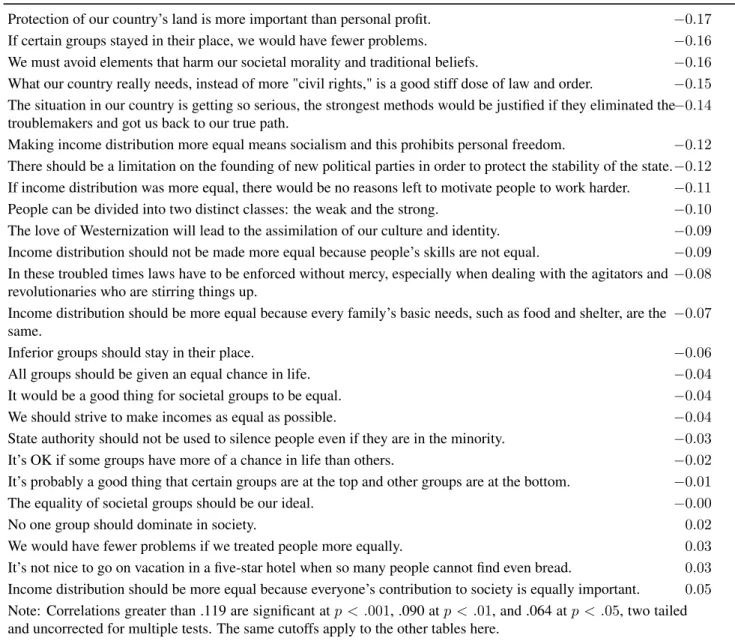
Table A1: Correlations of ACS with items of the Social/Political Conservatism Scale. Items marked with “(R)“ are reverse-coded. That is, for all items in these four tables, higher scores indicate higher conservatism.
Protection of our country’s land is more important than personal profit. −0.17 If certain groups stayed in their place, we would have fewer problems. −0.16 We must avoid elements that harm our societal morality and traditional beliefs. −0.16 What our country really needs, instead of more "civil rights," is a good stiff dose of law and order. −0.15 The situation in our country is getting so serious, the strongest methods would be justified if they eliminated the troublemakers and got us back to our true path.
−0.14 Making income distribution more equal means socialism and this prohibits personal freedom. −0.12 There should be a limitation on the founding of new political parties in order to protect the stability of the state.−0.12 If income distribution was more equal, there would be no reasons left to motivate people to work harder. −0.11 People can be divided into two distinct classes: the weak and the strong. −0.10 The love of Westernization will lead to the assimilation of our culture and identity. −0.09 Income distribution should not be made more equal because people’s skills are not equal. −0.09 In these troubled times laws have to be enforced without mercy, especially when dealing with the agitators and revolutionaries who are stirring things up. −
0.08 Income distribution should be more equal because every family’s basic needs, such as food and shelter, are the same.
−0.07 Inferior groups should stay in their place. −0.06 All groups should be given an equal chance in life. −0.04 It would be a good thing for societal groups to be equal. −0.04 We should strive to make incomes as equal as possible. −0.04 State authority should not be used to silence people even if they are in the minority. −0.03 It’s OK if some groups have more of a chance in life than others. −0.02 It’s probably a good thing that certain groups are at the top and other groups are at the bottom. −0.01 The equality of societal groups should be our ideal. −0.00 No one group should dominate in society. 0.02 We would have fewer problems if we treated people more equally. 0.03 It’s not nice to go on vacation in a five-star hotel when so many people cannot find even bread. 0.03 Income distribution should be more equal because everyone’s contribution to society is equally important. 0.05 Note: Correlations greater than .119 are significant at p < .001, .090 at p < .01, and .064 at p < .05, two tailed and uncorrected for multiple tests. The same cutoffs apply to the other tables here.
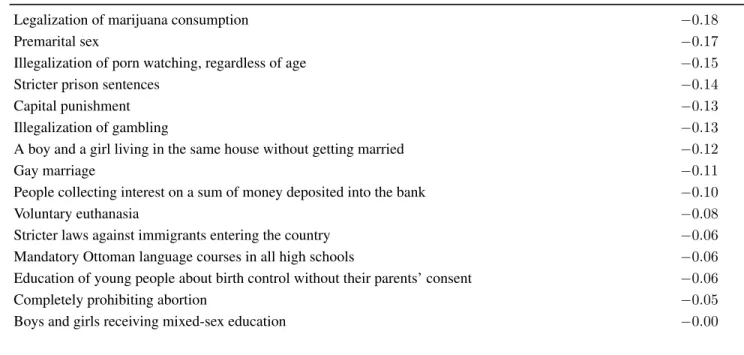
Table A2: Correlations of ACS with items of the Scale of Social Conservatism.
Legalization of marijuana consumption −0.18
Premarital sex −0.17
Illegalization of porn watching, regardless of age −0.15
Stricter prison sentences −0.14
Capital punishment −0.13
Illegalization of gambling −0.13
A boy and a girl living in the same house without getting married −0.12
Gay marriage −0.11
People collecting interest on a sum of money deposited into the bank −0.10
Voluntary euthanasia −0.08
Stricter laws against immigrants entering the country −0.06 Mandatory Ottoman language courses in all high schools −0.06 Education of young people about birth control without their parents’ consent −0.06
Completely prohibiting abortion −0.05
Boys and girls receiving mixed-sex education −0.00
Table A3: Correlations of ACS with items of the Economic Conservatism Scale.
The state should not interfere with economy. −0.08 As the state’s power for economic planning increases, the regime grows more dictatorial. −0.08 Incentives for encouraging rich people to invest should be increased. −0.07 The state should interfere with the economy in order to provide social equality. −0.05 Charity is individuals’ responsibility, not the state’s. Therefore, the state should not be charitable toward the
people. −
0.03 Public schools should be handed over to the private sector because private schools provide higher quality
education.
−0.02 If the state sets private venture completely free, they could carry out all sorts of cruelties toward workers. −0.02 Private venture is superior because it functions more efficiently and successfully than the state in almost all
domains.
−0.02 Health expenses of economically disadvantaged people should be completely covered by the state. 0.01 The state should collect more taxes from the rich and less from the poor in order to fix income inequality. 0.01 Individual freedom increases as the state becomes smaller. 0.01 The institution we call the state should increasingly move toward less tax collection and less service provision. 0.02 Privatization schemes benefit the rich and should be prohibited. 0.03 To take care of homeless people or kids who live on the street is state’s number one priority. 0.05 The shrinking of the state would increase income inequality even more. 0.05 The state should undertake any expenditure to provide people with a higher standard of living. 0.06
Table A4: Correlations of ACS with items of the Personal Conservatism Scale.
When I am informed of a change of plans, I tense up a bit. −0.14 I sometimes find myself avoiding changes that I know will be good for me. −0.13 I prefer to socialize with familiar friends because I know what to expect from them. −0.13 Changing plans seems like a real hassle to me. −0.12 I like to have friends who are unpredictable. −0.12 I find that establishing a consistent routine enables me to enjoy life more. −0.12 I become uncomfortable when the rules in a situation are not clear. −0.12 Often, I feel a bit uncomfortable even about changes that may potentially improve my life. −0.11
I dislike unpredictable situations. −0.11
It annoys me that someone whose job is to serve me addresses me casually. −0.09 I like to do the same old things rather than try new and different ones. −0.07 I feel uncomfortable when someone who is superior to me acts as if they are my equal. −0.07 Once I’ve made plans, I’m not likely to change them. −0.06
I’d rather be bored than surprised. −0.06
In social settings, it is necessary for some people to assume leadership over others for things to function
smoothly. −
0.06 The thought making changes in my life typically evokes negative emotions in me. −0.05 I enjoy the uncertainty of going into a new situation without knowing what might happen. −0.05 When I meet someone, within a short period of time, I assess how superior to me he/she is. −0.05 I feel equal to many people in my life. −0.04 I find that a well-ordered life with regular hours makes my life tedious. −0.04 It is against nature for everyone in a human community to be considered equal. −0.03 Every human community needs someone who has more power or authority than others in order to ensure
smooth functioning.
−0.03 When I work with a group of people, I prefer one of them to take charge. −0.02 In my personal relationships, I prefer either submitting or dominating, instead of equality. −0.02
I enjoy being spontaneous −0.01
I feel better if I know the hierarchical structure of a group that I have just been introduced to. −0.01 I like it when someone who is superior than me takes charge and tells me what to do. −0.00 Whenever my life forms a stable routine, I look for ways to change it. 0.04 I dislike the routine aspects of my work. 0.05