
Measuring electrochemical fruit quality of refrigerated ‘Hanita’ plum by Bioelectric Vincent method
8
0
0
Tam metin
(2) 316. Measuring electrochemical fruit quality of refrigerated ‘Hanita’ plum by Bioelectric Vincent method. et al., 2006), carrots (Velimirov, 2004; 2005; Gajewski et al., 2007), and tomatoes (Akay, Kara, 2006; Kaçiu et al., 2010). ‘Hanita’, originated from a cross between ‘President’ and ‘Auerbacher’ plums in 1980, is a table fruit with superior quality, suitable also for processing (Hartmann, 1999). The fruit ripens through the end of August in Germany and Austria, planted widely in Germany and recently other neighbouring countries as well (Hartmann, 1999). The plums are oval, blue to violet with an excellent taste accompanied by welldefined aroma and acidity (Hartmann, 1999). The ripe fruit has blue/violet peel colour which easily disguises changes in colour or undesired developments associated with the quality such as skin pitting and staining. Due to this arduousness for perceiving some physical changes associated with the quality on the fruit skin, new methods are required to measure the fruit quality especially for fruit stored at low temperatures. Bioelectric Vincent method would be a novel and simple way to measure the quality of ripe ‘Hanita’ fruit stored at low temperatures. The purpose of the study was to evaluate and compare electrochemical characteristics of ‘Hanita’ plums using Bioelectric Vincent method, and some physical and physiochemical attributes as well during and after storage at 0, 5 or 12°C. To our knowledge, this is the first report on measuring electrochemical plum fruit quality applying Bioelectric Vincent method.. Materials and methods The study was carried out during the summer (July–August) of 2008. ‘Hanita’ plum (Prunus domestica spp. domestica) at the commercial ripening stage (SSC – 13.45%, TA – 1.22%, firmness – 15.58 N) when fruit were dark blue/violet were hand-harvested from the experimental orchard of the University of Natural Resources and Life Sciences in Vienna (latitude: 48º 17ʹ 9″ N, longitude: 16º 25ʹ 31″ E, elevation approximately 200 m). Fruit of uniform size, free from visual blemishes and diseases were used for experiments. Three hundred fifty plums were harvested and divided into 3 lots including sampling at harvest. Each lot (100 plums per lot) was stored at 0, 5 or 12°C, and after 5, 10 or 15 days twenty plums from each lot were removed from the cold storage and subsequently held at 25°C for 1 day. Plums were placed in plastic trays (36 fruit per tray) in commercial cardboard boxes (29.5 cm wide by 50.00 cm long by 10.0 high; one tray per box). The experiment conducted at 12°C was terminated after 10 + 1 day due to a very high decay ratio whereas others were terminated after 15 + 1 day according to the proposed schedule.. Weight of individual fruit replicated samples was measured using a precision balance with an accuracy of 0.01 g (A&D FX-3000i, Japan). Weight loss was then calculated from the weight of each plum measured initially before storage and after the 5-, 10and 15-day storage period. Fruit firmness was measured on the equatorial zone of the both cheeks after removing fruit skin using a “Mecmesin Microprocessor Force Gauge” (M 1000E, “Henko (S)”, Singapore). The convex probe tip was penetrated into fruit flesh 5 mm at top speed of 10, and the reading was recorded as Newton (N). There were five replications with 3 fruit for each treatment. Mean of the subsamples (3 fruit) was taken to reduce the complexity of the statistical analysis. Deseeded plums (five replication per treatment and 3 fruit per replication) were passed through an electric juicer “Braun 4290” (Germany) and filtered through a Whatman No 4 filter paper for the measurement of soluble solids content (SSC), titratable acidity (TA) and vitamin C content. SSC was measured by a digital refractometer “Palette PR-100” (“Atago”, Japan). TA was determined by titration of 5 ml juice diluted with 25 ml distilled water to pH 8.2 with 0.1 N NaOH and expressed as percentage malic acid. For the titration an automatic titrator “TA 20 Plus” (“Schott”, Germany) was used. Vitamin C content was determined by a digital reflectometer “Qflex 10” (“Merck”, Germany) equipped with ascorbic acid test strips “Merckoquant Ascorbic Acid Test”, Cat. No. 1.10023.001 (“Merck”, Germany) and expressed as mgl-1 L (+) ascorbic acid. All the measurements were made at room temperature. Peel and flesh colour were measured on 15 individual plums per treatment at the equatorial region using a chromameter (model CR-200b, “Minolta”, Japan) initially and on selected days (5 + 1, 10 + 1, 15 + 1). Colour was recorded using the CIE-L*a*b* uniform colour space, L* (lightness), a* (redness), and b* (yellowness) values. Redox potential, pH, P-value and resistivity were determined from the juice prepared for the previous physiochemical analysis by a digital quality assessment device BE-T-Analyse Prof. n. Vincent (“MED Tronik”, Germany) with processing through a software Med-Tronik, Terrrainanalyse 2.2 (Germany). Approximately 30 ml fruit juice in a 50-ml beaker placed on a magnetic stirrer was used to determine the aforementioned values at room temperature (23 ± 1°C). The experimental design was arranged as completely randomized design with 5 replicates. Analysis of variance (ANOVA) was performed and treatment means were compared LSD multiple range test (p ≤ 0.05) using SAS software (release 9.1.3, SAS Institute Inc., USA)..
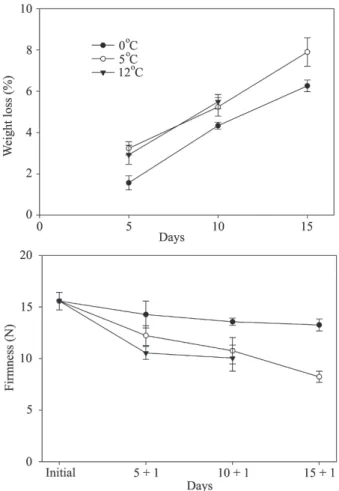
(3) ISSN 1392-3196. ŽEMDIRBYSTĖ=AGRICULTURE. Vol. 98, No. 3 (2011). 317. Results and discussion Plums lost their fresh weight steadily regardless of the temperatures (Fig. 1). Plums stored at 5 and 12°C had significantly more weight loss than those stored at 0°C in the course of storage. After 5 days, the loss was 1.56% for plums stored at 0°C, 2.92% for plums stored at 12°C and 3.23% for plums stored at 5°C. After 10 days, the loss increased to 4.33% for plums stored at 0°C, to 5.24% stored at 5°C and to 5.49% stored at 12°C. At the end of the storage period (on the 15th day), weight loss was 6.26% for plums stored at 0°C while 7.90% for plums stored at 5°C. At chilling temperatures shrivelling is minimized which is the main reason for the lowest weight loss in the plums stored at 0°C in the present study. Plums softened at different rates with storage duration irrespective of the temperatures (Fig. 1). Plums initially stored at 0°C softened only to 13.26 N after 15 + 1 day by retaining most of their firmness while plums initially stored at 5°C softened to 8.23 N after 15 + 1 day and plums initially stored at 12°C softened to 10.05 N after 10 + 1 day by losing most of their firmness even after 10 + 1 day. Starting on the 10th day of the storage, plums stored at 0°C had statistically higher firmness than plums stored at 5 and 12°C. The losses in firmness were minimal for plums at 0°C falling only to 13.26 N whereas extensive for plums at 5°C falling to 8.23 N. Firmness loss in plums has been linked to cell modifications which are greatly affected by several polysaccharide degrading enzymes (Nunes et al., 2008). The chilling temperature in the present experiment restricted the action of the cell wall degrading enzymes, which might be the reason for the higher firmness value registered on the plums stored at 0°C. Plums stored at 0 and 5°C had higher SSC compared to plums stored at 12°C starting from day 10. SSC of plums stored at 12°C decreased in the course of the storage reaching a value of 13.60% after 10 + 1 day while SSC of plums stored at 0 and 5°C increased reaching a value of 14.18% and of 14.60%, respectively, after 15 + 1 day. TA of plums showed a similar trend to SSC by decreasing to 1.39% in plums stored at 12°C after 10 + 1 day whereas increasing to 13.45% and to 13.42% in plums 0 and 5°C after 15 + 1 day (Fig. 2). Plums stored at 0 and 5°C had higher TA than plums stored at 12°C with storage duration. The increase in SSC and TA of plums stored at 0 and 5°C and the decrease in SSC and TA of plums stored at 12°C could be due to the climacteric behaviour of the plum fruit (Wang et al., 2010). The decrease in SSC or TA of plums stored at 12°C is probably caused by high respiration rates. Plums stored at 5 and 12°C had higher vitamin C content compared to those stored at 0°C (Fig. 2). Vitamin C content of plums stored at. Notes. Vertical bars represent standard error of means. Some error bars are not visible due to the lower value of standard error against the y-axis scale.. Figure 1. Changes in weight loss of ‘Hanita’ plums during storage at 0, 5 and 12°C, and in firmness during storage at 0, 5 and 12°C plus 1 day at 25°C 0 and 5°C decreased to 38.00 and 48.25 mg l-1 after 15 + 1 day while of those stored at 12°C increased to 61.75 mg l-1 after 10 + 1 day. L* value of both peel and flesh decreased at different rates regardless of the temperatures with storage duration (Fig. 3). At the end of storage period, plums stored at 0°C had higher L* values for both peel and flesh than those stored at 5°C. Measured on the flesh of plums a* value insignificantly increased irrespective of the temperatures over time (Fig. 3). The increase in a* value indicates the plums were still ripening. Peel a* value for plums stored at 0°C also increased, for plums stored at 5°C first increased and decreased and for plums stored at 12°C decreased. Flesh b* value, similar to flesh L* value declined for all the treatments over time (Fig. 3). Starting from day 10, plums stored at 0°C had higher flesh b* values compared to plums stored at 5 or 12°C. Peel b* value of all the treatments also decreased but the decrease was very slow compared to the flesh b* values (Fig. 3). Plums stored at 12°C had the lowest peel b* value af-.
(4) 318. Measuring electrochemical fruit quality of refrigerated ‘Hanita’ plum by Bioelectric Vincent method. Note. Vertical bars represent standard error of means.. Note. Vertical bars represent standard error of means.. Figure 2. Changes in soluble solids content (SSC), titratable acidity (TA) and vitamin C content of ‘Hanita’ plums during storage at 0, 5 and 12°C plus 1 day at 25°C. Figure 3. Changes in instrumental colours of ‘Hanita’ plum peel and flesh during storage at 0, 5 and 12°C plus 1 day at 25°C. ter 10 + 1 day, and plums stored at 5°C had the lowest peel b* value after 15 + 1 day among the treatments causing a statistical difference. Decrease in b* value is also associated with ripening or ever-ripening. Redox potential first increased then decreased over time regardless of the temperatures and no statistical differences were noted among the treatments (Fig. 4). Values of pH, on the other hand, showed a slight increase over time for all the treatments, and on the last day of the experiment plums at 5°C had higher pH values than those at 0°C (Fig. 4). P-value of all the treatments increased through day 5 + 1 then continued to increase to 964.80 µW for plums at 0°C,. slightly decreased to 892.40 µW for plums at 5°C, and decreased to 827.40 µW for plums at 12°C. P-values of plums stored at 12°C were statistically lowest after 10 + 1 day, and of plums stored at 5°C after 15 + 1 day, causing statistical differences among the treatments. Resistivity demonstrated a similar pattern to the redox potential by having no statistical differences among treatments (Fig. 4). Correlations between redox potential/P-value and physiochemical/electrochemical parameters are shown in Table. Redox potential and P-vale were found to be positively correlated; P-value and resistivity, and P-value and resistivity negatively corre-.
(5) ISSN 1392-3196. ŽEMDIRBYSTĖ=AGRICULTURE. Vol. 98, No. 3 (2011). 319. of life process (Gajewski et al., 2007). The rise in pH values means a loss of vitality in plants according to the method (Paulauskienė et al., 2005). In the present experiment, pH of plums slightly increased over storage time, referring a diminutive loss of vitality. P-value can also be used to define vitality of organisms, energy distribution tendencies, and might be a sign of corresponding entropy of the system (Bloksma et al., 2001). Higher P-value can be explicated as “more openness while lower values ordering or coherence” (Gajewski et al., 2007). Considering the P-value of the treatments and longevity of the storage, the 5°C storage regime performs well for ‘Hanita’ plums compared to the 0°C or 12°C storage regime. Resistivity fell below the initial level at the end of the storage regardless of the temperatures in the present experiment. This is considered to be more disorder in plums which indicates a lower quality when compared to plums at harvest. High value of electrical resistivity states that electrolytes and other cellular ions are more integrated in cell membranes and cell organelles (Gajewski et al., 2007); on the contrary, low values indicate the abundant presence of free-moving electrolytes, which could be interpreted as a sign of deterioration of plant cells and eventually tissues (Bloksma et al., 2001). Product quality in connection with bioelectrical properties of organically-grown carrots and spinach are well documented (Walz, 1996; Krautgartner, 2002; Velimirov, 2004). P-values have been found lower in organically grown carrots compared to conventionally grown carrots indicating organically grown carrots are healthier from nutritive aspect (Walz, 1996; Velimirov, 2004; 2005). Krautgartner (2002) and Velimirov (2004) also reported that organically-fertilized spinach had lower P-values. Velimirov (2004) further showed that organically-fertilized spinach had less dry matter loss claiming a longer shelf life.. Note. Vertical bars represent standard error of means.. Figure 4. Changes in redox potential, pH, P-value and resistivity (R) of ‘Hanita’ plums during storage at 0, 5 and 12°C plus 1 day at 25°C lated. No other significant correlation was recorded. According to Bioelectric Vincent method, better product quality or recovered products are achieved with a low redox potential and P-value but a higher resistivity (Wolf, Rey, 1997). In the present experiment, the initial P-value was the lowest then increased during the storage indicating a decrease in the quality of fruit regardless of the temperatures. Value of pH shows the level of acidity of ions and expresses energetic aspects. Table. Correlation coefficients r between redox potential and electrochemical/physiochemical, and between P-value and electrochemical/physiochemical characteristics of ‘Hanita’ plum Parameters. Redox potential. pH. P-value. Resistivity. SSC. −0.20. 0.33. −0.12. −0.12. TA. −0.04. 0.23. −0.30. −0.25. Vitamin C. 0.16. 0.13. −0.08. 0.20. Redox potential. –. −0.35. 0.61ǂ. 0.30. pH. –. –. −0.61ǂ. 0.23. P-value. –. –. –. −0.68ǂ. ǂ – means a moderate correlation.
(6) 320. Measuring electrochemical fruit quality of refrigerated ‘Hanita’ plum by Bioelectric Vincent method. Studies have confirmed that there is a correlation between P-values and plant health. For example, Nakvasil (2004) reported that cucumber fruit inoculated with zucchini yellow mosaic virus had higher Pvalues compared to non-inoculated fruit indicating a positive correlation between P-value and viral contamination. ‘Hanita’ plums’ peel and flesh were visually examined and pictured during the cold storage, and found that plums stored at 0°C performed well compared to plums stored at 5 or 12°C in terms of retaining peel and flesh colour, and developing flesh translucency. Most of the plum cultivars express chilling injury symptoms mostly as flesh translucency associated with flesh browning, and infrequently mealiness (Crisosto et al., 1990). In the present experiment, plums stored at 12°C developed intensive flesh translucency after 5 + 1 day, plums stored at 5°C developed a comparable degree of flesh translucency after 15 + 1 day; yet, plums stored at 0°C never developed as much as flesh translucency as in plums stored at 5 or 12°C. This indicates that the cause of flesh translucency in ‘Hanita’ fruit might be over-ripening. On the other hand, increasing P-value in plums subject to the 0°C treatment throughout the storage states that ‘Hanita’ plums are not in the state of better quality according to the Bioelectric Vincent method, which may be due to the chilling injuries that cannot be noticed until the fruit reach consumers (Crisosto et al., 1999).. Conclusions 1. The Bioelectric Vincent method might be used for measuring internal quality of plums at harvest or after storage with the help of classical quality parameters. 2. The method clearly indicates that plums stored at 0°C had higher P-values in the present experiment, asserting the fruit were handled with inappropriate storage conditions. Thus, the method might be used for refrigerated plums to trace the postharvest history, and could be useful for other horticultural crops as well.. Acknowledgments The authors express their gratitude for financial support from the Scientific and Technological Research Council of Turkey (TUBITAK). The authors thank Lucas Gach, Andreas and Spornberger from the University of Natural Resources and Life Sciences in Vienna, and Nazan Ergun for providing technical support and help. Received 28 03 2011 Accepted 12 07 2011. References Akay A., Kara Z. P-value and some other characteristics of tomato cultivar grown in greenhouse // Pakistan Journal of Biological Science. – 2006, vol. 9, iss. 10, p. 1991–1994 Bloksma J., Northolt M., Sluber M. Parameters for apple quality // Louis Bolk Institute. – 2001, p. 78–81. <http://orgprints.org/2716/1/gvv04.pdf> [accessed 18 03 2011] Crisosto C. H., Mitchell F. G., Ju Zu Z. Susceptibility to chilling injury of peach, nectarine, and plum cultivars grown in California // Horticultural Science. – 1999, vol. 34, iss. 6, p. 1116–1118 Gajewski M., Szymczak P., Elkner K. et al. Some aspects of nutritive and biological value of carrot cultivars with orange, yellow and purple-coloured roots // Vegetable Crops Research Bulletin. – 2007, vol. 67, p. 149–161 Hartmann W. Breeding of plum cultivars resistant to plum pox virus // Acta Horticulturae. – 1999, vol. 484, p. 487–490 Hoffmann M. Elektrochemische Merkmale zur Differenzierung von Lebensmitteln // LebensmittelqualitätGanzheitliche Methoden und Konzepte-Alternative Konzepte Nr. 66 (eds A. Meier-Ploeger, H. Vogtmann). – Germany, 1991, S. 67–86 (in German) Kaçiu S., Shala-Mayrhofer V., Mirecki N. et al. Influence of environment in electrochemical quality of tomato // International Journal of Horticultural Science. – 2010, vol. 16, iss. 5, p. 17–20 Kappert R., Meltsch B. Introducing a complementary investigation method concerning fruit and vegetable quality and human health // Acta Horticulturae. – 2007, vol. 744, p. 79–90 Keppel H. Measurability of the biological quality of apples by means of P value as dependent on different fertilizers // Obstbau Weinbau. – 1998, vol. 35, iss. 7–8, p. 259–261 Krautgartner G. Qualitätsuntersuchungen an Gemüsearten im Rahmen einer dreijährige Fruchtfolge während der Umstellung auf unterschiedliche Produktionssysteme mit Schwerpunkt auf elektrochemische Untersuchungen: Dissertation. – 2002 (in German) Meltsch B., Kappert R., Jezik K. Verbraucherakzeptanz und Qualitätsmerkmale von verschiedenen handelsüblichen Säften // Deutsche Gesellschaft für Qualitätssicherung (pfl. Nahrungsmittel). – 2005, vol. 40, p. 96–100 (in German) Nakvasil V. Zweijährige Ergebnisse des Einflusses von ZYMV bei Einlegegurken auf die elektrochemischen Messwerte // Tagungsband der 10. Jahrestagung der.
(7) ISSN 1392-3196. ŽEMDIRBYSTĖ=AGRICULTURE. Gesellschaft für Boden Technik, Qualität (BTQ). – Friesenheim, Germany, 2004 (in German) Nunes C., Saraiva J. A., Coimbra M. A. Effect of candying on cell wall polysaccharides of plums (Prunus domestica L.) and influence of cell wall enzymes // Food Chemistry. – 2008, vol. 111, p. 538–548 Paulauskiene A., Danilcenko H., Jariene E. et al. Quality of pumpkin fruits in relation to electrochemical and antioxidative properties // Vegetable Crops Research Bulletin. – 2006, vol. 65, p. 137–144 Paulauskienė A., Danilčenko H., Rutkovienė V., Kulaitienė J. The influence of various fertilizers on electrochemical properties of pumpkins fruits // Sodininkystė ir daržininkystė. – 2005, vol. 24, iss. 3, p. 78–86 Velimirov A. Integrative methods of product quality assessment in connection the P-value-determination (3 examples: food preference test, sensory evaluation and self-decomposition test) // Horticultural Science (Prague). – 2004, vol. 31, p. 17–21 Velimirov A. The consistently superior quality of carrots from one organic farm in Austria compared with conventional farms / Researching and shaping sustainable systems: 15th IFOAM organic world congress, Australia // Adelaide Convention Centre. – Adelaide, South Australia. – 2005, p. 192–195 Walz V. The P-value as a holistic quality parameter for food experiments with organically and non-organically grown carrots (Daucus carota spp. sativus, cv. ‘Bolero’) / New research in organic agriculture: proceedings of 11th international scientific IFOAM conference. – Denmark, Copenhagen, 1996, p. 265–272 Wang R., Xuan H., Streif J. Effect of 1-MCP on plum (Prunus domestica) ripening and quality during shelf-life at room temperature // Acta Horticulturae. – 2010, vol. 877, p. 317–322 Weissinger H., Stich K., Spornberger A., Jezik K. Influence of harvest progression on fruit quality parameter of early-ripening strawberry types // Deutsche Lebensmittel-Rundschau. – 2008, vol. 104, iss. 11– 12, p. 59–66 Wolf G., Rey C. Wie Qualität elektrochemisch zu messen ist // Vom Lebendigen in Lebensmitteln (ed. M. Hoffmann). – Germany, 1997, S. 50–60 (in German). Vol. 98, No. 3 (2011). 321.
(8) Measuring electrochemical fruit quality of refrigerated ‘Hanita’ plum by Bioelectric Vincent method. 322. ISSN 1392-3196 Žemdirbystė=Agriculture, vol. 98, No. 3 (2011), p. 315–322 UDK 634.22:634.1.004.12:631.526.32. Veislės ‘Hanita’ slyvų atvėsintų vaisių elektrocheminis kokybės matavimas bioelektriniu Vincent’o metodu M. Ergun1, K. M. Jezik2 Turkijos Bingol universitetas Austrijos sodininkystės bei daržininkystės ir vynuogininkystės institutas. 1 2. Santrauka Veislės ‘Hanita’ slyvos iki 15 dienų buvo laikomos 0, 5 arba 12° C temperatūroje ir 1 dieną 25° C temperatūroje, siekiant ištirti temperatūrų poveikį elektrocheminiams rodikliams, nustatytiems bioelektriniu Vincent’o metodu, taip pat fizinėms bei fiziocheminėms savybėms. Masės ir kietumo nuostoliai buvo mažiausi slyvose, laikytose 0° C temperatūroje. Slyvos, laikytos 0 ir 5° C temperatūroje, išlaikė vitamino C kiekį, o slyvose, laikytose 20° C temperatūroje, vitamino C kiekis sumažėjo. Vaisių odelės ir minkštimo spalvos ryškūs pokyčiai nustatyti nepriklausomai nuo temperatūros, tačiau jie buvo mažiausi 0° C temperatūroje laikytose slyvose. Reikšmingi elektrocheminių rodiklių pokyčiai taip pat nustatyti slyvose, nepriklausomai nuo laikymo temperatūros. Laikymo pabaigoje slyvos turėjo mažesnį oksidacijos-redukcijos potencialą, didesnes pH vertes ir mažesnes savitosios varžos vertes, nepriklausomai nuo temperatūros. Antra vertus, laikymo pabaigoje P vertė ryškiai padidėjo slyvų, laikytų 0° C temperatūroje, ne taip ryškiai esant 5° C ir šiek tiek sumažėjo esant 12° C temperatūrai. Slyvos, šaldytos 0° C temperatūroje, gerai išlaikė masę, kietumą, tirpiąsias medžiagas ir vitaminą C, taip pat spalvą. Tačiau esant 0° C temperatūrai slyvos turėjo didžiausią P vertę, rodančią mažiausią gyvybinę veiklą, nustatytą bioelektriniu Vincent’o metodu. Reikšminiai žodžiai: bioelektrinis Vincent’o metodas, P vertė, oksidacijos-redukcijos potencialas, savitoji varža, vaisiaus vidinė kokybė..
(9)
Şekil
Benzer Belgeler
For patients with an initial IOP above 50 mmHg, the difference in the grade of corneal edema measured 30 minutes after treatment was insigni ficant between the ACP and mannitol groups
To evaluate the spaces in terms of thermal, visual and acoustic parameters in the library settings in order to gain solid feedbacks for suggestions to enhance the conditions
With regard to the videoing process, Luoma (2004: 39) highlights the advantages of recording the discussion, as they may be used in self reflection of speaking skills. However,
D elikanlı kendisini h içbir şey söylem ek h a ttâ anlatm ak istem eden, fak at - şiddetle, fak at bütün kalbiyle, belki ölüm lere kadar sürecek bir aşkla seven
ölüm yıl dönümüne raslıyan 24 şubat günü Abdül- hak HSmid Derneği ile Güzel Sanatlar Akademisi Öğ renciler Derneği ortaklaşa olarak bir anma töreni
Bunca ressam tarafından ele alınıp da bunca özgün kalabilen atlar: K^h burun kanatları titreyen, kah şaha kalkmış, yeleleri rüz gârda savrulmuş, ama her
The Teaching Recognition Platform (TRP) can instantly recognize the identity of the students. In practice, a teacher is to wear a pair of glasses with a miniature camera and
Bu kağıtlar eklemdeki manipülasyon zorluğunu taşıyabildiği ve deri ile iyi kaynaştığı için genellikle deri onarımlarında daha etkili olarak kabul görmektedir (TYEK,
