t , <»;■■
Jstk
s & j ^ M r r m r o rl·íм o E P Â m rı^ m ^
o f c o m p u t s h·"■? _ji' Ki„^^ ’ 'r:jF*D--îMâ 0 I0 2 :^ SO .l£u''iO £
AN-»· THE I:'‘1STIT'JTE OF ENGiHEEHiMG AOID SCIENCE
OE OiU<£iM'rüNIV£Fi?5iTY'
f%>
-sf,.
^'Lâ-’^:-:EZ’‘iT OF THE HSOC-F-E-^-
î^-''· *'^
i » . .>kv., w*5. « . .;ü:· ·. .«irf · ırtk’ -*S*--..1MW' ^ y u K
^ ,.**»■■ v^y,»—/ ‘T * r ^ j g i / ı Y *
’ IvliCsTEH OF SCI EMCE
A A ^ X
A THESIS
SUBMITTED TO THE DEPARTMENT OF COMPUTER ENGINEERING AND INFORMATION SCIENCE AND THE INSTITUTE OF ENGINEERING AND SCIENCE
OF BILKENT UNIVERSITY
IN PARTIAL FULFILLMENT OF THE REQUIREMENTS FOR THE DEGREE OF
MASTER OF SCIENCE
By
Bora Uçar
September, 1999
for the degree of Master of Science.
Assoc. Prof. Dr. Cwdet Aykanat(Principal Advisor)
I certify that I have read this thesis and that in my opin ion it is fully adequate, in scope and in quality, as a thesis for the degree of Master of Science.
Asst. Prof. Dr. Atma Giii'soy
I certify that I have read this thesis and that in my opin ion it is fully adequate, in scope and in quality, as a thesis for the degree of Master of Science.
Prof. Dr. Kemal
Approved for the Institute of Engineering and Science:
A B ST R A C T
PARTITIONING SPARSE RECTANGULAR MATRICES FOR PARALLEL COMPUTING OF A /F x
Bora Uçar
M.S. in Computer Engineering and Information Science Supervisor: Asoc. Prof. Dr. Cevdet Aykanat
Spetember, 1999
Many scientific applications involve repeated sparse matrix-vector and matrix- transpose-vector product computations. Graph and hypergraph partitioning based approaches used in the literature aim at minimizing the total commu nication volume while maintaining computational load balance through one dimensional partitioning of sparse matrices. In this thesis, we consider two approaches which consider minimizing both the total message count and com munication volume while maintaining balance on the communication loads of the processors. Two communication schemes are investigated for the fold and expand operations needed in the parallel algorithm. For the global communica tion scheme, we show that the problem of minimizing concurrent communica tion volume can be formulated as the problem of permuting the sparse matrix into a singly-bordered block-diagonal form, where the total and concurrent message count is determined by the interconnection topology. For the person alized communication scheme, a two stage approach is proposed. In the first stage, the total communication volume is minimized while maintaining balance on the computational loads of the processors. In the second stage, a novel com munication hypergraph model is proposed which enables the minimization of the total message count while maintaining balance on the communication loads of the processors through hypergraph-partitioning-like methods. The solution methods are tested on various matrices and results, which are quite attractive in terms of solution quality and running times, are obtained.
Key words: Sparse Rectangular Matrices, Computational Hypergraph Model,
ÖZET
SEYREK DİKDÖRTGENSEL MATRİSLERİN /l/F a -’ İN PARALEL İŞLEMCİLERDE HESAPLANABİLMESİ İÇİN
PARÇALANMASI
Bora Uçar
Bilgisayar ve Enformatik Mühendisliği, Yüksek Lisans Tez Yöneticisi: Doc. Dr. Cevdet Aykanat
Eylül, 1999
Birçok bilimsel uygulama, bir seyrek dikdörtgensel matrisin bir vektör ve de aynı matrisin transpozunun bir başka vektör ile çarpılmasını içermektedir. Şimdiye kadar kullanılan çizge ve hiperçizge parçalanması algoritmalarında toplam haberleşme hacmi azaltılırken işlemciler arasındaki işlemsel denge, ma trisin tek boyutlu ayrıştırılması ile yakalanmaya çalışılmıştır. Bu tezde, toplam haberleşme sayısı ve hacmi iki yaklaşımla azaltılmaya çalışılmıştır. Genel haberleşme yaklaşımındaki birleşik haberleşme hacminin azaltılması problemi, matrislerin tek sınırlı çarpraz bloklar haline getirilmesi problemine dönüştü rülmüştür. Bu yaklaşımdaki birleşik ve toplam haberleşme sayısı paralel iş lemcilerin bağlantısına bağlı olup değiştirilememektedir. Kişiselleştirilmiş ha berleşme yaklaşımındaki toplam haberleşme sayısı ve hacmi iki aşamada azal tılmıştır. Birinci aşamada, toplam haberleşme hacmi azaltılırken işlemsel denge sağlanılmıştır. ikinci aşamada, önerilen haberleşme hiperçizgesi yardımı ile toplam haberleşme sayısı azaltılırken işlemciler arasında haberleşme işi dengesi sağlanmaya çalışılmıştır. Sunulan yöntemler birçok matris üzerinde sıncinmış ve iyi yönde sonuçlar elde edilmiştir.
Anahtar kelimeler: Seyrek dikdörtgensel matrisler, hesap hiperçizgesi, haber
A C K N O W LED GMENTS
Öncelikle danışmanım Cevdet Aykanat’a; Buraları daha çekilir kılan Nihan Ozyürek’e;
Programlama sırasında karşılaştığım sorunları çözmeme yardımcı olan Ümit V. Çatalyürek’e;
Tezi yazmama ve düzeltmeme yardım eden aynı zamanda inceldiğim her noktada bana destek olan kardeş Mehmet Koyutürk’e;
bu tez için teşekkür ederim. Ayrıca uil<umu açan A. Pınar Sayın’a,
1 Introduction
2 Preliminaries
2.1
Communication in Message Passing Systems2.2
Hypergraphs and Hypergraph P artition in g... 52.3 Computational Hypergraph M o d e ls ... 7
2.4 Hypergraph Partitioning M eth od s...
8
2.4.1 Iterative Improvement Approaches
2.4.2 Multilevel Approaches
11
3 Models and Solution Methods 15
3.1 Applications and Problem Definition 16
3.2
Minimizing Communication Cost in Global Fold-Expand Scheme21
3.3 Minimizing Communication Cost in Personalized Communica tion S c h e m e ... 23
3.3.1 Communication Hypergraph Model
3.4 Partitioning Computational Hypergraph
27
30
3.5 Partitioning Communication Hypergraph Using Existing Tools . 31
3.6 New Partitioning Tool for Communication Hypergraphs... 37
4 Experiments and Results 47 4.1 Data S e t ... 47 4.2 Implementation of A lg orith m s... 48 4.3 Experim ents... 51 4.4 R esu lts... 55 5 Conclusion 62 5.1 Conclusions 62
5.2
Euture W o rk ... 632.1 Multilevel direct /f-w ay partitioning
11
2.2
Coarsening Algorithm 1.32.3 Uncoarsening A lg o r ith m ... 14
3.1 Overall partitioning of A for /С = 4 ... 18
3.2 Two parallel computation schemes 19 3.3 4-way rowwise partitioning of A in singly boi'dei'ed from
21
3.4 Parallel computation of у = A A ^ x22
3.5 4-way rowwise partitioning of A : detailed single bordered from . 24 3.6 A partition of a hypergraph 25 3.7 A partition in a communication hypergraph 29 3.8 First partitioning sch em e... 323.9 Phase
1
r e s u lt... 333.10 Multilevel /f-w ay partitioning fram ew ork... 37
3.11 /v-way refinement a lg orith m ... 41
3.12
A'-way gain-initialization a lg o rith m ... 423.13 K-wa,y gain-update a lg o r ith m ... 43
4.1 Naive mapping heuristic 51
4.2
16-way normalized partitioning results of communication hyper graphs ... 564.3 32-way normalized partitioning results of communication hyper graphs ... 57
4.4
64-way normalized partitioning results of communication hyper graphs ... 574.5 64-way partitioning of CQ9 using M l and M 2 ... 59
4.1 Properties of test m a tr ic e s ... 48
4.2
Average case properties of communication h ypergraph s... 494.3 Communication requirements during fold and e x p a n d ... 53
4.4 Total running time of the algorithms 54
A .l Communication results of naive algorithm on the computational
hypergraphs using SHCM metric 70
A
.2
Communication results of 2Phase on the communication hyper graphs using S H C M ... 71A.3 Communication results of M l on the communication hyper graphs using SHCM m etric... 72
A.4 Communication results of M2 on the communication hyper graphs using SHCM m etric... 73
A.5 Computational load distribution 74
Introduction
Repeated matrix-vector and matrix-transpose-vector products of a rectangular or structurally non-symmetric sparse-matrix comprise the core of many itera tive parallel algorithms such as linear programs and linear system solvers. The efficient parallelization of such kind of algorithms requires the distribution of the nonzero elements of the matrix across processors in such a way that the computational work per processor is balanced and the cost of interprocessor communication is low.
In the literature, one dimensional partitioning of rectangular matrices is phrased in terms of partitioning bipartite graphs [15], and partitioning hyper graphs [
1
,6
]. Although recent works on modeling partitioning of rectangular or structurally non-symmetric sparse-matrices [1,6
, 15] handle the computational balance successfully, they fail to reveal the mystery behind the communication cost while minimizing it. The communication cost that is minimized in these works is considered to be the total communication volume across all proces sors. In the past, the total message count is proven to have great impact on the communicational cost [10]. Therefore, another objective of a partition ing method should be trying to minimize the total message count across the processors. Yet another objective may be achieving balance on the message count and communication volume handled by a processor. This work focuses on partitioning rectangular sparse-matrices using hypergraph models in such a way that after balancing the computational work per processor, the totalcommunication volume as well as total message count is minimized.
Two parallel communication schemes are investigated. The first one is named the global communication scheme in which all processors are involved in the same communication operation. The second one is named personalized
communication scheme in which each processor is involved in more than one
communication operation with some other processors.
The problem of minimizing the communication cost in the global communi cation scheme is reduced to the problem of minimizing the total and concurrent communication volume, due to the fact that the total message count is totally determined by the underlying interconnection topology in this scheme. The problem of minimizing the total and concurrent communication volume in this scheme is achieved by transforming the sparse matrix into a singly bordered (SB) block-diagonal form through non-symmetric row/column permutation. By minimizing the size of the border while maintaining balance on the nonzero counts of the row stripes of the matrix in the SB form, we minimize the total communication volume while maintaining computational load balance across the processors.
The problem of minimizing the communication cost in the personalized com munication scheme is modeled as a two stage process. In the first stage, total communication volume is minimized and in the second stage, total message count is minimized. The problem in the first stage is solved using existing tools. The problem in the second stage is solved by proposing a novel commu nication hypergraph model. After building a clear correspondence between the communication requirements and the proposed hypergraph model, the problem is solved by partitioning the mentioned hypergraph. Two solutions are pro posed. The first one solves the problem in this stage with a two phase process. In the first phase, the total message count is minimized and in the second phase communication loads of the processors are determined. The second solution minimizes total message count while determining the communication loads of the processors.
The organization of this thesis is as follows: Chapter
2
presents a brief de scription of hypergraphs and hypergraph partitioning problem. The terminol ogy described in this chapter will be used throughout the thesis. The chapter also includes a brief summary of communication cost in the message passing systems. Chapter 3 defines the problem of minimizing total communication volume in the global scheme in terms of computational hypergraph partition ing. This chapter also defines the problem of minimizing the total communica tion volume as well as total message count in the personalized communication scheme as a special hypergraph partitioning problem. In this chapter, two so lutions to the mentioned hypergraph partitioning problem will be presented. In Chapter 4, experimental results will be presented along with the comments on the proposed solutions. Finally, directions for future work and a conclusion will be presented.P reliminaries
In this chapter, after a brief discussion of communication in message pass ing systems, background on hypergraphs and hypergraph partitioning will be built. Iterative improvement hypergraph partitioning techniques and multi level hypergraph partitioning techniques will be reviewed in order to clarify the discussion in the following chapters.
2.1
Communication in Message Passing Sys
tems
Parallel applications running on a message passing system communicate re sults and problem parameters with explicit message-passing subroutines. The message passing performance is often measured in units of time, because it is a source of overhead when executing programs in parallel. The message passing time, tn, is usually a linear function of message size for two communicating processors. It is modeled as
tn = a + /3n + {h -
1)7
(1
)where a is the start-up time (latency), /3 is the per-byte transmission cost — often referred to as transfer time,
7
is the per-hop delay, n is the size of the message in bytes and h is the number of hops a message must travel.Due to efficient “worm-hole” routing [31] the per-hop delay becomes negligible and the first two terms are used to measure the cost of sending a message of size n bytes. In their work [10], Dongarra and Dunigan show the effect of latency in the message passing performance by examining various multi processor message passing systems. They show that for some architectures the latency is the dominating factor for messages of length smaller than 500-bytes. Therefore, one would like to minimize message count in his/her application in order to have an efficient parallel program.
2.2
Hypergraphs and Hypergraph Partition
ing
A hypergraph 7i = {V ,A i) is defined as a set of nodes V and a set of nets Af among those nodes. Every net Ui is a subset of nodes. The nodes in a net n,· are called its pins and denoted as Pins(ni). In this work this operator is extended to include the pin list of a set of nets i.e., Pins{Af') = Un.-ew·'T’m s(ni). The size of a net is equal to the number of its pins, i.e., s,· = ]Pms(n,)|. The set of nets connected to a node Vj is denoted as N ets{vj), which is also extended to a set of nodes appropriately. The degree dj of a node Vj is equal to the number of nets it is connected to, i.e.,dj = \Nets{vj)\. Weights can be assigned to the nodes. Let lo,· denote the weight of the node Uj·. The total number of pins, p, denotes the size of Tt where p = ~ ^vjev
dj-II = {Vi, V
2
, .. ·, Vk} is a /L-way partition oiH . = (V, W) if and only if thefollowing three conditions are satisfied;
• Vk C V and Vk
7
^ 0 for 1 < /: < K • U i i Vk = v• Vfc n Vi = 0 for I < /: < / <
The partitioning is sometimes referred to as bisection in the case of two-way partitioning. For K >
2
the partitioning is called multi-way or multiple-waypartitioning by some researchers.
In a partition II of 7^, a net is said to connect a part if it has at lecist one node in that part. Connectivity set A,· of a net Ui is defined as the set of connected by Ui. Connectivity A,· = |Ai| of a net Ui denotes the number of connected by Ui.
A net Ui is said to be internal if A,· =
1
. Aip is said to be the set of those internal nets. Accordingly, a net rii is defined to be external if A,· >1
. The set of external nets of a partition II is denoted as There are two metrics widely used in VLSI community [22
] to define the cost of a partition, usually referred to as cutsize. The first one is referred to as the cutnet metric and counts the number of external nets as the cost of the partition II, i.e..cosi(n ) = [Af^l (2)
The second one is referred to as the connectivity metric and counts the number of parts connected by external nets reduced by the number of external nets:
cosi(n ) = ^ (Aj- —
1
)(3)
The weight Wk of a part Vk is the sum of the individual weights of nodes in that part, i.e.,Wk = YivieVk ^ ‘ · ^ partition II is said to be balanced if:
W max - W avg
W.avg < e (4)
where IVmax is the weight of the part with maximum weight and Wavg is the average part weight, and e is a predetermined imbalance ratio.
Hence, the /f-w ay hypergraph partitioning problem can be stated as finding a partition H where cost(n) is minimized and the balance criterion stated by Eq. 4 is satisfied.
2.3
Computational Hypergraph Models
Computational graph model is widely used in the literature for the paralleliza
tion of various scientific applications including repeated sparse-matrix-vector- products through domain partitioning [18, 23, 24, 27, 31, 32, 33]. In this model, the problem of sparse matrix partitioning for minimizing communica tion volume while maintaining load balance is formulated as the well known /i - way graph partitioning problem, whei'e K denotes the number of processors in the target parallel architecture. Recently, two papers addressed tile flaws of this model [
6
, 14]. First, graph model can only be used for symmetric square matrices. Second, the cost function in the graph model is only a weak approx imation to the actual volume of communication. Computational hypergraph models are proposed by Çatalyürek and Aykanat [6
] to remedy these flaws. The hypergraph models enable the representation and hence partitioning of rectangular matrices as well as symmetric and non-symmetric square matrices. Additionally, the hypergraph models capture the total volume of communica tion accurately. Henceforth, the partitioning problem has been reduced to the well known /F-way hypergraph partitioning problem. In the rest of this chap ter, these computational hypergraph models and their partitioning methods will be discussed.Two computational hypergraph models for partitioning of sparse matrices are proposed by Çatalyürek and Aykanat [
6
]. The first one is named column-net model and the second one is named row-net model. The first one is used
for rowwise partitioning (post-communication) and the latter one is used for columnwise partitioning (pre-communication). Here, the referred paper will be used to define the first model. The definition for the latter model can easily be acquired by replacing column by row and vice versa through the following discussion.
In the column-net model, sparse matrix A is represented as a hypergraph
Ti — (V
7
г, A c) for rowwise partitioning. The elements of the set Vn correspond to the rows of A and, the elements of the set Afc correspond to the columns of A. For each row i of A there exists a unique node u,· € V7
г. For each column j of A there exists a unique net nj G Afc and, v,· € nj if and only if aij / 0, i.e..for each nonzero entry in A there is a unic[ue pin in Pi. Each node Vi G Vtz
corresponds to the atomic task associated with row i. Each net nj € jVc represents the dependency of atomic tasks on the columns. Particularly, in rowwise partitioning of sparse-matrix A for matrix-vector product y — A x ,
Vi G Vn
1
‘epresents the atomic task of computing the inner product of row i with column vector x, with the proper weight equal to the number of nonzero elements of row i — which is, in turn, equal to d,· in N.. A net nj G Afc represents the set of atomic tasks that need xj.A K-way partition II of Pi induces a K-way partition of rows of A among
K processors. Minimizing the outsize according to Eq. 3 corresponds to mini
mizing the total communication volume and maintaining the balance criterion according to Eq. 4 corresponds to maintaining the computational load balance. Note that weak balance conditions enlarge the domain of possible partitions, hence can enable partitions with smaller costs than those of partitions found under strong balance conditions. Particularly, by not setting a balance con straint one can find a partitioning with a minimal cost, albeit the problem as stated above is proven to be NP-hard [12].
2.4
Hypergraph Partitioning Methods
There has been vast amount of work on partitioning hypergraphs. As a re sult of these works lots of i^artitioning methods have been devised. They can be classified as move-based approaches — including iterative improvement [
1 1
, 20, 29, 30] and mean-field annealing [4, 5] approaches— , geometric represen tations [3, 16], and multilevel approaches [6
, 9, 16, 18]. multilevel approaches have been proven to be successful both in solution quality and run-time per formance. The multilevel partitioning tool PaToH [6
] is used in this thesis. It includes iterative improvement techniques. Therefore, for convenience the multilevel approaches and iterative improvement techniques will be discussed in the remaining of this chapter. For the rest of the approaches and many other approaches to hypergraph partitioning, the reader is referred to the excellent survey by Alpert and Kahng [2
].2.4.1
Iterative Improvement Approaches
Iterative improvement approaches start with a given feasible solution and move to a neighboring solution iteratively. The improvement process terminates when there is no better neighboring solution. In this case, the algorithm is said to be stuck in a local optima. In order to remedy this problem, the algorithms often include some hill-climbing paradigms.
Most of the iterative improvement algorithms are based on the famous Kernighan-Lin (KL) bisection heuristic proposed for graphs [19] which is later adapted to hypergraphs by Schweikert and Kernighan [.30]. The KL heuristic defines a partition
11
^ = {p\iP\} neighborhood of another partitionif can be obtained from by only exchanging position of two vertices belonging two different parts. The heuristic proceeds in a series of passes. At each pass, every vertex is swapped once to reach the best neighbor ing solution, i.e., the swap with the highest gain is tentatively realized. The gains due to these swaps are recorded and after all vertices are swapped once, the best solution encountered in this pass is returned. The gain of a move is defined as the decrease in the cutsize due to the move. Next pass is than started from the resultant bisection. KL heuristics climb out the local optima by considering swaps even with negative gain. Additionally, the heuristic is robust. It can be modified to partition into equal sized parts, to consider some vertices special than the others. liowever, it can handle only graphs with iden tically weighted vertices. It has a complexity of 0{rP\gn) per pass where it is experimentally verified that an average KL algorithm converges in 2 to 4 passes [19].
Fiduccia-Mattheyses’ Approach
Fiduccia and Mattheyses introduced their linear-time heuristics (FM) for hy pergraph bipartitioning in [
11
]. They modified the neighborhood definition of the KL heuristic and thus gain formulation. A partition is said to be in neighborhood of another if one can be derived from the other by only one node move, and gain associated with moving a node from one part to another isthe reduction in the cutsize. Note that in the intermediate solutions FM al lows deviations from the required balance on parts by the weight of the largest node. Like its ascendent KL heuristic, P'M performs passes where each node can move exactly once and returns the best solution encountered during the pass and terminates when there is no improvement throughout a pass.
The heuristic runs in 0{p) time where p is the number of pins of the input hypergraph. The reduction in the runtime is achieved by utilizing bucket data structure for gains, thereby providing constant-time selection of best move and fast gain updates.
Krishnamurty’s Approach
Krishnamurthy suggested that intelligent tie-breaking mechanisms are reciuired in order to avoid FM to make bad choices [20]. Later, Ha.gen et al. [
21
] empha sized the importance of tie-breaking by stating the observation that on some VLSI benchmark data at any time there are many alternatives with the high est gain. As a tie-breaking mechanism Krishnamurthy introduced look-ahead ability to the conventional FM. A gain vector of size I is associated with each node, which is a sequence of gain values corresponding to possible / moves in the future, where / is the predetermined number of levels. The first level gain is the same as FM method. The second level gain of u,· is the possible reduction in cutsize in the next move following the move of node u,·, and so on. Thus the level gain looks i moves ahead, and the ties are broken lexicographically by considering level gains, then by2
" “^ level gains, and so on.Saiichis’ Approach
Sanchis extended the conventional FM with look-ahead ability to a multi-way hypergraph partitioning that directly partitions the given hypergraph into more than two parts [28] with cost metric given by Eq.
2
. All the approaches prior to Sanchis’s method (SN) were originally proposed as bipartitioning algorithms. In SN heuristic, at any time during the iterative refinement, a node can move from its current part to any other part, as long as this move will not violateInput:7{: A hypergraph K: number of partitions begin ^ Coarsen(Tf); n <— InitialJPartitioning {'Hi{st[m])·, <—U n c o a r s e n i n g (
7
i i i5
f , m , r i ) ; endFigure 2.1: Multilevel direct /i-w ay partitioning
the balance conditions on parts.
She later enhanced her heuristic to work with the second cost metric [29]. Her heuristic for K-way partitioning of hypergraph 7{ — {V,Af) looking /-levels ahead runs in 0 ( l p K { l g K + d^ax-l)) and 0{p{smax + K l + K ‘^){lgK -|- dmax)) for cost metrics (
2
) and (.3), respectively, where p is the number of pins in 7i,dmax and S-^jiax — *
2.4.2
Multilevel Approaches
The performance of FM-like algorithms deteriorates for large and sparse hy pergraphs. They work well on hypergraphs with high node degrees and low net sizes. Another important fact is that the solution quality of FM is not pre dictable, i.e., the average solution’s quality is significantly worse than the best solution’s quality. These are the motivations directed researchers to multilevel approaches.
As seen in Fig.
2.1
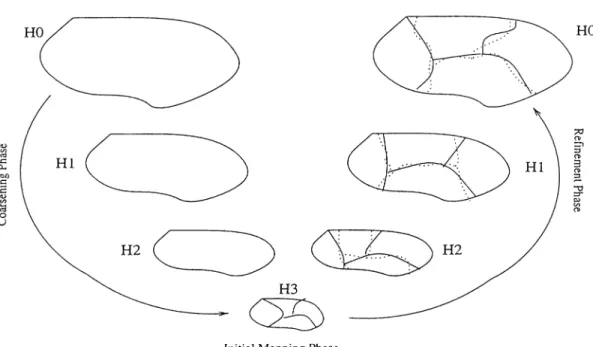
multilevel approaches have three phases: coarsening^initial partitioning, and uncoarsening. In the first phase, the input hypergraph
is coarsened by coalescing highly interacting nodes into multinodes forming a coarser hypergraph. The coarsening operation proceeds coarsening the hyper graph till the number of nodes in the coarsened hypergraph reduces below a predetermined threshold value. By the end of this phase, node degrees become larger than the original hypergraph. In the second phase, coarsest graph is
partitioned into K parts using various heuristics. In the third phase, the ini tial partition found in the second phase is projected back towards the input hypergraph, and refined on intermediate hypergraphs using FM-like heuristics.
Coarsening Phase
In this phase, the given hypergraph H = Tio = (V o,^o) is coarsened into a sequence of smaller hypergraphs Hi = {V i,A ii),?i2 = (V
2
,A/2
), · · · , ={VrnN^m) satisfying |Vo| > |Vi|··· > |Vm|· This coarsening is achieved by
coalescing disjoint subsets of nodes of hypergraph Tii into multinodes such that each multinode in Hi forms a single node in Hi+i- The weight of each node of Hi+i becomes equal to the sum of its constituent nodes of the respective multinode in Hi. Accordingly, the net set of each node of Hi^i becomes equal to the union of the net sets of the constituent multinodes in Hi.
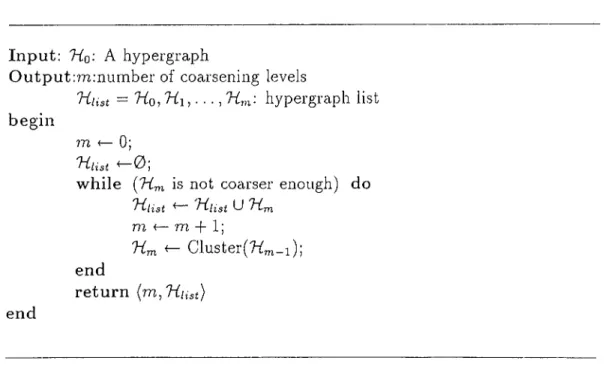
The skeleton of the coarsening algorithm is shown in Fig.
2
.2
. The clustering algorithms used in coalescing can be classified as agglomerative and hierarchical. In agglomerative clustering, new clusters are formed one at a time, whereas in hierarchical clustering several new clusters may be formed simultaneously. The hierarchical clustering scheme is often called matching-based clustering. The reason is that, it matches two nodes in Hi according to some criterion to form a multinode in 'W,q-i. That is, the nodes that are selected are at the same level of clustering. The algorithms in the latter category can choose a node in Hi to be involved in a previously formed multinode in .Initial Partitioning Phase
The goal of this phase is to partition the coarse enough hypergraph generated in the previous phase. Researchers employed a variety of initial partitioning algorithms including random partitioning [15] and bin packing-like methods [
1
, 6].Inpu t: Hq: A hypergraph
Output:m:number of coarsening levels
Tiiist = H o , ' H i , , Hrn- hypergraph list
begin
m
0;Hiist
0
;w hile {Hm is not coarser enough) do
Hlist ^ Hlisi U 'H.ffi
m <— m +
1
;H m Cl.uster(7ir„_i);
end
return {m, Hlist) end
Figure
2
.2
: Coarsening AlgorithmUncoarsening Phase
As seen in Fig. 2.3 the uncoarsening phase proceeds as follows. At each level
i (for i = m ,m — 1 , . . . ,
1
), partition Ili found on Hi is projected back to a partition n ,_i on H i-i- The constituent nodes of each multinode in Hi is assigned to the part of the respective node in Hi. Naturally, the partitions n ,_i and IIj· have the same cutsizes. Then, the new partitioning is refined with an FM-like algorithm.Inpu t: Tiiist = . . . ,'Hm· hypergraph list
m: number of uncoarsening levels a partitioning on Tim O u tp u t: n^o: a partitioning on Tío begin n <— IIh„, w hile (m >
0
) do DoRefinement(7ÍTO, H) m <— m —1
; n ^ Project(n,7fTO,'^m+i) end return n endModels and Solution Methods
In this chapter Interior Point Methods containing repeated matrix-vector and matrix-transpose-vector multiplications will be introduced. The communica tion cost in the parallelization of these applications depends on the communi cation scheme followed. The communication in the parallel implementation of these methods can take place in two schemes. In the first scheme, all of the processors are involved in a global communication on some equal sized sparse vectors. In the second scheme, the sparsity of the vectors can be exploited and communication can be restricted to some sets of processors. Note that in the first scheme all of the processors are involved in the same communica tion operation. Hence, this scheme is referred to here as global communication
scheme. In the second scheme, the communication takes place among some
sets of processors where each processors can be included in more than one set communicating on distinct vectors. Therefore, this communication scheme is referred to here as personalized communication scheme.
The communication cost of the global communication scheme is minimized in Section
3.2
by reducing the size of the communicated vector. The mini mization problem regarding the cost of global communication scheme is solved by minimizing the total communication volume. The total message count can not be changed in the global communication scheme. The communication re- cpiirernents in the parallelization of these algorithms are further investigated and the total communication cost is minimized by following the personalizedcommunication scheme where the total message count and total communica tion volume is minimized. The problem of minimizing the communication cost in the personalized communication scheme will be modeled as a two stage pro cess, where total communication volume is minimized in the first stage and the total message count is minimized in the second stage. Another objective of the second stage is set to be balancing the communication loads of the processors. Although first stage of the problem is solved using an existing hypergraph par titioning tool PaToH [
6
], one can use any other hypergraph partitioning tool which minimizes the total communication volume. The problem in the second stage is modeled with a special hypergraph called communication hypergraph, and we come up with two partitioning schemes that solve the communication cost minimization problem. The first one solves the problem in this stage with a two phase process. In the first phase — trying to be a generic solution— it utilizes PaToH The tool used in this phase is not tuned to work with the communication hypergraph, it just gives the total message count and a lower bound on the total communication volume, where the problem of assigning message loads to processors is not solved. In the second phase, the scheme uses weighted maximal matching in bipartite graphs to solve the assignment problem arising in the first phase. For the second scheme, we have tuned Pa- T oli to work on the communication hypergraph that will be defined to solve the problem.3.1
Applications and Problem Definition
Interior point methods are widely used to solve the linear programming (LP) problem
■minimize c^x subject to A x — b,
X > 0 ,
where, c ,x are real iV-vectors,
6
is a real7
\f-vector, and A is a real M x N matrix of rank M , with M < N. At each iteration of the methods, the searchdirection is determined. This comprises the bulk of the work done [34]. The search direction is computed by solving the set of equations
' D A ^ ' Ae w
A 0 A f . V
where / is the dual variable and D is the diagonal matrix that changes at each iteration. Alternatively, the normal equations
( A i) - 2 A ^ ) A / = r
can be solved at each iteration. Wang and O’Leary [34] discuss many iterative as well as direct methods for the solution of these equations.
In the iterative solution of normal equations, two basic types of opera tions are performed at each iteration of the iterative solver. These are lin ear operations on dense vectors and the matrix-vector product of the form
y = (A T »-
2
A ^ > which is computed as a sequence of matrix-transpose-vector product2
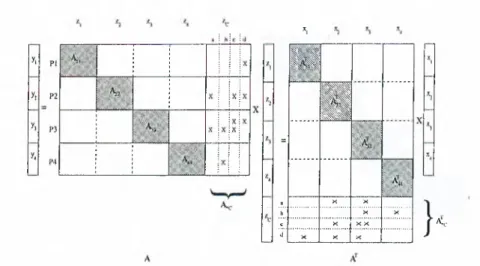
: = D~^A^x and matrix-vector product y = A z. The D~^ matrix changes at each iteration of the interior-point method and hence the ,D“ ^A matrix is computed only once at the beginning of each solution of the normal equations by the iterative solver. Since D~^ is a diagonal matrix, D~^A has the same sparsity pattern as A^. Thus, matrix D~^ is omitted while consid ering computational and communication requirements in the parallelization of the iterative solver.Our goal is the parallelization of the computation in the conjugate gradient like iterative solver through one dimensional rowwise or columnwise piirtition- ing of the M X N matrix A. In the rowwise partitioning of matrix A, matrix A^ is effectively pcirtitioned columnwise, i.e..
A =
Aa-,
^4 ■»
4
. X X] ^2^2
T T T T — — = A|* A3
* A^* X ^3 ^4 'UP'igure 3.1: Overall partitioning of A for K = 4
where processor Pk holds the ^th row stripe Ak» of A thus also holding the /sth column stripe of A^. In order to avoid the communication of vec tor components during the linear vector operations, a symmetric partitioning scheme is adopted. That is, all vectors (each of size M ) used in the solver are partitioned conformally with the row partitioning of A which is equivalent to the column partitioning of A^. In particular, the y and x vectors of size
M are partitioned as [?/i, · · ·, j/t, · · · and [aq, · · ·, Xk, ■ ■ ■ respectively. The z vector of size N is also K-w&y partitioned as [zi, ■ ■ ·, Zk, ■ ■ ■ for the parallelization of matrix-transpose-vector product and matrix-vector product computations. Note that the z vector is an intermediate vector which is not involved in the linear vector operations and its size is in general different than the size of the vectors used by the iterative solver (e.g., y and x). So, the partitioning of the z vector is totally independent from the partitioning of the
y and X vectors. The overall rowwise partitioning will be as shown in Fig. 3.1
for A = 4 processors. In this scheme, processor Pk is responsible for computing the local matrix-transpose-vector product = Aj^Xk, where z = I^k=i
the local matrix-vector product yk = Ak*z. Processor Pk is also responsible for computing the linear operations on the /:th blocks of the vectors. With this partitioning scheme, the linear vector operations in the iterative solver can be easily and efficiently parallelized such that only the inner-product com putations introduce global communication of whose volume does not scale up with increasing problem size. The matrix-transpose-vector product z = x
(a ) ( b )
Figure
3
.2
: Two parallel computation schemes: (a) Post-pre scheme, (b) Pre post schemerequii'es communication just after the local matrix-transpose-vector product computations and the following matrix-vector product y = A z requires com munication just before the local matrix-vector product computations. Thus, this parallelization scheme based on the rowwise partitioning of matrix A is also referred to here as post-pre communication scheme. The communication re quirement in the post-pre scheme is as follows. Each processor Pk holds a local sparse vector of size N and needs to know the resulting vector z =
of size N. This operation can be performed efficiently by a sequence of fold and expand communication steps; which effectively correspond to the post and pre-communication steps, respectively. In the fold communication operation, each processor Pk has a local vector z^ of size N and needs to gather the /:th block Zk of resultant vector z. To accomplish the expand operation, cin all-to-
all broadcast (AABC) operation is needed on the local Zk vectors to provide
each processor with a copy of the global z vector.
The parallelization scheme based on the columnwise partitioning of the A matrix is just the dual of that of the rowwise partitioning scheme. In this respect, this scheme is referred to here as the pre-post scheme, where the op erations performed in the pre and post-communication steps are expand and fold operations, respectively. The flow diagrams of the post-pre and pre-post schemes are illustrated in Fig.
3
.2
.As seen in Fig. .3.2, the major clifFerence between the two schemes mentioned is that the successive fold and expand operations are interleaved with linear vector operations in the pre-post scheme, whereas there are no interleaving linear vector operations between the fold and expa,nd phases in the post-pre scheme. Therefore, in the post-pre scheme the fold and expand phases can be considered as incurring only one synchronization point during the course of an iteration, but in the pre-post scheme there are two synchronization points. Due to this nature of the schemes we choose the post-pre scheme to work on.
As mentioned above, the expand operation is equivalent to the A ABC op eration. Since the communication pattern of the fold operation is the dual of the e.xpand operation, the communication cost of the fold operation is same as that of the AABC operation. In the standard approach the fold and ex pand operations are performed on the global z vector of size N. Therefore, the total communication volume of the post-pre scheme is 2 N {K —
1
) words, where half of the volume is due to the fold operation and the other half is due to the expand operation independent of the underlying interconnection network topology. The total message count varies with the interconnection topology. For example, the total message count is 2 K {K —1
), 4/F(a/ A — I), and 2 K log K in ring, square mesh, and hypercube topologies, respectively. Hence, the concurrent communication cost of a global fold-expand operation becomes: TCt = t = t isu X 2 {K - 1) + X 2 N {K - !)//< , ^su + X 2 N {K - i) /a;^su X 2 log K + tyj X 2 N {K - l ) ! K
in ring, square mesh, and hypercube topologies, respectively, where ij« repre sents the start-up cost and represents the transmission-time per word.
yi yi ^3 ^4 Inlcrmcdiaic X
Figure 3.3:
4
-way rowwise partitioning of A permuted in singly bordered form.3.2
Minimizing Communication Cost in Global
Fold-Expand Scheme
In this thesis, we show that minimizing the communication volume in the global fold-expand operation can be achieved by transforming matrix A into a singly bordered block-diagonal form (SB) through non-symmetric row/column permutation. Consider a 4-way SB form of the A and A ^ matrices, where nonzero entries exist only in the shaded submatrices as shown in Fig. 3.3. The columns of the matrix aligned with zc are coupling columns, i.e., the nonzeros in these columns span more than one row stripe. Each processor Pk holds the diagonal block Akk oi size Mk x Nk and border block Akc of size Mk x Nc and A:th slice of the x vector, i.e., Xk of size Mk, and hence the data blocks and
AJ.q with the responsibility to compute the A:th slice of the y vector, i.e., yk of size Mk- Note that Y^k^^k = M and N c + Y k ^ k = N. To accomplish its duty, each processor has to multiply its matrix blocks with the vector blocks that are aligned with these blocks. That is, the processor Pk has to know the
Xk, Zk, and Zc, but not the whole
2
vector.In the light of above discussion, the operations proceed as shown in Fig. 3.4. Note that in the proposed scheme the global fold-expand operation is restricted to the local zq vectors of size N c instead of the local
2
vectors of size N as1
. each processor Pk computes Zk = Ajk^k,2
. each processor Pk computes its contribution zq to theglobal zc vector z^ = A'^^Xk,
3. perform global fold-expan cl operation on the zc block of the
2
: vector so that each processor obtains zc = Zlyk=i4. each processor computes yk — Akk^k +
Akc^c-Figure 3.4: Parallel computation of y = A A ^ x
performed in the conventional computation scheme. That is, the proposed scheme reduces the concurrent communication volume from (K — 1) x N/K words of the conventional scheme to (/'i —
1
) x N c/ K words. Thus, the problem of minimizing the communication cost in the global scheme can be defined as transforming the A matrix into an SB form such that the border size Nq is minimized while maintaining a balance on the nonzero counts per row stripes of the matrix A. In recent works [7, 25, 26], the problem of permuting rectangular matrices into SB form is formulated as a hypergraph partitioning problem. In this formulation, the computational hypergraph model (column-net version) discussed in Section 2.3 is used. In this model, rows of mati'ix A (columns of A ^) correspond to the nodes and the columns of matrix A (rows of A^) correspond to nets of the hypergraph 7i = (V,yV"). Each node of the hyper- gi'ciph can be weighted by the nonzero entry count of the respective row of matrix A . Consider a /C-way partitioning H = {Vi, V2
, . . . , V/c) of H. fl can be decoded as a partial permutation on the rows and columns of matrix A to induce a permuted nuitrix A,sb· In this permutation, the rows associated withthe nodes in V*:+a are ordered after the rows associated with the nodes in V¿, for k =
1
, 2 , . . . , A' — 1. The columns associated with the nets internal to the nodes in Vk+\ are ordered after the columns associated with the nets internal to the nodes in V^;, for k =1
,2
, . . . , A' —1
, where the columns associated with the external nets, A /jf, are ordered last as the coupling columns. That is, a node Ui € Vk corresponds to permuting row i of A to the A;th slice of As b-An internal net rij of Vk corresponds to permuting column j of A to the Á;th column slice of As b, and an external net rij corresponds to permuting column j of A to the border of Asb· In the partitioning of the associated hypergraph.
minimizing the cutsize according to Eq.
2
corresponds to minimizing the border size N c while maintaining a given balance according to Eq. 4 corresponds to maintaining the computational load balance during both matrix-vector product and matrix-transpose-vector product computations.3.3
Minimizing Communication Cost in Per
sonalized Communication Scheme
The mentioned global fold-expand scheme has two disadvantages. First, the startup cost due to the total message count is totally determined by the un derlying interconnection topology. Second, the communication volume may be unnecessarily high due to the redundant communication.
Consider a close examination of the parallel algorithm shown in Fig 3.4. Only the nonzero segments of border matrix will incur nonzero entries in the local Zq vector computed by processor at step 2. That is, the
vectors are likely to be sparse vectors, so that the zq = operation performed during the global fold operation at step
3
is effectively a global sparse vector addition operation. In other words, processor Pk does not have to participate in the fold operation on the zero-valued components of its Zqvector. In a dual manner, for the computation of the Akc^c product each processor Pk needs to know the resultant
2
: vector components that correspond to the nonzero column segments of A kc which in turn corresponds to the nonzero row segments of A^q. For example in Fig. 3.5, only processors P2 and P3 should be involved in the computation of the cth component of the2
: vector during the fold operation. In a dual manner, only these processors need to know the accumulated result during the expand operation. These facts can be exploited to devise a personalized communication scheme to perform fold and expand operations as follows. For each entry of the zc vector, a processor Pk is assigned the responsibility of gathering and adding all the partial results lor that entry in the fold phase, where the processors that have partial results on this entry send their results to processor Pk- In the expand phase processor*1 =
w
...B
u X X h X X c X X X d X X X}
a;,.Figure 3.5; 4-way rowwise partitioning of A: detailed single bordered from
processors that need the final result — namely the processors that sent the partial results in the fold phase. For example, in Fig. 3.5, processor P\,P2, and P
3
should be involved in the fold-expand operation on dth entry of zc- If processor Pi is assigned the responsibility of folding the dthe entry then it gathers and adds the results from processors P2
and P3
in the fold phase and sends the accumulated result back to processors P2
and P3
in the expand phase. Hence, the personalized fold-expand scheme has the flexibility of reducing the total message count while avoiding the redundancy in communication.The problem of minimizing the communication volume in the personalized fold-expand scheme can also be defined as permuting matrix A into a /F-way SB form as follows. As in the global fold-expand scheme, a given balance criterion should be maintained on the nonzero counts per row stripes of matrix A in order to maintain computational load balance during the local matrix- vector product and matrix-transpose-vector product computations. Different from the global scheme, the total number of nonzero column segments in the
Akc border submatrices should be considered for minimization. Consider the
assumption that the fold-expand responsibility of each entry of the zc vector is assigned to a processor that generates a partial result for that entry. Under this assignment constraint, each coupling column that spans A row stripes of A contributes A — 1 words to the total communication volume.
The problem of permuting matrix A into an SB form with the desired prop erty for the personalized communication scheme can be defined as a hypergraph
P I P2 P2 P3 P4
P2
P3
P4
(b)
Figure 3.6: A 4-way partition of a hypergraph: (a) hypergraph and a parti tioning (b) associated sparse matrix and 4-way decomposition
partitioning problem on the column-net model as described in Section
3.2
for the global communication scheme. However, in this case, the cutsize definition given in Eq. 3 should be considered for minimization instead of Eq.2
. Thus, minimizing the cutsize will correspond to minimizing the total communication volume under the above mentioned assignment restriction, and maintaining the given balance criterion will correspond to balancing the computational loads of the processors as in the case of global communication scheme..Since the personalized communication scheme depends on the nonzero pat tern of the partitioned and permuted matrix, to continue with the discussion we have to assume a partitioning on the matrix A. Due to its superiority in representing the actual communication requirements, the computational hy pergraph model is assumed to be used in the partitioning of the input matrix.
A toy example of a computational hypergraph partitioning is seen in Fig. 3.6 along with its correspondence on the partitioned matrix. In this particular ex ample costili) = J·) = 5, which is equal to the total communication volume in both the fold and expand phases. Note that this equality is true un der the assignment constraint mentioned above. For example, in Fig. 3.6(a) if net d is assigned to part F
3
then partial results generated by Pi and P2 must be sent to processor P3
, where2
-words of communication volume will incur in fold phase, and hence2
-words of communication volume will incur in expand phase due to messages from P3
to Pi and P2·Actually, the assignment of cut nets to parts determines the total commu nication volume as well as the total message count and and it is not considered in [
6
] for minimization of these quantities. Consider the following assignments for the partitioning shown in Fig. 3.6:Assignment V M
ci, b —^ P\',d, c —^ Pt\ 9 6
a, b,d,c P3 5 3
a ^ Pi\b F i;d,c —»· P
2
6
5b P.i]d, a ^ Pi;c P2
6
5where V and M represent the total communication volume and the total mes- scige count both in the fold and e.xpand phases, respectively. As seen from the above table, the total communication volume and the total message count can assume varying values under a given partitioning according to the assignment of cut nets to parts. Particularly, it increases if a net is assigned to a part that is not connected by that net.
Note the following facts concerning the personalized communication used in post-pre scheme.
F A C T
1
The total communication volume and the total message count sent inthe fold phase is equal to the total communication volume and the total message count sent in the expand phase.
Specifically, if a processor Pi sends a message to Pj in the fold phase containing its partial result on some element of zq, then it will receive a message from Pj
containing the folded result in the expand phase to compute
Akc^c-F A C T
2
Although, the computational load of the processor is the same in thematrix-vector product and matrix-transpose-vector product operations, the com munication load o f a processor is not the same in the fold and expand phases.
In the case of partitioning square matrices a cut net Uj in the associated hypergraph is assigned to the part that holds vj, — prerequisiting the existence
of nonzero diagonal entries. This is too restrictive in the applications that do not impose symmetric partitionings on the columns and rows of the input matrix. In those applications, we can exploit the same flexibility as in the rectangular matrices to minimize the communication cost. There is not any clue in the literature about the assignment of cut nets to parts in case of partitioning rectangular matrices. What should be done is to pay tribute to the effect of communication on efficiency and to consider it as a problem that must be attacked rigorously, which is the subject of the following sections.
In the following sections, we propose a two-stage approach for solution of communication cost minimization pi’oblem in personalized communication scheme where the total communication volume is minimized in the first stage and the total message count is minimized in the second stage. The objectives in the first stage is balancing the computational loads of the processors and setting a lower bound on the total communication volume. For this purpose, we use the computational hypergraph model (column-net version) of Qatalyiirek and Aykanat and the hypergraph partitioning tool PaToH [
6
] to find a parti tion n to induce an SB form on the associated sparse matrix. The objective in the second stage is to find a fold-expand responsibility for the nets that are cut by the partition II found in the first stage to minimize the total message count while maintaining balance on communication loads of the processors. For this purpose, we propose the following communication hypergraph model and re duce the problem of the second stage to the hypergraph partitioning problem on the communication hypergraphs.3.3.1
Communication Hypergraph Model
Given a partition FI - {Vi, V
2
, . . . , Va'} of a computational hypergraph T~L — (V,yV), the communication hypergraph is defined as follows. Tic = {V c,A ic) where |Vc| = lA/^j | and \Afc\ — K- That is, for each ?t,· G we have a distinct node in 77c', and for each part Vj we have a distinct net in Tic· The nodeVi G Vc corresponding to ni G resides in the pin list of Uj G A/c- if and only if rii G Mg connects part V j under the partitioning II. That is ~
the partitioned computational hypergraph, they have size of at least 2. The nodes in the communication hypergraph hcis weights associated with them, representing the communication volume due to this net in the computatioiicil hypergraph, which is equal to the connectivity of the corresponding cut net in the computational hypergraph. By this setting, the communication hypergraph
Tic has the following relation to the input matrix A . The rows of the matrix PJ' that are in the border — a ,b ,c,d in Fig.
3
.6
(b) — necessitating folds and expands on the corresponding entries in zc, comprises the nodes of Tic· The row blocks in A are condensed in a single net, and the pin list of this net is set according to the nonzeros in the border blocks in the corresponding row block, meaning that some rows in this block require the entries in the o;-vector that correspond to the column indices whose corresponding nets are cut by the partition.Assume a partition 11^ = {V c i,V c 2, ■ ■ ■ ,Vc k} where Ui G jVc is the net that represents the processor that part V,· is associated in Tic· Recall that Si represents the sizo of the net rii, Pins[nk) represents the nodes that are in the pin list of net njt, and Nets{Vi) represents the nets that are connected to the nodes in the node set Vi. Then this partitioning determines the distribution of communication as follows.
the communication volume handled by processor Pk = , where
- V^ ': is the communication volume sent by processor Pk during the fold phase. It is equal to Sk — \Pins{nk) H Vca-|,
is the communication volume sent by processor Pk during the expand phase. It is equal to £VcM v) ~ |RW'S(n;-) n Vck\·
the total communication volume during both the fold cind expand phases is eciual to ~ \Pins{jik) n Vck\·,
the message count handled by processor Pk = M^ + , where
- M f : is the number of messages sent by processor Pk during the fold phase. It is equal to Xk — I,
- M k- is the number of messages sent by processor Pk during the ex
Figure 3.7: A partition in a communication hypergraph
• the total message count during both the fold and expand phases is equal
to ( E i , M f ) .
Note that the total message count in the fold phase is equal to
which is equal to cost(U c)· Due to Fact
1
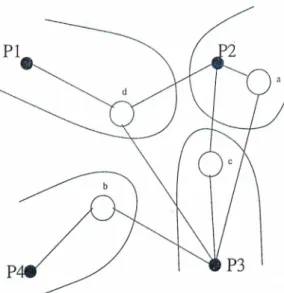
, it is also equal to the total message count in the expand phase.The communication hypergraph of the toy example of Fig. 3.6 and a par titioning is seen in Fig. 3.7. In the figure Pi, P2, P3 , and P4 are set to be re sponsible for fold operations on d,a,c, and b entries of vector zq, respectively.
The communication load of the processors after this partitioning becomes;
part fold ex]Dand
V M V M
Pi - -
2 2
P2
2
2
1
1
P3 3 3
1
1
Pi - -
1
1
where the total communication volume (V) and the total message count (M) in both the fold and expand phases are 5 words and 5, respectively.
In the light of above discussion the objectives of partitioning a comniunica- tion hypergraph can be set as follows:
Objective 1 Minimize cost(J[c) to minimize the total message coxmt in the
fold and expand phases. Minimize connectivity set of nets, \k, in TLct ond minimize nets of parts, Nets(Vck), In
He-Observing that the total communication volume, that is minimized in· the first stage, can increase after the assignment of cut nets to parts by partitioning communication hypergraph, another objective of the partitioning is set to be:
Objective 2 For each part, minimize the number of pins running out of this
part and running out o f its associated net to other nets and parts, respectively.
Objective 3 Maintain balance on the communication volume handled by the
processors.
Objective
1
above stands for the minimization of the total message count in the system as well as message count handled by a single processor in the fold and expand phases. Objective2
stands for minimization of total communication volume. The last objective is required to handle the concurrent communication volume. If the balance on the communication volume is not imposed, then triv ial but deficient solutions such as assigning all the messages and hence all the communication volume to a subset of processors can be proposed. These solu tions are deficient in the sense that the bottleneck processor’s communication volume will be too high, and thei'efore the overall cost of the communication volume will not be reasonable.3.4
Partitioning Computational Hypergraph
In this stage of the algorithm, we resort to the heuristic algorithms employed in PaToH in order to partition the input hypergraph. The objectives that are realized in this stage are balancing the computational loads of the processors