FORMATION AND REPRESENTATION OF INTERESTS IN TURKISH
POLITICAL ECONOMY: THE CASE OF MÜSİAD (INDEPENDENT
INDUSTRIALISTS’ AND BUSINESSMEN’S ASSOCIATION)
The Institute of Economics and Social Sciences
of
Bilkent University
by
MURAT ÇEMREK
In Partial Fulfillment Of The Requirements For The Degree Of
DOCTOR OF PHILOSOPHY IN POLITICAL SCIENCE AND PUBLIC
ADMINISTRATION
in
THE DEPARTMENT OF
POLITICAL SCIENCE AND PUBLIC ADMINISTRATION
BILKENT UNIVERSITY
ANKARA
June, 2002
I certify that I have read this thesis and in my opinion it is full adequate, in scope and in quality, as a thesis for the degree of Doctor of Philosophy in Political Science and Public Administration.
_______________
Assistant Professor Hootan Shambayati Supervisor
I certify that I have read this thesis and in my opinion it is full adequate, in scope and in quality, as a thesis for the degree of Doctor of Philosophy in Political Science and Public Administration.
_______________
Professor Ergun Özbudun Examining Committee Member
I certify that I have read this thesis and in my opinion it is full adequate, in scope and in quality, as a thesis for the degree of Doctor of Philosophy in Political Science and Public Administration.
_______________
Associate Professor Mehmet Okyayuz Examining Committee Member
I certify that I have read this thesis and in my opinion it is full adequate, in scope and in quality, as a thesis for the degree of Doctor of Philosophy in Political Science and Public Administration.
_______________
Assistant Professor Ömer Faruk Gençkaya Examining Committee Member
I certify that I have read this thesis and in my opinion it is full adequate, in scope and in quality, as a thesis for the degree of Doctor of Philosophy in Political Science and Public Administration.
_______________
Assistant Professor Filiz Başkan Examining Committee Member
Approval of the Institute of Economics and Social Sciences _______________
Professor Kürşat Aydoğan Director
ABSTRACT
FORMATION AND REPRESENTATION OF INTERESTS IN TURKISH POLITICAL ECONOMY: THE CASE OF MÜSİAD (INDEPENDENT INDUSTRIALISTS’ AND
BUSINESSMEN’S ASSOCIATION) Murat Çemrek
Department of Political Science and Public Administration Supervisor: Assistant Professor Hootan Shambayati
June 2002
This thesis examines the case of Müstakil Sanayici ve İşadamları Derneği- MÜSİAD [Independent Industrialists and Businessmen’s Association] to evaluate the formation and representation of interests within transformation of the Turkish political economy in the last two decades. The relatively liberalization in Turkey with further integration into the global markets led the development of civil society but it has not meant the waning of the “strong state” tradition. Thus, MÜSİAD as other Turkish business associations has been very dynamic to develop strong adaptability vis-à-vis strong state. The study benefits from Truman’s “disturbance,” Olson’s “collective action” and Salisbury’s “exchange” theories to delineate the emergence, development and mobilization of the association as well as the theories of pluralism, corporatism and clientelism to explore the essence of interest representation in Turkey.
The thesis analyzes the institutional framework and organizational structure of MÜSİAD and argues that the role of Islam for the association has been quite functional providing a common bond for its members, motivation to (re)gain the markets in the Islamic world captured by non-Islamic forces and a way of moderating the labor. MÜSİAD’s reference to the East Asian model was also parallel to its Islamic discourse blended with its emphasis on moral and communitarian values. 1997 has been a turning point for MÜSİAD in its de-emphasis of its ideological pillars as Islam and East Asian economic development model. Following the economic crisis in East Asian countries and the February 28 process, MÜSİAD retreated from its references to both factors. In short, the examination of MÜSİAD is illuminating in terms of illustrating the depth and extent of the Islamic business activity in Turkey as well as the rise of new business elite that could develop a challenging culture vis-à-vis the state.
ÖZET
TÜRKİYE EKONOMİ POLİTİĞİNDE ÇIKAR OLUŞUMU VE TEMSİLİ: MÜSİAD (MÜSTAKİL SANAYİCİ VE İŞADAMALRI DERNEĞİ) ÖRNEK ÇALIŞMASI
Murat Çemrek
Siyaset Bilimi ve Kamu Yönetimi Bölümü Tez Yöneticisi: Yrd. Doç. Dr. Hootan Shambayati
Haziran 2002
Bu tez MÜSİAD (Müstakil Sanayici ve İşadamları Derneği) örnek çalışmasını son yirmi yıldaki Türkiye ekonomi politiğindeki dönüşüm dahilinde çıkar oluşum ve temsilini değerlendirerek incelemektedir. Küresel pazarlara daha fazla eklemlenme ile Türkiye’deki göreceli liberalleşme sivil toplumun gelişmesine yolaçtıysa da, bu “güçlü devlet” geleneğinin sönmesi anlamına gelmedi. Bu nedenle, MÜSİAD Türkiye’deki diğer işadamı dernekleri gibi güçlü devlet karşısında güçlü adaptasyon geliştirmek de gayet dinamik oldu. Çalışma Truman’ın “kargaşa,” Olson’un “kollektif eylem” ve Salisbury’nin “mübadele” terorilerinden derneğin ortaya çıkışı, gelişmesi ve mobilizasyonunu; pluralizm, korporatizm ve klientelizm teorilerinden de Türkiye’deki çıkar temsilinin esasını tasvir etmek için faydalanır.
Tez kurumsal çerçevesi ve örgütsel yapısını inceleyerek, dernek için İslam’ın rolünün üyeler arası ortak bağ oluşturmak, İslam dünyasında gayr-i-Müslim güçlerce ele geçirilmiş pazarları (tekrar) kazanmak ve emeği ehlileştirmek gibi oldukça fonksiyonel bir anlamı olduğunu iddia eder. MÜSİAD’ın Doğu Asya modeline referansı da ahlaki ve cemaat değerlerine vurguyla harmanlanmış İslami söylemi ile parallelik arzetmekteyken, 1997 yılı MÜSİAD için İslam ve Doğu Asya ekonomik kalkınma modeli gibi ideolojik dayanaklarına vurguyu kaldırdığı bir dönüm noktası olmuştur. Dernek, Doğu Asya ülkelerindeki ekonomik kriz ve 28 Şubat süreci nedeniyle her iki referansından geri adım attı. Kısaca, MÜSİAD’ın incelenmesi Türkiye’deki İslami ticari faaliyetin derinliğini ve kapsamı ile devlet karşısında meydan okuyucu bir kültür geliştirebilen yeni bir işadamı seçkinler topluluğunun incelenmesi açısından aydınlatıcıdır.
ACKNOWLEDGEMENTS
PhD thesis writing was a long process for me in which I got the support and encouragement of many people. First of all, I owe special thanks my family who has always stimulated me in this long journey. I am indebted to Hootan Shambayati who has been the “best enemy” more than a supervisor challenging me after reading the drafts. I am thankful to Ömer Bolat, Ahmet Helvacı, Abdurrahman Esmerer for their kindness to have interviews with me as well as MÜSİAD staff, especially to Şükrü Kaya and Serdar Eryılmaz providing me the necessary information. I am deeply grateful to my roommates Mehmet Karakaya and Engin Emlek for their technical help when I am stuck about computer problems. I would like to indicate my deep appreciation for ARIT (American Research Institute in Turkey) for their modest scholarship. I am also very thankful to Nurcan Atalan and Hale Doğan for their help about drafts as well as Galip Yalman for permitting me to read the draft of his book. My special thanks are for my jury members who read the thesis and provided important contributions.
Finally, I owe my greatest thanks to the One whom I owe my being and my capabilities.
TABLE OF CONTENTS
ABSTRACT... iii
ÖZET...… iv
ACKNOWLEDGMENTS...…... v
TABLE OF CONTENTS...… vi
List of English Abbreviations...…….. x
List of Turkish Abbreviations...………… xi
List of Tables………...… xii
List of Graphics...………...… xii
CHAPTER I INTRODUCTION: INTEREST GROUPS AND INTEREST GROUPS POLITICS………...……. 1
1.1. Introduction………... 1
1.2. Theoretical Framework………. 9
1.3. State and Interest Groups……….. 10
1.4. Interest Group Power Variables……… 13
1.5. Literature Review on Interest Groups……….. 16
1.6. Public Interest Groups……….. 31
1.7. Modalities of Interest Representation..………. 35
1.7.2. Corporatism……….. 37
1.7.3. Comparison of Pluralism and Corporatism……….. 45
1.7.4. Clientelism……… 47
1.8. Conclusion………. 51
CHAPTER II STATE-BUSINESS RELATIONS IN TURKEY……….. 56
2.1. Introduction………. 56
2.2. Literature Review……….… 58
2.3. Historical Background……….… 66
2.3.1. Ottoman and Early Republican Era ………. 66
2.3.2. 1950-1980……… 71
2.3.2.1. The Voluntary Business Association Formation in Turkey……… 76
2.3.2.1.1. TÜSİAD... 77
2.3.3. 1980s……… 85
2.4. Conclusion... 93
CHAPTER III TURKISH POLITICAL ECONOMY IN 1980-2000: THE RISE AND FALL OF ISLAMIST POLITICS IN A TURBULENT ECONOMY……… 97
3.1. Introduction………..……… 97
3.2.1. The Military Government Period: 1980-1983……... 99
3.2.2. Özal’s Period: 1983-1989………. 103
3.2.3. The 1990s………. 105
3.3. Economic Level……….. 110
3.3.1. A Brief Account of Turkish Economy in 1980-2000.. 110
3.3.2. The 1980 Adjustment Program and Export-Promotion in the 1980s………. 125
3.3.3 Turkish State’s Role in Economy in 1980-2000…….. 129
3.4. The Political Economy of KOBİs and Islamic-oriented Enterprises in 1980-2000………...………. 139
3.5. Conclusion………...………..……….. 145
CHAPTER IV MÜSİAD: HIGH MORALITY HIGH TECHNOLOGY……….. 148
4.1. Introduction………...………...……… 148 4.2. Historical Background……….………….…….. 150 4.2.1. History………...………. 150 4.2.1.1. Formation ………...………. 151 4.3. Institutional Structure ………...………. 154 4.4. Membership Structure………...………. 163 4.5. Activities………...……….………… 175 4.5.1. Publications………...………….………. 176
4.5.2. International Fairs………...………. 179
4.5.3. International Business Forum (IBF) Meetings………. 183
4.5.4. Foreign Trips………...………. 188
4.5.5. Panels, Educational Seminars and Other Activities.… 190 4.6. Conclusion………...……… 197
CHAPTER V IDEOLOGICAL FRAMEWORK OF MÜSİAD... 199
5.1. Introduction……….. 199
5.2. MÜSİAD and Islamist Politics... 200
5.2.1. The Role and Function of Islam within MÜSİAD.... 200
5.2.2. MÜSİAD and February 28 Process………... 214
5.2.3. MÜSİAD and Milli Görüş Parties... 222
5.3. MÜSİAD and Economy... 231
5.3.1. MÜSİAD and the East Asian Model... 231
5.3.2. MÜSİAD vs. TÜSİAD... 236
5.4. Conclusion... 241
CONCLUSION...… 243
List of English Abbreviations
CB : Central Bank
CDs : Certificates of Deposits CEOs : Chief Executive Officers
CP : Contentment Party [Saadet Partisi-SP] CU : Customs Union
CUP : The Committee of Union and Progress [İttihat ve Terakki Cemiyeti-İTC] DP : The Democrat Party [Demokrat Parti-DP]
DTP : The Democratic Turkey Party [Demokratik Türkiye Partisi-DTP] DLP : TheDemocratic Left Party [Demokratik Sol Parti-DSP]
EU : European Union
FRD : Foreign Relations Department GDIs : Government Debt Instruments GDP : Gross Domestic Product GNP : Gross National Product
GUP : Grand Unity Party [Büyük Birlik Partisi-BBP] IBF : International Business Forum
IMF : International Monetary Fund
ISI : Import-Substituting Industrialization JP : The Justice Party [Adalet Partisi-AP]
JDP : Justice and Development Party [Adalet ve Kalkınma Partisi-AKP] MP : The Motherland Party [Anavatan Partisi-ANAP]
NMP : The Nationalist Movement Party [Milliyetçi Hareket Partisi-MHP] NOP : The National Order Party [Milli Nizam Partisi-MNP]
NSC : National Security Council
NSP : National Salvation Party [Milli Selamet Partisi-MSP]
NWP : Nationalist Working Party [Milliyetçi Çalışma Partisi-MÇP] PM : Prime Minister
PSBR : Public Sector Borrowing Requirement
RDP : Reformist Democracy Party [Islahatçı Demokrasi Partisi-IDP] RPP : The Republican People’s Party [Cumhuriyet Halk Partisi-CHP] SEEs : State Economic Enterprises
SDIF : Savings Deposit Insurance Fund
SDPP : Social Democratic Populist Party [Sosyal Demokrat Halkçı Parti-SHP] SPO : State Planning Organization
SSC : State Security Court TIS : Turkish-Islamic Synthesis TL : Turkish Lira
TPP : The True Path Party [Doğru Yol Partisi-DYP] VP : The Virtue Party [Fazilet Partisi-FP]
WP : The Welfare Party [Refah Partisi-RP]
List of Turkish Abbreviations
ASKON : Anadolu Aslanları İşadamları Derneği [The Anatolian Lions Businessmen’s Association]
DEMSİAD : Demokrat Sanayici ve İşadamları Derneği [The Democratic Industrialists’ and Businessmen’s Association]
HAK-İŞ : Hak İşçi Sendikaları Konfederasyonu [The Confederation of Right Worker Unions]
İŞHAD : İş Hayatında Dayanışma [The Association for Solidarity in Business Life]
KOBİs : Küçük ve Orta Büyüklükteki İşletmeler [Small and Medium Size Enterprises]
MÜSİAD : Müstakil Sanayici ve İşadamları Derneği [Independent Industrialists and Businessmen’s Association]
SESİAD : Serbest Sanayici ve İşadamları Derneği [The Free Industrialists’ and Businessmen’s Association]
TİSK : Türkiye İşveren Sendikaları Konfederasyonu [The Turkish Confederation of Employers’ Unions]
TOBB : Türkiye Ticaret, Sanayi, Deniz Ticaret Odaları ve Ticaret Borsaları Birliği [The Turkish Union of Chambers and Stock Exchanges] TTGV : Türkiye Gönüllü Kültür Teşekkülleri [Turkish Voluntary Cultural
Organizations]
TÜSİAD : Türk Sanayicileri ve İşadamları Derneği [The Turkish Industrialists’ and Businessmen’s Association]
List of Tables
1. No. of Newly Establishing Associations according to Years in Turkey… 88
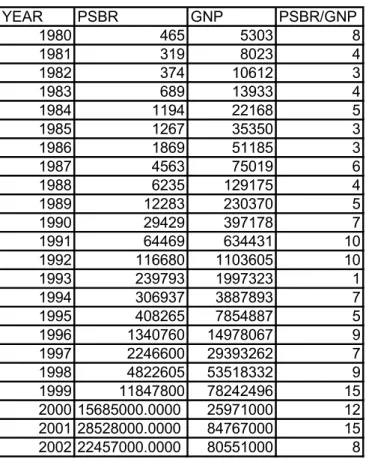
2. Public Sector Borrowing Requirement (PSBR) in 1980-2002…………..131
3. State-Dominated Factors of the Consolidated Budget………..132
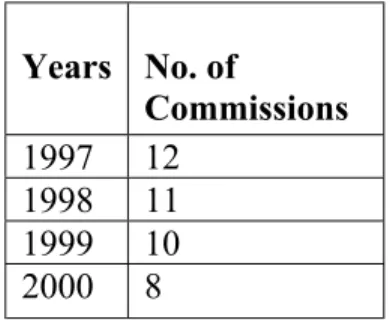
4. The Change in the Number of Subordinate Commissions………160
5. The Change in the Number of Branch Offices………..160
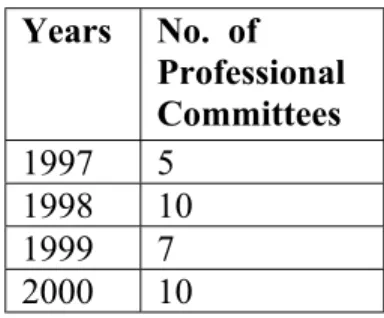
6. The Change in the Number of Professional Committees………..161
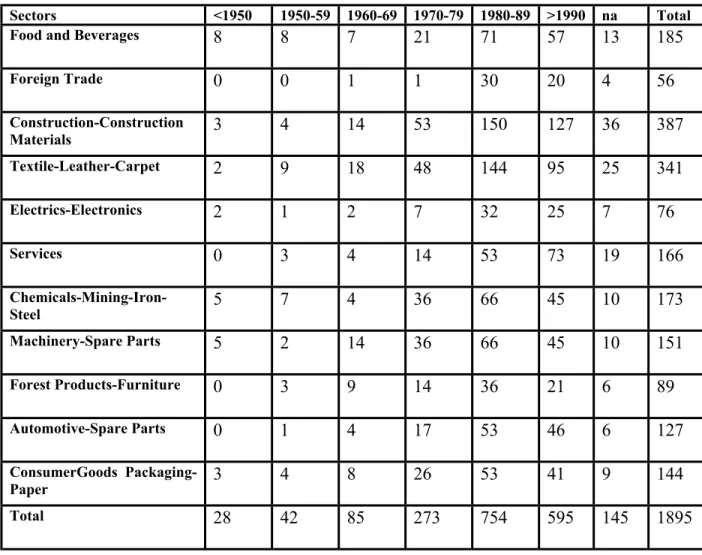
7. Sectoral Distribution of MÜSİAD Member Companies according to Date of Foundation……….165
8. Sectoral Distribution of MÜSİAD Member Companies according to Number of Employees……….166
9. Distribution of Members’ Size according to Foundation Years….……..167
10. The Distribution of MÜSİAD Members according to Sectors…………167
11. The Change in the Membership according to Years………169
12. Geographical Distribution of Members: 1995-1997 according to Branch Offices in Relation with the 1994 and 1999 Municipal Elections……...174
13. MÜSİAD International Fairs………...182
List of Graphics
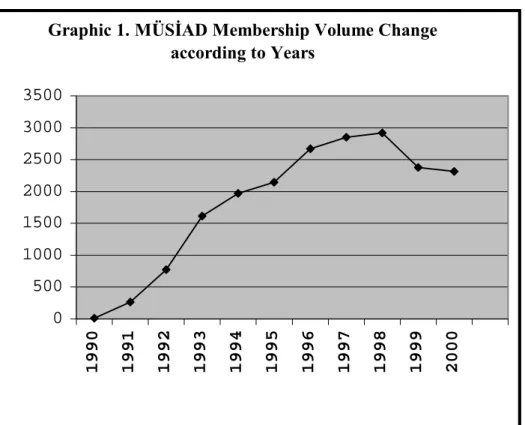
1. MÜSİAD Membership Volume Change according to Years………..…..170CHAPTER I
INTRODUCTION: INTEREST GROUPS AND
INTEREST GROUPS POLITICS
1.1. Introduction
During the first half of the 1990s, the Müstakil Sanayici ve İşadamları
Derneği- MÜSİAD [Independent Industrialists and Businessmen’s Association]
became popular in the public agenda, which came to its peak during the Refahyol -the coalition of Welfare Party-WP [Refah Partisi-RP] and True Path Party-TPP [Doğru Yol Partisi-DYP]- government led by Necmettin Erbakan during July 1996-June 1997. When I decided to study MÜSİAD, the Refahyol government had just fallen down and this, in turn, affected MÜSİAD negatively. The secular media showed MÜSİAD and its members backing irtica, religious reactionism, financially, which undermined the legitimacy of the association. Thus, the examination of MÜSİAD is illuminating in terms of illustrating the depth and extent of the Islamic business activity in Turkey as well as the rise of new business elite that could develop a challenging culture vis-à-vis the state. In order to analyze MÜSİAD, one needs to understand the developments of the political economy of Turkey in 1980s and in 1990s.
The political and economic developments in Turkey led to the emergence of MÜSİAD, in a response to the needs that originated with the transformation of the political economy during the 1980s. Moreover, Islamic business networks such as special finance houses and multi-share holding companies grew to be important actors on the economic scene. In fact, 1980 was a milestone in the history of Turkish political economy due to both the structural adjustment program introduced on 24 January and the military coup of 12 September. Until
this period, Turkish state-business relations were shaped according to the directives of an interventionist state that could dominate and manipulate the business class. However, in the 1980s, the global economic and political developments necessitated a further integration of Turkey into the global financial and commodity markets. This integration process resulted in a shift from an import-substituting industrialization (ISI) model to export-oriented policies, which meant a relative liberalization of the Turkish economy.
Following the transition to parliamentary democracy in 1983, the gradual liberalization of the Turkish society gave previously repressed identities a chance for public visibility. Through the approach of the military rule to integrate Islam into Turkish nationalism -crystallized in the Turkish-Islamic Synthesis (TIS)- the Islamic identity increased its visibility in the public sphere. This public visibility came to fore with diversified activities such as public broadcasting, education networks, publications, holding companies and other civil society organizations. Moreover, the relatively free political atmosphere and the fragmentation of the center-right and center-left parties led to the incremental rise of Islamist politics, and of the WP. This process of relatively liberal restructuration also increased the numbers and the intensity of civil society organizations and their activities, which became more dynamic especially after 1990. Thus, all these developments opened the path for the emergence of a new business elite organized in MÜSİAD. In short, this study is to evaluate the dynamics of this transformation of the Turkish political economy and the rise and fall of Islamist politics by examining the case of MÜSİAD.
Twelve young businessmen with Islamist leanings in İstanbul founded MÜSİAD on May 5, 1990. MÜSİAD soon became the largest voluntary business
association in Turkey with almost 2500 members, 27 branch offices and 45 overseas focal points in 35 different countries. MÜSİAD’s ideological basis is rooted in Islamic religiosity and in the needs of Küçük ve Orta Büyüklükteki
İşletmeler-KOBİs [Small and Medium Size Enterprises]. Originating from
Anatolian towns, this new business elite led by MÜSİAD has challenged the established business elite and the existing institutions while preserving its own traditional and religious values. It also accelerated the globalization of production in Turkey facilitating the mobility of global capital through collaboration with the international system.
MÜSIAD represents the “outsider” business class isolated from state incentives. Beside the political-economic dimension, there is a cultural aspect to the organization that is based on reinterpretation of Islam and Anadoluluk (Anatolianship). MÜSİAD reinterprets the popular religious norms and practices in accordance with the needs of free-market economy by emphasizing the importance of material wealth and hardwork. This attempt at reconciling capitalism and Islam has involved MÜSİAD in the construction and representation of this new type of bourgeoisie who benefited from being Islamic and oppositional within the rhetoric of general industrial progress and export. Thus, MÜSİAD referred to the East Asian countries that succeeded in developing their economic resources despite their traditional belief systems.
For MÜSİAD, Islam is not an obstacle before economic development. However, MÜSİAD’s religious standpoint has not only been a rhetorical trope as the association has also formulated concrete projects for economic union among Islamic countries, e.g. Cotton Union Project. In Anadoluluk, Anatolia is more than a geographical location. It connotes the traditional attitudes fostered with
Islamic moral values as well as the isolation of the petite bourgeoisie from state resources. One has to keep in mind that MÜSİAD headquarter is in İstanbul where approximately the quarter of the membership is located.
1997 happened to be a turning point for MÜSİAD forcing it to reevaluate its discourse about Islamic-orientation and East Asian model of development since both of them resulted in a disappointment. The close links of the organization with the Milli Görüş (National View) Parties; the WP and Virtue Party-VP [Fazilet Partisi-FP] in our study, has diminished since the February 28 process both accelerated the end of the Refahyol government and brought a court file for the closure of MÜSİAD. Thus, MÜSİAD found itself isolated in the political arena. Moreover, the East Asian crisis forced the leadership of the organization to reconsider its enthusiasm for the East Asian model of development after these countries had fallen into heavy economic crises one by one. Despite all, MÜSİAD did not give up referring to Islamic moral values in shaping its communitarian approach.
Why was MÜSİAD established? How is MÜSİAD represented in the political economic order? Whom does MÜSİAD represent? How is MÜSİAD organized? How is the MÜSİAD-government relationship institutionalized? What are the aims of MÜSİAD? What are the priorities in the field of economic policy? Which channels of access does MÜSİAD utilize? How is MÜSİAD’s relation with other business associations? The present study addresses itself to these questions as the main ones.
This PhD thesis on MÜSİAD is based on the following arguments: 1. All social units emerge in relation with the social, political and
factors not only pave the path for the formation of social units but also shape them. As a result of mutual relation, in time social units shape these external factors. In this context, MÜSİAD poses an interesting case since it is in the intersection of Islamic politics and political economy of Turkey in 1980s and 1990s when Turkey was exposed to a noticeable transformation. This historical analysis also provides us the basis to develop an understanding about the hinterland of the organization. The emergence and historical development of MÜSİAD is quite meaningful since it is the result of the rising civil society organizations and their activities as well as the conflict between small and big businesses.
2. We need a multi-theoretical approach to understand interest group formation and interest groups politics in Turkey due to the Turkish state’s dominance vis-à-vis the interest groups. This, in turn, oriented the Turkish business associations to recognize the historical legitimacy of the state and they adapted themselves according to this essential trait. However, in the establishment process of the business associations, we observe a challenging discourse vis-à-vis the state, which wanes in time. For example Türk Sanayicileri ve İşadamları Derneği-TÜSİAD [The Turkish Industrialists’ and Businessmen’s Association] supported the military intervention in 1980 and stood beside the military bureaucracy in the fall of the
Refahyol government despite its heavy emphasis on democracy. MÜSİAD also started to underline state incentives more than Islamic ethics following the February 28 process. 3. MÜSİAD appears as the product of a particular societal
environment where the state has a very significant role in shaping economy and society, and of a particular historical period characterized by certain important changes in domestic and global patterns of production and trade. This period involved the questioning of the traditional role of the state in the economy and its significant revision. This liberal orientation in the economy also resulted in changes in the political front that came hand in hand with the increase of visibility of Islam in the public sphere.
4. MÜSİAD has employed Islam functionally as a cultural-ideological factor supported mostly with secular-economic communitarian notions like Anadoluluk to bind its members in a coherent community, to secure markets and moderate labor. At the last instance, economic aspirations are more significant than Islam since MÜSİAD is a business organization. Thus, the fragility and vulnerability, read flexibility, of this Islamist discourse challenging the state was mainly observed in MÜSİAD’s decreasing its emphasis on Islam following the February 28 period.
5. MÜSİAD symbolizes both “traditional(ism)” and “modern(ity)” simultaneously and develops a synthesis of these
traits within an Islamist identity that is highly colored with Turkish nationalism and reference to the Ottoman imperial past. However, due to its association with political Islam –close links with the WP and VP- the legitimacy of the organization has been under question confronting various difficulties at political and legal levels. MÜSİAD’s functional Islamist identity represents the class interests within a revival of Islamic civilization and forms a network organization transforming traditional KOBİs’ economic mentality to globally integrated export-oriented business.
6. MÜSİAD is the association of the rising new business elite trying to get recognition for the isolated business groups. Thus, the examination of this association is quite illuminating in terms of the depth and extent of Islamic business activity to understand the transformation in Turkish political economy in the last two decades.
The first chapter outlines the theoretical framework of formation and development of interest groups and interest groups politics. The chapter delineates the interest groups from different aspects. The literature review section compares Truman’s “disturbance theory,”1 Olson’s “collective action theory”2 and Salisbury’s “exchange theory”3 to comprehend interest groups’ formation
1 David B. Truman, The Governmental Process: Political Interests and Public Opinion (New
York: Alfred A. Knopf, 1951).
2 Mancur Olson, The Logic of Collective Action: Public Goods and the Theory of Groups
(Cambridge, MA: Harvard University Press, 1968).
3 Robert H. Salisbury, “An Exchange Theory of Interest Groups,’ Midwest Journal of Political
and survival. The section on modalities of interest representation explores the literature on pluralism, corporatism and clientelism and compares them with each other to develop a better understanding of interest group politics.
The second chapter uncovers both the historical-political framework of the business associations and the development of the legal framework in Turkey. The literature review section examines books of Robert Bianchi,4 Metin Heper5 and Ayşe Buğra6 to comprehend Turkish state-business relations within a theoretical approach. The chapter also focuses on the voluntary business association formation in Turkey with reference to Türkiye İşveren Sendikaları Konfederasyonu-TİSK [Turkish acronym for the Turkish Confederation of Employers’ Unions], the Conference Board of Economic and Social Issues, and the emergence of TÜSİAD.
The third chapter explores the emergence and the development of MÜSİAD in conjunction with Truman’s “disturbance theory” through two variables of disturbances- rise and fall of Islamist politics in Turkey and transformation of Turkish political economy from different angles in the last two decades.
The fourth chapter benefits from Olson’s “collective action theory” and Salisbury’s “exchange theory” to delineate the mobilization and development of MÜSİAD. Olson’s approach of exclusive material selective benefits to prevent the free-rider problem is obvious in MÜSİAD’s activities, publications, trips and
4 Robert Bianchi, Interest Groups and Political Development in Turkey (Princeton: Princeton
University Press, 1984).
5 Metin Heper, The State Tradition in Turkey (Walkington: Eothen Press, 1985) and Metin Heper,
ed. Strong State and Economic Interest Groups: The Post-1980 Turkish Experience (Berlin and New York: Walter de Gruyter, 1991).
6 Ayşe Buğra, State and Business in Modern Turkey: A Comparative Study (Albany, N.Y.: State
etc. Salisbury’s theory interrelating the group’s survival upon a mutually advantageous exchange of benefits between the leader and the members is also helpful to understand MÜSİAD as well as solitary benefits -social rewards deriving from participation in group activities- and purposive benefits -rewards associated with ideological or issue-oriented goals. The chapter also analyzes the institutional framework and organizational structure of MÜSİAD through the historical background and Anadoluluk as a cultural basis for network formation in the last two decades.
The fifth chapter discusses the ideological background of MÜSİAD to understand the structure and the identity formation of the association. The chapter analyzes the transformation of the role and the function of Islam for MÜSİAD in conjunction with the Milli Görüş parties, especially WP-VP, and the consequences of the February 28 process. The chapter also focuses on the transformation of the emphasis on the East Asian development in relation to the economic crisis in East Asian countries. The chapter pays attention to TÜSİAD as the other in the identity of MÜSİAD and delineates MÜSİAD and interest group politics.
The last chapter is the concluding chapter in which I discuss the findings and contributions of the thesis to theory through some generalizations based on the Turkish case and in particular on MÜSİAD.
1.2.
Theoretical Framework
In this part, I will outline the theoretical framework of interest groups and modalities of interest representation. Firstly, I will evaluate the relations among state, economy, and interest groups focusing on the definition, functions, the differences between interest groups in different countries and their interaction
with the state. I will assess interest group power in relation to different variables of legitimacy, size, ability to form coalitions with other groups and financial resources influential in policymaking process. In the literature review section, I will compare Truman’s “disturbance theory,” Olson’s “collective action theory” and Salisbury’s “exchange theory” to understand the formation, mobilization and maintenance of interest groups. I will also pay attention to public interest groups to compare them with the economic interest groups in general, and business associations in particular.
The chapter also explores the theoretical framework of interest groups politics through the literature on pluralism, corporatism and clientelism. I will also explore the comparison between neo-corporatism and authoritarian corporatism as well as the comparison between corporatism and pluralism to develop a better understanding of interest groups representation. I will delineate clientelism based on patronage-clientele relations to understand interest groups politics in transitional societies. Most fundamentally, there is consensus that these are ideal types and that no polity actually conforms to either model. Lastly, I will highlight MÜSİAD in relation to its formation and the interest group politics in Turkey in which it is embedded.
1.3. State and Interest Groups
State is one of the essential preconditions for economic growth. Paradoxically, it is also the source of man-made economic decline.7 The
increased importance of the state in the contemporary world, being the crucial
7 Douglass C. North, “A Framework for Analyzing the State in Economic History,” Economic
History, 1979, Vol. 16, [pp. 249-259] in The State: Critical Concepts, Vol. 2, John A. Hall, ed.
factor in the institutionalization of the market, necessarily brings us to evaluate its relations with private interests. In this context, the study of interest groups is one way in which political science could advance beyond the confines of studies of institutions and begins to explore the links between politics and society.
Any effort to characterize the policy-making process must include at the same time an analysis of both the organization of the state and the organized factions, parties and interest groups that seek to influence the state. Both sides of the policymaking equation, the state and organized interests, are important determinants of policy outcomes, and each interacts with the other to produce a distinctive national system of politics and policymaking.8
Interest groups and state agencies can be allies, and each provides the other with valuable resources. State policies may, naturally, have the effect of creating organized interests where none had existed before. Government activity may promote interest group formation, which in turn may produce interest group influence. Thus, governance can also be viewed in interest group terms and the ability of interest groups to influence government policies has certain implications on bureaucratic policy formulation, implementation and administration.9
Interest groups are generally defined as organizations separate from the government, even though often in close partnership with it. They attempt to influence public policy by advancing a particular sectional interest or cause.10
8 Frank R. Baumgartner and Jack L. Walker, “Educational Policymaking and the Interest Group
Structure in France and the United States” Comparative Politics, April 1989, Vol. 21, p. 273.
9 Scott R. Furlong, “Interest Group Influence on Rule Making” Administration and Society, July
1997, Vol. 29, No. 3, p. 325.
Interest groups are often conceptualized interchangeably with “pressure groups” to reflect their activity of exerting pressure on governmental agencies. In this context, interest groups differ from a “lobby” that has the sole purpose of influencing legislation or the execution of policy.11 Conventionally, political parties seek to constitute the government, whereas interest groups try only to influence it. As a result, apparent purposes of interest groups are always narrower than that of political parties.12 On the other hand, interest groups like political parties constitute a form of political participation and they resemble political parties in many of their activities, i.e., political campaigning for candidates, making campaign contributions, screening appointments for public office, and formulating policy alternatives.13
Almost inevitably, all interest groups perform certain functions: (1) providing information to public officials to assist in designing policies; (2) seeking to persuade policymakers to pursue courses of action in the best interests of the organization and its members; (3) communicating with members, keeping them apprised as to what the government is doing, educating them about the political process, and refining support.14 The primary function of interest groups is no longer perceived solely as that of articulating and transmitting demands of the society into the political process; but also socializing citizens, organizing
11 Geoffrey K. Roberts and Alistairs Edwards, A New Dictionary of Political Analysis (London:
Edward Arnold Inc., 1991), p. 66, David, Robertson, The Penguin Dictionary of Politics (London; New York: Penguin Books, 1993), pp. 240, 396-397, Jack C. Plano, Robert E. Riggs and Helenan S. Robin, The Dictionary of Political Analysis (Santa Barbara, California: ABC-Clio Inc., 1982), p. 61.
12 Graham K. Wilson, Interest Groups in the United States (Oxford: Clarendon Press, 1981), pp.
1-6.
13 Graham K. Wilson, Interest Groups, p. 173.
14 Joel Krieger and [et al.] (eds.), The Oxford Companion to Politics of the World (Oxford; New
consensus, contributing to the policy-making process, implementing laws and the like.15 There are several tactics available to interest groups in democracy: control of information and expertise, electoral activity, use of economic power, public information campaign, violence and disruption, legal action and etc. Interest groups, to actualize their raison d’être, often resort to such direct actions as mass rallies, letters to politicians and press, committee negotiations, deputations to government agencies, campaigning for the election of sympathetic candidates or the recruitment of existing legislators, cooperation with official institutions and lobbying.16
In short, there are also considerable differences in the acceptance of interest groups in different countries parallel to: (1) the attitude prevailing towards interest groups in the political culture; (2) the degree to which interest groups achieve a high density of membership; (3) the degree of unity or fragmentation of interest groups; (4) the degree to which interest groups play a prominent role in policymaking; (5) the tactics of interest groups; (6) the differences in constitutions and political institutions and (7) the institutional focus of interest groups.17
1.4. Interest Group Power Variables
Interest groups need to be influential to survive and attract new members. In this context, Williams Keefe saw group power as a function of several factors including its size, its volume of financial resources, the cohesiveness of its membership, the skills of its leadership, its prestige, the geographical distribution
15 Graham K. Wilson, Interest Groups, p. 8.
16 David Robertson, A Dictionary of Modern Politics (London: Europa Publications, 1993), p.
241.
of its membership, the group’s determination and intensity, its ability to form alliances, and the compatibility of its purposes with the traditional values of society.18 Similarly, J. A. Thurber notes,
The power of interest groups depends on their resources (such as money, total membership, and the dispersion of members) and their ability to transform those resources (such as leadership and communication) into action toward an objective (such as passage of a law or regulations) without resistance from other actors (such as groups and government institutions).19
One variable concerning a group’s ability to influence the policymaking process relates to the amount of emphasis it places on participating in policymaking through formal and informal ways. Financial capacity is one obvious variable that will demonstrate a group’s propensity to participate and subsequently influence policy.20 Financial resources offer advantages such as allowing interest groups to hire staff, develop expertise, participate on advisory committees, and pursue other efforts to influence policy. Therefore, an interest group’s budget dedicated to lobbying policymaking agencies is an important element in demonstrating a group commitment to this area of policy development.
The ability to form coalitions with other groups also has an impact on the ability to influence the political agency. One would therefore expect that a group, more successful in forming coalitions, has a greater ability to influence rule making. Influence may vary because of the different amount of resources
18 William Keefe, Congress and the American People, 3rd ed. (Englewood Cliffs, NJ: Prentice
Hall, 1988), pp. 32-33.
19 J. A. Thurber, “Dynamics of Policy Subsystems in American Politics” in Allan J. Cigler and
Burdett A. Loomis, eds., Interest Group Politics, (Washington, DC: Congressional Quarterly Press, 1983), p. 338.
20 Kay Lehman Schlozman and John T. Tierney, Organized Interests and American Democracy
available, the opportunities to influence the executive branch, and the propensity for some kinds of groups to concentrate on the executive branch more than others.21
The legitimacy of an organization also affects its ability to influence the policymaking process. Legitimacy serves as a measure of credibility and knowledge of the political arena and policy. Although legitimacy may be a difficult concept to operationalize, the age of an organization may represent a good substitute. One would expect that the older the group the more legitimate it is in the eyes of policy makers. Older groups have had more time to gather information, make contacts, understand the governmental process, and learn the ropes of policy making. Long life also suggests more influence on the rule-making process.22
The size of an interest group membership may also affect its influence. A large membership may provide substantial resources and a certain amount of legitimacy to the organization although a large membership may be difficult to mobilize. Therefore, larger membership will increase an interest group’s ability to influence the policymaking process. One would therefore expect that as a group’s access increases, so its ability to influence rulemaking increases.23 However, the large group size may affect the cohesion among group members negatively, which increases the free-rider problem. Thus, in small size groups, members easily develop the causal relation between their individual contribution and the attainment of collective goods to be obtained. This provides the
21 Scott R. Furlong, “Interest Group Influence on Rule Making,” pp. 327-328. 22 Ibid., p. 329.
elimination of the free-rider problem and increases the attraction of the group for potential members.
1.5. Literature Review on Interest Groups
The US-American political scientists have mostly shaped the literature on interest groups. Moreover, interest groups have been significant throughout the history of US politics. Yet, political scientists have regularly debated the meaning of interest groups for understanding a country’s political processes. Writers such as Arthur Bentley,24 Elmer Er Schattschneider,25 David B. Truman,26 Earl Latham,27 Robert A. Dahl,28 Mancur Olson,29 Grant McConnell,30 Theodore J. Lowi,31 Robert H. Salisbury,32 Norman Frolich, Joe Oppenheimer, Oran R. Young,33 James Q. Wilson,34 Jeffrey M. Berry,35 Terry M. Moe,36 Russel
24 Arthur Bentley, The Process of Government, (Chicago: University of Chicago, 1908).
25 Elmer Er Schattschneider, Politics, Pressures and the Tariff (New York: Arno, 1935) and
Elmer Er Schattschneider, The Semi-Sovereign People: A Realist’s View of Democracy in
America (New York: Holt, Rinehart and Winston, 1960).
26 David B. Truman, The Governmental Process: Political Interests and Public Opinion (New
York: Alfred A. Knopf, 1951).
27 Earl Latham, The Group Basis of Politics: A Study in Basing Point Legislation (Ithaca, New
York: Cornell University Press, 1952).
28 Robert A. Dahl, Who Governs? Democracy and Power in an American City (New Haven: Yale
University Press, 1961).
29 Mancur Olson, The Logic of Collective Action: Public Goods and the Theory of Groups
(Cambridge, MA: Harvard University Press, 1968).
30 Grant McConnell, Private Power and American Democracy (New York: Alfred A. Knopf,
1966).
31 Theodore J. Lowi, The End of Liberalism: The Second Republic of the United States (New
York: Norton, 1979).
32 Robert H. Salisbury, “An Exchange Theory of Interest Groups,’ Midwest Journal of Political
Science, 1 (1969), pp. 1-32.
33 Norman Frolich, Joe Oppenheimer and Oran R. Young, Political Leadership and Collective
Goods (Princeton: Princeton University Press, 1971).
Hardin37 and Jack L. Jr. Walker38 conceptualized interest groups to be at the core of the political system in their studies.39
Traditional studies on interest groups basically derived from the “group theory of politics.” This approach conceived politics as a process of allocation of social values and resources. Thus, this process could be separated through examination of the groups taking part in and potentially influencing the decision-making process.40
Interest groups were conceptualized as providing a mediating structure standing between the state and the citizen. Bentley’s studies opened up a new chapter in group theory of politics and were later elaborated by Truman and Latham. Ultimately, their attempts aimed at understanding politics from the perspective of interest groups rather than developing theoretical arguments on interest groups. Thus, Truman defined interest groups as “any group that on the basis of one or more shared attitudes makes certain claims upon other groups in society for the establishment, maintenance or enhancement of form of behavior that are implied by shared attitudes.”41
35 Jeffrey M. Berry, Lobbying for the People: The Political Behavior of Public Interest Groups
(Princeton: Princeton University Press, 1977).
36 Terry M. Moe, The Organization of Interests: Incentives and the Internal Dynamics of Political
Interest Groups (Chicago: University of Chicago, 1980).
37 Russel Hardin, Collective Action (Baltimore: John Hopkins University Press, 1982).
38 Jack L. Jr. Walker, “The Origins and Maintenance of Interest Groups in America” American
Political Science Review, 1983, Vol. 77, pp. 390-406 and Jack L. Jr. Walker, Mobilizing Interest Groups in America: Patrons, Professions, and Social Movements (Ann Arbor: University of
Michigan Press, 1991).
39 Frank R. Baumgartner and Beth L. Leech, “The Multiple Ambiguities of ‘Counteractive
Lobbying’” American Journal of Political Science, Vol. 40, No. 20, May 1996, p. 521.
40 Ibid., p. 520.
The literature on social movements developed along a parallel path. In the 1950s and 1960s, analysts generally attributed the emergence of social protest movements to some kind of societal dysfunction paving the path for the emergence of interest groups. Social protest, a form of expression seen as entirely distinct from conventional interest group participation, was the product of some kind of social breakdown, a function of anomie, of society’s failure to provide “intermediary associations” “relative deprivation,” or some kind of “aggregate psychological disorder.”42
Truman related the creation of organizations and participation of people with their desire to protect their interests vis-à-vis disturbances and changes in their social environment.43 Then, such disturbances and changes in the socio-economic medium will consequently result in the disequilibria in the set of organized groups as well as the emergence of new organizations to re-establish the balance. Truman’s disturbance theory, suggesting that interest groups are organized to protect a threatened interest, has received the most extended attention.
Truman exemplified “disturbances” rather than giving a clear-cut definition of the concept. He cited recessions, wars, inflation, discrimination, and increased governmental activity as phenomena that have generated group formation. To demonstrate his theory, Truman examined the history of major farm groups in the Untied States. He argued that the National Grange, the Farmers Alliance, the Farm Bureau, and the Farmers Union all emerged between
42 Neil Smelser, Theory of Collective Behavior (New York: Free Press, 1963); Eric Hoffer, The
True Believer: Thoughts on the Nature of Mass Movements (New York: Harper & Row, 1951);
William Kornhauser, The Politics of Mass Society (Glencoe, Illinois: Free Press, 1959); Ted Robert Gurr, Why Men Rebel (Princeton: Princeton University Press, 1970), p. 24.
1867 and 1900 “out of the increased interaction of farmers in response to intense disturbances of their accustomed behavior.”44
Truman specifically gave voice to the post-war pluralist notion that interest group participation in the political process is an inherent characteristic of the US-American system and he traced the origins of interest groups to their external political environment. Truman argued that two interrelated processes lead to group formation. The first was “societal change” meaning that society evolves and becomes more complex in which new interests emerge while others fade. However, societal change alone cannot account for group mobilization. The unorganized constituencies become organized as a result of general societal change and specific “disturbances” derive individuals to support group endeavors. In short, Truman argued that individuals reacting to social change and/or disturbances with shared interests band together to stabilize relations among themselves when these interests are threatened. In this framework, Truman took an optimistic view of the natural wisdom of society that competing groups will spontaneously arise and an “invisible hand” will secure social checks and balances, stability, reasonable share for all.45
In this context, Truman’s disturbance theory helps us partially to understand the emergence of MÜSİAD. The transformation of Turkish political economy during the 1980s brought several disturbances resulting in a societal change and prompted new interests and their organizations. The implementation of liberal policies in the economic field paved the path for the emergence of new entrepreneurs of small and middle size firms prospering in this decade. Despite the liberalization policies, the state kept its importance in the economy. These
44 Ibid., p. 87. 45 Ibid., p. 33.
new entrepreneurs were not given access to state resources, which oriented them to organize in a new business association, MÜSİAD, at the beginning of the 1990s.
In the 1960s, scholars began questioning Truman’s disturbance theory prompted by Clark and Wilson’s decisive study “Incentive Systems: A Theory of Organizations,” 46 and Mancur Olson’s Logic of Collective Action: Public Goods
and the Theory of Groups, began to examine how groups overcome the
substantial barriers to mobilization. Political scientists increasingly turned their attention to the internal dynamics of interest groups rather than Truman’s external factors. A number of scholars began to push the field back to the study of lobbying and other influence-seeking activities47 since Truman’s disturbance
46 Peter B. Clark and James Q. Wilson, “Incentive Systems: A Theory of Organizations”
Administrative Studies Quarterly, 1961, Vol. 6. No. 2, pp. 129-166.
47 Jeffrey M. Berry, Lobbying for the People; J. David Gopoian, “What makes PACs Tick? An
Analysis of the Allocation Patterns of Economic Interest Groups” American Journal of Political
Science, 1984, Vol. 28, pp. 259-281; Andrew S. McFarland, Common Cause: Lobbying in the Public Interest (Chatham, NJ: Chatham House, 1984); Richard Smith, “Advocacy, Interpretation,
and Influence in the U.S. Congress” American Political Science Review, 1984, Vol. 78, pp. 44-63; John R. Wright, “PACs, Contributions, and Roll Calls: An Organizational Perspective”
American Political Science Review, 1985, Vol. 78, pp. 400-414; John R. Wright, “Contributions,
Lobbying, and Committee Voting in the U.S. House of Representatives” American Political
Science Review, 1990, Vol. 84, pp. 417-438; Kay Lehman Schlozman and John T. Tierney, Organized Interests and American Democracy; Gregory A. Caldeira and John R. Wright,
“Organized Interests and Agenda-Setting in the U.S. Supreme Court” American Political Science
Review, 1988, Vol. 82, pp. 1109-1127; Janet M. Grenzke, “PACs and the Congressional
Supermarket: The Currency is Complex” American Journal of Political Science, 1989, Vol. 33, pp. 1-24; David Vogel, Fluctuating Fortunes: the Political Power of Business in America (New York: Basic Books, 1989); William P. Browne, “Organized Interests and Their Issue Niches: A Search for Pluralism in a Policy Domain” Journal of Politics, 1990, Vol. 52, pp. 477-509; Richard L. Hall and Frank W. Wayman, “ ‘Buying Time’ Moneyed Interests and the Mobilization of Bias in Congressional Committees” American Political Science Review, 1990, Vol. 84, pp. 797-820; John Mark Hansen, Gaining access: Congress and the Farm Lobby,
1919-1981 (Chicago: Chicago University Press, 1991); Jack L. Jr. Walker, Mobilizing Interest Groups in America; Lawrence S. Rothenberg, Linking Citizens to Government: Interest Group Politics at Common Cause (New York: Cambridge University Press, 1992); Scott Ainsworth, “Regulating
Lobbyists and Interest Group Influence” Journal of Politics, 1993, Vol. 55, pp. 41-56; Scott Ainsworth and Itai Sened, “The Role of Lobbyists: Entrepreneurs with Two Audiences”
American Journal of Political Science, 1993, Vol. 37, pp. 834-866; William P. Browne and Won
K. Paik, “Beyond the Domain: Recasting Network Politics in the Post-reform Congress”
American Journal of Political Science, 1993, Vol. 37, pp. 1054-1078; Kevin B. Grier and
Michael C. Munger, “Comparing Interest Group PAC Contributions to House and Senate Incumbents, 1980-1986” Journal of Politics, 1993, Vol. 55, pp. 615-643; John P. Heinz, Edward O. Lauman, Robert L. Nelson and Robert Salisbury, The Hollow Core: Private Interests in
theory was a demand-side theory focusing on the conditions under which individuals will join in a collective action. Supply was not an issue due to the fact that societal conditions would produce a demand for group formation to materialize which formed the skeleton of these studies.
Olson emerged as a devastating critique of Truman’s disturbance theory and reasoned that individuals are not to organize for their collective interests unless problems of collective action are properly solved through “selective benefits.” Olson argued that selective -mainly material incentives exclusively available to members- benefits are the most critical resource that a political organization could have. Olson also reasoned that there are significant barriers to group formation. Primary among them is the “free-rider” instinct among individuals. Rational individuals often will not participate in collective activities if they can enjoy the benefits without doing so.48 In short, he observed the
availability of the common good for free-riders as the obstacle to participation in collective action.
Olson basically disagreed with Truman’s correlation between the proliferation of associations and the social disturbances because he found subordination of individual interest to group interest insufficient to explain voluntary associations. Moreover, Olson criticized the overemphasis of the commonality of individual interests in the formation of collective action, which de-emphasizes the act of a rational individual to obtain collective goods. In sum, National Policymaking; Lucig H. Danielian and Benjamin I. Page, “The Heavenly Chorus:
Interest Group Voices on TV News” American Journal Of Political Science, 1994, Vol. 38, pp. 1056-1078; Kevin B. Grier, Michael C. Munger and Brian E. Roberts, “The Determinants of Industry Political Activity, 1978-1986” American Political Science Review, 1994, Vol. 89, pp. 797-820.
48 Anthony J. Nownes and Grant Neeley, “Public Interest Group Entrepreneurship and Theories
he argued that it is foolish to assume that disturbances will stimulate group formation without taking the cost of participation in a group for an individual into consideration whether in time, money or labor.
Olson argued that no rational individual would assume these costs unless two conditions are met: (1) the likely benefits resulting from participation exceed benefits achieved without participation and (2) benefits exceed the costs of membership and participation. The precise reason behind these two constraints proved is the so-called free-rider problem that occurs when a collective good is sought. Because such goods are non-divisible, all regardless of whether or not they participated can share them equally. In addition, since collective goods appeal to such a potentially broad population, the perceived advantage to the group by any single individual’s membership will likely be calculated as insignificant. Thus, the costs of membership would most often be seen as outweighing benefits.
For interests seeking collective goods, therefore, neither of the aforementioned conditions for participation are likely to be met. The only way in which a potential group could get around this dilemma and attract members, for Olson, was if: (1) exclusive selective benefits -available only to members, such as magazines, discounts, travel, insurance and etc.- are offered in addition to the group’s collective goals; (2) memberships is made compulsory, or (3) the group is small enough to allow any individual’s impact upon the achievement of the group’s objectives seem sufficiently noticeable so that the benefits of participation would be seen to outweigh the costs. 49 Parallel to Olson, MÜSİAD offered exclusive selective benefits such as periodicals, mass travels to foreign
countries, conferences, panels and karz-ı-hasen, a special interest-free lending system, to overcome the free-rider problem.
Olson’s theoretical success was based on its significance on initiating an ample literature on the collective action problem formulating significant barriers to interest group formation, ignored in Truman’s disturbance theory. His theory also stressed incentive structure as an important determinant of interest group’s ability to mobilize and survive while appealing to supporters.50
In the aftermath of Olson’s famous book, the scholarship on interest groups has developed by both assuming that an inherent link exists between the external purposes of a group and the means by which it attracts members. Rational choice theorists conceived of interest groups as working for policies that enable them to provide selective benefits to their members, typically at the expense of non-members. At about the same time, however, another group of scholars, struck by the rapid growth of public interest groups, focused on the tendency of some groups to pursue collective goods that did not selectively benefit their members. Rather, members joined because they agreed with the public goods preferences of the group. At the very least, the absence of the members’ insistence on selective material benefits enabled such organizations to pursue policies involving larger public goods.51 Subsequent studies have
50 Patrick Dunleavy, “Group Identities and Individual Influence: Restructuring the Theory of
Interests Groups” British Journal of Political Science, 1988, Vol. 18, pp. 21-49; Norman Frohlich and Joseph Oppenheimer, “Beyond Economic Man: Altruism, Egalitarianism, and Difference Maximizing” Journal of Conflict Resolution, 1984, Vol. 28, pp. 3-24; John Mark Hansen, “The Political Economy of Group Membership” American Political Science Review, 1985, Vol. 79, pp. 79-86; Terry M. Moe, The Organization of Interests (Chicago: University of Chicago, 1980); Robert H. Salisbury, “An Exchange theory of Interest Groups,’ 1-32; James Q. Wilson, Political
Organizations (New York: Basic Books, 1973).
51 Andrew S. McFarland, Public Interest Lobbies: Decision-Making on Energy (Washington, DC:
American Enterprise Institute, 1976); Jeffrey M. Berry, Lobbying for the People; David Vogel, “The Public-Interest Movement and the American Reform tradition” Political Science Quarterly,
demonstrated that individuals also respond to a variety of “extra-rational” incentives including efficacy, fairness, civic duty and morality52 as well as solitary benefits -social rewards that derive from associating in group activities. Thus, purposive benefits -rewards associated with ideological or issue-oriented goals- also play an important role in motivating group membership.53 Moreover, empirical studies have shown that many individuals join groups to receive non-economic benefits such as fun, camaraderie, and a good feeling derived from promoting a worthwhile cause.54
We can observe the importance of purposive benefits in the development of MÜSİAD, with reference to Islam and locality. MÜSİAD referred to Islamic morality and Anadoluluk to develop the group identity as “outsiders” that could not get close to state resources. This approach shaped the name of the organization as “independent” and MÜSİAD leader cadre claimed that the great tycoons of Turkey have been dependent on the Turkish state. MÜSİAD also benefited from a reinterpretation of Sufism with its market-oriented comment of Islam. This interpretation was heavily blended with reference to communal
1981, Vol. 95, pp.607-627, Kay Lehman Schlozman and John T. Tierney, Organized Interests
and American Democracy.
52 Russel Hardin, Collective Action; Howard Margolis, Selfishness, Altruism, and Rationality: A
Theory of Social Choice (Cambridge, MA: Cambridge University Press, 1984); Gerald Marwell
and Ruth E. Ames, “Experiments on the Provision of Public Goods I: Resources, Interests, Group Size, and the Free-Rider Problem” American Journal of Sociology, 1979, Vol. 84, pp. 1335-1360; Terry M. Moe, The Organization of Interests.
53 Russel Hardin, Collective Action; Howard Margolis, Selfishness, Altruism, and Rationality and
Jack H. Nagel, Participation (Englewood Cliffs, NJ: Prentice Hall, 1987).
54 Jeffrey M. Berry, Lobbying for the People; Allan J. Cigler and John Mark Hansen, Constance
E. Cook, “ Participation in Public Interest Groups” American Politics Quarterly, 1984, Vol. 6, pp. 129-166; R. Keneth Godwin and Robert Cameron Mitchell, “Rational Models, Collective Goods, and Non-Electoral Political Behavior” Western Political Quarterly, 1982, Vol. 35, pp. 160-180; David Marsh, “On Joining Interest Groups” British Journal of Political Science, 1976, Vol. 6, pp. 257-272; Terry M. Moe, The Organization of Interests; Andrew S. McFarland, Common Cause:
Lobbying in the Public Interest; Robert C. Mitchell, “National Environmental Lobbies and the
Apparent Illogic of Collective Action” in Clifford Russell, ed. Collective Decision-Making (Baltimore: Johns Hopkins University Press, 1979), pp. 87-121.
bonds similar to the East Asian development model as well as issue-oriented goals of more export and developing their own business. MÜSİAD also provided friendship among members by organizing picnics, pilgrimage and umre tours.
Critics of Olson approached the world of interest groups as a far more diverse and complex place, full of varied and multi-dimensional group structures and incentives, to organize. Perhaps the starkest evidence of the deficiencies of Olson’s model, according to critics, has been the massive proliferation of interest groups since the political, social and economic conjecture of 1970s, what Mahood calls the “participation revolution.”55 Olson’s portrait of the individual as “a fully rational actor” with a near-perfect knowledge of costs and benefits has been quite suspicious for his critics. A number of influential studies have challenged this assumption in fields ranging from voting behavior to bureaucratic behavior and public policy.56 Rather than the fully “rational minimizer of costs”
and “maximizer of benefits,” William Kelso wonders if man, as a “social animal of limited rationality and limited knowledge,” is a bit more prone to the influences of emotion, ideology, fear, spite, altruism, or obligation than Olson would allow.57 This is why people also organize in public interest groups although they get nothing as benefit.
Critics of Olson also observed that there are obvious structural changes in interest group organization that Olson did not foresee such as agents, alliances, patronage, and etc. Beyond these, the theory of selective incentives could be
55 H. R. Mahood, Interest Group Politics in America: A New Intensity (Englewood Cliffs, NJ:
Prentice-Hall, 1990), p. 1
56 Angus Campbell, et al., The American Voter (New York: John Wiley & Sons, 1976); Herbert
A. Simon and James G. March, Organizations (New York: John Wiley & Sons, 1958); Thomas Dye, Understanding Public Policy, 6th ed. (Englewood Cliffs, NJ: Prentice-Hall, 1987).
more useful in understanding only certain types of organizations in certain situations, namely those which feature a clear free-rider problem such as trade unions on behalf of better wages. However, organizing on behalf of ecological goals has far less visible and quantifiable benefits. Their advocates also see these goals and benefits as being crucially important. As a result, the free-rider problem may not emerge since e.g. environmentalists would not mind sharing the benefits of clean air with the ones who did not contribute towards that goal. Thus, the intangibility and perceived overwhelming significance of such benefits are probably enough to convince concerned individuals that their small share on behalf of the cause is worth making.58
Critics continued that rather than merely being aggregations of co-equal individuals seeking a given benefit; interest groups can be seen as having considerable differentiation among their membership, with some members significantly more important than others. For example, scholars have long stressed the role of the entrepreneur whose skill, risk-taking, and dedication to a cause or goal is said to have the potential to add a huge and crucial element of support.59 Some also focused on the group’s leader, whose job it is to design and administer a group’s founding structure.60 Students of interest groups also noted that groups are increasingly reliant upon professional agents such as lawyers, lobbyists, or consultants who are often quite skillful at achieving influence or
58 Steven M. Davis, “Environmental Politics and the Changing Context of Interest Group
Organization” The Social Science Journal, Vol. 33, No. 4, p. 354.
59 Robert H. Salisbury, “An Exchange theory of Interest Groups,’ pp. 1-32; Norman Frohlich, Joe
Oppenheimer and Oran R. Young, Political Leadership and Collective Goods.
effective mobilization.61 In many cases, it is the skill of such agents rather than a group’s overall membership or resources, which determines group success.
Where do(es) an interest group’s incentive structure(s) come from? Who makes decisions regarding the mix of benefits offered to members? Robert H. Salisbury answered, “the group entrepreneur … [who] invests his capital to create a set of benefits which he offers at a price to a market.”62 Instead of focusing on what motivates members to support interest groups, Salisbury focused on the entrepreneur who administers and designs a group’s incentive structure. Salisbury argued that the group’s survival rests upon a mutually advantageous exchange of benefits between the group leader and group supporters. Thus, Salisbury’s exchange theory acknowledged that a successful group needs a leader able to choose that “right” mix of benefits to offer supporters.
Salisbury centralized the entrepreneur and conceptualized interest groups as exchange relationships between entrepreneurs and members. The entrepreneur invests group resources as benefits offered to the members.63 The group
entrepreneur obtains a good job at a good wage, power, prestige and personal fulfillment while group members receive three types of benefits: material, solitary, and purposive. Material benefits are tangible rewards such as goods or services that have monetary value, solitary benefits are social rewards that derive
61 Robert Salisbury, John P. Heinz, Edward O. Laumann, and Robert L. Nelson, “Who Works
with Whom? Interest Group Alliances and Opposition” American Political Science Review, 1987, Vol. 81, pp. 1217-1234.
62 Robert H. Salisbury, “An Exchange theory of Interest Groups,’ p. 17.
63 For further information see, Robert H. Salisbury, Interests and Institutions: Substance and