University of Richmond
UR Scholarship Repository
Classical Studies Faculty Publications
Classical Studies
2012
A Bronze Kline from Lydia
Elizabeth P. Baughan
University of Richmond, [email protected]
İlknur Özgen
Follow this and additional works at:
http://scholarship.richmond.edu/classicalstudies-faculty-publications
Part of the
Classical Archaeology and Art History Commons
This Article is brought to you for free and open access by the Classical Studies at UR Scholarship Repository. It has been accepted for inclusion in Classical Studies Faculty Publications by an authorized administrator of UR Scholarship Repository. For more information, please contact
Recommended Citation
ELIZABETH P. BAUGHAN, !LKNUR OZGEN A BRONZE KLINE FROM LYDIA
Introduction
In 1982, the
J.
Paul Getty Museum purchased an an-cient kline made mostly of bronze (pl. 9, I) 1• It
repli-cates, at full scale, a wooden couch with lathe-turned legs, comparable to those attested in the Greek world in the sixth and fifth centuries B.C.E2• As one of only four
known bronze beds or couches that" pre-date the Hel-lenistic period3, it is an important artifact that can
con-Antike Kunst 5 5, 2012, pp. 63-87 pls. 9-1 l
1 Accession no. 82.AC.94. The item is mentioned in B. K. McLauchlin,
Lydian Graves and Burial Customs (PhD Diss., University of Cali-fornia, Berkeley 1985) 365 n. 5' and was the supject of an appendix in E. P. Baughan, Anatolian Funerary Klinai: Tradition and Identity (PhD Diss., University of California, Berkeley 2004) 85-88. 566-85 figs. 224-2 3 5. Portions of what follows appeared there, but this paper presents a more detailed analysis and uses the piece as a means to ex-plore current debates about cultural property ownership. This work is based on the authors' personal study of the kline at the
J.
Paul Getty Museum in 1996 and 2001-2002, supported in part by a Humani-ties Research Grant from the University of California, Berkeley. We are grateful to theJ.
Paul Getty Museum and its former and current Curators of Antiquities - Marion True, Karol Wight, and Claire Lyons-for allowing us to study and publish the piece and for provid-ing drawprovid-ings and photographs. For assistance and valuable insights, special thanks are owed to John Papadopoulos and Ken Lapatin, past and current Associate Curators of the Department of Antiquities, and to Jeff Maish (Associate Conservator) and David Scott (then head of the Getty Museum Research Laboratory), who kindly shared the results of their technical analyses, now published in D. A. Scott -J. P. Maish, A Lydian Bed of Iron, Bronze and Copper. Technical Examination of a Metallurgical Masterpiece, Studies in Conser-vation 55, 2010, 3-19. We are also deeply indebted to Crawford H. Greenewalt, Jr., for introducing us to the piece, sharing records of his own investigations into its history, and helping to decipher its rather unpredictable decoration. For editorial assistance, thanks are also due to Rachel Starry and to the editors of Antike Kunst. It should be noted here that the kline is "the subject of ongoing discus-sions" between the Turkish Ministry of Culture and theJ.
Paul Getty Museum (Claire Lyons, personal communication).2 Baughan op.cit. (note l) 23-28. 579-80.
3 The other three are Etruscan: - l: the bronze bed from the
Rego-lini Galassi Tomb at Caere, now in the Museo Gregoriano Etrusco Vaticano 5 59 (here pl. 10, 5-6): L. Pareti, La Tomba Regolini-Galassi de! Museo Gregoriano Etrusco a la Civilta dell'Italia centrale nel sec. VII a.C. (Vatican City 1947) pis. I. 3. 30-31; G. M.A. Richter, The
Furniture of the Greeks, Etruscans, and Romans (London 1966) 92;
A BRONZE KLINE FROM LYDIA
In memoriam Crawford H. Greenewalt, Jr.
. tribute much to our understanding of ancient furniture and metallurgy, and adhering fragments and pseudo-morphs of linen cloth add to the corpus of preserved ancient textiles. The decoration incised on the surfaces of the kline frame offers unique variations upon Ar-chaic ornamental motifs (rosettes, mae~nder bands, and lotus-and-palmette and lotus bud-and-flower chains), in · a freehand technique that suggests individual
interpreta-tion and adaptainterpreta-tion.
Like many objects acquired by American museums in the 1980s, the kline has no certain provenance and no verifiable collectioi;i history and probably entered the antiquities market as the result of illicit excavations. Unlike most looted artifacts, however, its briginal con-text can be determined with near certainty, owing to its rarity: a bronze bed was reportedly plundered from a Lydian tumulus in 1979, and many details of the Getty
G. Colonna - E. Di Paolo, Il letto vuoto, la distribuzione de! corredo e la «finestra» della Tomba Regolini-Galassi, in: Etrusca et Italica. Scritti in ricordo di Massimo Pallottino I (Rome 1997) 131-172; - 2. a similar bed from Tarquinia: C. Avvolta, Annali dell'Instituto di cor-rispondenza archeologica l, 1829, 91-93 pl. B; Colonna and Di Paolo
op.cit. (see above) l 33 n. 7; - 3. another, composed of bronze sheeting
on an iron framework, reportedly found in one of the graves in the 'Tumulo di Mezzo' at Macchiabuia, with the remains of two individu-als: A. Minto, Marsiliana d'Albegna, Le scoperte archeologiche de! Principe Don Tommaso Corsini (Florence 1921) 26. A bronze bed in the Campana Collection appears to be a modern creation, inspired by the Regolini Galassi bed: G. Q. Giglioli, Studi Romani 3, 195 5, 430; F. Gaultier in: Les Etrusq\.Jes et !'Europe. Exposition aux Galeries na-tionales du Grand Palais, Paris, l 5 septembre - 14 decembre 1992 I
Altes Museum, Berlin, 25 fevrier- 31mai1993 (Paris.and Milan 1992) 358. Bronze couches are attested textually in Thuc. 3.68.3, where bronze and iron fittings from the. razed walls and buildings of Pla-taia are used to make couches for dedication to Hera, and in Pliny NH 34+9, on the fame of Delian bronze couches and couch-fittings. For bronze appliques or reinforcements for wooden couches of the Archaic and Persian periods, see infra note 124. For Hellenistic and Roman bronze (and bronze-fitted) couches and stools: Richter op.cit.
(see above) 58, figs. 308 and 530-49; S. Faust, Helvetia Archaeologica 23, 1992; 82-uo, figs. 9-16; A. Wallace-Hadrill, Rome's Cultural Revolution (Cambridge 2008) 421-25°; D. Andrianou, The Furniture and Furnishings of Ancient Greek Houses and Tombs (Cambridge 2009) 33-38, figs. 7-8. For iron beds and bed-frames from early Etruscan tombs: Minto op.cit. (see above) 26. 34-39. 158-174. 282-3 fig. 7, pl. 48, l; S. Steingraber, Etruskische Mobel (Rome 1979) no. 13.
LegG
Rail B
Fig. l Getty bronze kline, drawing of whole
LegH
u ·;a
c::
kline's decoration and design accord with an East Greek or Lydian manufacture and a date consistent with that of the plundered tomb. This unique bronze kline, then, also sheds new light on Lydian burial customs and
decora-tive arts and serves to illustrate the culture of looting that plagues Lydian tumuli4• It also raises the important issue of how we should deal with looted antiquities in a way that best serves the archaeological community. An un-provenanced item out of context, especially a rarity like the Getty bronze kline, is essentially useless; but when context can be recovered, such a rarity can offer valuable insights into the culture th~t produced and used it. Ren-frew has recently coined the term "post-disjunctive fo-rensic re-contextualisation" for this kind of analysis and has praised the recent "successes" of such work in Italy5•
Ignoring an object like this because of its looted status · serves only to sustain the loss of archaeological infor-mation caused by the tomb robbery. This paper marks the first archaeological study of the piece and its context since its discovery more than thirty years ago and is the result of collaboration among scholars and conservators in both the US and .Turkey. It is our sincere hope that publication of this piece will not only raise awareness of the ongoing problem of tumulus looting in Lydia but als9 enable discussion of approaches to provenance re-covery and issues surrounding repatriation.
General description of the kline
The frame and legs of the kline are composed of iron encased in cast bronze, and its bed-surface consists of thin copper sheeting, perforated to create a latticed ap-pearance
(jig.
I; pl. 9, I). Its cast legs exemplify the de-veloped 'Type A' form classified by H. Kyrieleis, with a4 C. H. Roosevelt - C. Luke, Looting Lydia: The Destruction ot
an Archaeological Landscape in Western Turkey, in: N. Brodie -M. -M. Kersel - C. Luke - K. W. Tubb (eds.), Archaeology, Cultural Heritage, and the Antiquities Trade (Gainesville 2006); C. H. Roosevelt - C. Luke, Mysterious Shepherds and Hidden Trea-sures: The Culture of Looting in Lydia, Western Turkey, Journal of Field Archaeology 3 l, 2006, 18 5-98.
5 C. Renfrew, Combating the Illicit Antiquities Trade: Progress and
Problems. Paper delivered at the International Meeting on Illicit Traf-fic in Cultural Property, Ministero per i Beni e le Attivita Culturali, Rome. Summary published in Ufficio Studi, Newsletter 2 (2009). http://www. ufficiostudi. beniculturali.it/ mibac/ export/UfficioStudi/ sito-UfficioStudi/Contenuti/ Archivio-N ewsletter/ Archivio/ 2010/ Newsletter-2/v.isualizza_asset.html_1712427011.html (21 May 201 l).
Fig. 2 Elevation dra~ing of kline, with rail C facing front
0
Fig. 3 Detail drawing of incised decoration on the face of rail C
central swelling balanced by concavities above and be-low, and a separately modeled foot6
•
The legs on one short end are slightly taller (by ca.
1 cm) than those on the other end and are distinguished
also by the presence of an additional molding on the lower concave portion of the leg7• Ancient klinai of all
known types (represented in Greek 'vase painting and Etruscan tomb painting, and replicated in stone as burial receptacles in Lydian tombs) often have one end higher than the other, to help support an elbow (usually the left) while banqueting8
• On Type A couches, a resting surface
was sometimes provided by a board or plank extending between the corner posts of the higher end9• While the
Getty kline lacks such a 'headrest' and the height dif-ference between the two ends is very slight, for the sake of clarity in the following analysis the taller end will be referred to as the 'head' end while the shorter will be
6 H. K yrieleis, Throne und Klinen: Studien zur Formgeschichte
altori-entalischer und griechischer Zeit,
J
di Erganzungsheft 24 (Berlin 1969) 118-41 fig. 22. Cf. Richter op.cit. (no~e 3) 5 5...'..56 "couch with turned legs";J.
Boardman, Symposion Furniture, in: 0. Murray (ed.), Sym-potica: A Symposium on the Symposion (Oxford 1990) 125; Baughanop.cit. (note 1) 24-30. For real wooden examples of turned legs of this type: B. D. Filow, Die Grabhiigelnekropole bei Duvanlij in Siid-bulgarien (Sofia 1934) figs. 145-46, and Kyrieleis op.cit. (see above) pl. 17, 3-4, a small wooden couch or bed found within a sarcophagus in a tumulus at Duvanli in Thrace; Richter op.cit. (note 3) figs. 217-18, stool (?)legs from Egypt and Olympia; and a couch(?) leg from an Etruscan shipwreck: M. Bound, The Giglio Wreck. A wreck of the Archaic period (c. 600 B.c.) off the Tuscan island of Giglio. An account of its discovery and excavation: a review of. the Main Finds,
ENAAIA Suppl. 1 (Athens 1991) 27 fig. 63.
7 The legs on the head end are also slightly wider, with a foot diameter of 0.07 m on the head end and 0.06 m on the foot end.
8 See Boardman op.cit. (note 6) 125; Baughan op.cit. (note 1) 17-18. 9 E.g., Filow op.cit. (note 6) fig. 150.
A BRONZE KLINE FROM LYDIA
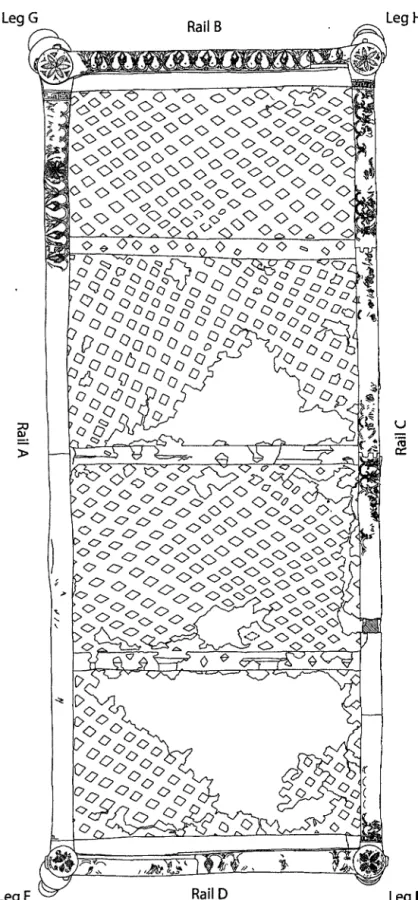
called the 'foot' end. Variation in the incised ornament on each of the four rails and the leg tops as well as in the leg profiles make further designations necessary. The four sides of the kline will therefore be referred to as A, B, C, and D ..:. A being the front of the kline if the head end is -placed on the right, B being the short side on the foot end, C being the back long side, and D being the short side on the head end (moving clockwise from the front) - and the legs will be referred to by the letters E through H (see diagram, jig. 1). The taller legs (E and F) have an additional, carinated torus molding in the mid-dle of the lower shaft.
At the top of each leg are two rectangular projecting 'tenons' in relief, one on each exterior side10
• Those on
the long sides of the kline are horizontally placed, while those on the short sides are vertical. These replicate ten-ons used in mortise-and-tenon joinery of wooden frame to legs, as commonly seen in representations of klinai in Greek vase-painting11
• The surfaces of the tenons carry
incised parallel lines, in groups of three. These striations must represent the end grain of wooden tenons, as some-times included in painted representations of klinai12
•
The upper surfaces and the top parts of the legs are covered with pseudomorphs of textile material that was once in contact with the metal, and in some areas actual remains of linen textile are preserved. The top surfaces
10 The tenons measure ca. 3 cm x I cm.
11 E. Simpson, The Andokides Painter and Greek Carpentry, in:
A.
J.
Clark-J.
Gaunt (eds.), Essays in Honor of Dietrich von Both-mer (Amsterdam 2002) 312-14; Baughan op.cit. (note l) 25. 37. 12 Simpson op.cit. (note 11) 313; Baughan op.cit. (note 1) 37-38. See,e.g., a red-figured kylix attributed to Makron, New York, Metro-polii:an Museum of'Art, 20.246 (Beazley Archive vase no. 204800),
Fig. 4 Det*il drawing of incised decoration on rail B
i
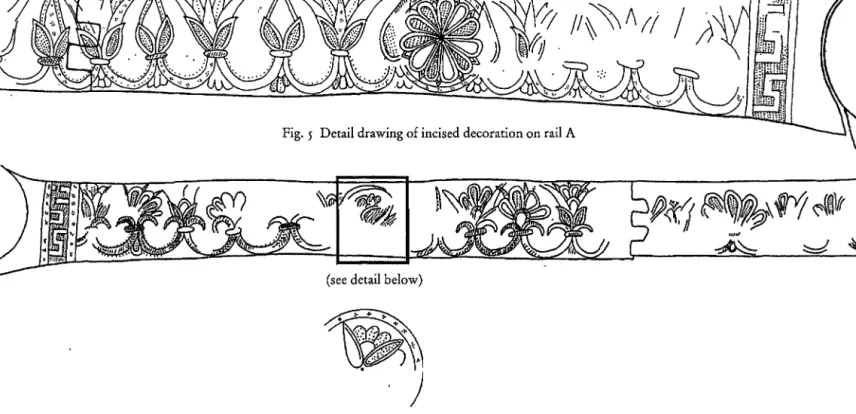
of all four rails are decorated with incised lotus chains: a lotus bud-and-flower chain on three sides (A, B, and D) and lotus-and-palmette on the other (C) (fig. 1). On the long rails (A and C), the lotus frieze is bordered at each end by a maeander band, conceived as if overly-ing the lotus friezes, whi~h seem to pass under them (figs. 5-6) 13
• These lotus chains are oriented with their
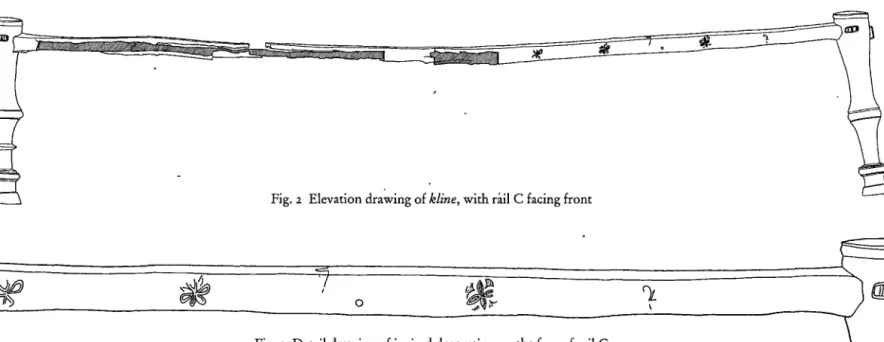
connecting tendrils towards the bed-surface of the kline, and all are executed in a free style, with a high degree of variation in the spacing of the individual elements as well as in the particular details of decoration, which will be considered in greater detail below. The faces of the long rails also carry incised rosettes, at regular intervals (fig. 3) 14, and the disc-shaped tops of the legs are
deco-rated wjth compass-drawn rosettes or quatrefoil motifs (fig. 1;pl. 9,3-5)15
•
Composition and Construction
The construction of the kline was a complex pro-cess, incorporating several different types of metal and a sophisticated understanding of their relative melting points, and involving a surprising conjunction of metal and wooden joinery techniques. Radiographic imaging has revealed that construction began with a simple iron core: four bars creating a rectangular frame, secured at the corners by vertical rods that served as interior
sup-13 Cf. the lotus-palmette chain on the front rail of the terracotta
sar-cophagus from Caere in the Louvre, Richter op.cit. (note 3) fig. 451.
14 The rosette motifs are spaced o. l o-o. l 5 m apart and vary in shape
and design. One appears to have seven petals, while another is a four-petaled rosette-star(?) with fan-shaped elements between the petals.
15 Small impressed points at the center of each design and some lightly
incised arcs reveal the use of a compass in laying out these designs. Legs G and H have rosettes with six dot-filled, pointed petals and fan-shaped, dot-filled elements between the petal ends, and the whole is surrounded by ring of tiny dot-rosettes in a double-bordered band
(fig. r; pls. 9, 3. 5). Additional dot-rosette clusters float between the
petals of tlie rosette, beneath each 'fan'. On legs E and F (fig. r; pl. 9, 4) are quatrefoil motifs composed of dot-filled petals, bordered by plain bands fringed with tiny, fringed petals. Clusters of smaller petals oc-cur irregularly between the main petals of the quatrefoil, surrounded by a ring filled with tiny dot rosettes.
ports for the cast bronze legs16• The horizontal frame is
visible in some places where the iron has corroded and expanded, causing the surrounding bronze to crack and spall off (fig. 2; pl. 9, I). The x-ray images also reveal that the vertical rods are not of uniform length and do not in all cases extend through to the bottom of the leg17
• The
casting of four uniform legs must therefore have been the next step in the production process, to create the sta-bility necessary for subsequent stages of construction. The legs were apparently cast via the lost wax method around the iron rods at their core; empty hollows be-tween the iron rods and the surrounding bronze, visible in the radiographic analysis, must represent some other core material used in the casting process18• Confirmation
of this sequence may be seen at the juncture of legs to frame, where the ends of the rails appear to 'melt' around the contours of the legs (pl. 9, 5 ).
Before the casting of the rails, however, the b~d-sur
face had to be put in place. This is composed of four pure copper sheets, hammered thin and perforated with dia-mond-shaped cut-outs for a latticework effect19
• These
sheets were laid side by side and supported at their junc-tures and at the ends on five copper cross-rails, to which they are attached with small rivets. Each joint is mask~d by an overlying band of copper sheeting, matching the width of the cross-rail below (pl. 10, 1-2). All these overlying bands except for the two on the ends have dia-mond-shaped perforations that continue the overall im-pression of a surface composed of latticed bands/cords, though somewhat less regular and less dense than those on the copper sheets (fig. 1; pl. 10, 1). The short ends of
these copper sheets were then wrapped around the iron bars that form the core of the long rails20
, and the
cop-per sheeting was then further secured to the iron bars by
16 Scott - Maish op.cit. (note l) 5-6. 17 Scott- Maish op.cit. (note l) 7 fig. 6. 18 Scott-Maish op.cit. (note l) 7-8 fig. 6.
19 Each copper sheet measures ca. 0.30-0.40 m x 0.70 m.
20 The folding of the copper sheeting around the iron bar is apparent
Fig. 5 Detail drawing of incised decoration on rail A
,{(/
~\
f1
~61ff ~
"'"
~ ~
(see detail below)
Fig. 6 Detail drawings of incised decoration on rail C
riveting or soldering. Next, the rails were cast in bronze by the lost wax method, around their iron cores21
•
The contact between the molten bronze and the cop-per sheeting may have been what prompted the use of pure copper for the bed-surface: since the melting point of copper is higher than that of bronze, the use of cop-per would have ensured that the bed-surface could with-stand the casting of bronze around it22
• That this was a
concern to the designer(s) of the piece may also be re-flected in the high lead content of the bronze alloy itself
(9,3% lead, 8,5% tin)23
• Since a high lead content lowers
the melting point of bronze, it could have been intended to alleviate further any potential problems in the casting of the bronze rails directly over the ends of the copper sheets24
• It is also possible that the choice of materials
had something to do with the desired coloring of the finished product. In their recent technical report on the
kline, Scott and Maish suggest that the combination of copper and bronze may have been intended for a poly-chrome effect, since the pure copper of the latticed
bed-21 Scott - Maish op.cit. (note r) 9-ro. The short rails (B and D) were
evidently cast first, because the bronze at the ends of the long rails (A and C) seeped around the legs and over the ends of the short rails in several places (pl. 9, 5).
22 D. Scott and]. Maish, personal communication.
23 Scott - Maish op.cit. (note r) 5. Cf. D. A. Scott -
J.
Podany in:M. True
-J.
Podany (eds.), Small Bronze Sculpture from the Ancient World (Malibu r990) Table 3.A BRONZE KLINE FROM LYDIA
-surface would have appeared reddish, while the bronze rails and legs, with their high lead content, would have appeared yellowish. The effect may have been similar to that of a wooden couch with leather netting25•
The casting of the rails was carried out in sections, using molds of varying lengths, probably to simplify the casting process by reducing the amount of molten bronze necessary at any one time26• Three of the six
junc-tures between cast sections take the form of a wooden
24 See P. T. Craddock -A. Giumlia-Mair in:
J.
Curtis (ed.),Bronze-working Centres of Western Asia c. rooo-539 B.C. (London r988) 3r9
on the effects of lead in bronze alloys, though the maximum advan-tages of extra fluidity were met by a 2 % lead content and anything above that caused only a "slight reduction in the melting
tempera-ture." · ·
25 Scott- Maish op.cit. (note 1) 10.
26 As
J.
Maish has suggested (personal communication), based on thesize of container used to pour the molten bronze. On the difficulty of casting large quantities of bronze, see H. Lechtman - A. Steinberg in: S. Doeringer - D. G. Mitten -A. Steinberg (eds.), Art and Technol-ogy. A Symposium on Classical Bronzes (Cambridge, MA 1970) 5-6; C. Mattusch, Greek bronze statuary: from the beginnings through the fifth century B.c. (Ithaca 1988) 47. Divisions between separately cast sections are visible at two points along each long rail (A and C), coinciding with the copper cross-rails of the bed-surface (fig. l): one aligned with the center cross-rail, and one halfway between the center and the head end (short rail D). The line visible in the overall photo-graph (pl. 9, l) and included in the drawing (fig. l) near the opposite end of rail C, near the portion of the rail that has cracked open, repre-sents a crack rather than a joint.
(see detail below) (see detail below)
Fig. 7 Detail drawings of incised decoration on rail D
tongue-and-groove joint (figs. I. 5. 6; pl. Io, I-2), while the others end in a straight line, or butt joint. The tongue-and-groove patterns are not simply etched into the bronze to resemble wooden joinery that may have been commonly seen on wooden klinai27 but are real
joints between two separate sections of molten bronze. One was cast with projecting tongues at the end, and the other filled in the space around those tongues to make a tighter fit and a stronger join than would result from two sections of bronze merely abutting one another28
• There
was evidently a concern for creating a stable, strong bond between these sections of separately cast bronze29
• That
these joints align with the divisions between the copper sheets and the reinforcing copper bars suggests that the fastening of the copper sheets and the casting of the rail sections may have been done in step, one section at a time30
• The fact that the most severe cracking occurred
on the side with no division of cast sections raises the
27 That wooden klinai may have sometimes had tongue-and-groove
joints visible in similar locations on the fronts of long rails is evi-denced by a kline painted by Smikros, on an Attic red-figured Stam-nos (Brussels, Musees Royaux des Beaux-Arts A717; ARV2 20,
l;
Beazley Archive vase no. 200102): on the front rail of the kline occu-pied by the figured labeled "Smikros", a vertical line indicating such a joint appears near a rosette, just behind the legs of an aulos-player.
28 The real three-qimensionality of the joints is clear on the front faces
of the rails, especially on rail C, where the bronze outer shell of the rail has split open. For mechanical joins of this type, see Lechtman - Steinberg op.cit. (note 26) 6. For other mechanical joins (with dow-els etc.) and metallurgical joins (through fusion or flow welding), see Lechtman - Steinberg op.cit. (note 26); A. Steinberg in: W.
J.
Young (ed.), Application of Science in Examination of Works of Art (Boston 1973) 103-38.29 Scott-Maish op.cit. (note l) 8-ro. They note that breaks in the iron
in these locations "suggests there is some movement, or flexing, as-sociated with these joints'', so the mechanical juncture may reflect an effort to strengthen potential weak points.
30 Or it may reflect a desire for aesthetic balance, possibly intended to
further the illusionism implied by the tongue-and-groove joints - if this were a wooden couch, such a joint would most likely be placed at a point on the rail with some other structural significance.
possibility that this approach to the problem of casting long segments of bronze really did add extra strength, whether or not that was the intended effect.
Shallow rectangular depressions on the inner edges of the smaller section of both rails B and D probably reflect the shape of the molds used31
• The larger of the
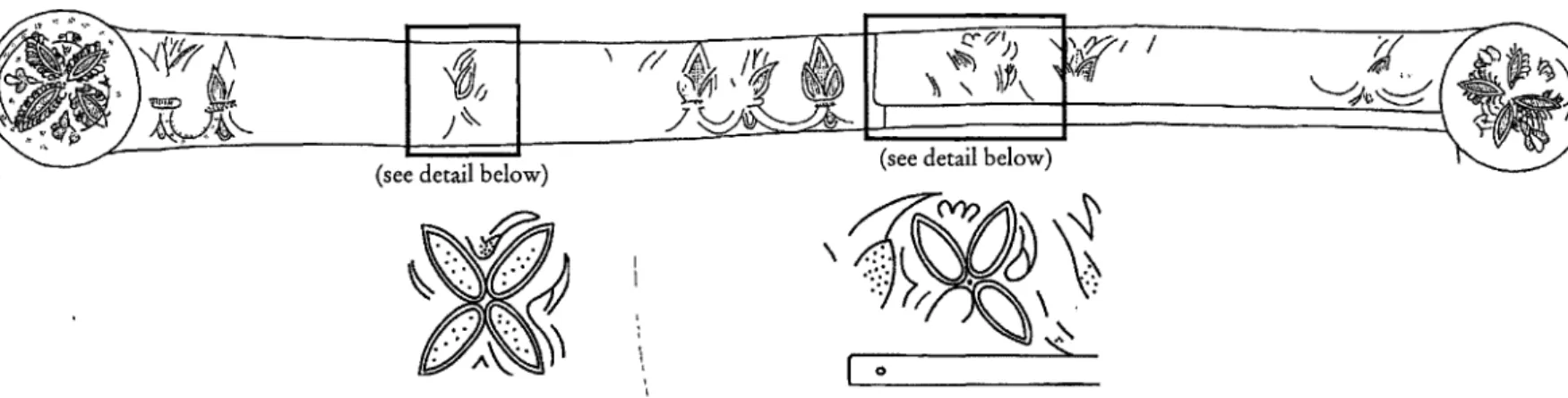
two rectangular depressions (on rail D) was filled with a thin strip of bronze, riveted in place at the end oppo-site the leg and about halfway along its length. Since the engraved lotus chain does not carry over onto the added strip but 'jogs' to avoid it (figs. I. 7), the decoration was
most likely executed before the depression was filled. The recessed strip on the opposite end of the kline (fig. I;
pl. Io, 4), was never apparently filled, as pseudomorphs of linen indicate that its surface was covered by the tex-tile laid over the whole kline at the time of its archaeo-logical deposition.
Textile Remains
Actual remains and pseudomorphs of linen textile are preserved on all upper surfaces of the kline, overlapping all four rails, and on the tops of the legs (pls. 9, 5; Io, I-4). These must represent one or more cloth coverings placed on the couch. Multiple layers of cloth are visible in some areas, but it is difficult to determine whether these be-long to different coverings or different folded layers of the same cloth. The preserved pieces of textile are off-white in color and appear to be plain-weave linen. Two different thread twists (S-spun and Z-spun) have been detected through microscopic analysis of the fibers32
• As
Scott and Maish conclude, this could result from two different people having spun the thread, or it could mean that two different layers of textile are represented33
• The
31 Or perhaps a problem in casting necessitated the insertion of
some-thing flat and rectangular in each of these locations.
32 Scott - Maish op.cit. (note l) l r. 33 Scott -Maish op.cit. (note
cloth (or cloths) may have been decorated in some way. In the preserved remains on the latticed surface of the bed, there are some areas that appear to have a tighter weave pattern, possibly part of a decorative border34• Wispy, wavy patterns in the textile pseudomorphs on the inside of leg G, at about mid-height, in one spot overly-ing a plain-weave layer, may belong to a froverly-inged border or corner tassel, as seen in some Greek and Lydian depic-tions of klinai, particularly in the Persian period35
•
Radiocarbon analysis of some of the textile fragments provides a date of ca. 505 B.C.E., with a two-sigma range of 792-419 B.C.E.36.
34 Two bands of tighter weave, ca. o.o r m wide, are visible near the foot
end of the bed-surface. '
35 The earliest Greek depictions of reclining banqueters (of the late
seventh to early sixth century) show cloths covering the upper parts of Type A couches, sometimes with a fringed border, but by the middle of sixth century the tops of klinai are usually shown. Examples from the Persian period include the couch on a funerary stele from Hayalh in Lydia, Manisa Museum 6225: C.H. Roosevelt, The Archaeology of Lydia, from Gyges to Alexander (Cambridge 2009) fig. 6, 21; and the rock-cut klinai in Tomb 59 at Myra in Lycia: J. Borchhardt (ed.), Myra: Eine lykische Metropole in antiker und byzantinischer Zeit (Berlin 1975) pl. 62a. See also, the carved and painted couches in a Macedonian-style tomb at Vathia near Eretria, K. G. Vollmoeller, AM 26, 1901, 332-76; C. Huguenot, La Tombe aux Erotes et la Tombe d' Amarynthos. Architecture funeraire et presence macedonienne en Grece centrale, Eretria XIX (Golliori 2008) pis. 82-83. A long, over-hanging coverlet is one of the features that distinguishes banqueting scenes in Anatolian-Persian funerary art from those on contemporary Attic vases or Etruscan tombs: P. Calmeyer in: G. Herrmann (ed.), The Furniture of Western Asia, Ancient and Traditional: Papers of the Conference Held at the Institute of Archaeology, University College London, June 28-30, 1993 (Mainz 1996) 223; M. Nolle, Denkmaler vom Satrapenstiz Daskyleion. Studien zur graeco-persischen Kunst (Berlin 1992) 69; B. Jacobs, Griechische und persische Elemente in der Grabkunst Lykiens zur Zeit der Achamenidenherrschaft, SIMA 78 Qonsered 1987) 35; Kyrieleis op.cit. (note 6) 146. See, for exam-ple, the cloth with knotted corners covering a couch of Persian type on a relief from Daskyleion, Istanbul Archaeological Museum 5763: J.-M. Dentzer, Le motif du banquet couche clans le Proche-Orient et le monde grec du VII• au IV• siecle av.J.-C. (Rome 1982) figs. 334-35; H. von Gall, Anadolu 22, l981/r983 (1989) 144 fig. 2; Nolle op.cit. (see above) 16-19. 107-8 no. S2; C. M. Draycott, Images and Identi-ties in the Funerary Art of Western Anatolia, 600 - 450 B.C. (Ph.D. diss., Oxford 2006) u4-16 no. 12.
36 University of Arizona Radiocarbon Laboratory, sample no. V 2053 5;
Scott - Maish op.cit. (note l) l r.
A BRONZE KLINE FROM LYDIA
Analysis and Comparanda Construction
Several features of the construction of the kline are paralleled in other works, while others are evidently unique. The bronze bed from the Regolini-Galassi tomb at Caere (pls. IO, 5-6) makes a useful comparison37•
While both have legs and rails made of cast bronze, the bed-surface of the Regolini-Galassi bed is composed of strips that are interlaced, like the leather straps or wo-ven cords on a real wooden bed would be38
, and
rivet-ea to the frame and cross-rail and, in a few places, to each other. The perforated copper sheets that form the bed-surface of the .Getty kline are very different, resem-bling a latticed network but not actually replicating it. Their attachment to the long rails is also quite differ-ent than the Regolini-Galassi bed, since their ends are wrapped around the iron framing bars and then encased in cast bronze. Other Etruscan metal beds consist of iron frames that supported latticed bronze strips or
a
net- . ting of perishable mateFials that have not survived39, and.interwoven metal strips are also attested for some Hellenistic bronze couches and on an iron bed from
37 Pareti op.cit. (note 3) 124-125, pis. r. 3. 30-31; Richter op.cit. (note
3) 92; S. T. A. M. Mols, Wooden Furniture from Herculaneum. Form, Technique and Function (Amsterdam 1999) 36-37 with n. 136.
38 As on the bed from Duvanli, Filow op.cit. (note 6) u9-26 figs.
143-150. Its frame was composed of ash wood, and its bed-surface was made of netted hemp cords, which ran through holes pierced through the wooden rails. For similar holes in other wooden furniture rails, see Richter op.cit. (note 3) fig. 216 (wooden stool and kline? rails from Olympia); G. Kopcke, AM 82, 1967, Beil. 74 (wooden furniture rail from Samos). Cf. also, the holes along the rails of Prokrustes' bed on a red-figured amphora attributed to the Alkimachos Painter (Munich, Staatliche Antikensammlungen 2325; ARV2 530, 19i Beazley Archive
vase no. 205995), where part of a latticed bed-surface is also shown. On latticed/woven bed surtaces, see also RE 3, l (1897) 370 s.v. Bet-ten (A. Mau); Richter op.cit. (note 3) 53; S. Laser, Hausrat (Gottingen 1968) 26ff.; Mols op.cit. (note 38) 36 n. 136.
39 See Minto op.cit. (note 3) 26. 282-283, for three beds from tombs in
Marsiliana d' Albegna (near Vetulonia), all of which had iron frames and crossbars while only one supported a network of bronze strips as on the Regolini-Galassi bed.
I
Paestum40
• The imitation rather than
replicati~n
of alat-ticed bed-surface, then, makes the Getty klin~ more re-moved, in concept, from wooden prototypes. Similarly, the tenons on the legs of the Regolini-Galassi bed seem to be real structural elements - i.e., they project from one rail through a hole in another to form a connection - rather than molded representations, as on the Getty
kline. But the Getty kline is of course not devoid of ·structural elements derived from real wooden
construc-tion, and the tenons and rails are slightly staggered, just as they would need to be in real wooden joinery so as not to collide41• The mechanical tongue-in-groove
join-ery of the cast bronze sections of the long rails is even more remarkable. Replication of wood joinery methods in bronze is rare, but some parallels are known. Rabbet-ed joints connect separately cast bronze parts of a small Geometric bird once in the Schimmel Collection42
, and
of a sixth-century Etruscan statuette43
• Much more
com-mon is the use of an iron rod as the core of a kline leg composed of another material. This was standard prac-tice by the Hellenistic and Roman period, for couches of bronze, ivory, bone, and alabaster. It usually marks the center of a wooden core, on or around which a finer
40 P. C. Sestieri, Archaeology 9, 1956, 23 figs. 5-6; R. V. Nicholls,
Ar-chaeologia 106, 1979, 13. 28 nn. 24-25;]. G. Pedley, Paestum. Greeks and Romans in Southern Italy (London 1990) 36-39. Faust (in: G. Hellenkemper Salies [ed.], Das Wrack: Der antike Schiffsfund von Mahdia [Koln 1994] 588-89), however, questions the identification of bronze strips found in association with kline fragments in Mahdia wreck as remnants of latticed bed-surfaces, since bronze lacks elastic-ity. It may not be coincidental that all other known examples of metal netting come from funerary or ritual beds, not necessarily ever oc-cupied by the living, though it is alro possible that funeral beds were used by their occupants in life, before relegation to the tomb.
41 The long rails (A and C) are ca. 0.01 m higher than those on the
short sides (B and D). The horizontally-placed tenons, on the long sides, are placed at a higher level than the vertical tenons on the short sides.
42 Lechtman - Steinberg op.cit. (note 26) 18-19 fig. 20; 0. W.
Mus-carella (ed.), Ancient Art. The Norbert Schimmel Collection (Mainz 1974) no. IO;
J.
Settgast, Von Troja bis Amarna. The Norbert Schim-mel Collection New York (Mainz 1978) no. IO; Mattusch op.cit. (note 26) 47 n. 46.43 M. Cristofani, I Bronzi degli Etruschi (Novara 1985) 45 fig. 12.
material was attached or cast44• Thus, the empty hollows visible in the radiographic images of the Getty kline,
around the iron center-rods, may once have been filled with wood.
Form
The Type A leg profiles of the Getty kline are most closely paralleled on couches (and representations there-of) dated to the late sixth and early fifth centuries B.C.E.45•
Couches and thrones of this type first appear in Greek art in the late seventh century, with broad legs deeply undercut in the lower half, between a flaring (often carinated) midpoint and wide foot (e.g.,
fig.
8a-c). The concave profiles of the upper and lower parts of the legs suggest that these forms are meant to represent lathe-turned wooden legs, round in section. Over time (by the end of the sixth century), the proportions lengthen and become more balanced, with less extreme variation in width between the upper and lower portions of the leg -the upper half gets narrower, while -the lower half widens yet still remains more slender than the upper half (e.g.,fig.
Bd-h ). By the late fifth century, the type appears in Attic and South Italian vase-painting with extremely at-tenuated legs, though it is unclear to what extent these paintings are faithful representations of real furniture, as it is hard to imagine such spindly legs providing suf-ficient structural support (e.g.,fig.
Bi). This attenuated variety occurs, for example, on the couch shared by Plouton and Persephone in the tondo of a red-figured cup attributed to the Codrus Painter (ca. 420,pl.
I 1,44 Richter op.cit. (note 3) f7; Nicholls op.cit. (note 40) 9. 28 n. 14;
Mols op.cit. (note 37) 36; A. St. Clair, Carving as Craft. Palatine East and the Greco-Roman Bone and Ivory Carving Tradition (Baltimore 2003) 28. See also, a Roman ivory couch from a tomb near Ancona, E. Brizio, NSc 1902, 445-62 fig. 18; Wallace-Hadrill op.cit. (note 3) 421-35.
45 The development of Type A furniture legs is discussed in more
de-tail in E. P. Baughan, Couched in Death: Klinai and Identity in Ana-tolia and Beyond (Madison, forthcoming).
46 London, British Museum E82; ARV2 1269, 3; Beazley Archive vase
no. 217212. Cf. especially the shape of the central molding. On this cup, see A. Avramidou, AJA 1 IO, 2006, 565-79. Cf. also, the couch in
a b. c d e f g h
Fig. 8 Line drawings of Type A klinai legs: a) Early Corinthian krater; b) Attic figured krater attributed to the Ptoon Painter; c) Attic black-figured oinochoe; d) Terracotta revetment plaque from Tarquinia; e) Etruscan limestone cippus; f) Attic red-figured kylix attributed to Ohos;
g) Sarcophagus lid from Xanthos; h) Tomb of the Diver, Paestum; i) Attic red-figured krater attributed to the Leningrad Painter
1)46• The profile and proportions of the Getty klirie legs
are closer to examples from the early part of the fifth century. Good comparisons can be made with a small wooden bed or couch from a sarcophagus burial at Du-vanli in Thrace (Bulgaria), dated to the early fifth cen-tury on the basis of a lekythos found with it (fig. 9)47 , and with the klinai painted on the slabs lining the Tomba del Tuffatore (Tomb of the Diver) at Paestum (fig. 8h,
ca. 470)48
• The Getty kline legs are similar to both in
depth of concave contours and proportional width of upper and lower portions of the leg, but fall somewhere in between the two in terms of proportional height - the lower portion of the Getty kline leg profile is taller in relation to the upper portion than those on the Duvanli bed, but shorter than the lower part of the legs depicted on the Paestum tomb. Similar proportions are found on Type A klinai represented in Late Archaic Etruscan art, such as on terracotta revetment plaques from Tarquinia
(fig. Bd) and a limestone cippus in Berlin (fig. 8e)49 ; on
the Polyxena Sarcophagus from the K1zoldiin Tumulus
relief outside the fourth-century 'Painted Tomb' (Tomb 81) at Myra in Lycia, though its top is shown covered with a long cloth, Borch-hardt op.cit. (note 35) 136 pls. 75a. 77a. c.
47
Filow op.cit. (note 6) u9-26. 229-30 figs. 143-50; Kyrieleis op.cit.
(note 6) 126ff. pl. 17, 2-3; Z. H. Archibald, The Odrysian Kingdom of Thrace: Orpheus Unmasked (Oxford 1998) 160. 162.
48 M. Napoli, La Tomba del tuffatore. La scoperta della grande pittura
greca (Bari 1970); R.R. Holloway, AJA uo, 2006, 365-88.
49 A. Cataldi, in: E. Rystedt et al. (eds.), Deliciae Fictiles. Proceedings
of the First International Conference on Central Italic Architectural Terracottas at the Swedish Institute in Rome, 10-12 December 1990 (Stockholm 1993) 207-20 fig. 10; Richter op.cit. (note 3) fig. 458. On this couch type in Etruria, see Steingraber op.cit. (note 3) ~13 (Type 2); Richter op.cit. (note 3) 92.
A BRONZE KLINE FROM LYDIA
Fig. 9 Type A kline leg from Duvanli, Thrace, ca. 500 B.C.E., wood
in the Troad, probably ca. 500 B.C.E. 50
; and in Lycian
fu-nerary reliefs of the late fifth and fourth centuries (e.g.,
fig. 8g)51
• The Berlin cippus (fig. Be) also provides a good
parallel for the convex disc capitals of the Getty kline, with the head end only slightly higher than the other. Most Type A klinai in Greek and Etruscan art have one clearly differentiated head end, with a higher raised
capi-50 N. Sevin~, Studia Troica 6, 1'996, 251-64 figs. 14-15; C. Reinsberg,
in: R. Bol - D. Kreikenbom (eds.), Sepulkral- und Votivdenkmaler ostlicher Mittelmeergebiete (7. Jh. v. Chr. - r. Jh. n. Chr.). Kulturbe-gegnungen im Spannungsfeld von Akzeptanz und Resistenz. Akten des lnternationalen Symposiums, Mainz, r.-3. l r.200 l (Mohnesee
2004) 199-217.
51 E.g., in a banquet scene on a sarcophagus lid from Xanthos, Istanbul
Archaeological Museum 5239T: P. Demargne, Fouilles de Xanthos V. Tombes-maisons, tombes rupestres et sarcophages (Paris 1974) pl. 24. See also, a Type A stool depicted on a relief from Kiraz in Lydia, now in the Odemi§ Museum (once in the collection of S. B~oi;lu), ca. 470-450: V. M. Strocka, Jdl 94, 1979, 143-73 fig. l; E. Berger, Antike Kunstwerke aus der Sammlung Ludwig III. Skulpturen (Mainz 1990) Beil. 2, 4.
I
\
tal and sometimes, as in the case of the Duvanli bed, a headboard or armrest plank extended between the capi-tals on the higher end.
Klinai used for protheseis on white-ground lekythoi attributed to the Sabouroff Painter (ca. 450) display sim-ilar leg profiles, and offer further details that are com-parable to the Getty kline52
• The couch on a lekythos in
New York (pl. I I, 2) offers the best parallels for the form of the foot and torus molding at the central carination, though its capitals are of a different type, with multiple layers (stepped fasciae), and its feet rest on high cylin-drical bases, perhaps intended to raise the couch for the
prothesis ritual53
• Like the Getty kline, it also has an extra
ring-element midway along the lower portion of the leg. But on the lekythos this ring consists of horizontal lines outlining a flat band, rather than a projecting torus, and it occurs on both ends of the couch.
The extra torus-ring on the lower portion of the legs on the heael end (legs E and F) is in fact one of the most distinctive features of the Getty kline's design. A wide projecting disc or torus in this location is characteristic of the earliest Type A furniture legs represented in Greek art (on Corinthian vases, Attic Siana cups, and Tyrrhe-nian amphorae, etc.), with very few exceptions (e.g.,
52 London, British Museum D62; ARV2 851, 273; Beazley Archive
vase no. 212421. Houston Museum of Fine Arts 37.8; Paralipomena 424, 37bis; Beazley Archive vase no. 276010; H. Hoffmann, Ten Cen-turies that Shaped the West. Greek and Roman Art in Texas Collec-tions (Mainz 1970) no. 185. Mannheim, Reiss-Museum 195; ARV2
851, 274; Beazley Archive vase no. 212422. New York, Metropolitan Museum of Art 07.286.40; ARV2 846, 190; Beazley Archive vase no.
212338 (pl. I 1, 2). Cf. also, a white-ground lekythos attributed to the Painter of the New York Hypnos, New York, Metropolitan Museum of Art 23.160.37; ARV21242, 3; Beazley Archive vase no. 216742; and
the white-ground prothesis scene (Achilles mourning Patroklos) on a squat lekythos attributed to the Eretria Painter, ca. 420, New York, Metropolitan Museum of Art 31,u.13; ARV2 1248, 9; Beazley
Ar-chive vase no. 216945, with the addition of a down-turned leaf mold-ing above the foot, reminiscent of Achaemenid furniture. The upper part of a similar kline, with rectangular tenoti outlined, is preserved on a fragmentary white-ground lekythos attributed to the Woman Painter, ca. 430-420, Vienna, Kunsthistorisches Museum 3748; ARV2
1372, 16; Beazley Archive vase no. 217615.
53 H. Mommsen, Exekias
I. Die Grabtafeln (Mainz 1997) 18; Baughan
op.cit. (note l) 253-54.
fig. 8a-h)54• In Greek and Etruscan art of the later sixth
and fifth centuries, however, the lower half of a Type A leg usually has a smooth, uninterrupted profile (e.g.,
fig. Be-g. i; pl. II, r)55• There are, however, notable
ex-ceptions, with projecting bands or carinated tori similar to those on the Getty kline (e.g.,fig. 8h)56
, and projecting
rings on the lower leg never disappear entirely from the Type A scheme, for they are also found on South Italian vases57
•
54 E.g., Richter op.cit. (note 3) figs. 294. 456. 593 (Early and Middle
Corinthian column kraters and an Etruscan black-figured kyathos); Kyrieleis op.cit. (note 6) pl. 16, 1-2 (Lakonian and Attic black-figured cups); b. Murray (ed.), Sympotica: A Symposium on the Symposion (Oxford 1990) pl. 13b (Corinthian bowl). See also, Siana cups attrib-uted to the C Painter or the manner of the C Painter (Athens, Nation-al Museum P3639 and 12522; ABV 53, 31 and 59, 12; Beazley Archive vase nos. 300408 and 300517; Hannover, Kestner Museum 1959.1; Paralipomena 24, 32bis; Beazley Archive vase no. 3 50157); early Attic black-figured vases attributed to the Ptoon Painter (amphora in New York, Metropolitan Museum of Art 59.64; Beazley Archive vase no. 350203; column krater in Paris, Musee du Louvre E623; ABV 83, l;
Beazley Archive vase no. 300775) and to Lydos (amphora, Florence, Museo Archeologico Etrusco 70995; ABV no, 32; Beazley +<\rchive vase no. 310178); and Tyrrhenian amphorae (e.g., Bochum Suo4, CVA Bochum l, 2005, pl. 24, 1-2). Early examples without this
ele-ment are, however, known: e.g., an Attic black-figured skyphos, Ath-ens, National Archaeological Museum 996; Beazley Archive vase no. 46491.
55 See also Richter op.cit. (note 3) figs. 213-215. 219. 297. For
exam-ples in other media, see Richter op.cit. (note 3) figs. 458-59. 461-462 (Etruscan cippi, tomb painting, and bronze mirror); Kyrieleis op.cit. (note 6) pl. 17, l (East frieze of the Siphnian Treasury); and E.
Pfuhl-H. Mobius, Die ostgriechischen Grabreliefs (Mainz 1977) no. 23 pl. 6 (Type A throne on a mid-fifth-century stele from Sinope).
56 On a red-figured kantharos fragment attributed to the Brygos
Painter, there is a thin, sharp projection on the lower part of a Type A leg: Athens, National Archaeological Museum; ARV2 1649; Beazley Archive vase no. 275212. At least one of the couches on a fragmentary kylix attributed to the same painter had a rounded molding on the lower leg at the head end: Paris, Cabinet des Medailles 5 8 5; AR V2 3 72, 28; Beazley Archive vase no. 203926. Flat (non-projecting) bands are delineated in this location on some klinai on white-ground vases: on another lekythos attributed to the Sabouroff Painter, London, British Museum D62 (see note 52 above) and on the Eretria Painter's squat lekythos in New York (see note 52 above).
57 E.g., Richter op.cit. (note 3) figs. 221. 300. 642; and a fragmentary
Lucanian red-figured krater in New York, Metropolitan Museum of Art 58.13.1: Kyrieleis op.cit. (note 6) pl. 18, l; R. Hurschmann,
-:;;; .. .
-~
... 012 5 10 20 40cm. •=red11
=green I A Section A B C I I I c-
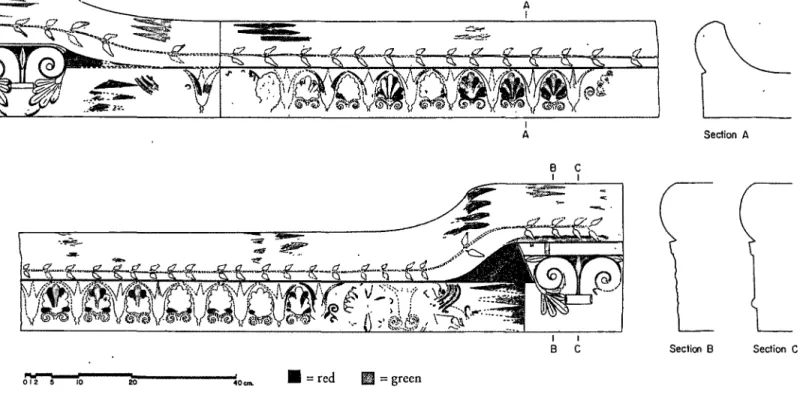
< Section B Section CFig. 10 Elevation and sections of the carved and painted front edge of the rear kline bedslab, Lale Tepe, marble
Such variation of Type A leg details from one end of a kline to the other is itself unusual, and parallels are
no-t~bly scattered. It occurs, for instance, on an Attic Siana
cup and on an Etruscan cinerary urn58
• On the first, the
variation is the addition of an extra ring molding in the lower portion of the leg on only the right/head end of kline, as was probably the case for the Getty kline. In-terestingly, the same kind of extra turning distinguishes the right-/head-end leg on at least two of the seven klinai painted on the slabs of the Tomb of the Diver at Paestum
(fig. 8h ), and these klinai also provide good parallels for the overall form of the Getty kline 59
•
Though no parallels include all the distinctive features of the Getty kline's form and leg profiles, the best com-paranda fall in the second half of the sixth and the first Symposienszenen auf unteritalischen Vasen (Wiirzburg 1985) no. L7 pl. 25. Richter op.cit. (note 3) 56 thinks these "extra turnings" im-pair the "sweep" of the fifth-century Attic examples, but they seem instead to be holdovers from or reinterpretations of earlier Type A form.
58 Murray op.cit. (note 54) pl. 14b, for the Siana cup, in the Kropatschek
Collection in Helgoland (Beazley Archive vase no. 63 5 8); C. Ransom, Studies in Ancient Furniture: Couches and Beds of the Greeks, Etrus-cans, and Romans (Chicago 1905) fig. 7, for the Etruscan urn. For the difference between front and rear legs on the head end of a kline, see the Tomb of Amarynthos near Eretria: Vollmoeller op.cit. (note 35); Huguenot op.cit. (note 35) 214-215. 222 pls. 52. 83.
59 Napoli op.cit. (note 48) pis.
1. 5. I I (the two rightmost klinai on the
north slab). The right legs of the other klinai are not well enough pre-served to determine whether they, too, carried additional moldings.
A BRONZE KLINE FROM LYDIA
half of the fifth century. The wide geographic range of these parallels - from Attic vases to Etruscan reliefs and a burial bed from Bulgaria - reflects the widespread use and popularity of Type A klinai in the Late Archaic and Early Classical period.
Decoration
The decorative friezes incised on the rails of the kline provide further clues for dating and provenance and of-fer more variations on typical decorative schemes. The rosettes at intervals along the faces of the long rails
(fig. 3) are a common sort of kline decoration, seen in representations of klinai in Athenian vase painting as well as among stone funerary couches, but normally on klinai of the Type B variety60
• This kind of decoration
is much rarer for Type A couches, which usually had no surface ornament. Only three known parallels occur with the Type A scheme: on stone klinai from a Lydian tomb (the side couches in the chamber of the Lale Tepe
60 E.g., A. Choisy, Note sur !es tombeaux lydiens de Sardes, RA
1876, 73-81 fig. 13, pl. 13a; U. Knigge, Der Siidhiigel. Kerameikos IX (Berlin 1976) fig. 22; M.
J.
Mellink, Excavations at Karat:l§-Semayiik and Elmah, Lycia, 1973, AJA 78, 1974, 3 58 fig. 16, pl. 69. See also, E. P. Baughan, Lale Tepe: A Late Lydian Tumulus near Sardis. 3. TheKlinai, in: N. D. Cahill (ed.), Love for Lydia. A Sardis
Anniversa-ry Volume Presented to Crawford H. Greenewalt, Jr. (Cambridge, MA 2008) 72.
tumulus, near Ahmetli, ca. 5 00-4 7 5, pl. II, 3) 6\; on one
of the klinai depicted in a symposion scene painted on a Klazomenian sarcophagus from Akanthos, attributed to the Albertinum Group62
; and on the couch occupied
by Plouton and Persephone on the Codrus Painter's cup (pf. II, I)63.
The lotus friezes on the top surfaces of the rails are even more distinctive. Although lotus decoration some-times occurs on the rails of klinai or other furnishings, in all other cases lotus chains occupy outer rail faces, not upper surfaces, and appear only on furnishings (couch-es or thron(couch-es) of the Type B scheme. Again, Lale Tepe
(fig. ro; pl. I I, 4) provides a signific'ant parallel, with a lotus-palmette frieze on the center face of its rear kline, capped by a sphinx at each end. The Etruscan terracotta sarcophagus in the form of a couch with reclining cou-ple from Caere, in the Louvre, also has a lotus-palmette chain decorating the front rail64
, and lotus-palmette
dec-oration occurs on the front rail of a Roman bone couch in Cambridge65
, but it is more commonly found on Type
B thrones, on sunken panels beneath the sides rails of thrones in several Archaic reliefs66
• It may have been
used even more widely on the wooden prototypes for such representations, and since it was infinitely expand-able, it was suited to furniture rails of varying lengths.
Although the lotus chains decorating the Getty kline rails are unique in their freely executed style and almost whimsical variation, the particular characteristics of their
61 Baughan op.cit. (note ,60) 72 pl. 3b. On the tomb and its dating,
see also C. H. Roosevelt, in: N. D. Cahill (ed.), Love for Lydia. A Sardis Anniversary Volume Presented to Crawford H. Greenewalt, Jr. (Cambridge, MA 2008) 1-24; P. T. Stinson, in: Cahill op.cit. (see above) 25-47.
62
N. Kaltsas, ADelt p/52, 1996/1997 (2000) 35-50 pl. 15. 21a-b.
63 See note 46 above.
64 Richter op.cit. (note 3) fig. 451. Bronze plates decorated with
stamped/impressed lotus buds once adorned a wooden bed or couch of uncertain type in a late seventh-century Etruscan tomb, the Tom- · ba della Pania at Chiusi: W. Helbig, Bullettino dell'Instituto di cor-rispondenza archeologica, 1874, 205; Steingraber op.cit. (note 3) no. 8.
65 Nicholls op.cit. (note 40) 12 fig. 3·
66 Berger op.cit. (note p) 30--34 fig. 5; V. Brinkmann, Die
Polychro-mie der archaischen und friihklassischen Skulptur (Munich 2003) nos. 180. 194· 277.
floral structures find ready parallels in lotus friezes on other types of metalwork, architectural ornament, and painted pottery, especially that of the Archaic East Greek world67
• In the bud-and-flower chains (on rails A, B, and
D), the lotus flowers are composed of two outer, flaring and three inner, pointed petals (figs. 4- 5;
pl.
Io, 3). The calyx from which the petals emerge is composed of two 'sepal' petals bordered by plain bands and filled with dots68• Similar calyces contain the tips of the unopened
flowers, which are bordered at the top by inverted-V-shaped bands. In some cases (especially on rail B,.fig. 4) these bands are filled with tiny dots. On rail C, the lotus flowers alternate with palmettes and differ also in form, with small palmettes rather than pointed spikes between the spreading outer petals of the blossoms (figs. I. 6). The large palmettes that occur in alternation with the lotus flowers are composed of four to six petals, outlined with plain bands and alternately plain and dot-filled whhin. Occasionally, dot-filled pointed spikes emerge from be-tween the petals near the center of the palmette, extend-ing upward beyond the level of the petals themselves.
The careful distinction of calyx petals on both flower types is a feature of Near Eastern lotus decoration that appears only in some Greek versions, such as on Caere-tan hydriae and in 'Vroulian'-style bands on some Late Wild Goat Style vases69
• A fragmentary polychrome hy-67 For discussions of lotus friezes in general, see E. Kunze, Kretische
Bronzereliefs (Stuttgart 1931) 97-103; I. Kleemann, Der Satrapen-Sarkophag aus Sidon, IstForsch 20 (Berlin 1958) p-71; E. L.B. Ter-race, Two Achaemenian Objects in the Boston Museum of Fine Arts, AntK 6, 1963, 74-75; A. Akerstrom. Die architektonischen Terra-kotten Kleinasiens (Lund 1966) 26; H.J. Kantor, Plant Ornament. Its Origin and Development in the Ancient Near East (PhD Diss., University of Chicago 1945, http://oi.uchicago.edu/OI/DEPT/RA/ HJK/HJKintro.html) 782-783. 807-814; Hemelrijk op.cit. (note 68) 96-97. 169ff.; B. Borell - D. Rittig, Orientalische und griechische Bronzereliefs aus Olympia (Berlin 1998) 144-47.
68 For the terminology of lotus parts used here, see R. M. Cook,
Clazomenian Sarcophagi (Mainz 1981) 91;]. M. Hemelrijk, Caeretan Hydriae (Mainz 1984) 96-97·
69 In most East Greek vase painting, the calyx petals are indicated, if
at all, by means of diagonal lines or lines dividing the buds in half: R. M. Cook, Greek Painted Pottery (3London 1997) fig. 19; see also, Payne op.cit. (note So) 154-55. For exceptions, see Hemelrijk op.cit.
Pot-dria from Samas, executed in a free style similar to that of the Getty
kline
lotus friezes, offers a particularly apt par-alleF0. More generally, the distinctive, V-shaped juncture of the two calyx petals seen on the Gettykline
is found in lotus-and-palmette friezes in terracotta and stone and on some stele anthemia: architectural terracottas from Larisa, Magnesia on the Maeander, Didyma, T emnos, and Pergamon, as well as from Caulonia in Magna Graecia71; marble simas from Archaic treasuries at Delphi72; an anta
capital from Didyma73; marble reliefs from Samas (from the Rhoikos altar, a stele anthemion, and relief vessels) 74; and stele anthemia from Sardis75. Comparanda in metal-work include an Achaemenid silver relief amphora from Duvanli in Thrace (early to mid fifth century B.c.E.) and a very similar one in the collection of G. Ortiz, with
si~larly outlined petals but squatter flowers76, and an
tery (London l 998) fig. 8, l 9. See also, a Pontic .amphora by the Paris Painter, R. M. Cook, La parola de! passato 44, 1989, 161-73 fig. 2.
70 A. E. Furtwangler, AM 95, 1980, 149-224 Beil. l, pl. 54. Only the
top part of the lotus frieze is preserved, so the arcing tendrils cannot be compared.
71 Akerstrom op.cit. (note 67) pis. 9, 4; 13, l; 31, l; 52; 57; E. D. van
Buren, Archaic Fictile Revetments in Sicily and Magna Graecia (Lon-don 1923) pl. 3.
72 P. de la Coste Messeliere, Au Musee de Delphes (Paris 1936) pl. 22.
See also, U. Wallat, Ornamentik auf Marmorsimen des griechischen Mutterlandes (Frankfurt am Main 1997) pis. 12-15. 17-19, for sima fragments from the Alkmeonid Temple of Apollo at Delphi, the Aphaia Temple at Aigina, and Amyklai.
73 W. B. Dinsmoor, The Architecture of Ancient Greece (3N ew York
1950) pl. 31.
74 E. Buschor, A1v,t 72, 1957, Beil. 6-7; Dinsmoor op.cit. (note 73)
fig. 54·
75 G. M.A. Hanfmann, On Lydian and Eastern Greek Anthemion
Stelai, RA 1976, 35-44 figs. 1-2; C. Ratte, AJA 98, 1994, 593-607 figs. 1. 9. 14-15.
76"Filow op.cit. (note 6) pl. III; G. Ortiz, The George Ortiz Collection.
In Pursuit of the Absolute. Art of the Ancient World (Berne 1996) no. 205. On the Duvanli amphora, see also P. Amandry, AntK 2, 1959, 40--43; M. Pfrommer, Archaologische Mitteilungen aus Iran 23, 1990, 193 pl. 40, 2; E. Rehm, in: J. Nieling - E. Rehm (eds.), Achaemenid Impact in the Black Sea. Communication of Powers (Aarhus 2010) 161-94 fig. 9; M. Y. Treister, in: Nieling - Rehm, op.cit. (see above) 224. 257 n. 22; and M. C. Miller, in: B. Jacobs - R. Rollinger (eds.), Der Achamenidenhof I The Achaemenid Court. Akten des 2. Inter-nationalen Kolloquiums zum Thema « V orderasien im Spannungsfeld
A BRONZE KLINE FROM LYDIA
incised silver skyphos in the Metropolitan Museum of Art, probably from Lydia77• The lotus flowers on a gold
necklace from a fifth-century sarcophagus burial in the Kizoldiin Tumulus in the Troad are also quite close, and offer an additional parallel in the tiny hatched lines on the inner edges of the flaring petals78. "The alternating dot-filled and plain petals of some of the palmettes on rail C are paralleled on painted pottery from Larisa on the Hermos79. Another Ionian trait is the filling of the lotus flowers on rails A, B, and D with spiky, pointed petals rather than palmettes80.
Both the flowers and the buds sit atop disc-like torus bases or 'collars,' sometimes plain but often filled with tiny lines - crosshatched, herringbone, or parallel ver-tical lines. These collars also derive from Near Eastern precedents. In Greek lotus chains, these are sometimes omitted or abbreviated to round button-like knobs. When they do appear, they are generally seen as an Io-nian feature81. The elongated shape of this feature on the Getty lotus friezes is found on East Greek and Lydian klassischer und altorientalischer Uberlieferungen», Landgut Castelen bei Basel, 23.-25. Mai 2007 (Wiesbaden 2010) 872. Cf. also, a bronze
kados in the Steinhardt collection, C. Stibbe, The Sons of
Hephais-tos: Aspects of the Archaic Greek Bronze Industry (Rome 2000) fig. l u; a silver bowl in Boston, Terrace op.cit. (note 67); an
Achaeme-nid silver stag-rhyton in the collection of G. Ortiz, Ortiz op.cit. (see above) no. 206; and Achaemenid gold spacer-beads from Pasargadae, D. Stronach, Pasargadae (Oxford 1978) pl. l 53d.
77 Metropolitan Museum of Art 1971.u8; D. von Bothmer,
Metro-politan Museum of Art Bulletin 42, l, 1984, 1-72 no. 49; 1. Ozgen et
al. (eds.), Heritage Recovered: The Lydian Treasure (Istanbul 1996) fig. 4; M. Y. Treister, in: A. Ivantchik- V. Licheli (ed.), Achaemenid Culture and Local Traditions in Anatolia, Southern Caucasus, and Iran. New Discoveries. Ancient Civilizations from Scythia to Siberia 13 (Leiden 2007) 76 fig. 7, 3; Treister op.cit. (note 76) 224.
78 N. Sevin~ et al., Studia Troica 9, 1999, 489-510 figs. 16-17.
79
J.
Boehlau - K. Schefold, Larisa III. Die Kleinfunde (Berlin 1942)pl. 23, 8.
80 H. Payne, Necrocorinthia. A Study of Corinthian Art in the
Archaic Period (Oxford 1931) 145·
81 Payne op.cit. (note 80) 155 n. r; Stibbe op.cit. (note 76) 152· For
Assyrian precedents, see, e.g., F. Thureau-Dangin - M. Dunand, Til-Barsib (Paris 1936) pl. 45;