Students’ And Instructors’ Perceptions Of The Learning And Target Needs In An English For Specific Purposes
(Esp) Program
Özel Amaçlı Bir İngilizce Programı’nda Öğrencilerin Öğrenme Ve Hedef İhtiyaçları Algıları
Sevda Gül KAZAR Yeditepe University, Turkey.
Enisa MEDE Bahçeşehir University, Turkey.
İlk Kayıt Tarihi: 29.11.2013 Yayına Kabul Tarihi: 01.07.2014
Abstract
The purpose of this study is to identify the learning and target needs of the students engaged in an ESP program offered by the Faculty of Fine Arts at a private university in Turkey. A sample of fifty-nine students and six instructors participated in the mixed methods study. The quantitative data were obtained through a needs analysis questionnaire, and the qualitative data were collected from a semi-structured interview referring to the students’ learning and target needs. The findings of the study revealed significant implications with respect to the design and implementation of the ESP program.
Keywords: english for specific purposes, needs analysis, learning needs, target needs Özet
Bu araştırmanın amacı Türkiye’nin İstanbul şehrindeki en prestijli üniversitelerinden birinde Güzel Sanatlar Fakültesi tarafından verilen Özel Amaçlı İngilizce programında bulunan öğrencilerin öğrenme ve hedef ihtiyaçlarını saptamaktır. Araştırmada 59 öğrenci ve 6 okutman yer almıştır. Niceliksel veriler ihtiyaç analizi anketi, niteliksel veriler ise öğrencilerin öğrenme ve hedef ihtiyaçları algısıyla ilişkili yarı-yapılandırılmış görüşme yöntemiyle toplanmıştır. Araştırmada elde edilen bulgular Güzel Sanatlar Fakültesi’ndeki Özel Amaçlı İngilizce programının yeniden düzenlenmesine ve uygulanmasına dair kayda değer uygulamalar ortaya koymuştur.
Introduction
In the twentieth century, developments in science and technology led to a world of international relations. Because communications among people all around the world through different kinds of channels are limitless, the English language is deemed to be meaningfully important in nearly every field of discipline (Williams & Burden, 1997; Roberts, 1998; Freeman, 2000; Celce-Murcia, 2001; Richards and Rodgers, 2001; Kaur and Khan, 2010). Specifically, after the end of the Second World War, the spread of scien-tific, technical and economic activities internationally has led to the increased importance of English due to the power gained by the United States. In their words, “as English became the accepted international language of technology and commerce, it created a new generation of learners who knew specifically why they were learning a language” (Hutchinson & Waters, 1987, p.6).
Furthermore, developments in educational psychology have contributed to the growth of English for Specific Purposes (ESP) by giving emphasis to the central importance of the learners and to their learning attitudes. Learners’ motivation to learn and the effecti-veness of their learning are seen to be influenced by the various needs and interests they have (Brown, 1995; Jordan, 1997; Richards, 2001; Nunan, 2004). This has led to the improvement of courses, with learners’ needs and interests being given great importance.
Needs analysis (also known as needs assessment) has a vital role in the process of designing and carrying out any language course, whether it is English for Specific Pur-poses (ESP) or general English course, and its centrality has been acknowledged by se-veral scholars and authors (Altschuld & Witkin, 1995; Rossi, Lipsey & Freeman, 2004; Brown, 1995). According to Altschuld and Witkin (1995), the term needs analysis gene-rally refers to a set of systematic procedures pursued in order to establish priorities based on identified needs, and make decisions attempting improvement of a program and allo-cation of resources (p.20). Brown (1995) offers a definition of needs analysis in language programs as “the identification of the language forms that the students will likely need to use in the target language when they are required to actually understand and produce the language”(p.36). Finally, Rossi, Lipsey and Freeman (2004) define needs analysis as “the means by which an evaluator determines whether there is a need for a program, and if so, what program services are most appropriate to that end” (p.3).
From the field of language teaching the focus of this paper will be on ESP. The te-aching of ESP is, in many ways similar to the tete-aching of English in general although there are features that are typical in different specialized subjects and that ESP should be recognized as an approach (Hutchinson & Waters, 1987). According to their viewpoint, the approach to ESP should be based on the learner’s needs in their respective specialized subjects. ESP teaching should be based on the principles of effective learning and teac-hing language for general purposes. Hutchinson and Waters (1987) further state that in the past, the teaching of ESP was primarily concerned with the linguistic aspects of the language. Now, it has shifted towards developing communication skills and learning is
very much directed by specific learner’s needs for mastering the language (pp. 18-19). Likewise, Kim (2006) notes that needs analysis has been influenced by the rise of ESP. She cites Richards’ (2001) comments in the 1960s on an increasing demand for specia-lized language programs, which brought needs analysis into language teaching research and practice.
Related to different types of approaches to needs analysis (Munby, 1978; Richte-rich and Chancerel, 1978; Hutchinson and Waters, 1987; Berwick, 1989; Brindley, 1989; Long 2005), many research studies were conducted to design and evaluate English lan-guage teaching and learning programs in general both in ESL and EFL contexts. While some of these studies have focused on identifying the students’ needs to design a specific language program (Baştürkmen and Al-Huneidi, 1996; Chia et al., 1999), others tried to evaluate whether the students’ needs were met after the implementation of the program (Edwards, 2000; Ekici, 2003; Özkanal, 2009).
Baştürkmen and Al-Huneidi (1996) for example, attempted to design a program ba-sed on the communicative language needs of the students in the College of Petroleum En-gineering at Kuwait University through questionnaires, observations and examinations of students’ materials and samples. The findings of the study revealed that there was a gap between the perceptions of the students and faculty members in terms of the importance of the four language skills. Students considered listening to be the most difficult skill whereas the faculty made no distinctions among the four language skills. As a result, a new program was developed for the prospective students.
In another study, Chia et al. (1999) aimed to identify the perceptions of staff and students towards the English language needs of the students in medical college. Res-pondents’ opinions involved: 1) the importance of use of English in students’ studies and future careers; 2) basic language skills needed in freshman English course; and 3) suggestions on language curriculum development. By the end of the study, it was found that English was important for the learners’ academic life and for their future career. At freshmen level, learners wanted a basic English language course, saying that listening was the main skill needing to be improved. The faculty and the students noted that they wanted more than one year of English language courses.
Furthermore, Edwards (2000) carried out an ESP case study with senior German ban-kers. He noted how many of the EFL teachers could not prepare the ESP assignment that they need to teach. The school director had an interview with the employer to identify course aims and objectives. In addition, the researcher conducted a brief needs analysis on the first day of the course. This initial needs analysis aimed to find out the learners’ learning experience in the past and their future objectives through general questions. By giving importance to the school director’s advice and to the needs analysis, the course aimed at developing spoken English, giving presentations with different graphs or charts, writing reports related to banking, listening to native speakers in meetings, and building general and specialist vocabulary. According to the results of the study, it was decided
that an effective and flexible ESP course design can be derived from the teachers own practical experiential knowledge and from the students themselves. This may be more effective than following explicit directives as to how to do a needs analysis and build ESP curricula.
In a similar fashion, Ekici (2003) investigated the language needs of Tour Guidance students at the Faculty of Applied Sciences at a private university with an emphasis on the perceptions of learners, English instructors, and curriculum developers. The rational of this study was to see whether there was a relationship between the learners’ English language attitudes and the language and target needs that they rated. An attitude scale and needs assessment questionnaires were administered. Additionally, two curriculum coor-dinators were given ESP identification forms and two curriculum coorcoor-dinators and three English instructors were given English Instructor Questionnaires. It was found that all the different groups of participants’ answers showed similarities and differences in percepti-ons of English with regard to the learning and target needs of learners. The results of the study revealed that speaking, listening and specialist vocabulary should be emphasized to be able to accomplish the needs of the Tour Guidance students.
Finally, Özkanal (2009) conducted a study with students in a preparatory English program, students who had finished the preparatory school and were studying in their faculties, and English Language instructors. The aim was to see whether the courses’ aims, content, education period, and evaluation matched the learners’ perceptions with respect to their needs and wants. The findings revealed that the students were content with the program, the program was successful in teaching English and the instructors were good at teaching. On the other hand, the participants also stressed that the physical conditions of the prep school were not satisfactory and an ESP (English for Specific Pur-poses) course be implemented in the program since these were seen as the deficiencies of the program in total.
In the light of the literature review presented above, this study aims to investigate the learning and target needs with regard to the students engaged in a specific program (e.g. ESP) which aims to provide them with instruction related to their field of Fine Arts. Specifically speaking, the following research questions were addressed:
1. What are the students’ and instructors’ perceptions in terms of the importance of student performance in language tasks referring to learning needs?
2. What are the students’ and instructors’ perceptions in terms of the importance of student performance in language tasks referring to target needs?
1. Methodology 2.1. Research Design
employs strategies of inquiry that involve collecting data either simultaneously or sequentially to best understand a research problem. The data collection also involves gathering both numeric information (e.g., on instruments) as well as text information (e.g., on interviews) so that the final database represents both quantitative and qualitative information (Creswell, 2009).
2.2. Setting
The present study was conducted at a private English-medium university in Is-tanbul, Turkey. There are various ESP programs offered for different disciplines at the university. For the purpose of this study, the emphasis was on the ESP program offered for the students studying at the Faculty of Fine Arts.
2.3. Participants
Convenient sampling was used in this study to regulate the participants because of the time constraints and availability (Dörnyei, 2007). 59 students (32 female, 27 female) and 6 female instructors participated in the study. Findings of the background questionnaire indicated that the age range of the participating students was 18-27 years old who came from families with a high socio-economic background. In additi-on, the ESP instructors’ age range was 25-32 years old and their average of teaching experience was at least for 3 years. While 4 of the instructors were graduates of the English Language Teaching programs (ELT), the other 2 instructors graduated from the English Literature programs and held teaching certificates.
2.4. Data Collection Instruments
For the purposes of this study, the data came from a needs analysis questionnaire and a semi-structured interview given to the ESP students and instructors about their perceptions referring to students’ learning and target needs.
2.4.1. Needs Analysis Questionnaire
A needs analysis questionnaire was given both to the students and instructors enrol-led in the ESP program offered by the Faculty of Fine Arts in the Fall Semester of 2012. The questionnaire was adapted from a study conducted by Ekici (2003), which aimed to identify the learning and target needs of the Tour Guidance students in Turkey.
The questionnaire contained two parts. The first part was designed to identify the learning needs of the students in terms of the four language skills. There were 45 items in total. 12 of the items were related to speaking, 10 to listening, 15 to reading, and 8 to writing skills. Each item in the scale was accompanied by a point Likert scale ranging from ‘very important’ (A) to ‘unimportant’ (D). As for the second part of the questionnaire, there were 49 items referring to the students’ target needs. 12 items were related to speaking skills, 8 to listening, 10 to reading, and 9 to writing skills.
Before the questionnaire was carried out, it was piloted with seven ESP students from different fields of the Fine Arts Faculty. Reliability estimates for the four langu-age skills of learning needs were α=.734 for speaking, α=.792 for listening, α=.831 for reading, and α=.729 for writing. In addition, alpha results for target needs were α=.907 for speaking, α=.823 for listening, α=.881 for reading, and α=.798 for writing. A high internal consistency of the items was found since the reliability estimate for the whole scale was α=.902 (Gliem and Gliem, 2003).
2.4.2. Semi-structured Interview
A semi-structured interview was carried out with six ESP students and six instruc-tors at the beginning of the Fall Semester of 2012 educational year to find out their perceptions about the students’ learning and target needs. Specifically, the interview consisted of six questions. The questions were prepared parallel to the items of the needs analysis questionnaire. The first question was about the perceptions of the students and instructors about the primary aim of the ESP program. As for the second question, the participating groups were asked to rank language components namely, speaking, liste-ning, reading, writing, specialist vocabulary and grammar from “1 (most important)” to “6 (least important)”. The third question was related to the most effective strategies to be emphasized in ESP courses to improve the students’ performance in the language tasks. In addition, the fourth question aimed at finding the most effective tasks in the ins-tructors’ and students’ opinion to be emphasized in ESP courses in order to improve the language proficiency of the students. Lastly, the fifth question was about the opinions of the students and instructors on the major strengths and weaknesses of the program.
2.5. Data Analysis
In order to find out the perceptions of ESP students and instructors about students’ target and learning needs, the quantitative data gathered from the needs analysis ques-tionnaire were tabulated and analyzed statistically using Statistical Package for Social Sciences 18.0 (SPSS). To put it simply, descriptive statistics (means and standard deviations) and frequencies were used to for the analysis of the questionnaire data.
As for the qualitative data of this study, semi-structured interviews were carried out individually with the two groups of participants. According to Bogdan and Biklen’s (1998) framework, the interviews were first transcribed, and then by reading each participant’s transcripts, the conceptual themes were identified by the researcher ac-cording to the recurring words and ideas. These conceptual categories were used to create a matrix of major themes which were sorted under specific headings. Finally, the supporting quotes from each participant were listed and discussed under each heading. 2. Findings
Findings are presented in two sections. The first section presents the results related to the perceptions of the students and instructors about the importance of students’
per-formance on tasks related to the four language skills referring to learning needs. As for the second section, the results with regard to the students’ and instructors’ perceptions about the importance of performing language tasks referring to target needs are reported.
3.1. The importance of student performance on language tasks referring to learning needs
In this section, the findings obtained through the needs analysis questionnaire rela-ted to the importance of students’ performance on language tasks referring to learning needs are reported. First, the results regarding the perceptions of participating groups with respect to the speaking subskills are presented. Second, the ranking of listening subskills are explained, followed by the reading subskills. Lastly, the results related to the writing subskills are emphasized in detail.
3.1.1. The importance of student performance on speaking tasks referring to learning needs
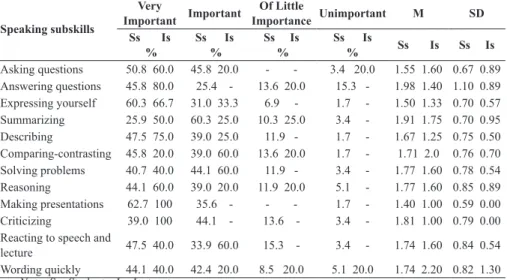
This part presents the statistical analysis of the perceptions of the students and instructors considering the importance of student performance in speaking tasks re-ferring to learning needs. Table 1 shows the descriptive statistics and percentages of the two groups in terms of the importance given to each item.
Table 1. The Importance of Student Performance on Speaking Tasks referring to Learning Needs
Speaking subskills
Very
Important Important Importance UnimportantOf Little M SD
Ss Is % Ss Is % Ss Is % Ss Is% Ss Is Ss Is Asking questions 50.8 60.0 45.8 20.0 - - 3.4 20.0 1.55 1.60 0.67 0.89 Answering questions 45.8 80.0 25.4 - 13.6 20.0 15.3 - 1.98 1.40 1.10 0.89 Expressing yourself 60.3 66.7 31.0 33.3 6.9 - 1.7 - 1.50 1.33 0.70 0.57 Summarizing 25.9 50.0 60.3 25.0 10.3 25.0 3.4 - 1.91 1.75 0.70 0.95 Describing 47.5 75.0 39.0 25.0 11.9 - 1.7 - 1.67 1.25 0.75 0.50 Comparing-contrasting 45.8 20.0 39.0 60.0 13.6 20.0 1.7 - 1.71 2.0 0.76 0.70 Solving problems 40.7 40.0 44.1 60.0 11.9 - 3.4 - 1.77 1.60 0.78 0.54 Reasoning 44.1 60.0 39.0 20.0 11.9 20.0 5.1 - 1.77 1.60 0.85 0.89 Making presentations 62.7 100 35.6 - - - 1.7 - 1.40 1.00 0.59 0.00 Criticizing 39.0 100 44.1 - 13.6 - 3.4 - 1.81 1.00 0.79 0.00 Reacting to speech and
lecture 47.5 40.0 33.9 60.0 15.3 - 3.4 - 1.74 1.60 0.84 0.54 Wording quickly 44.1 40.0 42.4 20.0 8.5 20.0 5.1 20.0 1.74 2.20 0.82 1.30
Note: Ss=Students; Is=Instructors.
As shown in the table above, the range of the means of items for speaking subs-kills was 1.40 – 1.98 for the students and 1.25 – 2.60 for the instructors. Specifically, the speaking tasks perceived highly important (as a combination of very important
and important) by the two groups were as follows: making presentations (Ss=98.3%/ Is=100%), asking questions (Ss=96.6%/Ts=80%), expressing yourself (Ss=91.3%/ Is=100%), summarizing (Ss=86.2%/Ts=75%), describing (Ss=86.5%/Is=100%), wording quickly (Ss=86.5%/Is=60%), comparing-contrasting (Ss=84.8%/Is=80%), solving problems (Ss=84.8%/Is=100%), criticizing (Ss=83.1%/Is=100%), reasoning (Ss=83.1%/Is=80%), reacting to speech and lecture (Ss=81.4%/Is=100%), and ans-wering questions (Ss=71.2%/Is=80%).
3.1.2. The importance of student performance on listening tasks referring to learning needs
As for the importance of student performance on tasks related to listening subs-kills, both students and instructors expressed similar viewpoints (see Table 2). Table 2. The Importance of Student Performance on Listening Tasks referring
to Learning Needs Listening subskills
Very
Important Important Importance UnimportantOf Little M SD
Ss Is % Ss Is % Ss Is % Ss Is % Ss Is Ss Is Obtaining gist 37.3 100 52.5 - 5.1 - 5.1 - 1.77 1.00 0.76 0.00 Obtaining specific information 64.4 40.0 28.8 40.0 3.4 20.0 3.4 - 1.45 1.80 0.72 0.83 Listening for summarizing 52.5 60.0 30.5 40.0 11.9 - 5.1 - 1.69 1.40 0.87 0.54 Listening for taking
notes 50.8 60.0 28.8 20.0 16.9 20.0 3.4 - 1.72 1.60 0.86 0.89 Recognizing language
structure 54.2 40.0 32.2 40.0 11.9 20.0 1.7 - 1.61 1.80 0.76 0.83 Understanding complex
sentences 62.7 60.0 18.6 40.0 13.6 - 5.1 - 1.61 1.40 0.91 0.54 Deducing the meaning
of unfamiliar words or word groups 42.4 60.0 45.8 40.0 10.2 - 1.7 - 1.71 1.40 0.72 0.54 Evaluating the importance of information 37.3 60.0 47.5 40.0 13.6 - 1.7 - 1.79 1.40 0.73 0.54 Extracting the information not explicitly stated 30.5 60.0 50.8 20.0 16.9 20.0 1.7 - 1.89 1.60 0.73 0.89 Recognizing speech organization patterns (lecture, announcement) 40.7 75.0 45.8 25.0 11.9 - 1.7 - 1.74 1.25 0.73 0.50 Note: Ss=Students; Is=Instructors.
According to the gathered results, the range of means of items for the listening subs-kills was 1.45–1.89 for the students and 1.40-2.80 for the instructors. Specifically, the
following listening subskills were perceived to be highly important (as a combination of very important and important) by the participants in given tasks: obtaining speci-fic information (Ss=93.2%/Is=80%), obtaining gist (Ss=89.8%/Is=100%), deducing the meaning of unfamiliar words or word groups (Ss=88.2%/Is=100%), recognizing speech organization patterns (lecture, announcement) (Ss=86.5%/Is=100%), recogni-zing language structure (Ss=86.4%/Is=80%), evaluating the importance of information (Ss=84.8%/Is=100%), listening for summarizing (Ss=83%/Is=100%), understanding complex sentences (Ss=81.3%/Is=100%), extracting the information not explicitly sta-ted (Ss=81.3%/Is=80%), and listening for taking notes (Ss=79.6%/Is=80%).
3.1.3. The importance of student performance on reading tasks referring to learning needs
As for the perceptions of the two groups with regard to the importance of student per-formance on reading tasks referring to learning needs, Table 3 reports the related findings. Table 3. The Importance of Student Performance on Reading Tasks referring to
Learning Needs Reading subskills
Very
Important Important Importance UnimportantOf Little M SD
Ss Is % Ss Is % Ss Is % Ss Is % Ss Is Ss Is Predicting 61.0 60.0 33.9 40.0 3.4 - 1.7 - 1.45 1.40 0.65 0.54 Scanning 42.4 60.0 47.5 40.0 6.8 - 3.4 - 1.71 1.40 0.74 0.54 Skimming 52.5 60.0 39.0 20.0 5.1 20.0 3.4 - 1.59 1.60 0.74 0.89 Reading intensively 44.1 80.0 40.7 20.0 11.9 - 3.4 - 1.74 1.20 0.80 0.44 Guessing the meaning
of unknown words from
context 66.1 60.0 25.4 40.0 6.8 - 1.7 - 1.44 1.40 0.70 0.54 Referencing (focusing on pronouns/numbers) 52.5 40.0 32.2 60.0 13.6 - 1.7 - 1.64 1.60 0.78 0.54 Analyzing 55.9 40.0 30.5 40.0 10.2 20.0 3.4 - 1.61 1.80 0.80 0.83 Synthesizing 49.2 60.0 32.2 20.0 15.3 20.0 3.4 - 1.72 1.60 0.84 0.89 Making inferences 37.3 60.0 45.8 20.0 15.3 20.0 1.7 - 1.81 1.60 0.75 0.89 Reading for note taking 35.6 40.0 45.8 40.0 15.3 20.0 3.4 - 1.86 1.80 0.79 0.83 Identifying main ideas 50.8 40.0 37.3 60.0 8.5 - 3.4 - 1.64 1.60 0.78 0.54 Paraphrasing 44.1 60.0 45.8 40.0 6.8 - 3.4 - 1.69 1.40 0.74 0.54 Summarizing 39.0 60.0 44.1 40.0 11.9 - 5.1 - 1.83 1.40 0.83 0.54 Transferring information 35.6 60.0 52.5 40.0 8.5 - 3.4 - 1.79 1.40 0.73 0.54 Responding critically 42.4 60.0 42.4 20.0 11.9 20.0 3.4 - 1.76 1.60 0.79 0.89
Note: Ss=Students; Is=Instructors.
The range of means of items for the reading subskills was 1.44-1.86 for the stu-dents and 1.20-2.60 for the instructors. In other words, the student performance was perceived to be important for the reading tasks namely, predicting (Ss=94.9%/
Is=100%), skimming (Ss=91.5%/Is=80%), guessing the meaning of unknown words from context (Ss=91.5%/Is=100%), scanning (Ss=89.9%/Is=100%), paraphrasing (Ss=89.9%/Is=100%), identifying main ideas (Ss=88.1%/Is=100%), transferring information (Ss=88.1%/Is=100%), analyzing (Ss=86.4%/Is=80%), responding cri-tically (Ss=84.8%/Is=80%), reading intensively (Ss=84.8%/Is=100%), referencing (focusing on pronouns, numbers) (Ss=84.7%/Is=100%), summarizing (Ss=83.1%/ Is=100%), making inferences (Ss=83.1%/Is=80%), synthesizing (Ss=81.4%/Is=80%), and reading for note taking (Ss=81.4%/Is=80%).
3.1.4. The importance of student performance on writing tasks referring to learning needs
The perceptions of the students and instructors about the importance of student performance on writing tasks referring to learning needs are shown in Table 4 below. Table 4. The Importance of Student Performance on Writing Tasks referring to
Learning Needs Writing subskills
Very
Important Important Importance UnimportantOf Little M SD
Ss Is % Ss Is % Ss Is % Ss Is % Ss Is Ss Is Structuring sentences 39.0 80.0 49.2 20.0 10.2 - 1.7 - 1.74 1.20 0.70 0.44 Addressing topic 54.2 60.0 32.2 40.0 10.2 - 3.4 - 1.62 1.40 0.80 0.54 Developing ideas 45.8 60.0 44.1 20.0 8.5 20.0 1.7 - 1.66 1.60 0.70 0.89 Linking ideas 62.7 40.0 23.7 40.0 11.9 20.0 1.7 - 1.52 1.80 0.77 0.83 Organizing the product 37.3 60.0 54.2 40.0 6.8 - 1.7 - 1.72 1.40 0.66 0.54 Using appropriate vocabulary 50.8 60.0 37.3 20.0 11.9 20.0 - - 1.61 1.60 0.69 0.89 Expressing ideas clearly 44.1 60.0 49.2 40.0 5.1 - 1.7 - 1.64 1.40 0.66 0.54 Spelling correctly 45.8 60.0 35.6 20.0 15.3 20.0 3.4 - 1.76 1.60 0.83 0.89 The range of means of items for the writing subskills tasks was 1.52-1.79 for the students and 1.20-2.40 for the instructors. To put it simply, the emphasis was given to the writing subskills such as, expressing ideas clearly (Ss=93.3%/Is=100%), organi-zing the product (Ss=91.5%/Is=100%), developing ideas (Ss=89.9%/Is=80%), struc-turing sentences (Ss=88.2%/Is=100%), using appropriate vocabulary (Ss=88.1%/ Is=80%), addressing the topic (Ss=86.4%/Is=100%), linking ideas (Ss=86.4%/ Is=80%), and spelling correctly (Ss=81.4%/Is=80%).
3.2. The findings of the semi-structured interviews referring to the learning needs
and instructors of the ESP program are presented in order to reveal their perceptions referring to students’ learning needs. Specifically, the aim and content of the program as well as the importance of students’ performance on language tasks related to their learning needs are discussed in detail.
3.2.1. The perceptions of the students and instructors about the aim and con-tent of the ESP program
When the ESP students and instructors were asked about the primary aim of the program, both groups stated that it attempts to meet the students’ specified needs by providing them with the necessary background knowledge to follow their undergra-duate courses effectively. In relation to this point, the students and instructors made the following comments:
Is: “The primary aim of the ESP program is to meet the specified needs of the students by giving them the necessary background knowledge to follow their undergraduate courses effectively.”
Ss: “The aim of our program is to help us follow our undergraduate program by providing us with the background knowledge considering our field of study.” In addition, the participants indicated that the content of the program is mainly based on teaching specific vocabulary related to the students’ field of study as shown in the excerpt below:
Is: “The ESP program focuses on teaching students the specific vocabulary based on their field of study.”
Ss: “In the ESP program, we are introduced to specific vocabulary with respect to our undergraduate courses.”
Lastly, the two groups of participants agreed on the ranking of the specialist voca-bulary, speaking, listening, reading, writing, and grammar concepts according to their order of importance. One of the instructors and students made the following comment:
Is: “Although the ESP program aims to develop the specialist vocabulary, four language skills, and the grammatical component of the language, there is an order of importance I think is followed as; specialist vocabulary, speaking, listening, writing, reading, and grammar.”
Ss: “If I was asked to rank the language components emphasized in the prog-ram I would do it as follows: specialist vocabulary, speaking, listening, wri-ting, reading, and grammar.”
3.2.2. Speaking
partici-pants stated that strategies such as making presentations and participating in discussi-ons/debates should be integrated in the program to develop the students’ performance in speaking tasks. An instructor and a student made the following comments:
Is: In the ESP program, the instructors try to give some strategy training to help the students’ improve their speaking skills. For example, students receive ins-truction on how to make presentations or participate in discussions/debates.” Ss: “In the ESP courses, we should learn how to speak effectively by making presentations or discussing particular topics.”
3.2.3. Listening
In an attempt to aid with the student development of the listening skills, the two groups stated that they should be actively involved in the process of how to use the necessary strategies in given tasks effectively as shown below:
Is: “Listening is one of the important components of the ESP program. We should try to raise the students’ awareness on how to listen for main idea or details of a lecture.”
Ss: “In our listening course, we should learn how to obtain the gist or get the key points while listening to a lecture.”
3.2.4. Reading
In relation to the students’ progress in their reading skills, both groups expressed that predicting, skimming, scanning, paraphrasing, guessing from the context, and previewing are among the essential strategies to be emphasized in the program. A participating instructor and student said:
Is: “Guessing from the context, paraphrasing, and previewing (reviewing the title to get a sense of the structures and content of a reading selection) are among the vital strategies that should be given importance in the program to improve the reading ability of the students.”
Ss:”In the reading course, strategies such as skimming and scanning should be focused on which would help us in understanding the given tasks effectively.” 3.2.5. Writing
On being asked about the student improvement in writing skills, both groups of participants indicated that expressing minor and major ideas, organizing ideas cle-arly, combining sentences, and using specialized vocabulary are among the essential strategies to be focused on in the program. The following excerpts from two of the interviewees clarify this point:
wri-ting, combine sentences and organize ideas clearly in order to make progress in their writing.”
Ss: “In the writing course, we should learn how to use the necessary strategies such as expressing major and minor ideas and using specialized vocabulary, which will help us improve our writing ability.”
3.3. The findings of the semi-structured interviews related to the ESP stu-dents’ target needs
As mentioned previously, the second section of the study highlights the results with respect to the importance of student performance on language tasks referring to target needs. First, the findings of the ESP students’ and instructors’ perceptions speaking subs-kills are given. Next, the results related to the listening subssubs-kills are presented which are followed by the reading subskills. Finally, the results of the writing subskills are described.
3.3.1. The importance of student performance on speaking tasks referring to target needs
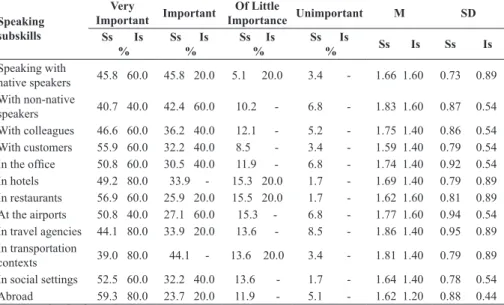
The perceptions of the students and instructors with regard to the importance of performing speaking tasks referring to target needs are displayed in Table 5.
Table 5. The Importance of Student Performance on Speaking Tasks referring to Target Needs
Speaking subskills
Very
Important Important Importance UnimportantOf Little M SD
Ss Is % Ss Is % Ss Is % Ss Is % Ss Is Ss Is Speaking with native speakers 45.8 60.0 45.8 20.0 5.1 20.0 3.4 - 1.66 1.60 0.73 0.89 With non-native speakers 40.7 40.0 42.4 60.0 10.2 - 6.8 - 1.83 1.60 0.87 0.54 With colleagues 46.6 60.0 36.2 40.0 12.1 - 5.2 - 1.75 1.40 0.86 0.54 With customers 55.9 60.0 32.2 40.0 8.5 - 3.4 - 1.59 1.40 0.79 0.54 In the office 50.8 60.0 30.5 40.0 11.9 - 6.8 - 1.74 1.40 0.92 0.54 In hotels 49.2 80.0 33.9 - 15.3 20.0 1.7 - 1.69 1.40 0.79 0.89 In restaurants 56.9 60.0 25.9 20.0 15.5 20.0 1.7 - 1.62 1.60 0.81 0.89 At the airports 50.8 40.0 27.1 60.0 15.3 - 6.8 - 1.77 1.60 0.94 0.54 In travel agencies 44.1 80.0 33.9 20.0 13.6 - 8.5 - 1.86 1.40 0.95 0.89 In transportation contexts 39.0 80.0 44.1 - 13.6 20.0 3.4 - 1.81 1.40 0.79 0.89 In social settings 52.5 60.0 32.2 40.0 13.6 - 1.7 - 1.64 1.40 0.78 0.54 Abroad 59.3 80.0 23.7 20.0 11.9 - 5.1 - 1.62 1.20 0.88 0.44
Note: Ss=Students; Is=Instructors.
The range of means items for speaking subskills was 1.59-2.16 for the students and 1.20-2.20 for the instructors. Both groups agreed on the importance of the students’
performance while speaking with native speakers (Ss=91.6%/Is=80%), with custo-mers (Ss=88.1%/Is=100%), in social settings (Ss=84.7%/Is=100%), with non-native speakers (Ss=83.1%/Is=100%), in hotels (Ss=83.1%/Is=80%), in transportation con-texts (Ss=83.1%/Is=80%), abroad (Ss=83%/Is=100%), with colleagues (Ss=82.8%/ Is=100%), in restaurants (Ss=82.8%/Is=80%), in the office (Ss=81.3%/Is=100%), in travel agencies (Ss=78%/Is=100%), and at airports (Ss=77.9%/Is=100%).
3.3.2. The importance of student performance on listening tasks referring to target needs
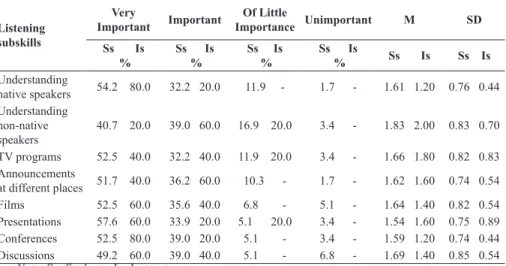
The perceptions of the students and instructors about the importance in performing listening tasks referring to target needs are reported in Table 6 below.
Table 6. The Importance of Student Performance on Listening Tasks referring to Target Needs
Listening subskills
Very
Important Important Importance UnimportantOf Little M SD
Ss Is % Ss Is % Ss Is % Ss Is % Ss Is Ss Is Understanding native speakers 54.2 80.0 32.2 20.0 11.9 - 1.7 - 1.61 1.20 0.76 0.44 Understanding non-native speakers 40.7 20.0 39.0 60.0 16.9 20.0 3.4 - 1.83 2.00 0.83 0.70 TV programs 52.5 40.0 32.2 40.0 11.9 20.0 3.4 - 1.66 1.80 0.82 0.83 Announcements at different places 51.7 40.0 36.2 60.0 10.3 - 1.7 - 1.62 1.60 0.74 0.54 Films 52.5 60.0 35.6 40.0 6.8 - 5.1 - 1.64 1.40 0.82 0.54 Presentations 57.6 60.0 33.9 20.0 5.1 20.0 3.4 - 1.54 1.60 0.75 0.89 Conferences 52.5 80.0 39.0 20.0 5.1 - 3.4 - 1.59 1.20 0.74 0.44 Discussions 49.2 60.0 39.0 40.0 5.1 - 6.8 - 1.69 1.40 0.85 0.54
Note: Ss=Students; Is=Instructors.
The range of means of items for listening subskills was 1.44-1.83 for the students and 1.00-2.00 for the instructors. The following items were given importance by the two groups of participants related to the student performance on the listening tasks: listening to conferences (Ss=91.5%/Is=100%), presentations (Ss=91.5%/Is=80%), discussions (Ss=88.2%/Is=100%), films (Ss=88.1%/Is=100%), announcements at different places (Ss=87.9%/Is=100%), understanding native speakers (Ss=86.4%/Is=100%), TV prog-rams (Ss=84.7%/Is=80%), and listening to non-native speakers (Ss=79.7%/Is=80%).
3.3.3. The importance of student performance on reading tasks referring to target needs
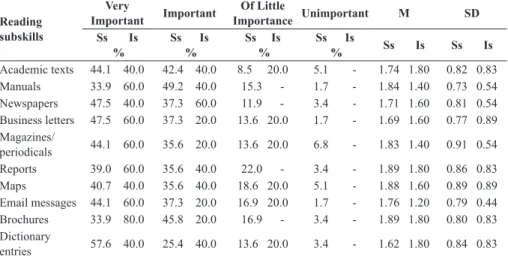
The perceptions of the students and instructors on the importance of per-forming reading tasks with regard to target needs are examined in Table 7.
Table 7. The Importance of Student Performance on Reading Tasks referring to Target Needs
Reading subskills
Very
Important Important Importance UnimportantOf Little M SD
Ss Is % Ss Is % Ss Is % Ss Is % Ss Is Ss Is Academic texts 44.1 40.0 42.4 40.0 8.5 20.0 5.1 - 1.74 1.80 0.82 0.83 Manuals 33.9 60.0 49.2 40.0 15.3 - 1.7 - 1.84 1.40 0.73 0.54 Newspapers 47.5 40.0 37.3 60.0 11.9 - 3.4 - 1.71 1.60 0.81 0.54 Business letters 47.5 60.0 37.3 20.0 13.6 20.0 1.7 - 1.69 1.60 0.77 0.89 Magazines/ periodicals 44.1 60.0 35.6 20.0 13.6 20.0 6.8 - 1.83 1.40 0.91 0.54 Reports 39.0 60.0 35.6 40.0 22.0 - 3.4 - 1.89 1.80 0.86 0.83 Maps 40.7 40.0 35.6 40.0 18.6 20.0 5.1 - 1.88 1.60 0.89 0.89 Email messages 44.1 60.0 37.3 20.0 16.9 20.0 1.7 - 1.76 1.20 0.79 0.44 Brochures 33.9 80.0 45.8 20.0 16.9 - 3.4 - 1.89 1.80 0.80 0.83 Dictionary entries 57.6 40.0 25.4 40.0 13.6 20.0 3.4 - 1.62 1.80 0.84 0.83 Note: Ss=Students; Is=Instructors.
The range of means of items for reading subskills was 1.62-2.03 for the students and 1.20-2.60 for the instructors. Both groups of participants gave importance to the student performance on the following tasks: reading academic texts (Ss=86.5%/ Is=80%), newspapers (Ss=84.8%/Is=100%), business letters (Ss=84.8%/Is=80%), manuals (Ss=83.1%/Is=100%), dictionary entries (Ss=83%/Is=80%), email messa-ges (Ss=81.4%/Is=80%), brochures (Ss=79.7%/Is=100%), magazines/periodicals (Ss=79.7%/Is=80%), maps (Ss=76.3%/Is=80%) and reports (Ss=74.6%/Is=100%).
3.3.4. The ESP students’ and instructors’ perceptions about the importance of items referring to writing skills as target needs
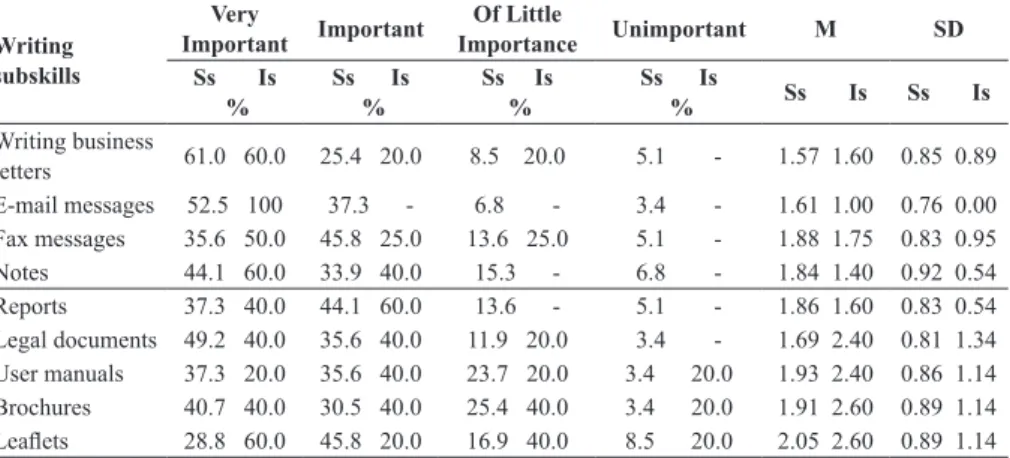
The perceptions of the students and instructors regarding the importan-ce of writing subskills with respect to target needs are presented in Table 8.
Table 8. The Importance of Student Performance on Writing Tasks referring to Target Needs
Writing subskills
Very
Important Important ImportanceOf Little Unimportant M SD
Ss Is % Ss Is % Ss Is % Ss Is % Ss Is Ss Is Writing business letters 61.0 60.0 25.4 20.0 8.5 20.0 5.1 - 1.57 1.60 0.85 0.89 E-mail messages 52.5 100 37.3 - 6.8 - 3.4 - 1.61 1.00 0.76 0.00 Fax messages 35.6 50.0 45.8 25.0 13.6 25.0 5.1 - 1.88 1.75 0.83 0.95 Notes 44.1 60.0 33.9 40.0 15.3 - 6.8 - 1.84 1.40 0.92 0.54 Reports 37.3 40.0 44.1 60.0 13.6 - 5.1 - 1.86 1.60 0.83 0.54 Legal documents 49.2 40.0 35.6 40.0 11.9 20.0 3.4 - 1.69 2.40 0.81 1.34 User manuals 37.3 20.0 35.6 40.0 23.7 20.0 3.4 20.0 1.93 2.40 0.86 1.14 Brochures 40.7 40.0 30.5 40.0 25.4 40.0 3.4 20.0 1.91 2.60 0.89 1.14 Leaflets 28.8 60.0 45.8 20.0 16.9 40.0 8.5 20.0 2.05 2.60 0.89 1.14
Note: Ss=Students; Is=Instructors.
As shown in the table above, the range of means of items for writing subskills was 1.57-2.08 for the students and 1.00-2.60 for the instructors. The performance of the students on writing tasks rated to be highly important (as a combination of very important and important) was: writing email messages (Ss=89.8%/Is=100%), business letters (Ss=86.4%/Is=80%), legal documents (Ss=84.8%/Is=80%), reports (Ss=79.7%/Is=100%), fax messages (Ss=81.4%/Is=75%), notes (Ss=78%/Is=100%), leaflets (Ss=74.6%/Is=80%), itineraries (Ss=78%/Is=80%), memos (Ss=72.9%/ Is=80%), and brochures (Ss=71.2%/Is=80%).
3.3.5. The findings of the semi-structured interviews related to the ESP stu-dents’ target needs
3.3.5.1 Speaking
In relation to the improvement of the students’ speaking skills, the ESP instructors and students agreed that the focus of the program should be on the student engage-ment in purposeful interaction during conversation with native-language teachers, as expressed in the excerpt below:
Is:”In order to help students improve their speaking ability, the program sho-uld include tasks that engage students in purposeful interaction with native speakers.”
Ss:”In the speaking course, we should learn how to communicate effectively in conversations with native speakers”.
3.3.5.2. Listening
stated that various tasks such as presentations, discussions, conferences, announce-ments, and radio and TV programs should be given importance to help students deve-lop their listening skills. Two of the participants expressed the following viewpoints: Is:“Providing listening practice in authentic situations (outside the classroom), listening to presentations, conferences, radio and TV programs, discussions, and public address announcements have a big role in helping students develop their listening abilities.”
Ss:”In the listening course, we should be asked to listen to various tasks such as announcements and conferences, which help us improve our listening ability.” 3.3.5.3. Reading
The students and instructors stated that among the important tasks, which help to improve the students’ reading abilities, were dictionary entries, newspaper articles, business letters, academic texts, and authentic stories. Some of the participants com-mented on this issue as follows:
Is: “When the students are asked to read tasks such as newspaper articles, in-terviews, poems, and simplified versions of classical works, they develop their ability to read effectively.”
Ss: “In the ESP courses, we should be asked to read various tasks in the reading course, like short stories, interviews and classical work[s], which aid in our improvement of the reading skill.”
3.3.5.4. Writing
As for the students’ improvement in their writing skills, the two groups approved that the focus should be on engaging students in authentic tasks such as writing email messages, business letters, legal documents, and reports. Related to this component a student and an instructor said:
Is: “The students must be good at writing so that they can express what they want to say. In order to do this, they need to be taught how to write email mes-sages, business letters, legal documents, and reports.”
Ss: “In order to improve our ability in writing, we should be engaged in various tasks such as writing email messages and reports.”
3. Conclusion
The present study revealed findings with respect to the identification of the ESP students’ and instructors’ perceptions referring to learning and target needs which are is in accordance with the previous research shedding light on the fact that needs analysis is the primary step to be taken while designing and implementing a language
program (Ekici, 2003; Mutlu, 2004; Özkanal, 2009). Specifically speaking, based on the data gathered from the needs-analysis questionnaire and semi-structured inter-view, the students and instructors engaged in the ESP program highlighted that that one of the primary aims of the program should be to engage students in various tasks related to the four language skills and subskills referring to their learning and target needs. To illustrate, the speaking syllabus should comprise tasks and activities that would provide the students with the opportunity to use the strategies such as making presentations, asking questions, expressing oneself, summarizing, and describing. As for the listening syllabus, it should focus on the subskills of obtaining specific in-formation, understanding gist, deducing the meaning of unfamiliar words or word groups, recognizing speech organization patterns (lecture, announcement), and recog-nizing language structure in order to raise the students’ awareness with respect to their application in a meaningful context. In addition, a great importance should be given to the following subskills while designing the reading syllabus: predicting, skimming, guessing the meaning of unknown words from context, scanning, and paraphrasing. Finally, in order to help the students develop their writing skills, the syllabus should ask the students to perform tasks and engage in tasks and activities that would aid in their performance while using the subskills expressing ideas clearly, organizing the product, developing ideas, structuring sentences, and using appropriate vocabulary. 4. Implications
The present study has both practical and empirical implications. As mentioned in the findings obtained through the needs analysis questionnaire and semi-structured interview, the nature of the ESP program should be based upon the students’ learning and target needs to specify the content (i.e. goals and objectives, materials, language teaching approach and testing) of the program. According to what has been discussed in the previous parts of this study, training programs should be provided to the pre-service and inpre-service teachers of ESP students to raise their awareness on the initial steps of needs analysis. Full collaboration between the coordinators, instructors, and students is needed to attain success in the program. In this sense, the findings of this study should be emphasized while designing the ESP program in various disciplines. 5. Limitations and Suggestions for Further Research
Although the current study revealed some interesting and important findings, there are a number of limitations. Therefore, the findings should be taken as suggestive rather than definitive for further research. First, the focus on this study was simply on the students’ and instructors’ perceived learning and target needs. Other types of needs such as communicative and objective needs were not identified due to time constraints. Another limitation of this study is that the study particularly focused on the perceptions of the students and instructors of the Faculty of Fine Arts at a private English-medium university in Istanbul, Turkey. Therefore, it lacks external validity
and generalizability.
Apart from the several limitations of this study, there are several recommendati-ons for further research. First of all, different types of needs (e.g. communicative and objective) can be investigated which would provide in-depth information for program design and evaluation. Finally, analysis of student needs will provide the basis for other research areas such as materials development, testing, and program evaluation. 6. References
Altschuld, J. W., & Witkin, B. R. (1995). Planning and conducting needs assessments: A practical
guide. California: Sage Publications.
Anthony, L. (1997). ESP: What does it mean? Why is it different? Retrieved December 19, 2013, from http://www.antlab.sci.waseda.ac.jp/abstracts/ESParticle.html
Baştürkmen, H., & Al-Huneidi, A. (1996). Refining Procedures: A needs analysis project at Kuwait
University. (ERIC Document Reproduction Service No: ED413762).
Berwick, R. 1989), Needs Assessment in Language Programming: from Theory to Practice. In R.K. Johnson (ed.), The Second Language Curriculum, pp. 48-62. New York: Cambridge University Press. Bogdan, R. C., & Biklen, S. K. (1998). Qualitative research for education: An introduction to theory
and methods. Ally & Bacon: Needham Heights, MA.
Bosher, S., & Smalkoski, K. (2002). From needs analysis to curriculum development: Designing a course in health-care communication for immigrant students in the USA. English for Specific Purposes, 21, 59-79. Brindley, C. (1989), The role of needs analysis in adult ESL programme design. In R.K. Johnson
(ed), The Second Language Curriculum, pp. 63-78. New York: Cambridge University Press. Brown, J. D. (1995). The elements of language curriculum. Boston: Heinle and Heinle.
Celce-Murcia, M. (Ed.). (2001). Language teaching approaches: An overview in teaching English
as a second or foreign language. Heinle and Heinle.
Chia, H. U., Johnson, R., Chia, H. L., & Olive, F. (1999). English for college students in Taiwan: A study of perceptions of English needs in a medical context. English for Specific Purposes, 18(2), 107-119. Creswell, J. (2009). Research design: qulitative, qunatitative and mixed methods appraoches (3rd
ed.). Los Angeles, London, New Dehli, Singapore: Sage.
Dörnyei, Z. (2007). Research methods in applied linguistics. Oxford: Oxford University Press. Edwards, N. (2000). Language for business: Effective needs assessment, syllabus design and
ma-terials preparation in a practical ESP case study. English for Specific Purposes, 19, 291-296. Ekici, N. (2003). A needs assessment study on English language needs of the tour guidance students
of faculty of applied sciences at Başkent University: A case study. Unpublished Master’s Thesis.
Middle East Technical University, Ankara.
Freeman, D. L. (2000). Techniques and Principles in Language Teaching. Oxford University Press. Garcia Laborda, J. (2003). Incidental Aspects in Teaching ESP for Turismo in Spain The Turismo
Learner: Analysis and Research. ESP World,3, 1-9. Retrieved January 5, 2013 from http://www. esp-world.info/Articles_3/ESP%20for%20Turismo%20in%20Spain.htm
Gatehouse, K. (2001). Key issues in English for Specific purposes (ESP) curriculum development. Internet
Gliem, J. A. & Gliem, R. R. (2003). Calculating, interpreting, and reporting cronbach’s alpha
relia-bility coefficient for likert-type scales. Presented at the Midwest Research to Practice
Conferen-ce in Adult, Continuing, and Community Education, The Ohio State University.
Hutchinson, T., & Waters, A. (1987). English for specific purposes: A learning-centered approach. Cambridge: Cambridge University Press.
Iwai, T., Kondo, K., Limm, S. J. D., Ray, E. G., Shimizu, H., and Brown, J. D. (1999). Japanese
lan-guage needs analysis. Honolulu: University of Hawai`i, Second Lanlan-guage Teaching & Curriculum
Center. Retrieved January 25, 2013 from http://www.nflrc.hawaii.edu/Networks/NW13/NW13.pdf Jordan, R. R. (1997). English for academic purposes. Cambridge University Press.
Kaur, S., & Khan, A. M. (2010). Language needs analysis of art and design students: Considerations for ESP course design. ESP World, 9(2), 1-16.
Kim, S. (2006). Academic oral communication needs of East Asian international graduate students in non-science and non-engineering fields. English for Specific Purposes, 25, 479-489. Mertens, D. M. (1998). Research methods in education and psychology: Integrating diversity with
quantitative & qualitative approaches. Sage Publications.
Munby, J. (1978). Communicative Syllabus Design. Cambridge: Cambridge University Press. Mutlu, Ö. (2004). A needs analysis study for the English-Turkish translation course offered to
man-agement students of the faculty of economic and administrative sciences at Başkent University: A case study. Unpublished Master’s Thesis. Middle East Technical University, Ankara.
Nunan, D. (2004). Syllabus design. New York: Oxford University Press.
Özkanal, Ü. (2009). The evaluation of English preparatory program of Eskişehir Osmangazi
Uni-versity Foreign Languages Department and a model proposal. Unpublished Dissertation.
Ana-dolu University, Eskişehir.
Rahman, M. M. (2011). English language teaching in Saudi Arabia: A case study of learners’ needs analy-sis with special reference to Community College, Najran University. Language in India, 367-461. Richards, J. C. (2001). Curriculum development in language teaching. Cambridge University Press. Richards, J., & Rodgers, T. (2001). Approaches and methods in language teaching. Cambridge
University Press.
Richterich, R., & Chancerel, J.-L. (1978). Identifying the needs of adults learning a foreign
langua-ge. Strasbourg: Council of Europe.
Roberts, J. (1998). Language teacher education. New York: Arnold.
Rossi, P. H., Lipsey, M. W., & Freeman, H. E. (2004). Evaluation: A systematic approach. Sage-Publications. Retrieved March 25, 2013, from http://www.google.com.tr/books?hl=en&lr=&id =8K3Ax5s7x5oC&oi=fnd&pg=PR9&dq=Evaluation:+A+systematic+approach&ots=Lm9Ys AQltN&sig=NSjsWfZuVlzUuSoZB_S1OFvcCo0&redir_esc=y