DOI No: http://dx.doi.org/10.14225/Joh1636
Geliş Tarihi: 11.04.2019 Kabul Tarihi: 30.06.2019 GÜNÜMÜZ DÜNYA SORUNLARI DERSİNİ ALAN SOSYAL BİLGİLER ÖĞRETMEN ADAYLARININ BU DERSE VE GÜNÜMÜZ
DÜNYA SORUNLARINA BAKIŞI Sibel IŞIK MERCAN1 - İbrahim SARI Özet
Türkiye’de öğretmen adaylarının günümüz dünya sorunları ile ilgili farkındalıklarının ne düzeyde olduğunu ortaya çıkarmanın amaçlandığı bu araştırmada, temel nitel araştırma deseni tercih edilmiştir. Temel nitel araştırmalar, insanların yaşamlarını nasıl yorumladığı, kendi algı dünyalarını nasıl yapılandırdıkları ve deneyimlerini nasıl anlamlandırdığını inceler (Merriam, 2013). Bu araştırma yönteminin öncelikli amacı bu anlamların açığa çıkarılarak yorumlanmasıdır. Çalışma grubu Sosyal Bilgiler Öğretmenliği Bölümü 4. Sınıf öğrencileridir. Yarı yapılandırılmış bir görüşme formu ile toplanan veriler betimsel analize tabii tutulmuştur. Analiz bulgularına göre; aynı zamanda günümüz dünya sorunları dersini almış olan katılımcıların dünya sorunları konusunda “çözümün bir parçası olma” olmak istedikleri, katılımcıların üzerinde durduğu en yaygın sorunların; çevre sorunları, nükleer enerji, sağlık sorunları, emperyalizm geldiği belirlenmiştir. Diğer bulgulara göre; günümüz dünyasının en önemli sorununun küresel ısınma olduğu, katılımcıların en çok çevre sorunları konusunda çözüm üretmek istedikleri ortaya çıkmıştır.
Anahtar Kelimeler: Günümüz dünya sorunları, Sosyal bilgiler öğretmen adayları, Nitel araştırma
Views on Todays World Issues and Todays World Issues Courseof The Prospective Teachers of The Social Studies Programme
INTRODUCTION
The idea of benefiting from the environment where human beings live has gained a different dimension with the process of industrialization and brought with it some problems. Unlike the increase in population, resources continue to decline rapidly. The competition brought by colonialization, World wars,
[172]
production of weapons of mass destruction, rapid population growth, hunger and poverty, war, problems of international waters, problems of education, terrorist incidents, exile caused by exile and massacres, refugee problem, unemployment problem, global energy problem, few women and human rights violations in the developed societies, problems of people with disabilities, ethnic conflicts, problems arising from religious differences, media and communication problems, problems of agriculture, environmental problems and disasters have brought forth today's important world problems that must be solved in the face of humanity.
At no time in the history of human beings' borderless movement has not overwhelmed the world in this way. While life continues in the spiral of global problems, the world carries its problems in the future. Considering that the world population will exceed 9 billion in the future, it is very difficult for human beings to find solutions to these problems with the existing knowledge and acretion (Yazıcı and Arıbaş, 2011). Nevertheless, in order to solve the current world problems mentioned above at national and international level, it is necessary for the individuals, the society and the decision makers in that society to fully recognize the problems.The second important step in solving these problems is deprivation of consciousness. In other words, it is not enough to approach the problems of today's world only at the level of knowledge. It is necessary to act as a citizen of the world, to make common decisions and to cooperate internationally in order to solve these important problems concerning large masses. In this case, effective world problems education should be considered as a life-long process starting in the family and becoming more systematic at school (Demirkaya, 2016).
Hundreds of thousands of years have a history of human beings, many activities carried out in the world has caused significant changes and disruptions on the place (Özgen, 2012). It is observed that this change and deterioration which occurred until the middle of the first century, has been slow. From the mid-twentieth century onwards, this has reached incredible levels and continues at the same speed today. At this stage, change and distortion can be discussed at two points. Considering the dimension of change; This rapid change experienced in the world for approximately 50-60 years is seen in both the environment and the economy and in the population and settlement area (Özey, 2001). Today's communication technology is increasingly increasing the speed and prevalence of this social change or interaction on a world scale. Thus, our world is becoming a global society by intertwining in political, economic and cultural dimensions.An other words, the globalization of the world and the geographical location of the society in which individuals are located are becoming more and
[173]
more affected by the dynamics of global change whereever they are in the world. (Kürkçüoğlu and Suğur, 1998). Looking at the distortion dimension; The political, economic, cultural and social values of the countries and the problems created by the globalization which bring the societies together in national and international relations have gained an international dimension and it has become a position that affects the other countries in the evaluation of the problems (Baykal ve Baykal, 2008). When viewed from both dimensions, globalization, in addition to increasing interaction and cooperation, prepares the environment for the reflection of the problems experienced within and between countries within the world (Yazıcı, 2013).
It has become a necessity to defend the world against many world problems, especially the environment, which can be regarded as the most endless disease in human history and to bring permanent solutions (Baykal and Baykal, 2008). “People who cannot see the impending catastrophe for the world and do not hear the bells of danger will not be able to temporarily postpone the problems they will face later” (Şakar, 2004).Therefore, it is necessary to seek solutions to the problems of the world in human. Because the many world problems mentioned above are caused by the human and society realtions and also by the relations of human and society with nature. The human being, who is the common subject of all these situations, lives the problems of the world and tries to find solutions for them (Uçar and Koşar, 2006). In this context, it is important to educate individuals who are knowledgeable, responsive and able to produce solutions about many world problems. This is only achieved through good training planning.
Education involving world problems should start in the family first, become more systematic in school, and be considered as a lifelong process. Education issues for today's world problems should be progressively included in each class and every course program in parallel with the development of students (Meydan and Doğu, 2008). The feedback expected from the process of world problems education is to ensure that individuals protect the world they live in (Yalçınkaya, 2013), to make individuals aware of world problems, to develop attitudes towards the solution of world problems, and to be more effective in preventing world problems. From this point of view, we should not only give information and responsibility to individuals about education for world problems, but also attitudes that will affect the life and behavior of individuals (Öcal, 2013: 348). An education process that will enable individuals to have a positive level
[174]
of knowledge, perception and attitudes towards world problems is of great importance for a sustainable world (Özgen, 2012b: 417).
In our country, the objectives for education related to the world problems are mainly given through Social Studies and Science and Technology courses in primary education and it is given through by Geography and Biology courses in secondary education. Althought there is no specific unit on world issues in these courses, the objectives related to education for world problems are placed in the courses in these units. (Köşker, 2013). Social Studies and Geography teachers, have important duties on the achievement of social studies lessons and geography lessons, who provide our students cognitive skills, positive attitudes and behaviors related to world problems (Karatekin ve Aksoy, 2012). From this point especially Social Studies and Geography teacher candidates should be the main actors in the education for world problems, which is an interdisciplinary education involving the whole society and these teacher candidates' knowledge, attitudes and behaviors towards world problems should be developed within the framework of higher education (Öcal, 2013). In universities, there is a “Today's World Problems” course which is taught only in the Social Studies Teaching undergraduate program. The content of this course is defined by the Council of Higher Education as; ”different approaches with national and international organizations which are aiming to examine and solve the problems such as “Natural disasters (global warming, earthquakes, tsunamis, etc.), environmental problems, limitation of natural resources, hunger, poverty, unemployment, human rights, unplanned population growth, racism, epidemic and infectious diseases, terrorism” (YÖK, 2007).
However, with the amendment made in the content of the undergraduate programs in 2018, “Today's World Problem” course was excluded from the Social Studies Education Program and was not replaced by another course that could meet the content of this course.
Importance and Purpose of the Study:
It is quite important to reveal the level of awareness about today's world issues of prospective teachers in Turkey.The curriculum of the social studies course, which aims to be a good citizen and a citizen of the world, cares about raising the generations who are aware of the problems in the world and produce solutions. (Meb, 2018). As it was mentioned above, with the amendment made in the content of the undergraduate programs in 2018, “Today's World Problem” course was excluded from the Social Studies Education Program and was not replaced by another course that could meet the content of this course. However, the benefit
[175]
of socially educated social studies teacher as an individual and as a teacher is undoubtedly a reality. In this respect, the studies that put forth the importance of the subject did not go beyond the works done in limited areas.
In Cogan's and others (1988) studies, they found that Japanese students had more knowledge and positive attitude about the problems of the world when they entered university, but they showed little progress on this subject during their four years of education, while American students found out that they learned about global problems in university courses.
In Demirtaş and Pektaş (2009) study, the level of recognition of basic concepts of environmental problems of elementary school students was investigated. According to the findings of the research, it is observed that students are more aware of environmental problems caused by environmental pollution, air pollution and waste.It has been observed that students are often given correct answers to the environmental problems they face in their daily life, but that they are given wrong answers about greenhouse effect, global warming, and so on, which are considered to be the current problems but which are not considered to be the main reasons in the teaching environment.In addition, some misconceptions have been found to be related to this. In addition, it was observed that students' sensitivity to the environment was sufficient.
The study of Kılıçoğlu, Karakuş and Öztürk (2012) was made in order to develop an attitude scale against the problems of today's world by benefiting from the perceptions of the students studying in various branches in the faculty of education.It can be said that the attitude scale towards the problems of today's world is a valid and reliable tool for determining the thoughts of the individuals. In the study of Hashizaki and Kawaguchi published in 2012, the student teachers' perceptions about teaching global problems were examined.It was observed that pre-service teachers lacked the opportunity to think about global issues and to use various strategies for teaching sensitive and controversial problems and developing curriculum.It has been determined that Japanese prospective prospective teachers have a positive attitude towards teaching global problems.
In a study conducted by Yalçınkaya (2012) in order to determine the awareness level of 6th grade students about environmental problems; According to students both Turkey and the world in terms of destruction of forests, water, air and soil pollution and global warming are serious environmental problems.According to
[176]
the analysis, with environmental issues across Turkey and worldwide, significant differences between the views on the world is in favor of a worldwide.Students see as more serious environmental worlwide problem rather than in Turkey like deforestation, water pollution, air pollution, soil pollution and global warming.
In study, Yazıcı (2013) investigated the attitudes of secondary school students towards contemporary world problems, where female students were more sensitive to global problems compared to male students and that their attitudes towards current world problems differed significantly in favor of grade 10 students were detected.
In this study; It was found that the attitudes of the secondary school students attending the research towards today's world problems did not show a significant difference according to the school type and field information variables and that the attitudes of the secondary school students towards the current world problems were positive and high. In addition, activities aiming to ensure that male students are more sensitive and participatory to the problems of the world and that these problems in the global scale should be classified according to their age groups and should be handled at different levels in a spiral manner and that the effects of family, environment, school and media on developing positive attitudes to the problems of the world, results can be found to be beneficial in terms of decreasing the negative factors detected.
Çolak, Kaymakçı and Akpınar (2015) In the social studiestextbooks and in the opinions of the prospective teachers, in the research they conducted in order to reveal the location of renewable energy sources, it was found that the subject of renewable energy resources in the social studies textbooks was limited.In addition, it is determined that prospective teachers do not have sufficient knowledge about renewable energy sources.
Akgün, Duruk and Güngörmez (2016) 's research about the metaphorical perceptions of middle school students about environmental education has been found to constitute 71 metaphors related to environmental education. These metaphors were grouped under 11 different categories according to their common characteristics.According to the findings of the study; It was observed that students emphasized metaphors about environmental concept rather than metaphors related to environmental education.
However, in a study conducted by Şeyihoğlu, Sever and Özmen (2018), the mind maps of social studies and geography teacher candidates have explored the problems of today's world and it has been proposed to provide a
[177]
comprehensive and compulsory World problems education in education institutions starting from the level of primary education.When all this is considered, it is important to determine the knowledge of social studies prospective teachers about the problems of today's world and to determine the knowledge and perspectives of the Social Studies prospective teachers who will be the pioneers of the education and sufficiency of today's world problems education they receive during the program they study at the university.In addition, it is thought that the Social Studies Education Program students will have information about the problems of today's world and will contribute to the researchers who will do research in this field. From this point of view, the aim of this study which aims to reveal the awareness of the students taking Today's World Problems Course in this subject is tried to understand and explain the perceptions of the participants with a qualitative approach.For this reason, the problem sentence of the study is as“What is the perception of social studies prospective teachers about current world problems?” In this context, answers for the following sub-problem sentences were searched in the study.
In which categories are the most common present-day world problems expressed by Social Studies prospective teachers?
What are the most important problems of today's world compared to prospective teachers of Social Studies?
What are the opinions of prospective teachers of Social Studies about project issues that they want to develop about today's world problems?
What are the views of today's world problems lesson on whether social studies prospective teachers have changed their awareness on these issues or not? What is the distribution of the categories of today's world problems course in which social studies prospective teachers change the world view more?
METHOD
Research Model: In this study, basic qualitative research design was preferred. With this research model, it is aimed to bridge the outcomes of the prospective teacher training process and the knowledge and skills acquired during the training process. Qualitative research was preferred to explain the
[178]
participants' experiences in detail, to try to explain how their experiences were expressed in the cultural context, to explore rather than to test, and perhaps most importantly, to enter the worlds of the participants and aim to illustrate their perspective (Corbin and Straus, 2008).
Descriptive analysis consists of four stages. In the first stage, the researcher forms a framework for data analysis, based on research questions, the conceptual framework of the research, or the dimensions of the interviews and observations.Thus, it is determined which data will be arranged under which themes. The researcher then reviews and edits the data based on the framework he has previously created. After this stage, the researcher identifies the data that he / she edited. They may also have to resort to direct quotations where necessary. Finally, the researcher explains, correlates and makes sense of the findings. At this stage, the researcher also explains the cause and effect relationship between the findings to further strengthen his comments and, if necessary, makes comparisons between different cases (Yıldırım and Şimşek, 2003).
Study Group: The appropriate sampling method was used in the study group. The study group of the study consisted of 4th year undergraduate students who took “Contemporary World Problems” course which is a compulsory course of Social Studies Education Department of the education faculty of a public university in 2018-2019 Academic Year Fall semester.
Data Collection:Before the beginning of the course, students were asked what they wanted to learn about the problems of today's world, the answers to these questions and a suitable program for the course content were created and the content created in this direction was taken as basis in the course process.The content is comprehensive and is now made up of topics that are of interest to societies today.The students have prepared voluntarily for the subjects they are interested in and those whose suject belongs to the person, has been responsible for the process of the course in 15-20 minutes.During the process, the other students in the class enriched the course with their questions and contributions.The instructor of the course also contributed to the progress of the process within a certain plan by expressing his / her views and opinions where he deems necessary.At the end of the semester, the students presented a file consisting of their pre-lesson preparation and the notes they took in the course to the instructor.Volunteer students were asked to respond in detail to a semi-structured interview form with 5 questions that they could present their views on current world problems and the course.The data in this study were obtained through these interview forms.
[179]
Data Analysis:The data were obtained by examining the documents in the interview forms. The contents of the 52 forms were analyzed and included in the whole analysis. However, it was also determined that some of the questions in different interview forms were not answered. Descriptive analysis method was used to analyze the data. In the analysis process, the interview forms were numbered from 1 to 52. Then the coding step was started. At this stage, data-based coding method is adopted. In data-data-based coding, the researcher begins to analyze without the pre-determined codes and the codes are generated in the analysis process. In this way, it is possible to support existing hypotheses and themes by coding, and to create new hypotheses and themes that are not previously defined to reach new theories (Brinkmann, 2013). Codes are compared with each other to create themes. Finally, themes are tabulated. In the presentation of the data, the opinions of the students before and after the course were not individually compared. In order to ensure the validity and reliability of the study; the researchers carefully paid attention to being away from subjective judgments and assumptions.
The present picture is tried to be presented by describing the situation without reflecting personal judgments.For this purpose, research process and data are tried to be described in detail. Quotations were made directly from the interview data.All the raw data of the study were kept in order to be examined as necessary. FINDINGS
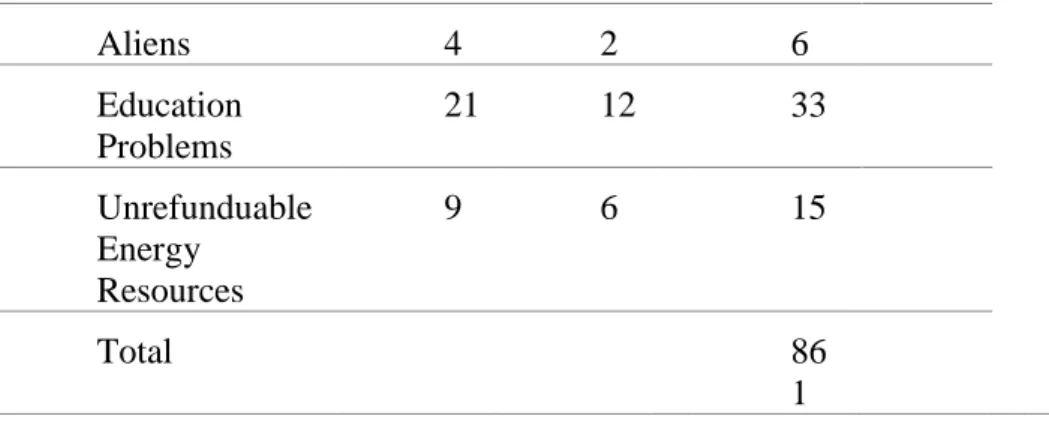
Firstly in the research, it was asked the answer to the question about “What are the most common problems of the todays world according to social studies prospective teachers?“Table 1 shows the frequencies and percentages of the most common world problems expressed by social studies prospective teachers participating in the research.
Table 1: Most Common Current World Problems Expressed by Social Studies Prospective Teachersin Frequency (f) and Percent (%) Distributions
Category
(f)
Gi
rl
(f)
B
oy
Tot
al
%
Wastes
17
14
31
Child Problems
19
10
29
[180]
Environment
Problems
25
22
47
East Turkestan
10
6
16
Natural
Disasters
13
5
18
Imperialism
20
15
35
Economic
Warfares
4
2
6
Economic
Problems
5
3
8
Palestine
Problems
5
3
8
Number
Cessation
of
Animals
11
5
16
Racism
25
10
35
Unemployment
20
10
30
Communicatio
n-Related
Issues
17
11
28
JapaneseSyndr
ome
19
13
32
Woman Rights
19
9
28
JerusalemProbl
ems
21
8
29
Global
Warming
19
15
34
[181]
Become
a
Cooperative
4
4
8
Refugee
Problem
15
14
29
Sectarian
Conflicts
19
14
33
Nuclear Energy
20
21
41
Obesity
10
10
20
Middle
East
Problem
1
2
3
Oil Issues
16
18
34
Health Issues
24
16
40
Health Systems
5
2
7
IndustrialIssues
11
6
17
Social
Media
Issues
11
3
14
Armament
Structure
17
12
29
Water
Problems
7
15
22
Terrorism
19
15
34
Agricultural
Issues
9
8
17
Losses
of
Technology
10
10
20
Consumption
Madness
6
3
9
[182]
Aliens
4
2
6
Education
Problems
21
12
33
Unrefunduable
Energy
Resources
9
6
15
Total
86
1
When Table 1 was examined, it was seen that 40 different world problems was stated according to the prospective teachers.Today's world problem, which is the most commonly used problem by prospective teachers, is an environmental problems (with 47 frequencies (%). Following this problem; “Nuclear Energy”41 frequency (%), “Health Problems“ 40 frequency (%),“ Imperialism“ 35 frequency (%), “Racism” 35 frequency (%), “Petroleum problems” 34 frequency (%), “Terrorism” 34 frequency (%), and “Education Problems” with a rate of 33 frequency (%) are among the most common problems expressed by prospective teachers. The least expressed by prospective teachers to the total number of repetitions are the problems; ”Economic Wars” are 6 frequencies (%), Aliens are 6 frequencies (%), and 3 frequencies (%) are ”Middle East Problem”.
In the second sub-problem of the study, the answer to the question ”What are the most important contemporary problems of social studies prospective teachers?” was sought. The frequency and percentage values of the findings of the prospective teachers were shown. (Table 2).
Table 2: Distribution of opinions of”The Most Important Issue of Today's World” according to Prospective Teachers of Social Studies”
Category
Girl
(f)
Boy
(f)
Total
Arms Race
2
1
3
Racism
1
1
2
Unemployment
2
2
[183]
HealthProblems
3
3
Wastes
1
1
Global Warming
5
3
8
PetroleumProblems
2
1
3
Woman Rights
1
1
2
EconomicalProblems
1
1
Depletion of Animal
Species
1
1
Industrial Resources
1
1
Education Problems
1
1
Non-renewable
Energy Resources
1
1
Losses
of
Technology
2
2
Environmental
Pollution
2
2
4
Communication-Related Issues
2
1
3
Imperialism
2
4
6
Terrorist
Organizations
1
1
2
Obesity
1
1
Refugee Problems
1
1
Sectarian Conflicts
1
1
Water Problems
2
1
3
[184]
Total
26
26
52
When Table 2 is examined, it is seen that the the number of the present world problem which has the highest importance by the prospective teachers is 22 problems.According to prospective teachers (f = 8), “global warming” seems to be the most repetitive problem when the world problems are sorted according to their importance.Following this problem, imperialism (f = 6) and Environmental Problems (f = 4) come. Some of the problems only repeated 1 time are problems such as economic problems, depletion of animal species, industrial resources, educational problems, non-renewable energy resources and obesity.
Some of the students' opinions on this finding are as follows;
“For me, the most important problem of the present world is global warming; because the world is alive now but I don't think it has much life left. When the world dies, the other problems will have no meaning or significance”. (Student 13).
“The most important problem is colonialism and imperialism; Because the powerful countries want to benefit from all the resources of the weak countries. As a result, other problems arise.” (Student 37).
“In my opinion the most important problem is environmental pollution. The reason for this is that the benefits of a society with a dirty air, soil and water, to production and consumption are reduced. In our world, which is contaminated day by day, we will not have the opportunity to live in the world for two days without water and one day without air”. (Student 25).
Table 3:Opinions of Today's World Problems Lesson Whether Students Change Their Awareness or not
Yes
No
[185]
26
25
0
1
When Table 3 is examined, it can be seen that almost all of the prospective teachers participating in the study (f = 51) think that today's world problems change their awareness and only one male student thinks otherwise.
“Thanks to this course, my awareness has increased and I have realized how problems should be solved and how problems affect people. I had an idea about that. So I think this course is very useful and helpful.”(Student 22).
“Of course, the effects of the works carried out in the context of today's world problems on the view of personal world were quite high. On the question of hunger and poverty, I realized that waste in the United States is so high that it can cover hunger in Africa, and I realize that there is a lot of waste and how bad it is.I once again saw how meaningful the phrase is “Eat, drink, but don't waste”(Student 12).
“ I cannot say that the works carried out in the context of today's world problems have greatly improved my awareness; Because the worldwide efforts in this area are not very effective and cannot be solved and cause problems as they do not solve the problems, this has not changed my personal world perspective. For example, those who say no to war have been the biggest supporters of the war by selling weapons.” (Student 44).
Table 4:Distribution of Prospective Teachers' Views on the Project Issues of Today's World Problems which they want to improve
Categories
Girl
(f)
Boy
(f)
Total
(f)
[186]
ChildrenDeath
4
4
EnvironmentProblems
8
5
13
Children Rights
1
1
Disabled
2
2
Energy Sources
1
1
Miscommunication
1
2
3
Japanese Syndrome
2
1
3
Woman Problems
1
1
Terrorism
2
2
Turkestan Issue
1
1
Health Issues
1
1
2
Global Warming
2
2
Racism
2
2
Refugee Problem
3
3
Obesity
2
2
ArmourOrganizations
1
1
Agricultural Issues
1
1
Total
26
21
47
When Table 4 is examined, it is seen that prospective teachers' opinions about project issues they want to develop about today's world problems are distributed according to male and female students. Accordingly, it was stated that the prospective teachers wanted to develop projects in 18 categories, the most common category amoung them was seen an “Environmental Problems (f = 13)”.This is followed by “child deaths” (f = 4). There is no significant difference between the repetitions of the desired categories.
[187]
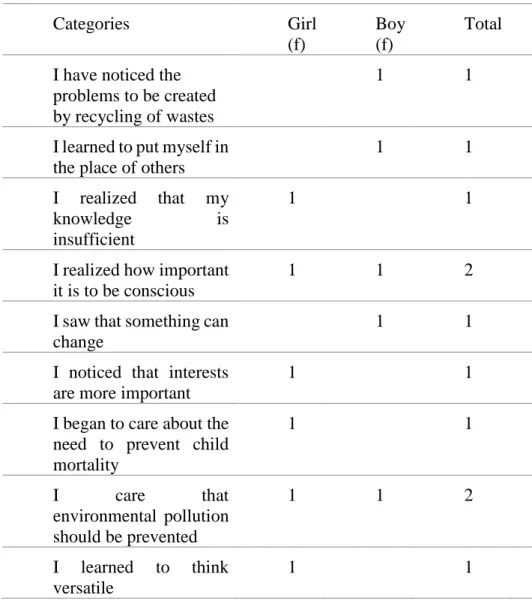
Table 5:Distribution of the answers of the prospective teachers' to the question as “In which area current world problems course has changedyour view of the world much more? ”
Categories
Girl
(f)
Boy
(f)
Total
I have noticed the
problems to be created
by recycling of wastes
1
1
I learned to put myself in
the place of others
1
1
I
realized
that
my
knowledge
is
insufficient
1
1
I realized how important
it is to be conscious
1
1
2
I saw that something can
change
1
1
I noticed that interests
are more important
1
1
I began to care about the
need to prevent child
mortality
1
1
I
care
that
environmental pollution
should be prevented
1
1
2
I
learned
to
think
versatile
1
1
[188]
I think I can be a part of
the solution
1
3
4
I Think I should be
environmentalist
1
1
I noticed that we need to
protect nature and the
environment
1
1
I noticed that we need to
take care of our trash
1
1
I noticed how much
environmental problems
are damaging to the
world
1
1
I noticed the wrong
behavior
of
the
environment issue
1
1
I recognized the danger
of imperialism
1
1
My Awareness Raised
3
3
I noticed that I can cause
some
problems
personally
1
1
I realized that today's
world problems need to
be transferred to others
2
2
I noticed the seriousness
of diseases
1
1
I noticed the problems
of wasting
[189]
I noticed the problems
caused by human
1
1
I noticed the mistakes
made by people
1
1
I noticed the problem of
noncommunication
among people
1
1
My opinion about the
need to use the Internet
and technology in a right
way has changed
1
1
My prejudgement on
Refugees has changed
1
1
I have started to think
about what I can do
1
1
I've noticed that Nuclear
Power Plants have more
Benefits
rather
than
Harm for Turkey
1
1
I noticed that the topics
you do not care about
are important
1
1
I
realized
that
the
politicians
of
the
countries are careless
about problem solving
1
1
I learned to deal with
problems
[190]
I
noticed
that
the
problems are of interest
to all world countries
1
1
I noticed that I Need To
Do Something About
Terrorist Organization
1
1
I realized the traps of
terrorist organizations
1
1
I
Recognized
Consumption Madness
1
1
I realized the importance
of valuing women
1
I noticed that I had
similar problems outside
my own country
1
I learned to put myself in
the place of others
1
1
Total
22
24
46
In Table 5, it is seen that 46 of the prospective teachers respond to the question as “In which field did the current world problems course change your view of the world? ” and when the data were analyzed, it was seen that prospective teachers stated that their point of view changed in 38 different categories. It is observed that the most frequently repeated category is an extension like: I think, Can I be a part of the solution? There is no significant difference between the repetition of other categories.
RESULT AND DISCUSSION
The views to the world problems of social studies prospective teachers who took the todays world's problems course, this course and today's world problems were investigated. First of all, it is examined what are the most common problems of today's world according to teacher candidates. According to
[191]
prospective teachers, 40 different world problems have been identified, the most common ones are; Environmental Problems, Nuclear Energy, Health Problems, Imperialism. Considering the most common problems, it can be said that social studies prospective teachers are aware of contemporary World problems. In a study conducted by Şeyihoğlu, Sever, and Özmen (2018), the contemporary world problems in the mind maps of social studies and geography prospective teachers were examined and the most common contemporary world problems used by prospective teacher in mind maps are; natural disasters, wars and occupations, hunger and famine, environmental problems and dünya çapında warming-greenhouse effect. According to the most common problems, the researchers stated that there is a basic consciousness about current world problems in prospective teachers. In the study conducted by Yazıcı (2013), attitudes of high school students towards contemporary world problems were examined and it was concluded that students were more sensitive to problems such as hunger, violence and gender discrimination.Although much intersected in these closely related our work set out in the survey results environmental problems of today's world, problems in environmental awareness on the intensification of studies conducted in Turkey, in other areas, but a rich literature on the subject contains limited accumulation.As a result of the research conducted by Karatekin, Kuş & Merey, (2014), it is concluded that prospective teachers' social participation towards the solution of environmental problems is very low, while Şahin, Cerrah, Saka and Şahin (2014) study of university students (N = 200). most of them before taking the “Environmental Science“ course, has showed that such as ozone layer perforation and greenhouse effectthat aware the world public opinion or have not been aware of the issues that concern the most or have incorrect information.
In this case, the importance of education on the problems concerning today's world is mentioned in many studies (Altıparmak (2012); Daniel, Stainsstreet & Boyes (2004); Yılmaz, Morgil, Aktuğ and Göbekli (2002); Yücel and Morgil (1998)). One of the most common problems of today's world which was repeated is the problem of Nuclear Energy. A new topic for our country is the fact that this field is considered as a world problem and gives an idea about the students' awareness about this issue. Similarly, the studies conducted with Ateş & Saraçoğlu (2013), Elçin, Karakaş & Sarıkaya (2016) and Eş, Işık Mercan & Ayas (2016) and prospetive teachers indicated that the nuclear power plant could be a problem for humanity if measures were not taken.
[192]
In another sub-problem of the study, it was tried to reveal the problem of today's world, which the prospective teachers considered the most important. According to the findings, it was found that global warming was the most repetitive one among 22 categories, which are determined as the most important problem of today's world.Similarly, Kışoğlu, Yıldırım, Salman & Sülün (2016), in their study with prospective teachers, concluded that global warming is seen as one of the most important problems created by humanity.Following the global warming problem, imperialism (f = 6) and Environmental Problems (f = 4) stand out. In a study carried out by Memişoğlu (2015), the problem of imperialism, social studies is one of the factors that threaten peace according to prospective teachers.
Environmental problems, similar to many other studies on this subject, have been expressed as a threat to today's world.Some of these studies are as follows; Çabuk & Karacaoğlu (2003); Acquisition (2007); Gürbüz and Çakmak (2012).
When the data about the opinions of the students of today 's World Problems Course about their opinions about whether they changed their awareness or not, revealed that the effect of this course is on high level. Similarly, Şeyihoğlu and others (2018) found that the primary source of the knowledge of prospective teachers on contemporary world problems is educational institutions.Similarly, Cogan and others (1988; Akt: Şeyihoglu and others, 2018) found that American students had learned about current world problems in the courses of the university.From this perspective, the fact that there is no other course in the Social Studies Education Undergraduate Program established within the framework of the New Teacher Education Undergraduate Program, which has been implemented gradually since 2018, is another important issue to be considered.
Within the scope of another sub-problem of the study, social studies propective teachers' opinions about project issues that they want to develop about today's world problems were examined; teacher candidates stated that they wanted to develop projects in 18 categories and the category of environmental problems was the most frequently repeated category. Although the sensitivity in this issue is noteworthy, it is concluded that the teacher candidates' social participation towards the solution of environmental problems is very low in their research on teacher candidates by Karatekin and others (2014) and Erol (2005). Low participation; the low level of interest, knowledge, sensitivity and awareness of prospective teachers, lack of cognitive skills required for social participation,
[193]
insufficient environment and opportunities to provide social participation, and the lack of guidance required by prospective teachers play an important role. From this perspective, the prospective teachers' desire to develop projects on environmental pollution does not mean that they are sufficient in this field.
Finally, within the scope of the research, as a result of the analysis of the answers to the question “How did the teacher candidates' contemporary world problems course change the way you look at the world?”; It is observed that prospective teachers stated that their perspectives changed in 38 different categories. Most of them have been expressed their opinion about “being a part of the solution”. Similarly, in a study conducted by Gökçe (2011), the findings of the prospective teachers were asked to work on the solution of various social problems.However, studies which address the problems of today's world in a more specific sense have revealed that prospective teachers do not have enough role in solving the problems. (Karatekin and others, 2014; Erol, 2005)
Suggestions
Based on the findings of the research and in the future, it is possible to make the following suggestions regarding the studies that can be done in this field. Today's World problems course can be provided as a course in different programs
where teachers of the future are also trained.
Attempts can be made to identify prospective teachers' studies on World problems.
Opportunities and incentives can be provided by the public and private sectors for the long-term projects that students will actively participate in through the courses such as community service or social projects.
It is suggested that prospective teachers' perceptions of contemporary world problems should be examined more specifically under different sub-headings. REFERENCES
Akgün, A. ,Duruk, Ü. & Güngörmez, H. (2016). Ortaokul Öğrencilerinin Çevre Eğitimi Kavramına Yönelik Metaforları, Dicle Üniversitesi, Ziya Gökalp Eğitim Fakültesi Dergisi, Issue/Sayı 28, 215-224.
Alım, M. (2007). Öğretmen Adaylarının Çevre Sorunlarına İlgileri. 3. Sosyal Bilimler Eğitimi Kongresi, Adana, ss.446-453.
[194]
Altıparmak, S. (2012). Üniversite öğrencilerinin çevreye yönelik tutumları. Uluslararası Hakemli Akademik Sağlık ve Tıp Bilimleri Dergisi, 2(2), 95-107
Ateş, H., & Saraçoğlu, M. (2013). Fen Bilgisi Öğretmen Adaylarının Gözünden Nükleer Enerji. Journal of Kirsehir Education Faculty, 14(3).
Baykal, H., & Baykal, T. (2008). Küreselleşen Dünya'da Çevre Sorunları/Environmental Problems in A Globalized World. Mustafa Kemal Üniversitesi Sosyal Bilimler Enstitüsü Dergisi, 5(9).
Brinkmann, S. (2013). Qualitative interviewing: Understanding qualitative research. New York: Oxford University Press
Cogan, J., Torney-Purta, J. and Anderson, D. (1988). Knowledge and attitudes toward global issues: Students in Japan and the United States. Comparative Education Review, 32(3), 282-297.
Corbin, J., & Straus, A. (2008). Basics of qualitative research: Technique and procedure for developing grounded theory. USA: Sage.
Cogan, J., Torney-Purta, J. & Anderson, D. (1988). Knowledge and attitudes toward global issues: students in Japan and the United States. Comparative Education Review, 32(3), 282-297.
Çabuk, A. G. B., & Karacaoğlu, A. G. Ö. C. (2003). Üniversite Öğrencilerinin Çevre Duyarliliklarinin İncelenmesi. Ankara University, Journal of Faculty of Educational Sciences, 36(1-2), 189-198.
Çolak, K. , Kaymakçı, S. ve Akpınar, M. (2015) Sosyal Bilgiler Ders Kitaplarında Ve Öğretmen Adaylarının Görüşlerinde Yenilenebilir Enerji Kaynaklarının Yeri, Eğitim Bilimleri Dergisi / Journal of Educational Sciences, Cilt-Sayı / Volume-Issue: 41.
Çepni, O., & Aksoy, B. (2016). Dünya çevre sorunları. Pegem Atıf İndeksi, 17-76.
Daniel, B., Stainsstreet, M., Boyes, E. (2004). How Can We Best Reduce Global Warming? School Students’ Ideas and Misconception. International Journal of Environmental Studies. 61, 2, 211
Demirkaya, H. (2016). Günümüz Dünya Sorunlarına Genel Bir Bakış, Fatih Aydın (Ed.) Günümüz Dünya Sorunları, Ankara: Pegem Akademi.
[195]
Demirtaş, M. ve Pektaş, M. (2009) İlköğretim Öğrencilerinin Çevre Sorunu İle İlişkili Temel Kavramları Gerçekleştirme Düzeyleri, Necatibey Eğitim Fakültesi Elektronik Fen ve Matematik Eğitimi Dergisi (EFMED) Cilt 3, Sayı 2, Aralık 2009, sayfa 195-211.
Elçin, A., KARAKAŞ, H., & SARIKAYA, R. (2016). Sınıf öğretmeni adaylarının nükleer enerji kavramına yönelik düşünceleri: Bağımsız kelime ilişkilendirme örneği. Cumhuriyet Science Journal, 37, S42-S54.
Erol, G. H. (2005). Sınıf öğretmenliği ikinci sınıf öğrencilerinin çevre ve çevre sorunlarına yönelik tutumları ( Yüksek Lisans tezi, Pamukkale Üniversitesi Fen Bilimleri Enstitüsü).
Eş, H, Işık Mercan, S., Ayas, C . (2016). Türkiye için yeni bir sosyo-bilimsel tartışma: Nükleer ile yaşam. Turkish Journal of Education, 5 (2), 47-59. DOI: 10.19128/turje.92919.
Eroğlu-Doğan, E. (2013). Biyolog ve Öğretmen Adaylarının Çevreye Yönelik Tutumları ve Bilgi Düzeyleri. İlköğretim Online, 12(2), 413-424.
Gökçe, N. (2011). Sosyal bilgiler öğretmen adaylarının topluma hizmet uygulamalarına ilişkin değerlendirmeleri. Uluslararası İnsan Bilimleri Dergisi, 8(2), 176-194.
Gürbüz, H. ve Çakmak, M. (2012). Biyoloji Eğitimi Bölümü Öğrencilerinin Çevreye Yönelik Tutumlarının İncelenmesi. Dicle Üniversitesi Ziya Gökalp Eğitim Fakültesi Dergisi, 19, 162-173.
Hashizaki, Y. and Kawaguchi, H. (2012). Japanese student teachers’ perceptions about teaching global issues. In P. Cunningham and N. Fretwell (Ed.) Creating Communities: Local, National And Global, (pp. 58-71). London: CiCe.
Karatekin, K., Aksoy, B. (2012). Sosyal bilgiler öğretmen adaylarının çevre okuryazarlık düzeylerinin çeşitli değişkenler açısından incelenmesi, Turkish Studies International Academic Journals, Volume 7, Issue 1, p. 1423-1438.
Karatekin, K., Kuş, Z., & Merey, Z. (2014). Sosyal bilgiler öğretmen adaylarının çevre sorunlarının çözümünde sosyal katılımları. İlköğretim Online, 13(2).
Kılıçoğlu, G. , Karakuş, V. ve Öztürk, T. (2012) Günümüz Dünya Sorunlarına Yönelik Tutum Ölçeği Geçerlik Ve Güvenirlik Çalışması, Turkish
[196]
Studies - International Periodical For The Languages, Literature and History of Turkish or Turkic Volume 7/4, p. 2209-2224.
Kışoğlu, M , Yıldırım, T , Salman, M , Sülün, A . (2016). İlkokul ve Ortaokullarda Çevre Eğitimi Verecek Olan Öğretmen Adaylarında Çevre Sorunlarına Yönelik Davranışların Araştırılması. Erzincan Üniversitesi Eğitim Fakültesi Dergisi, 18 (1), 299-318. DOI: 10.17556/jef.93507
Köşker, N. (2013). İlkokul Öğrencileri ve Sınıf Öğretmeni Adaylarının Doğaya İlişkin Algıları ve Sorumluluklarına Yönelik Düşünceleri, Turkish Studies International Academic Journals, Volume 8, Issue 3, p. 341-355.
Kürkçüoğlu, Ö. ve Suğur N. (1998). Yenidünya düzeni arayışları: Küreselleşme. İ. Güneş (Ed.), Dünya’nın ve Türkiye’nin Yakın Tarihi içinde (s. 62-83). Eskişehir: Anadolu Üniversitesi Açıköğretim Fakültesi Yayınları.
Meb. (2018) Sosyal Bilgiler Dersi Öğretim Programı (İlkokul ve Ortaokul 4, 5, 6 ve 7. Sınıflar), Ankara.
Meydan, A. ve Doğu, S. (2008). İlköğretim ikinci kademe öğrencilerinin çevre sorunları hakkındaki görüşlerinin bazı değişkenlere göre değerlendirilmesi. Selçuk Üniversitesi Ahmet Keleşoğlu Eğitim Fakültesi Dergisi, 26, 267-277.
Memişoğlu, H. (2015). Sosyal bilgiler öğretmen adaylarının barış ve barış eğitimine ilişkin görüşleri. Abant İzzet Baysal Üniversitesi Eğitim Fakültesi Dergisi, 151-175.
Öcal, T. (2013). Sosyal bilgiler öğretmen adaylarının çevre sorunlarına yönelik tutumlarının belirlenmesi. Marmara Coğrafya Dergisi, 27, 333-352.
Özey, R. (2001). Günümüz dünya sorunları. İstanbul: Aktif Yayınevi. Özgen, N. (2012b). Öğretmen adaylarının çevre sorunlarına yönelik tutumları: Türkiye örneği. Kastamonu Eğitim Dergisi, 20(2), 403-422.
Öztürk, T., Karakuş, U., & Kılıçoğlu, G. (2012). Günümüz dünya sorunlarına yönelik tutum ölçeği geçerlik ve güvenirlik çalışması, Electronic Turkish Studies, 7(4).
Şahin, N. , Cerrah, L. , Saka, A. , Şahin, B. (2014). Yüksek Öğretimde Öğrenci Merkezli Çevre Eğitimi Dersine Yönelik Bir Uygulama. Gazi Üniversitesi Gazi Eğitim Fakültesi Dergisi, 24 (3), . Retrieved from http://www.gefad.gazi.edu.tr/issue/6758/90891
[197]
Şakar, S. (2004). Küresel çevre ders notları. Yıldız Teknik Üniversitesi İnşaat Fakültesi Çevre Mühendisliği Bölümü, İstanbul.
Şeyihoğlu, A , Sever, R , Özmen, F . (2018). Sosyal Bilgiler Ve Coğrafya Öğretmen Adaylarının Zihin Haritalarında Günümüz Dünya Sorunları. Marmara Coğrafya Dergisi, (37), 1-15. Doı: 10.14781/Mcd.386035
Uçar, Ö. ve Koşar, B. (2006). Felsefe açısından dünya problemleri ve aydınlanma ideali. Kaygı, 11-13.
Yalçınkaya, E. (2012) İlköğretim 6. Sınıf Öğrencilerinin Çevre Sorunları Farkındalık Düzeyleri, Marmara Coğrafya Dergisi Sayı: 25, S. 137-151.
Yalçınkaya, E. (2013). İlköğretim 8. sınıf öğrencilerine göre çevre sorunları: Nitel bir çalışma. Marmara Coğrafya Dergisi, 27, 416-439.
Yazıcı, Ö. (2013). Ortaöğretim öğrencilerinin günümüz dünya sorunlarına yönelik tutumları. Turkish Studies - International Periodical for The Languages, Literature and History of Turkish or Turkic, 8(6), 807-823.
Yazıcı, H. ve Arıbaş, K. (Ed.). (2011). Günümüz dünya sorunları. Ankara: Pegem Akademi.
YÖK, (2007). Eğitim Fakültesi Öğretmen Yetiştirme Lisans Programları. Yüksek Öğretim Kurulu, Ankara.
Yıldırım, A. (2013). Öğretmen eğitimi araştırmaları: Yönelimler, sorunlar ve öncelikli araştırma alanları. Eğitim ve Bilim, 38 (169).
Yıldırım, A., Şimşek, H. (2003). Sosyal Bilimlerde Nitel Araştırma Yöntemleri. Ankara: Seçkin Yayınları .
Yılmaz, A., Morgil, İ., Aktuğ, P. ve Göbekli, İ. (2002). Ortaöğretim ve Üniversite Öğrencilerinin Çevre, Çevre Kavramları ve Sorunları Konusundaki Bilgi ve Öneriler. H. Ü. Eğitim Fakültesi Dergisi, 22, 156-162.
Yök (2018). Yeni Öğretmen Yetiştirme Lisans Programı, http://www.yok.gov.tr/documents/10279/41805112/Sosyal_Bilgileri_Ogretmenl igi_Lisans_Programi.pdf E.T:07/02/2019
Yücel, S. A. ve Morgil, İ. (1998). Yüksek Öğretimde Çevre Olgusunun Araştırılması. H. Ü. Eğitim Fakültesi Dergisi, 14, 84-91.