HYBRID BEINGS AND REPRESENTATION OF
POWER IN THE PREHISTORIC PERIOD
PREHISTORİK DÖNEMDE KARIŞIK VARLIKLAR VE
GÜCÜN TEMSİLİ
Sevgi DÖNMEZ
Makale Bilgisi Article Info Başvuru:31 Ocak 2018 Recieved: January 21, 2018
Kabul: 29 Haziran 2018 Accepted: June 29, 2018
Abstract
A great change in humankind's cognitive and symbolic world with the start of the Upper Paleolithic period around 40 thousand B.C.E. Depicted works of art describing hybrid creatures have emerged during the Upper Paleolithic period in parallel with emergence of hunter cultures. Ancient forms of Shamanism, a popular belief system among hunter cultures, had an effect on emergence of these hybrid figures. Imitation of the strong and the intelligent within the animal kingdom and the humankind's thirst for merging developing its physical and intellectual capacity with this power are among the main dynamics behind emergence of hybrid figures. The humankind of the Upper Paleolithic period, which has seen the world with a sense of permeability among species and an animalistic sensitivity and vigor, had a cognitive world within which things and humans must have been at the same level and forming a unity. During breakage of this unity and a sense of "togetherness," the hunter tries to balance the fear and suspense caused by prohibition of violence against those that exist at the same level and spiritual unity with mythical thinking. Prohibition of violence gave way to a cognitive status that identifies with the prey. This new symbolic consciousness which has emerged during the Upper Paleolithic period has tried to find a balance between controlling the suspense and fear caused by violence directed against the strong and the wild and the strength of the victim. While there were human-animal hybrids at first, emergence of hybrids of multiple animals and humans during the Neolithic period is of vital importance, as this shows the level of cognitive development of the humankind. Because cultural permeability, continuity, and mobility were substantially prevalent in hunter-gathering societies
Dr. Öğr. Üyesi, İnönü Üniversitesi Fen Edebiyat Fakültesi, Arkeoloji Bölümü,
this study focused on two regions especially where the hybrid symbols are intensively seen, the Upper Paleolithic Europe and Neolithic Near East.
Keywords: Hybrid Beings, Symbolic Threshold, Hunter-gathering Cultures, Neolithic Period, Representation of Power
Özet
MÖ 40 binlerde Üst Paleolitik dönemin başlaması ile birlikte, insanın bilişsel ve sembolik dünyasının gelişiminde büyük bir değişim ortaya çıkar. Karışık varlıkların tasvirli sanat eserlerinde ilk defa ortaya çıkışı, Üst Paleolitik avcı kültürlerin gelişimi ile paralellik göstermiştir. Karışık varlık figürlerinin ortaya çıkışında, avcı kültürler içerisinde yaygın bir inanç sistemini oluşturan şamanizmin ilkel biçimlerinin etkisi söz konusudur. Doğada güçlü ve zeki olana özenme, insanın fiziksel ve zihinsel kapasitesini bu güçle birleştirme arzusu, karışık varlık figürlerinin doğuşunun ana dinamiklerinden biridir. Dünyayı türler arası geçirgenliğe sahip, hayvansal bir duyarlılık ve canlılıkla algılayan Üst Paleolitik dönem insanın bilişsel dünyasında şeyler ve insan aynı düzlemde ve bir bütünlük içinde yer alıyor olmalıydı. Bu bütünlüğün ve “birlik” algısının kırılmasında, avcının, aynı düzlemde, aynı ruhsal birlik içerisinde yer alana karşı uyguladığı yasaklanmış şiddet olgusunun yarattığı korku ve gerilim, mitik düşünce yoluyla dengelenmeye çalışılmıştır. Yasaklanmış şiddet, kurban ile özdeşleşen bir bilinç durumu yaratmıştır. Üst Paleolitik ile başlayan bu yeni sembolik bilinç, güçlü ve vahşi olana yönelen şiddetin yarattığı gerilim ve korkunun kontrolünü, kurbanın gücü ile özdeşleşerek dengelemeye çalışmıştır. Başlangıçta insan-hayvan karışık varlıkların sunumları söz konusu iken, Neolitik dönem ile birlikte, ilk defa iki farklı hayvan ve insan birleşimi karışık varlıkların da ortaya çıkması, insanın bilişsel gelişiminin ulaştığı seviyeyi göstermesi bakımından önemlidir. Avcı toplayıcı toplumlarda kültürel geçirgenlik, devamlılık ve hareketlilik oldukça yaygın olduğundan bu çalışma, özellikle karışık varlık sembollerinin yoğun olarak görüldüğü iki bölge, Üst Paleolitik Avrupa ve Neolitik dönem Yakındoğu’ya odaklanmıştır.
Anahtar Kelimeler: Karışık Varlıklar, Sembolik Eşik, Avcı Toplayıcı Kültürler, Neolitik Dönem, Gücün Temsili
Introduction
In the beginning, everything existed within the now and an infinite existence during that long period where consciousness was not born and there were no contrasts. The Chinese philosophy of "wu chi" symbolizes the infinite emptiness as an empty circle. Symbols of time and accordingly the mortality such as the moon, the sun and the stars, day and night, yesterday and tomorrow, existence and decay, birth and death were not present in this world. There was only darkness before humankind passed through the symbolic threshold or before myths (Neumann, 1969: 12-13). What caused
transitioning from a life in infinite darkness and beyond such contrasts to a world filled with these contrasts?
Invention of tools and creation of art objects were the two most important events in the existence of the humankind. Emergence of art is obviously related to invention of tools, which came before it. A cognitive awakening, which feeds from the existing world, but challenges the available can be seen in the emergence of symbols (Bataille, 1955: 27 ff). According the Nixon (2010: 289 ff) the first cognitive awakening of humankind started with a severance from sensorial focusing and entrance to a new world created by symbolic thoughts. Creating tools out of stone and developing an expertise in this stoneworking, and subsequently controlling fire has undoubtedly created the basic dynamics for passing the symbolic threshold. Cognitive awakening or the symbolic crossing triggered by the search for redefining and renaming the world that is prompted in a sensory fashion. It was followed by an evolution from mythical experience to mythical understanding and comprehension.
Myths shape their existence based on relationships between contrasts, inversion, symmetry, replacement and relocation. Mythical thinking creates a logical model within itself for the purpose of solving dilemmas involving contrasts such as nature and culture, death and life, earth and sky, while always being aware of these contrasts (Levi-Strauss, 2013: 26). Expressed by symbols, myths have always used rituals to make great contributions to creation of a common social consciousness (Watkins, 2015: 153 ff). Descriptions or immaterial design, personal ornaments are generally regarded as archaeological expression of contemporary cognitive skills. As evidence to exceeding of the symbolic threshold, the Upper Paleolithic period of Europe provides numerous material (35,000-10,000 B.C.E), while there are many uses of paint in Africa as seen from artifacts dating back to the Middle Paleolithic period, which shows that symbolic acts date back to 400,000 B.C.E. Based on rocks and bones, the tool making technology, developing from simple towards complex, was definitely an accelerator for exceeding the cognitive threshold (d’Errico et al., 2003: 1 ff). Hodder (2016: 2 ff) coins the term “entanglement” regarding creation of the cognitive process. People have tried to give describe and give meaning to complex relationships based on components of relationships between human and tool, tool and human, human and human, and tool and tool by using religion and its rituals and symbols.
When interpreting prehistoric art, archaeologists such as Hodder (2010), Watkins (2015), Bailey (2005), Mithen (1996) and Cauvin (2000) have tried to create a framework for their studies in coordination with anthropology and in the scope of cognitive archaeology. In this context, they tried to look at the effects of symbolic revolution on humankind and social life from a different angle.
According to archaeological finds and anthropological resources in Prehistoric art, emergence of hybrid beings played a stabilizer role in conflict between human and the nature, life and death, and predator and prey. In this context, the article will discuss on how hybrid beings emerged and connected to survive for Prehistoric cultures. Shamanist practices, results of ecological conditions, and their dynamics can explain the virtual entanglement. Since shamanism and its practice are very prevalent in hunter-gathering communities, this article will try to explain hybrid symbols with shamanistic concept. Because cultural permeability, continuity, and mobility were substantially prevalent in hunter-gathering societies, this article will focus on two regions especially, where the hybrid symbols are intensively seen; the Upper Paleolithic Europe and Neolithic Near East.
The Birth of Hybrid Beings
In human history, symbolic treatments and cognitive awakening appeared in the different time and the geography. Geometrical symbols, use of red ocher, artifacts of engraved bones, which can be an evidence to exceeding of the symbolic threshold, was dated back to Middle Paleolithic period; we have found human, animal and hybrid figures, ornaments, hunting tools, drawings on rocks dating back to Upper Paleolithic period in Russia, Southern Europe, France, and Périgord. In Europe, transition from Middle Paleolithic period to Upper Paleolithic period started around 40,000 B.C.E This date coincides with the rise of "Homo Sapiens," the creator of figurative arts, in Europe (d’Errico et al., 2003: 17; Schebesh, 2013: 62; Wengrow, 2011a: 154).
During the Paleolithic period, humans would perceive the world as having interspecies permeability and metaphorical characteristics, with animalistic sensitivity and vitality (Haarmann and Marler, 2011: 78). For the earliest Upper Paleolithic hunter-gathering societies, there is no distinction between the worlds of humans and "things" which contained natural world. Existence of humans was formed within an environment that involves plants and animals and is fed by personal forces. Humans and things existed in a unity and sameness. Following the breaking down of this cognitive barrier, it has undoubtedly taken a long time for humans to leave a world, in which they are "one" and "the same" and develop fitting patterns of behavior (Mithen, 1996: 190). Figurative arts of the Upper Paleolithic period include many composite beings among prehistoric human figures called “man clad
One of the oldest examples to these is the lion man figurine made from mammoth teeth, which was found in pieces in a shallow cave in Hohlenstein Citadel located in the Lone Valley of Southeastern Germany (Fig. 1). Dating back to approximately 30,000 B.C.E. this figurine has muscular and flexing arms, elbows bent slightly, shoulders arching forward, its two feet looking like it's ready to move forward, and was approximately 30 cm (12 inches) long (Hahn, 1986: 195; Lewis-Williams, 2002: 463; Schebesch, 2013: 75 ff, fig. 2; Wengrow, 2011: 154). A second lion man figure found in the Hohle Fels cave in Germany was found to be similar, although scientists have interpreted it to be a standing bear (Floss, 2014: 56; Wengrow, 2011a: 154).
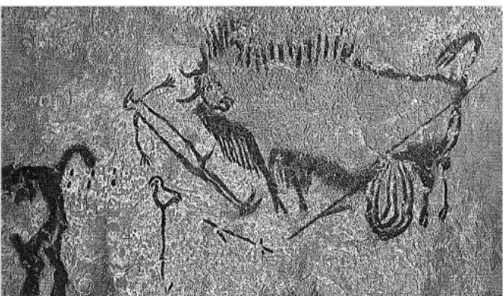
Hybrid beings in the Upper Paleolithic period can be seen frequently in drawings on rocks. The Lascaux drawings, which are thought to have been drawn around 30,000 B.C.E. include Bataille’s (1955: p. 113), "Man in the
Well” and the bird headed "ithyphallic" figure called “Dead Man” by Breuil
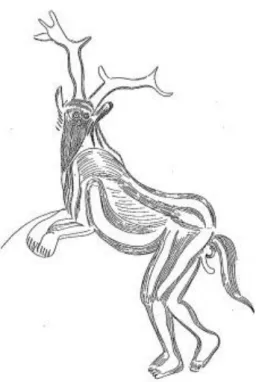
(1952: 114) stand in front of a bison that has been depicted as wounded by still ready to attack (Fig. 2). Below the bird headed figurine with a long torso and two arms stretched across lies a bird with long legs. A horse headed hybrid being figurine which stands on its two feet with both hands free and standing just behind a horse depiction on a carved plate was found in Étiolles in the Paris Basin which has been dated back to 12,000 B.C.E. (Taborin, 2001: 125 ff, fig. 2-3). Found in Les Trois Frères in the Ariége plains south of France, a drawn and painted bison headed dancer from an earlier period had a beard, a tail and an arching nose between round eyes. This composite figure called "The God of
Trois Frères" or "the sorcerer" (fig. 3) was depicted with front arms parallel and
flexing and feet in a dancing position (Bataille, 1955: 120, 135). The
"Aurignacien Silhouette," a barely visible figure drawn on the ceiling of the
Altamira cave in Spain, which was among the first half human half animal figures, was depicted as a man wearing a mask. The figure found in Hornos le Peňa, which looks like a monkey with a tail apparently attached later on, was also described as a human hiding behind a costume or a mask, just like the
"Aurignacien Silhouette". In the case of the bird headed feminine figurine found
in the Pech Merle cave in Midi Pyrénées region of France, it was obvious that its wings were attached. Most of humanoid depictions in Altamira and Hornos had weird appearances. Most were depicted as mixed with frog or fish figures (Bataille, 1955: 118 ff). The prominent feature of half human half animal figures is the fact that humanistic features were hidden behind a mask. Almost all of the figures with well-shaped heads and human faces that have been found inside the Caverne des Combarelles cave near Les Eyzies must have been depicted with a mask on their faces (Bataille, 1955: 119, 134). The human-animal hybrid figure (Fig. 4) playing the wind instrument he is holding with his two hands which has
been found inside the Les Trois Frères cave amidst wild animals, resembles a shaman in the middle of a ritual, wearing a human mask (Bataille, 1955: 135).
Humans, who have lived during the Upper Paleolithic period were successful technical painters, but they would hide human features behind an animal mask whenever they would depict themselves. Prehistoric humans, who had restrictive effect of nature, idealized some animals that were shared same place and time. Idealized animals by Prehistoric humans had some special powers and skills to pass beyond natural and spiritual borders. Lewis-Williams (2002: 283 ff), and Winkelman (2002: 77) consider human-animal composite figures and figures wearing masks as a part of some sort of shamanic ritual where a change in consciousness occurs. What made Paleolithic humans, who were living with confusion and embarrassment of their own bodies, to depict humans behind a monster's mask or as a broken silhouette? We have to look into the conflict between restriction and violence, the holy and the monster, predator and prey, and life and death in order to answer this question. At this point, the goal of a shamanic ritual is to ensure continuity of the goodness of clans, renewal of the universe and creating a balance between the destructive and the creative against the mental existence caused by these conflicts in a dialectic sense.
An organizational form of animism, shamanism is based on using abilities for "mental representation," "me" and "others." It allows natural and imaginary phenomena, presentation using anthropomorphic objects, and assigning mental qualities to non-human beings (especially animals) in order to create a balance between the nature and humans (Haarmann and Marler, 2011: 76; Winkelman, 2002: 74-75). In Prehistoric rock drawings, humanistic animal depictions are a reflection of the hunter, who assumes his prey's form in order to apply his power on the prey, while keeping elements that would remind him of his identity secret as a deep reflex in order to prevent himself from getting lost within the object (prey) he will transform into. Shamans create a "double perspective consciousness" in order to prevent being transformed into the imitated prey completely (Ishii, 2013: 798). Earliest hybrid beings like the lion man, which are considered as a reflection of this "double perspective consciousness" can be considered as an important indicator of changes in humans' cognitive habit which has, in later periods, triggers development of a dual capacity for emergence of complicated social relationships and complicated symbols (Wengrow, 2011a: 155).
Evolution of the Hybrid Beings in the Neolithic Societies
Changes in climate and environmental conditions, the pressure of increasing population, and symbolic or cognitive revolution which was undeniably important, have resulted in a new way of life in the Near East (Cauvin, 2000: 9 ff; Kuijt, 2002: 3 ff). In the Near East from the Epipaleolithic in human life big changes emerged. The domestication caused alteration on thought structure of the societies. In other words, living in houses grouped in villages offered the potential for a new structuring. In this way sedentary “domesticated” societies are distinguished by an emphasis on the boundary (Watkins, 2006: 19-20). For the domesticated societies, Watkins (2006: 20) proposes “it was natural for domesticated societies the
form analogues between their built environment and community, between house and household, and between the built environment that they create and inhabit and the world in which they live.”
The Natufian Culture, named as the pre-agricultural societies, has been a period of preliminary preparation for transitioning from hunter-gathering cultures to production at the core of subsistence economy in the region strating from the Euphrates to the Sinai that covers the whole Levant. During the transitioning from Natufian period to PPNA (Pre-Pottery Neolithic A) and PPNB (Pre-Pottery Neolithic B), settled cultures in Anatolia, North Levant, Lebanon and the Jordan Valley were represented with regional differences in terms of culture and chronology (Belfer-Cohen and Bar-Yosef, 2002: 19 ff; Kuijt, 2002: 5). Various zoomorphic tools engraved with three dimensional animal figures from the Carmel Mountain and Nahal Oren, which represent the Natufian Culture have taken their places as precursors for Neolithic period art. During the period called the Khiamian period (10,000 B.C.E.); schematic human figures were widespread in the Levant and Northern Syria (Cauvin, 2000: 22 ff). Miniature findings from Southern Levant from the PPNB phase (8,600-7,000 B.C.E) included goddesses, bulls, anthropomorphic males and various animal figures, made of clay schematically. Three masks in human shapes were found in Nehal Hemar and the Hebron region in Israel. In Nahal Hemar and Munhata in Southern Levant, miniature human heads made of bone and clay were depicted in a schematical manner (Cauvin, 2000: 105 ff). Examples of plastered skulls, which are among the greatest findings from the period, were found in Southern Levant settlements such as Jericho, Beisamoun, and Kfar HaHoresh. Towards the end of PPNB, the plastered skull tradition has spread outside the borders of Southern Levant. Examples of plastered skulls found in Tell Ramad in Central Levant Region and Köşk Höyük and Çatalhöyük in Central Anatolia provide some information on how Neolithic humans made
sense of the relationship between body and mind (Cauvin, 2000: 113-114; Özbek, 2009: 145 ff; Hodder and Meskell, 2010: 53;).
The importance given to human skulls in traditions on burying the dead and human figures hidden behind animal masks from the Prehistoric period is connected to the way contemporary humans have associated human mind and spirit (Kuijt, 1996: 313 ff). The way humans of the Neolithic period perceived themselves and the nature are more complex compared to humans from Prehistoric period coming from a culture of hunter-gatherings. In the relationship between humans and the environment in rock drawings from the Prehistoric period, humans are in unity or sameness with the nature, whereas in cognitive world of Neolithic period, they have started to put themselves in the center or gave meaning to the nature as "me" and "others." Without doubt the cognitive change evolved with effect of many social and natural factors. Monumentality and the way of presentation of the animals on "T" shaped columns with schematized human shapes, found in Göbekli Tepe and Nevali Çori, are important, as they emphasize on this new cognitive development (Hauptman, 1999: 70 ff; Schmidt, 2000: 45 ff; Schmidt, 2010: 239 ff). In the Neolithic communities, ceremonies and rituals were cyclically and repeatedly performed with collective memory and identity (Watkins, 2015: 154). The consciousness of community had to be kept alive through exchange of its symbols and manipulation of its reality. Because of that, in the communities “me” concept was not independent from the borders of the communities. Its dynamics can be determined requirement, habits, memories, and benefit of communities
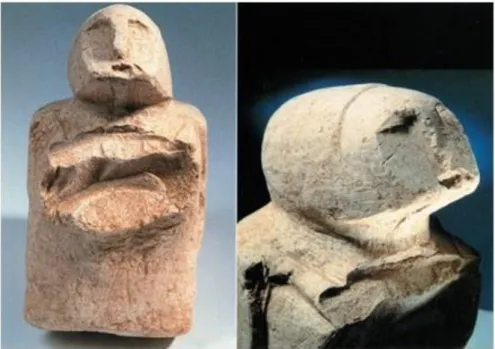
In most of hybrid beings from Neolithic period, hybrid components are emphasized on figures, especially their heads. Masks, headless figurines or bird headed human figurines (Fig. 5) show that Neolithic societies considered connection of spirit and head. Most of Neolithic period (7,400-6,000 B.C.E.) anthropomorphic figures found in Çatalhöyük were mostly headless or highly schematized miniature figures depicted with shortened heads in the shape of a bird beak (Hodder and Meskell, 2010: 56; Nakamura and Meskell, 2009: 212, fig. 2; Wengrow, 2011a: 156). At Körtik Tepe, which lies 30 km west of Batman in Southeastern Anatolia and represents the Pre-Pottery Neolithic period, was found some finds that show composite features. Among the finds at the Körtik Tepe settlement many stone vessels have geometric decorations. On the stone vessel which has founded at Körtik Tepe, the bird headed human figures stand between snake and crocodile figures (Özkaya and San 2007: 300, fig. 150).
Bird symbols from Neolithic period are mostly found in Çatalhöyük. Depictions generally involved vultures, although symbols of aquatic birds
and cranes were found, as well. The Temple VII.21 in Çatalhöyük had vultures with abnormal wings depicted as facing each other over a headless human body had legs in the form of human legs (Fig. 6) (Marler and Haarmann, 2007: 54, fig. 5; Russell and McGowan, 2003: 452). Mellaart (1967: 167, fig. 14, 15) interprets these depictions as priests or priestesses wearing vulture costumes and conducting a death ritual. Also, it is known that vulture skulls were frequently used in placements on the walls of Çatalhöyük (Hodder, 2006: 49). Bones, which were found in Çatalhöyük and determined to belong to wings of a crane were, based on the analysis over the cut sections, thought to have been used as part of a ritual costume. Cranes were generally associated with renewal, resurrection, change of seasons and productivity, while vultures were associated with death (Russell and McGowan, 2003: 445 ff). Depictions of cranes found in columns no. 2 and 33 in Göbekli Tepe were depicted with highly schematized legs (Peters and Schmidt, 2004: 184). Symbols of vultures are not common in Göbekli Tepe. The column no. 43 has a vulture figure, which sits with its legs extended. Another finding on vulture symbols in Göbekli Tepe was the highly decorated stone vulture head figurine (Peters and Schmidt, 2004: 184; Schmidt, 2010: 244). In Anatolia, another settlement in which bird symbols from Neolithic period were found is Nevali Çori. A bird statue found in Nevali Çori had a human face (Fig. 7). Another limestone statue found at the same settlement depicts a human head and a predator's head caught by a bird's claw. Another statue from Nevali Çori depicts a bird figure sitting on top of heads of two humans standing back to back (Hauptmann, 1999: 76; Schmidt, 2010: 247-248). Connected to the spiritual world, human and bird heads have an importance in Neolithic period (Hodder, 2010: 55).
In the Late Neolithic period hybrid beings were depicted on the pottery from varied settlements in the Near East. From the Near East on pottery sherds dating back to Late Neolithic human-animal hybrids were portrayed on the dancing scenes. Some remains from Domuztepe in between modern cities of Gaziantep and Kahramanmaraş in southeastern Turkey, date to Late Halaf period (5,750 B.C.E). Among the remains some pottery sherds were depicted as animal headed human figures (Fig. 8a). On the Domuztepe pottery sherds dancing human figures wear a horned animal mask and probably they practice a ritual. On another sherd from Domuztepe a headless or masked human figure has feathered arms (Fig. 8b). On the pottery sherds from Fıstıklı Höyük in Şanlıurfa city from southeastern Turkey similar to masked human figures have feathered arms (Carter, 2012: 116, fig. 14a-d). Domuztepe pottery sherds depicted hybrid human figurines were found in
found. From “death pit” human and animal remains show that human and animal sacrifice was practiced parallel with some rituals (Carter, 2012: 97 ff). The animal headed and feathered human symbols are performing a dance as a part of shamanistic ritual which was probably related to death and rebirth. In the Late Neolithic and Early Chalcolithic we can observe similar patterns on the pottery sherds from Iran and southern Mesopotamian settlements. At Tepe Sabz and Khazineh on Deh Luran Plain, some depicting pottery sherds dated to second half of the sixth millennium B.C.E. On the pottery sherds dancing human figures have featured arms. Symbols of the feathered human figures were found widespread in the settlements (Tul-i Bawa Muhammad and Tepe Giyan) of western Iran and Southern Mesopotamia (Garfinkel, 2003: 164 ff. fig. 9.7d-g, fig. 9.8d, fig. 9.10f-g).
Hybrid beings represented as human-animal hybrids in Upper Paleolithic period have transitioned to a mixture of humans and animals or humans and two different animals in Neolithic period. Animal symbols on chlorite stone plaques found in the cemetery of the settlement at Körtik Tepe (Fig. 9) (Özkaya and Coşkun, 2013: 10-11, fig. 9-10). These beings with ibex heads were depicted with horizontal bodies that end with a fluid curve. Their feet were not depicted. The way their front arms were depicted resembles composite figures from the Paleolithic period. Their arms were depicted as free and side by side, just like "The God of Trois Frères," the horse headed figure from Étiolles or composite figures from Hornos le Peňa. Another figure on top of a chlorite plate that was found in Körtik Tepe was depicted with two antennae or horns on top of its head, an insectoid face with round eyes, and a flat body with geometrical patterns comprised of circles and lines on top. Arms and legs of this insectoid faced composite figure were not depicted. These plaques that were uncovered from cemeteries can be associated with a belief on death and afterlife, as they have composite features and don't have a naturalist appearance.
The lower section of a figurine found in Gusir Höyük, which lies 2 km west of Ormanardı Village in Eruh Province of the city of Siirt, was found intact and depicted in a sitting position with its legs spread apart. These legs that belong neither to a human nor an animal, depicted as bent from its knees and then separated into two, must be representing a hybrid being (Karul, 2011: 4, fig. 21).
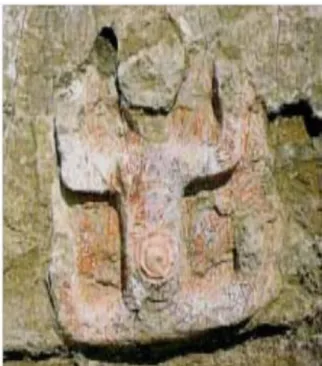
Those found at Çatalhöyük are very important to interpretation of hybrid beings in Neolithic period. The bear figure on a seal or pintadera found in Çatalhöyük was depicted with arms and legs spread and twisted upwards, in a body position that is impossible for both humans and animals. The bear figure, which is associated with mother goddess and femininity was
interpreted to be of a hybrid being (Marler and Haarmann, 2007: 48 ff; Türkcan, 2013: 243, fig. 13). The bear figure in a relief found in Çatalhöyük had the same position like the pintadera example (Fig. 10). Interwoven circles on its stomach section were associated with pregnancy (Marler and Haarmann, 2007: 57, fig. 7).
Bear-human hybrid symbols were also seen in Eastern Europe in Neolithic period. The bear symbol was directly related to the mother goddess symbol of the Neolithic Danube Culture of Eastern Europe. The female figure with a bear mask from the Neolithic period Vinča Culture of Serbia has paws for hands (fig. 11). Another bear figure from the Vinča Culture was depicted as a human in sitting position with its offspring on its lap (Marler and Haarmann, 2007: 69, fig. 14, 15).
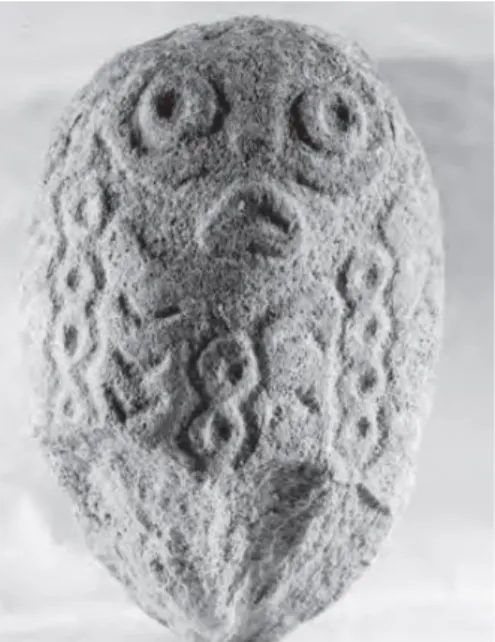
Transition processes from the nomadic to sedentary communities are very well represented in Neolithic southeast Europe, as well. Hybrid symbols were widespread in Neolithic southeast Europe where economic dynamics were still mostly based on hunting. In the southeast Europe an Early Neolithic center Lepenski Vir (9,300-5,700 B.C.E.) presents sculpted boulders, depicting human-fish hybrid beings, were found in trapezoidal buildings frequently around rectangular stone-lined hearths. This regional tradition has roots in the territorial Mesolithic sequence. The regional tradition is attested in the settlements found on both banks of the Danube Gorges. Hybrid human-fish boulder artworks were found at Lebenski Vir, (Fig. 12) in the centre of trapezoidal building House XLIV/57 (6,300-5,900 B.C.E) (Borić, 2007: 98-99). Palaeodietary data from the region indicates a strong reliance on fish consume through the Mesolithic period. However, researches show that Early Neolithic Lepenski Vir societies abandoned a high reliance on fish that has characterized the Mesolithic diet. Borić (2007: 99) refers that “since this change largely coincides with the appearance of
the boulder tradition and fish/human hybrids’ depictions, one is tempted to interpret this dietary change, although not entirely, as a consequence of specific prohibitions, including taboos against eating at least certain types of fish.” At Lepenski Vir human-fish hybrids and their associations with at
least several buried individuals strongly indicate a belief in the possibility of human metamorphosis into a certain kind of fish being. Some ethnographic researches show that fear of metamorphosis into a certain kind of animal closely related to humans comes out of the horror of eating the human, hiding in the animal skin. Here, the dead is not to be interpreted as humans, but rather as spirits that are intimately related to animals (Borić, 2007: 99). As a taboo, prohibited violence or forbidden hunting must have been effective on the emergence of the hybrid human-fish at Lepenski Vir.
When discussing animal representations within human life, Meskell (2015: 15-16) points out to differences and similarities between animals and humans. Animals and humans are similar in terms of birth, growth and feeding but their anatomic features, habits and physical capacities are different. They are like us, but different at the same time. The wild and the monstrous come from a far or from the unknown. Therefore, it is the master of the near and the far, the known and the unknown. Most of the animal figurines depicted during Neolithic period were wildlife animals. Bones from sheep, goat, cow and similar domestic animals were found while studying Çatalhöyük, but these animals were rarely depicted (Hodder, 2006: 9, tab. 1; Martin and Meskell, 2012: 414-415).
The settled Neolithic tradition with its known and defined borders and the wildlife with its unknown and uncontrollable borders were represented by the conflict over power and possession. During Neolithic period, borders between "me" and "the other," "wild" and "settled" were reimagined during redefining of existence over the conflict between culture and nature. In order to transform into the powerful, control the powerful and communicate with the powerful amidst this conflict, humans probably required the power of their totems and ancestors who have hunted in unknown and uncontrolled lands where monsters ruled. For this purpose, decorations on wild animal bones, especially keeping and preserving the wildest and most dangerous limbs of these animals can be interpreted as an indication of possessing this power (Hodder and Meskell, 2010: 42 ff; Meskell, 2008: 373 ff).
In Neolithic societies, the components of the hybrid beings included mostly feather or head of a bird, paw or head of a bear, horn of a wild animal. The parts of animals are related to power and some special skills like fly and speed. In a dangerous or essential situation like hunting the powerful body parts can be used for attack or defense. Such characteristics constitute the foundation of having privilege for the entity utilizing them to survive. On the other hand, one who has a bird ability can pass beyond borders between the life and death, the now and the future, the earth and the sky. Like Paleolithic hunter-gathering societies, in Neolithic societies desire of the power and passing borders must have been needed and caused to exchange of real and fanciful world. Besides of all that, in some cases, as a sacred punishment, being a part of a peaceful animal like a fish may be related to passing a forbidden border.
Prey Stress, “Altered States of Consciousness” and Metamorphosis Between Natural and Symbolic Borders
In describing monsters, Kearney (2012: 15-16) describes the habitat of these creatures that are symbols of an experience of extremities which bring us to the edge as a faraway land with phantasmal borders not shown on maps, where ships never dock, compasses are not correct, a country with no owners, where the world ends, where the wild things are. They come from nowhere, merely pass by, and change their masks. As Meskell (2015: 15) states, they are the owners of both "faraway" and "here." In his saying on monsters, Nietzche states "Beware that, when fighting monsters, you yourself do not become a
monster" (Beal, 2002: 2). When talking about the conflict between predators
and preys, Bataille (1955: 37-38) uses the concept of transition from prohibited to sin. The state of consciousness caused the breaching this prohibition associates itself with the prey. Kristeva (2004: 87) asks "Can we
define what is holy as a two faced creation?" A defense that is based on the
social bond created as a result of paying the price for killing along with killing and feeling of guilt and the dimension of "fear and approximation" that is built by fear and loathing alone and based on unity between the object and the subject constitute the basis for what is holy. Girard (2003: 17 ff) states that violence without risk of revenge is the defining point when selecting those that can be sacrificed and those that cannot be sacrificed. Therefore, feelings of guilt and fear caused by violence towards the prohibited or those that cannot be sacrificed mentioned by Bataille have caused, in a cognitive sense, a state of conscience which causes "approximation" and "sameness" between predator and prey and causes the hunter to "become the hunted."
Studying San Rock Paintings in South Africa, Lewis-Williams and Dowson have tried to explain certain depictions on rocks with changing cognitive status and transcendental traveling performance of the shaman. Human-animal hybrid figures depicted in rock drawings were interpreted as the shaman spirit traveling into an animal body. In a ritual of the Kalahari San Tribe, shamans repeat the ritual words "you entered, entered to the
ground and then into the skin in your body" after his travel into the spirit
world (Lewis-Williams and Dowson, 1990: 13). Regardless of its cultural background, human nervous system has the universal capacity to have some sort of hallucination experience. Neuropsychological researches have shown that continuous rhythmic movement, psychoactive drugs, sensory deprivation, intense concentration, auditory processes, schizophrenia and hyperventilation (shallow and rapid breathing, some sort of apnea) and similar situations may allow us to experience hallucinations (Lewis-Williams and Dowson, 1990: 7 ff). Shamanism has close relations with prey
animals at its core. Shamanism that uses the visual "ecstatic-visionary" technique while in trance is a typical animistic belief (Hoppal, 2001: 210).
Most scientists have resorted to shamanism when interpreting hybrid beings in Prehistoric period art. In his article on hybrid being or "the
sorcerer" of Trois Frères, Makkay (1953: 71), a Hungarian archaeologist,
uses the description below when interpreting this hybrid being:
The shaman performs a dance: He is in trance. In this state, his spirit leaves his body. We don't know much about the stance of Upper Paleolithic beliefs on the spirit. According to the original view, we can even assume that the shaman, dressed in animal fur, leaves only his costume rather than his body during his trance. It is obvious that wearing animal fur comes before evolution of shamanism, even in roles related to occult. Ancient humans have probably used animal masks and costumes before magical rituals.
Shaman clothing, with all of its ornaments and decorations, must have had the function of providing shamans a magical body in the shape of an animal. Shamans have the ability to shift their perspective between "me" and "the other." The main feature of shamanism is the ability to exceed ontological thresholds and assume the shape of a non-humanoid object. Shamans can transform into non-human forms such as animals or spirits and can see them as themselves. However, the greatest risk involved in this process is that shamans can be possessed by the object into which they wish to transform or become an animal or spirit. The hunter mimics movements of its prey to trap and kill. During this practice of imitation, the hunter agrees to assume appearance of the animal in order to exert his force upon the prey. However, this is dangerous for the hunter, because he can lose his identity and experience an inescapable metamorphosis. The hunter must not lose his consciousness during this imitation process in order to avert this risk. Although he acts like an animal in order to assume its form, the hunter has to preserve his identity and revert back to it with some sort of deep reflex. This is called the “double perspective consciousness.” Therefore, the first rule for a hunter shaman is to preserve one's own identity while assuming an alien form (Ishii, 2013: 797-98).
Conducting a research on shamanism in Siberia, Eliade (2014: 207-208) has given a special importance to bird costumes: “We have seen bird
feathers everywhere when looking for shaman clothing. Furthermore, designs of these clothes try to imitate a bird form as much as possible."
Eliade (2014: 212) uses the concept of "animal ancestor" when discussing the hybrid being thought in shamanism. The first shaman was born from the intercourse of an eagle and a woman. On the other hand, shaman himself
tries to transform into a bird and fly. Masks in shamanic rituals serve the same purpose. The goal should have been to return to "animal ancestor" which is the unlimited womb, the first source seen in animals which are considered to be ancestors. Shamans have used “spirit guides” in order to reach the "animal ancestor" spirit. In shamanism, spirit guides and guardian spirits are generally depicted as animals (Jilek, 2005: 9). The concept of
"animal ancestor" and spirit guides in the shape of an animal are the
primitive manifestation of the desire to acquire the strength and skill of uncontrollable wild animals and identify with them (Hoppal, 2001: 218). The spirit of the strong and wild animal killed by the hunter ancestor has merged with the spirit of the hunter ancestor to become the "animal ancestor" belief in later periods. The "ancestor cult" which has an important place in cognitive world of the Neolithic period shares certain similarities with the "animal ancestor" cult in shamanism. Headless and shortened anthropomorphic figurines, bird headed humanoid figurines, depictions of vultures with human legs, human skulls plastered with clay, depictions of humanoids in bear shapes must have been used in Neolithic spiritualism for the purpose of establishing a connection with distant ancestors and benefit from their protective qualities (Nakamura and Meskell, 2009: 210 ff; Hodder and Meskell, 2010: 54).
Eliade (2014: 212-213) states that the reason for collection of bones of hunted animals in a careful manner, storing them in a safe location and paying respect to them in shamanism was the belief that animals would resurrect from their bones after they die. Dangerous limbs of wild animals were preserved carefully or hung on walls and plastered skulls were at the same room with these artifacts in Çatalhöyük, which might be some sort of symbolic method to connect with a common "ancestor" or the "animal
ancestor" (Hodder and Meskell, 2010: 42 ff; Hodder, 2006: 137 ff, fig. 57).
Using shamanism alone to describe the spiritual world in Neolithic period would lead us to wrong conclusions. However, shamanistic belief systems born out of hunter cultures must have had an impact on Neolithic cultures. Indeed, hunting was an important component of subsistence economy for Neolithic cultures.
After Prehistoric period the presence and role of hybrid beings changed in very different cultural complex and the different social structure. With cultural, economic and social change hybrids represented ideologically hierarchical and divine power (Wengrow, 2011b: 135 ff). But certain Prehistoric traditions and beliefs related to hybrid beings transited to the hierarchical societies in the Ancient Near East, as well. In ancient historic Mesopotamian art, hybrid beings were generally used for apotropaic aims
(Wiggermann, 1994: 242-243). A different representation of spirit guides in Prehistoric period emerged after 3.000 B.C.E. In Mesopotamian art, differently demons, hybrid animals called monsters were some sort of protective powers as servants of gods. Indeed, in Mesopotamian mythology, we can see the beings who are messengers or an element of balance and are tasked with ensuring godlike "cosmos" or order against "chaos" during birth and development of hybrid or composite existence. They are keepers of order and balance, even warriors, against evil and demonic beings of chaos. (Wiggermann, 1992: 14 ff; Wiggermann, 2011: 299 ff; Dönmez, 2016: 213 ff; Gane, 2012).
Conclusion
Hybrid beings were a tool of “transgression” that is between natural and spiritual world in the shamanistic ritual practice in Prehistoric societies. The desire of passing beyond of the natural and phantasmal borders, which were drawn by Prehistoric consciousness, was vital to survive for Prehistoric societies. Nomadic consciousness perceived much wider natural border and the symbols of the border than sedentary communities had. In the Paleolithic period human and Pleistocene animal species inhabited same ecological space. The humankind of the Upper Paleolithic period, which has seen the world with a sense of permeability among species and an animalistic sensitivity and vigor, had a cognitive world within which things and humans were at the same level and forming a unity. During breakage of this unity and a sense of "togetherness," the hunter tries to balance the fear and suspense caused by prohibition of violence against those that exist at the same level and spiritual unity with mythical thinking. Prohibited violence gave way to a cognitive status that identifies with the prey. Neuropsychological studies show that human brain has a tendency to hallucinate, whatever the cultural background may be. In shamanism, which was a widespread belief among hunter societies, the shaman enters an
"altered states of consciousness" in order to connect with their ancestors in
afterlife. The ritual of a shaman changing his body usually requires entering the body of an animal which has been established as the "spirit guide." Shamans would have to wear clothes and masks in animal shapes that would represent the spirit guide. In shamanism, animals designated as spirit guides are strong and intelligent animals in the wild. As a matter of fact, during the birth of human-animal hybrids, humans representing themselves as the strong creature they are hunting or as hidden behind that animal shows his desire to acquire that power and become that power.
The first hybrid beings we come across in Upper Paleolithic period are usually comprised of a strong animal and a human. Specifically, a strong animal head is depicted as merged with a human body when representing hybrid beings. In certain cases, all animal beings with four legs would be depicted as a human in a bipedal position. In late Upper Paleolithic period and Neolithic period, this representation has turned into wild and dangerous limbs of a strong animal being merged with a human body. In fact, the mother goddess figurine with bear head and bear paws from the Vinča Culture is among the most striking examples of this representation. We start seeing complex hybrid figures that are a combination of two different animals and humans in Neolithic period, as seen in Körtik Tepe figurines. This was important, as it represents the complex patterns of the cognitive world of Neolithic period.
All wild animal parts connected to the representation of power such as jaws, hooves, horns and heads being preserved and kept, as well as being subjected to special processes, must be oriented at not only controlling the power from a far or an uncontrolled nature, but also at controlling the nature, itself. In this regard, Neolithic period figures which were classified as hybrid can be interpreted to be a representation of transforming into what is powerful, being possessed by power, connecting with ancestor from faraway lands, and balance. In fact, hybrids represent some sort of agreement and balance. In this context, search for the same spiritual balance must lie on the foundation of presentations of half human half animals which have been turned into the monstrous or possessed by the monstrous in the Prehistoric period.
Bibliography
Bailey, D., Prehistoric Figurines: Representation and Corporeality in the Neolithic, Roudledge Taylor and Francis Group, London and New York 2005.
Bataille, G., Prehistoric Painting: Lascaux or the Birth of the Art (The Great Centuries of Painting), Trans: A. Wainhouse, Switzerland, Skira 1955.
Beal, T. K., Religion and Its Monsters, Roudledge Press, New York 2002.
Belfer-Cohen, A. and O., Bar-Yosef, 2002, “Early Sedentism in the Near East: A Bumpy Ride to Village Life”, G. M. Feinman and T.D. Price (eds.) Life in Neolithic Farming Communities: Social Organization, Identity, and Differentation, Kluwer Academic Publishers, New York et al, 2002, pp. 19-37. Borić, D., “Images of Animality: Hybrid Bodies and Mimesis in Early Prehistoric
Art”, C. Renfrew and I. Morley (eds.) Image and Imagination: a global prehistory of figurative representation, Oxford: Oxbow Books, 2007 pp. 89-105.
Breuil, H. A., Four Hundred Centuries of Cave Art. Centre d’Études et de Documentation Préhistoriques, Trans: M. E. Boyle, Montignac 1952.
Carter, E., “On Human and Animal Sacrifice in the Late Neolithic at Domuztepe”, A. M. Porter and G. M. Schwartz (eds.) Sacred Killing The Archaeology of Sacrifice in the Ancient Near East, Eisenbrauns Inc. Winona Lake, Indiana 2012, pp. 97-124. Cauvin, J., The Birth of the Gods and the Origins of Agriculture, Trans: T. Watkins,
Cambridge University Press, Cambridge 2000.
d’Errico, F., et al., “Archaeological Evidence for the Emergence of Language, Symbolism, and Music-An Alternative Multidisciplinary Perspective”, Journal of World Prehistory 17/1, 2003, pp. 1-70.
Dönmez, S., “Eski Mezopotamya Toplumlarında Korku ve Güç İlişkisi Üzerine Bir Değerlendirme”, The Journal of Academic Social Science Studies 53 / Winter II, 2016, pp. 213-226.
Eliade, M., 2014, Şamanizm: İlkel Esrime Teknikleri, Çev. İ. Birkan, İmge Kitabevi Yayınları, 3. Baskı, İstanbul 2014.
Garfinkel, Y., Dancing at the Dawn of Agriculture, University of Texas Press, Austin 2003.
Floss, H., “A New Type of Society Creates a New Type of Objects. Aurignacian Ivory Sculptures From the Swabian Jura (Southern Germany)”, M.S. Corchón and M. Menéndez (eds.) Cien Aňos De Arte Rupestre Paleolítico: Centenario Del Descubrimiento De La Cueva De La Peňa De Candamo (1914-2014), Salamanca 2014, pp. 53-62.
Gane, C.E., Composite Beings in Neo-Babylonian Art, Doctoral Dissertation, University of California at Berkeley, 2012. https://escholarship.org/uc/item/3p25f7wk, (12.01.2018). Girard, R., Şiddet ve Kutsal, Çev. N. Alpay, Birinci Baskı. Pusula Yayıncılık,
İstanbul 2003.
Haarmann, H., and J. Marler, “The Unfolding of Old European Ritual Life: A Mesolithic Heritage”, The Journal of Archaeomytology, Vol. 7, 2011, pp. 73-88. Hahn, J., Kraft und Agression. Die Botschaft der Eiszeitkunst im Aurignacien
Süddeutschlands? Tübingen: Verlag Archaeologica Venatoria 1986.
Hauptmann, H., “The Urfa Region”, M. Özdoğan (eds.) Neolithic in Turkey, Archaeology and Art Publications, İstanbul 1999, pp. 65-86.
Hodder, I., Çatalhöyük Leoparın Öyküsü: Türkiye’nin Antik “Kasaba”sının Gizemleri Günışığına Çıkıyor. Çev. D. Şendil, Yapı Kredi Yayınları. İstanbul 2006.
Hodder, I., “Probing Religion at Çatalhöyük: An Interdisciplinary Experiment”, Religion in the Emergence of the Civilization, Cambridge University Press, Cambridge et al. 2010, pp. 1-31.
Hodder, I. and L. Meskell, “The Symbolism of Çatalhöyük in Its Regional Context”, Religion in the Emergence of the Civilization, Cambridge University Press, Cambridge et al. 2010, pp. 32-72.
Hodder, I., Studies in Human-Thing Entanglement, Creative Common Attribution (CC BY 4.0) 2016.
http://www.ian-hodder.com/books/studies-human-thing-entanglement (12.01.2018). Hoppal, M., “Sibirya Şamanizminde Doğa Tapınımı”, Ankara Üniversitesi Dil ve
Tairh Coğrafya Fakültesi Dergisi 41/1, Çev: G. Erginer, 2001, pp. 209-225. Ishii, M., “Playing with Perspectives: Spirit Possession, Mimesis, and Permeability
in the Buuta Ritual in South India”, Journal of the Anthropological Institute 19/4, 2013, pp. 795-812.
Jilek, W. G., “Transforming the Shaman: Changing Western Views of Shamanism and Altered States of Consciousness”, Investigación en Salud VII/1, 2005, pp. 8-15.
Karul, N., “Gusir Höyük”, M. Özdoğan, N. Başgelen and P. Kuniholm (eds.) The Neolithic in Turkey Vol. 1, Archaeology and Art Publications, İstanbul 2011, pp. 1-17.
Kearney, R., Yabancılar, Tanrılar ve Canavarlar, Çev: B. Özkul, Metis Yayınları, İstanbul 2012.
Kristeva, J., Korkunun Güçleri: İğrençlik Üzerine Bir Deneme, Çev. N. Tutal, Ayrıntı Yayınları, İstanbul 2004.
Kuijt, I., “Negotiating Equality through Ritual: A Consideration of Late Natufian and Prepottery Neolithic A period Mortuary Practices”, Journal of Anthropological Archaeology 15, 1996, pp. 313-336.
Kuijt, I., “Life in Neolithic Farming Communities: An Introduction”, G. M. Feinman; T. D. Price (eds.) Life in Neolithic Farming Communities: Social Organization, Identity, and Differentation, Kluwer Academic Publishers, New York et al. 2002, pp. 3-13.
Levi-Strauss, C., Mit ve Anlam, Çev: G.Y. Demir, İthaki Yayınları, İstanbul 2013. Lewis-Williams, D., and T.A. Dowson, “Through the Veil: San Rock Paintings and
The Rock Face”, South African Archaeological Bulletin 45, 1990, pp. 5-16. Lewis-Williams, D., The Mind in the Cave: Consciousness and Origins of Art.
Thames & Hudson. London 2002.
Makkay, J., “An Important Proof to the prehistory of Shamanism – The Interpretation on the Masked Human Portrait of the Cave Les Trois Frères.” Alba Regia (Szekesfeherfar) II-III, 1953, pp. 5-10.
Marler, J., and H. Haarmann, “The Goddess and Bear Hybrid Imagery and Symbolism at Çatalhöyük”, The Journal of Archaeomythology 3/1, 2007, pp. 48-79.
Martin, L., and L. Meskell, “Animal Figurines from Neolithic Çatalhöyük: Figural and Faunal Perspectives”, Cambridge Archaeological Journal 22/3, 2012, pp. 401-419.
Mellaart, J., Çatal Höyük: A Neolithic Town in Anatolia, Thames & Hudson, London 1967.
Meskell, L., “The nature of the beast: curating animals and ancestors at Çatalhöyük”, World Archaeology 40/3, 2008, pp. 373-389.
Meskell, L., “A society of things: animal figurines and material scales at Neolithic Çatalhöyük”, World Archaeology 47/1, 2015, pp. 6-19.
Mithen, S., The Prehistory of the Mind. A search for the Origins of Art, Religion and Science. Phoenix, London 1996.
Nakamura, C., and L. Meskell, “Articulate Bodies: Forms and Figures at Çatalhöyük”, Journal of Archaeological Method and Theory 16/3, 2009, pp. 205-230.
Neumann, E., The Origins and History of Consciousness, Trans: R. F. C. Hull, Princeton University Press, Princeton 1969.
Nixon, G., “Myth and Mind: The Origin of Human Consciousness in The Discovery of the Sacred”, Journal of Consciousness Explorations & Research, 1/3, 2010, pp. 289-337.
Özbek, M., “Köşk Höyük (Niğde) Neolitik Köyünde Kil Sıvalı İnsan Başları”, Hacettepe Üniversitesi Edebiyat Fakültesi Dergisi 26/1, 2009, pp. 145-162. Özkaya, V., and O. San, “Körtik Tepe”, Vor 12.000 Jahren in Anatolien: Die
Ältesten Monumente der Menschheit/12.000 Yıl Önce Anadolu: İnsanlığın En Eski Anıtları Kültür ve Turizm Bakanlığı Yayınları, 2007, pp. 78+436 +301-313. Özkaya, V., and A. Coşkun, “Körtik Tepe Excavations”, The Ilısu Dam and HEP
Project Excavations: Seasons 2004-2008, Diyarbakır, 2013, pp. 1-38.
Peters, J., and K. Schmidt, “Animals in the Symbolic World of Pre-Pottery Neolithic Göbekli Tepe, South-eastern Turkey: A Preliminary Assessment”, Anthropozoologica 39, 2004, pp. 179-218.
Russell, N., and K.J. McGowan, 2003, “Dance of the Cranes: Crane Symbolism at Çatalhöyük and Beyond”, Antiquity 77, 2003, pp. 445-455.
Schebesch, A., “Five Anthropomorphic Figurines of the Upper Paleolithic-Communication Through Body Language”, Mitteilungen der Gesellschaft für Urgesschichte 22, 2013, pp. 61-100.
Schmidt, K., “Göbekli Tepe Southeastern Turkey. A Preliminary Report on the 1995-1999 Excavations”, Paléorient 26/1, 2000, p. 45-54.
Schmidt, K., “Göbekli Tepe - The Stone Age Sanctuaries. New Result of Ongoing Excavations with a Special Focus on Sculptures adn High Reliefs”, Documenta Praehistorica XXXVII, 2010, pp. 239-256.
Taborin Y., “De l’art magdalénien figuratif à Étiolles (Essone, Bassin parisien)” Bulletin de la Société Préhistorique Française 98-1, 2001, pp. 125-128.
Türkcan, A. U., “Çatalhöyük Stamp Seals from 2000-2008”, I. Hodder (eds.) Substantive Technologies at Çatalhöyük: Reports from the 2000-2008 Seasons, Çatalhöyük Research Project Series Vol.9, British Institute at Ankara (BIAA) Monograph 48, London 2013, pp. 235-246.
Watkins, T., “Architecture and the Symbolic Construction of New Worlds”, E.B. Banning and M. Chazan (eds.) Domesticating Space: Consturction, Community and Cosmology in the Late Prehistoric Near East, Ex Oriente, Berlin 2006, pp. 15-24.
Watkins, T., “Ritual Performance and Religion in Early Neolithic Societies”, N. Laneri (eds.) Defining the Sacred: Approaches to Archaeology of Religion in the Near East, Oxbow Books, United Kingdom 2015, pp. 153-163.
Wengrow, D., “Gods and Monsters: Image and Cognition in Neolithic Societies”, Paléorient 37, 2011a, pp. 153-163.
Wengrow, D., “Cognition, Materiality, Monsters: The Cultural Transmission Counterintuitive Forms in Bronze Age Societies”, Journal of Material Culture 16/2, 2011b, pp. 131-149.
Wiggermann, F. A. M., Mesopotamian Protective Spirits: The Ritual Texts, Cuneiform Monographs I; STYX &PP Publications, Groningen 1992.
Wiggermann, F. A. M., “Mischwesen A-B”, Reallexikonder Assyriologie und Vorderasiatischen Archäologie 8, 1994, pp. 222-264.
Wiggermann, F. A. M., “The Mesopotamian Pandemonium: A Provisional Census”, Studi e Materiali di Storia delle Religioni 77/2, 2011, pp. 298-322.
Winkelman, M., “Shamanism and Cognitive Evolution”, Cambridge Archaeological Journal 12/1, 2002, pp. 71-101.
Fig. 1: The “Lion-Man” figurine from the Hohlenstein Stadel (Schebesh, 2013: 76, fig. 2).
Fig. 2: The bird-headed ithyphallic figure or the “Dead-man” from Lascaux (Bataille, 1955: 114).
Fig. 3: “The god of Trois Frères” or the “Sorcerer” (Bataille, 1955: 136).
Fig. 4: A hybrid figure playing a wind instrument that it holds with its hands and dancing among the wild animals, from the Les Trois Frères Cave (Bataille, 1955: 135).
Fig. 5: The bird-headed figures from Çatalhöyük (Nakamura and Meskell, 2009: 212, fig.2).
Fig. 6: The vulture depictions with human legs from the temple VII.21 in Çatalhöyük (Marler and Haarmann, 2007: 54, fig. 5).
Fig. 7: The human-faced bird image from Nevali Çori (Schmidt, 2010: 245, fig. 12).
a b
Fig. 8: a) Pottery sherd from Domuztepe with masked women dancing; b) From Domuztepe pottery sherd with feathered arms and masked (?) or headless figures (Carter, 2012: 116, fig.
Fig. 9: The depictions of hybrid beings on the plaques from the graves of Körtik Tepe (Özkaya and Coşkun, 2013: 36, fig. 9).
Fig. 10: A wall relief decoration, thought to be a bear, from Çatalhöyük (Marler and Haarmann, 2007, fig. 7: 57).
Fig. 11: The bear-masked feminine figure belonging to the Neolithic Vinča culture in Serbia (Marler and Haarmann, 2007: 70, fig. 14).
Fig. 12: Sculpted boulder showing a human-fish hybrid being from Lepenski Vir (Borić, 2007: 100, Fig. 7.8)