East European Quarterly, XLI, No. 3 September 2007 ALLIES OR PARTNERS? AN APPRAISAL OF T U R K E Y ' S T I E S TO RUSSIA, 1991-2007 Lema K. Yanik Bilkent University
Turkey's ties to Russia have received considerable attention in the recent past. Since the end of the Cold War scholars, observers and policy-makers have shed lots of ink trying to make sense of various as-pects of the ties between Turkey and Russia. (Bazoglu Sezer, 1997, 2000, 2001; GUI 2004; Ogan 2004, 2006; Akgun and Aydin 1999; Telial 2001; Sever 2001; Sel?uk 2005; Kazgan 1998; Efegil 2001; Trenin 1997; Bilge !997; Kimklioglu 2001, 2006; Kazgan and Ul9enko 2003; Nadein-Ravesky 1999; Warhola and Mitchell 2006; Akturk 2006; Hill 2003; Hill and Ta^pinar 2006a; Hill and Ta^pmar 2006b). While, in the late 1990s, some of these scholars and observers used terms such as "cold peace," (Bilge 1997: 92) and "schizophrenic," (Trenin 1997: 57) to describe the relations between the two countries, and "ruled out any strategic normalization between Moscow and Ankara in the medium term" (Allison 1999: 36), in the early 2000s, the term that was used to describe the ties between the two countries was "virtual rapprochement," (Bazoglu Sezer 2001: 62) indicating the thawing ice. Recently, in 2005, however, Russia was accused of launching "a little-noticed charm offen-sive" (Holbrooke, 2005) towards Turkey, and then, Turkey and Russia were credited for joining forces and shifting towards "Eurasianism" (Salhani, 2005) and forming an "axis ofthe excluded" (Hill and Ta§pinar 2006b) highlighting the possibility of a creation of a "quasi-alliance" between Turkey and Russia. It is true that the relations between Turkey and Russia have improved immensely, but can we talk of "quasi-alliances," "axes" or "couplings" between the two?
This article is an overview of factors, mostly from a Turkish per-spective, that changed the nature of ties between Turkey and Russia since the collapse ofthe Soviet Union. It argues that the improvement of these ties is a "dual normalization," and can be attributed to three over-lapping developments: diminishing ofthe factors that elevated levels of mutual threat perception in Turkey and Russia; Russia's emergence as a
profitable market for Turkish entrepreneurs as wel! as the Turkish elite's drive to make Turkey an energy hub; and, Vladimir Putin's goal to make foreign economic relations one of the priority areas in Russian foreign policy. In other words, the economic "normalization" began a long time ago, but political "normalization" had to wait for the diminishing of the threat perceptions present in both countries.
The paper unfolds in three parts. The first section following this introduction elaborates on the events that contributed to the increasing threat perceptions in Russia and Turkey, and how the disappearance of these issues from the agenda has changed threat perceptions in both countries. The second section examines the dynamics of the economic ties between the two countries. The conclusion highlights possible problem areas that might emerge between Turkey and Russia and ex-plains why "quasi-alli an ces" or "axes" between Turkey and Russia seem quite unlikely in the near future.
The Diminishing Threat Perceptions
History has been more than generous with both Turkey and Russia providing them enough opportunities to create mutually held "enemy" images. Thus, it is impossible to talk about relations between Turkey and Russia without the role of "perceptions" (Bazoglu Sezer 1992: 227; 2000: 62; Harris 1995: 3; Ogan 2004: 98; Hill and Ta§pmar 2006: 81). Though mutually held threat perceptions originated in the period in which both countries were empires, the discord between Turkey and the Soviet Union at the end of World War II also was crucial for the creation of the "enemy" image and a sprawling "enemy" discourse. The Soviet demands for Turkish territory and basing rights in the Turkish Straits at the end of World War II not only forced Turkey to choose sides and attach itself to the Westem security system, but also led to the labeling of the Soviet Union as a source of threat. After the initial tension, and several other ups and downs in political relations, Turkey and the Soviet Union nevertheless managed to strike a working relation in the later years of the Cold War, especially in economic terms. But, as a result of the ongoing Cold War, this perception of the Soviet Union as a source of threat stayed attached to this country.
When the Cold War was coming to an end, both Turkey and Russia had very high expectations of a "strategic partnership" (Nadein-Ravesky 1999: 174). In the agreements signed just before and after the dissolution
ALLIES OR PARTNERS? 351 AN APPRAISAL OF TURKEY'S TIES TO RUSSIA, 1991 -2007
of the Soviet Union, in March 1991 and May 1992, respectively, both sides envisioned great deal of cooperation in different areas (Telia! 2001: 547). initially Russia even welcomed T u r k e y ' s interest towards the newly independent Turkic republics. But this was a very short-lived honeymoon period. The institutionatization of Russia's "near abroad policy" through Russian Foreign Policy Concept and Military Doctrine, in February and May 1993, led Turkey and Russia to be rivals rather than partners in Eurasia (Tuncer 2000, 440-447).
This rivalry that amplified mutual threat perceptions stemmed from several different yet interrelated issues:' T u r k e y ' s ties to the Turkic republics in the former Soviet Union; debates regarding the extraction and especially the transportation of the energy resources of the Caspian basin; Russia's military might and muscle flexing, which Turkey saw as a threat; and mutual accusations of harboring and supporting ethnic separatism. Until the late 1990s, all of these factors enforced and rein-forced the threat perceptions that both countries held against each other. Political normalization between Turkey and Russia could only begin after the elimination of most of the issues feeding these mutual threat perceptions.
Turkey's Ties with the Turkic Republics and The "Turkish Model"
For some Turkish officials, the emergence of the Turkic Republics as newly independent states after the collapse of the Soviet Union was a once-in-a-millennium opportunity to establish ties with the "forgotten cousins." These ties with the Turkic republics would not only provide Turkey and Turkish entrepreneurs with ample business opportunities but, in addition, would be a reevaluation of its foreign policy at the end of the Cold War. American policy makers supported Turkey in this process thinking that in the vacuum created by the elimination of the communist ideology these newly independent countries could be susceptible to radi-cal religious influences from Iran and thus Turkey with is "Muslim, yet secular and democratic" model would be a better alternative (Winrow 1998a: 91).
For Russia, however, after 1993, the "Turkish Model," or any kind of Turkish involvement in the region meant the expansion not only of the Turkish sphere of inHuence but also the American one. Furthermore, the Russians were worried that the "Turkish Model" could find sympa-thetic ears within Russia's own Muslim population, threatening Russia's
own unity (Zagorski 1999: 63). Despite Turkey's denial of pan-Turkism from the beginning, Turkey's slogan, model and its interests in the region had caused Russia to consider Turkey as a threat.
However, many projections made in the early years following the Cold War were proven incorrect. One such projection was the rivalry hetween Turkey and Iran in Central Asia (Hunter 2003: 133). But more important than that, the projection that the "new century would be the century of the Turks, from the Adriatic Sea to the Chinese Wall"^ never materialized. Simply put, Turkey was far from being a model. It lacked the resources to he a locomotive country. As a result of an overconfident and unrealistic foreign policy based on supposed ethnic and linguistic commonality and unmet promises, the Turkic republics started to dis-tance themselves from Turkey (Carley 1995: 169-197; Aydm 2004: 6). In other words, by the mid 1990s, it became clear that Turkey had neither the means nor the facilities to create a sphere of influence in the region, as initially was projected. So, starting from the early 2000s, Turkish foreign policy towards the Turkic Republics became one of ap-plying pragmatic policies that primarily protected the economic interests ofthe Turkish entrepreneurs in the region (Robbins 2003: 271)."' But, nevertheless, even the attempt to forge ties with the "Turkic cousins" was enough for Russia to see Turkey as a threat to its own survival right up to mid to late 1990s.
Caspian Basin, Energy Resources and Pipelines
The Russian "near abroad" was not the only element that reinforced mutual threat perceptions, in the 1990s. The development and particu-larly the transportation of energy resources in the Caspian Basin became another element of competition between Turkey and Russia (as well as the United States). While westem oil companies rushed the region to get involved in the extraction of oil and gas resources, some observers in the United States, very optimistically, regarded the oil reserves, which were then estimated to be as large as those in the Persian Gulf, as a chance to reduce American dependency on Middle Eastem oil. Another optimistic American assumption was that the proceeds from these resources would bring wealth and thus democracy to the region, allowing these countries to stand on their feet and consequently be less dependent on Russia (Cohen 1997; Richardson 1999; Momingstar 1999).
ALLIES OR PARTNERS? 353 AN APPRAISAL OF TURKEY'S TIES TO RUSSIA, 1991-2007
Two major problems emerged regarding these optimistic assump-tions. First, the Caspian Basin, far from containing as much oil as the Persian Gulf, had reserves that at most equaled those in the North Sea (The Economist 1998; Manning 2000; Jaffe and Manning 1998-1999; Olcott 1998).'' Second, transporting oil to the world markets became a problem in its own right, requiring the construction or improvement of various pipelines. Countries neighboring the Caspian Basin proposed or espoused different routes passing through their own territories, thus ex-acerbating the race for sphere of influence, the so-called "Great Game," in the region (The Economist, 1992). Turkey proposed a pipeline that would run from the Azerbaijani capital of Baku to the Turkish Mediter-ranean port of Ceyhan. This pipeline was to be constructed as an alter-native to the existing pipeline routes running from Baku to the Russian port of Novorossiisk and the Georgian port of Supsa. Afraid of losing its monopoly and thus influence in the region, Russia argued fiercely that existing pipelines were enough to transport the region's oil to world markets (Jonson 2001: 95)
Turkey objected to Russia, ostensibly on environmental grounds, saying that super-tankers loaded with oil from the Novorossiisk and Supsa would not only clog the traffic in the already overcrowded Turk-ish Straits, but would also increase the possibility of an accident that could obliterate Istanbul (Nadein-Raevsky 1999: 177). The dispute between Turkey and Russia regarding Turkish Straits worsened when the Turkish authorities introduced a new set of regulations in November 1998. Though this was a much diluted form ofthe 1994 regulations that Turkey attempted to use, Russians claimed that it meant the modification of the Montreux Convention of 1936 that secured free passage of merchant ships through the Turkish Straits during peacetime. This modi-fication, which allowed only one large tanker to pass at a time and let others wait at the entrance ofthe Straits raised objections and complaints from the Russians claiming that Turkey deliberately extended wait times for Russian tankers, thereby increasing the cost of transporting Russian oil to world markets (Akgun and Aydin 1999, 52-64; Schleifer 2005). But Turkey stood firm for the regulation of traffic in the Straits and made it known that this applied lo everyone, thus making the Straits less and less of an issue between Turkey and Russia (Anatolia 2001).
However, in the 1990s, the Russians were not the only party objecting the Baku-Ceyhan pipeline. Major energy companies were as
adamant as Russia in their objection. Global oil prices that approached record lows between 1990 and 1998 simply did not justify the construc-tion of a new pipeline in the region, making energy companies unwilling to be financially involved in the construction of Baku-Ceyhan. (Akgun and Aydm 1999:85) Yet the insistence of the Turkish and American g o v e m m e n t s eventually overcame both Russian objection and the unwillingness of W e s t e m oil companies, saving the pipeline from a pos-sible derailment. Finally, at the O S C E (Organization for Security and Cooperation in Europe) Summit held in Istanbul in November 1999, Russia dropped its objections thus clearing the way for the construction of the Baku-Ceyhan pipeline, which was subsequently renamed the Baku-Tblisi-Ceyhan (BTC) and became operational in 2006, after five years of construction. Although T u r k e y ' s "danger in the Straits" argu-ment made sense, Turks certainly were more interested in the Baku-Tblisi-Ceyhan pipeline for reasons other than environmental. Meeting T u r k e y ' s growing energy needs was one such reason. But more impor-tantly, being part o f t h e East-West energy network and thus having a say in the region's affairs was what really mattered more for Turkey. Yet with the end of Russian objection one other element that spurred threat perceptions was dropped from the agenda of Turkey-Russia relations.
Accusations of Harboring and Supporting Ethnic Separatism
Ethnic separatism was also an issue that increased the tension between Turkey and Russia until the late 1990s. These accusations were mutual. Turkey accused Russia of sheltering m e m b e r s o f t h e Kurdistan Workers' Party ( P K K ) and Russia accused Turkey of tuming a blind eye on the activities o f t h e pro-Chechen Caucasian diaspora living in Turkey. In harboring pro-PKK elements the Russian D u m a t u m e d out to be more " w e l c o m i n g " than the Russian government: the "Kurdish Parliament in exile" convened in a building that belonged to the Duma; the D u m a helped organize two conferences on the Kurdish issue; in 1997, it accused Turkey o f committing "genocide" against the Kurds and fmally it called for granting asylum to PKK leader Abdullah Ocalan (Tellal 2 0 0 1 : 546; Akgun and Aydm 1999:26).
T u r k e y ' s involvement in the Chechen issue w a s multifold. First, Russia claimed that the separatists in Chechnya were receiving fmancial support from various Muslim countries, including Turkey. Second, Russian authorities were infuriated when Turkish nationals (usually of
ALLIES OR PARTNERS? 355 AN APPRAISAL OF TURKEY'S TIES TO RUSSIA, 1991 -2007
Caucasian origin) were captured fighting alongside the Chechen separa-tists against the Russian troops in Chechnya. Third, the Russians argued that Turkey had failed to properly punish the hijackers of a Turkish boat, Avrasya, in 1996 and (later two commercial planes in 1991 and 2001 and raiders ofthe Swissotel in 2001 in Istanbul), all supposedly, in "sup-port" of Chechen independence (Tellal 2001: 545; Hurriyet 2001). It was not just the attitude of the Turkish state that bothered the Russian authorities. They also found the lenient approach of the Turkish media towards the hijackers quite troubling (Kireyev 2003: 211-213). The Kurdish and Chechen issues became less of a dispute between Turkey and Russia after Turkey and Russia signed several counterterrorism agreements and exchanged lists of suspects in an effort to crack down on the illegal activities of pro-Chechen and pro-Kurdish organizations in their respective countries. But despite all these and despite Ankara's insistence, and much of its dismay, Moscow has refrained from recognizing PKK as a terrorist organization in order not to upset the Kurds who have started to become a force in Middle Eastem politics (Kmikhoglu 2006; 84).
Military Power: From Fear to Cooperation
The mutual threat perceptions between Turkey and Russia also stemmed from the supposed military superiority ofthe other side. Sev-eral events and issues increased the tension and perception of military threat among the Turkish elites and almost all of them were related to the Russian presence in the Caucasus. In 1992, when, for example, at the height of the Nagarno-Karabagh war Turkish officials openly aired the possibility of intervening in the war, Russian Marshal Shaposhnikov warned Turkey that this might "lead to World War III" (Bazoglu Sczer 2000: 65). Similarly, the Russian bases in Armenia and Georgia along with the security agreement that Russia signed with Armenia have caused Turkey to look at Russia with a great deal of suspicion (Robbins 2003: 169). In the early 1990s, the Russian presence in Armenia rein-forced perceptions of mutual threat that prevailed in Turkey and Armenia. Furthermore, the Russian presence in Georgia was seen as something that could hinder the construction ofthe Baku-Tblisi-Ceyhan oil pipeline (Larrabee and Lesser 2003: 113-15) Only in 2002, could the Turkish Chief of Staff finally say that Turkey no longer saw the Russian presence in Georgia as a threat (Interfax 2002).
The other major factor increasing the Turkish perception of threat coming from Russia was the Conventional Forces in Europe Treaty (CFE). Signed in 1990, before the collapse of the Soviet Union, the Treaty envisioned conventional arms limitation in Eurasia. However, the ethnic wars that flared up in the Caucasus and the Russian involvement in these wars forced Russia its needs for arms in this region. In Septem-ber 1993, Russia declared that it would not be fulfilling the terms ofthe CFE Treaty. Russian reluctance to its obligations alarmed Turkey who thought that Russia's military presence especially in the Caucasus was a way to reclaim its sphere of influence in that region (Akgun and Aydin 1999: 20). Eventually Turkey, mostly as a result of Western insistence, had to agree on a reformulated CFE Treaty, approved at the OSCE Summit in Istanbul in 1999, making the CFE Treaty a non-issue between Turkey and Russia (Robbins 2003: 21-23). The only tension-increasing event that was not related to the Caucasus was the sale of S-300 missiles to the Greek Cypriots in 1996. Turkey claimed this would disturb the balances in the region forced the missiles to be diverted to Greece (Akgun and Aydin 1999: 24-25).
Russia, on the other hand, despite being a former superpower, also saw Turkey as a military threat. In the early 1990s, Russia was "worried but not alarmed" to quote ZagorskI, because, while Russia as a military power was suffering from the adverse effects of the collapse of the Soviet Union, Turkey's military power (and thus possibly its influence) was growing. For example, in the early 1990s, the Germans and Ameri-cans transferred their excess military equipment to Turkey through the NATO Cascade Program. To make the Russian threat perceptions worse, at the same time, the Turkish army started its modernization program (Zagorski 1999: 66). In addition to hoth these factors, Russia perceived the Turkish naval presence in the Black Sea as a threat (Bazoglu Sezer 2000: 65; Rossisyskaya Gazeta 1996; Itar-Tass 1996).
Yet in the midst of these mutual perceptions of threat, both coun-tries took the first step towards military cooperation. In October 1993, Russia and Turkey signed an agreement allowing the sale of armored combat vehicles to Turkey, making Turkey the first NATO country to buy Russian military equipment. This agreement was the result of sheer pragmatism, fully in line with a Russian Military Doctrine of 1993, which approved the sale of military equipment to finance its operations (Telial 2001: 542). Russia needed cash to keep its military-industrial
ALLIES OR PARTNERS? 357 AN APPRAISAL OF TURKEY'S TIES TO RUSSIA, 1991-2007
complex going, and Turkey, who had been tumed down by Westem countries for violating human rights in Eastern Turkey, needed military equipment. In addition to the military equipment that Russia provided to Turkey, since the late 1990s, the Russians, have frequently expressed interest in selling combat helicopters, and various other military equip-ment and know-how to Turkey (Itar-Tass 1997; Enginsoy and Bekdil 2005). Though this deal has not yet materialized, in 1998, 2000, 2002 and 2004, Russia and Turkey signed other agreements promising further military cooperation (Itar-Tass 1998, 2002; Ogan 2006; Dunya 2004).
The real breakthrough in military sense was in the Black Sea. in April 2001, Russia and Turkey joined forces with other Black Sea countries and established the BLACKSEAFOR. The BLACKSHAFOR was intended to be a "task group" to undertake humanitarian search and rescue missions, environmental protection in the Black Sea, and good will visits (Cift?i 2005: 171-172). Later in 2004, in the aftermath of 9/11, Turkey took the initiative of launching Operation Black Sea Harmony to patrol the Black Sea for potentially suspicious ships. Russia joined this initiative in December 2006. But, more importantly, in 2006, Turkey and Russia twice joined forces to oppose two American proposals. The first one was the inclusion of the United States in the Black Sea Economic Cooperation (BSEC), an organization which was established in 1992 and remained mostly dormant since then, as an observer (Hill and Ta§pinar 2006a: 10). The second was the extension of NATO led Operation Active Endeavor into the Black Sea (Kmiklioglu 2006: 88-89: Cohen and Irwin 2006).
While both Turkey and Russia argued that BLACKSEAFOR and Operation Black Sea Harmony were enough to accomplish the tasks of Active Endeavor in the Black Sea, and that extending the mandate would create redundancy in the Black Sea, Turkey was more concemed that NATO, or the presence of ships belonging to non-riparian states would require modification of the Montreux Convention, which allows Turkey to maintain control over the Turkish Straits (Interfax 2005; Turkish Daily News 2006). Russian authorities, on the other hand, argued that Black Sea security is a "domestic affair" and thus should be taken care of by the states that have coast to the Black Sea (Agentstvo Voyennyky Novostey 2006). In other words, the Turkish objection was more of a concem that the presence of foreign ships in the Black Sea would open a whole can of worms regarding the Montreux Treaty, while Russian
refusal to let NATO forces into the Black Sea was due to the increased American presence in post 9/11 Eurasia.
In addition to this perceptional shift, several observers have claimed that the discontent with American policies has created a group within the Turkish military that is sympathetic to Russia and Russian might (Kiniklioglu 2006: 83; Conger in Duzel 2007). A possible example of this sympathy was displayed when Russian President Putin's "not-so-diplomatic" speech at the Munich Security Conference was posted immediately on the Turkish General Chief of Staffs website in February 2007 (Milliyet 2007).
So overall, in terms of military threat perceptions Turkey and Rus-sia went from an elevated level of threat to almost no threat.' Yet it is hard to claim that the evolution of this perception relates only to their interaction at the intemational level. It is important to consider the internal dynamics of these countries and how their respective National Security or Foreign Policy Concepts redefined the issues that constituted a threat to these countries. This kind of change was most obvious in Turkey. When the Turkish National Security Concept was reformulated in 1997, for the fii^t time since the end of the Cold War, threats stem-ming from radical Islam and Kurdish separatism were placed at the top. Thus intemal threats started to occupy a much more important place in Turkish threat formulation than extemal ones. And, among the extemal threats, Russia was not "the threat," but rather, Turkey's neighbors to the south and southwest (Kaya 2005: 222-223). A similar change also took place in Russia. In 1993, for example, the protection of Russian interests in the "near abroad" was a priority. In 2000, the Foreign Policy Concept stated that the pursuit of development of Russian economic interests in the intemational arena would become one of the most important priori-ties of Putin's Russia. This meant an additional spur for the economic ties between Turkey and Russia, that had already approached record levels after the end of the Cold War,
The Politics of Economics
Throughout the 1990s, while political tensions were mnning high between Russia and Turkey, economically everything just seemed excellent. However, it would be totally wrong to attribute this increased economic activity to the collapse of the Soviet Union. With the excep-tion of approximately a twenty-year period from the start of World War
ALLIES OR PARTNERS? 359 AN APPRAISAL OF TURKEY'S TIES TO RUSSIA, 1991-2007
II till the mid 1960s, Turkey's economic ties with the Soviet Union had always been good (Sel^uk 2005). During the height of the Cold War, Turkey not only received generous Soviet loans on easy terms to under-take various industrial projects, it also became one ofthe most important recipients of Soviet aid among developing countries (Bazoglu Sezer 1985: 121). In other words, economic normalization had already started to take place between the two during the Cold War, despite the absence of political normalization. This paved the way for the post-Cold War boost in economic activity.
In addition to the agreements signed in the 1960s and the 1970s, the 1984 natural gas deal signed between Turkey and Soviet Union, was the most crucial step boosting post Cold War economic activity between Turkey and Russia. In essence, the agreement was a barter agreement opening the doors of the Soviet market as well as the lucrative post-Soviet market to the Turkish entrepreneurs. From 1988 on, the post-Soviet Union agreed that Turkey could pay 70% ofthe Soviet gas it received by exporting goods and services to the Soviet Union. Through this agree-ment Turkish contractors started to access the Soviet market, particularly the construction sector, just as the Soviet Union was collapsing. As a result, the trade volume between Turkey and the Soviet Union moved from around 410 million dollars in 1980 to 1.7 billion dollars, in 1989, just a year after the new payment method was launched. {Sel?uk 2005: 54-55). This increasing economic activity led to the establishment ofthe Turkish-Soviet Business Council, which became Turkish-Russia Busi-ness Council after the collapse ofthe Soviet Union (Gunver Turan 2003: 281). In other words, while the recent economic boom was state-initiated, the business community then took the lead to initiate further extension of the business ties to the rest of Eurasia (Larrabee and Lesser 2003: xiii).
In this sense, the Blue Stream Pipeline displayed both the power of the business lobbies as well as the Turkish elite's desire to make Turkey an energy hub. Though from the outside the Blue Stream was an exam-ple of cooperation to deliver natural gas, before and after its construction the pipeline was mired with corruption and controversy, demonstrating the power of business lobbies both in Turkey and Russia and their ability lo influence the political decision-making process in Turkey (Winrow 2003: 89-90; Bacik2001: 91; Winrow 2004).
Tbese controversies surrounding the Blue Stream pipeline, how-ever, have not impeded plans for further cooperation in this area. During the mutual visits in 2004 and 2005, for example, Russian and Turkish officials discussed various such projects involving natural gas, as constructing a natural gas depot under Tuz Golli in Turkey, the possihle delivery of Russian gas to Israel and Southem Europe, and possible Russian involvement in Turkish gas distribution networks (Urey 2004; Ta§pmar and Demirta§ 2004). The sate and transportation of the energy resources of Eurasia are a blessing for Russia, and Turkey has become one of the countries best suited for Russia's purposes^first as a con-sumer and then as the recent discussions between Russian and Turkish official indicate, possibly, as a transit country for the Eurasian gas to energy hungry countries to the south of Turkey. Naturally, this has not been a one-way transaction. Since the mid 1990s, even when BTC was in the planning stage, Turkey has been aspiring to become an energy hub in the region. Furthermore, when it was revealed that Turkey had con-tracted for more gas than it needed (due to corruption, misplanning etc.,) finding a way to dispose of the excess gas became one of Turkey's goals.
\fore and More Business:
Trade, Shuttie Trade and Mutual Investment
Of course, natural gas is not the only trade item hetween Turkey and Russia, but it has become and still is the key to the trade between them. First, as explained above, it helped Turkish businessmen take root in the Russian business scene. Second, after the inauguration of Blue Stream, despite all the controversy it has caused, natural gas has become the most important trade item helping trade volumes to skyrocket between Turkey and Russia.
Figure 1 shows that in 1980, the total volume of trade between Turkey and the Soviet Union was only 361 million dollars {Akgun and Aydin 1999: 110). It increased to approximately 1.5 billion dollars, in 1992, and in 2006, with almost a twenty-fold increase, reached 20.7 billion dollars. The boost that came after 2003 as a result of the natural gas delivered through Blue Stream is also apparent in Figure 1.
ALLIES OR PARTNERS?
AN APPRAISAL OF TURKEY'S TIES TO RUSSIA, 1991-2007
361
Figure 1: Trade Between Turkey and Russia: imports. Exports and the Total Volume, 1992-2006
25 20
run
[J [J [j] afi fiJI
QRFtoTR • TRtoRF iD TOTAL
Yesra
Source: Turkish Undersecretary For Foreign Trade available at
http://www.dtm,gov.tr/dtmweb/index,cfm?actiQn=detayrk&yayiniD=1116&iceHkiD=1225& dil=TR
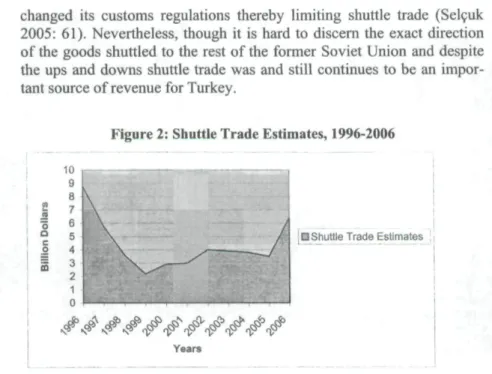
Russian natural gas not only increased the volume of trade between Turkey and Russia, hut because of its sheer amount has also started to create a negative trade balance for Turkey. The Russians claim that there is no such negative balance hecause the trade numbers do not include revenue generated by shuttle traders, investments of the Turkish enter-prises in Russia, and the Russian tourists coming to Turkey. This claim can be considered partially correct. Despite fluctuations, every year, shuttle trade brings billions of dollars to Turkey. For example, between 1996, the first year that the Turkish Central Bank started to keep an estimate on shuttle trade, and 2006, shuttle traders coming from all of the former Soviet Union countries exported more than 40 billion dollars worth of goods from Turkey (Sabah 2005; Takvim 2007).
There are multiple reasons behind the fluctuations seen in shuttle trading. The most important reason is the August 1998 crisis in Russia that severely decreased the purchasing power of Russian traders and the Russian people. The emergence of cheaper alternatives such as China, the United Arab Emirates etc., has also diverted the attention of shuttle traders away from Turkey. Finally, Russia, due to pressure from the IMF
changed its customs regulations thereby limiting shuttle trade (Sel^uk 2005: 61). Nevertheless, though it is hard to discern the exact direction ofthe goods shuttled to the rest ofthe former Soviet Union and despite the ups and downs shuttle trade was and still continues to be an impor-tant source of revenue for Turkey.
Figure 2: Shuttle Trade Estimates, 1996-2006
IShuttte Trade Estimates
Source: Turkish Central Bank Estimates cited in Selfuk 2005: 60; Sabah 2005 and Takvim 2007.
More important than trade are the mutual investments and con-tracts that both Turkish and Russian businessmen see as real revenue-generators. With the 1984 natural gas agreement Turkish businesspeople were among the first to undertake various projects and investments in Russia. Between, between 1989 and 2005, Turkish construction compa-nies, undertook 14.7 billion dollars worth of projects in the Russian Federation and Turkish investments there in recent years are estimated to be around 1.5 billion dollars (Turkrus.com 2006; DEIK 2005: 17). Rus-sian businesspeople, are latecomers to the Turkish business scene, but, their increasing presence is being felt. Russian investments in Turkey between 1995 and 1998 were only 12.5 million dollars (Kazgan 2003: 168). By 2005, there were 219 Russian owned firms operating in Turkey (Ta? 2005) and before the Russian Alpha Group's 3.3 billion dollars purchase of 13% of Turkcell (Turkey's largest mobile phone operator),
ALLIES OR PARTNERS? 363 AN APPRAISAL OF TURKEY'S TIES TO RUSSIA, 1991 -2007
Russian investments in Turkey were estimated at 300 to 350 million dollars (Putin 2005), most of it, not surprisingly in the tourism sector.^ Russian tourists have become one of the most crucial elements of the economic activity between Turkey and Russia. Since the dissolution of the Soviet Union, Russians, in increasing numbers., have made the Turk-ish Mediterranean coast their vacation destination. In 1999, 438,000 Russian tourists came to Turkey; the number for 2005 was 1.9 million (Selguk 2005: 63; Kiniklioglu 2006: 91). Overall, economic factors, which were quite independent of the political situation, have become the driving force in the rapprochement between Russia and Turkey, enabling these countries to call each other "partners."
Russian foreign policy perceptions changed further when Vladimir Putin came to power in August 1999. His arrival meant that Russia's economic interests would become one of the pillars of Russian foreign policy. This reevaluation of priorities was due to two important factors. First, Putin's belief that "citizens' happiness," in other words, improve-ment of the social conditions in the country is very much connected to overall improvement in economic conditions especially through the development of foreign economic ties of Russia (Putin 2004). Second, Putin linked Russia's power as a global player to the economic condi-tions and economic relacondi-tions of the country (Charap 2004: 57; Trenin 2003/04: 77). As Lo argues, Putin was clever enough to realize the important correlation between "geoeconomics" and "geopolitics," and put this idea into practice (Lo 2002: 52, 65-69). Given all this bilateral economic activity, it is no wonder that 25 billion dollars is the target trade volume of both Turkish and Russian officials (Bigg 2005).
Conclusion
Writing in the early 2000s, Bazoglu Sezer defined the relationship between Turkey and Russia as one of "virtual rapprochement" (Bazoglu Sezer 2000: 62). This meant that there was a consensus to cooperate, but, there was also "mutual fear, mistrust and suspicion" between the two countries. Today, however., it is clear that Turkey and Russia have managed to take their relationship to a much higher level than it was at the end of the Cold War. It is also true that Russia and Turkey have managed to shed the mutual perceptions of threat and normalize both their political and economic ties. But, have they been able to experience
the most necessary element for a "coupling," "quasi-alliance"—can they trust each other? That is one question that needs to be answered.
There are several issues, which might prove to be dealmakers, or deal-breakers in the bond between Turkey and Russia, possibly, defining the "virtualness" and the "realness" of what Winrow {1998b: 98) calls a "multifaceted and complex" relationship. The crucial issues are Cyprus; future cooperation in energy transportation projects; and the Black Sea.
In the past Turkey has tried to get Russian support on the resolution of the Cyprus conflict. So far, this much expected Russian support has not gone beyond equivocal and diplomatic statements calling for a peaceful resolution ofthe conflict. The Russian unwillingness to support Turkey in Cyprus is mostly due to Russia's economic ties with this country. Cyprus is an offshore heaven for Russian companies and Rus-sian arms are the preferred choice of the Greek Cypriot authorities. Indeed, Russia showed its support for the Greek Cypriots in 2004, when it vetoed a draft resolution on Cyprus at the UN Security Council in 2004, which Greek Cypriots thought could influence the outcome refer-endum to unify the island (Felgenhauer 2004: Torbakov 2004).
Leaving aside Cyprus, future cooperation in energy projects will be crucial in detemiining the course of relations between Turkey and Rus-sia. Russia has been very willing to cooperate with Turkey in natural gas deliveries and transportation, something that fits squarely with Turkey's desire to become an energy hub in the region. However, that has not been the case for oil transportation. Samsun-Ceyhan pipeline is a case in point. Despite the insistence of Turkish government's and some Turkish companies' to carry Russian crude from Samsun to Ceyhan, in 2007, Russia has opted for a 285 km Trans-Balkan Pipeline, running from Burgas in Bulgaria to Alexandroupolis in Greece. Moreover, in May 2007, the Russians also unveiled a new natural gas pipeline that will carry Turkmen gas to the West, again threatening the development ofthe previously discussed ways of delivering natural gas to the countries to the west and south of Turkey (Zaman 2007). All these show that Tur-key's ability to become an energy corridor is very much dependent on the terms dictated by Russia. Similarly, Turkey's dependency on Russian gas might create problems in the future. Though this dependency is mutual—one side needs to sell and the other side needs to buy—it is no secret that Russia has used gas deliveries as a weapon and will not hesi-tate to do so in the future. So far, there have been no problems with gas
ALLIES OR PARTNERS? 365
AN APPRAISAL OF TURKEY'S TIES TO RUSSIA, 1991-2007
deliveries to Turkey—with the exception of gas coming via the Balkans in January 2006 because of Russia's dispute with Ukraine. But with Turkey now getting 60% of its natural gas from Russia, natural gas could become a weapon, upsetting the bilateral ties that took a decade to improve.
Finally, though recent rapprochement between Turkey and Russia is blamed on mutual discontent with the American policies, one should keep in mind that historically even during the height of the Cold War, troubles or disagreement with the United States at different times, has pushed Turkey closer to Russia. The United States is a rival for Russia. This is not the case for Turkey. Though US-Turkey relations are going through a tumultuous period due to developments in Iraq, the United States and Turkey, since the end of the Cold War, have been allies, through thick and thin. So the "coupling" that some observers have indi-cated between Turkey and Russia might indeed be temporary.
At the moment Turkey is consumed by domestic troubles and by the task of turning its European dream into a reality. It is likely to be oc-cupied with these issues for the foreseeable future, but has still managed to "normalize" its ties, politically and economically, with Russia—one of the great powers of the world that desires a more enhanced role in Eurasia. Turkey is simply a partner, trying to make the most out of Rus-sia's recent "economic pragmatism,"^ and will likely to play the same role in the near future.
Notes
1. For an expanded "checklist" please see Bazogiu Sezer (2001).
2. There has been a debate as to who first came up with this slogan. Gun Kui argues that it was the American foreign policy elite who came up with Ihis rather than Ihe Turks. Sec Giln Kut, "Yeni Tiirk Cumhuriyetleri ve Uluslararasi Ortam," in BQ^ra Ersanli Behar et al., eds., Bagimsizligin Ilk Yillan (Ankara: T.C. Kultiir Bakanligi Yayitilan, 1994). p.l3, fn. 6.
3. This, especially, was evident in 2005 during "uprisings" in Kyrgyzstan and Uzbeki-stan. See for example, Arslan, Elif Onal. 2005. "No Appetite for Central Asia," Turkish
Daily News, 22 May and Radikal. 2005. "Turklere Saldin," 26 March.
4. The Economist in 1998 gave an estimate that ranged "from a conservative 70 billion barrels of oil to wildly optimistic 200 billion barrels or more," "Oil Drums Calling," 7 February.
5 These decreasing threat perceptions were also reflected in a public opinion survey taken in Turkey in October 2004. Among those who were polled only 3.5% said that they saw Russia as a threat for Turkey, ranking it well behind the United States, Greece, Armenia, Israel, the United
King-dom and Greek Cypriots. See, ISRO 2. Foreign Policy Perception Survey. October 2004. available at http ://www. lurk ishweekly.net/survey-tfpps.pdf.
6. It is hard to detect the exact amount of Russian investments in Turkey because Rus-sian investors either prefer to use Turkish partners or some have "shady" ties (Kititklioglu 2006: 86).
7.1 owe this term to D E I K officials. Interview with DEiK officials, Istanbul, February 17,2006.
References
Agencstvo yoyennyky Novostey. 2006. "Black Sea Security Should be Enforced By Regional
Navies-Russia Navy Chief," quoted in Foreign Broadcast Information Service (FBIS), 22 February.
Anatolia. 2001. "Turkish Minister Mirzaoglu: No Concessions To Be Made From Security
of Straits," quoted in FBIS-WEU-2001-0623. 23 June.
Akgun, Mensur and Turan Aydm. 1999. Turkiye-Rusya ilifkilerindeki Yapisal Sorunlar ve
Qoziim Onerileri Istanbul: TUISAD/Lebib Vayinlan.
AktUrk, 9cner. 2006. 'Turkish-Russian Relations after the Cold War (1992-2002)," Turkish
Studies 7: 3 September: 337-364.
Allison, Roy. 1999. "The Military and Political Security Landscape in Russia and the South," in Rajan Menon et al., eds. Russia, The Caucasus and Central Asia: The 21"
Century Security Environment. Armonk. NY and London, England: ME Sharpe:
27-60.
Aydm, M. 2004. "Foucauit's Pendulum: Turkey in Central Asia and the Caucasus," Turkish Sfurfies 5:2, Summer: 1-22.
Bacik, GOkhan. 2001. "The Blue Stream Project, Energy Co-operation and Conflicting Inter-ests," Turkish Studies 2:2, Autumn: 85-93.
Bazoglu Sezer, D. 1985. "Peaceful Coexistence: Turkey and the Near East in Soviet Foreign Policy," Annals of American Academy of Political and Social Science 481, September: 117-126.
Bazoglu Sezer, D. 1992. 'Threat Perception in Southern Europe: The Case of Turkey," in Laszio Valki, ed., Changing Threat Perceptions and Military Doctrines. Hampshire and London: Macinillan: 221'2'il.
Bazoglu Sezer, Duygu. 1997. "From Hegemony to Pluralism: The Changing Politics of the Black Sea." SAIS Review 17:1, 1-30
Bazoglu Sezer, Duygu. 2000. "Turkish-Russian Relations: The Challenges of Reconciling Geopolitical Competition with Economic Partnership," Turkish Studies 1:1, Spring: 59-82.
Bazoglu Sezer, Duygu. 2001. "Turkish-Russian Relations A Decade Later: From Adversity to Managed Competition," Perceptions: Journal of International Affairs 6:1, March-May: 79-99.
Bilge, Suat A. 1997. "An Analysis of Turkish-Russian Relations," Perceptions. Journal of
International Affairs 2:2, June-August: 66-92.
Bigg, Claire. 2005. "Russia: Putin Meets With Turkish Premier For Talks On Trade, Energy, Regional Issues," RF/RL Newsline, 18 July.
ALLIES OR PARTNERS? 367
AN APPRAISAL OF TURKEY' S TIES TO RUSSIA, 1991 -2007
Brill Olcott, Martha. 1998. "Caspian's False Promise." Foreign Policy M i : 94-114. Carley, Patricia, 1995, ' T u r k e y and Central Asia: Reality C o m e s C a l l i n g " in Regional
Power Rivalries in the New Eurasia: Russia, Turkey and Iran. Armonk NY and
Lon-don England: M,E. Sharp: 169-197.
Charap. Samuel. 2004. "The Petersburg Experience: Putin's Political Career and Russian Foreign Policy," Problems of Post-Communism 51:1, January/February: 55-62. Cohen, Ariel, 1997. "US Policy in the Caucasus and Central Asia: Building a New 'Silk
Road' To Economic Prosperity," The Heritage Foundalion. 24 juiy, available at htlp://w ww, treemedia ,com/cfrl ibrary/I ibrary/policy/cohen.html.
Cohen, Ariel and Conway irwin. 2006. "US Strategy in the Black Sea Region," 13 Decem-ber, available at http://www,heritage.org/Research/RussiaandEurasia/bgl990.cfm. <^ift?i, Kemai. 2005, "Karadeniz'in Degi^en Stratejik Konumu ve Turkiye," in Osman Metin
Ozturk and Yalgin Sankaya, eds., Uluslararast Miicadelenin Yeni Odagt: Karadeniz. Ankara: Ban? Kitap: 165-184.
(^ongar. Yasemin. 2007, "Tilrk Orduiiunda Rusya'nin Etki Alanina Girmi^ Askerler Var." Radikal,l\ May,
DEiK (D15 Ekonomik Hijkiler Kunilu). 2005. Rusya Olke Bulleni, October.
Dunya. 2004. "Rusya tie Tadhi Adini," 7 December. The Economist. "Oil Drums Calling," 7 February.
The Economist. "Old Game, New Players," 16 May. " '
Efegil, Ertan, 2001. 'Tiirk-Rus Ili^kileri: Bolgesei t^birligi Veya Stratejik Kazan?," in Idris Bal, ed.. 21. Yiizyil E^iginde Turk Diij Pohiikasi. Istanbul: Alfa: 305-321.
Enginsoy. Omit and Burak Ege Bekdil. 2005. "Old Rivals Turkey, Russia Forge New Ties,"
DefenseNews.Com,2\ March.
Felgenhauer, Pavel. 2004. "What Was in It for Russia?" Moscow Times. 27 April,
Foreign Policy Concept of the Russian Federation, 2000, available at http://www.fas.org/ nuke/guide/russia/doclrine/econcept.htm.
Giil, Abdullah, 2004. "Turkey 500 Years of Diplomatic Relations," International Affairs (Moscow), 50:3 :147-152
Giinver Turan, Giil, 2003, "Turkiye ve Rusya Arasindaki Iktisadi tli^kilerde Goniillu Bir Kurulu^: Tiirk-Rus ij Konseyi," in Gulten Kazgan and Nataiya Ulcenko, eds., Dtinden
Biigiine Turkiye ve Rusya: Potitik. Ekonomik ve Kiilturel Hi^kiler. Istanbul: Istanbul
Bilgi Universitesi Yayinlan: 273-295.
Harris, George. S. 1995, "The Russian Federation and Turkey," in Regional Power Rivalries
in the New Eurasia: Russia. Turkey and Iran. Armonk NY and London England: M, E. Sharpe: 3-25,
Hill. Fiona, 2003, "Seismic Shifts in Eurasia: The Changing Relationship Between Turkey and Russia and Its Implications for the South Caucasus," Journal of Southeast
Euro-pean and Black Sea Studies 3:3, September: 55-75
Hill, Fiona and Omer Ta^pmar. 2006a. "Russia and Turkey in the Caucasus Moving Together to Preserve the Status Quo,'" IFRl Research Programme, January.
Hill, Fiona and Omer Ta^pinar, 2006b. "Turkey and Russia: Axis ofthe Excluded?" Survival 48:1, Spring: 81-92.
Hunter, Shireen. 2003. "Iran's Pragmatic Regional Policy," Journal of International Affairs 56:2, Spring: 133-149.
Hiirriyei. 2001. "Rusya'dan Ankara'ya QeQen Notasi," 25 April.
Interfax. 2002. "Turkish Military Official Not Concerned at Russia Presence in Georgia,"
quoted in FBiS-WEY-2002-0611. 11 June.
Interfax. 2005. "Russian Representative Speaks Out Against NATO Presence in Black Sea,"
quoted in FBIS, 25 June.
Itar-Tass. 1996. "CIS: ITAR-TASS Carries Press Review for 15 Oct," quoted in
FBIS-SOV-96-201, 5 October.
Itar-Tass. 1997. "Russia: Russia Offers To Sell 'Black Shark' Helicopters to Turkey,"
quoted in FBIS-TAC-97-086, 27 March.
Itar-Tass. 1998. "Russia: Russia, Turkey Sign Military Cooperation Memorandum," quoted
in FBIS-UMA-98-140, 20 May.
Itar-Tass. 2002. "Russian, Turkish Military Chiefs Sign Cooperation Agreement," quoted in
FBlS-SOV-2002-0114, 14 January.
Jonson. Lena. 2001 "Russia and Central Asia," in Roy Allison and Lena Jonson, etJs.,
Cen-tral Asian Security: the New International Context Royal. Institute for Intemational
Affairs and Brookings Institution: London and Washington DC: 95-126.
Kaya, Sezgin. 2005. "Soguk Sava§ Sonrasi DOnemde Tilrkiye'nin Degi^en Ulusal Gtlvenlik Algttamasi ve Poiitikalan,"/4vrai'>'a Dosyasi 11:2, May-August: 212-239.
Kazgan, Giilten. 1998. "The Political Economy of Relations btw Turkey and Russia," in Libby Rittcnberg, ed.. The Political Economy of Turkey in the Post Soviet Era: Going
Wesl and Looking East. Westport, CT and London: Praeger: 137-156
Kazgan, GUlten and Natalya Ul^enko, eds., 2003. Diinden BiigUne Turkiye ve Rusya: Poiilik.
Ekonomik ve Kulturel ili^kiler Istanbul: Istanbul Bilgi Universitesi Yayinlari.
Kazgan, Giilten. 2003. "Bati lie lli^kilerin Giilgesinde TUrkiye-Rusya lli§kileri," in Giilten Kazgan and Natalya Ul^enko, eds., Diinden Biigiine Turkiye ve Rusya: Politik,
Eko-nomikve Kultiirel Ili^kiler. Istanbul: Istanbul Bilgi Universitesi Yaymlan: 148-181.
Kili^beyii, ElifHatun. 1999-2000. "Rusya'nm Siyasai Ekonomisi ve Turkiye ile Ekonomik ili§kileri (1992-2000), " Avrasya Dosyast 6: 4, Winter: 24-42
Kmikhoglu, Suat. 2001. "Tlirk-Rus ili^kileri: Kasyanov Ziyareti'nin Anatomisi," Avrasya
Dosyasi 6:4, Winter: 155-164.
Kmikhoglu, Suat. 2006. 'The Anatomy of Turkish-Russian Relations," Insight Turkey 8:2, April-June: 81-95.
Kireyev, Nikolay. 2003. "Avrasya Konseptleri Ijigmda Rusya-TOrkiye Ili^kileH," in GQIten Kazgan and Natalya Ul9enko, eds., Diinden Biigiine Turkiye ve Rusya: Politik,
Eko-nomik ve Kultiirel Ili^kiler. Istanbul: Istanbul Bilgi Universitesi Yayinlan: 199-215.
Larrabee, Stephen, F. and Ian O. Lesser. 2003. Turkish Foreign Policy in an Age of
Uncer-tainty Rand: Santa Monica, CA.
Lo, Bobo. 2002. Vladimir Putin and the Evolution of Russian Foreign Policy Royal Institute for Intemational Affairs and Blackwell Publishing: London and Maiden, MA: 51-71 Manning, Robert A. 2000. "The Myth of the Caspian Great Game and the "New Persian
Gulf," The Brown Journal of World Affairs 1: 7. Summer/Fall: 15-33.
ALLIES OR PARTNERS? 369
AN APPRAISAL OF TURKEY'S TIES TO RUSSIA, 1991-2007
Momingslar, Richard, L. 1999. "Testimony by Ambassador Richard L. Morningstar, Special Advisor to the President and Secretary of State for Caspian Basin Energy Diplomacy, Before the Senate Subcommittee on Intemational Economic Policy, Exports and Trade Promotion," 3 March, available at http://www.treemedia.cotn/cfriibrary/library/policy/ momingstar.html.
Myers iaffe, Amy, and Robert A. Manning. 1998/1999. "The Myth of Caspian 'Great Game': The Real Geopolitics of Energy." Survival 40:4, Winter: 112-132.
Nadein-Ravesky, Victor. 1999. "Russian-Turkish Relations," in Gennady Chufrin, ed.,
Russia and Asia: The Emerging Security Agenda. Oxford: Oxford University Press:
172-180.
Ogan, Sinan. 2004. "11 Eyltll Sonrasi Turk Dt^ Politikasmda Rusya" Avrasya Dosyasi 10:1, Spring: 77-98.
Ogan, Sinan. 2006. "11 EylO! Sonrasi Tiirk D15 Politikasinda Rusya," in ihsan Romaic, ed.,
Rusya: Stratejik Ara^tirmalari-\. Istanbul: Tasam Yayiniari: 187-206
Putin, Vladimir. 2004. "interview With the Turkish Media," 30 August, available at http://www.kremlin.ru/eng/speeches/20O4/08/30/21O4 76188.html.
Putin, Vladimir. 2005, Concluding Remarks After a Meeting With Representatives of Turkish Business Circles," 11 January, available at http://www.kremlin.ru/eng/text/ speeches/2005/01/11 /220O_type82914_82473.shtml.
Robbins, Philip. 2003. Suiis and Uniforms: Turkish Foreign Policy Since the Cold War, Hurst and Company: London.
Rossiyskaya Gazeta. 1996. "RUSSIA: Black Sea Fleet Problem at 'Crisis Point'," quoted in
FBIS-SOV-96-189, 24 September.
Sabah. 2005. "Her^ey Laleli'de Ba§ladi," 30 November. 1
Salhani, Claude. 2005. "Analysis: Eurasianism as EU Alternative?" (JPl International, 22 December.
Schleifer, Yigal. 2005. "Russian Oil Ships Stuck in Bosphonis Strait Traffic Jam," Christian
Science Monitor. 25 January.
Sel^uk. Hasan. 2005. TUrkiye-Rusya Ekonomik hli^kileri. Istanbul: Tasam Yayintari. Sever, AyjegUl. 2001. "Ttirkiye-Rusya Federasyonu Ili^kilerinde ^ati§ma, Rekabet ve
Ubirligi," Avrasya Dosyasi 7:3, Fall: 227-246.
Takvim. 2007. "Bavui Ticareti ikiye Katlandi," 25 March.
Ta§ Dilek. 2005. "Rus Yatirimci Gruplari Antalya'da Otel Bakiyor," Milliyet., 30 November. Ta§pmar, Suat, and Serkan Demirtaj. 2004. "Portre: Putin'ln TUticiye Ziyareti," Radikal. 12
December.
Teilal, Erel. 2001. "Rusya'yla Iliskiler," in Baskm Oran, ed., Turk Di? Politikasi: Kurtulu
Sava^indan Biigiine Otgular, Belgeler, Yorumlar. Vol. 2, Istanbul: ileti;im Yayinlan:
540-550.
Torbakov, Igor. 2004. "UN Veto Sparks Debate on Russian Policy Aims," Eurasia Daily
Monitor. 5 May.
Turknis.com. 2006. "in$aat9ilarin Yildizi Parliyor," 20 February. Turkish Daily News. 2006. "Turkey Objects to Black Sea Force," I March.
Trctiin, Dmitri. 1997. "Russia and Turkey: A Cure for Schizophrenia." Perceptions. Journal
Trenin, Dmitri. 2003/2004. "Pirouettes and Priorities: Distilling a Putin Doctrine," The
National Interest 74: 76-83.
Tuncer, idil. 2000. "Rusya Federasyonu'nin Yeni GUvenlik Doktirini: Yakin (^evre ve Tiirkiye" in Gencer Ozcan and ^u\e Kut., eds. En Uzun On Yil. Tiirkiye'nin Ulusal
Guvenlik ve D14 Politika Giindeminde Doksanli Yillar. Istanbul: Buke Yaymlan:
435-460.
Orey, Se9kin. 2004. "Rusya Sicak Denizlere iniyor," Milliyet. 29 August.
Warhola, James W., and William A. Mitchell, ' T h e Warming of Turkish-Russian Relations: Motives and Implications," DemoAra/ZroKiyo, 14: 1, Winter: 127-143.
Winrow, Gareth, M. 1998a. "Turkish Policy in Central Asia, " in Touraj Atabaki and John O'Kane eds., Post-Soviet Central Asia. London and New York: I. B. Tauris: 99-108. Winrow, Gareth. 1998b. "Turkey's Evolving Role in the Post Soviet World," in Libby
Rittenberg, ed.. The Political Economy of Turkey in the Post Soviet Era: Going West
and Looking East. Westport, (TF and London: Praeger: 98-114.
Winrow, Gareth, M. 2003. "Pivotal State or Energy Supplicant? Domestic Structure, Exter-nal Actors, and the Turkish Policy in the Caucasus," The Middle East JourExter-nal. 57:1, Winter: 76-92.
Winnaw, Gareth, M. 2004. 'Turkey and the East-West Gas Transportation Corridor,"
Turk-ish Studies 5:2, Summer: 23-42.
Zagorski, Andrei, V. 1999. "Traditional Russian Security Interests in the Caucasus and Central Asia: Perceptions and Realities," in Rajan Menon et al., eds., Russia, The
Caucasus and Central Asia: The 21" Century Security Environment. Armonk, NY and
London, England: ME Sharpe: 61-84.
Zaman. 2007. "Russian, C. Asian Deals to Undermine Ttiricey's Role as Energy Bridge." 14