Earlier title: Journal of Agricultural Science and Technology, ISSN 1939-1250
Essential Oil Composition of Six Pinus L. Taxa (Pinaceae)
from Canada and Their Chemotaxonomy
Ömer Kılıç
1and Alpaslan Koçak
21. Technical Science Vocational College, Bingol University, Bingol 12000, Turkey
2. Department of Biology, Faculty of Art & Science, Bingol University, Bingol 12000, Turkey
Received: November 26, 2013 / Published: January 20, 2014.
Abstract: In this study six Pinus L. taxa from Canada (P. strobus L., P. parviflora Siebold & Zucc., P. mugo Turra subsp. mugo, P.
resinosa Sol. ex Aiton, P. flexilis E. James and P. nigra J. F. Arnold) were studied to determine on chemical characters of studied
taxa. For this purpose, essential oil from needles of the six Pinus taxa were investigated by HS-SPME/GC-MS. 38, 33, 39, 28, 31 and 46 compounds were respectively identified from each species representing 95.90%, 95.07%, 95.79%, 96.20%, 93.05% and 96.25% of the oil. The results have given some clues on the chemotaxonomy of this genus and are of usable potentials of the plants as renewable resources. Although the essential oil composition of studied taxa showed chemical divergences because of climatical, seasonal, geographical and geological factors, but the major compounds of plant derivatives are generally similar and the major compounds are chemotaxonomical markers for studied taxa.
Key words: Pinus, Pinaceae, essential oil, Canada, HS-SPME/GC-MS.
1. Introduction
Pine oils are widely used as fragrances in cosmetic
industry, as flavoring additives for food and beverages,
and as scenting agents in a variety of household
products and intermediates in the synthesis of perfume
chemicals [1]. Essential oils which were obtained
from aromatic and medicinal plants have been known
since antiquity to possess biological activity, most
notably antibacterial, antifungal and antioxidant
properties. With growing interest in the use of
essential oils in both the food and pharmaceutical
industries, the systematic and potential usefulness of
plant extracts studies has become increasingly
important [2, 3]. Cones of some coniferous taxa were
used in industry [4] as renewable source of essential
oils. Besides economic value of essential oils, they
play an important role in the plant defense system
Correspounding author: Ömer Kılıç, assistant professor,
research fields: biochemical systematic, plant systematic, plant essential oil, ethnobotany, plant morphology and anatomy. E-mail: [email protected].
against fungus and insect attacks. Some studies have
been carried out to observe the effect on the seasonal,
genotypic and environmental variability of the
chemical contents in Pinus L. taxa [5-7]. The effects
of geographical variations in the needle oil
composition [8] and chemical composition of P. nigra
have been published [9].
Although there have been some studies on the
antioxidant activity, terpenoids, steroids, anti-HIV
activity, procyanidins, etc. of the Pinaceae cones,
essential oil constituents cones of the Pinaceae family
are poorly known yet [10]. Pine is used in
ethnomedical practice throughout the world; Indians
use a boiled extract of the inner bark from P. strobus
as an astringent for diarrhea or in cough remedies. In
19th century in North America, P. sylvestris was used
as a diuretic and to induce perspiration and thus help
break a fever [11]. P. brutia is used in folk medicine
in Turkey, and recently the antimicrobial activity of
tar obtained from the roots and stems of P. brutia
against
Staphylococcus aureus,
Streptococcus
D
pyrogenes, Escherichia coli and Candida albicans
was reported [12]. Previous studies on Pinus species
determined the diterpenoids [13], triterpenoids [14],
flavonoids and lignans [15]. Moreover, pine oils are
used for medicinal purposes in aromatherapy as
carminative, rubefacient, emmenagogue and
abortifacient agents. Pines are among the most
important forest trees in the Mediterranean region that,
pine oils were studied from the geographical [16],
seasonal [17], genotypic [18] and environmental [19]
points of view.
This paper reports the chemical composition of the
essential oil of six Pinus taxa which were collected in
vicinity region of Canada. The aim of the present
study is to provide chemical data that might be helpful
in potential usefulness, to summarize the available
information in order to facilitate and guide future
research and to examine potential chemotaxonomic
significance of studied taxa.
2. Materials and Methods
2.1 Plant Material
P. resinosa (4441); P. flexilis (4442) and P. nigra
(4443) were collected from Wilfrid Laurier University
Campus, Waterloo, Canada, on May 5, 2012, at an
altitude of 350-400 m, by Kilic. P. strobus (4451) and
P. parviflora (4452) were collected in vicinity of
Niagara Falls, Ontario, Canada, May 22, 2012,
150-250 m, by Kilic. P. mugo subsp. mugo (4453) was
collected in vicinity of Botany Hill Park, Toronto,
Canada, May 22, 2012, 350-400 m, Kilic.
2.2 HS-SPME Procedure
Aerial parts of plant sample previously triturated by a
liquidizer and 5 g powder of needles were carried out
by a (HS-SPME) head space solid phase
microextraction method using a divinyl
benzene/carboxen/polydimethylsiloxane (DVB/CAR/
PDMS) fiber, with 50/30 lm film thickness; before the
analysis the fiber was conditioned in the injection port
of the gas chromatography (GC) as indicated by the
manufacturer. For each sample, 5 g of needles,
previously homogenized, were weighed into a 40 mL
vial. The vial was equipped with a “mininert” valve and
was kept at 35 °C with continuous internal stirring, and
the sample was left to equilibrate for 30 min; then, the
SPME fiber was exposed for 40 min to the headspace
while maintaining the sample at 35 °C. After sampling,
the SPME fiber was introduced into the GC injector,
and was left for 3 min to allow the analyzes thermal
desorption. In order to optimize the technique, the
effects of various parameters, such as sample and
sample headspace volume, sample heating temperature
and extraction time were studied on the extraction
efficiency as previously reported by Verzera et al. [20].
2.3 GC-MS Analysis
A Varian 3800 GC directly inter faced with a
Varian 2000 ion trap mass spectrometer was used with
injector temperature, 260 °C; injection mode, splitless;
column, 60 m, CP-Wax 52 CB 0.25 mm i.d., 0.25 lm
film thickness. The oven temperature was
programmed as follows: 45 °C held for 5 min, then
increased to 80 °C at a rate of 10 °C/min, and to
240 °C at 2 °C/min. The carrier gas was helium, used
at a constant pressure of 10 psi; the transfer line
temperature, 250 °C; the ionisation mode, electron
impact (EI); acquisit ion range, 40 m/z to 200 m/z;
scan rate, 1 u/s. The compounds were identified using
the National Institute of Standards and Technology
(NIST) library (NIST/Wiley/EPA/NIH) and mass
spectral library, and verified by the retention indices
which were calculated as described by Dool and Kratz
[21]. The relative amounts were calculated on the
basis of peak-area ratios. The identified constituents
were listed in Tables 1 and 2.
3. Results and Discussion
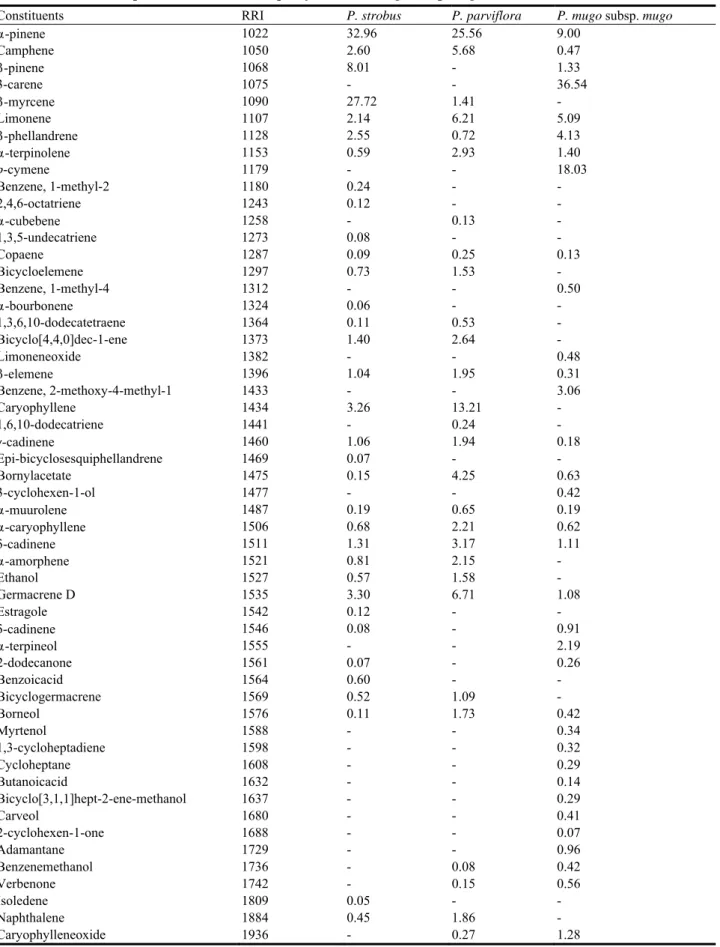
In this study, caryophyllene (27.60%), -pinene
(12.96%), 3-carene (12.93%) and naphthalene (9.37%)
in P. resinosa; -pinene (33.29%), β-pinene (16.24%)
and germacrene D (6.13%) in P. flexilis; acetic acid
(31.12%), bicyclo[2.2.1]heptan-2-one (21.45%) and
Table 1 Chemical compositions of P. strobus, P. parviflora and P. mugo subsp. mugo.
Constituents RRI P. strobus P. parviflora P. mugo subsp. mugo
-pinene 1022 32.96 25.56 9.00 Camphene 1050 2.60 5.68 0.47 -pinene 1068 8.01 - 1.33 3-carene 1075 - - 36.54 -myrcene 1090 27.72 1.41 - Limonene 1107 2.14 6.21 5.09 -phellandrene 1128 2.55 0.72 4.13 -terpinolene 1153 0.59 2.93 1.40 p-cymene 1179 - - 18.03 Benzene, 1-methyl-2 1180 0.24 - - 2,4,6-octatriene 1243 0.12 - - -cubebene 1258 - 0.13 - 1,3,5-undecatriene 1273 0.08 - - Copaene 1287 0.09 0.25 0.13 Bicycloelemene 1297 0.73 1.53 - Benzene, 1-methyl-4 1312 - - 0.50 -bourbonene 1324 0.06 - - 1,3,6,10-dodecatetraene 1364 0.11 0.53 - Bicyclo[4,4,0]dec-1-ene 1373 1.40 2.64 - Limoneneoxide 1382 - - 0.48 -elemene 1396 1.04 1.95 0.31 Benzene, 2-methoxy-4-methyl-1 1433 - - 3.06 Caryophyllene 1434 3.26 13.21 - 1,6,10-dodecatriene 1441 - 0.24 - -cadinene 1460 1.06 1.94 0.18 Epi-bicyclosesquiphellandrene 1469 0.07 - - Bornylacetate 1475 0.15 4.25 0.63 3-cyclohexen-1-ol 1477 - - 0.42 -muurolene 1487 0.19 0.65 0.19 -caryophyllene 1506 0.68 2.21 0.62 -cadinene 1511 1.31 3.17 1.11 -amorphene 1521 0.81 2.15 - Ethanol 1527 0.57 1.58 - Germacrene D 1535 3.30 6.71 1.08 Estragole 1542 0.12 - - -cadinene 1546 0.08 - 0.91 -terpineol 1555 - - 2.19 2-dodecanone 1561 0.07 - 0.26 Benzoicacid 1564 0.60 - - Bicyclogermacrene 1569 0.52 1.09 - Borneol 1576 0.11 1.73 0.42 Myrtenol 1588 - - 0.34 1,3-cycloheptadiene 1598 - - 0.32 Cycloheptane 1608 - - 0.29 Butanoicacid 1632 - - 0.14 Bicyclo[3,1,1]hept-2-ene-methanol 1637 - - 0.29 Carveol 1680 - - 0.41 2-cyclohexen-1-one 1688 - - 0.07 Adamantane 1729 - - 0.96 Benzenemethanol 1736 - 0.08 0.42 Verbenone 1742 - 0.15 0.56 Isoledene 1809 0.05 - - Naphthalene 1884 0.45 1.86 - Caryophylleneoxide 1936 - 0.27 1.28
(Table 1 continued)
Constituents RRI P. strobus P. parviflora P. mugo subsp. mugo
Sapathulenol 1969 0.23 0.52 0.73 3-hexene-1-ol-benzoate 1975 0.60 - - -cadinol 2028 - 0.12 - Longipinane 2076 - - 0.18 Phenanthrene 2171 - - 0.84 Caprolactam 2252 0.24 0.12 - Diethylphythalate 2296 - 0.08 - 1,3-benzenediamine 2564 0.95 3.52 0.49 Total 95.90 95.07 95.79
Table 2 Chemical compositions of P. resinosa, P. flexilis and P. nigra.
Constituents RRI P. resinosa P. flexilis P. nigra
-pinene 1022 12.96 33.29 2.68 Camphene 1049 1.47 - 4.79 -pinene 1068 1.93 16.24 - 3-carene 1073 12.93 - - -myrcene 1089 - 0.72 5.02 1,3,5-cycloheptatriene 1105 1.93 - - Limonene 1107 - 0.76 8.06 -terpinolene 1152 - - 0.19 Eucalyptol 1156 - - 0.78 p-cymene 1179 0.85 0.46 0.07 -cubebene 1258 1.87 - 0.06 Copaene 1288 2.92 - 0.09 Benzene, 1-methyl-4 1311 - - 0.07 Sabinenehydrate 1350 - - 0.21 Epi-bicyclosesquiphellandrene 1354 1.06 - - 3-cyclopentene-1-acetaldehyde 1357 - 0.19 - Fenchylacetate 1362 - - 0.04 2,6-octadienal 1377 - 0.41 0.10 Limonene oxide 1382 1.00 2.09 - -linalool 1387 - - 0.27 -elemene 1397 - - 0.36 6-octenal 1404 0.25 - - Caryophyllene 1434 27.60 1.52 0.73 Cyclopentene 1436 - 1.26 - 1.6.10-dodecatriene 1449 - - 0.09 Thujol 1454 - 1.69 - Bicyclo[2.2.1]heptan-2-ol 1455 - - 0.09 -cadinene 1459 - 0.41 - Bornyl acetate 1474 1.15 0.60 - -bisabolene 1482 1.08 1.00 - Aceticacid 1486 0.96 - 31.12 -muurolene 1492 - - 0.38 Isobornylacetate 1494 - - 0.48 Exo-methyl-camphenilol 1503 - - 2.10 Camphor 1507 2.27 - - Trans-pinocarveol 1510 - 5.34 - Bicyclo[2.2.1]heptan-2-one 1512 1.79 - 21.45 Cis--bisabolene 1514 0.58 - - Trans-pinocarvone 1516 - 3.71 - -amorphene 1521 0.97 - 1.52 Isoborneol 1527 0.71 - 0.30 Germacrene D 1535 - 6.13 0.27
(Table 2 continued)
Constituents RRI P. resinosa P. flexilis P. nigra
Estragole 1542 - - 0.09 -cadinene 1547 0.80 - 0.26 3-cyclohexane-1-methanol 1561 - 0.15 - -fenchylalcool 1564 - - 1.07 Borneol 1578 3.45 1.02 8.64 Citronellol 1587 - 2.95 0.85 Bicyclo[3,1,1]heptan-2-one 1597 - 0.81 - Cyclopentene 1620 - - 0.14 Bicyclo[3,1,1]hept-2-ene-methanol 1637 - 2.68 - Calamenene 1648 0.71 - 0.05 Benzoicacid 1657 - - 0.06 2,6-octadien-1-ol 1667 - - 0.17 2-cyclohexen-1-ol 1680 - 0.87 - 2-cyclohexen-1-one 1714 - - 0.52 Thymol 1729 0.52 0.26 - Benzenemethanol 1735 - 0.21 0.16 Verbenone 1741 3.03 4.07 0.20 1-butanol 1794 - - 0.05 Naphthalene 1884 9.37 0.22 2.01 Benzene, 1,2-dimethoxy-4 1923 - - 0.08 Caryophyllene oxide 1936 - 2.85 - 3-cyclohexen-1-carboxyaldehyde 1988 - 0.22 - Cyclohexanone 2051 - - 0.10 Ethanone 2146 - - 0.02 Diethylphythalate 2295 0.29 0.14 0.02 Phenol 2454 - - 0.39 1,3-benzenediamine 2564 1.71 0.78 0.10 Total 96.20 93.05 96.25
borneol (8.64%) in P. nigra;
-pinene (32.96%),
β-myrcene (27.72%) and β-pinene (8.01%) in P.
strobus;
-pinene (25.56%), caryophyllene (13.21%),
germacrene D (6.71%), limonene (6.21%) and
camphene (5.68%) in P. parviflora; 3-carene
(36.54%), p-cymene (18.03%), -pinene (9.00%) and
limonene (5.09%) in P. mugo subsp. mugo were
identified as main components. It is noteworthy that,
except for P. nigra,
-pinene was detected as main
compounds of all studied Pinus taxa (Tables 1 and 2).
The main components of P. nigra from Turkey were
α-pinene, β-pinene, β-caryophyllene and germacrene
D [1]. α-pinene was the main constituent of P.
slyvestris (14.76%), P. nigra (45.36%) and P.
halepensis (47.09%), too [22]. Like these results
-pinene (12.96%, 33.29%, 32.96%, 25.56% and
9.00%) was among the major compound in P.
resinosa, P. flexilis, P. strobus, P. parviflora and P.
mugo subsp. mugo, respectively (Tables 1 and 2).
In P. koraiensis α-pinene (22.3%), bornyl acetate
(8.3%) and camphene; in P. merkusii β-caryophyllene
(43.1%), caryophyllene oxide (11.9%) and α-humulene
(9.0%); in P. palustris α-terpineol (27.3%), β-pinene
(25.2%) and α-pinene (11.6%); in P. parviflora
α-pinene (20.2%), bornyl acetate (18.3%) and
β-caryophyllene (8.7%); in P. petula caryophyllene
oxide (14.8%), β-phellandrene (12.1%); in P.
ponderosa β-pinene (38.2%), α-pinene (13.0%); in P.
pumila α-pinene (18.3%), δ-3-carene (10.4%); in P.
rigida β-pinene (15.2%), α-pinene (11.1%); in P.
rudis β-pinene (21.4%), caryophyllene oxide (20.0%)
were reported as main components. According to
these results studied Pinus taxa can be separated into
two groups: One group is the one which contains a
large amount of α-pinene, and the other which
contains little α-pinene. P. koraiensis, P. parviflora
and P. pumila belong to the first group and contain
around 20% of α-pinene, and all the other species
belong to the second group [3]. In this study, P.
resinosa, P. flexilix, P. strobus, P. parviflora belong
to the first group and contain around 22% of α-pinene,
and P. nigra belong to the second group which
contain little α-pinene (2.68) (Table 2). Tumen et al.
[22] reported that, limonene (62.8%) in P. pinea and
β-pinene (39.6%) in P. brutia were found in higher
amounts. On the other hand, in this study limonene
(8.06%, 6.21% and 5.09%) was found in P. nigra, P.
parviflora and P. mugo subsp. mugo, respectively;
whereas limonene was not detected in P. resinosa.
β-pinene was not detected in P. parviflora and P.
nigra; on the other hand β-pinene was found in higher
amounts in P. flexilis (16.24%) and P. strobus (8.01%)
(Tables 1 and 2). The main differences among the
under studied samples are from chemical composition
a high percentage of -myrcene (27.72%) only in P.
strobus; acetic acid (31.12%),
bicyclo[2.2.1]heptan-2-one (21.45%) and borneol
(8.64%) only in P. nigra; p-cymene (18.03%) only in
P. mugo subsp. mugo; camphene (5.68%) only in P.
parviflora. Moreover,
-pinene was detected at lower
amount only in P. nigra (2.68%) among studied Pinus
taxa (Tables 1 and 2).
A comparison of the data presented in this paper
with those in the literature for other taxa of Pinus
show that there are qualitative and quantitative
differences in the levels of some of the compounds
present. Moreover, constituents such as sesquiterpenes
(δ-cadinene, γ-cadinene or oxygenated terpenes as
α-cadinol and τ-cadinol/τ-muurol (not separated by
GC)) were found in higher amounts (2.8%-7.7%) than
in the previously studied Pinus species [23]. In P.
strobus spathulenol (2.8%) and α-selinene/germacrene
B (3.0%) were also identified in larger amounts in
comparison to the essential oil from North American
pine and other conifers oils [23]. For the essential oil
of P. parviflora, 33 components were identified
representing 95.07% of the oil (Table 2). -pinene
was the predominant compound (25.56%) followed by
caryophyllene (13.21%), germacrene D (6.71%),
limonene (6.21%), camphene (5.68%) and
bornylacetate (4.25%). Above observations are in
contrast to the data published by Lis-Balchin et al.
(1998) [24], who correlated lack of the antifungal
activity of the needle pine oil with the high content of
α- and β-pinenes. On the other hand, these results are
in good agreement with the data reported by Magiatis
et al. (1999) [25]. For volatile constituents of P. mugo
subsp. mugo, 39 components were identified
representing 95.79% of the oil (Table 2). 3-carene was
the predominant compound (36.54%) followed by
p-cymene (18.03%),
-pinene (9.00%), limonene
(5.09%) and β-phellandrene (4.13%). The results of
these studies demonstrate that ∆-3-carene is present in
needles as traces, what is in contrast to other reports.
Dormont et al. (1998) [26] and Hanover (1975) [27]
determined in the oleoresin as well as the foliage
volatiles the levels of ∆-3-carene as high as 10%-40%.
HS-SPME/GC-MS method was used in a previous
study by Kilic (2013) [28].
It is possible to say that, P. strobus, P. parviflora, P.
mugo subsp. mugo, P. resinosa and P. flexilis showed
-pinene, whereas P. nigra showed acetic acid
chemo-type essential oils.
References
[1] E. Sezik, U. Osman, B. Demirci, K.H.C. Baser, Composition of the essential oils of Pinus nigra Arnold from Turkey, Turk. J. Chem. 34 (2010) 313-325.
[2] P.L. Teissedre, A.L. Waterhouse, Inhibition of oxidation of human low-density lipoproteins byphenolic substances in different essential oils varieties, J. Agric. Food Chem. 48 (2000) 3801-3805.
[3] K. Kurose, D. Okamura, M. Yataga, Inhibition of oxidation of human low-density lipoproteins by phenolic substances in different essential oils varieties, Flavour Fragr. J. 22 (2007) 10-20.
[4] H.Z. Villagomez, D.M. Peterson, L. Herrin, R.A. Young, Antioxidant activity of different components of pine species, Holzforschung 59 (2000) 156-162.
[5] A. Bader, G. Flamini, P.L. Cioni, I. Morelli, Composition of the essential oils from leaves, branches and cones of
Pinus laricio Poiret collected in Sicily, Italy J. Essent. Oil
Res. 12 (2000) 672-674.
[6] B. Nikolic, M. Ristic, S. Bojovic, P.D. Marin, Variability of the needle essential oils of Pinus heldreichii from different populations in Montenegro and Serbia, Chem. and Biodiversity 4 (2007) 905-916.
[7] T. Dob, T. Berramdane, D. Dahmane, C. Chelgoum, Chemical composition of the needles oil of Pinus
canariensis from Algeria, Chem. Nat. Comp. 41 (2005)
165-167.
[8] P.K. Koukos, K.I. Papadopoulou, A.D. Papagiannopoulos, Essential oils of the twigs of some conifers grown in Greece, AlsRoh-und Werkstoff 58 (2001) 437-438. [9] R. Mumm, T. Tiemann, S. Schulz, M. Hilker, Analysis of
volatiles from black pine (Pinus nigra): Significance of wounding and egg deposition by a herbivorous sawfly, Phytochem. 65 (2004) 3221-3230.
[10] R. Tanaka, S. Matsunaga, Y. Zasshi, Terpenoids and steroids from several Euphorbiaceae and Pinaceae plants, J. Pharm. Soc. Japan 119 (1999) 319-339.
[11] H. Sakagami, Y. Kawazoe, N. Komatsu, A. Simpson, M. Nonoyama, K. Konno, et al., Antitumor, antiviral and immunopotentiating activities of pine cone extracts: Potential medicinal efficacy of natural and synthetic lignin-related materials (review), Anticancer Res. 11 (1991) 881-888.
[12] S. Unten, H. Sakagami, K. Konno, Stimulation of granulocytic cell lodination by pine cone antitumor substances, J. Leulocyte Biol. 45 (1989) 168-175.
[13] H.T.A. Cheung, T. Myase, M.P. Lenguyen, M.A. Smal, Further acidic constituents and neutral components of
Pinus massoniana Resin, Tetrahedron 49 (1993)
7903-7915.
[14] J.M. Fang, C.I. Lang, W. Lien, Y.S. Cheng, Diterpenoid acid from the leaves of armand pine, Phytochem. 30 (1991) 2793-2795.
[15] J.M. Fang, W.C. Su, Y.S. Cheng, Flavonoids and stilbenes from armand pine, Phytochem. 30 (1988) 1333-1336.
[16] S. Rezzi, A. Bighelli, D. Mouillot, J. Casanova, Composition and chemical variability of the needle essential oil of Pinus nigra subsp. laricio from Corsica, Flav. Frag. J. 16 (2001) 379-383.
[17] V.A. Isidorov, V.T. Vinogorova, K. Rafalowski, HS-SPME analysis of volatile organic compounds of coniferous needle litter, Atmospheric Environ. 37 (2003)
4645-4650.
[18] E. Kupcinskiene, A. Stikliene, A. Judzentiene, The essential oil qualitative and quantitative composition in the needles of Pinus sylvestris L. growing along industrial transects, Environ. Pollut. 155 (2008) 481-491.
[19] J.R. Lazutka, J. Mierauskien, G. Slapšyt, V. Dedonyt, Genotoxicity of dill (Anethum graveolens L.), peppermint (Mentha piperita L.) and pine (Pinus sylvestris L.) essential oil in human lymphocytes and Drosophila
melanogaster, Food Chemistry Toxicol. 39 (2001)
485-492.
[20] A. Verzera, M. Zino, C. Condurso, V. Romeo, M. Zappala, Solid-phase microextraction and gas chromatography/mass spectrometry for the rapid characterisation of semi-hard cheeses, Anal. Bioanal. Chem. 380 (2004) 930-936.
[21] H. van Den Dool, P.D. Kratz, A generalization of the retention index system including linear temperature programmed gas-liquid partition chromatography, J. Chromatog. 11 (1963) 463-471.
[22] I. Tumen, H. Hafizoglu, A. Kilic, I.E. Dönmez, H. Sivrikaya, M. Reunanen, Yields and constituents of essential oil from cones of Pinaceae spp. natively grown in Turkey, Molecul. 15 (2010) 5797-5806.
[23] J.C. Chalchat, R.P. Garry, M.S. Gorunovic, Chemotaxonomy of pines native to the Balkans: Composition of the essential oil of Pinus heldreichii Christ, Pharmazie. 49 (1994) 852-854.
[24] M. Lis-Balchin, S.G. Deans, E. Eaglesham, Relationship between bioactivity and chemical composition of commercial essential oils, Flav. and Frag. J. 13 (1998) 98-104.
[25] P. Magiatis, E. Melliou, A.L. Skaltsounis, I. Chinou, S. Mitaku, in: Book of Abstracts—2000 Years of Natural Products Research-Past, Present and Future, Leiden University, 1999, p. 622.
[26] L. Dormont, A. Roquest, C. Malosse, Cone and foliage volatiles emitted by Pinus cembra and some related conifer species, Phytochem. 49 (1998) 1269-1277. [27] J.W. Hanover, Comparative physiology of eastern and
western white pines, For. Sci. 21 (1975) 214-221.
[28] B. Schäfer, P. Henning, W. Engewald, Analysis of monoterpenes from conifer needles using solid phase microextraction, J. High Res. Chromatog. 18 (1995) 587-592.