i«li-ri»4«iNAL
iViAlSAGiiMEm' ABOU'i 'I HEJR
C i»ii»A N raS ' PERFORMANCE THROUGH BONUS
"v;,
ISSUES'
/ f & 4 0 Z . S
THE SIGNALLING OF MANAGEMENT ABOUT THEIR COMPANIES' PERFORMANCE THROUGH BONUS ISSUES
A THESIS
SUBMITTED TO DEPARTMENT OF MANAGEMENT AND
THE GRADUATE SCHOOL OF BUSINESS ADMINISTRATION OF
BILKENT UNIVERSITY
IN PARTIAL FULLFILMENT OF THE REQUIREMENTS FOR THE DEGREE OF
MASTER OF BUSINESS ADMINISTRATION
BY
TARKAN GÜYÜK AUGUST 1998
HQ
■ Ь 5
G%3
I certify that I have read this thesis and in my opinion it is fully adequate in scope and in quality as thesis for the degree of Master of Business Administration
Assist. Prof Ashhan Altay-Salih
I eertify that I have read this thesis and in my opinion it is fully adequate in scope and in quality as thesis for the degree of Master of Business Administration
Assoc. Prof Dr. Kür§at Aydogan
I certify that I have read this thesis and in my opinion it is fully adequate in scope and in quality as thesis for the degree of Master of Business Administration
Assist. Prof Zeynep Önder
Approved by the Dean of the Graduate School of Business Administration
ABSTRACT
THE SIGNALLING OF MANAGEMENT ABOUT THEIR COMPANIES' PERFORMANCE THROUGH BONUS ISSUES
TARKAN GUYUK
M.B.A. THESIS
BILKENT UNIVERSITY - ANKARA JULY 1998
Supervisor: Dr. Aslihan Altay-Salih
The present thesis aims at investigating the validity of information signaling hypothesis through bonus issues in Turkey. The study looks at all the bonus issues by industrial companies realized during 1995-1997 period. It uses event study methodology to search for the positive average abnormal returns and the correlation of those with the real changes in yearly Net Sales ("NS"), Earnings Per Share ("EPS") and Earnings Per Price ("EPP") figures of the selected companies within 30 days before and after the bonus issue. The results support the positive abnormal return and abnormal volume increase before the split execution date, however no significant correlation between average abnormal returns and the selected indicators could be detected. This finding is contrary to the information-signaling hypothesis through bonus issues.
ÖZET
YÖNETİCİLERİN BEDELSİZ SERMAYE ARTIRIMI YOLU İLE ŞİRKETLERİNİN PERFORMANSI HAKKINDA PİYASAYA SİNYAL
VERMELERİ
TARKAN GÜYÜK
M.B.A. TEZİ
BİLKENT ÜNİVERSİTESİ - ANKARA TEMMUZ 1998
Tez Yöneticisi: Dr. Aslıhan Altay-Salih
Bu tez çalışmasının amacı, Türkiye'de sinyal hipotezine bağlı olarak bilginin bedelsiz hisse bölünmesi yolu ile iletibildiği varsayımının araştırılmasıdır. Çalışma, 1995-1997 dönemi içindeki sanayi şirketlerine ait tüm bedelsiz sermaye artırımlarını inceler. Örnekleme Analizi yöntemi ile yapılan çalışma hisselerin bölünme tarihinden 30 gün öncesi ve sonrasına kadar ki süre içerisinde normalin üzerindeki pozitif getiriler ile şirketlerin bölünme yılı başındaki ve sonundaki Net Satış ("NS"), Hisse Başı Kazanç ("HBK") ve Kazanç Başı Fiyat ("KBF") rakamları arasındaki korelasyona bakmaktadır. Çalışma sonuçları, bölünme öncesindeki günlerde ortalama normalin üzerindeki pozitif getirileri desteklerken, bu getiriler ile seçilen fınansal göstergeler arasında bir ilgi olmadığını göstermektedir. Bu bulgu, sinyal hipotezine bağlı olarak bilginin bedelsiz hisse bölünmesi yolu ile iletibildiği varsayımı ile çelişmektedir.
Anahtar Kelimeler: Hisse Bölünmesi, Bedelsiz Sermaye Artırımı, Net Satışlar, Hisse
TABLE OF CONTENTS ABSTRACT... 2 ÖZET... 3 TABLE OF CONTENTS...4 ACKNOWLEDGMENTS...5 LIST OF TABLES... 6 I. INTRODUCTION... 7
II. LITERATURE SURVEY... 12
III. CAPITAL INCREASES... 18
III. 1. BONUS SHARES AND PRE-EMPTION RIGHTS...18
III. 2. MECHANISM OF CAPITAL INCREASES... 19
111.2. I. Principal Capital System... 19
111.2. 2. Authorized Capital System...20
IV. DATA AND METHODOLOGY...22
IV. A. DATA...22 IV.B. METHODOLOGY... 24 V. RESULTS... 29 VI. CONCLUSION... 38 VII. REFERENCES... 41 VIII. APPENDIX... 43
ACKNOWLEDGMENTS
I must express my appreciation to the many colleagues and collaborators who contributed to research, data collection and the development of the ideas in this study. But at the very first hand, I owe special thanks to my supervisor Ms. Aslihan Salih for continually challenging me to improve and refine and extend my thinking. I should express my gratitude to Mr. Ali Seyhun, research director of my company for his assistance in developing ideas, and Mr. Nejat Seyhun, director of department of Finance in University of Michigan for his support in literature survey, and Mr. Burak Tugan, for his invaluable help in data collection and data management for this event study. I owe special debt to Mr. Mehmet Sami, senior vice president of my company and my business supervisor for his patience throughout the study. And I owe more than I express to my friend Şule Gökşenli for her assistance in research and patience and encouragement.
LIST OF TABLES
Table V.l. CAR (-30/30) and t statistics by years
Table V.2. CAR (-30/30) and t statistics for volume group
Table V.3. CAR (-30/30) and t statistics for split factor group
Table V.4. Regression Analysis - All data set
Table V.5. Regression Analysis - Volume group
Table V.6. Regression Analysis - Split factor group
I. INTRODUCTION
Stock splits remain one of the most popular academic research areas in equity markets. Researchers have puzzled about the impact of stock splits and stock dividends for long time. Since the stock dividends and stock splits lead to an increase in the number of shares of the company, they have no impact on percent of shareholder ownership in their company. There have been several empirical studies conducted to understand the basics behind the stock price changes during stock splits. Since, it is a fact that stock splits and stock dividends are no more than cosmetic changes and have no real affect on the value of the company, the interest of investors to splitted shares and companies' engagement in that financial manipulation are the basic questions.
Although a bonus issue should be viewed as nothing more than a stock split, likewise their foreign counterparts, the investors in the Turkish stocks market have been observed to reward such stocks in a surprising way for reasons that have not been fully understood. This study is conducted to shed some light on this anomaly from Turkish Stock Market point of view.
As details can be comprehended at Literature Survey section of this study, researchers generally reveal the stock splits in three different h)q5otheses. One hypothesis claims that the ultimate goal of stock splits is to bring the stock to an optimal trading range to attract additional investors with relatively low economic conditions. Another explanation stresses on signaling hypotheses, which claims that the management conveys favorable and previously unknown information to market via stock splits. The last common theory, on the other hand, asserts that stock splits are used by managers to attract the investors and to make them re-assess the value of their companies.
According to trading range hypothesis, stock splits are occasionally used by corporations that want to broaden the market for their shares. Splitting shares may enlarge the potential shareholder group to include investors who do not have large amounts to invest. This may also have reverse effects. Knowladgeable professionals will probably use the oversized split as an opportunity to sell in to the obvious "good news" and excitement, and take their profits. Additionally, stocksplits create a substantially larger supply and may put a company in a sluggish performance, or "big cap" status sooner which might lower the interest to the company's shares especially in speculative markets like Istanbul Stock Exchange ("ISE").
Another objection for price range approach is that large holders who are thinking of selling might feel it easier to sell some of their shares before the split takes effect than to sell increased number of shares after the split. The institutional investors would end up with a dramatically large number of shares to sell after an unreasonable stock split.
Signaling hypothesis relies on the traditional understanding that the stock splits are good news for investors. The companies split their stocks when they are confident that earnings growth will continue and accordingly the stock price will move upward. A stock split announcement will trigger the reassesments of the company's future cash flows by market analysts. It is obvious that such an approach is of interest to undervalued companies rather than overvalued ones.
Although stock splits usually have no obvious effects on investment values or investor returns, unusual price changes near the time of splits generally result from rational investor reactions to changes in the corporations earning power rather than from the split. In an efficient market, investors would adjust for the forthcoming stock split prior to the announcement, because any relevant information that caused the split has already been discounted. It is argued that the stock price increase that leads a company to split its stock is caused by increases in earnings or other important successes. Accordingly, these bits of information are known and adjusted prior to the
However, it could be argued that a split may provide a negative signal that management feels that its stock price has peaked. Additionally, some may find the splits' necessity is unclear since alternative signaling devices (such as dividend increases) are cheaper to implement. Moreover emprical research has declared several negative effects such as increase in transaction cost, false signaling cost, increased volatility following splits. Therefore, it remains a puzzle why companies split their shares (O'Hara et.all.,1998)
In Turkey, the companies may increase their capital only through the issuance of new shares, and such issuance may be in the form of a rights issue or a bonus issue. Holders of shares are entitled to subscribe for new shares ("pre-emption rights") in proportion to their respective share holdings each time the company undertakes a capital increase. Bonus issues may be undertaken in order to convert all or a portion of the revaluation fund and reserves of a company, distributable profits and profits from the sale of equity participations and fixed assets into share capital.
This study mainly concentrates on the perception and reaction of investors to bonus issues by the managers who are supposedly intending to convey favorable and previously privately known information to the market. The data set is composed of the bonus issues of ISE listed companies in Turkey between 1995-1997. The period beginning with 1995 is perceived as the more efficient period due to electronic trading system and considerably effective dissemination of information. This same period also excludes the 1994 financial crises which had significant impact on the companies' financial performance. The given period includes 97 stocks with 166 events. Financial companies are excluded from the sample set due to different balance sheet charactersitics and income structure.
The study mainly focuses on three points. Firstly, using the event study methodology, it explores the price reactions in the market during the course of 30 days before and after the split. The findings indicate that there exist statistically significant abnormal returns beginning from 10 days before the split. Following the execution of the split no significant abnormal returns have been detected.
Secondly, the study examines the relationship between average abnormal return around split days and selected financial indicators namely, real growth in yearly Net Sales ("NS" hereafter), annual change (%) in Earnings per Shares ("EPS" hereafter) and again annual change (%) in Earnings per Price ("EPP" hereafter) ratios. If signaling hypothesis is right, the companies with significant return during split days are expected to yield a positive real increase in their NSs and/or certain positive changes in EPS and EPP ratios. To be able to seek for the relation between average abnormal returns and the changes in the indicators, sample sets are formed in three different ways. First, all of the companies realizing bonus issues in 1995-97 period are taken as one sample group. Second, the companies having bonus issues in 1995-97 but average trading volumes of above 7 million shares (each representing the 0.2% of total ISE trading volume for benchmarking purposes) between 01/01/1997 and 31/12/1997 are taken as another sample group. Finally, the companies with a split factor of 1+, 2+, 3 and above are taken as the third sample group. The correlation between abnormal returns and selected indicators are searched for the same companies using three different sample groups. Among those groups, t statistics gives relatively significant results only for the first sample group. However the value is far below for all sample sets to explain a significant relation between dependent and independent variables which are selected indicators and average abnormal returns respectively. Our findings could not detect a relation between the financial performance of the companies and their abnormal return during split period. This raises the questions about the validity of signalling hypothesis in Turkish Capital Markets.
Lastly, the study discusses the trading volume changes in 30 days before and after the split date. To calculate the abnormal changes in the trading volume, the average historic trading volume of companies and ISE-100 are computed using associated data in 90 days starting from 120 days prior to the bonus issue. The results point out a significant change in the trading volumes of stocks picking up during 10 days period before bonus issue.
The study is organized as follows; the following section covers the literature on stock splits. In section 3, the capital increase mechanism, stages of decision and implementation in Turkey are explained briefly. Section 4 presents the methodology of the study, the data collection and data handling procedures are also discussed in detail. The results of the study are given in section 5. The last section is devoted to conclusions and future research ideas.
II. LITERATURE SURVEY
A number of explanations for stock splits have been proposed in the literature. The trading range hypothesis and signaling hypothesis are the most popüler ones. Trading range hypothesis, (Maloney et.alL, 1992 or Muscarella at.all., 1996), argues that the firms prefer to keep their stock price within a particular price range as uninformed traders prefer to trade the stock at the lower price rather than the higher price. Signaling hypothesis (Brennan and Copeland,1988 or Brennan and Hughes, 1991), on the other hand, asserts that splits reduce informational asymmetries either by directly signaling good news which are previously privately known or by simply attracting the investors to the company. Another popular explanation comes from Angel (1997), who claims that the splits bring about an increase in liquidity which improve the overall execution of the stock
One of the most popular studies addressing the above issues is presented by Lakonishok and Lev (1987) who investigate empirically why firms split their stock and distribute stock dividends and why the market reacts favorably to these distributions. They classify their hypotheses in two groups: signaling and optimal pricing. As far as the signaling hypothesis is concerned, they propose that for a signaling tool to be valid there should be a cost associated with sending false signals. There should be a cost incurred for companies with below average expected performance to imitate the signaling decisions of those companies with above average performance. For optimal trading range hypothesis, they suggest that stock splits will attract small size investors and lead to an increase in volume. Since the wealthy investors will be penalized due to brokerage costs arising from fixed per share transaction cost component, there must be an optimal range that equilibrates the preferences of those different class of investor.
To conduct their study, Lev et al. drive the data from University of Chicago's CRSP tape, the Merged Annual Compustat tape, and the Compustat Prices-Dividends- Eamings (PDE) monthly tape. The data sample consists of 1,015 stock split events and 1,257 stock dividend events. In addition to test sample, a control sample is constructed by matching every company that had a stock split or a stock dividend announcement with a company from the same four digit Standard Industrial Classification (SIC) industry code with an asset size as close as possible to the test company. Their analysis is primarily based on comparing the test and control samples. To test signaling hypothesis, they analyze the behavior of two major indicators of corporate performance: growth in earnings and in cash dividends. Growth is measured as the percent change in the value of earnings or dividends in the last quarter of an examined period relative to the corresponding values at the beginning of period quarter. Lev et al. uses E/P ratio (earnings per share divided by price) for the test sample since the E/P ratio reflects the markets expectations about the future growth of earnings. Their findings suggest that stock splits are mainly aimed at restoring stock prices to a "normal trading range". The price correction motive seems more strongly supported by the data than by the signaling motive.
Brennan and Copeland (1988), perform an empirical work and develop a model of stock split behavior in which the split serves as a costly signal of managers' private information because stock trading costs depend on stock prices. Both administrative costs including printing, legal and other administrative expenses and costs due to possessing odd lots are the main sources of costs arising from splits. The study's results provide strong empirical support that a stock split provides a useful signal to investors about managers' private information. Their second finding also contradicting with Lakonishok and Lev's study (1987) is that stock splits on average do not bring the price back to the average of a control sample of nonsplitting stocks.
Another study contradicting with Lev's findings about signaling is reported by Ikenberry, Rankine and Stice (1996). Ikenberry et al. focus on a single distribution size and two for one splits are selected because they are the most common. The sample is composed of all NYSE and ASE firms that declared two for one splits between 1975 and 1990. The test sample consists of 1,275 two for one splits. They
observe significant post-split excess returns both in the first year and the first three years. Their observations support the fact that since the managers can obtain relevant information about the future of their company, they declare stock splits to convey favorable information about the current and future value of the company. The other result of their study is on trading ranges. The study indicates that splits generally occur when stocks trade at high prices. Splits realign share prices to lower trading levels, but managers condition their decision to split on their expectations of the company's future performance.
Similarly, McNichols and Dravid (1990) study on the correlation between management's choice of split factor and private information conveyed about the future earnings. Their sample is comprised of 3,015 observations drawn from CRSP Daily Master Tape for the period of 1967-1975. They perform three different tests. The first test is on the choice of split factor reflecting management's private information about future earnings. Second test examines the association between announcement returns and split factor signal. The third test focuses on the relation between the revision of investors' beliefs about the value of the firm and the firm's future earnings. The first test concludes that firms incorporate their private information about future earnings in choosing their split factor. After the second test, they find a strong statistical relation between announcement returns and split factor signals, suggesting that investors' inferences about firms value correspond to firms' split factor choices. The third test presents one of the most important outcomes of the study that investors revise their beliefs about the company value according to the split factor. However, the error factor in forecasting future earnings indicates that split factors signal other valuation relevant attributes and should not be considered to be correlated with the future earnings. Their findings also strongly support trading range approach of Lakonishok and Lev (1987).
Brennan and Copeland (1988) look at the same split factor issue and they suggest that companies do not split by a factor larger than is warranted by their stock price and private information. Disregarding the transactional costs due to an increase in number of shares following a share split, managers' increasing expectation on the future earnings of their company is correlated with the split factor.
Grinblatt, Masulis and Titman (1984) analyze the valuation effects of stock split and stock dividend announcements. They collect the initial announcements of proposed splits and stock dividends for the years 1967-1976 from two sources: the Wall Street Journal Index and CRSP Daily Master Tape. The sample set includes 1,761 events. The result indicates that on average, there is a significant increase in a firm's stock price at the stock split announcement. This increase may be partially due to forecasts of impending increase in cash dividends. The further analysis suggests that some of the information content of stock distribution appears to be directly associated with companies' future cash flows since some of the companies that paid no dividends in the three years prior to the announcement display similar price behavior.
Lamoureux and Poon (1987) explain the abnormal return after the announcement of a large split in the context of "tax option model". They gather 217 events from CRSP tape for the period of July 1962 to December 1985. Three for one splits comprise sixty eight percent of the splitting sample. Poon et al. suggest that security volatility is desirable, given the nature of the U.S. tax code. In particular, long-term capital gains are preferred and short-term capital losses may be used to offset short-term gains. A stock with a price that fluctuates beyond an expected range presents its holder an opportunity to realize losses short term or gains long term to re-establish short term status. Therefore, it is suggested that the investors are willing to pay for a "tax option" component of a stock. Thus, stocks with higher volatilities will have higher values. According to their paper, following the announcement of a split, the daily number of transactions along with the raw volume of shares traded will increase. This increase in volume results in an increase in the noisiness of the security's return process. The increase in noise raises the tax option value of the stock and it is this value that generates the armouncement effect of stock splits. This theory implies a significant increase in the number of shareholders and trading volume around the announcement of a split and this occurs in spite of the reduction of liquidity.
The decrease in liquidity following the stock splits is evidenced by the paper published by Defeo and Jain (Forthcoming). This is inline with the suggestions given by Lamoureux and Poon (1987) but against the 98% of sample chief financial officers
indicating that their stock split enhanced the liquidity of their companies shares (Baker and Gallagher, 1980).
In another study Easly, O'Hara and Saar (1998) examined how splits affect the liquidity of a stock by providing explicit estimates of the rates of uninformed and informed trading. Their basic sample is all NYSE common stocks that had two for one splits in 1995. Hence the sample used in their empirical work consists of 72 stocks. Given the above data, they use algorithms (The Lee and Ready Algorithm and The Limit Order Algorithm) to measure the post split trade process after the split is carried out. Then they investigate the effect of splits on a stock's informational asymmetry by calculating the probability of information based trading both before and after a split. They conclude that the trading cost rise for uninformed traders, which will lead to an adverse effect on the liquidity of the stock. This result is inconsistent with the optimal tick size hypothesis by Angel (1997) who claims that the increase in spreads typically accompanying a split induces greater participation by liquidity providers (traders) and this increased liquidity enhances the overall execution of the stock.
Another different approach comes from Muradoglu and Aydogan (1998). They investigate the learning process and alternative reasons for market reactions at the emerging markets of continuously changing structure and market participants in the light of Turkish Stock Market. This study, the only analysis on stock splits behaviors in Turkey, investigate price changes subject to announcement and execution of rights issues and stock dividends by examining three different developmental levels of the Turkish Stock Market. They obtain data from Capital Market Board of Turkey. Their sample data consists of 73 events (40 firms) from 1988-89 period, 243 events (113 firms) from 1990-92 period, 196 events (119 firms) from 1993-94 period.
The study mainly concentrates on the abnormal and cumulative abnormal returns of stocks in a ±30 days event window where t=0 is the split day. The results indicate that as the market matures, the dependence of price reactions to board decisions becomes inconsistent. They also focus on whether the price reactions around the execution of rights issues are originating from the possible change in investor mix in the ISE.
Additionally, the study investigates the existence of increase in trading volumes associated with stock splits as the investor mix enriches with the new entrance of small investors to ISE. Furthermore, this paper argues the possible impact of prior knowledge on excess returns during execution of rights issues.
They find significant abnormal returns for the third period, 1993-1994. The reason for not detecting abnormal return for the initial periods is explained as the thin trading. Significant and persistent abnormal return for the entire 1988-1994 period is mainly due to the abnormal performance during the 3'^'' period. These abnormal return and price reactions are explained by the change in the investor mix in the ISE from institutional to individual investors which lead an improvement in quality and quantity of financial information during this period. This conclusion is supported with the fact that there has been an increase in the quantity and quality of interim reports released by Turkish companies during 1993-1994 period.
This thesis mainly covers the studies of Aydogan and Muradoglu to a certain extent for the period of 1995-1997 and adds its significant contribution by examining the signaling process in Turkish Stock Market. Using 166 events by 97 companies during 1995-97 period, we run regression analysis between average abnormal returns and selected financial indicators addressing growth in the sample companies. Additionally, the significance of price changes during the pre-split period and abnormal volume changes during the same period are examined to understand market perception of stock splits. The results display that there has been a value increase during the pre-split period. However, there is no proof that the mentioned growth in value is related to favorable information (growth in earnings) about the company. However, the significant average abnormal return and average abnormal volume changes during pre-split period demonstrate the interest of Turkish investors towards stock splits independent of the companies' growth prospects.
III. CAPITAL INCREASES
III.l. BONUS SHARES AND PRE-EMPTION RIGHTS
Turkish companies may increase their capital only through the issuance of new shares, and such issuance may be in the form of a rights issue or a bonus issue. Holders of shares are entitled to subscribe for new shares ("pre-emption rights") in proportion to their respective share holdings each time the company undertakes a capital increase. The boards of directors of Turkish companies generally recommend that new shares be issued at prices equal to their nominal value, which entitles the existing shareholders to subscribe for shares at a significant discount from their current market price. The exercise of pre-emption rights by shareholders must be made within a subscription period announced by the company, which may not be less then 15 days or more than 60 days. Shareholders of a listed company who do not wish to subscribe for new shares may sell their rights on the ISE. Any shares not subscribed by the existing shareholders or purchasers of the rights coupons are sold on the ISE at the current market price. Any differences between the rights issue price and price realized for the shares on the ISE accrues to the surplus account of the company. The Capital Market Board ("CMB" hereafter) requires that the right of the board of directors to restrict the pre-emption rights of shareholders apply equally with respect to all shareholders.
Under Turkish Law, bonus issues may be undertaken in order to convert all or a portion of the revaluation fund and reserves of a company, distributable profits and profits from the sale of equity participations and fixed assets into share capital. Shareholders' rights to receive bonus shares may not be restricted.
The issuing company declares the date of exercising bonus shares, together with the rate of increase, the capital increase date and other relevant information. Those information is published at the daily ISE bulletin.
In case the issuing company gives receipts representing the new issues, receipts are replaced with the genuine securities within 30 days for bearer securities, 90 days for the registered ones.
III.2. MECHANISM OF CAPITAL INCREASES
In Turkey, there are two different capital systems that are governed by both Turkish Commercial Code and Capital Market Law. Both systems have their own mechanisms in application.
II I.2 .1. Principal Capital System
Capital increases of corporations subject to the principal capital system are initiated upon the proposal of the Board of Directors to the General Assembly. The General Assembly resolves to raise the capital after the CMB approves the draft incorporating amendments pertaining to the capital increase in the Articles of Incorporation. Following the decision of the General Assembly, the same procedures specified for corporations, which have adopted the authorized capital system, are implemented. The amount to be paid for exercising preemptive rights are collected in a blockaged bank account of the Ministry of Industry and Trade. (Except for the State Economic Enterprises (“SEE”)). In case of bonus capital increase, bonus shares are distributed to shareholders after registration with the CMB, without the need for an announcement via a circular. Corporations subject to the principal capital system submit provisional receipts (non-transferable) to its shareholders in place of new shares. These provisional receipts are replaced by new shares upon the registration of the capital increase in the Trade Registry, approval of the Ministry of Industry and Trade and removal of the blockage. Shareholders of bearer certificates are entitled to receive
new stocks within 30 days while those holders of registered certificates will receive new shares within 90 days following the registration to the Trade Registry. Within 6 workdays after the end of the sale an application is made to the CMB for approval. The CMB approves the amount of shares obtained by exercising the preemptive rights. At this stage the shareholders obtaining 10% or more of the raised capital are announced.
IIL2. 2, Authorized Capital System
Contrary to the principal system, the Board of Directors of corporations subject to the authorized capital system is vested with more power. For corporations subject to the authorized capital system, the capital increase process starts with the resolution of the Board of Directors. Following the decision of the Board of Directors, the corporation applies to the Capital Markets Board (CMB) for registration of its capital increase.
Subsequently, a prospectus concerning the public offering approved by the CMB is registered and announced within 15 days following the registration of the capital increase. The circular pertaining to the new shares is also announced within 15 days after the registration of the prospectus.
Subscription for the exercise of the preemptive rights can be done either in the headquarters of the corporation or in a brokerage firm. In case of a public corporation the subscription for exercising the preemptive rights shall be in 3 easily reachable centers and in Takasbank. The subscription period for exercising preemptive rights is between 15-60 days. The amount to be paid for exercising preemptive rights is collected in a special bank account of the corporation.
Within 15 days after the termination of the subscription period, a circular is announced regarding the unexercized portion of right issues. If the last day is not a workday, then the first workday becomes the termination of the subscription period. At this stage, the period is not specified for the sale of unexercized portion of rights.
In the case of bonus capital increases, bonus shares are distributed to shareholders after registration with the CMB, without the need for an announcement via a circular.
Shareholders of entities subject to authorized capital system are entitled to new shares upon the submission of capital increase coupons within the subscription period. Within 6 workdays after the end of the sale an application is made to the CMB for approval. The CMB approves the amount of shares obtained by exercising the preemptive rights. At this stage the shareholders obtaining 10% or more of the raised capital are announced. Within 10 days the Corporation applies to the Trade Registry for registration of the CMB approval.
IV. DATA AND METHODOLOGY
IV.A. DATA
This study uses all of the bonus issues by industrial companies between 1995 and 1997 in Istanbul Stock Exchange ("ISE"). Considering the uncontrolled growth in 1993 and following financial crises in 1994, the data for the underlined period is accepted to be the most convenient set to be analyzed for the purpose of this study. Additionally the learning process concept mentioned in Aydogan and Muradoglu (1998) is also contemplated in initiating the data file from 1995.
The reason for concentrating on only bonus issues is that since the rights issues are used for strengthening the capital base of the company by issuing new shares at par value (TL 1,000 in most cases), some of the investors might be reluctant to use their pre-emptive rights due to cash outflow from their pockets. Although in some cases, the right issues are simultaneously followed by a declaration of cash dividend which turns the rights issue into a bonus issue, this study aims at understanding the signaling effects via pure bonus issues.
Another characteristics associated with the data file is that the data set composes of industrial companies having the same balance sheet and income statement structure. Financial companies, declaring different financial statements like banks or insurance companies are discarded due to distinctions in the formation of their income statements.
Given the approaches above, a total of 166 bonus issue by 97 different companies listed in the ISE, are contemplated. The breakdown of events and companies by years are tabulated below.
Years # of Events # of Companies
1995 33 30
1996 61 61
1997 72 62
Total 166 97
Table: IV .l. # o f Events and Companies by Years
All the data for this study covering the 3 years period, is drawn from daily and monthly bulletins of ISE Capital Market Board and Reuters' Data Bank. The entire price figures for companies are adjusted according to all kinds of capital increases and dividend distributions. Both price and volume figures are taken for the period of 30 days before and after the split date which is called as event window or period. The ±30 days limit is decided due to general tendency of company boards towards disclosing the split date generally one month in advance. While price changes are processed with the ISE-100 index during the same period for each split, the volume changes are compared with the average volume for each event (stock) and ISE that are calculated as the average of 90 days trading volume prior to 30'*’ day before split date as sugested in Aydogan and Muradoglu (1998).
To determine the real change in Net Sales, the year-end statements before and after the split date are used. Those figures are turned into real values by employing the average of Consumer Price Index ("CPI") and Wholesales Price Index ("WPI") of the related years (Table: IV.2.). Again the change in the EPS and EPP ratios are computed using the year-ends before and after the split date
Year Wholesale Price Index (%) Consumer Price Index (%)
1995 64.9 78.9
1996 84.9 79.8
1997 91.0 99.1
Table: IV.2. WPI and CPI in 1992-1997
The event study methodology used in calculations is taken from the study of Aydogan and Muradoglu (1998). The mentioned paper suggests that the abnormal return on stock i at day t, AR(j,t), is the difference between daily return, Rj,t, on stock i, and daily return on the Market Mt on day t. Hence,
IV.B. METHODOLOGY
AR(j,t) - R(i,i) - M(t) (Eq. 1)
where daily return R(i,t) is calculated as follows;
R(i, t) = P(i,l)-P(i.(t-I))
P(i.(t-D) (Eq. 2)
where P(i,t) is the price of stock i on day t. Mt represents the daily return of ISE-100 for two succesive days and can be computed similar to Equation 2;
Mt = ISE-lOOt-ISE-lOO(t-i)
IS E -100(1-1) (Eq. 3)
The average abnormal return for n stocks and on day t is given as;
— " AR(i,t)
AR(t) =
E-i=i n (Eq.4)
Considering that t = 0 is the event day, the cumulative abnormal return from ti to t2 (say period T) can simply be calculated as;
Accordingly, the t statistics for CAR(t) can be computed using the following formula;
t = CAR(T)
cr(CAR(T)) (Eq. 6)
where
cr(CAR(T)) = ct(AR(t))*Vt 2-ti + l (Eq. 7)
where cr(AR(T)) is the average variance between days ti and
ii-Besides above-mentioned analyses, volume changes during the split period should be observed to understand to strength of the demand for the sample stocks. In measuring the real trade volume change during the split period, both stock's trading volume as a percentage of the ISE total trading volume and stock's volume performance during a neutral period, Vneutrai, should be evaluated. The relative trade volume, RV(i, o, for stock i on day t is expressed as using trading volume, V(i, o of stock i over the market volume of MVt on day t such as that;
RV(i,t) = Eo.o
MV, (Eq. 8)
Furthermore, the average relative abnormal volume for stock i on day t for the ±30 days event period is given as;
»RAV(i,o ARAV(t) = Z
---i=i n (Eq. 9)
where:
R A V ( i, 0 = V (i, t) - Vneulral (Eq.lO)
Vneutrai in eq.lO, stands for the average relative volume covering the 90 days before day t= -30.
Linear regression is used to explore the relationship between the bonus issues and performance related financial variables, Net Sales, EPS and EPP. In order to observe the real impact of bonus issues, the abnormal returns are grouped into 10 day subgroups, such as, abnormal returns on t= -30 to t= -20 is one group, t= -19 to t= -10 is another group, etc. Then the average of abnormal return for stock, i, for each group (period) T, AR(i,T) is expressed as;
— '^oAR(i, i)
AR(i,T) = Z
/ 10
(Eq. 11)
Following regressions are run on the average abnormal returns;
y = l5o+ /3 iX + £ (Eq. 12)
where
y = Dependent variable - Abnormal Return, ARo.t)
jc = Independent variable - The real growth in Net Sales and change in EPS and EPP ratios.
e = Random error component Po= y-intercept of the line P, = Slope of the line
The same regression analysis is undertaken for three different sample groups. In the first group, all industrial companies accomplishing bonus issue during 1995-97 period are taken and analyzed for each year.
Second group is selected from industrial companies whose average trading volume from the period of 01/01/1997 to 31/12/1997 exceed 7 million shares. This figure represents a 0.2% share in total ISE average trading volume during the same period. The mention period is selected to have unique, reliable and representative data for all companies having more than one event during 1995-1997.
# of Events Data File - Sample Group I
(By Year)
Data File - Sample Group II
(By Volume)
1995 33 19
1996 61 33
1997 72 43
Total 166 95
Table: IV.2. # o f Events Breakdown by Year and Volume
Split Factor Data File - Sample Group III
(%) (By Split Factor)
>= 300% > = 200% > = 100% 28 46 101
Table: IV.3. # o f Events Breakdown by Split Factor
Third sample group is formed according to the split factors that are used to examine the investors' attitudes towards those during stock splits. Considering the possibility that higher the split factor, higher the cumulative abnormal return and correlation between the abnormal return and the financials, the events with split factors equal and greater than 1 are processed. Furthermore this analysis is repeated for split factors 2, 3 and above successively.
Since the CARm analysis points out the t= -9 to t= -1 period is the pick up period, for all sample groups explained above the average abnormal returns, AR(i,i) for this period (considering t= 0 is split day) is calculated and named as the dependent variables of linear regression equation. The independent variables of the equation are the yearly real change in the Net Sales figures and the yearly change in the EPS (Earning per Share) and EPP (Earning Per Price) ratios. Those figures are computed from the year-end financial statements of the companies. Earnings, Price and number of shares are as of year-ends before and after the split date. Net Sales are taken for the regression analysis since this figure is considered to be most difficult to manipulate (officially) compared to Net Earnings item eventhough year-end financials are fully
reviewed by the independent auditors based on Capital Markets Law. Earnings per Share, on the other hand, is a respectful indicator for both local and foreign investors to assess the performance of a company in a certain period of time. Earnings per Price ratio (known as price multiplier) is suggested by Lev 1987 for this kind of analysis, since it reflects the market's expectations about the future growth of earnings.
Real growth in Net Sales is calculated as dividing % change in Net Sales by % change in average of CPI and WPI;
%ANS = Net Sales y - Net Sales (y -1)
Net Sales (y - o (Eq. 13)
Real change in Net Sales is:
ANS = (1 + %ANS)
,, CPIy + WPIy,
(1 + --- ---)
-1 (Eq. 14)
where,
y = the year of bonus issue
%ANS = % Change in Net Sales ANS = Real Growth in Net Sales
V. RESULTS
Throughout this study, three different points are discussed to understand the motives and mechanisms behind the bonus issues in Turkey. Similar to international experiences, investors in Turkey exhibit considerable attention to splits. Accordingly, this is reflected as abnormal returns during the split period. This study aims at revealing the rationale behind the price movements during split period and exploring the possibility of private information signaling process from management to investors.
Initially, event study methodology is employed to explore the existence of statistically significant abnormal returns surrounding the split period. Graph v.l. exhibits CAR for 30 days before and after the bonus issue. From the figure one can see that cumulative abnormal returns gain an upward trend, especially 10 days prior to split and lead to a surge of 2.9% abnormal return on the average ("All" line indicating all issues during 1995-97 period in the below graph) at the split date. Following the split, no significant cumulative abnormal returns are detected.
Change o f CAR over 60 days Event Window
(1995-1997, %, Grouped by Years)
j
-H- 1997 ♦ 1 9 9 6 Graph: V .l. Change o f CAR by Years1995 -All
When the data file of 166 events is processed entirely and grouped for each year, the
graph v.l. indicates the relatively strong upward tendency in cumulative abnormal
returns especially in CAR (-30/0). Graph v.l. exhibits an increasing CAR(t> just
before the split day and CAR (-30/0) makes a peak at the split day. When the bonus issues are analysed year by year, the very same conclusion is reached with only one exception of 1997, when the CAR(-30/-l) value attains a peak at 1 day before the split day.
C hange o f C AR over 60 days Event W indow
(1995-1997, %, Grouped by Volume)
-1997 1996 1995 -All
Graph: V.2. Change o f CAR by Volume
When the same analysis is repeated for sample group II (volume group - graph v.2.) with 95 events out of 166 events, the results are in line with the above discussion. During last 10 days, there is an upwards trend in CAR (-30/0) reaching a value of 2.8% for all years data. Year based analysis for the same group supports the findings.
The very same conclusion applies to the event group formed based on split factors. This group represents 28, 46 and 101 events out of 166 events for split factors >300%, >200% and >100% respectively. The only noteworthy additional information is that the peak value of CAR (-30/-1) reaches to around 4.3%, when the split factor is >3. Enlarging the data set with split factors >1, the CAR (-30/0) makes a peak at 2.9%.
C hange o f CAR over 60 days Event W indow
(1995-1997, %, Grouped by Split Factor)
->=100% ->=200% ->=300% -All
Graph: V.3. Change o f CAR by split factor
As displayed in graph v.l., the year group (= total group with 166 events) exhibits the highest CAR value of 2.9% for -30‘'’ to 0*'’ days.
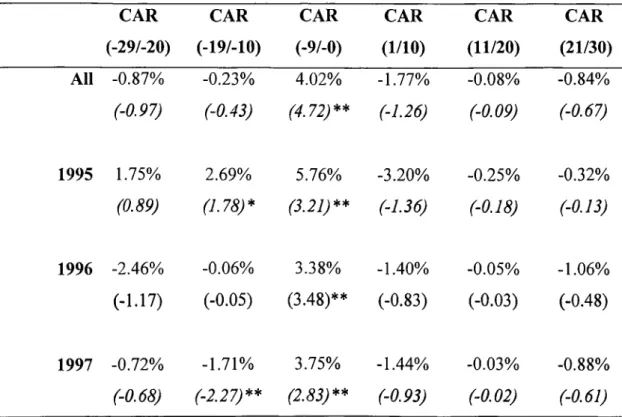
Table v.l. reports the CARs for 10 days periods in 30 days window before and after the split, to figure out the piek up period during bonus issue proeess. When the CAR is computed for days t--9 to t= 0, as can be seen from table v.l., CAR (-9/0) makes a high of 5.76% for bonus issues in 1995 and a low of 3.38% in 1996. However for three years analysis the CAR (-9/0) value is 4.02. During the following days the CARs drops down gradually.
The t statistics are reported in paranthesis such that those marked as and "**" stand for statistically significant at 5% and 10% respectively. The results reveal that only CAR(-9/0) is statistically significant at the 5% level. Another noteworthy point is the negative CARs following the split. Although they are statistically insignificant the CAR values after the split are negative.
CAR (-29/-20) CAR (-19/-10) CAR (-9/-0) CAR (1/10) CAR (11/20) CAR (21/30) All -0.87% (-0.97) 1995 1.75% (0.89) 1996 -2.46% (-1.17) 1997 -0.72% ( -0.68) -0.23% (-0.43) 2.69% (1.78)* -0.06% (-0.05) -1.71% (-2.27)** 4.02% (4.72)** 5.76% (3.21)** 3.38% (3.48)** 3.75% (2.83)** -1.77% (-1.26) -3.20% (-1.36) -1.40% (-0.83) -1.44% (-0.93) -0.08% (-0.09) -0.25% (-0.18) -0.05% (-0.03) -0.03% (-0.02) -0.84% (-0.67) -0.32% r-a/5 ; -1.06% (-0.48)
-
0.
88%
(-0.61)Table: V .l. CAR (-30/30) and t statistics by Years
Table V.2. reveals second sample group. When the volume group with 95 events, are
analysed, the (-9/0) period again exhibits the highest CAR value of 3.36% for all three years and is statistically significant at 5% level. In 1995, the same figure for -9‘'’ to 0*'’ days period goes up to 4.59% and statistically significant at 10% level.
CAR (-29/-20) CAR (-19/-10) CAR (-9/-0) CAR (1/10) CAR (11/20) CAR (21/30) All -0.01% -0.54% 3.36% -1.29% 1.01% 0.27% (-0.01) (-0.52) (2.57)** (-0.81) (0.89) (0.22) 1995 1.50% 4.26% 4.59% -2.77% -1.43% -0.06% (0.47) (1.44)* (1.57)* (-0.93) (-0.58) (-0.02) 1996 -0.80% -1.81% 3.44% -1.36% 0.21% -0.01% (-0.58) (-1.00) (1.71)* (-0.98) (0.12) (-0.00) 1997 -0.08% -1.69% 2.76% -0.58% 2.69% 0.64% (-0.04) (-1.53)* (1.55)* (-0.26) (1.31) (0.38)
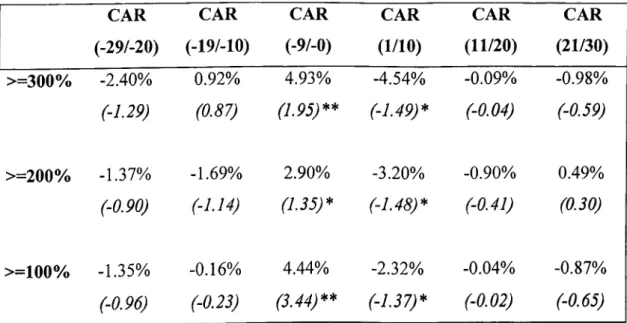
Table V.3. reports the CAR for the third sample set which is formed by considering
the split factor. The events with split factors of 3 or more, 2 or more and 1 or more constitute 3 different data sets. The results indicate that CAR (-9/0) changes between 2.90% to 4.93% which is suported by t statistics of 1.35 to 1.95 respectively.
Another interesting result is the statistically significant negative CAR(l/10)s following the split date. As split factor decreases, the magnitude of negative effect declines. CAR (-29/-20) CAR (-19/-10) CAR (-9/-0) CAR (1/10) CAR (11/20) CAR (21/30) >=300% -2.40% 0.92% 4.93% -4.54% -0.09% -0.98% (-1.29) (0.87) (1.95)** (-1.49)* (-0.04) (-0.59) >=200% -1.37% -1.69% 2.90% -3.20% -0.90% 0.49% (-0.90) (-1.14) (1.35)* (-1.48)* (-0.41) (0.30) >=100% -1.35% -0.16% 4.44% -2.32% -0.04% -0.87% (-0.96) (-0.23) (3.44)** (-1.37)* (-0.02) (-0.65)
Table: V.3. CAR (-30/30) and t statistics for split factor group
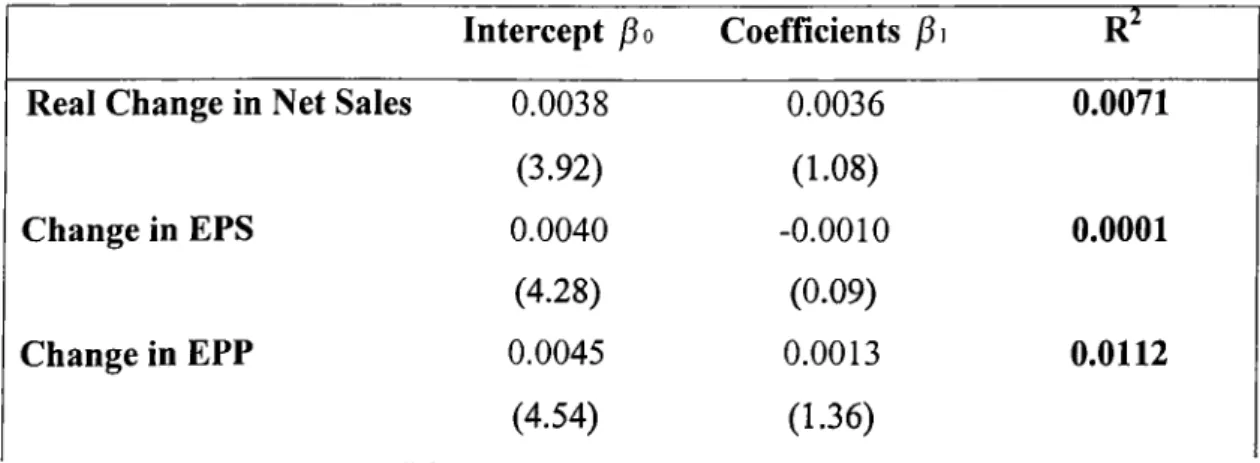
In the second part of the analysis, the signaling hypothesis is tested. The average abnormal returns between -9*'’ and 0*'’ days and selected financial indicators namely real growth in yearly Net Sales, yearly change (%) in Earnings per Shares and again yearly change (%) in Earnings per Price ratios are analysed. Existence of correlation between those dependent and independent variables are explored. The reason for selecting 10 days period just before split day and the AR(-9/0) value for regression analysis is due to statistically significant abnormal return findings in the above analysis.
Intercept fio Coefficients j3i 0.0038 0.0036 0.0071 (3.92) (1.08) 0.0040 -0.0010 0.0001 (4.28) (0.09) 0.0045 0.0013 0.0112 (4.54) (1.36)
Real Change in Net Sales
Change in EPS
Change in EPP
Table: V.4. Regression Analysis - All data set
Table V.4. reports the results of the regression analysis with all data set (166 events). The results point out that although the t statistics are significant at 5% level for Net Sales, EPP and EPS indicators, the inadequacy of prevent us to interprete a strong and reliable correlation between average abnormal returns, A R (-9 /0 ), and selected financial figures.
Table V.5. exhibits the results for volume based data file, the regression analysis between A R (-9/0) and financial indicators, results in low values which falls short in revealing the contribution of selected financials to average abnormal returns.
Intercept j3o Coefficients /3i R^
Real Change in Net Sales 0.0032 0.0034 0.0072
(2.89) (0.83)
Change in EPS 0.0035 -0.0013 0.0300
(3.28) (-1.68)
Change in EPP 0.0022 -0.0024 0.0284
(1.76) (-1.65)
Table: V.5. Regression Analysis - Volume group
Table V.6. reveals the regression result for the sample set grouped according to split factors. The results show that neither t statistics for financial indicators nor R^ support the correlation between average abnormal return and the financial indicators.
Split Factor Group, ^ 3 Intercept j3o Coefficients /3i R""
Real Change in Net Sales 0.0055 -0.0137 0.0782
(2.39) (-1.49)
Change in EPS 0.0045 -0.0028 0.0774
(1.98) (-1.48)
Change in EPP 0.0037 -0.0034 0.0696
(1.50) (-1.40)
Split Factor Group, ^ 2
Real Change in Net Sales 0.0031 -0.0104 0.0510
(2.00) (-1.54)
Change in EPS 0.0028 -0.0017 0.0428
(1.72) (-1.40)
Change in EPP 0.0025 -0.0012 0.0200
(1.46) (-0.95)
Split Factor Group,
Real Change in Net Sales 0.0045 -0.0007 0.0002
(3.10) (-0.12)
Change in EPS 0.0043 -0.0016 0.0126
(3.04) (-1.13)
Change in EPP 0.0038 -0.0012 0.0062
(2.40) (-0.78)
Table: V.6. Regression Analysis - Split factor group
When table v.6. is examined the common result is the insignificant values. Only for split group >3, the goes up to %8s but this again falls apart from explaining the relation between the indicators and the returns.
The third and the final issue is arises from the discussions of the trading volume changes in 30 days event window. To calculate the abnormal changes relative to the average historic volume level and ISE total volume, the study uses both the average trading volume of stock between 120 days and 30 days prior to bonus issue and ISE
total trading volume during the 60 days event window. The results presented in graph V.4. indicate that during 10 days period before the split day, there is an increase in the trading volumes of stocks which is followed by a significant decline immediately after the split execution.
The magnitude of decline is much stronger for the average abnormal volume change, ARAV, as can be seen from graph v.4. This situation can be interpreted as a sudden and permanent decline in the attention of investors to splitted stocks after the implementation of split. After the split day, the stocks seem to lose their attractiveness for the investors.
A verage R elative Abnormal Volume Change O ver 60 days E vent W indow
(1995-1997, %, Grouped by Years)
-All 1995 - - 1 9 9 6 ■1997
Graph: V.4. Change in ARAV
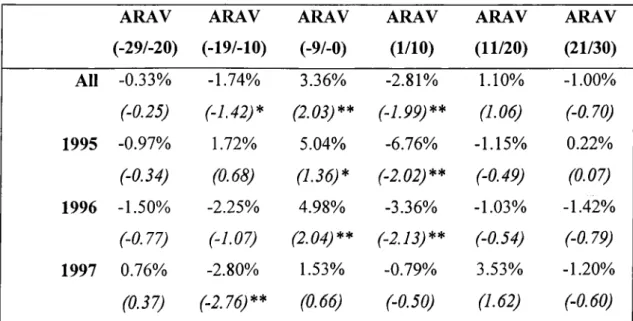
Abnormal change in volume exhibits a strong existence during t= -9 to t= -0 period. When all three years are considered, the t-statistics expose a significant rise during the mentioned period. This result is the strongest in 1996 and the weakest in 1997 (table V.7.).
ARAV ARAV ARAV ARAV ARAV ARAV (-29/-20) (-19/-10) (-9/-0) (1/10) (11/20) (21/30) All -0.33% (-0.25) 1995 -0.97% 1996 1997 (-0.34) -1.50% (-0.77) 0.76% (0.37) -1.74% (-1.42)* 1.72% (0.68) -2.25% (-1.07) -2.80% (-2.76)** 3.36% (2.03)** 5.04% (1.36)* 4.98% (2.04;** 1.53% (0.66) -2.81% (-1.99)** -6.76% ('-2.02; * * -3.36% (-2.13)** -0.79% (-0.50) 1.10% r/.oo; -1.15% ('-o.4p; -1.03% r-0.54; 3.53% r/.02; -1.00% C-0.70; 0.22% CO. 07; -1.42% C-0.7P; -1.20% C-o.oo;
Table: V.7. ARAV (-30/30) and t statistics by years
Table V.7. exhibits the same important effect revealed in table v.3. that the negative
AJRAV(1/10) values decline throughout the years from 1995 to 1997.
Given the hypotheses and approaches for stock splits in US markets and Turkish Market, a detailed event study is conducted to examine the perception of both investors and managers towards stock splits.
Using 166 events by 97 companies during 1995-97 period, we run regression analysis between average abnormal returns and selected financial indicators addressing growth in the sample companies. Additionally, the significance of price changes during the pre-split period and abnormal volume changes during the same period are examined to understand market perception of stock splits. The results display that there has been a value increase during the pre-split period. However, there is no proof that the mentioned growth in value is related to favorable information (growth in earnings) about the company. The significant average abnormal return and average abnormal volume changes during pre-split period demonstrate the interest of Turkish investors towards stock splits independent of the companies' growth prospects.
The analyses exhibit significantly positive pre-split period returns for the entire sample of pure bonus issues. The pick up period beginning from the 9'*’ day prior to split day makes a peak during the implementation day. Additionally, there is a significant increase in the trading volume 10 days before the split.
Associated with the findings above, when a regression analysis between the average abnormal return and selected financial indicators is conducted, the result demonstrates a negligible relation between those variables. This finding contradicts with the private information-signaling hypothesis. Eventhough, the split period returns enable the company to increase its value, this valuation change can not be explained by the growth in the companies' earnings. A sudden decline in the stock price, starting form the 1*' day after the split is an indicator of lack of a real valuation effect. Regarding to this analysis, the positive price movements just before the split date can be taken as the overreactions of the investors and can be accepted as a speculative maneuver to turn price adjustment expectations into lucrative returns. Since the foreign investors aim to invest in long terms and generally are reluctant to short term trading, the above mentioned speculative movements are expected to be performed by local investors/traders.
Furthermore, the sudden decrease in relative volume after the split similar to price, rises questions about the optimal trading range hypothesis in Turkey. With a decreasing volume and falling price, it is hard to talk about an expanding investor base due to affordable price range.
Due to immaturity of ISE as opposed to international markets, the consciousness level of average investors in ISE is still well below than those in foreign markets. Today, it is still possible to be in a situation in which the price difference between a stock with a dividend coupon on it and one without this coupon might be much higher than the dividend itself at the execution day. The investors (especially the local ones) are still making decisions based on rumors or street talks. Likewise, a significant number of Turkish investors are not used to comparing companies according to their market capitalization. Instead, they utilize only the share prices for this purpose. Within this context, a stock with lower price can be treated cheap compared to similar companies' stocks although those may have considerably low paid in capitals and accordingly low market value.
A stock split decision by a listed company may be perceived by investors as the proof of achievement of strong earnings in the near future. In a semi-efficient market such information must already be incorporated in the price with the disclosure of company financial data. Although the Turkish Stock Market is assumed to be semi-efficient, we suspect that the investors question the reliability of company financials in such a high inflationary economy like Turkey's. Therefore we believe that investors may require additional proof from the company, besides financial statements, possibly in the form of a corporate action such as dividend and/or capital increase. Given the recorded low level of net dividends paid by Turkish companies, announcement of capital increase is perceived as an indicator of achievement. This is true even if the capital increase is nothing more than an accounting manipulation and causes no real change in the value of the company.
In conclusion, stock splits in Turkey are utilized more as a speculative tool that has little financial reliability instead of serving for increase in liquidity or conveying valuable information to investors. However, with the increase in the number of educated investor, such anomalies will disappear.
1) Alvin Hall, Getting Started in Stocks, 2nd ed., N.Y. Toronto: John Wiley and Sons, 1994.
2) Angel, J.J., "Tick Size, Share Price and Stock Splits", Journal of Finance 52, 1997, 655-681.
3) Baker, H., and Gallagher, P., "Management View on Stock Splits", Financial Management 9, 1980, 73-77.
4) Brennan, M.J.,and Copeland, T., "Stock Splits, Stock Prices, Transaction Costs,", Journal of Financial Economics 22, 1988, 83-101.
5) Brennan, M.J.,and Hughes P., "Stock Prices and Supply of Information", Journal of Finance 46, 1991, 1665-1692.
6) C. Y. Francis, Management of Investments, 3rd ed.. New York, San Francisco, Tokyo; Me Graw Hill, 1993.
7) Defeo, V. and Jain, P., "Stock Splits: Price per Share and Trading Volume", Advances in Quantitative Anaysis of Finance and Accounting
8) E. Bradly, T. Teweles, The Stock Market, 6th ed.. New York: John Wiley and Sons, 1992.
9) Easly D., O'Hara M., Saar G., "How Stock Splits Affect Trading: A Microstructure Approach", Working Paper, Cornell University, March 1998.
10) Frank K. Reilly, Investment Analysis and Portfolio Management, 2nd ed.. New York: Dryden Press, 1979.
VII. REFERENCES
11) Ikenberry, D.L., Rankine, G. and Stice, E.K., "What do Stock Splits Really Signal ?", Journal of Finance and Quantitative Analysis 3, September 1996, 357-375.
12) Lakonishok, J. and Lev, B., "Stock Splits and Stock Dividends; Why, Who and When", Journal of Finance 4, September 1987, 913-932.
13) Lamoureux, C.G., Poon, P., "The Market Reaction to Stock Splits", Journal of Finance 5, December 1987, 1347-1370.
14) Maloney, M.T., and Mulherin, J.H., The Effects of Splitting on the Ex: A Microstructure Reconciliation", Financial Management 21,1992, 44-59.
15) McNichols, M., Dravid, Ajay., "Stock Dividend, Stock Splits, and Signaling", Journal of Finance 45, July 1990, 857-879.
16) Muradoglu G., Aydogan K., "Do Markets Learn from Experience? Price Reaction to Stock Dividends in Turkish Stock Market", Applied Financial Economics, Forthcoming, 1996.
17) Muradoglu G., Aydogan K., "Price Reactions to the Implementation of Stock Dividends and Rights Offerings; Efficiency of Turkish Stock Market Through Time", Working Paper, Bilkent University Faculty of Business Administration, February 1998.
18) Muscarella, C.J., and Vetsuypens, M.R., "Stock Splits: Signaling or Liquidity ? The Case of ADR 'Solo-Splits'", Journal of Financial Economics 42, 1996, 3-26.
19) W. O'Neil, How to Make Money in Stocks, 2nd ed., Washington: Me Graw Hill, 1995.
VIII. APPENDIX
Stocks with bonus issues in 1995
Stock Date 1 ANACM 06-Jan-95 2 TOFAS 16-Jan-95 3 GOODY 19-Jan-95 4 CUMRA 15-Feb-95 5 SMENS 15-Mar-95 6 TRKCM 16-Mar-95 7 ARCLK 07-Apr-95 8 ANACM 17-Apr-95 9 IZMDC 15-May-95 10 IZOCM 22-May-95 11 GOODY 24-May-95 12 BRSAN 30-May-95 13 TATKS 30-May-95 14 DOKTS 12-Jun-95 15 OTOSN 14-Jun-95 16 SIFAS 23-Jun-95 17 ERCYS 28-Jun-95 18 ANBRA lO-Jul-95 19 GUNEY 12-JUİ-95 20 TOASO 24-JuI-95 21 ECILC 16-Aug-95 22 BURCE 21-Aug-95 23 MERKO 25-Aug-95 stock 24 ARCLK 25 TIRE 26 CELHA 27 EGBRA 28 DARDL 29 ASLAN 30 NTTUR 31 BROVA 32 BUCIM 33 UCAK Date 28-Aug-95 31-Aug-95 20-Sep-95 25-Sep-95 18-Oct-95 01-Nov-95 06-NOV-95 17-NOV-95 04-Dec-95 14-Dec-95 43