T.C.
ISTANBUL AYDIN UNIVERSITY INSTITUTE OF SOCIAL SCIENCES
EXPLORING THE LEADER’S
LANGUAGE OF MOTIVATION ON SUBORDINATE PERFORMANCE AND JOB SATISFACTION IN BANGLADESH
MSc. THESIS
Mohammad Khairul Islam Rasel
Department of Business Business Management Program
Thesis Advisor: Assist. Prof. Dr. Burçin Kaplan
ii T.C.
ISTANBUL AYDIN UNIVERSITY INSTITUTE OF SOCIAL SCIENCES
EXPLORING THE LEADER’S
LANGUAGE OF MOTIVATION ON SUBORDINATE PERFORMANCE AND JOB SATISFACTION IN BANGLADESH
MSc. THESIS
Mohammad Khairul Islam Rasel (Y1412.130049)
Department of Business Business Management Program
Thesis Advisor: Assist. Prof. Dr. Burçin Kaplan
June 2017
v FOREWORD
All gratitude and admiration first goes to Allah for giving me the courage, strength and patience to complete my study.
My dear father, my dear mother and my family, I do not have more than bowing in front of their greatness.
I consider myself very fortune that Dr. Burçin KAPLAN has accepted to be my supervisor. Special thanks and admiration goes to him for his guidance, direction, comments, and feedback he provided me since the early stages of my research throughout the dissertation. I am also grateful for his wisdom, patience, and courage to accept the challenge with me and to encouraging me to keep momentum to continue.
As I am at the last stages of getting my degree, I would not forget my professors and doctors the teaching staff at the Department of Business Adminitration. For them all I extend my deepest appreciation and gratitude.
I also would like to acknowledge the support of the three organizations families’ management and staffs for making this research a reality. My appreciation goes for my colleagues in the Human Resources Department for their support and help. I am also grateful and especially thankful for international offices staffs of these organizations, Dutch-Bangla Bank, NGO (BRAC) and RFL Plastic Product Company in Bangladesh for encouragement and support they demonstrated during my study and research.
Acknowledgement and gratitude goes to my best friends and classmates in Istanbul city, who stand with and bring me all the support and help during whole thesis process and special gratitude for Yunus Simsek, SM-Abdullah Al Mamun, Abdullah Al Mamun Robin, and Ashik A Matin for their support.
vi TABLE OF CONTENTS Page FOREWORD………IV TABLE OF CONTENTS ... VI ABBREVIATIONS ... VIII LIST OF TABLES ... IX LIST OF FIGURES ... X ÖZET XI ABSTRACT ... XII 1 INTRODUCTION ... 0 1.1 Background to Research ... 0 1.2 Problem Statement ... 1 1.3 Research Questions ... 2 1.4 Research Method ... 3 1.5 Objectives of Research ... 3 1.5.1 Objectives ... 4 1.6 Importance of Research ... 4 2 LITERATURE REVIEW ... 6 2.1 Introduction ... 6 2.2 Leadership ... 7 2.3 Motivation Language ... 23 2.4 Job Performance: ... 30 2.5 Job Satisfaction ... 31 2.6 Over View ... 33
2.7 Comments on the Previous Studies... 46
3 RESEARCH METHODOLOGY ... 48
3.1 Introduction ... 48
3.2 Research Question ... 49
3.3 Research Methodology ... 49
3.4 Interview Technique ... 50
3.5 Population and Sample Size ... 50
3.6 Interview Method ... 51
vii
3.8 Why These Three Different Organizations? ... 52
3.9 Tool Development and Design ... 52
3.10 Data Measurement ... 53
3.11 Limitations of Semi Structured In-depth Interview ... 54
3.12 Ethical Procedures ... 54
3.13 Report Preview ... 55
4 DATA ANALYSIS AND FINDINGS ... 56
4.1 Introduction ... 56
4.2 Analysis of Data from Respondents ... 56
4.3 Discussion ... 68
4.4 Findings ... 71
5 CONCLUTIONS AND RECOMENDATIONS ... 74
5.1 Recommendation ... 76 5.2 Future Direction: ... 78 REFERENCES ... 81 APPENDICES ... 86 Appendix A ... 86 Appendix B ... 88 RESUME………...93
viii ABBREVIATIONS
BRAC : Bangladesh Rehabilitation Assistance Committee EI : Expected Frequency
ED : Effectiveness of Decision EM : Effectiveness of Motivation LMX : Leader-Member Exchange MLT : Motivational Language Theory ML : Motivational Language
ix LIST OF TABLES
Page
Table 2.2.1: The Typical Result ... 13
Table 2.2.2: Job Oriented and Employee Oriented Leadership Style ... 14
Table 2.2.3: Likert’s Study ... 15
Table 2.2.4: Harbison and Myers Study ... 16
Table 3.3.1: The Typical Result List of the Selected Organizations... 50
Table 4.1: Demographic Profile of Interviewees ... 56
x LIST OF FIGURES
Page
Figure 2.2.1: Maslow’s Hierarchy of Needs Model from Followers View. ... 8
Figure 2.2.2: Maslow’s Hierarchy of Needs Model from Leader View ... 9
Figure 2.3.3: Types of social network websites ... 17
Figure 2.5.5: The Needs Model Which is Always Upward Direction ... 26
Figure 2.6.6: ERG Model ... 27
Figure 2.7.7: ―Two factors‖ Models. ... 28
Figure 2.8.8: Performance Model ... 31
Figure 4.1: Language of Leadership ... 57
Figure 4.2: The Status of Relation between Subordinates and Superiors ... 58
Figure 4.3: Freedom in Practicing Daily Responsibility ... 59
Figure 4.4: Scale Motivation Practiced ... 60
Figure 4.5: Scale of Comfortability ... 61
Figure 4.6: Satisfaction According to Salary ... 62
Figure 4.7: Steps Defines to Offer Promotion ... 63
Figure 4.8: Type of Triaging Offered by Organization ... 64
Figure 4.9: Acknowledgement Offered by Superior ... 65
Figure 4.10: Elements of Motivation can be applied to Influence Performance... 66
Figure 4.11: Elements of the Leadership Satisfaction ... 67
Figure 5.1: Area Working Environment Coverage Area ... 79
xi
MOTIVASYON DILILIL BANGLADEŞ’TEKI ORGANAZASYONLARDA ÇALIŞAN İŞ GÜCÜNÜN ÜZERINDEKI ETKISINI VE YARATTIĞI
MEMNUNIYETI ARAŞTIRMAYTI HEDEFLEMEKTEDIR
ÖZET
Bu proje, motivasyon dilinin Bangladeş’teki organizasyonlarda çalışan iş gücünün üzerindeki etkisini ve yarattığı memnuniyeti araştırmayı hedeflemektedir.
Motivasyon dili, bütün organizasyonlarda, karmaşık organizasyonel görev ve sorumlulukların tamamlanmasını sağlamak için çalışanlara destek veren önemli bir araçtır.
Bu araştırma, Bangladeş’de bulunan Dutch-Bangla Bank, NGO (BRAC) ve RFL Plastic Product Company şirketlerinde çalışan 30 çalışan üzerinde gerçekleştirilmiştir. Yarı yapılandırılmış derinlemesine mülakat testlerinin sonuçları, hem performans ve memnuniyetin yukarı yönlü hareketine yol açan itici unsurları, hem de hedef çalışan kitlesindeki memnuniyeti ve performansı düşüren unsurları göstermektedir. Ayrıca bu çalışma, yönetici ve mahiyetindekiler arasındaki iletişim kopukluğunu (ki bunlar yöneticinin davranışlarını ve bu davranışların çalışanların üreteceği çıktılar üzerinde etkileri bulunmaktadır) ortaya çıkartmaktadır. Analizlerler göstermektedir ki, eğer bir çalışan memnun ve mutlu ise motivasyon seviyesi yüksektir. Ama eğer bunun tersi bir durum söz konusu ise, verim ve motivasyon hatırı sayılır bir şekilde düşmektedir. Bu sonuçların içeriği, yönetici ve iş sahiplerinin çalışanları ile kendileri arasındaki kopukluğu ortaya çıkartacak, ayrıca çalışanları motive ve memnun tutacak, beklenen performansa ulaşmalarını sağlayacak.bazı motivasyon dili tekniklerini uygulamalarına yardımcı olacaktır.
xii
EXPLORING THE LEADER’S
LANGUAGE OF MOTIVATION ON SUBORDINATE PERFORMANCE AND JOB SATISFACTION IN BANGLADESH
ABSTRACT
The present study aimed to exploring the language of motivation on the performance and satisfaction of workforce and employees of organizations in Bangladesh.
Language of motivation in every organization is considered as a tool that leads the employee towards accomplishing specific organizational objectives and goals. This research was conducted on 30 employees of the Dutch-Bangla Bank, NGO (BRAC) and RFL Plastic Product Company in Bangladesh. The results of semi structured in-depth interview revealed that the language of leadership or leadership style lead the performance and satisfaction in ascendant direction and what are factors, decreased the performance and dissatisfied the targeted employees. Also the study found the relational gap between the manager and the subordinates, which drives the behavior of the manager and makes an effect on the employee’s outcomes. The analysis proved that if the employee is pleased and satisfied at his work, his motivational level is high. However, if not, the level of motivation and productivity will decrease noticeably. These findings can have implications for managers and business owners to find out the gap between them and their employees and some action plans to fix the techniques for applying language of motivation that will keep the employees motivated and satisfied to perform as expected.
0 1 INTRODUCTION
1.1 Background to Research
The importance of employee motivation, performance and satisfaction of the company is increasing day by day. The motivation is the key factor, which affects the organizations’ human resources. So employees must receive motivations to improve the performance to accomplish the aims of the organization. Where the language of motivation is the distinct tool to improve performance and satisfaction . Nowadays most discussed topics are about language of motivation, performance and job satisfaction of employee and efficiency of the organization. Employees or workers will seriously perform their responsibilities and duties only if the leading factor in the organization is motivation (Mayfield & Kopf, 1998). Standard pays or salary is also an effective tool to take main roll to improve the performance of employees and also develop the productivity of an institution (Clampitt& Downs, 1994).
.
According to Dr. Niranjan Sia (2015), ―Motivation of the employees and performance are based on their ability to participate collectively and their responsibilities given by the superior are to be objective to get extreme productivity‖. Recent researches focus more on improving the level of productivity, accomplishment and ability of working. Managers who want to get maximum productivity with perfection for them the most psychological important term is language of motivation.
Employee takes main role in the perception of customer about the organization. Organizations spend a large amount of money to achieve the loyalty of customers in state of motivation plan of employee. Employees interact with customers and also carries image of organization in their attitude, behavior and in mind through. So organization needs to enhance their focus towards the motivation of employees.
1
In this advanced age of globalization, organizations are facing competition in the business. If an organization cannot positively motivate employees, it will not have opportunity to exist in the environment of competitive business market (Sullivan, 1988).
It has also discussed how important to understand different demographic motivations and their impacts on performance and job satisfaction. Bangladeshi organizational characteristics and their impact on the general motivation were researched. Human assets or human resources define the value of employee or the workers of any institution (Bass, 1985). Many studies have been done to find out the impact of motivation on the productivity and satisfaction of workforce in the company.
In light of the issues raised above, this study was an attempt to investigate the effect of language of motivation of leader on subordinates’ performance and job satisfaction in Bangladesh. The present study attempted to explore leader’s motivation on performance and job satisfaction of employees. Conducting studies like the present one can provide more effective and supportive motivational instrument for the organizations in Bangladesh. In other words, the results of studies like the current one may help managers to diagnosis the gap between the motivation approaches and outcomes of the workforce with right tools of solution.
1.2 Problem Statement
Annually number of industries spring up so much, but at the end of the year many of them go downhill against the leaders of the motivation factors and causes a lot of problems due to language have been attributed to the performance of employees. There are 175 million people in Bangladesh. Huge sources of workforce are working for the all type of industry such as bank, non-government development organization, production industry etc. So there are lots of valid and derived causes for which managers are always within distress in the organizations. Though human, materials, equipment and technology, all type of resources are available but very few matters envisaging managers every day. More significantly, from the human viewpoint has queries that managers are confounded and fascinated for a long time. Those questions contain:
2
Which leadership language or approach is practiced to make the subordinates motivated in Bangladeshi organization?
What leads the employees to act more actively than others?
Which tools drive the employees to be more satisfied in their tasks than others?
The truth is that the scale and style of motivation can drive subordinate behavior, performance and total job satisfaction. Up to now, many researches and analysis have been conducted with limited solution in Bangladesh.
1.3 Research Questions
Research question designs from principal of motivational language theory. First, the primary speech behaviors characterize most oral expressions which can arise in superior and subordinate talking. Second, behavior of leader powerfully drives the language of motivation on results of subordinate (Sullivan, 1988 &1992). Followers depend more on habitual message than language when the discrepant takes place between two individual (Dulek et al, 1992). Conversation is seen as cheap while it disputes with actions. View of subordinates from the speech of leader like a part of framework of a behavior and only language of motivation is potion of this structure. The third primary question of language of motivation deals with expectation that employees make greater engagement in acceptance than they have oral communications. The communication process of leader is dyadic. The theory of Sullivan also been agreed by same work like Pincus’ (1986) study, that gives strong realistic connection between dissimilar factors of communication of leader.
As derived before, language of motivation has significance because that connects communication strategy of leader with the key of result of performance and job satisfaction of employee. These estimations drive the bellow research primary question:
“Exploring the characteristics of leadership behavior (approach of motivational language) influence the performance and job satisfaction of subordinates of Bangladeshi organizations?”
3 Secondary questions of the study were as follows:
RQ1: What type of leadership approach is practicing in Bangladeshi organizations? RQ2: What are the tools of motivation applied to lead the performance of subordinates?
RQ3: What are techniques of the leadership style and motivation encounter in job satisfaction of subordinates?
1.4 Research Method
The idea of language of motivation and model of effective leadership talk was found by Sullivan in 1988. The goal is making a strong bridge between the distance of leader intention and followers considering to be positively derived for the outcomes. In brief, hypothesis of language of motivation theory that gives variance in speech of leader so that can be taken as a tool of motivation to aid subordinates to fulfill the desires of organization and objective of individuals. Here it is significant to mention that language of motivation only discursive responses of subordinate to managerial initiated approach and not the opposite part (Sullivan,1988).
The independent variable of this study is leader’s language of motivation and the dependent variables are subordinate’s performance and job satisfaction. Following are the theoretical and operational definitions of each variable:
Language of motivation: Some leading and hygiene factors that accelerate the performance and satisfaction of the workforce.
Performance of employees: The ultimate outcomes or productivity of the human resources of organization.
Job Satisfaction: The experiences and realization by the employees about the job.
1.5 Objectives of Research
This research will emphasis on the approach of motivation of leader how driving the performance and satisfaction of employee of an organization in Bangladesh. Different type of organizations with different work environment actually identifies
4
their own motivational approaches based on their employee level. So the aim of this study is as below:
“Exploring the characteristics of leadership behavior (approach of motivational language) influence the performance and job satisfaction of subordinates of Bangladeshi organizations?”
The aim will identify all the variables and competencies needed to find effective motivational language. Moreover, the outcomes of the research will make the below contributions.
1.5.1 Objectives
1. Recommending the effective motivational language. 2. Analysis that varies the satisfaction.
3. Offering assistance to the management of any kind organization to understand influencing the performance of workforce.
4. Mentioning the tools which will improve the job satisfaction of employees 5. Evaluate leader-subordinate liaison through motivating language structure.
Consider the applicability and implication of these findings in the perspective of Bangladesh.
1.6 Importance of Research
The ultimate purpose of this study is to identify the main facts of fluctuating employee’s performance and satisfaction for the language of motivation of leader within the framework of motivational method.
a) Scientific Importance:
The data of research question of this study will help to understand the management that implementation right motivation language of a leader is the key factors on the overall employee’s performance and satisfaction.
It will support the leader or managers to recognize the causes and methods which are effecting the behavior, performance and satisfaction of employees internally and externally of the organizations.
5
The analysis will sensitize leader that for which specific factors the employees act is commenced and prepared.
The research will also advantage the managers to formulate strategies which will make extremely inspired employees with expected results of productivity and satisfied workforces.
This is a source of study for researchers who want to learn about the implementation of this knowledge can be considered in Istanbul Aydin University, and the research in this area can be a primary basement for those interested in further study.
b) Practical Importance:
This study will have possibility to contribute in developing the supervision structure for the subordinate performance and job satisfaction depend on many dynamics, such as leaders motivating language, environment and culture of organization, compensation package and commitment of organization and so on. We presumed motivational language of leader is the only distinct variable to analyze subordinate performance and job satisfaction.
6
2 LITERATURE REVIEW
2.1 Introduction
Changing the world one of the most important and necessary skills is leadership style. It has become significant day by day, since we attempt to take control of our own objective and direct the objectives of our family, community, organization and our world, the needs of effective leadership capability is ever explicit. One of the key to our future accomplishment and endurance is effective leadership (Pearsall & Sims, 2013).
This has generally advised that the application of leadership style in present days is effective and beneficial not only to performance of institute but also increases the interests of stakeholders of organization (Sakiru et al., 2013).
But how we define leadership, and who is having it? How can a person build up ability of leadership, or does people get it by born? It is said leadership need to be educated and acquired. Some people say leadership can be a souvenir which cannot be learned.
Right leader and leadership styles are vastly related to the issue of employee motivation, outcomes and job satisfaction. A successful leader knows different way to provide the requirement of the others and influences them to act as wanted (Quaquebeke & Dick, 2012). Without leader an individual can be motivated but without the support of supporters no leaders can be successful (Fleming, 2011). If someone has believed for competing challenging type job, those type people have intrinsic to attend perform or influence themselves in different way to be able to accomplish at as in needs for challenging type job (Houglum, 2012).
On the way, if leaders find that someone is able to get promotion in the organization hierarchy but employee wants to stay at that same level where he/she is working at this time the leader does not have anything to do.
7
However, the employees have enough influence and motivation by the leaders but employees perhaps not rise up as expected in the hierarchy by the training process. Leaders have to convince their employees so that it becomes in their most priority to work as the way encouraged ( Rakich & Darr, 2000).
2.2 Leadership
Leadership is to influence other people behavior toward accomplishment of organizational or individual goals. Any kind of effort that influences other people’s behavior and tendency to accomplish towards the goals of organizational or individual is known as leadership (Danserau et al., 1975).
2.2.1 Leader
Rendering to Maslow, a person is prepared to move willingly towards the goal when if only if his or her unsatisfied needs are fulfilled. The initial idea of the Maslow involved with only characterized growth or development needs (Maskow, 1971).
Who influences other people’s behavior.
Who tries to accomplish the goals of organization. Ex:
Government political leader, coach of team.
If there is leader then there should be follower.
Leader influence the followers.
The number of follower can be many or few. In this case we can call this type of person as leader. She / he is leader because of leading other people we cannot consider parents as leader, although the lead their children. Because their leadership is not for organizational goals rather for ethical one.
8
Therefore, leadership must be for organizational goals. Leader via gaining organizational goals influences the behavior of subordinates (follower).Not only being president, but also the one who improves the moral of team to gain goals is consider as leader ( Maslow & Lowery, 1998).
Why should anyone accept commands of leader, influences and also efforts?
And why followers follow the leader?
To explain these questions need Maslow’s need model. The follower wants to satisfy their several needs.
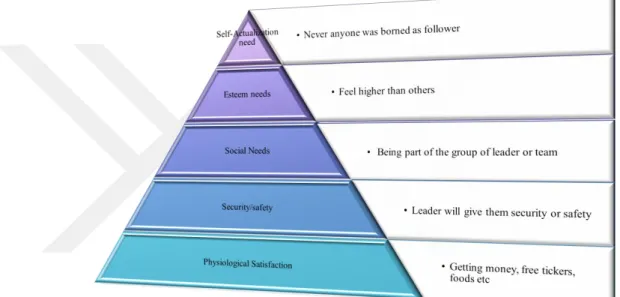
Figure 2.2.1: Maslow’s Hierarchy of Needs Model from Followers View. Maslow, A. H. (1954). Motivation and Personality. New York: Harper and Row. 2 ed., pp. 38 1. Physiological Satisfaction: Some follower need to satisfy their physiological
needs. Like – giving money, free tickers, foods etc.
2. Security/safety: They think the leader will give them security or safety. 3. Social Needs: They feel belongingness begging part of the group of leader or
team. Like: Football team fans.
4. Esteem needs: It makes them feel higher than others. Like – their team win but the competitors team loose, their team be in higher place than.
5. Self-Actualization need: It is the last possible satisfaction, because nobody dreams to become follower of someone. Never anybody gets borne as follower.
9 Why someone wants to become leader?
To explain these questions need Maslow’s need model. The leader wants to satisfy his/her several needs.
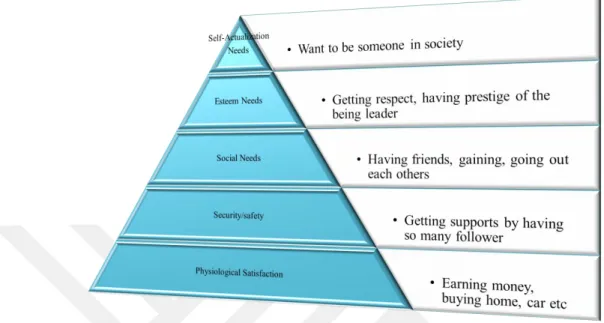
Figure 2.2.2: Maslow’s Hierarchy of Needs Model from Leader View
Maslow, A. H. (1954). Motivation and Personality. New York: Harper and Row. 2 ed., pp. 1. Physiological needs: Followers supports to leader by providing physiological needs. Like: Earning money, buying home, car etc. The follower provides money to leader. Most of the leader lives better life than the follower.
2. Security needs: They feel more safety because follower will provide it, by having so many followers to that supports him.
3. Social needs: As they have so many followers that means they have the society. Having friends, eating, gaining, and going out each other’s.
4. Esteem satisfaction: being in the top level, getting respect, having prestige of the being leader, looking from top level.
5. Self-actualization: Having so many followers they become motivated and they become motivated and they want to be someone in society and they start thinking.
10
Where does the leader get power to influence followers?
The answer of this question is based on the studies of two authors French and Raven ―Bares of powers‖ (1959).
Certain people have power because of their position on legal status.
Coercive power: The power of punishment of people. Threatening with punishment.
Reward power: The power of reward the above mentioned power are the command bases power
2.2.2 Types of Leadership According to Approach
From the analysis we can’t define which leader is appropriate because it depends on the situation. As we are analyzing the individual behavior, we found 4 types of leader according to behavior. Through these four types of leadership cover all type of approaches ( Lewin et al,1939).
1. Autocratic or Authoritarian leadership. 2. Democratic or Participative leadership. 3. The Laissez-faire or Free-rein leadership. 4. Paternalistic leadership.
1. Autocratic or Authoritarian Leadership: The leader makes all the decision. The leader decides who what to do and how to do? As the leader decides everyone responsibilities, if anybody do not do as she/he said she/he would threatened them as punishment. The leader controlled them all.
2. Democratic or Participative Leadership: Being democratic is different-participative. In democratic who gets the highest vote they choose that parson but democratic participative is more participation or everybody participate. Everybody gets chance to give decision. They get together and sit for discussion and said for decision. The leaders leave the decision to the group member or subordinates. So all the group members discussed and decide who will do what.
11
3. The Laissez-faire or Free-rein Leadership: The leader let others or follower what they wanted to do? The leader let follower complete freedom to do whatever they want to do. But do not give any instruction. Also larder does not control the subordinates or followers. Here everybody was free to take their own decision.
4. Paternalistic Leadership: Here leader considers the relationship between the followers as family relation. The subordinates get guides and protects as part of the family of leader. So subordinates get good working circumstances and handsome benefits from the head of the family. The idea is that employees will work harder out of appreciation.
There are more studies available those had been done about the approach of leadership ( Gregory, 2014).
One of the necessary task was an inclination to tangential areas which should surpass metropolitan places. That's why the improvement of SNSs are not related to Cyworld, it depends on the situation in America. MySpace was the first website that characterized with this attribute in America and after 2004 began to be widespread, even though afterward penetrated to music sector(Miller et al., 2015).
a. Great Man Approach:
Taking the history of some great leaders and study which and how make them effective and good leader. And understand their life. They tried to find the answer of ―what made them leader?‖ They looked at their life in ages when they were young, adult and old. This type of approach did not last long time because certain country and certain time have their own characters. Today this type of approach does not work because everything changed. Such as: time, situation and information ( Thomas, 1840).
12 b. The Trait Approach:
They studied some successful leaders’ history, character and personality. They tried to find all of the characteristics they have or not. And they left the study because they found some conflicts each other’s. They did not find all traits one leader had all of that. Why they left the approach? Because the formal characteristics under the trait approach is o measuring level or tools ( Stogdill, 1948).
c. Leader Behavior Approach(1930):
They took some good and bad leaders and studied their behaviors. How they became leader? What they made good or bad leader. The research in this type of approach they have asked question ―How do they behave as a leader?”
1. First Study:
In 1930 Lenwin, Lippitt and white (University of Iowa) took some assistance to send them in summer camp and they were interested to play different type of leader behaviors. The types of behaviors were:
i. Democratic Participative ii. Authoritarian Style
I. Democratic Participative:
Being democratic is different from democratic participative. In democratic who gets the highest vote they choose that person. But in democratic participative is having more participation or everybody participate. Here everybody gets change to give decision. They get together and sit for discussion and ask for decision. The leader leaves the decision to group member or subordinates. So the entire members discus and decide, who will do what. As a result when the group decision is made everybody is satisfied ( Lewin, 1939).
13
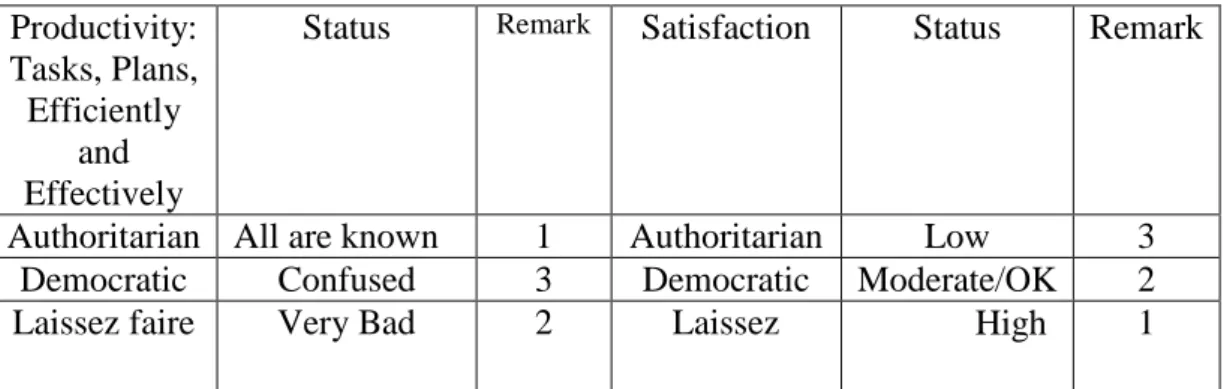
Table 2.2.1: The Typical Result Productivity:
Tasks, Plans, Efficiently
and Effectively
Status Remark Satisfaction Status Remark
Authoritarian All are known 1 Authoritarian Low 3
Democratic Confused 3 Democratic Moderate/OK 2
Laissez faire Very Bad 2 Laissez High 1
Lowin, A.(1963). Participative Decision Making: A Model, Literature Critique, and Prescriptions for Research. Organizational Behavior and Human Performance 3, pp. 68-106.
II. Authoritarian Style:
Authoritarian style of leadership can be found in political situations. Such as: in Russia. There were different results of behavior. The number of production can be increased but because of the threat of punishment there is no satisfaction ( Lewin, 1939) .
2. Second Study (1950 University of Michigan) :
This study called ―Style continuum‖ They took managers and divided them in two categories good and poor. After that they classified in three categories by evaluating them.
I. The Superior Rating: The people of higher level than managers. II. The Peers Rating: The same level or coworker.
III. The Subordinate rating: The people who work under those managers.
Those who got high scored in all three categories were goo and successful leader. There was also another criterion. There is also a criteria, the promotion rating: Those who got earlier promotion then other within less time.
Through that study they divided them into two groups. They found two kind of leadership behavior.
14 The two behaviors:
1. Job oriented style. 2. Employee oriented style.
In 1955 they concealed the study and found that Employee orientation is highly accepted ( Baker et al, 1955) .
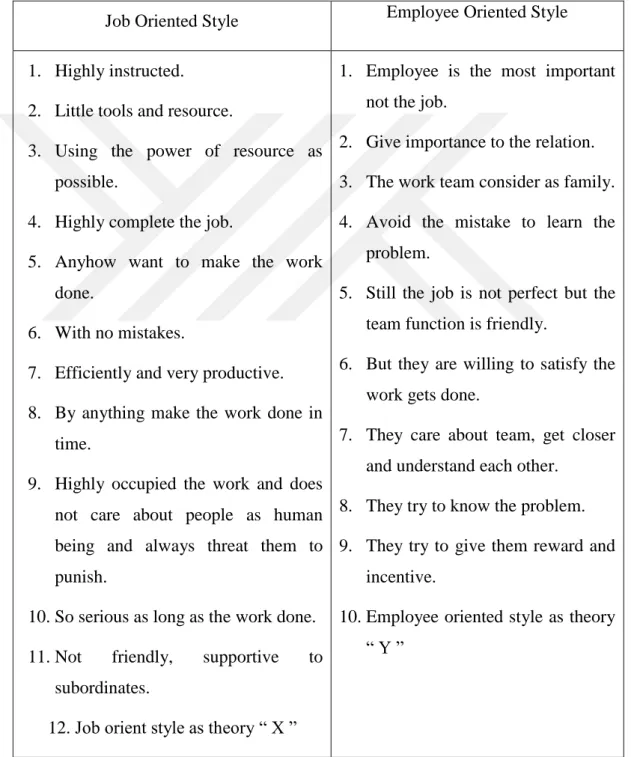
Table 2.2.2: Job Oriented and Employee Oriented Leadership Style
Baker, Sheridan W. Jr. 1955. The Rackham Funds of the University of Michigan. University Press. Job Oriented Style Employee Oriented Style 1. Highly instructed.
2. Little tools and resource.
3. Using the power of resource as possible.
4. Highly complete the job.
5. Anyhow want to make the work done.
6. With no mistakes.
7. Efficiently and very productive. 8. By anything make the work done in
time.
9. Highly occupied the work and does not care about people as human being and always threat them to punish.
10. So serious as long as the work done. 11. Not friendly, supportive to
subordinates.
12. Job orient style as theory ― X ‖
1. Employee is the most important not the job.
2. Give importance to the relation. 3. The work team consider as family. 4. Avoid the mistake to learn the
problem.
5. Still the job is not perfect but the team function is friendly.
6. But they are willing to satisfy the work gets done.
7. They care about team, get closer and understand each other.
8. They try to know the problem. 9. They try to give them reward and
incentive.
10. Employee oriented style as theory ― Y ‖
15 3. Third Study is Likert study (1961):
The most famous one. He made little different to other. He classified as in four groups ( Likert, 1961).
Table 2.2.3: Likert’s Study
Likert, R. (1961). New patterns of management. NY: McGraw-Hill
I. Exploitive: Leader maximum authority. Employees used them as machine. Leader thinks he knows everything and best. They want the work done by anyway. Egypt and China use this.
II. Benevolent: They try to help a little. They also make discussion. But the superior guide them and help them in few ways. They loved the manager as guardian.
III. Consultative: Leader consults their subordinates to know their opinions. Leader takes some suggestions which are useful. Leader asks for the opinion. But the final decision is made by the leader.
IV. Participative: The leader does not take decision. The managers give charge to subordinator to make decision. It must be more participative of the members. It’s true for us.
Again most successful manager style is system 4 participative. But it can be wrong if the subordinates are educated. So it depends on the education of the subordinates. It took place to the ―United States‖. So the results are true for the location only. According to Liker, system 4 participative is the best.
System 1 System 2 System 3 System 4
16
4. Fourth study was done by Harbison and Myers 1955(Michigan study) International study in 16 different countries. Some were industrialized like, France, some were half industrialized like Italy and Poland, and some were democratic like US, Russia. They used four different styles ( Herzberg &Mausner, 1987).
Table 2.2.4: Harbison and Myers Study
Herzberg, Mausner. (1987). The motivation to work. New York: John Wiley Inc
They found that in the country where more industrialized they are more participate 80% of the managers follow participative style. High level of industrialized has high level of participate. But where less industrialized they are more authoritarian management system. Less level of industrialized has authoritative. In industrialized countries more democratized management observed. There is high relationship between managerial and rate of industrialization. But this conclusion is not work but it support the employee oriented management. If you go to employee oriented, you become less authoritative. If you go to authoritative, you become less employee oriented.
5. OHIO State Studies (1945 and continuing into the 1950):
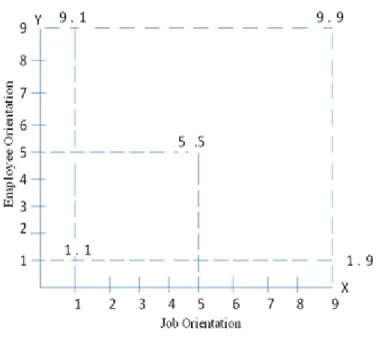
They study again the behavior of manager but there was one difference. They also got same result of Michigan study (Job oriented and employee oriented). According to OHIO State they have two axes. Every manager can have same manager of job and employee orientation or different amount. In one manager can have both of them at the same time. So it defines 9*9=81, so there 5 important position in the graph ( Hemphill & Coons, 1957).
17
Figure 2.3.3: Types of social network websites
Hemphill, J.K. & Coons, A.E. (1957).Leader behavior: Its description and measurement (Research Monograph No. 88). Columbus: Ohio State University, Bureau of Business
Research.
Description of points: Since the explanatory titles indicate, the approaches of leaders on the followers as employee oriented give importance on human relationship and Job oriented approach of leaders strongly emphasis on the production or performance of the responsibilities. Below points describes those 2 (two) approaches as opposites.
X.Y=1.1
No job and no orientation. They don’t like the job. They hate everybody.
Not share anything to others. Or closed to raiment
Y.X= 9.1
Vary authoritarian. Not care his employees. Very hard working parson.
18 Y.X= 1.9
They give importance not job. X.Y=5.5
They are having the both style in average. X.Y= 9.9
Maximum authoritarian. Maximum employee oriented. Best style.
Most successful manager.
In this managerial grid we can measure the manager orientation. But it varies manager to manager. Need to remember that both Michigan and OHIO studies related to leadership behavior but with a little difference.
6. MRF Maier Study:
In 1963 Maier found that, A decision is considered to be the three classes the function of the effectiveness of the results, each of which is used in the decision process can be expected to be affected . Maier found that Effectiveness of decision = Quality * Acceptance. In short ED = Q*A ( Lowin, 1963).
Quality:
How correct is the decision objectively is called Quality. Ex: sometimes good or bad.
Corrective form and amount of rightness. Acceptance:
Whether the decision is accepted or not according to the view of subject.
So the decision must be high quality and high acceptance. If one of this is ―0‖, it does not work. The outcome becomes also ―0‖. As the quality of the decision is 100% but no one accept it, than the outcome is ―0‖. Or the quality of decision is―0‖ but everybody accept it, than the outcome is still ―0‖. So here, the both factors dominator should be high. Right decision * high number of acceptance by member.
19 To Maximize Quality:
The leader should make decision. When the leader is experienced.
When the leader is knowledgeable and skilled. To Maximize Acceptance:
The group will make decision.
But the group member should be active and skilled, experienced.
So it makes conflicts sometimes. For that Maier said ―It depends on the situation and the type of problem.‖
To Maximize the Effectiveness of Decision: Effectiveness of decision = quality * acceptance. Where, Quality = Leader decision.
Acceptance = Group decision.
We should see that type of problem where quality is important or not. Where acceptance is important or not. If Q>A (decision) = leader decision, where the quality is more important than the acceptance. If Q<A (decision) = group decision, where the acceptance is more important than the quality. If Q = A (decision) = Leader discuss with group and makes the decision with group. Where quality and acceptance both are equally important. Maier said, 75% problem with A>Q or A=Q. So again he gave importance to the group.
20 7. Theory X, Theory Y:
Douglas McGregor's (1960) Theory X vs Theory Y is famous for an array of approaches to leadership ( Blake and Mouton, 1964).
THEORY – X: Typical man. Threat to punish. Subordinates are lazy.
In this approach is Authoritative.
Hobbes, Machiavelli, Fraid and Taylor believed it. THEORY - Y:
Men enjoy the work. No control on them. Give reward.
They are willing to take responsibilities. Here the approach is democratic.
8. Situational Leadership Approach (1969):
After 40 years they found now in this style. It depends on the condition. What type of leader, type of follower and type of problem and the type of urgency of the decision. It means the limitation time to take decision. A good leader should be able to change the approach on the time when need authoritative and when democratic. Group decision takes time but when there is no time the leaders need to make the decision. So a good leader should be able to change his style as condition required ( Blanchard et al, 1993).
9. Under The Frist Approach of Maier There are Three Related And Some Model:
A. Vroom and Yetton (1973) model.
B. Chung and Madison leadership selection model. C. Fiedler's contingency model ( Situational ,1960).
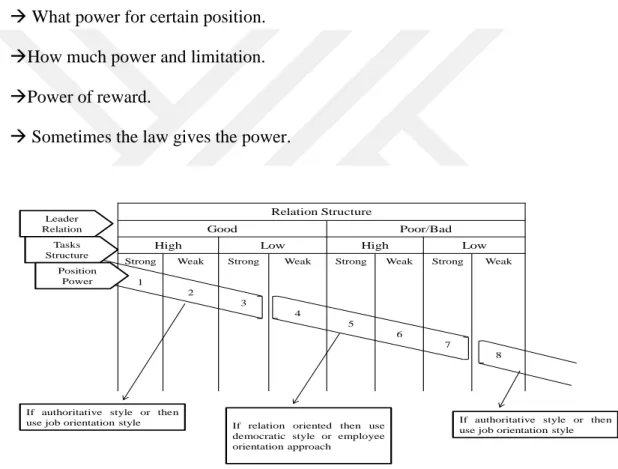
21 It includes 3 conditions to determine the style
1. Leader and member: The relation between leader and follower. 2. Task structure :
Structured task: jobs define clearly and in certain way. What to do? How to do?
Unstructured task: Tasks are not clear, Who and How will do it? 3. Position power:
It means the power of punishment. What power for certain position. How much power and limitation. Power of reward.
Sometimes the law gives the power.
Relation Structure
Good Poor/Bad
High Low High Low
Strong 1 Weak 2 Strong 3 Weak 4 Strong 5 Weak 6 Strong 7 Weak 8 Leader Relation Tasks Structure Position Power
If authoritative style or then
use job orientation style If relation oriented then use democratic style or employee orientation approach
If authoritative style or then use job orientation style
Figure 2.4.4: Relation Structure
Lowin, A. (1963). Participative Decision Making: A Model, Literature Critique, and Prescriptions for Research. Organizational Behavior and Human Performance 3, pp.
22
We can’t define from this analysis which one is appropriate because it depends on the situation.
As we are analyzing the individual behavior, we found 4 types of behavior.
4 kinds of Relationships: 1. Reactive.
2. Proactive. 3. Inactive. 4. Interactive.
1. Reactive: This type of leader accepts others. At the same time they are obedience and also obey others. Leaders accept other decision and motivation. When the other person knows then the leader does not know.
2. Proactive: They are disobedient. Leaders prefer to give order threat with punishment. Always keep telling others what to do. These kinds of leaders prefer supporting complex and seeking help from others. Also at the same time wants to make discussion and decision. It applicable when only has all resources.
3. Inactive: they do not like to make decision. They try to run away to take decision. Leaders make delay to decision and postpone it. They always do something to forget decision and do not want to make action to the decision. Sometime it needs to postpone the decision because of lack of resource.
4. Interactive: Leaders collect or seek information and share the information. These types of leaders try to learn the problem and at the same time create alternative solution and share with others. They always active and ready to discuss to increase both of their knowledge. This behavior is acceptable when both of them have same resources.
23 2.3 Motivation Language
It is a force in a framed to increase or exhilarate activates to attain the purpose which is known as motivation language. Where motivation defines as positive power and language is a process or approach. It drives to work hard to get the goal of organization. An inner state that activates, directs sustain nonstop behavior towards goal. Willingness to expert high levels effort to satisfy some needs of goal.
2.3.1 Motivation Patterns (Towards certain goal): Type A:
Legal (rolls or law) on imposed compliance (obey order): Legal makes sure the dependable behavior. It is classical theory. Threading to do some things. But it cannot attract qualified people or type of (III) peoples. Also it cannot satisfy (I & II). Type B:
Use of reward: It can attempt qualified people and ensure the dependable behavior. Telling the people that if you do the work then I will give you reward. Instead punishment, rewards, they have to work hard. EXM: Football players.
Type C:
Job Identification: Not for money it identity the work, which is enjoyable. And what the people like to do? Some people like the job which they enjoy. Such as actors, novelists, poets, craftsman. They do their jobs to prove its value, not because of money.
Type D:
Internalizing: Accepting the companies’ goal, getting the satisfaction by attaining the goal of company. Expecting your goal of company, as your companies reach its goal. They are willing to do extra work for company goal. They want to do something for the company.
24 Type C and D can satisfy all I, II and III To survive a form must:
I. Attract qualified employees (Relate with A type).
II. Ensure dependable behavior (Relate with A and B type). III. Elicit innovative behavior:
Innovative ideas.
Creative some things now.
Being the new ideas. (It’s related with type C and D).
If we go through deeply, will find that numerous of researches, studies and experiments had been done about this topic or related topics.
2.3.2 Historical Evaluation (Motivation Concept):
Motivation: It is a Latin word. The root of this word’s motor and it means => What more human beings.
=> Which moves behavior.
They earliest authors who talked and wrote a lot about motivation are Katz and Kahn.
During Greek civilization:
Hedonism: Greek word that means enjoying pleasure and avoiding pain. It is basic motivation (Benthon& Mill, 1973). Until about 1990s, they believed in above-mentioned concept. After 1900 year, William James and McDougall said, ―People have intrinsic feelings like, crying, joy, happiness, sympathy that are subconscious.‖ They introduced idea of instincts and subconscious.
Beside their people, Freud believed that people are emotional and people have intrinsic motivation. This is known as Freudian theory. People do not rational catch joy and avoid pain. Something inside force them to do something (Psychoanalytic theory).
25
Behaviorist Theory (1930-1940): It gives learning from a certain behavior. It comes from childhood. No one order and they live themselves. Everything they wish and they did. This is not so realistic. Some people the way of life, like Bakar ―Happiness is the matter of degree‖.
Industrialization: In the industrial revolution in 1750, the stream power and machine were invented and the workers saved themselves from several manual works. So hard and boring jobs became very smaller and easy. And which gives very little satisfaction.
Why do people work?
1. Work provides some pay: To fulfill the basic needs people do jobs. Earning through the work, not necessary to enjoy the works, they need to buy food, house cars etc.
2. Work provides Opportunity for physical and intellectual effort body: when people work they use physical energy and brain, like Calculation.
3. Work determines employee social status: The position people work it increase social status and prestige. Like Doctor, engineer etc.
4. Work provides human interaction: People do not to live alone .They always wants to meet with new peoples. So work place also a certain place where opportunity to have new friends.
5. Work in a source of satisfaction: When people identify that this product is his own made product, it’s give him some satisfaction from the final product.
2.3.3 Motivation Models:
A. Maslaw’s “Hirarchy of Needs”Models:
He was psychologist, His models relates to motivation of all human beings. In his models he explains why people behave in such way, what the reason is, what relies behind every action of the people and finally he concludes that it is because of their unsatisfied needs. The needs which are not satisfied for a long time. Unsatisfied need lead to tension, stress and frustration. So none of the people want to suffer them and want to get rid of them. Most of the people have many unsatisfied needs ( Maslow, 1971).
26 The Reasons are:
1. What they move.
2. What are the needs to move.
3. What are the needs to behave to work.
4. People behave to in order to satisfy their unsatisfied needs.
If the unsatisfied need continue for a long time, then they whatever they need to do to satisfy their needs.
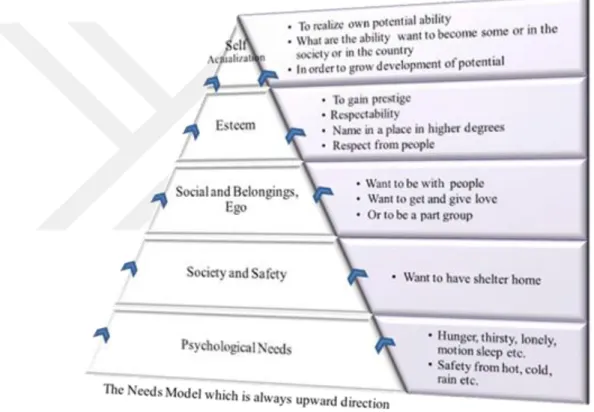
The needs are arranged in an order:
Figure 2.5.5: The Needs Model Which is Always Upward Direction
Maslow, A. H. (1954). Motivation and Personality. New York: Harper Row. 2 ed., pp. 37 If the organization find out the need of employers then from the needs model and satisfy their needs then it’s possible to move them work towards the goal of organization. There is no empirical test, no scientific test to prove this, but it’s logical.
27 B. Alderfer and Chungs “ERG” Model:
It has been said 1961 to 1978 the theory of ERG was developed. To convey Maslow’s required hierarchy motivational theory in harmonization by practical study, Clayton Alderfer reclassified by his own language. His modification is identified as ERG motivational theory. He rearranged model of hierarchy needs of Maslow into three straightforward and larger scales of needs. ERG Theory, beside with the three different fulfilled methods to examining motivation, offering the hypothetical basis for an observed research of motivational aspects in the place of work ( Alderfer,1969).
Figure 2.6.6: ERG Model
Alderfer, C. (1972). Existence, relatedness, & growth. New York: Free Press. They mention that it is not necessary to order that needs in hierarchy but that can exist at the same time in same level.
C. Herzberg’s “Two factor” Models (1987):
What are the two reasons that made you not to work in company or job on a position. 90% percent shows the problem in job place. The problems are:
1. Salary.
2. Working condition or environment. 3. Suppressions.
4. Co- work, not friendly. 5. Company policies.
Those are the reasons they compliance about the company working life. It is called ―Hertzberg’s Factors.
28
What are the two events that courage those to think feel better about company. The reasons are:
=>Type of job: They do the job they like. And they enjoy their work. =>Learning: Learning new things like: Sending seminar, workshop. =>Reorganization: For doing right things management congrats him.
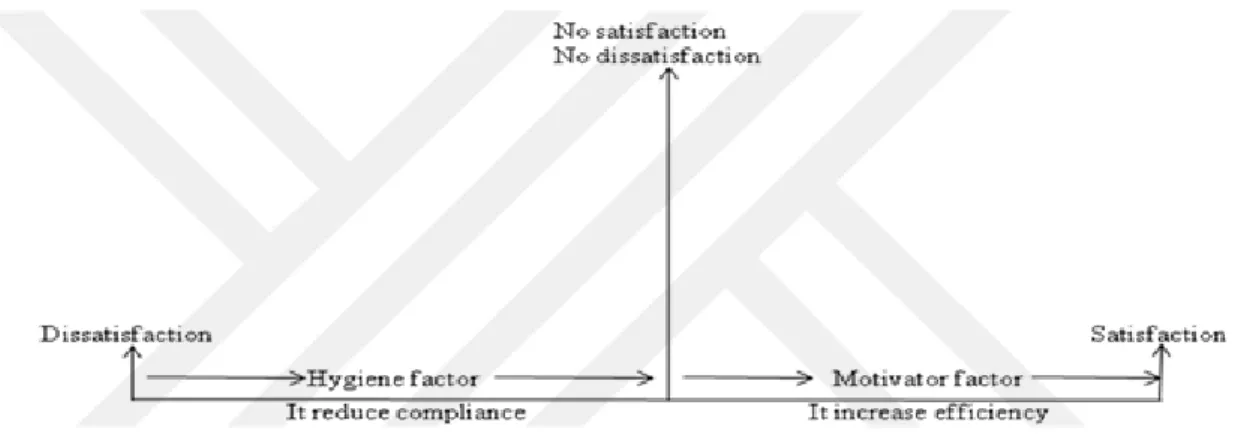
This model shows that if more power can be given to employee they find more responsibility. As a result employees get growth by increasing the ability and at same time they get change to develop their shelf. And they create space to entertainment. Those are known as ―Motivator‖ .On the basis on theory he come with new theory.
Figure 2.7.7: ―Two factors‖ Models.
Herzberg, Mausner. (1987). The motivation to work. New York: John Wiley & Sons, Inc If the salary is increased. And if the title of the position increased. Also at same time, if they get changes to satisfy their need. The person will come neutral position. So in that position can be defined as:
No satisfaction No dissatisfaction
So after this position if that time the motivator factor is given them, they will come satisfy people. The method Herzberg used it called ―Critical Incident ( Herzberg et al, 1987).
29
D. Theory-X, Theory –Y,( Douglas McGregor,1960 ): THEORY- X:
Those are typical human beings. These type of man don’t like to work, they are lazy by nature. If it is believable then they need to control them. Therefore they have to be controlled, disciplined, and threatened with punishment. Men like security and they do not want more responsibilities.
THEORY-Y:
These types of men enjoy work. They do not need to control because they are capable to self-control. If the reward is offended for performance then they will like to get more responsibilities and authority. And also to get this they will work hard. There is a trend in a direction those managers who follow function ―X ―. It may work but it does not bring any creativity. So sometimes need to follow ―X‖ and sometimes need to follow ―Y ―. But it depends on the people you have in the organization ( Blake and Mouton, 1964).
E. Mc Clellands “ Three needs ” Theory:
It specially needs for manager. The achievement needs are (i) To do better than last year (ii) To do better than others (iii) To do better than the world record. To be a good manager need to have high achievement. EX: Greek culture, Roman culture. Manager Job required feedback. The people with high achievement:
See feedback.
Industrial responsibilities. Want to make self-decision.
Organizational ability like planning ability.
Self-moderate goals and they take risk. But minimum risk.
30 2.4 Job Performance:
The approaches of motivation of leaders affect the performance of employees in a multiple of directions, and the comprehensive, written imagery direct from both supervisor and their personnel in their regular tasks. If the motivations currently is not given for the assigned task for each personnel, then need to talk about with management how job performance can be improved through two manner of communications and motivation.
Employees exactly motivated by superiors must practice well in their particular professional function, given the managers appreciated the function and offers clear instructions. The mission statement of one small business must focus on employees to an explanation of achievement. For instance, if someone motivates his employees by visibly stating that achievement in their position defines describing each level in the large regularly, and the reward is given when employee does it, employee realizes what is estimated.
Performance of the personnel is measured through what is done and what is not done by an employee. Performances of employees include quantity and quality of outcome, being mentally at job, cooperative and supportive character and appropriateness of outcome. On the basis of the outcomes of the research done by Yang (2008) on performance of individual explained that individual’s performance must not be confirmed. Equally he emphasizes that institutes may use straight additional benefits and incentives according to performance of individual, if the performance of employee is visible ( Yang, 2008).
Examined performance of employees and discovered that acceptance and appreciation and reward of employee performance drive the bigotry between employee outcomes ( Smith, 1983). Ethical and outcomes of employees is vastly derived by the effectiveness of an organizational performance and its system of reward of management. Farms are willing to take many steps to satisfy the clients but there is no approach to satisfy their employees. But the truth is that without making satisfy the employees, the clients cannot be satisfied.
31
Because once the employees becomes satisfied by the organization they want to do more to make the clients satisfied. Performance of employee is in fact motivations sparks because once personnel are motivated then employees becomes willing to do more work with more exertion and for that ultimately the performance get progressed.
According to the analysis of these literatures we can summarize by below flow chart.
Figure 2.8.8: Performance Model
Yang, H. (2008), Efficiency Wages and Subjective Performance Pay, Economic Inquiry, 46(2), pp. 179–196
2.5 Job Satisfaction
Job satisfaction of employees has become the more interested study area for the psychologists of organization and institutes. Lots of reasons can be shown for what the organizations are giving more importance on job satisfaction of employees, which can be identified in accordance with point on employees or the institutions. Number one, human point of view that people should be evaluated moderately and with their values. Job satisfaction is the indication of well evaluation. This is an indicator of mental health or emotional well-being. Number two, the effective viewpoint is that job satisfaction may direct to actions of employees so that the functions of organization can be affected. And more over the functions of organization can be indicated by the job performance. The main point of problem can be found out by making dissimilarity among the units of institution in job satisfactions. Every reason is enough and logical to clarify the relation with job satisfaction. Economic motivational factors which is direct force Non-financial motivational factors which is indirect force Complete sets of Motivation Performance Employee which is dependent variable
32
Many managers of different institution share their apprehension of study to find out the level of employees' job satisfaction. The evaluation of job satisfaction is a general action in many institutes where feelings of management where important are employee well-being issue ( Spector, 1997).
Many people prefer to work and those people believe that the important fraction of the lives is work. But some other people get the job as disagreeable and they perform the tasks as their necessity of live hood. How much the employee is enjoying and internalizing the job defines the level of job satisfaction. The most studied topic is job satisfaction in the field of organizational behavior. The necessity to understand for both of employees and the organization that what are causes and outcomes how affect the stage of job satisfaction.
From the employee viewpoint it must be clear that people wants to be evaluated fairly. For treating well at job the employees starts feeling satisfied and respected. On the other hand the viewpoint of organization a good level of job satisfaction can drive employees to perform better which reflects the outcomes of organization. Job satisfaction of employees is normally measured as the leader of retention of employees and performances of employees. Satisfied personnel are a requirement to increase the performance, quality, receptivity and service for customer ( Kaplan 1996, 130).
The factors of internal and external motivation affect the stage of job satisfaction, excellence of control, social interactions with the employee task group and the level of success of persons or being unsuccessful in the their tasks. It is assumed that when the employees become motivated perfectly and be loyal to the institution that leads the organization to achieve the goal or most liable to occur if a good level of job satisfactions is offered by the jobs. The study found that the main determinants to affect the job satisfactions are opportunities of career, job impacts group work and challenges of job ( Armstrong, 2006).
By doing a yearly survey usually organizations evaluate the job satisfaction of employees or organization does a monthly study by choosing employee arbitrarily.
33
The factors in job satisfaction of employees’ assessment might include attachment with taking decision, performing the assigned task perfectly, having right to get enough information to perform the tasks in a good manner, positive support to be innovative and use inspiration, encourage level from the employee rolls and on the whole satisfaction with organization ( Kaplan, 1996).
2.6 Over View
Reviewing of the literature of research on this topic is a critical issue. Below are some resources that are done in the same area as important.
Leaders contribute to a company or organization through their skills, knowledge and expertise with the means to act. Managing people at work planning and the way in which people achieve their goals in order to enable the company to perform is not concerned with deciding on the method to be used. The effective leadership is the intelligence of the people and their knowledge based the economy the most important thing is knowing which key aspects of the motivation spark the performance and satisfaction of the employees.
Motivation is important because people tend to change their work place often. To gain more respect for people and their work more valuable to be able to change their place of work. The management team also needs to much better understanding of motivation policies and practices. Typically, leading and motivating is implementation of HR policies. Leading and motivating ensure the fair treatment of employees and contract employees through the understanding environment. This mainly includes assessing the performance of the employees and workers to ensure equal opportunities by having work satisfaction according to leaders’ motivation approaches.
No matter what is essentially a challenge to adopt a multi-disciplinary investigation into the literature of the same or very similar variation in terminology used to the idea. Therefore, my review of the literature across disciplines, as I acknowledge the difference between representatives and then throughout the rest of the term of my thesis, I will proceed to use the mark.
34
Employee relations, rules, regulations and contracts which employees both as individuals and as a collective group conducted a study, as priority is given to the joint relationship from the company as opposed to varying values depending on the company's management( Robins,2003). That's how a number of different scenarios, such as an organization's business goals and objectives in order to achieve the commitment of the people are not concerned with profits.
The idea of a psychological contract, and his advice was largely responsible for the underlying contractual relationship between employer and employee about the nature of their relationship from the employer and the employee is derived from a series of assumptions was there ( Schein, 1988). The hypothesis to be legally enforceable, but they have a set of measures for mutual development and ethical basis for a series of expectations may have a considerable degree of force may constitute.
The prime principles are as below:
Employees will be treated adequately and authentically.
The relationship is characterized by a concern for parity and justice, and about to changes and the development will be required enough information to communicate.
The contributions of employees need to be given recognition and valued by leaders
To calculate the extent to which their employees work in the UK was satisfied with the work as part of an effort to address this issue( Schein, 1988)The prize package their overall job satisfaction, which combine elements of both the intrinsic and extrinsic elements of four different accounts with the employees' satisfaction is a measure of the compiled.
The impact on the work (sovereignty and control levels)
An intention of gaining goal that spark to facing threats formed by work. Appreciation in the team of management drives to complete the task well.
35
Where the payment was number fourth element for measurement. The researchers concluded that:
Employees influenced to be first satisfied with pay.
Managers influenced to be more satisfied than other professional factions.
Senior and experienced workers influenced to be more satisfied than junior workers.
Full-time workers were less satisfied then the short-time workers. 2.6.1 Three Roles of Language in Motivation Theory( Sullivan, 1988 )
Performance, job satisfaction and innovation are outcomes of significantly enhance such critical employee attitudes predicted by intentionally uses of leader speech through motivating language theory ( Mayfield& Kopf, 1998). Actually the idea of this theory developed by Sullivan through three main language act, to inspire the employee motivation, behaviors that promote organizational goals, which the workers will be motivated.
Those three types of oratory action are the following:
1. Direction-giving (Perlocutionary): When subordinates in the process of language to clarify organizational goals to alleviate uncertainty by leaders. Such as; when a subordinate is sat up importance of every project within various assignments by the language of giving direction of leader.
2. Empathetic (Illocutionary): A language is meant to understand the emotion of subordinates when leaders speak. When he or she shows perseverance or enthusiasm to repot directly.
3. Meaning-making (Locutionary):It occurs when a leader of a particular institute imbeds culture, rules, to subordinate. As an example; when subordinate is given diplomatic advises to gain a project buying corporately through using meaning-making speech by a manager. Indirectly in the form of stories structural folklore and metaphors (Cooke & Rousseau, 1988), it was established that meaning-making language regularly is offered.