POLITICS OF INTERDEPENDENCE: AN ANALYSIS OF TURKISH-GREEK ECONOMIC RELATIONS
A Master‟s Thesis
by
NÜVE YAZGAN
Department of International Relations Ġhsan Doğramacı Bilkent University
Ankara May 2016
POLITICS OF INTERDEPENDENCE: AN ANALYSIS OF TURKISH-GREEK ECONOMIC RELATIONS
The Graduate School of Economics and Social Sciences of
Ġhsan Doğramacı Bilkent University
by
NÜVE YAZGAN
In Partial Fulfilment of the Requirements for the Degree of MASTER OF ARTS IN INTERNATIONAL RELATIONS
THE DEPARTMENT OF INTERNATIONAL RELATIONS ĠHSAN DOĞRAMACI BĠLKENT UNIVERSITY
ANKARA May 2016
i ABSTRACT
POLITICS OF INTERDEPENDENCE: AN ANALYSIS OF TURKISH-GREEK
ECONOMIC RELATIONS
Yazgan, Nüve
M.A., Department of International Relations Supervisor: Associate Prof. Dr. Dimitri Tsarouhas
May2016
Over the last two decades, there has been a dramatic increase in bilateral relations
between Greece and Turkey in many areas from trade to tourism. This increase has
taken through both state and non-state level initiatives. It has become difficult to
ignore the existence of the economic interactions between the two countries.Previous
studies in the literature have mostly ignored the political economy of relations.The
purpose of this thesis is to examine the current state of economic relations between
Greece and Turkey, and how these affect the two states‟ political relations. Therefore it asks the question “to what extent do economic ties reflect on the evolution of
political relations between Greece and Turkey?”This research studies bilateral
economic relations by focusing onthe fields of trade, foreign direct investment,
energy and tourism interactions between the two countries and revisits
liberal/neoliberal approaches of economic interdependence to explore their relevance
in the Turkish-Greek case. It aims: 1. To examine the scope of economic
interdependence between two countries, 2. To ascertain the limitations and
opportunities in fields of economic interaction, 3. To determine the extent to which
ii
relations and whether increasing economic interdependence provide opportunities for
the resolution of their bilateral political problems.
iii ÖZET
KARġILIKLI BAĞIMLILIK POLĠTĠKALARI: TÜRK-YUNAN EKONOMĠK
ĠLĠġKĠLERĠ‟NĠN ANALĠZĠ
Yazgan, Nüve
Yüksek Lisans, Uluslararası ĠliĢkiler Bölümü DanıĢman: Doç. Dr. Dimitri Tsarouhas
Mayıs 2016
Geçtiğimiz yirmi yılda, Yunanistan ve Türkiye arasındaki iliĢkilerde, ticaretten
turizme farklı alanlarda, belirgin değiĢiklikler yaĢandı. Bu değiĢikler hem devlet
aktörleri hem de devlet dıĢı aktörler düzeyinde meydana geldi. Böylelikle iki ülke
iliĢkilerinde ekonomik etkileĢimin varlığını göz ardı etmek zorlaĢtı. Literatürdeki
çalıĢmalar çoğunlukla Türk-Yunan iliĢkilerinin politik ekonomiğini incelemeyi ihmal
etmiĢlerdir. Bu tezin amacı Yunanistan ve Türkiye arasındaki ekonomik iliĢkilerin Ģu
anki durumunu analiz etmek vebunun politik iliĢkilere nasıl yansıdığını incelemektir.
Bu nedenle bu tez; ekonomik bağlar Yunanistan ve Türkiye arasındaki politik iliĢkilere ne derecede yansımaktadır sorusunu soruyor. Bu araĢtırma ikili ekonomik
iliĢkileri ticaret, yabancı direkt yatırım, enerji ve turizm baĢlıkları altında ve
liberal/neoliberal karĢılıklı bağımlılık anlayıĢını temel alarak incelemektedir.Tezin
öncelikli amaçları: 1. Ekonomik karĢılıklı bağımlılığın derecesini araĢtırmak, 2.
Ekonomik etkileĢim alanlarındaki limitler ve fırsatların incelenmesi 3. Ġki ülke
iv
olacağının ve artan ekonomik karĢılıklı bağımlılığın politik sorunların çözülmesi için
fırsatlar yaratıp yaratmayacağının belirlenmesidir.
v
ACKNOWLEDGEMENTS
First and foremost, I would like to express my warmest gratitude to my
supervisor Associate Professor Dimitri Tsarouhas who has been providing me with
his invaluable guidance over the years. I would have not been written this thesis with
such a peaceful mind without his advice and encouragement throughout this journey.
Having his support means a lot.
I am also grateful to Associate Professor Ioannis Grigoriadis who has always
been helpful and supportive on every single issue whenever I have needed since my
undergraduate years. I wish to thank my thesis committee member Associate
Professor Özgehan ġenyuva for his constructive comments and criticism on the
theoretical framework of this thesis. Special thanks also go to my interviewees for
their significant contribution. I would also like to thank Assistant Professor Can
Mutlu for his valuable support in last two years and Dr. Alekos Lamprou for helping
me out on the Greek language.
I would like to thank my beloved friends Hazal, Merve, BüĢra and many
others who have touched my life. I cannot say enough how I appreciate their love
and kindheartedness. Last but not least, I would like to express my gratitude to my
vi TABLE OF CONTENTS ABSTRACT………...ii ÖZET………...iii ACKNOWLEDGMENTS………v TABLE OF CONTENTS……….vi LIST OF TABLES………...ix LIST OF FIGURES……….xi LIST OF ABBREVIATIONS………xii CHAPTER I: INTRODUCTION……….………....1
CHAPTER 2: THEORETICAL FRAMEWORK……….5
2.1.Commercial Liberalism and Democratic Peace Theory………..5
2.2. Trade vs. Conflict Theories………...11
2.3. Interdependence Theory and Institutionalist IR………15
2.4. Bridging between theories………26
CHAPTER 3: OVERVIEW OF TURKISH-GREEK RELATIONS………..…29
3.1. Evolution of Turkish-Greek Relations……….….29
3.2. The Historical Roots and Pre-1990‟s Period………....30
3.3. Issues of Dispute………...34
3.3.1. The Aegean Conflict……….…34
3.3.2. The Cyprus Conflict……….39
3.4. Changes and Continuities in Greek and Turkish Foreign Policies/Post-90s developments………...50
vii
3.4.1. The 1999 Rapprochement and Afterwards………...55
3.4.2. Turkey, the EU and the Middle East……….58
3.4.3. Bilateral Relations in Post-2010………...64
CHAPTER 4: OVERVIEW OF GREEK AND TURKISH POLITICAL ECONOMIES……….66
4.1. The Historical Development of Turkish Political Economy……….…66
4.1.1. Post 1980‟s and Turkish Neoliberalism………...….68
4.1.2. The AKP Era……….73
4.2. The Historical Development of Greek Political Economy………...…78
4.2.1. Post-1974 Period………..….80
4.2.2. The Greek Crisis………...84
4.3. A Brief Comparative Analysis of Greek and Turkish Political Economies….88 CHAPTER 5: TURKISH-GREEK ECONOMIC RELATIONS………....92
5.1. Determinants of Economic Relations………...92
5.1.1. Economic Developments………..92
5.1.2.The Rapprochement Process………...……..99
5.2.Fields of Economic Interaction……….…..101
5.2.1.Bilateral Trade……….101
5.2.2. Foreign Direct Investment………..…111
5.2.3. Tourism………...124
5.2.4. Energy……….136
CHAPTER 6: THE LINKAGE BETWEEN THEORY AND ECONOMIC RELATIONS………146
6.1. Limited Interdependence………...….146
viii
6.1.2 Foreign Direct Investment……….…..154
6.1.3. Tourism………...…....157
6.1.4. Energy……….161
6.2. Resolution of the Political Problems………...164
6.3. Likelihood of Armed Conflict………..…..167
CHAPTER 7: CONCLUSION……….170
APPENDIX………...175
ix
LIST OF TABLES
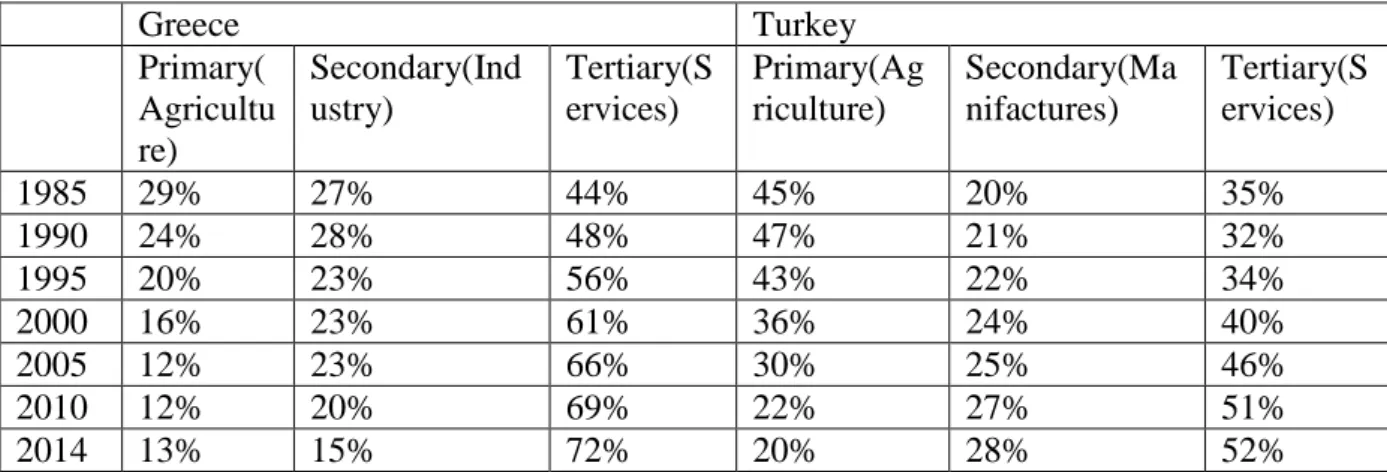
Table 1: Employment by Sectors in Greece and Turkey………91
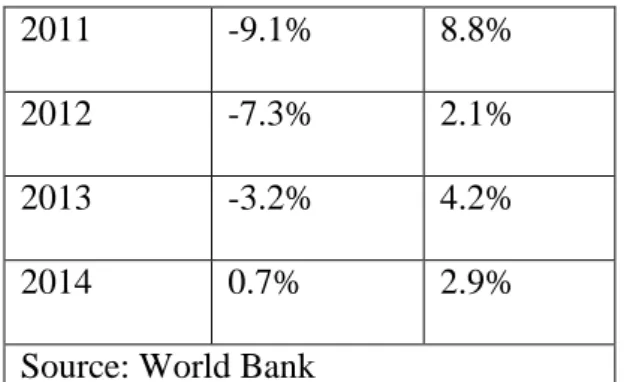
Table 2: Annual Growth rate of Greece and Turkey……….94
Table 3: Turkey‟s Trade with the EU………...…..95
Table 4: Trade in Greece and Turkey……….95
Table 5: FDI flows to Turkey 1996-2014………...…………96
Table 6: Overall Greek Imports and Exports of goods and services between 2009-2014……….98
Table 7: Turkish Bilateral Trade with Greece, in selected years………...…….98
Table 8: Greece‟s exports partners……….…..105
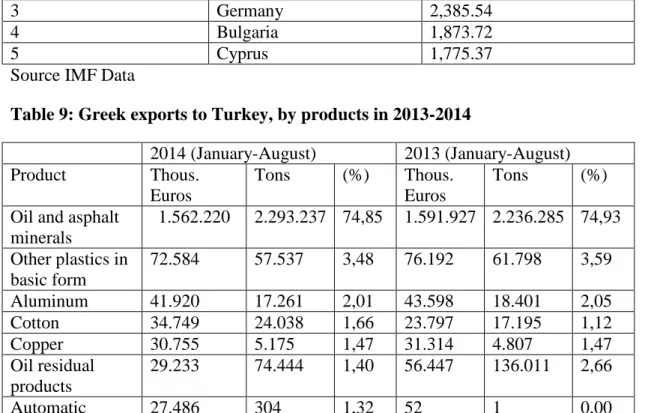
Table 9: Greek exports to Turkey, by products in 2013-2014………..105
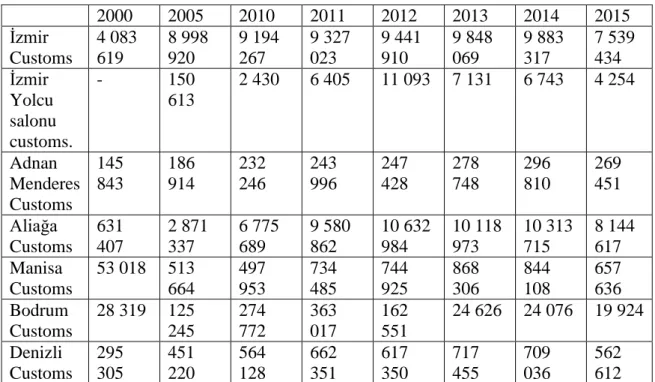
Table 10: Exports from some Aegean Customs………..….109
Table 11: FDI flows to Turkey by country, between 2005-2014……….113
Table 12: Greek FDI flows to Turkey………...113
Table 13: Greek companies investing in Turkey between 2003-2014……...……..116
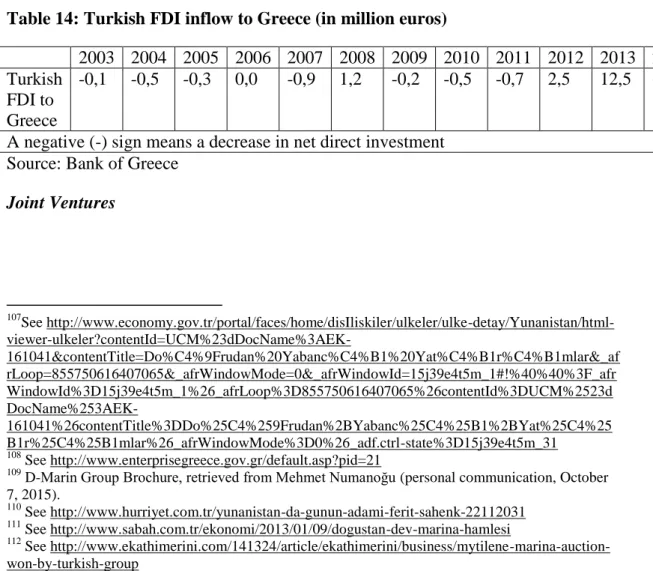
Table 14: Turkish FDI inflow to Greece………..….119
Table 15: Total contribution of Tourism to GDP ………....126
Table 16: Number of Turkish citizens visiting Greece……….126
Table 17: Number of Greek citizens visiting Turkey………...126
Table 18: Top 3 most visited countries by Turkish citizens……….136
Table 19: Consumption of Commercial Energy in Greece and Turkey……….…..137
x
Table 21: Natural gas imports by source in Greece………..………138 Table 22: Natural Gas Purchase Contracts of Greece and Turkey………...138 Table 23: The Scope of Turkish-Greek Economic Relations……….…..169
xi
LIST OF FIGURES
xii
LIST OF ABREVIATIONS
AKEL Progressive Party of Working People AKP Justice and Development Party
ANAP Motherland Party
ANEL Indeependent Greeks Party
BDDK Turkish Banking Regulation and Supervision Agency CFSP Common Foreign and Security Policy
CTP Republican Turkish Party DPT State Planning Organization DYP True Path Party
EC European Community
EEC European Economic Community EFSF European Financial Stability Facility ELSTAT Hellenic Statistical Authority
EMU European Economic and Monetary Union FIR Flight Information Region
HATTA Hellenic Association of Travel and Tourist Agencies ISI Import Substitution Industrialization
ĠZTO Ġzmir Chamber of Commerce
KKE Greek Communist Party
xiii
NGB National Bank of Greece
PASOK Panhellenic Socialist Movement RP Islamist Welfare Party
SEV Hellenic Federation of Enterprises SYRIZA Coalition of Radical Left
TAP Trans Atlantic Pipeline TANAP Trans Anatolian Pipeline
TESK Turkish Confederation of Employers‟ Union
TOBB Turkish Union of Chambers and Commodity Exchanges TUĠK Turkish Statistical Institute
TURSAB Association of Turkish Travel Agencies
TÜSĠAD Turkish Industrialists' and Businessmen's Association
1
CHAPTER 1:
INTRODUCTION
In the last two decades, relations between Greece and Turkey have improved
rapidly in many issue areas from tourism to bilateral trade. This improvement in
relations stemsboth from domestic dynamics in the two countries, and from structural
changes in world politics and international political economy. There has been a
sharp increase in interactions and exchange between the two countries and their
peoples‟ which have contributed in better bilateral relations. The likelihood of
military conflict has decreased since it would have massive consequences for the
interactions between the two countries. Despite these, bilateral political problems
remain unresolved. A considerable amount of literature has been published on the
improvement in Turkish-Greek relations. However, most studies in the field have
only focused on high politics issues, failing to provide a detailed analysis
ofincreasing economic interactions between the two countries at state and societal
level. That is, the majority of studies has adopted a state-centric understanding of
international relations and hasprioritized bilateral conflicting relations over the
Aegean Sea, and the Cyprus dispute, rather than bringing into focus improving
channels of economic interactions. This is not to say that security focused analyses of
Turkish-Greek relations have been proven wrong, or that they are obsolete. Rather
they have neglected to take into account more recent, yet important, changing
2
The main purpose of this thesis is to account for the political economy of
Turkish-Greek relations by use of a liberal/neoliberal approach of economic interdependence.
The main question is the extent to which economic ties reflect on the evolution of
political relations between Greece and Turkey.
This thesis will examine bilateral economic relations by evaluating the fields of
trade, FDI, tourism and energy interactions between the two countries, which have
gained momentum since the 1999 rapprochement. Regarding these, this research
attempts to revisit the liberal and neoliberal understanding of economic
interdependence and cooperation to explore their relevance on the Turkish-Greek
case.
Regarding scope of the this thesis, itseeks to account for the improvement in
economic relations between Greece and Turkey, and ascertain the limitations and
opportunities in various fields of economic interactionsnamely Bilateral Trade,
Foreign Direct Investment, Tourism andEnergy Issues. These four fields are not only
indicative for the scope of economic relations but also useful to examine similarities
and differences between them. The bilateral trade offers the most apparent field to
examine the level of economic interaction. The Foreign Direct Investment flows
provide ways to understand the economic and political dynamics between two
countries since investments relate to the deeper pattern of relations. The tourism field
is more open to societal cooperation between two countries and they are significant by directly including two societies‟ daily experiences. The energy field has been
improving recently compared to others due to regional developments in the energy
sector and it needs to be examined within a broader framework since it directly
touches upon security matters. Moreover, this thesisstrives to determine the extent to
3
and societal level can prove helpful in transforming relations and whether increasing
channels of contact provides opportunities for the resolution of outstanding political
issues and islikely to decrease possibility of military tensions caused bylong
standingbilateral political problems.
This dissertation adopts a qualitative methodology approach. Data for this
study were collected in various ways. The empirical data was collected by gathering
statistical informationfromthe Hellenic Statistical Authority (ELSTAT), Turkish
Statistical Institute (TUĠK), OECD, World Bank Data and Eurostat, and by
conducting interviews with diplomats and people from various business
organizations from two countries1. The secondary literature on Turkish-Greek
relations, economic interdependence theories, Greek and Turkish Political
Economies was utilized as well.Elevensemi-structured or/and structured interviews
were conducted. Those interviews were either conducted face to face in Greece or
conducted through e-mail in Turkey. Seven of the interviews were conducted in
Greece in July/August 2015. Those face to face interviews were conducted in
semi-structured way since semi-semi-structured technique gives flexibility to ask follow up
questions. Interviewees did not prefer voice recording. Therefore I used note-taking
technique. Four e-mail interviews were conducted in a structured way by sending
prepared questions to the interviewees. Interviewees were asked at least 5-6
questions. Moreover, they were asked not the same but similar questions varying
based on their backgrounds and sectors.
The present study makes a contribution to the literature by exploring the
deeper features of the political economy of Turkish-Greek relations and offers
important and up to date insights into the level of economic cooperation between the
1
4
two countries, as well as their implications on the political sphere. The thesis is
composed of 7 chapters. The following chapter will present the theoretical
framework of this thesis, discussing liberal and neoliberal theories by focusing on
economic interdependence and cooperation. In chapter 3, I provide a historical
overview of Greek relations. This includes a literature review of
Turkish-Greek relations and gives an account over recent dynamics in relations by focusing
on changes and continuities. Chapter 4 gives an insight in the historical evolution of
Greek and Turkish political economies with a comparative part as well.Chapter 5
accounts for findings of the research. It focuses particularly on economic relations,
containing the main determinants of improving economic relations and providing a
detailed analysis of the designated economic areas under study. In chapter 6, I
demonstrate a synthesis between economic relations and my theoretical focus. I
discuss the key findings in relation to economic interdependence and the current
political conundrum. Finally,the conclusion chapter reflects on the main arguments
5
CHAPTER 2:
THEORETICAL FRAMEWORK
As presented in the introduction chapter, I will discuss liberal/neoliberal
theories with a focus on the dialogue between economic interdependence and foreign
policy making in terms of establishing the theoretical settings of the thesis. Before
getting into the chapters related to the historical background of Turkish-Greek
relations, it is fundamental first to deal with the vast theoretical literature to apply in
the case of Turkish-Greek economic relations. Following on from that, this chapter
will give an account of the literature that has emphasized the role of interdependence
in world affairs. Regarding this, I will mainly look into Interdependence theory
developed by Keohane and Nye to consider its implications, if any, on the
Turkish-Greek case. While interdependence theory will be the main focus of this chapter,
other liberal/neoliberal approaches that have examined the relationship between
economic issues and conflict (or war), will also be discussed. Therefore, Democratic
Peace Theory, Trade versus Conflict theoryand Interdependence theory will all be
presented since all these approaches share common epistemological features and are
particularly appropriate to analyze a thesis focused on political economy.
2.1.Commercial Liberalism and Democratic Peace Theory
Realist and Liberal approaches have long been the two dominant traditions of
International Relations. While realism had overshadowed liberal IR in the first half
6
increasingly intense debates over globalization, non-state actors and
interdependence. The evolution of Liberal IR had been influenced by the thinkers of
17th, 18th and 19th centuries (Zacher &Matthew 1995: 110). All these thinkers,
Locke, Rousseau, and Kant among othershad discussed the themes that later became
core to the Liberal IR tradition. Therefore, their reflections on “the relationship
between democracy and peace, the possibility of achieving security through
international organization, the salience of international moral and ethical principles,
and the diminishing but ineradicable relevance of power relations and self-interest
among both democratic and non-democratic states”have a long history(Zacher &
Matthew 1995: 112). Before reviewing Democratic Peace Theory and Commercial
liberalism, it is useful to present the main theses of Liberal theory.
Liberal International Relations theory takes state actors and units into account
as the core level of analysis (Oğuzlu 2014 in Ali and KardaĢ). It questions the
traditional depiction of the state as a unitary and monolithic entity and asserts that the
domestic components of the stateare key in state policy formulation (Oğuzlu 2014). Therefore liberalism is a pluralist theory in a way that states‟ interests and policies
are defined by various interest groups who bargain over various issues (Zacher and
Matthew 1995: 118). As mentioned by Dunne, many described Liberalism as the “tradition of optimism” (Dunne 2001: 163). This is because liberals have believed in
gradual, yet inevitable,human progress. That is, self-interest can be synthesized to
lead to a harmony of interests (Doyle, 1986; Russet, 2013: 95) in a way that security,
welfare and human rights can be promoted (Zacher and Matthew 1995: 117).
Liberalism, like Realism, accepts that the international system is anarchic and there
is a security dilemma in the system (Russet 1993). Realism argues that states always
7
therefore is inescapable sincethe likelihood of arms race become increasingly
possible when states become threatening towards each other (Herz 1950; Glaser
1997).However for liberals, it is possible to overcome the negative impacts of this
anarchic system. Liberalism maintains that enduring war and conflict in the
international system can be avoided by the cooperative and integrative disposition of
states. Democratic governments, economic interdependence, and international law
and organizations are crucial in mitigating conflicts in International Relations (Doyle
1986; Russet 2013: p.95). As cooperation and interdependence between states
increase, it becomes progressively more difficult for states to withdraw from their
commitments. Military confrontation can thus be prevented (Pevehouse, 2004).
Liberals also assume that national interests are not constant and can be redefined
(Deutsch 1957; Haas 1958) since relations between domestic interest groupscan
evolve and they can be formed by domestic and international factors (Zacher &
Matthew 1995: 118-119). Accordingly,a state‟s foreign policy is conducted rather
different from the prototype held through the Realist anticipation. States might have
common interests to cooperate and in whichthey may be likely to focus on
absoluteinstead of relative gains,and they mostly follow international rules and
norms (Oğuzlu 2014). Further, liberal theory does not prioritize over issues as high
politics (security, military) vs. low politics (trade, environment). On the contrary,
realism sees that states are dominant actors and force is a useful instrument of
policymaking. Thus they prioritize military security related questions (Keohane &
Nye 1977: 19). The liberal understanding assumes that this hierarchy does not exist
because of the inherent complexity ofworld politics which allows for complex
8
(Keohane and Nye 1977: 27). Therefore, economic issues, such as trade relations,
can play a vital role same as others in states‟ foreign policy agenda.
Research into dynamics between economic and political relations (military
conflict in particular) has a long history in International Relations. As mentioned above, according to liberals, states‟ domestic characteristics determine the nature of
inter-state relations. A great deal of liberal research has focused on the impact of
democratic regimes on the international system. With respect to this, the Democratic
Peace Theory coined by Micheal Doyle (1983; 1986) has assumed that democracies
do not go to war with each other (cited in Zacher & Matthew 1995: 122). As coined
by Doyle (1983-1: 206), “Liberalism is not inherently peace-loving; nor is it
consistently restrained or peaceful in intent”. Therefore, Democratic Peace Theory
does not make idealist assumptions, and its axiomatic assumptions need some further
exploration.
Democratic Peace Theory has been much influenced by Kant‟s Perpetual
Peace, written in 1795. In his work, Kant assumes the widening and pacification of a
liberal pacific union and explains the reasons as to why liberal states may not be
peaceful in their relations with non-liberal states (Doyle, 1983-1: 225). Kant
describes three definitive articles for perpetual peace to be developed and maintained: “The Civil Constitution of Every State Shall be Republican”, “The Right
of Nations shall be based on a Federation of Free States”, and the “Cosmopolitan
Right shall be limited to Conditions of Universal Hospitality” (Kant 1795: 98-99,
p.105). While Kant had assumed the ultimate form of universal peace which will
produce "a harmony from the very disharmony of men against their will” (Doyle
1983-1: 207), Doyle (1983-1: 232) suggests a “separate peace among liberal states”
9
“Liberal states have not escaped from the Realists' security dilemma, the
insecurity caused by anarchy in the world political system considered as a
whole. But the effects of international anarchy have been tamed in the
relations among states of a similarly liberal character. Alliances of purely
mutual strategic interest among liberal and nonliberal states have been
broken, economic ties between liberal and nonliberal states have proven
fragile, but the political bond of liberal rights and interests have proven a
remarkably firm foundation for mutual non-aggression. A separate peace
exists among liberal states”.
Whereas there has been no consensus on the content of Democratic Peace Theory
and on the definition of democracies, scholars have provided two types of
explanations for Democratic Peace Theory: a normative explanation and a structural
explanation. The first explanation argues that shared values and norms are best to
explain peace between liberal democracies (Doyle 1983-1,1986: 1160; Maoz and
Russett 1992: 5; Rummel 1979). Liberal democracies are likely to resolve conflicts
by resorting to peaceful means in the international realm since liberal democratic
regimes favor transparency, negotiation and reconciliation in their domestic
operations too (Owen 1994, 89-90). Different than the normative explanation, the
second type of explanation argues that wars seem unattractive for both citizens and
governments. Citizens are unlikely to support governments who choose to launch
wars due to the high costs associated with conflict (Zacher & Matthew 1995: 123;
Russet 1993: 38-40). Moreover, structurally and institutionally, it is very hard to get
support for a decision to go to war when there is a fragmentation of domestic interest
groups (Maoz and Russet 1992: 7). Thus, liberal democracies capitalize on economic
10
policy of democracies inclined to focus on commercial gains (Doyle 1986; Morse
1976; Rosecrance 1986).
In the same vein, highlighted by commercial liberalism, trade is a more
effortless way for collecting wealth than making wars. As commercial ties between
states increase, it is likely that the use of coercive means in foreign and economic
policy making will decrease (Moravcsik 1997: 528-530). Turning now to commercial
liberalism, for the liberal approach the consequences of trade i.e. interdependence,
are considered as positive (Zacher and Matthew 1995, p.124). Trade can foster the
development of more positive interactions between states (Hirschman 1977). To
date, a number of studies have contributed to the commercial peace literature by
analyzing the “peace through trade” approach (McDonald 2004). For commercial
liberalism, state‟s acts are shaped by domestic and transnational economic actors
within the dynamics of the market (Moravcsik 1997: p.528). As stated by Moravcsik
(1997: 528),
“Changes in the structure of the domestic and global economy alter the costs
and benefits of transnational economic exchange, creating pressure on
domestic governments to facilitate or block such exchanges through appropriate foreign economic and security policies”.
Commercial liberalism argues that, economic relations, mainlytrade interactions,
contribute to the stability and order of the international system. This thought has
roots in the classical writings on trade theory by Cobden and Schumpeter. When
states become profitable in continuing economic relations, it is not desirable to break
ties. Therefore the possibility of conflict and war will decrease (Oğuzlu 2014). “The
11
production structures, the less cost-effective coercion is likely to be” (Van Evera
1990). Scholars have long given the example of Japan here, which transformed its
interests in post-WW2 period by aiming at economic growth through trade, rather
than through military objectives (Rosecrance 1986 in Nye 2009: 46). Trade can thus
have a significant transforming rolein redefining states‟ national interests and the
reformulation of state policy (Nye 2009: 46). Furthermore, increasing economic
interdependence among nations in the international system opens a way towards
international cooperation. The European Union is regarded as the most pronounced
and successful example of this notion of interdependencies that deters conflict
(Zacher & Matthew 1995: 124-125).As Richardson (1995: 285) points out,
“Among European leaders, a principal impetus to undertake this experiment
was to create very close economic interdependencies that, in turn, would
generate both objective interests in, and favorable attitudes toward,
maintaining peace among the continental powers twice devastated by recent wars”.
The coal and steel industry in Europe paved the way for the formation of rules of
competitive industry through spillover into other economic and political sectors
(Haas 1958). This step by step economic integration became a step forward to
political integration by giving rise to interdependencies between states. The
European Union countries have continued their cooperative economic and political
relations without falling into armed conflict ever since, despite their often intense
political disagreements on key issues affecting foreign policy.
12
A variety of standpoints exist in the literature regarding the impact of trade on
peace, war and international conflict. Thus a quantitative approach was employed by
many scholars to analyze whether trade fosters peace (Polachek 1978, 1980, 1992)
and/or whether economic interdependence decreases the likelihood of political
conflict/war (Barbieri 1996; Copeland 1996; Gelphi and Grieco 2008; Mansfield and
Pollins 2003; Morrow 1999; Oneal et al 1996; Oneal and Ray 1997;Pevehouse
2004). While most of the empirical studies revolved around a dyadic level of
analysis (Maoz 2009: 224), they produced challenging outcomes. The primary
disposition in the literature may be divided into two categories. On the one hand,
some scholars found that economic interdependence generates rivalries and political
conflict (cited in Mansfield and Pollins 2003, p.1; Barbieri 1996; Barbieri and Levy
1999). On the other hand, many scholars have concluded that increasing economic
interdependence discourages conflict and the use of military force (Mansfield 1994;
Oneal et al 1996; Oneal and Russet 1997; Russet, Oneal and Davis 1998; McDonald
2004). The common point between all these studies is that they focus on a variety of
domestic and international factors which determine whether economic
interdependence fosters or reduces conflict (Mansfield and Pollins 2003: 9). Before
proceeding to explain the main premises of the literature, it is necessary to explain
the key terms. As pointed out by Maoz (2009: 224), most studies regard
interdependence as synonymous with trade relations. Whereas the sources (air, sea
and land; trade and finance; transnational movements of students, teachers and
scientists) of interdependence might differ (Deutsch 1988: 286), economic
interdependence is the main concern of the studies presented in this chapter. While
many studies limit interdependence to trade relations (Maoz 2009: 224), Keohane
13
“Dependence means a state of being determined or significantly affected by
external forces. Interdependence, most simply defined, means mutual
dependence. Interdependence in world politics refers to situations
characterized by reciprocal effects among countries or among actors in different countries” (p.7).
Mansfield and Pollins (2003: 11) suggest that economic interdependence has two
attributions. Countries can be considered interdependent 1-if economic conditions in
one country have influence on other/s, 2- if it is costly for countries to give up their
relationship (p.11). Interdependence is not necessarily symmetrical which means “if
a change in country B has as big an effect in country A as the change in A had on B
(Deutsch 1988: 285). Therefore-in a dyadic case-one country A might be dependent
on country B than country B dependent on country A (Deutsch 1988: 293). Keohane
and Nye made a distinction between “sensitivity interdependence” and “vulnerability interdependence” (Keohane & Nye, 1975) (Baldwin 1980: 486–97). While
sensitivity concerns the amount and pace of the impacts of dependence, vulnerability
is about the relative costs of change in a system of interdependence (Nye 2009: 212).
As mentioned above, one standpoint in the literature suggests that economic
interdependence inhibits the likelihood of conflict (Oneal & Russet 1997). Through
economic interactions such as trade, economic interests becomes prominent in a way
that peaceful means of resolving conflicts come more desirable. Also economic
interactions are likely to foster communication between actors-private and
government- that may increase cooperative relations (Mansfield & Pollins 2003: 3). Rosecrance states, “as wars become more costly, alternative paths to pursuing
14
state goals such that conflict becomes an outmoded and inefficient political tool remains unclear” (Rosecrance 1986).
The literature had emphasized the dyadic trade‟s role in improving political
relations between states (Polachek, 1980, 1992) and had suggested economic
interdependence inhibits military conflict (Maoz and Russett 1993; Oneal et al. 1996;
Oneal & Ray, 1997). In his analysis, Polachek (1992) suggested that when there is a
reciprocal impact to be calculated, trade has a substantial impact on the level of
conflict. Mansfield (1994) also concluded that there is a negative relationship
between trade and war. Oneal and Russet (1997) explored both the effect of
economic interdependence and democracy on interstate conflict by examining dyads
for the Cold War era by using logistic regression analysis. This study confirmed that
democracy and trade have significant pacific benefits. Recently, Maoz (2009: 234)
supported the expectations of the liberal paradigm. He concluded that “economic
interdependence consistently reduces the probability of dyadic conflict regardless of
the dependent variable used”. The study by Reuveny and Kang (1998) offers a more
comprehensive empirical analysis by adding disaggregated trade into the research
agendaby arguing that trade gainsmay not be similar for every state. They concluded that “in some goods and dyads, neither pure economic models of trade nor pure
political models of conflict are able to fully explain the trade and conflict relationship
between countries. Trade and conflict appear to be truly interdependent” (Reuveny &
Kang 1998: 599).
However several other researches indicated results challenging such findings.
Copeland (1996: 24) highlights the need to bridge liberal and realist approaches on
economic interdependence and conflict. With regard to this he proposes a “trade
15
Therefore a state may choose to go to war if there is a “high dependence and
pessimistic expectations for future trade, creating a low or negative expected value for trade”. Barbieri‟s study (1996) in which she analyzed data from 1870 to 1938,
demonstrates that economic interdependence increases the likelihood of military
conflict. Barbieri (1996: 29) states, “extreme interdependence, whether symmetrical
or asymmetrical, has the greatest potential for increasing the likelihood of conflict.
Similarly, Gasiorowski (1986: 36) argued interdependence with its “real or potential”
costs can increase conflict. Furthermore by using both Barbieri and Russett data sets,
Gelpi and Grieco (2008: 31) indicated that “trade dependence is not in general a
constraint on the conflict behavior of autocratic leaders. Moreover, we can state that
the likelihood of democratic leaders initiating military conflict is in general relatively
low and that the additional impact of trade does not appear to be as large as the
impact of being democratic”. Another research found that the impact of trade is
conditional in a way that without trading institutions, trade has not much influence
on hostilities (Mansfield & Pevehouse 2000). Therefore an institutionalized
cooperation would work. Mansfield and Pevehouse (2000: 801) criticized the studies
which failed to incorporate the institutional context within which trade is practiced. They stated “preferential trading arrangements dampen military disputes and have a
strong bearing on the relationship between trade flows and conflict. A significant
analysis and discussion was also presented by Pevehouse (2004: 263-264) on
competing claims of realists and liberals. He suggests that trade‟s impact on the
possibility of conflict is much more complex than often assumed. Trade may increase
or decrease the probability of conflict depending on the context stating that “it (trade)
is not a panacea for the vagaries of nor is it a blighton interstate relations”.
16
So far this chapter has focused on commercial liberalism and economic
interdependence by demonstrating key concerns and debates in the literature. As
presented throughout the chapter, a large volume of the “peace through trade”
approaches and the trade vs. conflict debate has focused on bilateral trade and the
regime type. Therefore those studies have based their analysis on data like
democracy score and trade-to-GDP ratio. This thesis attempts to make a
comprehensive analysis of Turkish-Greek economic relations, taking not only
bilateral trade into account as possible source of interdependence and/or area of
cooperation, but also finance, tourism and energy interactions under the title of
economic relations. With respect to this, the theory of interdependence and
Neoliberal Institutionalist International Relations as outlined by Keohane and Nye
(1973, 1977, 2001, 2011) is vital in providing the backbone of the thesis‟ theoretical
framework.
“Contemporary world politics is not a seamless web; it is a tapestry of diverse
relationships. In such a world, one model cannot explain all situations. The
secret of understanding lies in knowing which approach or combination of
approaches to use in analyzing a situation” (Keohane and Nye 1977: 4).
The Liberal tradition emphasizes that interdependence makes states more reactive
towards each other and this relationship makes conflicts less attractive (Jorgensen
2010: 62). Before proceeding to discuss interdependence theory in detail, it is
necessary to lay out the basic premises of Neoliberal Institutionalist IR. Neoliberal
Institutionalism is considered a liberal tradition since it saves some basic
liberalassumptions such as the possibility of progress(Jorgensen 2010: 64-65).
Robert Keohane and Joseph Nye have formed Neoliberal IR in the 1970‟s by their
17
Interdependence: World Politics in Transition (1977). Keohane and Nye (1973,
1977: 7) criticized traditional realist assumptions in IR which provides narrow
explanations of world politics. They state,
“We are not suggesting that international conflict disappears when
interdependence prevails. On the contrary, conflict will take new forms, and
may even increase. But the traditional approaches to understanding conflict in
world politics will not explain interdependence conflict particularly well”.
Neoliberal IR shares some common assumptions with Realism that states are the
main actors in world politics (Keohane 1984). However neoliberalism acknowledges
that other significant actors exist (Milner 2009: 5 in Milner and Moravcsik). The
international system is anarchic (Keohane 1984). Moreover states are rational actors
that may define their interests (Axelrod &Keohane 1985). Both approaches tend to
adopt a rationalist and positivistresearch agenda (Milner 2009: 5). However
Neoliberal IR has developed so as to “cure deficiencies” in traditional thinking and
has focused on the possibility of international cooperation in world politics. As stated, “realism is a useful first cut at understanding world politics, but its vision of
the field is too limited to make it a good comprehensive doctrine” (Keohane 2002:
6). By contrast with Neorealism, Neoliberalism assumes that cooperation among
states is possible (Keohane & Nye: 1977). Also, neoliberals focus on absolute gains
from cooperation rather than relative gains (Keohane 1984; Axelrod and Keohane
1985). Moreover through institutionalized cooperation and through the existence of
international organizations, regimes can mitigate the possible negative impacts of cooperation and/or unequal distribution of gains (Oğuzlu 2014; Keohane and Martin
1995: 42). As presented, “international institutions can reduce verification costs,
18
158). Therefore, international institutions can be regarded as actors important as
states. This is very different from neorealism asserting that “institutions have no
independent effect on state behavior” (Mearsheimer 1994/9: 7). Those discussions
between neorealist (Waltz 1986; Grieco 1988, 1993; Snidal 1991; Mearsheimer
1994; Jervis 1999) and neoliberal studies (Ruggie 1983; Keohane 1984, 1993;
Lipson 1984; Axelrod and Keohane 1985), the so-called Neo-Neo debate,is
considered as one of the most significant inter paradigm debates in IR.
In their bookTransnational Relations and World Politics, Keohane and Nye
(1973: 4) scrutinized the effects of “transnational interactions” on the international
system and they illustrated “multidimensional economic, social and ecological interdependence”. These transnational interactions can be classified into 4 groups
which are: 1-communication, 2- transportation, 3- finance, 4- travel. It is possible
that an interaction may include all these groups at once (Arı 2002: 360). Therefore
transnational interactions and processes involve not only state actors but also
nongovernmental actors (Keohane and Nye1972: xii). Furthermore these roles are
rather blurred as an actor can act as a state or non-state actor depending on the
situation. Businessmen/women and students can be an example for this (Arı 2002:
361). In another major study, Power and interdependence: World politics in
Transition, Keohane and Nye (1997: 15) examined the patterns of international
cooperation by focusing on case studies from International Political Economy. They
state that,
“We sought to construct a way of looking at world politics that helps to
understand the relationships between economics and politics, and patterns of
19
roles that power and interests play in world politics” (Keohane and Nye 2001:
15).
Transnational interactions have an impact on world politics through
increasing dependence and interdependence (Keohane and Nye 1973: xvii-xxii).
Keohane & Nye (1977: 7) define Interdependence as “situations characterized by reciprocal effects among countries or among actors in different countries”.
International transactions which may take the form of flow of money, goods and
people among nations, are causes for these reciprocal effects (Keohane & Nye 1977:
7-8). An interdependent relation in world politics is likely tobe effected by
constraints, or costs (p.8). In this way interdependence is different than
interconnectedness (p.8).
Keohane and Nye hesitate to characterize interdependence as “mutually
beneficial” (p.8). They point out that “an interdependent relationship may have such
negative consequences that both parties would be quite happy to cease contact with one another entirely, forgoing any benefits that such contact may bring” (cited in
Baldwin 1980: 482). Moreover, an interdependent relationship is not necessarily
symmetrical in that asymmetries in dependence might have an impact of power
relations in the bargaining process (Keohane & Nye 1977: 9). For instance, powerful
states are likely to adjust quota and tariff rates in terms of shaping international trade
relations parallel with their interests (Arı 2002: 371).
As illustrated above, Keohane and Nye (1977: 10) make a distinction between “sensitivity” and “vulnerability” interdependence. Sensitivity interdependence is
determined by the degree of responsivess within a framework of policies. It involves “how quickly do changes in one country bring costly changes in another, and how
20
great are the costly effects?” (p.10). An example of a relationship which is sensitivity
interdependent is the way US and Europe were influencded by increased oil prices in 1970‟s (p.10). Vulnerability interdependence involves the situation when the
framework of policies can be changed if new and alternative policies are available.
This change however involves costs of adjusting (p.11).For instance, there are two
states who are equally sensitive to oil price changes. If one state can shift to domestic
sources at a moderate cost but the other does not have this alternative, the second
state is more vulnerable than the first(p.11).This separation is key to understand
power sources created by interdependence (p.15). Therefore, state A‟s bargaining power over state B depends on state B‟s sensitivity interdependence and vulnerability
interdependence in this relationship (Arı 2002: 376).
Complex Interdependence:
Having defined what is meant by interdependence in world politics, I will now move on to discuss “complex interdependence”. Keohane and Nye emphasized
that “complex interdependence” is very different from “interdependence” (1987:
730). As often mentioned in their studies, they aimed to integrate realist and liberal
approaches by proposing the theory of interdependence (Keohane & Nye 1977,
1987; Keohane 2002). However, they point out that the “complex interdependence”
concept can be considered rather liberal. They state,
“We made no attempt to integrate complex interdependence with realist
conceptions of power and structure. On the contrary, we set up complex
interdependence in opposition to a realist ideal-typical view of world politics.
Yet precisely because we insisted that complex interdependence is an ideal
21
trends, its relevance to contemporary world politics is ambiguous” (Keohane
& Nye 1987: 737).
With respect to this, they define complex interdependence as “a situation among a
number of countries in which multiple channels of contact connect societies (that is,
states do not monopolize these contacts); there is no hierarchy of issues; and military
force is not used by governments towards one another “(cited in Keohane&Nye
1987: 731). Keohane &Nye(1977: 20-21) present three key characteristics to
complex interdependence.
Firstly, communication (interaction) channels are multiple. There are
informal interactions between state elites, among non-state elites and among
transnational organizations. That is, there are interstate, transgovernmental, and transnational relations (p.20). As stated “A visit to any major airport is a dramatic
way to confirm the existence of multiple channels of contact among advanced industrial countries” (p.21). Many actors from different countries i.e. banks,
multinational firms, bureaucrats, businessmen/women have been in interaction with
one another through multiple ways and those elites have an influence on both
domestic and interstate relations (p.21). Furthermore, these non-state actors,
according to Keohane and Nye (1977: 21) can serve as a bridge between states through acting as “transmission belts, making government policies in various
countries more sensitive to one another”.
Secondly, there is an absence of hierarchy among issues in a state‟s foreign
policy agenda. It is not possible for military and security issues to dominate the
agenda due to the excess of multiple issues. The division between domestic and
22
government departments and at different levels (p.20). As presented “when there are
multiple issues on the agenda, many of which threaten the interests of domestic
groups but do not clearly threaten the nation as a whole, the problems of formulating a coherent and consistent foreign policy increase” (p.22).
Thirdly, military power loses its higher importance (relevance). As stated, “military force is not used by governments toward other governments within the
region, or on the issues, when complex interdependence prevails” (p.21). In
traditionally IR thinking, survival is the major objective of all states and military
force is the ultimate guarantee for survival (p.22). However military force would not
be relevant to solve economic problems when there is a complex interdependent relation (p.21) and it cannot be relevant for reaching economic welfare (p.23). “It is
not impossible to imagine dramatic conflict or revolutionary change in which the use
or threat of military force over an economic issue or among advanced industrial countries might become plausible” (p.23).
Keohane and Nye (1977: 24) suggest that there are political processes of
complex interdependence. The three characteristics of complex interdependence
outlined above pave the way for a transformation of realist conditions to a different.
For instance issue linkage strategies would be transformed. Traditional analysis
suggests,that militarily and economicaly powerful states are likely to shape various
organizations and issues through connecting their policy on an issue with another state‟s policy on a different issue (p.25). Nonetheless, such issue linkages are less
likely to happen when there is complex interdependence (p.25). This is because
while military force loses its importance, powerful states will realize that linkage is
not effective (p.25). Moreover, powerful states may try to use their economic power
23
and transgovernmental actors who are likely to be persistent about their interests
(p.26). Therefore under complex interdependence where there is a differentiation
among issue areas, issue linkage will be more complex and likely to diminish
international hierarchy (p.26).
The second characteristic of complex interdependence is the absence of
hierarchy amongthis variety of issues. This according to Keohane and Nye (2011:
26) “leads us to expect that the politics of agenda formation and control will become more important”. The traditional approach assumes that political-military issues are
on the top of a state‟s agenda and agenda setting will be done accordingly (p.27).
Therefore there is a sharp distinction between high politics (military, security) and
low politics (economic). However under complex interdependence, agenda setting
will be determined by domestic and international problems (p.27). Various
unsatisfied domestic groups might put pressure on government to put some issues on
to the interstate agenda (p.27).
Another characteristic of complex interdependence isthe multiple
communication (interaction) channels which add into the notion of bridging between
domestic and international politics (p.28). Political bargaining will be more open to
beeffected by transnational relations under complex interdependence since “the
availability of partners in political coalitions is not necessarily limited by national boundaries” (p.28). Therefore, multiple communication channels limit decision
making in domestic politics which were previously free from the manipulation of
interdependence (p.28). Keohane and Nye (2011: 30) also suggest that the role of
international institutions in world politics is widened in a way that they can play a
notable role in international agenda setting, coalition formation and allow small
24
therefore yields different political patterns than does the realist conception of the world” (p.30).
In their fourth edition to Power and Interdependence, Keohane and Nye
(2011: 225) engage with the globalization debate and relate it to interdependence.
While doing this they adopt the term “globalism” instead of globalization. They
suggest that globalization refers to something increasing but “globalism” implies
something that may be increasing or decreasing (p.225). Globalism is defined as“a
state of the world involving networks of interdependence at multi-continental
distances, linked through flows and influences of capital and goods, information and
ideas, people and force, as well as environmentally and biologically relevant substances” (p.225). Therefore they consider globalism as a certain type of
interdependence (p.225). For instance, interdependence between the United States
and Japan is part of globalism but not globalism itself (p.225). Keohane and Nye
(2011: 229-230) further argue that globalism is not a new phenomenon;however we should think about “globalization” as a process through which globalism becomes
increasingly thick. Similar to interdependence, globalism can produce costs and
constraints (p.231), thus sensitivity and vulnerability interdependence are also parts
of globalism (p.233). Contemporary globalism is becoming increasingly thicker as
we have an increasing “density of networks”, “institutional velocity” and “transnational participation” (p.236). In addition Keohane and Nye (2001: 240)
highlight that the relevance of complex interdependence has increased owing to
globalism. They note:
“Translated into the language of globalism, the politics of complex
interdependence would be one in which economic, environmental, and social
25
the Cold War, there has been an expansion of social and economic globalism
with a decline in military globalism (p.241). One example might be the
former Soviet republics becoming NATO members (p.241). Furthermore,
multiple communication channels have expanded tremendously as a result of thickening globalism (p.241). As stated, “it is no longer necessary to be a rich
organization to be able to communicate on a real-time basis with people around the globe” (p.241). Those changes still are not enough to make
complex interdependence a universal phenomenon but “correspond more
closely than obsolete images of world politics as simply those relations
among states that revolve around force and security” (p.242).
As demonstrated throughout the chapter, Keohane and Nye (2001: 267) have
frequently mentioned that they had no interest in offering a liberal theory, rather,
they have aimed at integrating liberal and realist approaches to provide a more
developed analysis of world politics. They note that “Our goal was not to discard the
insights of realist theory, but to construct a broader theoretical framework that could
encompass realist concerns about the structure of power while also explaining
changes in the processes of the international system” (p.264). Considering all of the
evidence, I argue that what Keohane and Nye had suggested on the theory of
interdependence and complex interdependence is closer to liberal approaches than to
realism. The short paragraph below can be illuminating on this:
“We did argue that the use of force has become increasingly costly for major
states as a result of four conditions: risks of nuclear escalation; resistance by
people in poor or weak countries; uncertain and possibly negative effects on
the achievement of economic goals; and domestic opinion opposed to the
26
had little impact on the policies of totalitarian or authoritarian governments,
and we warned that lesser states involved in regional rivalries and non-state
terrorist groups may find it easier to use force than before. The net effect of
these contrary trends in the role of force is to erode hierarchy based on
military power” (Keohane & Nye 1987: 727).
This paragraph clearly presentssimilar points as with commercial liberalism and
democratic peace theory by emphasizing issues like economic objectives and the
regime type, without claiming that the use of force has many way became obsolete in
IR. Moreover, Keohane and Nye (2001: 275) acknowledge the limitations of
structural explanations which fail to keep the role of domestic politics into focus.
They hold the view that it is essential to know how domestic politics impact on forms
of interdependence (2001: 277). For instance, it is necessary to understand the
reciprocal relation between economic interdependence and domestic politics, and
hence the ability of states to communicate and cooperate depends on that (2001:
277). As mentioned,
“We have paid too little attention to how a combination of domestic and
international processes shapes preference. The need for more attention to
domestic politics, and its links to international politics, leads us to believe that
research at the systemic level alone may have reached a point of diminishing returns” (2001: 281).
2.4. Bridging Between Theories
Taken together, all approaches that have been presented in this chapter have a
crucial role for this thesis since they have provided new angles to catch embrace
27
most studies on Turkish-Greek relations have proposed a structural analysis based on
realist/neorealist assumptions. The main weakness of these traditional analyses is that
they fail to explain the changing global political and economic
environment,oreconomic relations between Greece and Turkey. Although they may
provide important insights in examining continuities, they do not engage with current
dynamics of cooperation. For example, the level of interdependence between Greece
and Turkey today is certainly higher than what it was in the 1980‟s. Moreover,
globalization which Keohane and Nye called “globalism” is today much thicker
thanit was in the 1990‟s. Without addressing the possible impacts of changing
dynamics, any analysis is bound to be limited. Therefore I use liberal approaches of
interdependence. It is not wrong to say that when there is a blurring of the divide
between domestic and foreign policies under interdependencies, political and
economic relations will end up ever more entangled with one another. As suggested
by the Democratic Peace Theory literature, mutual commercial gains between two
liberal democracies decrease the possibility of use of military force towards each other. Similarly, commercial liberalism highlights economic interactions‟ role in the
redefinition of state interests that may pave the way for more cooperative relations.
Further, trade vs. conflict theories havethoroughly focused on explaining under what
conditions and whether economic interdependence fosters or reduces the likelihood
of conflict. By adding interdependence theory into the picture, a more comprehensive
analysis can be achieved since interstate relations are more “pluralistic, complex and
fragmented” (Moravcsik 2009: 245, in Milner and Moravcsik 2009). All of the
studies reviewed here are applicable to the Turkish-Greek case since they
acknowledge the importance of economic interactions. Not only have they been
28
“the autonomy of the political” (Moravcsik 2009: 246). For the sake of being in line
with the purpose of my thesis, I adoptedan eclectic approach when reviewing the
literatureon theory. While interdepence theory is my main focus, I find it useful to
add other mentioned theories into focus since they all examine the impact of
economic interactions on the political level.These areas of study therefore were
29
CHAPTER 3:
OVERVIEW OF TURKISH-GREEK RELATIONS
3.1. Evolution of Turkish-Greek RelationsA considerable amount of literature has emerged around the themes of
Turkish-Greek relations for several decades. The literature can be basically divided
into two time periods: pre-2000 and post-2000. Before 2000, research into relations
between Greece and Turkey was mainly concerned with security issues. Thus the
focus of these studies had been the Aegean and Cyprus conflicts combined with
NATO and US elements (Aristotelous 1983; Aydın 1997; Bahcheli, Couloumbis
&Carley1997; Clogg 1983; Couloumbis 1983; Kourvetaris 1988; Sander 1985-1986;
Sonyel 1977; Tozun 1990; Veremis 1991). In the post-2000‟s, the literature has
become more diversified in terms of topics and approaches.
Similar with past studies, the dominant theoretical approach in the literature
has been realism. With regard to this, realist approaches have characterized
Turkish-Greek relations as a rivalry with a focus of „high politics‟ issues and providing a
state-centered analysis (Aydın & Ifantis 2004; Couloumbis & Ifantis 2002; Dokos &
Tsakonas 2003; Ifantis 2005;Larrabee & Lesser 2003). However, there has been an
increasing amount of non-state centered literature on Turkish-Greek relations due to
opportunities provided by Europeanization, globalization and the rapprochement processes. A number of researchers explored the EU‟s role in bilateral relations
(Birden & Rumelili, 2009; Çelik & Rumelili, 2006; ÖniĢ & Yılmaz, 2008; Rumelili,
2005, 2007). Some examined the role of civil society initiatives to create bonds of
30
communities and local municipalities (Belge, 2004; Çuhadar et al 2015; Karakatsanis
2014; Ker Lindsay, 2007; Özel, 2004a), whereas others focused on media discourse
in bilateral relations (Lazarou, 2009; ÖzgüneĢ & Terzis, 2000). Thus,a good number
of scholars examined the 1999 rapprochement and it‟s aftermath (Anastasakis, 2004; Aydın & Ifantis, 2004; Çarkoğlu & KiriĢçi 2004; Economides, 2005; Evin, 2005;
Ganapati, Kelman& Koukis, 2010; Gündoğdu, 2001; Grigoriadis, 2012; Heraclides,
2002, 2006; Ifantis, 2005; Karakatsanis, 2014; Ker-Lindsay, 2000, 2007;
Koukoudakis, 2013; KuĢku, 2008; ÖniĢ & Yılmaz, 2008; Rumelili, 2003). Recent
developments in bilateral economic interactions have heightened the need for the
study of the political economy of relations. Several scholars examinedthe political
economy of Turkish-Greek relations (Liargovas 2002; Kollias,Günlük-ġenesen &
Ayman2003; Kutlay, 2009; Pantsios 2007; Papadopoulos 2008; Tsarouhas 2009) and
looked into economic cooperation between the two business communities (Özel
2004a, 2004b). Before examining into economic relations, this chapter will provide
an overview of Turkish-Greek relations.
3.2. The Historical Roots and Pre-1990’s Period
The roots of bilateral Turkish-Greek problems can be traced back to the late
18th and early 19th centuries (Heraclides 2010: 31). As Millas (2009: 96) illustrates,
before the 19th century “the Greek” and “the Turk” as an identity did not exist. Thus the „hatred‟ between the two is a consequence of their national constructions (Millas
2009: 96). The past experiences of the two countries characterized continuously
conflicting relations (Millas 2004, 2005, 2006 2008). As stated “the burden of history
prevented a fresh start in building a constructive relationship” (Evin 2011). Resulting
from the ideas propelled by the FrenchRevolution, the Greek Independence War and