INTERACTION OF TWO-LEVEL ATOMIC SYSTEM WITH A SINGLE-MODE RADIATION FIELD
T . HAKiOGLU
Physics Department, Bilkent University, Ankara, 06533 Turkey
Abstract. The Dicke model is examined in the limit of large number of atoms and lor large number of excitations. Superfluous instabilities arising from the rotating wave ap-proximation is examined and counterrotating terms are shown to be crucial for the correct dynamical evolution in these limits .
1. Introd uetion
In this article we will briefly introduce the main results of the problem of interaction of an atomic cluster with "p " atoms with a single mode resonant radiation field in the limit whenpand/or the total number of excitationsnis large . The principal assumption in t his model is that the atom is considered with only two energy levels interacting via photon exchange. The principle reason is that besides the well-observed energy-momentum con-servation in the obcon-servation time scales , atomic dipole transition between different energy levels are restricted by certain selection rules conserving the total angular momentum and parity due to the vector nature of the interaction. At the zero 'th order the atom field interaction is resonant and is described by a two-level transition. The transition between these two levels takes place by the absorption or emission of a single light quantum with an energy exactly matching the energy difference of the two levels in question. The corr ec-tions to zero'th order approximation come from the spontaneous radiative pro cesses and Lamb shift, atomic thermal collisions, recoiling effects and Doppler shift. The spontaneous radiative corrections produce a shift Su]» '" T/T '" 1O-3eV whereT '"10-15Sis a typical
period of the radiation field and T '"10-12S is a typical lifetime for atomic energy scales. These corrections can grow as the number of energy levels in the atom gets larger neverthe-less it can still be considered as a perturbative correctionjl].The nonrelativistic Doppler shift in the frequency of radiation for a gas of particles of mass M and temperature T
is given in natural units by
ov/v
=
7.1610-7(T / M )1/2.For a typical example of sodiumatom at room temperature one finds Sv]» ~ 10-13 which produces a negligible effect. Under more drastic Doppler shifts the Doppler-free spectroscopy can achieve resolutions approaching 1 part in 1011 which practically eliminates this effect.
It is clear that the zero 'th order approximation is sufficient for most simple atoms except for pure quantum radiative processes , experimental techniques are available to
121
T. Hakioglu and A.S.Shumovsky (eds.), Quantum Optics andthe Spectroscopy ofSolids. 121-138. ©1997Kluwer Academic Publishers.
122 T . HAKiOGLU
suppress higher order effects by shifting them to negligible scales. We will not dwell on the details of the physical justification of two level systems longer and recommend to the reader a good survey by Allen and Eberly[2]. We will now briefly describe our model. 2. The Dicke Model
The simplifications made by the two level atom and a single field mode certainly pays back . In 1954 Dicke introduced a model to study the collective emission-absorption properties of a cluster of two-level atoms[3] . The major additional assumption in this model is that the linear size (i.e. V1/3 where V describes the volume occupied) of the cluster is much
smaller than the wavelenght
>.
of the emitted and absorbed radiation . Since Vl/3 ~>.
the cluster-field coupling can be treated as a point-like interaction and all atoms within the cluster interact in phase with the same field strenght. This corresponds to the so called equivalent mode approximation and the atomic cluster is then composed of p two-level indistinguishable dipoles which interact via exchange of quantum of radiation . Each atom is then represented by the complete set of "spin=1/2" dipole operators,(1)
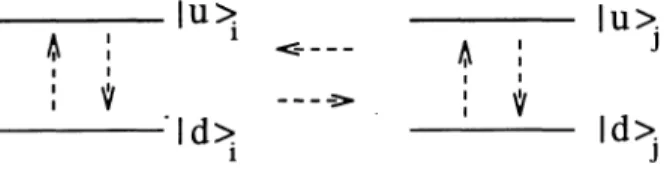
Here IU)jand Id)jdescribe the electron states in the excited and ground states of the j'th atom respectively as shown in Fig. (1) below. Eq.'s(l) can be shown easily to satisfy the
IU~
Iu>.
*
I I J I0«----*
I I I I I 'V ----0> 'V I' Id>
Id>.
1 JFigure 1. Two atoms in a Dicke cluster. Arrows indicate the exchange of photons.
SU(2) commutation relations ,
[i } - ) i}+)]
I , J=
[i } ±)
I ,l}z)]
J=
2j}z)
b. . '& '& ,J' "-L-(±) s .. T '& U t,] · (2)Since dipoles at each atom are assumed not to couple by direct overlap of the electron wavefunctions localized at each atom1,the total number of electrons
Nj
at each atom inthe cluster is separately conserved which is related to the total spin
L;
where,and (3)
1CoUective effects in a model which inherently has the feature of electron hopping between localized atomic orbitals is an interesting and realistic model in certain cases . This extention will be studied in a separate publication .
Interaction of two-level atomic system with a single-mode Radiation Field 123 In the model we study each atom contains only one transition electron. An arbitrary microscopic state I£)cof the cluster is then represented by,
(4) where £Zj
=
±
1/2 (j=
1, ... ,n) is the eigenvalue ofLj.
Ifthe linear size of the clust er is much smaller than the wavelenght of the dipole radiation we can apply the equivalent mode approximation. The whole cluster can then can be considered as a compound dipole with collective dipole operators ,(5)
which also respect similar commutation relations ala Eq.'s (2) as,
[L,L\]
=
2£z,
[£±, £zl
=
=f£± .
(6)
The algebra represented by these commutation relations permits us to find the macroscopic state of the cluster as linear superpositions of the microscopic ones in Eq.'s (4). Here one is tempted to adopt that the conserved quantum number under the action of the collective operators is the total number of atoms (or electrons) in the cluster fl .The total cluster spin
t:
is then described by,n
fI=
L
Ni,
;=1
and (7)
Let's adopt Eq.'s (7) temporarily and examine an arbitrary macroscopic state
1£
m)nas a linear superposition of/j)n as n1£
m)n=
E
cJn) Ij)n j=l with (8) where Ij)n describes a microscopic configuration and is nothing but Eq. (4) withj atoms in the up (i.e. +1/2) and n - j atoms in the down (i.e. -1/2) spin configuration. A typical microscopic state is then,n-j ~
I
+,+, ... ,+j -,-, .. .,-) '---v---' j (9)wherePj describes any permutation overj up and n-jdown spins. From Eq .'s( ..) and ( ..) it is appealing to say that -p/2 ~ m
=
j - n/2 ~ p/2 and £=
p/2. Although everything seems quite straightforward so far there is a subtlety involved such that the natural limit to the total spin £ is given by the total number of atoms hence£max=
p/2. However, inthe most general case £ is a degree of freedom of the system and it is the natural limit for m such that -£ ~ m ~ £ and the total number of excited atoms under most general
124 T. HAKiOGLU
initial conditions may be less than the total number of atoms in the cluster. Another way of approach is that the total cluster spin f is obtained by adding individual spins f j
=
1/2 and therefore it is allowed to change between p/2 and its minimum value, viz. f = 1/2 for odd total number atoms or f=
0 for even number of atoms. The value off is then fixed at the preparation of the initial macroscopic state and is a measure of cooperation between the atoms in their contribution to the radiative properties of the whole. Therefore in general we have 0 ::;f ::; p/2. In this case only those states with -f+p/2 ::;
j ::;f+
p/2 actively participate in the cooperative effects. Such states can in principle be uniquely determined in the initial state by proper choice of initial number of photons as well as the coefficients Cj in Eq. (8) .Moreover the Dicke Hamiltonian is totally symmetric with respect to the exchange of indices of different atomic dipoles. This implies that the symmetrical or anti-symmetrical initial states never mix in their time evolution. Specific choice for the cooperation number can lead to distinct cooperative quantum effects of radiation. The reader can consult to a vast number of literature in this field of which only a few are listed in the references below[L, 2,3,4] . Our specific aim in this section is to briefly investigate the most general case of arbitraryp ,f as well as total number of excitations n.
In this general case on has -f ::;m ::;f with f ::;p/2 . Hence the non-vanishing matrix elements of the collective dipole operators for the arbitrary macroscopic state in Eq . (8) are given as (dropping the index nfrom the
If
m) states),(f
ml£z
If
m)=
j - p/2(lm+
11£+
Ifm)=
J(f - j+
p!2)(f+j - p/2+
1)(lm -
11£-lfm)
=
J(f+
j - p/2)(f - j+
p/2+
1)(10)
We will use
If
m) as the natural basis in the description of the atomic component of the generalized Dicke state.The full Hamiltonian for the coupled cluster-single mode radiation state is given by, (11) where w is the frequency of the radiation, ( is the difference between the upper and lower atomic energy levels. Usually one considers w
= (
+/::;.
with /::;.I-
0 describing the detuning from the exact resonance condition (i.e. /::;.=
0).2.1. GENERAL SOLUTION
The exact analytic solution of the Hamiltonian does not exist for an arbitrary number of atoms p and/or arbitrary number of excitations n in a closed form. The solution for arbitrary number of atoms with n
=
1 has been given by Cummings and Dorri[5] and Seke[6] a more general solution under the same conditions but including the retardation effects of the emitted radiation from each atom was considered earlier by Milonni and Knight[7]. Forp=
1,2 and arbitrary n the exact solution is presented by Buzek[8]. The solution of this simplified model is strong geometry dependent results. For arbitrary p number of atoms initially with n=
1 the radiation properties of the cluster can be varied from a superradiant (constructive interference) to subradiant (destructive interference).Interaction of two-level atomic system with a single-mode Radiation Field 125 The case for 3
:S
p,n involves collective phenomena which are not present for the simple case when pand/orn are equal to one or two. A general pertubative approach for the 3:S
P,n was formulated by Kozierowsky et al.[9]. Here we will examine the generalp and ncase primarily focusing on the qualitative aspects of the time evolution arising from the complexityof the eigen solutions.In the Hamiltonian(11)the operator corresponding to the total number of excitations
, t ' p
N
=
Ii Ii+
.c
z+
-2 (12)
since
[N, ill
=
0 and the eigenvalue n is an integral of motion . Since[£2 ,
ill
=
0 the cooperation numberI.is also a good quantum number. We can restrict our attention onto a finite dimensional subspace of the Hilbert space corresponding to a given n . A typical state can then be represented at a particular instant by r photons, n - r atoms in the excited energy and p - n+
r atoms in the ground state energy level. Sincepis fixed andn is determined by the initial conditions, depending on the I.values in question there are certain restrictions on possible values that r can take. The conditions
Iml
:S
I.with I.:S
p/2 imply -I.+
n - p/2:S
r:S
I.+
n - p/2 hence the total number of states r can take is21.+
1.A dynamical state is then given in terms of combinations of In - r}c 0lr}f satisfying the above restrictions where the subscripts c andf
denote the cluster and the field respectively. In order to find the matrix elements of the Hamiltonian, we thus need to replace m=
j - p/2in Eq.'s(10) by m=
n - r - p/2 and,tz,
=
VTTI V£
+
n - r - p/2)(£ - n+
r+
p/2+
1) (m - 110 (r+
llillr) 01m}=
'YVr(m
+
110 (r - llillr) 01m}=
'YVr-l where(13)
with rm in
:S
r:S
Tmo» and I.:S
p/2 .The equations above represent the generalized case for arbitraryp and n. Here Trna» and
rmin determine the maximum allowable range for a given I.,nandp. In the most general case,
r m ax
=
I.+
n - p/2 and . _ { -I.+
n - p/2, and I.:S
n - p/2 ;rm m - 0 otherwise. (14)
At this point we analyze several distinct situations. Since rmin ~ 0 and r m ax
:S
n the number of possibilities for certain values of nand pcan be classified inn<
p, P<
nand n=
p as indicated in Table.I below.126 a) b) c) d) T . HAKiOGLU
Tmin
=
0 Tmin=
0 forced bound n<pand f
=
p/2 unphysical p<nTm ax
=
n Tmin=
0 natural bound n=p Tmin=
0 { Tmin=O natural it n>p/2j n<p " forced if n<p/2 . and f < p/2 unphysical p<n Trna» < n unphysical n=p Tmin > 0 unphysical n<p and f=
p/2 allowed p<n Trno» =n unphysical n=p Tmin > 0 { allowed Itn>p/2j n<p unphysical if n<p/2 . ande
< p/2 allowed p<n T m ax < n allowed n=p Table 1.It is crucial to remember that Dicke's superradiance condition f = p/2, m = 0 can be met initially within all the physically realizable parts (a) and (c) of Table. 1. Dicke's subradiance can be realized within parts(b) and (c)if in the initial stateTrnaa:
=
n - p/2which implies the f = 0, m = 0 singlet. The preparation of initial conditions in such a way that the time evolution will be dominated by superradiant or subradiant states is a difficult experimental task . First experiment on superradiant systems was performed in 1973 by Skribanowitz et al.[10] and that for subradiant states has been done in 1985 by Crubellier et al. and Pavolini et al.Il l]. A good account on experimental realization of the required symmetry properties for partial (full) observation of superradianca/subradiance has been given in the former reference.
A different approach to sub radiance has been suggested by Cummings[5] considering the spatial distribution of the atoms in the "equivalent mode" cluster for arbitrary p as well as number of initial field modes when only one atom is initially excited . The underlying principle behin subradiance, whether it is prepared by a particular initial state or by randomly distributing atoms in the cluster is based on the principle of destructive interference. The very commonly studied case ofp atoms and n
=
1 with field initially in the vacuum state corresponds to the case a in Table. 1 with n < p and n=
p.In this category, Cummings and Dorri[5] studied the evolution of an asymmetric initial state and for instance Seke[6] examined the symmetric case. The original Jaynes-Cummings model corresponds the case p=
1 and arbitrary number of initial photons Tin > P and hencen > p.The photon number range is therefore given by n - p~ T ~ n. This is contained in case(c)in Table. 1 withf = p/2 and hencef = 1/2.Buzekls]also studied the consequences of the spatial distribution of atoms in the spatially extended cluster (i.e. linear size of the cluster is compatible with the wavelenght of the single resonant field) . He considered the case ofp= 2 with m = 1 or m
=
2 initially with an arbitrary number of photons in the initial field state. Here for the number of initial photons 2 < Tin hence 2 < n2 and thusn - 2~ T ~ nwhich can be found within case(c)in Table. 1. Since in Buzek's calculation
f
=
p/2 and thus only f=
1 is allowed. He also examined the case where the initial field is in a coherent state again with p=
2. For this case each Fock component with a specificInteraction of two-level atomic system with a single-mode Radiation Field 127 number of photons (i.e. r) can be studied independently. Nevertheless , since for each such component it is true that n-p::; r::; n we still have the case(c)corresponding to f.
=
p/2yielding f.
=
1 for p<
n. For those components with n<
por n=
pease(c)is unphysical and thus we must have case a but still with f.=
1.Recently Kozierowski et al.[9] considered systems with three and more excited atoms in the initial state for arbitraryp.Insuch systems with n ;:: 3 super structures modulating the zero 'th order collapses and revivals appear arising from the non-equidistant eigenvalue distribution. Intheir exact results Kozierowski et al. considered the case with n
=
3 with arbitrary palso using symmetric wavefuntions with 0 ::; r ::; n. Again , this corresponds to the case (a)in Table. 1 with f.=
p/2.Hence we can see that, for symmetric initial states, or for all cases when r m ax
=
nthe cooperation number" does not need to be mentioned since in this case it is directly implied that f.
=
p/2. Forf.=
p/2 Eq.'s (13) can be seen to reduce into a relatively more conventional form via2(15) .We can then write the Hamiltonian in Eq . (11) as
(16) We will now rescale the matrix coefficients so that, is implicitly unity. The resulting matrix to be diagonalized is given by,
( _ € - ~mmax vT m 1n
o
o
VTm;n 0 - € - ~ (mmax - 1) vTm;n+1 VT m i n+lo
0 ... - € - ~ (mmin+
1)o
)
o
o
vT m a% - € - ~mmin (17) where mmax=
n - p/2 - rmin and mmin=
n - p/2 - r m ax. Denoting the eigenvalues by£(s) and eigenvectors by "p)(s) where 1
:s:
s:s:
n+
1 is the eigenvalue index, we have forn = 1 and arbitraryp,
t [
(p - 1)~
-J
~
2+
4v5 ]
~ 1.")2= (A2+4VS)1/210) _ ( 4v5 )1/211))'f' A2+8vo A2+8 v
5
(18) where Va= J(f.+1-pj2)(f.+ pj2). For p= 1 and n arbitrary we have the case (c) in Table. (1). The eigenvalues and eigenvectors are
~
~
!"ph
=
(VI - A21n - 1)+
A!n)) !"ph=
(AIn -
1) -Vf=A2ln))
(19)
2Eq . (15) is more appropriate and simple for the case n
:s
p. For the opposite case its symmetric eq uivalent with vr=
VT+
1J(p - T)(n - p+
T+
1) with 0:s
T:s
p and T=
r+
(p - n) is more appropriate to use . In this case there are p+
1 eigenvalues as opposed to n+
1 in the formercase.128 T . HAKiO GLU
whe re A = (1 + sin O' )/v'2 wit h sin o = 1f/.)6,.2 /4 +n. For p= 2 and n arbitrary we can have£
=
lor£=
O. For th e form er n - 2 ::;r ::; n and we have th e case (c)in Tabl e. ( 1). Wh ereas for t he lat t er (i.e. £=
0) we have only one allowed photon numberr=
n - 1 and this implies full radi ation trapping for th e antisymmetric initi al st ate1£
=
0 m=
0). For6,.
:f.
0 the eigenvalues and eigenvectors are not as simply expr essed as in the 6,.=
0 case . The eigenvalues and eigenvect ors are, for£=
1,lO l
=
U+
v,lO2
=
U cosep+ v cos2ep , lO l=
U cos2ep+ v cosep ,whereu and v are such t hat ,
:::}
l1/Ih
=
Ao In - 2)+
AlIn -
1)+
A 21n):::}
l1/Ih
=
B oIn -
2)+
B1In -
1)+
B 2 1n):::}
l1/Ih
=
Co In - 2)+
C1In - 1)+
C21 n) (20) u=
{6,.+
.)6,.2+
(4n - 2+
6,.2 )3 f/ 3 u = {6,._.)6,. 2+ (4n- 2+6,.2)3f/3with cosep
=
- v/ (2u ) andA1= <~ _ 62 A - _ y2n -2 A A - --.YE A <?- 62+<1(4n-2)+26
,
0 - <1 - 6 1 , 2 - <1+ 6 1 B1= « 2)L62+<2« 2)2-62(4n-2)+26,
Bo= _ y 2n-2 B<2+ 6 1 B 2= - <2-0i
B1 C1=
-B1,
Co=
B o , C2=
B 2 (21) (22)where
Ir)
=
In -
r) a0 Ir )f .For£=
0 we have a zero mode with11/10)
=1£
= Om = 0) =t (l
+ -)-1-
+) ) 0In -
1). For n<
p th e photon number is bound ed by 0 ::; r ::; 2 and thus we have t he case (a) wit h £=
p/2. Wh ereas for p<
n t he photo n number range is 1 ::;r ::;2 and t his again indicates t hat£=
p/2 whichcorres ponds t o t he case(c).The corresponding eigenvalues and eigenvectors are ob t ained from t he sym met ric case by interchanging n andpin Eq.' s (21) and (22).
We ca n also bri efly mention th e results for n
=
3 and n=
4 for ar bit ra ry p. The n=
3 case wit h arbit raryp was solved by Kozierowski[9] using symmet ric init ial stat es. For pand n being small and primarily less than two the eigenfrequencies are commensurate and the time dependence of the fluctu ating obs er vables are given by regular oscillations. St ar ting from 3 ::; n or 3 ::;pthe eigenfr equencies become incommensurat e as illustrated ab ove. This is reflect ed on th e time dependence of t he at omic population inversion and incom me nsu rate overtones of the eigenfrequencies man ifest themselves in t he appearance of su perim pos ed modulat ions on t he envelope func tion .
2.1.1. Commensurate versus Incom m ensurate regimes
Ifa number of frequ encies lOU) wher e
f ::;
(n+ 1) are incomme nsu ra te then for a set of int egers S l , S2, • . • , Sn t he frequen cy sumInteraction of two-level atomi c system with a single-mode Radiation Field 129 can not have a non- trivial solution except 81 = 82 = . .. = 8n = O. This condition can be
expressed equivalently by stating that there is at least one frequen cyE(J)of which ratio to all other frequencies is an irrational number. The representation of a dynamical observable
G(t) in the frequency spectrum
(24)
can display irregular behaviour since
g(w)
=
L
(25)where in ea ch summation -00
<
s,<
00 (i=
1,2, . ..,n) . By investigating theIg(w)1
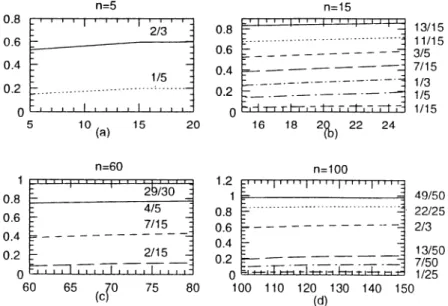
one can determine the nature (i.e . periodic, quasi-periodic, irregular) of its phase spac e attractor. In Fig . (2) below the ratio of the smaller eigenfrequencies to the larg est one is plotted for fixed values ofn ranging from 3 to 100 with respect to increasing values ofp for n
S
p and for b.=
O. The commensurability of the frequenci es is not guaranteed at all parameter values although in the limit 1~ pin the ratio of the frequencies approach to rational numbers . The opposite case with pin~1 is symmetric since it can always be mapped into an equivalent 1~ pin case by a simple shift in the photon number (see the footnote on page 9). Therefore, the strongest incommensuration in Fig. (2) corre sponds to n=
p. Continuous detuning from resonance is a controlled nevertheless nontrivial way of24 2\1) 22 18 16 n=15 0 .8 13/15 . . . .. .. . .. . . .. .. . 11/15 0.6 - - - 3/5 0.4 - - - 7/15 _ ._ ._ .- - ' 1/3 0 .2 1/5
o
U-.L...l...LLJLLJL.LJL.LJL..W....L.1....L.1....L-..J 1/15 20 -I 2/3 n=5 I 1/5 1- , -I I 10 (a) 15 0 .8 0.2 0.6tl-_---:j
0.4 I-n=60 n=100 1.2 1 49 /50 0 .8 22/25 0.6 - - - -- - 2/3 0.4 13/50 0.2 - - - 7/50o
1/25 100 110 120 130 140 150 (d) 80 75 2 130 4/5 7/15 65 1 0.8 0.6 0.4 0.2o
L-LLLLLJL..W-L.L....LJ...LL.L.L.L.L.LJ 60Figure2. The ratio of th e smaller eigenvalues to the largest one (i.e.l\?,~/l:::;%)as n:Spvaries . a) n=5 and from bottom to topj = 5 and j = 3; b) n = 15 and from bottom to topj = 15,13 ,11 , 9.7 ,5 ,3 ; c) n= 60 and from bottom to topj = 53, 33, 13, 3; d) n
=
100 and from bottom to top j = 97,87,75 ,35 ,13 ,3 .observing incommensuration. Non-zero detuning slightly softens the eigenfrequencies and increases their non-linear dependence on nand p. Strong nonlinearity is observed when
130 T . HAKiOGLU
nan d p are close to each other. The increase in the allowed ran ge for photon number
r m ax - rm in
=
2£+
1 also increases the effect .Incommensurate frequ enc ies are easily established for a number of parameter values . For instance for n
=
3 and n=
4 at ~=
0 we list a few cases for which one ob tains irrat ional values for the frequency ratios out of many other possible ones ''n
I
pI
1O(1) /1O(3)nlp l
1O(1) /1O(3)3 1 31 4 1 61 3 1 4 1 4 1 7 1 4 14 1 4 1 8 1 4 1 51 4 19 1 Ta ble.2
Perhaps a mor e illustrat ive quant ity to examine is t he time evolution of t he various mo-ments of the ph ot on number m(J;)(t)
=
((iitii)k) as the dynamical observable replacing the role of9(t) in Eq.(24).Here there is a competition between various ti me scales involved.Ifthe eigenfrequencies I b I d n ,p
<
n,p<
n,p<
n ,p<
n,p ith [ ] t i thei t are a e e as lO[n/2+1] _ 1O[n/2l _ lO[n/2_1] ... _ 102 _ 1O1 WI X rep res en mg em eger part of" x", the smallest finite period is given byT1n ,p -- 27l"/( 1O1n ,p- 1O[n/2+1]n ,p ) , if if
n is odd n is even
(26)
with the main difference arising from t he fact that for n
=
ev en one eigenvalue is alwayszero yielding an infinite per iod. On the other t he difference between the two smallest eigenfrequencies determine t he period of revivals in the atomic population inve rsion and corresponds to t he smallest beat frequency. Th e revival period is given by,
Tn ,p -(2) _ 27l"/ (lOn,p([n/ 2)) _ lOn,p([n/Hl)) ) , Tn ,p -(2) _ 27l"/ (lOn,p(n /2) _ lOn,pn /2 -1) , if if n is odd n is even (27)
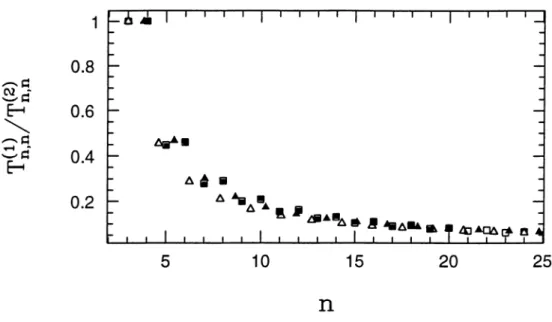
because of t he sa me reason as a bove. Co mparison of t he time scales in (26) an d (27) is crucial t o un derstand t he dynamical ti me correlations in m(k)(t) . In Fig .(3) below , we
. h .
t:
n/Tnn r • I A ' Tnn/T n n dexamme t e ratio l ' 2 ' lor vanous n va ues. s n increases l ' 2 ' ten s to zero . In the case of arbit rary n
<
pt he same qualitative behaviour is observed.3For the n
=
3 and n=
4 cases the frequency ratios can be repr esented asJ
:~::1c
where a,b, care positive integers.Itcan be shown that if c does not divide a2 and b2 t he frequ ency ratio is an irrational number. Such condition is satisfied when c itself or its divide nts are prime numb ers .Interaction of two-level atomic system with a single-mode Radiation Field 131
1
0.8
-l:::t\l • _l::: ~0.6
<,
-l:::.-l • _l:::0.4
~0.2
5
10
n
15
20
25
Figure 3. Here the open and solid triangles indicate n
=
p=
odd ,and n=
p=
even respectively for.c.
=o.
The open and solid rectangles indicat e the same for.c.
= 0.3.We can now examine the momentsm(kl(t)and their correlations. The time correlations within a single revival (i.e. T~~J $ t $ T~~J) and those spanning a time int erval large enough to intercorrelate more than one revivals (i.e.
T~~J
$T~~J
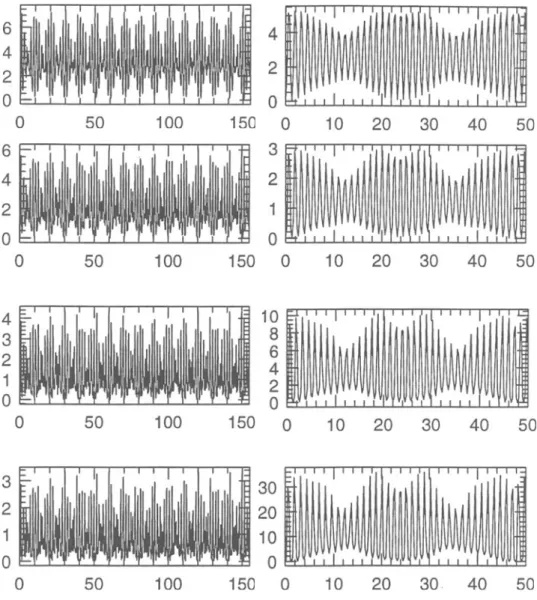
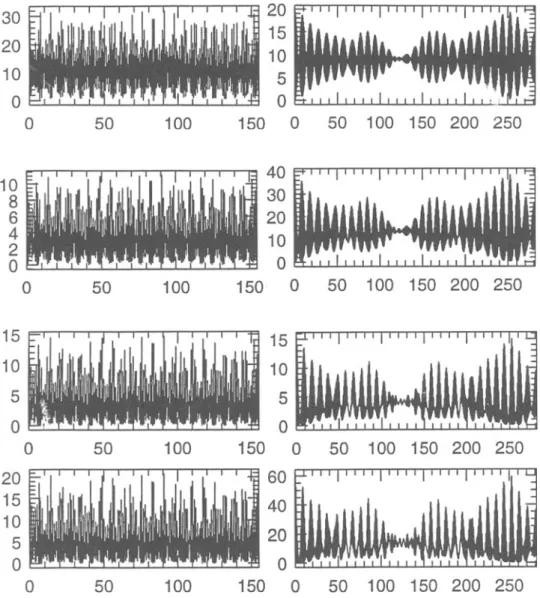
$ t exhibit qualitatively different behaviour. In the Fig.'s(4) and (5) below m(kJ(t) for k=
1,2,4 ,6 are plotted. Fig .'s (4. a,b,c,d) and Fig.'s (4.e,f,g,h) represent n=
p=
9 and n=
6 , p=
9 respectively. For the former the time dependence of all moments are irregular. The period of the envelope for the latter can be estimated using Kozierowski's perturbative result as[9],811" 3 / 2
TR
=
15
(p - n/2+
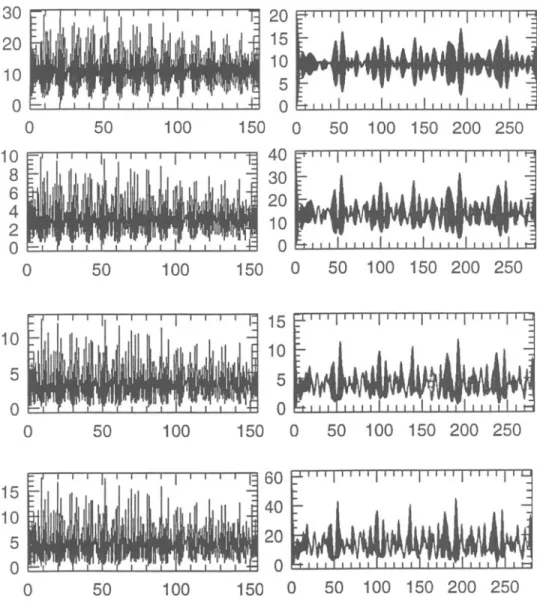
0.5) =::28 (28)which are within ten percent of the numerical calculations (for clarity two full periods are shown in the figure). In Fig.'s (5.a,b ,c,d) and Fig.'s (5.e,f,g,h) below n = p = 40 and n
=
20 , p=
40 are plotted. The same trend continues here and the time dependence of the n=
pcase is erratic whereas collective collapses and revivals are observed for the n=
p=
40 case . The revival period can be estimated from Eq. (28) above as TR=:: 156 which aga in underestimates the revival period by about ten percent. An interesting observation here is that during the short collapse period of the mean photon number there are strong fluctuations in the number of photons as visible in the higher moments m(kl(t)with k>
1 (also note the scale change as k increases). In Fig .'s (6) we numerically confirm for ~=
0.3 the effect of non-zero detuning driving the system into a strong incommensuration . Fig. (6.a,b ,c,d) represents n
=
p=
40, whereas Fig . (6.e ,f,g,h) represents n=
20 , p=
40. 3. Physical limitations in the large n limitThe exact solution of the eigen system in Eq.'s (16) and (17) has not been found in a closed analytic form. The eigenvalues of the full Hamiltonian are always symmetrically
132 T . HAKiOGLU
I
I
~II
I
~
~\Il\\!
~~
~I
Iii
1~1~1~
J
I
I ITtlIII
~I
50
40
30
20
10
20
30
40
50
I I~
~
I10
20
30
40
50
10
4
2
0=-'-'-'....L...I.-L..J...L..J...J...J....L..L..Ju....1...J....L....L...1....LJ:..l::l
150
0
3
2
1
0
150
0
10
8
6
4
2
0
150
0
100
100
100
50
50
50
6
4
2
o
o
4
3
2
1
O=..1.-J...L...l---l....-'--l-.l...--L...J...L-L...L...IL.:Co
6
4
2
o
<=.L.-L-.J...l...L...L...l-l-..J.-l---L...l.-JL...L...=o
3
30
2
20
1
10
0
0
0
50
100
150
0
I10
20
I30 .
40
50
Figure 4. From the top left to the bottom left the plots are (a) ,(b) ,(c) and (d ) representing k= 1, 2.4 , 6 resp ectively for n
=
p=
9 and for Do=
O. The vertical axes are scaled for k=
2 with xl0 ,fork=
4 withxl03 and fork=6 with x105
.On the right from top to bottom the plot s (c), (d ), (e) and (f) repr esent the
same ord er in kfor n
=
6P=
9 and forDo=
O.The vertical axes are scaled fork=
2 with xl0 ,fork=
4 with xl02 and for k= 6 with xl03•distributed around the central value wn as
E)n)
=
wn±
(~) . This is a strong signal t hat one should examine the large nand/or p limit with extra care . The behaviour of t he (~) 's as nand/or p increase can be examined using the recursi ve properties of t he det erminant. It has been shown previously[12] that t he properties of eigensolutions ofInt eraction of two-level atomic system with a single-mode Radiat ion Field 133
50
100 150 200
250
100
50
~...,....,r-r-,...,----r--r--r--r-T""""T-'--r--T::I20
15
10
5o
~~1-L.J.~1-L.J...L.1..JL...L..L...L..L..JL...L..L.":"'....J....L...I:JI150
0
30
20
10
o
o
50
100
150 200
250
10
8
64
2
o
o
50
100
40
="T"T""T""T....-r-I'""T""T'"T""T""T"'T""T""1"""T""T""r-rT""-'"""T""T""<=lI30
20
10
O=...L~J...J....1....L..L..1....L..I....L..L...L..L..JL...L..L...L...L..L.J..I...L...L..J::::I150
0
50
100
150 200
250
50
100
150 200
250
15
10
5
o
150
0
60
40
20
O=...L...L..L.J...J....1....L..L..1....L..I....L..L...L..L..JL....1-L..L...L..L.J..I.=.I..J::::I150
0
100
100
50
50
15
=r...,....,~...,---r-"'T""""""T--r-"T""""""T"-,--T""'"'"=10
5
o
o
20
15
10
5
o
o
Figure5. From the left top t o the left bottom the plots ar e (a), (b) ,(c) and (d) representing k= 1.2. 4 ,6
resp ectively for n
=
p= 40and for A=
O.The vert ical axes ar e scaled for k=
2 with xl02,for k
=
4 with xl 05 and for k= 6 wit h xI08•On the right from top to bottom t he plots (c), (d) , (e) and (f) representing t he sa me order in k for n
=
20P= 40and for A=
O.The ver tical axes are scaled for k=
2wit hx l O.for k=4 wit hx lO· and for k= 6 with xl 06•such sim ple Hamiltonians as (16 ) ca n be studied by or thogonal polinomials[13] . The model predi ct s t hat
dll
grow much faster th an wn eventually leading to negative ener gies. This is an ar t ifac t of the non-unitarity of the model in (16 ) arising from t he assum pt ion that t he counterrotating terms ar e neligible. For instance the largest eigenvalu e can be est imat ed134 T. HAKiOGLU
50
100
150 200
250
50
100
150 200 250
20
15
10
5
o
=....r...L..L..I...I....1....1....L.J...L...I...J....I....L...L..L..JL...L..J...=
150
0
40
30
20
10
O=...L....L.J....L..L..J...~...-...L.J...-...150
0
100
100
50
50
30
-..--,-r-r-,--r-r---r-...--r--r--r-r---r-...20
10
o
o
10
o=r-...,...,r-r--r--r-r--.-r--r-...-.-I--=!=l8
6
4
2
Oc=.J..-l-.J...L---J...L..-L...L...L..-.1...I.--'-...L...-J'--'=
o
50
100
150 200 250
15
10
5
o
CLL..L...I..J...J...L.JL..L.L...L.J....L...L..W-L-L-L..L.J....L...I..J...J...L.J=150
0
100
50
5
0c=.J..--L...J...I---J...I..-L...L...L..-..L-.L---J...L...-JL-J.J
o
10
50
100
150 200 250
100
50
=-r--.-...-r-,--...--r--,-...--r--r-,-,;-r-~60
15
10
40
5
20
o
c=.J..--L...J...I---J...I..-L...L...L..-.1...I.---J...L...-J'-=
0
=...L....L.J...I....1....1....I....L..L...I...JL...L..J...L...L..J....L..L..L..L..I...L.J..=o
150
0
Figure6. From the left top to the left bottom the plots are (a) ,(b) ,(c) and (d) representing k= 1,2,4 , 6
respectively for n
=
p=
40and for6.=
0.3.The vertical axes are scaled fork=
2with xI02,fork
=
4with xIO' and for k= 6 with xI08•On the right from top to bottom the plots (c) , (d) , (e) and (f) representing the same ord er in k for n
=
20p=
40 and for6.=
0.3. The vertical axes are scaled fork=
2with xIO, for k=4with xIO' and for k= 6 with xI06•by the inequality[12 , 13, 14],
Interaction of two-level atomic system with a single-mode Radiation Field 135 the left hand side of the inequality can be computed from Eq. (15) which gives an approx-imate critical size for the cluster below which the rotating wave approximation can be used. Using (29), this critical size Pc for the Hamiltonian in (16) is given by Pc
=
3 w - 2 such t hat p~Pcis required to secure t he validity of the pres ented solution based on the rotating wave approximation . The formal solution including the counter rotating te rms yields a unitary S-matrixbut the solution itself can not be given in a simple form[15].Th e counter rotating terms in the Hamiltonian are represented by
H'
=
l'(iit£+
+
ii£_) .The first order perturbative correction to the energy eigenvalues vanish. The second order correction can be calculated from"i,n
!(
i'n'IH'linW
£2
= '" "" "
LJ l in l"/ /
ini' ,n' fo - fO
i ::;(n
+
1)je s
(n'+
1) (30) where onlyn'=
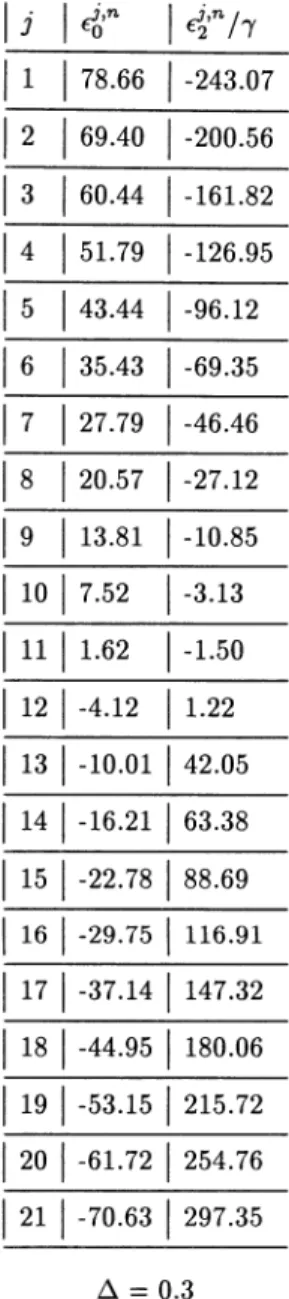
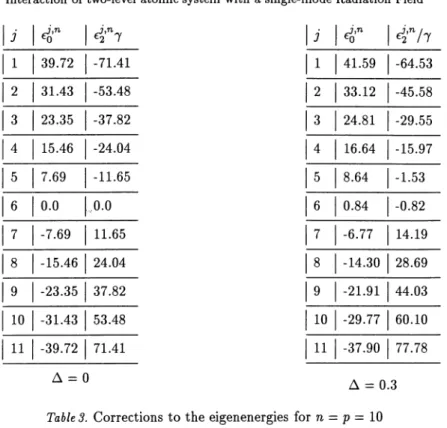
n±2contribute. Here it is important to know the full interaction strenght since the eigenvalues no more globally scale with the first power of the coupling constant 1'.Eq . (30) is shown below for n = p= 20 and for ~= 0 and for ~ = 0.3 respectively. In the next table n=
p=
10 for the same ~ values are given (note that the second order corrections are given in units of 1').The second order correction ~,n is consistently opposite in sign to the zero 'th order eigenvalue ~,n. The importance of this result is in the fact that corrections tend to con-fine the spreading eigenvalues for increasing nand/or p. Th e net effect is to correct the sup erfluous instability beyond the critical region p '" Pc by pushing it to larger values. Additional details about the instability will be presented elsewhere[14].
·Since[il' ,N']~ 0 different n's are mixed. In the Eq. (29) f~·n indicates th e j 'th order correction to th e i 'th eigenval ue of the unperturbed Hamiltonian (16) with a fixed n ,
136 T . HAKiOGLU J
d,n
0 ~,nh jd,n
0 ~,nh 1 74.60 -268.59 1 78.66 -243.07 2 65.52 -226.38 2 69.40 -200.56 3 56.76 -187.74 3 60.44 -161.82 4 48.34 -152.61 4 51.79 -126.95 5 40.26 -120.93 5 43.44 -96.12 6 32.56 ~ 92 .64 6 35.43 -69.35 7 25.24 -67.71 7 27.79 -46.46 8 18.34 -46.12 8 20.57 -27.12 9 11.86 -27.85 9 13.81 -10.85 10 5.79 -12.77 10 7.52 -3.13 11 0.0 0.0 11 1.62 -1.50 12 -74.60 268.59 12 -4.12 1.22 13 -65.52 226.38 13 -10.01 42.05 14 -56.76 187.74 14 -16.21 63.38 15 -48.34 152.61 15 -22.78 88.69 16 -40.26 120.93 16 -29.75 116.91 17 -32.56 92.64 17 -37.14 147.32 18 -25.24 67.71 18 -44.95 180.06 19 -18.34 46.12 19 -53.15 215.72 20 -11.86 27.85 20 -61.72 254.76 21 -5.79 112.77 21 -70.63 297.35 ~ = 0 ~ = 0.3Interaction of two-level atomic system with a single-mode Radiation Field 137 j d ,n0
I
~,n7 j d, n0 ~,n h 1 39.72I
-71.41 1 41.59 -64.53 2 31.43I
-53.48 2 33.12 -45.58 3 23.35I
-37.82 3 24.81 -29.55 4 15.46I
-24.04 4 16.64 -15.97 5 7.69I
-11.65 5 8.64 -1.53 6 0.0 10.0 6 0.84 -0.82 7 -7.69I
11.65 7 -6.77 14.19 8 -15.46I
24.04 8 -14.30 28.69 9 -23.35I
37.82 9 -21.91 44.03 10 -31.43I
53.48 10 -29.77 60.10 11 -39.72I
71.41 11 -37.90 77.78 .6.=
0 .6.=
0.3Table3. Corrections to the eigenenergies for n
=
p=
10Acknowledgements
The aut hor is gr at efull t o Dr. A. Miranowicz with whom most parts of this work were discussed during his visit at Bilkent .
References
1. The recent bo ok byL. Mand el and E. Wolf is an excellent sour ce for the treatment of spo ntaneous pr ocesses in two level syste ms. See Leonard Mandel and Emil Wolf, Opti cal Cohe rence and Quan tum Opt ics(Cambridge Univers it y Pr ess, 1995).
2. L. Allen and J .H . Eb erl y, Opti cal Resonance an d T wo-L evel A t oms , Dover Publicat ions , (New York 1975) .
3. R.H . Dicke, Ph ys. Rev . 93 , 99 (1954) .
4. Nicholas E. Rehle r and Joseph H. Eberly , Ph ys. Rev .A 3 , 1735 (1970) ; G.S. Aga rwal, Ph ys . RevA
2 , 2038 (1970); R. H. Lehmberg , Phy. Rev.A 2 , 883 (1970) ; ibid , 889 (1970) .
5. F.W . Cummings and A. Dorr i, Phy s. Rev.A28 , 2282 (1983); F.W . Cummings, Ph ys. Rev.Let t. 54 , 2329 (1985).
6. J . Seke, P hys. Rev .A 33 , 739 (1986).
7. W . Milonni and P. Knight , Phys . Rev.A 10 , 1096 (1974). 8. V. Buzek , Z. Ph ys.D 17, 91 (1990).
9. M. Kozierowski, A.A . Mamedov and S.M. Chumakov, Phys . Rev.A 42 , 1762 (1990); M. Kozierowski and S.M. Chumakov, Ph ys. Rev.A 52 , 4194 (1995).
138 T. HAKiO GLU
11. A. Cru bellier, S. Liberm an , D. Pavolin i and P. Pillet , J . Phys. B 18, 3811 (1985); D. Pavolini, A. Cr ubellier, P. Pillet , L. Ca baret and S. Liberman , Ph ys. Rev. Lett. 54, 1917 (1985) .
12. Y. Orl ov and V.V . Vedenyapin , Mod . Ph ys. Lett. B 9 , 291 (1995).
13. Ga bor Szegii, Orth ogonal Polinomials, (American Mathematical Society, (1939). 14. T . Hakioglu and A. Miran owicz, unpublished (1996).