THE REPUBLIC OF TURKEY
BAHCESEHIR UNIVERSITY
A STUDY ON SELF-HELP INCREMENTAL HOUSING:
LATTAKIA CASE
Master’s Thesis
NOOR RAI
THE REPUBLIC OF TURKEY
BAHÇEŞEHİR UNIVERSITY
THE GRADUATE SCHOOL OF NATURAL AND APPLIED
SCIENCES
MASTER OF ARCHITECTURE
A STUDY ON SELF-HELP INCREMENTAL
HOUSING: LATTAKIA CASE
Master’s Thesis
NOOR RAI
SUPERVISOR: PROF. DR. SEMA SOYGENIŞ
ACKNOWLEDGMENTS
First and foremost, I would like to thank God Almighty for giving me the strength, knowledge, ability and opportunity to undertake this thesis and to persevere and complete it satisfactorily. Without his blessings, this achievement would not have been possible.
Furthermore, I would like to express my profound gratitude to my thesis supervisor Prof. Dr. Sema Soygeniş for her guidance and support throughout this thesis. For taking her time to vet my drafts, making comments and providing helpful guidance through her comments and feedbacks.
Finally, I must express my very profound gratitude to my parents Dr. Fadi Rai and Dr. May Al-shihaby and to my brother Dr. Fouad Rai for providing me with unfailing support and continuous encouragement throughout my years of study and through the process of researching and writing this thesis. This accomplishment would not have been possible without them. Thank you
iv ABSTRACT
A STUDY ON SELF-HELP INCREMENTAL HOUSING: LATTAKIA CASE
NOOR RAI
Master of Architecture
Supervisor: Prof. Dr. Sema SOYGENIŞ May 2018, 61 pages
Informal settlement has been one of the major topics to discuss in the current time, and it is one of the most serious issue governments and societies face nowadays. Rapid population growth in developing countries forced households to use informal mechanisms to access housing, such as acquiring land in illegal sub-divisions or squatting on public land and incrementally building their dwellings. The study argues the potentials of government intervention for housing the poor, thru analysis of the Corniche Region phases of development similar to self-help incremental housing. The study deduces the best recommendations for finding possible solutions for incremental housing process. In brief, this thesis attempts to identify the main determinants and triggers of incremental housing process and the outcome of the Corniche Region case study where it is incrementally built but there is not much governmental intervention. These triggers might aid in explaining the challenges and potentials of the development of the process. Then, some recommendations, based on questioning the potentials of self-help incremental housing in various geographies, will be the starting points for an improved planning and management.
Keywords: Self-Help Housing, Incremental Housing, Site And Services, Informal Settlements Development
v ÖZET
SELF-YARDIM ÇÖZÜMLEME KONUTU ÜZERİNE BİR ÇALIŞMA: LATTAKYA'NIN ANALIZI
NOOR RAI
Mimarlık Yüksek Lisans Programı Tez Danışmanı: Prof. Dr. Sema SOYGENIŞ
Mayıs 2018, 61 Sayfa
Mimarlık ve mühendislik hizmeti alınmadan geliştirilmiş yerleşmeler, yönetimlerin ve toplumların karşılaştığı en ciddi sorunlardan birisi olmuştur. Gelişmekte olan ülkelerdeki hızlı nüfus artışı, hanehalkını, kamu arazisine el koyma ve konutlarını aşamalı olarak inşa etme gibi barınma olanaklarına erişimi için resmi olmayan mekanizmaları kullanmalarını zorunlu kılmıştır. Çalışma, “self-help” konutların üretim süreçlerine benzer bir oluşum yaşamış olan Corniche Bölgesi'ndeki gecekondu yerleşmelerinin yerel yönetim veya sivil toplum kuruluşlarının katkı potansiyelini savunuyor. Çalışma, uzun bir süreç içinde gelişimini tamamlayan knout süreci için olası çözümleri bulmak için önerileri ortaya koymaktadır. Kısacası, bu tez, arazinin yönetimler tarafından kullanıcıya sunulduğu, ve kendi kendine, gelişigüzel bir şekilde zaman içinde gelişen Corniche bölgesini inceliyor. Bu tetikleyiciler sürecin gelişiminin Yönetimlerin arazi sağlama dışında katkısının olmadığı bir yerleşmenin fiziksel koşulları, organize edilmiş “self-help“ örnekleri ile karşılaştırmalı olarak incelenerek yönetim veya kuruluşların destek ve müdahalelerinin önemi sorgulanmıştır.
Anahtar Kelimeler: Kendi Kendine Yardım Konutları, Artan Konut, Site Ve Hizmetler, Gayrı Resmi Yerleşim Yerleri Gelişimi
vi CONTENTS TABLES ... ix FIGURES ... x ABBREVIATIONS ... xii 1. INTRODUCTION ... 1
1.1 PROBLEM STATEMENT OF STUDY ... 2
1.2 RESEARCH OBJECTIVES ... 3
1.3 RESEARCH QUESTIONS ... 3
1.4 RESEARCH METHODOLOGY ... 4
1.4.1 Research Framework ... 4
1.4.2 Type of Research ... 4
1.4.3 Data Collection Methods and Research Sample ... 6
1.4.4 Research Validity and Reliability ... 6
1.4.5 Relevance of the Research ... 6
1.5 STRUCTURE OF RESEARCH ... 7
2. LITERATURE REVIEW ... 8
2.1 INTRODUCTION ... 8
2.2 THE IMPORTANCE OF HOUSING ... 8
2.3 CHARACTERISTICS OF INFORMAL HOUSING ... 9
2.4 THE FORMAL VERSUS THE INFORMAL HOUSING DEVELOPMENT ... 10
PROCESS ... 10
2.5 SELF-HELP HOUSING (SHH) ... 12
2.5.1 Characteristics ... 12
2.5.2 Types of Self-Help Housing ... 13
2.5.2.1 Users initiated Self Help Housing ... 13
2.5.2.2 State Supported Self-Help Housing ... 13
2.5.2.3 State Initiated Self-Help Housing ... 14
2.6 PHASES OF SELF-HELP HOUSING DEVELOPMENT PROCESS ... 16
2.6.1 Access to Land ... 16
vii
2.6.3 Incremental Improvement of The Basic Housing Core ... 18
2.7 CRITICS OF SELF-HELP HOUSING APPROACHES ... 20
2.8 SELF-HELP INCREMENTAL HOUSING: CONCEPTS ... 20
2.8.1 Factors supporting Incremental Housing ... 22
3. SELF HELP INCREMENTAL HOUSING: A CASE STUDY ... 26
3.1 PERU, 1970’S ... 26
3.2 BURKINA FASO, 1980’S ... 30
4. LATTAKIA, SYRIA A CASE STUDY ... 32
4.1 HISTORICAL BACKGROUND OF LATTAKIA ENVIRONMENT ... 32
4.2 FORMAL SETTLEMENT IN LATTAKIA ... 34
4.3 INFORMAL SETTLEMENT IN LATTAKIA AS A WHOLE ... 35
4.3.1 Corniche Region Today with Population Growth ... 37
4.4 THE STUDY AREA ... 38
4.4.1 Characteristics of Corniche Region ... 38
4.4.2 Legislative and Legal Framework Relating to Informal Settlement Property ... 39
4.4.3 The Importance of The Corniche Region ... 40
4.4.4 Physical Conditions of the Buildings ... 41
4.4.5 Land Use ... 41
4.4.6 Land Growth Analysis... 43
4.4.7 Road Network ... 44
4.4.8 Sewage and Water System ... 44
5. DATA COLLECTION AND FINDINGS ... 46
5.1 INTRODUCTION ... 46
5.2 RESEARCH FINDINGS AND ANALYSIS ... 48
5.2.1 Introduction ... 48
5.2.2 The Settlements process in Corniche Region ... 48
5.2.3 Squatter Settlement Upgrading ... 48
5.2.4 Physical Characteristics of the Corniche Region ... 49
5.2.4.1 Housing Conditions ... 49
viii
5.2.4.3 Gardens / Green Areas ... 51
5.2.5 Typically Incremental Housing Developing Patterns ... 51
5.2.5.1 Stage 1: Informal Land Acquisition ... 51
5.2.5.2 Stage 2: Typical System Of Incremental Construction ... 52
5.2.5.3 Stage 3: Shift in Building Materials towards Permanent- Conventional54 Materials ... 54
5.2.5 Stage 4: Use of Small Scale Local Builders for Construction Skills ... 55
5.2.5 Stage 5: Progressive Financing Mechanisms ... 56
5.2.6 Summary of Main Findings ... 56
5.2.7 Contrast Between Peru and Burkina Faso and Lattakia ... 57
5.2.8 Possible Solutions for Lattakia Informal Housing ... 57
6. CONCLUSION ... 60
REFERENCES ... 62
APPENDICES ... 65
Appendix A.1 Interview with a Palestinian Refugee 80-year-old Part 1: Households Characteristics ... 66
Appendix A.2 Interview with a Palestinian Refugee 38-year-old ... 69
Part 1: Households ‘Characteristics ... 69
Appendix A.3: Interview with Lattakia Municipality official ... 72
Appendix A.4: The survey interviews table ... 73
ix TABLES
x FIGURES
Figure 1.1: Thesis Framework ... 5
Figure 2.1: Housing patterns of informal and formal (Lattakia) ... 11
Figure 2.2: The Starter Core House Types ... 16
Figure 2.3: The starting basic housing core in informal settlement. Lattakia, Syria ... 18
Figure 2.4: Incremental improvement of the basic housing core in informal settlement. ... 19
Figure 2.5: Incremental improvement of the basic housing core in informal settlement. ... 19
Figure 2.6: Self-Help Housing Development Process ... 20
Figure 2.7: Incremental Housing Types ... 21
Figure 2.8: Incremental Housing Process Development ... 21
Figure 2.9: The Incremental Housing Diamond of Perfect Equilibrium of Inputs ... 23
Figure 2.10: Supporting Incremental Housing Through Microfinance ... 24
Figure 3.1: Diagram of the ascendant development in squatter settlements in Lima, ... 27
Figure 3.2: Basic core units designed for self-built extensions 1958 in Lima, Peru... 27
Figure 3.3: Family stage and evolution of their incremental self-help house in Lima, ... 28
Figure 3.4: The grid network that forms the surveyed plots in Villa El Salvador, Peru. ... 29
Figure 3.5: Sites and services, core house evolution in Villa El Salvador, Peru. ... 29
Figure 3.6: A large-scale surveyed plot program in Burkina Faso ... 30
Figure 3.7: Housing in Burkina Faso ... 31
Figure 3.8: Housing in Burkina Faso ... 31
Figure 4.1: Lattakia Governorate map ... 33
Figure 4.2: An aerial view of Lattakia ... 33
Figure 4.3: The development of master plan for Lattakia City ... 34
Figure 4.4: Informal settlements in Lattakia ... 35
Figure 4.5: The Corniche region / Al-Rammel Al-Phalastini ... 39
Figure 4.6: Land properties in Corniche region ... 39
Figure 4.7: The importance of the Corniche region ... 40
Figure 4.8: Physical situation of Corniche region buildings ... 41
xi
Figure 4.10: Building use of Corniche region ... 43
Figure 4.11: Building heights of Corniche region ... 43
Figure 4.12: Road network of Corniche region ... 44
Figure 4.13: Sewage network of Corniche region ... 45
Figure 4.14: Water system network of Corniche region ... 45
Figure 5.1: The study area ... 47
Figure 5.2: The coastline view of the study area ... 47
Figure 5.3: The street view of the study area ... 47
Figure 5.4 Difficulty in the installation and maintenance of the electricity in Corniche region... 49
Figure 5.5: Undesignated and Narrow Roads in Corniche Region ... 50
Figure 5.6: The expansion of the informal housing in Corniche region ... 52
Figure 5.7: “Houses” were built without building plans foundations in Corniche ... 53
xii ABBREVIATIONS E : Electricity EDU : Education Ex : Extended HE : Health
I.H : Informal Housing
N : Nuclear
N.P Lodgers : Non Paying Lodgers
S : Single
SHH : Self-Help Housing
W : Water
1. INTRODUCTION
Rapid population growth in developing countries and cities in the last three to four decades has brought about serious challenges to housing provisions around the globe. The increasingly urbanized boom of world’s population is projected to add 2.5 billion people to the urban population by 2050, with nearly 90 percent of the increase concentrated in Asia and Africa (United Nations, 2015). However, housing in the developing world is increasingly becoming a scarce commodity in many cities due to the rapid population growth as an effect of unparalleled urbanization phenomena; thus, resulting in people going to alternative solutions and temporal structures in form of squatter settlements (UNCHS, 1996). Increase in population growth in developing countries such as Syria means that providing housing and urban services for urban residents, especially the low-income will be a major challenge for urban managers and governments involved in this issue. Therefore, it is a difficult prospect, given that most developing countries are currently cannot deal with the housing needs of the existing urban populations.
As a matter of fact, housing is increasingly becoming unaffordable for most low-income groups. The have-nots in the developing countries cannot access mortgage finance. Furthermore, the cost of housing remains high (UN Habitat, 2008). In reality, the only solution left for those that cannot afford a decent house is the informal housing. The lack of appropriate housing finance models, the low-income households have constantly relied on other sources such as individual savings, informal loans from friends and relatives, to build their dwellings (Stein&Castillo, 2003). Consequently, their poor financial standing led them to invest in housing production incrementally.
As a developing country, Syria has been suffering an increase in urban population. The factors contribute to this growth are mostly natural population growth in addition to internally displaced people. Painfully, there are 6.5 million people, including 2.8 million children, displaced within Syria, the biggest internally displaced population in the world since 2011 (UNHCR, 2016). With this increase in urbanization, Syrian safe cities, especially Lattakia, are on the pressure to cope with the need for the growing demands for
2
housing in both quality and quantity. ''Informal settlements'' is described as settlements that do not adhere to all planning regulations such as construction regulations, land ownership, and the right to use elementary services (UN Habitat, 2008). In this context, it is important to realize that the escalating demands for housing have been accompanied by an increasing sense of urban dwellers to build their own housing. This naturally produces informal and incremental housing over a period of time.
1.1 PROBLEM STATEMENT OF STUDY
The trend of informal and incremental housing construction is rapidly increasing. What added insult to injury was the city officials who did not heed the aggravated situation and did not adjust the planning regulations to meet the needs of most people. This necessitated the inevitability of housing stocks. In reality, unless actions are taken against this phenomenon, low-income people are fated to live in informal and none decent housing. Actually, the task of accessing a good house has been left to the households themselves (UN-Habitat, 2012). Since they have no choice, they accept a kind of housing that does not respond positively to their needs and financial standing. According to (NHA, 1996), self-help incremental housing creates housing units of a very poor quality devoid of any urban planning, sufficient services, and land ownership. This is due to the slowness of land delivery for formal development which responds to the needs for low-income housing, lack sufficient finance, and the reluctant efforts to actualize housing development for the poor people. The phenomenon of building incrementally can be spotted in both informal and formal settlements, anyway. However, this research attempts to examine the process of incremental housing and how one can utilize this very process to improve the living standards of low- income people.
3 1.2 RESEARCH OBJECTIVES
This research attempts to delve into the growing phenomenon of incremental housing in Lattakia, Syria. Furthermore, the research looks at the informal incremental housing processes as practiced by most low-income groups. The study takes a case of Lattakia Corniche Region, for it is one of the informal settlements. The main research objectives therefore are:
To study the determinants that drove low-income people to build incrementally, to examine the self-help incremental housing processes in informal settlements, and draw possible intervention to support self-help incremental housing that would improve decent housing for low-income people in Corniche Region. The sub-research objectives are:
a) To shed light on how the process of incremental housing construction in Corniche Region is done by low-income households.
b) To understand of the factors that trigger the incremental housing process.
c) To find out the possible strategies for low-income groups that would improve self-help incremental housing process.
1.3 RESEARCH QUESTIONS
The research will seek to provide an answer to the question of whether or not self-help incremental housing processes have self-helped low income dwellers in informal settlements to access housing and how far these processes can be developed into a strategy for providing housing for low-income people in the Corniche Region. The research problem that are understudy in this thesis will help to answer the following question:
How does the low-income households in informal settlement in Corniche Region typically done their incremental housing construction?
4 1.4 RESEARCH METHODOLOGY
1.4.1 Research Framework
The beginning of this thesis presents the background and rationale for conducting the research. In order to understand the incremental housing processes, the thesis starts with drawing in-depth upon knowledge of literature. As a matter of fact, the comprehensive literature review and the research of concepts appeared over the years laid the foundation for forming an experimental study and developing the variables and the indicators that can be used to actualize this research.
1.4.2 Type of Research
The study is a qualitative interpretive one, carried out on three embedded case study. The study attempts to comprehend incremental housing phenomenon via detailed descriptive analysis of this phenomenon. The research, furthermore, includes essential quantitative data such as household’s sizes, household income, and other data related to the study. Much has been written by a host of researchers about self-help housing and incremental solutions. Hence, knowledge and giving an in-depth understanding of the experiences of the low-income households in Peru, Burkina Faso, and Lattakia form the foundation for this research. This case studies emphasize detailed analysis of the self-help incremental housing process according to the already mentioned examples. The case study is so relevant to the research, for it is an experimental analysis that examines a contemporary phenomenon within its real-life context. In this case study, multiple sources of data are also used for endorsement of the findings.
5 Figure 1.1: Thesis Framework
Source: edited by Author
Data Final Results Observation Literature Primary Data ( Open – ended interviews) Related Review Literature
Primary Findings Secondary
Findings
6
1.4.3 Data Collection Methods and Research Sample
The second part of this thesis includes going out into the field study to carry out data collection, after having drawn knowledge from literature. The case study data collection is undertaken in the researcher’s home country, Corniche Region, Lattakia, (the residence of the researcher), Syria. This research utilized various data collection methods including interviews with heads of households, photography, and observation including interviews with the officials of Lattakia City Council and non-government people such as contractors. A sample of 30 household respondents was chosen from one part of the settlement in Corniche Region that is the starting point of the informal settlement. From these 30 respondents, a basic survey was carried out to establish the household characteristics, the basic characteristics of the incremental development of the settlement, a physical characteristic of the environment, and possible interventions and support. The participated people were municipality officials and dwellers of various ages and occupations. The conducted 20-minute interviews were open-ended interviews, as all of them were face to face interviews. 1.4.4 Research Validity and Reliability
The main key informants in giving data related to the self-help incremental housing processes were the household interviews. Moreover, in order to obtain facts as well as the opinions of the low-income people in Corniche Region in their quest to have decent housing, researched questions were asked.
1.4.5 Relevance of the Research
The thesis finding would be relevant for architects and municipalities as well as the experts, contractors, and policymakers who can develop interventions that would be responsive to the low-income people.
7 1.5 STRUCTURE OF RESEARCH
Chapter one: this chapter includes the introduction of the thesis, which explains the rapid population growth in developing countries and the increasing housing demand, then gives a brief on internally displaced people in Syria and their need for housing. It also clarifies the problem statement of the study, research objectives, questions and research methodology.
Chapter two: the second chapter provides a literature review which contains theoretical studies about the importance of housing and the formal versus the informal housing development. Then analysis what is meant by self-help housing and its types, characteristics and the phases of self-help housing development. It also illustrates the self-help incremental housing concepts and factors that supporting it.
Chapter three: this chapter includes two successful case studies for self-help incremental housing which are located in Pero and Burkina Faso and explain them in detailed.
Chapter four: this section presents the self-help incremental housing case study in Corniche Region, Latakia, Syria which is the residence of the author, then explain it in detail with the characteristics of the study area and how the household build it incrementally over time. Chapter five: the fifth chapter mainly deals with data gathered in the research. It explains interviews with thirty participants and how does the low-income households in informal settlement in Lattakia typically done their incremental housing construction. Moreover, this section discusses the research findings that emerged in the analysis.
Chapter six: this chapter draws conclusion based on the recommendations and with the aim of enhancing low-income housing.
8
2. LITERATURE REVIEW
2.1 INTRODUCTION
Housing for the lower income groups has been a continuous problem especially for the countries of the developing world. The poor found very few places to live in developing countries due to increased migration to the cities. Some rented rooms in flats, but mostly all they could do was to occupy a vacant land and build makeshift shelters. Therefore, governments that do not have realistic housing policies neglected them or often faced the problem by evicting and removing slums to stop squatting, offering no housing alternatives to those displaced. Some of the states turned to predominating industrialized models for housing the poor, i.e. the public high-rise building projects. In the long run, these solutions failed since they were unaffordable to the target low-income groups and were disliked by residents. The housing deficit continued to get worse with no way to enter the housing industry, by default the poor continued to build their own cities of slums and illegal settlements. Consequently, the underlying issue for these households and for future generations continues to be legal and formal access to land, credit, and security of tenure. The urban poor has shown the ability and the willingness to build their houses. There are many examples of illegal and self-help housing where they did by themselves. If they are given the security from eviction, the time and place to build; houses and communities will flourish. (Gattoni,2011)
2.2 THE IMPORTANCE OF HOUSING
Narrowing focus down, it is important to explain what is meant by ‘housing. World Health Organization defines housing as “a residential environment which includes in addition to a physical structure all that man uses for shelter, all necessary services, facilities, equipment for the physical, mental health and social well-being of the family or occupants.” (WHO,2000). Housing is a human right which is expensive and involves fixed capital and location. Furthermore, due to the property rights and regulations, it requires additional infrastructure investments and other public services and also demands government intervention. Housing nowadays remains one of the most critical and challenging issues in
9
the developing world. It is also important addressing housing issues because a house is not just a structure of walls with a roof. It is a place where people raise and care for their children, where a family lives together. The physical environment gives a huge impact on people's well-being and outlooks on life. Furthermore, a house provides a family with personal and private space and also represents security as a coping structure, as a step into the city, as a safe investment and as an enterprise. Due to the importance of decent housing for people and societies, housing policies and programs should meet housing needs. (Williams,2005) 2.3 CHARACTERISTICS OF INFORMAL HOUSING
When government fails to provide formal housing to people, people tend to develop housing by themselves, named as Informal Housing. (I.H.) is viewed quite differently by different organizations. (The Vienna Declaration on National Regional Policy and Programs, 2004) Defined ‘informal housing or informal settlement’ as “human settlements, which is for a variety of reasons do not meet legal procedure. It has been built without respecting; formal procedures of legal ownership, transfer of ownership, as well as urban planning regulations which prevail in their respective countries” The declaration acknowledges that I.H. differs from one place to another. In other words, one cannot take one type of I.H. as the only sample because there is regional diversity in terms of the manifestation of informal housing. Yet there is something common among informal housing, for they are characterized by informal or insecure land tenure, inadequate access to basic services, lacking both social and physical infrastructure and housing finance (Tsenkova,2009). In some books, people refer to informal housing as slums or unauthorized housing. According to The UN-Habitat, the term “slum” refers to housing that is lacking one or more of the following conditions: security of tenure, structural quality, durability, access to improved water, access to improved sanitation, and sufficient living area. ‘unauthorized housing’ is defined to be housing that is not in compliance with the current regulations concerning land ownership, land use, and zoning or construction, while squatter housing relates to housing that is occupying land illegally” (Angel,2000). Since there are different names for the informal settlements. Informal housing will be used in this thesis to represent housing that has been built without respect for the formal procedures of legal ownership and urban planning regulations.
10
2.4 THE FORMAL VERSUS THE INFORMAL HOUSING DEVELOPMENT PROCESS
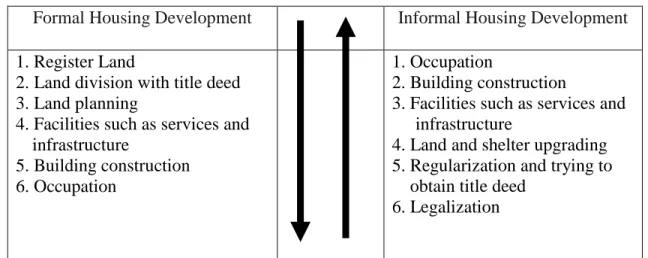
Although, formal housing is the legal basis of the planning agency which is developed within the structure of government rules, controls and regulations. As well as informal housing is illegal and consisted of unauthorized colonies and squatter settlements. There is something in common between formal and informal housing. Both of them have been incrementally developed over a period of time. What differs is the sequence of development anyway. The sequence of housing development in the formal and informal process usually occur in reverse order. The formal development follows planning regulations and land development procedures (Turner,1986). The future recommendations, in housing policies, point out that the in the formal processes the housing development follows a sequence of ‘land to build to people’. However, land is developed including a provision of infrastructure and services (Without knowing who will be the end user), then assigned to the intentional user with a title deed. In this land development order, all housing is developed in accordance with the planning guidelines and regulations. The final sequence is the occupation of the house by the user. This sequence is usually stunted because land delivery is quite slow and serious efforts hardly exist. (NHA, 1996).
On the other hand, There is a similarity between the formal and informal housing development. However, informal housing development follows a reverse sequence of the formal housing development. The sequence in the informal housing development process is from ‘people to land to build.’ People start occupying the land. Later, they develop it with all services they can afford. (Turner, 1986, Barros 1987). In this order, the acquisition of the title deed is the last in the sequence although it is not guaranteed. Following in Table 1 that shows the formal versus informal housing development processes.
11
Table 2.1: Formal Versus Informal Housing Development Processes
Formal Housing Development Informal Housing Development
1. Register Land
2. Land division with title deed 3. Land planning
4. Facilities such as services and infrastructure
5. Building construction 6. Occupation
1. Occupation
2. Building construction
3. Facilities such as services and infrastructure
4. Land and shelter upgrading 5. Regularization and trying to obtain title deed
6. Legalization
Source: (Mcleod & Mullard,2006)
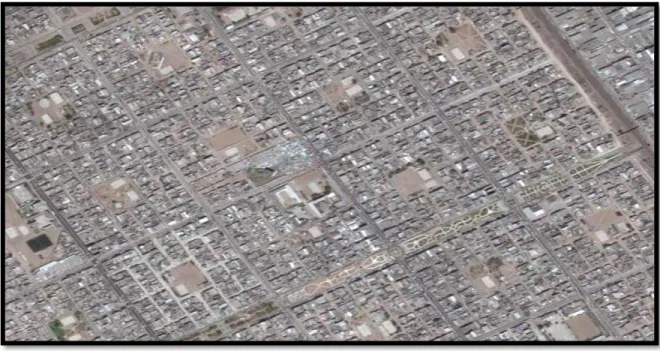
Figure 2.1: Housing patterns of informal and formal (Lattakia)
Source: google maps, edited by author.
Informal housing has been criticized, several emphasize the positive effect of it. Still, it has some advantages that cannot be ignored. It leaves strong effects on the housing stock (NHA,1996). (Greene&Rojas,2008) Also indicate about the positive side of the self-help incremental housing, for it immediately starts soon after land acquisition. Then, people go on to build shelters that provide their basic needs such as protection from natural phenomena and privacy. With the passage of time and funding, the households begin to consolidate their
12
dwellings. The majority of households consolidate their places from personal savings, microloans, and community aid. This process of consolidating the dwellings which takes into consideration the needs visions and priorities of the dwellers can take several years. From this argument, informal housing is studied under two expressions: help housing and self-help incremental housing processes which can be seen as a possible alternative that can be boosted with adequate technical and financial support for the poor. It is worth noting that the self-help incremental housing is frequently called self-help housing, self-managed housing that is an appropriate term. Nevertheless, what is different is that the self-help incremental housing indicates the construction is incremental. (Turner, 1982)
2.5 SELF-HELP HOUSING (SHH)
2.5.1 Characteristics
“Self-help” is a course of action in which low-income people are the major players in their own housing construction that will ultimately be improved. Furthermore, (Westendorff, n.d) defines self-help housing as the outcome of various activities leading to design, construction, maintenance and management of the physical structure and immediate surroundings of a permanent shelter for human beings. Self-help housing also includes renovations of existing buildings. This process includes tenements, industrial spaces or other structures that have not been occupied for lengthy periods. This can be done when new residents or others working with them undertake the improvements.
Still, views and counter views of the same issue can be seen. For example, Charles Abrams, an early critic of self-help housing models, contributes to the understanding of incremental housing models. For him, self-help housing breaks with more technological approach that the poor could not afford. For Abrams, self-help is nothing but a failure of institutions in providing the poor with more advanced, efficient, and affordable technologies. Consequently, these institutions or agencies push the poor to build on their own. Some of the shortcomings of self-help housing Abrams refers to are that self-help houses take a long time to build. Moreover, construction by families is defective due to the absence of experience in addition to the fact that efficient construction is not achieved since the modern techniques of
13
mass production are not used. John Turner, on the other hand, disagrees with Abrams. To him, the concept of self-help is not only as sweat investment by residents in their houses but also as the authorizing processes of owner-design and management. The primary aspect to the concept of self-help is that the residents are free and independent in their decisions. (Turner, 1976). Turner argued that such autonomy would provide the best results because the houses would be appropriate to the changing needs and circumstances of their dewllers (Turner&Fichter, 1972). Therefore, housing conditions in squatter settlements would be developed and improved over time primarily due to the individual efforts of the residents. He believes that the poor have the insight and the good judgment that enable them to visualize their own needs that they can address. (Turner&Fichter, 1972).
2.5.2 Types of Self-Help Housing
Self-help housing can be seen in three forms: users initiated, state supported, and state initiated housing programs (Harms, 1992).
2.5.2.1 Users initiated Self Help Housing
User-initiated self-help housing form frequently starts with the household obtaining a piece of land through legal squatting or un-registered subdivisions. In this form, low-income users commence the process and consolidate their dwellings little by little by themselves with no governmental aid or programs. Often this form produces low-quality housing and legal problems in both land acquisition measure and building regulations (Harms, 1992).
2.5.2.2 State Supported Self-Help Housing
The State Supported self-help housing starts by the local municipality or state offer that supports upgrading the settlements to minimum standards. It is important in this context to realize that the aid is often takes the form of technical support, infrastructure provision, and land possession. This form demands community participation procedures and the initiatives from Community Based Organizations (CBOs) or Non-Governmental organizations (NGO’s). This requires collaboration between professionals and non-professionals (Harms,1992). According to (UN Habitat, 2005), the state-supported self-help housing is a smart and affordable way of supplying sustainable shelter for low-income people due to:
14 a. It is formed on minimum criteria.
b. It integrates a permanent amount of equal efforts.
c. It is valuable due to the individuals and communities engaged in it and it gains building skills.
d. It meets people's real demand and levels of affordability.
e. It is flexible because of dwelling units are often designed to be extended over time. 2.5.2.3 State Initiated Self-Help Housing
State-initiated self-help housing is normally planned and regulated by national government or international agencies, the implementation of which requires participation from beneficiaries. It is important to know that state-initiated self-help housing and state-supported self-help housing differ significantly. In the first, the government offers much more aid, while in the second the aid is much less. As a matter of fact, the state initiated self-help housing implies two concepts which are concept of core housing; and site and service housing supported by the World Bank and other international organizations (Harms, 1992). Following are the concepts of core housing and site and service in detail in order to draw lessons from the state initiatives in supporting self-help housing approaches.
The concept of core housing means that the majority of low-income groups lack access to finance and as such opt incremental construction due to their financial standing. Actually, most low-income households start the process by building sections of their houses building materials they can afford after the acquisition of land. (Napier, 2002). Some of the principles of core housing as put by (Abrams, 1964) are:
a. It starts with a size quite enough to accommodate the typical family. b. It is designed to be enlarged by the household.
c. It is owned by the occupants by installment in both the original core and the extended structure
d. The core housing constructed from materials that allow expansion and which could be supplied through local material suppliers and producers.
15
e. The core housing unit must have access to water and sanitation since the occupation time. Also, it is designed to be comfortable as to adapt to changing climatic conditions. The concept of site and service comes from the awareness that governments cannot provide the complete serviced house. Furthermore, most government housing programs are not available to the majority of low-income families (Van der Linden, 1986). The program starts with providing the land with all its utilities such as sewage system, water supplies, roads, and electricity. This accelerates the process of improving the housing. The World Bank supported strongly such a concept by financing similar pogroms in various countries in South America, Asia, and Africa. Site and services can be seen as a means of solving the problem of squatter settlements that are expanding at the time. In other words, the governments should provide a plot of land and the infrastructure such as drainage systems, electricity, water supply, roads or a sanitary network while the households should contribute to the building of the houses. The financial procedures used for most of these projects demand beneficiaries to repay the money in terms of service charges.
According to (Goethert&Goethert&Chavez, 2011) there are advantages and disadvantages. Others have different opinions of site and services. The advantages of site and services are: site and services concept helps the government to focus on providing land for the low-income people as a role of city growth plans. Also, it helps to gives households legal status and control markets. Moreover, it organizes, facilitates and reduces the cost of housing production for government and homeowners. Furthermore, it helps to use savings for shelter and promotes community cohesion and collective responsibilities. Finally, it provides channels for complementary social assistance programs and improves coordination among service agencies, infrastructure, and utilities. However, the difficulties of sites-and-services are: it needs both the political commitment and the political to address land assembly and acquisition.
16 Figure 2.2: The Starter Core House Types
Source: (Abrams, 1964).
2.6 PHASES OF SELF-HELP HOUSING DEVELOPMENT PROCESS
It is possible to distinguish three phases of self-help housing identified by (Greene&Rojas,2004). These include; access to land, the construction of basic housing core, and the incremental improvement of the dwelling
2.6.1 Access to Land
The first step in self-help housing development process entails access to land, with appropriate location, by the low-income households. This step permits low-income families to build their dwellings and to benefit from basic services and job opportunities within the urban area. For (Payne, 2002), the priority of the poor urban households is to obtain a way to land where they can take full advantage of their livelihood opportunities and this is usually located in urban areas where competition for land and land prices are extremely high. In this context, (Greene&Rojas, 2004) maintain that low-cost or free land is highly important in
17
making the total process possible. (Payne, 2002) further affirms that the central location is carefully chosen because it provides access to transportation. The land prices are chiefly governed by the location and the future development of the land. In reality, the two factors, already mentioned, influence the land prices and explain why low-cost land can be only located on the city periphery that is deprived of infrastructure as well as basic social services. In some cases, nevertheless, incremental housing construction takes place in a central location by illegal seizure of the public land.
2.6.2 Construction of Basic Housing Core
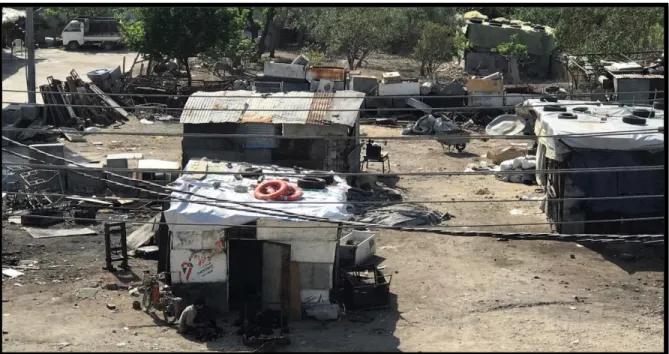
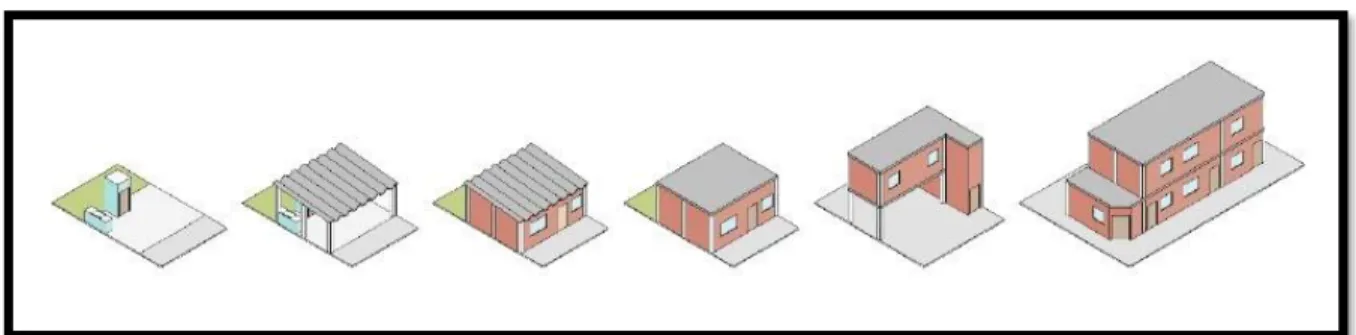
The second phase of the self-help housing development is construction of basic housing core. Upon accessing the land, low-income people start construction. The core unit offers them a shelter that protects them from bad weather (Figure2.3). Actually, the materials used for this construction are mostly not durable such plastic materials, cardboard, used tin sheets, or wooden pallets. In some cases, households use local materials that are affordable like burnt bricks and cement. All in all, these units lack basic services like sanitary systems, kitchens, electricity, water, and roads. It is important to realize that the construction and design are completely done by the households who make use of native equipment and local materials (Greene&Rojas, 2004).
These units, however, protect people from eviction. In this context, their construction is financed entirely from personal sources. Consequently, this defines both the type of housing unit and the type of materials used. (Hansen&Williams1998) argue that availability of household income is the most significant factor that determines how the basic housing core is constructed. More importantly, these households build the basic housing core to reveal their living standards. They avoid debts as much as possible. However, when it becomes necessary for them to incur debts, they choose shorter debt periods so that they can meet other pressing needs such as education for children, food, and travel costs (Smets, 1999).
18
Figure 2.3: The starting basic housing core in informal settlement. Lattakia, Syria
Source: Author.
2.6.3 Incremental Improvement of The Basic Housing Core
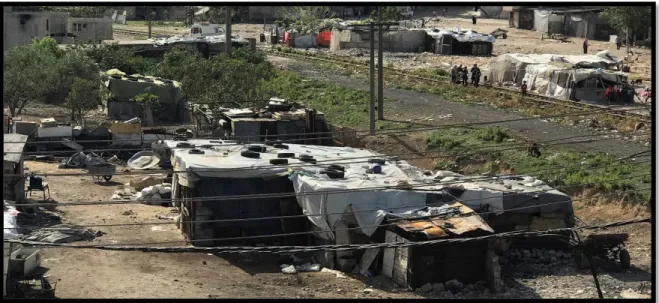
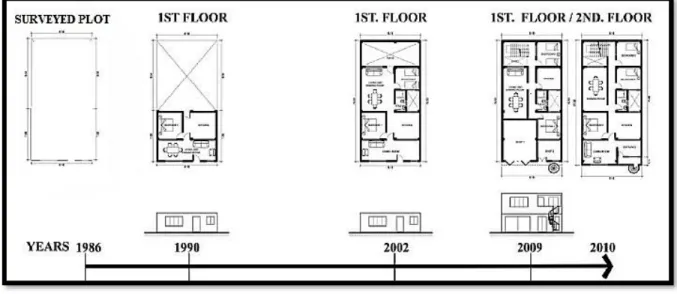
The third phase of self-help housing involves incremental improvement of the basic housing core. After completing the housing core possession, households go on to enlarge and improve their dwelling taking into consideration the family size, priority, income changes. At this stage of the expansion, they do not take into consideration the quality, rather the need for accommodating more additional members of the family. (Greene&Rojas,2004) (Figure2.4) (Figure2.5). This stage is characterized by minimal infrastructural services as well as conflict of interest between beneficiaries and public sector agencies. The beneficiaries are much highly preoccupied with consolidating their properties and maximum protection against natural phenomena, while public sector agencies recommend improvement of sanitation services. At this stage, improving the quality of the homes in case the initial expansion has taken place, considered the longest phase in the incremental housing development process. It involves further complex operations and technical expertise.
19
Figure 2.4: Incremental improvement of the basic housing core in informal settlement. Lattakia, Syria
Source: Author
Figure 2.5: Incremental improvement of the basic housing core in informal settlement. Lattakia, Syria
20
Figure 2.6: Self-Help Housing Development Process
Source: (Greene&Rojas,2004)
2.7 CRITICS OF SELF-HELP HOUSING APPROACHES
The concept of self-help housing has come under attack by many scholars such as (Burgess, 1982), (Ward, 1982) and (Mathey, 1992). For them, self-help housing produces low-quality housing as the households have neither the skills nor the money builds decent housing by themselves. The critics assert that self-help housing, as defended by Turner, goes against the necessary planning principals, and it can only provide short-term solutions to urgent housing problems. Furthermore, the request for households to manage their own housing development without professional skills assistance usually gives informality and low standards. The governments, furthermore, have limited resources for buying and improving the land to please the large demands of low-income housing. (Bredenoord&Lindert, 2010) (Greene&Rojas, 2008).
2.8 SELF-HELP INCREMENTAL HOUSING: CONCEPTS
The rise in the self-help incremental housing concepts witnessed in the1970s-1980s. It began to see a reasonable way in which low-income households’ access housing. Especially, (Turner, 1976& William, 1967) analyzed one of the most successful examples in the informal housing development in Peru and how the construction process experienced by low-income
21
people. Turner spotted the 'progressive development' of the informal housing which was a parallel between the social process of households and the gradual improvement and expansion of the shelters (i.e., consolidation) which people built by themselves. Since then, the concepts of self-help incremental housing received a lot of theoretical development. (Turner, 1976)
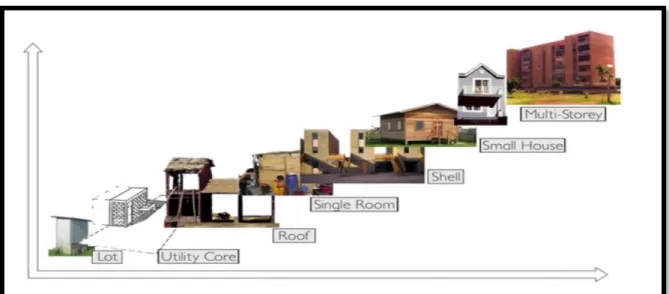
Figure 2.7: Incremental Housing Types
Source: edited by author.
Figure 2.8: Incremental Housing Process Development
Source: edited by author.
It is important to understand factors behind incremental hosing. In other words, one should understand the reasons that trigger the incremental housing growth. (Tipple, 2000) points out that both cities and households suffer from ‘housing stress’ which forces them to expand their
22
dwellings. The method and form of the incremental housing highly depends on the private needs of the occupants. From (Gattoni, 2011), some of the triggers include: changes in household sizes and changes in household income and strategies and priorities in space.
a) Changes in Household sizes
The households’ growth makes the needs for space more and more important. The occupants affect the incremental housing. In other words, the single family or the extended family has large impact on the process.
b) Changes in Household Incomes
Incomes play a crucial role in the expansion and improvement of the dwellings. The improvement of the households’ dwellings is attributed to the increase of income levels. With additional incomes, dwellers develop their household into a fully serviced house that has all essentials such as water, sanitation and electricity, etc.
c) Strategies in Space
The strategies differ among households for develop and expansion their home. Several households such as average and high income expand their homes and utilities to meet their needs in space, cultural requirements and functional priorities. Others such as low-income households are far more pragmatic. They improve their dwellings in proportion to their income. Therefore, their immediate needs are quite important.
2.8.1 Factors supporting Incremental Housing
For (Acioly,2003) there are some factors that support incremental housing process such as, building material, finance, infrastructure, labor, and land are equally important in incremental building well-functioning dwellings. In fact, these guarantee the possibility of incremental decent dwelling.
23
Figure 2.9: The Incremental Housing Diamond of Perfect Equilibrium of Inputs
Source: (Acioly, 2003)
a) Land Tenure and Location
Determining the location for the low-income housing is highly important to guarantee the success of the project. As mentioned elsewhere in this study, the land chosen should have affordable transport links to the city center for the low-income groups.
b) Housing Finance
Without sufficient housing construction finance, developing programs such as site and service programs are impossible. Similarly, the family savings, the public subsidies and mortgage loans usually finance the housing construction. The wealthy people have resources to purchase outright or construct their dwellings. In this context, access to housing loans and mortgages is restricted to people who have normal incomes such as the upper-class and middle-class people. The lower class, on the other hand, people who do not have regular incomes are denied the access to such loans. For (UN Habitat,2011) (Stein&Castillo,2005), various sources can be used for housing finance in housing development process. These
24
sources vary from, informal loans from colleagues and family, transference of funds from families working aboard, informal loan suppliers and household savings.(Figure 2.10) Figure 2.10: Supporting Incremental Housing Through Microfinance
Source: (Habitat for Humanity, 2014)
c) Services and Infrastructure
The level of infrastructure, timing, standards, and service provision are the chief factors that guarantee the success of incremental housing initiatives. In this context, a careful balance between quality of service/infrastructure or affordability must be taken into consideration. The low-income households cannot afford high levels of standards for infrastructures and services. The balance, as mentioned before, can be accomplished only when low-income groups start to define their own priorities and set the standards for infrastructure and services. (Wakely& Riley,2011)
d) Planning Standards and Technical Support
Planning for low-income housing must offer standards that meet the needs of low-income groups. Therefore, to implement affordable housing for the low-income households, low standards have to be used. Therefore, planning and building advisory services that provide
25
technical guidance on good practices specific to incremental housing must be established. (Wakely&Riley, 2011).
e) Community Participation
In fact, self-help incremental housing programs such as site and services program are impossible without the community participation, for they demand supports from the public sector by the provision of training, credit, and technical assistance (Erguden, 2001). In reality, most programs rely on community organizations and community leadership to make the projects possible. Therefore, community organizations have played an important role in the self-help incremental housing process, for they manifest collective concerns and needs. In brief, when the community participates in the incremental stage of development, success is guaranteed.
f) Private Sector Participation
The private sector also plays a vital role in the self-help incremental housing process. Furthermore, it provides an opportunity for small private businesses to share in the low-income housing development. Those private businesses can provide large support such as providing infrastructure and provision of services to the informal settlements where the local authorities cannot do or reluctant to do. Besides, they support the incremental housing process by providing building materials and local building technologies. However, private sector participation usually fails because those involved in the process find in it a financial risk they do not want to take. (Akely&Riley,2011)
İn conclusion, this chapter gives an overview of the characteristics and improvements surrounding self-help incremental housing in the context of the informal settlements. Due to the importance of improving the informal settlements, the study will show some case studies of self-help incremental housing in some different regions around the world.
26
3. SELF HELP INCREMENTAL HOUSING: A CASE STUDY
This chapter deals mainly with two case studies. First is the city of Lima in Peru in the period of 1970’s, with an emphasis on the successful examples of self-help incremental housing projects constructed in that period. The justification of choosing Peru as a good example for the possible solution for the self-help incremental housings was due to the support of the World Bank, the enlightened government and the civil and local organizations. Moreover, being the first is important. The World Bank constructed one of the first site and services projects in Peru. Also, the WB initiated a large scale, minimal-cost solution for site and services programs. On the other hand, Burkina Faso in the period of 1980’s provides another example of successful programs initiated a large-scale surveyed program following a master plan that had been developed with A Dutch cooperation. This was like a challenge trying to solve the problem of informal settlements due to the bad economic situation of the country in that period.
3.1 PERU, 1970’S
In the early 1970s, the World Bank constructed the first site and services projects in Latin America, Africa, and Asia. For instance, the government of Peru launched large-scale and minimal-cost solutions in and around Lima. The National Social Mobilization System SINAMOS transported and settled low-income communities and residents of squatters, in vast zones of empty land to the south and north of the capital city. These settlements consisted surveyed plots and organized communities but with no urban services. The World Bank played a crucial role in supporting sites and services projects by providing communal water fountains and core housing units. The purpose of the surveyed plots was to provide housing solutions for the majority of low-income households who spilled out into the cities from the countryside. The British architect, John F.C. Turner researched and executed the programs. For him, when left to their own devices, they can produce the most efficient possible housing solutions for themselves. From his observation came out the well-known phrase “Freedom to Build.” (Williams, 2000)
27
Figure 3.1: Diagram of the ascendant development in squatter settlements in Lima, Peru.
Source: John F. C. Turner Archive
Figure 3.2: Basic core units designed for self-built extensions 1958 in Lima, Peru.
28
Figure 3.3: Family stage and evolution of their incremental self-help house in Lima, Peru.
Source: John F. C. Turner Archive
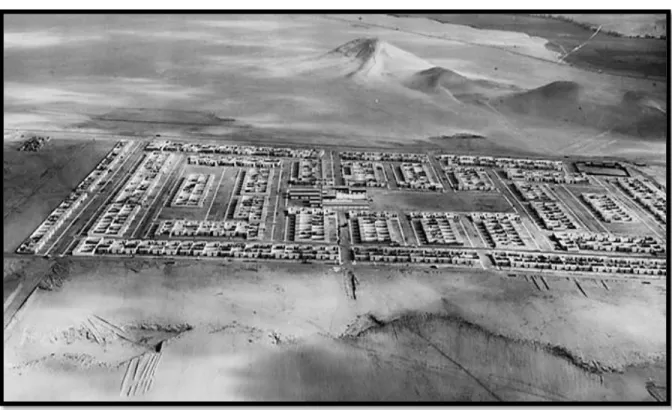
The first settlement was Comunidad Urbana Autogestionaria Villa El Salvador CUAVES (self-managed urban community Villa El Salvador). The design and surveyed plots characterized the settlement. The design was a vast network of adjacent areas of 400 x 400 meters. The center of each was dedicated to community facilities. SINAMOS collaborated with the military. They first used tanker trucks to provide water, the latter established field clinics to provide medical care for the population. Next, The World Bank was encouraged to upgrade Villa El Salvador in 1975. The World Bank provided water and electricity to the northeast of the Metropolitan area. After four decades, Villa El Salvador was converted into the second largest city. The housing core unites developed into one to three and four stories. The public areas in the middle, developed in several ways, they had a lot of facilities such as a health center a school and playground. Unlike other public spaces in informal settlements, they have become crime and violence free. (Gattoni & Goethert &Chavez, 2011)
29
Figure 3.4: The grid network that forms the surveyed plots in Villa El Salvador, Peru.
Source: Google Earth
Figure 3.5: Sites and services, core house evolution in Villa El Salvador, Peru.
30 3.2 BURKINA FASO, 1980’S
In the mid-1980s, Ouagadougou presents another successful example of surveyed plots programs that was supported by the World Bank. Thomas Sankara’s regime initiated a large-scale surveyed plot program following the master plan of the city. The assistance of Dutch cooperation had developed this program. The migrating low-income families who were living at the city limits moved to a residential surveyed plot program where each family was given a plot of land. Similar to Peru, the World Bank provided the essential services such as water and fuel for cooking food.
Figure 3.6: A large-scale surveyed plot program in Burkina Faso
31 Figure 3.7: Housing in Burkina Faso
Source: (Chavez, 2011)
Furthermore, streets were named to give the residents a sense of belonging and a sense of citizenship, i.e. the low-income people have all the abilities and rights as the city dwellers. (Chavez, 2011)
Figure 3.8: Housing in Burkina Faso
32
4. LATTAKIA, SYRIA A CASE STUDY
After the two successful examples of Peru and Burkina Faso, Lattakia it has potential as a self-help incremental housing whereas it turns out to be an initiation for self-help housing then it moved on incrementally. Lattakia suffered from overpopulation in both pre-war period and post-war period. However, the current war aggravated the problem of informal housing. Displaced and evicted people found safe haven in Lattakia that remained distant from warring factions. Displaced people could not afford to live in the city; therefore, they settled at the city limits that were already overpopulated by informal housing dwellers. Located at the city limits, the Corniche region / Al-Rammel Al-Phalastini (Figure 4.5) is a vacant land that was given by the government without formal planning to the Palestinian refugees to build on in 1948. Hence, it is deliberately chosen as a case study of self-help incremental housing, where people build their houses slowly. At that time the government intervention was so limited if there is any. In other words, the region developed incrementally because of the absence of government, or any other source in the process. Consequently, this gave way to huge and uncontrolled growths of population that led towards the phenomenon of haphazard settlements creating indecent living conditions. Taking what I already demonstrated into consideration justifies selecting Corniche region in Lattakia for the study.
4.1 HISTORICAL BACKGROUND OF LATTAKIA ENVIRONMENT
Lattakia figure (4.1), the largest city on the Mediterranean, is the principal port city of Syria, as well as the capital of the Lattakia Governorate. In addition to serving as a port, the city is a manufacturing center for surrounding agricultural towns and villages. According to the 2004 official census, the population of the city is 383,786. It is the 5th-largest city in Syria. It is located in western Syria 348 kilometers (216 mi) north-west of the capital city, Damascus, bordering Turkey to the north. The north-eastern tip of Cyprus is about 68 miles (109 km) away. The governorate has a reported area of either 2,297 square kilometers (887 sq mi) or 2,437 square kilometers (941 sq mi). Lattakia City is located in the Lattakia District in the northern portion of Lattakia Governorate.
33
Named by the Canaanites Ramitha in the 2nd millennium B.C., Lattakia was rebuilt by Slocus, the founder of the Seleucid State (2nd century), who renamed it Laodicea. Later it witnessed a period of Roman and Byzantine rule before the Arab conquest of 637 when it became to be known as Lattakia (Arabic: ةَّيِقِذ الَلا al-Lādhiqīyah). Before 1516, Syria was part of the Mamluk Empire centered in Egypt. The Ottoman Sultan Selim I conquered Syria after defeating the Mamlukes in 1516. When he brought the end to the Mamluk Sultanate, Syria became part of the Ottoman Empire. In 1617, he reorganized Syria into one large province or eyalet named Şam (Arabic/Turkish for "Syria"). The eyalet was subdivided into several districts or sanjaks. In 1579, the Eyalet of Tripoli was established under the name of Tripoli of Syria (Turkish:Trablusşam) (Arabic: ماشلا سلبارط). The Eyalet of Tripoli included the Sanjaks of Tripoli, Lattakia, Hama and Homs. (Phillips, 2010)
Source: google, 2018 Source: Municipality of Lattakia
34 4.2 FORMAL SETTLEMENT IN LATTAKIA
Housing areas in Lattakia, as elsewhere in Syria, are divided into three main areas: a housing area within master plan, boundary housing in the expansion area and housing as an informal settlement, i.e. areas that are inhabited by poor group who are less able to choose their own house design or modify it or change it due to economic status.
In this context, ‘formal housing’ refers to assimilated spheres, specific forms, elements or procedures that have become standards, the norm, rule, or convention. The master plan for Lattakia (figure 4.3) was issued for the first time in 1927. The area of which was 71 hectares. It was developed in 1944, 1964, 1991, and 2008 to be 8545 hectares. The housing area covered 61, 18 %, housing in the expansion area covered 26, 21 %., and the housing in informal settlement area covered 21, 61%.
Figure 4.3: The development of master plan for Lattakia City
35
4.3 INFORMAL SETTLEMENT IN LATTAKIA AS A WHOLE
The phenomenon of informal settlement in Lattakia dates back to many decades ago. It attracts a large number of people due to the availability of services and low prices. Nevertheless, informal settlement which lacks urban planning, leads to a lot of problems associated with the development and the society. Generally speaking, the phenomenon is one of the biggest problems on both global and local levels. Its emergence is due to several factors starting from population growth, rural-urban migration, drought, and the shrinkage in farming lands. Perhaps the most important factor is the job opportunities in various sectors in the city; hence they find no problem in living in houses lacking decent conditions and services.
In reality, informal settlement exists in several areas in Lattakia. They exist in the areas of Al-Rammel Al-Janoubi / Al-Rammel Al-Phalastini (Palestinian Sand) and Al-Daedour. They are occupied by thousands of people coming from various governorates in Syria. According to the residents of these areas, basic services are available and the living conditions seem to be okay. Above all, prices are low compared with other areas.
Figure 4.4: Informal settlements in Lattakia
36
Several problems faced the informal settlement in Lattakia, such as the failure of issuing the city's urban planning since 1965 has been one of the chief factors behind the emergence of informal settlement. "I work at several sites. However, the suspension of housing permits by the municipal and other governmental administrations for a long period of time made people resort to illegal options in construction. This delay also made the prices of houses soar forcing people into informal settlement, whose population is so dense, and setting up more pressure on the state and the services provided for them," Contractor, Khalid Al-Husein said.
Other problems created by informal settlements are difficulties of their maintenance and quality maintenance at the same time. “Informal settlement sites cost too much. They cost much more than the urban-planned sites. Their horizontal sprawl requires large services for the telephone and electricity cables in addition to those for the sewage system. Stretching over a large area of land, those buildings of a single-story houses or two- story houses will collapse at any earth tremor causing human, social and economic catastrophe, for they lack the technical requirements of construction," Mr. Husein added.
People involved in this problem maintain that informal settlement can be eliminated through a multi-decade process by utilizing various methods. Most importantly, Lattakia informal settlement must be planned by adopting global experiences. However, local peculiarity must be taken into consideration. To eliminate informal settlement, the location must be determined as a start. Then towers, with all technical requirements, must be built nearby. Afterwards, one can move to another block and so on. Some new self-planned sites built their own roads, their own sewage system and other services. As an example, Skubeen and Sinjwan are planned by collaboration between government and civil society.
The development of palestinian Corniche Region started in early 1950s with the coming of the first wave of Palestinian refugees. They occupied makeshift houses in Rammel Al-Janoubi / Al-Rammel Al-Phalastini (Palestinian Sand) making the first informal settlement. In the 1970s, Lattakia witnessed urban and economic boom that produced another informal settlement site such as Al-Daedour. ''Many people failed to heed these informal settlement locations. This phenomenon will expand endlessly devouring farming lands and green spaces surrounding the city. The prices of apartments in city were not high in comparison with
37
income at that time, but the complacency in controlling this phenomenon and the failure to heed its seriousness allowed it to expand to other areas in the city,'' said member of the City Council, Alaa Ghanem. It is important to realize that the Corniche Region remains informal settlement simply because the government cannot re-evacuate the Palestinians for political, human and economic reasons. In other words, the government cannot get them back to Palestine, in addition to the fact, that there are no other places in Syria to re-settle them. The Syrian government insists on their rights to return to their homeland: Palestine; therefore, it is reluctant to interfere. Hence the problem persists. Actually, the land without urban planning encourages informal settlement.
4.3.1 Corniche Region Today with Population Growth
Sites of informal settlement, mentioned above, are hierarchically classified according to their problems. Al-Rammel Al-Phalastini / Corniche Region comes at the top because it is entirely provided with all essentials such as electricity, potable water, and sewage system. However, due to the limited intervention of the government, it has serious problems because of bad planning, narrow roads, and insufficient health care. The essentials already mentioned are of poor quality, anyway. One can say that these ‘essentials’ does not go hand in hand with the population growth. The government stopped the development, while the population kept increasing. The Palestinians, especially in 1960s, had a large increase in birthrate on a limited space. This encouraged the horizontal buildings.
Municipal Administration Modernization (MAM) Program was selected as a data source for this study. The program supported by EU aimed at providing high quality support to the Ministry of Local Administration and Municipalities. Furthermore, Helping Syrian cities and the Ministry face the new challenges and improve their ways of working. The project focused on local, regional, economic and social development in Corniche Region. This objective was pursued in different parts of Syria, and in different types of cities. The Municipal Administration Modernization (MAM) program analyzed the Corniche Region from different aspects in cooperation with the municipality of Latttakia in order to improve