City, University of London Institutional Repository
Citation:
Kutlay, M. and Karaoguz, H. E. (2017). Neo-developmentalist turn in the global political economy? The Turkish case. Turkish Studies, 19(2), pp. 289-316. doi:10.1080/14683849.2017.1405727
This is the accepted version of the paper.
This version of the publication may differ from the final published
version.
Permanent repository link:
http://openaccess.city.ac.uk/20793/Link to published version:
http://dx.doi.org/10.1080/14683849.2017.1405727Copyright and reuse: City Research Online aims to make research
outputs of City, University of London available to a wider audience.
Copyright and Moral Rights remain with the author(s) and/or copyright
holders. URLs from City Research Online may be freely distributed and
linked to.
City Research Online: http://openaccess.city.ac.uk/ [email protected]
Neo-developmentalist turn in global political economy? The Turkish case
Dr Mustafa Kutlay
TOBB University of Economics and Technology
Dr Hüseyin Emrah Karaoguz
Central European University
Pre-published version of the article published in Turkish Studies,
https://doi.org/10.1080/14683849.2017.1405727
Abstract
The 2008 global economic crisis galvanized the debate on neo-developmentalism as the pendulum of economic thinking began to swing away from neoliberalism. The current shift in the modalities of market governance mainly deals with the ways through which industrial policies can be crafted in a more open-economy setting. Accordingly, the post-crisis literature turns a keen eye on the state’s developmental role in the research and development (R&D) sector in an age of ‘bit-driven’ global political economy. On that note, the nature, properties, and limits of state policies of emerging powers in this particular realm are becoming increasingly central but remain an understudied theme. This article discusses the R&D policies of Turkey from a state capacity perspective and questions the rationale of those policies by linking the state’s transformative capacity to the discussions on distributive pressures. Drawing on twenty-one in-depth semi-structured interviews, this article assesses Turkey’s R&D policies.
Key words: governing the market, Turkish political economy, R&D sector, state capacity, neo-developmentalism
Introduction
The state has made a strong comeback after the global financial crisis in 2008 as the liberal economies plunged into a severe turmoil whereas state-led heterodox economic
models seemed to survive the unprecedented shock.1 The crisis put a break to the
ascendance of neoliberal globalization as the reigning ideology and conventional economic policy paradigm over the last three decades. During the heyday of neoliberalism in the 1990s, the state was perceived as a ‘problem’ for the efficient functioning of the markets. Neoclassical political economists argued that rational private actors operating in efficient markets are more capable than states in enhancing national economic performance. Neoliberalization was seen as the most efficient way for
sustainable economic growth and human development. Therefore, deregulation, privatization, and reduction of the state were promoted as the founding pillars of the
so-called Washington Consensus.2 This conventional wisdom was forcefully supported by
international organizations like the IMF, WTO, and World Bank as several developing economies were advised to implement radical liberalization policies through structural adjustment programs.3
A comparative analysis, however, suggests that countries that outperformed their peers over the last thirty years in terms of development and integration into the international
economy are those that implemented heterodox economic policies.4 As Dani Rodrik puts
it, ‘globalization’s chief beneficiaries are not necessarily those with the most open
economic policies’.5 Drawing from ample empirical evidence, political economists
increasingly concentrated on the role of ‘state capacity’ in the formulation, implementation, and change in growth-enhancing economic policies. The recent literature demonstrates that state capacity is a precondition, not an obstacle to improve economic development performance.6
The 2008 global economic crisis galvanized the debate on state capacity as the pendulum began to swing away from neoliberalism.7 The current shift in the modalities of state
intervention, however, goes beyond the ‘governing the market’ approaches that put emphasis on selective industrialization and protectionist foreign trade policies.8 Given
that the ‘developmental space’ for emerging countries has shrunk dramatically,9 the
current conceptual and empirical work mainly deals with the ways through which industrial policies can be crafted in a more open-economy setting.10 One particular area
that emerges for states to intervene in the functioning of the market and achieving their developmentalist goals is the realm of technology. Accordingly, the post-crisis literature, in particular, turns a keen eye on the role of state in fostering research and development (R&D) in the age of ‘bit-driven’ global political economy.11 It appears that ‘R&D is the new industrial policy’ of our age12 and several states adopt R&D strategies in a way that can be considered ‘developmental state [policies] in disguise’.13 Mariana Mazzucato, for
instance, demonstrates that ‘the state has been behind most technological revolutions and periods of long-run growth.14 This is why an “entrepreneurial state” is needed to engage in risk taking and the creation of a new vision, rather than just fixing market failures’. On that note, the nature, properties, and limits of state policies of emerging powers in this particular realm are becoming increasingly central but remain an understudied theme. What kinds of R&D policies do the states in emerging powers implement and what are the developmental consequences of these policies?
Having taken the conceptual and empirical lacuna into consideration, this study discusses the R&D policies of Turkey, as it constitutes an illustrative case for broader literature on
state capacity, which also has implications on the discussions on populism. To begin with, a single party government has been ruling Turkey for more than 15 years, which makes the country an important case in terms of political stability and leadership that is constantly highlighted in the developmental state literature. Second, the Turkish state adopted a new set of policies in the post-2008 period, especially in the R&D sector, to shift the production structures of private firms and improve the place of the country in the hierarchy of the international economy. Third, Turkey has become a striking emerging power that has demonstrative effects for a group of countries understudied in the recent literature. Last, a detailed investigation of the Turkish state’s transformative performance signal that populist motivations prevail in the formulation and implementation of R&D policies. As known, the prevalence of populist tendencies in a policy-making process is not only a traditional problem in Turkey but also a common concern in several developing countries. Given the fact that R&D policy-making is more often than not considered to be a technical and a rational process, the questioning of populist inclinations in relation to state capacity provide important insights on the broader discussion on imminent distributive pressures in large developing countries.
The article proceeds as follows: The second part lays out the conceptual framework. The third part reviews the contemporary Turkish political economy with particular reference to the state’s R&D policies. Drawing on in-depth elite interviews conducted with bureaucrats and relevant stakeholders, and employing ample descriptive statistics, the fourth part turns a critical eye on the empirical developments in the post-2008 Turkey. The final part concludes the paper by extrapolating certain lessons for the broader literature. In regards to the interview method, twenty-one interviews are conducted in Turkey during November 2014 and June 2016 in different time periods. Except for one, which was conducted over the phone, all interviews were conducted face-to-face. Nineteen interviews lasted for more than half an hour and nine of them more than an hour. Purposive sampling in the form of ‘information-oriented selection’ is used as the main sampling strategy.15 The goal of the strategy has been to ‘maximize the utility of information from small samples and single cases,’ whereby ‘cases are selected on the basis of expectations about their information content’.16
Conceptual framework: Transformation of the neo-developmental state
The state’s role in the economy rests on a crucial question: ‘How could we square a state that was strong, but not predatory, credible to the private sector but not captured’.17 The developmental state framework offers two crucial criteria to determine the social foundations of the state,18 which we can classify as ‘internal’ and ‘external’ aspects of state capacity.19 The ‘internal’ qualification for assessing state capacity is the degree of bureaucratic autonomy.20 The level of insulation of bureaucracy vis-à-vis private interest
groups reflects the degree of state autonomy.21 In addition to autonomy, the internal capacity of the state depends on the degree of public bureaucracy’s meritocratic qualifications. Accordingly, internal capacity is measured with reference to the approximation of the existing bureaucratic structures to the Weberian ideal type. If the bureaucracy is organized in line with meritocratic recruitment, objective career promotion, and performance-based monitoring procedures, the state in question is more likely to have autonomy vis-à-vis economic interest groups.22 It also decreases the rent-seeking motivations on the part of the bureaucratic cadres and helps to avoid ‘state capture’. The crucial point, however, is that bureaucratic insulation is different from
isolation. Both Peter Evans’s ‘embedded autonomy’ concept23 and Linda Weiss’s
‘governed interdependence’ framework24 necessitate an active bureaucracy that has
regular and institutionalized deliberation channels with private economic elites in order to overcome collective action problems (see below). As put forward, state bureaucrats must be able to ‘foray outside the state with good coats rather than huddle inside insulated structures’.25 Yet, this interaction should not pave the way to degenerating and rent-seeking patterns of the state-business relationship. The only way for sustaining insulation-integration balance is to build a Weberian bureaucratic structure exempt from arbitrary political interference. Thus, in certain contexts the term ‘autonomy’ directly refers to the interplay between political elites and bureaucrats by questioning the bureaucracy’s relative decision-making power vis-à-vis the political leadership.26 As
Peter Evans argues, ‘in the absence of a coherent, self-orienting, Weberian sort of administrative structure, embeddedness will almost certainly have deleterious effects’.27 The ‘external’ capacity of a state refers to the ability to manage its economic environment and its relations with business groups. One can define two ideal types of state-business relations as heuristic analytical devices. On the one edge of the spectrum, there is the integrationist/collaborative type of state-business relations, whereas the rent-seeking type takes place at the polar opposite. The integrationist/collaborative type mainly refers to dense interpersonal and institutionalized networks that motivate and guide private actors
to make productive use of state support.28 The rent-seeking type of state-business
relations, on the other edge, refers to a sub-optimal equilibrium in which bilateral interactions lead to the waste of public resources for the sake of inefficient private purposes, which Bhagwati labelled as ‘directly unproductive profit-seeking.’29
Three factors inform the modus operandi of the public-private relationship. The first one concerns information flows. High-quality information flows facilitate collective goal setting by decreasing the information asymmetry between the parties through shaping expectations and signalling the credibility of mutual commitments.30 The lack of dense policy networks entwined by regular and high quality information exchange is likely to increase the motivation of private actors to squander public resources. The second factor
concerns credibility. In the absence of credible commitments on the part of the state, private actors are less likely to respond to the state signals. As argued, ‘enacting policies
that lack credibility can be worse than doing nothing at all’.31 The problem of many
developing states is low government credibility, which stems from frequent changes in
government policies.32 The weak government credibility directs market players to
prioritize only short-term interests rather than long-term productive commitments to handle the imminent risks emerging from ambiguous state policies. The third, and final, factor concerns reciprocity. Establishing information networks and building interpersonal trust is sustainable only if the relationship is based on solid institutional foundations.33 The state’s external capacity, therefore, stems from its ability to craft effective performance and monitoring criteria in return for credible commitments to private
actors.34 Otherwise, the subsidies and other support mechanisms might enfeeble the
conditionality-based performance and inform corrupt practices.
The conventional characteristics of a developmental state—though still relevant—must be updated so as to adjust for the current stage of global capitalism, which Peter Evans aptly called ‘bit-driven knowledge economy’.35 The new strands of development theories acknowledge the increasing importance of state capacity in setting collective goals, fostering ideas, and promoting the capabilities of individuals, particularly in the realm of high technology production in the age of the bit-driven knowledge economy—the backbone of which is the R&D sector. For instance, new growth theory suggests that the direction of development is shifting from the accumulation of physical capital to the ideas and knowledge. Accordingly, on-going paradigm shift avoids the constraint of diminishing returns and enables increasing returns to scale.36 The capabilities approach
also underlines the centrality of deliberative institutions that promote human capabilities and foster free and creative thinking so as to exploit new development opportunities.37 This suggests that new approaches highlight the increasing centrality of state capacity because ‘ensuring maximum possible access to ideas that are tools for the further expansion of knowledge requires active state involvement, sometimes in opposition to the private owners of those assets’.38 As the argument goes, ‘to facilitate 21st century
bit-driven growth, the state must be agile, active, resourceful and able to act independently of private interests whose returns depend on restricting the flow of knowledge’.39 Thus, a state’s ‘external’ capacity, in particular, must rely on an extended understanding of ‘embeddedness’ including universities, different divisions of public bureaucracy, business actors, and broader segments of civil society.40 The rest of the paper applies the
conceptual framework to the Turkish case in the R&D sector. First, however, we shall provide a brief overview of the Turkish political economy and the state’s R&D policies in the next section.
The political economy of Turkey’s R&D policies
The political economy of Turkey has undergone a considerable transformation over the last fifteen years. Following the February 2001 crisis, the coalition government of the time overhauled Turkey’s fiscal and financial regime along with the creation of new pro-reform coalitions. The transformation strongly showed a quality of a paradigm change since the state’s fiscal profligacy and lax financial supervision were replaced with a ‘regulatory state paradigm’ that precipitated strong fiscal and financial regulation.41 Following the crisis, a bold and comprehensive reform package was put into implementation, the aim of which was to fundamentally [transform] the functioning of the state through a three-pronged approach: fiscal consolidation, financial restructuring, and structural reforms to ensure the state’s fiscal and financial sustainability. In addition, the monetary policy moved toward inflation targeting as the Central Bank of the Republic of Turkey was given operational independence in maintaining price stability.
On 3 October 2002, in the first national elections following the economic crisis, Turkish
voters swept aside established parties. As a result, the AKP (Adalet ve Kalkınma
Partisi/Justice and Development Party) ended up with a two-third majority in the parliament, which put a decisive end to the long-lasting interlude of shaky coalition governments. The elections constituted a new critical juncture in the fortune of the
economic reforms enacted in the aftermath of the 2001 crisis.42 The AKP leadership
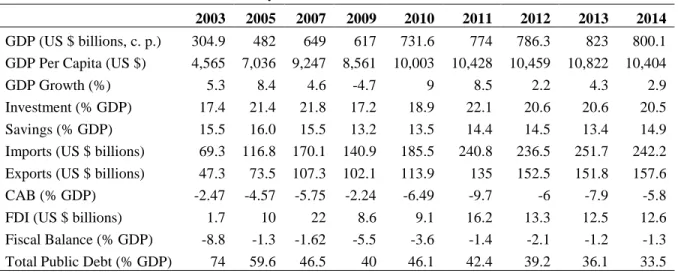
owned the IMF-induced reform program along with a quest for EU-membership, which in turn, paved the way for the consolidation of a reformist virtuous cycle. The AKP’s adherence to the main contours of the reform program laid the groundwork for the enhancement of Turkey’s state capacity in the regulatory realm. The regulatory institutions to ensure fiscal and financial discipline performed their functions properly, which in turn, reduced the public debt and budget deficits dramatically (see Table 1).
Table 1. Turkey’s main macroeconomic indicators
2003 2005 2007 2009 2010 2011 2012 2013 2014
GDP (US $ billions, c. p.) 304.9 482 649 617 731.6 774 786.3 823 800.1 GDP Per Capita (US $) 4,565 7,036 9,247 8,561 10,003 10,428 10,459 10,822 10,404 GDP Growth (%) 5.3 8.4 4.6 -4.7 9 8.5 2.2 4.3 2.9 Investment (% GDP) 17.4 21.4 21.8 17.2 18.9 22.1 20.6 20.6 20.5 Savings (% GDP) 15.5 16.0 15.5 13.2 13.5 14.4 14.5 13.4 14.9 Imports (US $ billions) 69.3 116.8 170.1 140.9 185.5 240.8 236.5 251.7 242.2 Exports (US $ billions) 47.3 73.5 107.3 102.1 113.9 135 152.5 151.8 157.6 CAB (% GDP) -2.47 -4.57 -5.75 -2.24 -6.49 -9.7 -6 -7.9 -5.8 FDI (US $ billions) 1.7 10 22 8.6 9.1 16.2 13.3 12.5 12.6 Fiscal Balance (% GDP) -8.8 -1.3 -1.62 -5.5 -3.6 -1.4 -2.1 -1.2 -1.3 Total Public Debt (% GDP) 74 59.6 46.5 40 46.1 42.4 39.2 36.1 33.5
Unemployment 10.3 9.5 9.2 13.1 11.1 9.1 8.4 9 9.9
Source: TUIK and CBRT
The regulatory state policies, however, were not complemented by a pronounced industrial strategy since prudently crafted and patiently implemented capacity enhancing policies were not included in the policy mix to ensure the transformation of the production and trade structures.43 Turkey’s acute current account deficit reverberate the structural economic problems lying beneath the surface (see table 1, rows 6-8).
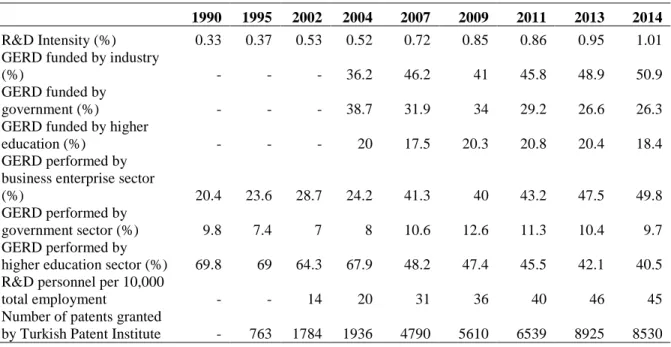
The transformations taking place in the post-crisis global political economy, however, triggered a reshuffling in the perspectives of Turkish policy-makers as well. Since 2009, the government has tried to formulate a hands-on approach regarding industrial policy to address poor technology performance. First, the Turkish Industrial Strategy Document was adopted in 2011 under the auspices of the MoSIT, along with the involvement of the relevant public and private bodies. The long-term goal of the industrial plan is to position Turkey as ‘the production base of Eurasia in medium and high-tech products’. In line with this overall objective, three basic strategic targets have been determined: (1) to increase the ratio of mid and high-tech sectors in production and exports, (2) to transition to high value-added products in low-tech sectors, and (3) to increase the weight of companies that can continuously improve their skills. Thus, industrial policy objectives are designed to target Turkey’s recalcitrant current account deficit through high value-added products, which is expected to decrease the dependence of exports on imports. The second aspect of Turkey’s new industrial strategy involves state investments in R&D sectors. The state has channelled considerable amounts of funding into research and innovation activities over the last decade. Gross domestic expenditure on R&D as a percentage of GDP (R&D intensity) has expanded substantially in comparison to the 1990s and crossed the 1 percent threshold in 2014 (Table 2). The funds allocated to the private sector through innovation governance organizations, including the MoSIT,
TÜBİTAK, KOSGEB, and the newly established regional development agencies44
increased dramatically. The increase continued despite the negative impact of the global economic crisis on the Turkish economy.45 In addition, there has been a technopark boom
in Turkey over the 2000s. Being infrastructural investments, technoparks are usually established within a university campus with the aim of enhancing innovation through exploiting geographical proximity. While there were only two technoparks in Turkey in 2001, the number skyrocketed to 63 in 2016.46 Moreover, R&D centers founded by the private sector via the ‘R&D law’, which was enacted in 2008. While there were 300 R&D centers in December 2016, December 2016, more than 600 centers were in
operation as of September 2017.47Turkey also heavily invested in the human capacity
from 76,074 in 2000 to almost 200,000 in 2013. This corresponds to an increase in R&D personnel per 10,000 total employment from 14 to 45 during 2002-2014 (Table 2).48
Table 2. Turkey’s main science, technology and innovation (STI) indicators
1990 1995 2002 2004 2007 2009 2011 2013 2014
R&D Intensity (%) 0.33 0.37 0.53 0.52 0.72 0.85 0.86 0.95 1.01 GERD funded by industry
(%) - - - 36.2 46.2 41 45.8 48.9 50.9
GERD funded by
government (%) - - - 38.7 31.9 34 29.2 26.6 26.3 GERD funded by higher
education (%) - - - 20 17.5 20.3 20.8 20.4 18.4 GERD performed by
business enterprise sector
(%) 20.4 23.6 28.7 24.2 41.3 40 43.2 47.5 49.8 GERD performed by
government sector (%) 9.8 7.4 7 8 10.6 12.6 11.3 10.4 9.7 GERD performed by
higher education sector (%) 69.8 69 64.3 67.9 48.2 47.4 45.5 42.1 40.5 R&D personnel per 10,000
total employment - - 14 20 31 36 40 46 45
Number of patents granted
by Turkish Patent Institute - 763 1784 1936 4790 5610 6539 8925 8530
Source: TUIK, TÜBİTAK, and Turkish Patent Institute
In short, Turkey achieved improvements in the basic STI indicators during the AKP era. There have also been significant increases in the R&D funds allocated to the private sector. The state occupied a central stage in this transformation. How can we assess the implications and possible consequences of the Turkish state’s involvement in the economy in terms of the trajectory of its neo-developmental credentials? The relevant literature on the Turkish political economy remains silent on these and other related crucial questions. Therefore, the next part aims to address this gap by relying on the conceptual framework delineated in the first part.
An assessment of the Turkish state’s neo-developmental turn
The Turkish government has taken certain steps over the last decade in order to promote technological capacity of the economy. The first step to this end concerns the institutionalization of the developmental mentality in the R&D sector. To begin with, the Supreme Council for Science and Technology (SCST), which is the highest-ranking STI
policy-making body in Turkey, has become fully operationalized. In fact, the Council, which set out to conduct two meetings each year only held three meetings in fourteen years until 1997. The Council could only meet once in a year during 1997-2004. With the emphasis placed upon the Council by the AKP governments, the Council meets two times annually since 2005. In addition, the Ministry of Industry and Trade has been replaced with the new MoSIT in 2011 to improve the coordination among acting state institutions in the economic realm. The main actors of the innovation system, including TÜBİTAK, KOSGEB, and the Turkish Academy of Sciences (TÜBA) were connected to this newly established Ministry.
Second, and equally important, new key legislation has been enacted to promote R&D, and to better monitor and enhance the effectiveness of the implemented policies. As such, the ‘R&D law’ was promulgated in 2008 leading to the establishment of R&D centers by the private sector. The government also amended the ‘Technopark Law’ more than once to further encourage high-tech production. The creation of ‘Technology Transfer Offices’ is set as a requirement in the law, and their establishment is incentivized to ignite the university-industry collaboration, a common practice of developmental states. Third, a new regulation on the surveillance of state subsidies was enacted to outline the principles and procedure to regulate the state incentives in line with the EU acquis. The State Aids Monitoring and Supervision Board has been set up with the law, and the General Directorate of State Aids has been created under the Undersecretariat of Treasury to carry out the Board’s secretariat services. Fourth, a new unit has been founded within the MoSIT to conduct the impact analysis of the allocated governmental support funds. Some indexes have also been created to assess the main players’ performance in the innovation system. Accordingly, ‘The Entrepreneurial and Innovative University Index’ has been
prepared under the auspices of TÜBİTAK since 2012, and the MoSIT has been
performing the ‘Technology Development Zones Performance Index’ study since 2013. The major developments reflecting the neo-developmentalist ambitions of the Turkish state notwithstanding, a number of factors have constrained Turkey’s state capacity. While some of the development-restraining factors are directly related to the AKP governments’ undertakings, some others are deeply rooted in the political economy structure of the Turkish innovation system. These two dynamics are also not always mutually exclusive. These problems can be analysed in a concise manner with respect to bureaucratic autonomy, the monitoring and the steering of the R&D funds, and the modalities of public-private coordination.
The interview data and the relevant empirical evidence suggest that significant problems prevail concerning bureaucratic autonomy in Turkey. This political interference had negative spillover effects on state capacity. TÜBİTAK, which is founded in 1963 and
currently acts as the secretariat of the SCST, is a case in point.49 The institution
constitutes one of the well-established innovation governance organizations in Turkey. TÜBİTAK is actively involved in all dimensions of the STI policy-making processes from initial design to implementation. TÜBİTAK is also the national coordination office for the EU Research Framework Programs. Thus, it plays a leading role as the ‘nodal agency’ in the Turkish innovation system. In the relevant legislation, TÜBİTAK is defined as ‘autonomous organization’ in terms of administrative and financial affairs. The Science Board governs the organization by electing its own members and nominating the President of TÜBİTAK. While the members are then appointed by the Prime Minister, the President of TÜBİTAK is appointed by the President of Turkey following the
approval of the Prime Minister. Before 2011, TÜBİTAK was directly connected to the
Prime Ministry. Since the foundation of the MoSIT in 2011, TÜBİTAK is now connected
to the MoSIT.
The fact that the Prime Minister and the President are involved in the election processes of the leading cadre of TÜBİTAK raises questions about the organization’s autonomy. Although the structure does not immediately suggest such involvement, the evidence
suggests that the governments intervened in the workings of TÜBİTAK over the 2000s.
This is first and foremost evident in the hotly debated amendment process of TÜBİTAK’s foundation law.50 Shortly after its rise to power in 2002, the AKP attempted
to amend the law. With the foreseen amendment, the Prime Minister would have had the
authority to directly appoint the Science Board members and the President of TÜBİTAK
for one time only. The amendment was debated in the parliament in October 2003. Despite the objections of opposition parties, it was adopted and then passed to the President for final approval. The President exercised his veto power by noting that the amendment undermined TÜBİTAK’s autonomy by way of granting excessive powers to
the Prime Minister.51 The government proposed the same amendment two months later.
The amendment was passed in the parliament. As the President did not have a second veto power, he approved the new proposal –Law 5016. However, the law could not even remain in execution for two months. As more than a hundred opposition deputies filed an appeal to the Constitutional Court, the Court stopped the law’s execution. The same process re-occurred two years later in 2005. Law 5376 was eventually put into force, but was overturned by the Constitutional Court. Finally, the law was amended in 2008 when one of the senior ruling party members became the new President in 2007.
One major consequence of the government’s interference with TÜBİTAK was the change in TÜBİTAK’s leading cadre during the first half of the 2000s. In February 2003, the
Science Board of TÜBİTAK re-elected its then incumbent president for his second term in office, and later on elected six new members to the Board. The Prime Ministry was notified about the decisions. However, the then Prime Minister did not pass the incumbent’s re-election to the President, and also did not approve the new members’ election.52 Following the refusal, the Science Board was unable to hold its meeting and
obtain a quorum of decision. Meanwhile, Prime Minister appointed six new Science Board members within the one-month period when the first amendment was put into force and expelled by the Constitutional Court. The new Board held its first meeting in January 2004 where the majority of the former members were replaced with the new ones.53 The new members also elected the new president of the Council.54 During this
turbulent process, four vice-presidents of TÜBİTAK resigned from their posts by noting that the organization had been completely politicized.55
The interventions were not limited to TÜBİTAK. Among the important ones, there have been significant regulatory changes in the election procedure of TÜBA members. Being the scientific brain trust in Turkey, TÜBA provides science-based consultancy service to governing elites in the shaping of science policies. Previously, TÜBA was electing its own members. Via a statutory decree published in the official gazette on 27 August 2011, TÜBA members were to be elected by TÜBA, the Council of Ministers, and the General Assembly of the Council of Higher Education. Each organization was said to elect one-third of the members. After the opposition harshly criticized the amendment due to the politicization of the Academy, the Council of Ministers was removed from the election
cycle to be replaced with the Science Board of TÜBİTAK.56 Currently, TÜBA,
TÜBİTAK, and Council of Higher Education are electing TÜBA members. The re-assigning of the role from the Council of Ministers to TÜBİTAK did not satisfy the
opposition’s concerns. As mentioned, TÜBİTAK is itself has been highly politicized
throughout the 2000s, thus the amendment did not mean much in practice. In fact, almost fifty TÜBA members submitted their resignation to protest the political intervention in the end of the day.
The bureaucratic apparatus’ lack of autonomy vis-à-vis political leadership is a defining trait of the Turkish state’s internal structure.57 This has continued to be the case during the 2000s –within the context of the independent regulatory agencies58 and the economic bureaucracy.59 In this respect, the AKP’s intervention to key innovation agencies has not only represented a continuum with the past, but also reflected the overall tendency in domains other than STI. The important question is, how exactly the interferences have influenced R&D policy-making processes and R&D policy in Turkey during the 2000s? The interview evidence strongly suggests that political interference with innovation organizations affects the policy-making processes drastically in Turkey in various interrelated ways. To begin with, when an organization’s leading cadre changes due to
political interference or other reasons, each new cadre aims to pursue an agenda that is clearly different from the existing one. More often than not, the new agenda neither expands on the previous one, nor takes the pros and cons of the existing implementation into consideration. Therefore, the learning effect in agenda-setting remains very weak. For example, with the coming to power of the new government in 2002, and the subsequent shift in TÜBİTAK’s leading cadre, there have been major discontinuities in the R&D policy design in Turkey. This includes the spatial distribution of the R&D funds, as well as the funds’ sectoral focus.60
The renouncement of the ‘Vision 2023’ project in the first half of the 2000s exemplifies
the point.61 As the first-ever national science and technology foresight exercise in
Turkey, the Vision 2023 project was conducted at the turn of the 2000s under TÜBİTAK’s leadership.62 The project’s two primary goals were to suggest long-term STI
policies and to determine strategic sectors for R&D investment. The project was unique in terms of embeddedness, as more than 2,000 public and private actors from different sectors took part in it. Based on evidence and collectiveness, certain strategic fields and sectors were identified for Turkey and numerous policy prescriptions were put forward. The SCST, the highest-ranking STI policy-making body in Turkey, approved the project in 2005. However, with the subsequent shifts in TÜBİTAK’s cadre, the project’s targets were not taken into account in practice. Its key priorities, projections, and suggestions were not reflected in the Council’s subsequent decisions and they were also not taken into
account by the short- and medium-term plans.63 A previous high-ranking bureaucrat
noted, ‘as the government changed, [the new governing elite] cancelled [the Vision 2023 project]’.64 Second, in the absence of bureaucratic autonomy, arbitrary interference paved
the way for ‘top-down policy-making’, further undermining the Turkish state’s developmentalist agenda. The same high-ranking bureaucrat, for instance, emphasized the dominance of the ‘top-down approach’ in the following way: ‘many of our policies emerge once a politician gives the idea and bureaucrats conduct the complementary preparation. Let’s say an idea occurs to the [politician] one night, he says let’s do this.
We cannot do the prior analysis to see if [the proposed policy] is doable or not’.65
Another previous bureaucrat noted in a similar fashion: ‘for instance, one of the Ministers come out to say we support innovation in the textile industry. He has to answer why it is the textile [industry] but not another one. If such a decision is made, [this should be
answered] right?’66 The extent of the ‘top-down approach’ can reach such levels that
even the bureaucrats of the very organizations that pursue the programs are not informed about new developments till the very last minute.67
Third, interventions to key agencies have enabled the government to pursue the policies as the party sees fit. To exemplify, the government preferred to relax resource allocation criteria in regards to R&D fund allocation to the private sector during the 2000s.68The
stated goal has been to promote innovation culture throughout the society. The government also preferred a horizontal policy design instead of a vertical one.69 Although many bureaucrats and the main opposition the Republican People’s Party (CHP) had deep hesitations about the effectiveness of these choices, the AKP managed to pursue its preferences on the ground thanks to its influence over key innovation agencies.70 Last,
politically-motivated involvements hampered the institutionalization of evidence-based
policy-making processes. One example from TÜBİTAK illustrates the point. When
TÜBİTAK began allocating R&D funds to the private sector in the mid-1990s for the first time, the organization forged mechanisms to assess value added of its support programs. To this end, TÜBİTAK relied on external evaluators. Although the bureaucrats were aware that R&D does not yield immediate results, and a certain period of time needs to pass to adequately measure impact, they chose to start evaluations right off the bat to ‘establish a discipline of evaluation’ in Turkey.71 However, the turbulent events at TÜBİTAK at the turn of the 2000s disturbed policy continuity. The organization neither furthered internal efforts to assess value-added, nor relied on external evaluators to conduct impact evaluation analysis in a consecutive and consistent manner. The issue of the monitoring and steering of the R&D funds is of utmost importance for the developmental states, and factors other than political interference influence the processes as well. Thus, the next section turns a keen eye on this particular issue.
The question of monitoring and steering
Performance-based monitoring and steering constitutes the second crucial aspect of a state’s internal capacity, as it becomes the only possible way for the state to steer innovation-led growth through efficient resource allocation. It is also the key component of evidence-based smart industrial policy design. It is no surprise that the leading countries on the innovation ladder all enjoy a process where evidence is gathered, analysed, and utilized at all stages of the policy cycle. In contrast, there have been significant problems with regard to evidence-based policy-making in Turkey. First, there is a clear absence of a state apparatus that can act as a ‘nodal agency’ to effectively steer the R&D fund allocation. No comprehensive agency or unit is solely devoted to the promotion of evidence-based policy-making processes. The units that have been created under the MoSIT and the Undersecretariat of Treasury are not full-fledged bodies that can steer the monitoring. Two bureaucrats, for instance, compared Turkey with Korea during the interviews to note that while in Korea performance-based monitoring is ensured by capable organizations that are solely dedicated to evidence-based policy-making, in Turkey no such organization exists.72 In addition, agencies that distribute the funds to the private sector also fail to follow systematic performance-based criteria while designing their own support schemes. On the one hand, it is sometimes the case that organizations do not rely on indicative measures simply as a matter of choice. In one
case, for instance, although an organization hired an independent agency to conduct the impact evaluation of its support schemes, and also trained its own bureaucrats to effectively steer the process, the upper management opted to revise the whole support
system before the evaluation results even appear.73 On the other hand, problems
associated with institutional memory hamper the institutionalization of performance-based monitoring efforts. In some cases, bureaucrats take the initiative and make sure that support programs’ impacts are measured, and the outcomes are reflected in subsequent decision-making processes. However, once a change materializes in any organizations’ leading cadre, it is quite likely that a policy-discontinuity emerges. The new cadre—or the new high-ranking bureaucrat—is likely to ignore the previous efforts and put the whole monitoring project aside.74 The fact that projections and impact evaluations are technically difficult to perform complicates the already difficult situation. In addition to the shortages of human capital, disagreements among public institutions occasionally arise with regard to the appropriate methodology to employ during performance evaluations. All in all, the interview data reveal that despite the positive steps undertaken, the Turkish innovation system has yet to adopt a comprehensive performance-based monitoring system, as has been the case in successful developmental states.75
One particular aspect of the policy-making culture in Turkey poses yet another difficulty for the institutionalization of evidence-based policy-making efforts. The interview evidence suggests that bureaucrats and political elites still tend to perceive impact evaluations as ‘punishment devices’ instead of seeing them as part of a learning process. There is a traditional reflex in the bureaucracy to avoid impact evaluations, since they think that the evaluation results can be used against organizations or units in the form of budget cuts. When faced with unsatisfactory results, some decision-makers can potentially react by saying ‘why are we allocating money to you, we can allocate more money to [construct] irrigation channels [instead]’.76 In some cases, political elites might set unrealistic goals at the outset; therefore, they might fail to appreciate the success that is achieved with scarce resources.77
In addition to this cultural trait, a ‘considerable degree of ambiguity [existed] in the classifications and definitions of the benefits to which businesses [were] entitled’ during the 1980s and the 1990s, which led to confusion and the inefficient utilization of the resources.78 A similar ambiguity has certainly been existent in the R&D sector. This can be easily observed in the relevant R&D legislation. As an illustrative case in point, the first condition that is required for the establishment of a technopark in Turkey is ‘the presence, in the identified area or within the boundaries of the province where the [park] is situated, of a university...and a sufficient R&D and technological potential in the area’.79 Each city in Turkey has at least one university within its borders; therefore, this is not a criterion in practical terms. The essential criterion is the ‘sufficient R&D and technological potential’. In the technopark legislation, the term ‘sufficient R&D and
technological potential’ is not defined in concrete terms. Although a number of criteria are set forth that are to be taken into account while evaluating a park application, no concrete threshold is provided based on which the evaluations are to be done. The Assessment Board, which evaluates park applications, is said to determine the sufficiency of R&D potential.80 In this regard, a comprehensive report on technoparks in Turkey
prepared by the State Supervisory Council notes that some of the Assessment Board’s decisions involve arbitrariness and contradictions.81In some cases, some parks failed to start their operations for a long period of time although they obtained the Board’s initial approval. In other cases, although the Board rejected some applications at first, it approved them soon afterwards, despite the fact that the issues based on which the prior application was rejected remained problematic.82 The same report also dubs the ‘absence of criteria in resource allocation and non-distribution of resources according to needs’ and ‘ambiguities in the payment of the Ministry support (amount, time, method)’ as problems encountered in the financing of the parks’ infrastructural investments.83Based on these, the Supervisory Council advised the Assessment Board to undertake a solution-oriented analysis, conduct more detailed research before making its decisions, take measures to pursue objective criteria, and change the Board’s structure if need be. Similar ambiguities in the R&D sector exist that pose a pertinent problem for the effective allocation of governmental resources.
As noted, the state opted to relax resource allocation criteria based on which R&D funds are allocated to the private sector.84To exemplify, almost all technopark applications and majority of R&D center applications are approved during the AKP period. If one considers the fact that there have been major problems associated with evidence-based policy-making during the 2000s, this flexibilization in resource allocation criteria casts serious doubts on the effective utilization of R&D resources.85 Having said this, it is important to underline that many problems pertaining to monitoring and steering are embedded in the overall political economy structure of Turkey. These issues have been long-lasting,86 and they are not only observable in the R&D sector.87 In light of this, a bureaucrat’s statement concerning the performance-based monitoring system’s persistent problems in Turkey is illustrative. The example covers the technoparks’ first appearance in the country, as well as the subsequent development pattern:
It was the time of [Turgut] Özal. Özal and his crew see a Technopark abroad. When they return, they decide to establish Technoparks [in Turkey]. [At the time], no one knew what is a Technopark, what is going on, [and] what this park is about [in Turkey]. Then, Turkey approaches UNIDO. She says, “Send us an expert, we are going to establish Technoparks... Then, experts come to Turkey and conduct a brief need-analysis. Then, they say [Technoparks] should be [established] in Ankara, Istanbul, Izmir, and TÜBİTAK-MAM. First, [the experts] ask us to establish an incubator, analyse it, and then if it becomes successful, establish a Technopark. This way, we would gain experience... It is OK, we start
[establishing incubators], [founding the required committees], but no one knows what is an incubator at the time. After five years, [the experts] visited Turkey once again to follow up on the project. They asked us, “What did you do?” We said we are doing like this, we are doing like that. They asked, “Where is your business plan? Where are your success criteria?” [We had] none of those... They asked, “Relying on what [plan] are you working?” [We said] we are just doing... [The expert] told us a very nice thing at the time. He said, “You are the descendants of the Ottoman Empire, do you assume that Mimar Sinan constructed the Blue Mosque without a plan? Did he do all those works randomly? How come you do not have a business plan, success criteria, etc.” Still, we do not have these today properly.
The question of bureaucratic coordination
The final element of the state’s internal capacity is the degree of coordination among relevant bureaucratic organizations. Interview data suggest that there have also been problems with bureaucratic coordination in Turkey over the 2000s, despite some positive steps undertaken under the auspices of single party governments. First, different state organizations run similar programs, which aim at similar target groups in the country. In some cases, organizations are aware of this fact. However, due to inter-organizational competition, and in the absence of a genuine pilot agency that can effectively govern the system similar to Korean and Japanese cases, Turkish developmental organizations continue to run similar programs. In other cases, organizations are not even aware of the
fact that they administer parallel programs.88 Overall, the absence of bureaucratic
coordination leads to the unnecessary proliferation of governmental support programs, confuses the private sector due to an influx of information, fuels inter-organizational
competition, and makes the monitoring of the programs more difficult. In fact, one
bureaucrat likened the unnecessary proliferation of support programs in Turkey to a ‘support jungle’.89 The issue is further aggravated given the fact that the relevant units of
various ministries also began to allocate R&D funds to the private sector over the last couple of years, although in many cases these units lacked the required expertise to scientifically evaluate applications and steer the allocation processes. Paradoxically, however, the lack of coordination among bureaucratic organizations might have actually had some unintended positive effects in an environment where the developmental state’s core characteristics are not in place. In an innovation system where organizations continuously face the danger of becoming ineffective due to political interference or change in their leading cadre, and where a top-down policy-making process dominates, concentration of resources in few organizations might turn out to be unfortunate because in case organizations in question become dysfunctional for the above-mentioned reasons,
then the entire system would face the risk of becoming dysfunctional.90 Therefore,
terms of state capacity, it might have a positive unintended consequence in the short run via an unplanned risk diversification.
The issue of bureaucratic coordination has another dimension linking the state elite with private actors, i.e., the external dimension of state capacity. The literature suggests that the institutional configuration of state-business relations informs the external aspect of
state capacity that in turn conditions the overall developmental performance. 91
Accordingly, institutionalized cooperation mechanisms between state bureaucrats and
business representatives—‘governed interdependence’, to use Linda Weiss’
terminology—help in upgrading the production and trade structure of a country towards the high-technology frontier.92 From a historical perspective, however, state-business relations in Turkey tilted toward a ‘market-repressing’ rather than a ‘market-enhancing’ institutional equilibrium that hampered the creation of a transparent and rule-based
economic environment.93
The interview data suggests that weak embeddedness in state-business relations is visible in the Turkish innovation system as well, in a way that curtails the state’s external capacity. On the one hand, the business elite does not seem to be interested in specializing in high-tech products despite its overwhelming rhetoric on the importance of high-tech production and innovation. In fact, the business elite had virtually no interest in collaborating with the state with regard to technological upgrading in the 1990s.94 Since external developments such as innovation-led competition under export-oriented industrialization and the Customs Union with the EU forced the private sector to become more innovative, business firms began to take innovation seriously and showed an interest in establishing cooperation with the state. Nevertheless, the business is yet to develop or suggest a comprehensive stance on the design of the innovation policy. On the other hand, formal mechanisms through which the private sector can participate in the decision-making processes are under-institutionalized. The collaboration is rather carried out through informal consultations and contacts. Even though in some cases business organizations take a step forward to involve in the process, ad hoc attempts have not yet yielded concrete results.95 In Singapore, for example, a strong political leadership that effectively controlled power at multiple layers had to engage with a coalition of private interests that played an active role in the design, implementation, and monitoring of
innovation policy.96 This situation happened to be a safeguard against the arbitrary
decisions of politicians, inserted credibility to the system, thus contributed to the
emergence of development-enhancing institutions. 97 Likewise, the institutions that
enabled the Brazilian success in sugar and ethanol were forged during the military regime (1964-1985), and the effective consultation of major sugar producers played a role in the
process.98 No such mechanism has been existent in Turkey within the context of the
It appears that weak state-business cooperation in R&D policies is closely associated with the recent turn in Turkish political economy. The increasingly harsh political criticisms directed against TÜSİAD, Turkey’s biggest business association representing the mainstream capitalist establishment of the country, by the government since mid-2013 injected a new wave of instability and polarization in the domestic political economy landscape, which in turn, hampered the kind of synergy needed to ensure developmentalist cooperation. On the other hand, the post-1980 period witnessed the emergence and rapid consolidation of a conservative business class vis-à-vis the dominant economic establishment of the country. The newly emerging business elite in the inlands of Turkey, the so-called Anatolian Tigers, injected new activism in industrial production and foreign trade. The new business elite, particularly the large-scale companies, took advantage of lucrative state incentives, public tenders, and extensive political support. However, the newly consolidating business actors have not demonstrated the expected performance in terms of the transformation of Turkey’s
production structure and foreign trade composition. As Buğra and Savaşkan have
documented in detail, the government-backed ‘new capitalist class’ mainly concentrated on low value-added sectors, with construction activities being the main engine of the
expansion of their wealth.99 The capital accumulation model over the last decade,
therefore, increasingly relied on construction-related activities at the expense of technological and industrial production. It is, for obvious reasons, an arduous task to build a neo-developmentalist state by relying overwhelmingly on traditional non-tradable sectors. Thus, the current dominant growth strategy creates imminent risks in terms of sustainable growth and high-tech-oriented production performance. As a result, the discussion so far suggests that there have been certain achievements and apparent challenges in the Turkish economy as it still encounters structural weaknesses in terms of the state’s internal and external capacity.
Conclusions
The state’s development-enhancing role is being discussed more frequently in the aftermath of the 2008 global economic crisis as the pendulum began to swing away from neoliberalism. In fact, it was already known that the countries that have pursued a heterodox agenda have outperformed their counterparts over the last thirty years. The institutional capacities that are underlined in the developmental state scholarship have indeed turned out to be crucial. Be that as it may, the 21st century’s socio-economic conditions led to a examination of the developmental state and necessitated a re-calibration of the state’s role in the contemporary bit-driven economy.100 Thus, whereas the first question has been whether the developmental state is still relevant for today’s
latecomers, the second question has been what additional challenges the states face in the new millennium. This article speaks to both discussions by providing an in-depth elaboration of the Turkish case. First, the core traits of the developmental state are still relevant as ever. The state’s ‘internal’ and ‘external’ capacities –manifested in bureaucratic autonomy, ‘expended embeddedness,’ Weberian bureaucracy, the prevalence of evidence-based policy-making mechanisms, and bureaucratic coordination, are crucial for the effective capitalization of the regulatory changes and the developmental attempts. As the Turkish case revealed, even though the governments have taken certain steps to institutionalize the developmental mentality in the R&D sector, those attempts could not contribute to effective policy-making due to the inherent problems in state capacity. Relatedly, the bureaucracy’s autonomy vis-à-vis the political leadership is of utmost importance. The political leadership’s interferences with key innovation agencies have undermined the Turkish state’s capacity by (i) curtailing the institutionalization of evidence-based policy-making efforts, (ii) hampering the emergence of a Weberian bureaucracy, and (iii) undermining the formation of long-term policies.101
The problems outlined in regards to the Turkish state’s transformative capacity in the R&D sector not only represent a continuum with the country’s past,102 but also mimic the
shortcomings that are examined in different policy domains during the 2000s.103
In-depth elaboration of the Turkish state’s transformative capacity in the R&D sector also suggests that populist tendencies have existed in the country during the formulation and implementation of R&D policies. Flexibilization in resource allocation criteria and lowering of expectations on R&D investments in the face of major monitoring and steering problems and the dominance of a top-down policy-making approach constitute the main characteristics of this approach.104 In fact, the evidence suggests that the current approach to R&D fund allocation as populist in nature by primarily emphasizing the proliferation of resources in the absence of impact evaluation mechanisms.
Notes
1 “The Rise of State Capitalism,” The Economist, January 21, 2012. http://www.economist.com/node/21543160
2 Williamson, Latin American Adjustment How Much Has Happened? 3 Stiglitz, Globalization and Its Discontents.
4 Chang, Kicking Away the Ladder; Chang, “Institutions and Economic Development: Theory, Policy and History”; Rodrik, “How to Save Globalization From Its Cheerleaders”; Wade, Governing the Market, 2003. 5 Rodrik, “How to Save Globalization From Its Cheerleaders,” 3.
6 Acemoglu and Robinson, Why Nations Fail; Chang, Globalization, Economic Development and the Role of the State; Fukuyama, “What Is Governance”; Wade, Governing the Market, 2003.
7 Haggard, “The Developmental State Is Dead: Long Live the Developmental State!”; Williams, The End of the Developmental State?
9 Wade, “What Strategies Are Viable for Developing Countries Today?” 10 Rodrik, “How to Save Globalization From Its Cheerleaders.”
11 Evans, “In Search of the 21st Century Developmental State.”
12 Schrank and Whitford, “Industrial Policy in the United States: A Neo-Polanyian Interpretation.” 13 Wade, “‘Market versus State’ or ‘Market with State.’”
14 Mazzucato, The Entrepreneurial State, 23.
15 Flyvbjerg, “Five Misunderstandings About Case-Study Research.” 16 Flyvbjerg, 34.
17 Haggard, “The Developmental State Is Dead: Long Live the Developmental State!,” 49.
18 The literature suggests that ‘state capacity’ in the abstract does not have much analytical value due to operationalization problems. Therefore, one has to concentrate on specific policy regimes to reveal the capacity of the state in that particular realm. In this study, we apply the concept to the R&D regime of Turkey as a crucial part of its industrial policy.
19 Haggard, “The Developmental State Is Dead: Long Live the Developmental State!”; Kohli, State-Directed Development; Öniş, “The Logic of the Developmental State”; Williams, The End of the Developmental State?; Woo-Cumings, The Developmental State.
20 Evans, Embedded Autonomy; Johnson, MITI and the Japanese Miracle; Wade, Governing the Market, 1990; Woo-Cumings, The Developmental State.
21 The early accounts equated state autonomy with insulation in the sense that state capacity is derived from its power over social segments of society. The later accounts revised this isolationist approach by arguing that state capacity is derived through society, not over it.
22 Evans, “Transferable Lessons?,” 70–71. 23 Evans, Embedded Autonomy.
24 Weiss, The Myth of the Powerless State; Governing the Economy in a Global Era. 25 Maxfield and Schneider, Business and the State in Developing Countries, 17.
26 Hundt, Korea’s Developmental Alliance, 7; Raquiza, State Structure, Policy Formation, and Economic Development in Southeast Asia, 15.
27 Evans, “The State as Problem and Solution: Predation, Embedded Autonomy and Adjustment,” 179. 28 Evans, Embedded Autonomy; Weiss, The Myth of the Powerless State; Governing the Economy in a Global Era.
29 Bhagwati, “Directly Unproductive, Profit-Seeking (DUP) Activities.”
30 Evans, “Transferable Lessons?,” 76; Evans, “In Search of the 21st Century Developmental State”; Maxfield and Schneider, Business and the State in Developing Countries, 7–12.
31 Maxfield and Schneider, Business and the State in Developing Countries, 11.
32Öniş and Şenses, “Global Dynamics, Domestic Coalitions and Reactive State: Major Policy Shifts in Post-War Turkish Economic Development.”
33 Evans, “Transferable Lessons?,” 74–76; Weiss, The Myth of the Powerless State; Governing the Economy in a Global Era, 38.
34 Amsden, Asia’s Next Giant; Maxfield and Schneider, Business and the State in Developing Countries, 10.
35 Evans, “In Search of the 21st Century Developmental State.”
36 Romer, “Increasing Returns and Long-Run Growth”; Romer, “The Origins of Endogenous Growth.” 37 Sen, Development as Freedom.
38 Evans, “In Search of the 21st Century Developmental State,” 19. 39 Evans, 19.
40 Williams, “Rethinking the Developmental State in the 21st Century,” 10.
41Bakır and Öniş, “The Regulatory State and Turkish Banking Reforms in the Age of Post-Washington Consensus.”
42 Öniş and Keyman, “Turkey at the Polls: New Path Emerges,” 96.
43 Kutlay, “Internationalization of Finance Capital in Spain and Turkey: Neoliberal Globalization and the Political Economy of State Policies”; Taymaz and Voyvoda, “Marching to the Beat of a Late Drummer: Turkey’s Experience of Neoliberal Industrialization since 1980.”
44 Lagendijk, Kayasu, and Yasar, “The Role of Regional Development Agencies in Turkey From Implementing EU Directives To Supporting Regional Business Communities?”
46 Whereas 41 of the parks are operational, 22 of them are at the stage of infrastructure investment. 47 The Ministry of Science, Industry and Technology.
48 The private sector employs 52 per cent of the full time equivalent R&D staff, whereas the government employs 11 per cent, and universities employ the remaining 37 per cent. It should be noted that despite the noteworthy upward trends in the main STI indicators, there is still a considerable gap with advanced countries in terms of the resources devoted to R&D. For instance, the average annual growth rate of R&D intensity was 4.4 per cent in Turkey during the last decade. Even if Turkey is to keep up the positive trend as it is, the country ‘will have an R&D intensity of 1.27 in 2020, which would be a very good achievement although still below the projected EU average for 2020.’ See European Union, Research and Innovation Performance in Turkey: Country Profile 2014, 2.
49TÜBİTAK is also elaborated in this regard elsewhere. See Karaoğuz, “The political dynamics of R&D policy in Turkey: Party differences and executive interference during the AKP period.”
50 Pak, “TÜBİTAK Nereden Nereye: Siyasallaştırılan Bilim.”
51 For the relevant press release of the Presidency of Turkey see (in Turkish): http://www.tccb.gov.tr/basin-aciklamalari-ahmet-necdet-sezer/1720/6028/5001-sayili-kanun.html
52 For the relevant press release of the Presidency of Turkey see (in Turkish): http://www.tccb.gov.tr/basin-aciklamalari-ahmet-necdet-sezer/1720/6028/5001-sayili-kanun.html
53 Pak, “TÜBİTAK Nereden Nereye: Siyasallaştırılan Bilim.” 54 Ibid.
55 Grüner, “Turkish Government Accused of Hijacking Boosted Science Budget,” 1055. 56 A statutory decree published in the official gazette on November 2, 2011.
57 Biddle and Milor, “Economic Governance in Turkey: Bureaucratic Capacity, Policy Networks, and Business Associations”; Buğra, State and Business in Modern Turkey; Heper, The State Tradition in Turkey.
58 Çetin, Sobacı, and Nargeleçekenler, “Independence and Accountability of Independent Regulatory Agencies”; Özel, “The Politics of de-Delegation: Regulatory (In)dependence in Turkey.”
59 Luca, “Do Bureaucracies Enhance or Constrain Policy Effectiveness? Evidence from Turkey’s Central Management of Public Investment.”
60 For a detailed elaboration of political dynamics’ influences on Turkish R&D policy during the 2000s, including the discussion of autonomy, see Karaoğuz, “The political dynamics of R&D policy in Turkey.” 61Also elaborated in Karaoğuz, “The political dynamics of R&D policy in Turkey.”
62 Saritas, Taymaz, and Tumer, “Vision 2023.”
63Various writings of Aykut Göker that are published on the website “Bilim, Teknoloji, İnovasyon Politikaları Tartışma Platformu” elaborate the issue of policy-discontinuity in Turkey in the field of STI policy (http://www.inovasyon.org/yazardetay.asp?YazarID=1).
64 Interview conducted in December 2015. Also quoted in Karaoğuz, “The political dynamics of R&D policy in Turkey.”
65 Interview conducted in December 2015. 66 Interview conducted in October 2014.
67 Interview conducted with a bureaucrat in December 2015. 68Karaoğuz, “The political dynamics of R&D policy in Turkey.” 69 Ibid.
70 Ibid.
71 Interview conducted with a previous bureaucrat in February 2016. 72 Interviews conducted in October 2014 and November 2015. 73 Interview conducted with a bureaucrat in December 2015.
74 Interviews conducted with previous bureaucrats in November 2015 and February 2016. 75 Some comprehensive reports on the Turkish innovation system underline the inherent problems
associated with evidence-based policy-making in Turkey as well. For instance, see Şirin Elçi, INNO-Policy TrendChart – Innovation Policy Progress Report Turkey, 2009; Şirin Elçi, Mini Country Report/Turkey, 2011; and Erkan Erdil and Dilek Çetin, Erawatch Country Reports 2012: Turkey, 2012.
76 Interview conducted with a bureaucrat in November 2015.
77 Interview conducted with a previous bureaucrat in November 2015.
78 Biddle and Milor, “Economic Governance in Turkey: Bureaucratic Capacity, Policy Networks, and Business Associations,” 291.
79 See Law No. 4691 on Technology Development Zones and the subsequent amendments. For Law No. 4691: http://www.wipo.int/wipolex/en/text.jsp?file_id=245146.
80 The Assessment Board is chaired by the MoSIT and established with the participation of one representative each from the Ministry of Finance, the Ministry of Development, the Council of Higher Education (YÖK), TÜBİTAK, the Union of Chambers and Commodity Exchanges of Turkey (TOBB), KOSGEB, and TTGV.
81 TC. Cumhurbaşkanlığı Devlet Denetleme Kurulu Araştırma ve İnceleme Raporu,“4691 sayılı Teknoloji Geliştirme Bölgeleri Kanunu Uygulamalarının Değerlendirilmesi ile Uygulamada Ortaya Çıkan Sorunların Çözümüne İlişkin Öneri Geliştirilmesi,” 2009.
82 Ibid, 146. 83 Ibid, 186.
84Karaoğuz, “The political dynamics of R&D policy in Turkey.” 85 Ibid.
86 Biddle and Milor, “Economic Governance in Turkey: Bureaucratic Capacity, Policy Networks, and Business Associations.”
87 Luca, “Do Bureaucracies Enhance or Constrain Policy Effectiveness? Evidence from Turkey’s Central Management of Public Investment.”
88 Interview conducted with a bureaucrat in December 2015. 89 Interview conducted with a bureaucrat in November 2014.
90 It is important to note that only one previous bureaucrat put forward this argument. The majority interpreted the proliferation of support programs as a signal of weakness in bureaucratic coordination. 91 Evans, Embedded Autonomy.
92 Weiss, The Myth of the Powerless State; Governing the Economy in a Global Era; Weiss, “The State in the Economy: Neoliberal or Neoactivist?”
93 Buğra,State and Business in Modern Turkey, 1994.
94 See Aykut Göker, Yaratıcılık ve Yenilikçiliğin Kültürel Kökenleri Ve Bizim Toplumumuz -Çözümleme Denemesi, 2013, 261. <http://www.inovasyon.org/pdf/AYK.Yar.Yen.II.Surum.pdf> (accessed 21 October 2016).
95As an illustrative case in point, the Turkish Industry and Business Association’s (TÜSİAD) request to include two additional members to the technoparks’ Assessment Board, who would be jointly nominated by civil society organizations that operate in the fields of technology and informatics, and selected by the then Ministry of Industry and Trade, was not considered in 2008.
96 Doner, Hicken, and Ritchie, “Political Challenges of Innovation in the Developing World,” 160. 97 Hicken and Ritchie, “The Origin of Credibility Enhancing Institutions in Southeast Asia.” 98 Doner, Hicken, and Ritchie, “Political Challenges of Innovation in the Developing World,” 160. 99Buğra and Savaşkan, New Capitalism in Turkey: The Relationship Between Politics, Religion and Business.
100 Evans, “In Search of the 21st Century Developmental State”; Williams, The End of the Developmental State?
101 The “17–25 December operations” in 2013 and the coup attempt of July 2016 affected the Turkish society deeply and led to massive shifts in the Turkish bureaucracy. In the overall political-economy climate, whereby many scholars discussed the quality of Turkish democracy from various angels, the main innovation governance organizations including TÜBİTAK were significantly affected from the
developments. To exemplify, a former President, Vice-President, and many employees of TÜBİTAK were taken into custody. In 2015, TÜBİTAK had to reject a local court’s request for evidence analysis due to lack of qualified specialists amid massive layoffs. Immediately after the coup attempt, more than two hundred TÜBİTAK personnel were fired within a month and a half. Although these developments reflect the politicized nature of the Turkish innovation system and support the main arguments presented in this article regarding state’s internal capacity within the realm of R&D, a thorough analysis is needed to carefully zoom into the post-coup-attempt developments in the Turkish bureaucracy and innovation system. On these issues see “TÜBİTAK’ta darbe operasyonu: 201 kişinin görevine son verildi,” Cumhuriyet, August 29, 2016; Saymaz, İsmail and Erdinç Çelikkan, “Turkey’s top scientific body has no digital analysts left amid ‘political’ layoffs,” Hurriyet Daily News, March 9, 2015; “Bakan Fikri Işık'tan TÜBİTAK operasyonu yorumu,” CNN Turk, April 29, 2015.