i i J ' Jirs ' 1 ' l Û ί L л . U. 1 ^ '* ·'ί - ^ J £ £vi ·Ό · I i V b ö , Λ -йтл‘т ' ¿. -ö æ'"'"*î !тчѵ· ■pr<j7 Tfi^> Д. Λ. τ V Ό Q Τ Ο .¿•'І. ^ η W i 5 I'^. ^ Τ .■ ,^;··*>" ;-·;. - * .& Ä ■■*■' ’/?· ί"· ·*η '"•.’•^ ■■*· Τ^*. *«*■ Λ ί> “С *'·’■1·"ί: Ο ^rf\ f*'',♦ 4Î ·': ,~ ■■'·*■ î Λ ^ ^^ ^ ^ Τ *■>’ ♦ * ,ί-4 -■ > ί’ > I ;»* І » .'V ^ If ί •J'» ■; V Г -C» ·>» « ■< f*·»^· W - -■-- - ··—' i*-. Г СІГ^. i\ у Т ^ · .;. ·* ·::, '·>* 7 Ci -'^ : ^ *Ь. ,*»•<‘’1 “# γ. f '·/?·;};. «Г»,-. ■. & ■>■.. >_'* f i , 1 ‘*"4 'Í* ■·'. 'η іГ , /Р » ·■-'“,"« V·· ^ ί'·>« r**■_ .г^А. S *! ♦‘'■•Г/< г V ^ ^л / , f ' y . -.·.· л ♦ 1 <1 / « 'ί^* i ô é é ' K S S
9990
IDENTIFICATION OF MOTIVES FOR LANGUAGE STUDY AT.THE POLICE ACADEMY
A THESIS
SUBMITTED TO THE FACULTY OF LETTERS
AND THE INSTITUTE OF ECONOMICS AND SOCIAL SCIENCES OF BILKENT UNIVERSITY
IN PARTIAL FULFILLMENT OF THE REQUIREMENTS FOR THE DEGREE OF A MASTER OF ARTS IN THE TEACHING OF ENGLISH AS A FOREIGN LANGUAGE
BY
NECAT KUMRAL August 1990
pe
BILKENT UNIVERSITY
INSTITUTE OF ECONOMICS AND SOCIAL SCIENCES MA THESIS EXAMINATION RESULT FORM
August 31, 1990
The examining committee appointed by the
Institute of Economics and Social Sciences for the thesis examination of the MA TEFL student
NECAT KUMRAL
has read the thesis of the student. The committee has decided that the thesis
of the student is satisfactory.
Thesis Title: IDENTIFICATION OF MOTIVES FOR LANGUGE STUDY
AT THE POLICE ACADEMY
Thesis Advisor:
Committee Members
Dr. Aaron S. Carton
Bilkent University, MA TEFL Program Dr. Esin Kaya-Carton
Hofstra University, Hepstead, N.Y. Dr. Lionel M. Kaufman, Jr.
We certify that we have read this thesis and that in our combined opinion it is fully adequate, in scope and in quality, as a thesis for the degree of Master of Arts.
Esin Kaya-Carton (Committee Member)
Lionel M. Kaufman, Jr. (Committee Member)
Approved for the
Institute of Economics and Social Sciences
BtJlent Bozkurt Dean, Faculty of Letters
Director of the Institute of Economics and Social Sciences
I would like to express my greatest gratitude to Dr.
Aaron S. Carton and Dr. Esin Kaya-Carton for their
unprecedented support and patience.
I am grateful to Dr. John Aydelott and Dr. Lionel M.
Kaufman, Jr. for their helpful suggestions and guidance.
I would like to thank Ms Nevin Inal for her
endless encouragement and support.
I would like to thank Mr. Süleyman Aydın and Mr. Ali
Tekçe, my colleagues, for their assistance in administration of the questionnaire.
I am especially indebted to Mr. Naci Mustafa Kayaoğlu for
his computer assistance and Ms. Nalan Kirbiyik for her
printing assistace.
My very special thanks go to my wife for her
understanding, endless patience and encouragement.
ACKNOWLEDGEMENTS
CHAPTER Page
1 INTRODUCTION ... 1
STATEMENT OF THE TOPIC... 2
STATEMENT OF THE PURPOSE...4
STATEMENT OF METHOD... 5
STATEMENT OF LIMITATIONS...6
ORGANIZATION OF THE STUDY... 6
STATEMENT OF EXPECTATIONS...7
2 LITERATURE REVIEW...8
MEANING OF MOTIVATION...9
KINDS OF MOTIVATION... 12
RELATIONS AMONG THE MAJOR DETERMINANTS OF MOTIVATION... 16 Motives... 16 Incentives... 18 Needs... 20 Attitudes... 27 THEORIES OF MOTIVATION...28 CONCLUSION... 29 TABLE OF CONTENTS
METHODOLOGY ... 31 LITERATURE REVIEW AND ANALYSIS...31 DEVELOPING AND ADMINISTERING THE
QUESTIONNAIRE... 32 OBTAINING AND PRESENTING RESULTS...34
PRESENTATION AND ANALYSIS OF THE DATA.... 36 INTRODUCTION... 36 PRESENTATION AND ANALYSIS OF THE DATA.... 36 ANALYSIS OF MOTIVE QUESTIONS... 37 ANALSIS OF SELF--REPORT... .47
INTERRELATION BETWEEN THE SELF— REPORT
AND THE MOTIVE QUESTIONS... 50
CONCLUSIONS ... 5 3 BIBLIOGRAPHY... 60 APPENDICES APPENDIX A ... 63 APPENDIX B ... 65 RESUME... 67 V I
CHAPTER 1
INTRODUCTION
The English language program at the Police Academy is a
general one concerning itself with the four basic language
learning ski 1ls--listening, speaking, reading and writing.
Most students, about 83 percent (according to the data
collected for this study), come to the Police Academy from
the Police Colleges. These are English--medium secondary
schools having preparatory classes for one year to teach
general English. A smaller group comes from general high
schools (lise). The academy offers the same EFL programs to
both the students from the Police Colleges and those coming
from high schools Thus, the difference between proportions
in English medium schools and high schools, which only offer
three years of limited classroom instruction is not taken
into consideration. All of the students are considered to be
intermediate in English and, they are all supposed to reach
advanced level at the end of the Police Academy's under
graduate program.
Although the time (six hours a week in all academic
years) allocated to EFL in the academy's total curriculum is
greater than the time allocated to all the other courses
(international law, public administration, vocational
subjects, and so on) in the undergraduate program of the
great variety of facilities, the achievement scores in English are considerably lower than expected.
There are, however, some students (considerably smaller
in number) who make great j)rogress In English and reac:h
adavanced leve l . It is a fact that those who appear to be
contented with the feeling of succ;ess have either intrinsic
ins trumental or incent i ve--oriented motivation, whIch
explains why they are successful in their language study. On
the whole, students, however, do not seem to reach advanced
level as stated in the overall goal of the EFL program.
When they finish the program, the students are supposed
to have acquired good command of English both written and
oral so that they can work in cooperation with the other
security organizations throughout the world. The sLudents who
achieve proficiency in English are very likely t:o Lake jobs
thaL offer h.igh promoLion prospect.s. They will also take the
opportuniLy Lo go abroad to study in their field of interest,
which results in many other opportunities like getting rapid
promotions.
Statement of the topic
The problem of not reaching the level planned may arise because of the lack of motivation on the part of the students
at the Police Academy. Motivation is often missing in EFL
classes in Turkey for reasons other than the ones which apply Lo Lhc Police Academy.
The topic of this thesis is the problem of motivation
with the focus on identification of motives of the students
for language study at the Police Academy.
MoLivaLion, as an umbrc'‘lla lor*m, has to do w.i Lh \A)C. wliy
of the behavior rather than l.he whaf and tha how of Lhe
behavior as Me Cleilland ( 1987 ) states. It is, therefore,
necessary to point out that students* conscious intents,
which refer to the perception of their wishes by making
inferences from their behaviors about their intent, are of
primary importance. Among other determinants of behavior,
motives appear to be the most important that can be said to be the core of motivation.
It is, therefore, crucial to identify students motives
expecLed Lo be of some major types as a basis for language
sLudy. WhaL should be done next is to find ways to promote
language learning, which requires a suitable method including
effective techniques in line with the text books in use and
with the objectives based upon the needs of the students, the
institute and the society.
This thesis, however, does not deal with the motivation al techniques to be used in EFL classes to promote motivation,
This study is devoted to identification motives considering
the relations among motives, needs--referred to as broad
security organization. Attitudes toward the target language
and the foreign culture are also considered to be of major
determinants of human behavior and, therefore, should be
taken into account. Statement of purpose
As stated in the paragraph above the issue concerns
motives and incentives for language learning in non--academic
governmental service settings teaching foreign languages
throughout the world e. g., the USA Defence Language
Institute. English is taught in non--academic settings, so
motivation is a basic issue in any form of classroom
learning.
The underlying purpose of this study is to focus upon
the motivation in general to set up basis for further study
on English teaching at the Police Academy.
Motivation has got to do with the classroom instruction
regarding effective techniques and the materials used but,
the underlying fact is that motives of students should be
identified first since '...when motives are ignored or
thwarted the learner may show resistance to learning’as
Harvey (1986) points out. Motivation is thought of as the
essence of language study since 'If a student does not want
to learn no--one can make him’ as Sharp (1976) asserts.
successful in their effort to learn a foreign language.
Incentives ranging from high promotion prospects to the
opportunity to study abroad may not get the learners
motivated when they do not care about them. Lack of
motivation on the pari, of the learners often results in poor
progress made in language learning. Thus, study that
provides the teachers with the information about major types
of motives of the students is needed in order for them to
conduct their classes properly as they should. This thesis
is also intended to provide an understanding of the
importance of identifying motives of future classes, which
entails designing EFL courses around the needs and the
motives of the students to promote motivation for language
study.
S l,a lemon 1 o f Mo Ihod
First a review of literature was conducted. The review
first concerned with motivation and then the examined
literature concerned with the motives of the students for
language study. An outline of the review is given below.
A) What is motivation? a) meaning
b) kinds of motivation
B) The relationship between motivation and its determinants
C) 'I’heorios of mot, i valion
Next, a questionnaire derived from the theoretical notions encountered in the review was prepared for administration to
students in one class of each academic year at the Police
Academy. The questionnaire also contained a number of items
concerned with related issues which will not be of concern to us in the present report.
The two significant sections of questionnaire were a)
self--report language proficiency scale and b) an instrument
consisting of eight Likert-~type items concerned with
language motivation. The first section was designed to
ascertain what students think they can do. The second
section was designed to identify the major language study of students at the Police Academy.
Statement of limitations
This study is limited to the following
a) not relevant to academic settings
b) findings may not be generalizable beyond the categories of people who are likely Lo aLLend Lhe Police Academy.
Organization of the study
Chapter 1 is devoted to the introduction and explanation of the topic.
Chapter 2 is the review of the literature related to the topic.
Chapter 3 is about explanation of the methodology used
Chapter 4 deals with the presentation of the data
collected through the questionnaire,and the analysis of the da ta .
Chapter 5 is focused on drawing conclusions and suggestions based on the conclusions.
Statement of expectations
The findings through the questionnaire are expected to
be reliable in order that suggestions based on them are
worth mentioning. The motivational techniques that can
be developed around the motives and the needs for language
study will be successful on condition that this study
provides useful information. It is expected that this study
will help find solutions to the problem of language learning.
It is also expected to find no more motive types among the
CIlAin’KJ^ 2
LITERATURE REVIEW
Motivation is an imy^ortant factor that affects attitudes toward language learning just as it plays significant role in other subjects sLudied at school.
Studies that have been done so far on identification of human mol.ives show fhat Snotives differ from other determin
ants of action and relate to other mo I. i vat ion-type variables
such as emotions , incentives, values, casual explana
tions, and conscious and unconscious intents’ as McClelland
(1987) asserts. The umbrella term-motivation-should
therefore be the major focus of this study, and different
points on it should be carefully studied.
The term 'motivation’ translates itself into a number
of different manifestations depending upon what researchers
i.n psychology understand by it. It can either be 'total
desire to learn ’, an LnteresL coming from 'inward drive’,
'emol.ioricii in teres L ’ Lhat appeals to one, 'natural
incentive ’, 'wanting to please someone’, 'wanting to
please one’s super ego’ or 'wanting to learn’ are considered
to be different sources of motivation. In language learning
'wanting to learn ’ seems to be the real motivation type
Marslial I J onc^s ' ( 1 9 f) f) ) sl.uf.ly on mo 1. i va I. i on a ssorLs LliaL * Lhc^
subject matter of motivation has to do with ” how behavior
gets started, is energized, is sustained, is directed, and is
stopped”,. To put it another way, motivation has to do with
the why of the behavior as opposed to the how or the what of the behavior’(p. 4).
For the foreign language educator certain guestions that
come to mind motivation: For learning to take place is it
enough to arouse a generalized form of motivation? Does
motivation also have to be directed in a certain way? Does
motivation have to be maintained? What is meant by
M.he motivated learner’? Can motivation be increased by
techniques which the educator can use? Is motivation
affected by the learning atmosphere in the language class?
What is the relationship between the motivation of students
and teacher's attitudes? Answers to such questions above
will not only help understand what motivation is, but also
lead to practical applications. For the present study an
understanding of the components of motivation can hielp in the
devc' ] oi)mon t o f su i t.ab I a measu r:*em(Mi L i ns truinen ts to i drui t i i'y
the nature of motives of students for language study at the
Police Accidemy.
Meaning of motivation
Motivation refers to a construct which is internal to the
real motivation. In his psychological analysis of motivation
Me Donough (1989) refers to the term as 'a cover--blanket
term-“ that includes a number of possibly distinct
c; (jПc;о p t s ’ w 11 i c 11 ai*e as f о .1. lows : a) energy b ) w i 11 i n g n e s s I. о 1 о. a r n c ) peir'severance d ) i n l.eres t e) enjoyrnoMit of Je^ssons f) incentives
g) benefits of knowing the language
In addition to his assertion, he says that 'the origin of
any of these variables for any particular learner may well be
different from that of other learners*(p. 149 ). McDonough
also states the importance of distinguishing between the
variables si.nc:e 'there are some dangers inherent in the term’
(P. M8). McClelland (1987), following Hull's example,
rc-'ifers to the term as 'aroused motive’ rather than 'any
factor that moves a person to a c t’ as Atkinson and Weiner
(1978, 1980) assert (p. 84). McClelland goes on to say
that
If the term motivation already has been used
to describe any factor that moves a person to
act, it is no longer available to describe an
use the term motivation to describe an aroused
motive and such terms as 'excitory potential’
or the'impulse’o r 'tendency to a ct’to describe the effect of the sum of the total of determin- ants of ac;. t i on ( p . 8 5).
Rogers (1986) refers to the term as force within the
individual that moves him or her to act in a certain way. In
addition, Rogers speaks of factors that energize and direct
behavioral patterns organized around a goal. Rivers (1984),
like Rogers, refers to motivation as the energizing force
each entity possesses. Gardner (1984), referring to the
studies he did with Lambert sees motivation as effort plus
desire to achieve the goal. Chastain (1976) clarifies
motivation as achievement motivation which leads one to
participation in an activity to learn. Harvey (1986),
speaking of learning motivation, refers to the term as
Mesire to a ct ’ which acts as impulse to human behavior
influenced by internal and external stimul.i. She goes on to
say that 'all human, behavior is more or less motivated and
more or less directed’(p .28). Stevick (1976) refers to
motivation as 'desire to learn aroused by a reward’. Brown
(1987), with reference to Ausubel's identification of human
desires and Maslow's hierarchy of human needs, he generalizes the meaning of motivation as 'inner derive, impulse, emotion,
or desire that moves one to a perticular action’(p. 114).
is also necessary to look into the types of motivation in order Lo undersLand the whole issue Lhoroughly.
Kinds of motivation
The question kept in mind in relation to motivation is
if motivation comes from witdiin oneself or from external
w o 1‘ Id. 'r h e a n s w o r * L.o 1:h o cj u e s t i. o n i s b o t hi since m o t i v a t i o n
can bo regarded as V^ontrolled’ which comes from within
oneself and^uncontrolled’ which comes from the outside world.
Sharp (1975) refers to kinds of motivation as internal
motivation which is the desire to learn coming from inside
through interest, curiosity, pleasure in the achievement or
in the acguiring of skills, and external motivation which
is thie desire to please parents or tocichiers, desire to avoid disapproval, and desire for a good mark or an examination
success. The types of motivation cited above can also be
referred to as intrinsic motivation that stems from within
oneself--and extrinsic motivation--one that comes from
external incentives, rewards, punishments and school
requirements as described by Kathleen Daily (Brown, 1987).
Brown (1987), with reference to the studies carried out by
Lambert and Gardner, states that motivation is a factor of a
number of different kind of attitudes which fall into two
types of motivation: insti'umental and integrative.
InstrumenLai motivation refers to motivation to acquire a
language as means for attaining instrumental goals:
furthering a career, reading technical material, translation,
and so forth.
Integrative motivation is the one which is employed when
Mearners wish to integrate themselves within the culture of
the second language group, to identify themselves with and
become a part of that society’(Brown, 1987, 114).
Speaking of the kinds of motivation, Harvey (1986) prefers to distinguish between the two types of motivation according to
the stimuli which may be either internal or external. In
education, therefore, both intrinsic motivation that results
from internal need (the need to know and understand), and
extrinsic motivation that is the result of external factors
(the fulfillment of institutional requirements) are spoken of
equal value. This means that instrumental motivation does
not always have to be intrinsic only, and integrative type
motivation can never be extrinsic.
Bailey's dichotomy of motivation types illustrates the
fact that integrative and intrumental motivation can be both intrinsic and extrinsic.
The studies carried out by Lambert and Gardner in ESL
(English as a second language) settings such as the USA and Canada show that integrative motivation is accompanied by
higher scores on the proficiency test in second language
learning. Yasmeer Lukmani's study (1972), as cited by Brown,
INTRINSIC EXTRINSIC
Integrative:L2 learner wishes to integrate with the L2 cul
ture (e.g. , for immigration
or for marriage)
Someone else wishes the L2 learner to know the rj2 for integrative reasons(e. g. , Japanese parents send their kids to Japanese-language school)
Instrumental: L2 learner wish es to achieve goals utilizing
1j2 (e. g. , for a career)
External power wants L2
learner to know the L2 (e.g., со грога Lion sends Japanese
businessman to U. S. for
language training) Figure 1: Bailey's classification of motivation types
(Brown, 1987)
carried ouL in India shows Lhat Indian students learning
lingllsh with instrumeriLal motivation scored high on English
Proficiency Tests. The findings, however, indicate that the
two types of motivation can not be mutually exclusive.
Arabic students learning English in English speaking
countries may have come up with both of the motivation types.
Brown (1987) speaks of the 'identity crisis’ among those
learning a foreign language in some language learning
settings like India and French speaking Africa. Kachru's
studies show that an identity crisis may be minimized in
.1.o g i L i in a L c .1a n g u a g e .1 o a i·n i. n g c; o n L e x L . S o c; o n d .1.a n g u ¿x g e
learning is often seen as emotional activity which generally
entails taking on a new identity. In this context,
therefore, integrative motivation might well be thought of as
assimilative motivation which is a drive to become an
indistinguishable member of a speech community.
Graham (1984), as cited by Brown (1987), says that
a s s i. m i 1 a 1. i v e rn o 1. i v t; ;L o n i s * t.h e c h a r a c: t e r* i s t i c o f (.hose w h o
lecirn English at a very young age', and that ' one can be
intégrâtively oriented without desiring ”to lose oneself”
(Brown 1987, 117). In connection with the types of
motivation Brown asserts that teachers need to find out the
source of the students' motivation in order to meet the
particular needs.
From these remarks cited above one can easily come up with the idea that motivation type varies from one to another
depending upon the distinct factors“~willingness, benefits of
knowing the language, energy, interest, enjoyment of lessons.
Sharp states that internal motivation can be increased by
making learning interesting, using different effective teach
ing techniques, and making learning rewarding. External
motivation can also be incresed by parents' and teachers'
encouragement of recognition of students' success. According
to Rogers, in each type of the motivation, motives can be
classified according to their importance in the given situa
It is necessary to go deeper into the study of motivation so as to find out the relationship among the major
de term inan ts of i (:.
RolaLions among Lho major determLnants of moLivciLion
Rivers (1983) refers to Frymiers’ definition of as”that
which gives direclLon and intensity to behaviour” (p. 108).
She goes on to say that.
... by Uie dii‘ccl,ion and intensity of the behavior
we try to infer something about the inner state
of the organism... studying this something in more
detail, we realize it as a complex of factors many of which are intensely personal (p.l08).
Rivers (1984) sees motivation as the private domain of the
learner using the term 'natural motivation’ that refers to
the energizing force each living entity possesses. Thus, to
study motivation in detail, it is necessary to consider it in relation to motives, incentives and needs.
Motives
As motivation is considered to be something that comes from within oneself, according to Lott are 'the factors which
incite a person’s will to do something. He appreciates the
importance of motivation since 'the more highly motivated
people are to dot something, the better they will do it’ (p.
87) .
Mugglestone (1977) believes that ^motives can be changed
and new ones learned’ , which applies to secondary motives
that are related to social motivation (p. 112). She
concentii'a tes on a ])rimary motive w?ri ch she calls * curiosity
motive’ that is innate, not necessarily human specific though
its strength varies from person to person.
Rogers (1986) states that 'parenl.aJ encouragement’ is a
low“level intrinsic motive that can be considered important
to some extent. He adds as follows:
A desire to please some other person that keeps student attending even when bored with the subject is seen as an intirinsic motive of a lower order than a desire to complete a particular task within the learning context (p. 62).
Speaking of parental encouragement, Lott (1978), referring to
a quotation from a study carried out in Jordan, points out
that * children in school courses have shown that parental
encouragement is generally conductive to success (p. 90). It
really is important in a language study that students can
acli iove boLl.oi.· r*osu I Ls i i‘ Uioy havo Liie powerful moLivaLLon
of their parents’ wish for them to acquire skills in English
use. McDonough (1987) also stresses the significance of
parental encouragement saying that 'willingness to learn may
be related to parental encouragement ( not necessarily
Tncen ti ves
IL is of no doubt that there is a strong relationship
between incentive and motivation since incentive incites
a person’s will to do something as best he can. Dry (1977)
feels a need to make a distinction between motivation and
incentive because motivation is 'the internal drive affected
of course by incentives which are external system of rewards
and punishments, both immediate and prospective, which
operate to induce a learner to learn’ (p. 190). Dry
continues to say that
incentive is external and real ranging from the negative ”if I do not learn this, I shan’t be able to do that" to the positively specific "if
I learn this to this level, I shall get that (p. 191).
Dry finds a direct relationship between the nature of
incentives and the situation in which one ]earns a language.
Dry comes up with the comparison that one with high incentive who comes from a sociel.y which r*egards language learning as
noniuil i.s likely l,o experience less difficulty than the one
with low incentive coming from society which considers
language learning to be a high academic phenomenon.
Pattison (1976) also believes that 'a direct desire to
learn the language usage seems to be a greater incentive than a long-termed need to learn it in order to do something with
it’ (p. 289). He makes his own remark by saying that trying
out what has been learned is itself ¿in incentive, if it does
I. Needs and Expectations (Internally or externally produced)
Teacher intervention;
(i) Identify , assess and
I. r'a n s 1 a 1.e 1 e a r* n r*’s needs into skills to be developed in order to meet his expect ations. (ii) help students
l)c^ a,w/iro o f t h e n a l . u r o aruJ
scope of their needs and expectations.
II. Motivation
( Desire to act, a psychological state
reflected in learner’s attitude toward the learning process.)
Teacher intervention: Create a motivating atmosphere by making the learner aware of the rele vance of the syllabus to communicative needs and real-l:i fe si tuations .
111. iioarni ng Ac t i v i ty
(Linguistic realization which satisfies communicative needs and expectations.)
IV.
Teacher intervention: Help the learner focus on a specific type of learning activity which:
(i) considers the most
efficient means of reach ing the end; (ii) takes into account individual learning styles; (iii) involves the learner in the process. Fulfillment of a Specific Goal
not result in too many failures, and that it depends on interest and confidence about being on the right route which are the driving wheels of motivation.
Needs
Needs play a key role in motivating students since they are tlic real energy that, instigate behaivors and direct them
towards the goal. Needs vary from person to person depending
on the physical and psychological states of people. Harvey
(Peterson, 1986) calls needs broad motives and appreciates
the importance of identification of motives in language
class. She asserts that
awareness of pervasive nature of motives and
goals is the first step for teachers in acquiring
control of classroom learning. The teacher must be
skillful enough to identify and use motives present in students because when these motives are ignored or thwarted, the learner may show resistance to learning
(p. 28).
Harvey sees teacher’s role as significant since it is
the teacher’s responsibility to create an environment in the
language class where students and teachers interact in order
to meet students’ needs and goals. In figure 2 Harvey
presents a motivational model in which needs are either
internally felt (desire to communicate, desire to know and
understand foreign culture) or externally created by
environmental factors (economic and employment conditions.
academic requirements which result from the use of English in the country).
When speaking of responsibility of the teacher, she
means that teachers do not create needs of the students but
rather they help students to identify their needs and also
they honor students’ own internally felt wants or needs for
English. Needs are the very first things together with
expectations to take into account in language study since
they lead to motivation that is desire to act which results
in attitudes towards the learning a language. Wlodkowski
(1989) refers to the term need as * the energy behind
behavior’. He states that
a need is a condition experienced by the individual as a force that leads the person
to move in the direction of a goal. The
achievement of Lhe goal is capable of releas ing or ending the feeling of the need or its related tension (p.21).
Needs are of two types, learned needs (the need to
achieve) and unlearned needs (thirst, hunger). Wlodkowski
gives the example of hunger to explain the process beginning
with the need that arouses and instigates behaivor , ending
with the fulfilment of the need. Hunger (a need) leads to a
search for food (a goal) that is achieved when the food is
eaten. According to him, a sequential pattern of motivation
in learning is as follows:
Like Harvey, Wlodkowski sees the need as the factor that
energizes human behaivor, which deals with the issue of
motivation·
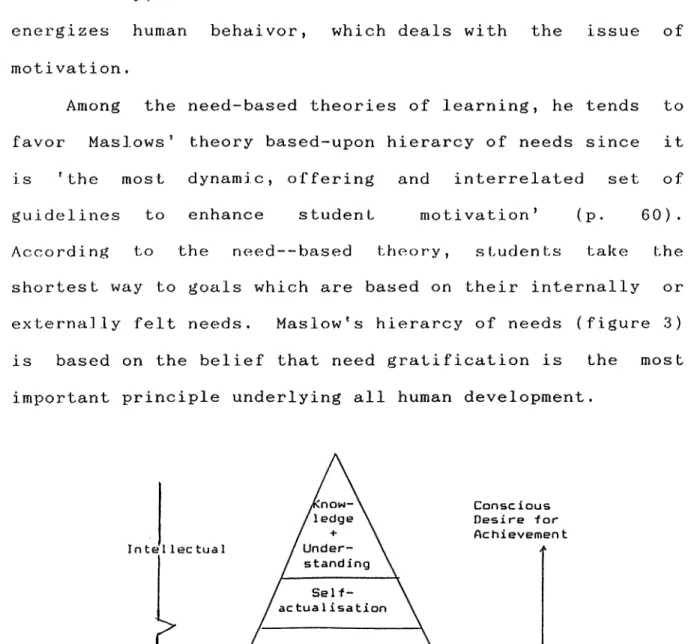
Among the need-based theories of learning, he tends to
favor Maslows’ theory based-upon hierarcy of needs since it
is ^the most dynamic, offering and interrelated set of
guidelines to enhance student motivation’ (p. 60).
According to the need--based theory, students take the
shortest way to goals which are based on their internally or
externally felt needs. Maslow's hierarcy of needs (figure 3)
is based on the belief that need gratification is the most
important principle underlying all human development.
Figure 3: Maslow's hierarchy of needs
The principle is that when needs are met at one level,
the next higher order of needs becomes predominant in
influencing human behavior. If a lower need is not
fulfilled, the next need higher can never influence the
person’s behavior.
There are five basic needs put in hier¿irchical order in
Maslow’s motivation pyramid. These basic needs are as
follows:
Physiological: needs for food, water, air, activity and
sensory satisfaction
Safety: needs for security, protection, freedom from
fear, anxiety and chaos
Belongingness and love: needs for finding a place in a
group, developing one’s own sense of identity
Self-Esteem: desire for achievement, adequacy,
confidence and independence, desire for
reputation
Self-actualizing: needs for self fulfillment, tendency
to become ac(,ualized, realization of one’s own
unique caipabi 1 ities , achievement of goals,
seeing one’s life as making sense in a
satisfying way (Stevick. 1976, 50).
HIGHEST LOWEST SELF-ACTUALIZING NEEDS (G) ESTEEM NEEDS (D) LOVE NEEDS (D) SAFETY NEEDS (D) PHYSIOLOGICAL NEEDS (D)
Wlodkowski (1989) basically dévidés needs into
deficiency and growth. Figure 4 illustrates which are
deficiency and wliich are growth needs. He nieriLions three
ways by which deficiency needs differ from growth needs.
1. People try to get rid of deficiency needs and satisfy
them to avoid problems. Satisfaction of growth needs
produces health, and leads to pleasure and desire for
further fulfillment. Passing a test meets a deficiency need
but creating a poem meets a growth need.
2. Deficit needs tend to be selfishly centered and
dependent on others for fulfillment. Growth needs tend to be
self directed and based on personal standards.
3. Learning from deficient needs tends to be
extrinsically rewarding while learning from growth needs
tends to be intrinsically rewarding. In the former, the
student is dependent on teacher approval, grades, test scores for a sense of satisfaction. In the latter, the student feels satisfied with what he learns.
As is seen from figure 3, human needs are given in
order of importance and in relation to each other, which
emphasizes that satisfaction of a lower level need is
perequisite for satisfaction of a higher level need. The
highest level can be reached on condition that all lower
level needs are satisfactorily met. If the motivation
pyramid is interpreted in terms of language learning, the highest level - knowledge and understanding- can be attained when all the lower levels of needs are fulfilled.
There is no doubt that a learner’s behavior can be
explained by inferring a need for the goal. If learning a
language, say, is the need, then the goal is to try to
satisfy that need, which requii-es the student’s effort to
reach it.
If the ultimate choice is made by the student, then what
teachers should do seems to be a real question. Maslow
implies that the answer is in what the environment (parents,
teachers, therapists) should do. Wlodkowski uses Maslow’s
approach to explain what should be the job of teachers in the process of language learning.
The teacher’s goal is, when arranging learning
opportunities, to increase the safety and attractiveness of
those choices that allow student growth as well as to
decrease Lhe safely and ci 11 гас Li veness of Lhose choices Lhat
prohibit student growth. Figure 5 illustrates that process.
ENHANCE THE DANGERS
Safety -< PERSON > MIMINMIZE THE ATTRACTIONS ENHANCE THE ATTRACTIONS Growth MINIMIZE THE DANGERS
Thus, the environment (parents, teachers) can
1. gratify the learner’s basic needs for safety,
belongingness, love and respect so that he can feel
unthreatened, autonomus, interested and spontaneuos for
choosing the unknown.
2. help by making the growth choice positively
attractive and less dangerous, and by making the regressive
choice less attractive and more costly.
The two types of strategy to be followed are to select
the content of the subject relevant to a specific need, and
to present it using an appropriate approach to learning in
such a way as to enhance motivation with respect to that
specific need.
McDonough (1989), however, finds the need-based theory
insufficient giving two reasons why the theory is of no
importance in human motivation. The first reason he mentions
is that drive to act is reduced when the need is reduced, so giving rewards reduces learning instead of increasing it. He adds that
although human learners often have well defined aims and objectives, the satisfaction of homeos tatic needs (air, water, food and constant body temperature) is irrelevant to them (p.l50).
He goes on to say that learning part of a language may
increase motivational strength which may make the learner to
learn the rest. The second reason he puts forth is that
need-based theory sounds to be mechanical although the drive
results automatically from the needs requiring no
sophisticated set of values. He further claims that ' in
h u m a n s , t h e e f f o c I. o f n ri y row a r d o f Ic n o w 1 e (J g e of r o s u 1 L s is
dependent on values and perceptions rather than mechanistic
rocictions’ (p. 1.50).
A t t i t i l d e s
Attitudes are also major components regarding
motivation. Lambert and Gardner appear to be the most
consistent researchers in motivation in ESL settings with the
focus on attitudes in langaueg learning. They simply
classify attitudes as social attitudes towards the community
and the people who speak the target language, and the
attitudes toward the leaning situation. Thc-rir studies
carried out in French Canada regarding the attitudes of
English-speaking students learning French are of signifance
to some extent in language study since they study
motivational charecteristics in relation to attitude,
motivation and personality. McDonough (1989), referring to
the studies of Gardner and Lambert, states that achievement in the second language is related either to a desire to use the language in the context of the student’s own community, for business, or promotion, or simply to possess
a prestigious qualification; or to a desire to become accepted by, or even become a member of, the community that speaks the other language
(p. 157).
It is evident that motivation for language learning can
either be instrumental or integrative coming from within
oneself or from outside of the learner. Integrative and
instrumental motivation can be intrinsic and extrinsic
although Lambert and Gardner insist on the two Lypes of
motivation. Attitudes toward community affect learning of
the target language to a great extent, which may be related
to historical relationship between the countries. Attitudes
toward culture of the people who speak target language are
also important in both ESL and EFL settings since language
can not be separated from its culture.
Theories of motivation
Except for the need-related theory, there are other
Lheories regarding motivation. Chastain (1976), referring to
Weiner, lists four basic theories of motivation. They are as
fo]lows:
1. Associative theory, which postulates specific
responses connected to certain stimuli
2. Drive theory, which postulates drives triggered by a
need to correct some type of imbalance in the
organism.
3. Cognitive theory, which stresses purposive V)ehavior
based on р1гт8, cognitive drive, Jevel of
aspiraLion, need for achievemenL, and need Lo avoid failure.
4. Pscychoanalytic theory, which is a psychological
theory of motivation stressing internal processes (p. 73).
McDonough (1989) lists four theories including the drive theory as follows:
1. Attributive theory deals with the motivated behavior
in terms of cause to which the individuals attribute, or
ascribe, their own ability, effort, intention, or others’
at) 11 i l.y or i n ton t i on , 1 uck , and so on .
2. Achievement theory is based on the idea that the
learner appreciiites the value of success which is the
essentia] component of motivation.
3. Aspiration theory is focused on the assumption that
success raises the level of aspiration while failure
experienced previously lowers it.
CONCLUSION
As is seen from the lists of motivational theories of
learning, each of the theories is based on intrinsic or
extrinsic motives according to the originators’
considirations of value placed on them. The theories can be
of importance in the explanation of motivation type depending on the determinants of motivation involved in the situation.
It is, therefore, the teacher^s responsibility to
identify the types of motives of the students in order for
him/her to create environment for language study that both
the tecaher and the students can benefit from to the fullest
extent. This will in turn enable the teacher to be aware of
the psychological state of students for the sake of a
s t r e s s -free atmosphere that can never be ignored in language class.
CHAPTER 3
METHODOLOGY
Introduction
Our literature review not only established the fact that motivation plays a key role in the achievement of students in
their language study, but also revealed that there are
several types of motives for teachers to identify in order to develop appropriate instructional techniques.
With this idea in mind, I felt sure that identification
of motives for language study .at the Police Academy would he
be the first step in order to find a solution to the
motivation problem. The study was planned to identify
motives of the students through a questionnaire based on the literature review related to the topic.
Literature review and analysis
What I did was to find the published materials--books,
journals, periodicals and so forth--related to the topic to
provide the information necessary to develop a questionnaire.
Therefore, I went to the libraries avaliable in Ankara
including university libraries like Bilkent, the Metu, Gazi
and Hacettepe. In addition, USIS library, Turco--British Asso
were all surveyed in order to find the materials pertaining
to the related area.
It was of great use to consult the staff members of the
universities in Ankara, I, therefore, consulted some of them
about the steps in carrying out the research. The
suggestions given were all helpful. The earlier theses on
motivation guided me, to some extent,through the stages of
the study. They were all related to EFL settings in Turkish
universities. The studies carried out by Lambert and
Gardner were mainly in French Canadian settings and did not seem to apply to the EFL setting at the Police Academy since the motivation type, the incentives for, and the needs of the sudents might be completely different in Turkey from those of students in French Canada.
As the literature review progressed, it was interesting
to find out that the same concepts associated with the topic
were assigned different terms by different authors. The main
point that motivation is of two types, intrinsic to the learner or extrinsic, remained the same.
Developing and administering the questionnaire
Literature review anlysis provided the foundation for
developing a questionnaire to be administered at the Police
Academy.
The questionnaire was made up of four sections which are (a) self--report for the respondent's English ability, (b)
Likert scale type motive questions, (c) the importance of
different English skills and (d) beaching behaviors to be
ranked by the students in order of importance. Also included
were demographic data such as grade, academic background.
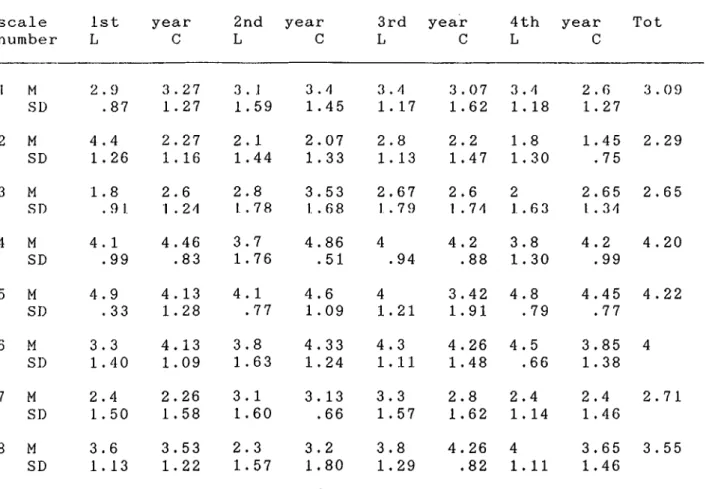
Since the questionnaire was rather long, the analyses of self--report regarding English ability and of the section for identification of motives, interests, attitudes and the needs
of the students were emphasized at the data analysis stage.
Also the relationship among the variables mentioned was
examined through statistical methods so as to come up with sound conclusion which, in turn, would help form the basis for recommendations.
I thought that it would be practical to administer the
questionnaire ( see Appendix B for original Turkish version
administered and Appendix A for English version) to a class during each academic year since the classes are comprised of
two different groups in terms of their backgrounds--lise
background and college background. So, the total number of
students, who the questionnaire was administered to, came to about 230.
The first and second year students are accommodated at
from the main campus at Anittepe where the third and fourth year students are accomodated.
I, therefore, felt that I had to ask a colleague to
adm i n i s 1.e r the q uos i on na i. r o I.o a f i r s I. y oa r ¿in(J a sooond
year cl ass al. Gol has i campus . T al so oxpl a i nod \.ho
instructions to him so that the students involved would have no trouble in understanding the instructions in order to give appropriate answers.
Judging by the answers the first and the second year
students gave to the items, i realized that they got the
instructions wrong. Therefore, I went to Golbasi campus and
explained the instructions to the students in each class. I
waited for all the students to finish answering the items,
and T made sure that I collected all the papers.
Before administering the questionnaire to the third and
fourth year students at the main campus, I explained the
instructions to the students in each class and made sure
that they understood the instructons absolutely in order not
to have any trouble in analyzing the data. I also waited
for the respondents to finish answering the items and
collected the papers. When I checked all the papers to see
if there was anything wrong with the responses, I found
nothing wrong.
Obtaining and presenting results
The process of obtaining and presenting results was
carried out in three steps:
1) Data processing and analysis"--counting/frequencies/ percentages/statistical analyses and tests.
2) Data presentation--tables/charts/texts
3) Data interpretation--conclusions/suggestions
During the data collection process it seemed logical to
administer the questionnaire to one of the classes from each grade level since classes within levels are formed in nearly the same way, having more or less the same features in terms of the backgrounds, age, and standing of the students.
Later on, after having examined the data by age, grade
level and academic background, I realized that there were no
age differences among the students of the same class and, age level went up in accordance with the academic year level.
One hundred cases comprised of 25 cases from each
grade including all lise graduates were selected at random
from 230 people that were tested reducing the sample to a
manageable size for purposes of analysis.
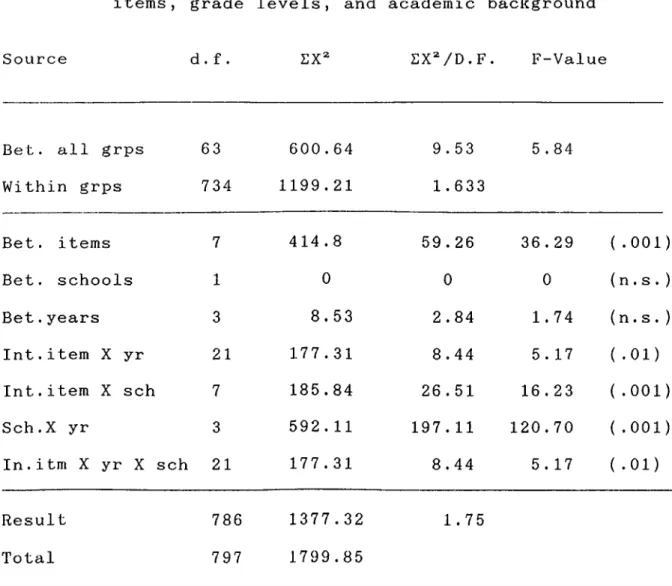
Statistical treatment of the data included checking
frequencies and percentages, as well as doing statistical
tests using the method of analysis of variance (ANOVA). The
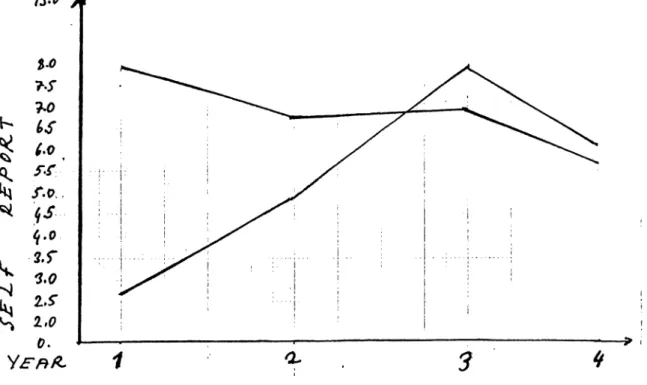
self--report results were correlated with the scores obtained from motivation questions.
The actual data aucilysis, results and interpretation are presented in the next chapter.
CHAI>'1’ER 4
PRESENTATION AND ANALYSIS OF THE DATA Introduction
This chapter presents the resull^s of the ques I, i.onnai re
study. The analyses and discussions which follow are
illuminating by what was found in the literature review. Presentation and analysis of the data
The analysis and discussions are presented in three
steps; (a) analysis of the motive questions, (b) analysis of
self report; and (c) the interrelation between motive
questions and self report.
Table 1: Numbers of Students for each Academic Year level by
Background and Age
Academic year Secondary School Background Age group T 0 t a 1 Lise College 18--20 21--23 I 10 42 49 3 52 II 12 45 42 15 57 III 12 48 6 54 60 IV 5 56 — 61 61 TOTAL: 39 191 97 133 230
Table 1 shows the numbers of students who responded from
all academic year levels. It is broken down to present the