ISSN-L: 2501 - 1235 Available on-line at: www.oapub.org/edu
doi: 10.5281/zenodo.896961 Volume 3 │ Issue 11 │ 2017
A SCRUTINY ON THE MORAL DECISION-MAKING ATTITUDES OF
THE YOUTH SPORTSPEOPLE IN COMBAT BRANCHES
Pepe Şirin1, Özsarı Arif2,
Pepe Hamdi3, Fişekçioğlu Bülent3, Pekel Aydıni4 1Erenkoy Zeki Altındag Secondary School, Physical Education and Sports Teacher, Turkey 2Osmaniye provincial directorate youth sports, Osmaniye, Turkey 3Faculty of Sports Science, Selcuk University, Konya, Turkey 4IstanbulGelişim University, School of Physical Education and Sports, Turkey
Abstract:
The objective of this study is to scrutinize the changes in the moral decision-making attitudes of the youth sportspeople in the branches of box, wrestling, karate, kickboxing, judo, and taekwondo. The population of the study is constituted by the youth sportspeople in Turkey and the sample group consists of 257 male and 135 female, totally 392, sportspeople doing sports in the youth setups of box, wrestling, karate, kickboxing, judo, and taekwondo in the province of Osmaniye. In acquiring the data, for demographic properties, a personal information form and, for moral decision-making attitudes, “Moral Decision-decision-making Attitudes Scale in Youth Sports” developed by Lee, Whitehead, and Ntoumanis (2007) and adapted to the Turkish culture and examined its test reliability by Gürpınar (2014a) were used. In our study where the level of significance was determined as 0,05, homogeneousness and variances of the data were determined by conducting a descriptive statistics operation; Kruskal Wallis, Man Whitney U tests were used in determining the changes between groups; and Tamhane’s T2 test was utilized to determine the source of the difference. In our study, no change in the moral decision-making attitudes of the youth sportspeople in combat branches in line with the factor of period of doing sports was observed, while it was determined that the factors of age, gender, branch, and parental education level are effective in the moral decision-making attitudes of sportspeople and that such effects cause statistically significant alterations (p<0. 05).
Keywords: combat sports, youth setup, morality, attitude 1. Introduction
Morality is a structure that contains concepts like rights, responsibilities, and wisdoms. The words like good or bad, right or wrong, and fair or unfair are shaped according to the moral structure (Arnnop et al., 2012; Ayala, 2010). Moral task is the complaince of a person with rules for himself/herself first and then for the counterparties (Sezen, 2003). The third meaning of morality in Turkish is “ethic” (Tepe, 1998). Ethics is perceived as the manner of distinguishing between right or wrong as the whole of the standards and principles that steer behaviors in all walks of life (Kaya, 2012). Sports ethics covers the duties and responsibilities of the supporters of a branch of sports, which play a significant part in the improvement of sports in general, and their performance of such duties and responsibilities in line with the universal values such as honesty, justice, openness, impartialness, and respect (Dolaşır, Tuncel, and Büyüköztürk, 2009)
Even though sports is a comprehensive contest performed to reach what is faster, stronger, and higher and at the same time, it is a game, race, and entertainment conducted through the universal principles and rules (Yetim, 2005). Sports entertain people and make them spend good time and there is the reality that it directs a person through his/her own will by means of the sportive obligations. Morality in sports starts at this point. Morality in sports is not the set of rules added to sports from outside; they are based on sports. Hence, the wisdoms acquired by means of morality in sports, which we refer to as the sportive wisdoms, stem from the phenomenon of sports (Öngel, 1997). According to Erdemli (2016), a sport is a special life and special morality. A sport is for humans; deterioration of morality in sports is not the deterioration of the sportive event but that of the person performing it. These two concepts have become integrated with each other; if you exclude one, the other will no longer be there (Erdemli, 2008). A sport is at the same time an instrument of moral development (Romance et al, 1986; Shields and Bredemeier, 1995).
A sport is divided into two as the individual sports and team sports. Individual sports are the sort of sports that can be performed personally and that usually bring contestants face to face one-by-one in general. A team sport is the general name of the sportive activity carried out as a team with multiple sportspeople (Kurtiç, 2006). In our country, the branches, with which the tendency toward combat sports is considered to be much, and which require individual combat are karate, judo, and taekwondo. In these branches, a sportsperson confronts an opponent and fights with him/her (Kayapınar et al., 2016). We can add box, wrestling, and kickboxing, whose audience
and participants are many, to such individual branches. Such fields of sports are considered by many parents as physical activities, discipline, and martial arts of self-defense for their children (Zetaruk et al., 2000).
The very first rules that sportspeople, just like any individual of a society, must obey in performing their professions, are the rules of morality. It will be in the manner of complying with the rules in sportive combats; being prudent in the case of both winning and losing; having the consciousness that a sportive event is a game, that it is performed for the sake of the sport itself, and that winning or losing has secondary importance; and behaving accordingly. Thus, sportive activities and sports education must endeavor to ensure not only the culmination of the psycho-motor movements of sportspeople but also their training toward contesting by adhering to moral values (Tanrıverdi, 2012). Sports education that starts at an early age ensures that success develops in line with the essence of sports. This way, a young one will work out knowing himself/herself and his/her limits and strength as well as what to do to improve them and render them competent and he/she will not overlook morality in sports for the sake of sportive success (Erdemli, 1996). As a sport is an area where moral development can take place, we can construct our character morally if we dedicate ourselves to sports (Austin, 2010).
3. Material and Methods 3.1. The Model of the Study
In this study, casual comparative study model was used.
3.2. The Study Group
The population of the study is constituted by the youth sportspeople in Turkey and the sample group consists of 257 male and 135 female, totally 392, sportspeople doing sports in the youth setups of box, wrestling, karate, kickboxing, judo, and taekwondo in the province of Osmaniye. In the selection of the study group, appropriate method of sampling was used and questionnaires were applied to sportspeople by way of their coaches.
3.3. Data Collection Tool
In the study, a questionnaire consisting of two sections has been used to collect data. In the first section, questions regarding the demographic properties (age, gender, family education status) of sportspeople are available. In the second section, the “Moral Decision-making Attitudes Scale in Youth Sports” developed by Lee, Whitehead, and
Ntoumanis (2007) was used to measure the moral decision-making attitudes of sportspeople. The adaptation of the scale to the Turkish culture and examination of its test reliability were conducted by Gürpınar (2014a). The scale is a five-level Likert-type scale with 9 articles and 3 sub-dimensions, scored between I strongly disagree (1) and I strongly agree (5). The sub-dimensions of the scale are constituted by adoption of cheating (articles 1, 5, 8), adoption of contest loving (articles 2, 4, 6), and maintaining fair victory (articles 3, 7, 9). 6 of the articles oriented to measure the moral decision-making attitudes have negative (1, 2, 4, 5, 6, 8) and 3 have positive (3, 7, 9) meanings. In scoring positive articles, “I strongly agree” is scored with “5” and “I strongly disagree” is scored with “1.” In scoring negative articles, “I strongly agree” is scored with “1” and “I strongly disagree” is scored with “5.” Articles numbered 1, 2, 4, 5, 6, and 8 are coded reversely. The high points received from the scale means that the moral decision-making attitudes of the sportspeople students are more positive and the low ones mean that they are negative.
3.4. Data Analysis
In the analysis of the data used in the study, SPSS (Statistical Package for Social Scientists for Windows Release 16. 0) program was used. The level of significance was evaluated upon 0,05. Homogeneousness and variances of the data were determined by conducting a descriptive statistics operation; Kruskal Wallis, Man Whitney U tests were used in determining the changes between groups; and Tamhane’s T2 test was utilized to determine the source of the difference.
4. Results and Discussion
The moral decision-making attitudes of the youth sportspeople in the combat branches, such as box, wrestling, karate, kickboxing, judo, and taekwondo were examined in terms of various variables in this study.
It is a reality that the things acquired by children and young ones interested in combat branches thanks to sports branches provide them with significant advantages compared with their peers. In terms of this reality, it is considered that the energies of the individuals in the developmental age must be converted into positive energy in appropriate channels by accurate timing. At this stage, sports morality comes into play. Minds and bodies kneaded with sports morality are a highly important acquisition for the future generations. In view of the possibility that the persons who lack sports morality can use their energy in negative things, the importance of the morality level in combat branches will be apparent.
In consideration of the fact that combat branches are performed individually and competition takes place against tens of people in a contest, it is a generally accepted view that placement in such branches is highly difficult. In addition, it is thought that in an environment in which the individual branches are performed one-on-one without the help of teammates, contrary to the team branches, sportspeople might try anything in order to win and that the fact that the mistakes made can be tolerated by the other members of the team while there is no such condition in combat branches creates the environments where the sportive moral rules can be violated.
Ability to obtain the efficiency expected from sports is possible through keeping up with the sports morality and its philosophical principles and rules that have reached the present times from the past. We can ensure it only through instilling the principles of sports and olympism to our children from early ages (Erdemli, 2002). Age is an important factor in the development of moral attributes. Understanding of morality of a young person will not be the same as that of a child or a mature person. From early childhood toward adulthood, there is a development stage regarding what is right or wrong and noticing what it means to be a good person (Clouse, 2000).
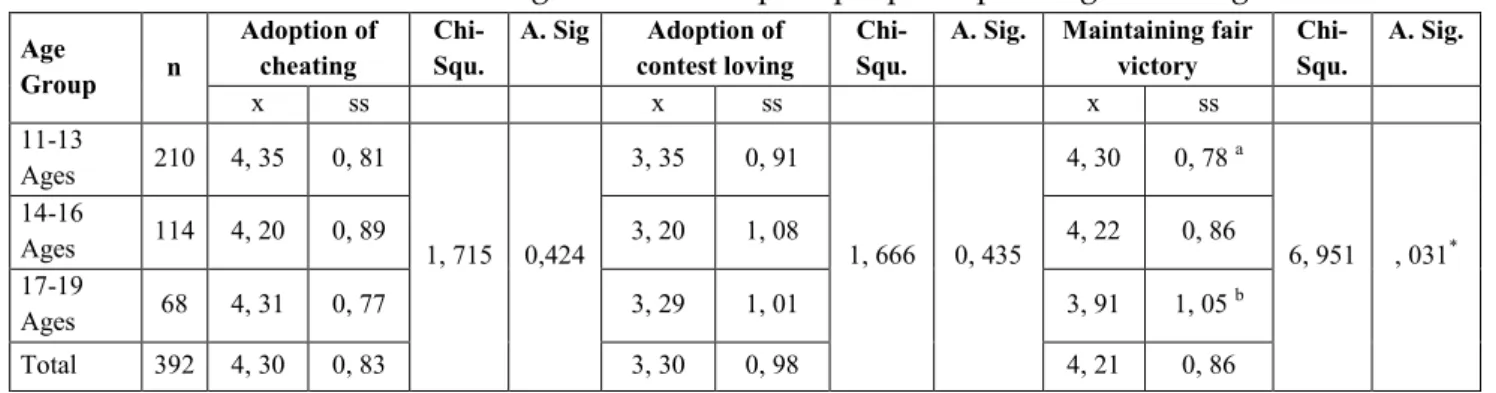
In our study, in terms of the age factor, no statistically significant difference was observed in the adoption of cheating and adoption of contest loving sub-dimensions while it was determined that in the adoption of cheating sub-dimension, 11-13 age group sportspeople averages were higher than the categories of 14-16 and 17-19 age groups. In the maintaining fair victory sub-dimension, the 11-13 age group sportspeople averages (4, 30 ± 0, 78) were found to be higher than the 17-19 age group averages (3, 91 ± 1, 05) and such change was determined to be statistically significant as well (p<0, 05; Table 1).
Moral attitude levels differentiate according to age (Avcı, 2010). Kaye and Ward (2010) express that the points of violating rules, which is adoption of cheating, were found higher in the sportspeople in the adults category (2, 20) than the sportspeople in the minors category (1, 93). Lee et al., (2007) specified that in the sportspeople in the 14- 16 age group, adoption of cheating and contest loving were significantly more than the sportspeople in 11-13 age group. According to the result of the study of Tsai and Fung (2005), tendency of the people with older ages toward being sportspeople is lower than that of the younger ones. Gürpınar and Kurşun determined that (2013) sportspeople with younger ages have lover sportspersonship scores. As it is seen, there are findings regarding moral attitude and behavior in the age variable dimension within the literature. It is considered that in the differences, the factors like social impacts, local culture, family and coach training style, and desire for succeeding are effective. In view of the findings of our study, determination of the adoption of cheating point averages of
sportspeople in younger age group makes us think that they were not sufficiently mature in a moral sense because of their lower ages. A response program that promotes moral reasoning for high school students by means of physical education was developed by Mouratidou et al (2007a) and a six-week moral development program, which was custom-made for them, was applied. A moral judgment test was applied prior and subsequent to training. It was determined at the end of the training that in the moral decision-making attitudes of students, there was a positive development. It is considered that the moral knowledge and experiences of our children and young ones taking part in sportive activities will increase also depending on the calendar age by means of accurate planning and moral education-training method. The most important point that must be remembered is that the sportive success targets affect the moral attitudes of sportspeople positively or negatively (Gonçalves et al., 2010).
Each sports branch has its own rules and unique characteristics. According to the findings obtained for the moral attitudes in the variable of branches of the combat sportspeople, there is no statistically significant difference in the adoption of cheating sub-dimension as per the branches of the sportspeople (p>0. 05), and, in the adoption of contest loving sub-dimension, the averages of the sportspeople in the taekwondo branch (3, 47 ± 0, 96) were found higher than the averages of the sportspeople in the kickboxing branch (3, 00 ± 0, 97) and such change was determined statistically significant (p<0. 05). In the adoption of contest loving sub-dimension, the point averages of the sportspeople in the taekwondo branch was higher than the point averages of the sportspeople in the wrestling, box, judo, and kickboxing branches, while they were lower than those of the sportspeople in the karate branch. The highest point average in the adoption of contest loving sub-dimension belonged to the sportspeople in the karate branch and the lowest point average took place in the sportspeople in the box branch. In the maintaining fair victory sub-dimension, the karate sportspeople averages (4, 97 ± 0, 10) were found to be higher than the other branch averages and such change was also determined statistically significant (p<0. 05; Table 2).
Combat branches can be the sports with contact. Gürpınar (2014) informs that the moral decision-making attitudes of the sportspeople students differed significantly according to the variable of the type of the sports, that the sportspeople performing sports without contact adopted cheating and contest loving less than the sportspeople performing sports with contact, and that they maintained fair winning more. Mouratidou et al (2007b) specify in their study regarding the sportspeople in the tennis, football, and handball branches that physical contact has a very important impact in the moral judgments of sportspeople, that the moral development scores of the sportspeople in the branches with low physical contact were higher, that the sports with
high physical contact levels are related with lower moral levels, and that the moral judgments of sportspeople vary according to the type of sports, the level of competition, and the level of participating in the sportive activities in a regular manner. In a study conducted by Gürpınar and Kurşun (2013), they determined that the sport personship points of basketball players were higher than and different from those of the football players significantly in the respect for rules and management sub-dimension. Professional football players consider the violation of rules as normal behaviors in higher proportions than amateur football players. They consider sports person like behaviors that do not comply with morality as smart tactics (Sezen, 2003). The results of the study of Lee et al (2007) show that the acceptance of cheating and contest loving is significantly more in the team sportspeople than individual sportspeople. Ramazanoğlu et al (2002) inform that people involved with taekwondo have lesser tendency of aggressiveness compared with football players. Tsai and Fung (2005) state that basketball players attach less importance to sports personship than volleyball players. In the point averages of the study performed by Ponseti et al (2012) in Spain, the ratio of adoption of cheating is significantly higher in basketball (2, 67) and handball players (2, 78) than football players (2, 25). In their study where they scrutinized the moral decision-making attitudes of the sportspeople in athletics and wrestling, Altın and Özsarı (2017) determined no statistical difference in the adoption of cheating and maintaining fair victory sub-dimensions depending on branch factor but they ascertained that in the adoption of contest loving sub-dimension, the sportspeople averages of the sportspeople involved with the wrestling branch were lower than the sportspeople involved with the athletics branch and that such change was statistically significant as well.
In the studies performed within the literature, different findings have been reached depending on the branch factor. It is considered that on the stage of evaluating the moral attitudes of sportspeople, evaluations must be performed without distinguishing them merely like with/without contact or personal -team sports, in the sports branches, but by considering unique characteristics of the branches as well as the factors like the culture where the sportspeople are trained, etc.
In the moral attitude behaviors of combat sportspeople, no statistically significant difference was observed in the moral decision-making attitude sub-dimensions depending on the sports personship period factor (p>0, 05; Table 3). The adoption of cheating point averages of the individuals with 1-2-year sports personship past are higher than the sportspeople with 3-4 and 7-year sports personship past. Depending on the period of sports personship factor, an intermittent decline in the point averages for adoption of cheating and an intermittent increase in the point
averages for maintaining contest loving and fair victory were observed. According to the findings of Gürpınar (2014b), the moral decision-making attitudes of the students doing sports differ according to the sports personship variable to a significant extent. The points received by the students doing sports from the adoption of cheating sub-dimension and adoption of contest loving sub-sub-dimension exhibited significant difference in favor of inexperienced sportspeople. In a study regarding the sportspeople in the kickboxing field, a result that aggressiveness reduces as longs as the number of the years of doing sports increases was obtained (Tekin et al, 2011). Gümüş et al (2014) determined in their study on the wrestling and muay-thai sportspeople that the points of aggressiveness of the individuals with 1-3 years of background are higher than those of the sportspeople with 6-7 years of background in the sport.
It is considered that an increase will take place in the moral maturity level of the individuals taking part in sportive activities as long as their past of doing sports increases. In the declaration at the end of the “Education through Sports” forum held in 2002, the fact that sports must remain as a tool that educates all people and that a sportive activity applied within the limits of the rules of ethics and fair play would enhance morality and physical strength was highlighted (Özbey and Güzel, 2009). Participation of children in regular physical activity has been related with cognitive processes, superior academic success, and aerobic suitability at higher level (Chaddock et al, 2012).
Parental education level has been determined to be effective on the social adaptation and skills of children (Sarı, 2007). Participation in sports in the childhood ages in terms of the education level of families is in parallel with the dimension of knowledge and consciousness of parents about physical activity and sportive activities (Dinç et al, 2011).
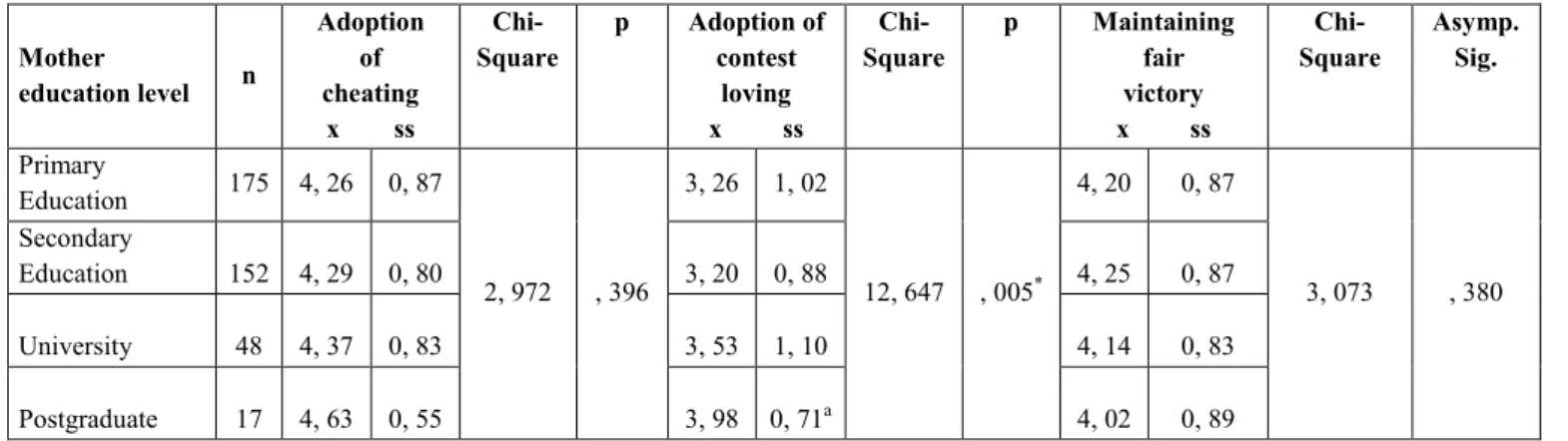
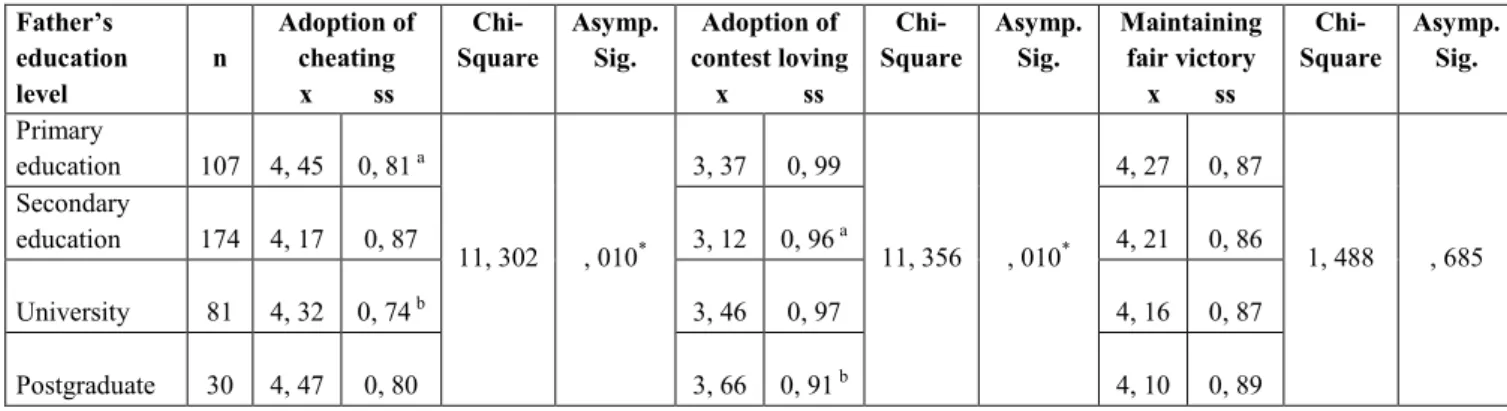
According to the findings of our study, in the mother education level factor, no statistical difference was observed in the adoption of cheating and maintaining fair victory dimensions, while it was found higher in the adoption of contest loving sub-dimension than postgraduate education level averages (3, 98 ± 0, 71), primary education averages (3, 26 ± 1, 02), and secondary education averages (3, 20 ± 0, 88) and such change was determined to be statistically significant (p<0. 05; Table 4). In the maintaining fair victory dimension, in the father education level factor, no statistical difference was observed while primary education level averages (4, 45 ± 0, 81) were found higher than the university averages (4, 32 ± 0, 74) in the adoption of cheating sub-dimension, and such change was determined to be statistically significant (p<0. 05). When it comes to the adoption of contest loving sub-dimension, the secondary education level averages (3, 12 ± 0, 96) were found lower than the university graduate
averages (3, 66 ± 0, 91) and such change was determined to be statistically significant (p<0. 05; Table 5).
Parental education levels are deemed one of the important factors in the moral decision-making attitudes of sportspeople. According to Demirtaş (2001), low education levels of mothers affect the self-care skills of children negatively. It is possible to state that the parental education level is effective in the social adaptation and social skills of children; that, when the relations between mothers and children are positive, the moral knowledge and understanding of children, and their moral behaviors accordingly, develop positively; and that the attitudes of the father are effective on the understandings of children about social rules (Özyürek and Şahin, 2015). Parental attitudes are one of the most important factors that affect the moral maturity levels of people (Ishak et al., 2012; Şengün, 2013). As highlighted in the literature, as long as the level of education increases, the level of participating in physical activity would increase (Arabacı, 2010). Considering that the initial foundations of morality of the students doing sports are laid within the family, high importance of the parental education level will be perceived better. Sportspeople are taught to reflect the moral education received in their family to the fields of sports together with the discipline brought along by their branches.
In view of the findings obtained regarding the moral attitude behaviors of combat sportspeople among the gender groups, the average of the females (4. 40 ± 0, 76) within the adoption of cheating sub-dimension was found higher than males (4. 23 ± 0, 87). In the maintaining fair victory sub-dimension, the point averages of males (4. 22 ± 0, 88) are higher than the females (4. 18 ± 0, 85); however, no statistically significant difference was found in terms of adoption of cheating and maintaining fair victory points (p>0, 05), while the point average of female sportspeople (3, 63 ± 0, 90) was found higher than the male sportspeople’s point average (3, 08 ± 0, 97) in the adoption of contest loving sub-dimension and statistically significant difference was determined (p<0. 05; Table 6).
According to the result of their study on the male and female basketball players, Ponseti et al (2016) inform that there are similarities in the acknowledgment of cheating dimension in both genders but the acknowledgment of cheating points of the females are higher than those of the males. Kavussanu and Roberts (2001) comment in view of the results of their study conducted on the college basketball players on the fact that in attaining their success targets, male sportspeople exhibit behaviors that do not comply with morality and sportspersonship at lower levels than female sportspeople. Tucker and Parks (2001) inform that the aggressive behavior points of females are lower than males. It is shown in the study conducted by Gürpınar (2014b), moral decision-making
attitudes of males exhibit a significant difference according to the gender variable. It was observed that the points of the sportspeople students they received from the sub-dimensions of adoption of cheating, adoption of contest loving, and maintaining fair victory presented a significant difference in favor of females. It was determined that females adopted cheating and contest loving to a lesser extent and that they maintained fair victory more than males. Sezer et al (2015) inform that the students doing sports and taking part in sportive activities exhibit significant differences in terms of avoiding inappropriate behaviors. According to the study, the point averages of the females were determined to be higher than the point averages of males. Tsai and Fung (2005) provide that male players attach less importance to sportsmanship than female players. Akandere et al (2009) specify that the moral judgment levels of the female students doing sports are higher than those of the males. According to the findings presented by Lee et al (2007), the level of moral decision-making attitudes of male sportspeople was higher than females. Mouratidou (2016) informs that gender of players does not have a significant impact on moral decisions.
The different results of the studies conducted in the field of sports demonstrate that it is difficult to reach a definite judgment in the gender variable in the case of moral decision-making of sportspeople. A question might come to mind at this point: “Are these results unique only to the field of sports?” According to the results of the study on the moral decision-making attitudes in view of the gender variable within the field of social sciences, attended by university students, the moral maturity point averages of the female students were found higher than the point averages of males (Kaya and Aydın, 2011). Cesur and Küyel (2010) determined at the end of their study examining the moral judgments of university students that the moral evaluation levels of the young ones do not differ according to gender. Şengün (2008) states that in his study on high school students, moral maturity point averages of female students were higher than male ones. Aydın (2011) showed that the level of moral judgment does not present a significant difference in terms of gender. In the study where the moral maturity levels of prospective teachers were examined, gender variable did not create a significant difference on the moral maturity level (Çekin, 2013).
In view of the results of the studies conducted within the field of social sciences, it appears that reaching a definitive judgment in the gender variable in moral decision-making is difficult. In sports, it is difficult to develop an equally-accepted definition of moral behavior; definitions vary in line with functionalizing, construal of moral behavior, origin of participants, and their viewpoint (Lucidi et al., 2017). In general, various demographic properties and the perceptions regarding sports must be taken into account when interpreting the morality profile of people (Mouratidou, 2016).
5. Conclusion
As a result, it is possible to reach a conclusion that in the moral decision-making attitudes of the youth sportspeople within the combat branches, such as box, wrestling, karate, kickboxing, judo, and taekwondo, the factor of the period of acting as a sportsperson is not significantly effective, while the factors of age, branch, parental education level, and gender are significantly important in sportspeople’s moral decision-making attitudes. It is considered that the variability of the sports branches, competition, desire of winning, fear of losing, and, most importantly, the moral structure of sportspeople can be effective in their decision-making attitudes. It must be remembered that when training youth sportspeople physically in line with their branches, their cultural education must not be neglected and that it is necessary to instill to sportspeople by the families in particular and then the trainers that losing or winning is in the nature of sports and honorable losing is superior to a dishonorable victory. Construction of individual and social moral structure on accurate foundations is an indispensable fact for a sensitive generation with conscience.
The findings obtained through this study are of course limited with the sampling properties of participants, the conditions upbringing of them, and their socio-cultural characteristics. We think that, despite the limitations, the results obtained will provide significant contributions to the sports scientists, trainers, parents, and sports executives and that similar studies will contribute to the development and maturity of a moral structure.
About the Author(s)
Şirin Pepe was born in 14.08.1979 in Kütahya. He completed his primary school and
high school in Kütahya. He was graduated from Kütahya Dumlupınar Üniversity, Physical education Sport department in 2001. He is working as a physical education teacher. He started to work as a teacher in 2007. He completed his master degree in Selçuk University and he completed his doctora degree in Erciyes University in 2016. He is still physical education and sports Teacher in Konya. Correspondence: Beyhekim Mah. Kılıçarslan cad. Houses of the judiciary 61/8 Selçuklu Konya, Türkiye email
Bülent Fişekçioğlu was born in 1959 in Ankara. He completed his primary school and
high school in Konya. He was graduated from Manisa Sport Academy in 1982. He worked as a physical education teacher. He started to work in Selcuk University as a lecturer in 1989. He completed his master degree in Selcuk University and he completed his doctora degree in Marmara University. He became a associate professor in 2013. He
is still head of sport management department in department of sport science faculty in Selcuk University
Aydın Pekel was born in Kayseri in 1984.He had his bachelor's and master's degree
from Erciyes University, School of Physical Education and Sports. He is continuing his Ph.D. studies in Muğla Sıtkı Koçman University, Physical Education, and Sports Division. He continues his academic life at Istanbul University of Physical Education and Sports.
7. References
1. Akandere M, Baştuğ G, Akdoğan Z, 2009. Erkek maratoncularda sosyal çevre ve ekonomik durumun spora yönelmeye etkisi. Selçuk University Social Sciences Institute Journal 22: 459-466.
2. Altın M, Özsarı A, 2017. Sporcu eğitim merkezlerinde yatılı olarak eğitim gören sporcuların ahlaki karar alma tutumları. International Cultural and Social Studies Journal 3(1): 133-145.
3. Arabacı R, 2010. Ambulatory activities in Turkish adults without exercise habits. Turkey’s Clinics J Med.Sci 30 (3): 985-994.
4. Arnnop PP, Dhanuthai K, Hemprich A, Pausch CN, 2012. Morality, ethics, norm sandresearchmisconduct. Journal of Conservative Dentistry, 15(1): 92–93.
5. Austin MW, 2010. Sport and moral development.
www.psychologytoday.com/blog/ethics-everyone/201006/sports-and-moral-development.
6. Ayala JF, 2010. The difference of being human: morality. Proceedings of the National Academy of Science 107(2): 9015-9022.
7. Aydın Z, 2011. Üniversite öğrencilerinin empati becerileri, kişilik özellikleri ve anneden algıladıkları çocuk yetiştirme stilleri ile ahlaki muhakeme düzeyleri arasındaki ilişkilerin incelenmesi. Unpublished Post-graduation Thesis, Istanbul University, Social Sciences Institute.
8. Avcı A, 2010. Eğitimde şiddet olgusu- lise öğrencilerinde şiddet, saldırganlık ve ahlaki tutum ilişkisi (Küçükçekmece İlçesi Örneği). Unpublished PhD Thesis, Marmara University, Social Sciences Institute, Istanbul.
9. Cesur S, Küyel N, 2010. Ebeveyn tutumları ve gençlerin ahlaki muhakeme ve ahlaki yönelimleri arasındaki ilişkiler. Psychology Studies Journal 29: 65-91. 10. Clouse B, 2000. Ergenlerde ahlâk gelişimi ve cinsellik. (Translated by Turgay
11. Çekin A, 2013. Öğretmen adaylarının ahlaki olgunluk düzeyleri. Kastamonu Education Journal, 21 (3): 1035-1048.
12. Demirtaş K, 2001. Annelerin değerlendirmesine gore çocukların özbakım becerileri ile anne tutumları arasındaki ilişki. Unpublished Post-graduation Thesis. Marmara University, Education Sciences Institute.
13. Dinç F Z, Sevimli D, Uluöz E, 2011. Ailelerin çocuklarını spor ve fiziksel
aktiviteye yönlendirmelerine ilişkin görüşleri. Sport Sciences, 6(2),93-102.
14. Dolaşır Tuncel, Büyüköztürk Ş, 2009. Antrenörlerin mesleki etik ilkeleri nelerdir? Nasıl ölçülür? Ölçek geliştirme: Ölçeğin geçerlik ve güvenirliği. Spormetre Physical Training and Sports Sciences Journal 7(4): 159-168.
15. Erdemli A, 1996. İnsan, Spor ve Olimpizm. Sarmal Publishing House, Istanbul. 16. Erdemli A, 2002. Temel Sorunlarıyla Spor Felsefesi. E Publications, Istanbul. 17. Erdemli A, 2008. Spor Yapan İnsan. E Publications, Istanbul.
18. Erdemli A, 2016. Temel Sorunlarıyla Spor Felsefesi. E Publications, Istanbul. 19. Gürpınar B, Kurşun S, 2013. Basketbolcuların ve futbolcuların sportmenlik
yönelimleri. Mediterranean Journal ofHumanities 3(1): 171-176.
20. Gürpınar B, 2014. Altyapı sporlarında ahlaki karar alma tutumları ölçeğinin Türk kültürüne uyarlanması: Bir Türk örnekleminde geçerlik ve güvenirlik çalışması. Education and Science Journal 39(176): 405-412.
21. Gürpınar B, 2014. Cinsiyet, eğitim seviyesi ve spora ait değişkenler açısından ortaokul ve lise’de okuyan sporcu öğrencilerin ahlaki karar alma tutumları. Education and Science Journal, 39(176): 413-424.
22. Gümüş H, Yetim A, Tortop Y, Işık Ö, 2014. Bireyse temas gerektiren mücadele sporlarından muay-thai ve güreş sporcularının saldırganlık davranışlarının çeşitli değişkenler açısından değerlendirilmesi. Sportive Health and Medicine Sciences Journal, 12(4): 1-13.
23. Gonçalves EC, Silva M, Cruz J, Torregrosa M, Cumming, PS, 2010. The effect of achievement goals on moral attitudes in young athletes. Journal of Sports Science and Medicine 9: 605 – 611.
24. Ishak Z, Low FS, Lau LP, 2012. Parenting style as a moderator for students’ Academic achievement. Journal of Science Educational Technology 21(4): 487– 493.
25. Kavussanu M, Roberts CG, 2001. Moral functioning in sport: an achievement goal perspectives. Human Kinetics Journals 23(1):37-54.
26. Kayapınar FÇ, Temür S, Akcan F, Temür M, 2016. Mücadele sporlarına ilişkin tutum ölçeği geliştirme çalışması. International Sports, Exercise and Practice Science Journal 2(2): 82-88.
27. Kaya M, Aydın, C, 2011. Üniversite öğrencilerinin dini inanç ile ahlaki olgunluk düzeyleri arasındaki ilişkinin incelenmesi. Ondokuz Mayıs University Theology Faculty Journal 30: 15-42.
28. Kaya TC, 2012. Etik değerlerden sapmanın muhasebesi. Organization and Management Sciences Journal 4(2): 19-27.
29. Kaye MP, Ward KP, 2010. Participant-related differences in high school athlete’s moral behavior. Athletic Insight 12(1): 1-17.
30. Kurtiç N, 2006. Futbol seyircisini saldırganlığa iten psiko-sosyal nedenler (Sakarya ili Örneği). Unpublished Post-graduation Thesis. Sakarya University, Social Sciences Institute. Sakarya.
31. Romance TJ, Weiss MR, Bockoven J, 1986. A program to promote moral development through elementary school physical education. Journal of Teaching in Physical Education 5(2): 126-136.
32. Lucidi F, Zelli A, Mallia L, Nicolais G, Lazuras LN, Hagger MS, 2017. Moral attitudes predict cheating and gamesmanship behaviors among competitive tennis players. Movement Science and Sport Psychology, 8,1-11.
33. Lee MJ, Whitehead J, Ntoumanis N, 2007. Development of the attitudes to moral decision-making in youth sport questionnaire (AMDYSQ). Psychology of Sport and Exercise, 8(3), 369-392.
34. Mouratidou K, Goutza S, Chatzopoulos D, 2007. Physical education and moral development: an intervention program metopromote moral reasoning through physical education in high school students. European Physical Education Review, 13(1), 41-56.
35. Mouratidou K, Chatzopoulos D, Karamavrou S, 2007. Moral development in sport context: utopia or reality. Hellenic Journal of Psychology 4: 163-184
36. Mouratidou K, 2016. Determinants of athletes’ moral competence: the role of demographic characteristics and sport-related perception. Sport in Society, 20(7), 802-815.
37. Öngel HB, 1997. Sporda etik değerler açısından doping. Gazi University Physical Training and Sport Sciences Journal 2(2): 73.
38. Özbey S, Güzel P, 2009. Uzun dönemli olimpik eğitim programlarının incelenmesi. Hacettepe J. of Sport Sciences 20(4), 117–131.
39. Özyürek A, Şahin FT, 2015. Anne-çocuk ilişkisinin ve baba tutumlarının çocukların ahlâki ve sosyal kural anlayışları üzerine etkisi. Education and Science Journal 40(177): 161-174.
40. Sarı E, 2007. Anasınıfına devam eden 5-6 yaş grubu çocukların, annelerinin çocuk yetiştirme tutumlarının, çocuğun sosyal uyum ve becerilerine etkisinin
incelenmesi. Unpublished Post-graduation Thesis, Gazi University, Education Sciences Institute, Ankara.
41. Sezer U, Ektirici A, Özbal FA, Atlı K, 2015. Ortaokul öğrencilerinin beden eğitimi ve spor dersi sportmenlik davranışlarının çeşitli değişkenler açısından değerlendirilmesi. International Sports Sciences Journal, 1(1): 41-52.
42. Sezen G, 2003. Profesyonel ve amatör futbolcuların fairplay anlayışları üzerine bir çalışma. Unpublished Post-graduation Thesis, Gazi University, Health Sciences Institute, Ankara.
43. Shields, D.L.L., Bredemeier, B.J.L. 1995. Character development and physical activity. Champaign, IL: Human Kinetics Publishers. England.
44. Şengün M, 2008. Lise öğrencilerinin ahlaki olgunluk düzeylerinin bazı kişisel değişkenler açısından incelenmesi. PhD Thesis, OndokuzMayıs University, Social Sciences Institute, Samsun.
45. Şengün M, 2013. Anne-baba tutumuna gore lise öğrencilerinin ahlâki olgunluk düzeyleri. Hitit University Theology Faculty Journal 12(23): 203-215.
46. Ponseti, F. J.,Palou, P., Borràs, P. A., Vidal, J., Cantallops, J., Ortega, F., Boixados, M., Sousa, C., Garcia-Calvo, T. and Garcia-Mas, A. (2012). El Cuestionario de Disposición al Engaño en el Deporte (CDED): su aplicación a jóvenes deportistas. Revista de Psicología del Deporte, 21(1), 75-80.
47. Ponseti, F.J., Cantallops, J., Muntaner-Mas A. 2016. Fair play, cheating and gamesmanship in young basketball teams. Journal of Physical Education &Health 5(8): 29-33.
48. Tanrıverdi H, 2012. Spor ahlakı ve şiddet. The Journal of Academic Social Science Studies. 58: 1071-1093.
49. Tekin A, Tekin G, Eliöz M, 2011. Kick-boksörlerin çeşitli değişkenlere gore öfke ve saldırganlık düzeylerinin araştırılması. Turkish Kickboxing Federation Sports Sciences Journal 4(1): 34-48.
50. Tepe H, 1998. Bir felsefe dalı olarak etik. East-West Thinking Journal 1(4):9-24. 51. Tsai, E., & Fung, L. (2005). Sportspersonship in youth basketball and volleyball
players. Athletic Insight, 7(2), 37-46.
52. Tucker LW, Parks JB, 2001. Effects of gender and sport type on intercollegiate athletes’ perceptions of the legitimacy of aggressive behaviors in sport. Sociology of Sport Journal 18(4): 403-413.
53. Yetim A, 2005. Sosyoloji ve Spor. Morpa Culture Publications, Istanbul.
54. Zetaruk, M. N., Violan, M. A., Zurakowski, D., & Micheli, L. J. (2000). Karate Injuries in children and adolescents. Accident Analysis and Prevention. 32, 421- 425.
Figures and Tables
Table 1: Moral Decision-making Attitudes of Sportspeople depending on the Age Factor
Age Group n Adoption of cheating Chi-Squ. A. Sig Adoption of contest loving Chi-Squ.
A. Sig. Maintaining fair victory Chi-Squ. A. Sig. x ss x ss x ss 11-13 Ages 210 4, 35 0, 81 1, 715 0,424 3, 35 0, 91 1, 666 0, 435 4, 30 0, 78 a 6, 951 , 031* 14-16 Ages 114 4, 20 0, 89 3, 20 1, 08 4, 22 0, 86 17-19 Ages 68 4, 31 0, 77 3, 29 1, 01 3, 91 1, 05 b Total 392 4, 30 0, 83 3, 30 0, 98 4, 21 0, 86 *, ab = Significant difference between groups.
As can be seen in Table 1, in terms of the age factor, no statistically significant difference was observed in the adoption of cheating and adoption of contest loving sub-dimensions while it was determined that in the maintaining fair victory sub-dimension, the 11-13 age group sportspeople averages (4, 30 ± 0, 78) were found to be higher than the 17-19 age group averages (3, 91 ± 1, 05) and such change was determined to be statistically significant as well (p<0, 05).
Table 2: Moral Decision-making Attitudes of Sportspeople According to the Branch Factor
Branch n Adoption of cheating Chi-Squ. A. Sig. Adoption of contest loving Chi-Squ. A. Sig. Maintaining fair victory Chi-Squ. A. Sig. x ss x ss x ss Wrestling 65 4, 45 0, 78 7, 085 0, 214 3, 14 0, 96 19, 375 ,002 4, 30 0, 92 28, 814 , 000* Taekwondo 170 4, 25 0, 84 3, 47 0, 96 a 4, 09 0, 93 Box 21 4, 03 1, 13 2, 89 0, 98 3, 86 1, 04 Karate 19 4, 58 0, 61 3, 65 0, 83 4, 97 0, 10 a Judo 50 4, 24 0, 88 3, 37 1, 00 4, 27 0, 69 Kickboxing 67 4, 33 0, 73 3, 00 0, 97 b 4, 26 0, 66
*, ab = Significant difference between groups
As it would be understood from Table 2, according to the findings obtained, there is no statistically significant difference in the adoption of cheating sub-dimension as per the branches of the sportspeople (p>0. 05), and, in the adoption of contest loving sub-dimension, the averages of the sportspeople in the taekwondo branch (3, 47 ± 0, 96) were found higher than the averages of the sportspeople in the kickboxing branch (3, 00 ± 0, 97) and such change was determined statistically significant (p<0. 05). In the adoption of contest loving sub-dimension, the point averages of the sportspeople in the taekwondo branch was higher than the point averages of the sportspeople in the wrestling, box, judo, and kickboxing branches, while they were lower than those of the sportspeople in the karate branch. The highest point average in the adoption of contest
loving sub-dimension belonged to the sportspeople in the karate branch and the lowest point average took place in the sportspeople in the box branch. In the maintaining fair victory sub-dimension, the karate sportspeople averages (4, 97 ± 0, 10) were found to be higher than the other branch averages and such change was also determined statistically significant (p<0. 05).
Table 3: Moral Decision-making Attitudes of Sportspeople according to the
Period of being Sportspeople Factor
Period of being Sportspeople n Adoption of cheating x ss Chi-Square Asymp. Sig. Adoption of contest loving x ss Chi-Square Asymp. Sig. Maintaining fair victory x ss Chi-Square Asymp. Sig. 1 - 2 Years 224 4, 34 0, 82 2, 901 0, 407 3, 34 0, 93 1, 727 0, 631 4, 30 0, 80 6, 343 0, 096 3 - 4 Years 101 4, 20 0, 87 3, 22 1, 05 4, 06 0, 89 5 - 6 Years 40 4, 36 0, 72 3, 22 1, 07 4, 08 0, 91 7 Years and above 27 4, 20 0, 87 3, 41 1, 01 4, 16 1, 12
As seen in Table 3, in the moral attitude behaviors of sportspeople, no statistically significant difference was observed in the entire moral decision-making attitude sub-dimensions depending on the sports personship period factor (p>0, 05).
Table 4: Moral Decision-making Attitudes of Sportspeople according to the
Mother’s Education Level Factor
Mother education level n Adoption of cheating x ss Chi-Square p Adoption of contest loving x ss Chi-Square p Maintaining fair victory x ss Chi-Square Asymp. Sig. Primary Education 175 4, 26 0, 87 2, 972 , 396 3, 26 1, 02 12, 647 , 005* 4, 20 0, 87 3, 073 , 380 Secondary Education 152 4, 29 0, 80 3, 20 0, 88 4, 25 0, 87 University 48 4, 37 0, 83 3, 53 1, 10 4, 14 0, 83 Postgraduate 17 4, 63 0, 55 3, 98 0, 71a 4, 02 0, 89 *, ab = Significant difference between groups
As seen in Table 4, in the mother education level factor, no statistical difference was observed in the adoption of cheating and maintaining fair victory dimensions, while it was found higher in the adoption of contest loving sub-dimension than postgraduate education level averages (3, 98 ± 0, 71), primary education averages (3, 26 ± 1, 02), and secondary education averages (3, 20 ± 0, 88) and such change was determined to be statistically significant (p<0. 05).
Table 5: Moral Decision-making Attitudes of Sportspeople according to the
Father's Education Level Factor Father’s education level n Adoption of cheating x ss Chi-Square Asymp. Sig. Adoption of contest loving x ss Chi-Square Asymp. Sig. Maintaining fair victory x ss Chi-Square Asymp. Sig. Primary education 107 4, 45 0, 81 a 11, 302 , 010* 3, 37 0, 99 11, 356 , 010* 4, 27 0, 87 1, 488 , 685 Secondary education 174 4, 17 0, 87 3, 12 0, 96 a 4, 21 0, 86 University 81 4, 32 0, 74 b 3, 46 0, 97 4, 16 0, 87 Postgraduate 30 4, 47 0, 80 3, 66 0, 91 b 4, 10 0, 89 *, ab = Significant difference between groups.
In Table 5, in the maintaining fair victory dimension, in the father education level factor, no statistical difference was observed while primary education level averages (4, 45 ± 0, 81) were found higher than the university averages (4, 32 ± 0, 74) in the adoption of cheating sub-dimension, and such change was determined to be statistically significant (p<0. 05). When it comes to the adoption of contest loving sub-dimension, the secondary education level averages (3, 12 ± 0, 96) were found lower than the university graduate averages (3, 66 ± 0, 91) and such change was determined to be statistically significant (p<0. 05).
Table 6: Moral Decision-making Attitudes of Sportspeople according to the Gender Factor
Gender n Adoption of cheating x ss Z A. Sig. Adoption of contest loving x ss Z A. Sig. Maintaining fair victory x ss Z A. Sig. Female 155 4, 40 0, 76 -1, 82 0, 069 3, 63 , 90 a -5, 404 , 000* 4, 18 0, 85 -0, 513 0, 608 Male 237 4, 23 0, 87 3, 08 , 97 b 4, 22 0, 88
As seen in Table 6, no statistically significant difference was found in terms of adoption of cheating and maintaining fair victory points (p>0, 05), while the point average of female sportspeople was calculated as 3, 63 ± 0, 90 and that of the male sportspeople as 3, 08 ± 0, 97 in the adoption of contest loving sub-dimension and statistically significant difference was determined between the females and males in the adoption of contest loving sub-dimension (p<0. 05).
Creative Commons licensing terms
Authors will retain the copyright of their published articles agreeing that a Creative Commons Attribution 4.0 International License (CC BY 4.0) terms will be applied to their work. Under the terms of this license, no permission is required from the author(s) or publisher for members of the community to copy, distribute, transmit or adapt the article content, providing a proper, prominent and unambiguous attribution to the authors in a manner that makes clear that the materials are being reused under permission of a Creative Commons License. Views, opinions and conclusions expressed in this research article are views, opinions and conclusions of the author(s). Open Access Publishing Group and European Journal of Physical Education and Sport Science shall not be responsible or answerable for any loss, damage or liability caused in relation to/arising out of conflict of interests, copyright violations and inappropriate or inaccurate use of any kind content related or integrated on the research work. All the published works are meeting the Open Access Publishing requirements and can be freely accessed, shared, modified, distributed and used in educational, commercial and non-commercial purposes under a Creative Commons attribution 4.0 International License (CC BY 4.0).